Today at a Campaign stop in Fredericton, New Brunswick Prime Minister Stephen Harper announced that if the Conservatives are re-elected, they would increase the number of Reserves in the Canadian Armed Forces from 24,000 to 30,000 within the next four years. That is almost a decade faster than the current Canadian Defense Strategy, which lists 2028 as the date for the Reserves to hit the 30,000 troop level.
The Prime Minister announced that a Conservative government would streamline the recruitment process for Reserves, and more to a more Central training system in Ontario and the Great Lakes region, so Reserves can train closer to home.
Such a surge will help increase the effectiveness of the Canadian Armed Forces, especially in response to Canada's Sovereignty needs, national emergencies (floods, and forest fires), and to help protect Canada's coastal and offshore waters.
In the 2011 Election the Conservatives took 8 of the 10 Seats in New Brunswick, and he is hoping to do just as well this time around. Canada's largest Eastern Military Base is CFB Gagetown located just outside of Fredericton.
To read the original CBC News Article: Stephen Harper Pledges Reserve Increase
Monday, August 17, 2015

Continue to Support for Air Task Force Iraq
You may know this already (perhaps because of this webpage) - but I am a strong supporter of the military. There have been recent calls for changes to Canada's contribution to the fight against ISIS. In Canada, our mission is titled, Operation IMPACT. The US led coalition name is Operation INHERENT RESOLVE. We need to continue to support Air Task Force Iraq (ATFI)
Those who call for changes say Canada has only contributed to approximately 3% of coalition air strikes. They argue that 3% of strikes will not hurt ISIS - and therefore, Canada should withdraw our fighter jets (as both the NDP and Liberal's propose) and withdraw our Special Forces training mission (as the NDP propose). But when you look at the breakdown of military forces in the region, it becomes extremely clear why Canada has only contributed to about 3% of airstrikes...we have 1% of the forces involved. If you want more of a Canadian contribution, you have to be willing to deploy more Canadian assets.
I agree with both the Liberal and NDP calls for more humanitarian aid - Canada has a Disaster Assistance Response Team (DART) - that I believe could be deployed for a longer mission to the UN refugee camps being set up in Jordan or Turkey. The DART team does amazing work when they deploy to disaster zones; just look at what they were able to do in Nepal on a month long deployment.
But to those who want Canada to be a bigger contributor to the fight against ISIS (which I think we should be at least maintaining our current contribution) you need to be willing to deploy more Canadian assets.
Canada currently has the following assets in place to help the coalition against ISIS;
(Numbers of Aircraft only - not support personnel)
Those who call for changes say Canada has only contributed to approximately 3% of coalition air strikes. They argue that 3% of strikes will not hurt ISIS - and therefore, Canada should withdraw our fighter jets (as both the NDP and Liberal's propose) and withdraw our Special Forces training mission (as the NDP propose). But when you look at the breakdown of military forces in the region, it becomes extremely clear why Canada has only contributed to about 3% of airstrikes...we have 1% of the forces involved. If you want more of a Canadian contribution, you have to be willing to deploy more Canadian assets.
I agree with both the Liberal and NDP calls for more humanitarian aid - Canada has a Disaster Assistance Response Team (DART) - that I believe could be deployed for a longer mission to the UN refugee camps being set up in Jordan or Turkey. The DART team does amazing work when they deploy to disaster zones; just look at what they were able to do in Nepal on a month long deployment.
But to those who want Canada to be a bigger contributor to the fight against ISIS (which I think we should be at least maintaining our current contribution) you need to be willing to deploy more Canadian assets.
Canada currently has the following assets in place to help the coalition against ISIS;
(Numbers of Aircraft only - not support personnel)
- 6 CF-188 Super Hornet Strike Aircraft
- 1 CC-150T Polaris Areal refueller to support Canada and Coalition allies
- 2 CP-140M Aurora Surveillance aircraft to target and examine airstrike effectiveness for Canada and Coalition allies.
- Numerous trips with a CC-177 Globemaster III for transport of Goods to Canadian Forces, Coalituon Allies and military and humanitarian aid to Iraq.
Between August and September 2014 - RCAF aircraft delivered 1.6 million pounds of military supplies to Iraq. The donations from coalition allies included small arms, ammunition and other equipment. Military equipment was delivered to Security forces working in Baghdad and Erbil.
As of August 12, 2015 - Air Task Force Iraq (ATFI)
- CF-188 Hornets have conducted more than 861 sorties, and more than 1000 Airstrikes
- CC-150T Polaris has conducted more than 228 sorties, and delivering close to 14 million pouds of fuel to coalition aircraft
- CP-140 Aurora aircraft have conducted more than 248 reconnaissance missions.
- CC-177 Globemaster aircraft have conducted dozens of flights.
Canada has close to 700 personnel deployed to Iraq - a relatively small number compared to out allies. Don't believe me? Take a look. (Some American breakdowns are not public)
The USAF Assets in Iraq
- Multiple B-1B Lancer Bombers operating out of Qatar
- Dozens of F-22 Raptor Strike Aircraft
- Dozens of F-15E Strike Eagles Aircraft
- Dozens of F-16C Fighting Falcons Aircraft
- Numerous F-16CJ Anti-Radar Aircraft
- Numerous A-10C Thunderbolt "Warthogs" Close Air support aircraft
- Numerous KC-135 Stratotankers - areal refueling aircraft
- Numerous KC-10 Extenders - areal refueling aircraft
- Numerous C-130J Hercules strategic lift aircraft
- Numerous Drones (Including MQ-1 Predator and MQ-9 Reaper Attack drones)
The US Navy Assets in Iraq
- 12 F/A-18E Super Hornet Strike Aircraft
- 22 F/A-18F Super Hornet Strike Aircraft
- Between 20 and 24 F/A-18C/D Super Hornet Strike Aircraft
- 5 EA-18G Growler Anti-Radar Aircraft
- 4 EA-6B Prowlers Anti-Radar Aircraft
- 4 E-2D Hakweye AWACS aircraft
- 3 E-2C Hakweye AWACS Aircraft
- Numerous SH-60B and SH-60F Seahawk Helicopters for support
- 11 MH-60R Seahawk Support Helicopters
- 2 C-2A Greyhound Strategic Transport Aircraft
The US Marine Corps Assets in Iraq
- 6 F/A-18 Super Hornet Strike Aircraft
- 10 F/A-18C (Navy) Super Hornet Strike Aircraft
- 6 AV-8B Harrier Strike Aircraft
- Numerous EA-6B Prowler Electronic Warfare
- Numerous KC-130 areal refueling aircraft
- 8 to 10 MV-22B Osprey Tilt-Rotor Assault aircraft
- At least 4 AH-1Z Super Cobra Attack helicopters
- At least 3 UH-1Y Hueys attack helicopters
- At least 3 CH-53E Super Stallion Transport Helicopters
Iraqi Air Force Assets
- 3 Cessna AC-208Bs - Armed Scout Aircraft
- 3 Cessna RC-208B - Reconnaissance Aircraft
- 15 Su-25 "Frogfoot" Attack Aircraft
- 6 Mi-35M "Hind" Attack Helicopters
- 15 Mi-28NE Night Hunter attack helicopters
- 19 Airbus EC635 Helicopters (Armed Scout)
- 23 Bell 407 JetRanger Armed Scout Aircraft
- 6 SA342 Gazelle Scout Helicopters
French Air Force Assets in Iraq
- 9 Rafales Reconnaissance/Attack Aircraft
- 6 Mirage 2000D Attack Aircraft
- 1 C135FR areal refueling aircraft
- 1 Breguet Atlantique 2 Reconnaissance Aircraft
Royal Australian Air Force Assets in Iraq
- 6 to 8 F/A-18F Super Hornet Strike aircraft
- 1 E-7A Wedgetail AWACS Aircraft
- 1 KC-30A areal refueling aircraft
- 1 C-17A Globemaster III Strategic Lift Aircraft
Royal Air Force (Great Britain) Assets in Iraq
- 8 Tornado Strike Aircraft
- 1 RC-135W surveillance Aircraft
- 1 Raytheon Sentital surveillance aircraft
- Numerous MQ-9 Reaper Surveillance Drones
Royal Danish Air Force Assets in Iraq
- 7 F-16AMs Strike Aircraft
- 1 C-130J Hercules Strategic Lift Aircraft
Italian Air Force Assets in Iraq
- 4 Tornado Tactical Recon aircraft
- 1 KC-767A areal refueling aircraft
- 2 MQ-1 Predator Attack Drones
Royal Saudi Air Force Assets in Iraq
- At least 4 Tornado IDS Strike Aircraft
- Possibly 4 F-15S Strike Eagles
- Numerous EF2000 Typhoon Multi-Role Aircraft
Other Air Assets in Iraq
- The UAE has at least 6 F-16s or Mirage 2000s deployed against targets in both Iraq and Syria
- The Royal Bahraini Air Force has at least 3 F-16s against targets in Syria
- Royal Jordanian Air Force has at least 3 F-16s against targets in Syria
- Belgian Air Component has at least 6 F-16 involved active in Iraq
- The Royal Netherlands Air Force has at least 8 F-16s active in Iraq
- The US Army has numerous AH-64D Apache Attack Helicopters for security of the US Embassy in Baghdad.
- The Iranian Air Force has possibly 4 to 8 F-4 Phantom IIs and possibly 5 Su-24MKs (They are however not part of the US Led Coalition)
- The Royal Moroccon Air Force has 6 F-16s active in Iraq.
- The Turkish Air Force have 3 F-16s operating against targets in Syria.
So when looking at the overall air assets in place against ISIS it is no wonder the RCAF has such a small role to play. If critics of Operation IMPACT (or OP INHERENT RESOLVE) want Canada to play a larger role - deploy more aircraft. Canada could easily deploy another 6 to 10 CF-18s without compromising our Sovereignty flights. (This calculation is based on the fact that at the outset of OP IMPACT, Canada had 6 (with one spare) CF-18s involved in the NATO Baltic Air Policing Mission in Eastern Europe.
Continue to Support Air Task Force Iraq - are a small part of the overall picture, but they are making a difference.
RCAF July 2015 Airstrike Update
An Update on the RCAF's Airstrikes against ISIS for July 2015. All in Iraq, with one in Syria.
On July 2, 2015 - RCAF CF-18s struck three ISIS fighting positions; one Northwest of Tal Afar; one Northeast of Tal Afar; and one in the vicinity of Sinjar.
On July 3, 2015- RCAF CF-18s struck three ISIS fighting positions; one in the vicinity of Sinjar; one Southeast of Mosul; and one Northwest of Mosul.
On July 4, 2015 - RCAF CF-18s targeted an ISIS fighting position Southeast of Fallujah.
On July 5, 2015 - RCAF CF-18s targeted an ISIS fighting position Southeast of Fallujah.
On July 10, 2015 - RCAF CF-18s targeted and ISIS fighting position Northeast of Fallujah.
On July 11, 2015 - RCAF CF-18s targeted two ISIS fighting positions; one Northeast of Fallujah; and one Southeast of Fallujah.
On July 12, 2015 - RCAF CF-18s struck an ISIS fighting position in the vicinity of Ramadi.
On July 15, 2015- RCAF CF-18s struck an ISIS fighting position Northwest of Tal Afar.
On July 16, 2015 - RCAF CF-18s struck an ISIS fighting position Northwest of Mosul.
On July 17, 2015 - RCAF CF-18s struck an ISIS fighting position Northwest of Tal Afar.
On July 18, 2015 - RCAF CF-18s struck two ISIS fighting positions; one within the vicinity of Ramadi; and another Northeast of Sinjar.
On July 19, 2015 - RCAF CF-18s targeted an ISIS transport vehicle Northwest of Tal Afar.
On July 21, 2015 - RCAF CF-18s targeted an ISIS fighting position Southeast of Haditha.
On July 22, 2015 - RCAF CF-18s targeted an ISIS fighting position Southeast of Mosul.
On July 23, 2015 - RCAF CF-18s struck and ISIS fighting position East of Mosul.
On July 24, 2015 - RCAF CF-18s struck an ISIS fighting position Northwest of Mosul.
On July 25, 2015 - RCAF CF-18s struck an ISIS staging area in Kirkuk.
On July 26, 2015 - RCAF CF-18s targeted two ISIS fighting positions in Sinjar and Tal Afar.
On July 29, 2015 - RCAF CF-18s struck an ISIS fighting position Northwest of Haditha.
On July 30, 2015 - RCAF CF-18s struck and ISIS compound and an ISIS fighting position Northwest of Haditha.
On July 30, 2015 - RCAF CF-18s targeted an ISIS compound in Al Qa'am
On July 30, 2015 - RCAF CF-18s targeted an ISIS compound North of Al Bukamal, Syria.
On July 2, 2015 - RCAF CF-18s struck three ISIS fighting positions; one Northwest of Tal Afar; one Northeast of Tal Afar; and one in the vicinity of Sinjar.
On July 3, 2015- RCAF CF-18s struck three ISIS fighting positions; one in the vicinity of Sinjar; one Southeast of Mosul; and one Northwest of Mosul.
On July 4, 2015 - RCAF CF-18s targeted an ISIS fighting position Southeast of Fallujah.
On July 5, 2015 - RCAF CF-18s targeted an ISIS fighting position Southeast of Fallujah.
On July 10, 2015 - RCAF CF-18s targeted and ISIS fighting position Northeast of Fallujah.
On July 11, 2015 - RCAF CF-18s targeted two ISIS fighting positions; one Northeast of Fallujah; and one Southeast of Fallujah.
On July 12, 2015 - RCAF CF-18s struck an ISIS fighting position in the vicinity of Ramadi.
On July 15, 2015- RCAF CF-18s struck an ISIS fighting position Northwest of Tal Afar.
On July 16, 2015 - RCAF CF-18s struck an ISIS fighting position Northwest of Mosul.
On July 17, 2015 - RCAF CF-18s struck an ISIS fighting position Northwest of Tal Afar.
On July 18, 2015 - RCAF CF-18s struck two ISIS fighting positions; one within the vicinity of Ramadi; and another Northeast of Sinjar.
On July 19, 2015 - RCAF CF-18s targeted an ISIS transport vehicle Northwest of Tal Afar.
On July 21, 2015 - RCAF CF-18s targeted an ISIS fighting position Southeast of Haditha.
On July 22, 2015 - RCAF CF-18s targeted an ISIS fighting position Southeast of Mosul.
On July 23, 2015 - RCAF CF-18s struck and ISIS fighting position East of Mosul.
On July 24, 2015 - RCAF CF-18s struck an ISIS fighting position Northwest of Mosul.
On July 25, 2015 - RCAF CF-18s struck an ISIS staging area in Kirkuk.
On July 26, 2015 - RCAF CF-18s targeted two ISIS fighting positions in Sinjar and Tal Afar.
On July 29, 2015 - RCAF CF-18s struck an ISIS fighting position Northwest of Haditha.
On July 30, 2015 - RCAF CF-18s struck and ISIS compound and an ISIS fighting position Northwest of Haditha.
On July 30, 2015 - RCAF CF-18s targeted an ISIS compound in Al Qa'am
On July 30, 2015 - RCAF CF-18s targeted an ISIS compound North of Al Bukamal, Syria.
Wednesday, August 5, 2015
HMCS Winnipeg joins SNMG2
On July 15, 2015 HMCS Winnipeg joined Standing NATO Maritime Group Two in Palma de Mallorca, Spain. This NATO exercise is part of the larger OP REASSURANCE.
On its initial meeting, Winnipeg meet with the SNMG2 Commanding Flag Ship, Federal German Ship (FGS) Hamburg as well was the Spanish Ship (SPS) Cantabria and SPS Santa Maria. While the ship was in port, it was open as a diplomatic engagement event, and was open to public tours to both local residents and tourists.
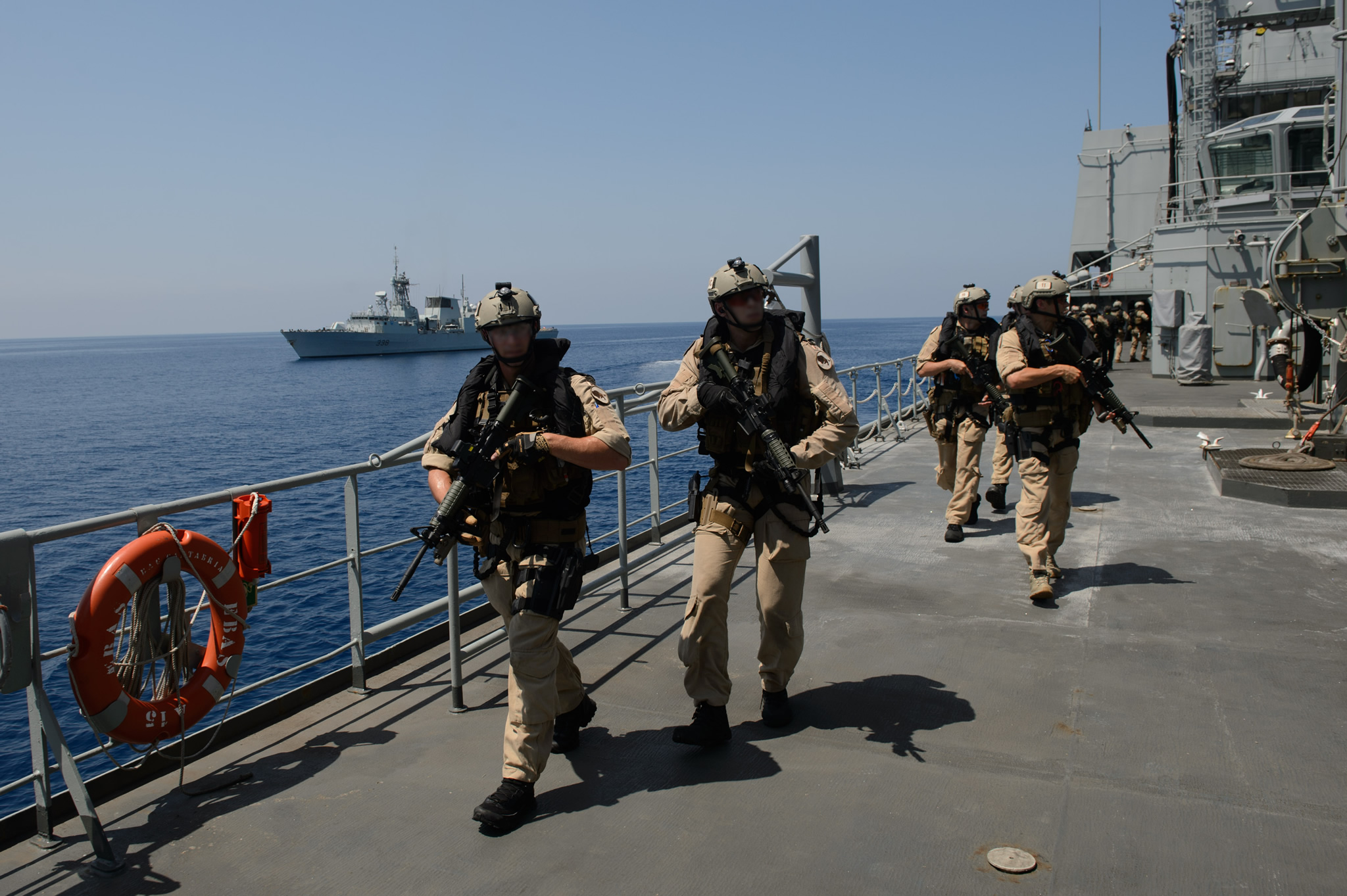 |
| The Advanced Boarding Party from HMCS Winnipeg trains on board the Spanish ship Cantabria on July 22, 2015. |
On its initial meeting, Winnipeg meet with the SNMG2 Commanding Flag Ship, Federal German Ship (FGS) Hamburg as well was the Spanish Ship (SPS) Cantabria and SPS Santa Maria. While the ship was in port, it was open as a diplomatic engagement event, and was open to public tours to both local residents and tourists.
True Story behind the sinking of the USS Ingraham 1942
Propaganda is as old as conflict itself. Propagandize was used in World War Two to ensure push for an increase in recruitment numbers, especially in coastal towns such as Halifax, Nova Scotia.
For 70 Years the deaths of 300 US Navy sailors have been buried in the propaganda of the time. The USS Ingraham, which was launched in 1941, was escorting two Canadian troop transports and a larger supply convoy on its way towards England, when on August 22nd 1942 is sank off of Sable Island, known as the Maritime Graveyard of the Atlantic.
It was not Sable island that caused the sinking, but a false U-Boat scare that led the USS Ingraham and USS Buck to begin a cross-search and destroy pattern. In the fog and darkness of the North Atlantic, the Buck's bow was hit by the troop transport Awatea and almost simultaneously, the oil tanker Chemung t-boned the Ingraham, causing the Ingraham to sink instantly killing all by 11 of its crew. As the Ingraham sank, the unlocked depth charges on its deck exploded, killing many of the survivors in the water.
Until recently, thanks to a National Post investigation the Ingraham was thought to have been hit by a torpedo while protecting the Awatea. There are no specific memorials to the USS Ingraham in Halifax - the port it last sailed from.
You can read the entire report here:
For 70 Years the deaths of 300 US Navy sailors have been buried in the propaganda of the time. The USS Ingraham, which was launched in 1941, was escorting two Canadian troop transports and a larger supply convoy on its way towards England, when on August 22nd 1942 is sank off of Sable Island, known as the Maritime Graveyard of the Atlantic.
It was not Sable island that caused the sinking, but a false U-Boat scare that led the USS Ingraham and USS Buck to begin a cross-search and destroy pattern. In the fog and darkness of the North Atlantic, the Buck's bow was hit by the troop transport Awatea and almost simultaneously, the oil tanker Chemung t-boned the Ingraham, causing the Ingraham to sink instantly killing all by 11 of its crew. As the Ingraham sank, the unlocked depth charges on its deck exploded, killing many of the survivors in the water.
Until recently, thanks to a National Post investigation the Ingraham was thought to have been hit by a torpedo while protecting the Awatea. There are no specific memorials to the USS Ingraham in Halifax - the port it last sailed from.
You can read the entire report here:
How 300 U.S. sailors died off the coast of Nova Scotia
Subscribe to:
Posts (Atom)