Translate

Friday, October 19, 2018

Mali Mission has 'no prospect of immediate success: Former Op. Medusa Commander

Rachel Gilmore,  CTV Power Play producer

The man who led Canada’s troops in Afghanistan said the Canadian peacekeeping mission in Mali has “no prospect of immediate success.”
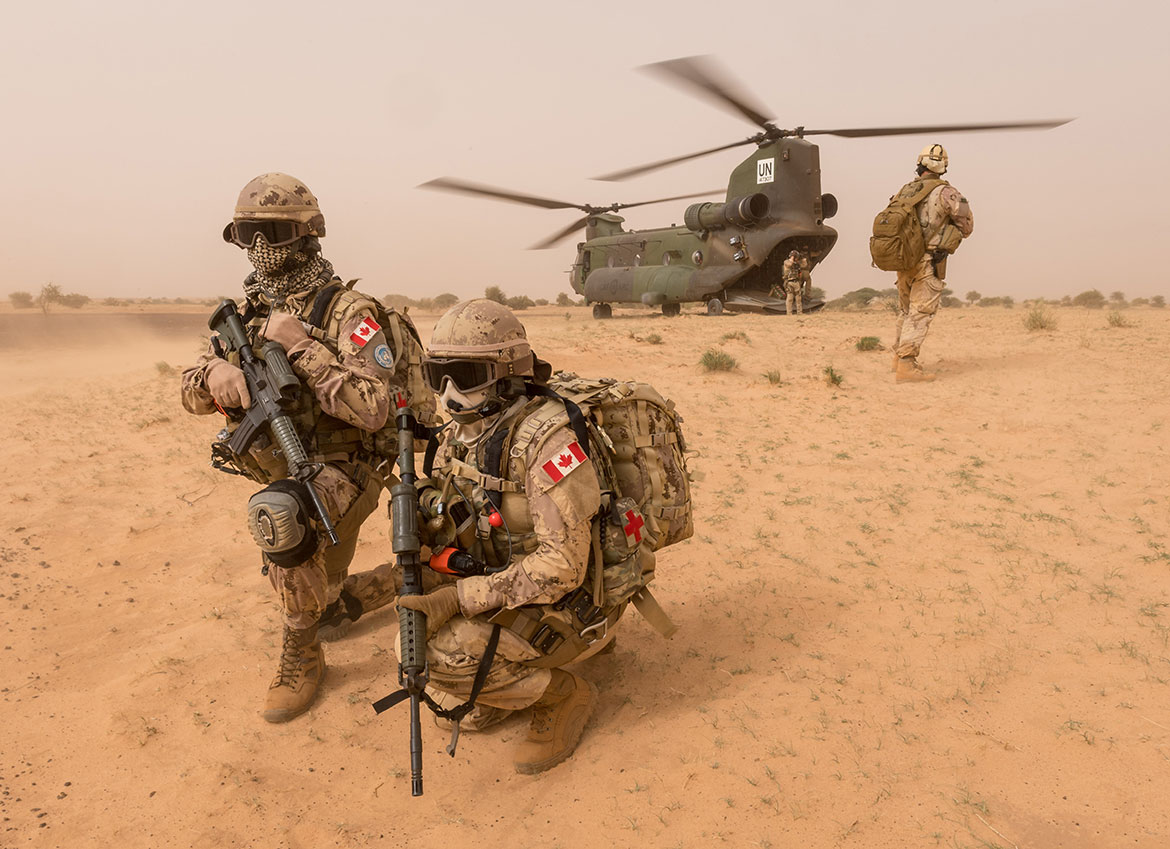
Image result for Canadian Forces in Mali
Gao, Mali. July 18, 2018 – Photo has been digitally altered for operational security. Members of the CH-147 Chinook medical team practice exiting the helicopter under the watchful eye of the force protection team in support of Operation PRESENCE - Mali around Gao, Mali. (Photo: MCpl Jennifer Kusche)
“The political overtones and what’s going on in this country and this mission are ugly,” retired major-general David Fraser told CTV’s Power Play host Don Martin on Monday.

“This is not going to be short mission.”

Canadian boots hit Malian soil in June for what has widely been regarded as a dangerous year-long peacekeeping mission. While Canada’s role is primarily to fly medical evacuation missions and provide support from the skies, the security situation in the region is said to have sharply deteriorated in recent months.

That’s something that hasn’t escaped Fraser’s notice.

“It’s as bad -- if not worse -- than what we experienced in Afghanistan, Iraq or Syria,” Fraser said of the conditions in Mali.

“It doesn’t take a rocket scientist to figure out that this mission isn’t going in the right direction from a trajectory point of view.”

His comments echo the revelations of a United Nations report released Wednesday. The assessment, conducted by UN Secretary General Antonio Guterres, described a plummeting humanitarian situation in Mali. Food aid and other humanitarian relief is in overwhelming demand and the country, according to the report, is faring worse in many ways than when Canadian peacekeepers first arrived in June.

Fraser explained that the key issue marking this decline is a lack of leadership. Despite successful elections in July and August, he said the insurgents are “winning the fight on the ground.”

“Peacekeeping can’t be effective. It can’t be effective without a strong civilian government leadership that’s running the government, that’s actually providing oversight for the military and the police forces and that’s not happening fast enough,” Fraser said.

“The race is being won not by the government and not by the military -- it’s being won by the people we don’t want to win.”

That on-the ground reality means humanitarian efforts aren’t getting to where they need to be.

“Aid, from a strategic and from a tactical point of view, is not getting to the ground fast enough,” Fraser said.

And at the end of the day, Fraser warned this hurts some people more than others.

“The local people are the ones who are going to be adversely affected,” he said.

To change this, the UN needs a change in their approach, according to Fraser.

“The UN’s not getting the locals to get the leadership or the women engaged fast enough, and they’re going to lose this race.”

If nothing changes, Fraser warned, we can expect the situation to continue to deteriorate -- and the UN reports to harshen.

“The people that are adversely affected are women and children and the innocent people, which is just going to make the next report card even worse than this one,” he said.

CAF Ditches Plan for New Paint Scheme on SAR Aircraft

By: David Pugliese, The National Post 

Canada’s military has reversed its plan to abandon the familiar yellow paint scheme for the country’s new search-and-rescue planes after debate within the ranks over the aircraft’s need to be visible on such missions.

The new fleet of 16 Airbus C-295W planes will replace the main Royal Canadian Air Force search-and-rescue fleet of Buffalo aircraft as well as the Hercules transport planes which are also used at times in a search-and-rescue role. Postmedia reported last year that RCAF leadership had requested the new planes be painted tactical grey, asking for a change to the original contract which had stipulated the familiar yellow colour scheme, because they wanted the aircraft to be available for other missions, including combat.

But the move to the grey paint scheme has now been reversed. “While there was, last year, a stated interest in painting the C-295W grey, a decision was made following further consultation to maintain the iconic yellow colour scheme of the RCAF’s current SAR fleet, such as the Buffalo, Twin Otter, Cormorant and Griffon,” the Department of National Defence said in a statement Wednesday. “This colour, which provides a higher level of visibility and recognition in the ground and the air, is also widely known by Canadians — especially those who might find themselves in a situation requiring our aid.”

Asked last year about the plan to ditch the yellow paint scheme, the Forces said in a statement to Postmedia that “the RCAF has made the decision to use a grey colour scheme for the C-295W fleet to enable surging flexibility for the very wide range of missions the RCAF is required to conduct, from humanitarian and disaster relief missions, to security missions with partners, and all the way to full spectrum operations.”

Military sources said RCAF leadership wanted to redirect some of the planes for use on international missions instead of search-and-rescue. But that unilateral decision sparked heated debate inside the military and DND and, sources said, the air force was forced to abandon its plans.


When the federal government awarded the contract to Airbus in December 2016, cabinet ministers highlighted the importance of having the right aircraft for the search-and-rescue job. “With this technology, we are giving our women and men in uniform the tools they need to continue to deliver effective and essential search and rescue operations,” defence minister Harjit Sajjan said at the time.

Construction of the first aircraft began in 2017 and the first new planes are expected to be delivered in 2019. They are outfitted with sensors that allow RCAF personnel to share real-time information with searchers on the ground. Equipment also includes sensors for searching in low-light conditions. A centre, equipped with simulators, is being built at Comox, B.C. to support training for the air crews.

The RCAF’s Buffalo and Hercules aircraft assigned to search and rescue perform more than 350 missions annually, according to the Canadian Forces. The Canadian military is responsible for providing aeronautical search and rescue operations.
The RCAF’s search-and-rescue Buffalo aircraft, above, will be replaced, but the yellow colour scheme will remain with the new Airbus planes. DND
But the project to purchase the new planes has faced a rough road over the years. The competition was announced in 2004 by the then-Liberal government and re-announced by the Conservative government in 2006. But it took another decade before it could be completed and Airbus declared the winning company.

Even then, Leonardo, an Italian aerospace firm, launched a lawsuit against Canada over what it claimed was a rigged purchase that favoured Airbus.

That lawsuit was dropped earlier this year, shortly before the federal government awarded Leonardo a new sole-source deal potentially worth billions of dollars to upgrade Cormorant search-and-rescue helicopters.

Officials with the Canadian Forces and Leonardo say the ending of the legal action in May had nothing to do with the company being picked for the new project the same month.

New Memorial to No.2 Construction Battalion in France

By: CTVNews Staff Writer(s)

A tiny French village unveiled a long overdue memorial to the men once dubbed Canada’s best kept military secret - the No. 2 Construction Battalion of the CEF's Forestry Corps; who fought for their right to fight for King and Country during the First World War.

The first and only black battalion in Canadian military history is being honoured in the Supt, in the Bourgogne-Franche-Comte region of eastern France, on September 29, 2018.

Douglas Ruck, chair of the board of governors for the University of King's College in Halifax, N.S, is son of the late Senator Calvin W. Ruck who wrote the book Canada’s Best Kept Military Secret – The No. 2 Construction Battalion C.E.F.

He told CTV News that after war erupted in Europe, Canada was brought into the conflict as part of the British Empire.

“While the white individuals were treated with great joy and taken into the fold, the black soldiers were rejected,” he said.

“Not because of any physical impairment, but because of the color of their skin and the perception that they were inferior and would not make good soldiers.”

From 1914 to 1916 the black soldiers fought for the right to fight through protests, petitions and bringing pressure to bear, Ruck says.

In 1916 they were granted permission to join the Canadian Expeditionary Forces, but in a segregated unarmed unit, going to war with pick-axes and shovels.

As part of the forestry corps near the frontlines, the soldiers cut trees for lumber, trenches, boardwalks and other requirements.

They were also involved with moving the dead and wounded off the battlefield.

In France, the segregation continued and the soldiers received inferior treatment, being the last to receive supplies and were often denied basics like underwear and socks.

Ruck told CTV News: “They were relegated to that role, not what they wanted to do, but that was the only choice they had.”

The memorial to the 3,000 Canadian forestry engineers will now bear the names of the 29 forestry engineers who were buried in that town and other nearby towns.

Of the 29, 10 were black men who were part of the 600-member No. 2 Construction Battalion, stationed near Supt, population 115.

It is thought to be the first memorial on French soil that recognizes the black men.

A memorial to the ‘Black Battalion’ already exists in Pictou, N.S, one of two bases in the province where soldiers were mustered before shipping out to Europe.

It is hoped the French monument will help preserve the memory of the brave men that made up the battalion.

Supt Mayor Evelyne Comte spearheaded the campaign to create the tribute after becoming aware of the Canadian contribution when she saw the graves at the cemetery.

This year marks the 100th anniversary of the armistice that ended of the Great War.

Friday, October 12, 2018

UN Reports Situation in Mali Deteriorating

By: Lee Berthiaume, Global News 

In a sobering new report, the head of the United Nations says the security situation in Mali has sharply deteriorated over the past three months even as demand for more food aid and other humanitarian assistance has skyrocketed.
The UN Mali patch is shown on a Canadian forces member's uniform before boarding a plane at CFB Trenton in Trenton, Ont., on July 5, 2018.
READ MORE: Canadian troops ready as ‘complex’ Mali peacekeeping mission gets underway: commander

The assessment by UN Secretary General Antonio Guterres coincides with the presence of Canadian peacekeepers in Mali, and suggests the country is in many ways worse off now than when they first arrived in June.

Not that there haven’t been some hopeful signs, including successful presidential elections in July and August and a marked decline in the number of peacekeepers killed or wounded despite continuing attacks by armed groups.

That is reflected in the fact that while the Canadian military’s primary task in Mali is to evacuate injured UN peacekeepers by helicopter, they have so far only conducted two such missions, both on Sept. 11.

Guterres nonetheless painted a picture of a country at war with itself as various ethnic and extremist groups targeted each other as well as the Malian military, international forces and even civilians.

The result was the largest number of civilians killed – 287 – in one three-month period since UN peacekeepers first arrived in the country in 2013, while thousands more have been forced to flee their homes to escape the violence.

Much of the fighting was between members of two different ethnic communities in the centre of the country, while groups linked to al-Qaida and the Islamic State were also responsible for a great deal of violence.

READ MORE: Canada’s on a new kind of mission in Mali — mixing peacekeeping with counterterrorism

“Intercommunal conflict, exacerbated by violent extremist groups, is fraying an already fragile social fabric and is deeply concerning,” Guterres wrote. “Too high a human toll has accrued as a result of the ongoing spiral of violence.”

The number of human-rights violations in Mali, which was already troublingly high, was similarly worse because of hundreds of new extrajudicial killings, disappearances, tortures and rapes across different parts of the country.

While most of those atrocities were perpetrated by the Islamic groups and competing ethnic communities, the Malian military itself was implicated in 18 violations – including one mass killing that is being criminally investigated.

“The human rights situation is alarming,” Guterres wrote. “It is absolutely imperative that the government prevent human rights violations and abuses, including those committed by the Malian armed forces.”

Further adding to Malians’ woes were severe floods in some areas and drought in others that, when combined with the fighting, had doubled the number of internally displaced people and left one in four needing humanitarian aid.

“The level of needs of is higher than at any point since the beginning of the crisis in 2012,” Guterres wrote.

READ MORE: Jeff Semple: First impressions of Canadian peacekeepers in Mali

The country was plunged into turmoil after a rebellion in the north at the same time as the Malian military was staging a coup in the capital, Bamako.

Canadian peacekeepers recently helped the World Food Programme deliver more than two tonnes of food, water and medicine by helicopter to a village in central Mali.

Yet despite the growing need for more emergency aid, Guterres reported that only one-third of the roughly $400 million needed to help Malians had been provided to the UN by the beginning of September.

WATCH: Exclusive: Treacherous conditions for Canada’s troops in Mali


“While needs continue to increase, humanitarian funding has decreased, preventing a timely at-scale and appropriate response,” he wrote.

Canada has provided funding for various development projects and agencies in Mali, but Bruno Charbonneau, an expert on Mali at Laurentian University, said the $60 million in emergency aid given since 2012 is relatively small.

Most of that money was also pledged immediately after the rebellion in the north and the coup.

READ MORE: At least 6 soldiers killed in attack on military taskforce headquarters in central Mali

As for the bigger picture, Charbonneau said what is needed is more international focus on the centre of Mali and greater emphasis on development to tackle the root causes of the conflict.

“As long as the focus is on countering terrorism in the Sahel, everything else is secondary,” he said. “And I think it’s a bad reading of the situation based on assumptions about the dynamics of the conflict and its causes.”

Taylor: Our Missions Lack Clear and Achievable Objectives

By: Scott Taylor, Editor and Chief of Esprit-de-Corps Magazine 

The Canadian Armed Forces are currently committed and deployed on five oversees missions, none of which have a clear cut or achievable objective.

Of course, the old Cold War warhorses will claim that our battle group stationed in Latvia has been successfully deterring Russian aggression into the Baltic States. One could similarly argue that a tinfoil cap is proper protection against alien brain removal, proven by the fact that you still have your brain.

I would think that Latvia, Estonia and Lithuania’s membership in NATO, with that alliance’s pledge of collective defence, coupled with the nuclear arsenals of the U.S., U.K. and France would serve as ample deterrent to even the most ambitious of Russian dictators.

Canadian officers who have served in Latvia know that it was nothing like our decade-long experience in Afghanistan. There will be no letters to the next-of-kin to inform them of a soldier’s death in combat. If the Russians don’t attack, nobody gets killed, and if Russia does trigger nuclear conflagration with NATO in the Baltic, there will be no one left alive to write the letters.

Keeping a battalion of Canadian soldiers in Latvia is an unnecessary waste of $400 million per year, and an added strain on the family lives of those personnel deployed abroad, unaccompanied, for either six months or one year.

We also have about 200 Canadian soldiers deployed in Ukraine as trainers. This is a bit of a sticky wicket (as the cricketers say) in that Ukraine is not a NATO member. Since 2014 Ukraine has been embroiled in a simmering civil war between the Western-backed regime in Kiev and the largely ethnic Russian breakaway regions of Donetsk and Luhansk.

Russian President Vladimir Putin has been soundly demonized for supplying military personnel, weapons and equipment to the ethnic Russian separatists. If Putin is evil for interfering militarily in a civil war in a neighbouring country in support of rebels of Russian ethnicity, how can we paint ourselves as angels for training and equipping more young Ukrainian men to kill in that same civil war?

Then we have not one, but two separate missions committed to the mess that once was the nation of Iraq.

One group of special forces operatives and helicopters remain in support of the U.S.-led alliance to defeat Daesh (aka ISIS or ISIL) while the second mission will be a Canadian-led, NATO effort to train more young Iraqi men how to kill. These Iraqis will in turn prop the corrupt regime in Baghdad.

For the record, and to silence those who prattle on about how the West is democratizing Iraq, the last round of elections failed to produce a verifiable result. A recount was ordered, but before that could happen, somehow, the warehouse containing the ballots burned down. You could not make this stuff up. As a result, the next regime will be headed up by a Shiite cleric and warlord named Muqtada Al-Sadr.

In 2004, this guy was considered public enemy No. 1 by the U.S. when he mobilized his militia to combat the American occupation.

Canada has no seat at the big boy table that will eventually seek to resolve the multifaceted conflict that engulfs Syria, Iraq and eastern Turkey. It will probably require a redrawing of existing maps and perhaps even the creation of new states, but none of that will be concluded with any Canadian say in the matter. In the meantime, we somehow justify the fact that our elite soldiers are teaching more young Iraqi men to kill more effectively.

In Mali, we can at least boast that we are under the UN banner, wearing blue berets, and using our helicopters for medical evacuation missions.

Unfortunately there is also no end game objective in Mali. Canada’s present commitment of one year will expire long before the fundamental causes of the Malian conflict have been resolved. In other words, our Canadian troops are doing a lot all around the world but achieving very little.