By: Daniel Leblanc, The Globe and Mail
Ten Canadian-based aerospace companies are calling on Prime Minister Justin Trudeau to stop blocking the purchase of 18 Super Hornet fighter jets, arguing they stand to suffer from the government's unwavering support of Bombardier Inc. in a trade dispute with Boeing Co.
"Prime Minister, we ask for your co-operation as we work with Boeing to keep our collective growth and innovation story unfolding here in Canada. Our partnership is deep and enduring, but it needs your engagement," said the letter sent on Tuesday by senior executives from firms such as Héroux-Devtek, L-3 MAS, CAE and GE Canada.
The letter, which calls on the government to advance "aerospace for all of Canada," is the most recent development in an increasingly bitter dispute between the Canadian government and Boeing. Ottawa is holding the Super Hornet contract as its main bargaining chip in its fight on behalf of Quebec-based Bombardier, while members of the "Boeing team in Canada" want to convince the government that its strategy will actually hurt Canada's aerospace industry as a whole.
Read more: Ottawa seeks second-hand jets from Australia amid Boeing, Bombardier dispute
"There is a bright opportunity in front of us that can be harvested, in a successful and mutually beneficial win for Canada, our Canadian companies, and Boeing," said the letter sent to Mr. Trudeau, his two key aides, Katie Telford and Gerald Butts, and five federal ministers.
At the heart of the dispute is Boeing's complaint against Bombardier over allegations of illegal subsidies and dumping that was filed in April with the U.S. Department of Commerce. The matter is currently in front of the U.S. International Trade Commission, with Boeing asking for tariffs to be imposed on Bombardier C Series planes sold in the United States.
Ottawa responded by lambasting Boeing for its actions against Bombardier, which is seen in the Liberal government as the crown jewel of Canada's aerospace industry, quickly putting the Super Hornet deal on hold.
A Canadian delegation recently travelled to Australia to see whether second-hand fighter jets, which are being placed on the market by the country's military, could instead fit Canada's needs for an "interim" fleet.
"Australia has flown a very similar F-18 to ours, it is one of the reasons why we have sent a team down to take a look at various options," Defence Minister Harjit Sajjan told reporters at a caucus meeting in Kelowna. "Our engineers will take a look at all the specs to make sure the airframe is worthy enough, making sure we look at the systems that are also employed. ... They will provide an assessment in short order."
Mr. Trudeau has himself sought to put pressure on Boeing to drop its complaint against Bombardier. On Tuesday, Mr. Trudeau called Eric Greitens, the Governor of Missouri, where Super Hornets are assembled, to highlight the billions of dollars and thousands of jobs that are now in play.
STORY CONTINUES BELOW ADVERTISEMENT
"Canada is reviewing current military procurement that relates to Boeing, as Boeing is pursuing unfair and aggressive trade action against the Canadian aerospace sector. Meanwhile, Boeing receives billions in support from U.S. federal, state and municipal governments," the Prime Minister's Office said on Tuesday.
Still, the president of Boeing International has told Canadian media that Boeing will not back down in its fight against unfair subsidies.
"We recognize the Canadian government might be upset with us. We don't intend to upset anybody, but we plainly have to do what we believe is right," Boeing International president Marc Allen told The Globe and Mail.
Mr. Allen urged the federal government to stop making a link between Boeing's case against Bombardier and the Super Hornet contract. "If you ask me my opinion, I wouldn't want the U.S. government trading national security for trade," he said.
Mr. Allen added the federal government should not forget that Boeing does $4-billion a year of business in Canada, with 560 suppliers and an overall impact of 17,000 jobs.
Bombardier has denied any wrongdoing and is currently defending itself in front of the U.S. International Trade Commission.
"The bottom line is that Boeing's petition is meritless and based on false assumptions, citing a campaign in which they didn't even compete," Bombardier Commercial Aircraft spokesman Bryan Tucker said. "Boeing's petition is a direct attack on innovation, competition, development and jobs on both sides of the border."
Showing posts with label Capability Gap. Show all posts
Showing posts with label Capability Gap. Show all posts
Monday, September 11, 2017

Thursday, August 24, 2017
Sajjan not keen on 2nd Hand Fighters to Fill Capability Gap
By: David Pugliese, The Ottawa Citizen
Defence Minister Harjit Sajjan continues to insist that the capability gap, supposed to be filled by the purchase of Boeing Super Hornets as an interim fighter, will still be dealt with.
The U.S. and Canadian governments are still talking about Super Hornets, although the Liberals have cut off Boeing from any discussions.
The Liberal government has taken that action in retaliation for a trade complaint that Boeing has filed with the Trump administration concerning what it claims is unfair subsidies awarded to Bombardier on its CSeries civilian aircraft production.
During his recent appearance at a defence and aerospace conference in Abbotsford, BC, Sajjan the Liberal government has “many other options, so that we can fill this capability gap.”
He, however, didn’t get into details.
“No decision has been made,” he added. “Discussions are still ongoing.”
But there have been suggestions in some quarters of the aerospace industry that the Liberals were considering the purchase of second-hand fighter jets to fill the gap.
Sajjan addressed that issue….somewhat.
“I’d prefer to buy brand new versus – versus used, but we are currently in the process, and we’ll make a decision to making sure that our members in the Canadian Armed Forces have the right tools necessary,” he said.
Thursday, June 22, 2017
Liberals Limiting Options for Interim Fighter Solution
By: Murray Brewster, CBC News
Talks with the Pentagon about filling the Canadian air force's short-term need for jet fighters remain on track, said Defence Minister Harjit Sajjan.
Those negotiations for a so-called "interim capability" continue despite the Liberal government making a very public display at the Paris Air Show this week of snubbing Boeing executives.
The U.S. aerospace giant's commercial trade complaint against Montreal-based Bombardier has thrown the military contract into limbo.
Boeing wants trade regulators in Washington to investigate subsidies for Bombardier's CSeries aircraft, claiming they allow the Canadian company to export planes at well below cost.
The Liberals had intended to purchase 18 Super Hornet fighters — at a potential total program cost of between $5 billion and $7 billion — from Boeing. The deal was supposed to be a stopgap until the government can finalize the purchase of 88 permanent replacements for the aging CF-18 fleet.
After Boeing filed the trade complaint earlier this year, the government broke off contact with the U.S. company and said it was reviewing the "interim" fighter deal. It heightened the rhetoric last month, saying the aircraft maker was no longer the "trusted partner" it had been.
Sajjan said that, regardless of the trade dispute, the urgent requirement for fighters has not gone away and must be filled somehow.
"We're still continuing our discussions with the U.S. government, making sure that we fill this capability gap," Sajjan said.
Other options?
If Boeing has been frozen out, what is the Liberal government talking about with the Pentagon?
Sajjan said there are "other options," but refused to explain what they might be.
There are limited choices for a government-to-government purchase with the U.S. if the Super Hornet has been excluded.
During a recent trip to Singapore, Sajjan met with the CEO of Lockheed Martin, which is eager to sell Canada its advanced, but often maligned, F-35 — a plane the Liberals promised not to buy during the last election.
A defence industry source with knowledge of the file said Lockheed Martin has sent a letter to the Liberal government, expressing interest in providing its jets as the "interim solution."
Defence Minister Harjit Sajjan unveiled the government's long-awaited vision for the Canadian Armed Forces last week. The new policy calls for the purchase of 88 new jet fighters but also says the government will continue to explore a stopgap purchase until the full fleet arrives. (Adrian Wyld/Canadian Press)
Sajjan dismissed the notion of making the stealth fighter the "interim" solution and seemed to place his faith in the trade dispute being settled.
"No, right now for us we need to fill this interim capability gap and keep on with these discussions with the U.S. government on this," he told CBC News. "We are going to be looking at other options as well. We are looking for this to be resolved by the U.S. Department of Commerce quickly, so we can get back to business."
During an appearance before the Commons defence committee late Tuesday, the country's top military commander also dangled that possibility.
"What I would tell you is that, as the minister has said, the option for the Super Hornet is still open," said Gen. Jonathan Vance.
Referring to Boeing, he said: "They're a bad partner now. Maybe they [could] become a good partner again."
New versus used
But if the dispute drags on, it is unclear what the Liberal government can do if both the Super Hornet and the F-35 are ruled out as the gap-filler.
 |
| There is a possibility that the Liberals could purchase refurbished F/A-18; which would be similar to the current CF-18's flown by the RCAF. |
Defence experts have suggested there is a remote possibility the U.S. could sell Canada refurbished F-18s, similar to the current CF-18s.
The Pentagon recently had modernized F-16s on the market, which the Polish air force considered but eventually declined. That would be an even more unlikely fit, since Canada has never flown the single-seat fighters, which were the backbone of the U.S. air force for decades.
The Pentagon recently had modernized F-16s on the market, which the Polish air force considered but eventually declined. That would be an even more unlikely fit, since Canada has never flown the single-seat fighters, which were the backbone of the U.S. air force for decades.
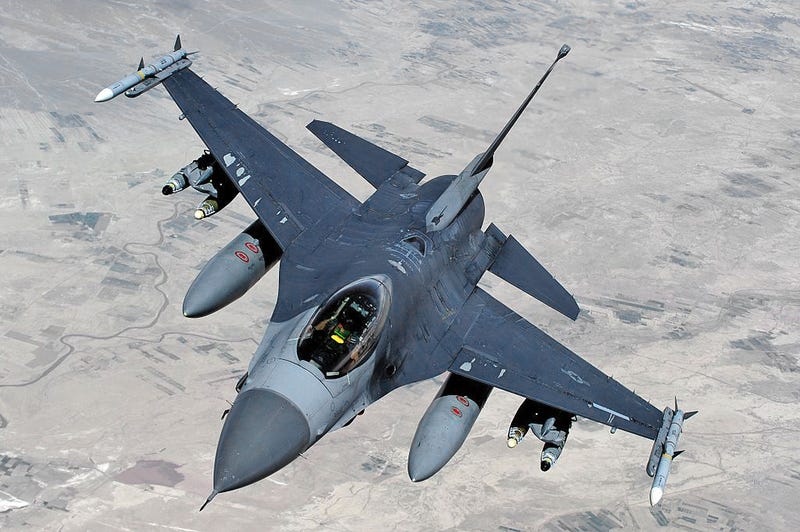 |
| The US Government also has surplus F-16s available, but it is highly unlikely Canada would purchase these jets. |
The "interim" fleet is meant to fill the gap until the Liberal government decides on a permanent replacement for the CF-18s.
Conservative MP James Bezan, his party's defence critic, wants the government to proceed to an open competition to buy fighter jets. (Adrian Wyld/Canadian Press)
Conservative defence critic James Bezan said he doesn't understand why the Liberals are twisting themselves into knots for a temporary solution when they can simply proceed to the open competition they promised for the full fleet.
Sajjan said that is still in the cards, but federal procurement officials have said a competition could take up to five years to run.
"If you look at what other states, other countries are doing in their recent procurement to replace their tactical fighters, none of them are taking five years to do this competition," Bezan said.
"If you look right now, Denmark is doing theirs in two years; Belgium means to complete theirs right now in 18 months; and just earlier this week, Finland started their F-18 replacement program, and they plan to have their first deliveries in 2021 and the entire fleet replaced by 2025, which coincidentally is the same time that our life extension on our CF-18s run out."
Wednesday, June 14, 2017
Defence Experts Reject "Capability-Gap" and Interim Fighter Plan

In a new survey, 88 percent of the country’s top experts on defence and security agreed the government should cancel its proposed interim Super Hornet purchase and proceed with a permanent fighter jet replacement
OTTAWA, June 13, 2017 – Nearly nine in 10 experts in Canada’s security and defence community say the federal government’s proposal to purchase Super Hornet fighters on an interim basis is a bad idea.
That’s the finding from a new paper from the Macdonald-Laurier Institute.
An overwhelming majority of defence and security thought leaders believe “the government’s plan lacks merit, is strategically unsound, and ultimately should be cancelled”, write authors David McDonough and Brian Lee Crowley.
To read the full paper, titled “Should We Purchase Interim Super Hornets? A survey of the experts”, click here.
In November 2016, the Canadian government announced plans to acquire an interim fleet of 18 Super Hornet fighter jets as a stopgap measure to supplement the existing fleet of 76 CF-18s. In addition, it announced an “open and transparent” competition for a permanent fighter aircraft replacement for its CF-18s, which would take up to five years to complete.
According to one respondent, if the government continues with this plan, “The damage to the RCAF and Canada’s defence posture would be devastating and permanent.” Indeed, 88% of the experts surveyed said the government should cancel the Super Hornet purchase and proceed with a permanent fighter jet replacement. In the words of another respondent, “it would show the Government has the courage to correct a significant error.” Only 6.6% were in favour of the purchase, with the rest unsure on this fundamental question.
The Macdonald-Laurier Institute surveyed the country’s foremost security and defence policy thinkers and practitioners to get an independent, dispassionate and expert assessment on the merits of the interim Super Hornet plan and its underlying rationale. Potential respondents were selected for their expertise in security and defence generally, although procurement and airpower experts and practitioners were well represented among them.
In total, more than 100 people were initially contacted to undertake the survey, and we received survey responses from 75 individuals (for more information on respondents, see the paper). Participants came from across the political spectrum, and included noted scholars and think tank experts, former senior military officers from all three services, including many former RCAF commanders, and former government officials. Many also had widely differing opinions on such issues as the need for a permanent fighter aircraft competition or what particular aircraft was most suitable for Canadian defence requirements.
In other words, the diverse range of participants encompassed a large part of the security and defence community in Canada, which allowed us to gain access to their collective wisdom on this vital matter.
The survey itself consisted of 8 questions to be answered yes, no, or unsure, which allowed us to aggregate the responses. In so doing, we were able to assess their collective views on this matter and gauge, in an “evidence-based” manner, whether there is any broad consensus on the wisdom of the government’s plan – from its key justifications to its costs to whether the decision should be reversed.
Today, the government is in a very public spat with Boeing, the Super Hornet manufacturer, owing to its decision to ask the US Commerce Department and International Trade Commission to investigate subsidies for Bombardier’s CSeries aircraft. As a result, Ottawa suspended talks with Boeing on the interim Super Hornet purchase. The government’s recent defence policy statement also now only refers to the “potential” acquisition of an interim aircraft, omitting even a reference to the Super Hornet.
“Both of these developments provide a welcome opportunity for the government to reconsider this hasty procurement decision”, write McDonough and Crowley. “As a government publicly committed to ‘evidence-based decision making,’ it should consider the opinions of the vast majority of experts in the field”.
***
David McDonough is Deputy Editor at the Macdonald-Laurier Institute and a Research Fellow at Dalhousie University’s Centre for the Study of Security and Development.
Brian Lee Crowley is the Managing Director of the Macdonald-Laurier Institute.
The Macdonald-Laurier Institute is the only non-partisan, independent national public policy think tank in Ottawa focusing on the full range of issues that fall under the jurisdiction of the federal government.
For more information, please contact Mark Brownlee, communications manager, at 613-482-8327 x105 or email at mark.brownlee@macdonaldlaurier.ca.
Tuesday, April 25, 2017
Minding the Capability "Gap"
BY HUDSON ON THE HILL
© 2017 FrontLine Defence (Vol 14, No 2)
The House of Commons Standing Committee on National Defence (SCND) recently went In Camera to start drafting its long-awaited report on “Canada and the Defence of North America”, an issue the Members of Parliament have been studying for the better part of a year.
The report, when it gets presented to the House, is virtually guaranteed to include more money for the Canadian Armed Forces in general, and the Royal Canadian Air Force in particular, given that continental defence is a top-dollar priority for the Department of National Defence. From a DND perspective, the Arctic (including the impact of global warming) is mainly an RCAF operational responsibility.
Some elements of the upcoming report can be found in an earlier report by the SCND, which is chaired by B.C. Liberal MP Stephen Fuhr, a former CF-18 Hornet pilot and one of several retired Canadian Armed Forces personnel who have repeatedly proved their mettle on defence policy despite being first-term MPs. That earlier report recommended better awareness of cyber attacks and emerging missile threats, among other things. But it focused heavily on NORAD and aerial readiness, and devoted most of its content to the RCAF.
Urging “a thorough review of Canada’s international and domestic capability requirements” for replacing the remaining “legacy” Hornets, the committee pushed for an aircraft that would satisfy all needs, including maintaining Canadian sovereignty in the North, and said the government should decide on a replacement by September 2017.
In a letter from Sajjan to Fuhr, the government’s response to the SCND noted that the DPR consultations over the past year had included not only the public through social media and other means but also experts through a series of roundtables, and more than 50 Members of Parliament had participated in constituency-level discussions.
Sajjan further highlighted the decision to acquire 18 Super Hornets from Boeing – to plug what he initially described as an RCAF “capability gap” until there’s a decision on replacing the already diminished legacy fighter fleet of CF-18s, which are set to be retired in the 2023-2025 timeframe, despite a pending $500-million upgrade program.
The notion of a “gap” arose when Sajjan announced last May that the government would work to acquire additional fighters to enable Canada to fulfill simultaneous commitments to both NORAD and NATO. The announcement seemed to come out of the blue because, only a few weeks earlier, the RCAF Commander Lieutenant-General Mike Hood never mentioned it when testifying before the SCND in April.
Pressed by Nova Scotia Liberal MP Darren Fisher, Hood noted that CAF readiness is budgeted annually. “I’m funded in my operations and maintenance budget to ensure that I can keep my NORAD commitments at a posture that’s ready.” He went on to say that finding resources “has not been a challenge under my watch at this time” and that “we have enough trained personnel, we have enough aircraft and enough maintenance people to keep them going, and we have the money, certainly, to operate.”
In other words, no “gap”, seen by some as a contradiction of the government’s position. While it might be splitting hairs, it should be noted that Hood did not include NATO, which obviously can be a volatile component, in the readiness/affordability mix. He did say, however, that if he faced “any challenges” in fulfilling commitments, he was confident that the additional resources would be endorsed by “the chief”, meaning General Jonathan Vance, the Chief of the Defence Staff (CDS).
Later, as the controversy continued to bubble, Sajjan’s spokesperson, Jordan Owens, sought to clear the air with a statement in which she defined the “capability gap” as being “an insufficient number of aircraft available on any given day to meet our existing NORAD obligations and NATO commitments combined, not to mention having the capacity to react to unforeseen and emerging threats.”
Owens also pointed out, rightly, that keeping the legacy Hornets flying longer was not the solution. “With the current availability rate what it is, even if the 77 airplanes could fly forever, there still wouldn’t be enough of them to simultaneously meet our NORAD and NATO commitments. The only way to address the capability gap is to improve the availability rate of our fighter fleet. This means we need more people and it means we need more planes.”
Note that this didn’t include domestic fighter requirements. With a serviceability rate of only about 50%, if all three became active missions simultaneously, the legacy fleet could not handle them all.
A few days later, Hood suggested to the Senate Standing Committee on National Security and Defence that a policy shift had resulted in the tactical shortfall. “The government has now directed that we be ready to meet our daily NATO and NORAD commitments simultaneously,” he said in his opening statement, adding later under questioning that he was “at present unable to do that with the present CF-18 fleet” because he doesn’t have enough aircraft (a status inherited from a series of RCAF commanders whose roles were constrained by various governments over the years).
Asked by Senator Colin Kenny how many aircraft the RCAF might need, given that it has been talking about a next-generation fleet of 65 compared with the 1980s buy of 138 CF-18s. Hood wasn’t prepared to reveal that: “the numbers behind the commitments with respect to NORAD and NATO are classified,” he said. “Suffice it to say,” he added, “the 77 we presently have are incapable of delivering that number.”
Judy Foote, the Minister of Public Services and Procurement (who has since taken an indefinite leave of absence for unspecified personal reasons), also involved herself in the debate, suggesting that the CDS was was in a better position to explain things. “I think if you ask General Vance, he’d have a different view on that and I have a lot of faith in the Minister of Defence, who of course has been on the ground and knows only too well what the need is," she said, adding that a capability gap has “existed for some time” but had been ignored by the previous government.
Foote also disagreed with Hood’s assertion to the Senate committee that keeping the legacy Hornets operational until 2025 would negate any urgency to sole-source FA/18 Super Hornets as the RCAF’s next frontline fighter.
On numerous occasions, Sajjan has reiterated the notion that providing the CAF with resources they need to do their job had been a “key component” of the DPR consultations. “Capability requirements for operations at home and abroad, situational awareness, and intelligence are all being considered. Our goal is to ensure the CAF have the tools they need to safely and effectively perform the missions set by our Government. Your conclusions and recommendations have informed and will be reflected in Canada’s new defence policy.”
That said, Sajjan’s latest statement on the DPR, after an April 11 cabinet meeting, was to repeat that “we are coming very close to making the decisions,” but deflected questions about when that might be.
“We want to make sure that we get this right,” he told reporters, repeating what has become a ministerial mantra. “We want to make sure that it’s not just about the missions and what we do here in Canada and abroad; it’s about how we look after our troops as well. It’s extremely thorough, and I look forward to presenting this to Canadians on behalf of the government, and […] to having the discussion with parliamentarians as well […] in the coming months.”
Could that mean the DPR isn’t released until after Parliament begins its summer recess? That’s currently set to begin June 23 and run until Sept. 18. That’s 12 weeks in which the government couldn’t be held accountable in Parliament. The optics of that scenario would be poor at best.
====
Hudson on the Hill
The role of Hudson is being filled by contributing editor Ken Pole.
Monday, February 27, 2017
Open Letter to the PM from Former RCAF Commanders Re: Super Hornet Purchase
Open Letter to the Prime Minister
From Former Air Force Commanders
Dear Prime Minister,
As former commanders of Canada’s air force, we respectfully but urgently ask that your government not proceed with the plan to purchase a fleet of Super Hornet aircraft as an interim measure pending the eventual replacement of our venerable CF- 18 fighters. It is our firm belief that the interim strategy is ill- advised, costly and unnecessary. Most important, it would significantly impair the Royal Canadian Air Force for years to come and ultimately damage the nation’s defence posture. The situation is complex, but our call for dropping the Super Hornet buy is based on some compelling facts, which we offer for your consideration.
First, we have serious misgivings about the use of a “capability gap” as the basis for your interim plan. Your government’s newly created policy calling for the Royal Canadian Air Force to meet its NATO and NORAD treaty obligations concurrently does not reflect a real and sudden change in the strategic situation. In our experience, it has been decades since Canada had sufficient fighter aircraft to meet all our commitments simultaneously. Over the years the air force, by judiciously balancing strategic risks and available resources, has managed its operational contributions reasonably well. We certainly welcome any initiative that promises to close the longstanding capability gap, but purchasing eighteen Super Hornet aircraft would in fact exacerbate the gap in the near to mid- term by imposing a heavy burden on the RCAF’s existing resources without producing a meaningful increase in fighter availability.
Although the Super Hornet does have some commonality with our current CF- 18s, it is a different airplane, requiring its own training system for pilots and technicians, as well as new flight simulators, logistic support and maintenance organizations specific to the Super Hornet. The air force would have to draw personnel from the existing CF- 18 fighter fleet (usually its most experienced people) to help bring into service a new and more complex fleet of fighter aircraft. But that would not be enough. It would be necessary to recruit, train and qualify several hundred new technicians and dozens of pilots. Recent experience indicates that the RCAF would face difficulty in achieving this; it can take four to five years from recruitment to produce fully trained, operationally ready pilots and specialists for advanced fighter aircraft. We foresee that bringing in an interim fleet would create serious practical problems of this kind.
Quite apart from such technical issues, we are aware that buying, operating and supporting an interim fleet of Super Hornets would be an expensive proposition, with cost estimates ranging from $5-$7 billion. We therefore ask that your government seek a better way of keeping the RCAF operationally effective until its fleet of CF- 18s is replaced with a modern fighter.
To this end, we respectfully recommend that three important initiatives be undertaken.
First, the RCAF should be given the necessary resources to conduct an aggressive recruiting and training process to eliminate existing personnel shortfalls and to provide for the interim period leading to CF- 18 replacement.
Second, if your government feels compelled to acquire additional fighters for the interim, it should seriously examine the prospect of purchasing so- called legacy Hornets (i.e. basically the same as our current CF- 18s) that are increasingly becoming available as Canada’s partner nations replace their older Hornet fleets with the F- 35. For example, both the United States Navy and the Royal Australian Air Force will have surplus F- 18s that are very close in configuration to our own. These would require very little modification to make them essentially identical to the CF- 18, having the same operational effectiveness and excellent safety record as today’s fleet. The capability exists in the Canadian aerospace industry to do the necessary modifications. The acquisition cost would be a fraction of a Super Hornet buy. Of critical importance, all the training, logistics and infrastructure needed to support the additional CF18s are already in place, and the larger CF- 18 fleet would fill the operational capability gap in the interim. All of this would be achieved without the cost, delay and disruption of burdening the RCAF with a second fleet of fighters.
Finally, and emphatically, we urge the government to proceed without further delay to implement the open and fair competition that you promised for replacement of our CF- 18s. Completing this within the next few years is entirely feasible, and it would allow for a faster, more effective and much less costly transition to full operational service by the CF-18’s eventual replacement.
We offer these recommendations based on our collective experience of many years of serving Canada’s air force, with the sole purpose of bringing to your attention some important realities regarding the future of the RCAF and the nation’s defence. We look to you for wisdom in resolving the matters that we have placed before you.
Sincerely,
Lieutenant- General (Ret’d) Larry Ashley
Lieutenant- General (Ret’d) Yvan Blondin
Lieutenant- General (Ret’d) Lloyd Campbell
Lieutenant- General (Ret’d) Bill Carr
Lieutenant- General (Ret’d) André Deschamps
Lieutenant- General (Ret’d) Dave Huddleston
Lieutenant- General (Ret’d) Dave Kinsman
Lieutenant- General (Ret’d) Steve Lucas
General (Ret’d) Paul Manson
Lieutenant- General (Ret’d) Don McNaughton
Lieutenant- General (Ret’d) Ken Pennie
Lieutenant- General (Ret’d) Fred Sutherland
Lieutenant- General (Ret’d) Angus Watt
Friday, August 19, 2016
F/A-18 & F-35 Come Face to Face in Canada
By: David Pugliese, The Ottawa Citizen
Last weekend the unicorn finally came to Canada.
Sitting on the tarmac at the Abbotsford Air Show, the F-35 stealth fighter made its first appearance in this country. Recently declared combat-ready by the U.S. Air Force — though critics point out much more work needs to be done on the jet — officials with its manufacturer, Lockheed Martin, were jokingly referring to it by the name of the mythical beast, because it’s been talked about here so much and seen not at all.
 |
| An F-35A fighter aircraft during a flypast at the Abbotsford International Airshow on Aug. 11. “It’s hard to find bad news” about the plane, said pilot Lt.-Col. Curtis Pitts. “It’s all good news.” Both Lockheed and Boeing are promoting their longtime presence in Canada as part of their pitch. DARRYL DYCK / THE CANADIAN PRESS |
And the two main contenders in that battle — Boeing with its Super Hornet and Lockheed with the F-35 — came face-to-face in Abbotsford.
“There’s no better vehicle to educate the public than to allow them to see the actual aircraft,” said Jack Crisler, one of Lockheed Martin’s top F-35 officials. “It’s here. It’s real.”
The Liberal government is expected to decide within months how it wants to proceed on replacing Canada’s aging fleet of CF-18 fighters.
Justin Trudeau came to power last fall pledging that a Liberal government wouldn’t buy the F-35, an aircraft he said was too expensive and unnecessary given Canada’s needs.
That should have been the kiss of death for Lockheed Martin. But Crisler said he’s feeling good these days about how Canada is moving ahead on the fighter jet file. Defence Minister Harjit Sajjan has talked about holding a fair and open competition. Lockheed Martin, along with other aircraft firms, recently submitted information to the government about their planes, and met Monday with federal officials.
“It looks like we’re being included, so we look forward to competing on that basis,” Crisler said.
“I’m certainly more optimistic than I was in December 2015.”
The controversial stealth fighter became a political nightmare for the Harper government after it pledged to buy 65 of the planes, which were plagued by technology problems and complaints from U.S. lawmakers about their cost.
Auditor General Michael Ferguson found that Canadian defence officials withheld key information from parliament about the proposed purchase, underestimated the costs of the jets and didn’t follow proper procurement rules.
In June, Lockheed Martin almost saw its hopes of selling planes to Canada disappear completely. The Liberal government was close to moving on an interim purchase of Super Hornets and Trudeau claimed the F-35 “does not work and is far from working.”
That prompted Lockheed Martin to warn that Canadian companies who had contracts on the F-35 would suffer. Plans for a Super Hornet interim deal seemed to disappear.
As for Trudeau’s F-35 comment, Crisler has a diplomatic response: “The evidence is not consistent with a statement like that. If you’re not living it day-to-day, you might not see that.” At the Boeing tent at the Abbotsford air show, officials smiled while pointing out the F-35 wasn’t going to be showcased in a flight demonstration that weekend. In contrast, their Super Hornets roared back and forth in front of the crowds on both days of the show.
“This is a remarkable event where we can show what our aircraft are capable of,” said top Boeing official Roberto Valla.
A Boeing representative providing commentary for the demonstrations introduced the Super Hornet as a “fifth generation stealth fighter” — a dig at Lockheed, which also bills the F-35 as such.
Boeing officials were happy to outline their sales pitch: their aircraft is combat proven, less expensive than the F-35 and will be operating with the U.S. military until at least 2040.
During a demonstration in which a Postmedia reporter flew in one of the planes, Boeing pilot Ty Frautschi claimed the Super Hornet’s capabilities are suited to both combat and Arctic patrols; its two engines provide added safety for northern flights. The jet is designed to take the pounding from short landings on aircraft carriers, he said, which would also help it handle the short runways at the Canadian military’s forward operating locations in the Arctic.
Both Lockheed and Boeing are promoting their longtime presence in Canada as part of their pitch. By September, Crisler said, Canadian firms will have been awarded US$1 billion worth of work on the F-35.
For its part, in conjunction with the air show, Boeing announced the opening of a new software lab in Vancouver, including 50 new jobs.
Crowds gathered to gawk and take photos of the planes, though the two F-35s didn’t fly. The U.S. Air Force pilots that flew them up from Utah were under strict rules not to discuss the Canadian situation.
Instead, they chatted about the aircraft’s capabilities. F-35 pilot Lt.-Col. Curtis Pitts highlighted the plane’s powerful radar and sensors, and the stealth technology that provides it with increased survivability. If necessary, Pitts said, he’d be ready to go to war in the F-35 today. “It’s hard to find bad news” about the plane, said Pitts. “It’s all good news.”
In the end, though, the Canadian Forces will have bad news for one of its suitors.
Friday, August 5, 2016
Canada not Required to provide a minimum number of jets to NATO: Report
OTTAWA — A Defence Department report says Canada is not required to provide a certain number of fighter jets to NATO, raising fresh questions about the Liberal government's rush to buy a new warplane.
The government has repeatedly stated the military does not have enough CF-18 fighter jets to both defend North America and fulfil its obligations to NATO, which is why a new airplane is needed sooner rather than later.
But a report published by National Defence's research arm in June 2014 says there is actually no minimum requirement for NATO, meaning any aircraft Canada does commit are completely optional.
A National Defence spokesman says while it's true NATO does not have a set minimum requirement for fighter jets, Canada nonetheless regularly commits aircraft to the alliance to ensure it remains strong and is able to meet any threat.
Defence analyst David Perry of the Canadian Global Affairs Institute says the report highlights the many questions that continue to swirl over the Liberal government's plan to buy a new fighter.
Critics have accused the Liberals of making up stories of a fighter-jet shortage to justify buying a new plane other than the F-35 stealth fighter without a competition.
The Canadian Press
Tuesday, July 19, 2016
Despite "Capability Gap" 8 RCAF CF-18s Deploy to RIMPAC
By: Lee Berthiaume, The Canadian Press
OTTAWA — Eight Canadian fighter jets have been deployed on a massive training exercise in the Pacific, despite Liberal government warnings the country does not have enough such aircraft to defend North America and fulfil its obligations to NATO.
The government says the month-long exercise is critical for training Canadian fighter pilots to work alongside allies — and the planes will return to Canada immediately if they are needed.
But the Conservatives say their involvement proves Liberal claims of a fighter-jet shortage aren't true.
The eight CF-18s arrived in Hawaii at the beginning of July as part of Canada's contribution to the Rim of the Pacific Exercise, or RIMPAC, which has been billed as one of the largest military exercises in the world. Canada is among 27 countries participating in the U.S.-led exercise, which takes place every two years.
The fighter jets are expected to remain in the region until July 29. Canada also has four naval ships, six helicopters, two refuelling aircraft, a surveillance plane and more than 1,500 military personnel participating in RIMPAC.
Defence Minister Harjit Sajjan's spokeswoman, Jordan Owens, said the air contingent is the largest ever for Canada in the Pacific. The exercise gives Canadian pilots the opportunity to operate together and also to work alongside counterparts from traditional and non-traditional allies throughout the Pacific region, she said.
"We need to train pilots, and they have this opportunity to train with more than 20 other countries," Owens said. "This is essential for having a combat-capable air force."
Yet Sajjan warned earlier this month that only about half of the Royal Canadian Air Force's 77 CF-18s are available for operations at any given time, which was not enough to meet Canada's commitments to NATO and North American defence.
"Today, the number of mission-ready aircraft we can deploy on an average day is actually less than the number of planes we are committed to have ready," Sajjan said on July 9, as he reiterated the need to purchase a replacement fighter jet quickly.
Conservative defence critic James Bezan said the CF-18s' involvement at RIMPAC is evidence the Liberals have made up talk the military is dealing with a shortage of fighter jets to purchase a new plane without a competition.
"It proves the fact Canada can do not just our NORAD and NATO missions, but we can do these exercises as well," he said. "Anything Minister Sajjan is saying now about a capability gap is a complete fabrication."
But Owens said the CF-18s' involvement in RIMPAC highlights the difficult work the air force has been doing to manage that shortage of fighter jets. If the aircraft are needed somewhere else before RIMPAC ends, she added, "they would leave."
The question of whether the military is really dealing with a shortage of fighter jets has become central to the debate that has raged for years over which aircraft Canada should buy to replace its aging CF-18s.
The Liberals say the problem is real and requires a quick solution to ensure Canada is able to meet all its international obligations. Critics, however, have accused the Liberals of manufacturing a crisis to justify buying a new fighter jet other than the F-35 stealth fighter without a competition.
The Liberals promised during last year's election that they would hold an open competition to replace the CF-18s. But they also promised not to buy the F-35. This created a potential legal situation if the government was seen to discriminate against the stealth fighter.
Postmedia reported in June that the government was considering whether to use an exemption in federal procurement laws to buy Super Hornets as an "interim" measure to address the capability gap. That would let it sole-source the planes without fear of a lawsuit.
- Follow @leeberthiaume on Twitter.
Monday, July 11, 2016
DND: Canada’s CF-18s can fly into next decade
By: Daniel Leblanc, Globe and Mail
The Department of National Defence predicts that its fleet of CF-18s will be able to fly into the next decade, even as Defence Minister Harjit Sajjan ramps up his calls for an urgent purchase of new fighter jets to ward off an eventual “capability loss.”
“Some aircraft could begin to be retired beginning in 2023,” said a document provided last week to the five aircraft manufacturers in the race to offer new fighter jets.

Over all, the Canadian Armed Forces are working to “extend the fleet to 2025” as part of a series of upgrades, said the document, which was also provided to The Globe and Mail.
As he announced a two-month-long consultation with the defence industry last week, Mr. Sajjan doubled down on talk of a disparity between the current availability of the CF-18 fleet and Canada’s commitments to NORAD and NATO.
“I can’t be any more clear. A capability gap will lead to a capability loss if we do not address it,” Mr. Sajjan told reporters.
He added that the Canadian Forces have adopted a risk-management strategy to deal with the scarcity of available aircraft, and he wants to put an end to the practice. Because of maintenance issues, he said, only about half the fleet of 77 fighter jets is available at any given time.
“The previous government has found it acceptable; I do not,” Mr. Sajjan said.
Still, critics and experts are raising the possibility that the Liberal government is trying to justify a future purchase of Boeing Super Hornets – an aircraft currently flying primarily with the U.S. Navy – instead of the brand-new Lockheed-Martin F-35 that was favoured by the previous Conservative government.
Military analyst David Perry said the government’s talk of a capability gap came “out of the blue,” and seems related to the Liberals’ election promise not to buy F-35s. “It’s pretty hard to divorce the politics of this from the actual operational requirements,” said Mr. Perry, a defence analyst with the Canadian Global Affairs Institute.
Conservative MP James Bezan said the government seems to be looking for a way to fulfill its promise to buy an aircraft other than the F-35. “This is about setting the narrative to go to a sole-source [acquisition of Super Hornets],” he said.
Mr. Bezan said the government could simply launch an open competition and quickly obtain the best product for the Canadian Forces at the best price for taxpayers.
“There’s no question that planes are available,” he said, explaining that both Super Hornets and F-35s are currently in production. “They can go through this very methodically and still come to the right decision, rather than try to rig the process.”
Asked to expand on the capability gap, Mr. Sajjan’s office said the 2023 timeline for the retirement of the first aircraft “doesn’t take into consideration any of the issues that could come up with our fleet,” such as crashes, being used for parts, or other commitments for deployment to NATO or peacekeeping missions that would add flying hours.
The government sent a 38-page questionnaire last week to five aircraft manufacturers that are in the running to replace the CF-18s: Boeing, Lockheed-Martin, Saab, Dassault and Eurofighter.
Ottawa is seeking a wide range of information from the firms by the end of July in order to design an acquisition process that will be unveiled as early as September. The questions include acquisition and life-cycle costs, current and planned production numbers, and potential industrial and technological benefits for Canada.
The government is also asking the various manufacturers how their aircraft would perform on a series of missions, such as flying from the fighter base in Cold Lake, Alta., to Inuvik, NWT, about 2,000 kilometres to the north.
The introduction to the questionnaire states that the government has not decided on a future course of action. “All procurement options are being considered,” the document said.
The Department of National Defence predicts that its fleet of CF-18s will be able to fly into the next decade, even as Defence Minister Harjit Sajjan ramps up his calls for an urgent purchase of new fighter jets to ward off an eventual “capability loss.”
“Some aircraft could begin to be retired beginning in 2023,” said a document provided last week to the five aircraft manufacturers in the race to offer new fighter jets.
Over all, the Canadian Armed Forces are working to “extend the fleet to 2025” as part of a series of upgrades, said the document, which was also provided to The Globe and Mail.
As he announced a two-month-long consultation with the defence industry last week, Mr. Sajjan doubled down on talk of a disparity between the current availability of the CF-18 fleet and Canada’s commitments to NORAD and NATO.
“I can’t be any more clear. A capability gap will lead to a capability loss if we do not address it,” Mr. Sajjan told reporters.
He added that the Canadian Forces have adopted a risk-management strategy to deal with the scarcity of available aircraft, and he wants to put an end to the practice. Because of maintenance issues, he said, only about half the fleet of 77 fighter jets is available at any given time.
“The previous government has found it acceptable; I do not,” Mr. Sajjan said.
Still, critics and experts are raising the possibility that the Liberal government is trying to justify a future purchase of Boeing Super Hornets – an aircraft currently flying primarily with the U.S. Navy – instead of the brand-new Lockheed-Martin F-35 that was favoured by the previous Conservative government.
Military analyst David Perry said the government’s talk of a capability gap came “out of the blue,” and seems related to the Liberals’ election promise not to buy F-35s. “It’s pretty hard to divorce the politics of this from the actual operational requirements,” said Mr. Perry, a defence analyst with the Canadian Global Affairs Institute.
Conservative MP James Bezan said the government seems to be looking for a way to fulfill its promise to buy an aircraft other than the F-35. “This is about setting the narrative to go to a sole-source [acquisition of Super Hornets],” he said.
Mr. Bezan said the government could simply launch an open competition and quickly obtain the best product for the Canadian Forces at the best price for taxpayers.
“There’s no question that planes are available,” he said, explaining that both Super Hornets and F-35s are currently in production. “They can go through this very methodically and still come to the right decision, rather than try to rig the process.”
Asked to expand on the capability gap, Mr. Sajjan’s office said the 2023 timeline for the retirement of the first aircraft “doesn’t take into consideration any of the issues that could come up with our fleet,” such as crashes, being used for parts, or other commitments for deployment to NATO or peacekeeping missions that would add flying hours.
The government sent a 38-page questionnaire last week to five aircraft manufacturers that are in the running to replace the CF-18s: Boeing, Lockheed-Martin, Saab, Dassault and Eurofighter.
Ottawa is seeking a wide range of information from the firms by the end of July in order to design an acquisition process that will be unveiled as early as September. The questions include acquisition and life-cycle costs, current and planned production numbers, and potential industrial and technological benefits for Canada.
The government is also asking the various manufacturers how their aircraft would perform on a series of missions, such as flying from the fighter base in Cold Lake, Alta., to Inuvik, NWT, about 2,000 kilometres to the north.
The introduction to the questionnaire states that the government has not decided on a future course of action. “All procurement options are being considered,” the document said.
Thursday, June 16, 2016
Openness, Transparency…and “Interim” Super Hornets?
By: The CDA Institute
CDA and CDA Institute CEO Tony Battista and Research Manager and Senior Editor David McDonough comment on the government’s apparent interest in procuring Super Hornets as an interim measure against a perceived capability gap.

Many expect the government’s Defence Policy Review (DPR) process will conclude with a new Defence Policy early next year. But, even in the midst of these public consultations, one can detect hints at the government’s plans and priorities – from reports that the government is not planning on cutting either personnel numbers or military bases to rumours (and potential ‘leaks’) that it plans on purchasing the Super Hornet as an ‘interim measure’ before a final decision on the CF-18 fighter replacement.
These important details provide some tantalizing hints at the government’s approach to defence matters. On the issue of personnel and bases, it raises questions on how the government expects to recapitalize the Canadian Armed Forces (CAF), and particularly fleet-replacement for both its navy and air force, without significantly increasing funding levels or recalibrating personnel numbers or rethinking basing infrastructure.
When it comes to the Super Hornets, one needs to ask serious questions on the extent to which there really is animminent capability gap – something seemingly refuted by the Commander of the Royal Canadian Air Force (RCAF), Lieutenant-General Michael Hood, at a Parliamentary committee earlier this year. Of course, one should add the caveat that much depends on retaining current CF-18 modernization plans designed to keep them in the air until 2025, as well as the timeliness of the eventual fighter replacement itself. Ultimately, this raises questions on the need for Super Hornets as an interim or “bridging” solution in the first place (the number being bandied about ranging from 25 to 30, although it could well be even more), to say nothing about the broader implications of such a decision.
If only an interim measure, we’d be wasting resources to fill a purported imminent capability gap that has yet to arise – with little explanation on or rationale for why the Super Hornet was selected at this particular moment in time (especially with the F-35 finally now in or on the cusp of achieving the so-called “sweet spot” of its production run, with attendant low per unit costs). If the Super Hornets are here to stay, the RCAF would either be forced to operate a mixed fleet, or alternatively have much less leeway to select a different platform as a permanent replacement for the CF-18. Either possibility is worrisome. A mixed-fleet is an expensive proposition, as noted by the National Fighter Procurement Secretariat’s Summary Report, while the latter possibility would represent a de facto end-run of the government’s own promise to pursue an open competition for the next generation fighter aircraft.
In particular, this latest, apparent ‘leak’ about the Super Hornets – and the government for now staying rather mute about it – is rather puzzling, to say the least! Cabinet decisions do not usually leak out that easily, especially not ones that involve lots of money. So, one might be led to speculate it is a ‘leak’ from somewhere at the top (government) to test the waters. If so, it would seem that a pattern is emerging here, whereby important decisions might be shaped and coming out ahead of the DPR and expected new Defence Policy, through statements and announcements (inadvertently or deliberately), rather than through the systematic, consultative, and open process that the government announced earlier this year.
It is certainly curious that such details emerged in the middle of a public consultation process. One hopes such decisions would only be made upon the completion of these consultations when the actual DPR is being formulated. (Parenthetically, it will be interesting to observe what other ‘hints’ might come out in the coming weeks when Prime Minister Justin Trudeau is going to the NATO summit in July and likely to make ‘announcements,’ and when he goes to the UN General Assembly in early fall and is expected to make more announcements about “peacekeeping.”)
Of note, the government has been insisting (even before it took power) that it knows how to “govern in a way that is inclusive, transparent, respectful and effective” and to rely on “evidence-based decision-making.” While there may be nothing wrong with the government making quick decisions to equip the Canadian Armed Forces with necessary capabilities, the fact of the matter is that it has promised to be “inclusive, transparent, respectful and effective” and to be in favour of “evidence-based decision-making.”
And the manner by which the Super Hornet interim option has leaked in the midst of public consultations about the DPR, and the extent to which claims about a purported capability gap seemingly contradicts the view of the military leadership, raise questions on whether the government is truly fulfilling its promises here. Canadians, including our extensive list of stakeholders (close to half a million people) and hopefully the Office of the Auditor General, should take note.
Just to be clear, the CDA and CDA Institute do not take positions on specific platforms, like the Super Hornet or the F-35; rather, both organizations focus predominantly on Policy issues, on the Profession of Arms and strategic-level considerations, such as capabilities and mission requirements. The CDA does so through balanced and informed advocacy, while the CDA Institute offers a multitude of distinct voices as part of its educational and awareness emphasis on policy research and informing the public.
Still, it is important to underline that this government has been clear on the need to have transparency, fairness, diligence, and due process in defence procurement decisions, which will shape what the CAF can do for decades into the future. These decisions come with particular responsibility not only from the current government’s mandate, which given its majority electoral win is undoubtedly strong, but also by determining what military tools are available for future governments, irrespective of which political stripe. As such, rather than focusing too narrowly on parochial, electoral or even ‘politicized’ service-specific concerns, the government needs to place the national interest in the heart of its plans for recapitalization – and that the decision on such issues as the fighter aircraft replacement, personnel levels, or basing infrastructure are done in accordance to such broader strategic (and indeed stately) perspective.
Specifically, a next generation fighter capability is required by Canada as part of its overall package to maintain sovereign control over its vast territory – including the Arctic, and its credible share of the defence of the North American continent. Given how successive governments – of both Liberal and Conservative stripes – have opted to contribute fighter aircraft for international military operations, such as over Kosovo in 1999 and more recently in Libya, Iraq, and Syria, Canada also needs a capability that can be used in expeditionary operations abroad, whether in coalitions of the willing or with our traditional Alliance partners. Thus, the need for such a capability should not be in question.
In addition, the government decision to maintain such a capability must also be taken with a number of key considerations in mind, such as overall cost (per unit and operating), interoperability with our major allies (especially theUS Air Force), and capacity to operate in a variety of different threat environments, which may change and evolve (becoming either more benign or perhaps contested) over coming decades. Irrespective of whether the Super Hornet, the F-35, or an altogether different aircraft (e.g., Eurofighter) is ultimately chosen, these considerations need to be foremost in the minds of decision-makers.
Tony Battista is Chief Executive Officer of the Conference of Defence Associations (CDA) and the CDA Institute.David McDonough is the Research Manager and Senior Editor at the CDA Institute.
CDA and CDA Institute CEO Tony Battista and Research Manager and Senior Editor David McDonough comment on the government’s apparent interest in procuring Super Hornets as an interim measure against a perceived capability gap.
Many expect the government’s Defence Policy Review (DPR) process will conclude with a new Defence Policy early next year. But, even in the midst of these public consultations, one can detect hints at the government’s plans and priorities – from reports that the government is not planning on cutting either personnel numbers or military bases to rumours (and potential ‘leaks’) that it plans on purchasing the Super Hornet as an ‘interim measure’ before a final decision on the CF-18 fighter replacement.
These important details provide some tantalizing hints at the government’s approach to defence matters. On the issue of personnel and bases, it raises questions on how the government expects to recapitalize the Canadian Armed Forces (CAF), and particularly fleet-replacement for both its navy and air force, without significantly increasing funding levels or recalibrating personnel numbers or rethinking basing infrastructure.
When it comes to the Super Hornets, one needs to ask serious questions on the extent to which there really is animminent capability gap – something seemingly refuted by the Commander of the Royal Canadian Air Force (RCAF), Lieutenant-General Michael Hood, at a Parliamentary committee earlier this year. Of course, one should add the caveat that much depends on retaining current CF-18 modernization plans designed to keep them in the air until 2025, as well as the timeliness of the eventual fighter replacement itself. Ultimately, this raises questions on the need for Super Hornets as an interim or “bridging” solution in the first place (the number being bandied about ranging from 25 to 30, although it could well be even more), to say nothing about the broader implications of such a decision.
If only an interim measure, we’d be wasting resources to fill a purported imminent capability gap that has yet to arise – with little explanation on or rationale for why the Super Hornet was selected at this particular moment in time (especially with the F-35 finally now in or on the cusp of achieving the so-called “sweet spot” of its production run, with attendant low per unit costs). If the Super Hornets are here to stay, the RCAF would either be forced to operate a mixed fleet, or alternatively have much less leeway to select a different platform as a permanent replacement for the CF-18. Either possibility is worrisome. A mixed-fleet is an expensive proposition, as noted by the National Fighter Procurement Secretariat’s Summary Report, while the latter possibility would represent a de facto end-run of the government’s own promise to pursue an open competition for the next generation fighter aircraft.
In particular, this latest, apparent ‘leak’ about the Super Hornets – and the government for now staying rather mute about it – is rather puzzling, to say the least! Cabinet decisions do not usually leak out that easily, especially not ones that involve lots of money. So, one might be led to speculate it is a ‘leak’ from somewhere at the top (government) to test the waters. If so, it would seem that a pattern is emerging here, whereby important decisions might be shaped and coming out ahead of the DPR and expected new Defence Policy, through statements and announcements (inadvertently or deliberately), rather than through the systematic, consultative, and open process that the government announced earlier this year.
It is certainly curious that such details emerged in the middle of a public consultation process. One hopes such decisions would only be made upon the completion of these consultations when the actual DPR is being formulated. (Parenthetically, it will be interesting to observe what other ‘hints’ might come out in the coming weeks when Prime Minister Justin Trudeau is going to the NATO summit in July and likely to make ‘announcements,’ and when he goes to the UN General Assembly in early fall and is expected to make more announcements about “peacekeeping.”)
Of note, the government has been insisting (even before it took power) that it knows how to “govern in a way that is inclusive, transparent, respectful and effective” and to rely on “evidence-based decision-making.” While there may be nothing wrong with the government making quick decisions to equip the Canadian Armed Forces with necessary capabilities, the fact of the matter is that it has promised to be “inclusive, transparent, respectful and effective” and to be in favour of “evidence-based decision-making.”
And the manner by which the Super Hornet interim option has leaked in the midst of public consultations about the DPR, and the extent to which claims about a purported capability gap seemingly contradicts the view of the military leadership, raise questions on whether the government is truly fulfilling its promises here. Canadians, including our extensive list of stakeholders (close to half a million people) and hopefully the Office of the Auditor General, should take note.
Just to be clear, the CDA and CDA Institute do not take positions on specific platforms, like the Super Hornet or the F-35; rather, both organizations focus predominantly on Policy issues, on the Profession of Arms and strategic-level considerations, such as capabilities and mission requirements. The CDA does so through balanced and informed advocacy, while the CDA Institute offers a multitude of distinct voices as part of its educational and awareness emphasis on policy research and informing the public.
Still, it is important to underline that this government has been clear on the need to have transparency, fairness, diligence, and due process in defence procurement decisions, which will shape what the CAF can do for decades into the future. These decisions come with particular responsibility not only from the current government’s mandate, which given its majority electoral win is undoubtedly strong, but also by determining what military tools are available for future governments, irrespective of which political stripe. As such, rather than focusing too narrowly on parochial, electoral or even ‘politicized’ service-specific concerns, the government needs to place the national interest in the heart of its plans for recapitalization – and that the decision on such issues as the fighter aircraft replacement, personnel levels, or basing infrastructure are done in accordance to such broader strategic (and indeed stately) perspective.
Specifically, a next generation fighter capability is required by Canada as part of its overall package to maintain sovereign control over its vast territory – including the Arctic, and its credible share of the defence of the North American continent. Given how successive governments – of both Liberal and Conservative stripes – have opted to contribute fighter aircraft for international military operations, such as over Kosovo in 1999 and more recently in Libya, Iraq, and Syria, Canada also needs a capability that can be used in expeditionary operations abroad, whether in coalitions of the willing or with our traditional Alliance partners. Thus, the need for such a capability should not be in question.
In addition, the government decision to maintain such a capability must also be taken with a number of key considerations in mind, such as overall cost (per unit and operating), interoperability with our major allies (especially theUS Air Force), and capacity to operate in a variety of different threat environments, which may change and evolve (becoming either more benign or perhaps contested) over coming decades. Irrespective of whether the Super Hornet, the F-35, or an altogether different aircraft (e.g., Eurofighter) is ultimately chosen, these considerations need to be foremost in the minds of decision-makers.
Tony Battista is Chief Executive Officer of the Conference of Defence Associations (CDA) and the CDA Institute.David McDonough is the Research Manager and Senior Editor at the CDA Institute.
The CF-18 capability gap: Time for some Transparency
By: George Petrolekas, Canadian Global Affairs Institute
Published by Globe and Mail
June 15, 2016
On May 25, Defence Minister Harjit Sajjan said Canada was facing a capability gap in its CF-18 fighter fleet so severe that commitments to both NATO and NORAD were becoming endangered. Almost overnight, the procurement of new fighters was propelled to the top of the government’s acquisition priorities. The issue is apparently so acute that the government is exploring a so-called “interim” acquisition of Super Hornet fighters – out of the blue, without any further details to Canadians.

Everyone – in Parliament, in the public and in the media – has known for quite some time that Canada’s F-18 fighters were approaching the end of their service lives having flown for 20 years more than what was intended when they were acquired. But years of flight do not tell the full story.
Capability gaps could exist in three areas: The sensors and mission systems of the aircraft and associated payloads; the service life of the airframe and its ability to undertake high-stress manoeuvres; and the actual number of planes available to Canada for its missions. The government has yet to explain which of these invoked the new sense of urgency.
The sensors and mission systems have received continual upgrades. For example, in Kosovo, our CF-18s could drop unguided bombs only, but the risks of collateral damage resulted in upgrades to sensors and targeting systems to permit the use of precision-guided weapons. Before the mission against Islamic State, CF-18 airframes were reportedly upgraded to extend their service life and ensure that they were safe to fly. On any given day, a minimum number of CF-18s have to be available for daily NORAD missions, and a number held in lower readiness for NATO commitments.
A deficiency in any of the above would provoke a rush for an interim acquisition, but the government has yet to explain the reasons.
Mere weeks ago, the commander of the RCAF told a Parliamentary committee Canada has enough fighters to meet its national and international obligations until at least 2025. This is ample time to conduct an open competition and buy new aircraft well before the CF-18s’ expiry date of 2025. Has someone been manipulating facts to Canadians?
Yet the government has now stated that the capability gap is so severe it needs a quick fix.
The thing is, there are no quick fixes unless an ally is willing to sell existing aircraft to Canada. If not, an interim purchase would still have to be built after it is contracted, and that would entail a wait of at least two to three years for delivery. And so if this is not an immediate problem but a projected one, an interim new aircraft purchase solves little, and if anything, constrains Canada’s future options.
Some point to Australia’s interim acquisition of Super Hornets as a model for Canada, but the context and circumstances were entirely different. Australia needed to replace an out-of-production fighter for which parts were in short supply until their F-35s were delivered. That is not Canada’s situation.
But what is most disconcerting is that this possible acquisition is being contemplated in isolation from the current defence review. Ideally, the defence review will consider what Canada wishes to do in the world, and equally, equipment will be acquired from an analysis of the future security issues and characteristics that will dominate that future landscape. Does the proliferation of portable and larger anti-aircraft equipment mean aircraft survivability will be at a premium? Are potential adversaries or their proxies being equipped with aircraft that are better electronically camouflaged, or with greater manoeuvrability or with enhanced networking abilities? Two years ago, an independent panel commissioned by Public Works produced a detailed analysis of competing aircraft – why have Canadians not seen that report?
Nevertheless, it is within a defence review that affordability, the future operating landscape and our future needs should be defined. Apparently, that is not happening.
Given that our new fighters can be expected to last at least 30 years, after a vigorous defence review, a competition should be held to find an aircraft that meets all of Canada’s requirements. Without a competition in which the best aircraft might emerge, a future government could be saddled with a capability gap in the making.
----
Published by Globe and Mail
June 15, 2016
On May 25, Defence Minister Harjit Sajjan said Canada was facing a capability gap in its CF-18 fighter fleet so severe that commitments to both NATO and NORAD were becoming endangered. Almost overnight, the procurement of new fighters was propelled to the top of the government’s acquisition priorities. The issue is apparently so acute that the government is exploring a so-called “interim” acquisition of Super Hornet fighters – out of the blue, without any further details to Canadians.
Everyone – in Parliament, in the public and in the media – has known for quite some time that Canada’s F-18 fighters were approaching the end of their service lives having flown for 20 years more than what was intended when they were acquired. But years of flight do not tell the full story.
Capability gaps could exist in three areas: The sensors and mission systems of the aircraft and associated payloads; the service life of the airframe and its ability to undertake high-stress manoeuvres; and the actual number of planes available to Canada for its missions. The government has yet to explain which of these invoked the new sense of urgency.
The sensors and mission systems have received continual upgrades. For example, in Kosovo, our CF-18s could drop unguided bombs only, but the risks of collateral damage resulted in upgrades to sensors and targeting systems to permit the use of precision-guided weapons. Before the mission against Islamic State, CF-18 airframes were reportedly upgraded to extend their service life and ensure that they were safe to fly. On any given day, a minimum number of CF-18s have to be available for daily NORAD missions, and a number held in lower readiness for NATO commitments.
A deficiency in any of the above would provoke a rush for an interim acquisition, but the government has yet to explain the reasons.
Mere weeks ago, the commander of the RCAF told a Parliamentary committee Canada has enough fighters to meet its national and international obligations until at least 2025. This is ample time to conduct an open competition and buy new aircraft well before the CF-18s’ expiry date of 2025. Has someone been manipulating facts to Canadians?
Yet the government has now stated that the capability gap is so severe it needs a quick fix.
The thing is, there are no quick fixes unless an ally is willing to sell existing aircraft to Canada. If not, an interim purchase would still have to be built after it is contracted, and that would entail a wait of at least two to three years for delivery. And so if this is not an immediate problem but a projected one, an interim new aircraft purchase solves little, and if anything, constrains Canada’s future options.
Some point to Australia’s interim acquisition of Super Hornets as a model for Canada, but the context and circumstances were entirely different. Australia needed to replace an out-of-production fighter for which parts were in short supply until their F-35s were delivered. That is not Canada’s situation.
But what is most disconcerting is that this possible acquisition is being contemplated in isolation from the current defence review. Ideally, the defence review will consider what Canada wishes to do in the world, and equally, equipment will be acquired from an analysis of the future security issues and characteristics that will dominate that future landscape. Does the proliferation of portable and larger anti-aircraft equipment mean aircraft survivability will be at a premium? Are potential adversaries or their proxies being equipped with aircraft that are better electronically camouflaged, or with greater manoeuvrability or with enhanced networking abilities? Two years ago, an independent panel commissioned by Public Works produced a detailed analysis of competing aircraft – why have Canadians not seen that report?
Nevertheless, it is within a defence review that affordability, the future operating landscape and our future needs should be defined. Apparently, that is not happening.
Given that our new fighters can be expected to last at least 30 years, after a vigorous defence review, a competition should be held to find an aircraft that meets all of Canada’s requirements. Without a competition in which the best aircraft might emerge, a future government could be saddled with a capability gap in the making.
----
George Petrolekas served with the military in Bosnia, Afghanistan and NATO and is a fellow with the Canadian Global Affairs Institute.
Subscribe to:
Posts (Atom)