Translate

Friday, February 24, 2017

Drones Expected to Operate from RCN Vessels Within Decade

By: Brett Ruskin, CBC News 

Canada's fleet of frigates will have new airborne assets in the next decade, according to a report listing the advantages of unmanned airborne drones.

An unmanned aircraft system, or UAS, could be deployed from the deck of a ship to identify targets, do reconnaissance and gather intelligence in areas where human-piloted helicopters could not.

In hostile environments, drones offer an "inherent operational advantage," the Royal Canadian Navy said in documents published online this month.
Double the flight hours of a helicopter

The details of the plans were found in a government request for information from industries, commonly sought prior to issuing tenders for goods or services.

"An embarked Maritime Helicopter on a typical six month deployment would fly approximately 500 hours," the document said.

"The UAS could fly closer to 1,000 hours in that same period."
The new unmanned aircraft will be stored alongside the Maritime Helicopter that is deployed with each Canadian frigate. Here, a diagram included in the request for information is superimposed on an aerial image of HMCS Charlottetown. (Cpl. Blaine Sewell / DND)
The document does not say which drone model will be purchased, but it does list its requirements:
  • Minimum flight time of six hours.
  • Minimum range of 50 nautical miles from the ship (92.6 km).
  • Ability to handle crosswind gusts up to 40 knots (74 km/h).
  • Not require any launch or recovery apparatus.
  • Vertical take-off and landing or rotary wing capability.
  • Won't hamper helicopter operations
The military is clear that the UAS should complement existing helicopter operations, not impede them.

"The embarked UAS must ensure that its launch and recovery has minimal interference with the deck cycle of the embarked Maritime Helicopter," the document says. 
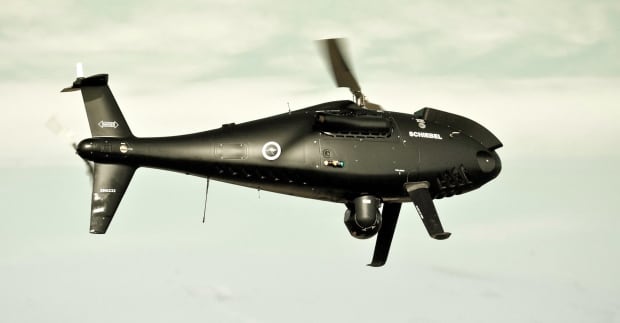
The Schiebel S-100 unmanned aerial vehicle (Schiebel Group)
While the drones may see more flight time, helicopters with on-board pilots will remain the ship's aerial workhorses.

The drones will not be weaponized, carry personnel or heavy payloads and will have a much shorter range than the helicopters.
Other navies have already deployed drones

Earlier this month, the Royal Australian Navy announced it would purchase a number of Camcopter S-100 unmanned vehicles from Austria's Schiebel Group.
Add captionThe Northrop Grumman TERN is designed to take-off vertically like a helicopter, then rotate in midair to fly like a fixed-wing plane. (Northrop Grumman)
The drone helicopter can carry 34 kilograms — typically cameras and sensors — for more than six hours and has a range exceeding 200 kilometres, according to the manufacturer.

The same model has also been purchased by navies in Italy, Jordan, Libya, Russia and China.

The United States defense department is working with American company Northrop Grumman to develop another type of ship-based unmanned aircraft.

The Canadian military will continue gathering input from industry officials this year.

A request for proposals is scheduled to be issued in 2020 and a contract to supply the UAS awarded sometime in 2021.

Thursday, February 23, 2017

Alenia C-27J Legally Challenges FWSAR Airbus C-295W Buy

By: Murray Brewster, CBC News 

The losing bidder in the race to replace Canada's fixed-wing search and rescue fleet is asking a Federal Court judge to toss out the multibillion-dollar contract, CBC News has learned.

Leonardo S.p.A., also know as Alenia, which offered its C-27J transport for the competition, filed notice of legal action in January, but only delivered supporting arguments and affidavits to the court on Tuesday.

The company is challenging the Liberal government's decision last fall to buy 16 new C-295W transports manufactured by rival Airbus Defence and Space.

The Italian aircraft-maker says the bid by Airbus should be disqualified and the court should cancel the contract.

The company cites a number of grounds, including a claim the C-295W does not meet the specifications originally set out by the Royal Canadian Air Force, notably the ability to "perform mandatory long-range missions stipulated" in the request for proposals.

Leonardo's court filing also raises alleged safety concerns related to the absence of a redundant power system in the aircraft.

"The necessary consequences of this inadequacy should have been the disqualification (if no modification was proposed) or rating penalization (if a modification was proposed) of the Airbus proposal," said the filing.
'A decision has been made and it's a really good thing for Canadians.'- Minister of Defence Harjit Sajjan

Separately, Leonardo argues that the Airbus bid should have been disqualified at the outset because of cost.

In late November, the Liberal government announced it was buying the C-295 in a two-step procurement for a total price of $4.7 billion over the next two decades.

The first step — at a cost of $2.4 billion — involves the purchase of aircraft, simulators and 11 years of support.

The second step involves a future in-service support program that will have to be negotiated with Airbus, at an estimated cost of $2.3 billion.

However, in the request for proposals, which was filed in court as part of the supporting documents, all bidders were told their package could not exceed $3.4 billion, including in-service maintenance support.
Silence from Public Works

Officials with Leonardo have sought an explanation from Public Works, but have been met with silence, said a source familiar with the file, but who was not authorized to speak with the media.

"The applicant's proposal to supply Canada with FWSAR aircraft and related services … was evaluated as being fully compliant with the requirements of the (request for proposals) and substantially less costly than the aircraft and services proposed by Airbus," the court filing said.

Federal lawyers have indicated the government intends to fight the claim, but has not filed a statement of defence.

The announcement last December by Defence Minister Harjit Sajjan, Public Works Minister Judy Foote and the commander of the Royal Canadian Air Force, Lt.-Gen. Michael Hood, was supposed to end a frustrating 12-year procurement odyssey that spanned three governments.

Defence Minister Harjit Singh Sajjan says he is confident the appropriate steps were followed in the procurement process and doesn't see any need for further delay. (Sean Kilpatrick/Canadian Press)

It was former prime minister Paul Martin's Liberal government in 2004 that first proposed replacing the fleet.

The former Conservative government, which put the program on hold over allegations the air force had calibrated the specifications in favour of Leonardo's C-27J, eventually asked the National Research Council to evaluate the requirements.

The Air Bus C-295, which is in service in 15 countries, is supposed to speed along the retirement of the air force's nearly 50-year-old C-115 Buffalos and older model C-130 Hercules transports, which were assigned to search and rescue duties a number of years ago.

The government said last fall that the first C-295 is expected on the tarmac in 2019, with the final delivery slated for 2022.

It is unclear how the court challenge will affect that timetable.

Sajjan defended the government's choice late Wednesday, saying he's confident the appropriate steps were followed and doesn't see any need for a delay.

"A decision has been made and it's a really good thing for Canadians," Sajjan told CBC News. "If somebody has any concerns about that decision they have the right to be able to have a look at that decision and use the various processes within our court system."

He described the C-295 as a "game-changer" for the air force.

Canada is Considering its Next Military Deployments

By: Bruce Campion-Smith, The Toronto Star 

OTTAWA—Canada's military is facing a critical few weeks as the federal government weighs renewed deployments to Iraq and Ukraine, ponders the fate of a long-awaited peace mission, lays out a new vision for the armed forces and decides the budget to pay for it all.

It all sets the stage for what promises to be a busy year for Canadian soldiers — one that could leave supply lines stretched — as they continue ongoing deployments in eastern Europe, the Middle East, embark on a new mission to Latvia and finally move ahead on the peace mission that could take them to Africa.

Defence Minister Harjit Sajjan used his oft-repeated line Tuesday that the Liberal government is taking the time it needs.

“We want to make sure that we actually spend the time to get the analysis right and that it goes through the appropriate government process before we make any announcements,” Sajjan said after a cabinet meeting.

In the meantime though, the defence department hangs in limbo as it waits for announcements.


“There’s a lot of uncertainty,” said Dave Perry, a senior analyst with the Canadian Global Affairs Institute.

Military deployments to Ukraine and Iraq are due to expire in March though observers expect both missions to be extended.

The former Conservative government dispatched 200 Canadian troops to Ukraine in 2015 in a non-combat role to train local soldiers, as part of efforts to bolster eastern European countries in the wake of Russia’s annexation of Crimea. It’s expected that a renewed mission in Ukraine will be announced soon.

“Canada is dedicated to the future good fortune of Ukraine. I am preparing options for the government to consider,” Gen. Jonathan Vance, the chief of defence staff, said last week.

Vance said the military has also laid the groundwork to continue its deployment in Iraq, where some 200 special forces soldiers are helping train and advise Peshmerga troops in their fight against Daesh near Mosul. The military operates a hospital near Erbil that has treated 100 patients since November while an air-to-air tanker and surveillance aircraft operate out of airfields in Kuwait.

“Canada is committed to this coalition and options will go before government on how to stay committed to it,” Vance said.

The big question mark continues to hang over the Liberals’ peace mission. After an announcement last August that the government could deploy up to 600 soldiers and 150 police officers on such a mission, a flurry of fact-finding trips to Africa by cabinet ministers, and promises of a decision by Christmas, the file has gone quiet since Donald Trump’s election as U.S. president.

Vance said the world has “changed a little bit” since planning for the mission began and said the government now needs to weigh those changes before deciding where troops are best deployed.

“The government has options before it but I think we’re finding that kind of set piece decision-making doesn’t work very well sometimes in a very, very fluid world where things are changing,” Vance told reporters.

“Where will coalition efforts occur next? What are our allies doing? What do they think?” Vance said.

Since taking over, Trump’s administration has turned up the heat on NATO member nations to pony up more for defence. The Liberal government has made the case that it matters more what Canada — which ranks near the bottom of the spending list — does with its military rather than simply measuring the bottom line. But that dynamic could be forcing the government to reframe its peace mission to account for U.S. concerns.

“I guess it’s understandable that the government wants to wait and see how the security environment unfolds given the U.S. election,” Perry said.

“They may be looking to make sure that any kind of operation we do is connected as much as it possibly could be to a broader alliance,” he said.

Still, the delay in an announcement has likely meant that plans conceived last fall will have to be updated,” Perry said.

“The mission doesn’t sit static, frozen in time while Canada decides whether or not we’re going to participate,” he said.

The other two big pieces of the defence puzzle are the upcoming budget — expected in the coming weeks — and the defence policy review which will lay out a new blueprint for the Canadian Armed Forces for the next 20 years.

According to the government, that strategy will deliver “a modern, more agile and better-equipped military.” It’s expected to touch on everything from procurement process, to whether the navy should have subs, what kind of fighter jets are required for the air force to how the military looks after its personnel.

“What are the capabilities that are required for this and what investment is going to be needed,” Sajjan said during a visit to NATO headquarters earlier this month. “Yes, we will be investing.”

But Perry said the military — which has a budget of $18.6 billion in 2016-17 — needs more money just to maintain the status quo.

“Unless the government directs them to do fewer things than it’s done before, they can’t make do with the existing funding,” he said.

Retired Air Chiefs Urge Liberals to Ditch Super Hornet Buy

By: John Ivison

OTTAWA — Former chief of the defence staff Paul Manson and 12 other retired senior air force commanders have written to the prime minister asking the government to abandon the $5-7 billion interim purchase of Super Hornet fighter jets.

An F/A-18E Super Hornet on the flight deck of the aircraft carrier USS Dwight D. Eisenhower on Oct. 23, 2016 in the Gulf.
An F/A-18E Super Hornet on the flight deck of the aircraft carrier USS Dwight D. Eisenhower on Oct. 23, 2016 in the Gulf. AFP/US NAVY/PETTY OFFICER 3RD CLASS NATHAN T. BEARD
Gen. Manson, who held Canada’s top military role between 1986 and 1989, said the government’s plan to buy an interim fleet to replace the current CF-18 fighters is “ill-advised, costly and unnecessary.”

“I’m 82 years old and I may not see the outcome of all this but I want the facts put before the public,” he said in an interview.

“The main point right now is that the government seems determined to go ahead with a plan that those of us with countless decades of experience running the air force think would take decades to correct. It makes no sense.”

Manson and the 12 former air force lieutenant-generals say they have serious misgivings about the government’s claim that a “capability gap” exists, justifying the need for an interim fleet of 18 Super Hornets.

“Your government’s newly created policy calling for the Royal Canadian Air Force to meet its NATO and NORAD treaty commitments concurrently does not reflect a real and sudden change in the strategic situation. In our experience, it has been decades since Canada had sufficient aircraft to meet all our commitments simultaneously. Over the years, the air force, by judiciously balancing strategic risks and available resources, has managed its operational contributions reasonably well,” the letter states.

Rather than increasing fighter availability, the air force commanders claim the interim fleet would tax resources, because it would require training for pilots and technicians, plus new flight simulators, logistics support and maintenance operations.

Even that would not be enough, the authors say. “It would be necessary to recruit, train and qualify several hundred new technicians and dozens of pilots. Recent experience suggests the RCAF would face difficulty in achieving this … We forsee that bringing in an interim flight would create serious practical problems of this kind.”

If the government is intent on an interim purchase, the letter says, it should examine the prospect of buying so-called legacy Hornets, which are similar to the existing CF-18 and are increasingly becoming available as such partner nations as Australia and the United States replace their Hornet fleets with the F-35 fighter.

“The acquisition cost would be a fraction of a Super Hornet buy,” the air commanders say, pointing out that all the training, logistics and infrastructure needs are already in place.

Related
Liberals admit ‘interim’ Super Hornet jets may only fly for 12 years, despite costing billions
Government decides report that questions purchase of interim fighter jets will remain secret
Retired RCAF commanders say not enough pilots to fly ‘interim’ fighter jets Liberals plan to buy
John Ivison: Liberals’ jet purchase a political solution to political problem of their own making

The letter also urges the government to proceed to the open and fair competition for a permanent replacement for the CF-18s promised by the Liberals during the past election.

During the campaign, Justin Trudeau said the Liberals would not buy the F-35, a statement Manson called “outrageous.”

He said he remains a strong proponent of the F-35, even if that is not the focus of the letter sent to the Trudeau government. He is a former chairman of Lockheed Martin Canada, manufacturer of the F-35, but said he left the company 20 years ago and today has no commercial interest in Lockheed.

Manson admitted that with the Liberals having just backed down on their electoral reform proposal, the prospect of a reversal on the interim purchase is slim.

“There is not an awful lot of hope they’ll do the right thing,” he said.

But, he added that if the interim purchase is being made by the Liberals to ingratiate the government with the incoming Trump administration, it is a superficial solution.

“The point needs to be made that it may add to the one per cent of GDP (spent on defence) but if it doesn’t improve operational effectiveness, it won’t fool our NATO allies,” he said.

According to Jordan Owens, spokesman for Defence Minister Harjit Sajjan, the government has no intention of reversing its decision on the interim purchase.

“The Royal Canadian Air Force faces a significant challenge because it does not have the number of fighter aircraft available to meet Canada’s NORAD and NATO obligations if called to do so simultaneously,” Owens said.

“Our government believes that we owe it to our women and men in uniform to provide them with the equipment needed to do their jobs. By acquiring an interim fighter fleet and proceeding to an open and transparent competition to procure the full replacement fleet, we will be providing the Royal Canadian Air Force with the resources necessary to meet this challenge.

“We have full confidence in their ability to do so.”

Wednesday, February 22, 2017

Canadian Generals Defend Strategy for Defeating ISIL

By: The Canadian Press

PERSIAN GULF — Two senior Canadian generals have defended the current strategy for defeating Daesh (also known as ISIS) in Iraq and Syria, which U.S. officials have put under review following scathing criticism by President Donald Trump.

U.S. Defence Secretary James Mattis was in Iraq this week after Trump gave the retired Marine Corps general until the end of the month to come up with a plan for speeding up the campaign.

During last year’s presidential election, Trump repeatedly criticized the slow pace of progress and promised to introduce a new approach that would hasten Daesh’s defeat.

But Brig.-Gen. David Anderson and Brig.-Gen. Stephen Kelsey say they are hard-pressed to think of ways to improve the existing strategy, which they have watched unfold firsthand for the better part of a year.

And they worry that rushing to destroy Daesh could in fact undermine the progress that has been made in dealing with the root causes that led to the extremist group’s rise in the first place.

“I can’t think of a different way to do this that doesn’t create all the problems that have been there from the past,” Anderson said Monday, before Mattis’s unannounced arrival in Iraq. “I think we’ve got it right.”

Anderson and Kelsey are both based in Baghdad. And while they’re Canadian, each holds a key position within the larger international coalition for defeating Daesh.

Since last spring, Anderson has led a multinational team of military advisers posted inside the Iraqi defence ministry in Baghdad, where they have helped formulate and implement the current campaign strategy.

Kelsey has helped oversee the actual fighting on the ground, which is being largely conducted by Iraqi forces with significant assistance from Canada and other countries.

Mattis hasn’t said what changes he wants to see in the campaign plan, but reports suggest the options under discussion include putting more U.S. troops on the ground and having them do more of the fighting.

American troops, like the roughly 200 Canadian special forces in northern Iraq, have largely stayed out of the fight and instead provided training, advice and some battlefield support from behind.

Anderson and Kelsey insisted it is up to the U.S. to decide its own approach to defeating Daesh; but any change would affect all countries involved in the effort.

That includes Iraq itself, which has been the scene of more than a decade of violence and strife after the U.S. invasion of Iraq in 2003 tore the country apart along ethnic and religious lines.

Kelsey said what’s different in Iraq this time around, and what he believes will end the cycle of violence, is that Iraqi troops are the ones doing the fighting and dying for their own country.

“What’s happening now with the strategy . . . is we are enabling our (Iraqi) partners to defeat Daesh,” he said. “We’re also creating capacity for the longer term.

“And in trying to accelerate that or do it for them, we then start owning the problem and affect their ability to create their own capacity, which is the key to long-term stability in the region.”

The two generals heaped praise on the Iraqi government and military for the progress they have made over the past two years in fighting Daesh while also dealing with various economic and political challenges.

And they said despite the fact Daesh remains a threat in Iraq and Syria more than two years after Canada and other countries intervened militarily, there is light at the end of the tunnel.

“We are closer than we think,” Kelsey said. “And that’s the adult discussion that’s going to play out here in the next little bit.”