Translate

Showing posts with label Future of RCN. Show all posts

Wednesday, December 12, 2018

Quebec Pushing for more Federal Shipbuilding Work

By: David Pugliese, Defence Watch

Quebec’s National Assembly has unanimously adopted a motion in support of the federal government re-examining the National Shipbuilding Strategy and how work on that strategy is allocated. The motion on Friday calls for more work to be directed to Quebec-based Davie Shipbuilding.

MV Asterix departs Halifax Harbour on 11 April, 2018 for the Pacific coast to work with Maritime Forces Pacific. Canadian Forces photo.


Davie has already converted one supply vessel, the Asterix, which is currently at the centre of the legal battle Vice Admiral Mark Norman faces. It is also converting a fleet of used icebreakers for the Canadian Coast Guard.

Quebec’s politicians want the Liberal government to proceed immediately with a second supply ship from Davie.

Not surprisingly, Davie officials and industry affiliates welcomed the political support and issued a news release Friday highlighting the National Assembly’s position.

“In order to ensure the success of the government’s defence policy – Strong, Secure and Engaged – as well as the navy’s Leadmark 2050 plan, we need to begin the construction of a second ship without delay,” James Davies, President of Davie Shipbuilding, said in a statement.

Irving and Seaspan, the shipyards selected to perform the major chunk of work under the shipbuilding strategy, are opposed to additional contracts going to Davie. Irving, in particular, has voiced its concern.

Seaspan shipyards in Vancouver will build the first of two Joint Support Ships, scheduled to be ready in the 2021-2022 timeframe.

This is not the first time that Quebec has pushed for more work under the shipbuilding strategy. In December 2017, politicians and unions in Quebec tried to turn up the heat on the Liberal government, questioning why Davie shipyards wasn’t getting work from the federal government. They highlighted the capability of the shipyard to deliver a second Asterix-type ship quickly.

But Transport Minister, and former navy officer, Marc Garneau said the federal government didn’t need another supply ship.
”We cannot artificially create a need for something that doesn’t exist,” he told reporters at the time.

He did not explain how one supply ship would support naval fleets operating on two coasts.

Tuesday, November 20, 2018

Government Announces Purchase of 6th AOPS

By: Mairin Prentiss · CBC News

The federal government is purchasing another ship to be built in Halifax, the defence minister says a day after Ottawa awarded $7 billion in contracts to three shipyards for work on Royal Canadian Navy frigates — leaving concerns over an 18-month gap in work for Irving Shipyard employees.

Image result for aops
The First Arctic and Offshore Patrol Ship assembled at Halifax Shipyard - Irving Shipbuilding
The government will buy a sixth Arctic and offshore patrol ship for the navy, Harjit Sajjan said to a crowd at the Irving Shipyard in Halifax on Friday.

"The women and men of the Irving Shipyard build incredible ships and are essential for enabling the success of the Royal Canadian Navy," said Sajjan.

The government planned to purchase five Arctic and offshore patrol ships — with a possibility of a sixth — after scaling back its original plan of buying between six and eight vessels in 2014.

Public Services and Procurement Canada announced Thursday in a news release that it intends to sign contracts worth $7 billion with Davie in Lévis, Que., Irving Shipbuilding Inc. in Halifax and Seaspan Victoria Shipyards in Victoria for maintenance on 12 Canadian navy ships.

With the maintenance program split between three yards, workers in Halifax feared they would be laid off in between the end of the patrol ships program and the start of the Canadian Surface Combatant program.

Last month, Irving employees held a march in Halifax to protest the Liberal government's intention to split the contracts with other yards, saying it would result in job losses.

Irving Shipyard workers say sharing the work will mean layoffs. (Robert Short/CBC)

Friday's announcement appears to be aimed at allaying those fears.

In a news release, the Department of National Defence said the sixth ship will help sustain hundreds of jobs at Irving shipyards.

"Today's announcement is good news for the Royal Canadian Navy, but it is also good news for Canadians, our economy and the city of Halifax. This is a region with deep ties to our navy," said Sajjan.

"By adding a sixth Arctic and offshore patrol ship, we are ensuring that our Royal Canadian Navy remains an agile and responsive force for years to come, so that Canada can continue to assert and enforce our Arctic sovereignty," he said.

Irving officials had meetings in Ottawa on Thursday where they said they received the news.

But building another ship doesn't mean there won't be layoffs, said Kevin McCoy, the president of Irving Shipbuilding.

"Nothing is guaranteed until we have contracts in hand and I know hearing that might make some folks a little uneasy, but I am encouraged by our discussions yesterday particularly around Halifax class maintenance work. This is a big piece of solving about a three-year problem, but we now have about half the problem solved."

Irving will begin construction on the fourth Arctic and offshore patrol vessel later this year.

Monday, October 22, 2018

British firm BAE Selected for Canada’s $60B Warship Replacement Program

By: David Pugliese, The National Post 

The Canadian Surface Combatant project will see the Halifax-based Irving build 15 warships, which will form the backbone of the future Royal Canadian Navy.


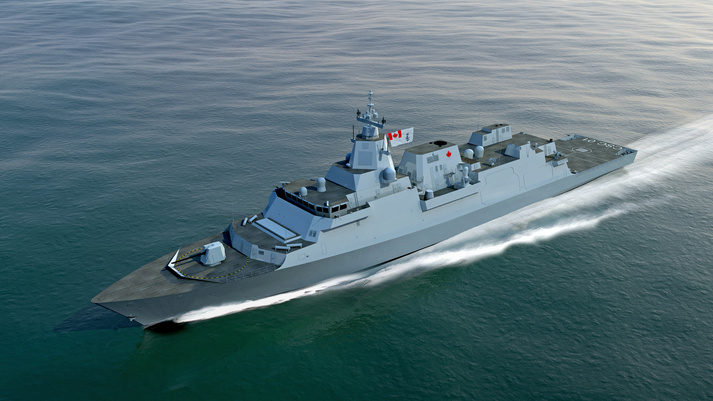
Artists Rendition of an RCN BAE Type 26 Global Combat Ship. BAE Handout
The Canadian government has selected a consortium closely linked to Irving Shipbuilding to provide it with a new warship design for the most expensive defence project the country has ever seen.

Canada announced Friday it had chosen the Type 26 warship design by British defence firm BAE for the $60-billion program to replace the Royal Canadian Navy’s Halifax-class frigates. Lockheed Martin Canada is leading the BAE consortium and will be the prime contractor. The group’s win had been anticipated since 2016, however, after rival defence firms raised concerns that the competition had been rigged in favour of the British design.

The Canadian Surface Combatant project will see the Halifax-based Irving Shipbuilding build 15 warships, which will form the backbone of the future Royal Canadian Navy. It will be the largest and most complex procurement in Canadian history. However, it is seen as a major departure from previous procurement processes, as Irving is playing a significant role in selecting the winning design.

The previous federal procurement minister, Judy Foote, had said only mature existing designs or designs of ships already in service would be accepted for the bidding process, on the grounds they could be built faster and would be less risky — unproven designs can face challenges as problems are found once the vessel is in the water and operating. But the Liberal government and Irving accepted the BAE design into the process, though at the time it existed only on the drawing board. Construction began on the first Type 26 frigate in the summer of 2017 for Britain’s Royal Navy, but it has not yet been completed.
Federal shipbuilding program poorly managed and lacks oversight, government adviser warns
Federal warship replacement cost swells to $62 billion, now more than twice the original budget: PBO
Liberals reject warship proposal that companies said would save taxpayers as much as $32B

Both Irving and the federal government have insisted the procurement was being conducted in a way that ensures all bidders are treated equally, overseen by a fairness monitor with no unfair advantage given to any individual bidder. Nonetheless, while three consortiums submitted bids for the surface combatant program, several European shipbuilders decided against participating because of concerns about the fairness of the process. Others raised concerns about BAE’s closeness with the Halifax firm.


Last year a French-Italian consortium also declined to formally submit a bid and instead offered Canada a fleet of vessels at a fixed price. Officials with Fincantieri of Italy and Naval Group of France said they don’t believe the procurement process as it is currently designed will be successful. The federal government, however, rejected the deal.

The federal government had to remind Irving about the potential for conflict of interest when the firm joined forces with BAE in late 2016 to bid on a multi-billion dollar contract to provide maintenance and support for the navy’s new Arctic patrol and supply ships.

The Irving-BAE alliance was not successful in that bid, but it led the government to remind Irving it had an obligation to “ensure that the Canadian Surface Combatant competition is conducted in a manner that is free from real or perceived conflicts of interest,” according to February 2017 documents prepared for defence minister Harjit Sajjan and released to the Conservatives under the Access to Information law.

Andre Fillion, assistant deputy minister for defence and marine procurement at Public Services and Procurement Canada, said Friday’s decision is not a contract award. “It’s an important step to getting to contract award in the coming months,” he said.

Negotiations will now begin with Lockheed Martin. if negotiations proceed accordingly a contract is expected to be signed sometime between January and March 2019.

But Fillion said if there are issues with those negotiations and an agreement is not reached, the government will then turn to the next highest-ranked bidder. The government has declined to identify that firm, but the other bidders were from the U.S. and Spain.

The Canadian Surface Combatant program has already faced delays and rising costs. In 2008 the then-Conservative government estimated the project would cost roughly $26 billion. But in 2015, Vice-Admiral Mark Norman, then commander of the navy, voiced concern that taxpayers may not have been given all the information about the program, publicly predicting the cost for the warships alone would approach $30 billion.

Monday, June 4, 2018

Final Cost for RCN Joint-Support-Ships Still Unknown as Work Begins

By: Lee Berthiaume, The Canadian Press 

OTTAWA -- The cutting of steel for the navy's long overdue support ships will begin next month in Vancouver, even though the federal government doesn't know how much the two vessels will ultimately cost.

Federal procurement minister Carla Qualtrough confirmed plans for an early start to work on the supply ships during a breakfast address Thursday at the Cansec defence show in Ottawa.

Seaspan Shipyards will receive $66 million to work on several dozen components of the so-called joint support ships during a lull in the building of two other Canadian Coast Guard vessels.

The government is hoping that advance work will shave about a year off the expected delivery time for the first support vessel, which is currently slated to hit the water in 2023.

It will also ensure Seaspan continues to have work for its employees during what would otherwise be a dead zone between construction of the last of three coast guard fisheries vessels and a new coast guard ocean science ship.

"These support ships will deliver fuel and other vital supplies to vessels at sea," Qualtrough said, "ensuring our women and men of the Canadian Armed Forces are able to carry out their missions for decades to come."

The navy has been without a permanent support ship since retiring its last two in 2015 because of an unexpected fire and excessive corrosion, and is currently relying on a converted civilian vessel to fill the gap.

The first new vessel, originally proposed by the Conservative as the Queenston-Class, now rebranded by the Trudeau Government as the Protecteur-Class was originally supposed to be delivered in 2019, but the project has been plagued with delays. The ships will be modeled after the German Navy's Berlin-Class Supply ships. 

EGV Berlin.JPG
The EVG Berlin, the flagship of The Berlin-Class. 
Even as work is set to begin, however, Qualtrough conceded later that the government still doesn't have a concrete estimate of how much the two joint support ships are going to cost.

"It's too early to speculate on what the (support ships) will ultimately cost," she said.

The previous Conservative government set a budget of $2.3 billion for the vessels back in 2011, but that number has been under review for nearly two years.

The parliamentary budget office pegged the full cost of two support ships back in 2013 at $4.13 billion, while the government's new defence investment plan, released this week, said it could cost up to $4.99 billion.

"There are a lot of things happening on (the support ships)," said Andre Fillion, head of military procurement at Public Services and Procurement Canada.

"The acquisition of long lead items, the start of the (early work) and also a lot of engineering work."

Seaspan vice-president Tim Page told The Canadian Press that the shipbuilder is in negotiations with the government, but remains committed to delivering the support ships to the navy.

Starting work early is a reasonable solution to what would otherwise be a troublesome lull in work at Seaspan, said defence analyst David Perry of the Canadian Global Affairs Institute.

But the government still doesn't have an approved design for the support ships, he said, and the whole point of the federal government's multibillion-dollar shipbuilding strategy was to prevent such production gaps.

"It's a solution to an immediate problem," Perry said, "but it's not by any means an ideal scenario."

Thursday, May 3, 2018

RCN and Irving Look to Sell AOPS Internationally to Fill Construction Gap

By: David Pugliese, National Post

The gap between the building of new ships for the navy could be as much as 18 months, opening the possibility of east coast shipyard employees to be laid off.

But the Defence department’s top equipment official says changes to the shipbuilding procurement process will reduce some, but not all, of that gap. Workers that could be affected would be blue-collar shipyard employees at Irving Shipbuilding.

The 18-month gap between finishing construction of the fleet of Arctic Offshore Patrol Ships or AOPS and starting the new Canadian Surface Combatant vessels at Irving shipyards in Halifax is outlined in documents obtained by Postmedia through the Access to Information law.

Image result for AOPS

“We are still concerned about a gap,” Pat Finn, assistant deputy minister for materiel at the Department of National Defence, acknowledged in a recent interview.

The engineering workforce in the Irving yard is about to ramp up dramatically, he added, so there are no concerns there. “The issue is on what we call the blue‑collar workforce, and particularly (in) the early stages of construction,” Finn explained. “Those are the people that, once you’ve finished cutting steel in the last AOPS, ideally the next day you start cutting steel on the first surface combatant. Well, right now we’re not lined up to do that.”

Construction of the first surface combatants isn’t scheduled to begin until the early 2020s.

The first AOPS will be in the water in the summer and the other vessels are expected to follow fairly quickly.

“The gap is still a few years away, but clearly if we’re going to make sure there’s continuous flow of work, we’ve got to be dealing with that now,” Finn said.

He said the Royal Canadian Navy is lending its support to help promote the AOPS to international customers in the hopes of drumming up more work to shrink the size of the construction gap.

Procurement Minister Carla Qualtrough has also said she is open to the idea of additional AOPS being purchased for Canada.

Irving spokesman Sean Lewis said Wednesday that the company, the federal government and a third-party expert continue to look at the issue. “The construction of additional AOPS for Canada or international export opportunities is being considered and various options pursued,” he explained. “At this time it is premature to comment further.”

It’s way too early to talk about layoffs

In November federal government and Irving officials acknowledged their worry that highly skilled employees and their expertise could be lost in any potential gap between construction of AOPS and the surface combatants. “It’s way too early to talk about layoffs,” Irving Shipbuilding president Kevin McCoy said at the time.

The same problem has emerged in the federal shipbuilding program on the west coast and unions there warn that layoffs are coming. Seaspan Shipyards in Vancouver acknowledges there will be a gap between the construction of coast guard vessels, a situation it is trying to deal with by drumming up more work from the federal government or from the commercial marketplace.

Such gaps were supposed to be prevented by the federal government’s national shipbuilding strategy, which called for the continuous build of vessels, ensuring steady employment for a skilled labour force.

The Canadian Surface Combatant program will cost between $55 billion and $60 billion. Fifteen ships will be eventually built. Three consortiums have bid on the program.

Image result for Type 26 Canadian Surface Combatant proposal
Artits Rendering of the BAE Type-26 Global Combat Ship; which many believe is the frontrunner in the CSC Fleet Proposal.
Finn said a contract is expected to be awarded by the end of the year.

About half of the cost of the surface combatants is for systems and equipment that will go on the 15 ships, according to federal documents obtained by Postmedia through the Access the Information law. “Approximately one-half of the CSC build cost is comprised of labour in the (Irving’s) Halifax yard and materials,” the documents added.

Last year, Jean-Denis Fréchette, the Parliamentary Budget Officer, estimated the CSC program would cost $61.82 billion. He also warned that every year the awarding of the contract is delayed beyond 2018, taxpayers will spend an extra $3 billion because of inflation.

Friday, April 20, 2018

Firms Skipped CSC Bib for Fear of Loss of Proprietary Information

By: David Pugliese, Ottawa Citizen 

In December Fincantieri of Italy and Naval Group of France decided not to bid on the Canadian Surface Combatant project. Instead, they offered the Canadian government a direct proposal that would see the the companies build 15 of the consortium’s FREMM frigates at a fixed price of roughly $30 billion.

The Liberal government rejected the offer.

A FREMM frigate sails off the coast of France in 2016. BORIS HORVAT/AFP/GETTY IMAGES
Fincantieri and Naval Group knew they were taking a chance when they passed on the formal bidding process for the CSC. Sources close to the European companies said at the time they felt they didn’t have anything to lose. They alleged the Canadian competition was skewed to favour a bid by Lockheed Martin Canada and the British firm BAE which would see Canada buying the Type 26 frigate BAE is building for Britain’s navy.

The Canadian government had originally asked for only bids featuring proven ship designs. But it later changed those parameters to allow a bid from BAE, though the Type 26 was at the time still on the drawing board.

Giuseppe Bono, the CEO of Fincantieri, recently told my colleagues at the U.S. publication Defense News of another concern that led to the decision not to bid on the CSC. Bono said that the firms were willing to turn over their sensitive technical data to the Canadian government but that they drew the line at providing the proprietary information to Irving and its team.

“We said we were prepared to give the information to the Canadian government but not to a rival company if we didn’t know if we were going to win the bid or not,” Bono said.

Fincantieri and Naval Group, along with other companies, have voiced concerns about Irving’s alliance with the U.S. firm, Gibbs and Cox, a top U.S. naval architecture firm that designs surface warships. Gibbs and Cox is also the main competitor for many companies – including Fincantieri and Naval Group – pursuing ship contracts around the world.

Irving, however, has rejected such concerns and has stated it is committed to protecting any sensitive data provided by companies bidding on CSC.

But Fincantieri and Naval Group weren’t buying that reassurance.

The firms still have their proposal ready in case the Canadian procurement falls apart and the federal government decides on a different course of action.

In February, the U.S. Navy named the FREMM design as one of five it could consider for its future frigate program and has provided Fincantieri $15 million to look at a design concept.

Monday, April 16, 2018

Bids for Future RCN Warships Don't Meet Many of the Requirements

By: David Pugliese, The National Post 

Canada’s quest for a new fleet of warships is off to a rocky start with all bidders failing to meet some of the federal government’s requirements.

Procurement officials are now trying to regroup on the $60-billion project and figure out ways that bidders might be able to change their proposals to make them acceptable, a number of defence industry executives pointed out.

The problems centre around technical issues. Some are minor but in other cases there is a view among defence industry officials that Canada is asking for too much in some areas such as radar, which may be causing problems with meeting requirements.

Public Services and Procurement Canada spokeswoman Michèle LaRose said the bids received for the Canadian Surface Combatant project have not been disqualified. Three bids have been received. The federal government and Irving Shipbuilding are still evaluating the proposals, she added. LaRose pointed out that the evaluation is at the second stage in the process.

Government officials say that involves what is known as “the cure process” in which bidders will be given details of how their proposals have failed to meet the stated criteria. They will then be given only one opportunity to fix issues with their bids.

HMCS St. John’s, one of Canada’s Halifax-class frigates, undergoes a mid-life refit at the Irving Shipbuilding facility in Halifax on Thursday, July 3, 2014. Andrew Vaughan/Canadian Press

If they are still considered “non-compliant” after the cure period they “will be eliminated from the competition,” according to the federal government.

Technical specifications are now being evaluated by the government. Later this year, the companies will provide the financial information related to their bids.

Warship builders submitted their bids on Nov. 30. A winning bid is expected to be selected sometime this year.

Irving Shipbuilding will begin construction of the first ship in the early 2020s and delivery of the first vessel is expected in the mid-2020s, according to the federal government.

But the project has been plagued with delays and controversy.

Approximately one-half of the CSC build cost is comprised of labour in the (Irving’s) Halifax yard and materials

The final cost of the ships is still unknown. In 2008 the government estimated the total cost of the project to be about $26 billion.

But in 2015 navy commander Vice Admiral Mark Norman voiced concern that taxpayers may not have been given all relevant information, and publicly predicted the cost for the ships alone would be around $30 billion.

Cost estimates for the project are now between $55 billion and $60 billion.

About half of the cost is for systems and equipment that will go on the 15 ships, according to federal documents obtained by Postmedia through the Access to Information law. “Approximately one-half of the CSC build cost is comprised of labour in the (Irving’s) Halifax yard and materials,” the documents added.
HMCS Iroquois arrives in Halifax on Oct. 23, 2008 after a six-month deployment to the Persian Gulf and Arabian Sea. Andrew Vaughan/Canadian Press
Last year, Jean-Denis Fréchette, the parliamentary budget officer, estimated the CSC program would cost $61.82 billion. He also warned that every year the awarding of the contract is delayed beyond 2018, taxpayers will spend an extra $3 billion because of inflation.

The surface combatant will be the backbone of the future Royal Canadian Navy.

In November in a surprise twist a French-Italian consortium declined to formally submit a bid and instead offered Canada a fleet of vessels at half the price.

Officials with Fincantieri of Italy and Naval Group of France said they don’t believe the procurement process as it is currently designed will be successful.

Instead they provided the Canadian government with a direct proposal that Irving Shipbuilding on the east coast construct 15 ships based on the consortium’s FREMM frigate design, which is proven and is currently in operation with the French and Italian navies. They are guaranteeing the cost of the ships at a fixed price of $30 billion.

The deal would have also focused on using Canadian technology on board the ships and included technology transfer to Canadian firms, so they could be involved in future sales of the FREMM vessels on the international market.

FREMM ships are operated by the Italian, French, Moroccan and Egyptian navies.

Under that plan, Irving could start building the warships almost immediately.

The Liberal government, however, rejected the deal.

Tuesday, April 3, 2018

Danish Arctic Patrol Ship coming to Halifax

By: David Pugliese, Defence Watch 


Representatives from Canada’s defence industry are being invited to tour a Danish Arctic patrol ship that will be in Halifax April 4-5.

The EJNAR MIKKELSEN (EJMI) is one of three KNUD RASMUSSEN-class Arctic vessels, supplementing the four units of the larger THETIS-class, Lt. Col. Per Lyse Rasmussen of the Danish embassy in Washington, pointed out to Canadian industry.

The ship is similar in design to Canada’s Arctic Offshore Patrol Ships being built by Irving but it is smaller. What is also significantly smaller is the cost. Each AOPS is estimated to cost $700 million. The Danish ships are estimated to cost $70 million to $80 million each.

Here are some more details about the ship provided by Rasmussen to Canadian industry representatives:

EJMI is primarily used in the Arctic and specifically in the waters around Greenland as an Arctic Patrol Vessel. Main missions are surveillance, sovereignty enforcement, search and rescue, fishery protection and support to the local community. Other tasks include environmental monitoring, assistance to research and scientific studies, navigational tasks, ice reconnaissance, collection of weather and oceanographic data, icebreaking, explosive ordinance disposal and transportation of personnel and materiel. Additionally, EJMI also offers assistance to Greenland’s Home Rule Government, the Danish Meteorological Institute, the National Police of Denmark, Customs Authorities and many others.

Some useful facts about EJMI, which was named 13 September 2008 after one of the Danish polar explorers:

Length (total): 71,80 meters

Beam: 14,60 meters

Draught: 4,95 meters

Displacement (standard): 2,050 tonnes

Engines: Two MAN diesels 7.770 hp, three generators

Speed (eco): 12 knots

Speed (max): 17 knots

Icebreaking capability: about 3 feet (up to 5 feet)

Basic crew: 19 (up to 43/45)

Range at 12 knots: 7,050 nm

Container positions: 4 standard flex

Weaponry: One 3-inch Oto Melare gun, two 50-cal heavy machine guns, two light machine guns

Other facilities: Flight deck, hospital, SAR-vessel, RHIBs.

Photos Courtesy of the Danish Navy. 

Tuesday, March 6, 2018

RCAF Outlines Cyclone Fix for Landing on RCN Fleet

RCAF Press Release 

Back in December the Canadian Press news agency had a story revealing a new series of problems affecting the RCAF’s new maritime helicopter, the CH-148 Cyclone, and its sonar system. The article outlined how the sonar system used by some CH-148 Cyclones must be removed before the helicopters are allowed to land on ships.

Crewmembers onboard Her Majesty’s Canadian Ship (HMCS) MONTREAL conduct vertical replenishment training with the CH-148 Cyclone helicopter during Exercise SPARTAN WARRIOR 16 in the Atlantic Ocean on October 31, 2016.

Photo: MCpl Jennifer Kusche, Canadian Forces Combat Camera 
IS15-2016-0003-042
The RCAF has provided additional information to Defence Watch about what caused the problems and what is being done about those issues:

What is the issue with the sonar equipment on the CH-148 Cyclones?

The HELRAS is a deployable sonar system onboard the CH148 Cyclone. The HELRAS internal reeling machine (used to recover the unit after it has been deployed) on the Block 1 CH-148 was modified (tilted slightly) to improve the hover characteristics of the aircraft while deploying the sonar into the water. The slight “tilt” of the reeling machine results in the sonar protruding slightly from the base of the helicopter once it has been recovered into the helicopter.

The protrusion from the base of the helicopter introduces a risk of the sonar striking the Cyclone – Recovery Assist Secure and Traverse (C-RAST) during a ship landing. Analyses have shown that, in theory, it is possible for the sonar submersible unit to contact the ship mounted assisted recovery system when operating in a high sea state condition. If contact occurred, it would not prevent the safe recovery of the helicopter but it could cause damage the submersible unit.


To prevent damage, the sonar submersible unit is not installed whenever the Block 1 configured Cyclones conduct shipborne operations. The Block 1 aircraft can fly from shore-based locations with the sonar installed.
This has had no impact on flying or training, as maintenance personnel can remove the sonar prior to conducting embarked operations.

How effective is the Cyclone as a maritime helicopter without its sonar system? Without its ship landing system?
Using its Sonobuoy Processing Sub-System (SPSS) to prosecute sub-surface targets by deploying sonobuoys into the water and processing their signals, the CH148 Cyclone is an effective ASW asset. The HELRAS is an additional system that can be used to prosecute sub-surface targets, but it is not the only means of conducting ASW operations. All of the other sensor systems on the CH148 can be used unrestricted (Radar, IR camera, etc.), making it an effective weapons system across the spectrum of operations.
Without the use of C-RAST, the CH148 is limited to a conservative ship motion envelope for takeoff and landing, and cannot be traversed into or out of the hangar. Again, CH148 maintenance personnel can remove the HELRAS system to conduct shipborne landings as required. Helicopter Air Detachments that embark with a Block 1 CH148 include the HELRAS as part of the equipment pack-up onboard ship. In the case of a requirement to use the HELRAS, the CH148 can be disembarked to a shore location where the sonar can be installed and operations conducted from the land based airfield.

What’s being done to fix the issue?

In the Block 2 configuration, the sonar system has been re-positioned so that the submersible unit will be housed completely inside the fuselage when stowed. This redesign eliminates the possibility of contact between any part of the helicopter and the ship mounted assisted recovery system.

The first 6 Block 2 Cyclones are scheduled to be delivered to Canada by June 2018.

Block 1 Cyclones have already begun a phased return for induction into Sikorsky’s Block 2 production line. For example, of the fifteen Block 1 helicopters delivered, seven have been rotated back to the contractor for retrofit and delivery in the Block 2 configuration. All 28 aircraft will be retrofitted, and final delivery is expected to be completed by 2021.

In its final configuration, the CH-148 Cyclone will be capable of a full range of anti-submarine and anti-surface warfare, search and rescue and utility missions in various environments, making it one of the most capable maritime helicopters in the world.

How much is it costing to fix the issue?

There is no additional cost to the Crown to rectify this issue.

What are the Block 1 Cyclones doing now?

The Cyclones currently in Shearwater are suitable for training and operations for a number of missions including Search and Rescue, utility transport, and surface and sub-surface surveillance, from both ashore, and while embarked on Royal Canadian Navy ships.