Translate

Showing posts with label CDS. Show all posts

Friday, June 22, 2018

Selling the Mali Mission: CDS Vance Heading to Africa with Journalists

By: David Pugliese, The Ottawa Citizen 

Selling the public on the Mali mission will get underway pretty soon. The African mission is the Liberal government’s high-profile initiative to show Canada supports the United Nations. The government is concentrating on generating as much positive publicity as it can for Canada’s contribution, which also coincides with a Liberal election promise to do with the UN.

As part of that public relations effort, Chief of the Defence Staff Gen. Jon Vance is said to be soon heading to Mali, according to reports. Journalists from the CBC and the Canadian Press will be coming along. No dates are being provided at this time and the Department of National Defence doesn’t want to talk about Vance’s involvement in the public relations trip at this point.
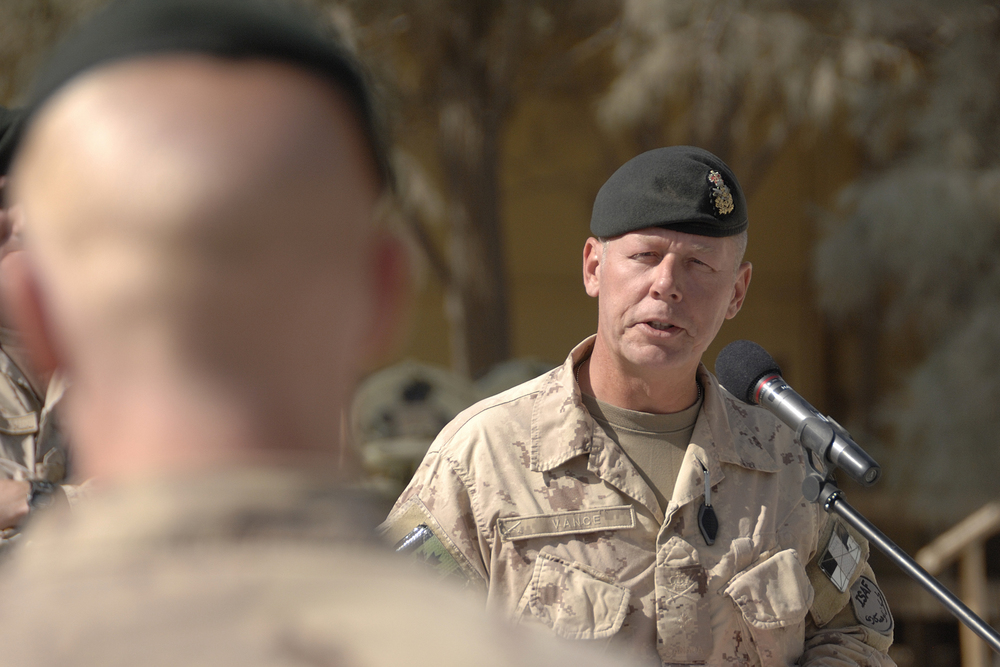
Image result for CDS Vance
Then LGen Jonathan Vance, then a Brigadier General, delivers a speech while serving as Kandahar 2013. 
“We cannot speak to movements of CAF senior leadership, however CBC and the Canadian Press will be visiting Mali in the near future,” Department of National Defence spokesman Dan Le Bouthillier told Defence Watch Thursday.

Canada announced in March that it would send support personnel, two RCAF Chinook helicopters, as well as four armed Griffon helicopters to act as escorts for those larger aircraft, to Mali, a west African country that since 2013 has been dealing with insurgents and armed Islamic extremists. The mission is expected to start in late July/early August.

The mission, however, has been dogged by more than a few concerns.

Conservative MPs have voiced criticism about the lack of planning and what they claim is a lack of mission focus.

To be sure, there was confusion initially. In mid-March, Defence Minister Harjit Sajjan announced that Canada would send two Chinook helicopters and four armed Griffon helicopters. A few minutes later at the same news conference Vance said the number of helicopters being assigned to the Mali mission had still not been determined. A short time after that, Sajjan’s office sent out a message to journalists, contradicting Vance by stating that ‘up to’ two Chinooks and four Griffons would be sent. Then another message went out to journalists later that there would be extra helicopters sent as backup.

The helicopter issue was eventually sorted out. But attention turned to the potential danger and whether the Mali mission could be considered as combat. MPs on the House of Commons defence committee raised those concerns and questioned generals about details of the Mali operation and whether Canadian military personnel would be safe.

Conservative defence critic James Bezan wanted information about the risks and whether troops would have enough protection from insurgent attacks. Questions were also asked about whether insurgents had surface-to-air missiles that could be of a threat to RCAF helicopters. “Our guys could potentially be going into hot conflict,” Bezan said at the committee.

Another MP asked if Mali was a war zone. Lt. Gen. Stephen Bowes, who was appearing before a Commons committee, answered that, “war zone is not a term. It’s a complex conflict zone.”

Such questions from MPs sparked Col. Jay Janzen, the Canadian Forces Director of Strategic Communications, to tweet to defence journalists that “Canada can do better than the nonsensical ‘combat/not-combat’ debate.”

That, in turn, prompted a showdown between Bezan and Conservative MPs and Janzen (who is slated to be promoted to Brig.-Gen. and put in charge of Canadian Forces public affairs).

Bezan lectured Janzen that he, as a MP, could ask whatever question he pleased and that questions about the safety of troops were certainly valid. He accused Janzen of trying to stifle debate. Bezan also noted that the head of the United Nations mission to Mali has characterized the operation as “war.”

“We have the right to know how Justin Trudeau is using our Canadian Forces to get (a) UN Security Seat,” Bezan tweeted.

Janzen said that while the military is subordinate to civilian authority, he had the right to make such comments.

Vance has done such mission public relations tours before. In 2016, he brought journalists along for his tour of the Canadian special forces mission in Iraq. The special forces were there to help the Kurds battle Islamic extremists who had seized large parts of Iraq.

The event was closely coordinated with Prime Minister Justin Trudeau’s office, as is this Mali trip. Vance also used that trip to play down any concerns about cracks in the Iraq-Kurd alliance. He told CTV at the time he didn’t agree there was a rift in the relationship between the two groups. A year later Kurdish and Iraqi forces were fighting each other.

What comes from the Mali visit remains to be seen but the Trudeau government wants public relations emphasis on support to the United Nations and the use of women on such missions.

Here is a snippet of the messaging that is to be provided to the news media: “The Canadian Armed Forces are working as part of an integrated, whole-of-government approach to deliver on Canada’s commitment to increase its support for UN peace support operations. Canada is a strong supporter of UN peacekeeping, and the CAF is prepared to make valuable contributions to this UN stabilization mission. To be safe at home, we need to contribute to international security abroad.”

Monday, January 23, 2017

Lawson fears Liberals Fighter Jet plan too Pricey

By: Laura Payton, CTV News 

The former head of Canada's military says the Liberal government’s plan to buy an interim fighter jet fleet will be expensive and difficult to carry out.

Retired general Tom Lawson, who served as chief of the defence staff from 2012 to 2015, says he believes Canada will end up buying Lockheed Martin's F-35 fighter jet to replace the current fleet of CF-18 Hornets despite the government choosing Boeing's Super Hornet to beef up the current air craft.

"There are hundreds of these things flying now and they've been declared combat-capable in the United States," Lawson said in an interview with Evan Solomon, host of CTV's Question Period.

Retired general Tom Lawson appears on CTV's Question Period on Sunday, Jan. 22, 2016.

"And they'll be getting better and better for years to come. The F-35 is the way forward, not only for the United States but all the members and the partners who have bought into that program."

Lawson, a long-time supporter of the F-35, is now retired from the Canadian Forces. In an email to CTVNews.ca, he said he has done several days of work for Lockheed Martin as a strategic adviser, but noted his support for the F-35 dates back to his time as assistant chief of the Royal Canadian Air Force.

The F-35 was the source of considerable controversy during Lawson's time as Canada's top soldier, after the auditor general and parliamentary budget officer found a range of problems with a planned purchase of the Lockheed Martin jets. The problems included national defence not telling the government about the aircraft's potential drawbacks or the full costs of the program, as well as not having documents to support some of the decisions defence officials made.

Prime Minister Justin Trudeau promised, during the 2015 election campaign, to hold an open competition to choose the CF-18 replacement, but pledged at the same time not to buy the F-35.

Last November, the government announced it was working on buying 18 Boeing Super Hornets as an interim measure while holding a five-year competition to choose a long-term replacement for the CF-18s.

Lawson, a former pilot, said that decision caught him off-guard because he believes Canada will eventually purchase the F-35.

"Every time the F-35 is in competition, it is the top -- in many cases the only choice out there, and it's becoming cheaper and developing an excellent reputation," Lawson said.

"So I think what caught me by surprise is that this putting off of that decision will of course be expensive and very difficult for the RCAF to carry out."

The current fleet of CF-18s is more than 30 years old and down from 138 planes to 76, according to numbers provided by the government.

During the 2015 election campaign, the Liberals estimated the cost of an F-35 at $175 million per plane, with the Super Hornet coming in at $65 million.

Canada has obligations to NORAD and NATO that require a specific number of jets to be "mission-ready," although officials won't say how many planes that means. Defence officials say there aren't enough mission-ready planes, but admit that is due to a change in policy under which they started counting the combined NORAD and NATO commitments. That policy changed on the day they announced the plan to purchase an interim fleet, a defence spokeswoman told

Saturday, October 8, 2016

CDS Flip Flops on African Mission

By: David Pugliese, Defence Watch

Michael Staples at The Daily Gleaner newspaper in Fredericton recently had an interview with Chief of the Defence Staff Gen. Jon Vance, in which some of the general’s interesting views emerged.

During the interview Vance claimed that all the discussion over the last several months about a Canadian military mission to Africa was just an “assumption” based on “people’s own assessments in the media.” “It’s been “over reported,” Vance claimed.

“Right now, I’ll tell you, honestly, there is no such thing as an Africa mission,” Vance told The Daily Gleaner. “It’s been over reported based on peoples’ own assessments in the media, in my view, that if you look at the world, it’s going to be an African mission. It’s an assumption.”

I wonder where all that “over reporting” came from? How did these media commentators ever, ever come to the “assumption” that the Canadian military was going to conduct an operation/operations in Africa?

Could it be in August when Defence Minister Harjit Sajjan told journalists that the Canadian military was looking at a number of countries in Africa to contribute troops?


Maybe.

Or how about this statement back in July?

“Internationally, the Army is at the forefront, managing conflicts around the world, contributing to operations in Iraq, building capacity with allies and partners in Poland, Ukraine, and very soon in Africa.”

Who said that?

Yes, that came direct from…..Chief of the Defence Staff Gen. Jon Vance.

Thursday, October 22, 2015

Canada in Iraq: CDS Vance to Provide Trudeau with Options

David Pugliese had  a good piece today in the Ottawa Citizen, discussing Canada's possible future role in Iraq against the Islamic State (ISIS). The new Liberal government plans to end Canada's bombing campaign, but no end date has been determined yet. 

Lt.-Gen. Jonathan Vance, then-Commander of Canadian Joint Operation Command, holds a technical briefing on combat strikes against the Islamic State at National Defence Headquarters last fall.
General (Then Lt. Gen) Jonathan Vance (former Commander of Canadian Joint Operations Command) holds a technical briefing on combat strikes against ISIS at NDHQ in Ottawa in the fall of 2014.

Article Written by David Pugliese, Ottawa Citizen, October 22, 2015 (page A13)

Military planners are working to come up with scenarios for the new Liberal government on how Canada can contribute troops to train Iraqi forces battling the Islamic State, even as Canada winds down the bombing campaign.

Prime Minister-designate Justin Trudeau this week reaffirmed his intention to have Canada pull out of the bombing against ISIL in Iraq and Syria, and instead focus on troops to train Iraqi soldiers.

Canada already has 69 special forces soldiers training Kurds in northern Iraq. It is unclear at this point whether an expanded training role would mean boosting the size of that special forces contingent or whether it would see regular troops helping improve Iraqi skills.

There have been initial discussions among planners at Department of National Defence headquarters but little can be done until a Trudeau government takes power. The cabinet will be sworn in Nov. 4.

“We would engage Canada’s military in something we’ve demonstrated tremendous ability at in Afghanistan and elsewhere: training up local troops doing the fighting on the ground,” Trudeau said during the election campaign.

The U.S. is conducting a training mission in Iraq and has more than 3,500 troops there. Troops from Italy, the United Kingdom, the Netherlands, Germany, Norway and Finland all have been involved in training Kurdish forces.

Conservative Prime Minister Stephen Harper committed Canada to the Iraq war a year ago. Six CF-18 fighter jets, surveillance and refuelling aircraft, as well as 600 personnel are involved in the bombing mission.

It will be up to Chief of the Defence Staff Gen. Jon Vance to present the options to Trudeau’s government.

Just 10 months ago, Vance — then a lieutenant general and in charge of the Iraq operation — was asked by journalists what would happen if the Canadian bombing mission ended early.

Vance answered that the coalition would adapt. “They have the capacity to react if a partner in the coalition leaves the mission,” Vance said in January. “It is possible to set priorities but we are very important at the present time in the mission, very important in the coalition, but they can change their method, their targeting and the priority of targets if one partner or another leaves the mission.”

Defence analyst Martin Shadwick said the impact of Trudeau’s decision to leave the bombing campaign will be blunted by Canada’s decision to commit more training troops.

“If it had been a complete pullout from the mission, then our allies would not have been happy,” said Shadwick, who teaches strategic studies at York University.

There have been concerns in the U.S. that the bombing campaign has had a limited impact. ISIL has retreated from about 25 per cent of the territory it seized in Iraq but it still continues to hold large areas of the country.

In late August, Harper acknowledged the effect had been less than envisioned. “The intervention has had the effect of largely stopping the advance of (the Islamic State), particularly in the north of Iraq and to some degree in other parts of Iraq and Syria – not maybe as much we’d like,” he said.

The Conservatives also committed the RCAF to expanding the bombing mission to Syria starting in April. At the time, Defence Minister Jason Kenney incorrectly claimed Canada was needed because it was one of the few nations in the coalition that had smart bombs.

Canada has only conducted a small number of bombing missions in Syria because it doesn’t have enough information about targets on the ground.

Monday, April 27, 2015

Lt. Gen. Jonathan Vance Announced as New CDS

Ottawa confirmed today what has been speculation - as Prime Minister Stephen Harper appointed  Lt. Gen. Jonathan Vance (will become General) to the position of Chief of Defence Staff.

Vance led the Canadian task force twice in Kandahar, during the countries thirteen year engagement in Afghanistan.

Vance is currently Canada's Joint-Operations Commander - and has been the face of many of the countries international operations.

Jonathan Vance
Photo: Canadian Press - April 27 2015, Ottawa. 

Friday, April 3, 2015

New CDS Semi-Confirmed

CTV News has reported that the new Chief of Defence Staff will be Lt. Gen. Jonathan Vance, who is a veteran of the War in Afghanistan, where he commanded Canadian troops between 2009 and 2010 before moving to the position of Deputy Commander of the Allied Task Force, Naples Italy. He will replace Gen. Tom Lawson later this fall.

He was later named Commander of the Canadian Joint Operations last September in Canada's fight against ISIS.