By: Lee Berthiaume, The Canadian Press
Canadian troops started to take up their positions in the world’s most dangerous peacekeeping mission on Sunday, as a dozen Forces members flew into an isolated United Nations’ base to begin work on Canada’s year-long commitment to help bring peace and stability to this strife-riven African nation.
The sun beat down on the tarmac as defence chief Gen. Jonathan Vance led the small contingent out of the Hercules transport plane that had carried them into the country and were met by a German convoy covered in the red dust that seems to be everywhere.
Gen. Vance and the 12-member advance team, whose task will be to lay the groundwork for the eventual arrival of the eight helicopters and 250 military members who comprise Canada’s mission in Mali, were scheduled to arrive the day before.
But a horrific dust storm, pictures of which showed a scene straight out of a movie, had forced Gen. Vance and the others to remain in Mali’s capital, Bamako, the previous night. It’s testament to one of the unpredictabilities of this mission – the weather.
Asked his first impression upon landing, a master warrant officer from Quebec who previously served in Afghanistan and Bosnia and who will act here as the camp sergeant major, replied: “It’s very hot. It’s very, very hot.”
But Nick, who like most others could only identified by his first name due to security reasons, was also clearly excited about the prospect of getting on with the mission after months of training – and nearly 10 years after he last deployed into Afghanistan.
“When the ramp of the Herc goes down on the tarmac, that’s a very, very good feeling,” he said. “It’s hot, you can feel it here in the desert. But that feeling is great.”
The arrival of the advance team marked the culmination of years of promises by the Trudeau Liberals, which initially pledged in the 2015 election to take a leadership role in UN peacekeeping missions if elected to power.
But with memories of the former Yugoslavia and Rwanda still fresh in many minds, the peacekeeping commitment has been politically divisive while some have questioned whether there is even a peace to keep in Mali.
In an interview with the Canadian Press, Gen. Vance said both the UN and Canada have learned a great deal since the previous peacekeeping debacles of the 1990s, both in terms of reviews and lived experience in Afghanistan.
“There was a time in the ’90s when we went on operations and we adopted their rules of engagement. We do not do that with this mission. We’ve learned,” Gen. Vance said.
“We understand a lot more than we did in the ’90s about the nature of theatre support to ensure command and control, communications, intelligence, logistics and engineering are put in place to the extent necessary to support a mission.”
Yet he was also candid in his assessment that, yes, the situation in Mali could get worse. But that is why the UN is in the country and why Canada is supporting the UN – to keep that from happening, which many say would unleash a Pandora’s box in the region.
The reality is that the Canadian mission was not expected to start until next year, when the government and military were expecting Canada to replace a contingent of Jordanian helicopters in Gao.
But when Jordan was unable, for reasons that are still unclear, to send their aircraft to replace the existing German helicopter contingent, which has been providing medical evacuations and transport, the UN turned to Canada in March.
Two large Chinook transport helicopters and four smaller Griffon escorts, along with one spare of each in case of breakdowns, are due to arrive next month and replace the Germans, who have been flying here for more than a year.
The Multidimensional Integrated Stabilization Mission in Mali – or Minusma, as the UN mission is known – has been criticized both for not doing enough to bring peace and stability to the country, and because of its dangers.
More than 100 peacekeepers have died since Minusma was established in 2013, but the reality is that cost has been borne by developing countries such as Chad, rather than more advanced Western forces like Germany and Canada.
Indeed, the Canadians will spend the next 12 months in what is known as Camp Castor, a German-run base that is actually separate from the so-called “super camp” that houses most of peacekeepers in what is known as Sector East.
The camp is a collection of buildings, most of them low-slung and reinforced to protect against mortar attacks, bounded by concrete barriers and dusty roads along which the occasional armoured vehicle passes bearing the famous “UN” on its side.
The Canadians will fly primarily medical evacuation missions – at least one Chinook and two Griffons must be on standby at the expansive nearby helipad at all times – but Gen. Vance said they could also be called upon to do other tasks.
Those could include providing medical assistance to a joint counterterrorism force established by Mali and four of its neighbours to fight Islamist jihadists and others, Gen. Vance said, as well as the actual defending of Malian civilians.
But it could also mean protecting convoys and giving fire support to fellow peacekeepers who find themselves in trouble, though Gen. Vance said those would only be launched if absolutely no other option was available.
That could put Canadian helicopters and troops in harm’s way, but one senior UN official told the Canadian Press that the Germans “never fired a shot in anger,” and that there is no significant threat to helicopters from the ground.
The bigger threat is the weather and desert, which have been blamed for the crash of one German and one Dutch helicopter over the years, and which was in clear evidence – at least the heat – on Sunday when the troops arrived.
There is also the ever-present danger of poisonous scorpions, snakes and spiders around the camp, particularly at night, as well as malaria-carrying mosquitos.
One of the main questions is whether Canada – and the UN – can make a difference in Mali, where poverty is everywhere and various factions are locked in bloody struggles for land, smuggling routes and ideology.
For Gen. Vance, the focus is on making sure the Canadian contribution accomplishes its mission by providing the UN – and by extension the Malian state – with the support that it needs until the situation begins to improve.
“I’m confident that we’re contemplating and doing the right things as an international community,” he said.
“I’m confident that our helicopter contribution to Mali will be first class and offer the mission exactly what it needs. And I suspect that all of that combined will help Mali resist any downward trends associated with those actors that would try and attack the state.”
Despite the challenges facing the Canadians, the UN and Mali as a whole, Capt. Megan of Kingston, Ont., is unwavering in her assessment of the situation: “I think the Canadians are part of an important thing here.”
Showing posts with label General Jonathan Vance. Show all posts
Showing posts with label General Jonathan Vance. Show all posts
Monday, June 25, 2018

Arsenault: Canadian Troops in Mali prepare for daunting Task
By: Adrienne Arsenault, CBC News
This is where it begins.
A small advance team for Canada's first substantial peacekeeping mission in nearly two decades has arrived in Mali.
The sweat was starting to pour off the dozen or so soldiers even as their plane thumped down in the capital, Bamako — and that might not just be because of the choking heat.
This is one of the most complicated tasks we have had to do.- Lt.-Col. Tom Murphy
A lot is expected.
Lt.-Col. Tom Murphy, commanding officer of the joint task force support component, has hurdles as high as his title is long. "This is one of the most complicated tasks we have had to do," he says.
This small team is what the Canadian Forces calls a theatre activation team, arriving ahead of the others to do reconnaissance and logistics planning.
Work will only get busier and more complicated as the summer goes on.
By Monday, a few dozen more troops will land at the dusty northern base in Gao, and by August, Canada's contribution begins in earnest: up to 250 troops, two Chinook helicopters, four armed Griffon helicopters and a major role in a daunting and expanded UN mandate.
Peacekeepers 'targeted'
Established in 2013, the UN Multidimensional Integrated Stabilization Mission in Mali (MINUSMA) started as a plan to keep some sort of political stability and security in the West African country that was plunged into strife after a coup gave rise to warring factions of insurgents. But time has not eased the violence of extremist groups here.
This terrifies those who look at a map and see the potential of a failed Mali.
They see the inevitability of more desperation pushing more people across the Mediterranean, deepening the migrant crisis in Europe.

They envision a foothold for terrorism that could threaten the Sahel region and beyond.
So the objectives have swollen: protect the civilians, promote human rights, rebuild the security sector, support political dialogue. The Canadian contingent joins 57 other countries — around 13,000 troops in all have been authorized to participate in the mission.
There are no small asks in this country. And you won't find credible voices sugarcoating what's ahead.
The UN's deputy force commander, Senegalese Maj.-Gen. Amadou Kane, is blunt about the dangers peacekeepers face. Yes, it is one of the UN's most deadly missions. Yes, 170 peacekeepers have already been killed. And yes was the answer to a CBC News question about whether he believes the peacekeepers are being targeted for attack.
"Absolutely," he said from the base in Bamako on a day when a delegation from the Canadian theatre activation team was swooping in to introduce themselves.
"The armed groups have shown their willingness to hamper the peace process by all means…. And we know that whatever opportunities they can get, they will act."
Even before the Canadians strap on the blue helmets, Kane has a list of needs and wants just to keep them and the other forces safe -- never mind all it will take to keep the population safe, which is effectively the point of this multinational effort.
"We don't have the intelligence in real time — this is the problem," he says.
Armed groups have carried out 44 attacks over two months this spring alone that killed and wounded civilians, Malian soldiers and UN personnel.
1-year commitment
Canada's commitment will be to make medical evacuations and provide aerial support.
No, that doesn't mean treacherous foot patrols. But it also doesn't mean a danger-free assignment. Canadians are entirely likely to be flying right into danger.
Lines blur and dance in the heat of Mali. So do missions. A documentary for the German network DW looked at the experience of Germans who are part of the Mali mission. A sergeant who had served in Afghanistan compared the two missions in terms of threat.
"There we had the Taliban — the one enemy that attacked us," the sergeant said. "Here we have several groups, and you lose track of who is who, and that's what makes it dangerous."
This will be at least one of the warnings the Canadians surely heed when they take over from the German helicopter contingent.
The plan is that Canada's contribution will have a hard end-date of one year. But few would be surprised if the UN didn't at least try for an extension or an expansion, because even after years of both a counterterror campaign and the UN mission, the violence has not abated. Some jihadist groups are joining forces, sharing their skills and intelligence and funds, which just adds a layer of vulnerability to both the people needing the peace and those trying to maintain it.
Timing is a wrinkle. Canada's deployment coincides with the Malian presidential election, set for July 29. That it will be free and fair is far from guaranteed.
Canada's ambassador to Mali, Louis Verret, is cautious in the way diplomats have to be.
"We hope that they will be transparent," he told CBC News in an interview at the embassy in Bamako.
"We hope that it will be democratic. We know we are not going to be perfect.… Let's say we are careful about those elections."
He and the Canadian troops have another serious concern: the discovery of mass graves holding the bodies of 25 civilians, purportedly executed by members of the Malian army -- the same military force MINUSMA is backing. The Malian government has said it will investigate.
"How can we have the civilian population being killed by their own army? This is not what we we believe in. This is not acceptable in terms of human rights," Verret says.
The work ahead is a little hard to fathom.
Mali needs fair elections. It needs stability. It needs the extremists to go away. It needs its poverty alleviated. It needs its drought abated.
In all this Canada has a part to play. And in all this there are risks around every dusty corner.
This is where it begins.
A small advance team for Canada's first substantial peacekeeping mission in nearly two decades has arrived in Mali.
The sweat was starting to pour off the dozen or so soldiers even as their plane thumped down in the capital, Bamako — and that might not just be because of the choking heat.
This is one of the most complicated tasks we have had to do.- Lt.-Col. Tom Murphy
A lot is expected.
Lt.-Col. Tom Murphy, commanding officer of the joint task force support component, has hurdles as high as his title is long. "This is one of the most complicated tasks we have had to do," he says.
This small team is what the Canadian Forces calls a theatre activation team, arriving ahead of the others to do reconnaissance and logistics planning.
 |
| Poverty and drought are just a few of the factors threatening civilians in Mali. (Stephanie Jenzer/CBC) |
By Monday, a few dozen more troops will land at the dusty northern base in Gao, and by August, Canada's contribution begins in earnest: up to 250 troops, two Chinook helicopters, four armed Griffon helicopters and a major role in a daunting and expanded UN mandate.
Peacekeepers 'targeted'
Established in 2013, the UN Multidimensional Integrated Stabilization Mission in Mali (MINUSMA) started as a plan to keep some sort of political stability and security in the West African country that was plunged into strife after a coup gave rise to warring factions of insurgents. But time has not eased the violence of extremist groups here.
 |
| Aboard a Hercules aircraft with Canadian troops bound for Mali. (Adrienne Arsenault/CBC) |
This terrifies those who look at a map and see the potential of a failed Mali.
They see the inevitability of more desperation pushing more people across the Mediterranean, deepening the migrant crisis in Europe.
They envision a foothold for terrorism that could threaten the Sahel region and beyond.
So the objectives have swollen: protect the civilians, promote human rights, rebuild the security sector, support political dialogue. The Canadian contingent joins 57 other countries — around 13,000 troops in all have been authorized to participate in the mission.
There are no small asks in this country. And you won't find credible voices sugarcoating what's ahead.
The UN's deputy force commander, Senegalese Maj.-Gen. Amadou Kane, is blunt about the dangers peacekeepers face. Yes, it is one of the UN's most deadly missions. Yes, 170 peacekeepers have already been killed. And yes was the answer to a CBC News question about whether he believes the peacekeepers are being targeted for attack.
"Absolutely," he said from the base in Bamako on a day when a delegation from the Canadian theatre activation team was swooping in to introduce themselves.
 |
| Chief of Defence Staff Gen. Jonathan Vance paid a visit to Mali and the Gao facilities where a Canadian advance team is arriving to set up for Canada’s mission that starts in August. He has since left. (Stephanie Jenzer/CBC) |
Even before the Canadians strap on the blue helmets, Kane has a list of needs and wants just to keep them and the other forces safe -- never mind all it will take to keep the population safe, which is effectively the point of this multinational effort.
"We don't have the intelligence in real time — this is the problem," he says.
Armed groups have carried out 44 attacks over two months this spring alone that killed and wounded civilians, Malian soldiers and UN personnel.
1-year commitment
Canada's commitment will be to make medical evacuations and provide aerial support.
No, that doesn't mean treacherous foot patrols. But it also doesn't mean a danger-free assignment. Canadians are entirely likely to be flying right into danger.
 |
| The UN’s deputy force commander, Senegalese Maj.-Gen. Amadou Kane, believes the peacekeepers in Mali are being targeted for attack by insurgents. (Stephanie Jenzer/CBC) |
"There we had the Taliban — the one enemy that attacked us," the sergeant said. "Here we have several groups, and you lose track of who is who, and that's what makes it dangerous."
This will be at least one of the warnings the Canadians surely heed when they take over from the German helicopter contingent.
The plan is that Canada's contribution will have a hard end-date of one year. But few would be surprised if the UN didn't at least try for an extension or an expansion, because even after years of both a counterterror campaign and the UN mission, the violence has not abated. Some jihadist groups are joining forces, sharing their skills and intelligence and funds, which just adds a layer of vulnerability to both the people needing the peace and those trying to maintain it.
Timing is a wrinkle. Canada's deployment coincides with the Malian presidential election, set for July 29. That it will be free and fair is far from guaranteed.
 |
| Guterres reviews the honour guard composed of MINUSMA peacekeepers, in Mopti, Mali, on May 30.(MINUSMA/Flickr) |
"We hope that they will be transparent," he told CBC News in an interview at the embassy in Bamako.
"We hope that it will be democratic. We know we are not going to be perfect.… Let's say we are careful about those elections."
He and the Canadian troops have another serious concern: the discovery of mass graves holding the bodies of 25 civilians, purportedly executed by members of the Malian army -- the same military force MINUSMA is backing. The Malian government has said it will investigate.
"How can we have the civilian population being killed by their own army? This is not what we we believe in. This is not acceptable in terms of human rights," Verret says.
The work ahead is a little hard to fathom.
Mali needs fair elections. It needs stability. It needs the extremists to go away. It needs its poverty alleviated. It needs its drought abated.
In all this Canada has a part to play. And in all this there are risks around every dusty corner.
Friday, June 22, 2018
Selling the Mali Mission: CDS Vance Heading to Africa with Journalists
By: David Pugliese, The Ottawa Citizen
Selling the public on the Mali mission will get underway pretty soon. The African mission is the Liberal government’s high-profile initiative to show Canada supports the United Nations. The government is concentrating on generating as much positive publicity as it can for Canada’s contribution, which also coincides with a Liberal election promise to do with the UN.
As part of that public relations effort, Chief of the Defence Staff Gen. Jon Vance is said to be soon heading to Mali, according to reports. Journalists from the CBC and the Canadian Press will be coming along. No dates are being provided at this time and the Department of National Defence doesn’t want to talk about Vance’s involvement in the public relations trip at this point.
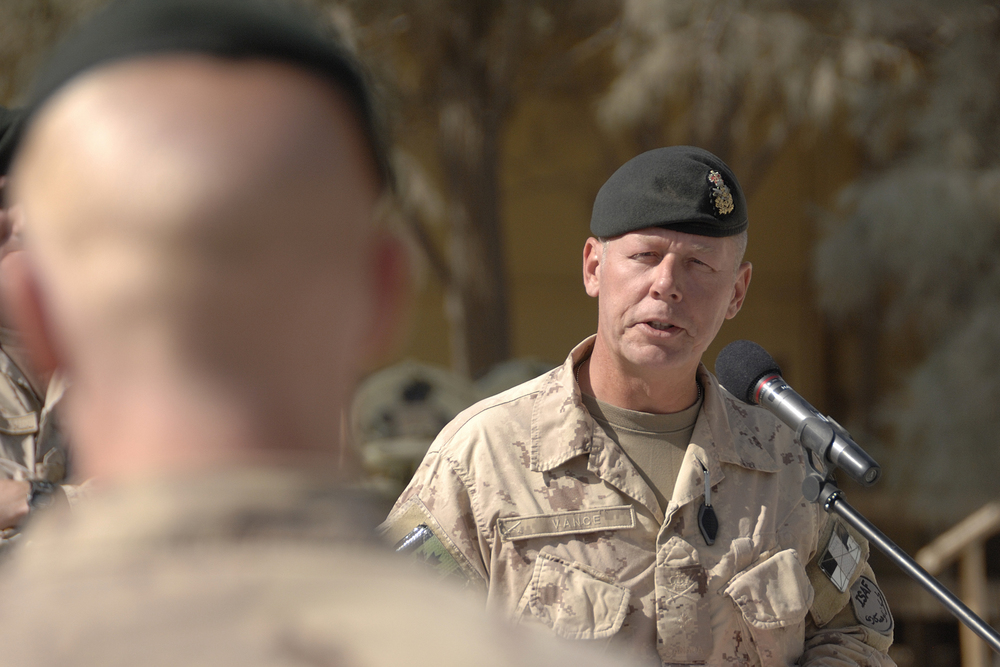 |
| Then LGen Jonathan Vance, then a Brigadier General, delivers a speech while serving as Kandahar 2013. |
“We cannot speak to movements of CAF senior leadership, however CBC and the Canadian Press will be visiting Mali in the near future,” Department of National Defence spokesman Dan Le Bouthillier told Defence Watch Thursday.
Canada announced in March that it would send support personnel, two RCAF Chinook helicopters, as well as four armed Griffon helicopters to act as escorts for those larger aircraft, to Mali, a west African country that since 2013 has been dealing with insurgents and armed Islamic extremists. The mission is expected to start in late July/early August.
The mission, however, has been dogged by more than a few concerns.
Conservative MPs have voiced criticism about the lack of planning and what they claim is a lack of mission focus.
To be sure, there was confusion initially. In mid-March, Defence Minister Harjit Sajjan announced that Canada would send two Chinook helicopters and four armed Griffon helicopters. A few minutes later at the same news conference Vance said the number of helicopters being assigned to the Mali mission had still not been determined. A short time after that, Sajjan’s office sent out a message to journalists, contradicting Vance by stating that ‘up to’ two Chinooks and four Griffons would be sent. Then another message went out to journalists later that there would be extra helicopters sent as backup.
The helicopter issue was eventually sorted out. But attention turned to the potential danger and whether the Mali mission could be considered as combat. MPs on the House of Commons defence committee raised those concerns and questioned generals about details of the Mali operation and whether Canadian military personnel would be safe.
Conservative defence critic James Bezan wanted information about the risks and whether troops would have enough protection from insurgent attacks. Questions were also asked about whether insurgents had surface-to-air missiles that could be of a threat to RCAF helicopters. “Our guys could potentially be going into hot conflict,” Bezan said at the committee.
Another MP asked if Mali was a war zone. Lt. Gen. Stephen Bowes, who was appearing before a Commons committee, answered that, “war zone is not a term. It’s a complex conflict zone.”
Such questions from MPs sparked Col. Jay Janzen, the Canadian Forces Director of Strategic Communications, to tweet to defence journalists that “Canada can do better than the nonsensical ‘combat/not-combat’ debate.”
That, in turn, prompted a showdown between Bezan and Conservative MPs and Janzen (who is slated to be promoted to Brig.-Gen. and put in charge of Canadian Forces public affairs).
Bezan lectured Janzen that he, as a MP, could ask whatever question he pleased and that questions about the safety of troops were certainly valid. He accused Janzen of trying to stifle debate. Bezan also noted that the head of the United Nations mission to Mali has characterized the operation as “war.”
“We have the right to know how Justin Trudeau is using our Canadian Forces to get (a) UN Security Seat,” Bezan tweeted.
Janzen said that while the military is subordinate to civilian authority, he had the right to make such comments.
Vance has done such mission public relations tours before. In 2016, he brought journalists along for his tour of the Canadian special forces mission in Iraq. The special forces were there to help the Kurds battle Islamic extremists who had seized large parts of Iraq.
The event was closely coordinated with Prime Minister Justin Trudeau’s office, as is this Mali trip. Vance also used that trip to play down any concerns about cracks in the Iraq-Kurd alliance. He told CTV at the time he didn’t agree there was a rift in the relationship between the two groups. A year later Kurdish and Iraqi forces were fighting each other.
What comes from the Mali visit remains to be seen but the Trudeau government wants public relations emphasis on support to the United Nations and the use of women on such missions.
Here is a snippet of the messaging that is to be provided to the news media: “The Canadian Armed Forces are working as part of an integrated, whole-of-government approach to deliver on Canada’s commitment to increase its support for UN peace support operations. Canada is a strong supporter of UN peacekeeping, and the CAF is prepared to make valuable contributions to this UN stabilization mission. To be safe at home, we need to contribute to international security abroad.”
Monday, June 11, 2018
Canada's Next Mission in Iraq - Awaiting Iraqi Approval
By: Lee Berthiaume, Global News
OTTAWA – Canada is waiting for the Iraqi government to sign off before launching the next phase of its fight against the Islamic State militant group, Gen. Jonathan Vance said Thursday.
Canadian special forces are preparing to work with the Iraqi military to secure the war-ravaged city of Mosul, where Vance said ISIL remains a threat even as thousands of displaced families return home.
Yet before that can happen, the Iraqis need to form a new government – which has proven difficult following elections last month – and indicate whether it still wants international forces operating in the country.
“There are a number of factors affecting mission planning for Iraq as we go forward,” Vance said after an event organized by the Canadian Global Affairs Institute.
“The government of Iraq needs to form a government and signal its intent as it relates to future military operations by coalition or on a bilateral basis in Iraq. So that’s Job 1.”
Canadian troops have been largely on the sidelines in Iraq since October when Canada suspended all assistance to the Iraqi military and Kurdish peshmerga when the two clashed over the latter’s independence referendum.
Up until that point, Canadian special forces had worked almost exclusively alongside the Kurds for more than three years to first stop ISIL’s advance across northern Iraq and then to dislodge it from the region.
Since the suspension of assistance, ISIL has lost control of the last of its territory in Iraq and turned to traditional insurgency tactics such as suicide bombings, while tensions between the Iraqis and Kurds have also cooled.
But friction between the country’s various political parties, none of whom secured enough votes for a majority government, have raised concerns about renewed divisions along religious and ethnic lines.
The Canadian Forces have been conducting reconnaissance and other preparatory work to get ready for the launch of the next phase of their mission in Iraq, Vance said, with a specific focus on helping families return to Mosul.
The country’s second-largest city was held by ISIL for three years, until Iraqi forces – with help from Canada and other international partners – were able to liberate it from the extremist group following nearly a year of bloody fighting.
Hundreds of thousands of people fled the city ahead of its capture by ISIL and during its liberation, and Vance indicated Canadian troops will help Iraqi forces make it more secure so families can return.
“It needs to be secure and there’s still remnants of ISIL there,” he said.
“They’re not actively conducting operations, but they could. So, trying to ensure successful security conditions in Mosul so that people have the confidence to return home is also what we’re looking at.”
Vance also confirmed that Canada has officially ceased operations with the Kurds after years of working alongside the peshmerga in the north of the country, and that it intends to partner exclusively with the Iraqi military.
The military’s current mandate in Iraq is set to expire in March.
Monday, April 23, 2018
Vance: No plan for CAF in Churchill
By: Dylan Robertson, The Winnipeg Free Press
OTTAWA — The head of the military says there is no role for soldiers in Churchill, adding a "wistfulness" is behind a call to station soldiers at Manitoba’s only seaport.
OTTAWA — The head of the military says there is no role for soldiers in Churchill, adding a "wistfulness" is behind a call to station soldiers at Manitoba’s only seaport.
 |
| The Canadian Rangers will get help from a refueling site in Nanisivik, Nunavut (above), when it opens later this year. |
"I don’t have a military task in Churchill," chief of defence staff Gen. Jonathan Vance told the Senate defence committee last week.
Churchill’s town council has named government services as one of five areas to pursue to bolster the northern town’s economy, including suggesting an increased role for the military. The town of 900 used to house more than 6,000 people, largely driven by Cold War-era rocket testing by American and Canadian troops.
The town, located 1,600 kilometres north of Winnipeg, had its land link cut when the rail line was flooded out and damaged last May. Prices for necessities such as food and fuel have soared and families have moved away.
Vance said he is not aware of any plan to station soldiers in Churchill. He also doesn’t see the wisdom in such a move. "Sometimes, there’s a wistfulness there, that Churchill doesn’t have a military base or that somehow we should be there more," he said.
He described the question that governments and the military have to consider: "What does the government need to get done up there, and how much military do you need to do that at any point in time?"
Vance said the military’s role in the Arctic is to conduct search-and-rescue operations and ward off foreign encroachment. The Canadian Rangers operate patrol vessels in the North and take part in NORAD missile defence. He said a naval refuelling site in Nanisivik, Nunavut, will help when it opens this year.
"From a military perspective, there is a certain posture that we need to take to get the job done. I think we’re at that posture," he said. "We have tremendous capacity to sense what’s coming into the Arctic."
Vance was responding to questions from Manitoba Sen. Marilou McPhedran, who asked about a media report on how Canada’s army and navy presence in the town has withered, to the point of leaving only "wind-hollowed remains of a large military base" and centuries-old fortifications.
Meanwhile, NDP MP Niki Ashton, who represents northern Manitoba, raised Churchill’s railway crisis in the House of Commons Thursday.
"People in Churchill are facing skyrocketing food prices. They are going hungry because of the kind of policies and incompetence of the government that has led to the loss of the rail service," Ashton said.
Churchill’s town council has named government services as one of five areas to pursue to bolster the northern town’s economy, including suggesting an increased role for the military. The town of 900 used to house more than 6,000 people, largely driven by Cold War-era rocket testing by American and Canadian troops.
 |
| Remnants of the Churchill Rocket Research Range which was operated by the USAF and CAF during the Cold War. The range ceased operations in 1985. |
Vance said he is not aware of any plan to station soldiers in Churchill. He also doesn’t see the wisdom in such a move. "Sometimes, there’s a wistfulness there, that Churchill doesn’t have a military base or that somehow we should be there more," he said.
He described the question that governments and the military have to consider: "What does the government need to get done up there, and how much military do you need to do that at any point in time?"
Vance said the military’s role in the Arctic is to conduct search-and-rescue operations and ward off foreign encroachment. The Canadian Rangers operate patrol vessels in the North and take part in NORAD missile defence. He said a naval refuelling site in Nanisivik, Nunavut, will help when it opens this year.
"From a military perspective, there is a certain posture that we need to take to get the job done. I think we’re at that posture," he said. "We have tremendous capacity to sense what’s coming into the Arctic."
Vance was responding to questions from Manitoba Sen. Marilou McPhedran, who asked about a media report on how Canada’s army and navy presence in the town has withered, to the point of leaving only "wind-hollowed remains of a large military base" and centuries-old fortifications.
Meanwhile, NDP MP Niki Ashton, who represents northern Manitoba, raised Churchill’s railway crisis in the House of Commons Thursday.
"People in Churchill are facing skyrocketing food prices. They are going hungry because of the kind of policies and incompetence of the government that has led to the loss of the rail service," Ashton said.
Wednesday, December 13, 2017
Canada Announces Purchase of 18 Australian F/A-18s
The Associated Press
 |
| A Royal Australian Air Force F-18 fighter on a training mission. (Royal Australian Air Force) |
Canada has ditched a plan to buy 18 Super Hornet jet fighters from U.S.-based Boeing Co. and will instead buy 18 used F-18 fighters from Australia.
Prime Minister Justin Trudeau had previously warned that Canada would stop doing business with Boeing if the company doesn't drop a trade complaint against Canadian plane maker Bombardier, and the government warned again on Tuesday that Boeing would have little chance of winning a new contract for 88 additional fighter jets under the status quo.
Trudeau's government also said Tuesday that it would assess companies' overall impact on Canada's economy before buying the 88 additional fighter jets to replace its aging F-18s.
"Bidders responsible for harming Canada's economic interest will be at a distinct disadvantage compared to bidders who aren't engaged in detrimental behavior," Procurement Minister Carla Qualtrough said.
Boeing spokesman Scott Day acknowledged that the statement was directed toward the company and said that Boeing respects the Canadian government's decision to buy the Australian planes. Day also said the company would review the requirements for the new fleet and emphasized what he said was Boeing's long-term presence in Canada.
"I think you have to let our record speak for itself," Day said in an email.
Boeing claims Bombardier's new C Series passenger aircraft receives subsidies that give it an advantage internationally.
Canada had been in talks to purchase the F/A-18 E/F Super Hornet fighter jets from Boeing in an effort to bridge the gap between its aging F-18s and the new fighter fleet that it plans to purchase.
But officials said the Australian jets will cost significantly less than Super Hornets and can be put into action two years earlier. "We have received an offer for sale of F-18 aircraft from the government of Australia, which we intend to pursue, and we have received an offer of Super Hornets from the U.S. government, which we intend to let expire," Qualtrough said.
Jonathan Vance, chief of the defense staff of the Canadian Armed Forces, said Canada can't meet its domestic and international obligations without some form of supplemental capability until the future fighter fleet is in place and the Australian jets will work fine.
Canada will begin receiving deliveries of the used Australian jets next year. The value of the deal is about $388 million.
Vance expects the fleet of 88 next-generation fighters to arrive in 2025, and the government said the competition would be open to all companies as bidding gets underway.
Analysts see the F-35 made by Boeing rival Lockheed Martin as a likely contender, even though Trudeau has said it is too expensive. Trudeau has since softened that stance.
Defense Minister Harjit Sajjan said the new fleet of planes is required to meet Canada commitments to NATO and the North American Aerospace Defense Command.
Monday, May 1, 2017
Sajjan facing criticism over Operation Medusa comments
By: Gloria Galloway, The Globe and Mail
Defence Minister Harjit Sajjan has apologized for embellishing the role he played in a significant and deadly battle in Afghanistan, but opposition MPs say the mea culpa was insufficient and that Mr. Sajjan's fabrication has punched holes in his credibility.
The Conservatives say they will be demanding a more heartfelt acknowledgment by Mr. Sajjan of his misrepresentation and suggest the Minister's statements are part of a larger pattern of untruthfulness.
The New Democrats, meanwhile, say they will be asking whether Mr. Sajjan's description of himself as being pivotal to the battle known as Operation Medusa means he diminished the importance of his role in Afghanistan when Conflict of Interest and Ethics Commissioner Mary Dawson briefly examined whether he had a personal interest in scuttling a public inquiry into the treatment of Afghan detainees.
"He has said he was involved in combat and planned combat missions, he has said he was an intelligence officer, and he apparently told the Conflict of Interest Commissioner he was just there doing police capacity building. So we have three different stories," Randall Garrison, the NDP defence critic, said Sunday.
Mr. Sajjan said during a speech in India in April that he was the "architect" of Operation Medusa, a land battle between NATO and 1,400 Taliban that took place over two weeks in the late summer of 2006. Roughly 550 insurgents and 12 Canadians were killed along with a number of others.
The Minister, who was an intelligence officer in the Canadian reserves, has been praised by senior military officers for his role in that combat. But he conceded on Saturday, after two days of criticism and an ambiguous statement on Friday, that he had "made a mistake" in describing himself as the operation's key planner.
"I wish to retract that description and apologize for it," Mr. Sajjan said Saturday in a post on Facebook. "What I should have said is that our military successes are the result of leadership, service and sacrifice of the many dedicated women and men of the Canadian Forces."
The India speech was not, however, the first time that Mr. Sajjan has talked about his part in Operation Medusa in that fashion. In July, 2015, when he was a Liberal candidate, he said on a British Columbia podcast called Conversations That Matterthat General Jonathan Vance, the Chief of the Defence Staff, "said I was the architect of Operation Medusa."
The Conservatives also point out that Mr. Sajjan told reporters in December that the issue of Canada withdrawing its CF-18 jets from the fight against the Islamic State was not raised during his meetings with Iraqi ministers in Baghdad – an assertion that was later debunked in a summary by Global Affairs that said the Iraqis had asked Mr. Sajjan to "reconsider the decision on numerous occasions."
The Minister's Facebook climb down for claiming to be the architect of Operation Medusa is not enough, James Bezan, the Conservative defence critic said in a telephone interview on Sunday.
"I expect him to offer a full, sincere apology in the House of Commons at his earliest possible convenience," said Mr. Bezan. "I also think that this is a disturbing pattern of embellishing stories and misrepresenting the facts and making up alternative facts, and that this pattern is something that all of us need to critique even more."
While he did not call for Mr. Sajjan's resignation, Mr. Bezan said Prime Minister Justin Trudeau will have to decide if the Minister still has his confidence.
For his part, Mr. Garrison said Mr. Sajjan's claim to have been the architect of Operation Medusa "does raise questions about both the confidence of the Canadian military in our minister and also of our NATO allies."
In March, Ms. Dawson dismissed concerns brought to her by Craig Scott, a former New Democrat MP, that Mr. Sajjan may have contravened the Conflict of Interest Act when he announced in June, 2016, that the government would not conduct an inquiry into the treatment of Afghans who had been captured by Canadian troops and turned over to Afghan security forces.
Defence Minister Harjit Sajjan has apologized for embellishing the role he played in a significant and deadly battle in Afghanistan, but opposition MPs say the mea culpa was insufficient and that Mr. Sajjan's fabrication has punched holes in his credibility.
 |
| A Canadian LAV-III during the 2006 Canadian-led Operation MEDUSA, in Afghanistan |
The New Democrats, meanwhile, say they will be asking whether Mr. Sajjan's description of himself as being pivotal to the battle known as Operation Medusa means he diminished the importance of his role in Afghanistan when Conflict of Interest and Ethics Commissioner Mary Dawson briefly examined whether he had a personal interest in scuttling a public inquiry into the treatment of Afghan detainees.
"He has said he was involved in combat and planned combat missions, he has said he was an intelligence officer, and he apparently told the Conflict of Interest Commissioner he was just there doing police capacity building. So we have three different stories," Randall Garrison, the NDP defence critic, said Sunday.
Mr. Sajjan said during a speech in India in April that he was the "architect" of Operation Medusa, a land battle between NATO and 1,400 Taliban that took place over two weeks in the late summer of 2006. Roughly 550 insurgents and 12 Canadians were killed along with a number of others.
The Minister, who was an intelligence officer in the Canadian reserves, has been praised by senior military officers for his role in that combat. But he conceded on Saturday, after two days of criticism and an ambiguous statement on Friday, that he had "made a mistake" in describing himself as the operation's key planner.
"I wish to retract that description and apologize for it," Mr. Sajjan said Saturday in a post on Facebook. "What I should have said is that our military successes are the result of leadership, service and sacrifice of the many dedicated women and men of the Canadian Forces."
The India speech was not, however, the first time that Mr. Sajjan has talked about his part in Operation Medusa in that fashion. In July, 2015, when he was a Liberal candidate, he said on a British Columbia podcast called Conversations That Matterthat General Jonathan Vance, the Chief of the Defence Staff, "said I was the architect of Operation Medusa."
The Conservatives also point out that Mr. Sajjan told reporters in December that the issue of Canada withdrawing its CF-18 jets from the fight against the Islamic State was not raised during his meetings with Iraqi ministers in Baghdad – an assertion that was later debunked in a summary by Global Affairs that said the Iraqis had asked Mr. Sajjan to "reconsider the decision on numerous occasions."
The Minister's Facebook climb down for claiming to be the architect of Operation Medusa is not enough, James Bezan, the Conservative defence critic said in a telephone interview on Sunday.
"I expect him to offer a full, sincere apology in the House of Commons at his earliest possible convenience," said Mr. Bezan. "I also think that this is a disturbing pattern of embellishing stories and misrepresenting the facts and making up alternative facts, and that this pattern is something that all of us need to critique even more."
While he did not call for Mr. Sajjan's resignation, Mr. Bezan said Prime Minister Justin Trudeau will have to decide if the Minister still has his confidence.
For his part, Mr. Garrison said Mr. Sajjan's claim to have been the architect of Operation Medusa "does raise questions about both the confidence of the Canadian military in our minister and also of our NATO allies."
In March, Ms. Dawson dismissed concerns brought to her by Craig Scott, a former New Democrat MP, that Mr. Sajjan may have contravened the Conflict of Interest Act when he announced in June, 2016, that the government would not conduct an inquiry into the treatment of Afghans who had been captured by Canadian troops and turned over to Afghan security forces.
Tuesday, February 7, 2017
Canadian Military to Become First to Issue Guidelines on Child Soldiers
The Canadian Press
The Canadian military is poised to become the first in the world to issue guidelines for dealing with child soldiers, which could be put to the test immediately in Africa.
The guidelines are intended to ensure Canadian troops are properly trained and emotionally prepared for situations involving child soldiers — including where they may have to shoot to kill.
“If a child has a gun pointed at you and they have the intent, they have the capability, and they have the means by which to conduct harm on you or your partners, you have to use force as necessary to neutralize that,” said Cmdr. Rory McLay, who is overseeing development of the guidelines.
“That is a tough reality, but we cannot afford to have our folks harmed because they hesitated.”
The guidelines are also intended to make sure Canadian soldiers deal appropriately with a child soldier who isn’t a threat.
“If you’re talking about detainees, for example, once it’s suspected or proven that the individual is a minor then they are immediately removed from the adult population,” said McLay. “The real push there is separation and rehabilitation. That’s what you want to do with child soldiers...to try to get these kids into a rehabilitated state and back to their families.”
The guidelines were ordered by defence chief Gen. Jonathan Vance last March after a meeting with retired senator Romeo Dallaire, who has championed the fight against using children in conflict.
While a variety of rules and policies on how to deal with child soldiers already exist, McLay said the new guidelines will be the first to gather everything into one place for Canadian military personnel.
Vance is expected to sign off on them in the coming days, after which they will be distributed to commanders across the Canadian Armed Forces to be included in training and other mission preparation.
“Training is one of the best ways to mentally prepare them to deal with the sights and sounds that they’re going to encounter,” McLay said.
“So if you can specifically guide the training to deal with a specific issue, you are better preparing your team to react appropriately and to be able to deal with their own actions during and down the road.”
Such direction is timely given the Liberal government is expected to greenlight the deployment of hundreds of Canadian soldiers to Mali in the coming weeks.
The UN and human rights groups say armed groups in Mali have intentionally recruited and are using child soldiers in a number of capacities.
The presence of child soldiers on the battlefield is a potential minefield for militaries like Canada, as the French learned the hard way last month when they came under fire for killing a 10-year-old boy.
While the French military says the boy was acting as a lookout for one armed group suspected of planting improvised-explosive devices, the killing has marred its counter-terrorism mission in Mali.
The Islamic State of Iraq and the Levant, which Canadian troops are fighting in Iraq, has also made extensive use of child soldiers.
While the British are developing similar guidelines, Shelly Whitman, executive director of the Romeo Dallaire Child Soldiers Initiative, said they aren’t as far along as the Canadian military.
Preparing Canadian soldiers for dealing with child soldiers in the field is critical for a number of reasons, Whitman said, which includes ensuring they are properly treated.
But it is also important to consider the impact of child soldiers on the battlefield when planning missions from a legal perspective and in terms of making sure Canadian soldiers don’t hesitate when threatened.
“A lot of soldiers would tell you they didn’t have any preparation for how to handle children in these contexts until they saw it in the battlefield,” she said.
“And that’s where the emotional part of your brain kicks in instead of the cognitive part of your brain. Which means you’ll make decisions based on emotion and not on what’s the best professional decision on that matter.”
Tuesday, November 22, 2016
Government to Buy 18 F/A-18 Super Hornets as Stop Gap before Competition
By: Daniel Maillet, CAF Dispatch Author
This afternoon the Government of Canada announced that it will pursue the purchase of 18 Boeing F/A-18 Super Hornets as a "stop-gap" measure on the CF-18 Replacement Procurement file which has been laden with issues for years.

During the 2015 Election, the Liberals promised to quickly launch a competition to replace the ageing fleet of the RCAF CF-18 Hornets. Originally purchased in the 1980s, the RCAF intended to fly the CF-18 for 20 years, and replace the fleet in the early 2000s. Many of the 77 serviceable CF-18s are older than 35 years and are flying much longer than the manufacturer intended.
Therefore, according to Minister of Defence Sajjan and General Vance a capability gap has arisen. Sajjan said that Canada has commitments to NATO and NORAD to have a specific number of serviceable aircraft on any given day, and when combined the RCAF is not currently able to meet these requirements.
To address this capability gap, the Government intends to enter into negotiations with Boeing on the F/A-18, and will purchase the aircraft as long as the purchase is cost and benefit effective to Canada. Yet the Government has no plan should these benefits not benefit Canada. Sajjan indicated that due to national security; he could not provide numbers of required jets, or if Canada had declined missions due to the gap. General Vance indicated that yes some missions were declined but did not go into details; while reiterating the importance of the RCAFs role in deterrence in the defence of Canada.
Sajjan and Minister of Procurement Canada Foote both blamed the previous Government for the delay on the CF-18 replacement. Both indicated that the replacement of the CF-18 should be months away if the Conservatives had actually closed the file.
Sajjan and Foote diverted away from any discussions of sole-sourcing the interim purchase.
The Government will open an open and transparent competition for a permanent fleet at some point in 2017 - a process that will take a minimum fo 5 years. A term that seems extremely long, especially as the file has been partially open for nearly a decade. Sajjan announced that the Canada will remain part of the JSF-Consortium, and Foote did not say that Lockheed Martin would be excluded - so therefore, the JSF F-35 will be allowed to bid.
The government believes that once the 5-year competition is complete, the delivery of the new fleet of fighter aircraft will be by late 2020. Therefore the current CF-18s will undergo further life-extension plans to keep flying until at least 2030. Canada is entering into the unknown with the CF-18 lifespan; no other country will have flown the "legacy" model of the F-18 this long.
Foote defended the length of the competition, by saying the Government does not want any mistakes. Foote confirmed that the Government is working with the American government on this file - almost indicating that the F/A-18 or the F-35 will be selected during the 5 years competition.
When asked why the F/A-18 was selected as the interim option Foote and Sajjan both indicated that the RCAF could not select an aircraft in development, and therefore the F/A-18 was the best option. When asked about the numerous European models that are in-service; they reiterated the interoperability with the American forces. Further, strengthening what many believe will be a 2 horse race - the F/A-18 or the F-35.
The announcement today indicated that investments will be made into the "legacy" CF-18s to ensure that they can safely operate for the RCAF and the safety of Canada and global security.
Foote indicated that the Government does not believe that the purchase of the F/A-18 Super Hornet will not stack the deck in favour of Boeing anymore than it does Lockheed Martin by remaining in the JSF-Consortium.
The government has not made any plans on what to do with the "interim" aircraft once a permanent fleet is selected. Any decisions on the disposal of the interim fleet will only be made in the future according to General Vance.
This announcement will invest billions of dollars into the interim fleet, as well as billions into a future permanent fleet. So where the savings will come for the future of the Royal Canadian Navy will be made is anyone's guess.
This afternoon the Government of Canada announced that it will pursue the purchase of 18 Boeing F/A-18 Super Hornets as a "stop-gap" measure on the CF-18 Replacement Procurement file which has been laden with issues for years.
During the 2015 Election, the Liberals promised to quickly launch a competition to replace the ageing fleet of the RCAF CF-18 Hornets. Originally purchased in the 1980s, the RCAF intended to fly the CF-18 for 20 years, and replace the fleet in the early 2000s. Many of the 77 serviceable CF-18s are older than 35 years and are flying much longer than the manufacturer intended.
Therefore, according to Minister of Defence Sajjan and General Vance a capability gap has arisen. Sajjan said that Canada has commitments to NATO and NORAD to have a specific number of serviceable aircraft on any given day, and when combined the RCAF is not currently able to meet these requirements.
To address this capability gap, the Government intends to enter into negotiations with Boeing on the F/A-18, and will purchase the aircraft as long as the purchase is cost and benefit effective to Canada. Yet the Government has no plan should these benefits not benefit Canada. Sajjan indicated that due to national security; he could not provide numbers of required jets, or if Canada had declined missions due to the gap. General Vance indicated that yes some missions were declined but did not go into details; while reiterating the importance of the RCAFs role in deterrence in the defence of Canada.
Sajjan and Minister of Procurement Canada Foote both blamed the previous Government for the delay on the CF-18 replacement. Both indicated that the replacement of the CF-18 should be months away if the Conservatives had actually closed the file.
Sajjan and Foote diverted away from any discussions of sole-sourcing the interim purchase.
The Government will open an open and transparent competition for a permanent fleet at some point in 2017 - a process that will take a minimum fo 5 years. A term that seems extremely long, especially as the file has been partially open for nearly a decade. Sajjan announced that the Canada will remain part of the JSF-Consortium, and Foote did not say that Lockheed Martin would be excluded - so therefore, the JSF F-35 will be allowed to bid.
The government believes that once the 5-year competition is complete, the delivery of the new fleet of fighter aircraft will be by late 2020. Therefore the current CF-18s will undergo further life-extension plans to keep flying until at least 2030. Canada is entering into the unknown with the CF-18 lifespan; no other country will have flown the "legacy" model of the F-18 this long.
Foote defended the length of the competition, by saying the Government does not want any mistakes. Foote confirmed that the Government is working with the American government on this file - almost indicating that the F/A-18 or the F-35 will be selected during the 5 years competition.
When asked why the F/A-18 was selected as the interim option Foote and Sajjan both indicated that the RCAF could not select an aircraft in development, and therefore the F/A-18 was the best option. When asked about the numerous European models that are in-service; they reiterated the interoperability with the American forces. Further, strengthening what many believe will be a 2 horse race - the F/A-18 or the F-35.
The announcement today indicated that investments will be made into the "legacy" CF-18s to ensure that they can safely operate for the RCAF and the safety of Canada and global security.
Foote indicated that the Government does not believe that the purchase of the F/A-18 Super Hornet will not stack the deck in favour of Boeing anymore than it does Lockheed Martin by remaining in the JSF-Consortium.
The government has not made any plans on what to do with the "interim" aircraft once a permanent fleet is selected. Any decisions on the disposal of the interim fleet will only be made in the future according to General Vance.
This announcement will invest billions of dollars into the interim fleet, as well as billions into a future permanent fleet. So where the savings will come for the future of the Royal Canadian Navy will be made is anyone's guess.
Thursday, November 3, 2016
Ottawa defends CAF's Fit-to-Serve rule
RENATA D’ALIESIO, The Globe and Mail
The federal government is defending the Canadian Forces’ fit-to-serve rule, which has led to the expulsion of nearly 7,000 ill and wounded members over the past five years – many of them Afghanistan war veterans who wanted to remain in the military.
The policy known as universality of service has long been criticized as too stringent, forcing out members as they cope with job-related injuries and mental illness, such as post-traumatic stress disorder. Veterans’ advocates argue the rule – which requires soldiers, sailors and air force personnel be capable of deploying at all times – deters some ill soldiers from seeking help, because they worry they’ll be discharged from the military.
A Canadian Forces working group has been studying the issue for more than two years, but change does not appear on the horizon. In a statement of defence submitted in response to legal action from injured veteran Louise Groulx, the Liberal government maintains the military’s employment standard is not discriminatory and is supported by the Canadian Human Rights Act.
Lawyers for the government also argue that the rule doesn’t demand military members be capable of serving in combat. Rather, they need to be “fit, employable without significant limitations and deployable for operational duties.”
Ottawa’s legal position buttresses comments made by General Jonathan Vance, the Chief of the Defence Staff, earlier this year. In May, Gen. Vance told The Globe and Mail there are many reasons the standard cannot be dropped, even for those who have been permanently injured in the line of duty, such as on the Afghanistan mission, but are still able to perform a job in Canada. “We are a small armed forces; everybody’s got to be able to pitch in all the way.”
Ms. Groulx’s lawyer, Corey Shefman, called the requirement that all 60,000-plus regular force members be ready to deploy any time “ridiculous.” He noted that there are many military jobs that don’t involve serving overseas.
“The Canadian Forces, like every other employer, needs to make reasonable accommodation for these soldiers and veterans,” Mr. Shefman said. “The Canadian people and the Canadian government owe a duty to our soldiers and our veterans for the risks that they put themselves in every day and for the service that they are giving to the country.”
Before becoming an air force instructor and aeromedical technician, Ms. Groulx was a medic and served in Haiti in 1995, part of Canada’s contribution to a United Nations mission. Her last job, which was based in Winnipeg, involved teaching pilots how to deal with medical emergencies and was unlikely to ever require her to work overseas, Mr. Shefman said.
The air-force instructor suffered a serious spinal injury in 1999, while participating in a military baseball game. She underwent six surgeries over 14 years, but was left with mobility problems, according to her statement of claim. She also experienced depression and PTSD, the claim adds.
While she returned to work and wanted to remain in the Forces, she was medically released in June, 2009. The retired master corporal’s lawsuit alleges the Forces’ universality-of-service rule violated her Charter rights.
“The fact is this is the 21st century. The American air force managed to put a double-amputee pilot back in his fighter jet and flying missions. If they can do that, I don’t see any good reasons why the Canadian Forces can’t put a person like Louise … in her non-deployable position,” Mr. Shefman contended.
The Forces’ universality-of-service working group was created in response to concerns that the rule was forcing too many ill and wounded members out of the military. The group last met in September to review findings from focus groups, and is scheduled to meet again in November, said military spokeswoman Jessica Lamirande. The focus groups helped identify “common and essential minimum operational standards” for Forces members, she said. It’s unclear when the review will wrap up.
Medical discharges hit a 17-year high in the 2014 fiscal year, with 1,908 personnel deemed unfit for duty – a 52-per cent increase from the year before, according to figures provided by the Forces. Last fiscal year, 1,533 members were dismissed from the military for medical reasons, which is far higher than before the Afghanistan war. Between 1999 and 2002, no more than 722 personnel were expelled in a single year.
Saturday, October 8, 2016
CDS Flip Flops on African Mission
By: David Pugliese, Defence Watch
Michael Staples at The Daily Gleaner newspaper in Fredericton recently had an interview with Chief of the Defence Staff Gen. Jon Vance, in which some of the general’s interesting views emerged.
During the interview Vance claimed that all the discussion over the last several months about a Canadian military mission to Africa was just an “assumption” based on “people’s own assessments in the media.” “It’s been “over reported,” Vance claimed.
“Right now, I’ll tell you, honestly, there is no such thing as an Africa mission,” Vance told The Daily Gleaner. “It’s been over reported based on peoples’ own assessments in the media, in my view, that if you look at the world, it’s going to be an African mission. It’s an assumption.”
I wonder where all that “over reporting” came from? How did these media commentators ever, ever come to the “assumption” that the Canadian military was going to conduct an operation/operations in Africa?
Could it be in August when Defence Minister Harjit Sajjan told journalists that the Canadian military was looking at a number of countries in Africa to contribute troops?
Maybe.
Or how about this statement back in July?
“Internationally, the Army is at the forefront, managing conflicts around the world, contributing to operations in Iraq, building capacity with allies and partners in Poland, Ukraine, and very soon in Africa.”
Who said that?
Yes, that came direct from…..Chief of the Defence Staff Gen. Jon Vance.
Thursday, September 22, 2016
CAF Will Never be under UN Command: CDS
By: Lee Berthiaume, CBC News
The country's top soldier is pushing back against suggestions the Liberal government wants to use Canadian troops for political purposes by deploying them on United Nations peacekeeping missions.
The opposition Conservatives accused the Liberals this week of treating the military like "pawns" by promising to support peacekeeping operations in exchange for a UN Security Council seat.
The Liberal government has promised up to 600 troops for future peacekeeping operations, as well as 150 police officers and $450 million for peace support operations.
But chief of the defence staff Gen. Jonathan Vance said Wednesday that Canadian troops will be deployed as peacekeepers for no other reason than to help bring peace and stability to another part of the world.
"I reject the notion that this is done simply for political reasons and putting troops in harm's way into risky areas for anything other than the true merits of the value of the use of military force," he said.
Vance told the Senate defence committee that his staff members are looking at various UN mission options to see where Canada could best contribute. The government still has not decided on a specific mission, he added.
Vance wouldn't say which missions the government is currently considering, but he acknowledged that many — if not all — carry some degree of risk. He said he wouldn't advise Canada participate in a mission with unnecessary or unmanageable risk.
"But a risky mission that has great potential of success may be a mission that you want to invest in," he said. "And the military, we do risk. We're good at that, if we can mitigate it."
Canadian troops under Canadian command
Some have worried that Canadian peacekeepers could be put into a no-win situation, or bound by endless UN bureaucracy that might tie their hands or otherwise put them at risk, such as in previous missions in Rwanda and Bosnia.
Vance said UN commanders might give Canadian troops specific tasks, but he would "never" let the UN have the last word on when or how Canadian peacekeepers could act. He said he is the one who writes the rules of engagement for Canadian troops, which would continue with a peacekeeping mission.
"I never relinquish Canadian command of those troops," he said. "We have learned a lot since the days of Bosnia and Rwanda and elsewhere. And one of those is you're never out from under Canadian command."
Wednesday, August 31, 2016
Vance: CAF Sexual misconduct an ongoing problem
By: David Pugliese, The Ottawa Citizen
Canada’s top soldier says sexual misconduct is still a problem in the military, with six people convicted of such offences in the last eight months and another 24 subjected to severe administrative action.
Canada’s top soldier says sexual misconduct is still a problem in the military, with six people convicted of such offences in the last eight months and another 24 subjected to severe administrative action.
 |
| FRED CHARTRAND / THE CANADIAN PRESSChief of the Defence Staff Gen. Jonathan Vance said the military is still tallying how many leaders have been released from the Canadian Forces because of sexual misconduct, saying it is still a problem in the military. Six people have been convicted of such offences in the last eight months. |
“Incidents of harmful sexual behaviour are still occurring,” Chief of the Defence Staff Gen. Jonathan Vance said Tuesday.
“We’ve removed people from command positions. We’ve dismissed people from the Canadian Armed Forces.”
Vance said the military is still tallying how many leaders have been released from the Canadian Forces because of sexual misconduct.
“We do know that leaders have been removed,” he said. “They are in the media right now. I don’t want to speak about them because they are before the courts.”
Vance said he expects more bad news when details of a survey of military staff come in. “I expect results to be sobering when we get results in the fall,” he said. “Quick fixes will not work.” Vance launched Operation Honour, or Op Honour, last year to deal with sexual misconduct in the ranks after a scathing report by former Supreme Court justice Marie Deschamps who found sexual harassment and misconduct, including assaults, appeared to be widespread in the Canadian Forces.
Her April 2015 report raised warnings about a “sexualized culture” that subjected women in uniform to abuse ranging from sexual jokes and harassment to rape. She also found sexual misconduct “endemic” in the Canadian Forces, but condoned by the military leadership.
During her year-long investigation, Deschamps interviewed hundreds of full- and part-time military personnel, as well as commanding officers, military police, chaplains, nurses and social workers.
The interviews pointed to what she described as a “hostile sexualized environment” in the military, particularly among recruits and the junior ranks.
“At the most extreme, these reports of sexual violence highlighted the use of sex to enforce power relationships,” noted Deschamps’ report, “and to punish and ostracize a member of a unit.”
The military’s leadership came under particularly harsh criticism. Deschamps found military personnel “became inured to this sexualized culture as they move up the ranks,” with officers turning a blind eye to inappropriate conduct and senior non-commissioned officers “imposing a culture where no one speaks up.”
“Underlying all these concerns is a deep mistrust that the chain of command will take such complaints seriously,” her report noted.
There have been concerns about how seriously some in the military take the issue of sexual abuse.
Then-chief of the defence staff Tom Lawson, who has since retired, came under fire last year for his claim that sexual harassment was still an issue in the Canadian Forces because people were “biologically wired in a certain way.” His comment sparked widespread outrage and Lawson apologized.
The Royal Military College in Kingston, Ont., was also in the headlines after it emerged that a guest speaker on sexual misconduct was belittled and harassed as she tried to conduct a seminar. The general in charge of the college eventually apologized for what was acknowledged as “unprofessional behaviour.”
Some recruits at the Royal Military College, as well as other Canadian Forces personnel, including individuals at the National Defence headquarters in Ottawa, have dubbed Vance’s initiative Op Honour as “Hop On Her” — a play on words suggesting sexual aggression.
Vance said Tuesday he understands that there are those who are skeptical of ongoing efforts to stop sexual misconduct but the situation is improving.
“We’ve made a good start.”
Thursday, June 23, 2016
Iraq needs to be broken up, say Kurdish leaders
 By: David Pugliese, Defence Watch
It looks like Kurdish officials didn’t receive the memo from Global Affairs Canada…the one about Canada’s support for the Kurds being part of supporting a unified Iraq. The Kurds, being armed and trained by the Canadian Forces, are instead pushing to break away from Iraq. They cite Quebec separatists as a role model. The Canadian military is well aware of the Kurdish push for separation.
But Chief of the Defence Staff Gen. Jon Vance suggests it’s none of Canada’s concern what will happen in Iraq once the Islamic State is defeated. Some Canadian diplomats, however, have warned that Canada’s arming and training the Kurds will lead to more problems down the road.
Tensions are increasing and Kurdish forces have clashed with forces loyal to the central government in Baghdad.
But Kurdish officials have said that Iraq is finished as a state.
Masrour Barzani, the Chancellor of Kurdistan Region Security Council, recently stated in an interview with Reuters news agency that the level of mistrust among various groups in Iraq – the Kurds, Sunnis and Shi’ites – is such that they should not remain “under one roof”.
“Federation hasn’t worked, so it has to be either confederation or full separation,” Barzani said. “If we have three confederated states, we will have three equal capitals, so one will not be above the other.”
Barzani’s father, Kurdistan Region President Masoud Barzani, has called for a referendum this fall aiming for complete independence.
Added Commentary:
This is not the first time the break-up of Iraq has been suggested. It has actually be studied in-depth for years. One particular study calls for 3 new states to be carved out of Iraq. Kurdistan, Sunni Iraq, and the Arab Shia State, with Baghdad becoming a City State similar to Vatican City. It can be read here.
Even CNN as recently as 2014 ran a column supporting the idea of dividing Iraq into three states.
Only time will tell; Iraq will remain unified to defeat ISIS, but it seems more and more that as the Kurdsish Peshmerga continue to claim territory, they admit that they will not cede it to Iraqi forces.
Wednesday, May 11, 2016
Operational Security for Special Forces Collateral Damage
By David Pugliese, The Ottawa Citizen
It wasn’t that long ago that the news media was prohibited from showing the faces of any Canadian military personnel taking part in the Iraq mission. Official photos from the mission were issued only after the faces of mechanics, pilots and other military personnel were blurred out. Journalists were told they were not allowed to take photos showing the faces of CF members involved in the Iraq conflict.
The reason?
The threat of retaliation from the Islamic State against a military member or their family was very real.
When Prime Minister Stephen Harper’s office inadvertently released a video showing the faces – albeit from a distance – of Canadian special forces the Liberals rose in the House of Commons and accused the Conservatives of putting Canadian lives at risk.
Harper’s office later issued an apology and removed the video imagery which was shot while the prime minister was visiting Canadian special forces in northern Iraq.
That was then.
Now it seems there has been a significant change of heart on operational security when it comes to the Iraq mission, and in particular, when it comes to Canadian special forces deployed to a war zone.
Chief of the Defence Staff Gen. Jon Vance recently took a tour of the front lines in northern Iraq with journalists in tow.
The media were not only allowed to photograph Canadian special forces but interview them as well (CANSOF personnel have been interviewed and photographed before by the Citizen, CBC, Global TV, CTV and other news outlets but on training missions and with various caveats attached…these latest interviews and photographs/video were taken in an active combat zone).
So what has changed?
The Islamic State is still a resourceful and significant enemy….or at least according to the Canadian government and Vance himself.
Military sources say the difference this time is that the Liberal government is keen on showing that Canada is indeed contributing to the Iraq mission, even though the Trudeau government pulled the CF-18s out of the coalition bombing campaign.
Vance was more than happy to accommodate the Liberals and so the military proposed the media tour of the front lines, highlighting Canadian special forces, sources added. It was all done in close co-ordination with Prime Minister Justin Trudeau’s office.
CANSOF operational security was simply collateral damage, sources say.
(Photo below screen grab from CTV news report about Canadian special forces in Iraq. The video was taken during Gen. Vance’s recent visit to special forces).

My Ottawa Citizen colleague Lee Berthiaume has more details here in his article:
http://news.nationalpost.com/news/canada/canadian-politics/military-defends-letting-media-show-pictures-of-canadian-special-forces-in-iraq
There are those inside the Canadian Forces who argue that OPSEC is too rigid for Canadian special forces. And still others who say it isn’t tight enough; that no faces should be shown or interviews granted….ever.
Whatever the case, the Genie has now been let out of the bottle.
In the wake of this new development on OPSEC, it should be interesting to see how the Canadian Forces will go about justifying operational security for future missions. If it is willing to show off its special forces in an active combat zone, where the enemy is a resourceful terrorist group that has shown it can strike at targets in the West, then it could prove very difficult for the Canadian Forces to rightfully claim OPSEC for other similar, or lesser operations.
It wasn’t that long ago that the news media was prohibited from showing the faces of any Canadian military personnel taking part in the Iraq mission. Official photos from the mission were issued only after the faces of mechanics, pilots and other military personnel were blurred out. Journalists were told they were not allowed to take photos showing the faces of CF members involved in the Iraq conflict.
The reason?
The threat of retaliation from the Islamic State against a military member or their family was very real.
When Prime Minister Stephen Harper’s office inadvertently released a video showing the faces – albeit from a distance – of Canadian special forces the Liberals rose in the House of Commons and accused the Conservatives of putting Canadian lives at risk.
Harper’s office later issued an apology and removed the video imagery which was shot while the prime minister was visiting Canadian special forces in northern Iraq.
That was then.
Now it seems there has been a significant change of heart on operational security when it comes to the Iraq mission, and in particular, when it comes to Canadian special forces deployed to a war zone.
Chief of the Defence Staff Gen. Jon Vance recently took a tour of the front lines in northern Iraq with journalists in tow.
The media were not only allowed to photograph Canadian special forces but interview them as well (CANSOF personnel have been interviewed and photographed before by the Citizen, CBC, Global TV, CTV and other news outlets but on training missions and with various caveats attached…these latest interviews and photographs/video were taken in an active combat zone).
So what has changed?
The Islamic State is still a resourceful and significant enemy….or at least according to the Canadian government and Vance himself.
Military sources say the difference this time is that the Liberal government is keen on showing that Canada is indeed contributing to the Iraq mission, even though the Trudeau government pulled the CF-18s out of the coalition bombing campaign.
Vance was more than happy to accommodate the Liberals and so the military proposed the media tour of the front lines, highlighting Canadian special forces, sources added. It was all done in close co-ordination with Prime Minister Justin Trudeau’s office.
CANSOF operational security was simply collateral damage, sources say.
(Photo below screen grab from CTV news report about Canadian special forces in Iraq. The video was taken during Gen. Vance’s recent visit to special forces).
My Ottawa Citizen colleague Lee Berthiaume has more details here in his article:
http://news.nationalpost.com/news/canada/canadian-politics/military-defends-letting-media-show-pictures-of-canadian-special-forces-in-iraq
There are those inside the Canadian Forces who argue that OPSEC is too rigid for Canadian special forces. And still others who say it isn’t tight enough; that no faces should be shown or interviews granted….ever.
Whatever the case, the Genie has now been let out of the bottle.
In the wake of this new development on OPSEC, it should be interesting to see how the Canadian Forces will go about justifying operational security for future missions. If it is willing to show off its special forces in an active combat zone, where the enemy is a resourceful terrorist group that has shown it can strike at targets in the West, then it could prove very difficult for the Canadian Forces to rightfully claim OPSEC for other similar, or lesser operations.
Tuesday, May 10, 2016
Military Defends Publication of Special Forces Photos
In a new report published in the Ottawa Citizen today, the military is defending the publication of photos; which clearly identify members of Canada's Special Forces team in Northern Iraq. (Photos which were also republished in previous posts on this webpage). The debate began, as the Liberals accussed the former Conservative Government of endangering CAF Special Forces members when then Prime Minister Harper visited Iraq.
Here is the full report:
OTTAWA — Military officials have defended the publication of photos and videos that clearly identify Canadian special forces soldiers operating in Iraq — even though the Liberals accused the Harper government of endangering lives by doing the same thing last year.
CTV and the Toronto Star shot and published the photos and video last month, after being invited to join defence chief Gen. Jonathan Vance on a tour of the Canadian mission in Iraq. Vance organized the tour in close co-operation with Prime Minister Justin Trudeau’s office.
Several members of the Canadian Special Operations Regiment from Petawawa, Ont., are clearly identifiable in the footage, with one even sitting down in an interview to discuss what the unit has been doing in northern Iraq.
Military spokeswoman Maj. Isabelle Bresse said in an email that “considerations for the safety of our deployed personnel and the security of military operations are at the forefront of our military planning and decision-making processes.” She did not say who decided to let the soldiers be filmed and photographed.
Bresse said the military has tried to maintain a balance between security and transparency when it comes to the mission. The two media outlets were required to sign an agreement outlining what they could and could not show, she said, adding: “The images were vetted and approved prior to release.”
The footage stands in sharp contrast to the extreme restrictions imposed at the start of the Iraq mission in early October 2014, when media were forbidden from publishing photos or video that would identify military personnel — whether they were involved in the Iraq mission or not.
Officials warned at the time that the Islamic State or supporters would use the information to identify and target the family and friends of military personnel. Those concerns were reinforced after two self-declared ISIL supporters killed Warrant Officer Patrice Vincent and Cpl. Nathan Cirillo in separate attacks later that month.
(Military intelligence reports later obtained by the Ottawa Citizen also showed several worrying incidents in which Canadian military personnel or their families received messages from purported ISIL supporters on Facebook and other social media.)
Those restrictions were still in place when then-defence minister Jason Kenney tweeted photos in March 2015 of Canadian Forces personnel participating in a ramp ceremony for Sgt. Andrew Doiron, who was killed by so-called friendly fire from peshmerga fighters.
Two months later, Prime Minister Stephen Harper’s office was forced to apologize after posting a video that showed Canadian military personnel in Iraq. The videos, shot while Harper was visiting the troops, were quickly removed after officials confirmed they posed a security risk.
In both cases, the Liberals accused the Conservatives of endangering Canadian troops. “They just want to promote themselves at any cost — and that’s at the expense of our Canadian Armed Forces,” Liberal MP Marc Garneau said of the Harper video at the time. Garneau is now the federal transport minister.
But Bresse said the threat to deployed military personnel “vary between geographic locations and change frequently over time.” She would not say what specifically had changed from last year to now.
FBI Director James Comey warned in an annual report in October that ISIL is targeting U.S. military personnel and their families back home. “The names continue to be posted to the Internet and quickly spread through social media, depicting ISIL’s capability to produce viral messaging. Threats to U.S. military and coalition forces continue today.”
Related
Iraqi leaders have to reconcile differences to avoid conflict after ISIL defeated, Sajjan says
New video shows Canadian soldiers wearing Kurdish flag on uniforms: Why this risks fracturing Iraq
Kurdish battle with Iraqi forces raises questions about Canadian military training
Retired major Michael Boire, an associate professor at the Royal Military College in Kingston, Ont., said he was surprised to see Canadian special forces troops in what he described as “full frontals,” given the nature of the conflict against ISIL. He said the real threat isn’t to the troops, but their families back home.
“They must be fairly certain that ISIL no longer poses a threat to the families,” Boire said of senior military officials. “If I were commanding those guys out in Iraq right now, I would be very, very leery of exposing their identities. And I sure as hell wouldn’t go on TV, but that’s just me.”
Conservative defence critic James Bezan said the Liberal government has an obligation to explain how publishing the faces of Canadian special forces troops does not constitute a security risk.
“Ultimately, it is the responsibility of the government of the day to monitor and control media access to our troops,” he said in an email. “I expect the government to take all necessary measures to ensure the safety and security of our troops, even if that means correcting a mistake.”
Thursday, May 5, 2016
Kurdish Flag on CAF Special Forces Stirs Worry
By: Lee Berthiaume, Ottawa Citizen
OTTAWA — New video footage showing Canadian soldiers wearing the Kurdish flag on their uniforms has raised fresh questions about Canada’s mission in northern Iraq and the message it is sending the rest of the country.
OTTAWA — New video footage showing Canadian soldiers wearing the Kurdish flag on their uniforms has raised fresh questions about Canada’s mission in northern Iraq and the message it is sending the rest of the country.
 |
| Two unidentified CAF Special Forces Members, in the CTV News footage from Iraq. |
The footage was shot by CTV as the network and the Toronto Star toured the mission with defence chief Gen. Jonathan Vance last week. The video clearly shows Canadian special forces operatives sporting the Canadian flag on one shoulder, and the Kurds’ distinctive red, white and green flag on the other.
National Defence spokesman Daniel Le Bouthillier said the flag patches are used “to enhance cohesion with partner forces and to ensure easy visual identification, which contributes to force protection.” He added that Canada remains committed to a unified Iraq.
But Denise Natali, a Middle East expert at the Institute for National Strategic Studies in Washington, said the flag, which includes a sunburst in the centre, is hugely symbolic for Kurds who want their own homeland.
And while most Canadians may see it as a tempest in a teapot, she said having Canadian soldiers wear the Kurdish flag sends a message to Kurds and non-Kurds alike that Canada supports those aspirations.
“The Canadian Forces putting the (flags) on their uniforms tells the rest of Iraq that we don’t support the territorial integrity of your country,” she said.
“Canada should be very careful about the optics and the messages it wants to send to the rest of Iraq. I’m quite surprised that someone higher up would even permit that. It does undermine the long-term strategic effort.”
The 30 million Kurds across Turkey and much of the Middle East have long sought their own country. Those in northern Iraq have a degree of autonomy, but their ultimate aspiration is official statehood.
Federal officials warned Prime Minister Justin Trudeau late last year that Canada may be contributing to long-term instability in Iraq by training and equipping Kurdish forces to fight the Islamic State of Iraq and the Levant, but whose ultimate goal is to create an independent state.
Government and military officials have downplayed those concerns, saying the central government in Baghdad has approved the mission and Canada has told the Kurds it strongly supports a unified Iraq.
But the Kurds have refused to return land recaptured from ISIL, but which is claimed by the central government. There are also fears that once ISIL is defeated, the Kurds will use their new military training and equipment to declare independence.
Violence has already erupted at least once. While Vance was touring Canada’s mission, Kurdish fighters and forces allied with Baghdad were battling each other, killing 10 people. A tense ceasefire between the two sides is now in place.
“We need to continue to recognize the role that the Kurds have played in fighting (ISIL),” Natali said. “However, there’s a larger strategic end-state here and there’s a lot of subnational groups, including the Kurds, jockeying for recognition and authority in some of these ungoverned spaces.”
The Liberal government has repeatedly sidestepped questions about what would happen if Iraq’s Kurds declared independence. Masoud Barzani, president of the Kurdistan Region, stoked the flames Feb. 2 when he called for a referendum to gauge interest in independence.
Speaking to CTV in Iraq, Vance said Iraq’s long-term political make-up was of secondary concern to defeating ISIL.
“While we’re here and while we’re performing this function to rid Iraq of ISIL, I think it’s in all of our best interests to have the political unity necessary to deal with this threat,” he said. “Where after Iraq decides to go in terms of its political laydown is up to Iraq.”
But Natali said what happens now will ultimately decide whether peace and stability return to Iraq sooner, rather than later.
“You’re always going to have second- and third-order consequences,” she said. “And in this case, optics matter.”
Ottawa Citizen
lberthiaume@postmedia.com
Twitter.com/leeberthiaume
© Copyright (c) National Post
Friday, April 29, 2016
Canada's Military mission in Iraq: A close-up look at the fight against ISIS
Bruce Campion-Smith, Ottawa Bureau Chief for The Toronto Star
Originally Published to CTV News Online
ERBIL, Iraq -- Abandoned villages, a shattered bridge, hidden bombs and a steady stream of fighters headed to the frontline.
That’s the scene that greeted Canada’s top general as he paid a dramatic visit to northern Iraq Thursday to the area where Canadian special operations forces soldiers are aiding Peshmerga fighters.
Gen. Jonathan Vance, chief of defence staff, said the Islamic State is doomed to defeat and predicted that Canadian forces and their Peshmerga allies will play a key role in the coming battle for Mosul, the Iraqi city that remains a key extremist stronghold.
RELATED STORIES
ISIS a dangerous but 'defeatable' enemy: Canada's top soldier
Lisa LaFlamme in northern Iraq: The Survivor's Camp
“We are on key terrain with a key partner as what is being billed as the final coup de grace of ISIL in Iraq occurs on Mosul,” Vance said.
CTV News and The Toronto Star were on hand as Vance came to take stock of Canada’s military mission, to “get eyes on as we contemplate next steps in the campaign.”
For more than a year, a small group of Canadian special operations forces soldiers have been working here, teaching Peshmerga troops skills that range from the basics -- map reading and shooting -- to calling in airstrikes.
That mission will get bigger in the coming months with the Liberal decision to end airstrikes and instead triple the number of troops on the ground to act as advisors.
The United States has also committed Apache attack helicopters, more cash and more troops as Western nations lay the groundwork for a final push to defeat ISIS, which has wreaked havoc across Iraq and Syria since 2014.
With the extra personnel, Canada will stretch its reach in this area west of Erbil, assisting Peshmerga along a line more than 100 kilometres long.
All of it is key terrain, some within sight of Mosul.
Vance predicts the battle for the city will unfold over the coming year, a battle delayed as Iraqi forces first seek to oust Islamic extremists from other sites across the country.
“There’s no question that Iraq and the coalition, they all want to get on with it but there’s other things that have to get done,” said Vance, who was making his first visit to Iraq since taking over as chief of defence staff in 2015.
“For a battle that must be started correctly and finished correctly, you don’t want to necessarily rush it,” Vance said.
But when that battle comes, Iraqi forces will squeeze Mosul from the south and it will be up to the Peshmerga soldiers, mentored by Canadian special operations forces troops, to protect the northern flank -- and block the ISIS’s path of escape.
“At some point, the coalition and Iraqi security forces will deal with Mosul and our forces will be on vital ground, key to the containment of ISIL,” Vance said.
Vance stressed that the Peshmerga -- not Canadians -- will be on the frontline to hold Islamic State fighters in place. “We are responsible to train and support them. They’re responsible to hold,” Vance said.
Canadian forces and their Peshmerga allies are already eroding the Islamic State’s capabilities in Mosul, thanks to their proximity to the city which enables intelligence collection and targeting, said Col. Andrew Milburn of the U.S. Marines, who commands coalition special operations forces.
“It’s very careful targeting. Your guys are not causing civilian casualties here. I can affirm that,” Milburn told the Star in an interview earlier this week.
“That’s a hard claim to make but these guys are doing this very well. They’re deliberately going after what we call key nodes in ISIS infrastructure, leadership, (command and control) nodes,” he said.
It was Vance’s first visit to Iraq since taking over as top general last summer and he saw firsthand the devastation caused by Daesh and the ongoing disruption caused by the conflict.
Vance visited a key stretch of the highway linking Erbil and Mosul where it crosses the Khazir River.
In 2014, this territory was all held by ISIS. With Erbil at risk, Peshmerga forces counterattacked, pushing ISIS fighters back. In their retreat, the militants blew up the bridge to stall the Peshmerga counterattack.
Today, two spans of the bridge are nothing more than smashed concrete and twisted metal, resting in the river.
An improvised single-lane, steel girder bridge has been erected in its place. On Thursday afternoon, a steady of cars passed by carrying Peshmerga fighters headed to and from the front, just a short distance to the west. Lacking military transport, they are forced to rely on their personal vehicles to move about.
Three villages, all within eyesight, have been largely abandoned and the buildings and terrain remain littered with explosive devices.
“Anything in the bushes, avoid it. The last thing I want is for you guys is to step on something that goes boom,” a Canadian special operations sergeant cautioned journalists as they awaited Vance’s arrival.
Indeed, the general’s visit -- done under a tight cordon of security provided by Canadian special operations forces troops -- was not without risk. ISIS militants are just a few kilometres away and their rockets and mortars land on the riverside villages every day, the sergeant said.
Vance cast an expert eye on the demolished bridge and said it highlights the capabilities of ISIS. “That’s a professional military act to drop that bridge,” he said.
But while still dangerous, Vance painted a picture of ISIS as a faltering force, starved of financing, losing terrain and forced to put inexperienced personnel into battle as “cannon fodder.”
“There’s no doubt in my mind -- and I don’t want to overplay this -- they will lose militarily in Iraq. It’s inevitable,” Vance said.
“But between now and the time they lose militarily they still have the power to generate big events that can cause a lot of problems,” he said.
That’s why local commanders like Maj.-Gen. Aziz Waisi, commander of the Zeravini forces, express gratitude for the work of Canadian soldiers -- and appeal for more.
“The Canadian people should be proud of their forces on the ground. They’re doing excellent work with us,” said Waisi, who accompanied Vance.
But like others here, he pressed home their need for better weapons to replace decades-old military gear, equipment like vehicles, anti-tank weapons, night-vision goggles, robots to help defuse improvised explosive devices and drones.
“We are hoping that Canada can assist us more,” Waisi said.
As part of its retooled mission, Canada has committed to providing arms for a new Zeravini commando force. “As we form it and train it, they’ll have the weapons necessary to do the job,” Vance said.
But he quickly adds, “we are not doing a wholesale re-equipping of the Peshmerga.”
Canadian commanders have conceded that more troops on the ground means more risk.
But Vance is hoping Canadians get behind the expanded mission.
“Just because it’s hard and dangerous doesn’t mean it’s bad,” Vance said.
“We do danger. That’s what a military force is for. Canada’s military goes to dangerous places all the time. It’s always for a good cause. I’d like very much for Canadians to put their shoulder behind what we’re doing here,” Vance said.
“Despite the dangers, it is for a good cause,” he said.
ERBIL, Iraq -- Abandoned villages, a shattered bridge, hidden bombs and a steady stream of fighters headed to the frontline.
That’s the scene that greeted Canada’s top general as he paid a dramatic visit to northern Iraq Thursday to the area where Canadian special operations forces soldiers are aiding Peshmerga fighters.
Gen. Jonathan Vance, chief of defence staff, said the Islamic State is doomed to defeat and predicted that Canadian forces and their Peshmerga allies will play a key role in the coming battle for Mosul, the Iraqi city that remains a key extremist stronghold.
RELATED STORIES
ISIS a dangerous but 'defeatable' enemy: Canada's top soldier
Lisa LaFlamme in northern Iraq: The Survivor's Camp
“We are on key terrain with a key partner as what is being billed as the final coup de grace of ISIL in Iraq occurs on Mosul,” Vance said.
 |
| CDS General Vance in Erbil, Iraq April 2016. |
CTV News and The Toronto Star were on hand as Vance came to take stock of Canada’s military mission, to “get eyes on as we contemplate next steps in the campaign.”
For more than a year, a small group of Canadian special operations forces soldiers have been working here, teaching Peshmerga troops skills that range from the basics -- map reading and shooting -- to calling in airstrikes.
That mission will get bigger in the coming months with the Liberal decision to end airstrikes and instead triple the number of troops on the ground to act as advisors.
The United States has also committed Apache attack helicopters, more cash and more troops as Western nations lay the groundwork for a final push to defeat ISIS, which has wreaked havoc across Iraq and Syria since 2014.
With the extra personnel, Canada will stretch its reach in this area west of Erbil, assisting Peshmerga along a line more than 100 kilometres long.
All of it is key terrain, some within sight of Mosul.
Vance predicts the battle for the city will unfold over the coming year, a battle delayed as Iraqi forces first seek to oust Islamic extremists from other sites across the country.
“There’s no question that Iraq and the coalition, they all want to get on with it but there’s other things that have to get done,” said Vance, who was making his first visit to Iraq since taking over as chief of defence staff in 2015.
“For a battle that must be started correctly and finished correctly, you don’t want to necessarily rush it,” Vance said.
But when that battle comes, Iraqi forces will squeeze Mosul from the south and it will be up to the Peshmerga soldiers, mentored by Canadian special operations forces troops, to protect the northern flank -- and block the ISIS’s path of escape.
“At some point, the coalition and Iraqi security forces will deal with Mosul and our forces will be on vital ground, key to the containment of ISIL,” Vance said.
Vance stressed that the Peshmerga -- not Canadians -- will be on the frontline to hold Islamic State fighters in place. “We are responsible to train and support them. They’re responsible to hold,” Vance said.
Canadian forces and their Peshmerga allies are already eroding the Islamic State’s capabilities in Mosul, thanks to their proximity to the city which enables intelligence collection and targeting, said Col. Andrew Milburn of the U.S. Marines, who commands coalition special operations forces.
“It’s very careful targeting. Your guys are not causing civilian casualties here. I can affirm that,” Milburn told the Star in an interview earlier this week.
“That’s a hard claim to make but these guys are doing this very well. They’re deliberately going after what we call key nodes in ISIS infrastructure, leadership, (command and control) nodes,” he said.
It was Vance’s first visit to Iraq since taking over as top general last summer and he saw firsthand the devastation caused by Daesh and the ongoing disruption caused by the conflict.
Vance visited a key stretch of the highway linking Erbil and Mosul where it crosses the Khazir River.
In 2014, this territory was all held by ISIS. With Erbil at risk, Peshmerga forces counterattacked, pushing ISIS fighters back. In their retreat, the militants blew up the bridge to stall the Peshmerga counterattack.
Today, two spans of the bridge are nothing more than smashed concrete and twisted metal, resting in the river.
An improvised single-lane, steel girder bridge has been erected in its place. On Thursday afternoon, a steady of cars passed by carrying Peshmerga fighters headed to and from the front, just a short distance to the west. Lacking military transport, they are forced to rely on their personal vehicles to move about.
Three villages, all within eyesight, have been largely abandoned and the buildings and terrain remain littered with explosive devices.
“Anything in the bushes, avoid it. The last thing I want is for you guys is to step on something that goes boom,” a Canadian special operations sergeant cautioned journalists as they awaited Vance’s arrival.
Indeed, the general’s visit -- done under a tight cordon of security provided by Canadian special operations forces troops -- was not without risk. ISIS militants are just a few kilometres away and their rockets and mortars land on the riverside villages every day, the sergeant said.
Vance cast an expert eye on the demolished bridge and said it highlights the capabilities of ISIS. “That’s a professional military act to drop that bridge,” he said.
But while still dangerous, Vance painted a picture of ISIS as a faltering force, starved of financing, losing terrain and forced to put inexperienced personnel into battle as “cannon fodder.”
“There’s no doubt in my mind -- and I don’t want to overplay this -- they will lose militarily in Iraq. It’s inevitable,” Vance said.
“But between now and the time they lose militarily they still have the power to generate big events that can cause a lot of problems,” he said.
That’s why local commanders like Maj.-Gen. Aziz Waisi, commander of the Zeravini forces, express gratitude for the work of Canadian soldiers -- and appeal for more.
“The Canadian people should be proud of their forces on the ground. They’re doing excellent work with us,” said Waisi, who accompanied Vance.
But like others here, he pressed home their need for better weapons to replace decades-old military gear, equipment like vehicles, anti-tank weapons, night-vision goggles, robots to help defuse improvised explosive devices and drones.
“We are hoping that Canada can assist us more,” Waisi said.
As part of its retooled mission, Canada has committed to providing arms for a new Zeravini commando force. “As we form it and train it, they’ll have the weapons necessary to do the job,” Vance said.
But he quickly adds, “we are not doing a wholesale re-equipping of the Peshmerga.”
Canadian commanders have conceded that more troops on the ground means more risk.
But Vance is hoping Canadians get behind the expanded mission.
“Just because it’s hard and dangerous doesn’t mean it’s bad,” Vance said.
“We do danger. That’s what a military force is for. Canada’s military goes to dangerous places all the time. It’s always for a good cause. I’d like very much for Canadians to put their shoulder behind what we’re doing here,” Vance said.
“Despite the dangers, it is for a good cause,” he said.
Subscribe to:
Posts (Atom)