Translate

Showing posts with label UN Peacekeeping. Show all posts

Friday, October 12, 2018

UN Reports Situation in Mali Deteriorating

By: Lee Berthiaume, Global News 

In a sobering new report, the head of the United Nations says the security situation in Mali has sharply deteriorated over the past three months even as demand for more food aid and other humanitarian assistance has skyrocketed.
The UN Mali patch is shown on a Canadian forces member's uniform before boarding a plane at CFB Trenton in Trenton, Ont., on July 5, 2018.
READ MORE: Canadian troops ready as ‘complex’ Mali peacekeeping mission gets underway: commander

The assessment by UN Secretary General Antonio Guterres coincides with the presence of Canadian peacekeepers in Mali, and suggests the country is in many ways worse off now than when they first arrived in June.

Not that there haven’t been some hopeful signs, including successful presidential elections in July and August and a marked decline in the number of peacekeepers killed or wounded despite continuing attacks by armed groups.

That is reflected in the fact that while the Canadian military’s primary task in Mali is to evacuate injured UN peacekeepers by helicopter, they have so far only conducted two such missions, both on Sept. 11.

Guterres nonetheless painted a picture of a country at war with itself as various ethnic and extremist groups targeted each other as well as the Malian military, international forces and even civilians.

The result was the largest number of civilians killed – 287 – in one three-month period since UN peacekeepers first arrived in the country in 2013, while thousands more have been forced to flee their homes to escape the violence.

Much of the fighting was between members of two different ethnic communities in the centre of the country, while groups linked to al-Qaida and the Islamic State were also responsible for a great deal of violence.

READ MORE: Canada’s on a new kind of mission in Mali — mixing peacekeeping with counterterrorism

“Intercommunal conflict, exacerbated by violent extremist groups, is fraying an already fragile social fabric and is deeply concerning,” Guterres wrote. “Too high a human toll has accrued as a result of the ongoing spiral of violence.”

The number of human-rights violations in Mali, which was already troublingly high, was similarly worse because of hundreds of new extrajudicial killings, disappearances, tortures and rapes across different parts of the country.

While most of those atrocities were perpetrated by the Islamic groups and competing ethnic communities, the Malian military itself was implicated in 18 violations – including one mass killing that is being criminally investigated.

“The human rights situation is alarming,” Guterres wrote. “It is absolutely imperative that the government prevent human rights violations and abuses, including those committed by the Malian armed forces.”

Further adding to Malians’ woes were severe floods in some areas and drought in others that, when combined with the fighting, had doubled the number of internally displaced people and left one in four needing humanitarian aid.

“The level of needs of is higher than at any point since the beginning of the crisis in 2012,” Guterres wrote.

READ MORE: Jeff Semple: First impressions of Canadian peacekeepers in Mali

The country was plunged into turmoil after a rebellion in the north at the same time as the Malian military was staging a coup in the capital, Bamako.

Canadian peacekeepers recently helped the World Food Programme deliver more than two tonnes of food, water and medicine by helicopter to a village in central Mali.

Yet despite the growing need for more emergency aid, Guterres reported that only one-third of the roughly $400 million needed to help Malians had been provided to the UN by the beginning of September.

WATCH: Exclusive: Treacherous conditions for Canada’s troops in Mali


“While needs continue to increase, humanitarian funding has decreased, preventing a timely at-scale and appropriate response,” he wrote.

Canada has provided funding for various development projects and agencies in Mali, but Bruno Charbonneau, an expert on Mali at Laurentian University, said the $60 million in emergency aid given since 2012 is relatively small.

Most of that money was also pledged immediately after the rebellion in the north and the coup.

READ MORE: At least 6 soldiers killed in attack on military taskforce headquarters in central Mali

As for the bigger picture, Charbonneau said what is needed is more international focus on the centre of Mali and greater emphasis on development to tackle the root causes of the conflict.

“As long as the focus is on countering terrorism in the Sahel, everything else is secondary,” he said. “And I think it’s a bad reading of the situation based on assumptions about the dynamics of the conflict and its causes.”

Tuesday, June 26, 2018

Peter MacKay: Peacekeeping is not Suited to Today’s Conflicts

By: Hon. Peter MacKay, Policy Opinions Forum

The future of Canadian peacekeeping was the topic of a November 2017 conference hosted by the Mackenzie Institute, a not-for-profit think tank on security matters. Its title was “Positioning for Peace Preservation: The New Form of Peacekeeping.”

This theme captures a mature, perhaps overdue admission that the Pearsonian peacekeeping era is well and truly over. That romantic vision of blue-helmeted troops must now join the other cherished military symbols and artifacts in the National War Museum in Ottawa. The principle of standing nobly between hostile forces to prevent conflict seems idyllic but detached from the modern world, where terrorist groups like ISIL, al-Qaeda and Boko Haram behead innocents, kidnap schoolgirls and wreak havoc through murderous nihilist means.


No one wants to avoid bloodshed more than those who have been closest to the sound of the guns. Our country has proudly produced warriors of the highest calibre and ability, who have made significant military contributions in combat to secure a more peaceful world. In addition, Canada has clearly earned immeasurable respect for peacekeeping since its inception. It is indeed part of our storied history that an unlikely hero, Lester B. Pearson, a diplomat at the time, helped negotiate a solution in the volatile Suez Canal crisis in 1956. It included “neutral” Canadian troops standing between potential warring factions until a settlement could be found. It worked. Peacekeeping, as it became known, was born, and Canada and Pearson rightly received much credit; in addition, Pearson won the Nobel Peace Prize.

Canadian peacekeeping’s high-water marks came in Suez and later in Cyprus, a mission that lasted until 1993. However, in recent times, the tragic missions in Somalia (1992-93) and Rwanda (1993-96) drastically undermined the view of traditional peacekeeping. The model is now associated with rising costs, increased risk, ineffectiveness, human rights failures and loss of life. Political and public enthusiasm for Canada to take on more of this type of mission has hugely decreased. The deeply flawed outcomes in Somalia and Rwanda were undeniably a serious blow to Canada’s reputation and the public’s perception of peacekeeping generally. Arguably, both missions were doomed from the get-go. They were ill defined and under-resourced, and they should never have been characterized as peacekeeping. In the midst of extreme poverty, famine and clannish blood feuds, the hostilities were intense, with violence and weaponry widespread. These were horrendous conditions on the ground for Canadians and others to contend with — and the farthest thing from peace. There was simply none to keep. Despite the best efforts of many Canadians and allies, failure was imminent in those two African nations.

Somalia and Rwanda led to a major rethink in most military circles on peacekeeping and on the need to adopt a more pragmatic posture. A new model was offered by NATO and other coalitions of allies, in more muscular missions like Bosnia (1992-95) and Kosovo (1998-99). These were more organized, better directed, had clear rules of engagement, and were certainly safer and more in keeping with traditional military objectives. These deployments had defined orders, discipline, heavy equipment, training and measurable tactical outcomes that were closely coordinated with diplomatic and development goals and among multiple members of allied nations. The best we can sometimes say at the close of a mission is that there is an absence of open conflict and a fragile, tenuous state of stability. Arguably, this is what we sought to achieve in Afghanistan (beginning in 2001), at tremendous cost in blood and treasure. Tragically, recent events show that with its troublesome neighbours and a resurgent Taliban, the future of the country is still far from secure.

I do not mean to diminish or tarnish peacekeeping overall and the ingenuity and valiant efforts exhibited by forces from the 1950s forward. But to maintain the mythology of peacekeeping as the answer to today’s conflicts is disingenuous and, I submit, dangerous. Canada’s glory days of peacekeeping are over, as sure as fixed bayonets and foxholes. To use a sports analogy, peacekeeping is like the era of hockey’s original six teams: while some may yearn for those good old days, the game has changed, and so have the players and the rules. Executing a peacekeeping mission today is more difficult and more deadly by factors of 100.

The Liberal government has been casting about in search of a peacekeeping mission for over two years now. The search appears to be driven more by the goal of keeping an ill-advised campaign commitment than by a genuine concern for ending conflict. For a while the destination of the next mission was rumoured to be an African nation, judging by the travels of the Defence Minister and the comments of the Chief of Defence Staff. Our last UN-led peacekeeping missions on the continent, in Somalia and Rwanda, went horribly wrong. If we replicate this outdated model in terrorist-riddled hot spots, it would be a recipe for disaster that sets Canadian forces up to fail.

Canada’s commitment announcement in November at a UN peacekeeping conference in Vancouver appeared to be a public relations exercise that landed flat and left many disappointed. The long awaited, much hyped roll-out was far less than what was expected. Prime Minister Trudeau had promised in the 2015 election that 600 troops and 150 police would be committed to a new UN peacekeeping mission. Yet all that was announced in Vancouver was the creation at a future date of a “rapid reaction force” of 200 persons (we already have DART, the Disaster Assistance Response Team), but no specific mission was announced for it or even a hint given of when a mission will be chosen. Trudeau committed to making helicopters available, although they are already in short supply for our own needs, and to add training capacity, including a new fund of $15 million for increasing female participation in security roles.


Canada’s commitment announcement in November at a UN peacekeeping conference in Vancouver appeared to be a public relations exercise that landed flat and left many disappointed.

The constant use of partisan language over the past two years, with references to Canada being “back,” and grand pledges delayed until well beyond the next election, are emblematic of a government that is not serious about robust defence and more concerned with re-election. Having backed away from leadership and the necessary heavy lifting, which would entail taking on a high degree of risk, cost and long-term commitment — for example, by taking part in the bombing runs over Syria to suppress the advances of ISIL and curtail the violent Syrian regime — we appear ready to pay others, train others and leave others to the hard, risky work of security building. That is not a return to our traditional role, it’s abandoning and shirking our responsibilities to our traditional allies. Some of the elements of the announcement were laudable: the commitment to include more women in security forces, and making equipment and training available to our allies. Yet it is far short of what was promised in 2015 and what was hoped for by the UN. “Condescending” and “tap-dancing around the difficult issues” was the apt description of one of our finest soldiers and peacemakers, General Lewis MacKenzie.

Another noble, well intended and, again, Canadian-led initiative that has lost some of its lustre is the Responsibility to Protect doctrine, known as R2P. It calls for UN intervention if a nation proves incapable of protecting its own population from harm. The UN version is a watered-down variant of article 5 of the NATO treaty, which binds the alliance’s members to come to the defence of any country that is attacked. Like peacekeeping, R2P is becoming tarnished: overwhelmed by the bureaucratic inertia emblematic of the UN or overruled by deadlock at the UN Security Council. Only robust force, clear red lines and measurable actions have any real meaning in the modern violent and volatile world, where peace can be elusive.

When, where, what and how to deploy should clearly be defined predominantly by the military, overseen and directed by democratically elected bodies. There is no doubt that our extraordinary Canadian armed forces and all our engaged security forces are up to the challenge. Their remarkable abilities have been demonstrated in recent joint operations. Joint Task Force 2 and the Canadian Special Operations Regiment have shown their superior discipline and surgical strike capabilities.

It is when the military operational decisions are thwarted or overtaken by political decisions (often geared to domestic audiences) that the inevitable troubles for those in harm’s way begin. The same can be said of military procurement: witness the Sea King helicopter replacement debacle in the 1990s, soon to be overtaken as the worst example by the current fiasco of fighter jet replacement.

Today’s overwhelming firepower has overwhelming impact; it is highly expensive yet effective. It is speed and lethality in balance that win the day, as in the first Gulf War and Libya. New technology for use in conflict zones — such as highly precise drones, better signals intelligence, life-saving explosive detection and removal equipment, and even missile defence and early warning systems — is a critical area of investment for Canada. Lest we forget, our history, reputation and identity include full-scale fighting when the cause is just, as recently as the last decade. This kind of engagement requires much different preparation than any type of peacekeeping.

Our open society, tolerance and inclusivity are admirable, attractive features of Canadian society, as are our rule of law, human rights protections and welcoming immigration system. All these are still a work in progress. But make no mistake: they also create openings and vulnerabilities for many reasons — reasons to be proud of, even to celebrate — but we must be vigilant in their preservation, for what makes us great also makes us a target. All that we love about Canada leaves us wide open and attractive to attack, especially by battle-hardened ISIL fighters, beaten and returning to the hated Western country they left. They come back with a distorted sense of vengeance and twisted values, and brandishing the deadly knowledge of how to hit soft targets. These are not individuals who can be rehabilitated, as was recently suggested by the Prime Minister; rather, they should be prosecuted and imprisoned, where evidence warrants.

We simply cannot afford to minimize the challenges or be naive about what it takes to create peace in today’s world. Security and defence are not areas where we can afford to cut corners on the significant investment of resources required to keep citizens safe. Our entire security apparatus of CSIS, CSE, the RCMP and all our law enforcement in addition to our military — and, I believe, our legal system, including antiterrorism laws — need vigilant attention, more nonpartisan support and ample funding, like the 2 percent of GDP for defence spending requested by NATO. Virtue signalling on security matters when citizens’ lives are at risk is anything but virtuous. Neglect and putting partisan politics ahead of principled decisions can put many in harm’s way. That is not the Canadian way.
----

Hon. Peter MacKay, PC, QC, is the former justice minister and attorney general, minister of defence, minister of foreign affairs and the minister responsible for the Atlantic Canada Opportunities Agency. He is now a partner with the Toronto-based law firm Baker McKenzie.

This essay was originally published by the Policy Opinions Foum on January 24, 2018
Published on CAF Dispatch - June of 2018

Monday, June 25, 2018

Arsenault: Canadian Troops in Mali prepare for daunting Task

By: Adrienne Arsenault, CBC News 

This is where it begins.

A small advance team for Canada's first substantial peacekeeping mission in nearly two decades has arrived in Mali.

The sweat was starting to pour off the dozen or so soldiers even as their plane thumped down in the capital, Bamako — and that might not just be because of the choking heat.
This is one of the most complicated tasks we have had to do.- Lt.-Col. Tom Murphy

A lot is expected.

Lt.-Col. Tom Murphy, commanding officer of the joint task force support component, has hurdles as high as his title is long. "This is one of the most complicated tasks we have had to do," he says.

This small team is what the Canadian Forces calls a theatre activation team, arriving ahead of the others to do reconnaissance and logistics planning.
Poverty and drought are just a few of the factors threatening civilians in Mali. (Stephanie Jenzer/CBC)
Work will only get busier and more complicated as the summer goes on.

By Monday, a few dozen more troops will land at the dusty northern base in Gao, and by August, Canada's contribution begins in earnest: up to 250 troops, two Chinook helicopters, four armed Griffon helicopters and a major role in a daunting and expanded UN mandate.
Peacekeepers 'targeted'

Established in 2013, the UN Multidimensional Integrated Stabilization Mission in Mali (MINUSMA) started as a plan to keep some sort of political stability and security in the West African country that was plunged into strife after a coup gave rise to warring factions of insurgents. But time has not eased the violence of extremist groups here.
Aboard a Hercules aircraft with Canadian troops bound for Mali. (Adrienne Arsenault/CBC)

This terrifies those who look at a map and see the potential of a failed Mali.

They see the inevitability of more desperation pushing more people across the Mediterranean, deepening the migrant crisis in Europe.


They envision a foothold for terrorism that could threaten the Sahel region and beyond.

So the objectives have swollen: protect the civilians, promote human rights, rebuild the security sector, support political dialogue. The Canadian contingent joins 57 other countries — around 13,000 troops in all have been authorized to participate in the mission.

There are no small asks in this country. And you won't find credible voices sugarcoating what's ahead.

The UN's deputy force commander, Senegalese Maj.-Gen. Amadou Kane, is blunt about the dangers peacekeepers face. Yes, it is one of the UN's most deadly missions. Yes, 170 peacekeepers have already been killed. And yes was the answer to a CBC News question about whether he believes the peacekeepers are being targeted for attack.

"Absolutely," he said from the base in Bamako on a day when a delegation from the Canadian theatre activation team was swooping in to introduce themselves.
Chief of Defence Staff Gen. Jonathan Vance paid a visit to Mali and the Gao facilities where a Canadian advance team is arriving to set up for Canada’s mission that starts in August. He has since left. (Stephanie Jenzer/CBC)
"The armed groups have shown their willingness to hamper the peace process by all means…. And we know that whatever opportunities they can get, they will act."

Even before the Canadians strap on the blue helmets, Kane has a list of needs and wants just to keep them and the other forces safe -- never mind all it will take to keep the population safe, which is effectively the point of this multinational effort.

"We don't have the intelligence in real time — this is the problem," he says.

Armed groups have carried out 44 attacks over two months this spring alone that killed and wounded civilians, Malian soldiers and UN personnel.
1-year commitment

Canada's commitment will be to make medical evacuations and provide aerial support.

No, that doesn't mean treacherous foot patrols. But it also doesn't mean a danger-free assignment. Canadians are entirely likely to be flying right into danger.
The UN’s deputy force commander, Senegalese Maj.-Gen. Amadou Kane, believes the peacekeepers in Mali are being targeted for attack by insurgents. (Stephanie Jenzer/CBC)
Lines blur and dance in the heat of Mali. So do missions. A documentary for the German network DW looked at the experience of Germans who are part of the Mali mission. A sergeant who had served in Afghanistan compared the two missions in terms of threat.

"There we had the Taliban — the one enemy that attacked us," the sergeant said. "Here we have several groups, and you lose track of who is who, and that's what makes it dangerous."

This will be at least one of the warnings the Canadians surely heed when they take over from the German helicopter contingent.

The plan is that Canada's contribution will have a hard end-date of one year. But few would be surprised if the UN didn't at least try for an extension or an expansion, because even after years of both a counterterror campaign and the UN mission, the violence has not abated. Some jihadist groups are joining forces, sharing their skills and intelligence and funds, which just adds a layer of vulnerability to both the people needing the peace and those trying to maintain it.

Timing is a wrinkle. Canada's deployment coincides with the Malian presidential election, set for July 29. That it will be free and fair is far from guaranteed.
Guterres reviews the honour guard composed of MINUSMA peacekeepers, in Mopti, Mali, on May 30.(MINUSMA/Flickr)
Canada's ambassador to Mali, Louis Verret, is cautious in the way diplomats have to be.

"We hope that they will be transparent," he told CBC News in an interview at the embassy in Bamako.

"We hope that it will be democratic. We know we are not going to be perfect.… Let's say we are careful about those elections."

He and the Canadian troops have another serious concern: the discovery of mass graves holding the bodies of 25 civilians, purportedly executed by members of the Malian army -- the same military force MINUSMA is backing. The Malian government has said it will investigate.

"How can we have the civilian population being killed by their own army? This is not what we we believe in. This is not acceptable in terms of human rights," Verret says.

The work ahead is a little hard to fathom.

Mali needs fair elections. It needs stability. It needs the extremists to go away. It needs its poverty alleviated. It needs its drought abated.

In all this Canada has a part to play. And in all this there are risks around every dusty corner.

Friday, June 22, 2018

Canada in Mali: What Exactly is the Mission?

By Charlie Pinkerton, iPolitics 

The Canadian Armed Forces are just weeks away from deployment to Mali, where they will replace a German helicopter contingent as part of the United Nations’ peacekeeping mission in the country.

Questions have been raised about whether there is any peace to keep in the central African nation. So what is the mission?

Some background: During the 2015 federal election Justin Trudeau promised that a Liberal government would involve Canada in peacekeeping again. In 2016 the government said up to 600 Forces troops would be made available to peacekeeping efforts.
A French soldier stands inside a military helicopter during a visit by French President Emmanuel Macron to the troops of Operation Barkhane, France's largest overseas military operation, in Gao, northern Mali, Friday, May 19, 2017. The six military helicopters that Canada plans to send to Mali could be used to move more than peacekeepers: they could be called upon to support a multinational counter-terrorism force also operating in the country.THE CANADIAN PRESS/AP-Christophe Petit Tesson, POOL
French soldier inside a military helicopter in Gao, northern Mali, Friday, May 19, 2017. is keeping the door open to sending more helicopters to Mali to support Canada's peacekeeping mission there. Christophe Petit Tesson / THE CANADIAN PRESS
The government announced in March that Canada would join the Multidimensional Integrated Stabilization Mission in Mali (also known as MINUSMA). It has since said that between 200-250 troops will deploy initially. The “flexibility” exists to deploy more, said Defence Minister Harjit Sajjan. “We can go up to 600 and we will make adjustments,” he said in May.

In Mali: Canadian troops will fly two Chinook transport helicopters and four Griffon armed escort helicopters. Forces will be armed on base and, in some circumstances, on board the helicopters. Weapon systems on the Griffons will be similar to those used in Afghanistan, according to Lt.-Gen Al Meinzinger, the commander of the Royal Canadian Air Force. Canada’s Griffons were outfitted with side-door machine guns and Gatling guns in Afghanistan.

The defence minister has not closed the door on the possibility that the number of helicopters that Canada sends to Mali could change.

While serving as the commander of the Canadian Joint Operations Command, Lt.-Gen Stephen Bowes clarified to the House defence committee what Canada’s role in Mali would be, saying that “it’s air medical evacuation, logistics support and transportation.” Bowes has since moved to a position with Veterans Affairs Canada.

Meinzinger said that Canadian troops will be supported by about 500 Germans in the base camp in the Gao region of Mali, where they’ll operate from.

Canadian soldiers are committed to MINUSMA for a year.

Since the mission began in April 2013 it has been the deadliest UN peacekeeping mission. In total, 169 MINUSMA peacekeepers have been killed.

Two German pilots were killed last year in a helicopter crash near Gao. A report conducted by Germany’s Defence Ministry showed the crash occurred because the helicopter’s autopilot had been set incorrectly.

A contentious aspect of the mission has been Forces rules of engagement when encountering child soldiers. The Forces published a joint doctrine last year on how to face young combatants. It was the first time the Canadian military has published a directive that specifically addressed encountering child soldiers.

Bowes told the Commons defence committee in April that Canadian Forces members would follow “Canadian rules of engagement” in MINUSMA.

“They will have the authority to defend themselves,” the defence minister has also said.

Discussion dividing Canada’s government and its opposition has largely been over whether Mali is considered a war zone.
At the G7 summit just weeks ago, UN Secretary General Antonio Guterres told CBC News that Mali is a war zone and that casualties are “possible.”

Bowes called it a “complex conflict zone.”

Sajjan has called the conflict “complex and dangerous” and repeatedly said it’s important to consider the “realities” of modern peacekeeping.

Bowes said in April that Canada would begin its involvement in Mali in June with most of its main troops entering before the third week of July and Germany’s helicopters exiting in August.

Sajjan said last month that Forces would enter Mali in July but that they would put safety over meeting deployment deadlines.

Thursday, May 24, 2018

With Mali Mission, Canadian Troops are entering a Madhouse

By: ROSIE DIMANNO, The Toronto Star 

Canadian troops deployed in UN peacekeeping missions, as of Feb. 28, 2018: 0.

Canadian police deployed in UN peacekeeping missions as of Feb. 28, 2018: 19.
Helicopters piloted by German soldiers take off from Gao airport in Mali last year. When the Canadians are deployed later this year, they will be replacing the Belgians, who are currently in the process of replacing the Germans. (SOULEMAIN AG ANARA / AFP/GETTY IMAGES FILE PHOTO)
Canadian staff officers deployed in UN peacekeeping missions as of Feb. 28, 2018: 12.

In all, 22 actual soldiers — excluding some staff positions — are participating in four of the 16 international peacekeeping operations around the world sanctioned by the UN Security Council, according to National Defence figures. Lowest number ever.

Out of 90,000 — 77,456 troops — deployed under the UN flag by 123 nations.

Which is surely an indictment for a country that likes to think it invented the whole blue helmet thing and still rhapsodizes/romanticizes over the concept.

Operationally, we are frauds.

Just as a by-comparison, for instance: Bangladesh has 6,342 troops in UN peacekeeping missions. Ethiopia has 8,121. Nepal has 4,672. (As per most recent UN statistics).

Of course Canada played a key role — sacrificing blood and treasure — in NATO-led operations in Afghanistan. Canadian CF-18s conducted airstrikes in the military intervention that brought down the Gaddafi regime in Libya in 2011, with a Canadian general in top command of that NATO undertaking. It was a spectacular success — until NATO wiped its hands of Libya, leaving a frail democratic movement to be overwhelmed by all the warring militias and terrorist groups on the ground. In a sideways development, tons of weapons from what is now a failed state were dispersed across Africa, fuelling conflicts in Syria, Somalia and Mali.

Some of those arms, now in the hands of Malian insurrectionists, could very well eventually be trained on the Canadian helicopter contingent — two Chinook choppers to provide medical evacuations and logistical support (unclarified in the details) and four smaller, lightly armoured Griffons to act as armed escorts for larger transports — that Ottawa this week announced will be sent to Mali by the end of the summer. For one year.

Fulfilling Prime Minister Justin Trudeau’s long, lazy, laggard commitment to step up Canada’s peacekeeping pledges to the UN.

While Mali is the worst of hellholes for UN peacekeeping missions — 162 peacekeeping fatalities since the mission began in 2013 — only four resulted from helicopter incidents and all of those were the result of mechanical failures, as Chief of Defence Staff Gen. Jonathan Vance told Global News in an interview a few days ago. Though I still don’t much like the idea of lightly armoured aircraft for the purpose in a war zone.

If nothing else — and a deployment of some 250 Canadians for the Mali endeavour, which is pitifully meagre — the commitment makes good on a Trudeau electoral vow after three years of dithering and dawdling and, even before that, as Opposition leader, disrespecting Canadian pilots (advocating humanitarian aid to Iraq rather than joining the military coalition against Daesh, “trying to whip out our CF-18s to show how big they are.”)

Ugh.

And nowhere near the later promise to deliver 600 troops and 150 police officers to UN operations.

Still and all, Mali wins the lottery. Canadian troops will, in about six months, replace the Belgians, who are currently in the process of replacing the Germans.

Also, this being Trudeau, the deployment comes wrapped in gender parity tinsel, because that is Trudeau’s obsession.

So off to war-ravaged Mali we shall go, where a peace agreement signed in 2015 hasn’t been worth the paper it was written on.

Listen, I’m all for peacekeeping, when there’s any peace to keep. I’m much more for peacemaking and boots on the ground when absolutely necessary. I know Canadian Forces personnel are well-trained and eager to deploy somewhere — and that they don’t require being swathed in no-risk gauze. That’s what Ottawa would deeply prefer, of course — noncombat no risk and no blowback should a Canadian be killed.

(A bit rich, however, for the Conservatives to be leading that war-leery charge now, a change-lobsters-and-dance position from the Afghanistan years.)

Not to Syria, then. Because, oh no, Ottawa doesn’t want any part of that endless atrocity. Not for a combat capacity contribution to Northern Iraq, where a U.S.-led coalition of the more-willing has seized back most of the territory which had fallen under the control of Islamic State (also known as ISIS and Daesh). And not to Burma, where a genocide against the Muslim-minority Rohingya continues to unfold before our uncaring eyes.

There are compelling reasons to intervene — to contribute to a military intervention — in combustible flashpoints across our war-exhausted planet:

Urgency. Except civilians dying by the tens of thousands in Syria is apparently not catastrophic enough for Canada, and in any event Russia’s veto at the Security Council would block a sturdy response under the UN aegis. President Barack Obama’s “line in the sand” — gas attacks — was just a rhetorical figment.

Reasonable expectation of making a difference. As Canadian troops clearly did in Afghanistan, until they were withdrawn and the Taliban tide erased just about every security and governance footprint.

Keeping the fighting sides apart by putting some armed muscle into ceasefire agreements. Not happening in Mali.

Places where Canada could make a difference, could be on the side of the angels. Because the Canadian public apparently insists on this — on clear-cut virtue.

Maybe that will be Mali as Canada returns to Africa, a continent where this country’s peacekeeping bona fides went to just about die: the 1993 shooting of an unarmed Somali drawn into an ambush to prevent looting and, two weeks later, beating to death a Somali teenager who snuck into their compound. Followed by denials and coverup conspiracies and, finally — there really was no choice, it was rotten to the core — disbandment of the Canadian Airborne Regiment.

There is always the potential for unforeseen consequences, in a strange land, and Mali is among the strangest of lands of all, torn apart by civil war between north and south, overrun with child soldiers and Islamic terrorism, reeling from severe food shortages.

Great big HOWEVER: Mali is a madhouse. And the United Nations MINUSMA (Multidimensional Integrated Stabilization Mission in Mali) has mismanaged the operation from the get-go, originally sending 10,000 soldiers in response to a terrorist takeover by independence fighters from the north, turned back from reaching the captial only by the earlier intervention of rapid response French troops in their former colony.

The UN troops were unprepared to engage in counterterrorism, which fundamentally the mission has become. In fact, they were explicitly ordered not to engage, until the rules of engagement were changed.

Writing in the New York Times two years ago, outgoing UN assistant secretary general Anthony Banbury called the Mali mission a blunder, with 80 per cent of the deployment’s resources going to logistics and self-protection. “The UN in Mali is day by day marching into its first quagmire.”

We’ll lock-step with them.

Rosie DiManno is a columnist based in Toronto covering sports and current affairs. Follow her on Twitter: @rdimanno

Thursday, March 22, 2018

What's the point of peacekeepers when they don't keep the peace?

With the current debate on Canada's return to Peacekeeping UN operations, this article by Chris McGreal was published by The Guardian in September of 2015, and it still reads well today. 

Enjoy, 

By: Chris McGreal, The Guardian 
Originally Published September 2015 
From Rwanda to Bosnia, Haiti to Congo, failures raise questions about future of United Nations blue helmets
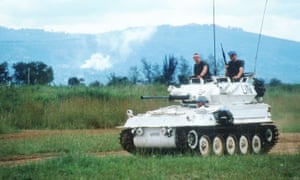

A UN tank helps civilians evacuate from Kigali, Rwanda, 1994. Photograph: Scott Peterson/Getty Images

Rwanda, 1994. The nadir of many lows for UN peacekeeping.

Hundreds of desperate Tutsis sought refuge on the first day of the genocide at a school where 90 UN troops were under the command of Captain Luc Lemaire. Here, they were surely safe from the Hutus and their machetes.

The UN flag flew over the school. The Belgian peacekeepers were armed with a machine gun, planted at the entrance. These soldiers were the world’s army. The Tutsis could not imagine they would stand by while people were slaughtered.

The 39-year-old captain feared otherwise. The UN in New York had ignored warnings that the genocide was being planned and the security council was pulling out peacekeepers in response to the mass killing.

Within days, the UN command decided there was more important work for Lemaire and his men than protecting Tutsis. The peacekeepers were ordered to abandon the school in order to escort foreigners to the airport and out of Rwanda.

As the soldiers left, Tutsis begged to be shot rather than left to the militia’s machetes. Within hours, the 2,000 people at the school were murdered by gun, grenade and blade.

Lemaire’s contingent kept a sporadic video diary of the wretched events. At one point a shaky camera captures a sandbagged machine-gun post and a pickup truck of Hutu militiamen sweeping by.

The video then focuses on the soldiers’ log. It reads: “New York didn’t agree to change the rules of engagement.” The peacekeepers were not to be permitted to save Tutsis. The camera’s microphone picks up an anonymous voice: “There are killings and New York doesn’t give a damn.”
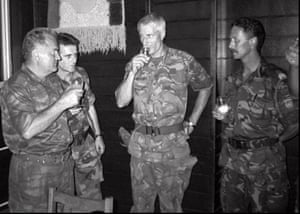
General Ratko Mladić of the Bosnian Serb army, left, drinks with Dutch colonel Ton Karremans, second right, in the Bosnian village of Potočari, on 12 July 1995, the second day of the massacre. Photograph: Anonymous/AP

The betrayal of the Tutsis in Rwanda was a low point for UN peacekeeping but not an isolated one. A year later, Dutch peacekeepers failed to stop the massacre of 8,000 Muslim men in Srebrenica, a supposedly UN “safe area”, the most notorious mass killing by the Serbs in Bosnia.
FacebookTwitterPinterest

Not long before, there had been the debacle in Somalia where a US-led UN humanitarian operation turned into a bloody conflict against a powerful warlord. By then Angola was already back at war after its UN peacekeeping mission collapsed amid accusations it contributed to the breakdown of peace.

Other disasters – the Democratic Republic of the Congo (DRC), Sierra Leone – were still on the horizon even as the UN peacekeeping department’s budget doubled and doubled again with growing numbers of missions.

70 years and half a trillion dollars later: what has the UN achieved?

There were good reasons to question the point of UN peacekeeping in the 1990s and to wonder if it was not costing as many lives as it was protecting by offering an illusion of security. The murdered Tutsis at the school might have stood a better chance if they had fled to Uganda.

Two decades later, those responsible for peacekeeping – UN officials, countries on the security council assigning missions, militaries contributing the forces in blue helmets – say the lessons of the 1990s have been learned. Protection of civilian lives is now a priority. UN soldiers no longer have their hands tied in using force to defend the innocent. Perhaps most important, the failures of two decades ago stripped the UN of the illusion that an election and a few soldiers in blue helmets is enough to sustain peace.

But even as peacekeeping has ballooned to become by far the most expensive of UN departments (in 2015 it will cost nearly $9bn to keep 120,000 blue helmet soldiers and policemen deployed in 16 countries from Mali to Cyprus and Haiti, compared with just $500m at the end of the cold war), it is dogged by challenges.

The politics of the UN security council continues to hamstring action over some conflicts, such as Syria and Darfur. Other missions drag on indefinitely, such as in the DRC and Haiti. There is friction between the UN and some governments over who has ultimate command over peacekeeping troops, which has resulted in conflicting orders with disastrous consequences. Then there are spreading conflicts against armed Islamist groups in central and west Africa.

“In the last 15 years, the number of missions, number of crises have drastically multiplied,” said Ban Ki-moon, the UN secretary general. “In addition to using military and police forces, we have been deploying a lot of special political missions. This is preventative diplomacy. If we can prevent at the time of symptoms of a crisis, we can save a lot of human lives and human resources.”
Advertisement

Jack Christofides, who is on leave from the UN as director of peacekeeping operations for central and west Africa, described peacekeeping as “extremely taxing at the moment”.

“We’ve got more troops, we’ve got a bigger budget, we deployed in all sorts of very very difficult places, much more difficult than we’ve ever been, and we’re stretched, we’re really stretched,” he said.

“If you think of the old deployments in places like Lebanon and Bosnia, there is a certain infrastructure you could use and work with. The troops coming were generally from countries that had the means to launch expeditions. Today, when you’re talking about northern Mali and central Africa, you have both extremely dangerous conditions and geostrategic locations which are very difficult to get to.”


The UN is also grappling with persistent accusations of rape and sexual exploitation by its peacekeepers, which is further undermining confidence in the organisation, particularly in some of the countries where its soldiers are deployed.

And there are added demands as the US presses for peacekeepers to take on a more aggressive role, particularly against armed Islamist groups in Africa. President Barack Obama is jointly hosting a summit with Ban in New York later this month to seek commitments to strengthen peacekeeping with better trained troops, equipment and intelligence resources, to the alarm of some of the countries that provide substantial contingents of troops in blue helmets.
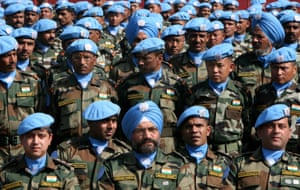
 Indian soldiers gather before their departure to Sudan on a UN peacekeeping mission. Photograph: Raveendran/AFP/Getty Images
India, which has sent more soldiers on UN missions than any other country – 180,000 on 49 missions – is openly challenging the move towards what some see as mostly rich and powerful countries on the security council sending the poor to fight and die.
Advertisement

“India is completely committed to peacekeeping provided peacekeeping is what we know it to be,” said India’s ambassador to the UN, Asoke Kumar Mukerji. “The soldiers in the blue helmets, under the blue flag, are impartial. They are not supposed to be partisan. If somebody wants soldiers to go in and fight they should hire mercenaries, not take UN soldiers.”

UN peacekeeping came into its own with the collapse of the Soviet Union in 1991 and the diminishing of ideological rivalries that had dominated international politics since the second world war.

Early successes in Cambodia, Namibia, Mozambique and El Salvador generated an overconfidence in the ability of UN soldiers to keep the peace. Each of those countries had an accord that former warring parties wanted to maintain.

The UN learned the hard way in Angola, Rwanda and Bosnia that where the UN wants peace more than those in conflict, then the illusion of peacekeeping can perpetuate instability and cost lives.

Out of the disasters of the 1990s came a new model including an ethos of “responsibility to protect”. No longer would UN forces stand idly by while innocent people were murdered. That has helped drive a rapid expansion of peacekeeping to become the UN’s single largest operation.

In 1991, the year the Soviet Union collapsed, the peacekeeping budget was just $490m. Over the past decade it has leapt from $3.8bn to about $9bn as the size and length of missions has expanded. More than 100,000 UN peacekeepers have served in Haiti since 2004 and close to 250,000 been deployed to the DRC over the past 15 years. There is little prospect of either mission ending soon.

Today, UN troop deployments in the DRC, Sudan and Darfur each cost more than $1bn a year, with Mali and Central African Republic not far behind. The most expensive outside Africa is Haiti, with a budget of $500m.

The emphasis on Africa is in part a reflection of the enduring nature of some conflicts on the continent, but also the politics of the security council. The UN might have had large peacekeeping missions in Syria and Ukraine, were it not for Russian objections.

As the scale of peacekeeping has grown so have the questions about its role. Most particularly, are peacekeepers there to monitor peace or to enforce it? It’s a source of increasing friction between the major powers on the security council that approve UN intervention and some of the countries which provide the troops.

In 2000, British forces landed in Sierra Leone after UN peacekeepers stood aside or fled an advance on the country’s capital, Freetown, by a notoriously brutal rebel group, the Revolutionary United Front (RUF). Several hundred peacekeepers surrendered to the rebels.
Advertisement

A British general, David Richards, was sent in by London to evacuate foreign citizens. Confronted with the RUF’s horrific record and the imminent killing of large numbers of civilians, he defied his instructions and used UK troops to spearhead a counter attack.

Richards, who went on to become Britain’s chief of the defence staff, said he was “staggered” to find that the Indian UN force commander, Major General Vijay Jetley, interpreted his mandate as that of a neutral intermediary. In Richards’ view the UN should have been siding with the elected government against rebels breaking a peace agreement.

“I had a real argument with Major General Jetley about this. The Indian hierarchy were very reluctant to lose a single person on a UN operation,” said Richards. “They were very reluctant to fight and that permeated quite a lot of the other contingents as well, to the point where I remember going in to the UN headquarters on my first day there in May 2000 and finding Jetley. I said General, we’ve got to stop the RUF, you’ve got to tell your people to fight. At least hold their positions. He was very reluctant to do it.”

India said its troops were sent to monitor the peace, not enforce it. The UN mission in Sierra Leone was further complicated by antipathy between some of the national forces, particularly Jetley and his Nigerian deputy, Brigadier General Mohammed Garba.

In an internal UN report, Jetley accused Garba and other senior Nigerians of being more interested in smuggling diamonds than keeping the peace. Nigeria’s military responded by accusing the Indian general of “trying to justify his ineptitude, inaction and inefficiency in the leadership of a 
multinational force.”
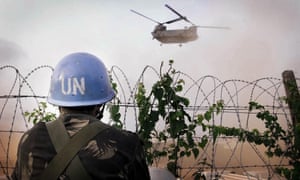
An Indian UN soldier watches an RAF Chinook helicopter land at the UN headquarters in Freetown, Sierra Leone. Photograph: Peter Macdiarmid/AFP/Getty Images
Such differences of opinion over the role of UN peacekeepers were replicated 12 years later in the Democratic Republic of the Congo as rebels advanced on the eastern town of Goma. The Indian commander of part of the largest peacekeeping force in the world ignored orders from UN officials to defend the town and called the Indian defence ministry in New Delhi to ask what he should do. He was told not to resist. The rebels seized Goma to the anger of Ban Ki-Moon, who regarded it as a “personal humiliation”, according to a senior UN official.

By then members of the wider UN mission in the DRC had come to look like bystanders to mass killing, rape and terror. Richard Gowan, until recently research director at the Centre on International Cooperation, a thinktank in New York that works closely with the UN on peacekeeping, said Indian forces in Sierra Leone and the DRC were taking orders from the defence ministry in New Delhi, not the UN commanders on the ground.

“It’s very clear that there are directions from New Delhi to avoid all risk, and that there are parallel lines of command between New Delhi and their guys in the field. That’s true of a lot of countries. A lot of field officers, if they get any order to take a significant risk in a peace operation, they’ll immediately phone home. That’s making it almost impossible for some force commanders to get anything done because they have no true control over their own units,” he said.

Most western nations will not put boots on the ground as frontline peacekeepers and so the UN is dependent on the goodwill of those countries prepared to deploy troops such as India, Bangladesh, Rwanda and Nigeria, making it hard to assert its authority.

The UN lost confidence in Jetley in Sierra Leone but when the then secretary general, Kofi Annan, tried to remove him, the Indian government threatened to pull out all of its forces. Annan’s successor, Ban, ran into the same threats from New Delhi when he tried to remove the Indian UN commander after the Goma debacle.

Rwanda and Srebrenica prompted a greater emphasis on protection of civilian lives, and involvement in rebuilding failed states instead of negotiating peace treaties, standing back and hoping it all worked out. Gowan said that while the “responsibility to protect” ethos was laudable it had also led to ill-thought-out missions.

“Sometimes in peacekeeping, the security council says ‘Good God we need to have a mission’ and that mission is stuck together,” he said.

Gowan pointed to Darfur, where he said the UN intervention came as a politically panicked response to public pressure over the mass killings by the government-allied Janjaweed militia.
Advertisement

“For political reasons the US and the UK insisted on having the mission. I’ve spoken to UK officials since who’ve said: ‘We had no real idea what this mission was meant to do. We were just under such public pressure to come up with an answer and the answer was peacekeeping.’ That was definitely true for the Bush administration as well,” he said.

“Darfur has been a quagmire from the beginning. The frank reality is no one believes that the mission is working but no one dares pull it out because they fear the moment it goes there will be an even greater spike in violence and the security council will be held responsible. It’s become a slow burning disaster.”

Philippe Bolopion, the UN director at Human Rights Watch, said the principal reason for the failure of the Darfur mission, a hybrid operation with African Union forces, was deadlock on the security council.

“When permanent members of the security council can’t agree to stand up to an abusive government such as Sudan’s, and you have weak peacekeeping troops on the ground, it’s almost a perfect storm where peacekeepers are not going to protect civilians properly,” he said.


Members of the security council routinely prioritise national interests over the needs of the peacekeeping missions

“Permanent members of the security council routinely prioritise their national interest over the needs of the UN peacekeeping missions they have mandated, as a result often undermining them. Russia and China have done this by opposing more sanctions against the Sudanese government even when it pushes peacekeepers around in Darfur.”

The responsibility to protect has had a more positive impact elsewhere. Peacekeepers in South Sudan turned their bases into de facto refugee camps protecting tens of thousands of people. That would have been unlikely 20 years ago.

But the ethos has been severely challenged by the fallout from the security council mandate for military intervention in the 2011 Libyan revolution to protect civilians in Benghazi. Russia accused Nato of abusing it to support the overthrow of Muammar Gaddafi. That in turn has complicated UN action on Syria.
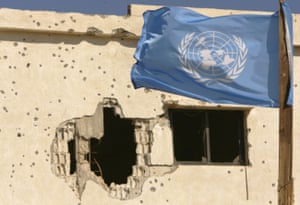
A UN flag flutters amid the rubble of the Lebanese-Israeli border town of Maroun al-Ras. Photograph: Patrick Baz/AFP/Getty Images
Finding common ground on sub-Saharan Africa has generally been less difficult because of fewer strategic rivalries. The debacle in Goma prompted the UN to put together a fighting force of soldiers prepared to go into combat. South Africa, Tanzania and Malawi volunteered to send troops to join the Force Intervention Brigade in part because they were weary of the persistent instability in the region.
Advertisement

“We were all embarrassed, humiliated at the end of 2012 when Goma fell,” said Christofides, who oversaw UN peacekeeping operations in the DRC from 2011 until earlier this year and was an architect of the intervention brigade. “Everybody has that image of peacekeepers sitting on top of an APC [armoured personnel carrier] and this group of ruffians walking into Goma. That was a low moment for everybody.

“When we recommended the mandate of the intervention brigade, the security council did not need much persuading. You have some very far-reaching language in the mandate about targeted offensive operations. That’s not language you see in resolutions of the UN. Neutralising armed groups, preventing their expansion, disarming them.”

The UN also deployed drones for the first time to help monitor the movements of the rebels and to verify Rwanda’s denials that it was supplying the insurgents. The drones are not armed although that appears the next likely step, if not in the DRC then in some other conflict where the UN is involved, given their increasing use in the Middle East by the US and its allies.

The intervention brigade has been successful in changing the dynamic in eastern Congo by pushing back the rebels and providing a degree of stability to begin the reconstruction of functioning systems of government, such as the courts – although regional politics has played a large part too. But the operation has also deeply alarmed countries such as India, which fears it sets an example for the future of peacekeeping.

Christofides doubts that the force intervention brigade provides a model for other peacekeeping missions. Senior UN officials, some of whom were strongly opposed to the creation of the brigade but now judge it a success, are deeply wary of the UN taking on a similar role in other conflicts. The DRC, they say, was a unique situation.

But even if the force intervention brigade is not replicated, it fits with a wider agenda by the major western powers to remake UN peacekeeping as a partner in military campaigns. For them, the lesson of British intervention in Sierra Leone or the recent French deployments in Mali and Central African Republic against armed Islamist groups is that better trained and equipped forces launch the initial assault and then the UN comes in as backup. But for that to happen, UN peacekeeping has to up its game.

Obama is leading the push with his New York summit on 28 September to seek pledges of troops, equipment and intelligence resources to a revamped peacekeeping operation.

Washington regards peacekeeping as a national security issue and a “good bargain”, as one official put it. The US picks up the tab for a quarter of the UN’s $9bn peacekeeping budget, but it is a fraction of the cost of the Pentagon or invading Iraq.

Moreover, if other countries are sending their forces then the US does not have to risk the lives of American soldiers. Previously, the US mostly regarded peacekeeping in Africa, in particular, as a humanitarian issue. Now, given the nature of the conflicts in Mali, Nigeria and Central African Republic, Washington views it as strategic.
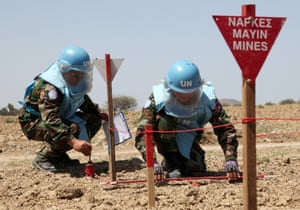
Cambodian mine experts demonstrate their work in the UN-controlled buffer zone in Cyprus. Photograph: Barbara Laborde/AFP/Getty Images
But while the US wants more assertive peacekeeping, it does not want to send its soldiers to fight. Obama is pressing more developed countries, in Europe, Asia and Latin America, to make greater commitments in the hope of improving the quality of UN forces. So is Ban.

“I’m now in the process of reaching out to developed countries. I’ve been speaking to many presidents and prime ministers to diversify the participation of peacekeeping forces,” he said.
Advertisement

“If we can diversify and have more countries, particularly some big countries, if they can send their own troops in addition to assets and financial support, that would be much appreciated.”

UN officials privately concede there is little chance of the US putting its forces under UN command. Congress would never stand for it. But Washington is joining the UN in pressing other developed countries to play a bigger part in peacekeeping.

The UK currently has fewer than 300 soldiers deployed on peacekeeping missions, mostly in Cyprus. “We’ve been having goodness knows how many discussions with British officials with a view to getting them more involved,” said Christofides. “We’re still drawing too many troops from a few parts of the world and not enough from other parts of the world. And I don’t just mean Africa versus the west, but other countries in Asia and Latin America that could contribute a bit more.”

Another senior UN official put it more bluntly: “Britain has a reputation for lecturing without contributing.”

The UK is expected to announce a contingent of peacekeepers for South Sudan at the New York summit, but numbers are not known.

Richards wants to see Britain make a greater contribution. “The Ministry of Defence and, I have to say sadly, the armed forces, don’t really see the UN as proper soldiering. This is a cultural ignorance that’s grown up over many years. The Americans share it writ large: UN ops is what second- and third-world nations do but proper armies, we pick and choose,” he said.

Richards said countries whose forces had experience in Afghanistan and Iraq could put that to good use in UN operations. “I think that’s a pretty good role for the British armed forces in this era when there’s so many nasty things going on in the world. The Americans really need to decide to do it as well,” he said. “I think at a low level, our young officers would love to do it. There is a higher level political/military reluctance and snootiness about it.”
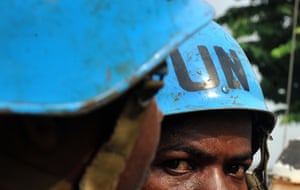
 A UN peacekeeper patrols in a street in Abidjan, Ivory Coast. Photograph: Issouf Sanogo/AFP/Getty Images
India strongly opposes a move towards more forceful peacekeeping. “When it has been used as a tool to ensure that a peace agreement is observed so that peace building can take place, or as a tool to facilitate a political resolution, it works,” said Mukerji, the Indian ambassador to the UN.

“But if peacekeeping is to be seen as peace enforcement, then unfortunately we can’t see the UN charter allowing such a radical departure of the use of peacekeeping.

“Peacekeeping is not an end in itself. The end is political stability and peacekeeping is just a tool to bring about political stability. What’s happening now is the cart is being put before the horse. I think that’s a very unfortunate development.”

Gowan is sceptical for different reasons. “I think that we may be stumbling into an enormous strategic trap because if we have learned over the last decade that very highly capable Nato forces, US forces, actually can’t suppress Islamic extremist groups, why on earth do we think slightly strengthening UN missions is going to give us a tool that allows us to fight terrorists?” he said.

Monday, September 18, 2017

Canada May Be Unwelcome at Peacekeeping Summit which it is Hosting

By: Lee Berthiaume, The Globe and Mail 

There are growing signs that Canada won't meet the criteria for attending a November peacekeeping summit in Vancouver, even though it is the host country.

The price of admission is clear in leaked UN documents obtained by The Canadian Press: Defence ministers attending must be ready to pledge specific forces to the UN, if they haven't already done so.

Canada has yet to make any definite pledge, despite being the host of this year's summit, and Prime Minister Justin Trudeau wouldn't commit Wednesday to a decision before mid-November.

The uncertainty over Canada's plans before the meeting has prompted renewed frustration and disappointment from the UN and various allies, some of whom are losing faith in the Liberal government's promise to support peacekeeping.

The UN documents lay out the overarching agenda and goals of the defence ministers' two-day meeting, which starts Nov. 14.

Those include looking at ways to better prevent conflict, protect civilians and ensure soldiers and police officers on peacekeeping missions are well trained.

The summit will also put a heavy emphasis on increasing the number of female peacekeepers and incorporating gender perspectives into operations.

Yet the real focus of the meeting will be on taking stock of the specific pledges those countries in attendance will have already made, or are prepared to make, to UN peacekeeping operations.

That is why participation in the summit, the third of its kind after the inaugural event in Washington in 2015 and last year's meeting in London, is only open to those countries that have made pledges.

"The participants of the 2017 ministerial will be defence ministers from all member states that have pledged and progressed capabilities or that are ready to make a new pledge," the document says.

It goes on to detail the specific equipment and troops that the UN needs for various missions, with "critical gaps" in the peacekeeping missions in Mali, South Sudan and Haiti.

Trudeau said Wednesday that Canadians expect his government to take its time before sending troops in harm's way and he wouldn't commit to a decision before the time of the Vancouver meeting.

"We need to make sure that we're doing it right, that we're doing it in a thoughtful way and that it's the right mission," he said in St. John's, N.L. "We will take the time necessary to do it properly."

The Trudeau government announced with much fanfare last year that Canada would provide up to 600 soldiers to future UN peacekeeping missions, but it has yet to spell out any details.

Early signs pointed to Canada sending a large number of troops to Mali and trainers to various other African countries to help their militaries become better at peacekeeping.

But the Liberals have instead waffled for over a year on where to deploy, except to send two police officers to monitor the peace process in Colombia in February.

Multiple officials at the Defence Department have said the file is out of the military's hands and now rests with Global Affairs Canada and the Prime Minister's Office.

The government's foot-dragging has long frustrated UN officials and allies, but there was always an expectation that a decision would at least be made by the Vancouver meeting.

Foreign diplomats in Ottawa and UN officials in New York were scrambling on Wednesday to find out whether that was now off the table, even as they lamented the government's mixed messaging.

"Canada is making one promise after the other," said one diplomat, who spoke on condition of anonymity. "But there's nothing on the ground. So Canada is not delivering.

Canada's foot-dragging has hampered mission planning and left critical gaps in terms of personnel and equipment on the ground, the diplomats added, especially in Mali.

And they warned that some countries could end up sending lower-level officials to Vancouver if Canada isn't prepared to make an announcement at the peacekeeping meeting.

Royal Military College professor Walter Dorn, who has done extensive work on peacekeeping, worried that Canada was setting a bad example as the UN tries to rally support for peacekeeping.

"It shows poor performance in delivering on commitments," Dorn said. "And performance is one of the principles this conference is supposed to uphold."

Friday, June 23, 2017

Dithering or a Rethink on Peacekeeping Intentions?

By: Blair Gilmore, RUSI-NS

Three recent news items relate to Justin Trudeau’s intent to send troops on a UN peacekeeping mission. Outfits like the CDA Institute have released their analysis on Canada’s new Defence Policy, the Globe and Mail reported that a CAF sniper once again holds the record for the furthest kill shot, and MPs of the House of Commons are expected to rise for their summer break, which lasts from June 23 to September 18.

Prime Minister Justin Trudeau famously (or infamously) declared in the early days after the 20 October 2015 election that “Canada is back!” This partly referred to our country’s apparent readiness to get back onto the world stage as a peacekeeping nation. The CAF had been regrouping after 12 years of operations in Afghanistan and had taken an operational pause. Cynics thought the Liberals just wanted a coveted seat back on the UN Security Council, while altruistic observers believed they wanted to bring Canadian ‘sunny ways’ to downtrodden portions of the planet. Either way, this promise to our allies to help with the ‘heavy lifting’ is going on two years with no fulfilment in sight.

Reminiscent of The Economist’s assessment of a former Liberal PM, Justin Trudeau seems to be turning into 'Mr. Dithers' The Sequel. He is hedging his bets by judiciously spending Canada’s "blood and treasure" on select hellhole missions around the world. The CAF has Special Operations Forces in hotspots sprinkled here and there and, as evidenced by the record-breaking kill shot, we are turning the ‘bad guys’ into pink mist. But these operations are shrouded in secrecy to minimise the PR fallout. We also are making a big deal of a contingent of 450 soldiers being sent to bolster Latvia; of CF 18s patrolling Iceland’s air space, and a frigate in the Mediterranean under Operation Reassurance in an effort to blunt Russia’s burgeoning re-emergence as an aggressive military world power. The world may be sliding back into another Cold War, but the potential for onesies or twosies of Canadian-flag-draped coffins coming home is minimal.

The government pumped out a comprehensive Canada Defence Policy which impressively lays out the CAF’s focus for the next 20 years along with substantive budget increases. There have been immediate results like overdue pay increases but the large expenditures will not kick in until after the next election cycle. Lots of good words and promises, but very little in the way of solid rubber meeting the road.

About a year ago, the Minister of National Defence (MND), Harjit Sajjan made the rounds of African countries for potential Canadian peacekeeping missions in an effort towards due diligence before fulfilling the PM's promise. The scuttlebutt has been that Mali was the lead contender of Canadian peacekeeping largesse. Mali is a particularly nasty quagmire with open Islamic civil warfare, use of child soldiers, frequent and numerous peacekeeper casualties – all with a generous dash of IEDs.

As a former Intelligence officer, the MND is no dummy. I think he and the PM were somewhat unprepared for the realities of Mali, and now recognise that dead CAF men and women will be regularly travelling the Highway to Heroes route if we send troops out on these peacemaking missions. This is why they dither when pressed on when the government is planning on making a decision.

I am no fan of sending CAF personnel into harm’s way. I have family and friends in uniform. I have lost military friends doing their duty. Frankly, in my opinion, some parts of the world are burning and that’s just the way it is. Let them sort their own crap out because all we seem to do as Western powers is muddy the water and waste our efforts. The government knows there is no upside to sending troops to a place like Mali, so they are stalling like mad, hoping other world events or opportunities will come up to distract us from that ill-conceived promise.

As reported by CBC's Murray Brewster, Canada has been presented with a long list of 'marquee command roles' for UN missions and has turned them all down except for a plum position in New York. With the rising of the House, the Liberals will undoubtedly push any decision further to the right by months until at least the fall session.

Opposition MPs will rightly want a debate before sending CAF troops into obvious peril – and this will be another excuse to, in military parlance, mark time.

There’s an old military adage related to the concept of leadership when it comes to making a choice. Either make a decision, follow, or get the hell out of the way. Our allies, like the Dutch in need of a tag-out in Mali, and the Germans who wanted the use of our helicopters instead of theirs, are probably dismayed that Canada is 'all talk and no action'.

Perhaps the innocents who are being killed, tortured, raped and maimed would like to stop holding out false hope that blue-beret-wearing Canadians are coming to their rescue. The world and our defence partners are realizing that Canadian ‘Sunny Ways’ and ‘Canada is Back’ talk is simply blowing sunshine up their collective behinds.
-----

– Blair Gilmore is a Research Fellow with the Nova Scotia branch of the Royal United Services Institute of (RUSI-NS)

Friday, May 12, 2017

"Peacekeeping" Mission Must Start With Exit Strategy - Warns CAF

By: Lee Berthiaume, The Canadian Press

OTTAWA — Make sure you have a plan to get out before you actually get in.

That is one of the main messages of an internal paper that military officials prepared last summer as they considered the challenges associated with the Liberal governments' promised return to international peacekeeping.

The paper also warns about the need to clearly explain why whatever mission the government chooses is in the national interest and expresses real concerns about the threat posed by terrorism.

The July 2016 paper was prepared by the strategic joint staff, which provides analysis and advice directly to the chief of defence staff, and was obtained by The Canadian Press through the Access to Information Act.

It emerges as the Liberal government continues to dither over where to send up to 600 Canadian peacekeepers, despite pressure from some allies as well as the UN for a decision.

The Liberals had been leaning toward — but have since waffled over — sending troops to the African nation of Mali, where more than 100 peacekeepers have been killed, many in terrorist attacks.

The government won't say when it will choose a mission, or why it is dragging its feet, but the issues and concerns raised in the paper may explain part of the delay.

One is the need to start thinking about an exit strategy even before the first troops arrive.

The paper notes that while countries like Canada often want to make only short-term contributions to UN missions, history has shown that there is often "significant pressure" to stay longer than expected. Canadian soldiers joined a UN peacekeeping force in Cyprus in 1964 and stayed until 1993.

"From the outset of planning, consideration should be given to the sustainment and eventual withdrawal from the (operation)," the paper reads, adding that leaving is often "a delicate mission to execute."

The government was encouraged to essentially line up other countries to step into the breach once Canada's commitment expires — a task that could be easier said than done for a mission like Mali.

Part of the reason Canada has faced international pressure to go into Mali is because some of the European countries already there have had trouble finding replacements.

The paper also says that moral arguments about peacekeeping being the right thing to do aren't a good enough reason for deploying troops on specific missions.

"There is a legitimate moral component to this discussion, namely that Canadian participation … is the right thing for a nation with Canada's good fortune, wealth and means to undertake," the paper says.

"But the discussion must be wider than a moral one in order to define the national interest in more tangible terms and to provide some balance by measuring the risks and rewards."

The Liberals have said expanding Canada's participation in peacekeeping serves the national interest by contributing to a more peaceful and stable world.

But government sources have admitted they must do a better job explaining why the Liberals are intent on peacekeeping — a task that will become even more important once a mission is chosen.

Much of the paper focuses on the new dangers that have crept into peacekeeping, with officials noting that missions "are higher-risk and take place in more complex environments than before."

Special attention is paid to terrorist organizations, which the paper says "pose an undeniable threat in certain locations," especially when it comes to protecting troops and fulfilling a mission's objectives.

This is especially true for UN missions, the paper says, which aren't mandated to conduct counter-terrorism operations.

While Mali isn't mentioned, the findings are particularly relevant to the mission there, as groups such as terrorist groups such as al Qaida in the Islamic Maghreb have repeatedly targeted peacekeepers.

Other factors to consider before choosing a mission, the paper says, are whether it is effective or could be made effective and what impact it could have on Canada's international reputation and national security.

"Canadian participation . . . should be grounded in a well-conceived and articulated strategic purpose, delivered via a strategy nested with other Canadian efforts globally," the paper concludes.

"It must reflect the contemporary operating environment, is mandated to have protection of civilians at its heart and should seek to promote responsible burden-sharing within the international community."

CAF "Peacekeeping" Mission Decision is Delayed for Months

By: Bruce Campion-Smith, Toronto Star

OTTAWA—Canada’s high-profile military mission to Africa appears off the radar for now with a decision on a deployment delayed, perhaps until fall, the Star has learned.

Political upheaval among key allies — notably the United States, France and Great Britain — is cited as the reason why Justin Trudeau’s government has pushed back its high-profile pledge to return Canada to international peacekeeping efforts.

The federal government does not want to deploy soldiers on a potentially dangerous mission only to find other nations have decided their priorities lie elsewhere, leaving Canada “stuck with a legacy mission,” one source told the Star.

One official at defence headquarters offered a blunt assessment of where the peace mission currently stood on the list of priorities. “It’s not on the radar,” said the source.

When asked about the delay, officials point to the political shake-ups around the globe, notably in Washington, where the unexpected election of Donald Trump as president and his unpredictable tenure in office so far has forced Ottawa to rethink priorities on issues from defence to trade.

But political change bubbles in other capitals too. Britons go to the polls in a general election in June. France just saw the election of a new president, Emmanuel Macron, who beat out right-wing candidate Marine Le Pen. That country has a significant military mission ongoing in Mali, one nation cited as the likely destination for the Canadian deployment.

At home, other issues are competing for attention. Next week, the Liberal government will unveil its defence policy review that will lay out a new vision for the armed forces and the promise of additional funding to pay for it.

That vision, expected to provide policy guidance for the coming two decades, will almost certainly include a nod to the record of Canadian peacekeeping around the globe. But it’s not expected to include any new details of forthcoming missions.

The government’s attention has also been distracted as the political front as the man tasked to sell that new vision — Defence Minister Harjit Sajjan — is fighting for his credibility after being forced to apologize for inflating his role as an officer during an Afghanistan offensive.

And within defence headquarters, the fallout from the surprise January ouster of Vice-Admiral Mark Norman, the second-in-command of the military is still being felt.

All that means that a decision on a peace support mission is now not expected for months yet. That timing means it could be more than a year since the Liberal government laid out its promise of personnel and funding for a mission — 600 troops, 150 police officers and $450 million over three years for a new Peace and Stability Operations Program.

An announcement on exactly where Canada would deploy those personnel on a peace mission had been expected by last Christmas. But there was no word and nothing yet in the months since.

Trudeau said in March that his government would not be pushed into making a decision, saying that any deployment had to be done “responsibly and thoughtfully.”

But months later, the government seems no closer to a decision.

“I don’t have a timeframe on that,” Sajjan told the Star in a recent interview.

“All I can tell you is we will make that decision as a government when we feel comfortable that we have all the necessary information, that we have a whole of government approach and definitely from the military side, one that is going to have an impact on the ground,” Sajjan said.

He conceded that the changes around the globe were, in part, the reason for prolonged discussions about Canada’s role in a UN mission.

“We do need to look at . . . the changing environment. We have to make sure that when we add in and say we’re going to do ‘X,’ we have to make sure that ‘X’ is actually going to provide added value to the UN,” Sajjan said.

In the January cabinet shake-up that made Chrystia Freeland foreign affairs minister, one of the tasks handed the Toronto MP was to “increase Canada’s support for United Nations peace operations.”

Alex Lawrence, her spokesperson, told the Star that the peace deployment remains under active consideration. “Our government is committed to international peace operations, and we are currently considering what precise role Canada can play,” Lawrence said.

But Canada’s hand could be forced when Sajjan hosts an international summit on peacekeeping at the end of the year.

Sajjan used last year’s summit in London to herald the willingness of the Liberal government to reengage in peace missions, declaring that, “Canada is committed to leading international efforts in peace support operations.

“Conflicts today are more complex than ever before and we’re serious about being part of the solution — that’s the reason we’re bringing our resources and skills to the table,” Sajjan said in a statement issued for the 2016 summit.

It could be awkward for the Liberal government to go into this year’s summit with nothing to show for the statements it made more than a year earlier.

Defence analyst Dave Perry says the delay in deciding a mission has already likely forced military officers and diplomats back to the drawing boards to update the proposals they first presented to the government.

“I would imagine given how long it has taken since some of those initial inputs were provided that revisiting some plans because events and things on the ground have changed significantly would be part of the delay now,” said Perry, a senior analyst with the Canadian Global Affairs Institute.

“Some of the plans would have been submitted a half year ago. Hard to think they would still be viable today,” he said in an interview.

Wednesday, January 25, 2017

Canada pauses Peacekeeping Plans to co-ordinate with Americans

By: Lee Berthiaume, Canadian Press 

OTTAWA — Defence Minister Harjit Sajjan plans to talk to his American counterpart before he pursues Canada's plan to send peacekeepers to Africa, saying co-ordination with the U.S. is essential.

The government announced in August that Canada would deploy up to 600 troops on future UN peacekeeping missions, though it stopped short of saying exactly where they would go.

A decision was promised by the end of the year, after military officials and Canadian diplomats had a chance to test the waters and get a better sense of where the troops could make a difference.

But the question of where Canadian blue helmets will end up is still hanging in the air as the government tries to get a handle on the Trump administration's priorities.

Sajjan spoke to new U.S. Defense Secretary James Mattis by telephone on Monday, and while they did not discuss peacekeeping, Sajjan said he intends to when the two meet in person for the first time.

That's because any troop deployment must be done with the bigger picture in mind, Sajjan said.

"It's all interconnected. For example, what's happening in Iraq right now impacts what's happening in Africa and other parts of the world," he told reporters in Calgary. "So we have to discuss this because we need to be able to maximize our impact on the ground."

The minister insisted Canada would make its own decision on when and where to send peacekeepers.

Sajjan had the distinction of being the first foreign defence minister that Mattis has spoken to after being confirmed U.S. defence secretary. The retired general was reportedly effusive in his praise for Canada.

According to a readout from the U.S. Defence Department, Mattis not only thanked Canada for its contributions to North American security, he noted the country's military contributions in Iraq and Latvia.

"Secretary Mattis thanked Minister Sajjan for Canada's strong support for our alliance," the readout says, "and expressed his personal appreciation for the professionalism of the Canadian Armed Forces."

Those words will be welcomed by Canadian officials who have been wringing their hands over whether the Trump administration plans to pressure Canada to spend more on defence.

Trump has previously railed against what he called "freeriders" within NATO, and while those words were largely targeted at European allies, critics say they could easily apply to Canada.

Canada spends less than one per cent of its gross domestic product on defence, while the NATO target is two per cent. But the federal government argues that such calculations ignore Canada's in-kind contributions to global security.

While Mattis does not appear to have raised the issue of defence spending with Sajjan, the touchy subject did figure prominently in the U.S. defense secretary's later phone call with British counterpart Michael Fallon.

Mattis reportedly emphasized the U.S.'s "unshakable commitment to NATO," according to a readout from that conversation, before thanking the UK for committing two per cent of GDP to defence.

In his own statement, Fallon said he and Mattis talked about "our joint leadership in NATO, including…how we ensure that all members meet the two per cent spending commitment alongside America and Britain."

The Liberal government is currently drawing up a new defence policy, and one of the key questions is whether it will include significant new cash for the military.