Translate

Showing posts with label Canada-US Relations. Show all posts

Friday, July 6, 2018

US Steel for Canadian Warships

By: David Pugliese, The Vancouver Sun 

The Canadian navy’s new supply ships are being constructed of U.S. steel even as President Donald Trump punishes Canadian producers of the same product with a 25-per-cent tariff.

The supply ships are being built at the Vancouver shipyards of Seaspan, which is owned by a U.S. company. The Department of National Defence confirmed the steel is being purchased from a mill in Alabama, a solidly Republican state that voted 62 per cent for Trump.

Defence Minister Harjit Sajjan cut some of the first U.S. steel for the ships at a June 15 ceremony, the same day that Trump launched yet another verbal attack on Prime Minister Justin Trudeau while praising North Korean dictator Kim Jong Un.

Trump has brought in tariffs of 25 per cent on Canadian-made steel and 10 per cent on Canadian aluminum. His government has stated that Canadian steel and aluminum pose a national security threat to the U.S.

Trump also lashed out at Trudeau as “dishonest and weak,” after the prime minister reiterated his position that U.S. steel and other products would face retaliatory tariffs. In addition, Trump has promised to punish Canadians in other ways on the economic front.

The government awarded Seaspan an initial $66-million contact to begin building 52 sections of the new naval supply ships, or about 20 per cent of the vessels. DND said the steel for the ships was ordered “a number of months ago.”

“While Canadian mills will continue to be considered for future chapters of the project, there simply was no Canadian mill who could supply the required certified steel of suitable size and grade at the time it was required,” the DND said in an email.

But Joseph Galimberti, president of the Canadian Steel Producers Association, said domestic firms can supply enough product.

“There is capacity in the Canadian steel industry to participate in these projects,” he said Wednesday. “As a general rule, we have very high quality, quite innovative, extraordinary cost-effective producers in Canada and would like to be considered for participation” in the government’s shipbuilding programs.

Galimberti pointed out that U.S. steel producers actively lobbied the Trump administration to make sure their Canadian competitors faced tariffs. The situation with the supply ships sees those U.S. firms protected in their home markets but still profiting on sales for a Canadian government project, he noted.

“If you wanted to respond to the U.S. tariffs but you are exempting U.S steel producers who are behind the U.S. tariffs, then you have failed,” Galimberti added.

Two supply ships will be built at Seaspan. The project will cost $3.4 billion, of which 60 per cent goes for the construction of the ships.
Defence Minister Harjit Sajjan, left, cuts steel for the first of two Joint Support Ships for Canada’s Navy at the Seaspan Shipyards in Vancouver, June, 15, 2018. JONATHAN HAYWARD/THE CANADIAN PRESS
At one point, the first ship was supposed to arrive in 2012. That has been changed a number of times, with the government later hoping for a 2018 delivery and then a 2019 arrival for the first vessel. DND is now hoping for the delivery of the first ship in 2022 or 2023. The Joint Support Ships are critical as they provide fuel and supplies for warships at sea. The Royal Canadian Navy retired its last two aging supply ships years ago.

Trump continues to threaten various nations, including Canada, with additional tariffs. But his economic policies are also backfiring on some U.S. firms.

Increased steel costs because of the tariffs forced the Mid-Continent Nail plant in Poplar Bluff, Missouri to recently lay off 60 of its 500 employees.

The company is in danger of shutting production by September unless the U.S. government grants it an exclusion from paying the tariffs, company spokesman James Glassman told CNN.

The plant is located in an area that overwhelmingly voted for Trump.

Harley-Davidson has also announced it will move the production overseas of motorcycles to be sold in Europe. The company decided on the move since the European Union has imposed retaliatory tariffs on U.S.-built motorcycles.

Trump responded to the decision by Harley-Davidson by threatening to increase its taxes.

Monday, June 18, 2018

RCAF Ups Used-Aussie F-18 Purchase to 25

By: David Pugliese, Defence Watch 

Canada has boosted the number of used Australian fighter jets it is purchasing to 25 but the deal to acquire those aircraft still hinges on approval from the U.S. government.

A Royal Canadian Air Force CF-188 Hornet departs Marine Corps Air Station Miramar, California to conduct a mission as part of Exercise PUMA STRIKE 16-B on November 16, 2016. Photo: Cpl Manuela Berger, 4 Wing Imaging CK01-2016-1124-014
The Liberal government originally announced it would buy 18 used Australian F-18 jets to augment the Royal Canadian Air Force’s CF-18s until new aircraft can be purchased in the coming years.

But it has added seven more used Australian F-18 aircraft to the deal, the Department of National Defence has confirmed.

Those extra aircraft will be stripped down for parts, Dan Blouin, a spokesman for the DND, said Friday.

It is not known yet if the seven aircraft will be flown to Canada or shipped, he added.

The exact cost of purchasing the 25 aircraft, along with weapons and other equipment is not yet known as negotiations are still underway on the deal, Procurement Minister Carla Qualtrough recently told journalists. The Liberal government has set aside up to $500 million for the project.

An Australian Senate hearing was recently told that Canada was presented with a cost proposal from the Australian government last year. “They accepted our offer in December, but they have also put in a further request for some seven aircraft for system testing, training and spares,” Australian Air Vice Marshal Cath Roberts told the hearing.

The U.S. government is examining the deal and will have to give its approval to Australia before that country can sell the F-18s to Canada.

Approval is needed because the F-18s were built in the U.S. with American technology.

Canada is hoping for the U.S. approval sometime in the summer.

Although U.S.-Canada relations have hit a slump, with American President Donald Trump vowing to punish Canadians because of ongoing economic disputes, the DND does not expect that situation to affect approval for the fighter jet deal to proceed.

Pat Finn, the Department of National Defence’s assistant deputy minister of materiel, has said he expects that a deal will be in place by the end of the year with deliveries of the Australian planes to begin in the summer of 2019. The Liberal government originally planned for the arrival of the first used aircraft in January 2019.

The Liberal government had originally planned to buy 18 new Super Hornet fighter jets from U.S. aerospace giant Boeing.

But last year Boeing complained to the U.S. Commerce Department that Canadian subsidies for Quebec-based Bombardier allowed it to sell its C-series civilian passenger aircraft in the U.S. at cut-rate prices. As a result, the Trump administration brought in a tariff of almost 300 per cent against the Bombardier aircraft sold in the U.S.

In retaliation, Canada cancelled the deal to buy the 18 Super Hornets. That project would have cost more than US$5 billion.

Thursday, June 14, 2018

Canada-US Trade Dispute Could Impact US Firms Out in Military Equipment Sales

By: David Pugliese, The National Post 

U.S. President Donald Trump’s tirade against Canada and threats to punish the country could undermine efforts by American firms trying to sell fighter jets and other military equipment to the Canadian Forces, warn defence and industry analysts.

One European firm, Airbus, has already been talking with Canadian officials to pitch its plan to build fighter jets in Quebec as it positions itself to win the $16-billion deal to replace CF-18 aircraft. A similar offer has been made in the past by Dassault Aviation. 

A Canadian Forces CF-18 Hornet comes in for a landing at CFB Bagotville, Quebec, on June 7, 2018. GEOFF ROBINS/AFP/GETTY. 
An Italian aerospace firm, Leonardo, is looking at building helicopters in Nova Scotia as it moves towards negotiations for a search-and-rescue aircraft modernization project the Department of National Defence says will be worth between $1 billion and $5 billion.

Trump has hit Canadian aluminum and steel with tariffs, claiming their import is a threat to national security. After the weekend G7 meeting and Prime Minister Justin Trudeau’s reaffirming that Canada would reciprocate with tariffs on specific U.S. products, Trump vowed more economic grief that will “cost a lot of money for the people of Canada.”

Trump’s move comes at a time when European firms are courting the Canadian government, particularly on big-ticket defence items such as aircraft and warships. Billions of dollars in new purchases are potentially at stake and European firms had a strong presence at the recent CANSEC military equipment trade show in Ottawa.

“Trump certainly isn’t helping U.S. defence companies who want to sell to Canada,” said Martin Shadwick, a defence analyst in Toronto. “It would be very difficult at this point from a political optics point of view for the government to announce awarding contracts to any American firm.”

Shadwick said whether that situation will continue for the next several years, when for instance the decision on new fighter jets is supposed to be made, would depend on any further actions by the president. Two U.S. aircraft, the Boeing Super Hornet and the Lockheed Martin F-35, are among the top contenders in that jet competition. The other three aircraft are from European companies.

An earlier trade dispute with Canada has already backfired on Boeing and the Trump administration, costing the U.S. billions in fighter jet sales. Last year Boeing complained to the U.S. Commerce Department that Canadian subsidies for Quebec-based Bombardier allowed it to sell its civilian passenger aircraft in the U.S. at cut-rate prices. As a result, the Trump administration brought in a tariff of almost 300 per cent against Bombardier aircraft sold in the U.S.

In retaliation, Canada decided against buying 18 new Super Hornet fighter jets from Boeing. That deal would have been worth more than US$5 billion.

Trump certainly isn't helping U.S. defence companies who want to sell to Canada

Christyn Cianfarani, president of the Canadian Association of Defence and Security Industries, said it is too early to determine the impact of the U.S. tariffs on the domestic defence industry. “Tariffs are never good for trade or business,” she added.

“CADSI is monitoring the issue and consulting our members to better understand the potential impact to Canadian firms, both in terms of the direct impact of any tariffs and the more indirect, long term impact on supply chains and market access,” she said.

There is growing concern that Canadian aviation firms could be hurt by Trump’s aluminum tariffs. The Aerospace Industries Association of Canada did not respond to a request for comment. But its counterpart in the U.S. has voiced concern that American aerospace companies could feel pain.

In March, the U.S. Aerospace Industries Association noted it was deeply concerned about Trump’s tariffs on steel and aluminum as it “will raise costs and disrupt the supply chain, putting U.S. global competitiveness at risk.”

“There is also a significant threat for retaliation from other countries towards American ­made products,” the association noted in a statement.

Canada is the largest exporter of aluminum and steel to the U.S.

Monday, June 11, 2018

Is Canada a Security Threat to the US? No - Canadians Actually Help Keep US Safe.

By: Tristen Hopper, The National Post

It's been two days since President Trump called Prime Minister Trudeau 'weak' and a 'backstabber', and it’s been a week since the Trump Administration slapped Canada with steel and aluminum tariffs on the ground that reliance on our imports was threatening the “national security” of the United States.

If Canadians are particularly galled at this, it might be because no foreign country in modern times has done more to arm and equip the United States than Canada. “I would not be surprised if every single major aircraft or warship in U.S. military service today has Canadian components in it,” said Richard Shimooka, a senior fellow at the Macdonald-Laurier Institute.

Below, a cursory summary of some of the Canadian stuff used by history’s most powerful military.

Landing gear

We’ll start with an entry that directly concerns steel and aluminum. Quebec-based Héroux-Devtek is the world’s third largest aircraft landing gear company, and some of that is thanks to a longstanding relationship with the U.S. Air Force and U.S. Navy. Specifically, Héroux-Devtek is in charge of landing gear repair and overhaul for several large U.S. aircraft, including the heavy-lift C-130 Hercules. Of course, landing gear is made almost entirely of steel or aluminum. So, thanks to these new tariffs, American military procurers are either going to start getting hosed on their Héroux-Devtek contracts — or they’re going to have start getting their landing gear overhauls from a U.S. company that isn’t their first choice.

Armoured personnel carriers

“Canada and the US have been building military equipment for each other since the summer of 1940,” David Bercuson, a military historian at the University of Calgary, told the National Post. “Literally billions of dollars of such equipment has passed the border since then.” The most obvious example is the Stryker. There are nearly 5,000 Stryker armoured personnel carriers in the U.S. military, and all of them were built in London, Ontario. Not only that, but the Stryker is even based on a Canadian design, the LAV III. Coming in at a rock bottom $4 million apiece, the Americans use Strykers for everything: Ambulances, firefighting, missile platforms, chemical weapons defence and mine detection. They even started rigging them up with giant lasers to shoot down enemy drones. Armoured vehicles happen to be a Canadian specialty. While the United States was busy throwing money at big ticket items such as tanks and attack helicopters, the shoestring Canadians have gotten very good at the much cheaper task of simply strapping guns and armour to oversized trucks. And if a U.S. diplomat found themselves touring Iraq in an armoured Toyota Land Cruiser, chances are good they were shielded from bullets and IEDs by Canadian workmanship.
Stryker in action. Trevor Robb/Edmonton Sun/QMI Agency
Specialized aircraft
The United States Army Parachute Team leap out of a modified Twin Otter. United States Military
Here again, the United States has it covered when it comes to big ticket aircraft such as fighters or bombers. But the U.S. military will occasionally call up Canadian plane-makers when it needs something quirky. Bombardier has retooled some of its airliners and business jets to act as airborne radar platforms. When the United States Army Parachute Team appears at air shows, they’re jumping out of a Canadian-made de Havilland Twin Otter. De Havilland has also hooked up the Americans with some of its famously rugged prop planes for use in electronic warfare, remote cargo drops or simply moving National Guard troops around Alaska. All told, the U.S. military is flying more planes built in Canada than in any other foreign country.

The U.S. military’s only cargo drone (and it has the most Canadian name imaginable)
A U.S. special forces unit is pinned down on a remote Central Asian mountaintop. Surrounded by militants on all sides, it needs an emergency airlift of water and ammunition to even see daybreak. Enter the SnowGoose, an unmanned autogyro specializing in precision deliveries to special forces. The SnowGoose is the U.S. military’s only cargo drone, and it’s an all-Canadian creation. An emerging theme on this list is that Canada is great at building niche military hardware for cheap, and the SnowGoose is no exception. As the drone’s Stittsville, Ont. builders note, it can move cargo across a battlefield at a fraction of the price of other drones.

Nuclear Fuel

Uranium is a big part of the modern U.S. military. It has more than 100 nuclear-powered vessels in the navy, and there’s also those 7,000 atomic weapons it still has lying around. Canada has sold a whole lot of uranium to the U.S. military, going all the way back to the initial atomic bombs dropped on Hiroshima and Nagasaki in 1945. However, the taps were somewhat shut off in the 1960s, when Canada started limiting uranium exports to “peaceful” purposes. Still, with Canada ranking as the United States’ top uranium dealer, we help keep their uranium topped up enough to have plenty left over for the military. With the Trump administration in the midst of a Trillion Dollor Nuclear Modernization plan, keeping Canada friendly is probably a good idea. 

Speaking of nuclear weapons, it might behoove the White House to remember that if a Russian or North Korean missile should happen to be fired in their direction, a Canada-based NORAD station will likely be among the first to let them know.

Making fighter jets last forever

This entry should fill thrifty Canadians with particular pride: We’ve gotten so good at squeezing every penny out of our CF-18s that we’re now globally renowned experts at fighter jet life extension. Among other things, Canada invented “robotic shot-peening,” a method of using robots to restore aging aircraft with a precision never before known. The technology has been exported to Europe, Australia and, in 2013, the U.S. Navy brought in the Quebec aerospace company L-3 MAS to give its jets a makeover.

A very old, but very well taken-care-of, CF-18. File

Battlefield communications

Tactical radios are another niche technology in which Canadian companies have a built a slow but steady reputation with the Americans. In a 2017 reporton Canada/U.S. military industrial cooperation, the Center for Strategic and International Studies noted that the U.S. military has been using Canadian radios since the 1960s. Ultra TCS, headquartered in Montreal, remains a supplier of tactical radios to both the U.S. Army and Marine Corps. And these aren’t just walkie-talkies; they’re hyper-advanced networks that can provide email, voice and even video hook-ups to American troops in battle.

Jeeps

That’s right. The Second World War-era Willys Jeep — one of the most American vehicles in history — was manufactured in part by Canada. Ford Motor Company of Canada churned out thousands of Jeeps after the Second World War. In 1952 alone, Canadian factories were making an average of seven of them per day. According to Ford Canada’s website, “these postwar Canadian-made Jeep were shipped to the United States, for the American military forces.”
A 1952 Willys Jeep similar to what Canada would have been manufacturing for the United States. file. 
Space robots
The space shuttle was initially envisioned as a vehicle to steal Russian military satellites, in which the Canadarm would have been critical. Max Harrold/Postmedia News
DARPA is the U.S. agency tasked with pursuing military so cutting edge that they occasionally veer into outright science fiction. Last year, DARPA signed a deal with Canada’s MacDonald, Dettwiler and Associates to design robots that could be dispatched into space in order to repair U.S. military satellites. And like most times Canada is brought in for U.S. military stuff, the robot space mechanic program is indeed intended as a cost saving measure. Canada has been a leader in space defence for some time. Our beloved Canadarm, in fact, technically qualifies as an early military space robot. Over the course of the space shuttle program 11 missions were sent up to perform classified work for the Pentagon. We still don’t know the specifics of what the Canadarm did for Uncle Sam on those missions, but the arm is a certifiable Cold Warrior.

Thursday, May 10, 2018

NORAD Struggles for Relevance after 60 Years

By: Andrea Charron The Conversation 
Associate Professor and Director of the Centre for Defence and Security Studies, University of Manitoba

The North American Aerospace Defense Command (NORAD) will celebrate its 60th anniversary this week.

Image result for norad

On May 12, 1958, the United States and Canada, recognizing that it made more sense to defend the airspace of North America together rather than separately, signed the first NORAD agreement.

This mutual defence logic, which drove the joint defence of North America following more than a decade of bilateral air defence, made infinite sense during the Cold War, when both states were threatened by the Soviet Union and its bear bombers and intercontinental ballistic missiles.

As the world has changed, however, so have the threats facing North America, including threats emanating from within the continent that resulted in the Sept. 11, 2001 terrorist attacks, requiring NORAD to adapt.

Canada and the United States have been “partners in defence” in NORAD since the beginning. Indeed, the agreement requires that the NORAD commander be chosen from one country and the deputy commander from the other.

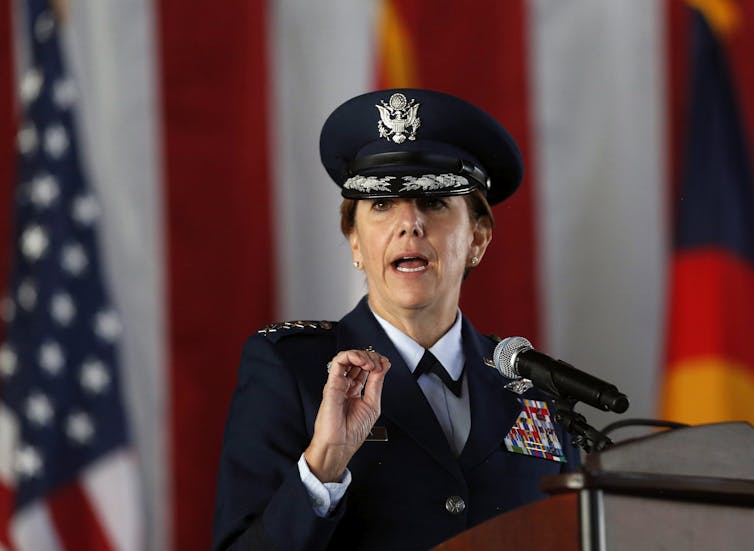
The NORAD commander, currently Lori J. Robinson, has always been American; the deputy commander, currently Pierre St-Amand, has always been Canadian by convention, but Canada must agree to the U.S. choice of commander before the nomination is sent to the U.S. Senate for approval.
Lori J. Robinson, the first woman to lead a top-tier U.S. military command, is seen in this May 2016 photo in Colorado. (AP Photo/Brennan Linsley)
This speaks to the truly remarkable nature of the binational agreement. NORAD is charged with the combined defence of both the U.S. and Canada, and the commander of NORAD is responsible to the highest levels of both governments via the Secretary of Defense and the President on the American side, and to the Minister of Defence and the Prime Minister in Canada.
Canadian in charge on 9/11

A Canadian, however, may find himself or herself responsible for the air defence of both states during a crisis, as was the case when then Maj.-Gen. Eric “Rick” Findley of the Royal Canadian Air Force was on watch as director of operations on 9/11, overseeing both Canadian and U.S. personnel at NORAD’s Cheyenne Mountain Operations Center.

The Canadian contribution also includes its NORAD regional headquarters based in Winnipeg, the maintenance of the North Warning System in the Arctic that provides vital aerospace surveillance information, data on maritime activity approaching North America and fighter jets to intercept potential threats.

Canada’s smaller military force, including approximately 150 personnel at NORAD headquarters in Colorado Springs, contributes a lot to NORAD. But that contribution isn’t well known, nor is the importance of NORAD to both countries fully appreciated.

NORAD today is largely out of sight and out of mind, best known as the organization that “tracks Santa.”

Image result for norad

The organization, however, has evolved, adapted and modernized, providing aid to drug interdiction missions in the 1980s and adding a maritime warning mission in 2006 to its aerospace warning and control missions.

Both the U.S. and Canada reflexively point to NORAD as proof of excellent relations between the two countries. And yet, few outside NORAD grasp the significant changes that have taken place and will need to be made in the very near future if NORAD is to continue to “deter, detect and defeat” threats to North America.
Questions and the need to adapt

First, threats can originate from multiple domains: Air, sea, cyberspace, aerospace, land and space to threaten North America. Does a command with responsibility in only three of the domains —air, aerospace and maritime — still make sense?

Second, is NORAD currently organized optimally to react to threats? Does it make sense for the commander of NORAD to be involved in operational-level decisions (for example, allocation of NORAD aircraft to specific regions) or should the Commander and her team focus their attention on broader strategic implications and how NORAD coordinates with allies and other combatant commands?

Third, does NORAD have the right information at the right time to make decisions? Given that a vital source of such information comes from an aged North Warning System about to reach its end of life, what could replace it, with what capabilities and at what cost?

And finally, what might be the future of NORAD in another 60 years’ time? Will Mexico be invited to join? Will Greenland play a greater role? Might NORAD become a multi-domain, multi-partner, multi-mission North American defense command, dropping reference to “aerospace” altogether?

No organization is more focused on all of these questions than NORAD itself, but what about the Canadian and U.S. governments and Canadian and American citizens and stakeholders?

On NORAD’s 60th birthday, a good start to looking ahead would be to pause and consider the contributions, challenges and failures of the command and reflect on its six decades of adaptation.

Anniversary celebrations will be held in Colorado Springs on May 12 and in Winnipeg on May 24.

And if you look to the sky in those cities, you may see a reminder of NORAD and its constant watch over North America with a fighter jet flyby. Such an important binational agreement, coupled with potentially significant changes in the future, merits all of our attention.

Image result for norad

Friday, June 9, 2017

NATO Hopes to see more of Canada following Defence Plan

By: Catharine Tunney, CBC News

The head of the North Atlantic Treaty Organization says he is expecting Canada to increase its presence on missions now that the Liberal government has promised to spend more on soldiers, ships and fighter jets.

"We are not able to tell exactly today what kind of missions and operations we will have in five to 10 years, but now we need more Canadian presence in Europe," NATO Secretary General Jens Stoltenberg told Chris Hall, host of CBC Radio's The House.

"There are already many different missions and operations where Canada is participating, but of course we hope that they can further strengthen their participation in NATO missions and operations."

On Wednesday the Liberal government unveiled its long-awaited defence policy, which will increase the defence budget by 70 per cent over the next decade to $32.7 billion. The plan also pledges to buy 15 advanced warships and 88 new fighter jets.

When asked if he expects Canada to make additional contributions going forward, including more rotations through NATO exercises, Stoltenberg said "absolutely."

"We are building up our maritime presence both in the Atlantic but also in the Black Sea and other places, and we need those Canadian planes, for instance, for air policing ," he said.

Gen. Jonathan Vance, chief of the defence staff, said decisions about individual NATO missions are made by the government, but the increased spending and bolstered fleet mean Canada can contribute more going forward.

"Absolutely yes we will be able to do more in the future, not because we're altered dramatically in terms of our size, because we're not, but what we will have will be relevant to the future," he said. "Absent this investment, we may have the size but we would be irrelevant.

"A lot of this is a commitment for NATO and other allies for the long term so that NATO has not only the qualitative but the quantitative predictable capacity of Canada in mind for the long term."

Stoltenberg will travel to Europe with Defence Minister Harjit Sajjan later this month to greet Canadian troops in Latvia as part of a NATO operation to counter Russian aggression in Eastern Europe.

"Our approach to Russia is based on a dual tract: defence and dialogue. Russia is our neighbour. Russia is here to stay. NATO doesn't want a new cold war, we don't want a new arms race."
NATO strong despite disagreements: Stoltenberg

The Liberals' defence review followed on the heels of a speech Foreign Affairs Minister Chrystia Freeland delivered in the House of Commons on Tuesday, when she said Canada will step up to play a leadership role on the world stage as the U.S. turns inward.


"The fact that our friend and ally has come to question the very worth of its mantle of global leadership puts into sharper focus the need for the rest of us to set our own clear and sovereign course," she said.

Stoltenberg said disagreements are bound to arise between NATO's 29 member countries.

"The strength of the alliance is that we have been able to overcome these kinds of differences again and again and unite around the core task of the alliance — that is, to protect and defend each other," he said.

That principle has come into question after U.S. President Donald Trump didn't explicitly mention Article 5, the mutual aid clause, in a speech to NATO allies in Brussels last month.

But Stoltenberg said Trump has made it clear to him that he's committed to the alliance.

"There is no way that it's possible to be committed to NATO without being committed to collective defence," he said.

Monday, April 24, 2017

Canada could be called on for troops in event of war with North Korea

By: Murray Brewster, CBC News 

Canada may be obligated as part of United Nations Command born of 1953 armistice

Should the tense standoff on the Korean Peninsula escalate into war, the United Nations could come calling on Canada for a military commitment.

But Defence Minister Harjit Sajjan said Friday the Trudeau government would prefer to focus its attention on diplomacy.
'This rogue regime in North Korea is a danger not only to the immediate region but the entire world.'- Prime Minister Justin Trudeau

There are reports that China has put its air force units along the North Korean border on heightened alert, and South Korea has moved its military to a heightened state of readiness over the possibility that the regime in Pyongyang will conduct another missile test, following a failed attempt last week.

China quickly denied the reports on Friday, but the buildup, which multiple media reports say could also include Russian forces, comes as a U.S. aircraft carrier strike force now moves towards Korean waters.

Rear Admiral Jim Kilby, commander of Carrier Strike Group One posted the news on social media. Last week, the White House said the task force was on its way to Korean waters when it, in fact, was not.

Soldiers' lives 'at risk'

Canada fought under the UN in the Korean War and is part of an organization known as the United Nations Command, or UNC, which came out of the 1953 armistice that ended three years of brutal fighting between North and South Korea.

There was never a formal peace treaty and the two nations have remained technically at war for over six decades.

"Diplomacy is the one thing we need to focus on first, because at the end of the day you could be putting soldiers' lives at risk," Sajjan said from Mumbai, India, in a conference call with reporters in Ottawa.

Prime Minister Justin Trudeau recently expressed concern about what North Korean leader Kim Jong-un might do next.

"We are worried about the dangerous and unstable North Korean regime — period," Trudeau said on April 10 while in Normandy, concluding visits to Canadian First and Second World War battlefields.
A U.S. Army tank takes part in a military exercise in Paju, near the North Korea- South Korea border on April 14. (Ahn Young-joon/Associated Press)
"This rogue regime in North Korea is a danger not only to the immediate region but the entire world," Trudeau said.

Sajjan said he has been in close touch with U.S. Defence Secretary James Mattis and they spoke specifically about the escalating tensions in Korea.

If the shooting starts, the United States-South Korea Combined Forces Command would take the lead in the initial stage of fighting, but policy documents prepared for former defence minister Peter MacKay in 2010 say reinforcements could be assembled using the existing, decades-old UN framework.

"The UNC structure would be used as a means of force-generating, and receiving and tasking any contributions that UNC sending states may choose to contribute in the event of a crisis," said the document, originally obtained and published by The Canadian Press.

The Department of National Defence confirmed on Friday that Canada remains part of the organization because it was one of the original 17 countries that took part in the fighting.

No binding treaty obligation

Six members of the Canadian Armed Forces are currently serving with the UNC.

But unlike NATO, there is no binding, clear-cut obligation for Canada to join a potential military action in Korea.

Sajjan said National Defence has, regardless of the situation, "done prudent planning" for possible crises.

"Our military will always play a responsible role, and the responsible role right now is to allow diplomacy to work," Sajjan said. "And, I'm very happy to see China, who has significant influence over North Korea, is actually taking concrete efforts in this regard."

Over the past few weeks, in response to the rising rhetoric of U.S. President Donald Trump, Chinese media has suggested Beijing has the option of halting crude oil shipments to North Korea — something that would put enormous pressure on Kim's regime. But a major Chinese newspaper said on Friday that China, by itself, cannot force North Korea to give up its nuclear weapons.

Trump ratcheted up the pressure on China with a Tweet Friday morning that read: "China is very much the economic lifeline to North Korea so, while nothing is easy, if they want to solve the North Korean problem, they will."

Tuesday, February 28, 2017

Canadian Forces Studying Options for Potential Syrian Deployment

By: Matthew Fisher, The National Post

The Canadian military has begun to study options for an operation in Syria, for the Liberal government to consider as U.S. president Donald Trump hints he may expand the 16-year-old war on terrorism by sending more troops to that country after the offensive to liberate the Iraqi city of Mosul from ISIL concludes.

Officers familiar with how the military does long-range planning said that offering such choices — as well as examining ways Canada might continue to contribute to the U.S.-led coalition in Iraq after the war there ends — was standard procedure. It is prudent to constantly prepare and update options regarding potential overseas deployment to hot spots in case the government of the day asks for them, they said.

What comes next for Canada and its allies is an obvious question, with the Islamic State in Iraq and the Levant holding only a sliver of land in Iraq and a much larger swathe of territory in Syria. Lt.-Gen. Steve Townsend, the U.S. ground commander for the wars in Iraq and Syria, expects ISIL to be defeated in both countries within six months. But nobody expects that ISIL, or its rivals, Al Qaeda, will be entirely eradicated for a very long time. There are fears the terrorist groups will go underground in those countries, increase their activities in Somalia or northern and central Africa or take their war global, launching more terrorist attacks on soft civilian targets, particularly in Europe.

It is not publicly known whether the Trump government has asked Ottawa to contribute troops or assist in other ways in the war against ISIL in Syria, or to take on other roles in the war on terror. But if there is anything to be taken from the example of the war in neighbouring Iraq, where Canada has been a participant since August, 2014, such a request is possible.

Canada is one of 17 countries currently assisting Iraqi and Kurdish forces in Iraq. About Canadian 800 troops now involved in what the Canadian Forces calls Operation Impact. About 70 are elite Special Forces from the Ontario-based JTF2. They train, advise and assist Kurdish fighters and when at risk themselves, have occasionally joined the fight.

Other Canadians are targeting experts, based in Kuwait and Qatar, or work with Kuwait-based reconnaissance aircraft which help identify ISIL targets. A small team of Canadian doctors, nurses and technicians also runs a military hospital in the Kurdish city of Erbil, about 70 kilometres east of the front lines around Mosul.

The U.S. already has 500 Special Forces soldiers in Syria and has been preparing the American public for the possibility that more troops may soon be headed there. Gen. Joseph Votel, the U.S. commander responsible for overseeing military operations in the Middle East and South Asia, took journalists with him on a secretive tour of northern Syria last week. At an undisclosed location he told his media entourage that “take-no-prisoners fighting” was in the offing to capture ISIL’s Syrian hub, Raqqa, and that more troops may be needed to accelerate the war against ISIL there.

Any expansion of the coalition war in Syria is complicated by Russia’s political and military support for the government of Syrian President Bashir Assad. There remains confusion over to what extent Trump’s professed admiration for Russia’s leader, Vladimir Putin, will play a role in decisions made in Washington, particularly as the U.S. president’s top security advisers regard the Kremlin with deep suspicion. Turkey, which is a member of NATO that has improving ties with Moscow, also does not want Syrian Kurdish forces allied with the U.S. to become more powerful.

Canada is already indirectly involved in the war in Syria. Since December, JTF2 has been advising Iraqi Kurds deployed near the Syrian border in northwestern Iraq, in an attempt to prevent ISIL forces escaping from Mosul and reaching Syria. It had been involved in the air war in Syria until the Liberals ordered home the RCAF’s F-18s.

If Canada were to become involved militarily in Syria again it could send a small number of JTF2 troops there in an advisory role. Another possibility is that Canada could be asked to provide “boots on the ground” to help protect civilians from violence in safe zones that Trump has said he intends to establish to prevent the Syrian refugee crisis from worsening.

Canadian Brig.-Gen. Dave Anderson, who heads the coalition’s strategic advisory team in Iraq, told Postmedia in an interview late last year that discussions were already taking place then about how “we — that is, the Iraqi security forces — can not only take Mosul but hold it afterwards.” According to Trump’s most senior general, Joseph Dunford, the U.S. and NATO are considering a long-term military commitment to assist Iraqi and Kurdish forces who will be responsible for trying to prevent ISIL or other terrorist groups from regrouping. Canada’s Iraq mission could be extended indefinitely as part of that effort.

The potential ask for Canada to extend or expand its role in the region comes as Ottawa undertakes an open-ended commitment to lead a NATO battalion in Latvia from this June, and continue training missions in Poland and Ukraine.

Friday, February 17, 2017

Canada to spend more on defence, Sajjan says, but non-committal on NATO

By: The Canadian Press 

OTTAWA -- Canada expects to make significant new investments in defence following the forthcoming release of its defence policy review, Defence Minister Harjit Sajjan said Thursday as he met with NATO leaders in Brussels.

But Sajjan was non-committal about the specific issue of Donald Trump's repeated complaints about NATO members whom the U.S. president has long alleged have failed to pay their fair share of the cost of the alliance.

Sajjan said he spoke with U.S. Defence Secretary James Mattis, a strident spokesman for the Trump administration on the issue of NATO spending who on Wednesday delivered a stern ultimatum to member nations.

RELATED STORIES
Pentagon chief says NATO members must boost defence spending
Troops prepare to leave for Ukraine amid uncertainty over mission's future

"America will meet its responsibilities, but if your nations do not want to see America moderate its commitment to the alliance, each of your capitals needs to show its support for our common defence," Mattis said.

Canada is demonstrating its commitment to NATO by contributing troops and leading a multinational NATO mission in Latvia as part of what is known as Operation Reassurance, Sajjan noted.

"Obviously we did discuss (spending) in terms of the resources required for the impact that we want to have in NATO, and every nation is doing their part towards that," Sajjan said.

He repeatedly mentioned the ongoing defence policy review, which was part of his mandate as defence minister and which is looking at Canadian defence needs for the next 20 years, including NATO commitments and missions.

That means more money, Sajjan said -- although he didn't say how much.

"We knew that spending by the previous government was low and the defence policy review allowed us to do a thorough analysis of what was required," he said. "Yes, this will require defence investments."

NATO says member states should aim to spend two per cent of GDP on defence. Canada now spends about one per cent and has long been under pressure from the U.S., including long before the start of the Trump era, to boost spending.

The government is looking at predictable, planned investments, Sajjan said.

"We in Canada need to be able to demonstrate a thorough plan and what type of defence investment is needed, because this is significant money that needs to be invested, but the Canadian taxpayer also requires us to make sure that we are efficient with the money."

As well as the NATO talks and a meeting with a counter-ISIL group led by Mattis, Sajjan also had bilateral meetings with the NATO Secretary General Jens Stoltenberg and ministers from Australia, France, Germany, Portugal, Slovenia and the United Kingdom.

He is heading to Germany for the Munich Security Conference, where senior decision-makers from around the world will discuss international security challenges.

Tuesday, February 7, 2017

Canadian UN Command Position Possibly Lost Due to Delay


The Canadian Press news service reports that Canada may have missed a chance to provide the commanding officer for the United Nations peacekeeping mission in Mali because it wanted to talk first to the Trump administration.

The UN put out requests to a handful of top-tier countries in mid-December as the term of the mission’s previous commander, Danish Maj.-Gen. Michael Lollesgaard, was coming to an end, the news service pointed out.

Sources told the Canadian Press the Liberal government asked the UN to hold off on a decision until after the government had a chance to consult the new American administration on Canada’s future peacekeeping plans.

It is believed that the U.S. military and Defense Secretary James Mattis outlined America’s top priorities to Sajjan and Vance on Monday and the Liberal government might adjust its defence policy accordingly, say sources.

SoD Mattis Admits Soft-Spot for Canadian Troops

By: Alexander Panetta, The National Post 

WASHINGTON — A first meeting between Donald Trump’s defence secretary and his Canadian counterpart began well on Monday — so well that, within just a few seconds, there was already talk of kissing and hugging.

Newly sworn-in U.S. defence secretary James Mattis says he’s so grateful for Canadian soldiers in Afghanistan he could have smooched them on sight.

At a meeting at the Pentagon, the retired general — nicknamed “Mad Dog” — said there’s a reason his first phone call to a foreign counterpart was to Canada’s Defence Minister Harjit Sajjan. The U.S. and Canadian military have been close allies since the Second World War, he said, and he experienced that bond personally in Afghanistan.

He noted that his own unit in Kandahar was relieved by Canadian soldiers from Princess Patricia’s Canadian Light Infantry.

“They were a welcome sight,” Mattis said as the meeting with Sajjan began.

“There was, ‘Don’t Ask, Don’t Tell’ in those days,” he said, referring to the now-discarded U.S. policy on gays and lesbians in the military.

“(But) I was hugging and kissing every one of you guys coming off the plane.”

He said the lives lost in the Afghan conflict have created a permanent bond between the countries. He also applauded Canada’s humanitarian efforts: “Your pledge to do a lot of leadership, whether it be in humanitarian ops, in battle groups, in reassurance efforts, we’re proud as all get-out of you and your forces and what they’ve stood up and delivered.”

The message from Mattis was striking in its difference from that of his boss. At a separate event Monday, the president said he expects allies to start doing their fair share and spending more on their military.

Canada spends less on its military as a share of its economy than almost any member of NATO.

Sajjan was at the Pentagon for what was scheduled to be a 45-minute discussion on a broad range of topics including military co-operation both abroad and closer to home. Key questions were expected to include the ongoing commitment to NATO, defence spending levels, and peacekeeping operations.

I was hugging and kissing every one of you guys.

The Canadian government delayed a planned peacekeeping deployment to Africa following the U.S. election, saying it wanted to first discuss a variety of global issues with its closest ally.

Trump’s election has prompted uncertainty on several military fronts — he has suggested NATO is becoming obsolete, while at the same time demanding that NATO allies increase defence spending.

He repeated his complaints about NATO spending during a speech Monday at an air force base in Florida.

Trump said he supports NATO, but countries must pay their share.

“We only ask that all of the NATO members make their full and proper financial contributions to the NATO alliance, which many of them have not been doing,” he said.

Trump has also been more supportive than his predecessor of Russia, which has caused anxiety in Eastern Europe.

Trump has sowed uncertainty on several defence issues. He’s complained about the cost of the F-35, a staple of the U.S. fighter-jet program. Also, in his inauguration speech Trump heaped scorn on the U.S. habit of defending other countries.
Saul Loeb/AFP/Getty ImagesU.S. Secretary of Defense James Mattis and Canadian Minister of Defense Harjit Sajjan shake hands prior to a meeting at the Pentagon in Washington, DC, Feb, 6, 2017.
Mattis spent last weekend in Asia, reassuring traditional U.S. allies. During the campaign, the president questioned why the U.S. should spend money securing Japan and South Korea — he went as far as to suggest, at one point, that they should get their own nuclear weapons.

Trump later dialled that back. But he said he wants allies spending more on defence. That was also the policy of the previous Obama administration and the former president even made that request in Canada’s Parliament.

It’s unclear where that conversation goes now.

Canada is 23rd among 27 NATO countries in terms of spending as a share of GDP. Canada’s 2016 spending of 0.99 per cent of GDP was less than half the NATO guideline of two per cent, which only five NATO countries currently meet.

One Canadian-American military analyst said it’s important to watch what Mattis says, while remembering he’s not the boss: “(There’s) the caveat of: I don’t believe anything that Mattis says binds this administration,” said Steve Saideman of Carleton University.

“Mattis is in the outer circle — and has been bypassed on major issues.”

Sajjan's Statement Following Meeting with SoD Mattis


Defence Minister Harjit S. Sajjan today issued the following readout after his first meeting with new U.S. Secretary of Defense, James Mattis:

"Today I had the pleasure of meeting with U.S. Secretary of Defence James Mattis. The warm, cordial tone of the discussion reflects the long-standing, close partnership between Canada and the United States, particularly when it comes to defence and security. "The close defence relationship between our two nations provides both countries with greater security in North America and contributes to peace and stability in the world in increasingly complex and uncertain times.

"With 2018 marking the 60th anniversary of NORAD, I was pleased to highlight the importance of this unique partnership and its success in protecting North America, and we looked forward to working together on its modernization. Secretary Mattis and I also discussed multilateral issues, including our pledges to lead battle groups in support of NATO's enhanced forward presence in Eastern Europe, our commitments to the United Nations and the Summit of Defence Ministers that Canada will host later this year. We discussed our training missions in both Ukraine and Iraq and the work being done by the Global Coalition to degrade and defeat Daesh. I also took the opportunity to discuss Canada's Defence Policy Review.

"We discussed Canada’s decision to launch an open and transparent competition to replace our legacy fleet of CF-18 fighter aircraft, and to explore the immediate acquisition of 18 new Super Hornet fighter aircraft as an interim capability. I expressed my appreciation to the secretary for the support and cooperation of the US Government in these processes.

"Secretary Mattis and I pledged to work closely together and look forward to our next meeting at the upcoming NATO defence ministerial later this month. "I want to thank Secretary Mattis and Pentagon officials for the warm welcome in Washington and look forward to hosting Secretary Mattis in Canada."

Monday, February 6, 2017

What President Trump Might Mean for Canadian Defence Policy


By Vincent J. Curtis, Espris de Corps Magazine (Vol. 23, No. 11) 

With the election of Donald Trump as the next president of the United States, the world can expect a large recapitalization of the U.S. military over the next four to eight years. We can also expect the Trump administration to pressure NATO allies to increase their defence expenditures to two per cent of their GDP (gross domestic product).

Trump famously campaigned on the theme that the United States was not going to carry a heavier share of the defence burden of the western world than was justified by economics. If NATO allies expected the assistance of the United States, then they needed to do their part. Some of that pressure will undoubtedly be applied to Canada, for Canada is one of those not spending up to the agreed level of two per cent of our GDP.

What does this mean for Canadian defence?

In the first place, it would mean that the Canadian defence budget would have to increase to be in the range of CDN $48-billion. The budget track released by the Trudeau government in its maiden budget forecast revealed a decrease in defence expenditures — the amount projected for 2016 was $29.4-billion with a decrease to $14.4-billion by 2020–2021. In the eyes of Trump, we are moving in the wrong direction.

Yes, defence is one of many competing priorities for federal tax expenditures, but national defence and maintaining good relations with allies is among the most fundamental of priorities of any national government. Those priorities have a higher call for money than new spending to make life more comfortable for a minority of Canadians. The needs of all take priority over the needs of the few.

What use could be made of additional defence expenditures?

There is no question that the Canadian Armed Forces are in need of recapitalization. The Royal Canadian Navy needs to be completely rebuilt, and soon. The fighting capacity of the Royal Canadian Air Force is aging rapidly, and the replacement for the CF-18 fleet is late and nowhere in sight. The Canadian Army could also use a new store of capital equipment for general-purpose combat operations.

The government is dithering over whether it should acquire 10 or 12 frigates to refight the Battle of the Atlantic, should it ever come back. The naval brass is still in the grip of the old-school small ship navy mentality that has dominated Canadian naval thinking since the days of the Niobe and the Rainbow. The RCN brass need to have in their top drawer a plan for a real battle fleet — a fleet consisting not just of frigates but of one or more battlecruisers as well. And if battlecruisers seem to be too war-like for political tastes, then missile-cruisers in the 10,000-ton range can be had off-the-shelf from the United States at $2-billion apiece, less than the cost of a 5,000-ton custom-built frigate. Anyhow, a capitalization project for the Navy in the range of $40-billion should be ready to go.

The RCAF is caught between the failure of Lockheed Martin to deliver a viable F-35 Joint Strike Fighter in a timely and cost-efficient manner, and a new government that wants to start the bidding process for a CF-18 replacement aircraft from scratch. The solutions are easy: buy off-the-shelf F-16s, or the updated F/A-18E/F Super Hornet off the shelf, both of which are also still in production. These are Gen 4.5 fighters, not Gen 5 fighters, but they can be had soon; they are still current and viable for modern combat air operations, and should be seen as an interim purchase until the Gen 5 fighters are finally available.

The Army could also use a store of useful equipment, in particular modern artillery. The M-777 proved spectacular in Afghanistan, and no army has been able to succeed in modern combat operations in the absence of dominant artillery since the 17th century’s Thirty Years’ War.

The problem of joint operations between air and surface has and will continue to bedevil CAF combat operations. If it flies, it is said to belong to the RCAF. But what about rotary aviation? What about a naval aircraft carrier? The United Timbuktu, Gao and Kidal regions ranged from 77 to 92 per cent.

Although PRTs were once described as the militarization of aid, some of these areas are just too dangerous for aid workers. In South Sudan, peacekeepers ignored the rape and assault of aid workers in the country. The adoption of a UN PRT model would allow aid workers to operate more freely in the country. It would also allow more positive interaction between the indigenous population and UN peacekeepers. The interaction with aid organizations and the local population will foster trust and, in turn, hopefully, generate useful, operational intelligence.

PRTs involved a level of Civil-Military Co-Operation (CIMIC) and that level and overall approach can vary depending on the model. There are four generic PRT models: American, German, British(-Nordic) and Turkish. These four generic models can be then divided into many sub categories that vary depending on which nation implemented the model in Afghanistan. A PRT model can be adapted to suit the requirements of a UN peacekeeping mission. Moreover, a UN PRT model in Mali may not work for South Sudan or Somalia and therefore a PRT model will need to be drafted to meet the requirements of each individual theatre.

The Trudeau government is weighing its options and conducting fact-finding missions to pinpoint the one mission that has the least of political consequences. The last thing the Trudeau government and the Canadian Armed Forces need is another Somalia incident. Since our withdrawal, UN peacekeeping missions have been blighted with accusations of rape and the solicitation of sexual relations with prostitutes and even trading weapons for gold.

Canada’s re-engagement with peacekeeping will offer its own unique challenges. Peacekeepers are regularly fired upon and that alone will create a political fervor in Canada. Our re-engagement will take political fortitude, but if the Trudeau government really desires for Canada to take international leadership, we must drive the evolution of UN peacekeeping.

Wednesday, January 25, 2017

Canada pauses Peacekeeping Plans to co-ordinate with Americans

By: Lee Berthiaume, Canadian Press 

OTTAWA — Defence Minister Harjit Sajjan plans to talk to his American counterpart before he pursues Canada's plan to send peacekeepers to Africa, saying co-ordination with the U.S. is essential.

The government announced in August that Canada would deploy up to 600 troops on future UN peacekeeping missions, though it stopped short of saying exactly where they would go.

A decision was promised by the end of the year, after military officials and Canadian diplomats had a chance to test the waters and get a better sense of where the troops could make a difference.

But the question of where Canadian blue helmets will end up is still hanging in the air as the government tries to get a handle on the Trump administration's priorities.

Sajjan spoke to new U.S. Defense Secretary James Mattis by telephone on Monday, and while they did not discuss peacekeeping, Sajjan said he intends to when the two meet in person for the first time.

That's because any troop deployment must be done with the bigger picture in mind, Sajjan said.

"It's all interconnected. For example, what's happening in Iraq right now impacts what's happening in Africa and other parts of the world," he told reporters in Calgary. "So we have to discuss this because we need to be able to maximize our impact on the ground."

The minister insisted Canada would make its own decision on when and where to send peacekeepers.

Sajjan had the distinction of being the first foreign defence minister that Mattis has spoken to after being confirmed U.S. defence secretary. The retired general was reportedly effusive in his praise for Canada.

According to a readout from the U.S. Defence Department, Mattis not only thanked Canada for its contributions to North American security, he noted the country's military contributions in Iraq and Latvia.

"Secretary Mattis thanked Minister Sajjan for Canada's strong support for our alliance," the readout says, "and expressed his personal appreciation for the professionalism of the Canadian Armed Forces."

Those words will be welcomed by Canadian officials who have been wringing their hands over whether the Trump administration plans to pressure Canada to spend more on defence.

Trump has previously railed against what he called "freeriders" within NATO, and while those words were largely targeted at European allies, critics say they could easily apply to Canada.

Canada spends less than one per cent of its gross domestic product on defence, while the NATO target is two per cent. But the federal government argues that such calculations ignore Canada's in-kind contributions to global security.

While Mattis does not appear to have raised the issue of defence spending with Sajjan, the touchy subject did figure prominently in the U.S. defense secretary's later phone call with British counterpart Michael Fallon.

Mattis reportedly emphasized the U.S.'s "unshakable commitment to NATO," according to a readout from that conversation, before thanking the UK for committing two per cent of GDP to defence.

In his own statement, Fallon said he and Mattis talked about "our joint leadership in NATO, including…how we ensure that all members meet the two per cent spending commitment alongside America and Britain."

The Liberal government is currently drawing up a new defence policy, and one of the key questions is whether it will include significant new cash for the military.

Wednesday, January 18, 2017

Trudeau vouches for NATO after Trump calls military alliance ‘obsolete’

The Canadian Press

OTTAWA – Justin Trudeau has affirmed Canada’s support of NATO, days after president-elect Donald Trump‘s pronouncement that the military alliance is obsolete.

But the prime minister stopped short of saying he would be willing to boost the defence budget so Canada could meet NATO’s spending target for its member countries.

READ MORE: Reality check: Donald Trump says NATO members need to pay more. What is Canada paying?

Trudeau cited Canada’s leadership in Latvia, where it will contribute 450 troops and command several national contingents as part of a military deterrent to Russia on Europe’s eastern flank.

He said that was “a great example of how Canada continues to be an extraordinarily important player in NATO and we will continue to be a reliable partner, not just to the United States, but to all of our allies as we move forward.”

The Liberal chair of the House of Commons foreign affairs committee has told The Canadian Press that Canada will have to contribute more to the 28-country alliance if the United States – its largest financial and military contributor – scales back its involvement as Trump has suggested.

“That means countries like ours will have to step up to the plate,” Bob Nault said in an interview Monday.

Speaking to reporters in New Brunswick today, Trudeau said: “When there’s heavy lifting to do, when there’s a need for people to step up, Canada is there on the front lines contributing fully to NATO operations.”

Howard Drake, the British high commissioner to Canada, told The Canadian Press that NATO remains highly relevant as the West deals with the challenge of a newly assertive Russia.

“That’s his view. Who am I to comment on that?” Drake said when asked about Trump. “If ever NATO was valid, it’s now.”

He recalled the 2006 London killing of former Russian spy, Alexander Litvinenko, who sipped a cup of tea laced with a radioactive poison administered by a Russian operative.

READ MORE: Canada has to reach into its pockets to pay for NATO if US leaves: MP

“The Russian state killed a former KGB agent on the streets of London,” Drake said.

“We know all about what it is to deal with Russia, and we believe we should be on our guard.”

Trump criticized NATO during the U.S. election campaign, and sparked surprise in Europe when he levelled more attacks this week.

But Trump’s nominee for defence secretary, retired Marine general James Mattis, spoke in support of NATO during his congressional confirmation hearing last week.

Analysts say Trump will expect other NATO members to increase spending in the alliance to ease the burden on the United States.

Canada lags at 23rd in spending in NATO, and currently contributes about one per cent of GDP to defence spending – well below the alliance’s two-per-cent target. The U.S. is one of only five NATO countries that meet the spending target.

Tuesday, January 17, 2017

NATO without U.S. means Canada will have to do more

By: Mike Blanchfield, The Canadian Press

OTTAWA — Canada will have to contribute more to NATO if the U.S. follows through on president-elect Donald Trump's musings on withdrawing from the alliance, says the head of the House of Commons foreign affairs committee.

Liberal MP Bob Nault cautions that Canada and its NATO partners need to see how U.S. foreign policy formally takes shape after Trump's Friday inauguration.

But he says Canada remains committed to the 28-country alliance and can't let it become weakened if the U.S. — its largest financial and military contributor — scales back its involvement.

"That means countries like ours will have to step up to the plate," Nault said in an interview Monday.

Nault said the upcoming defence policy review will help Canada decide where and how it should deploy its military resources. With a federal budget coming this winter that could mean an increase in defence spending, he added.

Nault and the committee are going to visit Latvia and Poland, two of NATO's eastern European members and nervous neighbours of Russia, which annexed part of Ukraine almost three years ago.

The MPs will travel to Ukraine as well as Kazakhstan on their 12-day, fact-finding mission.

The visit is timely, given Trump's frequent compliments directed at Russian President Vladimir Putin and his renewed criticism that NATO is "obsolete."

Trump also said he might end sanctions imposed on Russia for its 2014 annexation of Ukraine's Crimea region in return for a nuclear arms reduction deal.

Trump's latest NATO broadside sparked a backlash in Europe, while Moscow said his offer on linking sanctions relief with a nuclear arms deal should be treated with caution.

German Foreign Minister Frank-Walter Steinmeier said Trump's remarks "caused astonishment."

Trump criticize NATO during the election campaign, but his nominee for defence secretary, retired Marine general James Mattis, spoke in support of NATO during his congressional confirmation hearing last week.

In Ottawa, the government held firm to its current policy line, affirming Canada's commitment to NATO and its solidarity with Ukraine in the face of the "illegal annexation" of Crimea.

"Canada is a committed member of NATO; we have been a part of every single mission since its inception," said Joseph Pickerill, spokesman for Foreign Affairs Minister Chrystia Freeland.

Canada is one of four countries playing a leading role in NATO's military build-up on Europe's eastern flank to deter Russia with a 450-strong contribution of personnel to Latvia.

David Perry, senior analyst with the Canadian Global Affairs Institute, said if Trump is taken literally it is bad news for the alliance, but he said it could just be a salvo by a self-styled hard-bargainer to push more countries to increase their defence spending.

That has implications for Canada, which lags at 23rd in spending in NATO, and currently contributes 0.99 per cent of GDP to defence spending — well below the alliance's two-per-cent target, he said.

The U.S. is one of only five NATO countries to meet the target and Trump wouldn't be the first president to push for more spending. President Barack Obama chided Canada to increase defence spending during his speech to Parliament last summer.

Nault said his committee will be speaking with European officials about the continuing role of NATO, whether the sanctions on Russia are effective and how the region is coping and "how this is all translating into the new world order."

The committee will report back to Parliament on whether sanctions are in fact working, or if they are an ineffective political tool, he said.

If the U.S. removed its sanctions on Russia, it would likely undermine the whole regime, Nault said.

Nault said the issue of "unintended consequences" of sanctions needs a closer look. Canada-Russia trade has fallen by half since they were imposed.

"If we're putting sanctions on as Canadians and we feel good about it, and nobody else is doing the job then really, is it to our benefit? That's the question that has to be asked."

Thursday, June 30, 2016

'NATO needs more Canada,' President Obama says in Ottawa

By: Josh Dehaas, CTVNews.ca Writer

In a mostly praise-filled speech from U.S. President Barack Obama, one notable exception was his urging that Canada “contribute its full share” to the North Atlantic Treaty Organization.

“As your ally and as your friend, let me say that we’ll be more secure when every NATO member including Canada contributes its full share to our common security,” the president told Parliament.

“Because the Canadian Armed Forces are really good,” he added. “If I can borrow a phrase, the world needs more Canada. NATO needs more Canada. We need you. We need you.”

Obama made the remarks after stating that “when nations violate international rules and norms, such as Russia’s aggression against Ukraine, the United States and Canada stand united, along with our allies, in defence of our collective security.”

Canada currently spends less than one per cent of its GDP on defence, despite a commitment made by all NATO countries to spend at least two per cent of GDP.

Most NATO countries do not meet the two per cent target, but some do, including the U.S. which spends 3.5 per cent, France which spends 2.2 per cent, and the United Kingdom which spends two per cent, according to theWorld Bank.

The prodding of Canada to boost its military contribution was only a small part of a speech around the broad theme that countries are better off when they work together on things like trade and security, rather than “building walls.”

Obama’s position on NATO is in stark contrast to Republican Donald Trump, who has repeatedly called NATO “obsolete” and a waste of money.

Democrat Hillary Clinton has called Trump’s suggestion dangerous. "Putin already hopes to divide Europe," Clinton said in March, referring to Russian President Vladimir Putin. "If Mr. Trump gets his way, it will be like Christmas in the Kremlin,” she added.

In a speech last week, former Progressive Conservative prime minister Brian Mulroney also made the case that Canada should once again spend two per cent of its GDP on defence -- as it last did when he was in charge -- in part due to a rising threat from Russia.

“President Putin clearly wants to restore Russia’s great power status by forging, by force if necessary, a new Eurasian union dependent on Russia for its economy and security, adapting Lenin’s phrase of 'pushing the knife in,' until it hits NATO bone,” he said.

“He’s sharpening that knife with a 40 per cent increase in military spending since 2013, far and above anything committed by the West,” Mulroney added.

Mulroney said that NATO should be a top defence priority for Canada. “What we cannot do is talk about Canada “being back” in the world without making tangible commitments that will anchor our aspirations,” he said.

Monday, June 13, 2016

Fisher: Super Hornets will force Canada out of its own Arctic


F-35-1
Critics of the F-35 will laugh and say this is hyperbole and melodrama. It is not. Keeping the U.S. safe is the top priority of every U.S. president. If Canada cannot or will not protect its Atlantic, Pacific and northern approaches, its NORAD treaty with the U.S. permits Washington to do so.

Russia announced last week that its air force will begin deploying its first stealthy T-50 fifth-generation jet fighters next year. Such a timeline is highly doubtful. But Vladimir Putin has no higher priority than acquiring stealth technologies and, within a decade, T-50s will be deployed at air bases across the top of Russia.

Once this happens, and with threats from T-50-launched cruise missiles and Russian and North Korean intercontinental ballistic missiles (ICBMs), which fifth-generation aircraft such as the F-35 will be far more able to shoot down than Super Hornets, the reality is that the U.S. will do whatever it has to to defend itself.

That will mean patrolling Canada’s margins with USAF F-35s, which will use fighter jet-capable airfields in Iqaluit, Rankin Inlet, Inuvik and Yellowknife built mostly with U.S. money in the 1980s.

Worse than that, Washington will insist that Canada’s Super Hornets stay in the rear.

The reason is clear. Four allied air forces operate in the Arctic. The U.S., Norway and Denmark, which defends Greenland and sometimes deploys fighter jets to a base they jointly operate with the USAF at Thule, will soon only be flying state-of-the art F-35s in the Far North. The other country, Canada, will not.

The F-35 is revolutionary in that it will basically be a flying computer with sensor fusion. F-35s flying hundreds of kilometres apart will be able to create a common battle picture. Being stealthy, they will secretly patrol far more safely while collectively surveying vast amounts of territory for information that they can instantly share with each other, spy and command aircraft and ground stations.

Once the Super Hornet is found, as it will be by a stealthy enemy, F-35s in the vicinity will become targets, too. That is why the U.S. will not want Canadian fighters operating anywhere near its warplanes in the north.

A new argument advanced by the government last week is that there is a “credibility gap” for NATO and Norad with the existing F-18 Hornets that must be immediately filled by an interim purchase of Super Hornets. NATO and Norad people have privately but emphatically insisted that no such crisis exists and will not exist for about a decade, so there is no reason for Canada to rush to make a decision.

As for this being sold as an interim buy, with a decision on the F-35 later, this is a red herring. Canada has neither the money nor the military infrastructure to support two fleets of fighter aircraft.

An older but still persistent argument to support the Super Hornets is that it will be safer to operate in the Far North than the one engine F-35s. Advances in civilian and military jet engine technology long ago made such thinking obsolete. Otherwise, the Pentagon would not have decided that only F-35s will fly from its most northern air base near Fairbanks, Alaska.

The Super Hornets’ advantages in range, payload and an extra engine are irrelevant if the aircraft is not survivable. The Super Hornet will not be invisible to radar so, at a certain point in the not too distant future, it will be shot down long before it can engage the enemy.

With the U.S. defending Canadian air space because of Ottawa’s refusal to buy F-35s, what the RCAF will eventually end up with in the north is a niche capability in air/sea rescue.

That Canada is prepared to cede its defence and sovereignty over all three maritime approaches to the USAF is one of the many reasons that there is extreme disappointment and disbelief across the upper reaches of Canada’s military community about what has been decided. What makes them furious is the government’s refusal to discuss the matter.

Finland has looked at the numbers that Denmark came up with after a competition in which it chose the F-35 over the Super Hornet. As a result, the Finns are believed to be close to deciding that they, too, will reject the Super Hornet in favour of the F-35. If Finland follows Denmark’s lead, it will become the 12th western-oriented air force in a row to choose the F-35 over the Super Hornet, with Canada the only exception.

Canadians should ask themselves: Is everyone who made those decisions — including those confronting similar security challenges in the Arctic — stupid? What is it that makes Canada so unique that it feels it can ignore the collective wisdom of all its allies and friends?

There are no two more important issues for a government than national defence and sovereignty. Such matters must be settled fairly and as transparently as possible. Have the promised open competition to decide what aircraft is best to defend Canada for the next half-century

By: Matthew Fisher, The Ottawa Citizen 

LONDON — The most questionable aspect of Prime Minister Justin Trudeau’s quixotic decision to renege on the promise of an open competition for Canada’s next fighter jet and suddenly ram through the sole-source purchase of Super Hornets — a decision Postmedia News has revealed it is close to making — is that, by doing so, Canada will end up surrendering sovereignty of its Arctic air space to the United States Air Force in about 10 years.

Tuesday, June 7, 2016

Liberals Miss Membership Payment to Stay in F-35 Consortium

By: Murray Brewster, CBC News 

The Trudeau government has missed the deadline for a multimillion-dollar payment that keeps Canada in the club of nations involved in the F-35 stealth fighter program, CBC News has learned.

The $32-million membership fee was due on May 31, but a spokeswoman for Defence Minister Harjit Sajjan confirmed late Monday that the U.S. project office overseeing development of the highly complex jet has not received the instalment.

But Jordan Owens cautioned not to read too much into the oversight and that Canada is still on the hook for the cash.

"We will honour our financial commitments," she said, responding for the minister who was in transit from a defence conference in Singapore.

Related:
F-35 fighter jet purchase by Liberals may still be in the mix
Sajjan refuses to rule out F-35 from fighter jet replacement competition
Canada's F-35 decision anxiously awaited, says U.S. deputy secretary of defence

It's unclear when the instalment will be made and whether there are any penalties associated with a late payment.

The policy issue is an uncomfortable conversation for the Liberals.

Earlier this year, the fact that Canada was still paying to be part of the F-35 buyers' club raised questions about their campaign pledge to purchase something else other than the stealth fighter. Prime Minister Justin Trudeau said it "no longer makes sense" to buy the Lockheed Martin fighter because Canada would not participate in any first strike missions.

The annual payment also gives the federal government the right to buy F-35s at a discount price and gives Canadian companies access to supply contracts for the construction and maintenance of the high-tech jet.

The missed payment does not signal Canada's withdrawal from the agreement, Owens said.
Sole-sourcing a new jet

But it does shine a further spotlight on the contradictions in the Liberal policy and comes one day after published reports stated that cabinet was mulling over the sole-source purchase of an unknown number of Super Hornets, the Boeing-built rival to the F-35.

"I was shocked," said Alan Williams, a former procurement manager at the Department of National Defence, and one of the most strident critics of the Harper government's plan to acquire the F-35 without a competition. "I don't think anyone would have expected that kind of behaviour."

Williams was one of the defence insiders most impressed with the Liberal promise of open competition and transparency in last fall's election.

He said that if the government does a sole-source deal with Boeing, it makes the Liberals no better than the government they replaced.

"There is no legal justification to sole-source this," said Williams, who noted that the use of the national security criteria would not apply.

The move would possibly open the door to a legal — or even trade — challenge by competitors, he said.

"I'm not sure companies want to take the government to court on this kind of thing, but, you know, there is no legal justification for doing this," he said.

Owens denied cabinet has discussed a sole-source deal.
Capability gap or no capability gap?

But it was less than clear where the government was headed Monday when John McKay, the parliamentary secretary for defence, said the Liberals must do something about CF-18s that are getting old and need to be retired.

​"There is a developing capability gap that needs to be managed," he said. "We have obligations to NATO. We have obligations to Norad."

Up until the last couple of weeks, the line from both the Liberals and their Conservative predecessors was that the 1980s vintage CF-18s, which have been upgraded, are still good to keep flying into the 2020s.

Indeed, a year before being defeated, the Harper government ordered a further life-extension to the fighters — worth hundreds of millions of dollars — so they could stay airborne until 2025.

In light of that, Conservative defence critic James Bezan said the so-called capability gap is fiction.

"I think it's imaginary on their part and they're trying to use that as the narrative," he said. "There isn't this need to actually go out there and select immediately."

Follow @Murray_Brewster on Twitter

Friday, June 3, 2016

CDA Institute Analysis – “Trudeau’s Promises: From Coalition Operations to Peacekeeping and Beyond”


In this new CDA Institute Analysis, Stéfanie von Hlatky looks at the key considerations that should help guide the deployment of the Canadian Armed Forces (CAF). The following is an excerpt of the Analysis.

Academic and policy discussions on Canada’s future role in multinational military interventions inevitably refer back to the long war in Afghanistan. Canada’s involvement, as part of Operation Enduring Freedom (OEF) and the International Security Assistance Force (ISAF) evolved significantly over the years. Canada’s reputation as an alliance partner also improved noticeably in the process. As of 2006, the Canadian Armed Forces (CAF) were known for operating with few caveats and were at the forefront of developing a viable whole-​of-​government approach as part of their design of the Provincial Reconstruction Team (PRT) in Kandahar, despite obvious shortcomings.

Although the success metrics of the war in Afghanistan are hard to establish and the overall outcome of the intervention is inconclusive at best, the experience tells us a lot about Canada’s standing in alliance politics and what the CAF can be expected to do in the future as part of those coalitions, given the skills and expertise acquired during this war-​intensive period. Indeed, the CAF acquired diverse skills as the intervention called for both community engagement and warfighting, with a lot of necessary adaptations along the way.

Beyond the lessons learned from the previous war, Canada’s military role abroad should be guided by clear foreign and defence policy guidelines. The last defence policy statement dates back to 2008. With the economic recession hitting the country at about the same time, many of the plans outlined in the Canada First Defence Strategy had to be shelved. Now that there is a Liberal government in power, under the leadership of Prime Minister Justin Trudeau, the Department of National Defence (DND) has been tasked with conducting a defence review. The review process includes public consultations across Canada, through the organization of events, roundtables, and discussions on social media. The result of this process will be unveiled in January 2017 and will provide greater clarity on Canada’s role in operations, force levels, readiness, and personnel issues.

This paper examines the conditions under which Canada should consider deploying the CAF and considers some of the motives that play into the decision-​making process. It does so by taking into account past and current CAF operations, as well as the defence priorities that have already been announced by the government. I argue that, moving forward, the Canadian government ought to think much more about the type of mission that is well suited for the CAF, where Canadian soldiers are most needed, as well as which allies and partners are best to work with.

Alliance Politics

One of the assumptions of this paper is that maintaining a reputation for reliability within an alliance setting is one of the main currencies of influence for a medium-​sized country like Canada. Therefore, decisions on the use of force are assessed in reference to Canada’s most important allies. That being said, it is worth asking whether Canada paid too high of a price to boost its reputation over the course of the Afghan War. In Afghanistan, but also more recently in Iraq as a member of the global coalition against the Islamic State, Canada strived to make military contributions that place it in the top tier of participating countries. As mentioned before, Canada is also seen as an alliance partner capable of deploying its armed forces with few restrictions on what they can do on the battlefield, meaning a higher tolerance for risky missions, which plays into allies’ qualitative assessments of burden-​sharing. The nightmare of coordinating national caveats was felt by ISAF commanders as they had to consider the various contributions made by each ally and partner, factoring in each nation’s rules of engagement and restrictions on their mobility in order to translate pledges into effective multinational military cooperation.

Given what Canada has invested in previous military interventions, the government would do well to invest in mechanisms that preserve allies’ coordination capacity and interoperability, either as part of NATO or US-​led coalitions. For NATO, the Secretary-​General has insisted on the utility of the Connected Forces Initiative (CFI) as the means through which NATO allies and partners can retain their capacity to work closely together, as refined through ISAF and Operation Unified Protector in Libya. The message was reinforced during the 2014 Wales Summit:

We continue to build on the experience gained in recent operations and improve our interoperability through the Connected Forces Initiative (CFI). Today we have endorsed a substantial CFI Package consisting of six key deliverables, including the high-​visibility exercise Trident Juncture 2015, with 25,000 personnel to be hosted by Spain, Portugal, and Italy; a broader and more demanding exercise programme from 2016 onwards; and a deployable Special Operations Component Command headquarters.

Through CFI or military exercises led by the Alliance or individual nations, Canada has a stake in continuously sharpening its capacity to operate with other Western armed forces.

Why Participate in Military Operations?


The government of Canada, currently engaging in a comprehensive defence policy review, will examine how alliance ties can enhance the country’s foreign and defence policy goals, but the scope of the exercise is much broader. The review, which was launched by Defence Minister Harjit Sajjan in April 2016, is articulated around three issues: identifying the most pressing security challenges, defining the role of the CAF in meeting those challenges and finally, establishing the appropriate mix of capabilities needed by the CAF to accomplish their missions and tasks successfully. Therefore, as a point of departure, it is worth asking which security challenges or motives guide decisions on the use of force.

The primary motive for investing in the armed forces is national defence and, by extension, to contribute to regional and global security for the sake of international stability. In Canada, the absence of an existential security threat means the country’s military commitments are primarily assessed through alliance politics, especially the bilateral relationship with the United States. The US has a more expansive perception of threat than Canada, given its massive and global military footprint. Based on numerous treaty commitments and alliance ties, American armed forces have been deployed all over the world to defend US interests and partners, with the goal of ensuring international stability through the projection of its power. In Canada, decisions on the use of force are often taken as the result of US or NATO initiatives. Finally, the Canadian government may choose to use force for humanitarian purposes. The humanitarian logic of intervention can lead to operations ranging from disaster relief or peace support operations.

Click here to read the rest of the CDA Institute Analysis.

Dr. Stéfanie von Hlatky is an assistant professor of political studies at Queen’s University and the Director of the Queen’s Centre for International and Defence Policy (CIDP). (Image courtesy of David Goldman/​Associated Press.)