Translate

Showing posts with label NATO Maritime Group. Show all posts

Friday, July 20, 2018

CH-148 Cyclone Deploys on First International Deployment with HMCS Ville de Quebec

By BRETT BUNDALE, The Canadian Press

HALIFAX— Hundreds of people gathered on a jetty at Halifax’s naval base Wednesday to bid farewell to 240 military members aboard HMCS Ville de Quebec as it headed to the Mediterranean as part of Canada’s ongoing contribution to a NATO mission in central and eastern Europe.

Under pouring rain, family, friends and dignitaries waved goodbye as the warship sounded a fog horn and departed through a heavy mist in Halifax harbour.
HMCS Ville de Quebec in Halifax last December. Hundreds of people gathered on a jetty at Halifax's naval base today to bid farewell to 240 military members aboard the vessel. (ANDREW VAUGHAN / THE CANADIAN PRESS FILE PHOTO)

An RCAF CH-148 Cyclone maritime helicopter flies past a luxury yacht in Halifax on Friday, July 13, 2018. It departed for its first international deployment with the frigate HMCS Ville de Quebec today. (ANDREW VAUGHAN / THE CANADIAN PRESS)
Children in brightly-coloured rain boots waved Canadian flags and homemade signs, one saying, “Bye Mommy, see you later” while another said, “Bon Voyage Daddy.”

Couples shielded from the rain under large umbrellas hugged and kissed goodbye before the six-month mission.

“It’s overwhelming,” said Vanessa Picard, standing on the jetty with her two young children after her husband departed. She called the experience of watching him sail off “surreal.”

It’s a familiar scene here at HMC Dockyard Halifax, as the commanding officer of the warship noted.

“It’s really hard on families,” said Cmdr. Scott Robinson, adding he was leaving behind his wife and two young children. “I’m not the only one. It weighs on you.”

Several ships deploy from the east coast base every year, but the HMCS Ville de Quebec send off was a significant milestone for the Canadian military.

On board the frigate was a CH-148 Cyclone helicopter — the first international mission for the new twin-engine machine.

Defence Minister Harjit Sajjan said the state-of-the-art technology adds to the “tremendous capability” of the country’s armed forces and its contribution to Operation Reassurance.

The retired lieutenant-colonel also said it “sends a very strong message of deterrence” to countries like Russia, which he said is starting to go against “a rule-based order.”

Sajjan pointed to Russian actions under Vladimir Putin, such as the annexation of Crimea, its support for rebel forces in eastern Ukraine and Bashar al-Assad’s government in Syria.

“It’s something that we will not stand for,” he told reporters following the warship’s departure. “This is one of the reasons why Canada will continue to step up not only as part of NATO, but as part of a coalition.”

He added that Canada “will not take threats lightly” and that the multinational, “fully combat ready” battle groups send a strong message.

Indeed, the commander of the HMCS Ville de Quebec said he expects to run training exercises with his crew to “keep our combat capability at a high level in case the government calls upon us to react to some sort of world event,” Robinson said.

“We want to maintain our proficiency as much as we can at the highest level in case the government of Canada calls on us to do something.”

Meanwhile, the Royal Canadian Navy commander called it an “exciting moment” for the first-ever Cyclone helicopter to be sent on a mission.

Vice-Admiral Ron Lloyd said Canada’s contribution to the NATO mission will help “enhance regional maritime security and stability.”

The Halifax-class warship HMCS Ville de Quebec is slated to relieve HMCS St. John’s, which returns to Halifax later this month after a six-month mission.
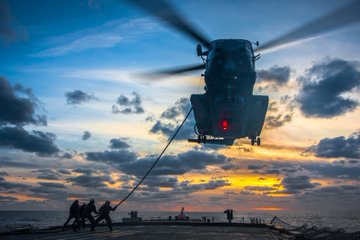
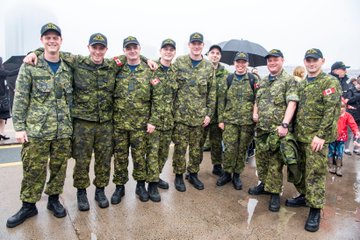
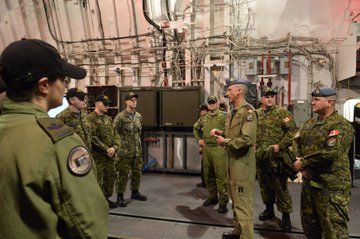
Today the first CH-148 Cyclone helicopter and aircrew embark aboard HMCS Ville de Québec for Op REASSURANCE, @CanadianForces support to #NATO defence and deterrence measures in Central and Eastern Europe.#RCAF #RCAFProud

The deployment of the Cyclone marks a major milestone for the 17-metre, 13,000-kilogram aircraft.

In January, the East Coast fleet of Sea Kings was retired after 54 years of service.

The Cyclone fleet will be tasked with surface and sub-surface surveillance, and search and rescue missions, while providing “tactical transport for national and international security efforts,” according to the military. Its aluminum and composite airframe is built with lightning-strike and high-intensity radio frequency pulse protection.

Monday, April 4, 2016

HMCS Fredericton Deploys to the Black Sea on OP REASSURANCE

DND Press Release:

April 1, 2016 – Ottawa – National Defence / Canadian Armed Forces

Her Majesty’s Canadian Ship (HMCS) Fredericton begins operations in the Black Sea today as part of Operation REASSURANCE, the Canadian Armed Forces’ on-going mission to promote security and stability in Central and Eastern Europe.

HMCS Fredericton is the lead to Standing NATO Maritime Group 2 (SNMG2) Task Unit 02 deployed to the Black Sea following the surveillance, reconnaissance and monitoring operations of migrant crossings in the Aegean Sea. During the month of April, the Royal Canadian Navy frigate will conduct operations in concert with Romanian Frigate ROS Regina Maria and other allied ships from Bulgaria and Turkey to enhance the Alliance’s maritime interoperability as participating nations develop familiarity, trust and confidence in each other.

While in the Black Sea, HMCS Fredericton will also conduct port visits to enhance diplomatic and defence relations with strategic partners in the region. Recurring naval operations in the Black Sea as part of NATO’s assurance measures to demonstrate solidarity towards our allies and partner nations.
Quotes

“HMCS Fredericton’s deployment to the Black Sea is one of many examples of Canada’s continued commitment to promoting security and stability in Central and Eastern Europe, as well as our resolute support for NATO’s collective defence. Canada’s participation in regional maritime security operations re-affirms that Canada’s Navy is a responsive, effective force in today’s maritime security environment.”Harjit S. Sajjan, Defence Minister

“Since joining Standing NATO Maritime Group 2 (SNMG 2) in January, HMCS Fredericton has had the opportunity to operate alongside a number of our allies in the Mediterranean and Aegean Seas. Moving our operations into the Black Sea will not change our objectives but will give the HMCS Frederictonan opportunity to work with key Black Sea-based partners. Fredericton’s ship’s company is very much looking forward to operating in this complex region.”Commander Trevor JC MacLean, Commanding Officer, HMCS Fredericton

April 1, 2016, HMCS Fredericton enters the Black Sea on NATO-led Maritime Assurance Activities. (Photo credit: Leading Seaman Dan Bard, Formation Imaging Service)

Thursday, February 11, 2016

HMCS Fredericton Deployed to Aegean Sea

Written by: The Associated Press
Published Thursday, February 11, 2016

HMCS Fredericton will be among three ships that NATO has announced it will send to the Aegean Sea to monitor the ongoing refugee crisis and provide surveillance of criminal networks working in the waters.

NATO Secretary-General Jens Stoltenberg says the NATO Maritime Group is being ordered immediately into the Aegean to help end illegal smuggling of migrants between Turkey and Greece, a situation he called a "human tragedy.”

Three NATO allies -- Turkey, Germany and Greece -- had requested NATO's help in an international effort to end the most intense migration crisis Europe has experienced since the Second World War.

HMCS Fredericton is part of NATO Maritime Standing Group 2, a flotilla that also consists of German navy flagship The Bonn, and the Barbaros from Turkey.

NATO Secretary-General Jens Stoltenberg said the warships "will start to move now" to provide surveillance of criminal networks working in the sea. They will then relay the information to the Greek and Turkish coast guards and other authorities, Stoltenberg said.

"This is not about stopping or pushing back refugee boats," Stoltenberg stressed.

"…This is about helping Greece, Turkey and the European Union with stemming the flow of migrants and refugees and coping with a very demanding situation.”

The International Organization for Migration said earlier this week that 76,000 people have travelled across the sea since Jan. 1 in an effort to reach Europe by sea. That’s nearly 2,000 people a day.

.The group also estimates that 409 people have died so far this year trying to cross from Turkey to Greece and between north Africa and Italy.

U.S. Defence Secretary Ash Carter said NATO military authorities also will draw up plans for how the alliance could further act to help shut down illegal human smuggling in the region.