By: Scott Taylor, Editor and Chief of Esprit-de-Corps Magazine
The Canadian Armed Forces are currently committed and deployed on five oversees missions, none of which have a clear cut or achievable objective.
Of course, the old Cold War warhorses will claim that our battle group stationed in Latvia has been successfully deterring Russian aggression into the Baltic States. One could similarly argue that a tinfoil cap is proper protection against alien brain removal, proven by the fact that you still have your brain.
I would think that Latvia, Estonia and Lithuania’s membership in NATO, with that alliance’s pledge of collective defence, coupled with the nuclear arsenals of the U.S., U.K. and France would serve as ample deterrent to even the most ambitious of Russian dictators.
Canadian officers who have served in Latvia know that it was nothing like our decade-long experience in Afghanistan. There will be no letters to the next-of-kin to inform them of a soldier’s death in combat. If the Russians don’t attack, nobody gets killed, and if Russia does trigger nuclear conflagration with NATO in the Baltic, there will be no one left alive to write the letters.
Keeping a battalion of Canadian soldiers in Latvia is an unnecessary waste of $400 million per year, and an added strain on the family lives of those personnel deployed abroad, unaccompanied, for either six months or one year.
We also have about 200 Canadian soldiers deployed in Ukraine as trainers. This is a bit of a sticky wicket (as the cricketers say) in that Ukraine is not a NATO member. Since 2014 Ukraine has been embroiled in a simmering civil war between the Western-backed regime in Kiev and the largely ethnic Russian breakaway regions of Donetsk and Luhansk.
Russian President Vladimir Putin has been soundly demonized for supplying military personnel, weapons and equipment to the ethnic Russian separatists. If Putin is evil for interfering militarily in a civil war in a neighbouring country in support of rebels of Russian ethnicity, how can we paint ourselves as angels for training and equipping more young Ukrainian men to kill in that same civil war?
Then we have not one, but two separate missions committed to the mess that once was the nation of Iraq.
One group of special forces operatives and helicopters remain in support of the U.S.-led alliance to defeat Daesh (aka ISIS or ISIL) while the second mission will be a Canadian-led, NATO effort to train more young Iraqi men how to kill. These Iraqis will in turn prop the corrupt regime in Baghdad.
For the record, and to silence those who prattle on about how the West is democratizing Iraq, the last round of elections failed to produce a verifiable result. A recount was ordered, but before that could happen, somehow, the warehouse containing the ballots burned down. You could not make this stuff up. As a result, the next regime will be headed up by a Shiite cleric and warlord named Muqtada Al-Sadr.
In 2004, this guy was considered public enemy No. 1 by the U.S. when he mobilized his militia to combat the American occupation.
Canada has no seat at the big boy table that will eventually seek to resolve the multifaceted conflict that engulfs Syria, Iraq and eastern Turkey. It will probably require a redrawing of existing maps and perhaps even the creation of new states, but none of that will be concluded with any Canadian say in the matter. In the meantime, we somehow justify the fact that our elite soldiers are teaching more young Iraqi men to kill more effectively.
In Mali, we can at least boast that we are under the UN banner, wearing blue berets, and using our helicopters for medical evacuation missions.
Unfortunately there is also no end game objective in Mali. Canada’s present commitment of one year will expire long before the fundamental causes of the Malian conflict have been resolved. In other words, our Canadian troops are doing a lot all around the world but achieving very little.
Showing posts with label OP REASSURANCE. Show all posts
Showing posts with label OP REASSURANCE. Show all posts
Friday, October 12, 2018

Friday, July 20, 2018
CH-148 Cyclone Deploys on First International Deployment with HMCS Ville de Quebec
By BRETT BUNDALE, The Canadian Press
HALIFAX— Hundreds of people gathered on a jetty at Halifax’s naval base Wednesday to bid farewell to 240 military members aboard HMCS Ville de Quebec as it headed to the Mediterranean as part of Canada’s ongoing contribution to a NATO mission in central and eastern Europe.
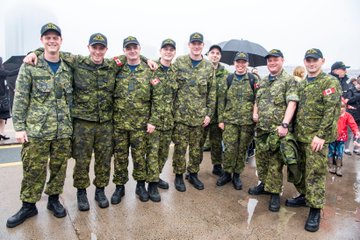
Under pouring rain, family, friends and dignitaries waved goodbye as the warship sounded a fog horn and departed through a heavy mist in Halifax harbour.
Children in brightly-coloured rain boots waved Canadian flags and homemade signs, one saying, “Bye Mommy, see you later” while another said, “Bon Voyage Daddy.”
Couples shielded from the rain under large umbrellas hugged and kissed goodbye before the six-month mission.
“It’s overwhelming,” said Vanessa Picard, standing on the jetty with her two young children after her husband departed. She called the experience of watching him sail off “surreal.”
It’s a familiar scene here at HMC Dockyard Halifax, as the commanding officer of the warship noted.
“It’s really hard on families,” said Cmdr. Scott Robinson, adding he was leaving behind his wife and two young children. “I’m not the only one. It weighs on you.”
Several ships deploy from the east coast base every year, but the HMCS Ville de Quebec send off was a significant milestone for the Canadian military.
On board the frigate was a CH-148 Cyclone helicopter — the first international mission for the new twin-engine machine.
Defence Minister Harjit Sajjan said the state-of-the-art technology adds to the “tremendous capability” of the country’s armed forces and its contribution to Operation Reassurance.
The retired lieutenant-colonel also said it “sends a very strong message of deterrence” to countries like Russia, which he said is starting to go against “a rule-based order.”
Sajjan pointed to Russian actions under Vladimir Putin, such as the annexation of Crimea, its support for rebel forces in eastern Ukraine and Bashar al-Assad’s government in Syria.
“It’s something that we will not stand for,” he told reporters following the warship’s departure. “This is one of the reasons why Canada will continue to step up not only as part of NATO, but as part of a coalition.”
He added that Canada “will not take threats lightly” and that the multinational, “fully combat ready” battle groups send a strong message.
Indeed, the commander of the HMCS Ville de Quebec said he expects to run training exercises with his crew to “keep our combat capability at a high level in case the government calls upon us to react to some sort of world event,” Robinson said.
“We want to maintain our proficiency as much as we can at the highest level in case the government of Canada calls on us to do something.”
Meanwhile, the Royal Canadian Navy commander called it an “exciting moment” for the first-ever Cyclone helicopter to be sent on a mission.
Vice-Admiral Ron Lloyd said Canada’s contribution to the NATO mission will help “enhance regional maritime security and stability.”
The Halifax-class warship HMCS Ville de Quebec is slated to relieve HMCS St. John’s, which returns to Halifax later this month after a six-month mission.
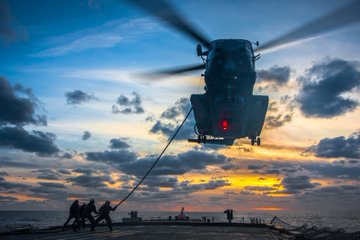
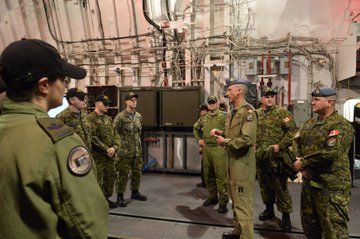
Today the first CH-148 Cyclone helicopter and aircrew embark aboard HMCS Ville de Québec for Op REASSURANCE, @CanadianForces support to #NATO defence and deterrence measures in Central and Eastern Europe.#RCAF #RCAFProud
The deployment of the Cyclone marks a major milestone for the 17-metre, 13,000-kilogram aircraft.
In January, the East Coast fleet of Sea Kings was retired after 54 years of service.
The Cyclone fleet will be tasked with surface and sub-surface surveillance, and search and rescue missions, while providing “tactical transport for national and international security efforts,” according to the military. Its aluminum and composite airframe is built with lightning-strike and high-intensity radio frequency pulse protection.
HALIFAX— Hundreds of people gathered on a jetty at Halifax’s naval base Wednesday to bid farewell to 240 military members aboard HMCS Ville de Quebec as it headed to the Mediterranean as part of Canada’s ongoing contribution to a NATO mission in central and eastern Europe.
Under pouring rain, family, friends and dignitaries waved goodbye as the warship sounded a fog horn and departed through a heavy mist in Halifax harbour.
 |
| HMCS Ville de Quebec in Halifax last December. Hundreds of people gathered on a jetty at Halifax's naval base today to bid farewell to 240 military members aboard the vessel. (ANDREW VAUGHAN / THE CANADIAN PRESS FILE PHOTO) |
 |
| An RCAF CH-148 Cyclone maritime helicopter flies past a luxury yacht in Halifax on Friday, July 13, 2018. It departed for its first international deployment with the frigate HMCS Ville de Quebec today. (ANDREW VAUGHAN / THE CANADIAN PRESS) |
Couples shielded from the rain under large umbrellas hugged and kissed goodbye before the six-month mission.
“It’s overwhelming,” said Vanessa Picard, standing on the jetty with her two young children after her husband departed. She called the experience of watching him sail off “surreal.”
It’s a familiar scene here at HMC Dockyard Halifax, as the commanding officer of the warship noted.
“It’s really hard on families,” said Cmdr. Scott Robinson, adding he was leaving behind his wife and two young children. “I’m not the only one. It weighs on you.”
Several ships deploy from the east coast base every year, but the HMCS Ville de Quebec send off was a significant milestone for the Canadian military.
On board the frigate was a CH-148 Cyclone helicopter — the first international mission for the new twin-engine machine.
Defence Minister Harjit Sajjan said the state-of-the-art technology adds to the “tremendous capability” of the country’s armed forces and its contribution to Operation Reassurance.
The retired lieutenant-colonel also said it “sends a very strong message of deterrence” to countries like Russia, which he said is starting to go against “a rule-based order.”
Sajjan pointed to Russian actions under Vladimir Putin, such as the annexation of Crimea, its support for rebel forces in eastern Ukraine and Bashar al-Assad’s government in Syria.
“It’s something that we will not stand for,” he told reporters following the warship’s departure. “This is one of the reasons why Canada will continue to step up not only as part of NATO, but as part of a coalition.”
He added that Canada “will not take threats lightly” and that the multinational, “fully combat ready” battle groups send a strong message.
Indeed, the commander of the HMCS Ville de Quebec said he expects to run training exercises with his crew to “keep our combat capability at a high level in case the government calls upon us to react to some sort of world event,” Robinson said.
“We want to maintain our proficiency as much as we can at the highest level in case the government of Canada calls on us to do something.”
Meanwhile, the Royal Canadian Navy commander called it an “exciting moment” for the first-ever Cyclone helicopter to be sent on a mission.
Vice-Admiral Ron Lloyd said Canada’s contribution to the NATO mission will help “enhance regional maritime security and stability.”
The Halifax-class warship HMCS Ville de Quebec is slated to relieve HMCS St. John’s, which returns to Halifax later this month after a six-month mission.
Today the first CH-148 Cyclone helicopter and aircrew embark aboard HMCS Ville de Québec for Op REASSURANCE, @CanadianForces support to #NATO defence and deterrence measures in Central and Eastern Europe.#RCAF #RCAFProud
The deployment of the Cyclone marks a major milestone for the 17-metre, 13,000-kilogram aircraft.
In January, the East Coast fleet of Sea Kings was retired after 54 years of service.
The Cyclone fleet will be tasked with surface and sub-surface surveillance, and search and rescue missions, while providing “tactical transport for national and international security efforts,” according to the military. Its aluminum and composite airframe is built with lightning-strike and high-intensity radio frequency pulse protection.
Monday, February 12, 2018
Public Outcry: The Way to Fix the Canadian Forces
By: Ian J. Keddie, Macleans
But despite the limited size of spending on defence, the Canadian Armed Forces have, in fact, maintained a complex and effective range of military capabilities around the world, providing specialist experience and capabilities that are the envy of almost every country. It contributes to a diverse range of military tasks and has maintained a long history of supporting NATO operations, taking part in 19 international military operations and 11 domestic operations in 2017. It has sustained a number of missions in Europe under Operation Reassurance since the Russian invasion of Crimea in 2014. Operation Reassurance has been a sustained effort, with elements of all three services maintaining a presence in Central and Eastern Europe. Canada also has 450 soldiers leading a NATO-enhanced Forward Presence battlegroup in Latvia. In addition to European commitments, the Royal Canadian Navy has deployed a submarine across the Pacific for the first time in 50 years.
Despite this tempo of operations, the Armed Forces are often out of sight and out of mind. Indeed, Canada’s relationship with its military could be generously described as aloof. Little attention is given to the topic of defence in the country’s media, and the Armed Forces often take a backseat to many other national issues. Considering the significant role of the Armed Forces in Canada’s founding myths, military tradition and experience is strangely absent from everyday life, and thanks in part to this feeling of indifference on the part of voters, Canada’s politicians have allowed spending to dwindle.
There are, however, still military issues that provoke attention nationally. Prime Minister Justin Trudeau’s tone-deaf response to a disabled veteran at a town hall meeting in Edmonton last week about why the government was fighting some veterans’ groups in court over injury compensation—because “they’re asking for more than we are able to give right now”—demonstrated a profound misjudgement of attitudes, and he has suffered a wave of criticism as a result.
Trudeau’s comment will only widen the divide between veterans and the government. But a gap between civilian and military culture is not isolated to the Liberal Party: it is the symptom of a broader disconnect in the national psyche.
COUNTERPOINT: We’ve given up on Canada’s military, so let’s abandon it altogether
Canada’s vast geography has a lot to do with that: the country is simply too big and major population centres too far away from the main centres of military activities. Of the world’s 20 largest economies, Canada easily has the smallest military per area of territory. Short of completely demilitarized states such as Iceland or Costa Rica, it is almost impossible to find a country with fewer personnel per square kilometre; as of 2016, Canada has just 0.0066 uniformed personnel to protect each square kilometre, while Australia is the only nation that comes close, with 0.0074 personnel per square kilometre. South Korea is (understandably) the most militarized of the top 20 economies, at 6.24 in uniform per square kilometre.
Of course, this may be an unfair metric for the second largest country on Earth. But an alternative metric, using military personnel per capita, still leaves Canada the fourth-lowest number, with 0.0018 per person. In this instance, Canada is only beaten by India, Brazil, and China, whose large armed forces are eclipsed by their giant populations. Such measurements tell us nothing about military effectiveness or capability, but they do give some indication of the presence of the military in everyday life.
Indeed, Canada’s military is far less visible, particularly to people living in larger urban centres, and Canadians are less likely to know someone who has, or is currently serving in the Armed Forces. Countries such as the U.K., Germany, and Australia have almost 30 per cent more personnel per capita and the proportion is greater still in places like Spain, France, or the United States. The recent attention on defence spending by NATO nations has certainly spurred a greater discussion on the topic and it is right that Canada should gradually take more responsibility for national defence and seek to improve the role it can play with allies and international partners. But it shouldn’t require a wounded former soldier arguing with the Prime Minister for military issues to make the front pages: there are Canadian personnel carrying out tasks around the world every day that largely go unreported.
READ MORE: Why military funding in Canada is in such a sorry state
The other reason for the forces’ lack of visibility is the simple fact of our national peace. More so than perhaps any other advanced economy, Canada has benefited from the peace dividend that resulted from the end of the Cold War, and the implied protection that Canada’s close relationship to the U.S. provides has led to a complacent attitude towards national defence. The Trudeau administration has attempted to reverse Canada’s spending trend and aims to increase spending from around 1 per cent of GDP to 1.4 per cent by the middle of the next decade, but it’s a decision many saw as merely a response to a new era of uncertainty around U.S. policy.
Still, the Trudeau administration has touted engagement with partners and a wider global presence as an aim for the military and Canada’s government agencies, and the country’s various deployments demonstrate an ability to carry out that role. But if Canada wants to maintain such capabilities, then investment in personnel and equipment are vital for the future of the CAF. There was a great deal of praise for the navy’s new supply ship, the MV Asterix, entering service last month, but celebrations should be tempered by remembering that the MV Asterix was hastily procured as a stop-gap until brand new supply ships are delivered some time next decade. Successive governments have delayed decisions on the Joint Supply Ship (JSS) programme since 2004, and no construction is likely to start until 2019. Multiple attempts to choose a new jet has left the air force in need of its own stopgap secondhand F-18s from Australia, and a huge shortfall looms in the number of reserve personnel that the army aims to have by next year. Trudeau’s planned additional investment of $62 billion over the next 20 years is failing to make headwayin the first year of implementation, and there are many areas of the Defence Policy Review that lack specific goals or deadlines.
If Canada wants to invest more in national defence, Canadian attitudes towards delays or can-kicking of procurement decisions must change so that they are politically unacceptable. Such an opportunity presents itself this year when the government selects a winning bidder for the Canadian Surface Combatant (CSC) programme; the CSC, the largest procurement project ever carried out by Canada, represents the future shape of the RCN, and could be the first of many large investments into the future of the CAF under Trudeau. Other, smaller investment decisions in cyber warfare, drones, and satellite communications are capabilities that Canada lacks, and while many of these are outlined as requirements in the Defence Policy Review, they were given no specific plans. Training, recruitment, and retention have also been chronic problems for the CAF, but investment in areas such as these usually fails to grab the headlines in the same way that new jets or ships do.
The stakes are increasing. Two decades of delays and underinvestment will eventually erode Canada’s capabilities. Much of Canada’s military equipment is entering the latter stages of its lifespan, and it is crucial that the money for replacements is invested now rather than left until it is too late. There won’t always be stop-gap options in the future, and it is far more difficult to relearn capabilities than it is to retain them.
In Jack Granatstein’s 2004 book, Who Killed the Canadian Military?, the historian concludes that ultimately, public attitudes have allowed politicians—who should take “the major share of the credit” in the military’s fade—to ignore the CAF. The Canadian interpretation of the military’s role is distinctive on the world stage, as the country sees peacekeeping as the CAF’S primary function and ignored the requirement for national defence. It’s produced a catch-22: the military’s shrinking role throughout the second half of the 20th century often placed it out of citizens’ view, which has led to even less public interest and political appetite. As the Trudeau administration reconsiders the country’s foreign policy and the role the armed forces will play in that, the public needs to provide the momentum for sustained regeneration of the military—before it’s too late.
Opinion: Why the Canadian Armed Forces are trapped in a catch-22—and why pressure on our politicians is the only thing that can break it
Canada may not be known for its military might—perhaps rightly so. The country’s military budget has fallen among the lowest in NATO, when measured as a percentage of GDP, and procrastination on decisions for new equipment has led to years of delays. A Lester Pearson-era reputation for peacekeeping has subsumed, in the public’s mind, the CAF’s responsibility for national defence.But despite the limited size of spending on defence, the Canadian Armed Forces have, in fact, maintained a complex and effective range of military capabilities around the world, providing specialist experience and capabilities that are the envy of almost every country. It contributes to a diverse range of military tasks and has maintained a long history of supporting NATO operations, taking part in 19 international military operations and 11 domestic operations in 2017. It has sustained a number of missions in Europe under Operation Reassurance since the Russian invasion of Crimea in 2014. Operation Reassurance has been a sustained effort, with elements of all three services maintaining a presence in Central and Eastern Europe. Canada also has 450 soldiers leading a NATO-enhanced Forward Presence battlegroup in Latvia. In addition to European commitments, the Royal Canadian Navy has deployed a submarine across the Pacific for the first time in 50 years.
Despite this tempo of operations, the Armed Forces are often out of sight and out of mind. Indeed, Canada’s relationship with its military could be generously described as aloof. Little attention is given to the topic of defence in the country’s media, and the Armed Forces often take a backseat to many other national issues. Considering the significant role of the Armed Forces in Canada’s founding myths, military tradition and experience is strangely absent from everyday life, and thanks in part to this feeling of indifference on the part of voters, Canada’s politicians have allowed spending to dwindle.
There are, however, still military issues that provoke attention nationally. Prime Minister Justin Trudeau’s tone-deaf response to a disabled veteran at a town hall meeting in Edmonton last week about why the government was fighting some veterans’ groups in court over injury compensation—because “they’re asking for more than we are able to give right now”—demonstrated a profound misjudgement of attitudes, and he has suffered a wave of criticism as a result.
Trudeau’s comment will only widen the divide between veterans and the government. But a gap between civilian and military culture is not isolated to the Liberal Party: it is the symptom of a broader disconnect in the national psyche.
COUNTERPOINT: We’ve given up on Canada’s military, so let’s abandon it altogether
Canada’s vast geography has a lot to do with that: the country is simply too big and major population centres too far away from the main centres of military activities. Of the world’s 20 largest economies, Canada easily has the smallest military per area of territory. Short of completely demilitarized states such as Iceland or Costa Rica, it is almost impossible to find a country with fewer personnel per square kilometre; as of 2016, Canada has just 0.0066 uniformed personnel to protect each square kilometre, while Australia is the only nation that comes close, with 0.0074 personnel per square kilometre. South Korea is (understandably) the most militarized of the top 20 economies, at 6.24 in uniform per square kilometre.
Of course, this may be an unfair metric for the second largest country on Earth. But an alternative metric, using military personnel per capita, still leaves Canada the fourth-lowest number, with 0.0018 per person. In this instance, Canada is only beaten by India, Brazil, and China, whose large armed forces are eclipsed by their giant populations. Such measurements tell us nothing about military effectiveness or capability, but they do give some indication of the presence of the military in everyday life.
Indeed, Canada’s military is far less visible, particularly to people living in larger urban centres, and Canadians are less likely to know someone who has, or is currently serving in the Armed Forces. Countries such as the U.K., Germany, and Australia have almost 30 per cent more personnel per capita and the proportion is greater still in places like Spain, France, or the United States. The recent attention on defence spending by NATO nations has certainly spurred a greater discussion on the topic and it is right that Canada should gradually take more responsibility for national defence and seek to improve the role it can play with allies and international partners. But it shouldn’t require a wounded former soldier arguing with the Prime Minister for military issues to make the front pages: there are Canadian personnel carrying out tasks around the world every day that largely go unreported.
READ MORE: Why military funding in Canada is in such a sorry state
The other reason for the forces’ lack of visibility is the simple fact of our national peace. More so than perhaps any other advanced economy, Canada has benefited from the peace dividend that resulted from the end of the Cold War, and the implied protection that Canada’s close relationship to the U.S. provides has led to a complacent attitude towards national defence. The Trudeau administration has attempted to reverse Canada’s spending trend and aims to increase spending from around 1 per cent of GDP to 1.4 per cent by the middle of the next decade, but it’s a decision many saw as merely a response to a new era of uncertainty around U.S. policy.
Still, the Trudeau administration has touted engagement with partners and a wider global presence as an aim for the military and Canada’s government agencies, and the country’s various deployments demonstrate an ability to carry out that role. But if Canada wants to maintain such capabilities, then investment in personnel and equipment are vital for the future of the CAF. There was a great deal of praise for the navy’s new supply ship, the MV Asterix, entering service last month, but celebrations should be tempered by remembering that the MV Asterix was hastily procured as a stop-gap until brand new supply ships are delivered some time next decade. Successive governments have delayed decisions on the Joint Supply Ship (JSS) programme since 2004, and no construction is likely to start until 2019. Multiple attempts to choose a new jet has left the air force in need of its own stopgap secondhand F-18s from Australia, and a huge shortfall looms in the number of reserve personnel that the army aims to have by next year. Trudeau’s planned additional investment of $62 billion over the next 20 years is failing to make headwayin the first year of implementation, and there are many areas of the Defence Policy Review that lack specific goals or deadlines.
If Canada wants to invest more in national defence, Canadian attitudes towards delays or can-kicking of procurement decisions must change so that they are politically unacceptable. Such an opportunity presents itself this year when the government selects a winning bidder for the Canadian Surface Combatant (CSC) programme; the CSC, the largest procurement project ever carried out by Canada, represents the future shape of the RCN, and could be the first of many large investments into the future of the CAF under Trudeau. Other, smaller investment decisions in cyber warfare, drones, and satellite communications are capabilities that Canada lacks, and while many of these are outlined as requirements in the Defence Policy Review, they were given no specific plans. Training, recruitment, and retention have also been chronic problems for the CAF, but investment in areas such as these usually fails to grab the headlines in the same way that new jets or ships do.
The stakes are increasing. Two decades of delays and underinvestment will eventually erode Canada’s capabilities. Much of Canada’s military equipment is entering the latter stages of its lifespan, and it is crucial that the money for replacements is invested now rather than left until it is too late. There won’t always be stop-gap options in the future, and it is far more difficult to relearn capabilities than it is to retain them.
In Jack Granatstein’s 2004 book, Who Killed the Canadian Military?, the historian concludes that ultimately, public attitudes have allowed politicians—who should take “the major share of the credit” in the military’s fade—to ignore the CAF. The Canadian interpretation of the military’s role is distinctive on the world stage, as the country sees peacekeeping as the CAF’S primary function and ignored the requirement for national defence. It’s produced a catch-22: the military’s shrinking role throughout the second half of the 20th century often placed it out of citizens’ view, which has led to even less public interest and political appetite. As the Trudeau administration reconsiders the country’s foreign policy and the role the armed forces will play in that, the public needs to provide the momentum for sustained regeneration of the military—before it’s too late.
Monday, August 21, 2017
CAF wraps up three year mission in Poland
DND Press Release
On August 17, the Land Task Force (LTF) in Poland completed its successful three-year mission on Operation Reassurance with an end of mission parade in Drawsko Pomorskie, Poland.
Various rotations of troops have served on Canada’s LTF in Poland since May 2014, and have participated in military exercises throughout the region to improve interoperability with Allies and demonstrate NATO’s resolve to protect Alliance territories and partners. Op Reassurance refers to the military activities undertaken by the CAF since 2014 to support NATO assurance and deterrence measures in Eastern and Central Europe with the aim of reassuring nations in the region of NATO’s commitment to support their stability and security.
Canada will continue to support NATO Allies in Europe by leading the enhanced Forward Presence battlegroup (eFP BG), which was stood up in June 2017 at Camp Adazi, Latvia. Canada is one of four Framework Nations supporting NATO’s aim to preserve peace and prevent conflict in Eastern and Central Europe.
“Canada is a strong supporter of NATO and is committed to doing its part as a member of the Alliance. Over the last three years, the Land Task Force in Poland has demonstrated Canada’s commitment to security and stability in Central and Eastern Europe, and that commitment continues through our many activities under Operation Reassurance, ” said Lieutenant-General Stephen Bowes, Commander Canadian Joint Operations Command.
The last rotation of the LTF, which served in Poland for about six months, is comprised of about 200 CAF soldiers mainly from 3rd Battalion, Princess Patricia’s Canadian Light Infantry out of Canadian Forces Base Edmonton, Alberta.
Following the LTF’s mission completion in Poland, the troops will redeploy to Canada while some of the equipment will be transferred to Latvia in support of the CAF led eFP BG.
CAF soldiers from the last rotation of the LTF took part in Exercise Allied Spirit VI in Hohenfels, Germany, from March 7 to March 30, 2017, working closely with soldiers from Allied countries and Partners for Peace.
From April 24 to May 4, 2017, an infantry company from the LTF participated in Exercise Platinum Eagle 17-2 hosted by the Romanian Land Forces in the Babadag Training Area, Romania.
A small team of snipers from the LTF took part in Exercise Spring Storm in Estonia from May 9 to 24, 2017. They trained with soldiers from France, Germany, and the United Kingdom under the lead of the Estonian Defence Forces.
The LTF took part in Exercise Sabre Strike from June 4 to 15, 2017, in Orzysz, Poland, which was hosted by the Polish Armed Forces. Units from Latvia, Lithuania, Estonia, Germany, and the United States, among others, also took part.
From July 13 to 24, 2017, the LTF participated in Exercise Saber Guardian. Under the US Army’s lead, troops from Canada, Greece, Italy, and Romania trained in air mobile and air assault operations in a global context.
Wednesday, August 16, 2017
CAF To Patrol Skies over Romania
DND Press Release
The Canadian Armed Forces (CAF) is sending approximately 135 CAF personnel and four Royal Canadian Air Force CF-18 Hornets to Constanta, Romania, to participate in NATO enhanced Air Policing from September to December 2017.
This mission is part of Operation Reassurance, Canada’s contribution to NATO assurance and deterrence measures. Air Task Force (ATF) Romania will augment the Romanian Air Force’s capability to preserve the integrity of its airspace.
NATO Air Policing has been part of Alliance assurance and deterrence measures since 2014. These measures demonstrate the collective resolve of Allies to protect NATO territory and populations.
“The Canadian Armed Forces is committed to the principle of collective defence of the Alliance, which is at the very heart of NATO’s founding treaty. Our military personnel are well-trained and committed to contribute to NATO enhanced Air Policing that ensures the integrity of Allies’ airspace. They are proud to work on behalf of Canadians, projecting the best of what Canada has to offer,” said Lieutenant-General Steve Bowes, Commander, Canadian Joint Operations Command.
"An Air Task Force is an agile and flexible organization that is always ready to employ air power and provide support wherever and whenever Canada requires. Our Air Task Force in Romania is proud to participate in the cooperative defence activities that support NATO’s enhanced Air Policing,” said Lieutenant-Colonel Mark Hickey, Commander, Air Task Force Romania.
The deployed CAF members that form the ATF in Romania are mainly from 409 Tactical Fighter Squadron out of 4 Wing Cold Lake, supported by personnel from 2 Air Expeditionary Wing and 17 Wing Winnipeg.
NATO enhanced Air Policing is a peacetime collective defence mission, safeguarding the integrity of the Alliance airspace. The CAF has supported this mission, on a rotational basis with other NATO Allies, as part of Op Reassurance since May 2014.
The CAF first deployed an ATF to Romania as part of Op Reassurance from April to August 2014 at the Romanian Air Force 71st Air Base in Campia Turzii. During this mission, the ATF was engaged in multinational training opportunities that developed interoperability in the areas of air defence, air superiority, and tactical support missions.
Op Reassurance refers to the military activities undertaken by the CAF since 2014 to support NATO assurance and deterrence measures in Eastern and Central Europe with the aim of reassuring nations in the region of NATO’s intent to support their stability and security.
Tuesday, May 23, 2017
RCAF CF-18's Begin Patrolling Iceland's Airspace
The Canadian Press
RCAF CF-18 fighter jets will begin patrolling Iceland's airspace today as part of Canada's OP IGNITION, a contribution to NATO.
The operation is intended to identify and intercept aircraft that approach NATO airspace in Iceland.
About 180 members of the Canadian Forces will be involved in the roughly month-long operation that involves six CF-18 fighter jets.
The aircraft will operate out of Keflavik Air Base, near Reykjavik.
The campaign is also part of Operation Reassurance, intended to reinforce the defence of NATO countries in Central and Eastern Europe.
Operation Reassurance is also intended to ease concerns of NATO allies in the face of Russian aggression toward Ukraine.
Iceland is the only NATO country that does not have a standing military.
 |
| A pilot positions a CF-18 Hornet at the CFB Cold Lake, in Cold Lake, Alberta on October 21, 2014. Canadian CF-18 fighter jets will begin patrolling Iceland's airspace today as part of Canada's contribution to NATO. The operation is intended to identify and intercept aircraft that approach NATO airspace in Iceland. THE CANADIAN PRESS/Jason Franson |
The operation is intended to identify and intercept aircraft that approach NATO airspace in Iceland.
About 180 members of the Canadian Forces will be involved in the roughly month-long operation that involves six CF-18 fighter jets.
The aircraft will operate out of Keflavik Air Base, near Reykjavik.
The campaign is also part of Operation Reassurance, intended to reinforce the defence of NATO countries in Central and Eastern Europe.
Operation Reassurance is also intended to ease concerns of NATO allies in the face of Russian aggression toward Ukraine.
Iceland is the only NATO country that does not have a standing military.
Monday, January 9, 2017
Edmonton-Based Soldiers to Deploy to Eastern Europe
By: Juris Garney and Clair Theobald, Edmonton Journal
Edmonton soldiers will be spending more time in Eastern Europe in 2017, with western Canadian forces on high readiness into the new year, says the commander of 3rd Canadian Division and Joint Task Force West.
About 220 Edmonton-based soldiers are rotating through six-month deployments in Poland as part of Operation Reassurance, while another 200 soldiers undertake a training mission in Ukraine as part of Operation Unifier, says Brig.-Gen. Simon Hetherington.
And next spring, 455 solders will be deployed just outside the capital of the tiny Baltic nation of Latvia.
Eastern Europe continues to be the focal point of Canadian troops as part of the country’s NATO commitments. With continued aggressive posturing by Russian President Vladimir Putin, soldiers could be in the region indefinitely.
“We train for all contingencies across the spectrum of conflict and that can be from high-intensity combat operations to counter-insurgency like we fought in Afghanistan through to humanitarian assistance and disaster relief,” Hetherington said in a year-end interview.
“Some are much more challenging to perform, but by training to that highest standard, we are prepared to do all those missions.”
Hetherington said the training mission in Ukraine, in which Canadian soldiers are training Ukrainian armed forces in everything from basic soldiering skills to enhanced first aid and enhanced explosives disposal, highlights Canada’s contribution to global security efforts.
But their role in Poland is quite different, however, and so too will be their presence in Latvia.
Putin’s annexation of Crimea, along with military incursions into eastern Ukraine, mirror his aggressive tactics in 2008 when troops entered Georgia under the guise of protecting South Ossetia.
Those living in Eastern Europe know too well about Russia’s willingness to throw its considerable military might around in the region.
“Is there a threat? Well, yeah, there is,” Hetherington said. “There is a reason why we are going there. Is it as imminent and is it as present as Afghanistan? Well, no.
“You go to Poland for a holiday. You go to Latvia right now for a holiday. But to Eastern Europe there is an existential threat. They have lived through it in the 20th century, so they have a different perspective than we do.
“But what we have trained for is the worst-case scenario and we’ll continue to train while we are there.”
Back in Canada, the military has seen its own challenges on two fronts: how it deals with sexual harassment and support for sufferers of post-traumatic stress disorder.
In November, a voluntary Statistics Canada survey found that in the past year, 960 full-time members, or about 1.7 per cent of the regular force, reported sexual assault.
More than one-quarter of all women in the military reported sexual assault at least once over their military careers, the survey found.
Hetherington said from across the country, he is receiving a report each day of some type of harassment incident, but that is a good thing because it means harassment is no longer hidden or not being discussed.
“The important thing is that our soldiers are reporting them,” he said. “They are saying, ‘Look, I don’t accept that behaviour from someone on my team and I don’t accept this as being put upon one of my teammates, regardless of how innocuous it is.’
“There is still issues out there and we are doing more than I’ve seen in my 30 years in the service to address it … (but) we’ve got to get it to zero.”
Hetherington said it was important to leverage the courage shown by soldiers in battle to also stand up for their comrades.
“The courage that it takes to charge up a hill against machinegun fire that every one of these men and women are prepared to do, it’s that courage that they need to step in when there is any kind of maltreatment or discrimination or harassment. (It’s) taking the courage to step up and say I’m not going to stand for that.”
As for sufferers of PTSD, Hetherington said significant changes have been made in identification of sufferers and the creation of supports.
“It’s not just a soldier’s condition; we know that families have to deal with this as well,” he said. “We have come miles and we continue to develop.
“There is not a leader in the Canadian Army now that is not cognizant of the challenges that our soldiers face and how to look for the signs.”
Joint Task Force West is responsible for the conduct of domestic operations in Alberta, Saskatchewan and Manitoba, while 3rd Canadian Division is responsible for all Canadian Army administration and operations from the Pacific Ocean to Thunder Bay, Ont. Both are based in Edmonton.
Monday, October 31, 2016
Canada Expanding OP REASSURANCE to Black Sea Region
By: Zane Schwartz, National Post
Canada will send troops to the Black Sea region to combat Russian influence there, NATO Secretary General Jens Stoltenberg announced Wednesday.
“I’m pleased to confirm that several nations indicated their willingness to contribute to our presence in the Black Sea region, on land, at sea and in the air,” said Stoltenberg, adding that the countries involved include: “Canada, Germany, the Netherlands, Poland, Turkey and the United States.”
The deployment is in addition to the troops Canada has already committed to Operation Reassurance in Eastern Europe.
Department of National Defence spokesperson Evan Koronewski confirmed the Black Sea deployment. It will include CF-18s stationed in Romania and a RCN frigate in the Black Sea.
Stoltenberg said he intends to confirm the plans by the next meeting of NATO defence ministers in February.
Stoltenberg also announced a land brigade in Romania, but Canada will not be part of that, Jordan Owens, press secretary of Defence Minister Harjit Sajjan, said Thursday.
Romania, Russia, Ukraine and Turkey are among the countries that border the
Black Sea. Turkish President Recep Tayyip Erdogan has described it as “almost a Russian lake” as a result of the Russian military presence there.
Related
U.S., Russia and other global rivals unite against a UN call to shed their nuclear weapons
Russia drops request to refuel Syrian-bound battle group at Spanish port after NATO uproar
Russia taunts U.S. on eve of election with biggest military deployment since the Cold War
Canada has 220 armed forces members deployed in Poland as well as about 250 aboard HMCS Charlottetown as part a maritime task force formed by NATO. HMCS Charlottetown could deploy to the Black Sea or, if its rotation is up by the time the order to move comes, the frigate replacing it will go.
Rona Ambrose, the interim Conservative leader, criticized Justin Trudeau’s government this week for its failure to disclose basic facts about Canadian troops fighting ISIL.
Stoltenberg’s announcement comes on the heels of rising tensions between Russia and NATO following the breakdown of a ceasefire on Oct. 3 brokered by the two countries in Syria.
For Operation Reassurance, about 4,000 soldiers divided into four battalions will deploy in Poland, Lithuania, Estonia and Latvia. Canada is leading the battalion based in Latvia.
Stoltenberg announced that Albania, Italy, Poland, and Slovenia would contribute to the Latvia battalion.
Tuesday, October 25, 2016
Sajjan Traveling to Paris, Eastern Europe
DND Press Release
Ottawa – National Defence / Canadian Armed Forces
Defence Minister Harjit S. Sajjan will travel to Central and Eastern Europe between October 24 and 29 to attend key international meetings including with the Counter-ISIL Ministerial Meeting of the Global Coalition against Daesh in Paris, and NATO Defence Ministers’ in Brussels. He will continue to Riga, Latvia, and speak at the Riga Conference which is known as a unique venue for dialogue on international security issues between leading global decision makers.
Canada is committed, active and engaged in addressing the evolving international security environment with allied and partner nations globally.
Wednesday, August 10, 2016
CAF Land Task Force Returns to Romania to Train with Allies
By: Captain Mark Ruban, Public Affairs Officer, Operation REASSURANCE Land Task Force
Approximately 40 soldiers of the Operation REASSURANCE Land Task Force (LTF) have concluded yet another successful training exercise with NATO allies in Cincu, Romania. LTF personnel returned to Cincu for Exercise SABER GUARDIAN, which took place from July 27 to August 7, 2016, after having first deployed there in April for Exercise SCORPION FURY.
 |
| Canadian soldiers of the Operation REASSURANCE Land Task Force (LTF) (in green) demonstrate their mechanized advance-to-contact procedures to American soldiers of 116th Cavalry Brigade Combat Team during Exercise SABER GUARDIAN, a multinational exercise comprising 10 countries, in Cincu, Romania on August 3, 2016. Canadian soldiers are deployed to Central and Eastern Europe as part of the LTF to support NATO assurance and deterrence measures, and improve interoperability with allies. (Photo: Corporal Guillaume Gagnon, Liaison Officer Driver, Operation REASSURANCE Land Task Force) |
“Once again, it was a pleasure to be training alongside our Romanian and American allies here in Cincu,” said Captain Tom Jancarik, a platoon commander with the 1st Battalion, Royal 22e Régiment (1 R22eR) deployed with the LTF. “It’s always a pleasure to find that, despite our differences in tactics and equipment, we are more alike than different. We are equally united in our desire to increase our interoperability and help defend Central and Eastern Europe.”
Like many joint exercises, Exercise SABER GUARDIAN was an opportunity to practice new or unfamiliar skills with allies. Thanks to the Americans’ Blackhawk helicopters, the Canadians – who are mainly mechanized infanteers from 1 R22eR – were able to practice airmobile-assault drills with their U.S. counterparts. LTF soldiers had already learned the essentials while training at their base in Poland and they welcomed the opportunity to conduct helicopter-borne training again in Romania.
Having recently acquired Bradley armoured vehicles as part of a process to develop new capabilities, soldiers of the U.S. Army’s 116th Cavalry Brigade Combat Team are still refining their skills as mechanized infanteers. The Canadians were happy to share their knowledge and experiences with respect to the strategies and tactics of fighting, defending and patrolling with the support of armoured vehicles.
“It was great working with both the Romanians and Americans, who were very welcoming and who ensured that we integrated smoothly into the team,” said Corporal Rylan Moser, a signaller within the LTF. “They had a wealth of knowledge and experience to share with us, and they were also very open to take what knowledge we had to offer. Overall, this was an excellent training experience that helped us develop within our respective trades.”
Exercise SABER GUARDIAN was an important training opportunity that demonstrated the strength of allied solidarity in the region. Aside from the tactical field-training component, several countries collaborated in computer-based simulations to test the performance of various capabilities under different scenarios. The President of Romania, Klaus Iohannis, visited soldiers during the exercise, as did a representative of the Canadian embassy in Bucharest, Romania.
Op REASSURANCE is the Canadian Armed Forces’ contribution to NATO assurance and deterrence measures in Central and Eastern Europe. Through the LTF, Canadian soldiers participate in training exercises alongside NATO allies in order to enhance interoperability and contribute to NATO’s readiness to respond to threats that may arise. Aside from Romania, soldiers of the current LTF rotation have also participated in such exercises in Estonia, Latvia, Lithuania and Poland.
Tuesday, July 19, 2016
HMCS Charlottetown in Black Sea
DND Press Release
Her Majesty’s Canadian Ship (HMCS) Charlottetown, while deployed on Operation REASSURANCE, will work and train in the Black Sea with vessels from several allied and partner nations from July 18 to August 2, 2016.
While operating in the Black Sea, HMCS Charlottetown will participate in two training exercises and conduct maritime situational awareness operations to enhance maritime security in the region. As part of its operations in the Black Sea, HMCS Charlottetown will also conduct port visits to enhance diplomatic and defence relations with strategic Allies.
From July 27 to 30, HMCS Charlottetown will participate in Exercise SEA BREEZE, which is an air, land, and maritime exercise designed to enhance maritime safety, security, and stability in the Black Sea. This year, the 2016 exercise involves naval vessels from four nations.
Operation REASSURANCE refers to the military activities undertaken by the Canadian Armed Forces to support NATO assurance and deterrence measures in Eastern and Central Europe. It includes operational and tactical level demonstrations, manoeuvres, and enhanced interoperability activities with Allies and partners.
Her Majesty’s Canadian Ship (HMCS) Charlottetown, while deployed on Operation REASSURANCE, will work and train in the Black Sea with vessels from several allied and partner nations from July 18 to August 2, 2016.
While operating in the Black Sea, HMCS Charlottetown will participate in two training exercises and conduct maritime situational awareness operations to enhance maritime security in the region. As part of its operations in the Black Sea, HMCS Charlottetown will also conduct port visits to enhance diplomatic and defence relations with strategic Allies.
“The deployment of HMCS Charlottetown to the Black Sea demonstrates the Canadian Armed Forces commitment to enhance NATO’s maritime capability to conduct operations and respond quickly to crises and conflict in the maritime domain.” said, Lieutenant-General Stephen Bowes, Commander CJOC
“HMCS Charlottetown’s participation in joint activities and training exercises improves our interoperability with NATO allies and other partners, and better prepares us to meet our collective defence and deterrence obligations.”according to Commander Andrew Hingston, Commanding Officer HMCS Charlottetown
From July 19 to 22, HMCS Charlottetown will participate in Exercise SEA SHIELD, which is aimed at developing international cooperation in the Black Sea operating area with NATO Allies and partner states to strengthen and develop common procedures for combat readiness, including anti-submarine warfare.
From July 27 to 30, HMCS Charlottetown will participate in Exercise SEA BREEZE, which is an air, land, and maritime exercise designed to enhance maritime safety, security, and stability in the Black Sea. This year, the 2016 exercise involves naval vessels from four nations.
Operation REASSURANCE refers to the military activities undertaken by the Canadian Armed Forces to support NATO assurance and deterrence measures in Eastern and Central Europe. It includes operational and tactical level demonstrations, manoeuvres, and enhanced interoperability activities with Allies and partners.
Thursday, July 7, 2016
R22eR Soldiers pass on life-saving tips to Ukrainian troops
By: Mathew Fisher, National Post
YAVORIV, Ukraine — Seven thousand kilometres from Quebec, but only 10 hours by road from the bloody battlefields of eastern Ukraine, about 200 soldiers mostly from Canada’s storied Royal 22nd Regiment, the Vandoos, are helping to prepare Ukrainian infantry, medics and combat engineers to defend their country against Russian-backed separatists.
More than anything, the Canadian training mission, which began last summer near the Slovak and Polish borders, tries to instil NATO fighting principles and western ethics.
“They are very highly motivated,” said Maj. Bruno Turmel, deputy commander of the Vandoo company which has been here since January. “What they are learning is to be inter-operable with us and the Americans and all the other partners that are here and to build their war fighting capacity and capability.
Turmel, who served twice as a military trainer to Afghan security forces, said he had learned “a lot from the Ukrainian officers and soldiers. They are patriotic and many of them have combat experience.”
Related
Talking to Russia doesn’t mean abandoning Ukraine, new ambassador to Canada says
Trudeau to sign long-awaited trade deal with Ukraine during visit next month
The Vandoos replaced mentors from the Ontario-based Royal Canadian Regiment, who started the mission last August, and will be succeeded next month by the western-based Princess Patricia’s Canadian Light Infantry.
The training mission was set up by the Harper government in reply to a request for help from Kyiv, which does not have enough resources to defend itself from its much larger and wealthier neighbour, Russia.
Prime Minister Justin Trudeau, who will be in Warsaw this weekend for the NATO leaders’ summit, will discuss whether to continue the training program when he meets Ukrainian leaders in Kyiv afterward.
The Canadians have seven different “lines of effort” taking place simultaneously at several locations around the country. But most of the troops work in a sprawling Ukrainian army base outside Yavoriv, where the training ground is nestled in green hills reminiscent of Quebec’s Eastern Townships.
The longest course offered by the Canadians lasts 55 days. It teaches basic and small unit fighting skills to infantry. There are also leadership courses for senior non-commissioned officers, courses for military police and anti-mining training.
One of the key areas is teaching Ukrainian medics battlefield emergency treatment practises. Such skills are urgently needed as the brutal war in the east grinds on.
Sgt. Yann Gauthier, who did three combat tours as a medic in Afghanistan, was amazed at how quickly some of his students applied the lessons he taught.
“Within a week after graduation, they can go directly to war,” he said.
About 70 per cent of the Canadian trainers — including three of the five medics teaching combat first aid and more specialized course — served in Afghanistan.
That experience “helps me a lot here,” Gauthier said. “It gives me credibility with the Ukrainians. Whether it is on the battlefield in Afghanistan or Ukraine, the body needs the same thing if it is bleeding to death. The techniques are almost the same so we can apply what we learned in Afghanistan.”
Instructor/soldier Arthur Woichenko describes the course offered by the Canadians as “priceless.”
“You can tell when a person already has some experience on the battlefield and has experienced that with his own blood. Looking him in the ey,e you feel it and understand why such methodologies and so important,” he said.
“I have participated in other courses before and we only got basic knowledge. Here, we get practical tasks. I have crossed out what I knew beforehand and absorbed all the information like a sponge because it was so important.”
Graduates are also given a combat first aid kid worth $350.
One of the goals of the 13 NATO nations training Ukrainian forces is to wean them from their top-down Soviet-style leadership and delegate more decisions to junior officers and sergeants.
“The culture is definitely different than what we are used to working with. The decision-making is more highly concentrated in the higher echelons,” said Maj. Jean-François Lamarche, a combat veteran in Kandahar who mostly works in the field with Ukrainian platoons during the 55-day courses.
Although the program had been “quite successful … of course there has been some resistance. It is a new way of thinking for them. But we are not teaching them this as ‘100 per cent the way to go.’ What we do is present them with a way to do things.”
Lt. Alexei Chebutav, who fought Russian-backed forces around the rebel-held city of Donetsk, said there was much to recommend the Canadian approach.
“In the Canadian Armed Forces the accent is on non-commissioned officers,” he said. “In the Ukrainian army a lot of instructors still act according to the rules of the Soviet time.”
“I always tell my soldiers that the experience we get with you can help to save our lives,” Chebutav told his mentor, Lamarche, as their course wound down Monday.
“You leave your souls here and our guys appreciate it very much.”
Friday, July 1, 2016
Canada Agrees to Head NATO Battalion; 1,000 Troops headed to Latvia
By: Murray Brewster, CBC News
The Trudeau government has decided it will send troops to join a NATO high-readiness brigade preparing to deploy in Eastern Europe.
Defence Minister Harjit Sajjan says Canada will take a leadership role and establish one of the battle group formations requested by the alliance.
The impending dispatch of forces builds on the former Conservative government's placement of troops in Eastern Europe for training exercises and to reassure governments in the region that western nations were serious about holding Russian expansionism in check.
With Crimea still under Moscow's rule and war raging in eastern Ukraine, Sajjan acknowledged Friday the fielding of the new NATO brigade is a serious step, but one that Canada is prepared to wholeheartedly support.
"As part of NATO we were giving assurance to member states there, but now this has evolved to deterrence," the minister said.
The shift in language is important.
The roughly 200 Canadian troops that have been training with allies in Poland will assume a different posture and signal their willingness to stand up to any potential interference in their host nation. A battle group also has the potential to bring with it heavy equipment, including tanks, artillery and surveillance systems.
But Sajjan insisted the build up does not exclude open dialogue with Russia, as the Liberals promised in the last election.
Hundreds of troops
The official announcement comes just one day after U.S. President Barack Obama challenged Canada to do more to support the military alliance.
Sajjan declined to release further details about equipment or force size, saying there will be a formal announcement at the upcoming NATO summit in Warsaw.
Multiple sources told CBC News the deployment would involve hundreds of troops and that it will "happen in short order." They will fill out one of four battalions being assembled to act as a deterrent against Russian expansionism and to reassure jittery allies, particularly in the Baltic region.
The U.S., Britain and Germany have already agreed to fill out the other three battalions, which are expected to be sprinkled among the former East Bloc countries.
During his speech to Parliament on Wednesday, the U.S. president's most pointed remarks involved Canada's commitment to NATO.
"As your NATO ally and your friend, let me say, we'll be more secure when every NATO member, including Canada, contributes its full share to our common security," Obama said. "Because the Canadian Armed Forces are really good. And if I can borrow a phrase, the world needs more Canada. NATO needs more Canada. We need you."
The deployment would be a "core" contribution, meaning that Canadians would fill the slot permanently until NATO dissolves that force, said one source.
It would require the army to rotate one of its infantry battalions and a headquarters — perhaps as many as 500 troops — into the position once every six months.
Sajjan confirmed Canada will establish a persistent presence in the region, creating a command and structural backbone for the battalion, but he refused to discuss numbers and specifics.
"Like all deployments, we will conduct (this) deployment on a rotational basis," he said."When it comes to exact numbers and time frames, the prime minister will announce that."
Latvia, one of the three Baltic states, is expected to be the location for the Canadian contingent.
A spokesman for the Russian embassy in Ottawa criticized the decision, suggesting there were more productive things Canada could be doing.
"We believe that NATO build-up on Russia's doorstep, which is reminiscent of Cold War saber-rattling, is a complete waste of money and resources, diverting them from the real existential threat of international terrorism," Kirill Kalinin told CBC News in an email.
Conservative defence critic James Bezan withheld judgment on the decision, saying the size and scope of the force will determine whether the Liberals are providing NATO with a credible deterrence.
"However, following today's announcement many questions remain unanswered; how many troops will be deployed, where will they be stationed, what will they be doing and for how long? These details are essential for our troops and our allies," he said.
NATO builds a bigger force
Russia's annexation of Crimea and support of rebels in eastern Ukraine prompted NATO to increase the size of its existing rapid reaction force to 40,000 soldiers.
In a crisis, that force is expected to assemble and respond within a week to 10 days.
But at the last summit of alliance leaders in Wales, the 28 member countries agreed to create high-readiness brigade of 4,000 troops which could be in place within 48 hours and would be available to deploy into eastern Europe within 48 hours.
The new NATO force is a bone of contention for Russia and some, including Germany's foreign minister, have suggested it could be seen as a provocation.
When the Cold War ended, Moscow signed a treaty with its former adversary and in it the military alliance explicitly agreed not to station troops along the Russian border in former satellite states.
NATO officials now argue Russia effectively threw out the treaty with the annexation of Crimea and that it has a duty to defend new members, including the Baltic states, Poland and Romania.
Monday, June 27, 2016
HMCS Charlottetown leaves for OP REASSURANCE; First Deployment since 2012
By: David Pugliese, Defence Watch
Her Majesty’s Canadian Ship Charlottetown departed from Halifax today as the designated forward deployed ship of the Royal Canadian Navy, replacing HMCS Fredericton in that role, the RCN said.
HMCS Fredericton has been on Operation REASSURANCE since January 2016.
HMCS Charlottetown’s last international deployment was in 2012, when the ship served on Operation METRIC, Canada’s support to enhanced security in the eastern Mediterranean region, and Operation ARTEMIS, Canada’s support to counter-terrorism and maritime security in the Red Sea, the Gulf of Aden, the Gulf of Oman, and the Indian Ocean, according to the RCN.
 |
| HMCS Charlottetown in 2012. Photo courtesy DND |
HMCS Charlottetown has been upgraded as part of the Halifax-class modernization. It completed the Halifax-class Modernization/Frigate Life Extension (HCM/FELEX) program in June 2014.
The program provided the ship with a new Combat Management System, new radar capability, a new electronic warfare system upgrade, upgraded communications and missiles, as well as a new Integrated Platform Management System.
The ship’s mission will be the third to employ one of the Royal Canadian Navy’s Enhanced Naval Boarding Parties, a specialized team that is capable of executing a full range of maritime interdiction operations.
Tuesday, June 21, 2016
Mulroney: Canada must do more to help NATO combat Russian threat
By: Robert Fife, Globe and Mail
Forrmer Prime Minister Brian Mulroney says the Trudeau government should choose the very best fighter jet to confront the growing threat from Russia as he urged Canada to play a more forceful role within NATO and the United Nations.
In a prepared text for a major foreign policy speech to the NATO Association of Canada on Monday night, Mr. Mulroney warned that Russian President Vladimir Putin is attempting to create a new Eurasian union dependent on Moscow.
“The primary challenge now is to thwart further expansion by Russia and to ensure that those NATO members that border Russia, especially Estonia, Latvia and Lithuania, remain secure and firmly under NATO’s wing,” he said.
NATO is scrambling to contain the threat by stationing four battalions of troops in the Baltic countries, but more needs to be done, Mr. Mulroney said.
“Canada is being invited to contribute troops in some way and, in my view, we should respond positively,” he said. “We need to be equipped and ready, as necessary, to preserve our values.”
Mr. Mulroney said Canada should double defence spending to 2 per cent of GDP.
“The simple reality is that if Canada expects NATO to do more on global security, we must decide to do more for NATO. That should be a top defence priority. What we cannot do is talk about Canada ‘being back’ in the world without making tangible commitments that will anchor our aspirations,” he said.
Mr. Mulroney was sharply critical of the Liberal government’s waffling on an open competition for a new fighter jet. During the election campaign, Justin Trudeau promised to reject the former Conservative government’s favoured aircraft, the F-35 stealth jet, which 11 western allies have now bought.
The government is considering Super Hornets as an interim replacement for the aging CF-18s.
“We need new fighter aircraft, but most of all, we need a decision on what we will buy to serve our strategic needs, not an interim purchase driven by political considerations that risk repeating the helicopter fiasco,” Mr. Mulroney said.
The former prime minister noted the problems that happened in the 1990s, when the Chrétien Liberals succeeded the Mulroney Conservatives and cancelled their $4.4-billion purchase of EH-101 helicopters. Mr. Chrétien’s decision cost taxpayers half a billion dollars in penalties. The government ended up buying the same helicopters, but the costs had then risen to $7.6-billion.
U.S. defence giant Lockheed Martin has already said Canada could lose $825-million in aerospace contracts that were signed with Canadian companies to build equipment for the F-35 jets if the Liberal government buys the Super Hornets.
Mr. Mulroney said Canada should follow the Australian model and set up an independent, arms-length agency to handle major defence procurement through an open bidding process.
He also urged Mr. Trudeau to join the U.S. anti-ballisic missile defence system to protect Canada from countries such as North Korea that are heavily investing in long-range nuclear missile capability.
“We cannot subcontract our responsibility to national security to our southern neighbour, no matter how secure we may believe ourselves to be relying exclusively on American continental security,” he said.
Mr. Mulroney supported Mr. Trudeau’s plans to be more engaged in UN peacekeeping and to play a more prominent role in the world body.
The UN is in urgent need of an overhaul in its personnel policies, and requires much tighter accountability, Mr. Mulroney said.
“Since Canada remains the 7th-largest contributor of funds to the UN and its agencies, we should move beyond fuzzy sentiments and position ourselves in the vanguard of those seeking genuine reform at the UN,” he said.
Wednesday, June 15, 2016
Canada considering European troop commitment
By: Murray Brewster, CBC News
Canada's participation in the Baltic operation was discussed Tuesday by the military alliance's defence ministers, including Canada's Harjit Sajjan, at a meeting in Brussels.
This comes just days after the Canadian Security Intelligence Service quietly released an open-sourced global security analysis warning, among other things, that the hard-line policies of Russian President Vladimir Putin are becoming more deeply entrenched and that Moscow is retooling its military for a fight.
The U.S., Britain and Germany publicly committed to the force on Tuesday, but federal sources said that while Canada has not yet made a decision, an answer could come soon and that Canada "supports what NATO is doing in the region."
Putin 'is modernizing conventional military capability on a large scale'
CSIS warns Russia is 'mobilizing for war'
The Trudeau government is considering a request to commit hundreds of troops to eastern Europe and take part command of a new NATO force being assembled to deter Russian aggression.Canada's participation in the Baltic operation was discussed Tuesday by the military alliance's defence ministers, including Canada's Harjit Sajjan, at a meeting in Brussels.
This comes just days after the Canadian Security Intelligence Service quietly released an open-sourced global security analysis warning, among other things, that the hard-line policies of Russian President Vladimir Putin are becoming more deeply entrenched and that Moscow is retooling its military for a fight.
The U.S., Britain and Germany publicly committed to the force on Tuesday, but federal sources said that while Canada has not yet made a decision, an answer could come soon and that Canada "supports what NATO is doing in the region."
 |
| Troops from Canada's 3rd Division participate at a NATO-led exercise with the U.S. Army's 173rd Infantry Brigade Combat Team and Poland's 6th Airborne Brigade. Canada is considering a request to supply troops for a new NATO force in the Baltics. (Kacper Pempel/Reuters) |
Related:
NATO vs. Putin sabre-rattling raises Cold War concerns
Crimean leader urges strong sanctions against Russia
Up to 4,000 troops are envisioned for the force, but the number coming from Canada, along with the type of equipment and vehicles that would be involved, is still being assessed.
The federal cabinet is expected to meet again on Wednesday but it is unclear whether the NATO request is on the agenda.
At the moment, just under 200 Canadian troops are involved in a massive drill — Exercise Anakonda — alongside Polish, Turkish and American forces near a base in Poland.
The Harper government committed Canada to a regular rotation of ground forces for exercises under the NATO's Operation Reassurancebanner following Russia's 2014 annexation of Crimea.
But the new proposal goes a step further with the creation of four battalions, which would rotate through bases in eastern Europe and the Baltics, and be on standby for emergencies.
The contingent would be backed by NATO's highly mobile, 40,000-strong rapid reaction force.
Baltic states could be overrun
Federal sources said Tuesday that it's not been decided where Canadian troops might be based, although published reports in Europe, quoting diplomatic sources, offered up two possible locations Poland or Latvia.
The Rand Corporation, a non-partisan U.S. think-tank, released a report last winter suggesting the proposed NATO force would simply be a speed bump for the Russian army should fighting take place. It said the Baltic states — Latvia, Estonia and Lithuania — could conceivably be overrun with 60 hours unless the West was willing to station several, heavily armoured brigades in the tiny nations.
Even before the contingent is finalized, political leaders in the Baltics have privately complained it is too small, according to published reports in Europe.
The request by NATO and the U.S. to fill one of the four slots took some in Ottawa by surprise, where the notion wasn't on the radar as little as two months ago, said one source with knowledge of the file.
It is expected the government will signal its intentions before Prime Minister Justin Trudeau goes to the NATO leaders summit in Warsaw next month.
The potential commitment is unfolding against the backdrop of an increasingly unpredictable Russian regime, said a security analysis released last week by the Canada's spy agency.
Russia 'mobilizing for war'
The report is a distillation of open source academic research and evaluations and not based on internal CSIS assessments.
It does however use stark language, and warned decision-makers not to treat Putin's rearmament drive lightly.
"Russia is not modernizing its military primarily to extend its capacity to pursue hybrid warfare," the 104 page report said, referring to the Kremlin's use of irregular tactics to take over Crimea. "It is modernizing conventional military capability on a large scale; the state is mobilizing for war."
The West has primarily responded to the annexation and Moscow's support of separatists in eastern Ukraine with economic sanctions.
The prevailing wisdom is that fiscal pain will bring Putin around, but the report dismissed that notion, saying two years after war erupted in Ukraine, the Kremlin "appears to be coherent, durable and united" at the centre.
"Western assessments that Russia is vulnerable to economic collapse and disruptive internal discontent are exaggerated," said the assessment, titled 2018 Security Outlook.
"Russia is adapting to adversity; the economy is deliberately tilted to security rather than economic freedom."
Polish president wants more Canadian troops
Friday, June 10, 2016
NATO request that 1,000 Canadian troops be deployed in Eastern Europe
BY LEE BERTHIAUME, OTTAWA CITIZEN
OTTAWA — Eastern European NATO allies have been pressing Canada to deploy up to 1,000 soldiers into the region to bolster the alliance’s presence amid continued concerns about Russian aggression.
The Liberal government says it is looking “actively considering options.” However, Eastern European diplomats say Ottawa has so far been giving “contradictory” signals.
“One day we hear we might be pleased with what is coming,” one envoy told the Citizen Thursday, “and the next things do not look good at all.”
 |
| Members of 3rd Battalion, The Royal Canadian Regiment during NATO exercises on May 16, 2015 in Cincu, Romania |
The allies’ request has been conveyed through diplomatic channels as well as political meetings between Canadian ministers and their NATO counterparts in recent months. Polish President Andrzej Duda raised the issue personally with Prime Minister Justin Trudeau during a visit to Ottawa in May.
Canada has had 220 soldiers in Poland since June 2014, three months after Russia annexed Crimea and began supporting separatist forces in eastern Ukraine. They are currently involved in a 10-day military exercise with 30,000 other NATO troops, the largest such exercise since the end of the Cold War.
NATO, however, wants to establish a new force in eastern Europe that would provide a bulwark against any further Russian expansion or aggression. The U.S., Britain and Germany have each promised 1,000 troops that will be stationed in different countries, but they need a fourth ally to step up.
If the request is approved by cabinet, one of Canada’s nine infantry battalions would rotate through Europe, serving between six and nine months before being replaced by another battalion.
Another possibility under discussion is for Canada to send an armoured reconnaissance unit to eastern Europe, a source in NATO said.
NATO has also requested that Canada keep a warship continuously on patrol in European waters and to continue from time to time to contribute CF-18 fighter jets to the Baltic Air Policing mission, which was set up after repeated violations of NATO air space by Russian aircraft.
A senior NATO diplomat told Reuters that other European allies are stretched thin because of operations in Africa, Afghanistan or at home, which is why Canada is being singled out.
Defence Minister Harjit Sajjan’s spokeswoman, Jordan Owens, was non-committal when asked if Canada would contribute the requested troops. “As a committed NATO ally, Canada is actively considering options to effectively contribute to NATO’s strengthened posture,” she said Thursday.
Discussions between Canada and the alliance are ongoing, diplomats told the Citizen on condition of anonymity, and a decision should be made before NATO leaders gather in Warsaw next month. Before that, however, the issue is expected to come up when Sajjan meets with other NATO defence ministers in Brussels next week.
Deploying so many soldiers overseas could be taxing for the Canadian Armed Forces given recent operational and budgetary pressures. Canada is ramping up its mission in Iraq to more than 800 personnel, including helicopters and other equipment. This is in addition to existing commitments in Europe.
At the same time, Canadian defence spending as a percentage of the economy has reached levels not seen in decades. This is despite NATO members having agreed in Wales two years ago to reverse the decline, and aim to spend two per cent of GDP on defence. Canada spends one per cent.
Eastern European NATO members, however, see the alliance force that Canada is being asked to support as essential for ensuring their security in the face of Russian aggression. Most are former Soviet states, and they worry that what is happening in Ukraine could also play out within their borders.
Canada previously had troops in Western Europe on a permanent basis during the Cold War, though most were returned home when the Soviet Union collapsed. The new force would be comprised of troops who would rotate through the region on a regular basis.
Despite not having a clear indication where the Liberal government was leaning, Eastern European diplomats said they were hopeful Canada would contribute the requested troops.
“I very much hope that by the time of NATO summit, it’s more clear and decisions will be taken at the summit that match our expectations,” said one. “I think Canada won’t let us down.”
With files from Postmedia News
Friday, June 3, 2016
Refugee Crisis - A Call for the RCN to Help
In a letter to the editor in today's National Post full comment section, Ernest Seidman of Cote St. Luc, Quebec asked a question many people are asking - why are children still drowning and why isn't our Navy doing anything about it?
Here is Ernest's letter:
Re: Why Are Children Still Drowning? May 31.
Here is Ernest's letter:
Re: Why Are Children Still Drowning? May 31.
As a pediatrician, I share my sense of horror and despair with my fellow Canadians asking, “Why are children still drowning”? Hundreds of refugees from Syria and Africa are so desperately seeking asylum that they are drowning offshore in dinghies and other ill-equipped boats. The images of this relentless and horrific loss of life of children and their families evoke emotions of helplessness and gloom across our nation. Many Canadians feel betrayed by the lack of our government’s effective and affirmative action. We can and must do more. What can we do?
Because of long-term cutbacks in equipment to modernize our fleet, the Royal Canadian Navy has been down-classified to a Rank 5 navy (offshore regional coastal defence) on the Todd-Lindberg classification system, from Rank 3 (multiregional power projection). In other words, our navy is no longer equipped to wage war. However, we can and should transport these refugees,using our naval boats, under the guidance of a well trained naval corps.
-- Ernest Seidman, Cote St. Luc, Que.
I second Ernest's call - and I did so back in September 2015 when the image of Alan Kurdi was front-page news around the globe. You can read my article "Refugee Crisis; the CAF can help - Deploy them!" here on my blog. It was originally published September 4, 2015. (If the link is broken at any point; find it in the Blog Archive)
The Royal Canadian Navy is currently operating in the Mediterranean as part of OP REASSURANCE. HMCS Fredericton joined Standing NATO Maritime Forces on 8 January 2016 as part of Operation REASSURANCE, Canada’s support to NATO assurance measures in Central and Eastern Europe. The ship joins Standing NATO Maritime Group 2 (SNMG2). HMCS Fredericton replaced HMCS Winnipeg which concluded a six-month operational deployment.
HMCS Fredericton is a Halifax-class frigate with a crew of approximately 250 personnel of all ranks, including a CH-124 Sea King helicopter and air detachment.
While patrolling and "putting Russia in it's place" is great and all - children are dying. The 250 member crew of HMCS Fredericton can help the asylum seekers from Syria and North Africa.
The Liberal Government should adapt the mandate of the Royal Canadian Navy vessels in the Mediterranean to help. This would also help reduce the stress the Italian and Greek Navy and Coast Guard currently faces with this crisis.
Because of long-term cutbacks in equipment to modernize our fleet, the Royal Canadian Navy has been down-classified to a Rank 5 navy (offshore regional coastal defence) on the Todd-Lindberg classification system, from Rank 3 (multiregional power projection). In other words, our navy is no longer equipped to wage war. However, we can and should transport these refugees,using our naval boats, under the guidance of a well trained naval corps.
-- Ernest Seidman, Cote St. Luc, Que.
I second Ernest's call - and I did so back in September 2015 when the image of Alan Kurdi was front-page news around the globe. You can read my article "Refugee Crisis; the CAF can help - Deploy them!" here on my blog. It was originally published September 4, 2015. (If the link is broken at any point; find it in the Blog Archive)
The Royal Canadian Navy is currently operating in the Mediterranean as part of OP REASSURANCE. HMCS Fredericton joined Standing NATO Maritime Forces on 8 January 2016 as part of Operation REASSURANCE, Canada’s support to NATO assurance measures in Central and Eastern Europe. The ship joins Standing NATO Maritime Group 2 (SNMG2). HMCS Fredericton replaced HMCS Winnipeg which concluded a six-month operational deployment.
 |
| Black Sea. 5 April 2016 – Her Majesty's Canadian Ship (HMCS) FREDERICTON performs a PASEX with the Bulgarian Frigate, BGS RESHITELNI (F13) and the Romanian Frigate, ROS REGINA MARIA, during a patrol in the Black Sea during Operation Reassurance. (Photo: Master Corporal Sebastian Allain, HMCS FREDERICTON Air Detachment) |
While patrolling and "putting Russia in it's place" is great and all - children are dying. The 250 member crew of HMCS Fredericton can help the asylum seekers from Syria and North Africa.
The Liberal Government should adapt the mandate of the Royal Canadian Navy vessels in the Mediterranean to help. This would also help reduce the stress the Italian and Greek Navy and Coast Guard currently faces with this crisis.
Thursday, May 12, 2016
Poland wants more CAF Troops to Deter Russian Aggression
By Jennifer Chevalier, CBC News
Poland's president says he hopes Canada will increase its military presence in his country in order to help deter Russian aggression.
In an interview with CBC News Network's Power & Politics, Andrzej Duda said it is "beyond any doubt" that Russia has an "expansionist, imperial policy," and he would like to see Canada increase its military personnel and equipment in Poland.
 |
| A CAF member looks on as a Polish soldier fires a C9 machine gun at the Drawsko Pomorskie Training Area in Poland during Operation REASSURANCE on March 15, 2016. (Photo: Master Corporal Andrew Davis, Operation REASSURANCE Land Task Force Imagery Technician) |
Related:
Polish president urges NATO to bolster eastern flank
Boost military spending, former NATO commander says
Cold War-style hotline proposed
Western allies are considering sending about 4,000 additional troops to the Baltic states and Poland on a rotational basis. The move is being worked out ahead of a NATO conference in July, which Duda is hosting in Warsaw.
Asked if this number of troops would satisfy Poland's concern about Russian aggression, Duda said he would like to see more.
"This is a big group of soldiers," he said through a translator, adding, "I would like them to be joined by soldiers from other NATO member states … also by Canadian soldiers."
Canada has 220 troops stationed in Europe as part of NATO's Operation Reassurance. They are due to come home at the end of June. Duda is touring NATO member states to lobby for the troop increase ahead of the July summit.
Concerns over Polish democracy
Duda's request comes as the European Union has issued its own demands of Poland.
Since its election last year, the conservative Law and Justice Party has been criticized for attempting to rein in the Polish Constitutional Court.
After it took power, Duda's government refused to seat judges appointed by the previous government, appointing its own judges instead. It later amended legislation to effectively curtail the power of the top court.
The issue has led to ongoing protests in Poland. Tens of thousands took to the streets in Warsaw this past weekend.
The ruling party has also been accused of taking control of the country's public media. Poland's treasury minister is now in charge of hiring — and firing — public TV and radio management.
Last month, the EU called on Poland's government to respect democracy. Members of the European Parliament passed a resolution saying the paralysis of the country's top court poses a danger to democracy, human rights, and the rule of law.
Political conflicts
Duda rejects the accusations that Poland's democracy is crumbling. He concedes there is a "political conflict" over the constitutional court, but nothing more sinister than that. Rather, he says it's the opposition party that is disappointed by its recent loss of power that is trying to use its connections in the European Parliament to stir up trouble.
"They are using that influence. Very often they are depicting the situation in our country in a false way," Duda said.
"The fact that people are free to demonstrate, the fact that nobody interferes with the demonstrations, the fact that there is absolute freedom of speech, this is a testament to the democratic system in Poland," Duda said.
When asked if NATO member states could put pressure on Poland to respect the rule of law in return for the military presence it is requesting, Duda insists these are two separate issues.
He said that on the one hand, "temporary political conflict … is just normal in every democratic state." On the other hand is military security, which Duda characterizes as much more important.
"Political disputes like the one we're going through in Poland are just temporary and passing," he said. "I don't think that wise politicians would like to combine these two things in any way."
Meeting Trudeau
Duda met Prime Minister Justin Trudeau on Tuesday to discuss security and trade issues. The Prime Minister's Office did not respond by the time of publication when asked if Trudeau brought up the EU's rebuke of Poland over democracy concerns.
Duda, 43, said he had "a very good conversation" with Trudeau. They had met briefly at the nuclear security summit in Washington in March, where Trudeau noted that with Duda attending, he was no longer the youngest leader in the room.
"I think we have a similar view of the world," Duda said of Trudeau. "Of course we might differ in our views, but we have this young outlook on the world. We try to look very far into the future, both of us."
Tuesday, April 5, 2016
Busy start for OP REASSURANCE LTF-Roto 5
DND News
Article / April 5, 2016
By: Captain Mark Ruban, Op REASSURANCE, Public Affairs Officer
In February 2016, a new contingent of Canadian soldiers landed in Europe as part of the Operation REASSURANCE Land Task Force (LTF). Since then, they have participated in a series of rewarding training activities alongside their partners from Poland and other NATO states.
Members of the new rotation, known as Roto 5, are primarily from 1st Battalion, Royal 22e Régiment (1 R22eR). A parade was held to mark the beginning of their bilateral training with the Polish 25th Air Cavalry Brigade at the airfield of the Drawsko Pomorskie Training Area, Poland, on February 29, 2016.
The Canadian troops are mostly mechanized infanteers, so they do not often have the opportunity to work with soldiers and helicopters from an air cavalry unit. During their training with Polish partners, they learned fast-rope techniques, as well as the principles of air-supported insertions and extractions.
“Working with the Polish forces and their helicopters not only enables us to operate together and share our knowledge—it’s also a chance to expand our tactical abilities,” said Captain Mike Cefaloni, a 1 R22eR Platoon Commander assigned to the LTF. “During this exchange, the Poles were impressed with our decentralized planning methods, while we were able to learn from their air-mobile drills.”
Interoperability activities also included demonstrations on firing ranges. Urban-combat training provided an opportunity to conduct joint assaults on targets and learn additional manoeuvres and room-clearing techniques. Each new situation was an opportunity to strengthen the partnership between the troops from different countries.
“Working with the Polish Army gives us a chance to test our communication skills as we learn new concepts and procedures, and teach them as well,” said Corporal Curtis Drakes, a reservist from The Royal Montreal Regiment. “During urban-operations training, there was a good level of cohesion since both Canadian and Polish soldiers were willing to learn about each other’s methods as we went along.”
The LTF engineers, primarily from 5 Combat Engineer Regiment, completed a number of demonstrations at the demolition range using an array of weaponry and explosives. One of the highlights of their work was the opportunity to perform a controlled blow up of an old T-55 tank. The tank flipped one-and-a-half times in the air, lost its turret, and landed 15 metres from its original location.
The LTF also includes a detachment of artillerymen from 5e Régiment d’artillerie légère du Canada. In March, these members taught their Polish counterparts Canadian call-for-fire standards, and in turn learned Polish artillery drills. Moreover, the Canadian artillerymen completed a firing mission during which they were able to further their skills.
“The Polish operate differently than we do and they have their own procedures, but our coordination allows us to nevertheless work together,” said Captain Marc Grenier, Forward Observation Officer. “Thanks to the Poles, we participated in firing a multi-launch rocket system, a very impressive weapon that we do not have back in Canada.”
The exchange of knowledge and best practices continued in Estonia, where LTF members participated in Exercise SNIPER DYNASTY. During the exercise, snipers shared knowledge with counterparts from other NATO countries and practiced concealment and firing techniques.
Throughout all of these exercises, the logistics support personnel have played a large role in the success of the mission. The LTF support personnel got straight to work upon their arrival in Poland, providing tactical support to training and exercises. They coordinated the operational and strategic logistical requirements with the host-nation, the Operational Support Hub (Europe), and Canada.
Op REASSURANCE represents Canada’s contribution to NATO assurance measures in Central and Eastern Europe. The LTF conducts joint training activities with NATO allies to enhance interoperability, helping to ensure that the Alliance is ready to respond to challenges that may arise. During the rest of their deployment, the members of Roto 5 will participate in a series of military exercises in Estonia, Latvia, Lithuania, Poland and Romania.
Article / April 5, 2016
By: Captain Mark Ruban, Op REASSURANCE, Public Affairs Officer
In February 2016, a new contingent of Canadian soldiers landed in Europe as part of the Operation REASSURANCE Land Task Force (LTF). Since then, they have participated in a series of rewarding training activities alongside their partners from Poland and other NATO states.
Members of the new rotation, known as Roto 5, are primarily from 1st Battalion, Royal 22e Régiment (1 R22eR). A parade was held to mark the beginning of their bilateral training with the Polish 25th Air Cavalry Brigade at the airfield of the Drawsko Pomorskie Training Area, Poland, on February 29, 2016.
The Canadian troops are mostly mechanized infanteers, so they do not often have the opportunity to work with soldiers and helicopters from an air cavalry unit. During their training with Polish partners, they learned fast-rope techniques, as well as the principles of air-supported insertions and extractions.
“Working with the Polish forces and their helicopters not only enables us to operate together and share our knowledge—it’s also a chance to expand our tactical abilities,” said Captain Mike Cefaloni, a 1 R22eR Platoon Commander assigned to the LTF. “During this exchange, the Poles were impressed with our decentralized planning methods, while we were able to learn from their air-mobile drills.”
Interoperability activities also included demonstrations on firing ranges. Urban-combat training provided an opportunity to conduct joint assaults on targets and learn additional manoeuvres and room-clearing techniques. Each new situation was an opportunity to strengthen the partnership between the troops from different countries.
“Working with the Polish Army gives us a chance to test our communication skills as we learn new concepts and procedures, and teach them as well,” said Corporal Curtis Drakes, a reservist from The Royal Montreal Regiment. “During urban-operations training, there was a good level of cohesion since both Canadian and Polish soldiers were willing to learn about each other’s methods as we went along.”
 |
| Drawsko Pomorskie Training Area, Poland. 15 March 2016 – A Canadian soldier and a Polish soldier fire a C6 machine gun at the Drawsko Pomorskie Training Area in Poland during Operation REASSURANCE. (Photo: Master Corporal Andrew Davis, Operation REASSURANCE Land Task Force Imagery Technician) |
The LTF also includes a detachment of artillerymen from 5e Régiment d’artillerie légère du Canada. In March, these members taught their Polish counterparts Canadian call-for-fire standards, and in turn learned Polish artillery drills. Moreover, the Canadian artillerymen completed a firing mission during which they were able to further their skills.
“The Polish operate differently than we do and they have their own procedures, but our coordination allows us to nevertheless work together,” said Captain Marc Grenier, Forward Observation Officer. “Thanks to the Poles, we participated in firing a multi-launch rocket system, a very impressive weapon that we do not have back in Canada.”
The exchange of knowledge and best practices continued in Estonia, where LTF members participated in Exercise SNIPER DYNASTY. During the exercise, snipers shared knowledge with counterparts from other NATO countries and practiced concealment and firing techniques.
Throughout all of these exercises, the logistics support personnel have played a large role in the success of the mission. The LTF support personnel got straight to work upon their arrival in Poland, providing tactical support to training and exercises. They coordinated the operational and strategic logistical requirements with the host-nation, the Operational Support Hub (Europe), and Canada.
Op REASSURANCE represents Canada’s contribution to NATO assurance measures in Central and Eastern Europe. The LTF conducts joint training activities with NATO allies to enhance interoperability, helping to ensure that the Alliance is ready to respond to challenges that may arise. During the rest of their deployment, the members of Roto 5 will participate in a series of military exercises in Estonia, Latvia, Lithuania, Poland and Romania.
Subscribe to:
Posts (Atom)