Translate

Showing posts with label Under-Ice. Show all posts

Tuesday, November 27, 2018

CAF Says Submarines can operate until mid-2020s

By: David Pugliese, Defence Watch 

The Victoria-class submarines were expected to reach the end of their operational lives starting in 2022, according to documents obtained under the Access to Information law.

That could have been a major problem for the federal government as it is looking at planning a modernization program for the on-board systems on the class, starting in 2023 or 2024.

If the subs were to reach the end of their operational lives starting a year earlier, how would that have worked?
HMCS Victoria operating on the west coast. Photo by David Pugliese.
Defence Watch asked that question and has been informed that things have now changed. Department of National Defence spokesman Daniel Le Bouthillier said that the Victoria-class start to reach the end of their operational life in the mid-2020s. That later date was determined after DND officials did a more extensive examination of the submarine fleet life.

But there are still no details on what needs to be done to extend the life of the subs, how much that will cost, or when that will be done. “The Victoria-class Modernization (VCM) Program is currently in the Options Analysis stage, where the preferred modernization option is being selected,” Le Bouthillier noted. “Details of specific capabilities and milestones will be determined as the program evolves.”

Last year Defence Minister Harjit Sajjan praised the capability submarines provide Canada. “No other platform in the Canadian Armed Forces can do what a submarine can do,” Sajjan said. “No other platform has the stealth, the intelligence-gathering, surveillance and reconnaissance capability and the deterrence to potential adversaries that a sub does.”

But the Liberals have rejected a Commons defence committee recommendation that the Victoria-class subs, bought used in 1998 from the United Kingdom, be replaced with submarines capable of under-ice capabilities.

“The government has also committed to modernizing the four Victoria-class submarines to include weapons and sensor upgrades that will enhance the ability of the submarines to conduct Intelligence, Surveillance and Reconnaissance (ISR) and deliver necessary improvements of platform and combat systems to extend operational capability to the mid-2030’s,” the government response to the committee noted.

Tuesday, November 20, 2018

Government Rejects Advice to Replace Victoria-Class Submarines

By: David Pugliese, The Ottawa Citizen 

New submarines won’t be part of the future mix for the Royal Canadian Navy, at least in the foreseeable future.

Several years ago there were some suggestions that a possible replacement for the Victoria-class submarines might be in the works. In 2017 a Senate defence committee recommended the subs be replaced.

The Commons defence committee also recently recommended that the Victoria-class subs, bought used in 1998 from the United Kingdom, be replaced with submarines capable of under-ice capabilities.

But the Liberal government has rejected that recommendation. The recommendation was the only one of the 27 made by the Commons defence committee that was rejected outright in a response delivered to the committee last month.

The committee had recommended that the federal government respond to NATO calls to improve the quality of their naval fleets and underwater surveillance capabilities by starting the process of replacing Victoria-class submarines with new boats that have under-ice capabilities. It also recommended increasing the size of that fleet to enhance Canada’s Arctic and North Atlantic defence preparedness.
Image result for victoria-class submarines
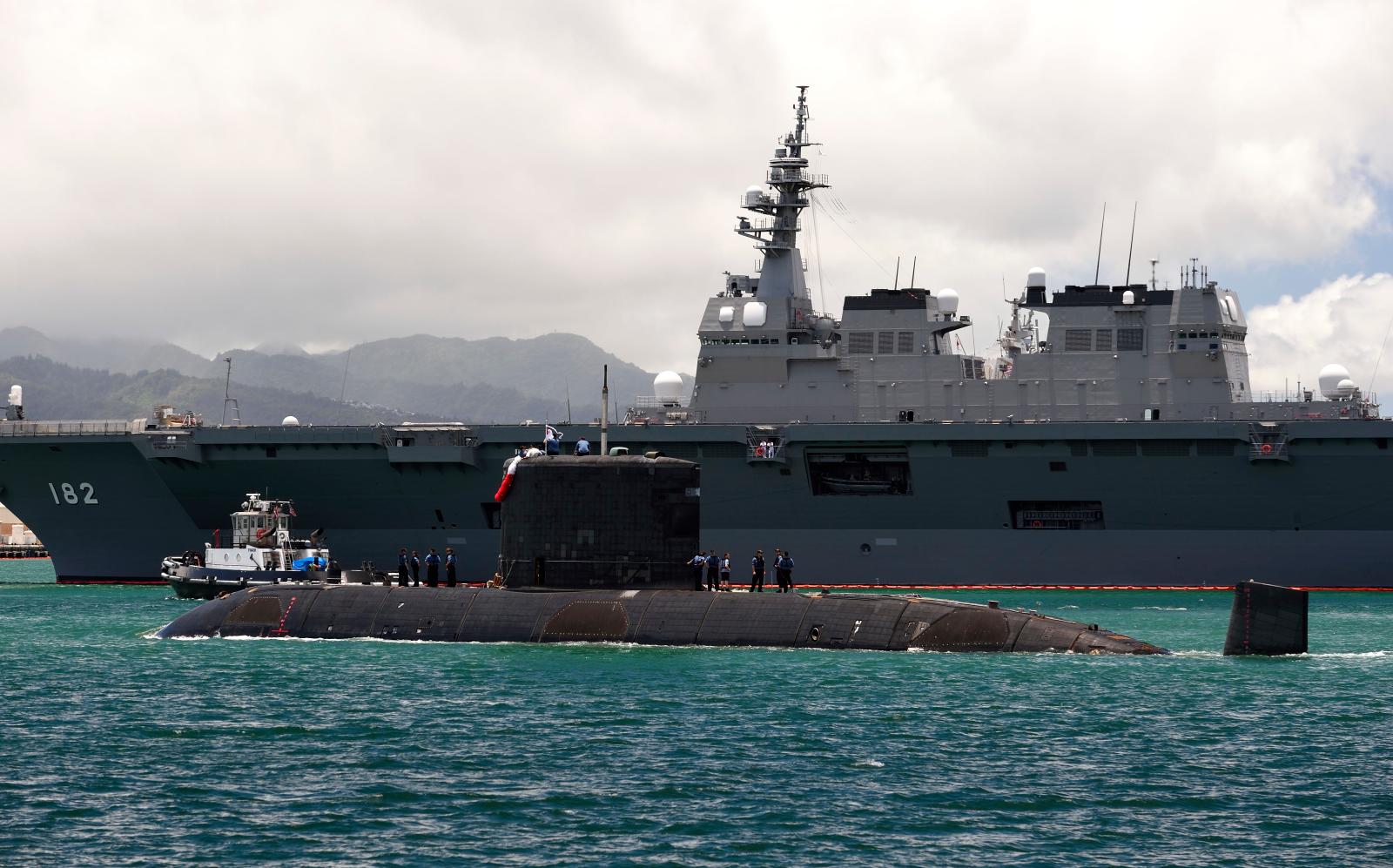
HMCS VICTORIA sails past the Japanese Ship ISE as she arrives in Pearl Harbor on July 1, 2014 to take part in Exercise Rim of the Pacific (RIMPAC).
But the Liberal government pointed out in its response that it is in the midst of the most intensive and comprehensive fleet modernization and renewal in the peacetime history of the Royal Canadian Navy. Canada is recapitalizing and increasing the size of its surface fleet through investments in 15 Canadian Surface Combatants, two Joint Support Ships, and five to six Arctic and Offshore Patrol Ships, it added. “The government has also committed to modernizing the four Victoria-class submarines to include weapons and sensor upgrades that will enhance the ability of the submarines to conduct Intelligence, Surveillance and Reconnaissance (ISR) and deliver necessary improvements of platform and combat systems to extend operational capability to the mid-2030’s,” the government response noted.

Canada is also engaged in the re-building of the anti-submarine warfare capabilities of the fleet through the introduction of technologies, sensors and weapons while preparing to transition to the fleet of the future, it added. “As part of the NATO S&T Organization, Canada is participating in the Maritime Unmanned Systems S&T Pre-Feasibility Studies that focus on ASW and naval mine warfare capabilities with Allied nations that have the same capability targets,” the government stated. “In addition to increasing existing platform capabilities, the RCN is also in the process of re-vitalising individual and collective ASW training and advancing distributed mission training and synthetic training environments.”

Last year Defence Minister Harjit Sajjan praised the capability submarines provide Canada. “No other platform in the Canadian Armed Forces can do what a submarine can do,” Sajjan said. “No other platform has the stealth, the intelligence-gathering, surveillance and reconnaissance capability and the deterrence to potential adversaries that a sub does.”

Upgrading the Victoria-class subs is more “prudent” than buying new subs, Sajjan said at the time.

Without upgrades, the first of the submarines will reach the end of its life in 2022, according to documents obtained last year through Access to Information by the Canadian Press. The last of the boats would be retired in 2027.

Friday, June 15, 2018

Canadian Submarines not part of international Arctic under-ice exercise

Kaila Jefferd-Moore, CBC News 


Royal Navy submarine HMS Trenchant after it had broken through the metre-thick ice of the Arctic Ocean to join two U.S. boats on a major exercise. Ice Exercise 18 (ICEX) is a series of demanding trials in the frigid climate of the Arctic Circle, designed to test submariners' skills in operating under the Arctic ice cap. No Canadian submarines took part. (MoD/Crown copyright 2018)
Over five weeks, the British submarine HMS Trenchant travelled beneath — and broke through — Beaufort Sea ice alongside two U.S. submarines.

It was there as part of the Arctic and Ice Exercise (ICEX) 2018, a U.S. Navy submarine arctic warfare exercise involving U.S., Canadian and British armed forces.

Taking place about 200 kilometres off the Alaskan coast in the Beaufort Sea, the exercise was designed, in part, for the U.S. Navy to practise and test the operational and tactical capabilities of its submarines under ice.

The Trenchant is one of the United Kingdom's Royal Navy submarines that has extensive under-ice capabilities.

"This exercise shows that our Royal Navy is primed and ready to operate in the harshest conditions imaginable, to protect our nation from any potential threats," Armed Forces Minister Mark Lancaster said in a Royal Navy news release.

The Royal Canadian Navy, however, cannot make the same claim about its submarines.

Canada's fleet of submarines, bought 20 years ago from the British Royal Navy, didn't join the latest ICEX operation. The Royal Canadian Navy's HMCS Windsor, Victoria, Chicoutimi and Corner Brook aren't designed for those kinds of under-ice uses.
Canada buys British submarines

Unlike their nuclear counterparts, Canadian submarines are limited to open water and near-ice-edge operations, an acknowledged concession due to budgetary realities. This is in part because they're diesel powered boats, and must come up for air periodically.

Both the U.S.and British navies have nuclear-powered submarines with the capacity to stay underwater for as long as a crew's food supply lasts. They can confidently travel under arctic ice.

Still, the Royal Canadian Navy has been involved in ICEX since 2011, according to naval communications adviser, Jennifer St. Germain. This year, Canada offered a "modest contribution" to ICEX 2018, sending "a naval communicator to support the exercises." That's one Canadian among a sea of many U.S. Navy and Royal Navy personnel.

The Royal Canadian Air Force also participated in the exercises, but did not respond to a CBC request for information on their involvement.
Sailors line up on Canadian submarine HMCS Corner Brook to salute Queen Elizabeth II during an international fleet review Tuesday, June 29, 2010 in Halifax. (Paul Chiasson/CP)
Canada relies on U.S. for security

Robert Huebert, a political science professor at the University of Calgary with a specific interest in arctic sovereignty and security, said the relationship between the U.S. and Canadian naval forces is one of the strongest in the world.

Without the ability to patrol and protect its arctic sovereignty, Canada relies on its allies — in particular the U.S. Navy — to help enforce it, Huebert explained.

Arctic sovereignty, according to Huebert, means "determining the boundaries within the region of the Arctic that Canada asserts having complete and absolute control [over]."

But the the ability of Canada's submarine fleet to work under ice isn't about sovereignty — it's about security, said Huebert.

"Sovereignty is about the international legal control, but security is about the enforcement ability."

Over the long term, Huebert said, it's important to keep an eye on China's naval forces, which now have icebreakers and an Arctic policy. He said it isn't hard to imagine that the Chinese will someday have under-ice submarine capabilities.

"It does bring up the question of sovereign control," Huebert said.
What does China's new Arctic policy mean for Canada?
A co-operative affair

Under the North American Aerospace Defence Command (Norad) agreement, the Canadian Armed Forces play a supportive role in the joint effort to patrol and protect North American arctic waters.

In 2017, the Canadian Armed Forces contracted Ocean Networks Canada to begin testing the feasibility of sensor-technology that would allow the navy to detect and track vessel traffic entering the Northwest Passage. This would replace the North Warning System that's been in use since the 1980s.

St. Germain said agreements with the Canadian Coast Guard on joint Arctic operations, and the addition of new Arctic patrol ships, mean the Royal Canadian Navy's "presence in the Arctic will increase in the near future."