Translate

Showing posts with label Victoria-Class Submarine. Show all posts

Tuesday, November 27, 2018

CAF Says Submarines can operate until mid-2020s

By: David Pugliese, Defence Watch 

The Victoria-class submarines were expected to reach the end of their operational lives starting in 2022, according to documents obtained under the Access to Information law.

That could have been a major problem for the federal government as it is looking at planning a modernization program for the on-board systems on the class, starting in 2023 or 2024.

If the subs were to reach the end of their operational lives starting a year earlier, how would that have worked?
HMCS Victoria operating on the west coast. Photo by David Pugliese.
Defence Watch asked that question and has been informed that things have now changed. Department of National Defence spokesman Daniel Le Bouthillier said that the Victoria-class start to reach the end of their operational life in the mid-2020s. That later date was determined after DND officials did a more extensive examination of the submarine fleet life.

But there are still no details on what needs to be done to extend the life of the subs, how much that will cost, or when that will be done. “The Victoria-class Modernization (VCM) Program is currently in the Options Analysis stage, where the preferred modernization option is being selected,” Le Bouthillier noted. “Details of specific capabilities and milestones will be determined as the program evolves.”

Last year Defence Minister Harjit Sajjan praised the capability submarines provide Canada. “No other platform in the Canadian Armed Forces can do what a submarine can do,” Sajjan said. “No other platform has the stealth, the intelligence-gathering, surveillance and reconnaissance capability and the deterrence to potential adversaries that a sub does.”

But the Liberals have rejected a Commons defence committee recommendation that the Victoria-class subs, bought used in 1998 from the United Kingdom, be replaced with submarines capable of under-ice capabilities.

“The government has also committed to modernizing the four Victoria-class submarines to include weapons and sensor upgrades that will enhance the ability of the submarines to conduct Intelligence, Surveillance and Reconnaissance (ISR) and deliver necessary improvements of platform and combat systems to extend operational capability to the mid-2030’s,” the government response to the committee noted.

Tuesday, November 20, 2018

Government Rejects Advice to Replace Victoria-Class Submarines

By: David Pugliese, The Ottawa Citizen 

New submarines won’t be part of the future mix for the Royal Canadian Navy, at least in the foreseeable future.

Several years ago there were some suggestions that a possible replacement for the Victoria-class submarines might be in the works. In 2017 a Senate defence committee recommended the subs be replaced.

The Commons defence committee also recently recommended that the Victoria-class subs, bought used in 1998 from the United Kingdom, be replaced with submarines capable of under-ice capabilities.

But the Liberal government has rejected that recommendation. The recommendation was the only one of the 27 made by the Commons defence committee that was rejected outright in a response delivered to the committee last month.

The committee had recommended that the federal government respond to NATO calls to improve the quality of their naval fleets and underwater surveillance capabilities by starting the process of replacing Victoria-class submarines with new boats that have under-ice capabilities. It also recommended increasing the size of that fleet to enhance Canada’s Arctic and North Atlantic defence preparedness.
Image result for victoria-class submarines
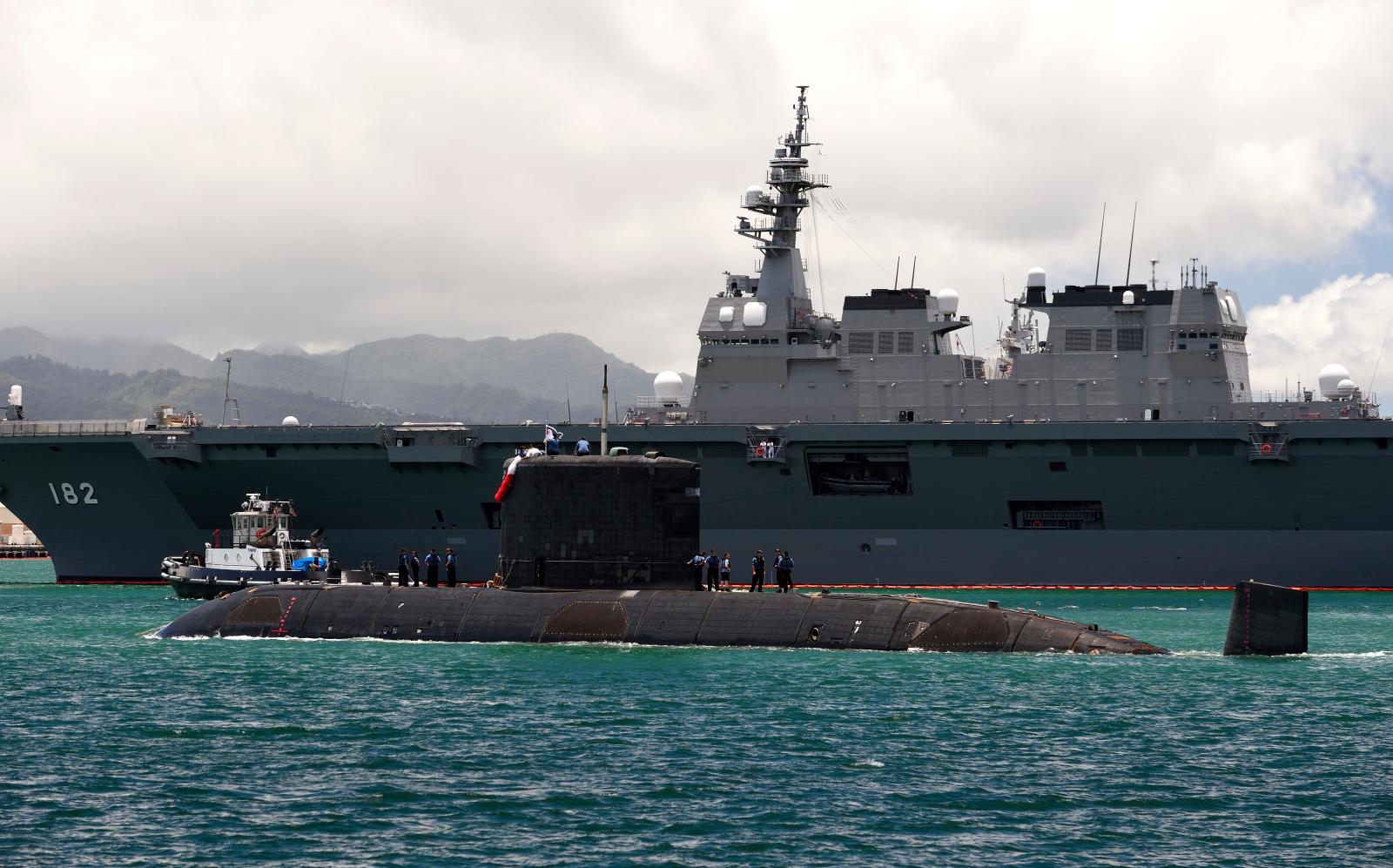
HMCS VICTORIA sails past the Japanese Ship ISE as she arrives in Pearl Harbor on July 1, 2014 to take part in Exercise Rim of the Pacific (RIMPAC).
But the Liberal government pointed out in its response that it is in the midst of the most intensive and comprehensive fleet modernization and renewal in the peacetime history of the Royal Canadian Navy. Canada is recapitalizing and increasing the size of its surface fleet through investments in 15 Canadian Surface Combatants, two Joint Support Ships, and five to six Arctic and Offshore Patrol Ships, it added. “The government has also committed to modernizing the four Victoria-class submarines to include weapons and sensor upgrades that will enhance the ability of the submarines to conduct Intelligence, Surveillance and Reconnaissance (ISR) and deliver necessary improvements of platform and combat systems to extend operational capability to the mid-2030’s,” the government response noted.

Canada is also engaged in the re-building of the anti-submarine warfare capabilities of the fleet through the introduction of technologies, sensors and weapons while preparing to transition to the fleet of the future, it added. “As part of the NATO S&T Organization, Canada is participating in the Maritime Unmanned Systems S&T Pre-Feasibility Studies that focus on ASW and naval mine warfare capabilities with Allied nations that have the same capability targets,” the government stated. “In addition to increasing existing platform capabilities, the RCN is also in the process of re-vitalising individual and collective ASW training and advancing distributed mission training and synthetic training environments.”

Last year Defence Minister Harjit Sajjan praised the capability submarines provide Canada. “No other platform in the Canadian Armed Forces can do what a submarine can do,” Sajjan said. “No other platform has the stealth, the intelligence-gathering, surveillance and reconnaissance capability and the deterrence to potential adversaries that a sub does.”

Upgrading the Victoria-class subs is more “prudent” than buying new subs, Sajjan said at the time.

Without upgrades, the first of the submarines will reach the end of its life in 2022, according to documents obtained last year through Access to Information by the Canadian Press. The last of the boats would be retired in 2027.

Friday, June 15, 2018

Canadian Submarines not part of international Arctic under-ice exercise

Kaila Jefferd-Moore, CBC News 


Royal Navy submarine HMS Trenchant after it had broken through the metre-thick ice of the Arctic Ocean to join two U.S. boats on a major exercise. Ice Exercise 18 (ICEX) is a series of demanding trials in the frigid climate of the Arctic Circle, designed to test submariners' skills in operating under the Arctic ice cap. No Canadian submarines took part. (MoD/Crown copyright 2018)
Over five weeks, the British submarine HMS Trenchant travelled beneath — and broke through — Beaufort Sea ice alongside two U.S. submarines.

It was there as part of the Arctic and Ice Exercise (ICEX) 2018, a U.S. Navy submarine arctic warfare exercise involving U.S., Canadian and British armed forces.

Taking place about 200 kilometres off the Alaskan coast in the Beaufort Sea, the exercise was designed, in part, for the U.S. Navy to practise and test the operational and tactical capabilities of its submarines under ice.

The Trenchant is one of the United Kingdom's Royal Navy submarines that has extensive under-ice capabilities.

"This exercise shows that our Royal Navy is primed and ready to operate in the harshest conditions imaginable, to protect our nation from any potential threats," Armed Forces Minister Mark Lancaster said in a Royal Navy news release.

The Royal Canadian Navy, however, cannot make the same claim about its submarines.

Canada's fleet of submarines, bought 20 years ago from the British Royal Navy, didn't join the latest ICEX operation. The Royal Canadian Navy's HMCS Windsor, Victoria, Chicoutimi and Corner Brook aren't designed for those kinds of under-ice uses.
Canada buys British submarines

Unlike their nuclear counterparts, Canadian submarines are limited to open water and near-ice-edge operations, an acknowledged concession due to budgetary realities. This is in part because they're diesel powered boats, and must come up for air periodically.

Both the U.S.and British navies have nuclear-powered submarines with the capacity to stay underwater for as long as a crew's food supply lasts. They can confidently travel under arctic ice.

Still, the Royal Canadian Navy has been involved in ICEX since 2011, according to naval communications adviser, Jennifer St. Germain. This year, Canada offered a "modest contribution" to ICEX 2018, sending "a naval communicator to support the exercises." That's one Canadian among a sea of many U.S. Navy and Royal Navy personnel.

The Royal Canadian Air Force also participated in the exercises, but did not respond to a CBC request for information on their involvement.
Sailors line up on Canadian submarine HMCS Corner Brook to salute Queen Elizabeth II during an international fleet review Tuesday, June 29, 2010 in Halifax. (Paul Chiasson/CP)
Canada relies on U.S. for security

Robert Huebert, a political science professor at the University of Calgary with a specific interest in arctic sovereignty and security, said the relationship between the U.S. and Canadian naval forces is one of the strongest in the world.

Without the ability to patrol and protect its arctic sovereignty, Canada relies on its allies — in particular the U.S. Navy — to help enforce it, Huebert explained.

Arctic sovereignty, according to Huebert, means "determining the boundaries within the region of the Arctic that Canada asserts having complete and absolute control [over]."

But the the ability of Canada's submarine fleet to work under ice isn't about sovereignty — it's about security, said Huebert.

"Sovereignty is about the international legal control, but security is about the enforcement ability."

Over the long term, Huebert said, it's important to keep an eye on China's naval forces, which now have icebreakers and an Arctic policy. He said it isn't hard to imagine that the Chinese will someday have under-ice submarine capabilities.

"It does bring up the question of sovereign control," Huebert said.
What does China's new Arctic policy mean for Canada?
A co-operative affair

Under the North American Aerospace Defence Command (Norad) agreement, the Canadian Armed Forces play a supportive role in the joint effort to patrol and protect North American arctic waters.

In 2017, the Canadian Armed Forces contracted Ocean Networks Canada to begin testing the feasibility of sensor-technology that would allow the navy to detect and track vessel traffic entering the Northwest Passage. This would replace the North Warning System that's been in use since the 1980s.

St. Germain said agreements with the Canadian Coast Guard on joint Arctic operations, and the addition of new Arctic patrol ships, mean the Royal Canadian Navy's "presence in the Arctic will increase in the near future."

Wednesday, March 28, 2018

HMCS Chinoutimi Celebrates Achievements in the Asia-Pacific Region


By Darlene Blakeley, The Maple Leaf 

Her Majesty’s Canadian Submarine (HMCS) Chicoutimi has piled up a lot of firsts on its lengthy deployment to the Asia-Pacific region.
HMCS Chicoutimi sails with ships of the U.S. Navy and the Japanese Maritime Self-Defence Force during ANNUALEX.

It’s the first time a Victoria-class submarine has deployed from the Royal Canadian Navy (RCN) to the region; been deployed for so long – nearly 200 days; participated in the previously bilateral ANNUALEX with the U.S. Navy (USN) and the Japanese Maritime Self-Defence Force (JMSDF); and made port visits to Yokosuka and Sasebo, Japan and Guam.

“Normally we have to take a submarine out of the water to change batteries, but this time we were able to do it safely in the water thanks to the expertise of Fleet Maintenance Facility Cape Breton.” — Captain (Navy) Chris Robinson

It’s also the first time a Victoria-class submarine has undertaken a large-scale deployed maintenance activity conducted by personnel from Maritime Forces Pacific (MARPAC) and Fleet Maintenance Facility Cape Breton (FMFCB) in Japanese ports – all while Super Typhoon Lan raged around them.

“It has been a phenomenally successful deployment,” says Captain (Navy) Chris Robinson, Commander of the Canadian Submarine Force.

HMCS Chicoutimi, under the command of Commander Stephane Ouellet, left its home base in Esquimalt, B.C., in early September last year. Its simply stated mission was to “support Canada’s global engagement strategy through strategic partnerships, port visits and operational interactions.”

But it has been anything but simple. Over the course of several months, Chicoutimi conducted intelligence, surveillance and reconnaissance; carried out seven interactions with the USN, JMSDF, the French Navy, the Royal Air Force and the Royal Australian Air Force; operated with more than 20 surface ships and 50 aircraft; and conducted more than 180 hours of submarine-on-submarine engagements.

The success of this hectic tempo is a testament to the crew, according to Capt(N) Robinson, who says they worked hard and overcame challenges prior to deploying. In particular he mentions the unexpected swapping out of the submarine’s main battery last May.

“The battery, the lifeblood of a submarine, was functioning below performance specifications,” Capt(N) Robinson explains. “Normally we have to take a submarine out of the water to change batteries, but this time we were able to do it safely in the water thanks to the expertise of Fleet Maintenance Facility Cape Breton. It enabled us to get back to work much more quickly.”

One of the highlights of Chicoutimi’s tour has been the ability to gain a greater understanding of the challenges facing the deployment of a Victoria-class submarine to a distant, strategically important area.

“We had very complex logistic and maintenance arrangements with partner nations that we navigated throughout the deployment,” says Capt(N) Robinson. “We gained a much better understanding within the RCN of the multi-faceted logistical arrangements needed when supporting a deployed submarine.”

Successful routine maintenance was carried out in Japanese ports, with USN support. More than 30 personnel from FMFCB conducted over 1,800 hours of maintenance in eight days. Additionally, there was a month-long maintenance period in Guam, the first deployed submarine short-work period ever conducted by MARPAC and FMFCB. During this time significant repairs were made to fridge and hydraulic plants, diesel engines and motor generators.

Capt(N) Robinson is quick to praise both FMFCB and a deployed joint logistic coordination cell from Esquimalt.

“They provided stellar support in moving both parts and people,” he says. “They also overcame significant challenges in moving military gear in and out of Japan. This has enabled us to learn valuable lessons for future deployed submarine work periods.”

Capt(N) Robinson says one of the most rewarding aspects of the deployment has been building relationships with both the USN and the JMSDF.

“These strategic partnerships are built on trust and experience working together in major ways,” he says.

Chicoutimi developed increased interoperability with the USN’s Seventh Fleet and forged strong bonds with the JMSDF. For the first time a Canadian submarine participated in ANNUALEX, normally a bilateral exercise between the USN and JMSDF. It is carried out every year in the Southern Sea of Japan to practise and evaluate the coordination, procedures and interoperability elements required to effectively respond to the defence of Japan or to a regional contingency in the Indo-Asia-Pacific.

“This was a major achievement and a real manifestation of Canada’s defence policy ‘Strong, Secure, Engaged’,” Capt(N) Robinson explains. “It represents a clear indication of the RCN’s commitment to peace and security in the region, and shows that our navy is fully engaged and able to project sea power far from Canada’s shores.”

Chicoutimi’s prowess did not go unnoticed by the USN. “Chicoutimi has provided exceptional support for the 7F (Seventh Fleet) team during the past few months and I sincerely appreciate all of the work to make its deployment happen. Hopefully 2018 will bring even more,” says Vice-Admiral Phillip Sawyer, Commander of the Seventh Fleet.

Over the course of this historic deployment, the 59 crew members have been exceptionally busy. They have been able to qualify 50 per cent of new submarine crew and progress several higher level qualifications, all while conducting operations.

“Through it all the crew has been enthusiastic and morale has been very good,” says Capt(N) Robinson. “The families back home have also been incredibly supportive of this long deployment.”

Unlike surface ships, submarines have no way to communicate with family and friends while submerged, except through coded “familygrams” once a week.

“This is always a challenge,” says Capt(N) Robinson. “There is no phone and no internet while the boat is under water.”

During port visits communications can take place as usual, and families can also get information through the Military Family Resource Centre in Esquimalt.

As Chicoutimi arrives home, crew members are looking ahead to some time off before the submarine continues operations later this year.

“They can take great pride in knowing that they have contributed to maritime peace and good order abroad by patrolling, building strategic relationships and interacting with our partner nations,” says Capt(N) Robinson. “It has been an exceptional deployment on so many levels.”

Thursday, March 22, 2018

HMCS Chinoutimi Returns from Longest-Ever Victoria-Class Submarine Deployment

Royal Canadian Navy Press Release

HMCS Chicoutimi has returned to CFB Esquimalt, B.C. after a 197-day deployment in the Asia-Pacific region, marking a historic milestone for the Royal Canadian Navy (RCN) submarine fleet after a nearly 50-year absence from the region. The deployment included numerous opportunities for HMCS Chicoutimi to operate with regional partner navies such as the United States Navy, the Japan Maritime Self Defence Force, The Royal Australian Navy and the French Navy. As part of her deployment, HMCS Chicoutimi visited Yokosuka, Japan, further strengthening the relationship between our two countries. 

Image result for hmcs chicoutimi
HMCS Chicoutimi file Photo. (The Canadian Encyclopedia) 
“HMCS Chicoutimi’s successful six-month deployment to the Asia-Pacific region is a historic 50-year milestone for the Royal Canadian Navy and our Victoria-Class submarine,” said Harjit S. Sajjan, Defence Minister.

“I am incredibly proud of the work done by the submariners on board HMCS Chicoutimi. Their consistent dedication and professionalism is an inspiration. The advantage that submarines can bring to a battle space cannot be underestimated. They are stealthy, lethal, and persistent. They are an important strategic asset that the Canadian Armed Forces brings to the table when working with our partners and allies around the world,” said Vice-Admiral Ron Lloyd, Commander Royal Canadian Navy.

“HMCS Chicoutimi conducted a well-executed patrol to the Asia-Pacific region to operate with our partners, and allies – a clear signal of the strategic importance of the region to Canada, that reinforces Canada’s commitment to the maintenance of regional peace, and security,” said Captain (N) Chris Robinson, Commander Canadian Submarine Force.

HMCS Chicoutimi deployed on patrol in the Asia-Pacific region as part of a strategic engagement mission, for 197 days. This is the longest Victoria-class deployment to date. Prior to this the longest Victoria-class single deployment was a 101-day North Atlantic patrol by HMCS Windsor in 2015. HMCS Windsor is once again deployed, currently supporting NATO operations in the Mediterranean Sea.

HMCS Chicoutimi operated with the Japan Maritime Self Defence Force (JMSDF) and the United States Navy (USN) for several months, a period which included participation in the annual USN-JMSDF ANNUALEX – a three week bi-lateral exercise which was made tri-lateral for the first time with the inclusion of Canada in 2017.

HMCS Chicoutimi visited Hawaii, Guam, and Japan during the six-month deployment. The visit to Yokosuka, Japan was the first by a Canadian submarine since the visit by HMCS Grilse in May 1968.

HMCS Chicoutimi conducted two Rest and Maintenance Periods, in Japan and the US territory of Guam, supported by deployed maintenance teams from the RCN Fleet Maintenance Facility based in Esquimalt. These periods further refined processes for deployed maintenance and support activities.

HMCS Chicoutimi is one of four Victoria-class submarines in the RCN. Chicoutimi along with HMCS Victoria and HMCS Corner Brook are based out of CFB Esquimalt, while HMCS Windsor is based at CFB Halifax in Nova Scotia.

Victoria-class submarines are extremely versatile, allowing them to operate in any weather condition for periods of up to 45 days, and perform in a variety of roles to fulfill Canada’s requirements for a balanced, multi-purpose and combat-effective naval fleet.

Wednesday, August 16, 2017

Opinion: Canada Should Consider Hybrid Submarines

By: Danny Lam, Frontline Defence

Outrageous cost estimates for nuclear-powered submarines tend to cloud Canadian thinking for recapitalizing its submarine fleet. The US Navy is presently building Virginia class nuclear-powered submarines for USD$2.6 billion per unit. At CAD $1.5 to $3B (assuming no cost overruns), DND’s proposal for extending the lives of its four Victoria class conventional submarines for another 6-18 years appears a comparative bargain. But there must be a better way.

Off-the-shelf submarine designs that are direct or equivalent replacements to the Victoria class, like the German Type 212s presently are in the 300 to 400 million euros range (U$350-470 million), Swedish Gotlands are in the U$200-300 million range, while the Japanese Soyru is around U$550 million. These costs are roughly comparable to the high end of extending the life of Canada’s existing fleet. However, they do not reflect foreign military sales “markup” and likely exclude the weapons suite – nor are these prices based on quantity.

If any of these candidates can be built in quantity – and an exception made to arcane Canadian military procurement rules that require the design to be manufactured wholly in Canada or have restrictive industrial and technological benefit demands – it is undeniably possible to substantially lower costs.

The first challenge to costs is volume. Development, or non-recurring engineering costs make up a sizable percentage of the cost of a small fleet. If an existing, proven, hull can be slightly modified, it is a major cost saver. That will require DND to end the habit of imposing onerous modifications that inevitably cause costs to explode like the CSC or Maritime Helicopter program. Another route to substantial cost savings is to share the development costs of major items like the propulsion and power plant with partners.

Nuclear propulsion was a major innovation in submarine technology. It significantly extends endurance to the point where it is limited only by food and consumables, and crew stamina.

Technologies like air independent propulsion (AIP) or lithium batteries that extend the endurance of diesel submarines but introduce major compromises in performance. But neither of these options are satisfactory for Canadian naval requirements.

With or without AIP, diesels are far too “short legged” – they are dependent on logistically complex supplies such as liquid oxygen that deplete quickly; and the engines are mechanically complex. These are distinct disadvantages given the long distances and extended under-ice missions that are unique to Canada.

Whenever a diesel “snorts”, it leaves a very visible plume of smoke and heat that is readily detectable. Radar can pick out periscopes or snorkels. Then there is the deafening noise of diesels, even when equipped with the latest quieting technologies. Thus, nuclear propulsion in some form is still the ideal for Canadian requirements.

The dominant paradigm for a modern nuclear-powered submarine is for a steam generating reactor driving turbines that directly drive the propulsor or propeller. The French Barracuda offers a limited hybrid design that enables electric propulsion for low speed cruising and turbo-mechanical drives at higher speeds. The Tullibee (SSN-597) and Glenard P. Lipscomb (SSN-685) were two nuclear-electricvessels that experimented with the technology, but it was not competitive against nuclear-steam turbo-mechanical for blue water operations. At the other end of the spectrum, a “mini” 400 ton nuclear submarine NR-1 was used for many key deep-ocean, bottom-exploration tasks.

Due to their endurance, nuclear submarines tend to be blue water, ocean-going vessels. Los-Angeles and Virginia class fast attack submarines displace 6-8,000 tons. French Barracudas are about 5,000 tons, UK’s Astutes are 7,000 tons, while the Shortfin Barracuda (conventional version) is about 4,000 tons. Compared to the Upholder/Victoria class at about 2,500 tons, they are large vessels.

A small nuclear-powered attack submarine that is large enough to support a good sized crew and carry unmanned systems would be ideal for Canada, but presently, none is available because nuclear submarines are historically optimized for stealth in blue water. Much of Canadian waters in the Arctic are relatively shallow, and along the Pacific and Atlantic coasts up to the continental shelf where Canadian submarines are most likely to operate. A fleet nuclear submarine (6-8,000 ton range) is neither necessary nor ideal for Canadian waters.

The dominant design for nuclear propulsion places a premium on sustained high speed, even though most submarines cannot do so while maintaining acceptable radiated noise levels. Sustained high speed, except for “getaway” or transit, is a capability that is rarely needed. Because nuclear reactors react relatively slowly to throttling, it also means that nuclear energy generates a large infra-red signature that is a much bigger liability in littoral vs. blue waters. Hybrids offer a novel solution.

A nuclear-steam-electric hybrid is a potentially attractive alternative to the dominant nuclear turbo mechanical drive. One or more modular reactors can be used to generate steam to drive a turbine generator. The ability to completely shut down a reactor module, and tightly match energy demand with supply, reduces the amount of excess (waste) heat dumped – don’t forget, that heat dump is detectable.

Machinery noise from the nuclear turbo-mechanical generator can be more readily controlled if the system is operated at (and optimized for a relatively narrow power band) with no requirements for rapid throttling as with a turbo-mechanical drive. Electricity generated can be stored in state-of-the-art lithium batteries. Reactor shielding can potentially make use of lead acid cells doing double duty. Electric power from batteries driving propulsors offer the prospect of extremely low radiated noiseand yet maintain a high degree of “throttlability” with only limited compromises in sustained high speed cruising that would be a function of the nuclear plant’s power ramp and maximum output. Making the propulsor jets steerable and eliminating control fins is an additional benefit in minimizing the active signature.

Building such a submarine within a small displacement (2,5-3,500 tons surfaced) 60 days endurance, transit speed of 20 knots, burst speeds above 30 knots, and state of the art signature management technologies and support for unmanned platforms would be cost prohibitive for all but the largest Navies.

Canada, however, has potentially very good technologies that can contribute to a joint venture for a new hybrid nuclear submarine design. The Canadian SLOWPOKE reactor has been operating in Canada since 1971 and is licensed for unattended operation. A later variant was rated for 2-10MW per module, just about ideal for a small nuclear-powered submarine. It is conceivable that the design can be freshened, miniaturized, compacted and “fitted” into an existing conventional submarine design displacing 2,500 to 4,000 tons, though quieting radiated noise of a small displacement submarine is challenging and require considerable ingenuity and technical competence.

Packaged with a turbo-generator plant, a SLOWPOKE reactor can also have many civilian applications such as being a steam generating plant for low GHG heavy oil extraction SAGD facilities, or a stationary energy plant for Northern communities. The more units deployed, the lower the fixed costs. That will also spread the political constituencies in favour of the program from just the coastal provinces to Ontario, Quebec, Alberta, Nunavut, and NW Territories: A major consideration given the political fault lines in Canada for a multi billion dollar program.

If Canada contributed a major portion of the development cost of a new modular nuclear power plant for a hybrid submarine, it can be used to negotiate a good price on the vessel. It will also be the only small naval reactor / power plant available that can potentially also be used on surface vessels like the Canadian Surface Combatant or civilian vessels – reducing GHG emissions from shipping potentially opens up lucrative markets for Canadian nuclear technology. Who might partner with Canada?

Germany, Sweden, France, Japan, Australia are all potential partners. Each nation’s existing or planned submarine designs are potentially good candidates, in fact, the French are already working on a new hybrid Barracuda variant for Australia. A collaboration with Japan, which has begun work on its next generation submarines, can contribute certain technologies, like lithium ion batteries (in which they excel). Any of these would deliver a state-of-the-art nuclear-powered submarine for a fraction of the cost of “going it alone” or the Australian “built in Australia” technology transfer model. The key will be that the new co-developed hybrid nuclear submarine must find additional markets beyond the needs of the partners.

The question is, can such a new vessel be built in quantity (more than 20) for less than US$700 million a copy?

Success in this program will forever banish the ghost of the DeHavilland Arrow.

It will be challenging, but Canadian ingenuity is up to it.

– Danny Lam

Friday, June 16, 2017

Liberals to spend $2.5-billion to keep Victoria-Class Submarines Operating Past 2030

By: Lee Berthiaume, The Canadian Press 

The Trudeau government is planning to spend billions more on the navy's four wayward submarines to keep them operating into the 2030s.

The plan to extend the lives of the troubled vessels is included in the Liberals' new defence policy and comes following calls from senior naval officers to save the controversial ships from the scrap heap.

The actual price of the plan was not revealed in the policy document, which was released to much fanfare last week, and National Defence refused to provide a price tag following multiple requests.

That is despite assertions from the Liberal government that the defence policy was fully costed and following promises of full transparency when it came to the overall plan.

"Detailed costing will be provided in the Defence Investment Plan to be published in due course," National Defence spokesman Daniel Le Bouthillier said in an e-mail.

Defence sources, however, have told The Canadian Press that keeping the submarines in the water for another decade will cost upwards of $2.5-billion.

Without upgrades, the first of the submarines will reach the end of its life in 2022, according to documents obtained last year through Access to Information, with the last retired in 2027.

Some have questioned the wisdom of spending more money on the four vessels, which have been plagued with problems since Canada bought them used from Britain in 1998.

While the Chretien government said at the time that it was getting a bargain by paying only $750-million, the ships have required constant repairs and upgrades just to make them seaworthy for a limited time.

And while a number of experts have called for Canada look to purchase new submarines, rather than upgrading the ones it has, others have said the country doesn't need such expensive vessels.

Defence Minister Harjit Sajjan this week emphasized the Liberal government's view, previously expressed by senior naval officials, that subs are necessary for protecting Canada's security and sovereignty.

"No other platform in the Canadian Armed Forces can do what a submarine can do," Sajjan said during an event in Halifax on Monday.

"No other platform has the stealth, the intelligence-gathering, surveillance and reconnaissance capability and the deterrence to potential adversaries that a sub does."

Sajjan added that the government decided upgrading the existing subs – HMCS Chicoutimi, Victoria, Corner Brook and Windsor – was more "prudent" than purchasing new vessels.

The Liberals promised in their defence policy to invest an additional $62-billion in the military over the next 20 years, which includes increasing annual defence spending by 70 per cent over the next decade.

A large chunk of that new money will end up going towards replacing the navy's 12 frigates and three recently retired destroyers with 15 new warships at a cost of between $56-billion and $60-billion.

Previous estimates had pegged the cost of those vessels at $26-billion.

The four submarines continue to generate headlines for the wrong reasons, with the most recent Thursday when HMCS Chicoutimi was hit by another naval vessel while docked at CFB Esquimalt in B.C.

But Rob Huebert, an expert on maritime security at the University of Calgary, said the other three have been involved in a variety of tasks and mission in recent months – even if most Canadians don't realize it.

"The very nature of what they do means that (the military) can't talk about it," he said.

"They're actually exceeding what the navy was expecting them to do in terms of time at sea, interdiction of drugs and co-operation with the Americans. You can't talk about any of that, but it is occurring."

Rather than extend the lives of the submarines, Huebert said he would have liked to see the government start looking for replacements, but that wasn't possible given the huge costs of replacing the frigates.

"What we saw was the defence review was an intelligent decision to do what was necessary to lengthen the life of the subs while making sure the (new warships) are built," he said.

HMCS Chicoutimi Struck by Orca-Class Training Vessel

By: The Canadian Press

OTTAWA -- HMCS Chicoutimi, one of the navy's four submarines was hit Thursday by another naval vessel while docked at CFB Esquimalt in British Columbia.

A naval spokesman says HMCS Chicoutimi was docked in the harbour when an Orca-class training vessel that was moving at low speed bumped up against the sub.

Navy Lt. Greg Menzies says no one was injured, and that the two vessels sustained only minor scrapes, though a more detailed damage assessment of the submarine was being conducted.

The Orca-class are small vessels, about 33 metres long and displacing about 210 tonnes. The submarine is 70 metres long and displaces more than 2,400 tonnes.

Defence officials were investigating the cause of the crash.

The incident is the latest round of bad luck for Canada's submarine fleet, which has been plagued with breakdowns and other problems since the ships were bought from the United Kingdom in 1998.

The Liberal government says it plans to upgrade the subs so they can continue to operate into the 2030s, at which point the oldest will be more than 40 years old.

Wednesday, October 26, 2016

Parliamentarians spend 24 hours under the waves with HMCS Windsor

Navy News / October 25, 2016

By Ryan Melanson, Trident Military Newspaper

A 24-hour stint under the waves in Her Majesty’s Canadian Submarine (HMCS) Windsor, one of Canada’s four Victoria-class submarines, was the highlight of a visit to the East Coast by four parliamentarians from October 12 to 13, 2016.

Chandra Arya, Marwan Tabbara, Pierre Paul-Hus and Cheryl Gallant
Members of Parliament Chandra Arya, Marwan Tabbara, Pierre Paul-Hus and Cheryl Gallant suit up for their Canadian Leaders at Sea program at Canadian Forces Base Halifax on October 11, 2016.
The politicians made the trip as part of the Royal Canadian Navy’s Canadian Leaders at Sea (CLaS) Program. For nearly a decade, CLaS has been embarking government officials, community and business leaders, and other strategic stakeholders on board HMC ships and submarines to showcase the skill sets and equipment that the navy employs in defence of Canada. The program also provides valuable insight into the day-to-day life of sailors and submariners, and the living and working conditions inside their temporary homes at sea.

The guests included Liberal Members of Parliament Marwan Tabbara and Chandra Arya, as well as opposition Members Pierre Paul-Hus and Cheryl Gallant, both of whom sit on the House Standing Committee on National Defence. They were accompanied by Rear-Admiral John Newton, Commander Maritime Forces Atlantic.

CLaS is meant to be an intensive and immersive experience, and a Victoria-class submarine was the right place to fulfill that goal. The guests were submerged more than 100 metres under water, dined in the boat’s small messes alongside personnel, and slept on metal racks alongside submarine trainees and Mark 48 heavy torpedoes.

The MPs also got a small taste of the slow-moving game of hide and seek that is submarine warfare, with Halifax-class frigate HMCS St. John’s and a CH-124 Sea King helicopter participating in a short exercise about 20 kilometres offshore.

Windsor closed within 2,000 yards of the warship at periscope depth, giving everyone a chance to observe the “adversaries” from the search periscope, before the participants took turns listening to St. John’s acoustic signature through the boat’s newly advanced AN/BQQ10 sonar, the same system employed by the newest submarines in the U.S. fleet.

Sitting at the fire control system, they then learned how visual, acoustic and other points of data are combined to accurately track nearby vessels and plot possible attacks.

As part of the simulation, Windsor fired off a green flare, a signal indicating a torpedo attack against St. John’s. There was no harm done, but in reality, the boat’s torpedoes would have no issue breaking the back of a frigate.

“The torpedo will find and sink whatever is out there, guaranteed. It’s been proven time and time again,” said Lieutenant-Commander Peter Chu, Windsor’s Commanding Officer.

Later, the visitors witnessed the crew run through a comprehensive set of pre-diving checks before plunging below into their natural hidden state below the waves.

“It becomes incredibly calm,” observed Mr. Tabbara while the submarine was submerged, compared to the way Windsor rolls with the waves at periscope depth.

It’s one of the many reasons submariners prefer to stealthily submerge as much as possible, though the boat did surface again in the evening so their guests could experience a “snort”, drawing in air and recharging the battery while running the diesel engines.

Windsor’s crew members each performed their designated tasks with precision, but for Mr. Paul-Hus, a first-time MP elected to Parliament last year, the biggest takeaway was the confidence the submariners have in the Victoria-class boat and the state-of-the-art technology found inside it.

“In the end, to have a successful crew, we also need the crew to have good equipment. I think we see that here with a submarine with its new sonar and other upgrades that are working so well,” Mr. Paul-Hus said.

The crew was upbeat, welcoming to guests and enthusiastic to chat about their jobs, but leadership is well aware of the heavy workload placed upon the submariners, and that it’s important not to burn them out. The boat spent nearly 200 days at sea over the past year, recently tackling an extended three weeks of deployment following Exercise DYNAMIC MONGOOSE 2016, cutting short a much-deserved summer break.

The MPs pressed LCdr Chu on his secrets for keeping up morale through long stretches of slow-paced, but demanding work. He said it boils down to communication – speaking with his personnel in small groups to explain the tasks at hand and the importance of the work, and giving extra attention to crew with family concerns at home or other stresses.

It helps that his crew has grown so close and supportive of each other, a necessity with 48 men and women working in such close quarters. The nature of submarine life and duty watch means submariners spend countless hours learning about each other’s lives, families and hometowns.

“It becomes part of our entertainment, but it also builds a cohesiveness within the crew. From a captain’s perspective, it’s extremely important to build that cohesiveness. When the team gets together, starts to trust each other and learn they can rely on each other, that’s when you build that true Windsor spirit,” LCdr Chu said.

There’s also immense pride in the work, and the lack of outside communications or missed family moments can be accepted more easily when working in support of real NATO operations, as Windsor did in summer 2015 and again this year. Having the boat and crew prepared to answer those calls for support is also significant in showcasing RCN capability, RAdm Newton said. “It shows that it doesn’t take a large submarine fleet to have trained submariners and be an undersea nation. In the international community, there’s no doubt Canada is at the table.”

Before leaving the boat to continue their tour of CFB Halifax sites, each visitor was presented with an Honorary Submariner card, an HMCS Windsor coin, and even a dolphin badge like the ones worn proudly by submariners around the world.

“I really encourage them all to carry these with pride and to show them off whenever they can,” LCdr Chu said. “It’s an experience they’ll remember for the rest of their lives, no doubt.”

The parliamentarians’ time at CFB Halifax also included a number of other stops to help illustrate the full picture of Maritime Forces Atlantic. These included glimpses into the navy’s future, like a static tour of the CH-148 Cyclone helicopter at 12 Wing Shearwater, N.S., as well as a walkthrough of Irving Shipbuilding’s Halifax Shipyard where work on the first Arctic Offshore Patrol Vessel is well under way.

“They’ve seen some very important work happening,” said RAdm Newton. “So hopefully they’ll go back and tell their fellow parliamentarians about what the navy does and what our submariners do. They can help tell our story through their own lens, whether it’s to the defence committee or within government. We can’t ask for much more than that.”

Friday, September 9, 2016

Sajjan says submarines critical for defence, but no decision on upgrades

By: Lee Berthiaume, The Canadian Press

OTTAWA — Defence Minister Harjit Sajjan says the navy's submarines are "critical" for Canada's defence, but that the government has not decided whether to spend more money to keep them for the long term.

"Our submarines do play a critical role for sovereignty, but no decision has been made at this time," Sajjan said from London, where he was attending a peacekeeping conference. "As we complete the defence policy review, we'll have recommendations in there on the route we will be proceeding."

Documents obtained by the Canadian Press show that the first submarine will reach the end of its service life in 2022, with the other three retiring one by one until 2027.

The navy estimates that extending their usefulness would cost between $1.5 billion and $3 billion, depending on the upgrades that are made and how long they are to remain in service.

The Liberal government is currently developing a new defence policy, which will spell out what jobs the military will be expected to perform. That will have direct bearing on the types of equipment purchased in the coming years.

But any investment is likely to stoke controversy as the submarines have been plagued by technical problems since they were bought used from the United Kingdom in 1998 for what the Chretien government described as a bargain $750 million.

While naval officials say they have managed to fix many of the problems and have started using the ships in earnest, two were docked early this year over concerns about shoddy welding. Another had to be repaired after breaking down en route to a training exercise in Norway in June.

At the same time, the government is preparing to shell out billions for new fighter jets while the army has been clamouring for cash for new light and heavy trucks. Half of its current truck fleet has been parked because of age and maintenance costs.

The navy is also waiting to see how much money it will get for new surface warships, which are slated for construction at the same time the submarine life extension would take place. The budget was previously set at $26 billion for up to 15 vessels, but recent estimates have put the cost much higher.

Meanwhile, Sajjan said the government is looking at information submitted by various fighter jet companies at the end of July, but would not say when a decision will be made on replacing the aging CF-18s.

"Our staff is actually crunching through a lot of that data just now," he said. "I want to make sure to give them the opportunity to synthesize that information.

"I want to make sure we have all the right information so that we can pick the right process. This decision will be coming in months, and not longer than that."

- Follow @leeberthiaume on Twitter.

Friday, September 2, 2016

Submarine-Proliferation and Canada's Need for Nuclear Powered Submarines

BY MARK ROMANOW
© 2016 FrontLine Defence (Vol 13, No 4)

For those who thought Anti-Submarine Warfare (ASW) was dead, its time to wake up to the fact that submarine numbers worldwide have increased by some 100 boats over the past decade, and continues to steadily climb. Meanwhile, new construction and surplus transfers are expected to add an additional 45-55 submarines in the next 5 years – and that’s without counting China or Russia. The fact that six other nations, with France; the United Kingdom (UK) and the United States exclusive nuclear-powered submarine operators, have the ability to send over 150 nuclear-powered submarines (see Table #1) under Canada’s ice-covered Arctic waters, if they so desire, has significant implications for sovereignty concerns. Russia in particular has been engaged in repeated undeclared hostilities (from the 2007 cyber attack on Estonia through to the Ukraine conflict and annexation of Crimea), and China is increasingly assertive in its territorial/resource claims. Moreover, the Indo-Pacific region is in the middle of a major naval arms race, with significant numbers of warships having been added to the fleets of many nations.

Submarine hull classifications
SS means Ship Submersible. Adding the following letters, or combinations of letters, describes the individual capabilities of that class of submarine. If the classification does not include an ‘N’ it is not nuclear-powered. For example, SSBN is a nuclear-powered, ballistic missile-capable submarine.

N: Nuclear powered (fast attack)
A: Auxiliary vessel (supporting or research role)
B: Ballistic missile capable
C: Coastal submarine (small and manœuverable, with shallow draft)
G: Guided missile capable (Cruise Missile capacity)
K: Hunter-Killer (specialized for anti-submarine duties)
R: Rescue (mostly Russian)
P: Air-Independent Propulsion

Acronyms
CM: Cruise Missile
NATO: North Atlantic Treaty Alliance
FPDA: Five Power Defence Alliance
DSRV: Deep Sea Rescue Vehicle
ASR: Auxiliary Submarine Rescue vessel
NSRS: NATO Sub Rescue System

Propulsion
Conventional: diesel-electric powered
Nuclear (N): nuclear-reactor powered
AIP (P): Air Independent Propulsion
(can extend a diesel-electric’s time
submerged without having to snort).

Implications of Resurgent Great Power Competition
Revanchist Russia

Over the past decade, the west has seen a vast increase in both airspace-probing military overflights (including North America, Europe and Japan). There has also been a huge increase in ship and submarine patrols in both the Pacific and Atlantic (including off both the Canadian and U.S. coastlines). As a case in point, last fall saw an aggressive ‘surge’ of five Russian submarines into the Atlantic, perhaps a precursor to renewed Okean worldwide Soviet fleet surges that involved hundreds of vessels during the Cold War.

In April 2016, the commander of U.S. naval forces in Europe acknowledged that Russia is deploying its submarines in numbers not seen in decades. “The submarines that we're seeing are much more stealthy,” Admiral Mark Ferguson told CNN.

“No longer is the maritime space uncontested,” noted U.S. Navy Vice Admiral James Foggo III in June. “For the first time in almost 30 years, Russia is a significant and aggressive maritime power” with technologically advanced submarines, the current 6th Fleet Commander continued, saying that Russian submarine patrols have increased by 50% since 2013.

In May, USN Captain Ollie Lewis, who took command of Submarine Squadron 12 in January 2016, confirmed: “We’re at the point now where we have to consider that there’s an adversary there ready to challenge us in the undersea domain, and that undersea superiority is not guaranteed.

In fact, recent Russian naval developments have so alarmed Norway that in May this year, state secretary Øystein Bø noted in Washington that “the maritime domain, in our opinion, needs particular attention [...] NATO and its allies need to invest in high-end maritime capabilities.” Thus reinforcing a call for advanced nuclear-powered submarines to counter the renewed Russian threat. The nuclear-powered cruise missile submarine (SSGN) USS Missouri’s Commanding officer, Cmdr Fraser Hudson, asserted “the best way right now to find another submarine is with a submarine.

In the 2015 ‘Maritime Doctrine of the Russian Federation’, Russia asserts that NATO’s actions (moving infrastructure and holding troop exercises near Russia’s eastern borders) are “unacceptable” expansionism and affirms that, to counter this, the Russian navy will expand its forces in both the Atlantic and the Arctic.

This naturally follows on from Putin’s 2003 assertion that “if we want Russia to flourish and be [a] powerful, self-sufficient and influential country in the world we must play proper attention to the Navy.” It has already started to see fruition as, over the last decade, the downsizing has stopped and many warships and submarines have been or are being modernized, and many new submarines are entering service. Construction is well underway on new classes of nuclear-powered submarines and Air Independent Propulsion (AIP)-equipped Lada-class patrol submarines (SSKs that also feature Optronic Periscopes – see Table #2 – and possibly also a PumpJet Propulsor, as already trialed on the Kilo-class submarine Alrosa), as well as new classes of both large nuclear-powered and military icebreakers (further to my previous article in FrontLine) in regards to Arctic aspirations. Thus, in conjunction with reopening Cold War bases and constructing new Arctic naval facilities, a prominent part of Russia’s security policy for the foreseeable future is militarization of the Arctic.

Today, six countries deploy some form of nuclear-powered strategic submarines: China, France, India, Russia, the UK, and the United States. Several other countries, including Argentina and Brazil, have ongoing projects in different phases to build nuclear-powered submarines. Above: Commissioned in 2013, K-560 Severodvinsk is the Russian Navy’s newest Yasen-class nuclear attack submarine.

This focus on revamping its naval forces, in particular the submarine fleet (such as upgraded Oscar II-class ‘carrier killers’), plus renewed operations in the Norwegian Sea from Murmansk-based forces, poses a renewed potential to block North American reinforcement access to Europe – especially as the U.S. completed by 2010 the redeployment of 60% of its submarines to the Pacific as part of an Indo-Pacific refocus. A February 2016 UK MoD Military assessment (‘Is it time for the West to wake up and smell the vodka?’ pg 11) clearly agrees that recent Russian action constitutes a significant strategic threat. “We have lost our intellectual ‘critical mass’ to understand deterrence, as well as too much of our military conventional deterrence capacity, the conventional ‘deterrent ramp’ we had during the Cold War, and much of the conventional forces that used to support the nuclear submarines. During the Cold War we understood that we were in strategic competition. Putin’s actions make it clear that we are, once again, in a deadly serious strategic competition, even if the global environment and weapons employed are in many cases different. But neither our populations nor, it seems, our politicians, understand this.”

Most Russian SSAN are reportedly equipped with pincers/cutters and are suspected of being able to interfere/tamper with undersea cables and NATO undersea hydrophones that are used to detect submarine and ship movements.

China / Indo Pacific
While less rhetorical and bellicose than Russia, subtle policy shifts and actions by China slowly reveal it too is unhappy with the existing international order, and seemingly won’t hesitate to ignore legal trivialities if they get in the way of its aspirations – such as declaring the vast South China Sea to be a ‘core national interest’. China’s Military Strategy 2015 moves beyond “offshore waters defence” and adds “open seas protection” which reiterates its claim to most of the South China Sea (which was proven unfounded by the recent International Tribunal ruling). Despite denials to the contrary, China’s actions fall outside international norms – such as the building of artificial islands and the internationally unrecognized subsequent usage of their existence as the basis for overlapping territorial claims, and their subsequent militarization (through building runways and port facilities and deployment of military assets) – to secure offshore resources. That, along with maritime coercion of smaller nations, have so alarmed most other Indo-Pacific nations and hence precipitated a regional arms race.

As with Russia, China is also placing a high priority on upgrading and expanding its submarine fleet, which could rise to between 85 and 100 submarines by 2030. It is successfully introducing new classes of nuclear-powered submarines – seven new ones over the past decade, and two more by 2017 – and hopes to introduce the Type 095 with cruise missile capabilities by the early-2020s, plus will reportedly begin regular Pacific patrols with ballistic missile-capable submarines. The Chinese navy (PLAN) has moved away from noisy, low-tech attack capability, and is now fielding designs that incorporate the latest technology, at approximately two or three per year, such as advanced Russian Kilo and indigenous Type 039G Song-class, plus the AIP-equipped Type 041 Yuan-class that is replacing ageing Ming-class boats.

By perfecting its ballistic and cruise missiles, buying and designing new submarines, ships, and aircraft, cracking down on ­corruption, and improving internal organization and logistics, the PLAN is undergoing a transformation that will have ramifications for years to come. (Photo: sputniknews.com)

Concurrent with the precipitated regional arms race, and a severely deteriorated South China Sea situation of late, the Indo-Pacific region has seen submarine fleets increasing or being established by many nations, mostly driven by PLAN’s submarine expansion.

Since 2000, Singapore has added five ex-Swedish boats, including two fitted with AIP before delivery. Malaysia has added two Scorpene-class SSK to its fleet. Due to past maritime incidents, Vietnam is almost finished acquiring six advanced Kilo-class. Bangladesh is acquiring two of China’s Ming-class. In a new trend for China, Thailand will be receiving three export variants (slightly downgraded technologies) of the Yuan-class over the next 10 years. Possibly due to longstanding differences with India, Pakistan is acquiring eight of the AIP-equipped export variant Yuan-class to add to its two AIP-equipped Agosta-class SSKs.

Of the prior submarine operators, Indonesia is replacing and expanding its fleet to three Type 209 SSKs by 2020. Iran is acquiring up to 10 coastal submarines, and disturbingly, North Korea has been actively working to develop an active ballistic missile submarine (SSB) capability through repeated test launches. Japan will end up with 22 SSKs, an increase from its prior self-limit of 16, including 11 AIP-equipped Souryu-class. South Korea is close behind and will soon have 18 SSKs, half of them AIP-equipped Type 214s.

Recognizing the impact of submarine proliferation (which Canada should also heed), Australia is acquiring 12 conventional variants of France’s Barracuda-class SSNs to replace its six troubled Collins-class and meet the growing threat to its north and west.

As Commander Michael Craven, a Canadian submariner since 1985, asserted in the Canadian Military Journal (vol 7, no 4), that each nation “understands that possession of a submarine capability confers an influence out of proportion to initial investment and ‘year-over-year’ operating and maintenance expenses.”

Since the threat of submarines can deter the presence of other naval vessels, irregardless whether they are actually present, Indo-Pacific regional leaders are preparing for the South and East China Seas to become increasingly unstable.

Meanwhile, India is acquiring six Scorpene-class (with nine additional options) for an eventual fleet size of 15 SSKs, and plans to expand its indigenous nuclear-powered submarine fleet by an additional four SSBN boats to meet a perceived threat from both Pakistan and the PLAN. It was recently confirmed that India plans to lease a second Akula I-class SSN from Russia.

Through a long-term leasing agreement, the Indian Navy was able to commission the INS Chakra, a Russian Akula II class nuclear submarine, into its submarine fleet.

In the widely submarine-populated environs of South America, in addition to its nuclear-powered aspirations, Brazil is also expanding its SSK fleet with the acquisition of four Scorpene-class boats in the potential presage of another regional submarine race.

Interestingly, in the new-build global submarine export market, Germany is still in the lead with 83 Type 209-212-214 submarines in service or being acquired; followed by France with 26 Scorpene- and Barracuda-classes, plus some 13 varied Agosta-class SSKs; Russia has 35 Kilo-class; and newcomer China is last with 11 Yuan-class SSKs. Thus confirming that ASW has returned as a critical tasking for Western navies vs the myth it was shrinking. Indeed, more maritime air assets, and especially more submarines (both SSNs and SSKs) are needed to counter the threat.

Arctic Aspirations
Despite the Arctic Ocean lying over 2,000 miles from its nearest port (Shanghai), China tends to refer to itself as both an ‘Arctic stakeholder’ and a ‘near-Arctic state’. Chinese Rear Adm Yin Zhuo said in 2010 that “the Arctic belongs to all the people around the world, as no nation has sovereignty over it ... China must plan an indispensable role in Arctic exploration as we have one-fifth of the world’s population.” All the while fully cognizant of the vast unexplored petroleum (estimated by the U.S. Geological Survey at 25% of the globe’s undiscovered hydrocarbon resources), mineral and seafood riches that the increasingly accessible Arctic Ocean holds.

The shallower Northern Sea Route remains Russia’s most secure trading route to Europe, with a similar portent for our deeper Northwest Passage, due to continual thinning of the Polar Ice Pack.

In 2010, as part of the wary China-Russia dynamic, a Russian Admiral was quoted as affirming that “Russia will increase naval patrols in the Arctic Ocean to defend its interests against nations such asChina seeking a share of the area’s mineral wealth.” Meanwhile, Canada remains wary that non-Arctic members in NATO, as well as China, will receive an unfair voice in the region at the expense of Arctic council founding members.

More subtle in undisclosed policy – as China does not refer to the Arctic in either its 2013 Defence White Paper or its 2015 Military Strategy, and has not released an official Arctic policy – is China’s growing interest in the Arctic.

In an attempt to increase its ‘status and influence’ in this area, China’s ambiguous and discreet semi-official Polar policy is aimed at protecting its ‘polar rights’ while helping gain official observer membership on the Arctic Council in 2013 (alongside India, Japan, South Korea, and Singapore) so as to be involved in Arctic developments.

JS Hakuryu, Soryu-class SSK (S 503), a diesel-electric AIP attack submarine.
China’s actions also betray its Arctic interests as it continues to negotiate extensive commercial relations with Arctic nations in return for Chinese investment and technology, as part of a cautious long-term strategy to vest its Arctic access. Since the mid-90s, China has owned the world’s largest icebreaker, the 21,000 ton Xue Long (Snow Dragon) – a B1-class Ukrainian-built former Polar ice-breaking cargo and supply ship – and has utilized it for repeated Arctic voyages, including an un-tracked 1999 visit to Tuktoyaktak in northern Canada. The lack of fallout from this may have prompted former commander of Canadian Forces Northern Area, Colonel Pierre Leblanc, to assert (nine years later): “Are we doing enough to protect the Arctic? In my opinion we are not.”

In January 2016, the nearly 5,000-ton medium military icebreaker Haibing, first of a new Type-272-class, was commissioned into the PLAN, ostensibly for ice research and search and rescue in the Bo Hai Sea. Additionally, with the 2015 presence of a flotilla of five PLAN warships in the Bering Strait, an increasing PLAN presence in the Arctic can no longer be discounted.

Foreign incursions through the Canadian Arctic
As widely reported by Bob Weber of the Canadian Press in 2011, sections of Cold War-era nautical charts may offer the first documented proof of the widely held belief that Soviet nuclear-powered submarines routinely navigated or patrolled through Canadian Arctic waters.

Aaron Lawton, who operates a tourism company, chartering Academik Ioffe (a Russian-owned ship) for Arctic cruises, was quoted confirming: “In some cases the Russian charts are more detailed than the Canadian ones.” In some places, notes Weber, the Russian charts are “preferred to current Canadian charts.”

The charts seen by the Canadian Press were clearly marked with Soviet insignia, including the hammer and sickle and red star. “Both sections are of highly strategic Arctic waterways. One map is a section of the North-West Passage in Barrow Strait, southwest of Resolute [a choke-point for deep-water vessels ...]. The other section details a choke point on the Nares Strait [...] between Ellesmere Island and Greenland. Both sections of the charts contained many more depth soundings than corresponding modern Canadian charts,” noted the article.

Alex MacIntyre, a highly experienced Canadian ice pilot who was interviewed by Weber, saw the charts on the Ioffe’s bridge, and wondered how the Soviets got all those soundings. Also on that voyage was a Canadian academic, Michael Byers, who had been solicited as a guest lecturer for the trip, was also “struck by” the detail of the Soviet charts. “The density of soundings on the Soviet chart was much greater than on the Canadian one.” According to the article, both Byers and MacIntyre believe “the only way the Soviet government could have acquired data for the charts is from nuclear submarines secretly patrolling the Arctic.” Byers said seeing the charts “confirms what many of us assumed.”
June 2015 – USS Maine (SSBN 741) sails back to its home port of Naval Base Kitsap – Bangor. Maine is one of eight ballistic ­missile submarines stationed at the base. (U.S. Navy photo: MCS 1st Class Kenneth G. Takada)
Incursions in Canadian waters have not been limited to war time, to one country, to adversaries, nor to the past. In fact, U.S. Navy historical data clearly shows American nuclear-powered subs (SSNs) have routinely operated in the Arctic since 1957 – and transited repeatedly through Canadian Arctic waters since 1960, while Russian submarines have operated in the Arctic since 1960. Chinese and French nuclear-powered operations in Canadian Arctic waters are unknown.

UK Royal Navy SSNs have operated in the Arctic since 1975. These include known transits of Canada’s Northwest Passage since 1988-2008 and again in 2015 to reach the joint Ice Exercise (ICEX) test area on floating ice sheets off the north coast of Alaska (jointly run, with Canadian and UK participation, by the U.S. Navy Arctic Submarine Laboratory).

Canada’s Northern Strategy, published in 2009, does not address our under-ice surveillance deficit – which can only safely and effectively be resolved by nuclear-powered submarines. And since both Russia and the U.S. are our closest Arctic neighbours (an indisputable fact of geography), we cannot let ourselves fall into a delusional Arctic complacency, as neither will guarantee the sovereignty of our Arctic waters. In fact, before looking at Canadian submarine requirements, we must be mindful of the following precis:
Once a crisis erupts, the idealistic notions of peacekeeping and aid provision go out the window as they require the cooperation of all conflict participants;
As a G7 economic world leader with an obligation to help maintain world order, Canada must be prepared to use force when and wherever necessary;
The global uncertainty that is prevalent for the foreseeable future requires that Canada maintain combat-capable, versatile, and rapidly deployable forces;
As they are inherently flexible, mobile, and don’t require land bases, naval forces are nearly always the first responders to a global crisis;
The fastest and most unobtrusive naval asset that can respond world-wide – including in areas where a hostile air environment demands heavy air defence, or where a single surface asset could inflame maritime tension – is a nuclear-powered submarine, as they are almost undetectable until so desired;
The hundreds of western submarine nuclear reactors, used/in-use since the 1950s, have a 100% safety record due to stringent naval standards;
1980s Canadian Navy studies (with allied consultation) determined that economies of scale, with regards to submarine fleet size, started with a submarine force of at least six submarines at the same base (Halifax) – thus, a force of eight allows two to be detached to Esquimalt on the West Coast, or vice versa;
As for recruiting issues, future Canadian submariners will demand modern habitability and safety standards (eliminate hot-bunking, make off-duty exercise spaces available, for example), and these can only be incorporated into the larger SSN designs.

Canadian Arctic under-ice submarine requirements
Keeping in mind the above-noted precis and various submarine arms races / proliferation for the foreseeable future, Canadian submarines will need to be able to operate for prolonged periods – at great distances, and with unlimited endurance – in some of the most unforgiving waters on the planet.
Sailors and members of the Applied Physics Laboratory Ice Station clear ice from the hatch of the Seawolf-class submarine USSConnecticut (SSN 22) as it surfaces above the ice in the Arctic Ocean during ICEX 2011.
The Arctic’s under-ice environment has limited opportunities for conventional diesel/AIP-powered submarines, which lack endurance, speed and versatility, the ability to safely surface in extreme conditions (only SSNs have the power for repeated surfacing attempts through ice of any significant thickness, even several feet), and requires constant heat generation to prevent freezing. Conventional submarines are thus restricted to near ice-edge operations.

As Cdr Michael Craven describes them, conventional submarines are “generally characterized as‘vehicles of position’ (as opposed to nuclear submarines, which are ‘vehicles of manÅ“uvre’).

To fully understand why SSNs are the only choice for year-round under-ice operations – as compared to Canada’s current ‘ice-edge limited’ capability – requires only a brief examination of the non-nuclear power limitations.

Both the submarine and the submariners require air to operate/survive and to recharge batteries. To replenish air, SSKs must surface, or almost surface, to raise its snorkel or ‘snort’ mast at regular intervals – which is impossible for SSKs under all but the thinnest layers of ice. Surfacing is a dangerous undertaking when seas are rough, as submariners can fully attest to. Snorting is also inherently dangerous in rough seas as water washing over the top of a snort mast will cause the valve head to constantly shut. A shut valve creates a vacuum in the boat, that if maintained for too long causes dangerously low levels of oxygen – and long exposure to reduced oxygen causes a potentially fatal cycle of dangerously impaired actions.

There are three means of keeping enough oxygen in a submarine: Electrolysis; Carbon dioxide scrubbers; and, as a last resort, a limited supply of oxygen generating candles. Electrolysis requires the constant power generation that only a nuclear-powered reactor can provide, while the other two are never as safe or effective as having all three available. Additionally, heat generation requires extensive power usage, the more heat generated, the faster the batteries drain, thus yet another under-ice requirement that drains the limited batteries on an SSK. In fact, batteries can be their own hazard; if contaminated with seawater they usually give off a deadly chlorine gas, which requires immediate surfacing to clear the air.

A look at the four non-nuclear Air Independent Propulsion systems currently in service or development shows clear limitations. First of all, the current AIP record for a slow submerged transit is a mere 18 days (without snorting). It is important to remember that none of the conventional-power options allow for prolonged under-ice operations.

June 2001 – Los Angeles-class fast attack ­submarine USS Scranton (SSN 756) breaks through almost four feet of Arctic ice. One of two U.S. submarines to surface at the North Pole, Scranton was participating in Atlantic Submarine Ice Exercise (LANTSUBICEX) 1-01, a three-ship exercise that demonstrated the U.S. Navy’s commitment to assure access to all international waters. (U.S. Navy photo)
The Closed Cycle Diesel Engine, usually using a LOX oxidant, is the cheapest and noisiest (high detection risk); and often the only option for poor nations.

The French Module d’Energie Sous-Marin Autonome (MESMA) or Closed Cycle Steam Turbine system, available on export SSKs, is basically a conventional version of a nuclear-reactor, but mixing ethanol and oxygen generates the heat to provide power and has the highest level of oxygen consumption.

The Ballard Fuel Cell method used in German submarines requires highly-flammable hydrogen – a significant fire risk in an environment where surfacing quickly is usually not an option.

Lastly, the Stirling Cycle Engines – as used on Swedish and Japanese submarines – is quieter and more reliable than conventional diesels, but best used at a constant lower speed with a lower power output (a major limitation in Arctic waters) as it’s not as responsive as internal combustion engines.

With the exception of the last, all are hybrid systems, with the diesel engine as the primary power source, and utilizing the smaller AIP for limited stealth operations.

Thus, existing AIP technology does not meet Canadian geographical demands for extended safe under-ice operations.
March 2009 – USS Annapolis (SSN 760), an “improved” Los Angeles-class submarine rests in the Arctic Ocean after surfacing through three feet of ice during Ice Exercise 2009, a two-week training exercise about 200 miles from the north coast of Alaska, near Prudhoe Bay. (U.S. Navy photo)
Water Space Management (WSM) Explained
The most important part of understanding the necessity for SSNs is to understand submarine movements as regulated under the overarching concept of the NATO WSM system. For this, I draw on condensed excerpts from Canadian submariner, Navy Captain Phil Webster’s article: ‘Arctic Sovereignty, Submarine Operations and Water Space Management’, in the Canadian Naval Review, to explain this concept succinctly:

WSM de-conflicts the movements of submarines throughout the world. NATO and regional submarine operating authorities (SUBOPAUTHs) ensure the safety of submarine operations in the world’s oceans. Submarines are routed to their operating areas using a SUBNOTE, and provide a ‘moving haven’ of defined dimensions (including depth) in which the submarine must remain. This allows submarines to be routed in closer proximity to each other without danger of mutual interference. The actual patrol or operating area is defined by a Notice of Intention (NOI), or a Submarine Patrol Area (SPA), providing the geographic coordinates, depth and time period in which the submarine will be operating. Information on submarines operating in their own territorial waters is not shared with other states. Operating a dived submarine in another state’s territorial seas is considered a serious act of provocation (assuming you have a submarine that can detect it).

In peacetime, the safety of submarine movement is paramount – an underwater collision will be catastrophic. Consequently, all submarine movement (including covert operations) is de-conflicted using the NATO and/or regional SUBOPAUTHS and the WSM system to ensure no other submarines are operating or transiting in the same ‘moving haven’ or MH.

Deployment areas for U.S., Royal, and French Navy SSBNs are closely held by their national authorities, but even these operations are de-conflicted among themselves at a high level.

One aspect of the (WSM) system not well understood is the ability for a submarine-operating state to temporarily declare a NOI for submarine operations on the high seas, thus de facto controlling that area. For example, Canada established a submarine NOI off the Grand Banks during the so-called Turbot War with Spain in 1995 using WSM protocols (as one tool used by) the Canadian government to resolve this unfortunate incident.
HMAS Dechaineux leads HMAS Waller and HMAS Sheean in formation. (Photo: CPOIS David Connolly)
Declaring the operation of a nuclear-powered submarine in Canadian Arctic waters and Northwest Passage choke points, indicates to other states that Canada has the capability to control the water column in ocean areas claimed by Canada. Although the WSM is not meant to prevent other states’ submarines from operating in the Canadian Arctic under the control of Canada (with the exception of internal waters and territorial seas), it will ensure that when a Canadian SSN NOI is established, other allied states that intend to take their submarines through the NOI need to de-conflict their movement with the Canadian SUBOPAUTH to ensure the safety of both states’ submarines. Demonstrating to Canadians and non-Canadians alike that Canada has the will and the capability to assert sovereignty in the seas of the Arctic will become more important as global warming allows increased exploration of the Arctic seabed, and its rich resources. The WSM system is an important tool in this endeavour, but only if Canada maintains a viable and capable submarine force which, by necessity, demands the timely replacement of the ‘ice-edge limited’ Victoria-class SSKs by a capable fleet of eight under-ice capable SSNs, to allow for a seamless transition period.

Lessons Learned
The need for SSNs demands a look back at the 1987 White Paper and its ‘Crown Jewel’ plans for 10-12 SSNs, plus the uninformed, media-whipped hysteria against the acquisition. I was unfortunate enough to witness first hand, at a local Department of National Defence forum, bogus arguments against ‘nuclear-armed’ submarines or that sinking a Soviet submarine in our sovereign waters would start nuclear Armageddon.

As senior research fellow with Dalhousie University’s Centre for Foreign Policy Studies, Peter Haydon, notes: “That these issues became publicly volatile can be attributed in part to poor DND Public Relations policy on the submarine acquisition program. Simply, the concept of operations and the acquisition process were not adequately transparent.” A common PR failing has been the lack of emphasis on nuclear-powered vice nuclear-armed.

As it was then, and stands even more so today – the SSN is the only tool / platform capable of extending the RCN's reach below our ice-covered Arctic waters by demonstrating a measure of actual control, providing the RCN with a respectable presence in both the Atlantic and Pacific, and a true force-multiplier able to meet all Canadian maritime sovereignty and defence requirements.
2014 – HMCS Victoria (SSK 876) departs Joint Base Pearl Harbor-Hickam for the at-sea phase of the biennial Rim of the Pacific Exercise (the world’s largest international maritime exercise). Participating in the Hawaiian Islands exercise were 22 nations, 49 ships and submarines, more than 200 aircraft, and 25,000 personnel. (Japan Maritime Self-Defense Force Photo: PO1 Makoto Maeda)
An SSN can travel the Northwest Passage, under the icecap, from Atlantic to Pacific, in just 14 days vice a month via the Panama Canal, or two months going around South America. Soviet submarines are again able to ‘surge’ into the Atlantic; and travel under the Arctic icecap (would) enable them to avoid the monitored Greenland, Iceland, UK (GIUK) gap in the Atlantic. Let us not forget that Russian and American nuclear-powered submarine travel in our Arctic waters has indeed been confirmed.

As in 1987, Canadian sovereignty over our increasingly accessible Arctic waters rests upon little more than uninformed proclamations made by politicians in Ottawa. Without the capabilities of SSNs to operate under the Arctic icecap, Ottawa cannot claim to control our Arctic waters and their increasingly accessible rich resources. Perrin Beatty fully realized this when he asserted in Summer 1987 that: “the new thrust of exploration of the seabed, and competition for resources that may be found in the Arctic, could lead to disputes about sovereignty over maritime supremacy and rights of passage. Canada would be in a much stronger position to press her claims if she possessed adequate capabilities to establish surveillance and presence in the contested waters.”

Without SSNs Canada cannot exercise authority in the Arctic waters within the confines of it’s sovereign territory. This is a central requirement to any definition of sovereignty. As noted in theDefence Update 1988-89: “to be a truly independent nation we must shoulder the responsibilities that come with independence [such as the ability to assert control over our own ice-covered Arctic waterways] by contributing more fully to our own defence. If we are to be truly sovereign, we cannot ‘contract out’ the defence of Canada.”

As the International Court of Justice ruled in 1931, it is the exercise of authority that is the ‘principal’ consideration when dealing with matters of sovereignty, as this control even supersedes prior claims.

France’s ambassador to Canada from 1989-91, Bujon de l’Estang, asserted in 2007 to Keith Spicer that the ‘Crown Jewel’ SSN acquisition was cancelled in 1991 due to U.S. Navy opposition and not ‘budgetary reasons’. “I was always convinced that Washington’s pressures weighed heavily in this, and were likely decisive. The truth is, the U.S. didn’t [and still doesn’t] want Canada to be able to protect its own territory, especially in the Arctic.”

Delegating the defence of our Arctic waters to U.S. Navy SSNs, as is presently the case, leaves Canada in a shameful position of utter dependence – a position unbefitting a sovereign Canada. An increase of just 1/20 of our defence budget, some C$1 Billion a year over 12 years, or approximately .01% of our annual GDP (easily affordable for a G7 nation), would allow Canada to fund the SSN acquisition and allow us to finally contribute our ‘fair share’ within the NATO alliance. Otherwise, we may as well just tuck our heads in the sand like an Ostrich, ignore reality, and continue to profess hot-air sovereignty over our Arctic seas while somebody else stamps their national flag on our behind and usurps our Arctic maritime resources.

===
Mark Romanow is an Independent Defence Analyst/Writer that has been repeatedly published in Canadian and International Defence Magazines, as well as in on-line articles. He can be reached in Edmonton at:defencegeopol@shaw.ca.

Wednesday, August 31, 2016

HMCS Chicoutimi Expected to Return to Sea by Year-End

By: David Pugliese, Defence Watch

The Victoria-class submarine HMCS Windsor, as outlined in a previous Defence Watch post, will be taking part in Exercise Cutlass Fury, expected in mid-September.

Another sub, HMCS Corner Brook, is in deep maintenance.

The Royal Canadian Navy is continuing to deal with problems with welds on the remaining subs, HMCS Victoria and HMCS Chicoutimi, Vice Admiral Ron Lloyd, head of the RCN, told Defence Watch.

A February inspection of 344 welds on HMCS Chicoutimi showed 30 needed immediate repair, according to the Times Colonist newspaper. The work is being done under warranty by Babcock Canada. Also to be inspected are 325 welds on HMCS Victoria.

“The contractor has taken on and has dealt with this head on, and he’s going to include it as warranty work,” Lloyd told Defence Watch. “And they’re working full out in terms of rectifying this shortcoming.”


“Our goal is to have Chicoutimi at sea by the end of the year, looking to employ her more fulsomely in 2017,” Lloyd explained. “And then once we’ve got Chicoutimi back to sea, we’ll start focusing our attention on HMCS Victoria.”

Monday, June 20, 2016

To Maintain Subs or Not? That is the Question for the RCN

Personal Opinion:

David Pugliese, who writes for Post Media in both the Ottawa Citizen and National Post (and also publishes at Defence Watch and DefenceNews recently posted the following about the Royal Canadian Navy's Victoria-Class submarines:


Here are my thoughts on the matter:

Firstly I honestly believe the Royal Canadian Navy needs to maintain a submarine fleet. Canada possesses the longest coastlines in the world when you take into consideration the thawing Arctic region; which itself is larger than continental Europe. The question then becomes should another $1.5-$3 Billion be spent on upgrading the Victoria-Class submarines to operate until 2030? The Simple answer is No.

What where once the Upholder-Class submarines - renamed Victoria-Class on the Canadian acquisition were never fully completed or updated before they where mothballed by the British Royal Navy in 1994. (The UK moved to a complete Nuclear-powered submarine fleet strategy) A total of 9 Upholder-class submarines were to be built in 3 phases. The 4 that were built were part of phase 1 and 2.

Phase 3 would have included more modern equipment and advancements in the design with any flaws that had become apparent in the earlier generations. This never occurred as the British Ministry of Defence scrapped the Upholder-class submarines before Phase 3. The 4 completed subs then sat mothballed between 1994 and 1998 when the Canadian government announced its $740 million acquisition of the 4 subs.

When you consider the cost of a new submarine today, $740 million for 4 is a bargain - and the government touted that in 1998 - despite the fact that nearly $1 billion would need to be spent before they entered service in the RCN between 2003 and 2015.

To be fair - few expected that the four Victoria-Class subs would need as much work as they ended-up needing.

In the current Defence Review, the government is looking at if it is worth it to keep the Victoria-Class submarines operating, especially as they will need an estimated $3 billion in upgrades to keep the fleet operational until the 2030s. Personally I think this is far too much money. The RCN has already spent close to $2 billion on the Victoria-Class subs. It is time to prepare for their retirement.

Instead of investing $3 billion in retrofitting these subs; look at purchasing new ones.

Australia recently announced a $20 billion program for 12 new Type 216 diesel submarines to be built in Germany. I am not saying Canada needs 12 submarines, but a new fleet of 4 to 6 would be extreamly useful. And $20 Billion? No way - the Type 216 is still a design and in the works; which shows why is costs are above $1 billion per submarine.

The model I am currently looking at is the German Type 212 submarine; currently being operated by Germany and Italy. At an initial cost of 370 million; if allowed to be built, could cost Canada $2 billion to build 4 new submarines, and $3 billion for 6.

U Boot 212 HDW 1.jpg
Submarine Typ 212 in Docks at HDW/Kiel (Germany).
The German Type 212 class, also Italian Todaro class, is a highly advanced design of non-nuclear submarine developed byHowaldtswerke-Deutsche Werft AG (HDW) for the German and Italian Navies. It features diesel propulsion and an additional air-independent propulsion (AIP) system using Siemens proton exchange membrane (PEM) compressed hydrogen fuel cells. The submarine can operate at high speed on diesel power or switch to the AIP system for silent slow cruising, staying submerged for up to three weeks without surfacing and with no exhaust heat. The system is also said to be vibration-free, extremely quiet and virtually undetectable.

The Type 212 is a much more advanced submarine than the Victoria-Class which the RCN currently operates, and with the ability to stay submerged for 3 weeks, it could easily operate in the Arctic.

It is time to stay looking for a new fleet of Canadian submarines instead of investing the total value of a new fleet into ones designed in the 1980s and constructed in the early 1990s.