Translate

Showing posts with label CH-147 Chinook. Show all posts

Wednesday, July 18, 2018

Photos: Air Task Force Mali Arrive in Gao, Mali

Thanks to the Canadian Forces Combat Camera, the first images are surfacing from OP Presence, Canada's contribution to the UN mission in Mali. 

IS03-2018-0041-006
Canada's contingent to the UN Mission in Mali includes a large Female presence. 

IS03-2018-0040-025
Canadian Forces members meet their German counterparts at Camp Castor, Gao, Mali. 
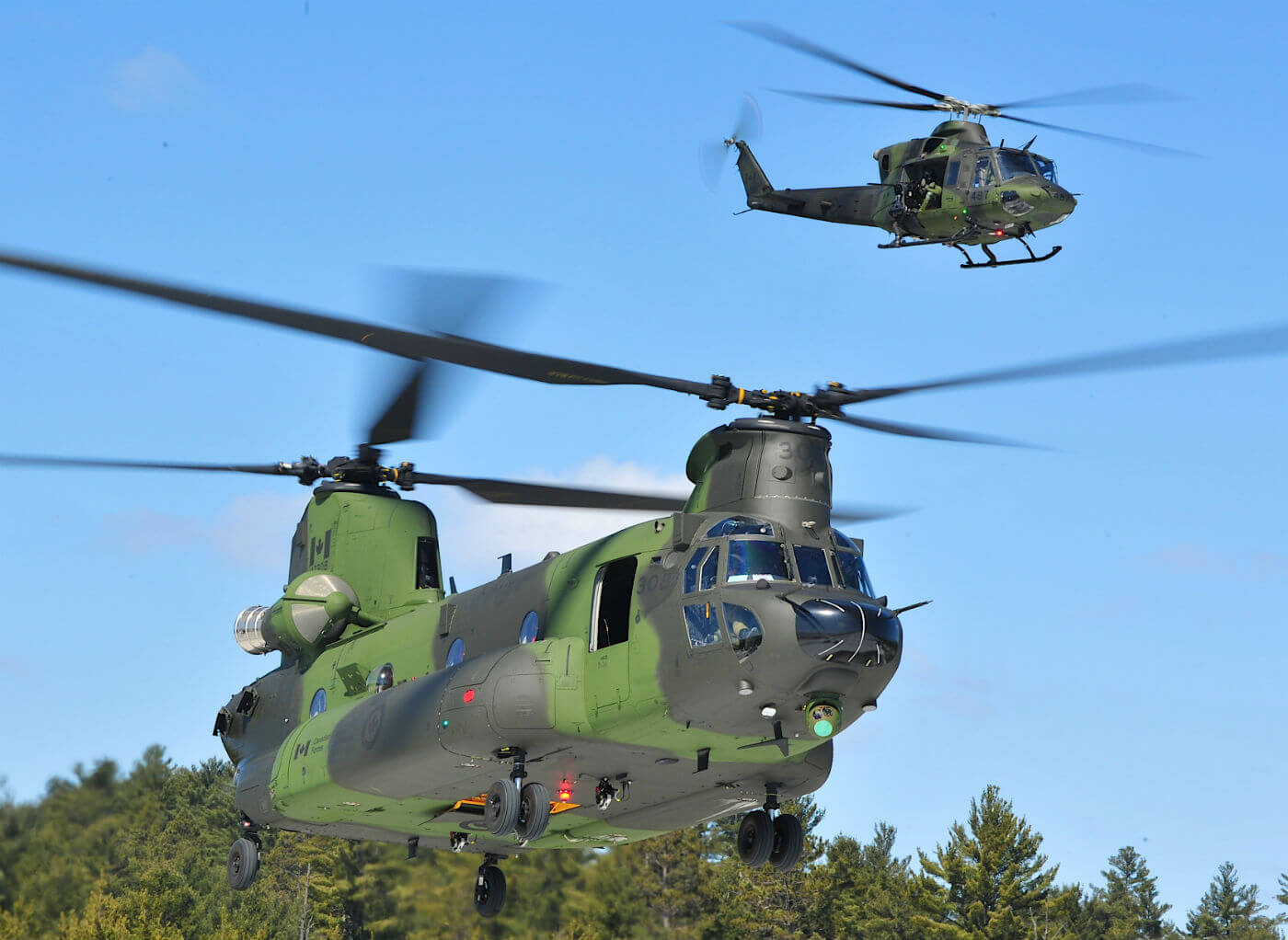
An RCAF CH-147 Chinook arrives at Camp Castor in Gao, Mali on July 15, 2018. Photo: MCpl Jennifer Kusche. Note the door gun MG in the Chinook for suppression during medevac or transport missions.
IS03-2018-0040-019
A CH-146 Griffon with door gunner arrives at Camp Castor in Gao, Mali on July 15, 2018. Photo: MCpl Jennifer Kusche


Wednesday, May 30, 2018

RCAF Griffons To Replace German Tiger Attack Helicopters in Mali

By: Daniel Maillet,
CAF Dispatch  

By August 2018 Canada will have "returned" to the United Nations Peacekeeping circle with some 250 members of Air Task Force Mali; which is expected to have two CH-147 Chinook helicopters and four CH-146 Griffons with door-gunner escort helicopters.

The mission is the deadliest of any United Nations peace operation, with 162 fatalities since it began in 2014.

Canada's deployment of an RCAF contingent is replacing the German Air Force's four UH-Tiger Attack helicopters and the Belgian Air Forces two NH90 medium-utility transport helicopters.

Image result for UH-Tiger Mali
Two German UH-Tiger Attack helicopters in Mali. 
The CH-147 Chinook is an upgrade for the Mali mission over the NH90. While the Chinook is slower and has a slightly shorter ranger - it can carry a much larger payload - more than double the payload of the NH90.

Canada's CH-146 Griffon Helicopters, on the other hand, are leading to questions about whether or not they can maintain the same level of security as the UH-Tigers. Prior to the Tiger's arrival in Mali; the Dutch Air Force had deployed Apache Attack helicopters as escorts. So the Griffon is a clear step-down.

Ted Campbell, a retired Senior Officer of the Canadian Armed Forces clearly expresses this concern. "[The] Griffon is a good helicopter and its crews, including the door gunners, are...much better than any aircrews anywhere on earth, but they do not have the “punch” of any attack helicopter." He goes on to say, "it is, of course, far to late to equip the Canadian Forces with attack helicopters for this mission."

Mr. Campbell is correct - here is a side-by-side comparison I compiled, as one does exist (because the Griffon is not considered by anyone except the RCAF as an "attack" helicopter)

Eurocopter UH-TigerBell CH-146 Griffon
Range: 800 kmRange: 656 km
Max Speed: 290 km/hMax Speed: 260 km/h
Ceilling: 14,000 ftCeilling: 20,000 ft
Max Takeoff: 13,000 lbsMax Takeoff: 11,900 lbs
Main Armament: 2x 30 mm (1.18 in) GIAT 30
Secondary Armament:  Multiple Options for
two outer hardpoint connections. This includes options for rockets and additional guns.
Main Armament: 2 x  7.62 mm M134D "Minigun";
or  2 x 7.62 mm C6 general purpose machine gun;
or  2 x .50 Cal (12.7 mm) GAU-21
Secondary Armament: None
Power Plant: 2 × MTU Turbomeca Rolls-Royce MTR390 turboshaft engines, 1.303 shp (958 kW) - EachPower Plant: 1 × Pratt & Whitney Canada PT6T-3D turboshaft engine, 1,250 shp (932 kW)

With the side-by-side comparison - it is clear that the Griffon, while it can operate a higher altitude, has little else in comparion to the UH-Tiger. The Eurocopter Tiger Attack helicopter is a far more versatile helicopter than the Griffon, and the twin engines make it far more powerful.

Image result for Griffon Door Gunner
Canadian Door Gunner sits back in his CH-146 Griffon helicopter over Afghanistan. Photo by: Sergeant Matthew McGregor, Canadian Forces Combat Camera© 2011 DND-MDN Canada
The Risks to RCAF Helicopters and Crew 

Additionally, something the Government of Canada is not highlighting is the very real risks involved in the Mali deployment. Last summer Germany lost a Tiger Helicopter, killing its crew of two.  This was not due to an attack by extremists, but an error in the auto-pilot settings.  This source of this error has not yet been located, but the Subsaharan climate could be to blame. RCAF Griffon pilots have experience in both Afghanistan and in Iraq, but the deserts of Mali are different than both those of Mesopotamia. Although General Vance considers the dry, dusty conditions of the terrain in Mali are similar to what the military has faced elsewhere.  Only four of the 160 fatalities have been associated with helicopter incidents. All of those had to do with mechanical failure of the aircraft and not with enemy or belligerent fire” according to Chief of Defence Staff Gen. Jonathan Vance in an interview with Global News.

Tuesday, May 8, 2018

More RCAF Helicopters a Possibility for Mali Mission

By: David Pugliese, Defence Watch 

The number of helicopters the RCAF will eventually send to Mali continues to be uncertain.

Image result for griffon attack helicopter
Canada has announced it will send two Chinook and four armed Griffon escort helicopters to Mali. 
In mid-March Defence Minister Harjit Sajjan announced that Canada would send to the United Nations mission in Mali two Chinook helicopters and four armed Griffon helicopters to escort them. A few minutes later at the same news conference Chief of the Defence Staff Gen. Jon Vance said the number of helicopters being assigned to the Mali mission have still not been determined as a reconnaissance had to be carried out.

A short time after that, Sajjan’s office sent out a message to journalists, contradicting Vance by stating that ‘up to’ two Chinooks and four Griffons would be sent.

Now in a response from the Canadian Forces to a series of questions about the Mali mission submitted by Defence Watch, it appears changes are again in the works…maybe…. “Details regarding tactics, risk mitigation, and force protection measures are yet to be finalized and many considerations need to be made,” the Canadian Forces noted in an email. “For instance, regarding operational sustainment, considerations include the possibility of deploying spare helicopters. As planning continues, we will be able to confirm such details in the near future.”

The response didn’t indicate whether that refers to spare Chinooks, Griffons, or both.

In addition, there are no details yet on costs….not even a ballpark figure on what Canadian taxpayers will have to spend for this one-year mission.

Monday, April 30, 2018

Is sending helicopters to Mali good enough?

By Chris Kilford

Given the recent concern over Canada’s upcoming contribution to the Multidimensional Integrated Stabilization Mission in Mali (MINUSMA), one might easily assume that up until now few Canadians had ever set foot in Mali. However, this is far from the case – Canada is Mali’s second-most important bilateral development partner, after France.

Image result for rcaf chinook helicopter afghanistan
Sgt Chad Zopf, a door gunner, onboard a Griffon helicopter while on exercise in Afghanistan.

At the Embassy of Canada in Mali, which opened in the city of Bamako in 1970, the Université Laval and various Canadian non-governmental organizations have been working for years to improve the daily lives of Malians.

In the past 12 months alone, and with the support of the Canadian government, efforts were underway to: improve agricultural output and food security; to assist community health physicians graduate from the University of Bamako; and to provide new software to Mali’s government for improving domestic revenue collection.

Meanwhile, several Canadian mining companies have significant investments in Mali. B2Gold Corporation, for example, operates the Fekola Mine with a 950-strong, mostly Malian workforce. According to Canada’s Ambassador, Louis Verret, the gold sector “accounts for about 66% of Mali's exports and is therefore critical for government revenue.”

However, since 2012, Mali has been gripped by civil war in part fuelled by the Canadian-backed ouster of Libya’s Muammar Gaddafi in 2011. Following his death, many Malian Tuareg fighters who had fought for his regime, returned home to fight for their own space in northern Mali. And, while a peace agreement between the government and its main opponents (including the Tuareg) was signed in 2015, little has changed on the security front. Instead, the French, the G5 Sahel regional force, and MINUSMA are doing what they can to contain various rebel factions.

As for MINUSMA, it is only as good as the troops it gets from contributing countries – and many western armies, which could make a big difference – are noticeably absent from the front lines. For a mission deployed in an asymmetrical conflict environment, this is a big problem, and has resulted in significant casualties for UN troops that have largely been drawn from developing countries.

Still, not all is lost. In June 2017, the UN instructed MINUSMA to fully concentrate its efforts on supporting the Agreement on Peace and Reconciliation and step-up efforts to redeploy Malian security forces to the centre and north of the country. To help, an EU Training Mission with 580 personnel is re-building the military, while 128 personnel with the EU Capacity Building Mission are focused on training the police, gendarmerie and national guard.

As for Canada, it will soon send six helicopters and approximately 250 personnel for 12 months in support of MINUSMA. For those wanting Canada to take on a more active international role, it’s good news. But when it comes to truly helping the UN, apparently our deeds are falling short of our words. Sending helicopters is important, but it’s not quite what many had expected from a government that has been consistently eager to portray itself internationally as a serious player on the world stage.

–––
Chris Kilford is a former Army Officer and defence attaché who served in Afghanistan and Turkey. Currently he is a fellow with the Queen's Centre for International and Defence Policy.

Thursday, April 26, 2018

UN Says 2 RCAF Chinooks Not Enough for Mali Mission

By: Melissa Kent, CBC Exclusive 

Canada is taking over a key role in the peacekeeping mission in Mali, but United Nations officials worry it may not be able to fully implement its mandate because it plans to send limited helicopter support.

Canada has pledged to send two CH-147 Chinook transport helicopters to a peacekeeping mission in Mali but the UN wants more. (Fred Chartrand/The Canadian Press)
Ottawa has said it will supply two CH-147 Chinook transport helicopters for logistical support and medical evacuations and four armed CH-146 Griffon helicopter to the UN Multidimensional Integrated Stabilization Mission Mali (MINUSMA).

The UN, meanwhile, is expecting that two Chinooks will be available at any given time — which means Canada would need to send more than two to Mali.

''A helicopter is not like a car. They have planned maintenance,'' said a UN official familiar with the talks. ''Therefore, in order to have two available on a daily basis you would need three."

The UN will meet with a delegation from Canada on Wednesday to discuss the mission's operational requirements, including the availability of two transport helicopters on a daily basis, the official told CBC News.

Germany, which Canada will be replacing in Mali, deployed four NH90 transport helicopters to make sure it had two operational on a daily basis. But that may have had more to do with the fact the NH90 is so new and had never been deployed into the desert, the official said.

The Chinook, on the other hand, is a workhorse that's been in operation for decades. Its quirks and reliability issues in harsh conditions are well known.

Deadliest peacekeeping mission

The four Griffon helicopters Canada is sending to Mali are armed, but they are not full-scale attack helicopters and won't be providing critical fire support from the air to secure convoys and troops on the ground.

This is not a frivolous requirement: the mission in Mali is currently the UN's deadliest. Since it was established in 2013, 166 soldiers have been killed.
The UN mission in Mali is one of the most dangerous peacekeeping operations in the world. (Moustapha Diallo/Reuters)
The peacekeepers are also dealing with a growing terrorist threat and a peace accord that the country has been struggling to implement for more than two years.

Germany currently has four Tiger utility helicopters in Mali to provide protection for troops on the ground. The Netherlands had four Apache attack helicopters and three Chinooks when it was in theatre from 2014 to 2017.

Canada's military, however, doesn't have attack helicopters. The role of the Griffons will be to escort and defend the Chinooks, not protect ground troops.

According to the Canadian military's standard operating procedures, whenever a Chinook is dispatched in a hostile environment, it must be escorted by two armed Griffons for protection.
El Salvador to provide firepower

Instead, El Salvador will provide ground troops with aerial cover. The small Central American nation is supplying six U.S.-built MD500 attack helicopters — two air-cover units consisting of three helicopters.

One of the units has been operating out of Timbuktu in the country's north since 2015. Another trio will deploy in July and is expected to work alongside Canada at the UN mission's base in Gao, in northeast Mali.

The UN would also like Canada to allow the Griffons to do double-duty as light transport helicopters, with El Salvador providing the escort. That request is also expected to come up at Wednesday's meeting.
Canada's Griffon helicopters are armed, but the will not be in Mali to protect ground troops as helicopters sent by other countries have. Rather, their role will be to escort and defend the Chinooks. (Ryan Remiorz/The Canadian Press)
Germany, meanwhile, will continue to have soldiers in Mali providing ''intelligence, surveillance, reconnaissance'' confirmed Peter Neven, a spokesperson at the German Mission to the UN. But the country's helicopter contribution will come to an end June 30.

Canada has said its aerial task force won't be operational until August.

Sources within the UN's peacekeeping department have said contingency plans are already in place, and that arrangements have been made with private contractors to fill any operational gaps that month.

''I hope they can come to an agreement, so there is no gap between the Germans' departure and the arrival of the Canadians,'' said the head of MINUSMA, Mahamat Saleh Annadif, during a media briefing at UN headquarters earlier this month.

Wednesday, April 25, 2018

Are 2 RCAF Chinooks Enough for Mali Mission?

By: David Pugliese, Defence Watch
RCAF Chinook in action during training in the U.S. in 2016. Photo courtesy Canadian Forces. 
Melissa Kent, the CBC correspondent at the United Nations, has raised some interesting points in her article today about Canada’s contribution to the Mali mission.

Talks will take place today between UN and Canadian officials about the contribution.

Canada will supply two Chinook helicopters and four CH-146 Griffon helicopters to the UN mission to Mali. The UN, meanwhile, is expecting that two Chinooks will be available at any given time — which means Canada would need to send more than two to Mali, Kent points out. ”A helicopter is not like a car. They have planned maintenance,” a UN official familiar with the talks told Kent. ”Therefore, in order to have two available on a daily basis you would need three.”

At least three.

Whether the Canadian government acknowledges this remains to be seen.

The Mali mission was announced March 19 by Defence Minister Harjit Sajjan and Foreign Affairs Minister Chrystia Freeland, with Chief of the Defence Staff Gen. Jon Vance standing by to answer questions. The “press conference” lasted probably a whole 10 minutes. There was no technical briefing to provide details of the mission.

At times, the press conference was an exercise in confusion, as Defence Watch has reported.

Sajjan announced Canada would send to the two Chinook helicopters and four armed Griffon helicopters to escort them. A few minutes later at the same news conference Vance said the number of helicopters being assigned to the Mali mission had still not been determined.

The government’s news release on the deployment indicated helicopters would be sent but did not provide specific numbers.

And Sajjan’s office later sent out a message to journalists, contradicting Vance by stating that ‘up to’ two Chinooks and four Griffons would be sent.

Friday, April 20, 2018

RCAF Mali Mission to use Afghanistan Playbook

By: Murray Brewster, CBC News

The Canadian helicopters going to Mali will be outfitted as they were in Afghanistan and will fly their missions the way they did there, senior military commanders said Thursday.

A French soldier stands inside a military helicopter during a visit by French President Emmanuel Macron to the troops of Operation Barkhane, France's largest overseas military operation, in Gao, northern Mali, Friday, May 19, 2017. Canada is sending six military helicopters to take part in the UN peacekeeping mission there.(Christophe Petit Tesson/THE CANADIAN PRESS-AP POOL)
The country's military operations command, Lt.-Gen. Steve Bowes, and the director of the strategic joint staff at National Defence headquarters, Maj.-Gen Al Meinzinger, testified before the House of Commons defence committee about the upcoming peacekeeping mission in the troubled West African country.

They and senior officials from Global Affairs were questioned repeatedly by Conservatives MPs about whether the planned year-long deployment, slated to begin operations in August, can be deemed a combat — or war zone — operation.

The officials sidestepped that description. Bowes said the Canadian military is accustomed to operating in "high-risk environments" and called Mali a "complex conflict zone."

Armed groups linked to al-Qaeda, ethnic Tuareg and Arab guerillas and government-supported militia have attacked each other, Malian soldiers, peacekeepers, aid workers and other civilians in a conflict that has raged on since late 2012.

The six Canadian helicopters — two CH-147 Chinook battlefield transports and four CH-146 Griffon armed helicopters — will carry out medical evacuations, shuttle around United Nations peacekeepers from other countries and occasionally support the so-called G-5 Sahel countries which are carrying out counter-terrorism operations against Islamic extremists.
A 'disciplined approach'

That means Canadian pilots and aircrew will have to be very deliberate in the way they conduct themselves, said Meinzinger, a former CH-146 Griffon pilot who was commander of the Canadian air wing in Kandahar near the end of Canada's Afghan war.

"Our approach to this mission from an aviation perspective will be very akin to the way we operated in Afghanistan," he said.

"A very disciplined approach as to how we accept missions at the front end and pre-execution ... we have a very disciplined way where we consider all of the potential threats from the weather to the fatigue levels of the crews."

Those air operations in Kandahar were carried out under the umbrella of Canada's five-year combat mission, which ended in 2011.

The Griffons — which can be outfitted with a multitude of weapons, including the C-6 machine gun, the M-134 Dillon six-barrel gatling gun and the GAU-21 .50 Cal machine gun — will be used in the role of "armed escort" for the Chinooks, the generals testified.

The threat to aircraft posed by extremists in Mali comes from light arms, such as rifles, machine guns and rocket-propelled grenades — not very different from the weapons the air force faced in Afghanistan.

Bowes told the committee there's been "no evidence" of guerillas being armed with portable surface-to-air missiles, known as MANPADS.

Even still, he noted, the Canadian helicopters are equipped with defensive systems, including .50 calibre machine guns.
'Sophisticated and underhanded'

One of the biggest dangers to aircraft and crews in Mali is expected to be the harsh desert climate. Last summer, the Germans lost a Tiger helicopter in a mechanical failure crash that killed two.

A UN base in the troubled country was recently subjected to a four-hour rocket, mortar and car bomb attack, which killed two peacekeepers. It was described by the French military as "sophisticated and underhanded" — something that caught the attention of opposition MPs.

"They've been extremely bold in the last month," said Conservative MP and defence critic James Bezan, who has led the party's charge to have the deployment debated and approved by Parliament. "We're not talking [attacks] in open theater. They're coming right on the bases and taking the fight to us."

The air contingent will deploy with its own security and Meinzinger said the Germans will still station as many as 500 troops at the air base where operations are conducted.

Thursday, March 22, 2018

Canadian Peacekeepers head to Mali, a country broken by Civil War

GEOFFREY YORK, The Globe and Mail 
JOHANNESBURG
Originally Published: March 19, 2018

For a decade, Canada has pumped more than $1-billion in foreign aid and military support into the West African nation of Mali, trying to rebuild a fragile and dysfunctional state.

It has largely been a failed effort. Despite massive international support, Mali has fallen into turmoil, suffering first a military coup and then widening violence as its government steadily lost territory to northern separatists and Islamist militias.

Now Canada will try again. Defence Minister Harjit Sajjan announced on Monday that Canada will send military helicopters to Mali to support the United Nations peacekeeping mission there. The one-year deployment is expected to include two Chinook helicopters for medical evacuations and logistical support, along with four smaller Griffons to serve as armed escorts.


It will be one of Canada’s first major peacekeeping efforts in Africa since the troubled missions in Somalia and Rwanda in the early 1990s. The deployment will also include Canadian troops, although Mr. Sajjan said the number is not yet decided. Sources earlier told The Globe and Mail that 200 to 250 Canadian soldiers could be deployed to Mali as air crews, medical crews, support staff and special forces.
A French soldier of the operation Barkhane, an anti-terrorist mission in Sahel, patrols during a tactical flight on March 12, 2016 over Mali. PASCAL GUYOT/THE GLOBE AND MAIL

Mali is considered the most dangerous UN mission in the world, with 162 peacekeepers killed since 2013. Canada hopes to avoid casualties by deploying helicopters, which are much less vulnerable to attack.

But physical danger is only one of the challenges. The bigger question is whether a military effort can reconstruct a broken state, one of the most aid-dependent in the world, where the government has little effective control of the country.

By some estimates, two-thirds of Mali’s territory is under constant threat from armed groups, including Islamist extremists.

Scholars have described Mali’s government as a Potemkin façade, more fictional than real. “Donors have little to show for their efforts,” said a recent analysis by Catriona Craven-Matthews and Pierre Englebert, scholars at Pomona College in California who have studied Mali for years.

They estimate that international donors have spent an average of US$3-billion annually since 2013 to support Mali’s security and development – nearly a quarter of the country’s GDP. Yet the state remains weak. “Violence is on the rise, institutions remain dysfunctional, the military is inefficient, investments have been few, and corruption is rampant,” the two scholars wrote.

Image result for canadian chinook afghanistan
The last major overseas deployment of the RCAF Chinook helicopters was in Afghanistan, where the workhorse heavy-lift helicopters were used to avoid roadside IEDs. PHOTO: RCAF
Despite this, foreign support continues to pour into the country, largely because many countries have keen strategic interests in Mali.

For the United States, northern Mali is a dangerous source of Islamist fighters, including those who crossed the border into Niger and killed four U.S. soldiers last October.

For European countries, Mali is one of the main routes for the traffickers who bring migrants and drugs onto the continent.

For Canada, there are economic and humanitarian interests. Canadian mining companies have invested more than $1-billion in Mali’s mining industry. And both the Liberal and Conservative governments in Ottawa since 2006 have made Mali one of their favourite recipients of aid.

A decade ago, Ottawa saw Mali as a model of democracy and stability for Africa – an assumption that was later undermined by a coup, civil war and terrorism.

After choosing Mali as one of its “countries of focus” for development aid, Ottawa spent huge sums of money to prop it up. Mali has become one of Canada’s top five recipients of foreign aid, getting more than $100-million annually, including $125-million in 2016. This has made Canada the third-biggest bilateral donor of development aid to Mali, behind only France and the United States.

Canada forged an even stronger connection to Mali after the kidnapping of Canadian diplomats Robert Fowler and Louis Guay, who were held hostage by an Islamist radical militia in the deserts of northern Mali for several months in early 2009. Canada put heavy pressure on the Malian government to help negotiate their release.

Canada has also sent hundreds of soldiers to Mali since 2010 in a multimillion-dollar effort to help train the Malian army in counterterrorism, border security and other priorities.

Much of this training was led by the U.S. military under a US$500-million counterterrorism program. But one of the graduates of the U.S. training program, Captain Amadou Sanogo, shocked the Pentagon in 2012 by leading a military coup in Mali.

The coup forced Canada to suspend its aid to Mali for nearly two years.

Military solutions have failed to build a self-sustaining democracy in Mali. The country remains heavily dependent on troops from France, West Africa and the United Nations. It remains to be seen whether Canada’s helicopters can make any real difference in a dismal situation.

- With a report from Robert Fife in Ottawa

Thursday, May 11, 2017

Op-LENTUS 17-03 Flood Support Update

DND Report:

A total of approximately 2200 CAF personnel have been deployed to support Quebec citizens in the four affected regions: Montérégie, Outaouais, Mauricie and Montréal. Troops, along with aviation assets, engineer assets, and 12 boats from the Naval Reserve, are in place to support and react to the needs identified.

Timeline:
May 5, 2017: Within one hour of Public Safety receiving a request for assistance, the CAF sent liaison officers and reconnaissance elements to four regional coordination centres. There they met with provincial partners to determine how the CAF could help.

May 6, 2017: An immediate response unit of 400 military personnel departed CFB Valcartier to begin assisting in the four affected regions. The CAF also sent additional personnel to the regional coordination centres to pave the way for additional waves of troops preparing to leave Valcartier.
May 7, 2017: Hundreds more troops departed Valcartier. Total troop strength reached approximately 1650 spread out over the four affected regions.

May 8, 2017: The CAF put additional troops and equipment on standby to help if needed. These consisted of about 470 personnel from 31, 32, and 33 Canadian Brigade Group Domestic Response Companies, plus a Composite Reserve Engineer Squadron.

May 9, 2017: By this date, approximately 1830 military personnel were supporting flood relief.

May 10, 2017: The approximately 470 personnel that were on standby moved into affected areas and began assisting in flood relief. These troops are from 31, 32, and 33 Canadian Brigade Group Domestic Response Companies, plus a Composite Reserve Engineer Squadron. By the end of the day on May 10, 2017, approximately 2200 military personnel were supporting Operation LENTUS. More troops are now deployed for the operation in Quebec than the rest of all Canadian Armed Forces operations around the world combined.

There are currently seven RCAF helicopters deployed on #OpLentus -
one CH-147F Chinook from 450 Tactical Helicopter Squadron from Petawawa and six CH-146 Griffons (four from 430 Tactical Helicopter Squadron from Valcartier and one from each 438 Tactical Helicopter Squadron from St. Hubert and 439 Combat Support Squadron from Bagovtille).

As of May 10, 30 sorties have been flown, including two sorties by the Chinook, which did a sandbag resupply to Berthierville, Quebec.

May 11, 2017: HMCS Montréal arrived in Trois-Rivières. Approximately 160 personnel of the ship’s company will join the CAF troops already on the ground to support the citizens in this affected area. HMCS Montréal was originally anticipated to arrive in its namesake city this week to celebrate the 375th Anniversary of the City of Montreal.

The CAF is helping the civil and municipal security teams already on the ground by conducting tasks such as:

distributing and filling sandbags to help solidify existing structures and protect critical infrastructure
using military vehicles to help the civil authorities to maintain traffic on critical arteries and help evacuate citizens to safe areas patrolling to monitor critical infrastructure and safety of citizens
reinforcing dikes and walls to protect critical infrastructure such as water treatment plants and bridges

The CAF is also ready to support civilian partners such as the Canadian Red Cross in the supply of shelters.

Wednesday, November 2, 2016

Germans Tiger attack helicopters might provide cover for RCAF Chinooks in Mali

By: David Pugliese, Defence Watch 

There are reports in the German media that the country’s military is looking at providing Tiger attack helicopters to accompany RCAF Chinooks for an upcoming mission in Mali.

But the Liberal government says it still has to decide on whether those Chinooks, based in Petawawa, Ontario, – or any other units for that matter – would be heading to a mission in Africa.

Image result for tiger attack helicopter
A German Eurocopter Tiger attack Helicopter. Germany is considering deploying these to Mali in the wake of the Dutch decision to withdraw its Apache Helicopters. 
Meanwhile, the Canadian Press is reporting that Defence Minister Harjit Sajjan will travel to Mali and Senegal later this week as the Liberal government considers where to send hundreds of Canadian peacekeepers. International Development Minister Marie-Claude Bibeau visited Mali in September. Sajjan visited the Democratic Republic of Congo, Ethiopia, Kenya, Uganda, and Tanzania.

In September, the Canadian government sent a team to Mali to do a reconnaissance mission for a potential UN operation in that country. The reconnaissance team included members of the Canadian military, Global Affairs Canada and the RCMP.

The UN mission currently involves around 10,000 military personnel taking part in an effort to stabilize Mali. Various armed groups, including Islamic insurgents, have been conducting sporadic attacks in that country. The UN plans to boost the mission by around 2,500 personnel.


The UN has also made it known it would like attack helicopters and transport helicopters to fill the void left by the withdraw of Dutch Chinooks and Apaches from Mali.

“We have decided to continue the Mali mission, but with a reduced capacity,” Dutch Prime Minister Mark Rutte told reporters Oct. 7. “Dutch helicopters will be withdrawn.”

Sajjan has said that by the end of the year the government expects to make its decision on the next peacekeeping mission. But in his interview with the Canadian Press, he appeared to retreat somewhat on his previous statements. “We need to go into this eyes wide open,” Sajjan said. “So based on that, I have not set a deadline as I want to make sure that we do all the necessary work, so that we can have the meaningful impact.”

Wednesday, June 1, 2016

Canadians to hold key positions in RIMPAC; while U.S. politicians want to ban China from military exercise

By: David Pugliese, Defence Watch 

RIMPAC 16 gets underway June 30 and runs until August 4 in the Hawaiian and Southern California area. The Canadian Forces says it is sending the following:
  • A maritime component comprised of four ships (HMCS Calgary, HMCS Vancouver, HMCS Saskatoon and HMCS Yellowknife), a RCN team of clearance divers, and a forward logistics team;
  • A Land Component comprised of a Company Group based on a Rifle Company from the Third Battalion, Royal 22e Regiment, based out of Valcartier, Quebec;
  • An Air Task Force comprised of several aircraft (six CF-188 Hornets, one CC-130 Hercules, one CC-150 Polaris and one CP-140 Aurora), a Maritime Helicopter Detachment, and a Tactical Aviation Detachment consisting of four CH-146 Griffons and two CH-147 Chinooks;
  • More than 1,500 sailors, soldiers, airmen and airwomen; and Several command, staff and support personnel.
The Canadian Forces noted that some of its personnel will once again hold key leadership positions during RIMPAC 2016. They include Rear-Admiral Scott Bishop, who will serve as the Deputy Commander of the Combined Task Force; and Brigadier-General Blaise Frawley, will serve as the Air Component Commander.

RIMPAC is held every two years. This year it will include 45 ships, five submarines, more than 200 aircraft and 25,000 personnel from the armed forces of 27 nations.

Training is varied and will include everything from counter-piracy to amphibious operations.

Besides the U.S., the participating nations include Australia, Brunei, Canada, Chile, Colombia, France, India, Indonesia, Japan, Malaysia, Mexico, the Netherlands, New Zealand, Norway, Peru, South Korea, the Philippines, Singapore, Thailand, Tonga, the United Kingdom, Brazil, Denmark, Germany, Italy and China.

China first joined RIMPAC in 2014. It sent four ships but in addition one of its spy vessels also shadowed the exercise off Hawaii.

Some U.S. lawmakers have called for China to be banned from RIMPAC.

They are upset with what they see as China’s aggressive stance in the South China Sea. As part of its strategy in the region, China has been building artificial islands to act as military bases.

U.S. congressman Mark Takai, of Hawaii, has asked U.S. defense secretary Ash Carter to ban China from RIMPAC. “I guess my question is why then should we reward China for this aggressive behavior by including them in an event meant for allies and partners?” Takai asked Carter during a meeting in March.

CAF and RCN Prepare for RIMPAC 2016

By: Frontline Defence News

Four warships, several aircraft and more than 1,500 Canadian sailors, soldiers, airmen and airwomen will participate in the United States Navy-led Exercise Rim of the Pacific (RIMPAC) from June 30 to August 4, 2016, in and around the Hawaiian Islands and Southern California.

The aircraft carrier USS Ronald Reagan (CVN 76) transits the Pacific Ocean with ships assigned to Rim of the Pacific (RIMPAC) 2010 combined task force as part of a photo exercise north of Hawaii.
The 25th edition in a series and held every two years, RIMPAC has grown into the world’s largest combined and joint maritime exercise. RIMPAC 2016 will bring together 45 ships, five submarines, more than 200 aircraft and 25,000 personnel from the armed forces of 27 nations. The exercise will challenge participants with unique training opportunities across the spectrum of military capabilities - from humanitarian assistance and disaster response to dynamic maritime security and complex warfighting operations.

"Canada has participated in every RIMPAC since 1971," said Defence Minister Harjit Sajjan. "Over the years, our participation has helped us build and foster collaborative relationships with our allies and partners in the region. RIMPAC 2016 will once again provide the Canadian Armed Forces with a valuable training opportunity, while demonstrating Canadian leadership and operational excellence abroad."

Participation in RIMPAC contributes to the operational readiness of the Canadian Armed Forces. Operational readiness allows the CAF to meet the likely tasks that the Government of Canada will assign.

“RIMPAC 2016 is a valuable opportunity for all services of the Canadian Armed Forces to train together in a joint environment with international allies and partners.," said Rear-Admiral Scott Bishop, RIMPAC Deputy Commander Combined Task Force.

"As Deputy Commander for the Combined Task Force, I am looking forward to working with our forces and our allies. The exercise will challenge our 1,500 Canadian men and women as we improve our readiness to respond to a range of potential operations, strengthen military-to-military partnerships, and enhance our ability to work effectively with participants from more than 25 nations.”

RIMPAC 16 takes place from June 30 to August 4, 2016 in the Hawaiian and Southern California area. Canada is deploying:

A maritime component comprised of four ships (HMCS Calgary, HMCS Vancouver, HMCS Saskatoon and HMCS Yellowknife), a RCN team of clearance divers, and a Forward Logistics Team;
A Land Component comprised of a Company Group based on a Rifle Company from the Third Battalion, Royal 22e Regiment, based out of Valcartier, Quebec;
An Air Task Force comprised of several aircraft (six CF-188 Hornets, one CC-130 Hercules, one CC-150 Polaris and one CP-140 Aurora), a Maritime Helicopter Detachment, and a Tactical Aviation Detachment consisting of four CH-146 Griffons and two CH-147 Chinooks;
More than 1,500 sailors, soldiers, airmen and airwomen; and
Several command, staff and support personnel.

Canadians will also hold key leadership positions during RIMPAC 2016:
Rear-Admiral Scott Bishop will serve as the Deputy Commander of the Combined Task Force; and
Brigadier-General Blaise Frawley, will serve as the Air Component Commander.

Monday, May 9, 2016

RCAF Chinook provides humanitarian assistance in Alberta

Originally Published by: Frontline Defence, In the News 
A CH-147F Chinook helicopter from 450 Tactical Helicopter Squadron at 4th Canadian Division Support Base lands at Leismer Aerodrome in Conklin, Alberta, on May 6, 2016, as part of Canadian Armed Forces support to the Province of Alberta's emergency response to wildfires in Fort McMurray.
A CH-147F Chinook helicopter delivered 8,200 pounds of food, water, and other sundries to Fort McKay First Nation yesterday as part of the Canadian Armed Forces’ (CAF) ongoing support to the Province of Alberta in responding to the wildfires in Fort McMurray.

It is the first time that the CAF is operating a CH-147F Chinook helicopter on a domestic humanitarian operation. The aircraft, from 450 Tactical Helicopter Squadron at 4th Canadian Division Support Base Petawawa, joins four CH-146 Griffon helicopters and one CC-130J Hercules aircraft currently supporting relief efforts in the province.

The CH-147F Chinook is an advanced, multi-mission, medium to heavy-lift helicopter. Its primary mission is the tactical transport of equipment and personnel during domestic or deployed operations. The versatility, impressive capacity and extended range of the Chinook make it ideal for operations in Canada’s vast territory and demanding environment.

“It brings me great pride to be a part of the first ever employment of the CH-147F Chinook in Canadian domestic humanitarian operations," said Lieutenant-Colonel Kevin Kimpinski, Air Task Force Commander – Joint Task Force West. "The helicopter’s role is just another example of how Joint Task Force West is ready and able to help fellow Albertans affected by the wildfires.”

The CH-147F Chinook is part of Joint Task Force West’s Air Task Force - Forward, which is working to evacuate people, transport emergency response personnel, conduct search and rescue missions, deliver emergency supplies, and fly reconnaissance and night surveillance missions.

The CH-147F Chinook is deployed under Operation LENTUS, the CAF’s contingency plan that outlines the joint response to provide support to provincial and territorial authorities in cases of major natural disasters.

Wednesday, October 14, 2015

RCAF Doesn't Like To Admit it flew Russian Mil-17-V5s

Updated: March 2018

While Air Task Force Afghanistan stood down in August 2011, there is a part of its history that seems to have been forgotten...perhaps deliberately. The part that was forgotten...that the RCAF operated Russian Mil-17 helicopters.

Almost immediately in Canada's deployment to Afghanistan, the CAF realized that it was missing the medium-heavy lift helicopter its NATO allies had. A large percentage of casualties in Afghanistan to the ISAF forces came from IEDs. One way to deploy troops to a location and avoid IEDs along the way was through strategic medium lift helicopters. Canada did not possess such a capability - having only deployed our CH-146 Griffon escort helicopters.

Then CDS Gen. Rick Hillier called for the Conservative Government to look at acquiring a medium-heavy lift helicopter to carry troops and supplies into combat zones in Afghanistan. A modernized CAF would require such a capability for all future deployments. The government agreed, and the search was on.

Almost immediately, the then Minister of Defence Peter MacKay announced that Canada would purchase the Boeing CH-47 D Chinook Helicopter. While it waited for deliveries of new helicopters, it would lease several from the US Military.

The lease agreement took some time to negotiate, and the leased CH-47's would not be immediately available - therefore Canada would need to find an interim solution.

That solution came with the Russian built Kazan Mil-17-V5 helicopters. In 2009 the Conservative cabinet quietly agreed to lease the "Hip" helicopters as NATO has code-named them for use in Afghanistan, according to a 2010 CBC news article.

The Mil-17-V5 is the export version of the Mil-8MTV-5. The cabinet agreed to lease 6 of these helicopters; of which the RCAF took delivery and operated 4, which was designated CH-178. The government was able to keep the deal quite until November 2010 when photos emerged of the Mil-17's flying in RCAF paint schemes for Afghanistan. The media began asking questions, and the government announced that in fact it was operating four of the helicopters as a stop-gap in Afghanistan, and had been since May/June of 2010.

An RCAF identified Mil-17-V5 (CH-178) operating over Afghanistan in 2010. (#178405)
The four Mil-17's operated by the RCAF were assigned serial numbers 178404-178407.

The government had previously leased 6 civilian Mil-8s from SkyLink Aviation of Toronto. SkyLink is known to lease its fleet internationally for peacekeeping, and humanitarian purposes. This lease agreement started in November of 2008. Unlike these 6 civilian Mil-8's which were operated by civilian crews under strict rules. The Mi-8s were only used to transport cargo. While the Mil-17s were fully outfitted with weaponry and flown and crewed by CAF members into combat situations.

What happened to these aircraft after their use in Kandahar? There are reports that at least 3 of the 4 Mil-17s were airlifted top Graf Ignatievo Air Base in Bulgaria in August of 2011, with the Canadian markings covered in tape.
An RCAF identified Mil-17-V5 (CH-178) operating over Afghanistan in 2010. (#178407)

The archived RCAF Air Task Force Afghanistan webpage does not even acknowledge that the RCAF flew Mil-17s. It only lists the leased civilian Mil-8s under its Canadian Helicopter Force Afghanistan.

Also, on the RCAF's webpage, under its Historical Aircaraft no Mil's are mentioned or listed at all. Some would say that this is because the aircraft we leased. But the CT-156T Harvard II and CT-155 Hawk flown Moose Jaw are listed and they are leased.

The only visible mention of the RCAF's use of the Mil-17-V5 CH-178 was odly on Twitter by the RCAF in October 2016 during one of it's quiz Tweets; where it stated that the Mil-17's were flown by 427 Special Operations Air Squadron in Afghanistan.


So is misplaced pride the reason why the RCAF and CAF do not recognize the fact that it operated Mil-17s between 2010 and 2011? Or is it the fact that the CAF swore not to fly "Russian" aircraft? Or is it the fact that these were the first Russian aircraft operated by the RCAF that they are not proud of?

Either way, the RCAF operated Russian built Mil-17-V5s designated as CH-178's in Afghanistan, and it is not recorded anywhere on the Canadian Forces webpage that they ever existed.