Translate

Showing posts with label Canada and Kuwait. Show all posts

Wednesday, May 11, 2016

OP IMPACT: Camp Canada - Base Expansion


By: JTF–I Public Affairs Officer
DND Press Release:

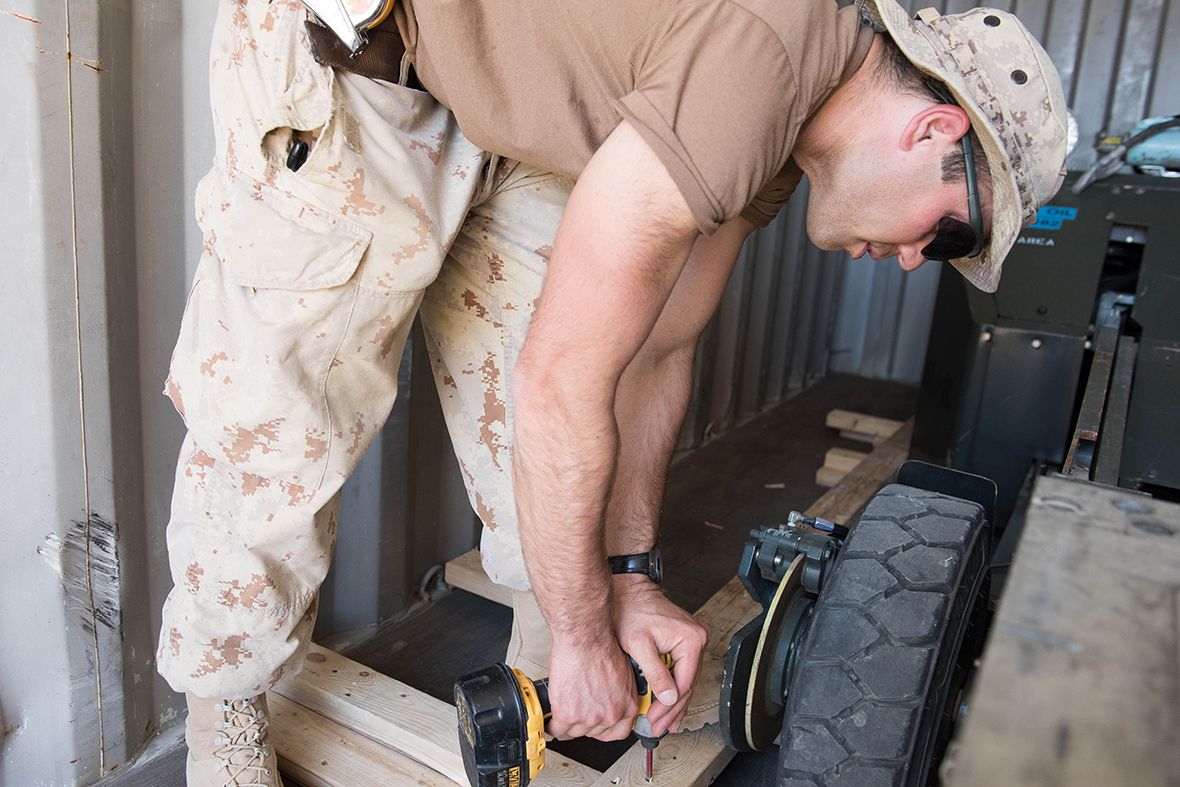
Operation IMPACT began with the delivery of more than 1.6 million pounds of equipment from Canada to Kuwait in the late summer of 2014. This materiel was brought over to establish a base camp from which to conduct air operations to degrade, dismantle and eventually defeat the Islamic State of Iraq and Levant. After approximately 20 months of operations, Camp Canada is expanding in line with the refocused mandate of Operation IMPACT.

“We have levelled new ground here, expanding into land given to us to level and repurpose,” said the Joint Task Force Support Component Adjudant. “Working from a plan and map designed for us by our engineers, we are creating more bed spaces and a larger morale and welfare area to meet the influx of new people. Our operations cell coordinates the efforts across the different specialist groups to ensure the wide diversity of projects and tasks are managed and completed on time. Our logisticians, engineers, and signals personnel have made much of the construction appear seamless.”

In a very short period of time, the Joint Task Force Support Component (JTFSC) expanded the camp by more than 10,000 square metres. The camp now includes new headquarters space, weight and cardio rooms, the new Canada House with a recreation area and a multi-purpose room, a new health services tent, and a chapel, among other necessary resources for camp personnel.

An expansion like this takes meticulous planning and consideration of different units’ requirements.

“The detail that must go into the planning phase is intense,” said the Construction Engineer Commander. “For example, when planning to build a new medical inspection room, we had to think about the base, the walls and structure of the tent, the drainage material required in addition to ensuring the amount of power supply was adequate. A medical unit must have air conditioning, multiple power outlets for computers and medical equipment, lighting, and anything else they require to provide clinical care to members. All the infrastructure on base has unique needs, so we plan multiple times for each project, checking and rechecking the details, overcoming snags as we progress through our projects.”

When expanding the camp, JTFSC worked quickly to avoid any significant impact on operations. This could be a challenge when moving personnel to new sections of the camp, but JTFSC was up to the task. For example, they tore down and set up the medical inspection room in a day, with many volunteers lending a hand to ensure the process was smooth and quick. They then moved the medical unit into their new site and soon had them up and running.

“With the help of members of JTFSC, the move was done with little disruption to services and in a very smooth fashion,” said the Task Force Surgeon.

Another example is Air Task Force – Iraq (ATF-I), which was relocated in March to join Joint Task Force – Iraq. The JTFSC was able to ensure initial operational capability within just two days of ATF-I’s arrival, with little disruption to their communications capability. This relocation was recently finalized with the official closure of a satellite location of ATF-I.

Overall, constructing the new camp and moving personnel to new areas have gone quickly and smoothly.

“I have been moving throughout Camp Canada as this expansion process has been underway and appreciate the heavy lifting and intensive labour of the JTFSC,” said Chief Petty Officer Andrew Tiffin, JTF-I Sergeant Major. “In a matter of weeks the camp has been completely transformed and to all those involved I want to say thank-you on behalf of the Commander, Brigadier-General James Irvine, and me.”

Monday, February 1, 2016

Ottawa Pushes Military Deal with Kuwait despite UN

STEVEN CHASE
OTTAWA — The Globe and Mail
Published Sunday, Jan. 31, 2016 9:42PM EST
Last updated Sunday, Jan. 31, 2016 9:48PM EST

The Canadian government is busy promoting Canada’s defence industry in Kuwait even as a United Nations report accuses a Saudi-led coalition, which includes Kuwait, of “widespread and systematic” bombing of civilians in Yemen.

Ottawa’s efforts to secure military contracts for Canada’s defence industry are coming under increasing scrutiny as controversy grows over the federal government’s commanding role in a $15-billion sale of weaponized armoured vehicles to Saudi Arabia, a country notorious for human-rights abuses.

Kuwait is among a group of Arab states conducting air strikes in Yemen and has supported this effort with its air force, which includes fighter jets and KC-130J tanker aircraft that can supply warplanes with fuel while in the air.

Montreal-based CAE recently built a flight simulator for the Kuwait Air Force that trains military pilots on the KC-130J tanker aircraft. It was contracted to supply the simulator to the air force’s Al Mubarak air base near Kuwait International Airport.

Canadian officials paid a visit to the simulator last week, talking up the Canada-Kuwait business deal on the same day the UN report on Yemen air strikes made international headlines.

The delegation included a top executive from the Canadian Commercial Corp., Ottawa’s defence and security export sales outfit, as well as Martine Moreau, Canada’s ambassador to Kuwait.

“Great visit to @CAE_Defence’s impressive new KC-130J flight sim[ulator] & facility with @CanadaKuwait CDN Ambassador Moreau,” Cameron Mackenzie, vice-president of business development and sales at Canadian Commercial Corp., wrote on Twitter this past Wednesday.

A leaked UN panel report last week attributed 60 per cent, or 2,682, civilian deaths and injuries in the Yemen conflict to air-launched explosive weapons and said the Saudi-led coalition’s actions are a “grave violation of the principles of distinction, proportionality and precaution” and violate international law.

Saudis and their Arab allies launched a military intervention in Yemen last year in support of President Abed Rabbo Mansour Hadi who was under threat from Houthi forces aligned with Iran.

Kuwait, a Persian Gulf state of 3.4 million, is heavily dependent on oil exports. According to Amnesty International, even peaceful criticism of Islam and the emir, the ruling head of state, remains criminalized. The rights watchdog says human-rights activists and political reformers are among those targeted for arrest, detention and prosecution. Authorities have prosecuted and imprisoned critics who express dissent through social media and they have curtailed the right to public assembly, Amnesty says.

Foreign Affairs Minister Stéphane Dion’s department did not immediately respond when asked Friday to explain why the government is promoting military sales in Kuwait while the Mideast country is part of a Saudi-led coalition that is carrying out air attacks in Yemen.

Targets in Yemen, the UN report found, have included refugee camps; weddings; civilian vehicles, such as buses; homes; medical facilities; schools; mosques; factories and civilian infrastructure.

Canadian military sales to regions such as the Mideast have risen significantly in the past decade as the former Harper government worked to build up this country’s role as an international arms dealer. Pentagon budget cuts drove the Canadian Commercial Corp. to look further abroad for arms buyers. In 2009 it created a new line of business, Global Defence and Security Sales, to seek new customers. This move into “non-traditional defence and security markets will require an increased vigilance for responsible and ethical business conduct,” the agency says in its latest published corporate plan.

Critics say Ottawa’s policing of arms exports is in dire need of an overhaul.

“The credibility of Canadian export controls is severely strained. It is high time the government address persistent, legitimate questions about the process by which military export authorizations are granted,” said Cesar Jaramillo, executive director of Project Ploughshares, based in Waterloo, Ont.

He said the UN report “left little doubt about the systematic targeting of civilians and the violation of international humanitarian law by the Saudi-led coalition that Kuwait is a part of. Canada should proceed with utmost care when pursuing or entering into military exports deals” with these countries.

Mr. Jaramillo said the Canadian government is in a conflict of interest when it comes to military exports. “There is a clear tension in Ottawa between the sometimes conflicting objectives of facilitating trade deals for private Canadian companies and ensuring that Canadian-made goods do not contribute to the violation of human rights or serve to exacerbate conflict situations.”

Asked whether CAE would cease doing business with Kuwait in light of the UN panel report, a CAE spokesman said the company is complying with all Canadian government rules on exports.

Pascale Alpha, director of global communications at CAE, said the simulator deal with Kuwait was arranged through the U.S. military.

“We follow Canada’s export regulations as well as NATO regulations, and the export regulations of the countries we operate in. In this case, our contract was to supply a simulator to the U.S. Navy. Through Foreign Military Sales, the U.S. Navy supplies the aircraft and training equipment to foreign nations, including the Kuwaiti air force,” Mr. Alpha said.

Follow Steven Chase on Twitter: @stevenchase