By: The Canadian Press
Defence Minister Harjit Sajjan met with his Iraqi and Kurdistan counterparts in Baghdad on Monday to discuss Canada's ongoing contribution to the fight against the Islamic State of Iraq and the Levant.
Jordan Owens, a spokeswoman for the minister, said Sajjan arrived in Iraq after attending the recent NATO summit in Warsaw, Poland.
She said U.S. Defence Secretary Ashton Carter was also in Iraq, but that he and Sajjan were not together.
Owens said she could not provide details of Sajjan's discussions, adding the minister will discuss his visit later in a telephone conference call with the media.
The Liberal government announced in May that it was expanding its contribution to the fight against ISIL to include three CH-146 Griffon helicopters, an intelligence centre and additional trainers to what is called Operation IMPACT.
It said that would triple the size of Canada's mission to train, advise and help Iraqi security forces plan and conduct military operations against ISIL.
Sajjan will return to Canada on Thursday.
Additional Content by: David Pugliese,
Sajjan’s visit also coincided with a trip to Baghdad by U.S. Defense Secretary Ashton Carter.
At the end of the recent NATO summit, Canada announced it would contribute to an alliance program to train Iraqi troops in disposing of improvised explosive devices.
But at the time Prime Minister Justin Trudeau did not offer any details about the mission, such as numbers of personnel, duration of their mission, and where they would be operating in Iraq. “The fact is from the beginning we have always talked about the broad range of activities we can do in support of the local troops,” Trudeau told reporters.
The Kuwait News Agency, citing Iraqi officials, reported that Canada will be providing military engineers as part of the training package.
NATO has been training Iraqi personnel in counter-IED operations at the King Abdullah II Special Operations Training Centre in Amman, Jordan. NATO is also providing “train the trainer” instruction, enabling the officers to build the professionalism of the Iraqi forces by sharing their new skills with colleagues with the support of the NATO Counter Improvised Explosive Devices Centre of Excellence, the alliance added in an earlier news release.
At the request of the Iraqi government, NATO is now assessing the possibility of conducting training inside Iraq as well, NATO pointed out.
Showing posts with label New OP IMPACT. Show all posts
Showing posts with label New OP IMPACT. Show all posts
Tuesday, July 12, 2016

Thursday, June 2, 2016
OP IMPACT Air-Task-Force Iraq Update
Since the end of the RCAF CF-18 Air campaign against ISIS, little news has surfaced about OP IMPACT until the recent news regarding CAF Special Forces facing mortar fire over the weekend; or the political implications of wearing the Kurdish flag on their uniforms.
As such, I figured it was about time to offer an update on Air-Task-Force Iraq.
According to the DND OP IMPACT webpage,
As part of the Government of Canada’s expanded contribution to multinational efforts to degrade and defeat the so-called Islamic State of Iraq and the Levant (ISIL), the Canadian Armed Forces (CAF) recently added three CH-146 Griffon helicopters, an all-source intelligence centre, and additional trainers to Operation IMPACT. Learn more.
As such, I figured it was about time to offer an update on Air-Task-Force Iraq.
As part of the Government of Canada’s expanded contribution to multinational efforts to degrade and defeat the so-called Islamic State of Iraq and the Levant (ISIL), the Canadian Armed Forces (CAF) recently added three CH-146 Griffon helicopters, an all-source intelligence centre, and additional trainers to Operation IMPACT. Learn more.
Current Total of Aircraft sorties
*This total includes 1378 sorties conducted by CF-18 Hornets between 30 October 2014 and 15 February 2016.
- As of 28 May 2016, Air Task Force-Iraq has conducted 2332 sorties*:
- CC-150T Polaris aerial refueller conducted 462 sorties, delivering some 26,800,000 pounds of fuel to coalition aircraft; and
- CP-140 Aurora aircraft conducted 492 reconnaissance missions.
*This total includes 1378 sorties conducted by CF-18 Hornets between 30 October 2014 and 15 February 2016.
 |
| To keep the aircraft functioning properly in a desert environment, an aviation technician sprays down the wing and fuselage of a CP-140 Aurora in Kuwait during Operation IMPACT on April 4, 2016. Photo: CAF Combat Camera |
Wednesday, May 11, 2016
OP IMPACT: Camp Canada - Base Expansion
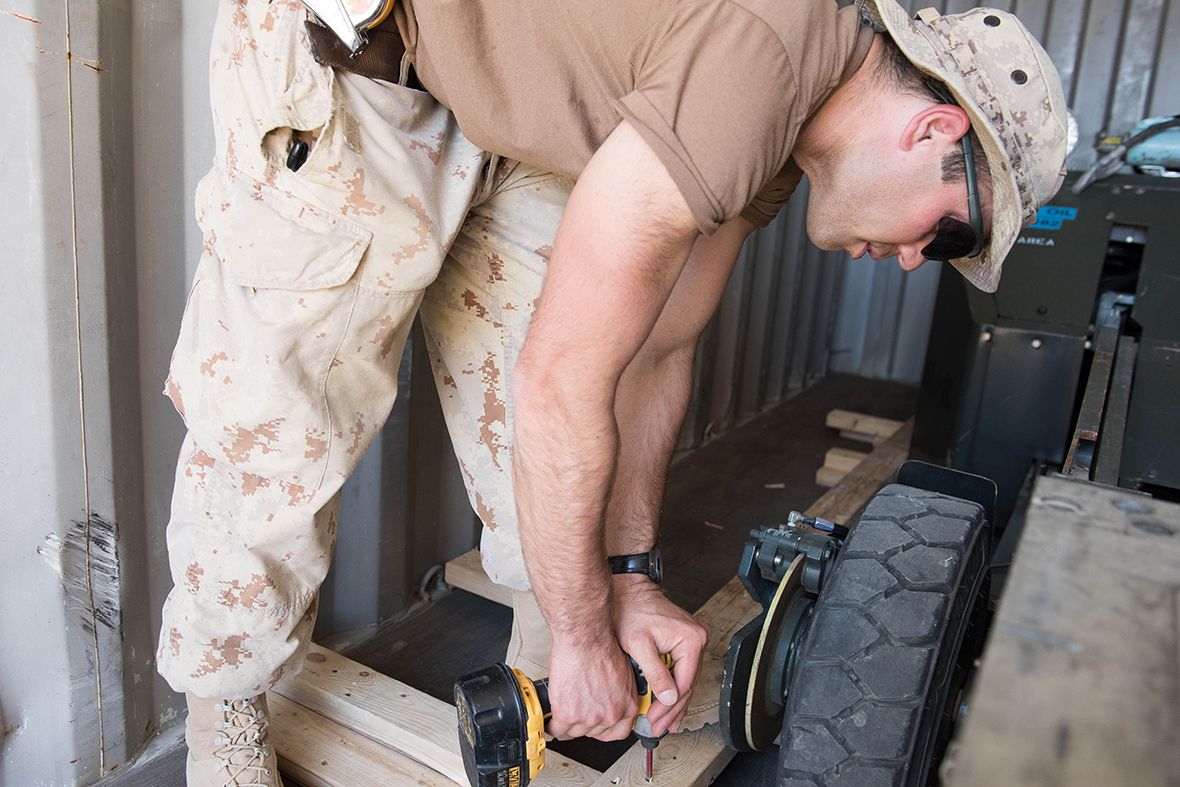
By: JTF–I Public Affairs Officer
DND Press Release:
Operation IMPACT began with the delivery of more than 1.6 million pounds of equipment from Canada to Kuwait in the late summer of 2014. This materiel was brought over to establish a base camp from which to conduct air operations to degrade, dismantle and eventually defeat the Islamic State of Iraq and Levant. After approximately 20 months of operations, Camp Canada is expanding in line with the refocused mandate of Operation IMPACT.
“We have levelled new ground here, expanding into land given to us to level and repurpose,” said the Joint Task Force Support Component Adjudant. “Working from a plan and map designed for us by our engineers, we are creating more bed spaces and a larger morale and welfare area to meet the influx of new people. Our operations cell coordinates the efforts across the different specialist groups to ensure the wide diversity of projects and tasks are managed and completed on time. Our logisticians, engineers, and signals personnel have made much of the construction appear seamless.”
In a very short period of time, the Joint Task Force Support Component (JTFSC) expanded the camp by more than 10,000 square metres. The camp now includes new headquarters space, weight and cardio rooms, the new Canada House with a recreation area and a multi-purpose room, a new health services tent, and a chapel, among other necessary resources for camp personnel.
An expansion like this takes meticulous planning and consideration of different units’ requirements.
“The detail that must go into the planning phase is intense,” said the Construction Engineer Commander. “For example, when planning to build a new medical inspection room, we had to think about the base, the walls and structure of the tent, the drainage material required in addition to ensuring the amount of power supply was adequate. A medical unit must have air conditioning, multiple power outlets for computers and medical equipment, lighting, and anything else they require to provide clinical care to members. All the infrastructure on base has unique needs, so we plan multiple times for each project, checking and rechecking the details, overcoming snags as we progress through our projects.”
When expanding the camp, JTFSC worked quickly to avoid any significant impact on operations. This could be a challenge when moving personnel to new sections of the camp, but JTFSC was up to the task. For example, they tore down and set up the medical inspection room in a day, with many volunteers lending a hand to ensure the process was smooth and quick. They then moved the medical unit into their new site and soon had them up and running.
“With the help of members of JTFSC, the move was done with little disruption to services and in a very smooth fashion,” said the Task Force Surgeon.
Another example is Air Task Force – Iraq (ATF-I), which was relocated in March to join Joint Task Force – Iraq. The JTFSC was able to ensure initial operational capability within just two days of ATF-I’s arrival, with little disruption to their communications capability. This relocation was recently finalized with the official closure of a satellite location of ATF-I.
Overall, constructing the new camp and moving personnel to new areas have gone quickly and smoothly.
“I have been moving throughout Camp Canada as this expansion process has been underway and appreciate the heavy lifting and intensive labour of the JTFSC,” said Chief Petty Officer Andrew Tiffin, JTF-I Sergeant Major. “In a matter of weeks the camp has been completely transformed and to all those involved I want to say thank-you on behalf of the Commander, Brigadier-General James Irvine, and me.”
Monday, April 4, 2016
Additional 200 CAF Still Waiting to Deploy to OP IMPACT
In a new report released this morning, David Pugliese, of The Ottawa Citizen, reported that despite it being almost two months since the Liberal's announced their new mission to Iraq - the extra 200 CAF personnel have yet to be deployed.
Here here is his report:
In the first week of February, Prime Minister Justin Trudeau announced the changes in the Iraq mission. The CF-18s were to be withdrawn while the Auroras and refuelling aircraft would stay. Canada’s contribution would actually increase by more than 200 personnel, with those extra staff being assigned to the training mission, according to the government.
The CF-18s now are gone. There are still 600 Canadians overseas on the Iraq mission, according to the Department of National Defence. That figure includes the estimated 69 special forces personnel.
"But the promised extra personnel have yet to deploy. An exact timeline has yet to be determined,” Canadian military spokesman Capt. Kirk Sullivan told Defence Watch. “The Canadian Armed Forces is in the process of finalizing plans for the transitioning of the mission. Deploying military capabilities over thousands of kilometers into a theatre of operations requires careful planning, which takes time."
Monday, February 8, 2016
Canada in Iraq: Trudeau Outlines Canada's New ISIS Commitment
Written by: JDM, Canadian Forces Dispatch author
Last Updated: February 8, 2016 - 2:12 pm
In a nearly hour long briefing and question session, Prime Minister Justin Trudeau, flanked by Minister of Defence Sajjan, and Minister of Foreign Affairs Dion, outlines Canada's new mission against the Islamic State (ISIS) in Iraq and Syria.
Prime Minister Trudeau started the press conference by thanking the RCAF and its personnel for their service to Canada over the past year and half in the fight against ISIS. The Prime Minister made it clear, he believes that, "airstrikes can be useful...and there is a role for bombing in the short-term," however, he said, "they cannot ensure a long-term stability for the region."
As examples to support his opinion, Trudeau pointed to US led airstrikes in Afghanistan and Libya.
The Prime Minister stated that Canada is going to contribute and is committed to a multi-lateral robust mission to stabilize the region.
Canadian CF-18 fighter jets will halt their airstrikes on ISIS positions as of February 22, 2016, and will be withdrawn from the region. The CC-150 Polaris, and CP-140 Aurora aircraft will remain as part of the US-led coalition.
Canada will triple the size of its training force in Northern Iraq. Specifics on who Canada will be training are still vague - and should be outlined in a technical briefing by the Chief of Defence Staff later today. It is assumed that most of this training will be to the Kurdish Peshmerga forces that Canada's current 69 Special Forces trainers are currently working with. There were also some hints that some of the training might be for the Iraqi Security Forces in the northern region of Iraq. However, it was announced that the CAF will also provide medical personnel to the new training mission; something that is currently not part of OP IMPACT.
Prime Minister Trudeau announced that Parliament will debate and vote on this motion when Parliament resumes next week. However, with the Liberal Majority, it will likely not make any difference, as it is expected all Liberal members will support the motion. The Opposition Conservatives will likely be up-in arms over the withdrawal of Canada's CF-18s which can be seen as valuable in this mission, especially with the 10 RCAF Airstrikes already in February.
Prime Minister Trudeau has faced opposition on many fronts to maintain the CF-18 presence in Iraq and Syria - but has remained adamant that he will not back down from his election promise; this despite the fact that most polls continue to show that Canadians support the bombing mission. According to an Angus Reid poll late last week, it showed that only 27% of Canadians agreed with the Liberal plan to withdraw the CF-18s. While, 64% said the bombing should continue, or increase.
“We know Canada is stronger, much stronger, than a threat posed by a group of murderous gang of thugs,” Trudeau said.
Trudeau said his decision to pull the CF-18 fighter jets was guided by a “desire to do what Canada can do best” to assist affected regions.
“For us, this is the right approach,” he said.
Increased training efforts are “very much appreciated by the Iraqi government,” he added.
Canada's training mission will be an "Advise and Assist" mission. So the specifics seem not to have changed from Canada's current training mission, and CAF members will potentially still be on the front-lines of the Battle with ISIS - although will only fire-back when fired upon.
The difference in the Liberal plan is Canada will commit to sending small-arms and ammunition to those who the CAF is training. The mission will remain under the OP IMPACT banner until March of 2017; at which point the mission will be reviewed, and ensure it remains relevant before any extension is considered. Any changes will again be subject to parliamentary approval. The total number of personnel deployed under Operation IMPACT is increased to a maximum of 830 CAF members, from the previous mandated level of 600 personnel and 69 advisers working in an advisory and assistance role to the Iraqi security forces.
Over the next three years, Canada plans to commit $1.6 Billion to the region to combat ISIS. Much of this funding will go to Lebanon and Jordan who have seen the largest influx of refugees. A large portion of this funding will be directed to building local capacity to ensure long-term stability in the region. The humanitarian mission includes $840 million to provide water, shelter, health care, and sanitation. Another $270 million will be provided to assist countries that are helping refugees from the region.
In a statement by the interim Conservative Party leader Rona Ambrose, she called the withdrawal from the combat mission a “shameful step backward” for Canada.
“For generations, our men and women in uniform have fought bravely against those who violate human rights, and those who threaten and terrorize the innocent and vulnerable,” she said. “Today, in his first major foreign policy decision, the Prime Minister has shown that Canada is not ‘back’.”
Ambrose went on to call ISIS “the greatest terror threat in the world” and said pulling back threatens the safety of Canadians.
Today's announcement comes before the NATO Secretary meeting in Brussels later today.
In a statement on DND's OP IMPACT webpage reads:
"Subject to further discussions with the Government of Iraq and coalition partners, the Government of Canada is implementing a renewed and broadened whole-of-government approach to the fight against ISIL. The main areas of engagement are Human Assistance, Building Resilience, Political Engagement and Security and Stability. The CAF is responsible for the Security and Stability area and sees its contribution of military capabilities and personnel increased. The military engagement in Iraq and Syria under Operation IMPACT is extended until 31 March, 2017."
Last Updated: February 8, 2016 - 2:12 pm
In a nearly hour long briefing and question session, Prime Minister Justin Trudeau, flanked by Minister of Defence Sajjan, and Minister of Foreign Affairs Dion, outlines Canada's new mission against the Islamic State (ISIS) in Iraq and Syria.
Prime Minister Trudeau started the press conference by thanking the RCAF and its personnel for their service to Canada over the past year and half in the fight against ISIS. The Prime Minister made it clear, he believes that, "airstrikes can be useful...and there is a role for bombing in the short-term," however, he said, "they cannot ensure a long-term stability for the region."
As examples to support his opinion, Trudeau pointed to US led airstrikes in Afghanistan and Libya.
The Prime Minister stated that Canada is going to contribute and is committed to a multi-lateral robust mission to stabilize the region.
Canadian CF-18 fighter jets will halt their airstrikes on ISIS positions as of February 22, 2016, and will be withdrawn from the region. The CC-150 Polaris, and CP-140 Aurora aircraft will remain as part of the US-led coalition.
Canada will triple the size of its training force in Northern Iraq. Specifics on who Canada will be training are still vague - and should be outlined in a technical briefing by the Chief of Defence Staff later today. It is assumed that most of this training will be to the Kurdish Peshmerga forces that Canada's current 69 Special Forces trainers are currently working with. There were also some hints that some of the training might be for the Iraqi Security Forces in the northern region of Iraq. However, it was announced that the CAF will also provide medical personnel to the new training mission; something that is currently not part of OP IMPACT.
Prime Minister Trudeau announced that Parliament will debate and vote on this motion when Parliament resumes next week. However, with the Liberal Majority, it will likely not make any difference, as it is expected all Liberal members will support the motion. The Opposition Conservatives will likely be up-in arms over the withdrawal of Canada's CF-18s which can be seen as valuable in this mission, especially with the 10 RCAF Airstrikes already in February.
Prime Minister Trudeau has faced opposition on many fronts to maintain the CF-18 presence in Iraq and Syria - but has remained adamant that he will not back down from his election promise; this despite the fact that most polls continue to show that Canadians support the bombing mission. According to an Angus Reid poll late last week, it showed that only 27% of Canadians agreed with the Liberal plan to withdraw the CF-18s. While, 64% said the bombing should continue, or increase.
“We know Canada is stronger, much stronger, than a threat posed by a group of murderous gang of thugs,” Trudeau said.
Trudeau said his decision to pull the CF-18 fighter jets was guided by a “desire to do what Canada can do best” to assist affected regions.
“For us, this is the right approach,” he said.
Increased training efforts are “very much appreciated by the Iraqi government,” he added.
Canada's training mission will be an "Advise and Assist" mission. So the specifics seem not to have changed from Canada's current training mission, and CAF members will potentially still be on the front-lines of the Battle with ISIS - although will only fire-back when fired upon.
The difference in the Liberal plan is Canada will commit to sending small-arms and ammunition to those who the CAF is training. The mission will remain under the OP IMPACT banner until March of 2017; at which point the mission will be reviewed, and ensure it remains relevant before any extension is considered. Any changes will again be subject to parliamentary approval. The total number of personnel deployed under Operation IMPACT is increased to a maximum of 830 CAF members, from the previous mandated level of 600 personnel and 69 advisers working in an advisory and assistance role to the Iraqi security forces.
Over the next three years, Canada plans to commit $1.6 Billion to the region to combat ISIS. Much of this funding will go to Lebanon and Jordan who have seen the largest influx of refugees. A large portion of this funding will be directed to building local capacity to ensure long-term stability in the region. The humanitarian mission includes $840 million to provide water, shelter, health care, and sanitation. Another $270 million will be provided to assist countries that are helping refugees from the region.
In a statement by the interim Conservative Party leader Rona Ambrose, she called the withdrawal from the combat mission a “shameful step backward” for Canada.
“For generations, our men and women in uniform have fought bravely against those who violate human rights, and those who threaten and terrorize the innocent and vulnerable,” she said. “Today, in his first major foreign policy decision, the Prime Minister has shown that Canada is not ‘back’.”
Ambrose went on to call ISIS “the greatest terror threat in the world” and said pulling back threatens the safety of Canadians.
Today's announcement comes before the NATO Secretary meeting in Brussels later today.
In a statement on DND's OP IMPACT webpage reads:
"Subject to further discussions with the Government of Iraq and coalition partners, the Government of Canada is implementing a renewed and broadened whole-of-government approach to the fight against ISIL. The main areas of engagement are Human Assistance, Building Resilience, Political Engagement and Security and Stability. The CAF is responsible for the Security and Stability area and sees its contribution of military capabilities and personnel increased. The military engagement in Iraq and Syria under Operation IMPACT is extended until 31 March, 2017."
Subscribe to:
Posts (Atom)