Translate

Showing posts with label Kurdish Peshmerga. Show all posts

Wednesday, March 28, 2018

Canada Puts Hold on Kurdish Weapons Shipments

By: Murray Brewster, CBC News 

Kurdish security forces stand guard in their defensive position in Alton Kupri, on the outskirts of Irbil, Iraq, Thursday Oct. 19, 2017. (Khalid Mohammed/The Associated Press)
Up to $10 million worth of weapons originally purchased by Canada to help Kurdish fighters beat back ISIS could end up in the hands of the Iraqi government, or helping to support NATO's military training mission, said Defence Minister Harjit Sajjan.

The federal government originally promised the materiel — grenade launchers, sniper rifles, mortars, anti-tank rockets and other military equipment — over two years ago, when it first reconfigured the size and scope of Canada's contribution to the U.S.-led coalition fighting ISIS.

The fate of the weapons, currently stored in two warehouses in Montreal and Amman, Jordan, has been up in the air for months following the refusal of the central government in Baghdad to sign off on their transfer to separatist-minded Kurds.

Now, the defeat of ISIS on the battlefield is prompting the Liberals to overhaul the mission terms once again — and that includes reconsidering who will end up with the weapons.

"What we're looking at is, where are the needs?" Sajjan told CBC News.

"We are looking at where we can do the best capacity-building and at the same time looking at where we can best counter a resurgence of Daesh [ISIS]."

Fighting between the Kurdish peshmerga fighters and the Iraqi army, in the aftermath of last fall's Kurdish independence referendum, forced a halt to a program of training and assistance for Kurdish fighters conducted by Canadian special forces.
The threat of a new civil war

Critics of that support program have argued that arming the Kurds could help tip Iraq into civil war.

Thomas Juneau, a University of Ottawa professor and former analyst at National Defence, said the decision to arm the Kurds made sense back when ISIS was a primary threat and the peshmerga fielded the most effective local force on the battlefield.

Canada's policy is to support a united Iraq. Juneau said that with the defeat of ISIS as a military force, it's only natural that Ottawa's policy would tilt towards Baghdad.

"The need has changed," he said, and Canada needs to be taking steps now toward "fighting an insurgency and building a legitimate government."

In doing that, Juneau said Canada and the other allies will have to walk a fine line.
Articulate a reason why it makes sense to transfer these weapons. Because at this point, I don't see that argument.- Peggy Mason, Rideau Institute

"We shouldn't jettison the Kurds," he said. "We shouldn't forget about them, but there needs to be more support for Iraqi national institutions."

One compromise solution might be to use the weapons to bolster the planned NATO military training mission, which Canada has signalled in a preliminary way it will support.

"If the needs are there for training capacity, and if our resources in terms of equipment — including weapons — are needed, we will look at that option," Sajjan said.

The minister added, though, that whatever Canada decides to do, it will talk to the Iraqi government to ensure "they are OK with it."

Canada will need to take a great deal of care if it opts to transfer the weapons to the Iraqi government, Juneau said.
'Thuggish, corrupt and incompetent'

The sectarian political divide between Sunni and Shiite — which led to the birth of ISIS in the first place — is still very much alive, he said, and the government of Iraqi Prime Minister Haider al-Abadi still has a long way to go in healing that rift and avoiding civil war.

"It was a government in that was extremely thuggish, corrupt and incompetent and significantly contributed to the emergence of [ISIS] in 2014," Juneau said. "It is in the interest of the international community to build [a] legitimate ... national government, not only in the Sunni areas but in the country as a whole."

Peggy Mason, president of the Ottawa-based think-tank Rideau Institute, said the Liberal government seemed surprised when fighting erupted between the Iraqi army and the Kurds, even though most seasoned observers saw it coming.

Canada and its allies have tended to treat Iraq as a military problem, with development money thrown in, she said.

"I think the government should explain to us exactly what they are trying to do in Iraq and, if there is a role for those weapons, what is it?" Mason said.

"Articulate a reason why it makes sense to transfer these weapons. Because at this point, I don't see that argument."

There are also more basic questions that still need answers, including whether that stock of weapons meets the current conditions, said Juneau.

"Everything that's been sitting in warehouses for two years — is that right equipment? We don't know that it is," he said. "Chances are it might be, but then again it might not. It should be re-evaluated, not cancelled."

ABOUT THE AUTHOR

Murray Brewster,  Defence and security

Murray Brewster is senior defence writer for CBC News, based in Ottawa. He has covered the Canadian military and foreign policy from Parliament Hill for over a decade. Among other assignments, he spent a total of 15 months on the ground covering the Afghan war for The Canadian Press. Prior to that, he covered defence issues and politics for CP in Nova Scotia for 11 years and was bureau chief for Standard Broadcast News in Ottawa.

Monday, February 19, 2018

On Target: Expanded role in Iraq doesn’t make sense for Canada


By: Scott Taylor, The Chronicle Herald

Last Thursday Defence Minister Harjit Sajjan emerged from a NATO conference in Brussels and hinted that Canada would be willing to support the Alliance’s request for an expanded training role in Iraq.

Sajjan could offer no specifics on how many Canadian soldiers would be involved or what their role would be, but somehow he remains confident that this time around the training of the Iraqi Security Forces will be successful.

What makes Sajjan’s broad comments laughable is that we still do not know which faction in this complex conflict our soldiers will be training. We presently have a few hundred elite commandos sitting idle in Iraq because their training missions in support of both Kurdish militia and Iraqi government troops were suspended after these two groups began fighting each other.
There is also a handful of Canadian combat engineers in Iraq conducting training in regard to the clearing of booby traps and unexploded munitions.

However, in a bizarre move last June, the Trudeau Liberals promised to keep our military in Iraq until the summer of 2019. At the time this arbitrary mission extension was announced, Daesh (a.k.a. ISIS or ISIL) was already reduced to a handful of diehard zealots fighting in the rubble of Mosul.
As expected, the last of the Daesh evildoers were eliminated just a few weeks later, and equally predictable was the fact that the diverse factions of the U.S.-led, anti-Daesh coalition began to fight among themselves.

Now NATO wants to bring in more elite trainers to train more young Iraqi men how to fire weapons and drive tanks. With Canada having pledged our military support for another 18 months at least, the decision for Sajjan to join this new training mission was a no-brainer. We are there anyway, doing nothing until the summer of 2019, so why not?

However, for Sajjan to think this is a successful strategy is sheer folly.

Albert Einstein’s definition of insanity is doing the same thing repeatedly and expecting a different result. This is exactly what the West continues to do in conflict after conflict, with the same failed result of increased violence and instability instead of the desired end-state of a secure environment.

In Afghanistan in 2001, after the U.S.-led invasion toppled the Taliban, NATO members including Canada contributed troops to the International Security Assistance Force (ISAF). As the name implies, ISAF was to assist the Afghans in achieving a secure environment.

The plan from the outset was for NATO to train and equip a self-sufficient Afghan Security Force. Seventeen years later, the alliance has trained hundreds of thousands of young Afghan males how to kill, and poured in massive arsenals of weaponry in the name of security.

The result has been a steady increase in factional violence and a free-fall descent into violent anarchy. The proposed solution by NATO generals? More training and more weapons for Afghans.

In 2003, following the U.S. invasion of Iraq, the decision was made by the administration of President George W. Bush to immediately disband all of Saddam’s security forces — army, police, border guards, the lot.

This resulted in months of absolute anarchy, looting and factional bloodletting. As the Iraqi insurgency grew around them, the Americans began recruiting, training and equipping a new Iraqi security force.

By the time President Barrack Obama withdrew U.S. troops from Iraq in 2011, the Americans had trained and equipped hundreds of thousands of Iraqi soldiers.

However, when Daesh spilled into Iraq from Syria in the summer of 2014, this U.S.-trained force collapsed like a cheap suitcase. The huge, U.S.-supplied arsenal of modern weapons and armoured vehicles were abandoned to Daesh with hardly a shot fired.

Now that Daesh has finally been defeated in Iraq, NATO’s answer is to train more Iraqis how to kill and to bring in more weapons. Sajjan agrees to send Canadians and he assures reporters that this time it will work.

By Einstein’s reckoning, our defence minister is completely insane. And he is not alone.

Tuesday, February 13, 2018

Future of Canada's Role in Iraq Still Uncertain

By: David Pugliese, The Ottawa Citizen

Defence Minister Harjit Sajjan will travel to Rome and Brussels from February 13-15 to participate in a meeting of defence ministers from the main force contributors in the war against the Islamic State. Sajjan will also participate in a meeting of NATO defence ministers.

His trip comes as the Liberal government has yet to decide what comes next for Canadian military personnel involved in the war against the Islamic State of Iraq and the Levant.

Training by Canadian special forces for Kurdish personnel is still suspended.

Sajjan said in late December that he hoped to have a better idea of the future direction of Canada’s mission in Iraq even as the U.S. and Iraq have declared Islamic extremists defeated.

Sajjan said at that time the Canadian Forces leadership was developing options for what is to come next and that advice was expected in early 2018.

The Liberal government has extended Canada’s mission in Iraq until at least March 2019.

Following the meetings on ISIL, Sajjan will travel to Munich from February 16-17 to attend the annual Munich Security Conference, a global forum focused on defence and security related issues, his office said.

Friday, December 22, 2017

CAF Plan to Arm Kurds On Hold

By: David Pugliese, Defence Watch 

During a Wednesday news conference with Defence Minister Harjit Sajjan, I asked the minister a direct question about the Iraq mission: “Do you still intend to provide arms to the Kurds?”

The minister, talking to journalists via phone from London, England, seemed taken back and stumbled for an answer. Sajjan then reverted to his standard talking points about wanting to work closely with the Iraqis. But he really didn’t answer the question.

Then on Thursday, the reason became apparent. Justin Ling broke a story on Buzzfeed noting that the weapons purchased by Canadian tax dollars are in storage in Montreal. The Iraqi government is refusing to give approval for the weapons to be delivered to the Kurds, he reported.

Iraqi troops attacked Kurdish forces after the Kurdish Regional Government announced plans to declare an independent state in the northern part of the country, including the oil-rich area around Kirkuk.

Iraqi forces seized Kirkuk and the Kurds retreated. The region faces further upheaval, as protests started on Monday after demonstrators took to the streets calling for the resignation of the Kurdish Regional Government. A number of government buildings were set on fire, and at least five protesters have been killed by security forces and dozens wounded. Some hospital officials put the number of wounded at more than 100.

The demonstrators are protesting against government corruption, the failure of the KRG to provide basic services and a lack of pay for civil servants — and there remains anger over the failed independence bid.

Prime Minister Justin Trudeau announced in February 2016 that Canada would provide weapons to the Kurds in support of their efforts against ISIL.

Canada had planned to provide the Kurds with gear including .50-calibre sniper rifles equipped with silencers, 60mm mortars, as well as Carl Gustav anti-tank systems, as well as grenade launchers, pistols, carbines, thermal binoculars, cameras, scopes and medical supplies.

But that doesn’t appear like it is going to happen.

No specific delivery plans have been made by Canada, a Department of National Defence spokesman told Defence Watch.

“As is the case for any CAF operation, our contributions are constantly under assessment in order to ensure all appropriate strategic and tactical steps are taken,” he noted. “Canada also has a responsibility to ensure any provisions of equipment and small arms such aid is provided under the right conditions.”

The lethal equipment that has been acquired to date is currently stored in Canada at the 25 Canadian Forces Supply Depot in Montréal, QC. The supply depot is run by the Canadian Materiel Support Group, which is responsible for providing operational-level support through the delivery of materiel and assigned logistics services to the CAF and the DND.

Monday, November 13, 2017

Canada Suspends Aid to Iraq and Kurdish-Peshmerga

By: David Pugliese, The National Post 

Canada has suspended the assistance its special forces were providing to Iraqi security forces as Iraqi and Kurdish forces battle each other.

Canadian commandos have been working with the Kurds and some assistance has been provided to the Iraqis.
Canadian special forces look over a Peshmerga observation post, Monday, February 20, 2017 in northern Iraq.THE CANADIAN PRESS/Ryan Remiorz

But, “given the fluidity of the current situation, Canada’s Special Operations Task Force has temporarily suspended the provision of assistance to various elements of Iraqi security forces,” Canadian Forces spokesman Col. Jay Janzen said Friday.

“Once more clarity exists regarding the interrelationships of Iraqi security forces, and the key priorities and tasks going forward, the Task Force will resume activities,” he said. “In the interim, they will continue to monitor the situation and plan for the next potential phases of operational activity.”

The Ottawa Citizen reported Wednesday that Canada is also reviewing its program to supply the Kurds with small arms.

Canadian special forces have been providing assistance to the Kurds and Iraqis in their war against ISIL. But with ISIL in retreat, Iraqi and Kurdish forces are now fighting each other. The Kurds want to separate from Iraq and, during the war against ISIL, they seized large portions of the country. That included the city of Kirkuk and nearby oil fields, which hold an estimated 40 per cent of Iraq’s oil.

The Iraqi government declared the recent Kurdish referendum supporting independence illegal and sent troops to retake Kirkuk and other territory.

The Kurds offered on Wednesday to put any drive towards independence on hold, but that was rejected by the Iraqis.

However, on Friday, Iraqi Prime Minister Haider al-Abadi ordered a 24-hour ceasefire. That “should allow a joint technical committee to work on the deployment of federal Iraqi forces in all disputed areas, including Fish-Khabur, and the international border,” Abadi said in a statement.

The Kurds have welcomed the pause in fighting.

Janzen said the Canadian Forces will continue to support the U.S.-led coalition battling ISIL. That includes the provision of transport helicopters, a medical facility and surveillance and intelligence gathering capabilities.

“Only the provision of assistance to various elements of Iraqi security forces has been temporarily suspended,” Janzen said.

The previous Conservative government sent Canadian special forces to northern Iraq to train the Kurds starting in 2014. That program was continued by the Liberals.

But the issue of training and arming the Kurds has been highly controversial from the start. Kurdish leaders openly acknowledged their intent was to eventually create an independent state. The arms were needed both to fight against ISIL and to defend an independent state, they said.

The Kurds say at least 30 of their soldiers have been killed and another 150 wounded in ongoing clashes.

Bayan Sami Abdul Rahman, the Kurds’ top diplomat in Washington, said it’s past time the international community end its “laser focus” on ISIL and begin to address Iraq’s many underlying problems.

“’We are laser-focused on (ISIL).’ That has been the mantra of the past few years,” Abdul Rahman told The Canadian Press. “But to continue to say we’re laser-focused on (ISIL) is missing the obvious truth of what is happening in Iraq.”

Wednesday, October 18, 2017

Does Threat of Iraq Civil War Endanger Canadian Special Forces?

By: David Pugliese, The Ottawa Citizen 

Is civil war looming in Iraq?

Iraqi Vice President Ayad Allawi seems to think that could be a possibility. In an interview with the Associated Press, he warned a “civil war” could erupt over the Kurdish-administered city of Kirkuk.

The city of Kirkuk falls outside the autonomous Kurdish region in the northeast Iraq. But the Kurdish referendum for independence from Iraq included the city.

Allawi is particularly worried about how militias in Iraq will react to the Kurds retaining Kirkuk.

The head of the Asaib al-Haq militia Qais Khazali warned worshippers in a sermon Sunday that Iraq’s Kurds were planning to claim much of north Iraq, including Kirkuk, for an independent state, after Iraq’s Kurds voted for independence in a controversial but non-binding referendum two weeks ago, Associated Press reported.

That, he said, is a “foreign occupation.”

But Allawi, a former prime minister, told Associated Press that any move by the country’s Popular Mobilization Front militias, which include the Asaib al-Haq, to enter Kirkuk would open the door to “violent conflict.”

“The government claims they control the Popular Mobilization Forces. If they do they should restrain them, rather than go into a kind of civil war. And there should be a restraint on Masoud Barzani and the Peshmerga not to take aggressive measures to control these lands,” said Allawi.

In July, Gen. Raymond Thomas, head of U.S. Special Forces Command, suggested any moves toward independence by the Kurds, who now control the city of Kirkuk and 40 per cent of Iraq’s oil, will lead to conflict. The Iraqis will not stand by and allow independence to happen. “I don’t think they’re going to say, sure, take the oilfields and Kirkuk and go your way,” Thomas told a security forum. “It’s not going to go peacefully.”

If fighting breaks out between the Kurds and Iraqis what happens to the Canadian special forces in the Kurdish area? Are they pulled out or do they sit tight?

There is no word from the government or Canadian military. They have been relatively silent on the Kurdish independence vote and its implications for the Canadian military mission.

Since the fall of 2014, Canada has been providing equipment and military training to Kurdish troops in northern Iraq as part of the coalition against the Islamic State of Iraq and the Levant, or ISIL.

Barzani has cited Quebec’s quest for independence as one of the reasons why he and his fellow Kurds are entitled to their own country.

The Kurds were able to use the war against ISIL to seize portions of Iraq, such as Kirkuk. That gave them control of 40 per cent of Iraq’s oil and a steady flow of cash from oil sales to bolster their quest for independence.

In November 2015, Kurdish forces, with support from coalition fighter jets including Canadian CF-18s, helped push ISIL out of the city of Sinjar. The Kurdish flag – not Iraq’s – was erected over the city. “Long live Kurdistan,” Kurdish gunmen shouted as they fired their weapons into the air.

Barzani has said the Kurds will never surrender any of the territory they now hold in Iraq.

Tuesday, March 7, 2017

Taylor: Canada’s Actions in Iraq are Sending Mixed Messages

By: Scott Taylor, The Chronicle Herald 

From 2002 to 2014 the Canadian military had one primary mission and a singular focus and that was, of course, the mission in Afghanistan. The rotations of contingents into Kandahar became so routine that the Canadian Army constructed a full-scale replica of the southern Afghanistan region at Canadian Forces Base Wainwright for training purposes.

Finbarr O'Reilly/Reuters
Canadian Forces members in southern Afghanistan in 2006. 
In preparing for their deployments, troops would spend upwards of six months conducting exercises in mock Afghan villages with civilian actors playing the part of Afghans, including pretend local journalists because, as we all know, perception can soon become confused with reality.

We did not win the war in Afghanistan but those days of purpose and clarity have been replaced with a perplexing set of new challenges for the Canadian military.

We currently have approximately 200 elite commandos deployed to train Kurds in northern Iraq. These Kurds are battling Daesh — aka ISIS evildoers — and this is a good thing. However, the Kurds fly the flag of Kurdistan and proudly display that same symbol on their uniforms. As a show of soldierly camaraderie, the top-level decision was made to allow Canadian trainers to also wear the bright red, white and green flag of Kurdistan on their uniforms.

The problem with this practice is that Kurdistan is not a recognized state, and the Canadian government’s stated policy is to support a unified, post-Daesh Iraq (i.e., not an independent Kurdistan).

The Kurds have clearly stated they are fighting to establish their own country and will therefore not submit to the central Iraq authority that Canada purports to support.

The last Daesh stronghold in Mosul is under an allied siege that, although it may take months yet, will result in a Daesh defeat. At that juncture Canada will have to make some serious choices, as the most likely scenario will see the present allied, anti-Daesh coalition begin to battle each other for the spoils.

Since the summer of 2015, a contingent of approximately 200 Canadian trainers has been deployed to Ukraine on a mission that is due to expire at the end of this month. The rationale for our troops being there is to boost the capability of the Ukrainian military to resist pro-Russian Ukrainian rebels in the country’s eastern provinces.

Russian President Vladimir Putin has been widely condemned for assisting the pro-Russian Ukrainian rebels with the provision of weapons and training.

But it begs the question: If it is wrong for Putin to take sides in a simmering civil war in Ukraine, even when it is on his doorstep and involves ethnic Russians, how can it be a good thing for Canada to be facilitating a military build-up on the other side of the battle lines? Training and equipping young men to fight does not seem like the smartest path towards a peaceful resolution in any conflict.

Then there is the commitment to put 450 Canadian troops in Latvia on a non-permanent, rotational basis beginning this June. The Canadian contingent is part of a 4,000-strong multinational NATO force intended to deter Russian aggression against Latvia, Lithuania and Estonia. As full-fledged NATO member states, all three Baltic States have the alliance’s assurance of collective defence.

This virtual handful of NATO combat troops is being described by some as a tripwire, with defence analysts speculating that an actual Russian attack would capture the Baltic States within 60 hours — with or without these 4,000 allied soldiers. In other words, unless the NATO treaty is not worth the paper it is printed on, we are committed to protecting the liberty of these nations. Having our troops dangle as bait up on the Russian border therefore seems an unnecessary provocation.

Canada does not have an unlimited defence budget and therefore any money spent on building necessary infrastructure to house our contingent in Latvia means infrastructure dollars not spent on upgrading our bases here in Canada.

Then, of course, there is the long-delayed decision on where to send an additional 450 peacekeepers in Africa. Prime Minister Justin Trudeau remains adamant that Canada will send in this force of UN Blue Helmets — along with a mission budget of $500 million. He just still doesn’t know exactly where or why.

Almost makes one yearn for the good old days of the war in Afghanistan.

Thursday, February 9, 2017

Iraqi Kurds to receive sniper rifles, anti-tank weapons, mortars from Canada

By: David Pugliese, The National Post 

Canada will provide long-range sniper rifles and anti-tank weapons to the Kurdish forces fighting the Islamic State (ISIL) in northern Iraq, the Department of National Defence said Wednesday.

Prime Minister Justin Trudeau announced a year ago that Canada would arm the Kurds, and DND said Wednesday the list included .50-calibre sniper rifles equipped with silencers, 60mm mortars, as well as Carl Gustav anti-tank systems. Details about the numbers of each type of equipment were withheld for security reasons.

Other gear includes grenade launchers, pistols, carbines, thermal binoculars, cameras, scopes and medical supplies.

DND did not say when the arms would be delivered.

“We are currently working through the administrative, legal and various supply arrangements to enable the delivery of equipment,” DND spokesman Daniel Le Bouthillier said Wednesday. “Exact delivery dates will depend on the Government of Iraq, as well as the availability of the identified equipment for delivery.”


But a Kurdish general told a Kurdish news outlet that within a month, Canada will make good on its promise.

“It should include weapons, military equipment and devices for the size of a battalion — everything, not including vehicles,” Brigadier General Hajar Ismail, director of coordination and relations at the Kurdish Ministry of Peshmerga told Rudaw, a Kurdish media outlet. “The paperwork is done, Baghdad has signed off.”

Related
Trump’s vow to use torture against ISIL won’t affect how Canada fights in Iraq, general says
Matthew Fisher: What happens after Mosul falls will set the new status quo for region
Kurds urge Canada to provide heavy weapons for war against ISIL, as well as for their independence

Canada required that the Iraqi government provide written approval to proceed with the provision of the equipment to the Kurds.

It took until December before the Iraqis did that, according to DND.

The issue of arming the Kurds, who have been trained by Canadian special forces, is highly controversial. Kurdish leaders openly acknowledge their intent is to eventually create an independent state. They argue it is their right to break away from Iraq, pointing to Quebec’s attempts to leave Canada as an example. The arms are needed both to fight against ISIL and to defend an independent state, Kurdish leaders have said.

It is unclear why Iraq took almost a year to approve Canada’s arming of the Kurds. In the summer, Defence Minister Harjit Sajjan said the delay was due to bureaucratic roadblocks and not resistance from the Iraqi or Turkish governments.

The U.S. military already has provided Kurdish units with mortars, anti-tank weapons and armoured personnel carriers. The U.K. announced last year it had shipped heavy machine guns and ammunition.

In August 2016, Germany resumed its weapons shipments to the Kurds. Such shipments were halted after it emerged that some of the weapons Germany previously supplied to the Kurdish Peshmerga had turned up on the black market.

Germany’s latest shipment included 1,500 rifles, 1 million rounds of ammunition, three armoured vehicles and 100 MILAN guided missiles.

Friday, December 16, 2016

Battle for Mosul will shape Canada's ground commitment in Iraq

Canadian special forces launch a mission from a base in Erbil, Iraq, on Nov. 14, 2016
Canadian special forces launch a mission from a base in Erbil, Iraq, on Nov. 14, 2016 (Murray Brewster/CBC)
By: Murray Brewster, CBC News 

Canada will continue to have a military mission in Iraq through 2017, but the size and scope of it have yet to be determined, the country's defence minister said in advance of an international meeting with allies battling ISIS.

Defence planners have been spinning various scenarios for months, but the Liberal government committed — when it overhauled the mission against ISIS last February — to reviewing the deployment of special forces, helicopters, surveillance planes, an air-to-air refueling jet and a military field hospital.

The assessment is due by March of next year, but the last budget numbers put before Parliament have set aside only $41 million for the operation, less than one-third of what's being spent in the current budget year.

'We need to make sure that troops we have trained are up to the level where they can hold the gains they have [made].'
- Defence Minister Harjit Sajjan

Earlier in the fall, the country's operations commander, Lt.-Gen. Steve Bowes, said the military had been given orders, but its "posture is not oriented towards" an extended mission.

Asked on Wednesday whether the military commitment would continue, Sajjan told CBC News: "Absolutely."

Iraqi security forces are still involved in the battle to retake Mosul, the country's second-largest city, from deeply entrenched ISIS fighters. Iraqi forces are being aided by Canadian and allied special forces soldiers, who are providing not only advice, but covering fire.

"We need to make sure that troops we have trained are up to the level where they can hold the gains they have [made]," Sajjan told CBC News.

Whether the Kurds and the Iraqis can effectively provide security is a fundamental question and consideration, he said.

"We entered when Iraqi security forces couldn't hold the ground and do what they are supposed to do. So, the last thing you want to do is just leave without making sure you've answered that question."
Teaching new lessons

If you listen to the Kurds, whom Canadians have been training since the fall of 2014, the answer is they need a different kind of support once Mosul has been cleared of extremists.

One of the Kurdish Peshmerga commanders taking part in the battle, Brig. Adel Rash, recently made a pitch to Canada's deputy commander of special forces for specialized training in counter-insurgency warfare.

The training Canadian special forces have provided to the Kurds thus far involves traditional combat skills, not the intelligence-driven shadow warfare that characterized the decade-long combat commitment in Afghanistan.
ANALYSIS | What happens once Mosul is recaptured from ISIS?
Canadian forces shooting first at ISIS to protect civilians, allies

Most military planners, including many at the Pentagon, expect ISIS to revert to a guerrilla war once it has been driven out of Mosul.

"We are in need of training courses," Rash said in an interview with CBC News. "ISIS activity is changing towards an insurgency and we need to be prepared. We expect Canadians to play a good role."
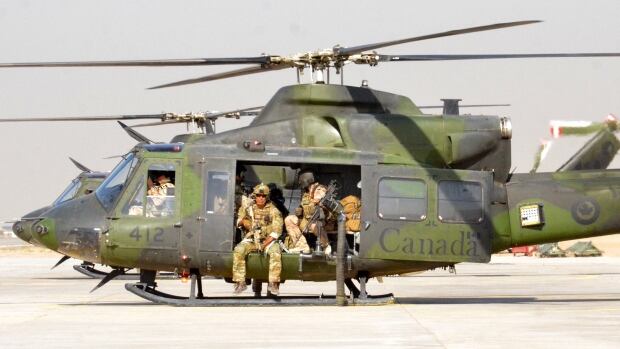
A CH-146 Griffon lands in a field northwest of Erbil. The helicopter detachment is a recent addition to Canada's mission in Iraq. (Murray Brewster/CBC)
Government ministers from countries taking part in the campaign to defeat ISIS will get an update on where the fight could be headed at a meeting in London on Thursday.

Sajjan was asked whether he is laying groundwork within the Liberal government for an extended mission that would involve preparing the Kurds for a guerrilla war, in much the same fashion that Canada trained Afghan forces to take on the Taliban.

He left the door open to that possibility.

"The goal is always to eliminate the threat," Sajjan said. "That is the goal, but we will have to assess, at the time, what is needed."

A liberated Mosul will need police forces, reconstruction and development to get back on its feet, and those will be major considerations in the upcoming assessment, he added.

If it is any indication, military engineers recently put the finishing touches on a semi-permanent military camp in Erbil, which houses different elements of the mission.

Major construction only started in June and some barracks just opened last month at the $3.75-million centre.

Monday, December 5, 2016

Canadian Weapons Arriving to Kurdish Fighters

By: Scott Taylor The Chronicle Herald 

It was with very little fanfare that Canada announced last week that the Iraqi government has finally agreed to let us provide weapons to Kurdish militiamen. The weapons were originally promised by Prime Minister Trudeau back in February, but that’s when things got a little bit sticky.

In the fall of 2014, the Harper Conservative government sent Canadian Special Forces trainers to Iraq for the purpose of combating the spread of the then-rampant Daesh evil-doers. Canadians were told that our troops were going to Iraq because it made things seem a little simpler than was actually the case. Our Special Forces Operatives were sent to the city of Erbil and when they stepped off the plane, they were greeted by a sign reading Welcome to Kurdistan.

It has indeed been Kurdish fighters that our soldiers have been training and assisting for the past two years. These Kurds are very open about their desire to establish an internationally recognized, independent nation. They already consider themselves to be a separate state; they fly their own flag and sing their own anthem.

Yes, they have proven to be motivated and effective fighters against Daesh, but they have also clashed with Iraqi security forces loyal to the Baghdad regime and their Shiite militia allies. Canada’s official position is that we are supporting a unified Iraq under one central Baghdad government. Naturally, that same Baghdad regime did not like the idea of Canada supplying weapons to Kurdish troops, whose openly stated, and oft repeated aim, is to break away from Iraq.

That sentiment of not providing more weapons to the Kurds was echoed by the Turkish government. Turkey is a NATO ally and they are presently dealing with a full-scale insurgency by Kurdish separatist forces in their eastern provinces. The revolt in Turkey is spearheaded by the Kurdish Workers Party (PKK), which is recognized by Canada, the U.S and the European Union to be a terrorist organization. Given the blurred lines between the various Kurdish militias, there are no doubt grave concerns on the part of the hard-pressed Turkish security forces that Canadian-supplied weapons will end up in the hands of the PKK, or worse, the Al-Qaeda Kurdish Battalions (AQKB).

While Canadian officials have not yet identified exactly which type of weapons we will provide the Kurds — or at what cost — their shipment has admittedly not yet been sent.

Which means there is still time to rethink this flawed logic.

The allied campaign to recapture Daesh-held Mosul is now well underway. Progress has been slow and Daesh defenders have been determined, but the end result is not in doubt.

So if Canadian-supplied weapons will not arrive in time to assist in driving Daesh from Iraq, that means that they will only reach the battlefield in time to assist in the post-Daesh mayhem that will inevitably ensue.

Iraq has been engulfed in a horrific orgy of inter-factional bloodletting for the past 13 years and somehow the Canadian answer to the problem is to send in more weapons and to specifically train just one of the warring factions? Is training more young men to be soldiers the pathway to peace? Human Rights Watch recently reported that the Kurdish militias trained by the Canadians, and loyal to warlord Massoud Barzani, have been engaging in the ethnic cleansing of non-Kurdish minorities. This, of course, is not being done under the watchful eye of Canadian trainers — the Kurds are too clever for that.

Off the record, Canadian officers have admitted their Kurdish fighters are not angels, but they are the best of a bad lot.

Unlike those factions already involved in the conflict, Canada does not need to compromise its values or align with dubious allies. Thankfully, we have no dog in this fight and ultimately we will have no say in the final resolution. Which makes it all the more ludicrous that we would start pouring more weapons and munitions into an already raging conflagration over which we have zero control.

Canadian veteran fighting ISIL has been arrested in Iraq, his mother says

By: Stewart Bell,  Globe and Mail 

TORONTO — A Canadian military veteran who has spent the past six months fighting ISIL alongside Kurdish forces has been arrested in northern Iraq, his mother said in an interview Sunday.

Michael Kennedy, 32, was on his to Sulaymaniyah, trying to make it home to Newfoundland for Christmas, when he was taken into custody by Iraqi Kurdish authorities, said his mother Kay Kennedy.

“All I know is he’s been arrested and he’s in Erbil,” she said from Saint Vincent’s, Nfld. She said she got the news from a Kurdish friend of her son’s. “He said nobody knows the reasons.”
Family handout Michael Kennedy is a military veteran
He has been held since Tuesday in Erbil, said Kennedy, adding the affair has been hard on her because she lost another son, Pte. Kevin Kennedy of the 2nd Battalion, Royal Canadian Regiment, to a roadside bomb in Afghanistan on April 8, 2007.

Michael Kennedy was taken into custody Tuesday, his mother says
Michael Kennedy was taken into custody Tuesday, his mother says. Seen here in a family photo - at the KAF Cenotaph while on deployment to Afghanistan. 
It is not unusual for the Kurdistan regional government of Masoud Barzani to arrest Western volunteer fighters as they are leaving Iraq on the grounds they have overstayed their visas and must pay fines.

But Kennedy’s visa was valid until January, said his mother. She said she last spoke to her son Monday when he was in Dohuk and he told her he was coming home through Sulaymaniyah, Dubai and Toronto.

She said he was at a restaurant with friends and sounded upbeat but when she called him back later that night, his mood had changed. “I could tell by his voice there was something off.”


Several dozen Canadians, many of them military veterans, are among the hundreds of foreign volunteers assisting Kurdish militias on the frontlines against the Islamic State of Iraq and the Levant.

Ottawa has verbally discouraged Canadians from taking up arms against ISIL but has not stopped them from traveling or arrested them upon their return, although some have been questioned by the RCMP.

Kennedy served in the Canadian Forces for 13 years, including a Navy deployment in the Gulf of Aden, she said. Three months after leaving the military in March, he made his way to northern Syria.

“He decided to go over there in June. He decided to go fight ISIS after reading about what those Kurdish people were going through,” his mother said. “Michael decided to do this as sort of a humanitarian thing.”

He fought initial with the YPG militia in northern Syria. About a month ago, he crossed into Iraq and has been fighting around Shingal, his mother said. The area is where ISIL kidnapped and murdered hundreds of Yazidis.

“Then he decided, ‘After six months there, mom, it’s time for me to come home, I’m exhausted,’” she said, adding he had told her, “’I’ll be home for Christmas, mom.’”

She said she had contacted Global Affairs Canada over the weekend and was told “they’d get back to me.”

A report released last summer by the Institute for Strategic Dialogue said the hazy legality around foreign anti-ISIL fighters has led to confusion and uncertainty. The study found that military veterans fighting with the Kurds were motivated partly by a desire to “finish the job” they had started in their respective armies.

Monday, November 21, 2016

War Against ISIL Marches On as Canada, Allies Wonder What Trump will Ask of Them

By: Murray Brewster, CBC News

The night Donald Trump was elected, Canadian Brig.-Gen. Dave Anderson was at a reception hosted by the U.S. Embassy in Baghdad.

When the results were finalized, the American ambassador gave a short speech to his anxious Iraqi hosts and assured them Washington's commitment to the war-ravaged country is "real and it's long-term."

A little later, Anderson spoke with the chairman of the U.S. joint chiefs of staff, who told him: "If you look at a problem set through the lens of national interest, the solution doesn't change."

It was a comment that stuck with him as the uncertainty unfolds around the incoming U.S. administration's foreign policy.

"National interest trumps everything," said Anderson, who leads the multi-national liaison team that's helping advise the Iraqi defence ministry.

Canadian Special Forces troops launch into a mission from a base in Erbil, Iraq, on Nov. 14, 2016
Canadian Special Forces troops launch into a mission from a base in Erbil, Iraq, on Nov. 14, 2016 (Murray Brewster/CBC News)
Related
Kurdish PM opposes Canada's 'organized migration' of Yazidis
Canadian special forces shooting first at ISIS to protect civilians, allies
Canadian troops watching for human rights abuses as battle for Mosul rages

Because national interests don't change, he said, he believes there's a real commitment from Washington, and right the way through the coalition, to stick it out in Iraq until ISIS is totally defeated and the region is stable.

"We shouldn't see a dramatic change and as long as the government of Iraq wants us here, we'll be here," Anderson told CBC News.

The determination to destroy the extremist group may not be in question, but the stage is set for what could be some pretty brutal policy battles about how that can be accomplished.

The election of Trump as the next U.S. president has the potential to radically reshape the future of the war against the Islamic State over the long-term.

It will have little influence, in the near-term, on the unfolding, bloody campaign to retake Iraq's second-largest city, said Anderson and other coalition commanders who spoke to CBC News.
A Peshmerga soldier guards an outpost on Zardek Mountain, northwest of Erbil, in northern Iraq. (Murray Brewster/CBC)
The direction of the daily, grinding battle in Mosul was set months ago. Trump's election is also not expected to change the plan to encircle and eventually liberate Raqqa, the de facto ISIS capital in Syria.

The Obama administration intended those campaigns to be conducted with a "light footprint" from the Western point of view, utilizing local ground forces, Syrian opposition groups, coalition special forces, as well as western artillery and air power.

But key decisions on how and where to proceed afterwards await the president-elect when he takes over in January.
What will Trump ask of Canada?

Whether Trump agrees with the strategy or wants it changed to include a more robust Western involvement is unclear.

During the U.S. election, Trump threatened to "bomb the hell out of ISIS" and suggested he was prepared to upend the carefully laid military plans.

"I know more about ISIS than the generals do, believe me," Trump said last August. "I'd hit them so hard your head would spin. There's nobody bigger or better at the military than I am."

He promised to send up to 30,000 U.S. troops to the region, but has since backtracked with a pledge to pressure other countries to fight.

The big question for Canada will be whether a Trump administration will demand more than just military training and non-combat support in the next phase of the campaign.
Lt.-Col. Steve Hunter, commander of the Canadian Special Forces Operating Regiment in Iraq on Nov. 14, 2016. (Murray Brewster/CBC)
The Liberal government withdrew Canadian fighter-bombers from the anti-ISIS air campaign last February, but tripled the number of special forces trainers and increased specialized intelligence and surveillance of extremists in Iraq.

Trump has made no secret of the fact he believes allies should pay and do more around the world.

The campaign to liberate Mosul could drag on for months as Iraqi security fight their way, block by block, through the city that once housed two million people.

It is now a warren of rubble, booby traps, roadside bombs and sniper ambush points.
Shadow warfare expected next

Almost every senior military commander on the ground, American, Canadian, Iraqi and Kurdish, is expecting ISIS to revert to a hit-and-run insurgency once Mosul and surrounding villages are cleared.

That presents a problem.

Most of the training Canadian special forces have provided to the Kurds involves traditional combat skills, not the intelligence-driven shadow warfare that characterized the decade-long combat commitment in Afghanistan.

Brig. Adel Rash, a Peshmerga commander in the region of Zartak Mountain on the outskirts of Mosul, told CBC News that his forces would welcome counter-insurgency training and he wants the Canadians to deliver it.

"We are in need of training courses," he said in an interview. "When ISIS activity changes to an insurgency, I need to be prepared."

Whether the Trudeau government, with its planned return to peacekeeping and deployment of a battle group in eastern Europe, is interested in such an ongoing commitment is unclear.

Judging by federal budget documents, the Liberals have given themselves the option of pulling the plug next year.

Only $41.9 million has been set aside for the operation in Iraq in 2017-18, two-thirds less than what is being spent this year.

But now, one has to ask: Will Donald Trump allow Canadians to leave without consequence?

Thursday, November 17, 2016

Plan to Arm the Kurds stalled by Iraqi government

By: David Pugliese, Defence Watch 

Prime Minister Justin Trudeau said in February that Canada would be providing the Kurds with lethal military equipment.

That still hasn’t happened and the Canadian government can’t say when such shipments might take place.

But at the Canadian Forces briefing Wednesday to provide an update on the progress of the Iraq war, details emerged about the holdup. Canadian officials said the arms have not been sent to the Kurds because the Iraqi government has yet to approve the shipment of such weapons.

The issue of arming the Kurds, who have been trained by Canadian special forces, is highly controversial. Kurdish leaders openly acknowledge their intent is to eventually create an independent state. They argue it is their right to break away from Iraq, pointing to Quebec’s attempts to leave Canada as an example. The arms are needed both to fight against ISIL and to defend an independent state, Kurdish leaders have said.

Strangely, other nations have received permission from the Iraqi government to provide weapons to the Kurds.

The U.S. military already has outfitted Kurdish units with mortars, anti-tank weapons and armoured personnel carriers.

The UK recently announced it had shipped heavy machine guns and ammunition.

In August, Germany resumed weapons shipments to the Kurds. Such shipments were halted in January after it emerged that some of the weapons Germany previously supplied to the Peshmerga had turned up on the black market.

Germany’s latest shipment included 1,500 rifles, 1 million rounds of ammunition, three armored vehicles and 100 MILAN guided missiles.

Wednesday, November 16, 2016

Vance: Canadian Special Forces have fired first at Islamic State

By: Michelle Zilio, The Globe and Mail 

The country’s top soldier says that Canadian troops have shot first at Islamic State forces in Iraq, reopening the question of whether the military is engaged in a combat mission against the terror
group.

Image result for canadian special forces iraq

While government and military officials have said Canadian Forces are allowed to fire in defence in Iraq, General Jonathan Vance, chief of the defence staff, made it clear Tuesday that troops have fired first at the Islamic State. However, he said this does not mean the mission is turning from a “train, advise and assist” role into a combat one.

“The use of force by our soldiers on this operation ... has only been used in a defensive mode to ensure that our partners were not subject to an attack that they couldn’t deal with,” Gen. Vance told the House of Commons defence committee.

“If you are suggesting that our forces have been manoeuvring so as to provide offensive fire, thereby taking the fight to the enemy, then you are wrong.”

Speaking to reporters after the meeting, Gen. Vance insisted Canadian troops have always been allowed to fire first in the fight against the Islamic State – something he says he has made clear throughout the mission.

“I’ve said this publicly. We do not have to be shot at first to defend ourselves,” Gen. Vance said. “I don’t think that any Canadian that’s listening out there would think that we need to be shot first before we can take defensive actions.”

For instance, Gen. Vance said that Canadian Forces would shoot first if Kurdish forces do not have the ability to defend themselves against suicide bombers, in order to protect themselves and their partners. He said he is confident Canadian troops are still operating within the parameters of the mission mandate outlined by the Liberal government.

Defence Minister Harjit Sajjan echoed Gen. Vance’s comments Tuesday, saying Canadian troops need to be able to defend themselves, their partners and civilians.

“When it comes to self-defence and the rules of engagement, you do not have to wait to be shot at first,” Mr. Sajjan told reporters. “The last thing you want to be able to do is put a restriction like that onto our troops.”

Last year, the Liberals campaigned on the promise to end Canada’s combat mission in Iraq. Although the government withdrew Canada’s six CF-18 fighter jets from the U.S.-led coalition in February, it ramped up the training mission by increasing the number of troops on the ground to more than 200 from 69. Canadian troops were first deployed to Iraq in October, 2014, under the previous Conservative government.

The federal government continues to insist Canada’s involvement in the coalition against the Islamic State is not a combat mission. However, the opposition parties disagree.

“The Liberal government ... continues to mislead Canadians by insisting that we are in a non-combat role,” Conservative defence critic James Bezan said during Question Period Tuesday. “Will the defence minister finally be honest, acknowledge that our troops are in combat, and apologize for misleading Canadians?”

NDP Leader Tom Mulcair said outside the House of Commons that Prime Minister Justin Trudeau and his government have to stop “beating around the bush” and call the Iraq mission what it is.

“Mr. Trudeau promised word for word in his program to put an end to Canada’s involvement in the combat mission in Iraq. He has not done that. This is a combat mission. When you have soldiers on the front line firing first, you’re in a combat mission.”

Wednesday, October 26, 2016

Video Appears to Show Canadian Special Forces in Battle Against ISIL Near Mosul

By: Ben Makuch, Vice News

New video released last week shows Canadian special forces setting up a mobile anti-tank rocket atop a Kurdish armoured vehicle, in one of the clearest pictures yet showcasing Canada's role on the frontlines of the war to retake Mosul from the Islamic State.

Screen grabs of the footage, broadcast by Kurdish news station Rudaw and posted to Twitter and Instagram, show several special forces, in desert fatigues with Canadian flag patches, helping set up what appears to be an anti-tank missile launcher. A cropped version of the footage—without the Canadian soldier—appeared in a nightly newscast.

Canadian SOF (CSOR) in — Abraxas Spa (@AbraxasSpa) October 24, 2016

New video appears to clearly show  a Canadian commando sets up an ATGM atop an armoured vehicle, with the Canadian flag patch visible on his left arm. Screenshot.
In recent months, Ottawa has become cagey in giving details about special forces operations in northern Iraq, especially when it comes to the battle to retake Mosul.

Recently, military brass has admitted that their special forces have been increasingly on the front lines—but only under an 'advise and assist' mandate

But the video, which shows the special forces setting up the missile for what appears to be an offensive attack against an Islamic State position in the distance, shows just how integrated Canadian personnel are to the fight.

Other sections of the video shows the special forces peering through what seems to be a Canadian-made scope, sitting on the armoured vehicle's machine gun.

The video appears to be from the Hamdaniya region, east of Mosul, where had been held by the Islamic State until recent days, when the Iraqi and Kurdish fighters pushed the terrorist group out of several towns in the area.

When asked about the photos, Defense Minister Harjit Singh Sajjan told VICE Canada from a defense ministers meeting in Paris that while Canada has brought heavy anti-armour weaponry to Iraq, it's intended for self-defense.

"There is no secret here," Sajjan said in response. "Our troops have all the necessary equipment to be able to apply the rules of engagement, if necessary.

"I was actually very upfront from last year, when I visited the troops on the ground, that we need to bring some anti-armour capability in, where the previous government did not have this. So we brought the right resources in for our troops, in making sure that they could protect themselves, the partners they're working with, and other coalition partners as well."

A spokesperson from the Department of National Defence wouldn't comment on the Rudaw video featuring Canadian special operations forces.

"To ensure the safety and protection of our deployed personnel, the exact details of ongoing operations will not be disclosed," DND spokesperson Dan Lebouthillier told VICE Canada. "Our mandate has not changed. We are there to train, advise, and assist the Iraqi security forces and it is important at this time to let them do their work."

The covert role Canada's special operations forces play in the fight against ISIS in Iraq has been questioned in recent weeks, just as international forces ramp up an assault on Mosul. Both of Canada's elite soldier units, the Canadian Special Operations Regiment and Joint Task Force 2, are deployed in Iraq as part of the training mission.Media in Canada is particularly interested in the operations of special operations soldiers in Iraq since they were deployed in 2014, some calling for the Trudeau government to simply admit the country is serving in a combat role and directly engaging ISIS forces.

In an early October news conference, the Justin Trudeau government conceded Canadian special forces previously came under direct ISIS attack and returned fire, but that these occurrences were "sporadic in nature and have not resulted in any Canadian injuries." But in March 2015, a Canadian special forces member died in a frontline Peshmerga controlled position in what was deemed to be a friendly-fire incident.

At the same news conference earlier in the month, defence officials maintained the mission in Iraq was swiftly transforming into a more offensive engagement demanding Canadian troops travel to the frontlines with their Peshmerga counterparts. The Rudaw footage confirms just that: the Peshmerga forces on camera clearly show an entrenched frontline position, with heavy fighting and a large Kurdish force within direct sight of IS fighters.

Canada currently has 200-plus special forces stationed in Iraq advising Kurdish forces and calling in airstrikes.

Tuesday, October 18, 2016

Canadian Special Forces providing crucial support in Battle of Mosul

By: Steven Chase, Globe and Mail 

Canadian Armed Forces members are playing a modest but vital supporting role as the operation to retake Mosul, the last major stronghold of Islamic State militants in Iraq, gets under way.

How dangerous it might get for Canada’s special forces soldiers will depend on whether the Kurdish troops they’re advising are assigned a difficult role in reclaiming Mosul, which has been occupied by the Islamic State jihadis since June, 2014. It will also depend on whether their political masters in Ottawa allow Canadian soldiers to enter Mosul during what could be difficult block-by-block urban warfare.

Up to 210 Canadian special forces troops are advising Kurdish peshmerga fighters who are teaming up with Iraqi government forces, Sunni tribal fighters and Shia militias to encircle and take Mosul. The Trudeau government, which promised in the 2015 election campaign to end a combat role in Iraq, insists what soldiers are doing there is not combat even though Canadian special forces soldiers are guiding the Kurds from the front lines and exchanging fire with enemy troops from time to time.

Related:
Explainer: A guide to the battle of Mosul, and why it matters in the war against Islamic State
Interactive: Untangling the Middle East: A guide to the region's shifting relationships

Right now, Canadian military advisers are with Kurdish unit commanders near the battlefront or in peshmerga encampments around Erbil, the capital of Iraqi Kurdistan which is 85 kilometres from Mosul, or farther south in Kirkuk, 175 kilometres from the IS stronghold.

Canadian generals last week warned the public that the environment in Iraq has grown more dangerous for Canada’s soldiers as their task now focuses on advising the Kurds in battle rather than merely training them in open-air classrooms far back from the conflict.

Overhead, two Canadian spy planes, the CP-140 Auroras, are gathering intelligence that will be used by coalition planners to generate lists of Islamic State targets to be bombed. As well, the Royal Canadian Air Force’s Polaris tanker is refuelling coalition warplanes conducting the bombing raids.

Not far from the front line – but not so close as to be in harm’s way – up to 60 Canadians will be operating a field hospital to treat the wounded Kurds, Iraqi government forces or their allies. The Role 2 facility will not be big but will triage, resuscitate, treat and care for injured soldiers until they return to duty or are evacuated.

Ottawa is tight-lipped on the role that Canada’s 21st Electronic Warfare Regiment is playing in Iraq. The military has reportedly deployed members of this regiment, which can intercept and decipher enemy communications.

Canadian Defence Minister Harjit Sajjan was tight-lipped Monday when asked exactly where Canada’s soldiers are located on the battlefield, citing operational security.

“For force protection, I won’t tell you exactly where they will be, but they will be always in an advise-and-assist mission. They will always be within [or] behind the front lines to conduct their work and … they will always have the right tools and abilities to be able to protect themselves if needed.”

The fight to retake Mosul is being billed as the largest military effort in Iraq since the United States withdrew its combat forces in 2011.

David Perry, a senior analyst with the Canadian Global Affairs Institute, said Canadians are also helping to assemble targeting “packages” for air commanders who are selecting bombing targets.

He said it’s possible the fight to retake Mosul could end up going relatively slowly because the coalition will be trying to avoid killing civilians inside the city. Mr. Perry said estimates of civilians inside Mosul are as high as one million people.

A U.S.-led air campaign has helped push Islamic State from much of the territory it held, but 4,000 to 8,000 fighters are thought to remain in Mosul.

Monday, October 17, 2016

ISIL’s defeat in Mosul is now inevitable, Canadian generals say

By: Matthew Fisher, National Post 

Iraqi Prime Minister Haider al-Abadi went on state television early Monday to announce that the crucial battle to end Islamic State’s ruinous reign of terror in Mosul and western Iraq had finally begun.

“Today I declare the start of these victorious operations to free you from the violence and terrorism of Daesh,” al-Abadi said, using the Arabic acronym for ISIL.

Before the prime minister told Iraqis that “God willing, we will win,” two Canadian generals who are privy to the battle plans said they were convinced the end of the hardline jihadists in Iraq was inevitable and fast approaching.

The long anticipated assault on Iraq’s second largest city, where 2.2-million people lived when ISIL seized it two years ago, was likely to be bloody and could take some time, Brig.-General Greg Smith and Brig.-Gen Dave Anderson, who both served multiple tours in Afghanistan, said during interviews from Baghdad.

“Let there be no doubt, Mosul is a very big city and they have been working on its defences,” said Smith, who is the chief of staff of the U.S.-led Combined Joint Forces Land Component Command. “We are agreed that it is going to be a very tough, complex fight.”

“It really depends on the enemy,” said Anderson, who heads the coalition’s strategic advisory team, which works closely with Iraq’s security ministries. “One way to look at it is that there is a hard outer crust. It depends how soft and squishy the middle is. Getting through the crust will be hard. Once inside the crust we will see whether they stand and fight to the last man or run away as they did in Ramadi and Fallujah.

“I think that they are on their back foot, I really do. The pressure has been relentless and it has been like that for six to eight months. Some of them have picked up sticks and been seen in Syria. The reports we are getting is that the morale in Mosul is quite fragile. We will see how it works. The war has a pace and rhythm all of its own. The enemy always gets a vote.”

ISIL revels in celebrating many diabolical acts including the sexual enslavement of women its captures. It has produced a seemingly endless stream of ghastly videos which depict prisoners being drowned, beheaded, thrown from buildings and set fire to in cages.

For Anderson one of the many reasons ISIL had to be eliminated was its “appalling” treatment of children as suicide bombers and its “craven willingness to hide among the civilian population inside the city or when they try to flee…

Related
'The liberation of Mosul is beginning': Iraqi troops gather for battle over ISIL stronghold
Who will control Mosul after ISIL? Groups fighting extremists are bitter rivals with competing interests
The Pentagon is confronting a new threat from ISIL in Iraq: exploding drones

“There are bad cats in Mosul and we have every confidence that the Iraqi security forces will be there to deal with them.”

It was just over two years ago that the Iraqi army fled Mosul rather than defend it, as ISIL swept in from the west. Smith and Anderson, who were sent to Iraq earlier this year along with about 30 other Canadians to assist the Iraqi army with its training and development, lauded the ISF’s leadership for turning that pathetic situation around and for its methodical approach to regaining territory from ISIL along the Euphrates and Tigris River valleys.

The Iraqi forces were “completely different” today than they were two years ago, Anderson said. Their confidence had been “born of success” over “the last 14 or 15 months and certainly the last three months.”

“If they had morale problems in 2014 as Daesh pushed them out, they are working hard to push them back,” Smith said, referring to ISIL by its Arabic acronym. “They are very motivated. They are the ones driving the timeline.
AHMAD AL-RUBAYE / AFP / Getty ImagesIraqi forces gesture as they gather at the Qayyarah military base, about 60 kilometres south of Mosul, on Sunday.
“When I got here Daesh was just outside the gates of Baghdad. It was still counter-attacking and had some ability to manoeuvre. It is not the same Daesh any more. They are constantly getting defeated by the ISF. It was impressive to see their determination and aggression in taking down Fallujah. It is not a small place. They fought hard.”

The ISF counter-offensive has reached as far west on the Euphretes as Haditha, which is about 100 kilometres from the Syrian border. Further north, in the Tigris Valley, they have forced ISIL out of Ramadi and Fallujah and are now within 40 kilometres of the southern and east outskirts of Mosul while the Kurdish Peshmerga, who have Canadian military advisers, are about 15 kilometres to the north of the city.

“There is still a ways to go to the Syrian border but it was gone exceptionally well,” Smith said. “They are effectively in the process of isolating ISIL (around Mosul) now. Daesh remains a formidable foe but they are transitioning more into a terrorist force which means they are losing. It is pretty much all going against them.”

To wear down ISIL before what could be a ferocious street-by-street fight for Mosul, allied warplanes have accelerated their bombing campaign using “critical” targeting information provided by RCAF spy planes and a Canadian intelligence cell based in Kuwait, the generals said. There have also been constant artillery barrages on ISIL forces by US Marines and French gunners.

After Mosul falls, Anderson, who is to remain in Baghdad until next summer, will help advise the Iraqis about how to consolidate their territorial gains while continuing to move against ISIL-held pockets in towns and rural areas in the west of the country.

“The upcoming battle is taking a lot of the bandwidth of everyone, but all the right indications and all the right discussions are there to ensure that we – that is, the Iraqi security forces – can not only take Mosul but hold it afterwards,” Anderson said.

As for life today in ISIL’s so-called Iraqi capital, “by all accounts it is horrific,” Anderson said. “There is a complete absence of personal freedom. In many cases people are being pressganged in order to man the lines. One of the reasons that the ISF is unified is that Daesh is evil and really needs to be destroyed and those people liberated from its influence.”

Thursday, October 6, 2016

General: Canadian Special Forces have been in Firefights with ISIS

The Canadian Press 
Information from a Technical Briefing from the Canadian Forces

Canadian special forces troops are spending more time on the front lines in Iraq and have engaged in a number of gunfights with Islamic insurgents in the last few months.

Brig.-Gen. Peter Dawe, deputy commander of the special forces, says the additional time on the front lines is a result of Kurdish allies needing less training.

Instead, Dawe says his soldiers are helping and mentoring the Kurds as they launch attacks against forces from the Islamic State of Iraq and the Levant.

Dawe says Canadian troops have fired back on a number of instances either to protect themselves or friendly forces.

He says no Canadian soldiers have been killed or injured in the recent battles.

Canada has about 200 special forces soldiers helping Kurdish forces fight ISIL in northern Iraq.

Canada’s role in fight against ISIS
Military officials, Lieutenant-General Stephen Bowes, Brigadier-General Peter Dawe, provide update on Canada’s role in fight against ISIS on Thursday, Oct. 6, 2016.


Monday, September 26, 2016

Still no Canadian weapons for the Kurds – will the small arms ever be sent?

By: David Pugliese, Defence Watch 

Prime Minister Justin Trudeau said in February that Canada would be providing the Kurds with lethal military equipment.

That still hasn’t happened and the Canadian government can’t say when such shipments might take place.

The issue of arming the Kurds, now being trained by Canadian special forces, is highly controversial. Kurdish leaders openly acknowledge their intent is to eventually create an independent state. They argue it is their right to break away from Iraq, pointing to Quebec’s attempts to leave Canada as an example. The arms are needed both to fight against ISIL and to defend an independent state, Kurdish leaders have said.

In addition, some Iraqi MPs have spoken out about U.S. efforts to directly arm Kurdish forces, saying that is a violation of the Iraqi constitution. Turkey has also expressed concerns about the U.S. supplying weapons to Syrian Kurdish militias.

In the summer Defence Minister Harjit Sajjan said the delay in providing small arms to the Kurds was due to bureaucratic roadblocks and not resistance from the Iraqi or Turkish governments. “We have to go through a process for us here in Canada but we have to respect the process in Iraq as well,” he said. “I’ve spoken to the Iraqi Defence Minister. He’s assured me once we have completed our process that he will expedite it.”


There are a number of Canadian regulations that have to be dealt with before the arms can be provided, Sajjan added.

Defence sources say Canada is trying to purchase the small arms on the open market.

Meanwhile, other nations are shipping heavy weapons to Kurdish Peshmerga forces.

The U.S. military already has outfitted such units with mortars, anti-tank weapons and armoured personnel carriers.

The UK Secretary of State for Defence Michael Fallon recently announced in the Commons addition equipment to be supplied. “We have supplied not only heavy machine guns to the Peshmerga but ammunition for those heavy machine guns,” he said. “I announced earlier in the summer a fresh gift from us of ammunition for those heavy machine guns, and that ammunition has now arrived and is being used.”


In August, Germany resumed weapons shipments to the Kurds. Such shipments were halted in January after it emerged that some of the weapons Germany previously supplied to the Peshmerga had turned up on the black market.

Germany’s latest shipment included 1,500 rifles, 1 million rounds of ammunition, three armored vehicles and 100 MILAN guided missiles.

Tuesday, August 16, 2016

CTV Exclusive: Canadian-trained forces clearing the way to retake Mosul from ISIS

Josh Dehaas, CTVNews.ca Writer
Published Monday, August 15, 2016 10:00PM EDT 

Exclusive: Canadian-trained forces clearing the way to retake Mosul from ISIS

CTV News has learned that Canadian-backed Kurdish forces have spent the past 48 hours clearing the way to take back Mosul, the last major stronghold of ISIS and its de facto capital in Iraq.

The Peshmerga spent Sunday and Monday reclaiming a dozen villages near Iraq’s second-biggest city, sources told CTV’s Mercedes Stephenson.

The Canadian Special Forces helped the Kurdish troops plan the operation and remained close enough to the combat that they could see the fighting and provide real-time advice -- but they were not on the frontline.

RELATED STORIES
Iraqi Kurds advance near ISIS-held city
U.S., allies announce 'key moment' in fight against ISIS

No Canadian soldiers were injured.

David Fraser, a former NATO commander in Afghanistan, called Mosul “the most important objective” for the U.S.-led coalition.

ISIS fighters took the city in June 2014, despite being vastly outnumbered by Iraqi soldiers.

Fraser said taking Mosul back will “demonstrate to the world that (ISIS) is losing ground.”

In fact, more than 40 per cent of the territory seized by ISIS has already been taken back since coalition airstrikes began on Aug. 8, 2014.

Canada was contributing to those airstrikes until February, when the Liberals pulled Canada’s CF-18 fighter jets, while at the same time tripling the number of Special Forces trainers on the ground.

At the time, Interim Conservative Party leader Rona Ambrose called the withdrawal from combat a “shameful step backward.”

More than 3.2 million Iraqis have been displaced from their homes due to the ISIS, according to information gathered by the International Organization for Migration.