Translate

Showing posts with label War in Afghanistan. Show all posts

Monday, April 23, 2018

Operation Medusa: The Furious Battle that Saved Afghanistan from the Taliban


A book review by Brett Boudreau
Authors: Major-General (Ret’d) David Fraser and Brian Hanington

Publisher: McClelland and Stewart, 272 pages
Click to purchase from Amazon


It is now 2018, and the Canadian military ended its training mission in Afghanistan 4 years ago, wrapped up its combat operations there almost 7 years ago, and fought Operation Medusa nearly 12 years ago. During that long campaign, the Canadian Armed Forces transformed into an accomplished, middle-power combat force and the mission came to meaningfully impact the national political scene. The Canadian public also re-connected with the military – with a fervour unlike that for any military undertaking since World War II.

For about a decade, Canadians were subject to regular, daily media reporting about the Afghanistan campaign in its many guises and associated twists, turns and tragedies. A considerable number of books, periodicals, theses, articles and movies have dissected pretty much everything there is to know or of interest about the modern-day Afghanistan campaign.

As it turns out, however, in the book Operation Medusa, retired Major-General David Fraser and Brian Hanington have explored otherwise well-trod ground to produce a compelling and immensely readable first-hand account that sets out a panoply of new insights through Fraser’s unique perspective as operational commander. The pair recount in lush detail, and with crisp, precise prose the many challenges of command in modern-day conflict. They have given important reasons for those interested in current events, security and leadership to read and learn more about how a six-month period of the Afghanistan campaign molded and shaped the Canadian military of today (and indeed, NATO).

This book thankfully does not feature the hagiography that has served to diminish some other written accounts by general officers. This book is not about personality criticisms – excepting brief comments about one British brigadier, who also comes under fire in General Sir David Richards’ autobiography Taking Command (Richards wrote the foreword to Operation Medusa, and as the overall ISAF commander was Fraser’s boss during most of the time in question). Nor is this book it prideful boasting about penetrating insights and strategic acumen that somehow escaped other lesser commanders, or a personal history of life changing experiences in youth and military assignments that presaged later success: instead, it is about team work. The scene-setting is mercifully brief – the West was attacked by terrorists who were allowed to plot and plan from Afghanistan, and Kandahar was a challenging location where Canada could add strategic value to the Alliance mission – “and, so it began.”

Operation Medusa, the first large-scale ground combat operation in the Alliance’s history, is widely agreed to be the key engagement to date of the entire NATO campaign. Kandahar is the second largest city in Afghanistan and was the spiritual heart of the Taliban during their rule of the country from 1996-2001. By early 2006, the Taliban had massed several hundred or even thousands of fighters nearby in defensive positions amongst the population and terrain with which they were intimately familiar, and could move with impunity. The city, and province of the same name – and indeed the whole of the south of the country – was at risk of again falling under their direct control. The Taliban were determined to test the newly- arrived and under-strength international NATO forces, which up to that point had operated in Kabul and in the north and west of the country, all relatively safe.

Had the effort to rout Taliban forces failed then, it is probable that Kandahar would have fallen, and risked the loss of the entire South of the country, providing an immense psychological boost to the Taliban as well as being a devastating blow to Alliance credibility. A defeat here would also have emboldened other states, terrorist groups and state-sponsored malign actors to more openly challenge NATO, being viewed as unwilling to sustain combat casualties needed to win wars.

This account sets out the road to the battle and the fight itself, from the person most responsible to orchestrate the effort at the operational level. This perspective is a welcome addition to the existing literature, being distinct from soldier-against-enemy soldier tactics or the other end of the spectrum where higher headquarters are consumed with considerations of personalities, politics and grand strategy.

A number of factors argued against military success in southern Afghanistan in 2006. Non-U.S. NATO members were just starting to learn what they had gotten themselves into. Limited NATO forces operated in an area more than 200,000 square kms large, or nearly the size of the United Kingdom. Staff regularly dealt with more than 30 major operations and incidents a day including attacks by a resurgent Taliban. A skeptical population was disillusioned from years of continual war and withheld support to back whoever would emerge the winner. Afghanistan’s capacity to deliver effective governance did not exist, or was limited, or was affected by endemic corruption of local and national authorities. A schizophrenia also bedeviled NATO as it tried to square the circle between a U.S.-heavy counter-terrorism “close with the enemy and destroy” interest and an Alliance effort decidedly more geared to supporting reconstruction and development. Conditions on the ground were not yet conducive to that, and any efforts to make a difference were limited by a lack of officials with the requisite expertise from contributing nations.

The telling of this story does not pull punches about the challenges, including starting out with a Canadian military inexperienced in modern-day combat and commanding forces at brigade level (c. 5,000 soldiers) in significant, joint operations. Nor does it hold back from explaining how national caveats or restrictions on the use of a country’s forces affected the operation. Many nations did not want to dispatch forces to the south where there was direct combat, fearing that casualties would result in domestic pressures to pull out altogether. The combination of constraints meant the campaign was hobbled from the start by a mission of “arbitrary limitation”. As Fraser recounts, “during Operation Medusa many nations simply would not show up to fight at all. Planning was agony. Even when the operation was only days away, we weren’t certain who would support us at H-Hour [the start of a military activity].“

In the face of great stress, we also learn the importance of “lively discussions” among peers, subordinates and superiors as a means to explore the best way to achieve the mission and limit casualties in the face of a determined enemy – and how, after “disagreeing daily on how that should be done,” they just got on with it.

The tone, style and format – with 20 chapters and an epilogue named with one-word action verbs – set a brisk pace. The terminology is made entirely manageable through careful attention to clarity of language, supplemented by helpful descriptive notes for the layperson. This is an accessible read for all and while scrupulously balanced, is not without wry commentary. In describing the challenges of coordination and command for instance, Fraser writes, “Here’s a surprise: the complexity of joint action between governmental agencies from multiple countries working on foreign soil to serve populations whose languages they don’t understand on behalf of a nascent democracy at war with a terrorist insurgency using the proceeds of illegal drug production to acquire weapons from neighbouring states did not turn out to be as easy as our deputy ministers assumed.”

Readers may be struck by the paucity of support at the time in theatre by both CIDA (the Canadian development agency) and Foreign Affairs. Fraser recounts that in 2006, he had to make do with a single representative advisor from each of CIDA and Foreign Affairs, and only after making a case for the help. At this stage of the mission, departments struggled mightily to evolve expeditionary capability to give weight and purpose to the 3-D (defence, diplomacy, development) effort. The death of diplomat Glyn Berry in January 2006 when a vehicle he was travelling in struck an IED, set back efforts by Foreign Affairs for several months to deploy more civilians to theatre, as the department frantically examined duty-of-care issues and how to deploy staff safely in a raging counter-insurgency. It was not until 2008-09, following the recommendations of the Manley Panel that the Canadian civilian contribution improved from a handful of persons to a world-class effort of more than 100 from multiple departments and agencies. Sadly, these important lessons have not been captured in any detail from a whole-of-government perspective.

And, yes, current Defence Minister Harjit Sajjan features briefly, in a factual recounting of his important contribution drawing on his heritage and background as a police officer.

My one quibble is a desire for the book to have set out at least a short treatment of the effort, energy and attention expended in theatre to detainee handling during the period in question. Operation Medusa is neither the book nor the place for a detailed account of the Canadian-transferred detainee saga. Still, the challenge of dealing with detainees captured on the battlefield had been brought into stark relief by the American experience during the Iraq campaign, and was already a keen topic of discussion in the Canadian Parliament in early 2006.

The agreement signed in December 2005 by Chief of the Defence Staff General Rick Hillier and Afghan Defence Minister Rahim Wardak informed how Fraser operated with respect to Canadian-transferred detainees – recalling that NATO did not have their own agreed policy on the matter and so each nation followed different rules about what to do. By early 2007, those overseeing the effort in Ottawa understood the need to build Afghan capacity faster, and in May 2007 a new transfer arrangement was in place – reinforced by policy, standard operating procedures, a robust monitoring regime, training and better infrastructure. In November 2009, Fraser, along with his Canadian boss Lieutenant-General Mike Gauthier and Hillier testified to a special Afghanistan-related Parliamentary committee about the subject. There, Fraser recalled his remit before leaving for Afghanistan – the Canadian strategic intent, he was told by Hillier, would be affected by three things: careful attention to avoid Afghan casualties (‘civcas’), Canadian casualties, and detainees. It was a stricture that informed Fraser throughout his command.

Early in the book, Fraser surprises with the admission that prior to deployment he had studied and reflected on the prospect for casualties, telling Hillier in a PowerPoint briefing that the expected death toll would be “between forty and forty-two Canadians between February and November of 2006,” [it turned out to be 36] and was told “now take that slide out and never show it again.” Given the human and financial cost, the book inevitably and rightly concludes with the necessary “Was it worth it?” question. Entitled “Tally”, this chapter provides some of the book’s most important insights. Fraser sets out context to explain why he answers ‘yes’, assessing that, “Operation Medusa was a costly and necessary fight that achieved a temporary effect that allowed the coalition and the Afghans to move on. We did not lose this battle. Had we, the consequences would have been grave…. Operation Medusa gave hope and opportunity to people, two precious gifts we all take for granted in Canada. The Canadian men and women who gave their lives did not die in vain, and those who were wounded may bear their scars with well-deserved pride.”

In addition to the Canadian toll of 159 military and three civilians killed and thousands injured during the mission, should be added the dozens now known to have committed suicide following their tour and the hundreds more who have developed mental health injuries. And, the jury may still be out on whether Afghanistan is yet “saved” from the Taliban. But today, Afghans are now fully responsible for the country’s security, and the army, air force and police in 2018 are decidedly and without question much more professional and better equipped. They are not asking anyone to do their fighting for them. They are doing the fighting – and the dying. And, for the first time, there are tentative yet substantive feelers regarding reconciliation.

Operation Medusa is an overdue account and a memorable addition to modern-day military literature that will feature on staff college reading lists throughout NATO. It is also a wonderful primer on leadership. This is a notable work of non-fiction that will be surely be marked as a strong favourite to win a major national book award.

---

Brett Boudreau (Colonel, Ret’d) is a Fellow with the Canadian Global Affairs Institute and the author of We Have Met The Enemy And He Is Us, an examination of the NATO strategic communications effort during the 2003-2014 ISAF campaign, and is available online at https://www.stratcomcoe.org/we-have-met-enemy-and-he-us-analysis-nato-strategic-communications-international-security-assistance

Friday, April 20, 2018

RCAF Mali Mission to use Afghanistan Playbook

By: Murray Brewster, CBC News

The Canadian helicopters going to Mali will be outfitted as they were in Afghanistan and will fly their missions the way they did there, senior military commanders said Thursday.

A French soldier stands inside a military helicopter during a visit by French President Emmanuel Macron to the troops of Operation Barkhane, France's largest overseas military operation, in Gao, northern Mali, Friday, May 19, 2017. Canada is sending six military helicopters to take part in the UN peacekeeping mission there.(Christophe Petit Tesson/THE CANADIAN PRESS-AP POOL)
The country's military operations command, Lt.-Gen. Steve Bowes, and the director of the strategic joint staff at National Defence headquarters, Maj.-Gen Al Meinzinger, testified before the House of Commons defence committee about the upcoming peacekeeping mission in the troubled West African country.

They and senior officials from Global Affairs were questioned repeatedly by Conservatives MPs about whether the planned year-long deployment, slated to begin operations in August, can be deemed a combat — or war zone — operation.

The officials sidestepped that description. Bowes said the Canadian military is accustomed to operating in "high-risk environments" and called Mali a "complex conflict zone."

Armed groups linked to al-Qaeda, ethnic Tuareg and Arab guerillas and government-supported militia have attacked each other, Malian soldiers, peacekeepers, aid workers and other civilians in a conflict that has raged on since late 2012.

The six Canadian helicopters — two CH-147 Chinook battlefield transports and four CH-146 Griffon armed helicopters — will carry out medical evacuations, shuttle around United Nations peacekeepers from other countries and occasionally support the so-called G-5 Sahel countries which are carrying out counter-terrorism operations against Islamic extremists.
A 'disciplined approach'

That means Canadian pilots and aircrew will have to be very deliberate in the way they conduct themselves, said Meinzinger, a former CH-146 Griffon pilot who was commander of the Canadian air wing in Kandahar near the end of Canada's Afghan war.

"Our approach to this mission from an aviation perspective will be very akin to the way we operated in Afghanistan," he said.

"A very disciplined approach as to how we accept missions at the front end and pre-execution ... we have a very disciplined way where we consider all of the potential threats from the weather to the fatigue levels of the crews."

Those air operations in Kandahar were carried out under the umbrella of Canada's five-year combat mission, which ended in 2011.

The Griffons — which can be outfitted with a multitude of weapons, including the C-6 machine gun, the M-134 Dillon six-barrel gatling gun and the GAU-21 .50 Cal machine gun — will be used in the role of "armed escort" for the Chinooks, the generals testified.

The threat to aircraft posed by extremists in Mali comes from light arms, such as rifles, machine guns and rocket-propelled grenades — not very different from the weapons the air force faced in Afghanistan.

Bowes told the committee there's been "no evidence" of guerillas being armed with portable surface-to-air missiles, known as MANPADS.

Even still, he noted, the Canadian helicopters are equipped with defensive systems, including .50 calibre machine guns.
'Sophisticated and underhanded'

One of the biggest dangers to aircraft and crews in Mali is expected to be the harsh desert climate. Last summer, the Germans lost a Tiger helicopter in a mechanical failure crash that killed two.

A UN base in the troubled country was recently subjected to a four-hour rocket, mortar and car bomb attack, which killed two peacekeepers. It was described by the French military as "sophisticated and underhanded" — something that caught the attention of opposition MPs.

"They've been extremely bold in the last month," said Conservative MP and defence critic James Bezan, who has led the party's charge to have the deployment debated and approved by Parliament. "We're not talking [attacks] in open theater. They're coming right on the bases and taking the fight to us."

The air contingent will deploy with its own security and Meinzinger said the Germans will still station as many as 500 troops at the air base where operations are conducted.

Friday, February 9, 2018

Steve Coll: Canada Had It Right in Afghanistan

By: Steve Coll, The Globe and Mail - Opinions

Steve Coll is the Pulitzer Prize-winning author of Ghost Wars, a staff writer for The New Yorker and dean of the Graduate School of Journalism at Columbia University. His new book is Directorate S: The C.I.A. and America's Secret Wars in Afghanistan and Pakistan, 2001-2016.
In the tragedy of the American-led war in Afghanistan, a turning point was 2006, the year Canadian forces turned up in Kandahar expecting to keep the peace, only to become embroiled in a bloody fight with the Taliban. Neither NATO nor U.S. intelligence prepared Canadian commanders for what they encountered; if Ottawa had known how far the Taliban's comeback had progressed – and how ambitious its guerrillas had become – the minority government led by Paul Martin, which agreed to the deployment to Kandahar in 2005, might have declined the mission. Intelligence about the Taliban's revival and intentions surfaced too late, and even then, in too many quarters, it wasn't taken seriously enough.
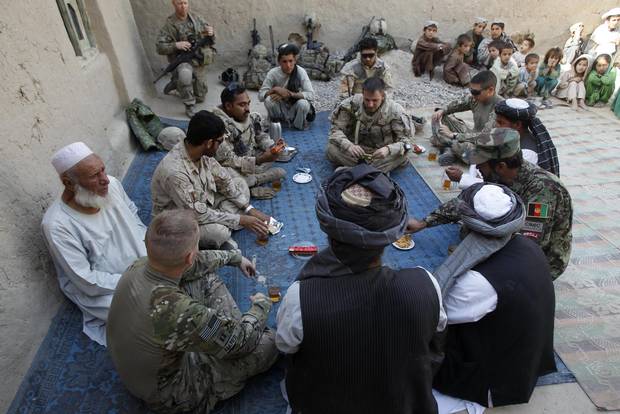
Canadian , US and Afghan army officers sit with local Afghan elders during a meeting in the village of Small Loi Kola in the Panjwai district, in the province of Kandahar June 23 , 2011. Canada will end its combat role in Afghanistan by the end of July, after nearly ten years fighting in the country.
Canadian, U.S. and Afghan army officers sit with local Afghan elders during a meeting in the village of Small Loi Kola in the Panjwai district on June 23 , 2011.
BAZ RATNER/REUTERS

Early in 2006, Amrullah Saleh, then the head of Afghanistan's National Directorate of Security (NDS), the country's principal intelligence service, decided to conduct a formal study of the Taliban's gathering resurgence, to inform Afghan President Hamid Karzai, his cabinet and allies of Afghanistan. He decided to interview active Taliban commanders personally. (There are few impermeable lines in Afghanistan's internal conflicts.) Mr. Saleh travelled to Zabul, Uruzgan, Helmand, Kandahar and other provincial capitals. His colleagues in regional NDS offices negotiated safe-passage agreements with Taliban commanders, who came in to talk to him. This sometimes involved paying the Taliban for their time and insights. Mr. Saleh's classified paper was completed in May, 2006, the same month Canada's Task Force Orion launched Operation Mountain Thrust, "to defeat the Taliban in their traditional areas." Commanded by Colonel Ian Hope, it was the first of a succession of operations intended to break the back of the Taliban's comeback around Kandahar, the movement's birthplace. Canadian forces fought hard, absorbed unexpected casualties and were often tactically successful, but trying to suppress the Taliban proved to be like "digging a hole in the ocean," as Canadian Major-General David Fraser, the top Canadian commander, put it.

Canada had run into a Pakistani covert operation to bring back the Taliban. In his paper, Mr. Saleh concluded that Pakistan's powerful Inter-Services Intelligence agency, or ISI, had made a decision in 2005 to support the Taliban more actively, with cash and other aid, backed by covert subsidies from Saudi Arabia. The consolidation of Mr. Karzai's government between 2003 and 2005 – a period when a new Afghan constitution was ratified and successful presidential and parliamentary elections were held – explained the timing of this Pakistani turn in policy, Mr. Saleh judged. He regarded Pakistan as an "India-centric country." In essence, he concluded, Pakistan's generals feared that Mr. Karzai's legitimacy would steer Afghanistan toward a durable role as an Indian ally, with international backing.
Soldiers of the U.S. 82nd airborne detain an Afghan man during Operation Alamo Sweep in southeastern Afghanistan on Nov. 7, 2002.
SCOTT NELSON/AP
His study predicted that the Taliban mobilization would intensify and that by 2009, the guerrillas would be advancing from rural strongholds to threaten major cities such as Kandahar. The paper forecast that the Taliban would mount a full-fledged insurgency that would bog down Afghan and international troops. This would turn out to be largely accurate, except that the Taliban drive on southern cities occurred even faster than that, at Canada's expense. The "Afghanistan government's legitimacy should not be brought down due to our inefficiency in knowing the enemy, knowing ourselves and applying resources efficiently," Mr. Saleh warned.

He passed his paper to the United States, and it seems likely that Canadian decision-makers and commanders saw it as well, but by then they were committed to the Kandahar campaign. They had to contend not only with the Taliban but with an Afghan President who discounted the seriousness of the insurgency. Mr. Karzairejected the study's findings. He ridiculed its predictions and asked Mr. Saleh to never again call the Taliban "an insurgency."

For years, Mr. Karzai clung to the conviction that the Taliban were a problem of international terrorism solely attributable to the ISI and that there was no indigenous cause of the revolt against his rule. He told U.S. General Stanley McChrystal in 2009, as the United States took charge of the war from NATO allies and dispatched tens of thousands of troops to escalate the fight: "An insurgency, as I understand the meaning, suggests there are citizens of a country who are fighting against their government because they think the government is illegitimate. Now, we are a conservative, simple Muslim people. If they are fighting against an illegitimate government, then who are you, the United States? You are propping up an illegitimate government. No. There is no insurgency."

Mr. Karzai believed, like many other Afghans, that the true story of the war – the essential problem – was not his government's corruption or legitimacy but the mysterious unwillingness of the United States to challenge the ISI and Pakistan. By the end of his time in power, Mr. Karzai had sunk into conspiracy thinking, concluding that the United States must want the ISI to succeed in destabilizing Afghanistan in order to justify maintaining U.S. military bases in his country.

American diplomats tried to dissuade Mr. Karzai of this belief, but until the end, he refused to yield. During a 2013 meeting, recalled James Dobbins, then the U.S. special envoy to Afghanistan and Pakistan, he said to Mr. Karzai: "Mr. President, between Edward Snowden and WikiLeaks, you have several million documents to examine – can you find any mention of such designs? Do you really think I would lie to you about this?"

"Maybe you don't know about the plan," Mr. Karzai replied, suggesting the existence of a "deep state" in America.

The truth was more prosaic. Distracted by the Iraq War and seeking to avoid deep entanglement in Afghanistan, the Bush administration was slow to recognize that it was being deceived by Pakistan's generals and spies. When it finally did wake up, toward the end of 2006, the Taliban had acquired momentum. The Bush administration and then the Obama administration conducted multiple reviews of strategy in Afghanistan but discovered few palatable options. If NATO launched an all-out war against the Taliban's sanctuaries in Pakistan, it would further destabilize a country containing dozens of nuclear weapons and at least that many terrorist groups. Instead, George Bush and then Barack Obama were sold on a counterinsurgency war against the Taliban inside Afghanistan, supplemented by a CIA-run drone war against Taliban encampments in Pakistan's western tribal areas.

Canadian forces held the line in Kandahar, of course, until the Americans poured in, in 2009. Some U.S. commanders were disdainful of Canada's "3-D" strategy of defence, diplomacy and development, which had suffered on contact with the Taliban early on, in 2006. Hubristically, the Pentagon believed that only American muscle could clear out Kandahar and other Taliban regions in the south and east. With greater numbers and a more unified command, the Americans did make some progress, at a high cost in lives and limbs, but gradually they also discovered that they were no better equipped than NATO allies to defeat the ISI's strategy – and that Maj.-Gen. Fraser's metaphor was apt.

Today, in the American-led war's 17 th year, U.S. and allied Afghan forces are still digging that hole in the ocean, hoping against all historical evidence that they can make enough progress on the battlefield to force the Taliban into a political settlement acceptable to most Afghans. The Trump administration has suspended aid to Pakistan in the hope that it will pressure the ISI to change course. The reaction in Pakistan since that announcement has been one of deep nationalist defiance.

Afghanistan has been at war for four decades. The only interlude of relative peace – apart from the years of smothering Taliban rule, which quieted many parts of the country – lasted from 2002 to 2006, years when many Afghans in exile came home to reclaim and rebuild their country. Counterfactual history is a fool's game, but if there ever was a chance to prevent Pakistan from interfering once again in Afghanistan through the ISI, and to incorporate significant numbers of former Taliban into constitutional politics, those were the years when it might have been done. And we can see now, in hindsight, that the framework of Canadian policy – security, reconstruction and active diplomacy to forge stable Afghan politics, backed by regional powers – was the right one. Instead, NATO failed to see what was coming out of Pakistan until it was too late and succumbed to hubristicAmerican strategy dominated by a Pentagon that repeatedly overestimated its capacity to change the course of the war. In its blindness, the alliance failed the many Afghans who relied on its power and promises.

Monday, September 18, 2017

Khan: Why Canada should Return to Afghanistan

By: Adnan R. Khan, Macleans Magazine 

The Iraq mission wasn’t all it was pumped up to be. In retrospect, Canada shouldn’t have left Afghanistan, which badly needs help. 

Image result for canada in afghanistan

In April 2016, while on a tour of the frontlines in the fight against the so-called Islamic State in Iraq’s Kurdistan Region, General Jonathan Vance, Chief of Defence Staff of the Canadian armed forces, made forceful pitch for why Canada needed to train Iraq’s Kurds.

“I believe [the offensive to re-take] Mosul will start this year,” he told CTV News. “The Zeravani commando isn’t formed yet. So as we form it and train it, they’ll have the weapons necessary to do the job they need to do. When the campaign to re-take Mosul will start and end, it would be ideal if we have the Zeravani commando ready for operations.”

Vance was referring to the Kurdish forces that were receiving the bulk of the training and assistance Canada’s Special Operations Forces had been providing since 2014. At the time, the Zeravani were expected to be at the forefront of the impending battle for Mosul. After withdrawing Canadian fighter jets from the international coalition in February 2016, the Liberal government had doubled-down on the Kurds, announcing it would send an additional 200 special forces to the region with the express mission of getting the Zeravani ready for what everyone knew would be a brutal fight.

It seemed like a prudent decision. Since it emerged in 2014, ISIS had proven itself to be the most dangerous terrorist group the world had ever seen. It had injected new blood into the global jihadist movement, attracting unprecedented recruits who either joined the group in Syria and Iraq or were inspired to carry out devastating attacks at home.

Mosul was its crown jewel, the place where its leader, Abu Bakr al Baghdadi, had declared a caliphate and the largest city under its control, with an estimated population of one million. Retaking Mosul would deal a near-fatal blow to the movement.

Meanwhile, in March 2014, Canada had officially ended its military mission to Afghanistan after 12 years and 158 dead soldiers. It was a bitter-sweet end to a mission that had pushed Canada into territory it had not ventured into since the Korean War: direct involvement in war fighting. Canadians had fought bravely in Kandahar, despite the overwhelming odds stacked against them. They had built up a reputation for fielding one of the best-trained militaries in the world.

By 2014, however, that mission had been reduced to a small contingent tasked with training Afghan security forces and was floundering in obscurity.

Under the Harper Conservatives, Canada’s military sights had begun to drift westward in 2011, away from Afghanistan and toward the Arab Spring in the Middle East and the conflicts arising from it. The Conservatives, with an almost obsessive focus on terrorism, had decided to go all-in, playing a key role in the mission to topple the Ghaddafi regime in Libya and, at least initially, supporting the Syrian opposition against Bashar al Assad.

History will judge the wisdom of those decisions but the early signs are discouraging. From 2011 onward, Canada’s stated mission—assisting democratic movements in the region—collided with the complexities of nation building. Libya fractured into mini-states ruled by tribal militias. Syria devolved into a civil war pitting dozens of armed groups against each other. By the fall of 2014, as ISIS rose out of the ashes of the Syrian civil war, the Conservatives shifted their focus again.

“Let me be clear on the objectives of this intervention,” Harper said of the decision to deploy special forces trainers, along with the fighter jets, to Iraq in a speech to parliament in early October 2014. “We intend to significantly degrade the capabilities of ISIL… Specifically, its ability either to engage in military movements of scale or to operate bases in the open.”

At the same time, the breakdown of security in Afghanistan had accelerated, particularly after the U.S. pulled its troops later in October. Many started to see Afghanistan as a lost cause, despite the significant progress that had been made in developing the country’s infrastructure and institutions.

Was this Canada’s WMD moment? In 2003, the U.S. under George W. Bush turned away from Afghanistan and poured its military resources into Iraq. The shift is now blamed for giving the Taliban the time it needed to regroup and rebound as an insurgent movement. Bush’s cohorts in the Republican Party initially used the spectre of weapons of mass destruction as justification for the shift. When those failed to turn up, it recast Iraq as a mission to bring democracy to the Middle East.

Canada has also struggled to find meaning in its Middle East pivot. Democracy in Libya, Syria and Egypt appears further away today than ever and even though the mission to destroy ISIS is succeeding, Canada’s contribution to the fight is looking more and more superficial.

Initially, things were going according to plan. The expertise Canadian special forces brought to the table was a valuable asset to the Kurds. While other NATO countries provided training to the Kurdish Peshmerga in purpose-built centres scattered around the Kurdistan Region, the Canadians embedded with Zeravani forces on the ground, at or near the frontlines, providing real-time guidance and support in real-life combat situations.

Not surprisingly, the Zeravani were transformed into a capable fighting force, arguably the best fighters Kurdistan now fields. They took the lead at the launch of the Mosul offensive in October last year, punching through ISIS frontlines and retaking territory north and east of the city. And Canadians were right there with them.

But then they stopped. In a deal brokered with Iraq’s central government, the Kurds agreed not to fight in Mosul. Instead, they set up their own positions kilometers away, watching as elite fighters from the Iraqi special forces confronted the bulk of ISIS forces.

Compared to what the Iraqis faced inside the city, the Kurdish advance was a cakewalk. The initial resistance they met collapsed quickly as ISIS fighters retreated to Mosul and dug in for the gruelling battles to come. Airstrikes helped the Kurds roll through largely emptied towns and villages and avoid the kinds of street-by-street, house-by-house confrontations the Iraqis would have to contend with.

Politically, things were not much better. Canada’s train and assist mission had a destabilizing effect on the Kurdistan Region. The focus on the Zeravani, a specialized commando force attached to the Interior Ministry, angered some Kurdish politicians. The ministry, like many of Kurdistan’s power centres, is controlled by the dominant Kurdistan Democratic Party, a family affair run by the Barzani clan. Opposition parties, and some Canadian diplomats, complained to Maclean’s in 2015 that Canada, under the Harper Conservatives, was favouring one political party and, perhaps unwittingly, playing into the deep-rooted Kurdish divides that have plagued the region for decades.

More broadly, the support for the Kurds ratcheted up tensions with Baghdad, which accused foreign governments like Canada of stoking Kurdistan’s independence aspirations. In June, Kurdistan’s president Masoud Barzani announced a non-binding referendum on independence scheduled for Sept. 25, raising concerns that Canada may have armed and trained the military of a future breakaway state.

The Liberal government now appears to be coming around to the problems associated with supporting the Kurds. In March, Canada’s special forces shifted some of their focus to helping the Iraqi army in Mosul and a February 2016 deal to provide weapons to the Kurdish Peshmerga has been put on hold indefinitely.

Still, the grand vision articulated by Harper, and later by General Vance, where Canadian-trained Zeravani commandoes would take the fight to the Islamic State, largely came to naught. In the process, Canada abandoned a mission in Afghanistan in which it had invested millions of dollars and where Canadians had sacrificed their lives.

Chris Kilford, a retired Canadian artillery officer and now a fellow at the Queen’s University Centre for International and Defence Policy, argues that Canada’s turn to the Middle East was probably inevitable given the public fatigue over the war in Afghanistan. And neither the Harper government nor the Liberals, he adds, could have predicted how events would unfold in Mosul.

“Should we have left [Afghanistan] when we did?” he says. “No. Should we still have trainers on the ground? Yes. But we have a bit of momentum now. We’ve put a lid on this massive issue known as the Islamic State. We can turn our attention to other places such as Mali, Libya and Afghanistan.”

It’s impossible to judge if Afghanistan would be different today if, instead of pulling trainers out, Canada had sent its special forces there instead of Iraq. What’s certain is that Afghan security forces have come to rely on their own special forces, largely trained by the U.S., to take the fight to the Taliban. According to Afghan defense ministry officials, their special forces only make up seven per cent of the Afghan military but have led 80 per cent of offensives. U.S. commanders say they are the most successful fighters on the battlefield, but they are being pushed to their limits.

Earlier this year, President Ashraf Ghani announced a plan to double the existing 17,000 special forces troops over the next four years. Kilford warns such an expansion will require a massive mobilization of resources.

“In Canada, the Liberals have decided to increase special forces personnel by around 600 over the coming years,” he says. “That means taking on around 1,800 recruits and whittling them down to the best.”

It was a mistake to turn away from Afghanistan and Afghans have paid the price for it. Canada should not compound the mistake by continuing to withhold the support the Afghan military needs at a time when successes in Afghanistan hangs precariously in the balance.

Training for the Kurds has only produced elite fighters without a war to fight. In Afghanistan, the war is still raging. And they need Canada’s help.

Thursday, August 24, 2017

Trudeau Not Planning on Sending Troops Back to Afghanistan

LEE BERTHIAUME
OTTAWA
THE CANADIAN PRESS

Prime Minister Justin Trudeau has thrown cold water on suggestions the Liberal government wants to sign onto continental ballistic missile defence, or that it might send troops back into Afghanistan.

The question over whether Canada should be part of the U.S.'s continental missile-defence shield has been rekindled in recent days amid concerns about North Korea's growing nuclear arsenal.

Canada opted out of ballistic missile defence in 2005 following a divisive national debate, but many defence experts and parliamentarians, including some Liberals, want the issue reopened.

Meanwhile, U.S. President Donald Trump's plan to send thousands more troops to Afghanistan has also resurrected questions about whether Canada will be asked to follow suit.

Speaking in Montreal on Wednesday, however, Trudeau appeared to close the door on both ideas.

"On those cases, we will always take the decisions in terms of what is the best interests of Canadians," Trudeau told reporters after meeting federal and provincial immigration officials.

"And our long-standing positions on those two issues are not going to be changed any time soon."

The comments on ballistic missile defence were the strongest yet from the Liberal government, which has largely sidestepped questions about its intentions in recent weeks.

Whether the prime minister has succeeded in finally putting the issue to rest is another question, however, particularly if tensions between Washington and Pyongyang continue to escalate.

At least one Liberal MP has said Canada should reconsider its decision not join the U.S. missile-shield system, as have both the House of Commons and Senate defence committees.

The Liberals had also said in their recent defence policy that they planned to discuss with the U.S. ways to improve North America's defences against, among other things, ballistic missiles.

Exactly what form those discussions will take – and what concrete measures will be taken to better protect the continent – remains unclear.

Trudeau's position on Afghanistan was less of a surprise, as he had previously ruled out a NATO request for Canada to send police trainers to the war-torn country.

The last Canadian troops left Afghanistan in 2014, and despite concerns about a resurgent Taliban, the Liberals have instead emphasized Canada's military contributions to Iraq and Latvia.

Still, it's uncertain how the comments will be received by the Trump administration and NATO, both of which have called on allies to redouble their efforts and help end the 16-year-old conflict there.

"We will ask our NATO allies and global partners to support our new strategy, with additional troop and funding increases in line with our own," Trump said Monday. "We are confident they will."

Friday, June 23, 2017

Canadian Trainers Would Face Risk in Afghanistan

By: Evan Dyer, CBC News 

As the security situation in Afghanistan continues to slip, NATO has asked Canada to help with its Resolute Support mission by sending trainers to help build an Afghan military and police force capable of defending the country.

For the past three years, Canadian soldiers have been training and mentoring Kurdish Peshmerga fighters in Iraq with great success and only one fatality: Sgt. Andrew Doiron was killed in a "friendly fire" incident that all sides agree was a tragic but honest mistake.

The Canadians have developed a relationship of mutual trust and even affection with their Kurdish hosts, according to Canadian military commanders.

So the Afghan training and mentoring mission NATO is now asking Canada to take on, might also seem to be a relatively safe assignment.

But bitter experience has taught NATO that the Afghan frontline runs through every army base, police detachment and training classroom. Western soldiers have died not only on the battlefield, but on the parade ground, the firing range and even sitting down to dinner with their Afghan counterparts.

"Insider attacks" have been a constant of the Afghan war, and many have taken the form of so-called "green-on-blue" shootings, in which foreign instructors are deliberately killed by their own students.

Opinion: Canada should join its closest allies and return to Afghanistan

In August 2012, an Afghan police commander called Asadullah sat down to a pre-dawn meal with three U.S. marines in Helmand province. The marines were there to train Afghan national police. Asadullah invited them, he told them, to discuss security arrangements.

Partway through the meal, Asadullah produced a pistol and shot the three marines dead. He then fled the base in the dark.

"He is with us now," Taliban spokesperson Qari Yusuk Ahmadi later confirmed to Agence France-Presse by phone.
Insider attacks

Sixty foreign advisers were killed by Afghan soldiers and police that same year, according to figures compiled by the International Security Assistance Force. The attacks prompted new measures by ISAF to protect trainers from their trainees.

The changes included strengthened identity vetting for Afghan security forces members.

That's no simple matter in a country where the typical recruit is an illiterate villager with no real birth certificate and often, no family name (many Afghans use only a first name).

The Afghan military is now using biometric scans, with equipment and supervision provided by ISAF, on all new recruits. Recruits must also provide references from two trusted elders from their home district.

Western trainers also instituted a system of "guardian angels," where a coalition soldier is assigned to stand guard over Afghan recruits at all times.
Afghan police demonstrate their skills during a graduation ceremony at a police training centre in the Adraskan district of Herat province, Afghanistan, in March, 2011. (Reza Shirmohammadi/Associated Press)
Not getting safer

On military bases where Afghan soldiers and police mix with foreign forces, the Afghans are required to be unarmed inside the gates, or have the firing pins removed from their rifles.

It was partly because of that rule that a recent Taliban attack on an Afghan army base in Mazar-e-Sharif was so deadly, says Bill Roggio, a former U.S. soldier who today edits the Long War Journal, published by the Washington think-tank the Foundation for the Defence of Democracies.

In that incident, about 10 attackers were recently able to kill about 140 mostly unarmed recruits.

"It tells you just how the Taliban strategy of conducting insider attacks has second and third order effects that people often don't consider," said Roggio. "They just aren't being trusted right now and trust is the first thing you need when you're partnering with foreign forces.

"You have cases where Afghan soldiers have gone through the vetting process, they didn't have any problems and then after a couple years in service, or a couple of months or weeks, they've been pressured or talked to by the Taliban and recruited to conduct attacks," he said.

Roggio says the countermeasures taken by NATO forces are not the main reason for the reduction in insider attacks.

"The primary reason for the reduction over the last several years is there's been less coalition forces partnered" with Afghan forces, he says, and fewer Westerners in Afghanistan generally.
Police forces clash with protesters during a demonstration in Kabul earlier this month. Hundreds of demonstrators demanded better security in the Afghan capital in the wake of a powerful truck bomb attack that killed scores of people. (Massoud Hossaini/Associated Press)
Yet three more U.S. soldiers fell victim to such an attack on June 12. The men of the 101st Airborne were killed in Nangarhar province by an Afghan National Army soldier who was immediately killed by return fire.

A week later, seven more Americans were shot by an Afghan soldier inside the Mazar-e-Sharif base. All seven survived.


An Ottawa cop remembers

Canada has been involved in training Afghan police before.

Ottawa police Sgt. Colin Stokes, who trained Afghan police in Kandahar from 2009 to 2010, operated mostly out of Camp Nathan Smith.

He says his experience was mostly positive, but remembers the precautions he and his fellow police officers took, particularly when their students were armed at the firing range.
Ottawa police Sgt. Colin Stokes oversees an Afghan police trainee during weapons training in Kandahar. Stokes was posted with the Canadian Armed Forces as a trainer in 2009 and 2010. (Colin Stokes )
"When we were on the range with them, we always ensured there were other police officers, basically, very hands on and close to all the Afghan soldiers and constables that were on the line," he says.

Stokes said his Afghan trainees were mostly keen to learn, but says it's impossible to prevent all green-on-blue killings when dealing with armed recruits.

"Mistakes are made, things slip through the cracks. Everybody tries to do the best we can to vet personnel, but it's a war zone and you can't be too surprised when people get killed."

He says he'd be willing to return under certain circumstances.

"If Canada does go back, if I was to go back, I'd want to mentor Afghans that have the capacity to absorb the type of police training that we have to give."

Thursday, June 15, 2017

Walkom: Canada Mulling a return to the Unwinnable Afghan War

By THOMAS WALKOM, Toronto Star 

A return to the Afghan War is one step closer. Defence Minister Harjit Sajjan has confirmed that NATO has asked Canada to send police trainers to assist Afghanistan’s struggling government in the fight against Taliban insurgents. He said Ottawa is seriously considering the request.

The trainers, if sent, could be either soldiers or police officers.

The NATO request is part of an effort by the alliance to quietly beef up its role in the Afghan war without inflaming public opinion back home.

Technically, the roughly 13,000 troops under NATO command in Afghanistan do not engage in combat. Their role is to train, advise and assist local Afghan forces.

But the war in Afghanistan is going badly for the government in Kabul. It faces not only its traditional Taliban foes but the terrorist group Daesh, also known as ISIS.

High-profile suicide bombings have rocked Kabul. The Taliban effectively controls large swaths of the countryside. The central government is shaky.

American Gen. John Nicholson, who heads NATO operations in Afghanistan, says he needs at least 3,000 to 5,000 more “advisers” to meet his military needs there.

In Washington, President Donald Trump’s administration is mulling over the question of how many more American troops to commit to Afghanistan (it already has roughly 8,400 soldiers there).

But Trump has also made it clear that he expects other NATO countries to pick up part of the slack.

Currently, Canada and France are the only NATO countries without troops in Afghanistan.

Canadian troops entered the Afghan War in 2001 and stayed for just over 12 years. Over that period, 158 Canadian soldiers were killed and hundreds more wounded.

It was the longest-running war in Canadian history. By the end, it was also one of the most unpopular.

In 2014, with an election year looming, Stephen Harper’s Conservative government ordered the last Canadian troops home.

Prime Minister Justin Trudeau’s Liberal government is careful to couch any return to Afghanistan in minimalist terms.

Sajjan first raised the possibility in a CTV interview on Saturday, volunteering that NATO had made an “ask” for Canadian advisers to help train Afghan police and that Canada was actively considering the request.

He repeated this again Monday to reporters in Halifax. But he noted that Ottawa’s real military focus now is on the war against Daesh in Iraq and that, in any case, Canada’s military operations in Afghanistan ended three years ago.

Translation: Even if we accede to the NATO request, this will not be as bad as before.

But of course that’s the kind of optimistic thing governments always say at the outset of armed conflict.

When Canada first entered the Afghan War after the 9/11 attacks on New York and Washington, the stated aim was to honour its NATO obligations to the U.S. When Canada upped its military commitment in 2006, the stated aim was to ensure that Afghan girls could go to school.

Throughout, the experts told us that we had to take part in this war to maintain our credibility in NATO and to avoid irritating the U.S. In fact, what we became involved in was a complicated, vicious and ultimately unwinnable conflict where the line between friend and enemy was too often blurred.

So we shall see what the Trudeau Liberals have in mind this time. They have already expanded Canada’s role in the ground war in Iraq. Foreign Affairs Minister Chrystia Freeland talks glowingly of using Canadian “muscle” to promote Canadian values,

They plan to increase defence spending overall.

Perhaps they will remember how difficult it was to extricate ourselves the last time we involved ourselves in the Afghan War. Sajjan should. He fought in it.

Or perhaps they will calculate that the political benefits of satisfying a U.S. and NATO request are worth the risk.

After all, they could say, it’s just training. What’s so dangerous about that?

Tuesday, June 13, 2017

Sajjan: Canada Committed to Iraq for the Long-Haul; Afghanistan Training Mission a Possibility

Michael MacDonald, The Canadian Press

HALIFAX — The federal government is considering a NATO request to send police trainers to Afghanistan, but Defence Minister Harjit Sajjan says Canada's military focus remains in Iraq.

"As any good allied partner does, we will look at that request," Sajjan said Monday after a news conference highlighting the Defence Department's new, 10-year defence policy, which was rolled out last week.

"Our focus right now is on our mission in Iraq and the region. We will be moving forward with that mission."

Sajjan said even though Canada continues to provide funding for development and security personnel in Afghanistan, the military mission there ended three years ago.

The conflict claimed the lives of 158 Canadian soldiers, one diplomat and one journalist between 2001 and 2014. Thousands of those who served there continue to suffer from physical or mental injuries, an issue that continues to make headlines across the country.

However, the United States and NATO are reaching out for more help in Afghanistan now that the Taliban appear to be making a comeback in the region. As well, the arrival of the Islamic State of Iraq and the Levant has complicated matters. During the past year, the group has launched deadly attacks across the country.

As for Iraq, Sajjan says Canada remains committed to maintaining a long-term military presence in that country, but he followed up by suggesting some changes were in order.

"For Iraq ... we are in this as a reliable coalition partner, in for the long term," the minister said as he answered questions from reporters gathered at Her Majesty's Canadian Dockyard, along the west side of Halifax's sprawling harbour.

"We're going to make adjustments to the mission ... We have taken this year to review the evolution of the situation on the ground. We will be extending the mission, but we'll be making the final decision on this very shortly to outline what our contributions will be. One thing I can assure you: we will remain as a credible partner to make sure the coalition has all the right assets in place."

There are about 200 Canadian special forces soldiers deployed in northern Iraq. Though their mission is to train Kurdish fighters, they have engaged in gun battles in Iraq.

The federal government has confirmed that in March some of the special forces took part in the battle to reclaim the Iraqi city of Mosul from ISIL.

In the defence policy overhaul, Sajjan has committed to adding 605 new elite special forces commandos.

Overall, the new policy commits Canada to spending an extra $14 billion over the next 10 years on defence matters — a 70 per cent increase for the department's budget.

The money will be used to put another 5,000 troops in uniform and, among other big-ticket items, offset the skyrocketing cost of buying new warships and fighter jets.

But much of the money won't flow until after the next election, and it’s not clear whether the spending spike would mean bigger federal deficits or spending cuts in other areas.

Sajjan noted that two of Canada's new Arctic patrol ships were under construction at the nearby Halifax Shipyard, and he said his new defence policy commits the government to spending up to $60 billion on building 15 new warships, which will replace much of the Royal Canadian Navy's aging fleet.

"We are excited for the economic growth and development that this policy means for Halifax, Nova Scotia and the broader Canadian defence industry," he said. More than 14,000 Nova Scotians are employed as part of a "defence team" that spends $1.3 billion annually in the province, he said.

Sajjan said the original budget for the Canadian Surface Combatant program in 2008 was set at $26.2 billion, which the Parliamentary Budget Office later determined was enough for only six ships.

"We need 15 and we are committed to 15 ships," Sajjan said, adding that the policy also commits the government to maintaining the navy's four problem-plagued submarines and to build two new support ships.

Friday, May 19, 2017

Afghanistan, the sequel. Why would Canada return to a war it would rather forget?


By: Andrew Potter, Special to National Post |
Amber Bracken/PostmediaSoldiers disembark from their plane as they return home from Afghanistan at the Edmonton International Airport in Edmonton, Alta. on Friday, Oct. 11, 2013
The last time Canadians paid any serious attention to Afghanistan was just over three years ago. It was March 2014 when we ended our training mission in Kabul with a quiet flag-lowering ceremony in Kabul.

It wasn’t exactly the Fall of Saigon, but there was a definite sense of Mission Unaccomplished to the proceedings. For all our efforts, first in support of Operation Enduring Freedom to rout out al Qaeda, then as part of the NATO-led International Security Assistance Force that had committed to bring stability, security, good governance and democracy to Afghanistan, the job was far from complete. But many of our close allies, such as the Dutch, had already headed for the exit, and with President Obama determined to end the war on his watch, the Americans were drawing down as well.

Afghanistan was our most ambitious foreign adventure since the Korean War, but it’s an adventure most Canadians, including their government, seem keen to forget. The American journalist Dexter Filkins wasn’t wrong when he called it The Forever War though, which is why the United States is readying a “mini-surge” of potentially 5,000 troops back into Afghanistan. Once again, they will be asking NATO countries to help out. And as Postmedia’s David Pugliese reported last week, Canada will be asked to chip in.
Cpl Keith Wazny / DNDA Ramp Ceremony was held at Kandahar Airfield on 21 July 2010 for Sapper Brian J. Collier, who was killed by an Improvised Explosive Device
If we agree, we’ll be sending troops back to a country we left after 12-year military presence that cost the lives of 158 soldiers as well as those of a diplomat, two aid workers and a journalist. We’ll also be returning to a country where we left behind a great deal of unfinished business.

It’s no surprise Americans are looking to beef up their troop levels in Afghanistan: the place is on the verge of collapse.

The Afghan government in Kabul controls less than 60 per cent of the country, and that number is going in the wrong direction. In the parts of the country that it does control, the government is widely seen as deeply corrupt and barely functional. The Afghan security forces that are doing the bulk of the heavy fighting against the Taliban are suffering jaw-dropping (and unsustainable) casualty rates. In one shocking incident in late April, 140 Afghan troops were killed in a single Taliban attack on a base in the north of the country.

The peace agreement with the Pashtun warlord Gulbuddin Hekmatyar and his “triumphant” return to Kabul earlier this month is a sign of how bad things are going for the government. Meanwhile, ISIL’s franchise in the region is clinging to a foothold with about 800 fighters regularly engaged in terror attacks and assassinations, mostly against Shia targets.

The Americans might have blowed things up real good when they dropped the MOAB onto an ISIL cave complex near the eastern border with Pakistan, but many analysts expect that its most significant effect will be to draw more jihadis to the cause. Right on cue, five ISIL jihadists attacked a television station in Jalalabad this week, killing four journalists and two police officers.

In short, there’s a lot of bad news, and the best predictions are things will get worse.

In the face of all this, the mini-surge of troops will have a pretty modest mission. Strengthen the government and train and assist the Afghan National Security Forces, while trying to stabilize the deteriorating security situation. The aim would be give Afghan president Ashraf Ghani’s government just enough credibility while bombing the Taliban hard enough to force some sort of peace deal.

The problem with this is that it was former Afghan President Hamid Karzai’s strategy for virtually his entire term in office, and it is the same strategy former President Obama pursued with his surge in 2010. Its failure was and always will be overdetermined because, to begin with, you can’t kill enough Taliban to force them to the table. If anything, what this does is play along with the Taliban’s parallel strategy, which is to kill enough western troops and Afghan civilians that we leave and then the Afghan government sues for peace. To ask which side has been more successful is to answer the question.

Related
Canada, other NATO nations being asked to send troops back to Afghanistan
After decades as fugitive, Afghan warlord Gulbuddin Hekmatyar returns with appeal for peace
U.S. general would ‘not refute’ that Russia is arming the Taliban and re-engaging in Afghanistan war

The deep problem here is Pakistan. It isn’t just that Pakistan’s Federally Administered Tribal Areas have served as the home base for the Taliban since they were chased out of Afghanistan in 2001. The Pakistan military has basically run the Taliban insurgency since then, using it as a proxy force to ensure the ongoing destabilization of Afghanistan. This suits Pakistan’s purposes fine, but it means that there can be no solution to the problem in Afghanistan without a solution to Pakistan. An additional 5,000 troops helping train Afghan soldiers to be Taliban fodder isn’t going to change that.

So where does Canada fit in? Our mission in Afghanistan was beset by confusion on many fronts: Why we were there, how we ended up in Kandahar, and what our ambitions were. Depending on who you ask — politicians, diplomats, soldiers, general public — you’ll get different answers.

As Carleton University professor Steve Saideman argues in his book Adapting in the Dust, Canada went to Afghanistan for the simple reason that it has always gone along with NATO missions. It would have been weird for us not to go in some capacity. We went big because wanted to show our bonafides to the Americans after refusing to get involved in Iraq. And we went to Kandahar because we wanted to make a real contribution that would allow us to have strong say in the campaign.

Manpreet Romana / AFP / Getty ImagesIn this photograph taken on July 2, 2009, US Marines from the 2nd Battalion, 8th Marine Regiment of the 2nd Marine Expeditionary Brigade wait for helicopter transport as part of Operation Khanjar at Camp Dwyer in Afghanistan's Helmand Province

As Saideman describes it, by these metrics our mission was a complete success: We earned combat cred with the Americans, we were able to keep the U.S. working within the NATO structure, and we punched above our weight in the alliance itself.

The problem with these metrics is they have nothing to do with Afghanistan or the Afghan people. They are entirely about Canada’s interests in alliance-building, continental politics and generally managing the Americans. They are, at best, only accidentally about fighting the war on terrorism, defending global security, fighting the Taliban or helping Afghan girls go to school.

And so Canada’s ultimate political strategy was always going to be at odds with the execution of the mission, which evolved from a counter-terrorism operation in the early going into a “whole of government” nation-building agenda in Kandahar. Our ambitions on this score can be traced through the quarterly reports to parliament that were issued from 2008 until the end of the combat mission in 2011, listing our priorities and ticking off our achievements.

The unfailingly optimistic tone of those reports held up right till the end, our faith in the strategy surviving our abandonment of it. As the last line of the last quarterly report put it: “As Canada begins to transition from Kandahar to a more nationally focused role in Afghanistan, we will continue to support the hopes and dreams of the Afghan people as they endeavour to rebuild a more peaceful and prosperous nation.”
Master Corporal Matthew McGregor/DNDA foot patrol of Canadian and Afghan soldiers near the village of Haji Baba
Or, to put it more colloquially, good bye and good luck.

Let’s be clear about this: Canadians made a number of profound commitments to helping Afghans, promises that many Afghans took seriously. At least they did until Canada’s political calculations changed and we simply downed tools and left. The Taliban weren’t defeated, the nation wasn’t rebuilt, but we’d done what we set out to do.

Maybe it’s this general sense of unfinished business that has led Canadians to pretty much forget that for 12 years, some of the best and brightest soldiers, diplomats, development officers and public servants this country has to offer risked their careers and their lives in, and more importantly, for Afghanistan. At the height of the troop surge in 2010, a senior Canadian civilian official at Camp Nathan Smith gave a rousing pep talk to the members of the Provincial Reconstruction Team (and to journalists), telling them, “This is the place, now is the time, and we are the ones” to fix Kandahar. It was melodramatic, but it captured the spirit of the Canadian mission.
Corporal Bill Gomm/DND
Today, our interest in the country is pretty much non-existent, the war is rarely mentioned except in the context of wounded warriors.

And that’s an attitude matched by the government. The simple but symbolic Kandahar Airfield Cenotaph remains wrapped up in a packing crate somewhere in Ottawa. The more substantial military memorial to the mission, to be situated down by the Ottawa River east of the Portage Bridge, was scheduled to be opened for the sesquicentennial celebrations on July 1. It has fallen into Ottawa’s version of bureaucratic hell. When, where and whether it will ever see the light of day is anyone’s guess.

Besides, why have a memorial to a war everyone wants to forget?

***

And now we’re being asked to go back. Assuming we’d actually be welcome, what’s in it for Canada? Or more pointedly, what’s in it for Afghans?

Assuming the Americans do ask us to pitch in, and assuming we agree, there’s no way we are going back to our old mission. The heady nation-building ambitions of 2010-2011 are done. We’ll be there as trainers, as part of what the Americans are pitching as an open-ended mission without the artificial deadlines that Obama imposed. Which means we will be there in the service of one of two possible outcomes, neither of which is terribly appealing.

One is that we help the Afghans keep fighting in a more or less perpetual fight against the Taliban.

The other is that we play a part in helping bring about a political solution to the problem. Practically, that means handing over a big chunk of Afghanistan to the Taliban, which in turn means a return to the days of mandatory burkas and beards, Sharia law and the ministry of vice and virtue. No music or movies, no kite flying, no school for girls.

This wouldn’t be the end of the world — we already live with versions of that in other countries. We helped fight North Korea to a stalemate long ago, and have lived ever since with the result. Nothing says that every country’s problem is our problem to solve.

The difficulty we have with Afghanistan is that for a period of time, we made their problems our problems, and we sent the best among us to help solve them. Then we left, and ever since we’ve been trying, and mostly succeeding, at forgetting we were ever there.

If we do return, we might forgive our Afghan hosts if they are so unkind as to remind us.
----
Andrew Potter is the former editor-in-chief of the Ottawa Citizen.

Will the CAF Return to Afghanistan?

By: David Pugliese, The Ottawa Citizen

Canada will be asked to consider sending troops to Afghanistan once again to deal with the Taliban resurgence in that country.

The request will be on the agenda May 25 at the NATO summit in Brussels to be attended by U.S. President Donald Trump and Prime Minister Justin Trudeau.

Trump is looking at up to 5,000 more troops. Australian Prime Minister Malcolm Turnbull has already confirmed he has already received a request from NATO for more troops. Germany has rejected the request already.

NATO wants the soldiers to help shore up Afghan forces who are struggling to deal with a Taliban resurgence.

NATO Secretary-General Jens Stoltenberg said a request has been received from alliance commanders in Afghanistan for several thousand more soldiers. Additional soldiers would be used for training and advising.

Canada ended its military involvement in Afghanistan in March 2014. Canada’s Afghan war cost the lives of 158 soldiers. In addition, a Canadian diplomat, two civilian contractors and a journalist were also killed. More than 2,000 soldiers were injured.

There are currently a handful of Canadian military personnel currently in the country to provide security at the Canadian embassy in Kabul.

NATO has up to 13,000 personnel, the bulk of those U.S. troops, involved mainly in training. Another 1,500 U.S. special forces are operating in the country as well, conducting combat missions against the Taliban as well as those aligned with the Islamic State.

There is not a lot of interest in the Trudeau government about sending troops to Afghanistan, considering there probably wouldn’t be much support for such a mission among the Canadian public (the attitude seems to be, “Been there, done that, it didn’t work).

There could, however, be a role to play for Canadian special forces.

NATO’s Stoltenberg specifically mentioned the need for special forces training teams. CANSOFCOM has done that role before. A small SOF team might satisfy NATO and Trump and be just enough of a low profile footprint to be acceptable to the public and Liberal government supporters.

Monday, May 15, 2017

NATO Asks Canada to Send Troops back to Afghanistan

By: David Pugliese, The Ottawa Citizen 

NATO is asking Canada to once again send troops to Afghanistan to help deal with the resurgence of the Taliban.

The request will be on the agenda at the May 25 NATO summit in Brussels, to be attended by U.S. President Donald Trump and Prime Minister Justin Trudeau.

NATO Secretary-General Jens Stoltenberg said a request has been received from alliance commanders in Afghanistan for several thousand more soldiers to help shore up Afghan forces who are struggling to deal with the resurgent Taliban. Estimates suggest the Islamic fundamentalist group, which ruled Afghanistan from 1996 until the U.S.-led NATO invasion of 2001, is now back in control of or a major presence in about 40 per cent of the country.

“It will continue to be a train, assist and advise operation,” Stoltenberg said. “We are now looking into requests regarding some areas like more education, for the military academies, but also training special operation forces and air forces.”

The office of Defence Minister Harjit Sajjan did not comment on whether the NATO request had been received yet or whether it had already been rejected by the Canadian government. “We are not tracking a request,” Sajjan’s spokesperson Jordan Owens said in an statement emailed Friday.

But Australian Prime Minister Malcolm Turnbull confirmed Friday he has received such a request from NATO and is considering sending more troops. Although Australia is not a NATO nation, it has about 300 soldiers in the country training and advising Afghan forces.

Germany’s government indicated it too had received a request from NATO but would not send additional soldiers. German troops are already in northern Afghanistan.

In March 2014 Canada ended its military involvement in the Afghan war, which cost the lives of 158 Canadian soldiers. A Canadian diplomat, two civilian contractors and a journalist were also killed. More than 2,000 soldiers were injured.

A handful of Canadian military personnel are currently deployed in the country to provide security at the Canadian embassy in Kabul. “The number of CAF members deployed is limited, and in order to maintain operational security and ensure the safety of Canadian Armed Forces personnel, no further information is available at this time,” Department of National Defence spokesman Evan Koronewski said Friday.

There are slightly more than 13,000 coalition and NATO soldiers now in Afghanistan, involved mainly in training. Of those around 7,000 are from the U.S.

Another 1,500 U.S. special forces are operating in the country as well, conducting combat missions against the Taliban as well as those aligned with the Islamic State of Iraq and the Levant.

Trump is currently examining a recommendation that could see between 2,000 and 5,000 additional U.S. troops sent to Afghanistan. He has yet to make a decision. White House National Security Adviser H.R. McMaster said Friday that Trump will have the opportunity to hear from allies during his trip to the NATO summit and the upcoming gathering of G7 nations. McMaster said that Trump understands that “America first does not mean America alone.”

In February, Gen. John Nicholson, the top U.S. commander in Afghanistan, told Congress that America and its NATO allies are facing a “stalemate” in Afghanistan as the Taliban gain more ground. He noted he needed a “few thousand” soldiers to act as advisors to the Afghan military.

Afghan security forces are still plagued by weak leadership and corruption.

Several weeks ago John Sopko, the U.S. Special Inspector General for Afghan Reconstruction, told Congress that casualties being suffered by Afghan security forces were “shockingly high.”

In the first six weeks of 2017, 807 Afghan security personnel were killed and more than 1,300 wounded. Civilian casualties had also increased to the highest on record since the United Nations started documenting them in 2009, Sopko said.

Australia’s Turnbull said Friday he is carefully reviewing the NATO request. “We are certainly open to increasing our work there, but we’ve obviously got to look at the commitments of the Australian Defense Force in other parts of the region and indeed in other parts of the world,” he told journalists. “It is very important that we continue — we and our other allies in the effort in Afghanistan — continue to work together,” he added.

U.S. intelligence official Dan Coats told Congress on Thursday that the Taliban are making gains and warned that the situation will get worse over the coming year. “Afghanistan will almost certainly deteriorate through 2018 even with a modest increase in military assistance by the United States and its partners,” Coats said. “Afghan security forces performance will probably worsen due to a combination of Taliban operations, combat casualties, desertion, poor logistics support and weak leadership.”

Monday, May 8, 2017

Senior British Officer Confirms Sajjan's Planning Role in MEDUSA

By Sandy Garossino, National Observer

It's been pretty rich watching Her Majesty's Loyal Amnesiacs carry on over Harjit Sajjan in the House of Commons this week.

By now everyone's heard about the CBC story by Murray Brewster, who reported that "(s)oldiers who were there in 2006 tell CBC News that Sajjan did have a key role, but at 'no time was he in on the planning of (Operation Medusa).'" (My emphasis--we'll come back to this).

Yet the claims of these anonymous sources--courageous types, these--stand in stark contrast with the contemporaneous 2006 letter of Brig-Gen David Fraser. Fraser, then commander of Canadian forces in Afghanistan, said of Sajjan's contribution:

"his analysis was so compelling that it drove a number of large scale theatre-resourced efforts, including OPERATION MEDUSA..."

But in case that's not specific enough, on Wednesday, a retired senior British army officer, Col. Chris Vernon came forward and, in a radio interview on AM640 in Toronto, directly contradicted the CBC's sources.

In doing so, Vernon, who in 2006 was Chief of Staff to the Coalition Task Force Headquarters, makes it plain that whoever the CBC's sources were, they appear to have no direct knowledge of the small "cell" of officers who mapped out the early stage plans for Operation Medusa. A cell which included Harjit Sajjan.
British Army Colonel (ret'd) Chris Vernon, briefing media on Iraq in 2015 Source: YouTube
Have you heard Vernon's interview reported anywhere else than this one radio station? Me neither.

Do listen to the interview in full, but Vernon described Sajjan's contribution in the following way:

"(Sajjan) was a major player in the design team that put together Operation Medusa. He was able to put together an intelligence picture of the Taliban and the tribal dynamics west of Kandahar, without which we probably wouldn’t have been able to mount Operation Medusa. So that’s what he did. Pretty significant stuff.

Q: So it would be fair to say that he was integral to the operation:

A: More than integral. I know the word 'architect’s' been used and the minister has apologized for that, but he was a critical member of the planning and design team. He worked hand in glove with the Australian lieutenant colonel who was the lead planner. It was quite a small discrete group because we didn’t want it too wide in the early stages. And a critical part of it was played by Maj. Sajjan.


Q: What do you make of the Opposition Leader saying he’s committed stolen valour?

A: I’ve got no axe to grind, I’m a retired British army officer watching the Canadian press. I don’t think so. The only person who could be vaguely annoyed by that is the Australian lieutenant colonel to whom Maj Sajjan worked and actually I spoke to him yesterday and he’s not at all miffed by it.

In fact he reiterated from Australia everything that I was saying. You know, without Maj Sajjan’s input as a critical player, major player, a pivotal player I’d say, Medusa wouldn’t have happened. We wouldn’t have the intelligence and the tribal picture to put the thing together."

So, counting the Australian lieutenant colonel who wants Vernon to speak for him, there are three senior officers who were indisputably in the room planning Operation Medusa from the beginning. Fraser, Vernon, and the un-named Australian lead. Those accounts are internally consistent. The Fraser letter was written contemporaneously with the events themselves, rather than being dredged from memory some 11 years later.

All of them place Sajjan squarely in the centre of the planning of Operation Medusa, and all of them say, in effect, that his contribution was vital to its planning. "Pivotal." Admittedly, this is not being the architect of the project, but that description looks more like an exaggeration than the full-blown lie he's being accused of today.

In stark terms, these are the two versions:


These statements cannot both be true. If we accept the word of the CBC's anonymous sources, we have to reject the word of Col. Chris Vernon, a senior officer who was in the room.

It's worth remembering that Sajjan was decorated by the Governor-General for his service to Canada in the Afghan War. His observations on the poppy trade eradication strategy have been cited by Dr. Barnett Rubin, formerly a senior adviser on Afghanistan to the US State Department.

I think Canadians have to ask ourselves this. Are we being fair here?

Is this really how we honour the sacrifice of our combat veterans--with a cold and unforgiving judgment never applied to their predecessors?

Since when do Canadians not accept an apology, grant the benefit of the doubt to someone who's admitted his mistake, and judge a person on their job performance?

If memory serves, there used to be rules about these things, and I'm pretty sure there still are.

Thursday, May 4, 2017

Sajjan Faces Continued Criticism Over MEDUSA Claims

By: David Pugliese, Defence Watch 

It was another tough day for Defence Minister Harjit Sajjan.

He tried to change the channel Wednesday with a speech that bluntly outlined the problems that the Canadian military and the DND face as far as money and resources.

But most of the questions he faced from journalists were still about his Op Medusa claims.

As readers know, in an April 18 speech during his trip to India, Sajjan made this claim about Operation Medusa: “On my first deployment to Kandahar in 2006, I was kind of thrown into an unforeseen situation and I became the architect of an operation called Operation Medusa where we removed over, about, 1,500 Taliban fighters off the battlefield. And I was very proud to be on the main assault of that force,” he said.

Claiming to be the architect of Medusa was seen as an embarrassing exaggeration by some and by others as a blatant lie. Over the last several days Sajjan has been called out by military personnel as well as members of the public. Sajjan issued a clarification/statement of regret but that didn’t seem to quell the anger.

On the weekend he issued an apology on his Facebook page.

That hasn’t done much to ease the situation.

The Conservatives are continuing their strategy of raising questions about Sajjan’s credibility. They have pointed to the Op Medusa “architect” claims and statements that Canada’s allies had no issues with the pull-out of CF-18s from the Iraq campaign, when they clearly did.

The NDP have raised questions about conflict of interest in regard to the Afghan detainee issue. As minister, Sajjan, an Afghan war veteran, decided against an inquiry into allegations of abuse of detainees. But the NDP argue he may have had indirect/direct knowledge of detainee issues so he could be in a conflict of interest on making a decision against an inquiry.

Parliament’s ethics commissioner gave Sajjan a clean bill of health on this file.

But the commissioner is now reviewing a request by NDP leader Tom Mulcair to reconsider her decision.

All this means that Sajjan will be in the news for the next little while.

Prime Minister Justin Trudeau is said to like Sajjan and has, for now, stood behind him.

How long will that last?

One potential scenario is that Sajjan will stick around long enough to deliver the Liberal government’s new defence policy. And then a short time later he will leave in a cabinet shuffle.

Monday, May 1, 2017

Sajjan facing criticism over Operation Medusa comments

By: Gloria Galloway, The Globe and Mail 

Defence Minister Harjit Sajjan has apologized for embellishing the role he played in a significant and deadly battle in Afghanistan, but opposition MPs say the mea culpa was insufficient and that Mr. Sajjan's fabrication has punched holes in his credibility.

Image result
A Canadian LAV-III during the 2006 Canadian-led Operation MEDUSA, in Afghanistan
The Conservatives say they will be demanding a more heartfelt acknowledgment by Mr. Sajjan of his misrepresentation and suggest the Minister's statements are part of a larger pattern of untruthfulness.

The New Democrats, meanwhile, say they will be asking whether Mr. Sajjan's description of himself as being pivotal to the battle known as Operation Medusa means he diminished the importance of his role in Afghanistan when Conflict of Interest and Ethics Commissioner Mary Dawson briefly examined whether he had a personal interest in scuttling a public inquiry into the treatment of Afghan detainees.

"He has said he was involved in combat and planned combat missions, he has said he was an intelligence officer, and he apparently told the Conflict of Interest Commissioner he was just there doing police capacity building. So we have three different stories," Randall Garrison, the NDP defence critic, said Sunday.

Mr. Sajjan said during a speech in India in April that he was the "architect" of Operation Medusa, a land battle between NATO and 1,400 Taliban that took place over two weeks in the late summer of 2006. Roughly 550 insurgents and 12 Canadians were killed along with a number of others.

The Minister, who was an intelligence officer in the Canadian reserves, has been praised by senior military officers for his role in that combat. But he conceded on Saturday, after two days of criticism and an ambiguous statement on Friday, that he had "made a mistake" in describing himself as the operation's key planner.

"I wish to retract that description and apologize for it," Mr. Sajjan said Saturday in a post on Facebook. "What I should have said is that our military successes are the result of leadership, service and sacrifice of the many dedicated women and men of the Canadian Forces."

The India speech was not, however, the first time that Mr. Sajjan has talked about his part in Operation Medusa in that fashion. In July, 2015, when he was a Liberal candidate, he said on a British Columbia podcast called Conversations That Matterthat General Jonathan Vance, the Chief of the Defence Staff, "said I was the architect of Operation Medusa."

The Conservatives also point out that Mr. Sajjan told reporters in December that the issue of Canada withdrawing its CF-18 jets from the fight against the Islamic State was not raised during his meetings with Iraqi ministers in Baghdad – an assertion that was later debunked in a summary by Global Affairs that said the Iraqis had asked Mr. Sajjan to "reconsider the decision on numerous occasions."

The Minister's Facebook climb down for claiming to be the architect of Operation Medusa is not enough, James Bezan, the Conservative defence critic said in a telephone interview on Sunday.

"I expect him to offer a full, sincere apology in the House of Commons at his earliest possible convenience," said Mr. Bezan. "I also think that this is a disturbing pattern of embellishing stories and misrepresenting the facts and making up alternative facts, and that this pattern is something that all of us need to critique even more."

While he did not call for Mr. Sajjan's resignation, Mr. Bezan said Prime Minister Justin Trudeau will have to decide if the Minister still has his confidence.

For his part, Mr. Garrison said Mr. Sajjan's claim to have been the architect of Operation Medusa "does raise questions about both the confidence of the Canadian military in our minister and also of our NATO allies."

In March, Ms. Dawson dismissed concerns brought to her by Craig Scott, a former New Democrat MP, that Mr. Sajjan may have contravened the Conflict of Interest Act when he announced in June, 2016, that the government would not conduct an inquiry into the treatment of Afghans who had been captured by Canadian troops and turned over to Afghan security forces.

Tuesday, March 7, 2017

Taylor: Canada’s Actions in Iraq are Sending Mixed Messages

By: Scott Taylor, The Chronicle Herald 

From 2002 to 2014 the Canadian military had one primary mission and a singular focus and that was, of course, the mission in Afghanistan. The rotations of contingents into Kandahar became so routine that the Canadian Army constructed a full-scale replica of the southern Afghanistan region at Canadian Forces Base Wainwright for training purposes.

Finbarr O'Reilly/Reuters
Canadian Forces members in southern Afghanistan in 2006. 
In preparing for their deployments, troops would spend upwards of six months conducting exercises in mock Afghan villages with civilian actors playing the part of Afghans, including pretend local journalists because, as we all know, perception can soon become confused with reality.

We did not win the war in Afghanistan but those days of purpose and clarity have been replaced with a perplexing set of new challenges for the Canadian military.

We currently have approximately 200 elite commandos deployed to train Kurds in northern Iraq. These Kurds are battling Daesh — aka ISIS evildoers — and this is a good thing. However, the Kurds fly the flag of Kurdistan and proudly display that same symbol on their uniforms. As a show of soldierly camaraderie, the top-level decision was made to allow Canadian trainers to also wear the bright red, white and green flag of Kurdistan on their uniforms.

The problem with this practice is that Kurdistan is not a recognized state, and the Canadian government’s stated policy is to support a unified, post-Daesh Iraq (i.e., not an independent Kurdistan).

The Kurds have clearly stated they are fighting to establish their own country and will therefore not submit to the central Iraq authority that Canada purports to support.

The last Daesh stronghold in Mosul is under an allied siege that, although it may take months yet, will result in a Daesh defeat. At that juncture Canada will have to make some serious choices, as the most likely scenario will see the present allied, anti-Daesh coalition begin to battle each other for the spoils.

Since the summer of 2015, a contingent of approximately 200 Canadian trainers has been deployed to Ukraine on a mission that is due to expire at the end of this month. The rationale for our troops being there is to boost the capability of the Ukrainian military to resist pro-Russian Ukrainian rebels in the country’s eastern provinces.

Russian President Vladimir Putin has been widely condemned for assisting the pro-Russian Ukrainian rebels with the provision of weapons and training.

But it begs the question: If it is wrong for Putin to take sides in a simmering civil war in Ukraine, even when it is on his doorstep and involves ethnic Russians, how can it be a good thing for Canada to be facilitating a military build-up on the other side of the battle lines? Training and equipping young men to fight does not seem like the smartest path towards a peaceful resolution in any conflict.

Then there is the commitment to put 450 Canadian troops in Latvia on a non-permanent, rotational basis beginning this June. The Canadian contingent is part of a 4,000-strong multinational NATO force intended to deter Russian aggression against Latvia, Lithuania and Estonia. As full-fledged NATO member states, all three Baltic States have the alliance’s assurance of collective defence.

This virtual handful of NATO combat troops is being described by some as a tripwire, with defence analysts speculating that an actual Russian attack would capture the Baltic States within 60 hours — with or without these 4,000 allied soldiers. In other words, unless the NATO treaty is not worth the paper it is printed on, we are committed to protecting the liberty of these nations. Having our troops dangle as bait up on the Russian border therefore seems an unnecessary provocation.

Canada does not have an unlimited defence budget and therefore any money spent on building necessary infrastructure to house our contingent in Latvia means infrastructure dollars not spent on upgrading our bases here in Canada.

Then, of course, there is the long-delayed decision on where to send an additional 450 peacekeepers in Africa. Prime Minister Justin Trudeau remains adamant that Canada will send in this force of UN Blue Helmets — along with a mission budget of $500 million. He just still doesn’t know exactly where or why.

Almost makes one yearn for the good old days of the war in Afghanistan.