Translate

Showing posts with label CH-146 Griffon. Show all posts

Wednesday, July 18, 2018

Photos: Air Task Force Mali Arrive in Gao, Mali

Thanks to the Canadian Forces Combat Camera, the first images are surfacing from OP Presence, Canada's contribution to the UN mission in Mali. 

IS03-2018-0041-006
Canada's contingent to the UN Mission in Mali includes a large Female presence. 

IS03-2018-0040-025
Canadian Forces members meet their German counterparts at Camp Castor, Gao, Mali. 
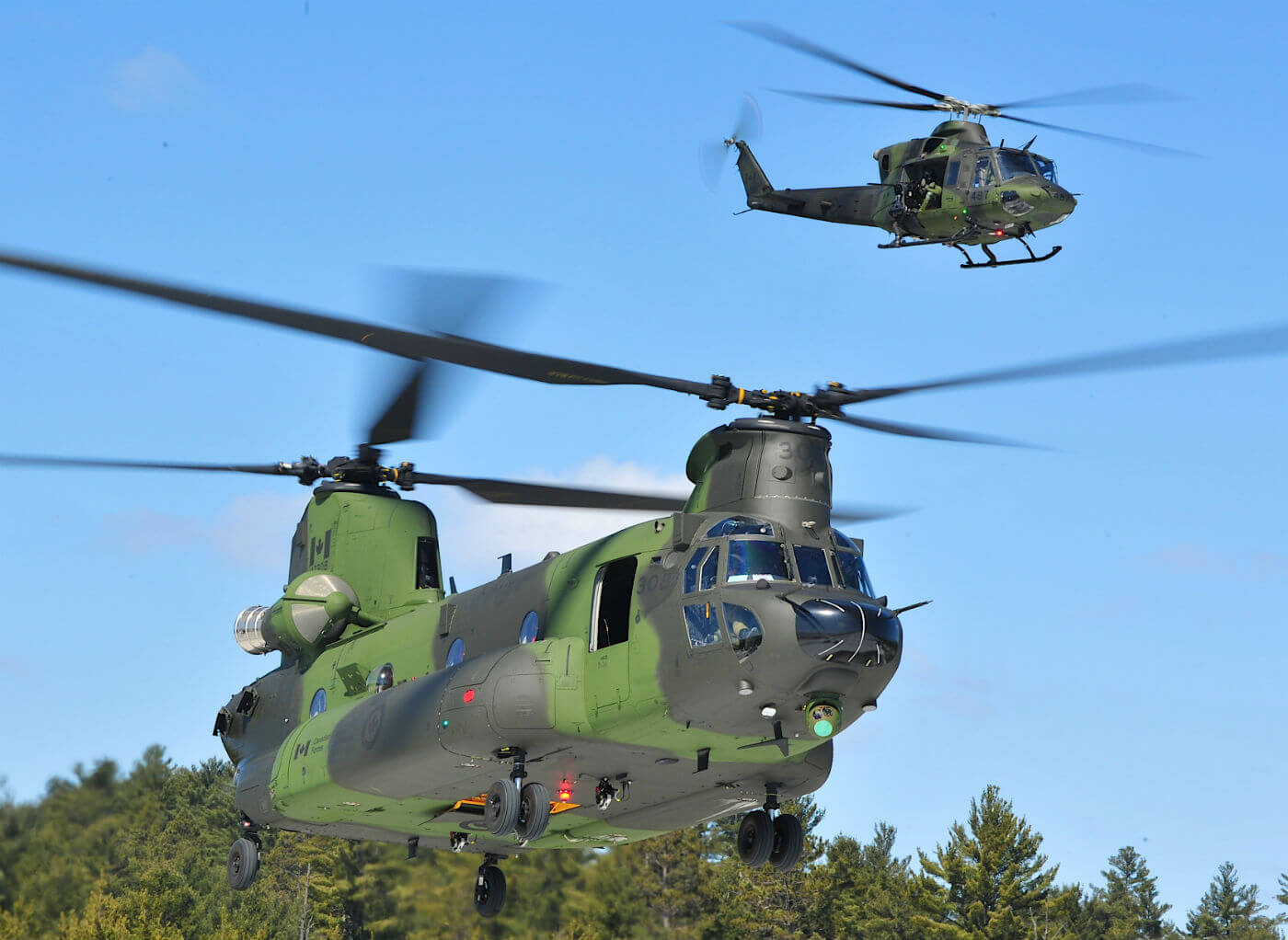
An RCAF CH-147 Chinook arrives at Camp Castor in Gao, Mali on July 15, 2018. Photo: MCpl Jennifer Kusche. Note the door gun MG in the Chinook for suppression during medevac or transport missions.
IS03-2018-0040-019
A CH-146 Griffon with door gunner arrives at Camp Castor in Gao, Mali on July 15, 2018. Photo: MCpl Jennifer Kusche


Wednesday, May 30, 2018

RCAF Griffons To Replace German Tiger Attack Helicopters in Mali

By: Daniel Maillet,
CAF Dispatch  

By August 2018 Canada will have "returned" to the United Nations Peacekeeping circle with some 250 members of Air Task Force Mali; which is expected to have two CH-147 Chinook helicopters and four CH-146 Griffons with door-gunner escort helicopters.

The mission is the deadliest of any United Nations peace operation, with 162 fatalities since it began in 2014.

Canada's deployment of an RCAF contingent is replacing the German Air Force's four UH-Tiger Attack helicopters and the Belgian Air Forces two NH90 medium-utility transport helicopters.

Image result for UH-Tiger Mali
Two German UH-Tiger Attack helicopters in Mali. 
The CH-147 Chinook is an upgrade for the Mali mission over the NH90. While the Chinook is slower and has a slightly shorter ranger - it can carry a much larger payload - more than double the payload of the NH90.

Canada's CH-146 Griffon Helicopters, on the other hand, are leading to questions about whether or not they can maintain the same level of security as the UH-Tigers. Prior to the Tiger's arrival in Mali; the Dutch Air Force had deployed Apache Attack helicopters as escorts. So the Griffon is a clear step-down.

Ted Campbell, a retired Senior Officer of the Canadian Armed Forces clearly expresses this concern. "[The] Griffon is a good helicopter and its crews, including the door gunners, are...much better than any aircrews anywhere on earth, but they do not have the “punch” of any attack helicopter." He goes on to say, "it is, of course, far to late to equip the Canadian Forces with attack helicopters for this mission."

Mr. Campbell is correct - here is a side-by-side comparison I compiled, as one does exist (because the Griffon is not considered by anyone except the RCAF as an "attack" helicopter)

Eurocopter UH-TigerBell CH-146 Griffon
Range: 800 kmRange: 656 km
Max Speed: 290 km/hMax Speed: 260 km/h
Ceilling: 14,000 ftCeilling: 20,000 ft
Max Takeoff: 13,000 lbsMax Takeoff: 11,900 lbs
Main Armament: 2x 30 mm (1.18 in) GIAT 30
Secondary Armament:  Multiple Options for
two outer hardpoint connections. This includes options for rockets and additional guns.
Main Armament: 2 x  7.62 mm M134D "Minigun";
or  2 x 7.62 mm C6 general purpose machine gun;
or  2 x .50 Cal (12.7 mm) GAU-21
Secondary Armament: None
Power Plant: 2 × MTU Turbomeca Rolls-Royce MTR390 turboshaft engines, 1.303 shp (958 kW) - EachPower Plant: 1 × Pratt & Whitney Canada PT6T-3D turboshaft engine, 1,250 shp (932 kW)

With the side-by-side comparison - it is clear that the Griffon, while it can operate a higher altitude, has little else in comparion to the UH-Tiger. The Eurocopter Tiger Attack helicopter is a far more versatile helicopter than the Griffon, and the twin engines make it far more powerful.

Image result for Griffon Door Gunner
Canadian Door Gunner sits back in his CH-146 Griffon helicopter over Afghanistan. Photo by: Sergeant Matthew McGregor, Canadian Forces Combat Camera© 2011 DND-MDN Canada
The Risks to RCAF Helicopters and Crew 

Additionally, something the Government of Canada is not highlighting is the very real risks involved in the Mali deployment. Last summer Germany lost a Tiger Helicopter, killing its crew of two.  This was not due to an attack by extremists, but an error in the auto-pilot settings.  This source of this error has not yet been located, but the Subsaharan climate could be to blame. RCAF Griffon pilots have experience in both Afghanistan and in Iraq, but the deserts of Mali are different than both those of Mesopotamia. Although General Vance considers the dry, dusty conditions of the terrain in Mali are similar to what the military has faced elsewhere.  Only four of the 160 fatalities have been associated with helicopter incidents. All of those had to do with mechanical failure of the aircraft and not with enemy or belligerent fire” according to Chief of Defence Staff Gen. Jonathan Vance in an interview with Global News.

Monday, May 28, 2018

RCAF Griffons Still Busy Over Iraq

By: Chris Thatcher, Vertical Magazine 

The battle for the northern Iraqi city of Mosul and an offensive in the Hawija pocket further south may have concluded in the summer and fall of 2017, but the whirl of Canadian helicopters continues to resound over the region.

Iraqi security forces, with the assistance of a coalition of international partners, broke the four-year siege of Mosul by the Islamic State of Iraq and Syria (ISIS) in July and have continued a sporadic fight against pockets of ISIS, also known by its Arabic name, Daesh, and its supporters across Iraq’s northern provinces.

CH-146 Griffon aircrews have resumed conducting four to five missions per day, seven days a week, a pace similar to the height of the pre-Mosul campaign. Skip Robinson Photo
Though the scope of the conflict has changed, Canadian Special Operations Forces (SOF) continue to train, advise and assist the Kurdish Peshmerga as part of Operation Impact. In support of that effort, a tactical aviation detachment comprised of four CH-146 Griffon helicopters and around 50 aircrew, maintenance, logistics and headquarters personnel continue to provide tactical transport from an airbase near Erbil, carry Canadian and coalition SOF, equipment and ammunition between forward locations.

“There is really no change to that part,” said Maj Sylvain Lapierre, commanding officer of the fifth rotation of the detachment. “We still provide them with liaison, reconnaissance, and material support, and we are on standby for casualty evacuation if it were to be required.”

In the months following the ouster of Daesh from Mosul, Iraq’s second largest city, the aviation detachment saw what Lapierre calls a “tactical pause” in coalition SOF operations. But it was only a brief respite. As winter turned to spring, Griffon aircrews have resumed conducting four to five missions per day, seven days a week, a pace similar to the height of the pre-Mosul campaign when special forces helped Iraqi troops establish blocking positions around the city.

“We are task-tailored for 12 hours a day and we routinely do about 16,” said Lapierre of what remains, despite the disintegrating enemy force, a remarkably high operational tempo. In fiscal 2017, the detachment flew over 3,000 hours. “We would have no difficulties surging to 24 hours a day if we needed to.”

As with all commanders since the tactical aviation detachment was first deployed in October 2016, risk management remains the biggest concern.

Lapierre, a helicopter pilot with two tours in Bosnia and one in Afghanistan, as well as two years as a liaison officer with the U.S. Army Aviation Center of Excellence in Fort Rucker, Alabama, said the threat of enemy rocket, mortar and small arms fire is still a threat. But the variable weather, which can quickly reduce visibility, and man-made obstacles, also have to be mitigated.

“Lots of towers, lots of power lines-they are everywhere,” he said. “And they are not necessarily marked to the same standards that we are used to in Canada.”

Still, “rogue actors” in the form of Daesh or their sympathizers remain the preeminent threat to both helicopters and special forces. Aircrews routinely change flight profiles and rely on well-honed tactics, techniques and procedures to transit potentially risky airspace and to protect the aircraft.

Potentially complicating matters further, Turkey, a NATO ally, has been conducting offensive operations across its southern border against Syrian Kurdish militia. While the fighting has not affected the detachment’s missions-it’s a conflict to be addressed at the political level, Lapierre noted-it nonetheless is one more issue to keep an eye on.

“We obviously monitor everything that happens in the region from an intelligence perspective,” he said. “But nothing has really changed the way we are flying or how the [detachment] is operating in the area.”

However, before granting mission acceptance and launch authority, air task force commanders routinely use a risk assessment scorecard that has its origins in the helicopter missions of Afghanistan. The evolving tool forces leaders to deliberately evaluate the level of risk they are being asked to accept by assigning a score to the nature of the mission, how it is organized, the number and type of aircraft involved, the types of passengers, the degree of reliable intelligence, the availability of supporting enablers, and the environmental conditions.

“When we are looking at communicating the aspects of flight safety, it has become a very important supervision tool,” said Lapierre.

Many of those risks are mitigated by the fact that, although most of the tactical aviation detachment are on their first operational tour, all of the aircraft commanders (AC) are veteran pilots of multiple tours.

“I find myself in a privileged situation,” Lapierre acknowledged. “It makes the risk management aspect a little easier. And they have become outstanding mentors for the newer generation of aircrew that are rotating through theatre that may not have [served] in Afghanistan or on a previous mission. There is great sharing of information, not just among the aircrews but also within the maintenance organization.”

Exercises might train and validate the competency of an air task force, but the repetition of missions on an operation can make it easier to absorb instruction in a way that isn’t always possible in complex exercise scenarios, he observed.

“Sometimes coming to a theatre where the focus is different brings new opportunities to learn. Here we have the opportunity to train our younger aircrew in a real theatre, with real tasks and real control measures, with real users. In some ways it caps everything. What you have learned before as a young aviator, this is the sum of it.”

Despite temperature swings that have ranged between 35 C and below zero since the rotation began, the CH-146 Griffon has exceeded expectations. The detachment, which slimmed down from around 60 to 50 personnel last fall, is largely self-sufficient, managing most aspects of maintenance and logistics, and yet has had little trouble keeping the almost 20-year-old helicopters flying.

“I have outstanding serviceability here,” said Lapierre. “We haven’t seen any loss of performance. Like any other helicopter, there comes a point in the very high heat of the summer where we have to get into the books, look at the performance charts and find efficiencies, which we can do by managing the missions and the timings for the tasks. I think we are doing very well with this aircraft.”
Leading the way

Since the detachment was first stood up in 2016, three squadrons have assumed the leadership, beginning with 427 Special Operations Aviation Squadron from Petawawa, Ont., and then 430 Tactical Helicopter Squadron (THS) from Valcartier, Quebec.

Like Lapierre, many of the current detachment are from 408 THS in Edmonton. But over the course of his more than seven-month tour, he has seen members from every tactical aviation squadron in 1 Wing, as well as 417 Combat Support Squadron from Cold Lake, Alta., deployed to Camp Erable, home to Joint Task Force-Iraq Detachment Erbil, a headquarters staff of approximately 30 personnel and a Canadian-led Coalition Role 2 medical facility.

The commander admits he wasn’t sure how well a diverse group would gel without a lot of pre-deployment training. To his surprise, the different helicopter organizations clicked together almost immediately, proving the flexibility the Royal Canadian Air Force tactical aviation detachment concept.

“It’s one of those cases where one plus one equals three,” he said. “We’ve got a lot of synergies with different units. Everybody brought something and it made the sum of everything greater.

“It proves that we have a great deal of interoperability. Regardless of which unit people were coming from, it was easy to integrate them,” he observed as he prepared to hand over command to 430 THS in late May.

“[It’s also] a testament to our level of readiness and how strong and mature our SOPs (standard operating procedures) are. That is one thing I’ll be passing on, that we maintain our solid SOPs and work practices back home-they transfer well into theater.”

If anything, he’s realized how difficult it is to deliver such a high level of service for so long a period.

“One of my challenges is going to be to go back home and maintain the 100 per cent focus people have here,” he said. “Whether it’s maintenance, flying, logistical support-everyone has worked hand-in-hand to make these missions happen.”

Thursday, May 24, 2018

GoC Still Considering Spare Helicopters for Mali Mission

By: Lee Berthiuame, The Canadian Press

OTTAWA — The Trudeau government is keeping the door open to sending more helicopters to Mali to ensure the Canadian Forces can provide round-the-clock medical evacuations in what is expected to be a harsh operating environment.

Canada is preparing to send two Chinook transport helicopters and four armed Griffon escorts to the African nation this summer as part of a commitment to support the UN mission there.

Those helicopters and about 250 military personnel are scheduled to leave in July and begin work on Aug. 1, Col. Chris McKenna, the commander of the helicopter detachment, told The Canadian Press on Wednesday.

While the detachment will likely be called upon at times to move troops and equipment across the arid landscape as required by UN officials, their primary mission will be evacuating injured peacekeepers and others.

That will entail having one Chinook and two Griffons on "perpetual standby, 24/7," McKenna said, "so our crews are essentially sleeping almost beside the aircraft ready to launch.

"We are focused on getting to an incident site as quick as we can to be able to provide lifesaving interventions for both soldiers and anyone else that the UN would choose to medevac."

Such medical services are especially important given the nature of the UN mission in Mali, which has seen dozens of peacekeepers killed or injured in ambushes and roadside bomb attacks by local militants.

While that high tempo alone could be expected to put a heavy burden on the detachment, the extreme heat and dust at the UN mission in Gao, where the Canadians will be based, isn't expected to make life any easier.

Both the Germans and the Dutch have lost helicopters in the area over the last couple of years in crashes blamed on technical problems caused by the environment. The accidents killed four peacekeepers.

McKenna, whose detachment recently wrapped up several days of training at Canadian Forces Base Wainwright in Alberta, described the environment as "the biggest enemy."

"We're talking about operating state-of-the-art helicopters in the sub-Saharan Sahel region where the temperatures can reach 50-plus degrees and you see an enormous amount of dust," he said.

"And as you know from our experience in Afghanistan, that can be quite tricky from a helicopter point of view."

There are ways to manage those challenges, McKenna said, including making sure crews are familiar with the environment and setting up a stringent and efficient maintenance regime.

But the question of whether to send spare helicopters to Mali, either now or at some other point during the 12-month mission, is also on the horizon.

"I've been given leeway (to ask) for spares if we so think that that is required," he said. "And it is still being determined by government whether or not we'll be able to bring spares."

The Canadian helicopters and military personnel will replace counterparts from Belgium and Germany, the latter of which has been operating both transport and attack helicopters in Mali for several years.

Canada's arrival in Mali comes only months after the UN Security Council authorized the peacekeeping mission there to provide medical evacuations and transport services to a multinational counterterror mission in the country.

When asked whether that means his force could be called upon to support the so-called Group of Five Sahel force, McKenna would only say that his role will be to support the peacekeeping mission's mandate.

"We are having essentially no caveats going in," he added, "so we work for that force commander and we execute what he asks us to do as long as it's within our capabilities and our risk."

— Follow @leeberthiaume on Twitter.

Tuesday, May 8, 2018

More RCAF Helicopters a Possibility for Mali Mission

By: David Pugliese, Defence Watch 

The number of helicopters the RCAF will eventually send to Mali continues to be uncertain.

Image result for griffon attack helicopter
Canada has announced it will send two Chinook and four armed Griffon escort helicopters to Mali. 
In mid-March Defence Minister Harjit Sajjan announced that Canada would send to the United Nations mission in Mali two Chinook helicopters and four armed Griffon helicopters to escort them. A few minutes later at the same news conference Chief of the Defence Staff Gen. Jon Vance said the number of helicopters being assigned to the Mali mission have still not been determined as a reconnaissance had to be carried out.

A short time after that, Sajjan’s office sent out a message to journalists, contradicting Vance by stating that ‘up to’ two Chinooks and four Griffons would be sent.

Now in a response from the Canadian Forces to a series of questions about the Mali mission submitted by Defence Watch, it appears changes are again in the works…maybe…. “Details regarding tactics, risk mitigation, and force protection measures are yet to be finalized and many considerations need to be made,” the Canadian Forces noted in an email. “For instance, regarding operational sustainment, considerations include the possibility of deploying spare helicopters. As planning continues, we will be able to confirm such details in the near future.”

The response didn’t indicate whether that refers to spare Chinooks, Griffons, or both.

In addition, there are no details yet on costs….not even a ballpark figure on what Canadian taxpayers will have to spend for this one-year mission.

Monday, April 30, 2018

Is sending helicopters to Mali good enough?

By Chris Kilford

Given the recent concern over Canada’s upcoming contribution to the Multidimensional Integrated Stabilization Mission in Mali (MINUSMA), one might easily assume that up until now few Canadians had ever set foot in Mali. However, this is far from the case – Canada is Mali’s second-most important bilateral development partner, after France.

Image result for rcaf chinook helicopter afghanistan
Sgt Chad Zopf, a door gunner, onboard a Griffon helicopter while on exercise in Afghanistan.

At the Embassy of Canada in Mali, which opened in the city of Bamako in 1970, the Université Laval and various Canadian non-governmental organizations have been working for years to improve the daily lives of Malians.

In the past 12 months alone, and with the support of the Canadian government, efforts were underway to: improve agricultural output and food security; to assist community health physicians graduate from the University of Bamako; and to provide new software to Mali’s government for improving domestic revenue collection.

Meanwhile, several Canadian mining companies have significant investments in Mali. B2Gold Corporation, for example, operates the Fekola Mine with a 950-strong, mostly Malian workforce. According to Canada’s Ambassador, Louis Verret, the gold sector “accounts for about 66% of Mali's exports and is therefore critical for government revenue.”

However, since 2012, Mali has been gripped by civil war in part fuelled by the Canadian-backed ouster of Libya’s Muammar Gaddafi in 2011. Following his death, many Malian Tuareg fighters who had fought for his regime, returned home to fight for their own space in northern Mali. And, while a peace agreement between the government and its main opponents (including the Tuareg) was signed in 2015, little has changed on the security front. Instead, the French, the G5 Sahel regional force, and MINUSMA are doing what they can to contain various rebel factions.

As for MINUSMA, it is only as good as the troops it gets from contributing countries – and many western armies, which could make a big difference – are noticeably absent from the front lines. For a mission deployed in an asymmetrical conflict environment, this is a big problem, and has resulted in significant casualties for UN troops that have largely been drawn from developing countries.

Still, not all is lost. In June 2017, the UN instructed MINUSMA to fully concentrate its efforts on supporting the Agreement on Peace and Reconciliation and step-up efforts to redeploy Malian security forces to the centre and north of the country. To help, an EU Training Mission with 580 personnel is re-building the military, while 128 personnel with the EU Capacity Building Mission are focused on training the police, gendarmerie and national guard.

As for Canada, it will soon send six helicopters and approximately 250 personnel for 12 months in support of MINUSMA. For those wanting Canada to take on a more active international role, it’s good news. But when it comes to truly helping the UN, apparently our deeds are falling short of our words. Sending helicopters is important, but it’s not quite what many had expected from a government that has been consistently eager to portray itself internationally as a serious player on the world stage.

–––
Chris Kilford is a former Army Officer and defence attaché who served in Afghanistan and Turkey. Currently he is a fellow with the Queen's Centre for International and Defence Policy.

Thursday, April 26, 2018

UN Says 2 RCAF Chinooks Not Enough for Mali Mission

By: Melissa Kent, CBC Exclusive 

Canada is taking over a key role in the peacekeeping mission in Mali, but United Nations officials worry it may not be able to fully implement its mandate because it plans to send limited helicopter support.

Canada has pledged to send two CH-147 Chinook transport helicopters to a peacekeeping mission in Mali but the UN wants more. (Fred Chartrand/The Canadian Press)
Ottawa has said it will supply two CH-147 Chinook transport helicopters for logistical support and medical evacuations and four armed CH-146 Griffon helicopter to the UN Multidimensional Integrated Stabilization Mission Mali (MINUSMA).

The UN, meanwhile, is expecting that two Chinooks will be available at any given time — which means Canada would need to send more than two to Mali.

''A helicopter is not like a car. They have planned maintenance,'' said a UN official familiar with the talks. ''Therefore, in order to have two available on a daily basis you would need three."

The UN will meet with a delegation from Canada on Wednesday to discuss the mission's operational requirements, including the availability of two transport helicopters on a daily basis, the official told CBC News.

Germany, which Canada will be replacing in Mali, deployed four NH90 transport helicopters to make sure it had two operational on a daily basis. But that may have had more to do with the fact the NH90 is so new and had never been deployed into the desert, the official said.

The Chinook, on the other hand, is a workhorse that's been in operation for decades. Its quirks and reliability issues in harsh conditions are well known.

Deadliest peacekeeping mission

The four Griffon helicopters Canada is sending to Mali are armed, but they are not full-scale attack helicopters and won't be providing critical fire support from the air to secure convoys and troops on the ground.

This is not a frivolous requirement: the mission in Mali is currently the UN's deadliest. Since it was established in 2013, 166 soldiers have been killed.
The UN mission in Mali is one of the most dangerous peacekeeping operations in the world. (Moustapha Diallo/Reuters)
The peacekeepers are also dealing with a growing terrorist threat and a peace accord that the country has been struggling to implement for more than two years.

Germany currently has four Tiger utility helicopters in Mali to provide protection for troops on the ground. The Netherlands had four Apache attack helicopters and three Chinooks when it was in theatre from 2014 to 2017.

Canada's military, however, doesn't have attack helicopters. The role of the Griffons will be to escort and defend the Chinooks, not protect ground troops.

According to the Canadian military's standard operating procedures, whenever a Chinook is dispatched in a hostile environment, it must be escorted by two armed Griffons for protection.
El Salvador to provide firepower

Instead, El Salvador will provide ground troops with aerial cover. The small Central American nation is supplying six U.S.-built MD500 attack helicopters — two air-cover units consisting of three helicopters.

One of the units has been operating out of Timbuktu in the country's north since 2015. Another trio will deploy in July and is expected to work alongside Canada at the UN mission's base in Gao, in northeast Mali.

The UN would also like Canada to allow the Griffons to do double-duty as light transport helicopters, with El Salvador providing the escort. That request is also expected to come up at Wednesday's meeting.
Canada's Griffon helicopters are armed, but the will not be in Mali to protect ground troops as helicopters sent by other countries have. Rather, their role will be to escort and defend the Chinooks. (Ryan Remiorz/The Canadian Press)
Germany, meanwhile, will continue to have soldiers in Mali providing ''intelligence, surveillance, reconnaissance'' confirmed Peter Neven, a spokesperson at the German Mission to the UN. But the country's helicopter contribution will come to an end June 30.

Canada has said its aerial task force won't be operational until August.

Sources within the UN's peacekeeping department have said contingency plans are already in place, and that arrangements have been made with private contractors to fill any operational gaps that month.

''I hope they can come to an agreement, so there is no gap between the Germans' departure and the arrival of the Canadians,'' said the head of MINUSMA, Mahamat Saleh Annadif, during a media briefing at UN headquarters earlier this month.

Friday, April 20, 2018

RCAF Mali Mission to use Afghanistan Playbook

By: Murray Brewster, CBC News

The Canadian helicopters going to Mali will be outfitted as they were in Afghanistan and will fly their missions the way they did there, senior military commanders said Thursday.

A French soldier stands inside a military helicopter during a visit by French President Emmanuel Macron to the troops of Operation Barkhane, France's largest overseas military operation, in Gao, northern Mali, Friday, May 19, 2017. Canada is sending six military helicopters to take part in the UN peacekeeping mission there.(Christophe Petit Tesson/THE CANADIAN PRESS-AP POOL)
The country's military operations command, Lt.-Gen. Steve Bowes, and the director of the strategic joint staff at National Defence headquarters, Maj.-Gen Al Meinzinger, testified before the House of Commons defence committee about the upcoming peacekeeping mission in the troubled West African country.

They and senior officials from Global Affairs were questioned repeatedly by Conservatives MPs about whether the planned year-long deployment, slated to begin operations in August, can be deemed a combat — or war zone — operation.

The officials sidestepped that description. Bowes said the Canadian military is accustomed to operating in "high-risk environments" and called Mali a "complex conflict zone."

Armed groups linked to al-Qaeda, ethnic Tuareg and Arab guerillas and government-supported militia have attacked each other, Malian soldiers, peacekeepers, aid workers and other civilians in a conflict that has raged on since late 2012.

The six Canadian helicopters — two CH-147 Chinook battlefield transports and four CH-146 Griffon armed helicopters — will carry out medical evacuations, shuttle around United Nations peacekeepers from other countries and occasionally support the so-called G-5 Sahel countries which are carrying out counter-terrorism operations against Islamic extremists.
A 'disciplined approach'

That means Canadian pilots and aircrew will have to be very deliberate in the way they conduct themselves, said Meinzinger, a former CH-146 Griffon pilot who was commander of the Canadian air wing in Kandahar near the end of Canada's Afghan war.

"Our approach to this mission from an aviation perspective will be very akin to the way we operated in Afghanistan," he said.

"A very disciplined approach as to how we accept missions at the front end and pre-execution ... we have a very disciplined way where we consider all of the potential threats from the weather to the fatigue levels of the crews."

Those air operations in Kandahar were carried out under the umbrella of Canada's five-year combat mission, which ended in 2011.

The Griffons — which can be outfitted with a multitude of weapons, including the C-6 machine gun, the M-134 Dillon six-barrel gatling gun and the GAU-21 .50 Cal machine gun — will be used in the role of "armed escort" for the Chinooks, the generals testified.

The threat to aircraft posed by extremists in Mali comes from light arms, such as rifles, machine guns and rocket-propelled grenades — not very different from the weapons the air force faced in Afghanistan.

Bowes told the committee there's been "no evidence" of guerillas being armed with portable surface-to-air missiles, known as MANPADS.

Even still, he noted, the Canadian helicopters are equipped with defensive systems, including .50 calibre machine guns.
'Sophisticated and underhanded'

One of the biggest dangers to aircraft and crews in Mali is expected to be the harsh desert climate. Last summer, the Germans lost a Tiger helicopter in a mechanical failure crash that killed two.

A UN base in the troubled country was recently subjected to a four-hour rocket, mortar and car bomb attack, which killed two peacekeepers. It was described by the French military as "sophisticated and underhanded" — something that caught the attention of opposition MPs.

"They've been extremely bold in the last month," said Conservative MP and defence critic James Bezan, who has led the party's charge to have the deployment debated and approved by Parliament. "We're not talking [attacks] in open theater. They're coming right on the bases and taking the fight to us."

The air contingent will deploy with its own security and Meinzinger said the Germans will still station as many as 500 troops at the air base where operations are conducted.

Thursday, March 22, 2018

Canadian Peacekeepers head to Mali, a country broken by Civil War

GEOFFREY YORK, The Globe and Mail 
JOHANNESBURG
Originally Published: March 19, 2018

For a decade, Canada has pumped more than $1-billion in foreign aid and military support into the West African nation of Mali, trying to rebuild a fragile and dysfunctional state.

It has largely been a failed effort. Despite massive international support, Mali has fallen into turmoil, suffering first a military coup and then widening violence as its government steadily lost territory to northern separatists and Islamist militias.

Now Canada will try again. Defence Minister Harjit Sajjan announced on Monday that Canada will send military helicopters to Mali to support the United Nations peacekeeping mission there. The one-year deployment is expected to include two Chinook helicopters for medical evacuations and logistical support, along with four smaller Griffons to serve as armed escorts.


It will be one of Canada’s first major peacekeeping efforts in Africa since the troubled missions in Somalia and Rwanda in the early 1990s. The deployment will also include Canadian troops, although Mr. Sajjan said the number is not yet decided. Sources earlier told The Globe and Mail that 200 to 250 Canadian soldiers could be deployed to Mali as air crews, medical crews, support staff and special forces.
A French soldier of the operation Barkhane, an anti-terrorist mission in Sahel, patrols during a tactical flight on March 12, 2016 over Mali. PASCAL GUYOT/THE GLOBE AND MAIL

Mali is considered the most dangerous UN mission in the world, with 162 peacekeepers killed since 2013. Canada hopes to avoid casualties by deploying helicopters, which are much less vulnerable to attack.

But physical danger is only one of the challenges. The bigger question is whether a military effort can reconstruct a broken state, one of the most aid-dependent in the world, where the government has little effective control of the country.

By some estimates, two-thirds of Mali’s territory is under constant threat from armed groups, including Islamist extremists.

Scholars have described Mali’s government as a Potemkin façade, more fictional than real. “Donors have little to show for their efforts,” said a recent analysis by Catriona Craven-Matthews and Pierre Englebert, scholars at Pomona College in California who have studied Mali for years.

They estimate that international donors have spent an average of US$3-billion annually since 2013 to support Mali’s security and development – nearly a quarter of the country’s GDP. Yet the state remains weak. “Violence is on the rise, institutions remain dysfunctional, the military is inefficient, investments have been few, and corruption is rampant,” the two scholars wrote.

Image result for canadian chinook afghanistan
The last major overseas deployment of the RCAF Chinook helicopters was in Afghanistan, where the workhorse heavy-lift helicopters were used to avoid roadside IEDs. PHOTO: RCAF
Despite this, foreign support continues to pour into the country, largely because many countries have keen strategic interests in Mali.

For the United States, northern Mali is a dangerous source of Islamist fighters, including those who crossed the border into Niger and killed four U.S. soldiers last October.

For European countries, Mali is one of the main routes for the traffickers who bring migrants and drugs onto the continent.

For Canada, there are economic and humanitarian interests. Canadian mining companies have invested more than $1-billion in Mali’s mining industry. And both the Liberal and Conservative governments in Ottawa since 2006 have made Mali one of their favourite recipients of aid.

A decade ago, Ottawa saw Mali as a model of democracy and stability for Africa – an assumption that was later undermined by a coup, civil war and terrorism.

After choosing Mali as one of its “countries of focus” for development aid, Ottawa spent huge sums of money to prop it up. Mali has become one of Canada’s top five recipients of foreign aid, getting more than $100-million annually, including $125-million in 2016. This has made Canada the third-biggest bilateral donor of development aid to Mali, behind only France and the United States.

Canada forged an even stronger connection to Mali after the kidnapping of Canadian diplomats Robert Fowler and Louis Guay, who were held hostage by an Islamist radical militia in the deserts of northern Mali for several months in early 2009. Canada put heavy pressure on the Malian government to help negotiate their release.

Canada has also sent hundreds of soldiers to Mali since 2010 in a multimillion-dollar effort to help train the Malian army in counterterrorism, border security and other priorities.

Much of this training was led by the U.S. military under a US$500-million counterterrorism program. But one of the graduates of the U.S. training program, Captain Amadou Sanogo, shocked the Pentagon in 2012 by leading a military coup in Mali.

The coup forced Canada to suspend its aid to Mali for nearly two years.

Military solutions have failed to build a self-sustaining democracy in Mali. The country remains heavily dependent on troops from France, West Africa and the United Nations. It remains to be seen whether Canada’s helicopters can make any real difference in a dismal situation.

- With a report from Robert Fife in Ottawa

Monday, June 12, 2017

Griffon Helicopter Replacement not in the Cards

By: David Pugliese, Defence Watch 

A number of aerospace firms exhibiting at the recently held CANSEC 2017 defence trade show in Ottawa highlighted the helicopters they hoped they could offer the Canadian government as a replacement for the RCAF’s Griffons. The companies had heard Defence Minister Harjit Sajjan suggest that a replacement would be needed for the Griffon.

English/Anglais<br>
FA2006-0249<br>
16 May 2006<br>
4 Wing, Cold Lake, Alberta<br><br>

2 CH 146 Griffons from 408 Tactical Helicopter Squadron take off on a mission.<p>

Elements of 408 Squadron deployed to 4 Wing Cold Lake along with 17 Wing Winnipeg's Mission Support Unit for Exercise Maple Flag XXXIX and form the Air Expeditionary Unit.<p>

Maple Flag is an annual international air combat exercise that attracts more than 5,000 participants from all over the globe, which engage in a simulated, 10-day air campaign. The exercise provides aircrews with realistic training in a modern simulated air combat environment. Maple Flag provides critically important training for Canadian and allied aircrews.<br><br>

Photo by WO Serge Peters, Air Public Affairs<p>

French/Français<br>
FA2006-0249<br>
Le 16 mai 2006<br>
4e Escadre Cold Lake (Alberta)<br><br>

Deux CH-146 Griffon du 408e Escadron tactique d'hélicoptères partent en mission.<p>

Des éléments du 408e Escadron ont été déployés à la 4e Escadre Cold
Griffon helicopters take off on a mission. DND photo. 
Romain Trapp, president of Airbus Helicopters in Canada, briefed journalists at CANSEC pointing out the capabilities of the company’s H145M as a possible replacement for the Griffon. “We made the business case by showing (the RCAF) that by going to a new platform, the Canadian taxpayers would save more than $1 billion,” he explained. Those saving would be made over a 10-year period.

Leonardo Helicopters also has a variety of aircraft that could replace the CH-146.

But the Liberal government’s newly released defence policy did not follow through with a Griffon replacement.

Instead, the Liberals will embark on what they are calling the “CH-146 Griffon Limited Life Extension.”

They didn’t go into details but the emphasis here is “limited.”

It is unclear whether that project will be a stop-gap life extension until a new helicopter procurement could take place.

Thursday, May 11, 2017

Op-LENTUS 17-03 Flood Support Update

DND Report:

A total of approximately 2200 CAF personnel have been deployed to support Quebec citizens in the four affected regions: Montérégie, Outaouais, Mauricie and Montréal. Troops, along with aviation assets, engineer assets, and 12 boats from the Naval Reserve, are in place to support and react to the needs identified.

Timeline:
May 5, 2017: Within one hour of Public Safety receiving a request for assistance, the CAF sent liaison officers and reconnaissance elements to four regional coordination centres. There they met with provincial partners to determine how the CAF could help.

May 6, 2017: An immediate response unit of 400 military personnel departed CFB Valcartier to begin assisting in the four affected regions. The CAF also sent additional personnel to the regional coordination centres to pave the way for additional waves of troops preparing to leave Valcartier.
May 7, 2017: Hundreds more troops departed Valcartier. Total troop strength reached approximately 1650 spread out over the four affected regions.

May 8, 2017: The CAF put additional troops and equipment on standby to help if needed. These consisted of about 470 personnel from 31, 32, and 33 Canadian Brigade Group Domestic Response Companies, plus a Composite Reserve Engineer Squadron.

May 9, 2017: By this date, approximately 1830 military personnel were supporting flood relief.

May 10, 2017: The approximately 470 personnel that were on standby moved into affected areas and began assisting in flood relief. These troops are from 31, 32, and 33 Canadian Brigade Group Domestic Response Companies, plus a Composite Reserve Engineer Squadron. By the end of the day on May 10, 2017, approximately 2200 military personnel were supporting Operation LENTUS. More troops are now deployed for the operation in Quebec than the rest of all Canadian Armed Forces operations around the world combined.

There are currently seven RCAF helicopters deployed on #OpLentus -
one CH-147F Chinook from 450 Tactical Helicopter Squadron from Petawawa and six CH-146 Griffons (four from 430 Tactical Helicopter Squadron from Valcartier and one from each 438 Tactical Helicopter Squadron from St. Hubert and 439 Combat Support Squadron from Bagovtille).

As of May 10, 30 sorties have been flown, including two sorties by the Chinook, which did a sandbag resupply to Berthierville, Quebec.

May 11, 2017: HMCS Montréal arrived in Trois-Rivières. Approximately 160 personnel of the ship’s company will join the CAF troops already on the ground to support the citizens in this affected area. HMCS Montréal was originally anticipated to arrive in its namesake city this week to celebrate the 375th Anniversary of the City of Montreal.

The CAF is helping the civil and municipal security teams already on the ground by conducting tasks such as:

distributing and filling sandbags to help solidify existing structures and protect critical infrastructure
using military vehicles to help the civil authorities to maintain traffic on critical arteries and help evacuate citizens to safe areas patrolling to monitor critical infrastructure and safety of citizens
reinforcing dikes and walls to protect critical infrastructure such as water treatment plants and bridges

The CAF is also ready to support civilian partners such as the Canadian Red Cross in the supply of shelters.

Tuesday, April 18, 2017

Edmonton Helicopter Squadron Deploys to Iraq

The Canadian Press 

EDMONTON—The Canadian military has deployed 60 members of an Edmonton-based helicopter squadron to Iraq as part of Operation Impact, a mission to fight Daesh militants in the country’s north.

The Department of National Defence says the Royal Canadian Air Force’s 408 Tactical Helicopter Squadron will take over from their counterparts from Valcartier, Que., who have been providing tactical support since October 2016.

The 408 squadron operates out of 3rd Canadian Division Support Base in Edmonton.

They will fly and maintain up to four CH-146 Griffon helicopters at Camp Erable near Erbil, Iraq.

Maj.-Gen. Christian Drouin, commander of 1 Canadian Air Division, says the squadron will provide support to both Canadian and coalition partners.


There are currently 830 Canadian military personnel based in both Iraq and Kuwait as part of Operation Impact.

“The men and women of 408 Tactical Helicopter Squadron will continue to provide agile, reliable and dedicated service that Canada’s Special Operations Forces and our coalition allies have come to expect from the RCAF,” Col. Jeannot Boucher, commander 1 Wing, said in a news release.

Wednesday, November 23, 2016

New Photos From OP IMPACT

Very little news is generated out of OP IMPACT these days. So here are some photos of our Canadian Armed Forces members serving in Iraq and are on the frontlines in the battle against ISIL.

It is evident that the RCAF CH-146 Griffon's are being well used on their most recent deployment to the Middle East.

IS03-2016-0039-001
An RCAF CH-146 Griffon on the tarmac in Erbil, Iraq. 
IS18-2016-0002-015
Photo has been digitally altered to protect operational security. Medical personnel from the Canadian Armed Forces and the Norwegian Army transfer a simulated patient to the operating table during an exercise scenario at the Role 2 medical facility in Northern Iraq.
IS18-2016-0003-002
A CH-146 Griffon helicopter flies over Northern Iraq for a tactical flying mission during Operation IMPACT on November 8, 2016.
IS18-2016-0004-011
A Canadian Armed Forces member secures the area while CH-146 Griffon helicopter crew members kit up before a tactical flying mission in Northern Iraq during Operation IMPACT on November 9, 2016.
KW05-2016-0201-007
Deployed Canadian Armed Forces Health Services personnel unpack and set up equipment at the Role 2 medical facility in Erbil, Iraq

IS18-2016-0001-012
A Canadian Armed Forces soldier guards his arcs of fire on board a CH-146 Griffon helicopter during an air mobility mission in Northern Iraq during Operation IMPACT on November 4, 2016.
IS03-2016-0039-003


Wednesday, June 15, 2016

Canadian officer assumes American command of 80th Wing

U.S. 80th Operations Group Commander Colonel Paolo Baldasso (left) transfers command of the 89th Flying Training Squadron to Royal Canadian Air Force Lieutenant-Colonel Rhett Chambers.
U.S. 80th Operations Group Commander Colonel Paolo Baldasso (left) transfers command of the 89th Flying Training Squadron to Royal Canadian Air Force Lieutenant-Colonel Rhett Chambers during an April 22, 2016, Euro-NATO Joint Jet Pilot Training Program change-of-command ceremony held at Sheppard Air Force Base, Texas. The handover represented the first time a Royal Canadian Air Force officer has been appointed as a squadron commander in the 35-year history of the program. PHOTO: Debi Smith, USAF photo

RCAF Press Release

From Sheppard Air Force Base

Royal Canadian Air Force Lieutenant-Colonel Rhett Chambers assumed command of the 89th Flying Training Squadron on April 22, 2016, in a ceremony at the 80th Flying Training Wing at Sheppard Air Force Base, Texas. The change of command ceremony marked the first time in the 35-year history of the Euro-NATO Joint Jet Pilot Training Program that an RCAF officer has been appointed to a squadron command position.

He has 4,000 flying hours to his credit; 330 of those he amassed during 75 missions in Afghanistan. His wife, Major Martine Chambers, retired last year after serving for 23 years in the Royal Canadian Air Force.

Lieutenant-Colonel Chambers joined the Canadian Armed Forces in 1994. Many of his flight hours were spent in CT-114 Tutor, CH-139 Jet Ranger, CH-146 Griffon, and CT-156 Harvard II aircraft.

The 89th Flying Training Squadron traces its lineage to the Second World War 89th Pursuit Squadron. As part of the Euro-NATO Joint Jet Pilot Training Program, 89th Flying Training Squadron trains 250 pilots a year in the T-37 twin-engine jet-powered Cessna Tweet. Designed specifically for training purposes, the Tweet is used for undergraduate pilot, undergraduate navigator, and tactical navigation training, during which students learn the fundamentals of aircraft handling, and instrument, formation and night flying.

Thursday, June 2, 2016

100 CAF Members start OP NEVUS-16 in High Arctic

DND Press Release

Yellowknife, NWT – National Defense / Canadian Armed Forces

Operation NEVUS 2016 (Op NE 16) will take place in and around Canadian Forces Station (CFS) Alert, Nunavut, from June 1 to 30, 2016.

Commanded by Joint Task Force (North) and involving approximately 100 Canadian Armed Forces (CAF) personnel from across Canada, Op NE 16 is the annual deployment of a technical team to Ellesmere Island to perform essential maintenance on the High Arctic Data Communications System (HADCS), located between CFS Eureka and  CFS Alert.

Op NE 16 will involve technicians from the Canadian Forces Information Operations Group, military members from the Mapping and Charting Establishment, and personnel and aircraft from the Royal Canadian Air Force, including a CC-177 Globemaster from 8 Wing Trenton, Ontario; a CH-146 Griffon detachment from 430 Tactical Helicopter Squadron in Valcartier, Québec; and a CC-140 Twin Otter from Yellowknife-based 440 Transport Squadron. The Canadian Armed Forces’ northern operations contribute to wider Canadian efforts to improve northern surveillance and reconnaissance, and to demonstrate a visible presence in Canada’s Arctic.

“I am proud of our men and women in uniform and DND civilians, who have deployed on Operation NEVUS. Their individual and collective efforts are essential to maintaining critical Government of Canada infrastructure on Ellesmere Island. They also have the opportunity to experience the unique environment found only in the High Arctic.” - Brigadier-General Mike Nixon, Commander, Joint Task Force (North)

Maintenance operations on the HADCS have been carried out annually since 1982, when the HADCS system first became operational. The operation began as Operation HURRICANE and was also briefly carried out under Operation NEMESIS before being renamed Operation NEVUS.

Wednesday, June 1, 2016

CAF and RCN Prepare for RIMPAC 2016

By: Frontline Defence News

Four warships, several aircraft and more than 1,500 Canadian sailors, soldiers, airmen and airwomen will participate in the United States Navy-led Exercise Rim of the Pacific (RIMPAC) from June 30 to August 4, 2016, in and around the Hawaiian Islands and Southern California.

The aircraft carrier USS Ronald Reagan (CVN 76) transits the Pacific Ocean with ships assigned to Rim of the Pacific (RIMPAC) 2010 combined task force as part of a photo exercise north of Hawaii.
The 25th edition in a series and held every two years, RIMPAC has grown into the world’s largest combined and joint maritime exercise. RIMPAC 2016 will bring together 45 ships, five submarines, more than 200 aircraft and 25,000 personnel from the armed forces of 27 nations. The exercise will challenge participants with unique training opportunities across the spectrum of military capabilities - from humanitarian assistance and disaster response to dynamic maritime security and complex warfighting operations.

"Canada has participated in every RIMPAC since 1971," said Defence Minister Harjit Sajjan. "Over the years, our participation has helped us build and foster collaborative relationships with our allies and partners in the region. RIMPAC 2016 will once again provide the Canadian Armed Forces with a valuable training opportunity, while demonstrating Canadian leadership and operational excellence abroad."

Participation in RIMPAC contributes to the operational readiness of the Canadian Armed Forces. Operational readiness allows the CAF to meet the likely tasks that the Government of Canada will assign.

“RIMPAC 2016 is a valuable opportunity for all services of the Canadian Armed Forces to train together in a joint environment with international allies and partners.," said Rear-Admiral Scott Bishop, RIMPAC Deputy Commander Combined Task Force.

"As Deputy Commander for the Combined Task Force, I am looking forward to working with our forces and our allies. The exercise will challenge our 1,500 Canadian men and women as we improve our readiness to respond to a range of potential operations, strengthen military-to-military partnerships, and enhance our ability to work effectively with participants from more than 25 nations.”

RIMPAC 16 takes place from June 30 to August 4, 2016 in the Hawaiian and Southern California area. Canada is deploying:

A maritime component comprised of four ships (HMCS Calgary, HMCS Vancouver, HMCS Saskatoon and HMCS Yellowknife), a RCN team of clearance divers, and a Forward Logistics Team;
A Land Component comprised of a Company Group based on a Rifle Company from the Third Battalion, Royal 22e Regiment, based out of Valcartier, Quebec;
An Air Task Force comprised of several aircraft (six CF-188 Hornets, one CC-130 Hercules, one CC-150 Polaris and one CP-140 Aurora), a Maritime Helicopter Detachment, and a Tactical Aviation Detachment consisting of four CH-146 Griffons and two CH-147 Chinooks;
More than 1,500 sailors, soldiers, airmen and airwomen; and
Several command, staff and support personnel.

Canadians will also hold key leadership positions during RIMPAC 2016:
Rear-Admiral Scott Bishop will serve as the Deputy Commander of the Combined Task Force; and
Brigadier-General Blaise Frawley, will serve as the Air Component Commander.

Wednesday, May 25, 2016

RCAF Ex. MAPLE FLAG Set for May 30th

DND Press Release:

Cold Lake, Alberta – National Defence / Canadian Armed Forces

Exercise MAPLE FLAG, the Royal Canadian Air Force’s largest and most complex international training event of the year, begins next week in Cold Lake, Alberta. Taking place between May 30 and June 24, Exercise MAPLE FLAG brings together up to 1300 Canadian Armed Forces (CAF) personnel in participant or supporting roles, and over 400 personnel from six allied and partner nations along with multiple aircraft including:
From Canada: CF-188 Hornet fighters, CH-146 Griffon helicopters, CP-140 Auroras, CC-177 Globemaster III heavy lift aircraft, CC-130 Hercules air-to-air refueling and transport aircraft, and contracted Dornier Alpha Jets;
From United States: C-130 Hercules aircraft and E-3 Sentry aircraft;
From France: Mirage 2000-5 and Rafale fighter aircraft; and
From the United Kingdom: E-3 Sentry aircraft.

This international exercise prepares Canadian and international aircrew, maintenance, and support personnel for the rigours of operations in the modern aerial battlespace. Exercises like this contribute to the operational readiness of the CAF so it can meet the likely tasks that the Government of Canada could assign.

Slide - Royal Canadian Air Force hosts Exercise MAPLE FLAG

“Exercise MAPLE FLAG is a direct contributor to the RCAF’s success in generating world-class air power. This exercise is a great opportunity to enhance our agility, reach, and power, while integrating with our domestic joint partners and allies.” - Major-General David Wheeler, Commander 1 Canadian Air Division

“We are pleased to once again host Exercise MAPLE FLAG in Cold Lake. The personnel of 4 Wing and CFB Cold Lake have been working hard over the past several months planning this incredible, fully immersive training opportunity for not only the Royal Canadian Air Force, but our international allies and partners. The outcomes of this exercise will undoubtedly provide those involved with the skills and expertise to operate effectively against any adversary.” - Colonel Eric Kenny, Commander 4 Wing Cold Lake
MAPLE FLAG Quick Facts
In recent years, Exercise MAPLE FLAG has begun to fuse with elements of concurrent exercises, such as the Canadian Army-led Exercise MAPLE RESOLVE.
Participants will use a fictitious scenario in which they will fight against simulated threats using the latest in tactics, weaponry, and technology. The goal is to hone their skills within a realistic, evolving, and challenging operating environment. This exercise is as close as it gets to the real thing.
Participants from allied and partner forces include:
The United States Air Force;
The United States Air Force Reserve;
The Kentucky Air National Guard;
The United States Marine Corps;
The Royal Air Force;
The French Air Force;
The German Army; and
The Belgian Army.

Exercise MAPLE FLAG takes place primarily inside the Cold Lake Air Weapons Range (CLAWR). This unique airspace permits the use of a variety of simulated and live weapons systems, as well as supersonic flight.

Thursday, May 19, 2016

CAF Expansion of OP IMPACT and RCAF Griffon's Head to Iraq


DND Press Release
May 19, 2016 – Ottawa – National Defence / Canadian Armed Forces

As part of the Government of Canada’s expanded contribution to multinational efforts to degrade and defeat the so-called Islamic State of Iraq and the Levant (ISIL), the Canadian Armed Forces (CAF) recently added three CH-146 Griffon helicopters, an all-source intelligence centre, and additional trainers to Operation IMPACT.

The three CH-146 Griffon helicopters will enhance in-theatre tactical transport, including medical evacuations if required. The Griffons and their crews excel in the tactical transportation of troops and materiel. A variety of self-defence weapons are fitted to the aircraft for the deployment.
CH-146 Griffon helicopters
Members of the Canadian Armed Forces load CH-146 Griffon helicopters, which are deploying as part of Operation IMPACT, into a CC-177 Globemaster aircraft at Canadian Forces Base Trenton, Ontario, on May 4, 2016.
As a part of Joint Task Force-Iraq, the CAF officially opened an all-source intelligence centre, responsible for collecting, synthesizing, and analyzing information derived from a variety of sources. This intelligence is then used to inform operational planning, ultimately contributing to the protection of Coalition forces and the conduct of Coalition operations.

The additional tactical aviation, intelligence and training personnel are part of Canada’s enhanced mission that will eventually see around 830 CAF members deployed as part of Canada’s contribution to Coalition efforts to improve the security of Iraq and the region. These adjustments of personnel and capabilities are expected to be completed by late summer.

Under the enhanced mission, Canada is tripling the size of its train, advise, and assist mission to help Iraqi Security Forces plan and conduct military operations against ISIL.

“These new capabilities underscore Canada’s unwavering commitment to the Global Coalition and the fight against ISIL. Canada’s expanded mission is setting the conditions for Iraqi security forces and regional partners to achieve long-term success by enabling them to effectively plan and execute military operations aimed at defeating ISIL and improving security and stability in the region.” - Harjit S. Sajjan, Defence Minister

“The fight against ISIL depends on credible, integrated, and timely intelligence, which is essential in planning and executing military operations. The all-source intelligence centre will enhance our situational awareness along with that of the Coalition. Griffon helicopters will provide effective in-theatre tactical transport, and will enhance the capabilities of our trainers in Iraq. All of these Canadian assets will make significant contributions to Coalition operations.” - General Jonathan Vance, Chief of the Defence Staff

Monday, May 9, 2016

RCAF Chinook provides humanitarian assistance in Alberta

Originally Published by: Frontline Defence, In the News 
A CH-147F Chinook helicopter from 450 Tactical Helicopter Squadron at 4th Canadian Division Support Base lands at Leismer Aerodrome in Conklin, Alberta, on May 6, 2016, as part of Canadian Armed Forces support to the Province of Alberta's emergency response to wildfires in Fort McMurray.
A CH-147F Chinook helicopter delivered 8,200 pounds of food, water, and other sundries to Fort McKay First Nation yesterday as part of the Canadian Armed Forces’ (CAF) ongoing support to the Province of Alberta in responding to the wildfires in Fort McMurray.

It is the first time that the CAF is operating a CH-147F Chinook helicopter on a domestic humanitarian operation. The aircraft, from 450 Tactical Helicopter Squadron at 4th Canadian Division Support Base Petawawa, joins four CH-146 Griffon helicopters and one CC-130J Hercules aircraft currently supporting relief efforts in the province.

The CH-147F Chinook is an advanced, multi-mission, medium to heavy-lift helicopter. Its primary mission is the tactical transport of equipment and personnel during domestic or deployed operations. The versatility, impressive capacity and extended range of the Chinook make it ideal for operations in Canada’s vast territory and demanding environment.

“It brings me great pride to be a part of the first ever employment of the CH-147F Chinook in Canadian domestic humanitarian operations," said Lieutenant-Colonel Kevin Kimpinski, Air Task Force Commander – Joint Task Force West. "The helicopter’s role is just another example of how Joint Task Force West is ready and able to help fellow Albertans affected by the wildfires.”

The CH-147F Chinook is part of Joint Task Force West’s Air Task Force - Forward, which is working to evacuate people, transport emergency response personnel, conduct search and rescue missions, deliver emergency supplies, and fly reconnaissance and night surveillance missions.

The CH-147F Chinook is deployed under Operation LENTUS, the CAF’s contingency plan that outlines the joint response to provide support to provincial and territorial authorities in cases of major natural disasters.

Wednesday, April 13, 2016

Senior CAF officer being investigated for 2009 helicopter crash in Afghanistan

CBC Exclusive Report: By Brett Ruskin

1 British and 2 Canadian soldiers died in flaming wreckage

At least one senior Royal Canadian Air Force officer is under investigation by the military police unit that probes major crimes for alleged negligence relating to a deadly helicopter crash six years ago in Afghanistan.

CBC News has confirmed that the Canadian Forces National Investigation Service is looking into allegations of negligence related to an incident on July 6, 2009, when a CH-146 Griffon crashed with six people on board.

All survived the impact, but three soldiers — including two Canadians, Master Cpl. Patrice Audet, 38, and Cpl. Martin Joannette, 25, and British Capt. Ben Babington-Browne, 27 — died after being unable to escape the flaming wreckage.

"This investigation is ongoing and no further information can be provided at this time," a military police spokesperson said in an email.
Heavily redacted report

Initially the crash was blamed on "pilot technique" and sandy ground conditions.

Those conclusions were based on a heavily redacted board of inquiry report released two years after the crash.

CBC News has since obtained a less-redacted version, along with the flight safety investigation report.

According to both reports, there are at least two underlying issues — the flight crew had too little training and the helicopter carried too much weight.


The crash involved a CH-146 Griffon helicopter. (Canadian Forces)

On July 6, 2009, the Griffon took off from a sandy area. The down force of the spinning blades created a "dust ball," which reduced the pilot's visibility.

Dust ball training is mandatory for all flight crews, who usually did exercises before and during their deployment to Afghanistan.

However, "the vast majority of the [Canada Helicopter Force, Afghanistan] aircrew only received the theory portion of the dust ball training," the board of inquiry report said.

Some pilots only got to watch the manoeuvre, not attempt it.

In this specific case, prior to his deployment "the [pilot] only observed a demonstration of the landing technique rather than practised dust ball landings himself," the flight safety report said. "Additionally, the [pilot] did not observe or complete any dust ball takeoff techniques."

Put simply, the pilot blamed for crashing the helicopter was allegedly sent to Afghanistan lacking the training to take off and land in sand.
Griffon weight limits modified

The original weight limit for the Griffon helicopter in Afghanistan was between 10,300 and 10,700 pounds.

But senior officials thought the weight cap would limit operations.

The weight cap "would significantly impair the ability of the unit to fulfil the entire spectrum of operations in support of the Joint Task Force," the board of inquiry report heard from military commanders.

So they changed the flight manual.

"The modified operating limitations in Section 1 of the flight manual restricted the Griffon to between 11,750 and 11,900 lb.," the board of inquiry report said.
Weight limit 'unknowingly' tested

Helicopter payload calculations are complex.

If a helicopter is close to the ground, it needs less power. The air its rotor forces downward bounces off the ground and creates a type of cushion.

To rise above that cushion and maintain altitude, more power is needed. A helicopter loaded to its maximum weight might be able to take off, but would have difficulty climbing above a certain height.

These two height zones are called "in ground effect" or "out of ground effect."

That height as well as the weight and power calculations change with air temperature and altitude above sea level.

Investigators compared the Griffon's payload to all possible weight limits.

The board of inquiry report found it exceeded those limits "by between 1,020 lb. to 1,320 lb." The flight safety report found it may have been as much as 1,720 lb. overweight.

"The Griffon flight [crew] was unknowingly flight testing the performance information found in the flight manual," the board of inquiry report found.

"The crew attempted to conduct a takeoff not knowing that the aircraft had an insufficient margin to remain within engine limitations," the flight safety found.
New allegations prompt investigation

These report observations went largely unnoticed for years.

But recently, a former Royal Canadian Air Force flight instructor began raising concerns about the incident.

"As a former helicopter pilot, I was stunned by what I read," said retired captain Anthony Snieder.

Snieder said he began looking into the crash after noticing safety violations in Moose Jaw in 2012. He was stationed at 15 Wing Moose Jaw teaching air force pilots.

He looked back at previous incidents and found issues with the Griffon crash.
Retired Capt. Anthony Snieder (Facebook) in a CT-114 Tutor
"We have limitations for how to operate the aircraft, and they were intentionally violating aircraft limitations," he said.

As a result of voicing his concerns, Snieder said, he was reassigned to an office position and publicly discredited. He filed a harassment claim with the military, but it was dismissed. At that time Snieder asked to be released from the military.

Snieder has since applied to Federal Court for a judicial review of the dismissal of his harassment claim.

Amid his court battle, Snieder contacted the military police.

"If you do any act that could likely cause the destruction of an aircraft, it's against the law and you go to jail for it," Snieder said.

The Canadian Forces National Investigation Service is a unit with the military police that independently investigates serious and sensitive matters. Their jurisdiction covers Department of National Defence (DND) property, DND employees and Canadian Forces personnel serving around the world.

An official tells CBC News that "in all cases, investigations are conducted to determine the facts, analyze the evidence, and if warranted, lay appropriate charges."

----

Brett Ruskin is a reporter and video-journalist covering everything from local breaking news to national issues. He's based in Halifax.