Translate

Showing posts with label MINUSMA. Show all posts

Monday, June 25, 2018

Rueter: Brief History of the Mali Conflict and the Challenges Canadian Soldiers are Likely to Face

By: Annie Rueter, CBC News

Canadian troops are set to join the UN peacekeeping mission in Mali, a country that's been torn apart by violence since 2012.

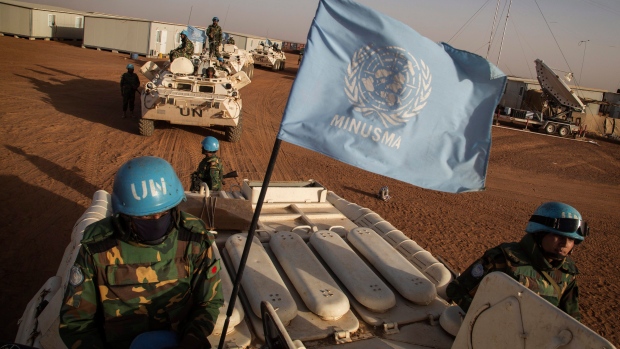
They will be teaming up with around 13,000 authorized international troops as part of the UN Multidimensional Integrated Stabilization Mission in Mali (MINUSMA) that's trying to stabilize the landlocked West African country amid an ethnic and jihadist insurgency.

Despite UN peacekeeping and French-led counterterrorism efforts that began in 2013 and a peace deal signed in 2015, Mali remains a "war zone," according to UN Secretary General Antonio Guterres.

According to the UN, 170 peacekeepers have been killed there since 2013, making it one of the organization's deadliest peacekeeping missions to date.

The mission has 57 partner countries and is based in the northeastern city of Gao.
Key groups in the conflict

Bruno Charbonneau, an associate professor at Laurentian University and an expert in peacekeeping and military intervention in francophone Africa, says the groups involved in the conflict can be divided into two categories: those that signed the 2015 peace agreement and those that didn't.

The signatories include the Malian government; Platform, a pro-government coalition; and Co-ordination of Azawad Movements (CMA), a pro-separatist alliance that includes the Tuaregs, a traditionally nomadic ethnic group that has long felt marginalized and excluded in the country.

Both Platform and CMA are armed groups without representation in the legislature.

The non-signatory groups, Charbonneau says, are "fluid in membership" and include militias, bandits, jihadists and gangs. Members of each group are not mutually exclusive, further complicating counterterrorism efforts.

G5 Sahel is also an important player in the conflict. Developed in 2014, its members — Burkina Faso, Chad, Mali, Niger and Mauritania — support the French counterterrorism mission.
A history of violence

A former French colony, Mali became independent in 1960. It moved from a single-party state to a multiparty democracy in 1991 in the wake of anti-government riots. But a lack of autonomy and services for the sparsely populated northern region remained a problem.

In 2012, the anger in northern Mali boiled over as Tuareg rebels waged an insurgency against the Malian government in Bamako, located in the south. The Malian military took over the state and deposed President Amadou Toumani Touré for failing to quell the Tuareg rebellion.

The rebels and other insurgents took advantage of the chaos and seized control of the north, but French troops and airstrikes pushed the rebels back in January 2013, allowing the Malian government to regain control.
A French soldier inspects a home near Tin Hama in southeast Mali in October 2017. (Benoit Tessier/Reuters) 
The UN authorized the MINUSMA peacekeeping mission three months after the French-led counterterrorism efforts began.

In 2015, Mali declared a state of emergency as attacks spread to the south, particularly in the Sikasso region.

"We focus a lot on terrorism in the north of Mali in the Sahel, while the actual problems within Mali right now are in the centre where you have a lot more people living there," Charbonneau said. "This is where it is really, really worrisome and yet the focus is still on the north and terrorism."
Persistent problems

Today, the coalitions remain factious, and the violence has only intensified. Northern jihadist groups have unified while Platform and CMA continue to splinter.

The al-Qaeda-linked Group for the Support of Islam and Muslims, for example, was formed in 2017 and has since captured territory in the north.

Charbonneau said two big problems that help fuel the conflict are the lack of state services, including a functioning and impartial justice system and the army's "history of human rights abuses."
The Malian army has a poor reputation when it comes to human rights, an analyst says. (Benoit Tessier/Reuters)
There's also the fact the government has yet to successfully implement the 2015 peace deal.

"There is definitely a lack of leadership within the government of Mali," Charbonneau said.
Risks for peacekeepers

In March, Canadian Defence Minister Harjit Sajjan and Foreign Affairs Minister Chrystia Freeland announced Canada would deploy an aviation task force to Mali for a period of 12 months.

The task force will include up to 250 troops, two Chinook helicopters to provide needed transport and logistics capacity and four Griffon helicopters to provide armed escort and protection.

Charbonneau suspects the task force will have little interaction with people on the ground. However, he does anticipate the separation of roles between the peacekeeping mission and French-led counterterrorist operation could be a challenge.

The climate could also be an issue, he said.

"It definitely takes a toll on equipment to fly around in that region," he said, referring to the heat and dust storms.

And, of course, there is always the threat of violence.

The latest monthly report by the UN Security Council on MINUSMA says the security situation in Mali remains of "grave concern," and there's been an increase in the complexity of the attacks against Malian and international forces, as well as an "unprecedented number" of civilian casualties.

Tuesday, April 3, 2018

Canadian Helicopters Bound for Mali Could See Combat

By: Lee Berthiaume, The Canadian Press 

The six military helicopters that Canada plans to send to Mali could be used to move more than peacekeepers: they could be called upon to support a multinational counterterrorism force also operating in the country.

The six military helicopters that Canada plans to send to Mali could be used to move more than peacekeepers: they could be called upon to support a multinational counterterrorism force also operating in the country.
THE CANADIAN PRESS
The UN Security Council in December authorized the peacekeeping mission in Mali to provide assistance to the Group of Five (G5) Sahel, a military force comprised of troops from five African nations.

That assistance includes medical evacuations for combat and noncombat injuries as well as the provision of fuel, water and rations – exactly what the Canadian military helicopters due to arrive in Mali in August will be configured to do.

The Trudeau government made no mention of the G5 Sahel when it announced its decision last month to send helicopters to Mali, and the Defence Department declined to comment on whether Canada would support the force.

“Details remain to be determined as negotiations with the United Nations have yet to begin,” spokeswoman Jessica Lamirande said in an e-mail.

“Specifics regarding the exact CAF contribution, and how that CAF contribution will be used, are some of the many factors that will be addressed during upcoming reconnaissance and negotiations with the United Nations.”

But the revelation has sparked renewed opposition calls for the Liberal government to provide more information about what the Canadian military is walking into in Mali.

“There’s just so many holes and unanswered questions about mission that we’re still very apprehensive,” said Conservative defence critic James Bezan, whose party has demanded a debate and vote on the mission.

“The Liberals say there won’t be necessarily boots on the ground, but they’re going to be moving boots on the ground back and forth from the conflict zone.”

The G5 Sahel, whose members include Burkina Faso, Chad, Mauritania, Niger and Mali, has been tasked with fighting jihadists and transnational crime groups across a large swath of West Africa south of the Sahara desert.

The force was the brainchild of France, which has been conducting counterterror operations in Mali and the region since 2012, and enjoys financial backing from France, the U.S., the European Union and others.

But the 5,000-strong force’s first operation in November was plagued by logistical problems, and it remains very much a work in progress despite political support from a variety of powers including Russia and China.

It was in that context that the UN Security Council passed a resolution Dec. 8 emphasizing the G5 Sahel’s role in bringing security to the region and authorizing the UN mission in Mali provide support to the African force.

An agreement between the UN, EU and G5 Sahel members to provide operational and logistical support to the force through the United Nations Multidimensional Integrated Stabilization Mission in Mali, or MINUSMA, was signed in February, a UN spokesperson said.

Security Council members specifically authorized the provision of medical evacuations, including those related to combat and other malicious acts, as well as fuel, water and rations and engineering services to the G5 force.

Such support is to be restricted to Mali, in accordance with the UN mission’s own boundaries, and only when it won’t negatively affect the peacekeeping mission’s own operations.

Royal Military College professor Walter Dorn, one of Canada’s pre-eminent experts on peacekeeping, found himself hard-pressed to think of another UN mission whose mandate included supporting a counterterrorism mission.

There could be a higher risk for Canadian military personnel if they are asked to evacuate injured G5 troops from a battle, Dorn acknowledged, though he said the UN is protective of its helicopters.

“While there may be circumstances where the helicopters could be flying into a conflict, in most cases the helicopters will be landing in secured landing zones,” he said.

“The procedure will be that the forces on the ground have to secure a landing zone for them for an evacuation to take place. The UN doesn’t want to lose a helicopter, particularly on a G5 or non-UN mission.”

Canada could also tell the UN that it doesn’t want its helicopters to support the G5 force.

But the UN typically pushes back against countries imposing restrictions on how their troops and equipment can be used on missions, as such caveats have been blamed for some of the peacekeeping disasters of the 1990s.

The fact Canadian troops could end up supporting counterterror operations nonetheless came as a shock to NDP defence critic Randall Garrison, who blasted the Liberals for not telling Canadians more about the Mali mission.

“It falls on the Liberals to tell us what they actually intend for this mission to do,” Garrison said. “What role will it play? What are the parameters? They haven’t given us anything.”

Tuesday, March 27, 2018

Krayden: Canada's Peacekeeping mission in Africa is destined to become the folly in Mali

Whether we send 250 or 2,500 personnel, we'll be sending them into quicksand

By: David Krayden

Canada's upcoming contribution to a United Nations peacekeeping mission in Mali — announced by the Trudeau government on Monday — is destined to become the folly in Mali. It is exactly where Canada and the Canadian military does not need to be.

The Trudeau government has chosen a most inhospitable plot of land that is replete with Islamic terrorism, child soldiers, torrid temperatures and a raging civil war. (Reuters TV)
First of all, the Canadian military has been unequivocal in issuing warnings of deploying to African nations that are in the midst of civil war, rife with Islamic extremism and replete with child soldiers — and all three conditions exist in Mali. It's become one of the deadlier UN missions in history as a result.

A military briefing note on potential peacekeeping missions to Africa, published before the Mali announcement this week, warned that "child soldiers … are likely to be encountered on an increasing basis," which can lead to severe psychological trauma for deployed personnel. The document noted that combat encounters between Canadian soldiers and Mali children could become a public affairs nightmare if the engagement "is not well-handled, and communicated effectively." In fact, the authors continue, "there is a strong potential for significant negative impact on the mission."

No kidding. Any of us who remember Somalia can attest to that. In that case, the Canadian Airborne Regiment became embroiled in a very dirty war where it could not discern friend from foe, nor the kids from the adults who often came around to loot the camp supplies. It ended with a tortured and beaten-to-death Somali teen, a disbanded regiment and larger questions about the overall purpose of Canadian "peacekeeping" missions.

In the same briefing note mentioned above, the military warned about sending less than the most combat-capable troops to any African peacekeeping mission, suggesting that "a force consisting of only lightly armed and equipped personnel may be much more vulnerable to attacks from child soldier units."

"Consideration should be given to the provision of heavier weapons," it added.
Part of the rationale behind the mission is obvious: Prime Minister Justin Trudeau is desperate for a seat on the UN Security Council. (Christophe Petit Tesson/The Canadian Press)
So what is the Liberal government planning to send to Mali? Lightly armed helicopters and troops that are described as "support" and not combat-ready — exactly contrary to the advice offered by the Canadian Armed Forces (CAF). And of course, the Trudeau government wants our UN contingent deployed with a marked female presence, even though — despite years of emphasis on getting more women in uniform — women comprise less than three per cent of CAF combat arms today.

Part of the rationale behind the mission is obvious: Prime Minister Justin Trudeau is desperate for a seat on the UN Security Council, a UN body that is remarkable for its uselessness and characterized by its dominance by tinpot dictatorships. But Trudeau has promised the pursuit of the UN Security Council seat as part and parcel of the idea that "Canada is back."

But back exactly where is the question. If he means back in the 1970s, that would be entirely accurate and in keeping with the prime minister's perception of peacekeeping as a wonderful Pearsonian invention that seeks to remedy strife in the world with UN blue helmets and civil conversation. That kind of peacekeeping was both real and efficacious for the Cold War realities of Cyprus and the Middle East. But that is not the world we live in today.

Peacekeeping is an anachronism, and it is quite appropriate that the equally anachronistic UN keeps describing its overseas missions in that way. Since the dissolution of the Soviet Union, Canada has largely been committed to peacemaking operations through the more robust delivery services of NATO, which did an effective job of ending civil war in the former Yugoslavia where the UN had failed.

But UN peacekeeping in Africa has a much different legacy. The mission in Somalia was visceral and devastating for the Canadian Armed Forces. In Rwanda, Canadian Lieut.-Gen. Romeo Dallaire oversaw a catastrophic peacekeeping operation that stood by helplessly while a genocide of 800,000 people occurred. Canada's experience in the Congo was dubbed "the bungle in the jungle" by many observers.

These experiences shouldn't be laid at the feet of the CAF, who (aside from a few glaringexceptions) provide that unique mixture of bravery, expertise, experience and civility that is so right for any peacekeeping operation — if they are actually deployed to one, that is, and not in the midst of the chaos of civil war and ethnic cleansing.

Instead of playing gender politics and demonstrating his sycophantic love of the UN, Trudeau should be ensuring that we have a military that is capable of fulfilling its basic obligations to NATO and NORAD.

Ultimately though, the folly in Mali is not just emblematic of a failed defence policy. After dithering over where to send Canadian troops to plant the peacekeeping flag, Trudeau has chosen a most inhospitable plot of land that is replete with Islamic terrorism, child soldiers, torrid temperatures and a raging civil war. Whether he sends 250 personnel or 2,500 personnel, he is sending them into quicksand.

David Krayden has worked in print, radio and television journalism. He served in the Canadian Armed Forces as a public affairs officer and was employed for almost a decade as a communications specialist on Parliament Hill. He is currently the Ottawa Bureau Chief for The Daily Caller, a Washington-based news service.
----
This column is part of CBC's Opinion section. For more information about this section, please read this editor's blog and our FAQ.
ABOUT THE AUTHOR

David Krayden has worked in print, radio and television journalism. He served in the Canadian Armed Forces as a public affairs officer and was employed for almost a decade as a communications specialist on Parliament Hill. He is currently the Ottawa Bureau Chief for The Daily Caller, a Washington-based news service.

Monday, March 26, 2018

Five Things to Know About the Upcoming CAF Mali Mission

Mike Blanchfield, The Canadian Press 

United Nations peacekeepers in Mali
UN peacekeepers arrive at the Niger Battalion Base in Ansongo, in eastern Mali, on Feb. 25, 2015. (Marco Dormino/United Nations via AP)
OTTAWA -- The Liberal government has unveiled Canada's 12-month UN peacekeeping commitment to the west African country of Mali. It includes two Chinook helicopters to provide medical evacuations and logistical support, along with four smaller, armed Griffons to act as escorts for the larger transports. Here are five things to know about Mali and the mission.

1. Lots of Canadian aid dollars. Mali has relied heavily on Canadian foreign aid, with only the United States and France contributing more. In 2014-15, Canadian development spending reached $152 million. Since 2012, Canada has also contributed $44 million in humanitarian aid following the country's 2012 crisis (more on that below) and about $10 million to support the UN peacekeeping mission, making Canada its ninth-largest supporter.

2. The 2012 crisis. It started when soldiers overthrew the country's president, creating a power vacuum that was filled by an Islamic insurgency. The fall of Libya in 2011 busted the locks off Moammar Gadhafi's arsenal, spreading weapons across north Africa, which armed various militia groups, including al-Qaida linked organizations. France led a war in 2013 that succeeded in driving the jihadists out of the stronghold they established in northern Mali. A UN peacekeeping force was established that year, and it has become its most dangerous mission with more than 160 fatalities.

3. Canada's drop in the peacekeeping bucket. Canada's contribution of 250 personnel is far less than many of its allies. The UN mission comprises more than 13,000 troops. Germany, the country whose air support operations Canada will be replacing, has authorized the deployment of more than 1,000 troops. In addition to the UN mission, Germany has contributed 350 troops to a training mission for Mali's military. France has 4,000 troops deployed to a counter-terrorism mission in northern Mali separate from the UN's peacekeeping efforts. "This announcement is a small but important step towards Canada's re-engagement in peacekeeping," said peacekeeping expert Walter Dorn of the Canadian Forces College in Toronto, noting that Canada's contribution to peacekeeping has hit an "all-time low" of a couple of dozen.

4. The political peace process. In June 2015, a peace agreement was signed between the Malian government, Tuareg rebels and other rebel groups. The Tuareg first sparked the 2012 rebellion, but that was soon hijacked by the better-armed jihadists. Those jihadists are outside the peace process. Gen. Jonathan Vance, Canada's chief of the defence staff, said "there is a prospect of a brighter future for Mali" but that "the basic deconstruction of Libya and the rise of terror groups, terror armies" has to be addressed.

5. The human rights situation. The UN's latest report on the human rights situation, tabled last month, offers a grim update of the situation in Mali. Between January 2016 and June 2017, it documented 608 cases of human rights violations involving almost 1,500 victims. These occurred across the country, including Gao, where the Canadian air contingent is expected to be based, and further north in Timbuktu. The perpetrators include signatories to the peace process and "non-signatory and splinter armed groups." The vast majority of the victims are men. The abuse included illegal detention, torture, extrajudicial executions, recruitment of child soldiers and sexual violence.

Sources: Government of Canada, The United Nations, Deutsche Welle

Thursday, March 22, 2018

Levine: More than Helicopters Needed to Help Mali

By: Corey Levine,  The Ottawa Citizen 

The Canadian government has now set the stage to claim a Schwarzenegger-style “We’re back!” after finally confirming our long-delayed contribution to United Nations peacekeeping in Mali. But after spending a year in the West African nation, I’m doubtful about what 200 soldiers and a few helicopters will achieve. 

Canada's contribution to the UN peacekeeping mission in Mali is expected to include up to six helicopters and a sizeable female presence, operating in an area rife with violence. CHRISTOPHE PETIT TESSON / THE CANADIAN PRESS
Canada’s long association with peacekeeping and reputation as a calm presence in the world’s hot zones has taken a serious hit in recent years. Our contribution to UN missions is at its lowest ebb since the 1990s and we are no longer seen as a relevant actor in today’s multilateral military interventions.

As someone who has worked in conflict zones for the last 20 years, I believe in Canada’s peacekeeping legacy. Like many other Canadians, I was disappointed when Prime Minister Justin Trudeau did not live up to his promises to polish this legacy back to its former lustre.

When I first arrived in Mali in November 2016 to provide training to Malian soldiers on humanitarian law, human rights and gender issues as part of the European Union Training Mission, (EUTM), I was surprised at the warm reception I received as a Canadian. Although the Liberal government had publicly mused about the possibility of Canada supporting the UN peacekeeping mission there, by then Mali appeared to have dropped off our foreign policy radar.

Still, diplomats, donors, peacekeepers and even Malians themselves expected that Canada would soon help rescue MINUSMA (the Multidimensional Integrated Stabilization Mission in Mali), the UN’s deadliest peacekeeping mission, and the country itself, from the quagmire it had become. And it was hoped that a battalion of Canada’s finest military men and women, tough and experienced from tours in Haiti and Afghanistan, would bring the Pearson back to peacekeeping.

Mali observers continued to remain hopeful, even after it was announced that a Belgian general, with no peacekeeping background, rather than a Canadian experienced in the international arena, had been named to head up the MINUSMA military forces. Had we lost our chance because we had dithered to long about our commitment?

By the time I moved from a Malian military base to the capital, Bamako, in February 2017, responses to my nationality were more quizzical about a civilian Canadian working for a European military mission than hopeful, despite the aid dollars flowing into the country as part of Canada’s 3D approach (diplomacy, defence, development). People stopped asking me to set up meetings with “the Canadians,” and I stopped harassing my friends at the embassy to see if they had any news from their bosses back home about our presumed military contribution to Mali.

Not that there isn’t already a significant international military presence in the country. MINUSMA is the largest, with its approximately 11,000 forces drawn mostly from African nations, but also a few European and Asian countries. It is followed by Barkhane, a French active combat force, whose numbers range from 3,000 to 6,000, depending on whom you talk to. Barkhane, as the “French pillar of counter-terrorism,” differs from MINUSMA, which is a more traditional peacekeeping mission, carrying out “security-related tasks” in support of the peace process. The fact that there is no peace to keep in Mali seems to make no difference at all. (Although EUTM is solely a training and capacity-building mission, I lost a colleague in a terrorist attack in which 11 other colleagues survived).

Then there is the newly minted Force Conjointe G5 Sahel, consisting of troops from Mali, Burkina Faso, Chad, Mauritania and Niger. Supported by various UN Security Council Resolutions and headquartered in Sevare, it is still trying to figure out its role in a region already crowded with competing military and diplomatic initiatives. There are many unanswered questions as to its operational capabilities and political co-operation.

Mali is at the same time: a civil war with the Arab tribes of the desert north seeking independence from African ethnic groups in the tropical south, its roots in Africa’s colonial past; a dwindling democratic state after a 2012 coup; a threat to Europe as both a source and transit route for migration, and illicit drugs and arms; and the latest front line in the global war on terrorism. Both ISIL and al-Qaida have local organizations in the region.

International soldiers in Mali speak in terms of “terrorist armed groups,” known as TAGs, and “criminal armed groups” (CAGs). Then there are those agitating for an independent homeland. Sometimes the various TAGs, CAGs, and “freedom-fighters” are separate groups; sometimes they are combined. They occasionally splinter off and form new groups with different alliances but with the same leaders. Allegiances switch more often than most people change their bedsheets. Frankly, it’s an alphabet soup of confusion where the enemy is concerned.

There is officially a peace process known as the Algiers Agreement. But the signatories, including the Malian government, have only a tenuous commitment to peace. Then there is the growing insurgency among those fed up with an international presence that has brought little development, despite the aid dollars, and even less respite from the violence (shades of Afghanistan).

It will take much more than a few Chinook helicopters to turn Mali around. But this beginning could be the thin edge of the wedge that leads to more muscular involvement on our part further down the line. Still, like Afghanistan, it’s an unwinnable war.

The real solution to the problems of Mali doesn’t lie in helicopters and troops, but in a sustainable and sustained commitment to economic, political, social and multi-ethnic development of the region.

Corey Levine is a human rights and peacebuilding consultant. She returned to Canada last fall after a year in Mali. It was her 14th mission and 10th conflict country.

BY THE NUMBERS

As of the end of 2017:

43: Number of Canadian peacekeepers deployed worldwide (down from 62 in November);

20: Number (from that total) of peacekeepers who were police officers. Fourteen others were military officers and nine were “experts on mission” (which can include police officers, military personnel and civilians);

6: Number of those peacekeepers who were women (five police officers and one military officer.)

600: The number of troops the federal government promised, in 2016, to make available for UN peacekeeping missions;

150: The number of police officers the government promised to make available.

(Source: The Canadian Press)