Translate

Showing posts with label Air Task Force Mali. Show all posts

Thursday, March 28, 2019

Canadian Peacekeepers Evacuate Wounded French Soldiers in Mali

By: Lee Berthiaume, The Canadian Press 

Canadian peacekeepers were called upon to evacuate several wounded French soldiers in Mali earlier this month after their patrol was ambushed while hunting for militants along the border with Niger.

The previously unreported incident marks the first time the Canadians have been asked to help non-United Nations forces in Mali, where the French have been conducting counter-insurgency operations since 2014.

READ MORE: Canadian peacekeepers in Mali challenged by geography, shifting violence

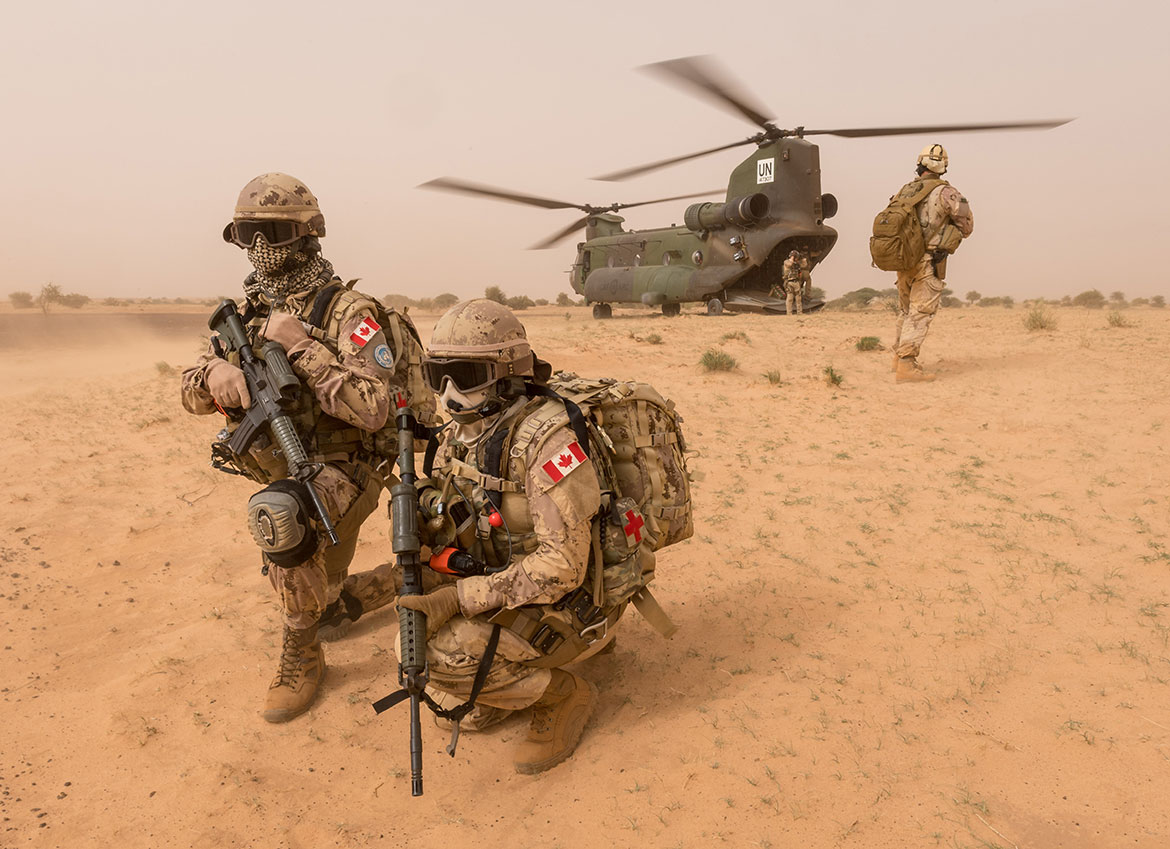
Canada has eight helicopters and 250 military personnel in Mali, where they have been providing emergency medical evacuations and transporting troops and equipment across a large swath of the remote African country.

The Canadians have conducted seven other medical evacuations since August, all of which involved injured UN troops and workers.

In an interview with The Canadian Press, the commander of Canada’s task force in Mali said the UN and France have agreed to help each other in extreme circumstances and that his peacekeepers did their jobs by helping save lives.
Prime Minister Trudeau visiting CAF members in Mali earlier this year. 
“I wouldn’t want people to presume or assume that we’re supporting counterterrorism efforts,” said Col. Travis Morehen. “But it’s really at this point about saving allied lives.”

News of the French evacuation comes as the federal government is contemplating a formal UN request to extend its peacekeeping mission in Mali, which is currently set to end at the end of July.

France has about 3,000 heavily armed soldiers in Mali and the surrounding region hunting militants linked to al-Qaida, the Islamic State and other extremist groups through what is known as Operation Barkhane.

While Operation Barkhane has been credited with keeping the numerous Islamic extremist groups in Mali off balance, it has also been accused in some corners of contributing to instability in the region.

READ MORE: Canada’s on a new kind of mission in Mali — mixing peacekeeping with counterterrorism

According to media reports, a French patrol was operating near Mali’s border with Niger on March 10 when they were ambushed by a vehicle packed with explosives and a group of militants on motorcycles.

Fifteen French soldiers were reportedly injured, two seriously before the militants fled.

The Canadians first learned about the attack when a French officer at the Operation Barkhane camp in Gao called while it was still happening and indicated an emergency medical evacuation might be required, said Morehen.

The French counter-terror mission operates largely independently from the UN peacekeeping mission in Mali, but Morehen says there is a good working relationship between the two.

Many critics have raised questions about Canada's mission in Mali - even asking if it is considered as Counter-Terrorism? 

That includes the French providing air-traffic control services to the UN around Gao, the northern Malian city that is home to several military bases, including one belonging to Barkhane and another where the Canadians are located.

The French also boast a more capable hospital than the UN, Morehen said, which is why the Canadians often end up bringing any wounded peacekeepers that they pick up in the field to the Barkhane camp.

“So our pilots go over there and make sure that we have our flying procedures correct and we have a technical arrangement with them as well for medical support,” Morehen said.

“There’s lots of sharing between us, which is all blessed by our governments.”

READ MORE: UN reports sharp deterioration in Mali since Canadian peacekeepers arrived

Three Canadian helicopters were quickly deployed with approval from the UN mission commander in Bamako, Morehen said, and arrived at the scene about two hours later, at which point the fighting was over.

Because of the distance, the two smaller Griffon escorts were redirected to a nearby town to refuel while the larger Chinook, which is configured like a flying hospital, continued back to Gao alone with the injured French soldiers.

“It does increase the risk,” he said, “but we balanced it against the need to get those wounded back to medical facilities as soon as possible.”

While he agreed that it was “the right thing to do,” Walter Dorn, an expert on peacekeeping at the Canadian Forces College in Toronto, said the evacuation nonetheless risked linking the UN and French missions in some minds.

“The risk is that we are associated with Barkhane and we then become subject to more attacks and the line between peacekeepers and counter-insurgency fighters is blurred,” Dorn said.

Morehen pushed back against such suggestions, insisting the evacuation was an extremely rare circumstance and that anyone who wants to target the UN – which has suffered dozens of casualties in Mali – will do so no matter what.

“The people that want to do people harm here, they’ve already got it formulated in their mind,” he said. “I don’t see how fathomable it is that we would be targeted because we gave a medevac to French forces.”

Friday, January 11, 2019

Disappointment Emerges as Canada’s Peacekeeping mission in Mali nears Halfway Mark

By: Lee Berthiaume, The Canadian Press 

Canadian soldiers watch as a helicopter provides air security during a demonstration on the United Nations base in Gao, Mali, on Dec. 22, 2018.
ADRIAN WYLD/THE CANADIAN PRESS
Nearly halfway through Canada’s 12-month mission in Mali, questions and disappointment are emerging over what some experts see as the Trudeau government’s lack of interest in the country – and peacekeeping in general.

Mali has been racked by violence and instability since a rebellion and coup in 2012, and there are fears that Islamic extremists and criminal organizations will run wild there and across the wide expanse of Africa south of the Sahara Desert.

Canada has had about 250 military personnel and eight helicopters in Gao, Mali, to provide medical evacuations and logistical support since August, which Prime Minister Justin Trudeau says is helping make a difference.

“The peace process is unfolding in Mali,” Mr. Trudeau said during a whirlwind visit to Gao on Dec. 23. “Certainly our presence here is allowing it to unfold more quickly than it otherwise would be, but it is a difficult situation.”

Keep your perspectives sharp & informed with The Globe's Opinion newsletter.

The United Nations is reporting limited signs of progress there over the past three months, as slight improvements in the political and humanitarian situation have been marred by a dramatic spike in violence.

That includes a marked increase in the number of improvised explosive devices targeting peacekeepers and officials, as well as several co-ordinated attacks on UN bases and staff.

Yet several experts say they were hoping the peacekeeping mission would serve as a way for the Trudeau government to deepen its engagement in the UN, Mali and the Sahel region, none of which has happened.

Rather, they argue the government appears to have little actual interest in Mali or peacekeeping, in spite of spending millions of dollars on both.

“The Canadian contribution to MINUSMA [the UN mission in Mali] will be forgotten quickly,” said Bruno Charbonneau, an expert on Mali at Laurentian University in Sudbury.

“It’s a quick in-and-out that … changes nothing to UN peacekeeping in Mali or in general, and certainly changes nothing to the situation in Mali and the larger Sahel.”

The country has been one of the top recipients of Canadian foreign aid for the past several years, which experts say is helping. It has also received some of the $450-million set aside in 2016 for peace programs.

Yet the Trudeau government has repeatedly rejected the prospect of extending the Mali mission by several months to minimize a gap between when the Canadians stop flying in July and the arrival of Romanian replacements in the fall.

That stands in sharp contrast to the repeated extensions of Canada’s military missions in Latvia, Ukraine and Iraq, none of which falls under the auspices of the UN.

“I have to wonder: Why not the UN? Why not Mali?” said Walter Dorn, an expert on peacekeeping at the Canadian Forces College in Toronto.

There were suggestions in July that Canada would step up its presence and involvement in Mali, when officials revealed plans to send up to 20 police officers and spend millions of dollars to help the UN train local security forces.

While Public Safety Minister Ralph Goodale’s office said Tuesday that two police officers have undergone pre-deployment training and will arrive in Mali later this month, it did not provide a timeline for when the rest would be deployed.

Meanwhile, experts say the government’s overall long-term plans for Mali remain shrouded in mystery – including its plan for aid funding.

“My colleagues and I are trying to make the case for more involvement [in Mali], but have the impression of speaking to a relatively disinterested audience,” said Jonathan Sears, an expert on Mali at the University of Winnipeg.

Defence Minister Harjit Sajjan’s spokeswoman, Byrne Furlong, on Tuesday commended the Canadian military’s work in Mali, even as she asserted the government’s commitment to “promoting peace and stability in the world.”

“We are proud of the important work the women and men of our Canadian Armed Forces are doing to help set conditions for durable peace, development, and prosperity in Mali,” Ms. Furlong said in a statement.

Tuesday, November 20, 2018

Sajjan Confirms - Mali Mission Will Not Be Extended

By: Kathrine Starr, CBC News 

Canada's peacekeeping mission in Mali will end in July as planned, Defence Minister Harjit Sajjan has confirmed.

"The United Nations is working with other nations to look at replacing us," Sajjan told Chris Hall in an interview airing today on CBC Radio's The House. Sajjan spoke to Hall before his speech Friday to the tenth annual Halifax International Security Forum, a gathering of global leaders discussing major security and defence issues.

Sajjan said Canada will have fulfilled its year-long promise to head the Mali mission by July. The Canadian Press reported this week that the UN has quietly asked Canada about extending its role.

"The discussions I've had with other UN security generals has not led to that," Sajjan said.

Canadian troops arrive at a UN base in Gao, Mali, on Monday, June 25, 2018. (Sean Kilpatrick/Canadian Press)
"We've said this for a year. We wanted to offer up support for what the UN wanted to do. One big ask they had was the concept of smart pledges. Nations come, take a yearly responsibility. We have done that."

The minister added that there will be a transition period before Canada leaves Mali, much like the one that occurred when the German-Belgian helicopter mission in Mali was winding down and Canadian personnel were arriving last year.

Although an official announcement has not been made, The Canadian Press is reporting that Romania is expected to take over from Canada, but not until October or November — months after the Canadians have left.

"The UN is on track to be able to find a replacement," Sajjan said. "We will work with whoever steps up."
Most dangerous UN mission

Canada currently has eight helicopters and 250 military members in the sprawling West African nation to rescue injured peacekeepers and UN workers and to transport troops and equipment.

The Mali mission is considered the most dangerous UN mission in the world; 22 peacekeepers were killed this year alone and 177 have been killed since the mission began in 2013. About 15,500 people are part of the Mali mission now, which began after a rebellion in the north and a coup in the capital in 2012 resulted in a surge of violence.

Canadian peacekeepers have so far conducted four emergency evacuations in Mali. The most recent was on Nov. 1, after two civilians were injured when they were attacked with an improvised explosive device while driving.
More permanent presence needed in North

Sajjan also discussed Canada's defence goals in the Arctic, saying that more permanent troops are needed in the North to respond to threats such as increasing Russian aggression and Chinese interest in the region.

"We did identify that we do need to do more," he said, adding that a broader approach to the Arctic is necessary.

"Sovereignty [in the Arctic] isn't strictly about defence. It's about supporting our communities up there. We're looking at this from a whole-of-government approach."

Sajjan pointed to investments in Arctic offshore patrol vessels and satellites with greater coverage as two examples of government efforts to "sustain our ability to respond in the North."
Defence Minister Harjit Sajjan says that with the North growing in strategic importance every day, Canada needs to further develop its Arctic military presence. (Jeff McIntosh/The Canadian Press)
In August and September, Canada's largest annual Arctic sovereignty exercise, Nanook 2018, took place in Northern Labrador, Nunavut and the Northwest Territories. Sajjan himself visited various Canadian Armed Forces installations in the North in August.

With approximately four million square kilometres of Arctic land to keep an eye on — that's about 40 per cent of Canada's total land mass — Canada won't be able to ramp up its polar presence overnight, Sajjan acknowledged.

"We have increased our spending year by year, but it's going to take us a little more time to get to the efficiency we want," he said.

In its updated defence policy released last year, the federal government committed to pushing Canada's defence budget to $32.7 billion annually in the tenth year, with expenditures set to rise the most after the 2019 election.

Specific Arctic investments will include updating Canada's ability to monitor air traffic over all of the 36,000 islands in Canada's Arctic archipelago, and buying ATVs, snowmobiles and other vehicles as part of an $8.8 billion, 20-year commitment to new equipment.

The navy also will receive five to six armed and "ice-capable" ships, meant to keep the government informed of activity in Arctic waters.

Friday, October 19, 2018

Mali Mission has 'no prospect of immediate success: Former Op. Medusa Commander

Rachel Gilmore,  CTV Power Play producer

The man who led Canada’s troops in Afghanistan said the Canadian peacekeeping mission in Mali has “no prospect of immediate success.”

Image result for Canadian Forces in Mali
Gao, Mali. July 18, 2018 – Photo has been digitally altered for operational security. Members of the CH-147 Chinook medical team practice exiting the helicopter under the watchful eye of the force protection team in support of Operation PRESENCE - Mali around Gao, Mali. (Photo: MCpl Jennifer Kusche)
“The political overtones and what’s going on in this country and this mission are ugly,” retired major-general David Fraser told CTV’s Power Play host Don Martin on Monday.

“This is not going to be short mission.”

Canadian boots hit Malian soil in June for what has widely been regarded as a dangerous year-long peacekeeping mission. While Canada’s role is primarily to fly medical evacuation missions and provide support from the skies, the security situation in the region is said to have sharply deteriorated in recent months.

That’s something that hasn’t escaped Fraser’s notice.

“It’s as bad -- if not worse -- than what we experienced in Afghanistan, Iraq or Syria,” Fraser said of the conditions in Mali.

“It doesn’t take a rocket scientist to figure out that this mission isn’t going in the right direction from a trajectory point of view.”

His comments echo the revelations of a United Nations report released Wednesday. The assessment, conducted by UN Secretary General Antonio Guterres, described a plummeting humanitarian situation in Mali. Food aid and other humanitarian relief is in overwhelming demand and the country, according to the report, is faring worse in many ways than when Canadian peacekeepers first arrived in June.

Fraser explained that the key issue marking this decline is a lack of leadership. Despite successful elections in July and August, he said the insurgents are “winning the fight on the ground.”

“Peacekeeping can’t be effective. It can’t be effective without a strong civilian government leadership that’s running the government, that’s actually providing oversight for the military and the police forces and that’s not happening fast enough,” Fraser said.

“The race is being won not by the government and not by the military -- it’s being won by the people we don’t want to win.”

That on-the ground reality means humanitarian efforts aren’t getting to where they need to be.

“Aid, from a strategic and from a tactical point of view, is not getting to the ground fast enough,” Fraser said.

And at the end of the day, Fraser warned this hurts some people more than others.

“The local people are the ones who are going to be adversely affected,” he said.

To change this, the UN needs a change in their approach, according to Fraser.

“The UN’s not getting the locals to get the leadership or the women engaged fast enough, and they’re going to lose this race.”

If nothing changes, Fraser warned, we can expect the situation to continue to deteriorate -- and the UN reports to harshen.

“The people that are adversely affected are women and children and the innocent people, which is just going to make the next report card even worse than this one,” he said.

Friday, October 12, 2018

UN Reports Situation in Mali Deteriorating

By: Lee Berthiaume, Global News 

In a sobering new report, the head of the United Nations says the security situation in Mali has sharply deteriorated over the past three months even as demand for more food aid and other humanitarian assistance has skyrocketed.
The UN Mali patch is shown on a Canadian forces member's uniform before boarding a plane at CFB Trenton in Trenton, Ont., on July 5, 2018.
READ MORE: Canadian troops ready as ‘complex’ Mali peacekeeping mission gets underway: commander

The assessment by UN Secretary General Antonio Guterres coincides with the presence of Canadian peacekeepers in Mali, and suggests the country is in many ways worse off now than when they first arrived in June.

Not that there haven’t been some hopeful signs, including successful presidential elections in July and August and a marked decline in the number of peacekeepers killed or wounded despite continuing attacks by armed groups.

That is reflected in the fact that while the Canadian military’s primary task in Mali is to evacuate injured UN peacekeepers by helicopter, they have so far only conducted two such missions, both on Sept. 11.

Guterres nonetheless painted a picture of a country at war with itself as various ethnic and extremist groups targeted each other as well as the Malian military, international forces and even civilians.

The result was the largest number of civilians killed – 287 – in one three-month period since UN peacekeepers first arrived in the country in 2013, while thousands more have been forced to flee their homes to escape the violence.

Much of the fighting was between members of two different ethnic communities in the centre of the country, while groups linked to al-Qaida and the Islamic State were also responsible for a great deal of violence.

READ MORE: Canada’s on a new kind of mission in Mali — mixing peacekeeping with counterterrorism

“Intercommunal conflict, exacerbated by violent extremist groups, is fraying an already fragile social fabric and is deeply concerning,” Guterres wrote. “Too high a human toll has accrued as a result of the ongoing spiral of violence.”

The number of human-rights violations in Mali, which was already troublingly high, was similarly worse because of hundreds of new extrajudicial killings, disappearances, tortures and rapes across different parts of the country.

While most of those atrocities were perpetrated by the Islamic groups and competing ethnic communities, the Malian military itself was implicated in 18 violations – including one mass killing that is being criminally investigated.

“The human rights situation is alarming,” Guterres wrote. “It is absolutely imperative that the government prevent human rights violations and abuses, including those committed by the Malian armed forces.”

Further adding to Malians’ woes were severe floods in some areas and drought in others that, when combined with the fighting, had doubled the number of internally displaced people and left one in four needing humanitarian aid.

“The level of needs of is higher than at any point since the beginning of the crisis in 2012,” Guterres wrote.

READ MORE: Jeff Semple: First impressions of Canadian peacekeepers in Mali

The country was plunged into turmoil after a rebellion in the north at the same time as the Malian military was staging a coup in the capital, Bamako.

Canadian peacekeepers recently helped the World Food Programme deliver more than two tonnes of food, water and medicine by helicopter to a village in central Mali.

Yet despite the growing need for more emergency aid, Guterres reported that only one-third of the roughly $400 million needed to help Malians had been provided to the UN by the beginning of September.

WATCH: Exclusive: Treacherous conditions for Canada’s troops in Mali


“While needs continue to increase, humanitarian funding has decreased, preventing a timely at-scale and appropriate response,” he wrote.

Canada has provided funding for various development projects and agencies in Mali, but Bruno Charbonneau, an expert on Mali at Laurentian University, said the $60 million in emergency aid given since 2012 is relatively small.

Most of that money was also pledged immediately after the rebellion in the north and the coup.

READ MORE: At least 6 soldiers killed in attack on military taskforce headquarters in central Mali

As for the bigger picture, Charbonneau said what is needed is more international focus on the centre of Mali and greater emphasis on development to tackle the root causes of the conflict.

“As long as the focus is on countering terrorism in the Sahel, everything else is secondary,” he said. “And I think it’s a bad reading of the situation based on assumptions about the dynamics of the conflict and its causes.”

Wednesday, July 18, 2018

Photos: Air Task Force Mali Arrive in Gao, Mali

Thanks to the Canadian Forces Combat Camera, the first images are surfacing from OP Presence, Canada's contribution to the UN mission in Mali. 

IS03-2018-0041-006
Canada's contingent to the UN Mission in Mali includes a large Female presence. 

IS03-2018-0040-025
Canadian Forces members meet their German counterparts at Camp Castor, Gao, Mali. 
An RCAF CH-147 Chinook arrives at Camp Castor in Gao, Mali on July 15, 2018. Photo: MCpl Jennifer Kusche. Note the door gun MG in the Chinook for suppression during medevac or transport missions.
IS03-2018-0040-019
A CH-146 Griffon with door gunner arrives at Camp Castor in Gao, Mali on July 15, 2018. Photo: MCpl Jennifer Kusche


Monday, July 16, 2018

Eggleton: CAF Pulling Its Own Weight

By: Art Eggleton, Toronto Star - Opinions 

As NATO leaders prepare for their upcoming summit in Brussels, U.S. President Donald Trump is complaining about Canada and other allies not spending enough on their military operations. This brings into play the goal from past summits of each country spending 2 per cent of Gross Domestic Product (GDP) on defence.

There are two problems with this 2 per cent of GDP figure. First, meeting it would increase defence spending by approximately two thirds in Canada, and secondly, it is the wrong measurement for capabilities and contributions to NATO.
The UN Mali patch is shown on a Canadian forces member's uniform before boarding a plane at CFB Trenton on Thursday. The soldiers are heading to Mali for Operation Presence, the military operation to support the United Nations peace mission. (LARS HAGBERG / THE CANADIAN PRESS)
A two thirds defence expenditure hike would necessitate either substantial tax increases and/or significant reductions in other government programs and services, including social support measures. I consider that unrealistic and unacceptable.

GDP can go up or down, or it can be stagnant. If we have robust economic growth over the next decade, getting to 2 per cent will become even more expensive and challenging. If we unfortunately experience a recession, then our percentage of GDP for military expenditure can increase without spending a dollar more.

What sense does that make in terms of measuring capabilities and contributions? Also, only four of 29 NATO countries currently meet the 2 per cent goal. And the goal is not compulsory; or, as the Harper government said after the last summit in Wales, it is “aspirational.”

In my five years serving as Minister of National Defence in the Chrétien cabinet, I never came to appreciate that 2 per cent of GDP was the appropriate way to measure our contributions as a member of the alliance.

That was verified by NATO officials Simon Lunn and Nicholas Williams, who wrote: “the 2 per cent takes no account of the ebbs and flows of economic fortunes; is vulnerable to changing circumstances and domestic pressure, both in terms of the security requirements and the economic base; encourages creative accounting to satisfy targets; and provides zero guidance concerning precisely what capabilities are needed to counter the threats and challenges that NATO faces.”

If not 2 per cent of GDP then what?

We could, for example, measure per capita expenditures, in which case Canada ranks ninth out of 29 member states. Or a percentage of the federal government expenditures, in which case Canada ranks sixth. In either case, we rank above the NATO average if you exclude the United States, which is really in a league of its own, spending more than double on defence than all the other NATO countries combined.

Better still, shouldn’t we be measuring outputs and outcomes rather than input percentages? As Lunn and Williams suggest, the important measurement should be based on capabilities and contributions.

When it comes to capabilities, our Canadian Forces personnel are some of the best in the world. They are motivated, highly skilled and dedicated to their roles. Our allies around the world, including the U.S. military, recognize this.

We are no laggard when it comes to joint military exercises and contributing to multilateral missions. We don’t need all the equipment in the world — we work with our allies — but what’s important is the interoperability with them that strengthens the capabilities of our troops.

On the issue of equipment, NATO does want member countries to update their assets and the government has started to implement that request with budget increases this year and thereafter. This commitment is real investment in the equipment of our forces, one that is not tied to GDP but reflects actual military expenditures, and again contributes to capabilities.

When it comes to recent contributions, we have sent troops and equipment, along with our NATO allies, to operations in Afghanistan, Bosnia, Kosovo and are currently leading a mission in Latvia. And now with the United Nations, they are headed to Mali.

It is these and other capabilities and contributions to the defining conflicts of our time that armed forces should be measured by — not something as flawed as a financial yardstick that is tied to GDP.
---
Senator Art Eggleton is a member of the Canadian Senate from Toronto. He currently serves as chair of the Standing Committee on Social Affairs, Science and Technology.

Friday, July 6, 2018

Opinion: Canada is Sending the Wrong Helicopters to Mali

By: Robert Smol, iPolitics 

In Mali, Canada’s flying pick-ups are no replacement for European helicopters

Canadian Forces door gunner keeps watch as his Griffon helicopter goes on a mission, February 20, 2017 in northern Iraq. THE CANADIAN PRESS/Ryan Remiorz
"Will our next round of UN peacekeepers have to engage, yet again, in that perennial Canadian military tradition of sending our military into harm’s way with far less than what our allies might provide to their forces?"A

For the last four years the German peacekeeping contingents, as well as the preceding Dutch, have struggled though the military and political quagmire of Mali with heavily armed, combat-proven attack helicopters operated by specially trained crews.

Quite appropriate for what is already considered the most dangerous peacekeeping operation attempted by the UN in its 73-year history.

But Canada does not own any attack helicopters. Instead our aging Griffon utility helicopters will be taking on armed escort responsibilities alongside our larger Chinook transport helicopters. Griffons were never designed to be an attack helicopter except in a pinch.

So the question needs to be asked: if Canada is expected to carry on and match the efforts of the Germans and Dutch will we have comparable capability in our improvised “armed” helicopters or will our next round of UN peacekeepers have to engage, yet again, in that perennial Canadian military tradition of sending our military into harm’s way with far less than what our allies might provide to their forces?

National Defence Headquarters, perhaps predictably, would not respond to my requests for information on any possible armament, sensor, and protective devices being installed on our 22-year old utility helicopters. However during the Afghan and Iraqi deployments , when Canadian troops were under the protective shield of US and allied attack helicopters and fighter aircraft, our Griffons were occasionally photographed carrying a door gunner positioned in the aircraft’s opening with a C-134 machine gun.

This haphazard, Vietnam-era “gun in the door” protection is quite consistent with the Griffon’s purpose. The Griffon is classified as a Utility Tactical Transport Helicopter. Its primary role, according to the RCAF website is “transportation of troops and material” making it more of a flying pick-up truck as opposed to highly agile flying tank that is a modern attack helicopter.

We should be concerned because, in Mali we will be away from the protective, largely U.S military shield that our military, not to mention the Canadian public, have come to expect in recent years.

So what did the preceding Dutch and German contingents in Mali have by way of armed helicopter escort? What level of armed, combat capability would our improvised, souped up utility helicopters have to match?

From 2014 to 2017 the Royal Netherlands Air Force deployed A-64D Apache attack helicopters to protect its assets. The Dutch Apache is armed with a 30mm automatic Boeing M230 chain gun that has a rate of fire of 625 rounds a minute. It also has a Lockheed Martin/Boeing AGM-114D hellfire air-to-surface missile with a range of 8-12 km. Also, depending on the nature of the threat, the Dutch Apache can also be mounted with Hydra 70 general purpose rockets and the AIM-92 Stinger anti-aircraft missiles.

Equally lethal, the standard armament for the German Tiger attack helicopter, currently exiting Mali, include a 30 mm cannon with a rate of fire of 750 rounds per minute. The Tiger can also be equipped 8 HOT Trigat anti-tank missiles, and 4 Stinger or Mistral short range air-to-air missiles. Also standard for the Tiger are two pods carrying 22 SNEB 68mm rockets.

Also impressive are the defensive countermeasure systems that are fitted to these flying tanks maximizing their survivability and effectiveness. These include, on both the German Tiger and the Dutch Apache a radar warning receiver, laser warning, and a chaff/flare dispenser. Crew survivability is also enhanced through the armoured protection given them a chance to make it back safely even after taking on enemy fire.

Could it be that Canada’s modified utility-transport helicopters, being deployed to Mali, are fitted with comparable armament and protection? Since we all know what the answer likely is the question then has to be asked: what level of additional support and compensation for our military weakness and vulnerabilities could we demand from the primary peacekeeping contingents in Mali which today are Burkina Faso, Chad, Bangladesh, Senegal, and Togo?

With Germany and the Netherlands out of the conflict, and the United States disengaged, it is from these country’s militaries that we will have to rely on once Mali’s Islamic militants realize that America’s most humble and obedient military servant (Canada) is facing them with utility transports posing as attack helicopters.


Welcome back to peacekeeping Canada!


The views, opinions and positions expressed by all iPolitics columnists and contributors are the author’s alone. They do not inherently or expressly reflect the views, opinions and/or positions of iPolitics.

Monday, June 25, 2018

Rueter: Brief History of the Mali Conflict and the Challenges Canadian Soldiers are Likely to Face

By: Annie Rueter, CBC News

Canadian troops are set to join the UN peacekeeping mission in Mali, a country that's been torn apart by violence since 2012.

They will be teaming up with around 13,000 authorized international troops as part of the UN Multidimensional Integrated Stabilization Mission in Mali (MINUSMA) that's trying to stabilize the landlocked West African country amid an ethnic and jihadist insurgency.

Despite UN peacekeeping and French-led counterterrorism efforts that began in 2013 and a peace deal signed in 2015, Mali remains a "war zone," according to UN Secretary General Antonio Guterres.

According to the UN, 170 peacekeepers have been killed there since 2013, making it one of the organization's deadliest peacekeeping missions to date.

The mission has 57 partner countries and is based in the northeastern city of Gao.
Key groups in the conflict

Bruno Charbonneau, an associate professor at Laurentian University and an expert in peacekeeping and military intervention in francophone Africa, says the groups involved in the conflict can be divided into two categories: those that signed the 2015 peace agreement and those that didn't.

The signatories include the Malian government; Platform, a pro-government coalition; and Co-ordination of Azawad Movements (CMA), a pro-separatist alliance that includes the Tuaregs, a traditionally nomadic ethnic group that has long felt marginalized and excluded in the country.

Both Platform and CMA are armed groups without representation in the legislature.

The non-signatory groups, Charbonneau says, are "fluid in membership" and include militias, bandits, jihadists and gangs. Members of each group are not mutually exclusive, further complicating counterterrorism efforts.

G5 Sahel is also an important player in the conflict. Developed in 2014, its members — Burkina Faso, Chad, Mali, Niger and Mauritania — support the French counterterrorism mission.
A history of violence

A former French colony, Mali became independent in 1960. It moved from a single-party state to a multiparty democracy in 1991 in the wake of anti-government riots. But a lack of autonomy and services for the sparsely populated northern region remained a problem.

In 2012, the anger in northern Mali boiled over as Tuareg rebels waged an insurgency against the Malian government in Bamako, located in the south. The Malian military took over the state and deposed President Amadou Toumani Touré for failing to quell the Tuareg rebellion.

The rebels and other insurgents took advantage of the chaos and seized control of the north, but French troops and airstrikes pushed the rebels back in January 2013, allowing the Malian government to regain control.
A French soldier inspects a home near Tin Hama in southeast Mali in October 2017. (Benoit Tessier/Reuters) 
The UN authorized the MINUSMA peacekeeping mission three months after the French-led counterterrorism efforts began.

In 2015, Mali declared a state of emergency as attacks spread to the south, particularly in the Sikasso region.

"We focus a lot on terrorism in the north of Mali in the Sahel, while the actual problems within Mali right now are in the centre where you have a lot more people living there," Charbonneau said. "This is where it is really, really worrisome and yet the focus is still on the north and terrorism."
Persistent problems

Today, the coalitions remain factious, and the violence has only intensified. Northern jihadist groups have unified while Platform and CMA continue to splinter.

The al-Qaeda-linked Group for the Support of Islam and Muslims, for example, was formed in 2017 and has since captured territory in the north.

Charbonneau said two big problems that help fuel the conflict are the lack of state services, including a functioning and impartial justice system and the army's "history of human rights abuses."
The Malian army has a poor reputation when it comes to human rights, an analyst says. (Benoit Tessier/Reuters)
There's also the fact the government has yet to successfully implement the 2015 peace deal.

"There is definitely a lack of leadership within the government of Mali," Charbonneau said.
Risks for peacekeepers

In March, Canadian Defence Minister Harjit Sajjan and Foreign Affairs Minister Chrystia Freeland announced Canada would deploy an aviation task force to Mali for a period of 12 months.

The task force will include up to 250 troops, two Chinook helicopters to provide needed transport and logistics capacity and four Griffon helicopters to provide armed escort and protection.

Charbonneau suspects the task force will have little interaction with people on the ground. However, he does anticipate the separation of roles between the peacekeeping mission and French-led counterterrorist operation could be a challenge.

The climate could also be an issue, he said.

"It definitely takes a toll on equipment to fly around in that region," he said, referring to the heat and dust storms.

And, of course, there is always the threat of violence.

The latest monthly report by the UN Security Council on MINUSMA says the security situation in Mali remains of "grave concern," and there's been an increase in the complexity of the attacks against Malian and international forces, as well as an "unprecedented number" of civilian casualties.

First Canadian Peacekeepers arrive in Mali as year-long mission begins

By: Lee Berthiaume, The Canadian Press

Canadian troops started to take up their positions in the world’s most dangerous peacekeeping mission on Sunday, as a dozen Forces members flew into an isolated United Nations’ base to begin work on Canada’s year-long commitment to help bring peace and stability to this strife-riven African nation.

The sun beat down on the tarmac as defence chief Gen. Jonathan Vance led the small contingent out of the Hercules transport plane that had carried them into the country and were met by a German convoy covered in the red dust that seems to be everywhere.

Gen. Vance and the 12-member advance team, whose task will be to lay the groundwork for the eventual arrival of the eight helicopters and 250 military members who comprise Canada’s mission in Mali, were scheduled to arrive the day before.

But a horrific dust storm, pictures of which showed a scene straight out of a movie, had forced Gen. Vance and the others to remain in Mali’s capital, Bamako, the previous night. It’s testament to one of the unpredictabilities of this mission – the weather.

Asked his first impression upon landing, a master warrant officer from Quebec who previously served in Afghanistan and Bosnia and who will act here as the camp sergeant major, replied: “It’s very hot. It’s very, very hot.”

But Nick, who like most others could only identified by his first name due to security reasons, was also clearly excited about the prospect of getting on with the mission after months of training – and nearly 10 years after he last deployed into Afghanistan.

“When the ramp of the Herc goes down on the tarmac, that’s a very, very good feeling,” he said. “It’s hot, you can feel it here in the desert. But that feeling is great.”

The arrival of the advance team marked the culmination of years of promises by the Trudeau Liberals, which initially pledged in the 2015 election to take a leadership role in UN peacekeeping missions if elected to power.

But with memories of the former Yugoslavia and Rwanda still fresh in many minds, the peacekeeping commitment has been politically divisive while some have questioned whether there is even a peace to keep in Mali.

In an interview with the Canadian Press, Gen. Vance said both the UN and Canada have learned a great deal since the previous peacekeeping debacles of the 1990s, both in terms of reviews and lived experience in Afghanistan.

“There was a time in the ’90s when we went on operations and we adopted their rules of engagement. We do not do that with this mission. We’ve learned,” Gen. Vance said.

“We understand a lot more than we did in the ’90s about the nature of theatre support to ensure command and control, communications, intelligence, logistics and engineering are put in place to the extent necessary to support a mission.”

Yet he was also candid in his assessment that, yes, the situation in Mali could get worse. But that is why the UN is in the country and why Canada is supporting the UN – to keep that from happening, which many say would unleash a Pandora’s box in the region.

The reality is that the Canadian mission was not expected to start until next year, when the government and military were expecting Canada to replace a contingent of Jordanian helicopters in Gao.

But when Jordan was unable, for reasons that are still unclear, to send their aircraft to replace the existing German helicopter contingent, which has been providing medical evacuations and transport, the UN turned to Canada in March.

Two large Chinook transport helicopters and four smaller Griffon escorts, along with one spare of each in case of breakdowns, are due to arrive next month and replace the Germans, who have been flying here for more than a year.

The Multidimensional Integrated Stabilization Mission in Mali – or Minusma, as the UN mission is known – has been criticized both for not doing enough to bring peace and stability to the country, and because of its dangers.

More than 100 peacekeepers have died since Minusma was established in 2013, but the reality is that cost has been borne by developing countries such as Chad, rather than more advanced Western forces like Germany and Canada.

Indeed, the Canadians will spend the next 12 months in what is known as Camp Castor, a German-run base that is actually separate from the so-called “super camp” that houses most of peacekeepers in what is known as Sector East.

The camp is a collection of buildings, most of them low-slung and reinforced to protect against mortar attacks, bounded by concrete barriers and dusty roads along which the occasional armoured vehicle passes bearing the famous “UN” on its side.

The Canadians will fly primarily medical evacuation missions – at least one Chinook and two Griffons must be on standby at the expansive nearby helipad at all times – but Gen. Vance said they could also be called upon to do other tasks.

Those could include providing medical assistance to a joint counterterrorism force established by Mali and four of its neighbours to fight Islamist jihadists and others, Gen. Vance said, as well as the actual defending of Malian civilians.

But it could also mean protecting convoys and giving fire support to fellow peacekeepers who find themselves in trouble, though Gen. Vance said those would only be launched if absolutely no other option was available.

That could put Canadian helicopters and troops in harm’s way, but one senior UN official told the Canadian Press that the Germans “never fired a shot in anger,” and that there is no significant threat to helicopters from the ground.

The bigger threat is the weather and desert, which have been blamed for the crash of one German and one Dutch helicopter over the years, and which was in clear evidence – at least the heat – on Sunday when the troops arrived.

There is also the ever-present danger of poisonous scorpions, snakes and spiders around the camp, particularly at night, as well as malaria-carrying mosquitos.

One of the main questions is whether Canada – and the UN – can make a difference in Mali, where poverty is everywhere and various factions are locked in bloody struggles for land, smuggling routes and ideology.

For Gen. Vance, the focus is on making sure the Canadian contribution accomplishes its mission by providing the UN – and by extension the Malian state – with the support that it needs until the situation begins to improve.

“I’m confident that we’re contemplating and doing the right things as an international community,” he said.

“I’m confident that our helicopter contribution to Mali will be first class and offer the mission exactly what it needs. And I suspect that all of that combined will help Mali resist any downward trends associated with those actors that would try and attack the state.”

Despite the challenges facing the Canadians, the UN and Mali as a whole, Capt. Megan of Kingston, Ont., is unwavering in her assessment of the situation: “I think the Canadians are part of an important thing here.”

Arsenault: Canadian Troops in Mali prepare for daunting Task

By: Adrienne Arsenault, CBC News 

This is where it begins.

A small advance team for Canada's first substantial peacekeeping mission in nearly two decades has arrived in Mali.

The sweat was starting to pour off the dozen or so soldiers even as their plane thumped down in the capital, Bamako — and that might not just be because of the choking heat.
This is one of the most complicated tasks we have had to do.- Lt.-Col. Tom Murphy

A lot is expected.

Lt.-Col. Tom Murphy, commanding officer of the joint task force support component, has hurdles as high as his title is long. "This is one of the most complicated tasks we have had to do," he says.

This small team is what the Canadian Forces calls a theatre activation team, arriving ahead of the others to do reconnaissance and logistics planning.
Poverty and drought are just a few of the factors threatening civilians in Mali. (Stephanie Jenzer/CBC)
Work will only get busier and more complicated as the summer goes on.

By Monday, a few dozen more troops will land at the dusty northern base in Gao, and by August, Canada's contribution begins in earnest: up to 250 troops, two Chinook helicopters, four armed Griffon helicopters and a major role in a daunting and expanded UN mandate.
Peacekeepers 'targeted'

Established in 2013, the UN Multidimensional Integrated Stabilization Mission in Mali (MINUSMA) started as a plan to keep some sort of political stability and security in the West African country that was plunged into strife after a coup gave rise to warring factions of insurgents. But time has not eased the violence of extremist groups here.
Aboard a Hercules aircraft with Canadian troops bound for Mali. (Adrienne Arsenault/CBC)

This terrifies those who look at a map and see the potential of a failed Mali.

They see the inevitability of more desperation pushing more people across the Mediterranean, deepening the migrant crisis in Europe.


They envision a foothold for terrorism that could threaten the Sahel region and beyond.

So the objectives have swollen: protect the civilians, promote human rights, rebuild the security sector, support political dialogue. The Canadian contingent joins 57 other countries — around 13,000 troops in all have been authorized to participate in the mission.

There are no small asks in this country. And you won't find credible voices sugarcoating what's ahead.

The UN's deputy force commander, Senegalese Maj.-Gen. Amadou Kane, is blunt about the dangers peacekeepers face. Yes, it is one of the UN's most deadly missions. Yes, 170 peacekeepers have already been killed. And yes was the answer to a CBC News question about whether he believes the peacekeepers are being targeted for attack.

"Absolutely," he said from the base in Bamako on a day when a delegation from the Canadian theatre activation team was swooping in to introduce themselves.
Chief of Defence Staff Gen. Jonathan Vance paid a visit to Mali and the Gao facilities where a Canadian advance team is arriving to set up for Canada’s mission that starts in August. He has since left. (Stephanie Jenzer/CBC)
"The armed groups have shown their willingness to hamper the peace process by all means…. And we know that whatever opportunities they can get, they will act."

Even before the Canadians strap on the blue helmets, Kane has a list of needs and wants just to keep them and the other forces safe -- never mind all it will take to keep the population safe, which is effectively the point of this multinational effort.

"We don't have the intelligence in real time — this is the problem," he says.

Armed groups have carried out 44 attacks over two months this spring alone that killed and wounded civilians, Malian soldiers and UN personnel.
1-year commitment

Canada's commitment will be to make medical evacuations and provide aerial support.

No, that doesn't mean treacherous foot patrols. But it also doesn't mean a danger-free assignment. Canadians are entirely likely to be flying right into danger.
The UN’s deputy force commander, Senegalese Maj.-Gen. Amadou Kane, believes the peacekeepers in Mali are being targeted for attack by insurgents. (Stephanie Jenzer/CBC)
Lines blur and dance in the heat of Mali. So do missions. A documentary for the German network DW looked at the experience of Germans who are part of the Mali mission. A sergeant who had served in Afghanistan compared the two missions in terms of threat.

"There we had the Taliban — the one enemy that attacked us," the sergeant said. "Here we have several groups, and you lose track of who is who, and that's what makes it dangerous."

This will be at least one of the warnings the Canadians surely heed when they take over from the German helicopter contingent.

The plan is that Canada's contribution will have a hard end-date of one year. But few would be surprised if the UN didn't at least try for an extension or an expansion, because even after years of both a counterterror campaign and the UN mission, the violence has not abated. Some jihadist groups are joining forces, sharing their skills and intelligence and funds, which just adds a layer of vulnerability to both the people needing the peace and those trying to maintain it.

Timing is a wrinkle. Canada's deployment coincides with the Malian presidential election, set for July 29. That it will be free and fair is far from guaranteed.
Guterres reviews the honour guard composed of MINUSMA peacekeepers, in Mopti, Mali, on May 30.(MINUSMA/Flickr)
Canada's ambassador to Mali, Louis Verret, is cautious in the way diplomats have to be.

"We hope that they will be transparent," he told CBC News in an interview at the embassy in Bamako.

"We hope that it will be democratic. We know we are not going to be perfect.… Let's say we are careful about those elections."

He and the Canadian troops have another serious concern: the discovery of mass graves holding the bodies of 25 civilians, purportedly executed by members of the Malian army -- the same military force MINUSMA is backing. The Malian government has said it will investigate.

"How can we have the civilian population being killed by their own army? This is not what we we believe in. This is not acceptable in terms of human rights," Verret says.

The work ahead is a little hard to fathom.

Mali needs fair elections. It needs stability. It needs the extremists to go away. It needs its poverty alleviated. It needs its drought abated.

In all this Canada has a part to play. And in all this there are risks around every dusty corner.

Friday, June 22, 2018

Canada in Mali: What Exactly is the Mission?

By Charlie Pinkerton, iPolitics 

The Canadian Armed Forces are just weeks away from deployment to Mali, where they will replace a German helicopter contingent as part of the United Nations’ peacekeeping mission in the country.

Questions have been raised about whether there is any peace to keep in the central African nation. So what is the mission?

Some background: During the 2015 federal election Justin Trudeau promised that a Liberal government would involve Canada in peacekeeping again. In 2016 the government said up to 600 Forces troops would be made available to peacekeeping efforts.
A French soldier stands inside a military helicopter during a visit by French President Emmanuel Macron to the troops of Operation Barkhane, France's largest overseas military operation, in Gao, northern Mali, Friday, May 19, 2017. The six military helicopters that Canada plans to send to Mali could be used to move more than peacekeepers: they could be called upon to support a multinational counter-terrorism force also operating in the country.THE CANADIAN PRESS/AP-Christophe Petit Tesson, POOL
French soldier inside a military helicopter in Gao, northern Mali, Friday, May 19, 2017. is keeping the door open to sending more helicopters to Mali to support Canada's peacekeeping mission there. Christophe Petit Tesson / THE CANADIAN PRESS
The government announced in March that Canada would join the Multidimensional Integrated Stabilization Mission in Mali (also known as MINUSMA). It has since said that between 200-250 troops will deploy initially. The “flexibility” exists to deploy more, said Defence Minister Harjit Sajjan. “We can go up to 600 and we will make adjustments,” he said in May.

In Mali: Canadian troops will fly two Chinook transport helicopters and four Griffon armed escort helicopters. Forces will be armed on base and, in some circumstances, on board the helicopters. Weapon systems on the Griffons will be similar to those used in Afghanistan, according to Lt.-Gen Al Meinzinger, the commander of the Royal Canadian Air Force. Canada’s Griffons were outfitted with side-door machine guns and Gatling guns in Afghanistan.

The defence minister has not closed the door on the possibility that the number of helicopters that Canada sends to Mali could change.

While serving as the commander of the Canadian Joint Operations Command, Lt.-Gen Stephen Bowes clarified to the House defence committee what Canada’s role in Mali would be, saying that “it’s air medical evacuation, logistics support and transportation.” Bowes has since moved to a position with Veterans Affairs Canada.

Meinzinger said that Canadian troops will be supported by about 500 Germans in the base camp in the Gao region of Mali, where they’ll operate from.

Canadian soldiers are committed to MINUSMA for a year.

Since the mission began in April 2013 it has been the deadliest UN peacekeeping mission. In total, 169 MINUSMA peacekeepers have been killed.

Two German pilots were killed last year in a helicopter crash near Gao. A report conducted by Germany’s Defence Ministry showed the crash occurred because the helicopter’s autopilot had been set incorrectly.

A contentious aspect of the mission has been Forces rules of engagement when encountering child soldiers. The Forces published a joint doctrine last year on how to face young combatants. It was the first time the Canadian military has published a directive that specifically addressed encountering child soldiers.

Bowes told the Commons defence committee in April that Canadian Forces members would follow “Canadian rules of engagement” in MINUSMA.

“They will have the authority to defend themselves,” the defence minister has also said.

Discussion dividing Canada’s government and its opposition has largely been over whether Mali is considered a war zone.
At the G7 summit just weeks ago, UN Secretary General Antonio Guterres told CBC News that Mali is a war zone and that casualties are “possible.”

Bowes called it a “complex conflict zone.”

Sajjan has called the conflict “complex and dangerous” and repeatedly said it’s important to consider the “realities” of modern peacekeeping.

Bowes said in April that Canada would begin its involvement in Mali in June with most of its main troops entering before the third week of July and Germany’s helicopters exiting in August.

Sajjan said last month that Forces would enter Mali in July but that they would put safety over meeting deployment deadlines.

Selling the Mali Mission: CDS Vance Heading to Africa with Journalists

By: David Pugliese, The Ottawa Citizen 

Selling the public on the Mali mission will get underway pretty soon. The African mission is the Liberal government’s high-profile initiative to show Canada supports the United Nations. The government is concentrating on generating as much positive publicity as it can for Canada’s contribution, which also coincides with a Liberal election promise to do with the UN.

As part of that public relations effort, Chief of the Defence Staff Gen. Jon Vance is said to be soon heading to Mali, according to reports. Journalists from the CBC and the Canadian Press will be coming along. No dates are being provided at this time and the Department of National Defence doesn’t want to talk about Vance’s involvement in the public relations trip at this point.

Image result for CDS Vance
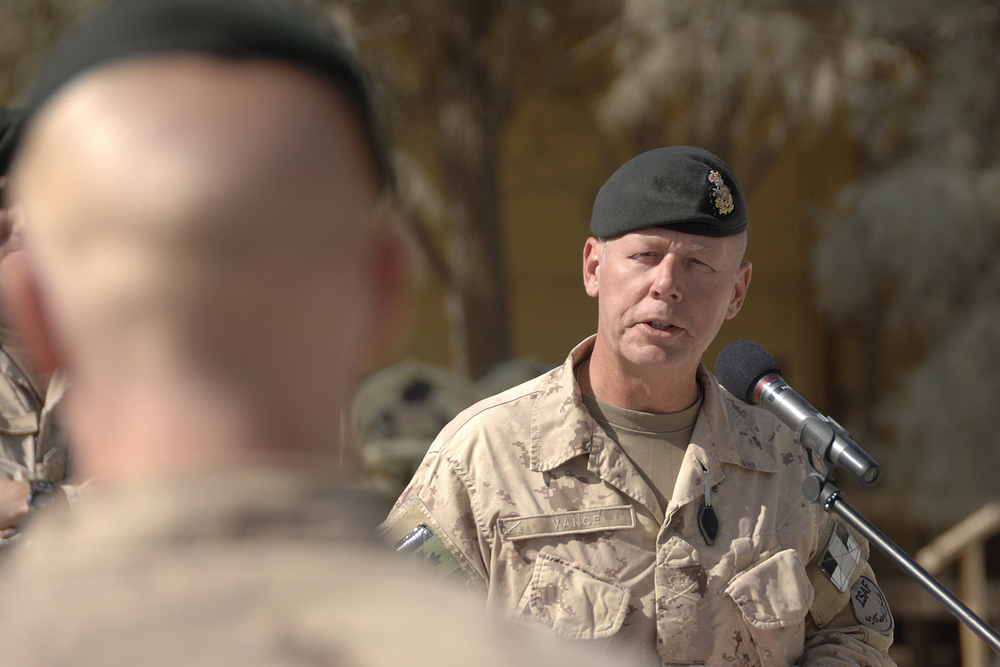
Then LGen Jonathan Vance, then a Brigadier General, delivers a speech while serving as Kandahar 2013. 
“We cannot speak to movements of CAF senior leadership, however CBC and the Canadian Press will be visiting Mali in the near future,” Department of National Defence spokesman Dan Le Bouthillier told Defence Watch Thursday.

Canada announced in March that it would send support personnel, two RCAF Chinook helicopters, as well as four armed Griffon helicopters to act as escorts for those larger aircraft, to Mali, a west African country that since 2013 has been dealing with insurgents and armed Islamic extremists. The mission is expected to start in late July/early August.

The mission, however, has been dogged by more than a few concerns.

Conservative MPs have voiced criticism about the lack of planning and what they claim is a lack of mission focus.

To be sure, there was confusion initially. In mid-March, Defence Minister Harjit Sajjan announced that Canada would send two Chinook helicopters and four armed Griffon helicopters. A few minutes later at the same news conference Vance said the number of helicopters being assigned to the Mali mission had still not been determined. A short time after that, Sajjan’s office sent out a message to journalists, contradicting Vance by stating that ‘up to’ two Chinooks and four Griffons would be sent. Then another message went out to journalists later that there would be extra helicopters sent as backup.

The helicopter issue was eventually sorted out. But attention turned to the potential danger and whether the Mali mission could be considered as combat. MPs on the House of Commons defence committee raised those concerns and questioned generals about details of the Mali operation and whether Canadian military personnel would be safe.

Conservative defence critic James Bezan wanted information about the risks and whether troops would have enough protection from insurgent attacks. Questions were also asked about whether insurgents had surface-to-air missiles that could be of a threat to RCAF helicopters. “Our guys could potentially be going into hot conflict,” Bezan said at the committee.

Another MP asked if Mali was a war zone. Lt. Gen. Stephen Bowes, who was appearing before a Commons committee, answered that, “war zone is not a term. It’s a complex conflict zone.”

Such questions from MPs sparked Col. Jay Janzen, the Canadian Forces Director of Strategic Communications, to tweet to defence journalists that “Canada can do better than the nonsensical ‘combat/not-combat’ debate.”

That, in turn, prompted a showdown between Bezan and Conservative MPs and Janzen (who is slated to be promoted to Brig.-Gen. and put in charge of Canadian Forces public affairs).

Bezan lectured Janzen that he, as a MP, could ask whatever question he pleased and that questions about the safety of troops were certainly valid. He accused Janzen of trying to stifle debate. Bezan also noted that the head of the United Nations mission to Mali has characterized the operation as “war.”

“We have the right to know how Justin Trudeau is using our Canadian Forces to get (a) UN Security Seat,” Bezan tweeted.

Janzen said that while the military is subordinate to civilian authority, he had the right to make such comments.

Vance has done such mission public relations tours before. In 2016, he brought journalists along for his tour of the Canadian special forces mission in Iraq. The special forces were there to help the Kurds battle Islamic extremists who had seized large parts of Iraq.

The event was closely coordinated with Prime Minister Justin Trudeau’s office, as is this Mali trip. Vance also used that trip to play down any concerns about cracks in the Iraq-Kurd alliance. He told CTV at the time he didn’t agree there was a rift in the relationship between the two groups. A year later Kurdish and Iraqi forces were fighting each other.

What comes from the Mali visit remains to be seen but the Trudeau government wants public relations emphasis on support to the United Nations and the use of women on such missions.

Here is a snippet of the messaging that is to be provided to the news media: “The Canadian Armed Forces are working as part of an integrated, whole-of-government approach to deliver on Canada’s commitment to increase its support for UN peace support operations. Canada is a strong supporter of UN peacekeeping, and the CAF is prepared to make valuable contributions to this UN stabilization mission. To be safe at home, we need to contribute to international security abroad.”

CAF Mali Mission May be Tainted by Atrocities

By: Geoffrey York, The Globe and Mail
African Correspondent, Johannesburg

As Canada prepares to send hundreds of troops to Mali on a peacekeeping mission, a fresh discovery of mass graves and alleged military atrocities has highlighted the human-rights challenges that the Canadians could face.

The defence minister of the West African country admitted this week that Malian soldiers were implicated in “gross violations” after the bodies of 25 civilians were found in mass graves in central Mali.

Canada plans to deploy up to 250 troops and six helicopters to northern Mali in August for a one-year mission as part of the United Nations peacekeeping force, known as MINUSMA, which co-operates with the Malian military on the ground. The Malian forces have been battling Islamists and other rebel groups.

Why is Mali in crisis?

Some experts say Canadian troops should look for opportunities to train and advise Mali’s soldiers on human rights – a subject where previous training by the European Union seems to have been ineffective.

Kisal, an organization that helps pastoral communities in Mali, said the 25 dead civilians in the mass graves were mostly herders from the Fulani ethnic group who had been detained by the Malian military last week.
Members of the Malian Armed Forces secure a road in 2017.
Mali’s defence minister, Tiena Coulibaly, confirmed the existence of the mass graves and ordered an investigation. He said “some armed-forces personnel” were implicated in “gross violations” that caused the deaths.

Mali’s authorities are “firmly resolved to fight impunity and get soldiers to strictly observe international rights and humanitarian conventions,” Mr. Coulibaly said.

The evidence of mass graves was just the latest in a long series of documented cases of extrajudicial killings and arbitrary arrests by Mali’s military.

Corinne Dufka, a West Africa researcher at Human Rights Watch who travels frequently to Mali, said she has documented more than 60 alleged summary executions by Mali’s security forces since 2017, with the remains of the victims found in at least seven mass graves. This does not include the latest case of the 25 bodies reported this week.

“Since early 2017, scores of witnesses have described severe mistreatment, arbitrary arrest, disappearances and summary executions,” she said. “I am aware of no single soldier held to account for any of these. … As long as soldiers continue to enjoy impunity, the abuses will continue.”

Human Rights Watch had earlier warned in April that it had received many reports of torture and mass arrest by the Malian army. The army seemed to be “running amok” in central Mali, it said.

In a report in late March, covering a three-month period, the UN said Mali’s defence and security forces were involved in a quarter of the 133 cases of human-rights abuses that UN peacekeepers had documented.

It said, for example, that Malian armed forces had arbitrarily arrested 10 civilians in a counterterrorism operation on Feb. 21 and had summarily executed seven of them, while the others are still missing.

In another report in June, the UN cited allegations of 56 summary executions by Mali’s armed forces.

Because of the continuing problem of human-rights abuses, the Canadian troops in Mali should prioritize the protection of civilians and should try to advise and mentor Malian soldiers to ensure better respect for human rights, Ms. Dufka said.

“We have found that the presence of MINUSMA and French forces in conflict zones in Mali serve as a strong deterrent to abuses by armed groups,” she told The Globe and Mail.

The UN peacekeeping mission co-operates with Mali’s military in a number of areas, including intelligence-sharing and some ground patrols, although the Canadian troops would primarily be supporting the UN in helicopter operations.

The UN mission has “conducted regular patrols” with Mali’s defence and security personnel and provided medical evacuations for the military, according to the UN report in late March.

The Canadian government has disclosed few details of how Canada’s peacekeepers will operate in Mali. Opposition MPs in Ottawa have complained about a lack of information on the planned mission.

It seems likely, however, that the Canadian troops will be based at an airfield in the town of Gao in northern Mali, and they will primarily be there to support the Canadian helicopters.

Bruno Charbonneau, a peacekeeping expert and associate professor of political science at Laurentian University, said he is doubtful that the Canadian peacekeepers will have much contact with Malian forces.

He noted, however, that the Canadian forces could potentially be asked to support the activities of the French military or a new West African military force known as G5 Sahel, both of which are fighting Islamist jihadists in Mali. The G5 group includes Malian troops.

The UN peacekeeping force is not officially authorized to conduct counterterrorism operations, he said. “But in practice it is difficult if not impossible to differentiate between peacekeeping and counterterrorist operations,” he said.

Walter Dorn, a peacekeeping expert at the Canadian Forces College in Toronto, said the Canadian military should support the UN peacekeeping force in providing human-rights training and mentoring for Malian soldiers.

Tuesday, June 12, 2018

Boeing Sending Technical Staff with RCAF to Mali

By: David Pugliese, Defence Watch 

Boeing says it will be sending a technical representative to Mali to support the RCAF when it deploys its Chinook helicopters. So far one specialist is scheduled to go but others could follow.

The Boeing staff will be at the RCAF base in Mali to consult on issues that arise during the Chinook operations in what is expected to be a deployment that is hard on the helicopters because of the environment.

Members of the Canadian Medical Emergency Response Force Protection Team fall back to the CH -147 Chinook helicopter, during Exercise Maple Resolve in Wainwright, Alberta on the 16th of May 2018. Photo: Corporal Andrew Kelly, Canadian Forces Combat Camera IS08-2018-0010-009

On March 19 the Canadian government announced its commitment to deploy a task force made up of medium utility and heavy lift transport helicopters for up to 12 months to the United Nations Multidimensional Integrated Stabilization Mission in Mali.

The task force will provide two CH-147F Chinook helicopters from 450 Tactical Helicopter Squadron, based in Petawawa, Ont. and four CH-146 Griffon helicopters from 408 Tactical Helicopter Squadron, based in Edmonton, Alta. Aircraft spares could also be made available to the Aviation Detachment.

The aircraft and personnel are expected in Africa by August.

In Mali, the CH-146 Griffon helicopters will serve as an armed escort for the Chinooks as they carry out UN missions. The Canadian Armed Forces will provide MINUSMA with a number of medically-trained personnel who will help in medical evacuations for partners and allied forces on the ground and provide logistical support for the mission.

Monday, June 11, 2018

In Mali, how do we avoid helping the bad guys again?

By: Doug Saunder, The Globe and Mail

In a few weeks, six military helicopters and 250 soldiers will begin their journey from Canada to the Sahara Desert, where they will join more than 11,000 international forces in a five-year-old operation known as the United Nations Multidimensional Integrated Stabilization Mission in Mali.

MINUSMA Guinean contingents set up positions on higher ground around Kidal, Mali, in December 2016.
UN PHOTO/HARANDANE DICKO/UN PHOTO
And once again, there is controversy: Are we pouring money and lives into another mission that risks becoming a decade-long quagmire, with unclear goals? Has the Trudeau government pushed our soldiers into this commitment because there’s pressure from our allies and a voter appetite to see maple leaves on the peacekeepers’ blue helmets?

While there’s some truth in both accusations, the Mali mission is not, by itself, an unworthy or imprudent use of our military resources. Mali, a hopeful and comparatively stable country until Islamist forces invaded its north in 2012, needs help rescuing itself from an outside invader hated by most of the population. The UN mission is not a Western imposition or a regime-change operation: Mali’s legitimate government has requested military assistance with what should be a limited operation against a jihadi insurgency – thus the operation’s name.

That said, there is reason to be gravely concerned about the prospects of this sort of military mission. While this is still officially a peacekeeping operation, in practice it bears no resemblance to the classic conflict-prevention campaigns of decades ago. Its mission is “to help stabilize key population centres and support the re-establishment of state authority throughout Mali, and to develop and implement programs for the disarmament, demobilization, and reintegration of former combatants.” It is, in everything but name, a counter-insurgency operation.

And counterinsurgency operations – designed to neutralize an extremist guerrilla enemy by strengthening a country’s civic institutions and supporting the population – have a terrible track record.

The Mali goals are strikingly similar to those of Canada’s mission in Afghanistan, under NATO’s International Security Assistance Force. The stabilization and institution-building operations in Afghanistan were expensively implemented by hundreds of thousands of people, lavishly and carefully designed by scholars and social scientists – and they failed badly.

Last week, the U.S. government’s Special Inspector General for Afghanistan Reconstruction released its report concluding that 17 years of “efforts to stabilize insecure and contested areas in Afghanistan mostly failed,” and that elsewhere the Afghan mission “overestimated its ability to build and reform government institutions as part of the stabilization strategy,” and “spent far too much money, far too quickly, in a country woefully unprepared to absorb it.”

As a consequence, “opportunities for corruption and elite capture [theft] abounded, making many of those projects more harmful than helpful,” and “power brokers and predatory government officials with access to coalition projects became kings with patronage to sell, fueling conflicts,” and the many Afghans left outside these power networks “found natural allies in the Taliban, who used that support to divide and conquer communities the coalition was keen to win over.”

This pattern keeps repeating itself: Even the most well-intentioned and well-designed “stabilization and assistance” operations end up benefiting the enemy.

Aisha Ahmad, a political scientist at the University of Toronto who specializes in the financing and economic activities of jihadi extremist groups (patterns she investigates in her new book Jihad & Co.: Black Markets and Islamist Power) has found that most efforts to stabilize and normalize countries are designed in ways that benefit the jihadis more than those they’re meant to support.


The reason why jihadist groups keep returning to power in African and Central Asian countries, she writes in a new essay, “has remarkably little to do with jihadist ideology or identity politics. Rather, there is a clear economic logic behind these patterns of jihadist resurgence.”

Big international interventions (whether UN or NATO), she writes, “flood conflict zones with foreign resources, which create a series of perverse incentives. These incentives change the cost calculations and the behaviour of local armed groups, especially the international community’s local allies. Too often, foreign dollars socialize and incentivize these local allies to behave poorly — and indeed, even sabotage mission success.”

From the perspective of a poor country’s economy, an international military mission is something like a discovery of oil – a flood of untethered money that risks a “resource curse” effect, making the worst people more powerful. This has a tendency to turn insurgent groups into winners and governments into losers. It is still possible to play an important role in making Mali a better place – but, as Dr. Ahmad concludes, we’d better pay a lot more attention to what our money is doing.

Friday, June 1, 2018

Canada’s Mission to Mali could become a new Afghanistan

By: Ken Hansen, Special to Macleans Magazine 

Opinion: There is no peace to keep in Mali, and the UN mission there has become a deadly quagmire—one that Canada might be wise to just avoid

Ken Hansen is an independent defence and security analyst and owner of Hansen Maritime Horizons. Retired from the navy in 2009 in the rank of Commander, he is a member of the Science Advisory Committee for Atlantic Oceans Research Enterprise and a contributor to the Security Affairs Committee for the Royal United Services Institute.
“Canada is back,” Justin Trudeau said when his Liberals won the 2015 election. After years in the wilderness on peacekeeping, he said, Canada would be returning to its heritage as a leader in peacekeeping missions, promising to commit up to $400 million and 600 Canadian Armed Forces personnel to UN peace operations.

In this Feb. 25, 2015 photo provided by the United Nations, UN peacekeepers from Bangladesh arrive at the Niger Battalion Base in Ansongo, in eastern Mali. (Marco Dormino/United Nations via AP)
But his Liberal government has hit a significant road bump along the way: The most recent figures from the United Nations have found that Canada’s peacekeeping commitment has reached an all-time low. The government said it was looking for a mission that would be the right fit.

In March, after the United Nations sent a formal request for a military contribution to its ongoing mission in Mali (MINUSMA)—established in April of 2013 with a mandate to “support the transitional authorities of Mali in the stabilization of the country and implementation of the transitional roadmap”—the government announced that it had found the right mission. Canada offered up six helicopters—four light utility “Griffons” and two twin-rotor “Chinook” transports—and approximately 250 military personnel (and up to 600) to MINUSMA.

But the UN was quick with its assessment. In mid-April, the UN said that the Canadian force was not robust enough to meet the increasing demands of what is being described as the UN’s most dangerous mission, saying that Canada needed more helicopters to assure a minimum of two transport aircraft and two escort helicopters at short notice. The current German contingent employs four armed utility helicopters and four transports with over 900 support personnel, while the Dutch, who the Germans replaced, used four Apache attack helicopters and three Chinook transports; both contingents lost a helicopter due to accidents Nevertheless, the helicopters and personnel were reportedly set to be deployed later this summer, though Canada now appears to be hemming and hawing as the UN calls for Canada to meet its deadlines.

But even beyond Canada’s seeming unpreparedness, and the pressure to bolster its peacekeeping efforts, there are red flags all over the mission. The situation in Mali strongly resembles the conflict in Afghanistan, a mission marked by mission creep and escalating risk. Ethnically divided, with a weak central government and borders that are not respected or controllable, Mali is confronted by a radical opponent that will use any level of violence against all manner of victims. Canada’s desire to participate in future UN peace support missions must be tempered by careful situation analysis and adequate risk mitigation, or they risk blundering into a dangerous mission like MINUSMA—a toxic situation that Canada would be wise to avoid.

The history of the violent conflict between the impoverished northern and affluent southern parts of Mali is long, with a traceable history going back to the 13th century. This most recent issue, according to the Clingendael Institute—which has charted the break-up between north and south—stems from the French period of colonization when the northern Tuareg and nomadic Arab communities were virtually excluded from plans for post-colonial rule on June 20, 1960. From that point onward, the Tuareg have had only a few seats in the Malian assembly. The first-ever Arab, Zahabi Ould Sidi Mohamed, was elected in 2013.


From 1960 to 2012, there were four Tuareg rebellions and five different peace agreements. The use of the French military to force the sides apart has been a recurring theme, and the deployment of France’s notorious Foreign Legion—whose heavy-handed use of force in this part of the world is legendary—only sharpens the resentment of the northerners.

The most recent peace accord, sponsored by Algeria, was signed in 2015, but the violence since then has been almost constant. Neither side respects the agreement. The arrival of al-Qaeda in the Sahel to bolster the northerners has provoked a significant escalation in the type of attacks being staged, while also broadening the issues at stake; indeed, the Malian situation is only part of the bigger social and economic problems that stretch across the entire region. The International Crisis Group (ICG) report for 2017 postulated the Sahel as the zone of conflict between forces from Saharan Africa and the non-Arab agrarian south.

The trend lines in Mali do not auger well for Canada’s peacekeeping aspirations. The ICG’s 2018 Watch List Report describes strengthening insurgencies in parts of Mali, Burkina Faso and Niger. Jihadi groups are exploiting the situation to establish secure operating areas and find new recruits. The ICG maintains that the Bamako Peace agreement of June 2015 has stalled, and crop failure and food shortages are only exacerbating the ethnic tensions.

These are huge, historical issues, and if disentangling them seems like an outsize task for Canadians who still value the peacekeeping tradition, the UN’s recent history of expanding the mission mandate should be particularly worrisome. a long list of further duties, including: “ensuring security, stabilization and protection of civilians; supporting national political dialogue and reconciliation; and assisting the reestablishment of State authority, the rebuilding of the security sector, and the promotion and protection of human rights in that country.” These complicated responsibilities tasks carry a far heavier burden of responsibility for the use of force. The mission has grown, as a result, and its current strength is set at 15,425 personnel, comprising mostly 13,289 military and 1,920 police. The annual budget is USD$1.048 billion.

The biggest problem is that MINUSMA does not have the capabilities for the type of threat they face. “We are gathering the intelligence, but we lack the forces­ who can act on that information,” the mission’s chief of intelligence, Swedish Lt.-Colonel Per Wilson, told Sieff. And after a visit to Mali, Prof. Walter Dorn of the Royal Military College in Kingston told the CBC“the UN mission is struggling, but is making a difference on the ground… The Mali government is struggling to exert control over the wild territories in the north.” The successes, so far, have been limited—and the risks are great.

The need for more robust military capabilities led the UN to approve cooperation between the French military and the UN mission. Resolution 2364 (2017) expanded MINUSMA to its current limits and added the additional tasks of “providing operational and logistical support to the Malian Security and Defence Forces. The resolution also reinforced cooperation between the mission, the local multi-national “Group of 5” Sahel forces and French forces while respecting their respective mandates.” The escalatory nature of the UN’s move is obvious.

The tactical connection between French Foreign Legionnaires and the UN forces have only led to an inevitable comparison that has made the task even tougher for the peacekeepers on the front lines: according to Sieff’s article, Islamist extremists across the Sahel region have dubbed the whole undertaking as “Crusader occupation forces.” As a result, the militants have started targeting peacekeepers. Sieff described attacks on UN convoys with improvised explosive devices and cars driven into UN compounds carrying 1,000-pound bombs detonated in suicide attacks. The UN death toll is currently 169, and there will be more.

If Canadians think that our mission in Mali will be a return to some form of peacekeeping, they are in for a stunning shock: There is no peace to keep. The UN has already begun moving into a dangerous and violent form of operations that the UN does not formally recognize, known in military circles as “peace imposition.” The obvious demand for rapid reaction and effective logistics will put a heavy burden on the Canadian contingent. They will be in the very epicentre of the most aggressive and dangerous actions, and losses are practically a certainty. “It is a crisis that looks more like the U.S. ground wars in Iraq and Afghanistan than the cease-fires traditionally monitored by U.N. missions,” Sieff writes—and in this, he is absolutely correct.

Former ambassador Robert Fowler, in an open letter published in the Globe and Mail, wrote of what he saw as “the importance of Canada’s mission to Mali.” “The Islamists hate everything we represent,” he argued. “They also hate the United Nations with a vicious passion.” His assessment aligns quite well with the trends identified here. However, his recommendation for a major whole-of-government commitment to the region is definitely not what the Trudeau government wants—that is, another searing Afghanistan experience.

Fowler, who spent months as a captive of the rebels, feels that the Canadian mission will not be about regime change and social re-engineering. But frankly, how he views the mission will not affect how it is actually conducted. That has already been established by the rebels who have likened all outside forces to “crusaders.” The prospects are high that this will go much as the Afghanistan debacle went; the same type of escalation and mission creep seen during our 12-year engagement there is already happening in Mali. The UN is expanding its operational aims and tactical objectives in the region, finding new allies, and some old ones, for a protracted struggle.

This type of mission against radical extremists and corrupted political systems has consistently produced very dubious results in Afghanistan, Iraq, Libya and Syria. Given the long and complicated history of the Sahel region, it feels foolish to expect anything else in Mali.