Opinion: There is no peace to keep in Mali, and the UN mission there has become a deadly quagmire—one that Canada might be wise to just avoid
Ken Hansen is an independent defence and security analyst and owner of Hansen Maritime Horizons. Retired from the navy in 2009 in the rank of Commander, he is a member of the Science Advisory Committee for Atlantic Oceans Research Enterprise and a contributor to the Security Affairs Committee for the Royal United Services Institute.
“Canada is back,” Justin Trudeau said when his Liberals won the 2015 election. After years in the wilderness on peacekeeping, he said, Canada would be returning to its heritage as a leader in peacekeeping missions, promising to commit up to $400 million and 600 Canadian Armed Forces personnel to UN peace operations.
In this Feb. 25, 2015 photo provided by the United Nations, UN peacekeepers from Bangladesh arrive at the Niger Battalion Base in Ansongo, in eastern Mali. (Marco Dormino/United Nations via AP)
But his Liberal government has hit a significant road bump along the way: The most recent figures from the United Nations have found that Canada’s peacekeeping commitment has reached an all-time low. The government said it was looking for a mission that would be the right fit.
In March, after the United Nations sent a formal request for a military contribution to its ongoing mission in Mali (MINUSMA)—established in April of 2013 with a mandate to “support the transitional authorities of Mali in the stabilization of the country and implementation of the transitional roadmap”—the government announced that it had found the right mission. Canada offered up six helicopters—four light utility “Griffons” and two twin-rotor “Chinook” transports—and approximately 250 military personnel (and up to 600) to MINUSMA.
But the UN was quick with its assessment. In mid-April, the UN said that the Canadian force was not robust enough to meet the increasing demands of what is being described as the UN’s most dangerous mission, saying that Canada needed more helicopters to assure a minimum of two transport aircraft and two escort helicopters at short notice. The current German contingent employs four armed utility helicopters and four transports with over 900 support personnel, while the Dutch, who the Germans replaced, used four Apache attack helicopters and three Chinook transports; both contingents lost a helicopter due to accidents Nevertheless, the helicopters and personnel were reportedly set to be deployed later this summer, though Canada now appears to be hemming and hawing as the UN calls for Canada to meet its deadlines.
But even beyond Canada’s seeming unpreparedness, and the pressure to bolster its peacekeeping efforts, there are red flags all over the mission. The situation in Mali strongly resembles the conflict in Afghanistan, a mission marked by mission creep and escalating risk. Ethnically divided, with a weak central government and borders that are not respected or controllable, Mali is confronted by a radical opponent that will use any level of violence against all manner of victims. Canada’s desire to participate in future UN peace support missions must be tempered by careful situation analysis and adequate risk mitigation, or they risk blundering into a dangerous mission like MINUSMA—a toxic situation that Canada would be wise to avoid.
The history of the violent conflict between the impoverished northern and affluent southern parts of Mali is long, with a traceable history going back to the 13th century. This most recent issue, according to the Clingendael Institute—which has charted the break-up between north and south—stems from the French period of colonization when the northern Tuareg and nomadic Arab communities were virtually excluded from plans for post-colonial rule on June 20, 1960. From that point onward, the Tuareg have had only a few seats in the Malian assembly. The first-ever Arab, Zahabi Ould Sidi Mohamed, was elected in 2013.
From 1960 to 2012, there were four Tuareg rebellions and five different peace agreements. The use of the French military to force the sides apart has been a recurring theme, and the deployment of France’s notorious Foreign Legion—whose heavy-handed use of force in this part of the world is legendary—only sharpens the resentment of the northerners.
The most recent peace accord, sponsored by Algeria, was signed in 2015, but the violence since then has been almost constant. Neither side respects the agreement. The arrival of al-Qaeda in the Sahel to bolster the northerners has provoked a significant escalation in the type of attacks being staged, while also broadening the issues at stake; indeed, the Malian situation is only part of the bigger social and economic problems that stretch across the entire region. The International Crisis Group (ICG) report for 2017 postulated the Sahel as the zone of conflict between forces from Saharan Africa and the non-Arab agrarian south.
The trend lines in Mali do not auger well for Canada’s peacekeeping aspirations. The ICG’s 2018 Watch List Report describes strengthening insurgencies in parts of Mali, Burkina Faso and Niger. Jihadi groups are exploiting the situation to establish secure operating areas and find new recruits. The ICG maintains that the Bamako Peace agreement of June 2015 has stalled, and crop failure and food shortages are only exacerbating the ethnic tensions.
These are huge, historical issues, and if disentangling them seems like an outsize task for Canadians who still value the peacekeeping tradition, the UN’s recent history of expanding the mission mandate should be particularly worrisome. a long list of further duties, including: “ensuring security, stabilization and protection of civilians; supporting national political dialogue and reconciliation; and assisting the reestablishment of State authority, the rebuilding of the security sector, and the promotion and protection of human rights in that country.” These complicated responsibilities tasks carry a far heavier burden of responsibility for the use of force. The mission has grown, as a result, and its current strength is set at 15,425 personnel, comprising mostly 13,289 military and 1,920 police. The annual budget is USD$1.048 billion.
The biggest problem is that MINUSMA does not have the capabilities for the type of threat they face. “We are gathering the intelligence, but we lack the forces who can act on that information,” the mission’s chief of intelligence, Swedish Lt.-Colonel Per Wilson, told Sieff. And after a visit to Mali, Prof. Walter Dorn of the Royal Military College in Kingston told the CBC“the UN mission is struggling, but is making a difference on the ground… The Mali government is struggling to exert control over the wild territories in the north.” The successes, so far, have been limited—and the risks are great.
The need for more robust military capabilities led the UN to approve cooperation between the French military and the UN mission. Resolution 2364 (2017) expanded MINUSMA to its current limits and added the additional tasks of “providing operational and logistical support to the Malian Security and Defence Forces. The resolution also reinforced cooperation between the mission, the local multi-national “Group of 5” Sahel forces and French forces while respecting their respective mandates.” The escalatory nature of the UN’s move is obvious.
The tactical connection between French Foreign Legionnaires and the UN forces have only led to an inevitable comparison that has made the task even tougher for the peacekeepers on the front lines: according to Sieff’s article, Islamist extremists across the Sahel region have dubbed the whole undertaking as “Crusader occupation forces.” As a result, the militants have started targeting peacekeepers. Sieff described attacks on UN convoys with improvised explosive devices and cars driven into UN compounds carrying 1,000-pound bombs detonated in suicide attacks. The UN death toll is currently 169, and there will be more.
If Canadians think that our mission in Mali will be a return to some form of peacekeeping, they are in for a stunning shock: There is no peace to keep. The UN has already begun moving into a dangerous and violent form of operations that the UN does not formally recognize, known in military circles as “peace imposition.” The obvious demand for rapid reaction and effective logistics will put a heavy burden on the Canadian contingent. They will be in the very epicentre of the most aggressive and dangerous actions, and losses are practically a certainty. “It is a crisis that looks more like the U.S. ground wars in Iraq and Afghanistan than the cease-fires traditionally monitored by U.N. missions,” Sieff writes—and in this, he is absolutely correct.
Former ambassador Robert Fowler, in an open letter published in the Globe and Mail, wrote of what he saw as “the importance of Canada’s mission to Mali.” “The Islamists hate everything we represent,” he argued. “They also hate the United Nations with a vicious passion.” His assessment aligns quite well with the trends identified here. However, his recommendation for a major whole-of-government commitment to the region is definitely not what the Trudeau government wants—that is, another searing Afghanistan experience.
Fowler, who spent months as a captive of the rebels, feels that the Canadian mission will not be about regime change and social re-engineering. But frankly, how he views the mission will not affect how it is actually conducted. That has already been established by the rebels who have likened all outside forces to “crusaders.” The prospects are high that this will go much as the Afghanistan debacle went; the same type of escalation and mission creep seen during our 12-year engagement there is already happening in Mali. The UN is expanding its operational aims and tactical objectives in the region, finding new allies, and some old ones, for a protracted struggle.
This type of mission against radical extremists and corrupted political systems has consistently produced very dubious results in Afghanistan, Iraq, Libya and Syria. Given the long and complicated history of the Sahel region, it feels foolish to expect anything else in Mali.
HUDSON ON THE HILL FrontLine Defence (Vol 15, No 3)
If all goes according to plan, two Boeing CH-147F Chinook transport helicopters and four Bell CH-146 Griffon utility tactical helicopters, supported by 200-250 personnel, will be deployed to Mali in August to augment what is arguably the most challenging mission for United Nations’ “blue berets” in recent years.
Our first major involvement in Africa since the troubled missions in Somalia and Rwanda in the early 1990s, it was described by Prime Minister Justin Trudeau as a re-engagement in the UN after a decade of withdrawal by the former administration. “That’s what Canadians expect,” he told the House of Commons when the plan was unveiled in mid-March after months of speculation.
Toronto Conservative MP Lisa Raitt, calling the decision “absolutely deplorable,” noted that Jean-Pierre Lacroix, a career French diplomat, had questioned the objectives in a country where 162 foreign troops have been killed since 2013. A review kick-started by Lacroix last January was, he said, “a race against time” to keep the situation in Mali from deteriorating even further.
Trudeau, reading from notes, told Raitt that Canada would be contributing “in ways that bring the most value” to the mission – mainly by transporting other countries’ personnel under the protection of Griffon crews. Having reiterated that “the safety of our men and women in uniform is paramount”, Trudeau noted that while troops have the appropriate training and equipment, “of course we cannot altogether eliminate the risk.”
It will be the most dangerous mission on the UN’s recent agenda, and there are fundamental questions about the organization’s ability to rebuild what is clearly a broken country with a government that has little effective control.
Considered a model of democracy and African stability only a decade ago, Mali was one of Canada’s “countries of focus” for development aid. Averaging more than $100 million annually and topping out at $125 million in 2016 alone, Canada ranked third on Mali’s international donor list behind France and the United States.
Two German UH -Tiger Attack Helicopters taxi in after finishing a patrol over Mali in 2017.
Canada has also sent instructor troops to Mali since 2010 as part of a US-led effort to help train the land-locked country’s army in counter-terrorism, border security and other priorities. One of the program’s graduates, Captain Amadou Sanogo, spearheaded a military coup which prompted Canada to suspend aid for nearly two years.
Sundry so-called rebel forces have since struggled for dominance, mainly in the northern Gao region, part of a sprawling desert zone declared “independent” in 2012 by the National Movement for the Liberation of Azawad. The NMLA subsequently lost control to Islamist militias.
The “rebels” are a loose and shifting coalition of groups with different aims and motivations. This fractured and fractious environment has been a major stumbling block for the UN and its partners.
Marie-Joëlle Zahar, research director at the University of Montreal’s peace operations network and a UN-sanctioned mediation expert, highlighted the problem during an appearance in late April before the House of Commons Standing Committee on National Defence.
“Deployment environments […] have changed since Canada was last part of a UN mission,” Zahar noted, speaking as an individual witness rather than for the university network. “Violent conflict is on the rise, and there are at least four characteristics of violent conflicts. […] The first is that they're much more regionalized than internationalized, as they used to be.” Most current wars were not civil wars per se, but “internationalized civil wars” in which foreign states and non-state actors instigate and prolong conflict for their own interests.
“In Mali, the fragmentation of northern anti-government forces and their composition and re-composition into ever-shifting alliances and counter-alliances remains one of the main obstacles to achieving sustainable peace,” Zahar said.
On the specific issue of Canada’s upcoming Mali deployment, she said it would fill “the most serious gaps” in the UN’s Multidimensional Integrated Stabilization Mission in Mali. “MINUSMA has repeatedly highlighted that this is what it needs and what it cannot get from a majority of troop-contributing countries. […] The high number of fatalities is partly due to logistical difficulties of attending to injuries in situ and providing reliable evacuation of the wounded.” The UN Department of Peacekeeping Operations confirms that at least 143 of the MINUSMA fatalities came from troop-contributing countries whose militaries are deployed as part of the ground forces.
Inadvertently linking to Lisa Raitt’s impossible-to-answer question about risk, Zahar said that “not only would the Canadian Forces be helping reduce the number of casualties, but based on current trends of who is most in danger, they would not be a primary target.”
That, obviously, remains to be seen because there is a key capability gap, demonstrated graphically during Op Athena in Afghanistan. Canada’s Chinooks, considered the most advanced model of the twin-rotor platform, have a maximum speed of 170 knots (315 kilometres per hour). The single-rotor Griffons, meanwhile, max out at 140 knots (160kph). Faster just isn’t aerodynamically possible and the significant differential means that Chinooks have to be throttled back to let their Griffon escorts keep up, presenting an easier target for opponents on the ground. The geography of the most likely theatre of operations features plateaus up to 500 metres above sea level and, in the northeast, hills up to 1,000 m.
Sources with the Royal Canadian Air Force have acknowledged the challenge but, without going into detail, say they have refined tactics to take that into consideration. They also privately echo Zahar’s warning that re-engaging in peacekeeping, while not free of danger, is “a necessity to prevent trouble spots […] from becoming open sores and the source of regional and international instability.”
As one veteran Chinook pilot pointed out, “it’s what we train for, what we do, and we have the best aircraft of its kind for the job.” It helps that the Chinooks have been fitted out with the latest countermeasures.
Dutch and German forces (Canada will be replacing the latter but there will be a gap of about a month) have used their armed helicopters to support UN ground troops against ambushes, but General Jonathan Vance, the Chief of the Defence Staff, demurred when the prospect of using Griffons in that role was broached during a televised interview. “At this juncture, the planning we’re doing is armed escort,” he said, adding that his planners would be talking with their German counterparts. “It is possible […] they could be used for support to ground forces. It is possible. We’ve got to look at it. We need to get a lot more detail.”
Why Train?
Carolyn McAskie, who oversaw the 2004-2006 UN peacekeeping mission in Burundi, which involved some 5,600 troops, 120 police and 1,000 civilians, stressed the need not to “get hung up on traditional peacekeeping” because “there has been no such thing since the Cold War.”
Testifying as an individual as well, McAskie advised those on the Committee to “ignore the nervous Nellies” who fret about risk. “Of course it's dangerous; why else would we be going? It’s a war zone; of course armies have to take precautions. Of course I’m sensitive to the political and human side of casualties, absolutely, but if we want a casualty-free war, why do we have 68,000 really good, well-trained, experienced troops? Why bother? Are we then to leave the heavy lifting to others?”
She also pointed out that Canadian civilians had been in the forefront all along – with no government support. “When I joined the UN in 1999 as humanitarian relief coordinator, it was at a time when there was a pullback internationally from peacekeeping. More humanitarians died on the front lines in 1998 than peacekeepers.”
On Mali specifically, Canada’s involvement would be in our national interest. “We’ve had a development program for years of […] up to $100 million a year,” McAskie explained. “There are a dozen Canadian mining companies in Mali with an investment of $1.5 billion. In the 1990s, if you were a Canadian and walked into Bamako, you were welcomed with open arms.” She says the signs of trouble have been brewing, but ignored, in recent years.
Military involvement, however, must be matched with development investment to foster economic stability and undercut criminal and terrorist elements. “If we want to contribute to the success of the mission, we need a place at the political table. We don’t have that now. Our contribution, military or financial, has to be enough to give us a voice. Otherwise, we’re just playing around the edges.”
McAskie challenged those who don’t seem to understand that Canada has a responsibility, working with the international rules-based system that Canada helped to build over the last 70 years. Otherwise, she cautioned, “we cannot blame others it if fails.”
Peacekeeping Capacity
Walter Dorn, a professor of defence studies at the Royal Military College of Canada, told the committee that missions in Somalia, Bosnia, Cambodia and then Rwanda saw Canada’s military and police deployments peak at 3,300 in mid-1993. A UN hiatus for the rest of that decade saw Canada drop its numbers to the 300-500 range before a general cutback which meant that Canada currently provides no units and only 47 personnel as individuals, 23 police in Haiti, and 24 military personnel in Haiti, the Congo, Cyprus, South Sudan, and the Middle East.
“Unlike the UN’s, Canada’s capacity for peace operations has declined,” said Dorn. “With few personnel deployed over the past two decades, the Canadian Armed Forces have less experience than in previous generations and do much less training.”
Closure of the Pearson Peacekeeping Centre in 2013 meant there was no place where military, police and civilian personnel could be trained together and, although the new Peace Support Training Centre in Kingston does “excellent work”, it is strictly for the military and aimed mainly at tactical training with “only a small fraction” focused on the UN.
“As the only person who teaches a course on peace operations at the command and staff level, I can tell you that the number of activities in the Canadian Armed Forces has dropped to less than a quarter of what it was in 2005, with fewer exercises and almost no role-playing as UN peacekeepers, though some efforts are now being made to reinvigorate the peace operations curriculum.”
Dorn closed his testimony by pointing out that while Canada presses for more women to be involved in UN peace operations, it is failing to lead by example with only three women currently deployed. “I’ve had women in my office saying that they’ve been trying for years to get on UN operations but that the opportunities just haven’t been there.”
Sources have told FrontLine that one of the reasons for the more than four-month delay between mission announcement and deployment, other than the need to have the aircraft ready to move out of CAF Base Petawawa for transport overseas, is that there is a renewed effort within the military to significantly increase the number of women who will be eligible to wear the UN blue beret.
=== Hudson on the Hill The role of Hudson is being filled by contributing editor Ken Pole.
There is a sharp bit of historical cynicism that generals always prepare to fight the last war. In today’s world, it’s politicians who want to ignore the lessons of the past and fight the war again.
Case in point: the decision to deploy the Canadian military as part of the United Nations “peacekeeping” force in Mali. Mali, which, just last week, suffered another attack on peacekeepers on its soil – one Blue Helmet was killed, and 14 French troops and UN peacekeepers were injured, along with two Malian civilians. The UN said it was the third attack this month.
A Bangladeshi United Nations soldier walks by a car during the weekly cattle market in Gao, Mali, in this file shot from 2017.ALEXANDER KOERNER / GETTY IMAGES
Canada’s decision to deploy military personnel there suggests none of the lessons learned from our 13-year war in Afghanistan are remembered. Nor is there memory of Canadian military involvement in the messy, inconclusive wars in Libya and Iraq, or our involvement in the disastrous wars in Somalia, Rwanda and the Congo. Adding the “United Nations” label to a force has become a cruel deception in collective decisions to fight first and make peace later.
There are daily reminders of the lasting effects of the Afghan war on Canadians. One would hope there would be some pause before an even more dangerous military adventure was undertaken. And at first, it did look as if the Liberal government remembered. But the Liberals’ ill-defined promise before the 2015 election that, if elected, they would return Canadian soldiers to peacekeeping missions around the world, needed fulfilment. Like electoral reform, the promise should have been left on the side of the road as an indication of mature decision-making. But it wasn’t.
The result is Canada joining the United Nations Multidimensional Integrated Stabilization Mission in Mali (MINUSMA) – a mission named for hope, not reality. As we have seen, the less hope there is, the greater the grandiosity of the name.
Trudeau defended the mission this week in Paris, where he said Canada is taking a more modern approach, trying to deal with child soldiers and focusing on training, for instance.
Even so, the world has changed dramatically in terms of the ability of outside countries to significantly alter the dynamics of internal civil conflicts. “Peacekeeping” has become an over- and ill-used metaphor when the international community faces with tragedies that are largely the products of colonial gerrymandering, poor governance and an unwillingness to seeks policies of national reconciliation. The injection of foreign troops into the struggles of weakening states will do nothing except sharpen divides, increase deaths and prolong the tragedy. The hope that foreign interventions can stop wars lives on, despite overwhelming evidence to the contrary.
Indeed the UN itself is now reviewing its Mali mission, to see if it is actually helping support stability or peace. This is happening even as Canada has committed to sending in military helicopters.
For hundreds of years, the policy of European and other countries called for the intervention of a few soldiers and ships to shape the international and regional futures of troubling countries. That time has passed. Unfortunately, the historical impulse to intervene has not. And so the hope that foreign interventions (irrespective of the sponsoring body) can stop wars lives on, despite overwhelming evidence to the contrary.
Mali is but the latest example. France, the colonial era intruder in this tragedy, decided it could no longer cope with the mess it had created when it sent in a few hundred French troops. It decided to spread the blame and asked for help, first from other African states, then the UN.
Even a cursory acknowledgement of the history of the country and the region, where “empires” were almost as numerous as the sands of the Sahara, suggests the injection of thousands of foreign troops will do little to settle historical geographic, ethnic and linguistic divides, which have been sharpened by the involvement, or more accurately, accentuation of extreme Islamic theology.
During the colonial period, formalized in 1892, the region was called French Sudan and, at various iterations, was inclusive of Senegal, Ivory Coast, Benin, Burkina Faso and Mali. In the north, it overlapped with the southern regions of Algeria with easy, uncontrolled connections into Morocco, Tunisia and Libya.
Some will suggest our Afghanistan experience was unique but in doing so we easily forget the beginnings of African peacekeeping in 1960 in the Congo. More are dying today than when the area was the personal fiefdom of the King of the Belgians.
Granted, today’s urge to help may be larger than lingering colonial mentality. But even the faint hopes associated with the “responsibility to protect” concept move many to promote and accept bad policies. The ubiquity of these disasters always includes adding more guns.
There is sufficient evidence to disabuse us of the hope that we are doing anything more than assuaging historical guilt and the public urge for government to do something. What is missing from these considerations is any serious effort by the international community to foster, create and maintain a non-military process in the affected countries.
The disasters associated with “peacekeeping” are now more than manifest and successes are faint memories. It is time for new thinking. If half of the cost of the UN mission to Mali were dedicated to a political solution, then there might be some hope that a more peaceful future could be achieved.
Otherwise, after a while on the “peacekeeping” road, we will soon wonder how we can get off. --- Gar Pardy is retired from the Canadian foreign service and comments on issues of foreign policy from Ottawa.
With the current debate on Canada's return to Peacekeeping UN operations, this article by Chris McGreal was published by The Guardian in September of 2015, and it still reads well today.
Originally Published September 2015 From Rwanda to Bosnia, Haiti to Congo, failures raise questions about future of United Nations blue helmets
A UN tank helps civilians evacuate from Kigali, Rwanda, 1994. Photograph: Scott Peterson/Getty Images
Rwanda, 1994. The nadir of many lows for UN peacekeeping.
Hundreds of desperate Tutsis sought refuge on the first day of the genocide at a school where 90 UN troops were under the command of Captain Luc Lemaire. Here, they were surely safe from the Hutus and their machetes.
The UN flag flew over the school. The Belgian peacekeepers were armed with a machine gun, planted at the entrance. These soldiers were the world’s army. The Tutsis could not imagine they would stand by while people were slaughtered.
The 39-year-old captain feared otherwise. The UN in New York had ignored warnings that the genocide was being planned and the security council was pulling out peacekeepers in response to the mass killing.
Within days, the UN command decided there was more important work for Lemaire and his men than protecting Tutsis. The peacekeepers were ordered to abandon the school in order to escort foreigners to the airport and out of Rwanda.
Lemaire’s contingent kept a sporadic video diary of the wretched events. At one point a shaky camera captures a sandbagged machine-gun post and a pickup truck of Hutu militiamen sweeping by.
The video then focuses on the soldiers’ log. It reads: “New York didn’t agree to change the rules of engagement.” The peacekeepers were not to be permitted to save Tutsis. The camera’s microphone picks up an anonymous voice: “There are killings and New York doesn’t give a damn.”
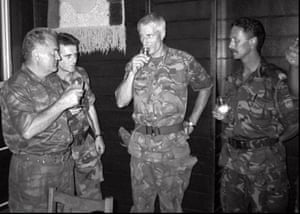
General Ratko Mladić of the Bosnian Serb army, left, drinks with Dutch colonel Ton Karremans, second right, in the Bosnian village of Potočari, on 12 July 1995, the second day of the massacre. Photograph: Anonymous/AP
The betrayal of the Tutsis in Rwanda was a low point for UN peacekeeping but not an isolated one. A year later, Dutch peacekeepers failed to stop the massacre of 8,000 Muslim men in Srebrenica, a supposedly UN “safe area”, the most notorious mass killing by the Serbs in Bosnia. FacebookTwitterPinterest
Not long before, there had been the debacle in Somalia where a US-led UN humanitarian operation turned into a bloody conflict against a powerful warlord. By then Angola was already back at war after its UN peacekeeping mission collapsed amid accusations it contributed to the breakdown of peace.
Other disasters – the Democratic Republic of the Congo (DRC), Sierra Leone – were still on the horizon even as the UN peacekeeping department’s budget doubled and doubled again with growing numbers of missions.
70 years and half a trillion dollars later: what has the UN achieved?
There were good reasons to question the point of UN peacekeeping in the 1990s and to wonder if it was not costing as many lives as it was protecting by offering an illusion of security. The murdered Tutsis at the school might have stood a better chance if they had fled to Uganda.
Two decades later, those responsible for peacekeeping – UN officials, countries on the security council assigning missions, militaries contributing the forces in blue helmets – say the lessons of the 1990s have been learned. Protection of civilian lives is now a priority. UN soldiers no longer have their hands tied in using force to defend the innocent. Perhaps most important, the failures of two decades ago stripped the UN of the illusion that an election and a few soldiers in blue helmets is enough to sustain peace.
But even as peacekeeping has ballooned to become by far the most expensive of UN departments (in 2015 it will cost nearly $9bn to keep 120,000 blue helmet soldiers and policemen deployed in 16 countries from Mali to Cyprus and Haiti, compared with just $500m at the end of the cold war), it is dogged by challenges.
The politics of the UN security council continues to hamstring action over some conflicts, such as Syria and Darfur. Other missions drag on indefinitely, such as in the DRC and Haiti. There is friction between the UN and some governments over who has ultimate command over peacekeeping troops, which has resulted in conflicting orders with disastrous consequences. Then there are spreading conflicts against armed Islamist groups in central and west Africa.
“In the last 15 years, the number of missions, number of crises have drastically multiplied,” said Ban Ki-moon, the UN secretary general. “In addition to using military and police forces, we have been deploying a lot of special political missions. This is preventative diplomacy. If we can prevent at the time of symptoms of a crisis, we can save a lot of human lives and human resources.” Advertisement
Jack Christofides, who is on leave from the UN as director of peacekeeping operations for central and west Africa, described peacekeeping as “extremely taxing at the moment”.
“We’ve got more troops, we’ve got a bigger budget, we deployed in all sorts of very very difficult places, much more difficult than we’ve ever been, and we’re stretched, we’re really stretched,” he said.
“If you think of the old deployments in places like Lebanon and Bosnia, there is a certain infrastructure you could use and work with. The troops coming were generally from countries that had the means to launch expeditions. Today, when you’re talking about northern Mali and central Africa, you have both extremely dangerous conditions and geostrategic locations which are very difficult to get to.”
The UN is also grappling with persistent accusations of rape and sexual exploitation by its peacekeepers, which is further undermining confidence in the organisation, particularly in some of the countries where its soldiers are deployed.
And there are added demands as the US presses for peacekeepers to take on a more aggressive role, particularly against armed Islamist groups in Africa. President Barack Obama is jointly hosting a summit with Ban in New York later this month to seek commitments to strengthen peacekeeping with better trained troops, equipment and intelligence resources, to the alarm of some of the countries that provide substantial contingents of troops in blue helmets.
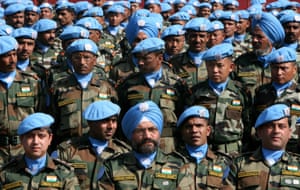
Indian soldiers gather before their departure to Sudan on a UN peacekeeping mission. Photograph: Raveendran/AFP/Getty Images
India, which has sent more soldiers on UN missions than any other country – 180,000 on 49 missions – is openly challenging the move towards what some see as mostly rich and powerful countries on the security council sending the poor to fight and die. Advertisement
“India is completely committed to peacekeeping provided peacekeeping is what we know it to be,” said India’s ambassador to the UN, Asoke Kumar Mukerji. “The soldiers in the blue helmets, under the blue flag, are impartial. They are not supposed to be partisan. If somebody wants soldiers to go in and fight they should hire mercenaries, not take UN soldiers.”
UN peacekeeping came into its own with the collapse of the Soviet Union in 1991 and the diminishing of ideological rivalries that had dominated international politics since the second world war.
Early successes in Cambodia, Namibia, Mozambique and El Salvador generated an overconfidence in the ability of UN soldiers to keep the peace. Each of those countries had an accord that former warring parties wanted to maintain.
The UN learned the hard way in Angola, Rwanda and Bosnia that where the UN wants peace more than those in conflict, then the illusion of peacekeeping can perpetuate instability and cost lives.
Out of the disasters of the 1990s came a new model including an ethos of “responsibility to protect”. No longer would UN forces stand idly by while innocent people were murdered. That has helped drive a rapid expansion of peacekeeping to become the UN’s single largest operation.
In 1991, the year the Soviet Union collapsed, the peacekeeping budget was just $490m. Over the past decade it has leapt from $3.8bn to about $9bn as the size and length of missions has expanded. More than 100,000 UN peacekeepers have served in Haiti since 2004 and close to 250,000 been deployed to the DRC over the past 15 years. There is little prospect of either mission ending soon.
Today, UN troop deployments in the DRC, Sudan and Darfur each cost more than $1bn a year, with Mali and Central African Republic not far behind. The most expensive outside Africa is Haiti, with a budget of $500m.
The emphasis on Africa is in part a reflection of the enduring nature of some conflicts on the continent, but also the politics of the security council. The UN might have had large peacekeeping missions in Syria and Ukraine, were it not for Russian objections.
As the scale of peacekeeping has grown so have the questions about its role. Most particularly, are peacekeepers there to monitor peace or to enforce it? It’s a source of increasing friction between the major powers on the security council that approve UN intervention and some of the countries which provide the troops.
In 2000, British forces landed in Sierra Leone after UN peacekeepers stood aside or fled an advance on the country’s capital, Freetown, by a notoriously brutal rebel group, the Revolutionary United Front (RUF). Several hundred peacekeepers surrendered to the rebels. Advertisement
A British general, David Richards, was sent in by London to evacuate foreign citizens. Confronted with the RUF’s horrific record and the imminent killing of large numbers of civilians, he defied his instructions and used UK troops to spearhead a counter attack.
Richards, who went on to become Britain’s chief of the defence staff, said he was “staggered” to find that the Indian UN force commander, Major General Vijay Jetley, interpreted his mandate as that of a neutral intermediary. In Richards’ view the UN should have been siding with the elected government against rebels breaking a peace agreement.
“I had a real argument with Major General Jetley about this. The Indian hierarchy were very reluctant to lose a single person on a UN operation,” said Richards. “They were very reluctant to fight and that permeated quite a lot of the other contingents as well, to the point where I remember going in to the UN headquarters on my first day there in May 2000 and finding Jetley. I said General, we’ve got to stop the RUF, you’ve got to tell your people to fight. At least hold their positions. He was very reluctant to do it.”
In an internal UN report, Jetley accused Garba and other senior Nigerians of being more interested in smuggling diamonds than keeping the peace. Nigeria’s military responded by accusing the Indian general of “trying to justify his ineptitude, inaction and inefficiency in the leadership of a
multinational force.”
An Indian UN soldier watches an RAF Chinook helicopter land at the UN headquarters in Freetown, Sierra Leone. Photograph: Peter Macdiarmid/AFP/Getty Images
Such differences of opinion over the role of UN peacekeepers were replicated 12 years later in the Democratic Republic of the Congo as rebels advanced on the eastern town of Goma. The Indian commander of part of the largest peacekeeping force in the world ignored orders from UN officials to defend the town and called the Indian defence ministry in New Delhi to ask what he should do. He was told not to resist. The rebels seized Goma to the anger of Ban Ki-Moon, who regarded it as a “personal humiliation”, according to a senior UN official.
By then members of the wider UN mission in the DRC had come to look like bystanders to mass killing, rape and terror. Richard Gowan, until recently research director at the Centre on International Cooperation, a thinktank in New York that works closely with the UN on peacekeeping, said Indian forces in Sierra Leone and the DRC were taking orders from the defence ministry in New Delhi, not the UN commanders on the ground.
“It’s very clear that there are directions from New Delhi to avoid all risk, and that there are parallel lines of command between New Delhi and their guys in the field. That’s true of a lot of countries. A lot of field officers, if they get any order to take a significant risk in a peace operation, they’ll immediately phone home. That’s making it almost impossible for some force commanders to get anything done because they have no true control over their own units,” he said.
Most western nations will not put boots on the ground as frontline peacekeepers and so the UN is dependent on the goodwill of those countries prepared to deploy troops such as India, Bangladesh, Rwanda and Nigeria, making it hard to assert its authority.
The UN lost confidence in Jetley in Sierra Leone but when the then secretary general, Kofi Annan, tried to remove him, the Indian government threatened to pull out all of its forces. Annan’s successor, Ban, ran into the same threats from New Delhi when he tried to remove the Indian UN commander after the Goma debacle.
Rwanda and Srebrenica prompted a greater emphasis on protection of civilian lives, and involvement in rebuilding failed states instead of negotiating peace treaties, standing back and hoping it all worked out. Gowan said that while the “responsibility to protect” ethos was laudable it had also led to ill-thought-out missions.
“Sometimes in peacekeeping, the security council says ‘Good God we need to have a mission’ and that mission is stuck together,” he said.
Gowan pointed to Darfur, where he said the UN intervention came as a politically panicked response to public pressure over the mass killings by the government-allied Janjaweed militia. Advertisement
“For political reasons the US and the UK insisted on having the mission. I’ve spoken to UK officials since who’ve said: ‘We had no real idea what this mission was meant to do. We were just under such public pressure to come up with an answer and the answer was peacekeeping.’ That was definitely true for the Bush administration as well,” he said.
“Darfur has been a quagmire from the beginning. The frank reality is no one believes that the mission is working but no one dares pull it out because they fear the moment it goes there will be an even greater spike in violence and the security council will be held responsible. It’s become a slow burning disaster.”
Philippe Bolopion, the UN director at Human Rights Watch, said the principal reason for the failure of the Darfur mission, a hybrid operation with African Union forces, was deadlock on the security council.
“When permanent members of the security council can’t agree to stand up to an abusive government such as Sudan’s, and you have weak peacekeeping troops on the ground, it’s almost a perfect storm where peacekeepers are not going to protect civilians properly,” he said.
Members of the security council routinely prioritise national interests over the needs of the peacekeeping missions
“Permanent members of the security council routinely prioritise their national interest over the needs of the UN peacekeeping missions they have mandated, as a result often undermining them. Russia and China have done this by opposing more sanctions against the Sudanese government even when it pushes peacekeepers around in Darfur.”
The responsibility to protect has had a more positive impact elsewhere. Peacekeepers in South Sudan turned their bases into de facto refugee camps protecting tens of thousands of people. That would have been unlikely 20 years ago.
But the ethos has been severely challenged by the fallout from the security council mandate for military intervention in the 2011 Libyan revolution to protect civilians in Benghazi. Russia accused Nato of abusing it to support the overthrow of Muammar Gaddafi. That in turn has complicated UN action on Syria.
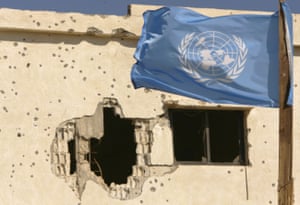
A UN flag flutters amid the rubble of the Lebanese-Israeli border town of Maroun al-Ras. Photograph: Patrick Baz/AFP/Getty Images
Finding common ground on sub-Saharan Africa has generally been less difficult because of fewer strategic rivalries. The debacle in Goma prompted the UN to put together a fighting force of soldiers prepared to go into combat. South Africa, Tanzania and Malawi volunteered to send troops to join the Force Intervention Brigade in part because they were weary of the persistent instability in the region. Advertisement
“We were all embarrassed, humiliated at the end of 2012 when Goma fell,” said Christofides, who oversaw UN peacekeeping operations in the DRC from 2011 until earlier this year and was an architect of the intervention brigade. “Everybody has that image of peacekeepers sitting on top of an APC [armoured personnel carrier] and this group of ruffians walking into Goma. That was a low moment for everybody.
“When we recommended the mandate of the intervention brigade, the security council did not need much persuading. You have some very far-reaching language in the mandate about targeted offensive operations. That’s not language you see in resolutions of the UN. Neutralising armed groups, preventing their expansion, disarming them.”
The UN also deployed drones for the first time to help monitor the movements of the rebels and to verify Rwanda’s denials that it was supplying the insurgents. The drones are not armed although that appears the next likely step, if not in the DRC then in some other conflict where the UN is involved, given their increasing use in the Middle East by the US and its allies.
The intervention brigade has been successful in changing the dynamic in eastern Congo by pushing back the rebels and providing a degree of stability to begin the reconstruction of functioning systems of government, such as the courts – although regional politics has played a large part too. But the operation has also deeply alarmed countries such as India, which fears it sets an example for the future of peacekeeping.
Christofides doubts that the force intervention brigade provides a model for other peacekeeping missions. Senior UN officials, some of whom were strongly opposed to the creation of the brigade but now judge it a success, are deeply wary of the UN taking on a similar role in other conflicts. The DRC, they say, was a unique situation.
But even if the force intervention brigade is not replicated, it fits with a wider agenda by the major western powers to remake UN peacekeeping as a partner in military campaigns. For them, the lesson of British intervention in Sierra Leone or the recent French deployments in Mali and Central African Republic against armed Islamist groups is that better trained and equipped forces launch the initial assault and then the UN comes in as backup. But for that to happen, UN peacekeeping has to up its game.
Obama is leading the push with his New York summit on 28 September to seek pledges of troops, equipment and intelligence resources to a revamped peacekeeping operation.
Washington regards peacekeeping as a national security issue and a “good bargain”, as one official put it. The US picks up the tab for a quarter of the UN’s $9bn peacekeeping budget, but it is a fraction of the cost of the Pentagon or invading Iraq.
Moreover, if other countries are sending their forces then the US does not have to risk the lives of American soldiers. Previously, the US mostly regarded peacekeeping in Africa, in particular, as a humanitarian issue. Now, given the nature of the conflicts in Mali, Nigeria and Central African Republic, Washington views it as strategic.
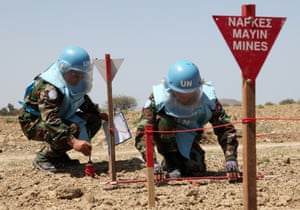
Cambodian mine experts demonstrate their work in the UN-controlled buffer zone in Cyprus. Photograph: Barbara Laborde/AFP/Getty Images
But while the US wants more assertive peacekeeping, it does not want to send its soldiers to fight. Obama is pressing more developed countries, in Europe, Asia and Latin America, to make greater commitments in the hope of improving the quality of UN forces. So is Ban.
“I’m now in the process of reaching out to developed countries. I’ve been speaking to many presidents and prime ministers to diversify the participation of peacekeeping forces,” he said. Advertisement
“If we can diversify and have more countries, particularly some big countries, if they can send their own troops in addition to assets and financial support, that would be much appreciated.”
UN officials privately concede there is little chance of the US putting its forces under UN command. Congress would never stand for it. But Washington is joining the UN in pressing other developed countries to play a bigger part in peacekeeping.
The UK currently has fewer than 300 soldiers deployed on peacekeeping missions, mostly in Cyprus. “We’ve been having goodness knows how many discussions with British officials with a view to getting them more involved,” said Christofides. “We’re still drawing too many troops from a few parts of the world and not enough from other parts of the world. And I don’t just mean Africa versus the west, but other countries in Asia and Latin America that could contribute a bit more.”
Another senior UN official put it more bluntly: “Britain has a reputation for lecturing without contributing.”
Richards wants to see Britain make a greater contribution. “The Ministry of Defence and, I have to say sadly, the armed forces, don’t really see the UN as proper soldiering. This is a cultural ignorance that’s grown up over many years. The Americans share it writ large: UN ops is what second- and third-world nations do but proper armies, we pick and choose,” he said.
Richards said countries whose forces had experience in Afghanistan and Iraq could put that to good use in UN operations. “I think that’s a pretty good role for the British armed forces in this era when there’s so many nasty things going on in the world. The Americans really need to decide to do it as well,” he said. “I think at a low level, our young officers would love to do it. There is a higher level political/military reluctance and snootiness about it.”
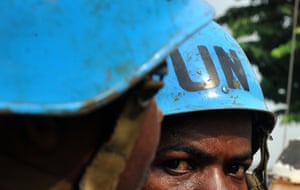
A UN peacekeeper patrols in a street in Abidjan, Ivory Coast. Photograph: Issouf Sanogo/AFP/Getty Images
India strongly opposes a move towards more forceful peacekeeping. “When it has been used as a tool to ensure that a peace agreement is observed so that peace building can take place, or as a tool to facilitate a political resolution, it works,” said Mukerji, the Indian ambassador to the UN.
“But if peacekeeping is to be seen as peace enforcement, then unfortunately we can’t see the UN charter allowing such a radical departure of the use of peacekeeping.
“Peacekeeping is not an end in itself. The end is political stability and peacekeeping is just a tool to bring about political stability. What’s happening now is the cart is being put before the horse. I think that’s a very unfortunate development.”
Gowan is sceptical for different reasons. “I think that we may be stumbling into an enormous strategic trap because if we have learned over the last decade that very highly capable Nato forces, US forces, actually can’t suppress Islamic extremist groups, why on earth do we think slightly strengthening UN missions is going to give us a tool that allows us to fight terrorists?” he said.
General Jonathan Vance, Canada’s chief of defence staff, has a confident and relaxed way about him. But when he opened the second day of the Conference of Defence Association in Ottawa last week, and then answered questions from reporters on the country’s peacekeeping operations, the tone seemed wrong for the moment. “The UN has spaces available for nations to contribute to, should they wish. We understand what those spaces available are,” said Gen. Vance, adding that the government is in preliminary stages of planning such a deployment “We are in what I would call the planning stages to deploy forces. We’re trying to match best fit to best missions with the capability that we have. So it’s a work in progress, but it’s going well.”
The optimism of that tone came in stark contrast to the many speakers who highlighted the government’s failure to carry through with a 2016 pledge to deploy up to 750 personnel on international peacekeeping missions in addition to the 112 which were deployed at the time of the announcement. The most recent figures from the United Nations show that Canada’s commitment has reached an all-time low, and now stands at just 43 peacekeeping personnel at present. This represents the lowest number of uniformed personnel and lowest global military contribution for Canada since 1956.
The Liberal government maintains that it is merely awaiting the right opportunity to deliver on 2016’s promises. Gen. Vance’s suggestion that Canada is in the “the planning stages to deploy forces” maintains the idea that the government is still searching for deployments that Canadian forces can support and the Prime Minister’s own speech at the UN Peacekeeping Defence Ministerial in Vancouver in November 2017 outlined the need for Canada to deliver more. “We are making these pledges today, because we believe in the United Nations and we believe in peacekeeping,” the Prime Minister said at the time, as he called for a new era in peacekeeping.
But rather than delivering a reinvigorated peacekeeping effort, two years of handwringing by the Trudeau administration has seen Canada revert to a pre-Pearson era level of deployment. Experts agree that decision-making has become paralyzed and that the Liberal government seems reluctant to follow through on its promises. “Canada has let the UN down,” said Dr. Walter Dorn of the Canadian Forces College. “If you actually look at the pledges we would have more than 750 uniformed personnel and we’re down at an all-time low. It’s a disappointment and at this point, you could say it’s a broken promise.” Dorn puts the blame at desks of the most senior figures in the current administration: “I think it’s at the cabinet level: the Prime Minister, the Defence Minister and the Foreign Minister just haven’t got their act together.”
Even more disappointing is that the original troop pledge was sold as a sign of Canada’s commitment to the international community. “This government came to power with the promise of doing real peacekeeping and then has repeatedly told the UN and lots of countries that might want to vote for Canada for the next security council seat,” said Stephen M. Saideman, the Paterson Chair in International Affairs at Carleton University.
While many of the conference attendees condemned the low number of peacekeeping personnel being deployed, there was disagreement over how Canada should move forward. Dorn suggested that operations in Africa could be more palatable, pointing that peacekeeping operations in Mali are less dangerous and less expensive than most people perceive. “The fatality rate is a factor of five less in Mali (when compared to Afghanistan), and the type of equipment you need is less expensive and the UN pays back a substantial portion of your costs,” he said. But Saideman thinks that missions in Africa would prove challenging for Canadian forces. “As far as I understand it, most of the places that Canada would be asked to go in Africa are actually quite risky. The Japanese have pulled out of the South Sudan because it’s falling apart. The DRC—600 troops would be a drop in the bucket. The people that I know that have gone to Mali suggest that it’s a counterinsurgency war, it’s not a peacekeeping campaign.” Saideman added that Canada already missed an ideal opportunity: “If I was advising the government I would’ve told them to go to Colombia last year, because I think that would’ve been a far less risky endeavour, but that would have made a contribution.”
If the government is going to continue to wait for a less risky peacekeeping opportunity, then there might not be any decision in the near future. If Colombia was the ideal deployment, as Saideman suggests, then it is unlikely Canada will find something suitable in the current trouble spots of the world. Trudeau and his cabinet have made numerous pledges of peacekeeping to the international community but those promises will fall on deaf ears, particularly to countries such as India, Pakistan, and Ethiopia who contribute thousands of troops to UN missions. It will likely come down to voters at home as to whether or not the government should take its pledges more seriously though.
With such a low number of peacekeeping personnel on operations, it is hard to believe the government can ignore the glaring contradiction in rhetoric versus action for much longer. If Canada truly wants to contribute to peace operations on a meaningful scale once again, it comes with an inherent risk. While there may be some missions that are better suited for Canadian expertise and equipment, it’s clear that the government has given every option some consideration over the last couple of years—but any further delay clearly rests on the desks of the Foreign, Defence, and Prime Ministers.
Canada had a small military team on standby to take part in a high-profile United Nations peacekeeping mission in Colombia, but foot-dragging on Ottawa's part saw other countries fill up the mission's ranks instead, newly released documents reveal.
The army "identified, screened and trained" 19 Spanish-speaking soldiers to act as ceasefire observers in the South American country, which is emerging from five decades of guerrilla war.
The troops were, according to a briefing note prepared for Defence Minister Harjit Sajjan, ready to go by October 2016 — just weeks after the Liberal government committed itself to deploying 600 troops and 150 police officers in support of UN-led peace operations.Play
The soldiers remained on standby for months.
A decision to deploy them, however, remained in limbo — until it was too late.
"No [Canadian Armed Forces] nominations were submitted to the UN and, as of March 2017, the mission is currently fully manned with no foreseen additional requirements from Canada," said the March 30, 2017 briefing note, obtained by CBC News under access to information legislation. Worries about troop security
Chief of the Defence Staff Gen. Jonathan Vance, the country's top military commander, said the mission was considered — but he had concerns about how well protected the troops would be in the event of trouble.
He said concerns about force security are "a good reason for everything as to why we do, and do not, do everything the UN asks of us."
Chief of Defence Staff General Jonathan Vance. (Fred Chartrand/Canadian Press)
Canada did end up deploying two police officers to support the special political mission in that country.
Ultimately, it would have been up to the federal cabinet to decide whether to participate in the mission.
The UN mission in Colombia was one of the more benign deployments available to Canada in terms of mandate and risk. A lower-risk mission
Over 450 unarmed soldiers, in 40 locations, acted as observers supervising the disarming of the Revolutionary Armed Forces of Colombia (FARC) — a mission that is more in line with the Canadian public's perception of peacekeeping.
The mission certainly presents a lower risk to peacekeepers than the tribal, jihadist-fuelled bloodshed in Mali, or the civil war in the corruption-tainted Democratic Republic of Congo — both sites of current UN peacekeeping operations.
"It is startling that we had the personnel trained and we didn't deploy them," said Walter Dorn, a professor at the Canadian Forces Staff College.
He said Canada's failure to send soldiers to the one of the most auspicious missions on the UN's plate throws into doubt the Liberals' election pledge to return to peacekeeping in a meaningful way.
Since the 2015 election of the Liberal government and Prime Minister Justin Trudeau's declaration that "Canada is back" on the world stage, the UN has offered Canada a number of marquee posts and opportunities. Multiple missions rejected
According to documents uncovered last summer by CBC News, Canada was: offered command of the mission in Mali; asked to deploy troops to replace the Dutch contingent in the same country; bombarded with multiple requests for helicopter support and; asked to establish a police training mission in the volatile Central African Republic.
All of the requests were turned down, much to the frustration of UN officials and diplomats with the European Union who were courting Canada on separate, but complementary peace deployments and training in the region.
"The cabinet is just not able to make up its mind about where it wants to deploy," said Dorn. "It seems there is eagerness at some levels of the Canadian government, but not others."
Last fall, Trudeau laid out the Liberal government's roadmap for rejoining peacekeeping, which includes phased deployments of transport planes, helicopters, military trainers and a 200-strong rapid reaction force over a five-year period.
Where they'll go, and when, is still the subject of discussions.
The federal government also made an important social commitment to deploy more women peacekeepers and to end the exploitation of child soldiers.
Dorn said Canada's contribution to UN missions is at an all-time low.
At the end of December, Canada had only 43 peacekeepers deployed on various missions.
OTTAWA—The Trudeau Liberals may have promised to ramp up Canada’s role in peacekeeping, but new UN figures show there were fewer Canadian peacekeepers in the field last month than at any point in recent memory.
The revelation comes as Canada prepares to host a major peacekeeping summit in Vancouver next month, raising fears the country will be badly embarrassed unless the numbers start rising — and fast.
The Liberals promised last summer to make up to 600 soldiers and 150 police officers available to the UN for future peacekeeping missions, but have yet to make any concrete commitments.
The intervening year has instead seen a steady decrease in the number of Canadian blue helmets and blue berets deployed around the world, from 112 peacekeepers in August 2016 to 68 last month.
The decline is largely attributed to 44 fewer Canadian police officers being deployed to Haiti, where the UN is closing down its 13-year stabilization mission in favour of a much smaller effort.
Walter Dorn, an expert on peacekeeping at the Canadian Forces College in Toronto who has studied the numbers, says the result is the smallest Canadian contribution to peacekeeping since at least 1990.
By comparison, Canada’s smallest contribution to peacekeeping under Stephen Harper, who made no secret of his dislike for the UN, was 88 soldiers and police officers in October 2014.
“The government is at an all-time low while saying that it wants to re-engage in peacekeeping,” Dorn said. “Its numbers are lower than the Conservatives ever were.”
Foreign Affairs Minister Chrystia Freeland’s spokesperson, Adam Austen, said the government remains convinced that Canada has an important role to play in peacekeeping and that it is committed to do more.
Defence Department officials have drawn up a list of possible missions for the government to review, sources have told The Canadian Press, one of which would involve sending transport helicopters to Mali.
While the Liberals reportedly hope to make a decision before the upcoming peacekeeping summit in Vancouver on Nov. 14-15, there is no certainty they will.
The government has repeatedly said it will not be rushed into a mission, which Austen repeated on Monday, saying in an email: “We are doing this carefully and thoughtfully, as Canadians expect.”
But the UN expected last year when it agreed to let Canada host the peacekeeping meeting that Canadian troops would already be on the ground.
The summit, to be hosted by Defence Minister Harjit Sajjan, is only supposed to be open to officials from countries that have made concrete pledges to peacekeeping missions.
UN officials and foreign diplomats have expressed varying degrees of frustration and disappointment with the Liberal indecision over the last year, which Dorn echoed on Monday.
“Not only has Canada not lived up to its promises, it has actually decreased its contribution,” he said. “Canada is setting a poor example as the host for a pledging conference.”
The fact there are any Canadian peacekeepers in the field may come as a surprise to many people.
While the Liberals promised a return to peacekeeping during the last election campaign and again last year Canada has, in fact, continued to contribute soldiers and police officers to UN missions for decades.
But last month’s numbers continue a trend of declining participation that has seen Canada move from being one of the largest contributors to peacekeeping in the 1990s to the bottom half of the pack today.
There has also been a gradual shift from deploying Canadian military personnel to police officers; of the 68 Canadian peacekeepers in the field last month, 40 were police.
Pages of newspaper ink are being spilled to highlight the risks in any of the UN peacekeeping missions Canada might be considering — from the Democratic Republic of Congo to Mali to the Central African Republic. What has been missing from all the commentary and government pronouncements, though, is a coherent argument for why UN peacekeeping is a job worth the all-too-evident dangers.
This is too bad because there are solid reasons for Canada to re-engage. While UN peacekeeping is no miracle cure and there are no guarantees of success, when done right and properly mandated and resourced, UN peacekeeping offers the best chance for a society emerging from violent conflict.
Peacekeeping is the front end of a complex, long-term process of helping conflicting parties create the necessary conditions — political, socio-economic, security — for sustainable peace.
At the centre of this effort is the peace process. Complex political problems always lie at the heart of violent conflict and require political solutions that are negotiated and agreed to by the parties. A capable security force will be essential in both the peace negotiation and implementation phases, but it is a supporting element of the overall mission nonetheless.
As the Afghanistan debacle has so dramatically and tragically illustrated, no amount of military “robustness” and professionalism on the part of international military forces can make up for the lack of a credible peace process.
The statistical evidence is also clear: looking at all past wars of the last quarter-century, only 15 per cent have ended decisively on the battlefield, and in these cases the rebels prevailed at least as often as the governments they fought. All the rest ultimately had to be settled at the negotiating table.
Precisely because of the primacy of the peace process, today’s multi-dimensional UN peace operations — which involve military, police and civilian contingents — are much more than military operations charged with providing a safe and secure environment. Their civilian components are mandated to facilitate the peace process, promote the rule of law, and support the establishment of legitimate and effective institutions of governance.
Increasingly mandates, like that for MINUSMA in Mali, also include security assistance to the transitional government so it can reassert its authority nationwide. This military assistance is in concert with support for national political dialogue and reconciliation efforts.
For a collective enterprise of this magnitude to succeed — as UN peacekeeping does more often than not — the international effort must be perceived as legitimate and impartial. And it must have the broadest possible international support within a coherent legal and operational framework.
Only the UN Security Council can mandate such an operation and only the UN Organization can lead the mission if is to be internationally acceptable. Headed by a civilian in the role of Special Representative of the UN Secretary-General (SRSG), with all the other components, including the military and police, reporting to him or her, the very structure of the UN peacekeeping mission reflects the centrality of the peace process. This stands in sharp contrast to NATO-led military missions, even where authorized by the UNSC to assist in stabilizing a conflict.
NATO-led stability operations lack the perceived legitimacy and impartiality of UN-led operations precisely because their political and military leaders are seen to represent a very specific set of powerful countries and interests. Not only does this undermine coherence in the international effort; it also constitutes a gift to spoilers on the ground decrying alleged “foreign occupation.”
An integrated mission under the overall authority of the SRSG also allows UN command and control to be decentralized to the operational level. This contrasts with the centralized, top-heavy and opaque command structure operating in NATO.
Many current UN missions may have comprehensive mandates to build sustainable peace but they manifestly lack the professional forces and equipment to do the job. That’s a major concern.
Re-engagement by Canada and other Western countries is therefore long overdue and welcome. This is why 10 leading civil society organizations in their submission to the Defence Policy Review, entitled “A Shift to Sustainable Peace and Common Security,” call on Canada to make UN peacekeeping a Canadian defence priority.
But they also caution that specialized interdisciplinary peacekeeping training for Canadian forces, particularly commanders and their staff, is an indispensable precondition if there is to be effective Canadian engagement. --- Peggy Mason is President of the Rideau Institute and a former Canadian Ambassador for Disarmament to the UN, with over 20 years of experience in peacekeeping training.
Canadian troops could face a terrifying arsenal of rebel-held weapons, from rockets and artillery to shoulder-fired missiles and anti-tank mines, if they are deployed as expected in a peacekeeping operation in the West African nation of Mali.
A report released on Wednesday shows that the terrorist and separatist groups have obtained a wide range of heavy weaponry from government stockpiles in both Mali and Libya, as well as other unknown sources.
The report, published by British-based Conflict Armament Research, also traces the weapons used by the Islamist radicals who killed six Canadians and 24 other civilians in Burkina Faso earlier this year. Their weapons were relatively new Chinese-made assault rifles, which – based on their similar serial numbers – appeared to share the same supplier as Islamic State fighters in Syria, the report says.
Conflict Armament Research is largely financed by the governments of Britain and Germany and the European Union. Its 49-page report is one of the most extensive recent studies of the sources of illicit weapons in West Africa.
The huge range of heavy weapons in Mali could help explain why the Canadian government has been cautious and hesitant in announcing its peacekeeping plans in Africa.
The government announced in August that it will deploy up to 600 soldiers and 150 police officers in “peace and stabilization operations” in Africa, but nearly three months later, it still hasn’t revealed the location of the deployment.
Most analysts believe that Mali is the most likely location for the Canadian deployment, although the Canadian troops could eventually be divided among several African locations. Defence Minister Harjit Sajjan visited Mali and neighbouring Senegal last week, and his department earlier sent a reconnaissance team to Mali to scout out a possible peacekeeping mission.
Mali has endured civil war and terrorist attacks for much of the past five years. Radical Islamist militias won control of northern Mali in 2012, until they were pushed back by French and Malian forces. Terrorist attacks have continued since then, making Mali the deadliest country in the world for United Nations peacekeepers. More than 100 peacekeepers have been killed there since 2013, including more than 30 this year alone.
Asked about the dangers of a Mali mission, Mr. Sajjan told reporters this week that “radical groups” are a threat to UN peacekeeping missions in many parts of the world.
“Peacekeeping of today is much different from before,” he told reporters in Ottawa on Monday. “It’s far more complex. … And that’s why we want to make sure that we take our time, to make sure that we get all the necessary information on how we can actually reduce the threat.”
Before any Canadian troops are deployed, they will get “the right pre-deployment training, the right equipment … and the right rules of engagement to be able to not only defend themselves, but also the civilian population that they’re there to protect,” Mr. Sajjan said.
The dangers of a Mali mission were sharply highlighted last week when a UN peacekeeper was killed and seven others were injured in an attack on a military convoy in central Mali on the first day of Mr. Sajjan’s visit to the country.
The new report by Conflict Armament Research confirms that huge numbers of weapons have been smuggled into Mali from the vast arsenals of Moammar Gadhafi, the Libyan dictator who was killed in 2011 after a military intervention by Western countries, including Canada. Those arsenals were “one of the largest and most diverse conventional weapon stockpiles of any African country,” the report says.
Weapons from the Gadhafi stockpiles fuelled the 2012 insurgencies in northern Mali and later spread to several other countries in West Africa, even reaching Syria, where they were used by Islamic State forces, the report says.
Among the Libyan weapons obtained by rebels in Mali and neighbouring countries were Russian-made MANPADS (man-portable air defence systems), a shoulder-fired missile that can destroy helicopters and other aircraft. These would be of particular concern to Ottawa, since Canadian tactical helicopters could be deployed in Mali if there is a Canadian peacekeeping mission there.
A month ago, Prime Minister Justin Trudeau knew that a return to UN peacekeeping would automatically be seen as a useful global contribution by Canada’s major ally in Washington. Donald Trump’s election changed that.
That’s why sending Canadian peacekeepers to Mali should now be an obvious political choice for the government, which has pledged to announce a deployment of up to 600 peacekeepers within weeks.
It’s not that the African country matters to Mr. Trump. It seems likely the president-elect couldn’t find Mali on a map and that his national-security staff might not bother pointing to it in his early briefings. But Mr. Trump’s priority is combatting the spread of Islamist terror, and that’s key to the mission in Mali.
That makes sending peacekeepers to Mali just the sort of international security initiative that fits a Canadian Liberal prime minister.
“It has both the realpolitik as well as the more idealistic liberal international justifications,” said Walter Dorn, an expert in peacekeeping and professor at the Royal Military College and the Canadian Forces College.
Mr. Trudeau’s Liberals want to embrace do-gooding internationalism that makes peacekeeping popular with Canadians. It was also something U.S. President Barack Obama urged allies to do.
Mr. Trump, however, doesn’t appear to have any interest in UN peacekeeping. But that still might suit Mr. Trudeau in one way: When the U.S. president is unpopular in Canada, Liberal prime ministers like to be perceived as pursuing an “independent” foreign policy.
Even so, it’s still valuable to be seen as a useful ally in Washington. Canada depends on U.S. co-operation. When the U.S. and other allies complain Canada’s military spending is half its expected NATO obligation, Ottawa likes to point to an active role in missions. Canada has troops advising Kurdish peshmerga forces in Iraq and joined efforts to bolster NATO presence in Eastern Europe, but Ottawa will also hope its peacekeeping mission will be seen in Washington as helpful.
Mali means sharp-ended UN peacekeeping. It operates alongside a French-led counterterrorism mission fighting insurgents in northern Mali and across the Sahel-Sahara region. The peacekeepers are trying to stabilize the country, including the vast north that still suffers disaffection from the government in Bamako – the same vacuum that helped fuel insurgents who were on the verge of taking the capital in 2013, until French troops intervened.
Mr. Trudeau’s government hasn’t yet said where in Africa it will deploy peacekeepers. Defence Minister Harjit Sajjan visited Mali earlier this month, but the Liberals have also considered UN missions in Central African Republic and the Democratic Republic of Congo. There are arguments for going to a less-dangerous place. Former senator and retired lieutenant-general Roméo Dallaire has suggested Canada should send troops to CAR, where peacekeepers are tasked with tamping down sectarian violence. Ottawa is likely to choose one main mission but could send a handful of troops to others.
But there are also calls for Canada to send its peacekeepers to Mali precisely because it is dangerous. The UN’s under-secretary-general for peacekeeping field support, Atul Khare, said this weekend the Mali mission needs critical elements like helicopters.
“I think the most important contributions currently would be devoted to Mali,” he said in Halifax after meeting Mr. Sajjan and his British counterpart, Michael Fallon.
Mr. Dorn thinks Canadian troops would be more useful in Mali. They have Afghanistan experience, can offer equipment such as Chinook helicopters and expertise such as engineering, communications and possibly intelligence – the Mali mission has more intelligence personnel than any UN mission before it.
But it is more dangerous. So far, 109 peacekeepers have died, including a Togolese soldier two weeks ago. Statistically, Mr. Dorn said, peacekeepers in Mali have a 0.3-per-cent chance of fatality, compared with 1 per cent for Canadian troops in Afghanistan. That’s the biggest risk Mr. Trudeau’s Liberals must weigh. But the Mali mission has a purpose, protecting civilians in a fragile country threatened by insurgents, and it’s one that can be clearly explained to left and right, around the world, in Washington and at home.
Defence Minister Harjit Sajjan continues to be very discreet about his plans to give content to Justin Trudeau’s 2015 election pledge to revive Canada peacekeeping – or rather, in contemporary terms, to “peace and stabilization operations.” The straightforward Pearsonian era of supervising an agreed-upon ceasefire lines is long past.
On a trip this week, Mr. Sajjan is going to Mali and Senegal. The federal government has already been considering Mali, the Central African Republic and the not so very Democratic Republic of the Congo. The government insists that any visit to a particular country does not signify an intention to undertake a military mission there.
But if a military mission in Africa there must be, Senegal may be a good way to start. Though hardly a utopia, it is much more stable than any other country that has hitherto been mentioned in this context. The prevalence of peaceable Sufism there does not provide much ripe ground for radical jihadism.
Nonetheless, there have been incursions into Senegal by Islamic extremists from time to time, unsuccessful so far, from neighbouring Mauritanian and Malian militias. (A Christian and animist uprising in Senegal ended with a unilateral ceasefire in 2014.)
Hypothetically, in any case, it’s worth looking at what a Canadian military contingent of 600 troops and 150 military police in Senegal (the number that Canada is thinking of) or some other African country might find itself dealing with.
On its face, a Canadian the new peacekeeping or “peace security operations” contribution in Senegal might be more like an allied presence, to share in the continuing defence of Senegal – perhaps a little like the Canadian forces in Germany in NATO before the end of the Cold War.
A counterinsurgency in a chaotic, arid country such as Mali or Mauritania would be outside the experience of most members of the Canadian Armed Forces.
Mr. Sajjan has prudently said, “We need to go into this eyes wide open. So based on that, I have not set a deadline,” specifically, not the end of 2016, “as I want to make sure that we do all the necessary work, so that we can have [a] meaningful impact.”
Such a moderate initial objective may be a good start.
The number of Canadian Forces troops and rules of engagement matter a great deal to the protection of civilians.
On June 6, 2014, a few hours after sunset, armed men opened fire on an outdoor church ceremony in Mutarule, a small village in the eastern Democratic Republic of the Congo (DRC). The assailants attacked the village with rifles and grenade launchers, shooting civilians at close range and then burning them alive.
An offensive use of force by Canada during its UN peacekeeping mission in Africa should reduce violence against civilians, writes Kennedy Jawoko. (ED JONES / ED JONES/AFP/GETTY IMAGES)
A survivor described the experience to Human Rights Watch: “We heard bullets coming from all sides. We all got down on the ground. They came in by the door and were in camouflage military uniforms. There were many of them. The first one said: ‘Exterminate them.’ Then they started shooting.”
All told, the attackers killed 38 villagers in a few hours, including at least nine children. Many more were injured, stabbed with bayonets or burned past recognition.
That’s the picture Canadian peacekeepers are likely to come face-to-face with when Canada returns to peacekeeping in an era where the rules of engagement are non-existent.
The tragedy in Mutarule could have been avoided. A United Nations peacekeeping base, located just an eight-minute drive away, received frantic phone calls from villagers asking for help as the massacre began. Although the peacekeeping mission in the DRC has the authority to use force to protect civilians, UN soldiers stayed in their barracks.
This week the UN Secretary-General Ban Ki-moon sacked the commander of a peacekeeping force in South Sudan following a damning report that accused the blue helmets of failing to protect civilians during an outbreak of violence in July that killed dozens of people. Investigators concluded peacekeepers abandoned their posts and failed to respond to pleas for help from aid workers under attack.
These reports illustrate how peacekeepers’ choices — in particular the choice to use force — matter a great deal to the protection of civilians. For the past 15 years, UN peacekeepers have had robust mandates that require them to protect civilians and authorize them to use force beyond self-defence to achieve that goal. Despite these changes, long-standing debates on the offensive use of force in peacekeeping continue.
A Nanos Research survey conducted for CTV News last month found that nearly 70 per cent of Canadians support deploying Canadian Forces on UN peacekeeping missions in active fighting areas. Prime Minister Justin Trudeau has committed to deploying 600 Canadian troops on UN peacekeeping missions. If Canadian peacekeepers were to use force beyond self-defence, then I believe four key factors should be taken into consideration.
First, the deployment of a large number of peacekeepers will likely amplify the deterrent effect of the use of force. When they intervened, blue helmets in Congo simultaneously launched offensives and deployed in greater numbers to war-affected regions. This combination probably did more to change the calculus of rebels than the offensive use of force alone, which failed to quell rebel violence against civilians in other cases.
Second, Canadian Forces should also weigh the capacity of rebel groups, compared to peacekeepers and their allies, when contemplating the use of force. UN peacekeepers and the Congolese army failed to change the behaviour of sophisticated rebel groups. These large and well-trained forces, with external financial or military support, continued to target civilians during and after the offensive use of force.
Third, Canadian peacekeepers might not be able to protect civilians through the use of force when the national government allies with a rebel group that commits atrocities. In these situations, Canada might have to turn to other tools to persuade the government to reconsider the alliance or to otherwise protect civilians. These tools might include diplomatic pressure, use of media, or threatening to suspend certain forms of co-operation with the government.
Lastly, rebel groups that operate out of a vast and remote forest, employ hit-and-run tactics, and disappear into the local population might not often respond to the offensive use of force. These guerrilla tactics mean offensive use of force might not bring about a decrease in rebel violence against civilians.
Research shows that deploying large numbers of peacekeepers does reduce violence against civilians. I believe the offensive use of force amplifies that effect. When Canada takes the initiative, it should do so with a sufficient number of troops — both civilian and military — not just 600 pairs of boots on the ground.
---- Kennedy Jawoko is a professor at Seneca College. He has conducted research on media and conflict in South Sudan.