Translate

Showing posts with label Canadian Peacekeepers. Show all posts

Thursday, March 28, 2019

Canadian Peacekeepers Evacuate Wounded French Soldiers in Mali

By: Lee Berthiaume, The Canadian Press 

Canadian peacekeepers were called upon to evacuate several wounded French soldiers in Mali earlier this month after their patrol was ambushed while hunting for militants along the border with Niger.

The previously unreported incident marks the first time the Canadians have been asked to help non-United Nations forces in Mali, where the French have been conducting counter-insurgency operations since 2014.

READ MORE: Canadian peacekeepers in Mali challenged by geography, shifting violence

Canada has eight helicopters and 250 military personnel in Mali, where they have been providing emergency medical evacuations and transporting troops and equipment across a large swath of the remote African country.

The Canadians have conducted seven other medical evacuations since August, all of which involved injured UN troops and workers.

In an interview with The Canadian Press, the commander of Canada’s task force in Mali said the UN and France have agreed to help each other in extreme circumstances and that his peacekeepers did their jobs by helping save lives.
Prime Minister Trudeau visiting CAF members in Mali earlier this year. 
“I wouldn’t want people to presume or assume that we’re supporting counterterrorism efforts,” said Col. Travis Morehen. “But it’s really at this point about saving allied lives.”

News of the French evacuation comes as the federal government is contemplating a formal UN request to extend its peacekeeping mission in Mali, which is currently set to end at the end of July.

France has about 3,000 heavily armed soldiers in Mali and the surrounding region hunting militants linked to al-Qaida, the Islamic State and other extremist groups through what is known as Operation Barkhane.

While Operation Barkhane has been credited with keeping the numerous Islamic extremist groups in Mali off balance, it has also been accused in some corners of contributing to instability in the region.

READ MORE: Canada’s on a new kind of mission in Mali — mixing peacekeeping with counterterrorism

According to media reports, a French patrol was operating near Mali’s border with Niger on March 10 when they were ambushed by a vehicle packed with explosives and a group of militants on motorcycles.

Fifteen French soldiers were reportedly injured, two seriously before the militants fled.

The Canadians first learned about the attack when a French officer at the Operation Barkhane camp in Gao called while it was still happening and indicated an emergency medical evacuation might be required, said Morehen.

The French counter-terror mission operates largely independently from the UN peacekeeping mission in Mali, but Morehen says there is a good working relationship between the two.

Many critics have raised questions about Canada's mission in Mali - even asking if it is considered as Counter-Terrorism? 

That includes the French providing air-traffic control services to the UN around Gao, the northern Malian city that is home to several military bases, including one belonging to Barkhane and another where the Canadians are located.

The French also boast a more capable hospital than the UN, Morehen said, which is why the Canadians often end up bringing any wounded peacekeepers that they pick up in the field to the Barkhane camp.

“So our pilots go over there and make sure that we have our flying procedures correct and we have a technical arrangement with them as well for medical support,” Morehen said.

“There’s lots of sharing between us, which is all blessed by our governments.”

READ MORE: UN reports sharp deterioration in Mali since Canadian peacekeepers arrived

Three Canadian helicopters were quickly deployed with approval from the UN mission commander in Bamako, Morehen said, and arrived at the scene about two hours later, at which point the fighting was over.

Because of the distance, the two smaller Griffon escorts were redirected to a nearby town to refuel while the larger Chinook, which is configured like a flying hospital, continued back to Gao alone with the injured French soldiers.

“It does increase the risk,” he said, “but we balanced it against the need to get those wounded back to medical facilities as soon as possible.”

While he agreed that it was “the right thing to do,” Walter Dorn, an expert on peacekeeping at the Canadian Forces College in Toronto, said the evacuation nonetheless risked linking the UN and French missions in some minds.

“The risk is that we are associated with Barkhane and we then become subject to more attacks and the line between peacekeepers and counter-insurgency fighters is blurred,” Dorn said.

Morehen pushed back against such suggestions, insisting the evacuation was an extremely rare circumstance and that anyone who wants to target the UN – which has suffered dozens of casualties in Mali – will do so no matter what.

“The people that want to do people harm here, they’ve already got it formulated in their mind,” he said. “I don’t see how fathomable it is that we would be targeted because we gave a medevac to French forces.”

Friday, October 12, 2018

UN Reports Situation in Mali Deteriorating

By: Lee Berthiaume, Global News 

In a sobering new report, the head of the United Nations says the security situation in Mali has sharply deteriorated over the past three months even as demand for more food aid and other humanitarian assistance has skyrocketed.
The UN Mali patch is shown on a Canadian forces member's uniform before boarding a plane at CFB Trenton in Trenton, Ont., on July 5, 2018.
READ MORE: Canadian troops ready as ‘complex’ Mali peacekeeping mission gets underway: commander

The assessment by UN Secretary General Antonio Guterres coincides with the presence of Canadian peacekeepers in Mali, and suggests the country is in many ways worse off now than when they first arrived in June.

Not that there haven’t been some hopeful signs, including successful presidential elections in July and August and a marked decline in the number of peacekeepers killed or wounded despite continuing attacks by armed groups.

That is reflected in the fact that while the Canadian military’s primary task in Mali is to evacuate injured UN peacekeepers by helicopter, they have so far only conducted two such missions, both on Sept. 11.

Guterres nonetheless painted a picture of a country at war with itself as various ethnic and extremist groups targeted each other as well as the Malian military, international forces and even civilians.

The result was the largest number of civilians killed – 287 – in one three-month period since UN peacekeepers first arrived in the country in 2013, while thousands more have been forced to flee their homes to escape the violence.

Much of the fighting was between members of two different ethnic communities in the centre of the country, while groups linked to al-Qaida and the Islamic State were also responsible for a great deal of violence.

READ MORE: Canada’s on a new kind of mission in Mali — mixing peacekeeping with counterterrorism

“Intercommunal conflict, exacerbated by violent extremist groups, is fraying an already fragile social fabric and is deeply concerning,” Guterres wrote. “Too high a human toll has accrued as a result of the ongoing spiral of violence.”

The number of human-rights violations in Mali, which was already troublingly high, was similarly worse because of hundreds of new extrajudicial killings, disappearances, tortures and rapes across different parts of the country.

While most of those atrocities were perpetrated by the Islamic groups and competing ethnic communities, the Malian military itself was implicated in 18 violations – including one mass killing that is being criminally investigated.

“The human rights situation is alarming,” Guterres wrote. “It is absolutely imperative that the government prevent human rights violations and abuses, including those committed by the Malian armed forces.”

Further adding to Malians’ woes were severe floods in some areas and drought in others that, when combined with the fighting, had doubled the number of internally displaced people and left one in four needing humanitarian aid.

“The level of needs of is higher than at any point since the beginning of the crisis in 2012,” Guterres wrote.

READ MORE: Jeff Semple: First impressions of Canadian peacekeepers in Mali

The country was plunged into turmoil after a rebellion in the north at the same time as the Malian military was staging a coup in the capital, Bamako.

Canadian peacekeepers recently helped the World Food Programme deliver more than two tonnes of food, water and medicine by helicopter to a village in central Mali.

Yet despite the growing need for more emergency aid, Guterres reported that only one-third of the roughly $400 million needed to help Malians had been provided to the UN by the beginning of September.

WATCH: Exclusive: Treacherous conditions for Canada’s troops in Mali


“While needs continue to increase, humanitarian funding has decreased, preventing a timely at-scale and appropriate response,” he wrote.

Canada has provided funding for various development projects and agencies in Mali, but Bruno Charbonneau, an expert on Mali at Laurentian University, said the $60 million in emergency aid given since 2012 is relatively small.

Most of that money was also pledged immediately after the rebellion in the north and the coup.

READ MORE: At least 6 soldiers killed in attack on military taskforce headquarters in central Mali

As for the bigger picture, Charbonneau said what is needed is more international focus on the centre of Mali and greater emphasis on development to tackle the root causes of the conflict.

“As long as the focus is on countering terrorism in the Sahel, everything else is secondary,” he said. “And I think it’s a bad reading of the situation based on assumptions about the dynamics of the conflict and its causes.”

Friday, June 22, 2018

Selling the Mali Mission: CDS Vance Heading to Africa with Journalists

By: David Pugliese, The Ottawa Citizen 

Selling the public on the Mali mission will get underway pretty soon. The African mission is the Liberal government’s high-profile initiative to show Canada supports the United Nations. The government is concentrating on generating as much positive publicity as it can for Canada’s contribution, which also coincides with a Liberal election promise to do with the UN.

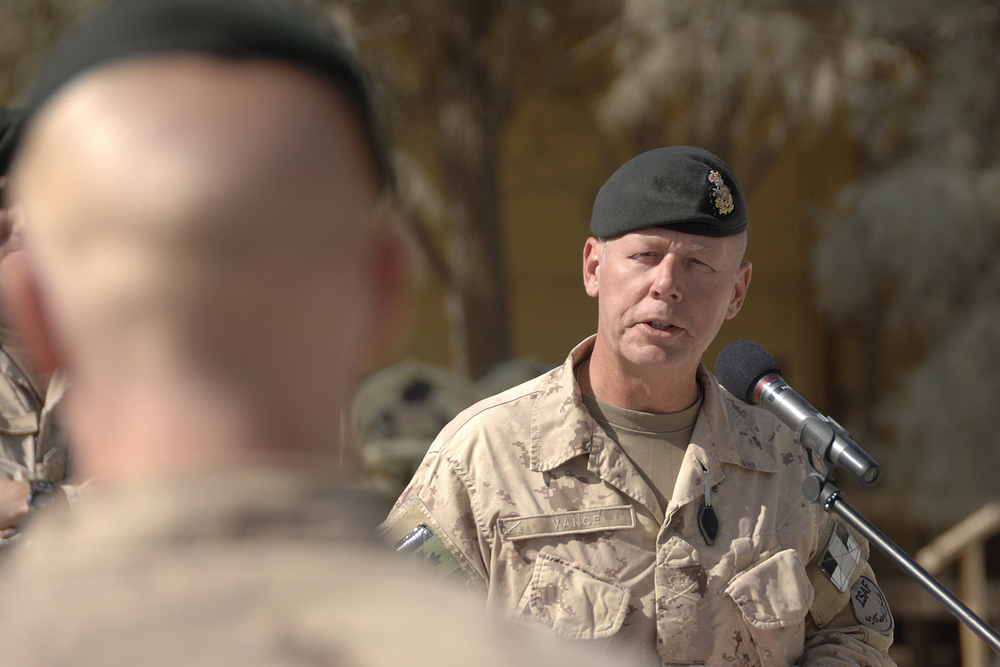
As part of that public relations effort, Chief of the Defence Staff Gen. Jon Vance is said to be soon heading to Mali, according to reports. Journalists from the CBC and the Canadian Press will be coming along. No dates are being provided at this time and the Department of National Defence doesn’t want to talk about Vance’s involvement in the public relations trip at this point.

Image result for CDS Vance
Then LGen Jonathan Vance, then a Brigadier General, delivers a speech while serving as Kandahar 2013. 
“We cannot speak to movements of CAF senior leadership, however CBC and the Canadian Press will be visiting Mali in the near future,” Department of National Defence spokesman Dan Le Bouthillier told Defence Watch Thursday.

Canada announced in March that it would send support personnel, two RCAF Chinook helicopters, as well as four armed Griffon helicopters to act as escorts for those larger aircraft, to Mali, a west African country that since 2013 has been dealing with insurgents and armed Islamic extremists. The mission is expected to start in late July/early August.

The mission, however, has been dogged by more than a few concerns.

Conservative MPs have voiced criticism about the lack of planning and what they claim is a lack of mission focus.

To be sure, there was confusion initially. In mid-March, Defence Minister Harjit Sajjan announced that Canada would send two Chinook helicopters and four armed Griffon helicopters. A few minutes later at the same news conference Vance said the number of helicopters being assigned to the Mali mission had still not been determined. A short time after that, Sajjan’s office sent out a message to journalists, contradicting Vance by stating that ‘up to’ two Chinooks and four Griffons would be sent. Then another message went out to journalists later that there would be extra helicopters sent as backup.

The helicopter issue was eventually sorted out. But attention turned to the potential danger and whether the Mali mission could be considered as combat. MPs on the House of Commons defence committee raised those concerns and questioned generals about details of the Mali operation and whether Canadian military personnel would be safe.

Conservative defence critic James Bezan wanted information about the risks and whether troops would have enough protection from insurgent attacks. Questions were also asked about whether insurgents had surface-to-air missiles that could be of a threat to RCAF helicopters. “Our guys could potentially be going into hot conflict,” Bezan said at the committee.

Another MP asked if Mali was a war zone. Lt. Gen. Stephen Bowes, who was appearing before a Commons committee, answered that, “war zone is not a term. It’s a complex conflict zone.”

Such questions from MPs sparked Col. Jay Janzen, the Canadian Forces Director of Strategic Communications, to tweet to defence journalists that “Canada can do better than the nonsensical ‘combat/not-combat’ debate.”

That, in turn, prompted a showdown between Bezan and Conservative MPs and Janzen (who is slated to be promoted to Brig.-Gen. and put in charge of Canadian Forces public affairs).

Bezan lectured Janzen that he, as a MP, could ask whatever question he pleased and that questions about the safety of troops were certainly valid. He accused Janzen of trying to stifle debate. Bezan also noted that the head of the United Nations mission to Mali has characterized the operation as “war.”

“We have the right to know how Justin Trudeau is using our Canadian Forces to get (a) UN Security Seat,” Bezan tweeted.

Janzen said that while the military is subordinate to civilian authority, he had the right to make such comments.

Vance has done such mission public relations tours before. In 2016, he brought journalists along for his tour of the Canadian special forces mission in Iraq. The special forces were there to help the Kurds battle Islamic extremists who had seized large parts of Iraq.

The event was closely coordinated with Prime Minister Justin Trudeau’s office, as is this Mali trip. Vance also used that trip to play down any concerns about cracks in the Iraq-Kurd alliance. He told CTV at the time he didn’t agree there was a rift in the relationship between the two groups. A year later Kurdish and Iraqi forces were fighting each other.

What comes from the Mali visit remains to be seen but the Trudeau government wants public relations emphasis on support to the United Nations and the use of women on such missions.

Here is a snippet of the messaging that is to be provided to the news media: “The Canadian Armed Forces are working as part of an integrated, whole-of-government approach to deliver on Canada’s commitment to increase its support for UN peace support operations. Canada is a strong supporter of UN peacekeeping, and the CAF is prepared to make valuable contributions to this UN stabilization mission. To be safe at home, we need to contribute to international security abroad.”

CAF Mali Mission May be Tainted by Atrocities

By: Geoffrey York, The Globe and Mail
African Correspondent, Johannesburg

As Canada prepares to send hundreds of troops to Mali on a peacekeeping mission, a fresh discovery of mass graves and alleged military atrocities has highlighted the human-rights challenges that the Canadians could face.

The defence minister of the West African country admitted this week that Malian soldiers were implicated in “gross violations” after the bodies of 25 civilians were found in mass graves in central Mali.

Canada plans to deploy up to 250 troops and six helicopters to northern Mali in August for a one-year mission as part of the United Nations peacekeeping force, known as MINUSMA, which co-operates with the Malian military on the ground. The Malian forces have been battling Islamists and other rebel groups.

Why is Mali in crisis?

Some experts say Canadian troops should look for opportunities to train and advise Mali’s soldiers on human rights – a subject where previous training by the European Union seems to have been ineffective.

Kisal, an organization that helps pastoral communities in Mali, said the 25 dead civilians in the mass graves were mostly herders from the Fulani ethnic group who had been detained by the Malian military last week.
Members of the Malian Armed Forces secure a road in 2017.
Mali’s defence minister, Tiena Coulibaly, confirmed the existence of the mass graves and ordered an investigation. He said “some armed-forces personnel” were implicated in “gross violations” that caused the deaths.

Mali’s authorities are “firmly resolved to fight impunity and get soldiers to strictly observe international rights and humanitarian conventions,” Mr. Coulibaly said.

The evidence of mass graves was just the latest in a long series of documented cases of extrajudicial killings and arbitrary arrests by Mali’s military.

Corinne Dufka, a West Africa researcher at Human Rights Watch who travels frequently to Mali, said she has documented more than 60 alleged summary executions by Mali’s security forces since 2017, with the remains of the victims found in at least seven mass graves. This does not include the latest case of the 25 bodies reported this week.

“Since early 2017, scores of witnesses have described severe mistreatment, arbitrary arrest, disappearances and summary executions,” she said. “I am aware of no single soldier held to account for any of these. … As long as soldiers continue to enjoy impunity, the abuses will continue.”

Human Rights Watch had earlier warned in April that it had received many reports of torture and mass arrest by the Malian army. The army seemed to be “running amok” in central Mali, it said.

In a report in late March, covering a three-month period, the UN said Mali’s defence and security forces were involved in a quarter of the 133 cases of human-rights abuses that UN peacekeepers had documented.

It said, for example, that Malian armed forces had arbitrarily arrested 10 civilians in a counterterrorism operation on Feb. 21 and had summarily executed seven of them, while the others are still missing.

In another report in June, the UN cited allegations of 56 summary executions by Mali’s armed forces.

Because of the continuing problem of human-rights abuses, the Canadian troops in Mali should prioritize the protection of civilians and should try to advise and mentor Malian soldiers to ensure better respect for human rights, Ms. Dufka said.

“We have found that the presence of MINUSMA and French forces in conflict zones in Mali serve as a strong deterrent to abuses by armed groups,” she told The Globe and Mail.

The UN peacekeeping mission co-operates with Mali’s military in a number of areas, including intelligence-sharing and some ground patrols, although the Canadian troops would primarily be supporting the UN in helicopter operations.

The UN mission has “conducted regular patrols” with Mali’s defence and security personnel and provided medical evacuations for the military, according to the UN report in late March.

The Canadian government has disclosed few details of how Canada’s peacekeepers will operate in Mali. Opposition MPs in Ottawa have complained about a lack of information on the planned mission.

It seems likely, however, that the Canadian troops will be based at an airfield in the town of Gao in northern Mali, and they will primarily be there to support the Canadian helicopters.

Bruno Charbonneau, a peacekeeping expert and associate professor of political science at Laurentian University, said he is doubtful that the Canadian peacekeepers will have much contact with Malian forces.

He noted, however, that the Canadian forces could potentially be asked to support the activities of the French military or a new West African military force known as G5 Sahel, both of which are fighting Islamist jihadists in Mali. The G5 group includes Malian troops.

The UN peacekeeping force is not officially authorized to conduct counterterrorism operations, he said. “But in practice it is difficult if not impossible to differentiate between peacekeeping and counterterrorist operations,” he said.

Walter Dorn, a peacekeeping expert at the Canadian Forces College in Toronto, said the Canadian military should support the UN peacekeeping force in providing human-rights training and mentoring for Malian soldiers.

Thursday, March 22, 2018

What's the point of peacekeepers when they don't keep the peace?

With the current debate on Canada's return to Peacekeeping UN operations, this article by Chris McGreal was published by The Guardian in September of 2015, and it still reads well today. 

Enjoy, 

By: Chris McGreal, The Guardian 
Originally Published September 2015 
From Rwanda to Bosnia, Haiti to Congo, failures raise questions about future of United Nations blue helmets
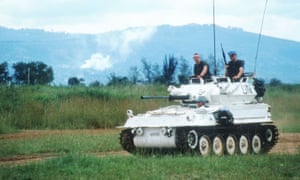

A UN tank helps civilians evacuate from Kigali, Rwanda, 1994. Photograph: Scott Peterson/Getty Images

Rwanda, 1994. The nadir of many lows for UN peacekeeping.

Hundreds of desperate Tutsis sought refuge on the first day of the genocide at a school where 90 UN troops were under the command of Captain Luc Lemaire. Here, they were surely safe from the Hutus and their machetes.

The UN flag flew over the school. The Belgian peacekeepers were armed with a machine gun, planted at the entrance. These soldiers were the world’s army. The Tutsis could not imagine they would stand by while people were slaughtered.

The 39-year-old captain feared otherwise. The UN in New York had ignored warnings that the genocide was being planned and the security council was pulling out peacekeepers in response to the mass killing.

Within days, the UN command decided there was more important work for Lemaire and his men than protecting Tutsis. The peacekeepers were ordered to abandon the school in order to escort foreigners to the airport and out of Rwanda.

As the soldiers left, Tutsis begged to be shot rather than left to the militia’s machetes. Within hours, the 2,000 people at the school were murdered by gun, grenade and blade.

Lemaire’s contingent kept a sporadic video diary of the wretched events. At one point a shaky camera captures a sandbagged machine-gun post and a pickup truck of Hutu militiamen sweeping by.

The video then focuses on the soldiers’ log. It reads: “New York didn’t agree to change the rules of engagement.” The peacekeepers were not to be permitted to save Tutsis. The camera’s microphone picks up an anonymous voice: “There are killings and New York doesn’t give a damn.”
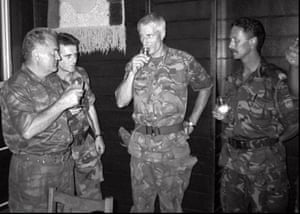
General Ratko Mladić of the Bosnian Serb army, left, drinks with Dutch colonel Ton Karremans, second right, in the Bosnian village of Potočari, on 12 July 1995, the second day of the massacre. Photograph: Anonymous/AP

The betrayal of the Tutsis in Rwanda was a low point for UN peacekeeping but not an isolated one. A year later, Dutch peacekeepers failed to stop the massacre of 8,000 Muslim men in Srebrenica, a supposedly UN “safe area”, the most notorious mass killing by the Serbs in Bosnia.
FacebookTwitterPinterest

Not long before, there had been the debacle in Somalia where a US-led UN humanitarian operation turned into a bloody conflict against a powerful warlord. By then Angola was already back at war after its UN peacekeeping mission collapsed amid accusations it contributed to the breakdown of peace.

Other disasters – the Democratic Republic of the Congo (DRC), Sierra Leone – were still on the horizon even as the UN peacekeeping department’s budget doubled and doubled again with growing numbers of missions.

70 years and half a trillion dollars later: what has the UN achieved?

There were good reasons to question the point of UN peacekeeping in the 1990s and to wonder if it was not costing as many lives as it was protecting by offering an illusion of security. The murdered Tutsis at the school might have stood a better chance if they had fled to Uganda.

Two decades later, those responsible for peacekeeping – UN officials, countries on the security council assigning missions, militaries contributing the forces in blue helmets – say the lessons of the 1990s have been learned. Protection of civilian lives is now a priority. UN soldiers no longer have their hands tied in using force to defend the innocent. Perhaps most important, the failures of two decades ago stripped the UN of the illusion that an election and a few soldiers in blue helmets is enough to sustain peace.

But even as peacekeeping has ballooned to become by far the most expensive of UN departments (in 2015 it will cost nearly $9bn to keep 120,000 blue helmet soldiers and policemen deployed in 16 countries from Mali to Cyprus and Haiti, compared with just $500m at the end of the cold war), it is dogged by challenges.

The politics of the UN security council continues to hamstring action over some conflicts, such as Syria and Darfur. Other missions drag on indefinitely, such as in the DRC and Haiti. There is friction between the UN and some governments over who has ultimate command over peacekeeping troops, which has resulted in conflicting orders with disastrous consequences. Then there are spreading conflicts against armed Islamist groups in central and west Africa.

“In the last 15 years, the number of missions, number of crises have drastically multiplied,” said Ban Ki-moon, the UN secretary general. “In addition to using military and police forces, we have been deploying a lot of special political missions. This is preventative diplomacy. If we can prevent at the time of symptoms of a crisis, we can save a lot of human lives and human resources.”
Advertisement

Jack Christofides, who is on leave from the UN as director of peacekeeping operations for central and west Africa, described peacekeeping as “extremely taxing at the moment”.

“We’ve got more troops, we’ve got a bigger budget, we deployed in all sorts of very very difficult places, much more difficult than we’ve ever been, and we’re stretched, we’re really stretched,” he said.

“If you think of the old deployments in places like Lebanon and Bosnia, there is a certain infrastructure you could use and work with. The troops coming were generally from countries that had the means to launch expeditions. Today, when you’re talking about northern Mali and central Africa, you have both extremely dangerous conditions and geostrategic locations which are very difficult to get to.”


The UN is also grappling with persistent accusations of rape and sexual exploitation by its peacekeepers, which is further undermining confidence in the organisation, particularly in some of the countries where its soldiers are deployed.

And there are added demands as the US presses for peacekeepers to take on a more aggressive role, particularly against armed Islamist groups in Africa. President Barack Obama is jointly hosting a summit with Ban in New York later this month to seek commitments to strengthen peacekeeping with better trained troops, equipment and intelligence resources, to the alarm of some of the countries that provide substantial contingents of troops in blue helmets.
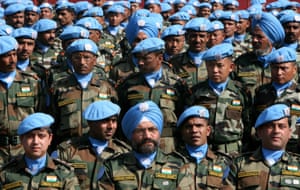
 Indian soldiers gather before their departure to Sudan on a UN peacekeeping mission. Photograph: Raveendran/AFP/Getty Images
India, which has sent more soldiers on UN missions than any other country – 180,000 on 49 missions – is openly challenging the move towards what some see as mostly rich and powerful countries on the security council sending the poor to fight and die.
Advertisement

“India is completely committed to peacekeeping provided peacekeeping is what we know it to be,” said India’s ambassador to the UN, Asoke Kumar Mukerji. “The soldiers in the blue helmets, under the blue flag, are impartial. They are not supposed to be partisan. If somebody wants soldiers to go in and fight they should hire mercenaries, not take UN soldiers.”

UN peacekeeping came into its own with the collapse of the Soviet Union in 1991 and the diminishing of ideological rivalries that had dominated international politics since the second world war.

Early successes in Cambodia, Namibia, Mozambique and El Salvador generated an overconfidence in the ability of UN soldiers to keep the peace. Each of those countries had an accord that former warring parties wanted to maintain.

The UN learned the hard way in Angola, Rwanda and Bosnia that where the UN wants peace more than those in conflict, then the illusion of peacekeeping can perpetuate instability and cost lives.

Out of the disasters of the 1990s came a new model including an ethos of “responsibility to protect”. No longer would UN forces stand idly by while innocent people were murdered. That has helped drive a rapid expansion of peacekeeping to become the UN’s single largest operation.

In 1991, the year the Soviet Union collapsed, the peacekeeping budget was just $490m. Over the past decade it has leapt from $3.8bn to about $9bn as the size and length of missions has expanded. More than 100,000 UN peacekeepers have served in Haiti since 2004 and close to 250,000 been deployed to the DRC over the past 15 years. There is little prospect of either mission ending soon.

Today, UN troop deployments in the DRC, Sudan and Darfur each cost more than $1bn a year, with Mali and Central African Republic not far behind. The most expensive outside Africa is Haiti, with a budget of $500m.

The emphasis on Africa is in part a reflection of the enduring nature of some conflicts on the continent, but also the politics of the security council. The UN might have had large peacekeeping missions in Syria and Ukraine, were it not for Russian objections.

As the scale of peacekeeping has grown so have the questions about its role. Most particularly, are peacekeepers there to monitor peace or to enforce it? It’s a source of increasing friction between the major powers on the security council that approve UN intervention and some of the countries which provide the troops.

In 2000, British forces landed in Sierra Leone after UN peacekeepers stood aside or fled an advance on the country’s capital, Freetown, by a notoriously brutal rebel group, the Revolutionary United Front (RUF). Several hundred peacekeepers surrendered to the rebels.
Advertisement

A British general, David Richards, was sent in by London to evacuate foreign citizens. Confronted with the RUF’s horrific record and the imminent killing of large numbers of civilians, he defied his instructions and used UK troops to spearhead a counter attack.

Richards, who went on to become Britain’s chief of the defence staff, said he was “staggered” to find that the Indian UN force commander, Major General Vijay Jetley, interpreted his mandate as that of a neutral intermediary. In Richards’ view the UN should have been siding with the elected government against rebels breaking a peace agreement.

“I had a real argument with Major General Jetley about this. The Indian hierarchy were very reluctant to lose a single person on a UN operation,” said Richards. “They were very reluctant to fight and that permeated quite a lot of the other contingents as well, to the point where I remember going in to the UN headquarters on my first day there in May 2000 and finding Jetley. I said General, we’ve got to stop the RUF, you’ve got to tell your people to fight. At least hold their positions. He was very reluctant to do it.”

India said its troops were sent to monitor the peace, not enforce it. The UN mission in Sierra Leone was further complicated by antipathy between some of the national forces, particularly Jetley and his Nigerian deputy, Brigadier General Mohammed Garba.

In an internal UN report, Jetley accused Garba and other senior Nigerians of being more interested in smuggling diamonds than keeping the peace. Nigeria’s military responded by accusing the Indian general of “trying to justify his ineptitude, inaction and inefficiency in the leadership of a 
multinational force.”
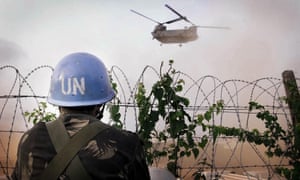
An Indian UN soldier watches an RAF Chinook helicopter land at the UN headquarters in Freetown, Sierra Leone. Photograph: Peter Macdiarmid/AFP/Getty Images
Such differences of opinion over the role of UN peacekeepers were replicated 12 years later in the Democratic Republic of the Congo as rebels advanced on the eastern town of Goma. The Indian commander of part of the largest peacekeeping force in the world ignored orders from UN officials to defend the town and called the Indian defence ministry in New Delhi to ask what he should do. He was told not to resist. The rebels seized Goma to the anger of Ban Ki-Moon, who regarded it as a “personal humiliation”, according to a senior UN official.

By then members of the wider UN mission in the DRC had come to look like bystanders to mass killing, rape and terror. Richard Gowan, until recently research director at the Centre on International Cooperation, a thinktank in New York that works closely with the UN on peacekeeping, said Indian forces in Sierra Leone and the DRC were taking orders from the defence ministry in New Delhi, not the UN commanders on the ground.

“It’s very clear that there are directions from New Delhi to avoid all risk, and that there are parallel lines of command between New Delhi and their guys in the field. That’s true of a lot of countries. A lot of field officers, if they get any order to take a significant risk in a peace operation, they’ll immediately phone home. That’s making it almost impossible for some force commanders to get anything done because they have no true control over their own units,” he said.

Most western nations will not put boots on the ground as frontline peacekeepers and so the UN is dependent on the goodwill of those countries prepared to deploy troops such as India, Bangladesh, Rwanda and Nigeria, making it hard to assert its authority.

The UN lost confidence in Jetley in Sierra Leone but when the then secretary general, Kofi Annan, tried to remove him, the Indian government threatened to pull out all of its forces. Annan’s successor, Ban, ran into the same threats from New Delhi when he tried to remove the Indian UN commander after the Goma debacle.

Rwanda and Srebrenica prompted a greater emphasis on protection of civilian lives, and involvement in rebuilding failed states instead of negotiating peace treaties, standing back and hoping it all worked out. Gowan said that while the “responsibility to protect” ethos was laudable it had also led to ill-thought-out missions.

“Sometimes in peacekeeping, the security council says ‘Good God we need to have a mission’ and that mission is stuck together,” he said.

Gowan pointed to Darfur, where he said the UN intervention came as a politically panicked response to public pressure over the mass killings by the government-allied Janjaweed militia.
Advertisement

“For political reasons the US and the UK insisted on having the mission. I’ve spoken to UK officials since who’ve said: ‘We had no real idea what this mission was meant to do. We were just under such public pressure to come up with an answer and the answer was peacekeeping.’ That was definitely true for the Bush administration as well,” he said.

“Darfur has been a quagmire from the beginning. The frank reality is no one believes that the mission is working but no one dares pull it out because they fear the moment it goes there will be an even greater spike in violence and the security council will be held responsible. It’s become a slow burning disaster.”

Philippe Bolopion, the UN director at Human Rights Watch, said the principal reason for the failure of the Darfur mission, a hybrid operation with African Union forces, was deadlock on the security council.

“When permanent members of the security council can’t agree to stand up to an abusive government such as Sudan’s, and you have weak peacekeeping troops on the ground, it’s almost a perfect storm where peacekeepers are not going to protect civilians properly,” he said.


Members of the security council routinely prioritise national interests over the needs of the peacekeeping missions

“Permanent members of the security council routinely prioritise their national interest over the needs of the UN peacekeeping missions they have mandated, as a result often undermining them. Russia and China have done this by opposing more sanctions against the Sudanese government even when it pushes peacekeepers around in Darfur.”

The responsibility to protect has had a more positive impact elsewhere. Peacekeepers in South Sudan turned their bases into de facto refugee camps protecting tens of thousands of people. That would have been unlikely 20 years ago.

But the ethos has been severely challenged by the fallout from the security council mandate for military intervention in the 2011 Libyan revolution to protect civilians in Benghazi. Russia accused Nato of abusing it to support the overthrow of Muammar Gaddafi. That in turn has complicated UN action on Syria.
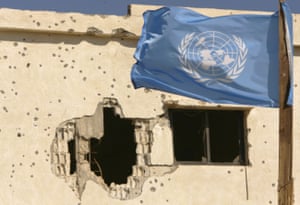
A UN flag flutters amid the rubble of the Lebanese-Israeli border town of Maroun al-Ras. Photograph: Patrick Baz/AFP/Getty Images
Finding common ground on sub-Saharan Africa has generally been less difficult because of fewer strategic rivalries. The debacle in Goma prompted the UN to put together a fighting force of soldiers prepared to go into combat. South Africa, Tanzania and Malawi volunteered to send troops to join the Force Intervention Brigade in part because they were weary of the persistent instability in the region.
Advertisement

“We were all embarrassed, humiliated at the end of 2012 when Goma fell,” said Christofides, who oversaw UN peacekeeping operations in the DRC from 2011 until earlier this year and was an architect of the intervention brigade. “Everybody has that image of peacekeepers sitting on top of an APC [armoured personnel carrier] and this group of ruffians walking into Goma. That was a low moment for everybody.

“When we recommended the mandate of the intervention brigade, the security council did not need much persuading. You have some very far-reaching language in the mandate about targeted offensive operations. That’s not language you see in resolutions of the UN. Neutralising armed groups, preventing their expansion, disarming them.”

The UN also deployed drones for the first time to help monitor the movements of the rebels and to verify Rwanda’s denials that it was supplying the insurgents. The drones are not armed although that appears the next likely step, if not in the DRC then in some other conflict where the UN is involved, given their increasing use in the Middle East by the US and its allies.

The intervention brigade has been successful in changing the dynamic in eastern Congo by pushing back the rebels and providing a degree of stability to begin the reconstruction of functioning systems of government, such as the courts – although regional politics has played a large part too. But the operation has also deeply alarmed countries such as India, which fears it sets an example for the future of peacekeeping.

Christofides doubts that the force intervention brigade provides a model for other peacekeeping missions. Senior UN officials, some of whom were strongly opposed to the creation of the brigade but now judge it a success, are deeply wary of the UN taking on a similar role in other conflicts. The DRC, they say, was a unique situation.

But even if the force intervention brigade is not replicated, it fits with a wider agenda by the major western powers to remake UN peacekeeping as a partner in military campaigns. For them, the lesson of British intervention in Sierra Leone or the recent French deployments in Mali and Central African Republic against armed Islamist groups is that better trained and equipped forces launch the initial assault and then the UN comes in as backup. But for that to happen, UN peacekeeping has to up its game.

Obama is leading the push with his New York summit on 28 September to seek pledges of troops, equipment and intelligence resources to a revamped peacekeeping operation.

Washington regards peacekeeping as a national security issue and a “good bargain”, as one official put it. The US picks up the tab for a quarter of the UN’s $9bn peacekeeping budget, but it is a fraction of the cost of the Pentagon or invading Iraq.

Moreover, if other countries are sending their forces then the US does not have to risk the lives of American soldiers. Previously, the US mostly regarded peacekeeping in Africa, in particular, as a humanitarian issue. Now, given the nature of the conflicts in Mali, Nigeria and Central African Republic, Washington views it as strategic.
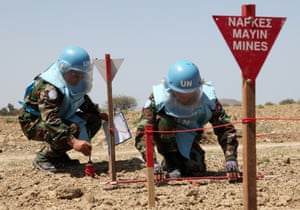
Cambodian mine experts demonstrate their work in the UN-controlled buffer zone in Cyprus. Photograph: Barbara Laborde/AFP/Getty Images
But while the US wants more assertive peacekeeping, it does not want to send its soldiers to fight. Obama is pressing more developed countries, in Europe, Asia and Latin America, to make greater commitments in the hope of improving the quality of UN forces. So is Ban.

“I’m now in the process of reaching out to developed countries. I’ve been speaking to many presidents and prime ministers to diversify the participation of peacekeeping forces,” he said.
Advertisement

“If we can diversify and have more countries, particularly some big countries, if they can send their own troops in addition to assets and financial support, that would be much appreciated.”

UN officials privately concede there is little chance of the US putting its forces under UN command. Congress would never stand for it. But Washington is joining the UN in pressing other developed countries to play a bigger part in peacekeeping.

The UK currently has fewer than 300 soldiers deployed on peacekeeping missions, mostly in Cyprus. “We’ve been having goodness knows how many discussions with British officials with a view to getting them more involved,” said Christofides. “We’re still drawing too many troops from a few parts of the world and not enough from other parts of the world. And I don’t just mean Africa versus the west, but other countries in Asia and Latin America that could contribute a bit more.”

Another senior UN official put it more bluntly: “Britain has a reputation for lecturing without contributing.”

The UK is expected to announce a contingent of peacekeepers for South Sudan at the New York summit, but numbers are not known.

Richards wants to see Britain make a greater contribution. “The Ministry of Defence and, I have to say sadly, the armed forces, don’t really see the UN as proper soldiering. This is a cultural ignorance that’s grown up over many years. The Americans share it writ large: UN ops is what second- and third-world nations do but proper armies, we pick and choose,” he said.

Richards said countries whose forces had experience in Afghanistan and Iraq could put that to good use in UN operations. “I think that’s a pretty good role for the British armed forces in this era when there’s so many nasty things going on in the world. The Americans really need to decide to do it as well,” he said. “I think at a low level, our young officers would love to do it. There is a higher level political/military reluctance and snootiness about it.”
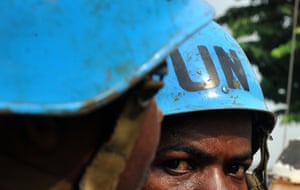
 A UN peacekeeper patrols in a street in Abidjan, Ivory Coast. Photograph: Issouf Sanogo/AFP/Getty Images
India strongly opposes a move towards more forceful peacekeeping. “When it has been used as a tool to ensure that a peace agreement is observed so that peace building can take place, or as a tool to facilitate a political resolution, it works,” said Mukerji, the Indian ambassador to the UN.

“But if peacekeeping is to be seen as peace enforcement, then unfortunately we can’t see the UN charter allowing such a radical departure of the use of peacekeeping.

“Peacekeeping is not an end in itself. The end is political stability and peacekeeping is just a tool to bring about political stability. What’s happening now is the cart is being put before the horse. I think that’s a very unfortunate development.”

Gowan is sceptical for different reasons. “I think that we may be stumbling into an enormous strategic trap because if we have learned over the last decade that very highly capable Nato forces, US forces, actually can’t suppress Islamic extremist groups, why on earth do we think slightly strengthening UN missions is going to give us a tool that allows us to fight terrorists?” he said.

Monday, November 14, 2016

Canada Committed to 3-Year deployment in Africa: Sajjan

By TONDA MACCHARLES, Toronto Star

OTTAWA—Canadian troops headed to Africa will operate in dangerous territory where peacekeepers have been killed, says Defence Minister Harjit Sajjan.

In an exclusive interview with the Star from Vancouver Sajjan said Canada has committed to a three-year deployment that will be reassessed each year to ensure it has an “enduring” impact.

It will be spread among a number of unspecified African countries, have a major focus on training and increasing “capacity” of the host nation as well as other countries’ troops, and build on existing social, economic and deradicalization programs on the ground.

“These missions, all of them, have the level of risk where peacekeepers have been hurt, they have been killed. And we’ve been looking at the risk factor in a very serious way,” said Sajjan.

Asked about his approach to deploying Canadian forces to conduct counter-insurgency operations — something the previous Conservative government was keen to avoid in Africa when it turned down requests to deploy soldiers to Congo and Mali — Sajjan said “some of it is going to be the reduction of radicalization in certain areas, in other parts it will be developing the capacity of the host nation.”

Just back from Mali, which hosts the deadliest United Nations mission in the world right now, Sajjan says it’s clear there are risks there. He said the same risks exist in the other African missions under consideration by the Liberal government.

But, he added, there are also risks to Canada of doing nothing to counter insurgent groups that are terrorizing populations and radicalizing new recruits, and suggested he and the Liberal government have made this clear to Canadians from “day one.”

“This is not the peacekeeping of the past — we need to look at what the challenges are of today and develop the peace operations for today’s challenges.”

After having travelled to the Democratic Republic of Congo, Uganda, Kenya, Tanzania and Ethiopia in late summer, and Senegal and Mali in the past week — Sajjan said he believes the UN mandate for and rules of engagement with hostile forces are “robust” enough to address the risks, particularly in Mali. The UN mission in Mali, known as MINUSMA, has seen 106 casualties since it was established in 2013, including 69 from “malicious acts.”

“One thing I did learn, the mandate for the mission is robust so there no concern that our troops would be limited in any way,” said Sajjan. “I had a very direct conversation with the political leadership of the UN and the force commander about that, and the safety of our troops is always paramount.”

The defence minister, a Canadian Armed Forces veteran of the Afghanistan combat mission, suggested the risk to soldiers’ lives, however, does not justify inaction.

“It can’t just be one factor that we look at. That’s one; that’s an important factor that needs to be addressed. We have looked at that and the question always comes: how do you mitigate some of these challenges,” he said.

“But at the end of the day just because you see a problem ahead of you, you can’t just ignore it, you have to look at, can we look at addressing it.”

He insisted Canada “can play a huge role where we can reduce conflict and get into areas where we can start preventing conflict by addressing certain root causes at an early stage.”

Sajjan said there are ways to “mitigate” risk, just as he says the Liberal government did when it overhauled Canada’s combat mission to Iraq, “and making sure that we put the right type of troops, the right equipment with the right mandate for that mission.”

The Liberals pulled out Canada’s CF-18 fighter jets and refocused Canada’s military contribution to the fight against Daesh on training Iraqi and Kurdish peshmerga forces to fight the Islamist rebel forces.

Sajjan stressed that a big part of the federal analysis underway — as he, two other federal ministers, and military and civilian fact-finders have travelled to Africa — is examining how Canada’s contribution of some 600 soldiers and up to 150 police can have a maximum impact, whether it’s through military training, building on economic development programs and opportunities like on the “agriculture side” in Mali, or combating sexual violence, including by UN peacekeeping troops.

“What we do provide will be enduring. We committed for three years, but the thinking is to have the impact, we always need to assess,” said Sajjan.

Asked how Canada avoids sending troops to be injured or killed in a mission where there is no end in sight, Sajjan stressed Canada’s intention is to effect measurable change.

“I wouldn’t want to put troops in any place where there is no end,” he said, suggesting the plan is to provide “innovative” solutions, to help UN or African Union troops be better able to do their jobs, “so we don’t have to look at a very long, protracted deployment that will not have an impact.”

Sajjan said Canada is looking at spreading its various contributions — military, police and civilian — among a number of UN missions, not African Union-led missions, in Africa. But it will support African Union efforts at the same time.

Right now, he said, much of the public attention is on exactly where soldiers will be sent.

But he said Canadians should expect a broader mission that could see troops sent to one end of Africa while other elements of Canada’s contribution will be sent to a different part. He said there are troop and police training centres across Africa, and “a small number of troops or even RCMP can have significant impact in other areas, to make a training centre far more effective.”

“We will be assisting in capacity-building in many of the training centres and that will be . . . regardless of where we go.”

Much has been made of the fact Canada has French-speaking troops and no colonial baggage, an asset from the perspective of many francophone African nations and the UN. Sajjan said it doesn’t mean soldiers from Quebec or New Brunswick would be the only ones to deploy, rather he said that across the armed forces, the leadership in officer ranks are bilingual, as are many in the non-commissioned ranks.

Sajjan said the government has “narrowed” the ultimate destinations for its Canadian mission, but did not tip his hand on his preference.

He said there is nothing to be read into the countries he’s travelled to, nor the fact that he recently went to Mali, saying he couldn’t fit it into the earlier trip to central and East Africa. Although he has not travelled to the Central African Republic, Darfur, or South Sudan, Sajjan said he has addressed the same questions around those missions at meetings in Ethiopia late summer.

He said the decision on where to dispatch Canada’s peace support mission is expected to be finalized by the federal cabinet before end of year.

“I think when Canadians see the level of work that’s gone into this it’s not just the location that’s going to be the main news, it’s how we’re going to be deployed.”

Sajjan’s comments flesh out the “layered approach” that Prime Minister Justin Trudeau said Canadians should expect to its upcoming Africa “peace support” operation.

Several ministers and government departments are working up options to make good on the Liberal election pledge to re-engage with the United Nations.

International Development Minister Marie-Claude Bibeau also travelled to Senegal (where many UN offices operating in West Africa are located) and Mali in August. And Global Affairs Minister Stéphane Dion travelled this week to Kenya, Nigeria and Ethiopia.

Dion, in a statement issued Thursday from Nairobi where he announced $21.5 million for development and security projects, said: “Kenya is an important partner for Canada in regional peace and security in Africa, but there is room for further growth.”

Dion said the money will “help provide youth with enhanced skills for employment and improve security and stability by countering terrorism, combating radicalization and violent extremism, and ensuring safety and security of borders within the region.”

Tuesday, September 27, 2016

Colombia peace agreement sets stage for Canadian Peacekeepers

By: David Pugliese, Defence Watch 

Colombia’s government and the Revolutionary Armed Forces of Colombia, the country’s largest rebel movement, signed a historic peace accord Monday night ending 50 years of war….and perhaps paving the way for Canadian peacekeepers to undertake a mission in that country.

The Liberal government is considering whether to send unarmed observers to help monitor the agreement. Defence Minister Harjit Sajjan’s office confirmed last week to the Canadian Press that Colombia is one of the options being considered as the government decides where to deploy upwards of 600 Canadian peacekeepers.

Canadian representatives have been in contact with the UN looking for more information about the observer mission in Colombia, including potential security hazards, the Canadian Press noted in its report.

Colombians are to vote on the peace agreement in a plebiscite on Oct. 2. If all goes as expected, the United Nations will begin deploying 450 unarmed observers to around 40 locations around Colombia soon after to begin monitoring implementation of the agreement, CP pointed out. The one-year monitoring mission would involve ensuring both sides adhere to the peace deal as FARC forces turn over their weapons and begin the process of reintegration into Colombian society, it added.

Below is the Associated Press article on the peace agreement in Colombia:

Underlining the importance of the deal, President Juan Manuel Santos and Rodrigo Londono, leader of the Revolutionary Armed Forces of Colombia, signed the 297-page agreement before a crowd of 2,500 foreign dignitaries and special guests, including UN Secretary-General Ban Ki-moon and U.S. Secretary of State John Kerry.

Many in the audience had tears in their eyes, and shouts rose urging Santos and Londono to “Hug, hug, hug!” But in the end, the two men just clasped hands and the rebel commander, also known as Timochenko, put on a pin shaped like a white dove that Santos has been wearing on his lapel for years. Seconds later five jets buzzed overhead in formation trailing smoke in the colours of Colombia’s flag.

During a minute of silence for the war’s victims, 50 white flags were raised. Everyone at the event wore white as a symbol of peace.

Santos proclaimed after the signing that the accord will help Colombia to stop the killing, to end the deaths of young people, the innocent, soldiers and rebels alike. He led the crowd in chants of “No more war! No more war! No more war!” and he urged Colombians to vote to accept the accord in the Oct. 2 national referendum that will determine if it takes effect.

Londono called Santos “a courageous partner” in reaching the peace deal through four hard years of negotiations, calling the accord “a victory for Colombian society and the international community.”

He also praised FARC’s fighters as heroes of the downtrodden in the struggle for social justice, but repeated the movement’s request for forgiveness for the war. “I apologize … for all the pain that we have caused,” he said.

The signing was greeted by wild cheers by about 1,000 FARC rebels in Sabanas del Yari, where the group recently concluded its last congress by endorsing the peace deal. “Yes, we can; yes, we can; yes, we can,” they shouted, followed by calls for Timochenko to be president.

“Let no one doubt that we are going into politics without weapons,” Londono said in his speech after the signing. “We are going to comply (with the accord) and we hope that the government complies,” he added.

Earlier in the day, Santos and foreign dignitaries attended a Mass celebrated by Cardinal Pietro Parolin, the Vatican’s secretary of state, at a baroque church named for St. Peter Claver, a 17th century Jesuit priest revered as the “slave of slaves” for his role aiding tens of thousands of African slaves brought to the New World as chattel.

In a stirring homily, Pope Francis’ envoy praised Colombians for overcoming the pain of the bloody conflict to find common ground with the rebels.

“All of us here today are conscious of the fact we’re at the end of a negotiation, but also the beginning of a still open process of change that requires the contribution and respect of all Colombians,” the cardinal said.

Across the country Colombians marked the occasion with a host of activities, from peace concerts by top-name artists to a street party in the capital, Bogota, where the signing ceremony was to be broadcast live on a giant screen. It was also celebrated by hundreds of guerrillas gathered in a remote region of southern Colombia where last week top commanders ratified the accord in what they said would be their last conference as a guerrilla army.

Colombians will have the final say on endorsing or rejecting the accord in the Oct. 2 referendum. Opinion polls point to an almost-certain victory for the “yes” vote, but some analysts warn that a closer-than-expected finish or low voter turnout could bode poorly for the tough task the country faces in implementing the ambitious accord.

Among the biggest challenges will be judging the war crimes of guerrillas as well as state actors. Under terms of the accord, rebels who lay down their weapons and confess their abuses will be spared jail time and be allowed to provide reparations to their victims by carrying out development work in areas hard hit by the conflict.

That has angered some victims and conservative opponents of Santos, a few hundred of whom took to the streets Monday to protest what they consider the government’s excessive leniency toward guerrilla leaders responsible for scores of atrocities in a conflict fueled by the country’s cocaine trade.

To shouts of “Santos is a coward!” former President Alvaro Uribe, the architect of the decade-long, U.S.-backed military offensive that forced the FARC to the negotiating table, said the peace deal puts Colombia on the path to becoming a leftist dictatorship in the mould of Cuba or Venezuela — two countries that along with Norway played a vital role sponsoring the four-year-long talks.

“The democratic world would never allow bin Laden or those belonging to ISIL to become president, so why does Colombia have to allow the election of the terrorists who’ve kidnapped 11,700 children or raped 6,800 women?” he told protesters gathered in a working-class neighbourhood on the outskirts of Cartagena.

The stiff domestic opposition contrasts with widespread acclaim abroad for the accord — a rare example in a war-torn world of what can be achieved through dialogue. On Monday, European Union foreign policy co-ordinator Federica Mogherini said that with the signing of the peace agreement, the EU would suspend the FARC from its list of terrorist organizations.

Asked whether the U.S. would follow suit, Kerry was less willing to commit but expressed a possible openness to similar action.

“We clearly are ready to review and make judgments as the facts come in,” he told reporters. “We don’t want to leave people on the list if they don’t belong.”

Tuesday, August 30, 2016

UN Africa Mission will be Complex and Dangerous - More So than Afghanistan

By: Matthew Fisher, National Post 

The Liberal government has been silent about where in Africa Canada’s soldiers and a cadre of diplomats, aid workers and police officers will be deployed. None of the potential United Nations missions are safe. All are complex. None come with an exit strategy.

The strongly preferred choice of the Canadian Forces is Mali, which is about the same size as Manitoba and Saskatchewan together and has about seven times as many people. South Sudan, the Central African Republic and the Democratic Republic of Congo, which have also been mooted, are believed by Canadian Joint Operations Command to present even greater perils and offer less chance of a positive outcome.

Having been with Canadian peacekeepers in Somalia, Eritrea and Rwanda, I can categorically state that African missions are in a league of their own for complexity and danger. Much has been made recently about the risks that will soon face Canadian troops in Africa, and whether they have enough training in the subtleties of peacekeeping and peacemaking.

This is all to the good, but equal attention should be paid to the civilians who will be deployed as part of the whole-of-government approach developed by the Harper government in Afghanistan and which will be repeated, perhaps on a larger scale, in Africa.

Related
Canadian regular forces to train troops in Niger as Liberals seek to take part in more UN peace operations
Chris Selley: Are we really any good at peacekeeping?
John Ivison: Prudence demands that we see our way out of African peacekeeping mission before venturing in
Matthew Fisher: Truck attack in France ups the ante for Canada ’s peacekeeping mission in Mali

Like soldiering, combat diplomacy requires people who are brave and highly adaptive. Our diplomats and aid specialists in Afghanistan quickly discovered that not only were they totally reliant on the troops for their safety, but the soldiers often had more useful skills — military engineers, military civil affairs specialists and military doctors, nurses and medics were better equipped to oversee the building of schools and deliver medical outreach projects in hostile territory than were civilians.

This made for a complicated relationship at times, not helped by the fact that what is now called Global Affairs tended to send Brahmins with Ivy League educations off to war. Still, there is a small corps of diplomats still in harness such as Ben Rowswell, Canada’s ambassador to Venezuela, and James Christoff, who was until very recently our number two in Kenya, who excelled in Kandahar and whose experience working cooperatively with the army would benefit Canada greatly in Africa.

The most informed guesses provided to me by the military suggest that it will take until at least next March or April to get Canadian troops and gear into the field. If the mission is to Mali, one place the Canadians could be based at or near is Timbuktu, where French troops clashed with fighters from al-Qaida in the Islamic Maghreb in the spring of 2013. The average daytime temperature in April and May at the fabled crossroads for Saharan camel caravans will be above 40 C, and never drops below 30 C the rest of the year. It is only slightly cooler elsewhere in the country.

Mali is ranked 179th in the UN Human Development Index. That is eight places behind Afghanistan. The average lifespan in Mali is nearly 30 years less than it is in Canada. Half the population gets by on less than one dollar a day.

Meningitis is the biggest killer, followed by its frequent partner, malaria, according to the Centers for Disease Control and Prevention in Atlanta. Cholera, hepatitis, rabies, tuberculosis, typhoid, yellow fever and the Zika virus are all present. Polio has again become a serious concern.

So even before the fluid security situation is considered, pestilence and hot weather may make Africa more of a challenge for the Canadians than Afghanistan, with its fairly predictable summer fighting seasons.

Before Canada’s mission to Kandahar in 2006, then-defence minister Bill Graham and Gen. Rick Hillier embarked on a cross-country tour to inform Canadians about how dangerous it would be. That process is underway again, with initial warnings from defence minister Harjit Sajjan and Canada’s new ambassador to the UN, Marc-André Blanchard, that what Canada is about to undertake in Africa will be peacemaking, not Pearson-style peacekeeping, and that the prospect of combat and casualties is very real.

If the mission is to Mali, the 600 Canadians would join 15,000 other peacekeepers in a country where there has been little peace to keep. More than 100 blue helmets have died in terrorist attacks there during the past 40 months.

Among the insurgents in Mali is a relatively new group, the Macina Liberation Front, which specifically targets UN and French troops. The MLF claims loyalty to al-Qaida in the Islamic Maghreb but resembles Boko Haram, which is affiliated with ISIL and has carried out terrorist attacks and hundreds of kidnappings in an arc that cuts across northern Nigeria into Chad and Niger.

Whether it is Mali or somewhere nearby, Canada’s soldiers and civilians must pull together in an environment that will be more unpleasant and potentially far more forbidding than Afghanistan.

Monday, August 15, 2016

Canada's military plan for Africa will be for a 'long duration,' says Sajjan

Terry Pedwell, The Canadian Press

OTTAWA -- The federal government will soon announce a plan to bolster United Nations peace efforts in Africa, including trans-border operations, Defence Minister Harjit Sajjan said Monday, as he wrapped up a five-country, fact-finding mission to the continent.

"I do have a number that we will be announcing shortly that we can sustain for a long duration," Sajjan said during a teleconference from the Democratic Republic of Congo.

And while no final decisions have been made yet on numbers, timing or location, Canada's contribution to a UN mission on the continent will involve more than the military and go beyond what would be considered a traditional peacekeeping role, Sajjan said.

RELATED STORIES
Canada not required to provide minimum number of jets to NATO: report
Canadian army heading for Africa 'very soon': top general
Sajjan to tour Africa, collect information for potential peackeeping mission
Spread of terrorism in Africa on Canada's peacekeeping radar: Sajjan

Whatever form the mission takes, it will also operate beyond the borders of individual countries, said the minister.

"We need to look at the area by regions," Sajjan explained.

"It's all interconnected. If we ended up looking at problems only within the confines of borders, then we are not going to have a true impact."

Establishing trans-border peace operations in Africa may prove difficult for the United Nations, which is already having difficulties manoeuvring through the politics of individual nations.

On Friday, the UN Security Council authorized an extra 4,000 troops to curb the latest violence plaguing South Sudan, a move that was almost immediately rejected by government officials there. That opposition was later softened by President Salva Kiir, who said he would consider the plan under certain conditions.

There has been fierce fighting in South Sudan in recent days, raising concerns that the country, which gained its independence in 2011, may slide back into civil war.

Canadian defence and foreign affairs officials have been assessing the possibility of Canada joining UN peacekeeping operations in Mali or the Central African Republic.

A mission in Mali would be fraught with risk. There are roughly 13,000 blue helmets in the country and more than 100 have been killed in ambushes and attacks since the mission was established in April to support a ceasefire between the government in the south and armed groups in the north.

As part of an effort to finalize Canada's commitment to boost the UN's numbers in Africa, Sajjan visited Ethiopia, Kenya, Tanzania and Uganda before making his final stop in the Congo. He was accompanied by former Supreme Court of Canada justice Louise Arbour, who is also a former UN high commissioner for human rights, and retired lieutenant-general Romeo Dallaire, who once commanded a UN peacekeeping force in Rwanda.

Defence analysts have questioned whether Canada is stretching itself too thin by contemplating multi-country commitments of military resources to Africa. Canadian Forces personnel are already involved in or preparing for training and other missions in Latvia, Iraq and Ukraine.

But Ottawa won't task the military with anything that commanders believe they can't handle, Sajjan said.

Friday, August 5, 2016

Ivison: Liberals’ African peacekeeping plan unlikely to offer easy wins

By: John Ivision, The National Post 

OTTAWA — Harjit Sajjan is heading to West Africa this month on a fact-finding mission impossible.

The defence minister will search for an elusive United Nations peacekeeping mission that will maximize Canada’s chances of winning a seat on the UN Security Council but minimize the potential cost in Canadian lives and resources.

“That’s hard to find in Africa,” warned a senior military source.

Justin Trudeau’s belief in the United Nations as an effective institution runs from the top of his perfectly coiffed head to the tips of his stripey socks, and he is apparently prepared to send Canadian Forces into action to test it.

At a time when people like former UN assistant secretary general Anthony Banbury are lamenting an organization he called a “black hole into which disappear countless tax dollars and human aspirations, never to be seen again,” the Liberals are exploring a role in an African trouble-spot like Mali or the Central African Republic.

Trudeau and his team feel obliged to do something in the world. There was the small deployment to Latvia, as part of NATO’s mini-surge in eastern Europe, but these Liberals have a Chrétien-like aversion to being aligned too closely with U.S. foreign policy and they see the UN as much more sound ideologically than NATO.

A mission in Africa would bring about the happy coincidence of winning acclaim from the developing nations who will decide which country gets the “Western Europe and Others” seat on the UN Security Council in 2020 (Canada is in the running against Ireland and Norway).

Winning this prize would be all the sweeter given the Conservative government’s abject failure to do so in 2010.

“The UN thing looms much larger (for Trudeau’s team) than people credit,” said one senior source.

The military is gung-ho, not least because there are no other major deployments on the horizon — dangerous for morale (there has been a mass exodus of experienced soldiers since Afghanistan) and budgets (the view in National Defence Headquarters is that it would be a good idea to get the army out the door before the completion of the current defence review; “More missions mean more visibility,” said one NDHQ source).

None of this need necessarily be a bad thing. Dr. Walter Dorn, professor of defence studies at the Royal Military College of Canada, has long argued that Canada should beef up the number of military personnel on UN deployment from its current level of less than 30.

Canada, he contends, has special capabilities that could be used in French-speaking West Africa, not least of which are language skills, and there is a “new generation” of peacekeeping missions that differ from those Canada experienced in Rwanda and Somalia because the UN has since adopted a “protection of civilians” mandate.

In the government’s defence, it can be argued that a mission to bolster local African forces would be useful in denying haven to Islamist terror groups. But even if the cause is noble, the Canadian public deserves a thorough explanation on where we might be going and what the mission might entail.

Will we have an end-date or a plan to hand off responsibility to another country? Is there even a peace to keep?

Nobody in Sajjan’s office was prepared to answer these questions, presumably on the basis that the minister hasn’t yet found his facts.

Yet Jon Vance, chief of the defence staff, told a change-of-command ceremony on Parliament Hill last month that the army would be deploying to Africa “very soon.”

If we are going, and it seems we are, let’s hope it’s not to Mali (apparently Sajjan’s trip will not take him to Bamako, though this doesn’t necessarily mean Canadians won’t end up there).

Of 27 UN fatalities so far in 2016, 24 of them were inflicted in Mali as part of the country’s nasty civil war. (In 2015, 12 of 34 deaths were in Mali, and 10 were in the Central African Republic, another potential landing place for Canadian troops).

As Banbury, who quit the UN earlier this year, wrote in The New York Times: “Our most grievous blunder was in Mali.… More than 80 per cent of the force’s resources are spent on self-protection.

“The United Nations in Mali is day to day marching into its first quagmire.”

For a Canadian military with recent experience of fighting in hostile terrain, where hard-won tactical gains were rarely sustained, the prospect of spending all its time and resources on “force protection” can scarcely be an attractive one.

Related
Matthew Fisher: Truck attack in France ups the ante for Canada’s peacekeeping mission in Mali
Canadian Army headed to mission in Africa ‘very soon’: top general

“I think they will be extremely leery of putting themselves in an area where significant groups target peacekeepers,” said one senior military source.

With the security situation in Sudan deteriorating, perhaps Central African Republic offers the best prospect for Sajjan to fulfil his impossible mission.

For reasons best known to themselves, UN bureaucrats sent soldiers from the Democratic Republic of Congo and Republic of Congo as part of its CAR mission, resulting in serious human rights violations by the soldiers. Banbury noted “a persistent pattern of rape and abuse of the people the UN was sent to protect.”

Protecting civilian populations from rape and abuse; winning the acclaim of emerging nations; avoiding cost in blood and treasure — that would be an ideal trifecta for a government launching its first peacekeeping mission.

It must seem such a no-brainer to the Liberals that they see no need to hold a parliamentary debate, or “consult with Canadians,” normally their favourite pastime.

“It seems anything labelled ‘peacekeeping’ gets a free pass,” said one defence source. “But given the destination, that’s a very bad idea.”

Thursday, July 14, 2016

Colombia or Mali? Somewhere Else? Where are Canadian troops headed next?

By: David Pugliese, Defence Watch 

Defence Minister Harjit Sajjan says the Canadian military will be able to take on a peacekeeping mission despite committing troops to a new and open-ended NATO operation in eastern Europe.

Sajjan said despite other ongoing missions the Canadian Forces has the capacity to do a peacekeeping operation.

“We are gathering information,” Sajjan told reporters during a conference call from Kuwait on Wednesday. “I’ve had certain briefings. We will be moving ahead on this because it’s very important to send a message that Canada will play a responsible role” in the world.

Canada is contributing troops to train Kurds in northern Iraq in their battle against the Islamic State or ISIL. It is also providing additional soldiers to the Iraq mission against ISIL.

In addition, Canada recently announced it would send around 450 soldiers to Latvia as NATO ramps up efforts in eastern Europe to counter what it considers an aggressive Russia. Canada will also keep a warship in the region and contribute fighter jets at different times to that NATO mission.

Those commitments have raised questions whether Canada would have military units available for peacekeeping operations. The Liberal government has promised it would re-establish Canada’s role in such missions after the number of troops committed to the United Nations has dwindled in record low numbers.

Sajjan said Canada must carefully examine where it might want to contribute for such a mission. “We have to have a need for impact,” he explained. “It’s not just about going somewhere.”

There have been suggestions that Canada could contribute to a peace operation in Colombia or in Africa. A mission to Mali has mentioned as a possibility.

Sajjan wouldn’t get into specifics. But he added: “Certain parts of the world haven’t got the right amount of attention and that’s why we’re looking at Africa.”

Sajjan arrived in Iraq early Monday to meet with his Iraqi counterpart Khaled al-Obeidi.

Sajjan’s visit also coincided with a trip to Baghdad by U.S. Defense Secretary Ashton Carter who promised more American soldiers for the ongoing war against the Islamic State.

At the end of the recent NATO summit, Canada announced it would contribute to an alliance program to train Iraqi troops in the disposing of improvised explosive devices.

Sajjan said during his visit he also travelled to northern Iraq to meet Kurdish officials.

Sajjan said he is happy with the progress of the coalition mission against the Islamic State, noting the extremist group has suffered a number of serious setbacks on the battlefield.

But the Islamic State has also launched a new terror campaign, detonating bombs mainly in and around the Iraqi capital of Baghdad.

Last week its attacks killed more than 300 people. Additional suicide attacks continued on Tuesday and Wednesday, claiming at least another 19 lives.

Sajjan said the coalition expected that response because of the setbacks Islamic State has faced. “We expected additional attacks to come,” he explained. “We have prevented quite a few of them as well.”

Tuesday, May 31, 2016

Partners for Peace: Assessing Canada’s return to peacekeeping

Published by: Geoff Tasker, CDA Institute and Partners for Peace

CDA Institute Analyst Geoff Tasker recently attended the Partners for Peace seminar held at the University of Ottawa on17 May 2016. The following post takes a look at what was discussed at the event and assesses the challenges facing Canada’s return to peacekeeping.


Following the federal election, the new government wasted no time in announcing to the world that “Canada is back.” This re-​entry into world affairs reflected what many Canadians view as a staple of our national identity; a mandate for legislators to develop and implement policy around “UN peace operations.” For the time being, however, the details about this prospective commitment are largely unknown. It is one thing for Canada to say it once again wants an active role in the peacekeeping business and quite another to implement an updated policy which can convince a skeptical public, largely disillusioned after years of heavily reported failures, that this is something still worth investing in.

It is this idea of learning from both our successes and mistakes that motivated the recent Partners for Peace seminar held at University of Ottawa. Organized by the Embassy for the Kingdom of the Netherlands in partnership with Global Affairs Canada and the Centre for International Policy Studies, the event provided a venue for panel contributors and observers to openly discuss ideas and share experiences from the world of peacekeeping in hopes of aiding both countries as they re-​engage with the now significantly dated concept.

With approximately 130,000 personnel currently serving in missions around the world, UN peacekeeping has not vanished in recent years. With the nature and form of conflict ever changing, however, the question then becomes how can the UN be reformed to adapt peacekeeping to fit in the current world order and what role should Canada play in the process?

It is, unfortunately, no secret that UN peacekeeping has had its share of rocky endeavors over the past two decades. Incidents such as Rwanda and the current crisis in South Sudan linger in the minds of both the public and policy-​makers alike. Regardless, observers at the event were also quick to point out the multiple success stories which have helped stabilize regions and prevent countless deaths.

No one in attendance, however, was under the illusion there was not room for drastic improvement and adaptation. The question is how, in what way, and at what cost?

The most critical aspect highlighted in each of the event’s panels was the need for the UN to become more adaptive in how it views such operations and what can actually be achieved. Multiple presenters brought attention to the ever changing nature of conflict and warfare. Inter-​state violence is largely, for the time being at least, subsumed by intra-​state violence and terrorism/​criminality that do not respect conventional borders. While this shift in scope may have decreased the level of destruction and deaths in violent conflicts, it has also created untold sufferings, large displacements of people, and changed the game in regards to how interventions or mediations can take place.

The image of UN blue helmets standing between two warring nations is a thing of the past. Perhaps, in its place might emerge the idea of conflict prevention through continuous dialogue with all involved belligerents, if dialogue can be had. As the conflict in Syria has shown, combatants in today’s deadliest conflicts are diverse, multi-​regional, and often make for highly undesirable partners. Nevertheless, some form of dialogue with most regional actors and host nations is crucial if one hopes to achieve eventual stability. Many presenters stressed that focusing solely on the physical protection of civilians – a singular goal that has often fueled peacekeeping’s negative perception – is no longer enough. Creating a secure political, economic and social environment for civilians living in these conflict zones may be the only way to obtain some form of lasting peace; to achieve this, all parties need to be brought to the table.

Panelists were in agreement on the need for the UN to promote greater integration between the countries contributing to such efforts. The lack of communication and cooperation between member states fueled by their individual political objectives was identified by multiple panelists as the primary factor holding back the entire process. A more integrated approach, the panelists argue, allows for different states to assist in different capacities, moving command and objectives away from singular actors into a common UN mandate.

For Canada, currently assessing how its specialized “niche capacities” can be used most effectively, an integrated approach with other countries plays to our strengths. The idea is not without issues however. The more skeptical of the panelists endorsed the idea of an integrated approach, but stressed it could only work if all members had a clear idea on the scope and objectives of the mission. If intelligence is not shared, the result can be disastrous for both UN personnel and civilian populations.

Yet, while integration sounds nice on paper, how can individual state political objectives take a backseat to a UNmandate? The answer almost universally touched on by all panelists is, in theory, quite simple: training.

For Canada at least, the return to an emphasis on training carries great appeal – in light of its experience with peacekeeping, stability operations, as well the training expertise generated by the Pearson Peacekeeping Centre that only ceased operating in 2013. Peacekeepers being trained under a set curriculum would not only ensure a standard for personnel and better guarantee appropriate conduct in the field, but would also allow the UN to reliably delegate greater decision-​making responsibility to troops on the ground. A common criticism has been that the “stove-​pipe” nature of UNdecision-​making restricts the flexibility of active peace support forces, preventing peacekeepers from effectively adapting to evolving situations. While standardized training will not entirely remove this bureaucratic obstacle, it will help to generate forces on the ground who are knowledgeable in key dimensions of the mission – this opens up the possibility of effectively decentralizing decision-​making to forces in the field and allowing for more proactive action on the part of peacekeepers themselves.

Unfortunately, it is difficult to conceive how universal peacekeeper training could ever become reality, let alone actually overcome state political biases. There are many roadblocks standing in the way of such an initiative, but the main obstacle is funding. The current UN budget could not sustain such a wide reaching project; individual member states would have to support it, which will inevitably mean that some states (especially those who foot the bill) will have more of a final say on the project objectives.

This reality is as true for the idea of a training program as it is for all aspects of UN peacekeeping. If any action is to be truly multilateral in its implementation, it is going to have to deal with both diverse political objectives and a possible unwieldy UN bureaucracy. The alternative, however, is to fall back on the so-​called “coalitions of the willing,” where actions can be taken quickly but are ultimately fueled by political objectives outside the scope of the UN.

If Canada truly wants to re-​enter the world of peacekeeping interventions, it will have choose between these options. Both scenarios come with challenges but such is the reality of peacekeeping as a whole. That the world is better with UNpeacekeeping missions than without them was not up for debate at the seminar. Panelists were quite clear that even the smallest improvements can have real impact on the outcome of such missions. If we are in fact serious about “being back,” it might be in our best interests to lead the way in helping to ensure such initiatives are actually effective – not simply because peacekeeping is expected of us, but because it then becomes something ultimately worth investing in.

Geoff Tasker is an Analyst with the CDA Institute currently working towards a Master’s degree at UOttawa’s Graduate School of Public and International Affairs (GSPIA). His research interests focus on international security and defence policy as well as conflict mediation and humanitarian intervention. (Image courtesy of Mike Kouxommone.)