 By: John Ivision, The National Post
The decision has ominous implications, not only for the men and women being deployed but also for the political fortunes of the Liberal government that is sending them
Retired Lieutenant-General Roméo Dallaire was blunt in his assessment.
“I wouldn’t touch Mali with a 10-foot pole,” he told me in fall 2016 after returning from a fact-finding trip to Africa with Defence Minister, Harjit Sajjan.
Yet, fully armed with the facts, Sajjan announced Monday that Mali is indeed where Canadian Forces will be heading, nearly two years after Chief of the Defence Staff Gen. Jonathan Vance said a deployment to Africa would happen “very soon.” Maybe they were hoping peace would break out in the interim.
Even with all that planning time, they couldn’t get it right. Sajjan said Canada’s “smart pledge” will involve sending two Chinook helicopters and four armed Griffon helicopters to escort them, as part of its aviation task-force. Vance took the microphone minutes later to say the number of helicopters being assigned is subject to further reconnaissance.
Canada’s top soldier may not want to dissect the political motives behind the operation too closely — he might find the deployment is more about image management than national security.
In an interview Monday Dallaire said he is more comfortable with the idea of the Canadian Forces playing a support role than putting peacekeepers on the ground. “To me, this is the first step into a new generation of peacekeeping in Africa — a support role that is absolutely essential, helicopters that will be force-multipliers. So it is a useful engagement,” he said.
But his initial reticence is understandable. Mali is the most dangerous UN mission in the world. One hundred and sixty two blue helmets have died and, according to a former UN assistant secretary general, 80 per cent of the force’s resources are spent on self-protection from northern separatists and Islamic extremists.
“The United Nations in Mali is day-to-day marching into its first quagmire,” Anthony Banbury wrote two years ago in the New York Times.
The most recent report by Jean-Pierre Lacroix, the UN’s under-secretary general for peacekeeping, was scarcely more optimistic. “We are facing increased insecurity,” Lacroix told the UN, characterized by worsening human rights, food insecurity and daring attacks on mission forces, mainly from Burkina Faso, Bangladesh, Chad and Senegal.
Dallaire’s preference was a mission to the Central African Republic, where there are at least the foundations of peace on which to build. It’s not clear why CAR was rejected in favour of Mali — beyond the appeal by allies like Germany and the Netherlands, which have provided helicopters in the past.
But this is a decision that has ominous implications, not only for the men and women being deployed but also for the political fortunes of the Liberal government that is sending them.
The plan fails to articulate how the deployment to West Africa is in the national interest, Conservative defence critic James Bezan said Monday. There is a case to be made that the Mali commitment is being made to combat international jihadism, but Sajjan and Freeland didn’t make it during their press conference. “It’s actually about Justin Trudeau’s selfish political ambition to win a seat at the UN security council,” said Bezan. “He’s using our troops as pawns in his own political game.”
Of course, Bezan would say that. Many will dismiss his comments as a typical partisan smear. Except, there is more than a crumb of truth to them.
Winning the security council seat, after the Conservatives failed to do so, has been a foreign policy priority for the Trudeau government — a sign that “Canada is back.” A one-year commitment by Canada is not likely to make an appreciable difference to the broader mission but it does fulfil a Liberal electoral promise and improves the prospects of winning the seat.
Global Affairs minister Chrystia Freeland, downplayed the grubby brokerage aspect of the announcement, pointing out that Canada believes strongly in an international rules-based order that requires confronting instability and conflict around the world. “We are very aware of the complexity and the difficulty of the situation (in Mali),” she said.
But for a government that proclaims itself prepared, the plan has the back-of-an-envelope feel to it.
“In the coming days, the government will register its pledge with the UN and the Canadian Armed Forces will begin their planning process,” the official release said.
In addition, there remain many unanswered questions that should be tackled by ministers in a debate in the House of Commons, followed by a vote. What are the rules of engagement for Canadians flying into a war-zone? Could the mission be extended beyond 12 months? What is the chain of command? Is this just the first phase of a number of deployments?
The number of personnel being sent to Mali was not released Monday but Canada has committed to 600 peacekeepers and 150 police to UN missions. It is Dallaire’s distinct impression that further forces will be deployed elsewhere in Africa over time.
The cause is noble, no doubt. But it is risky for peacekeepers and politicians alike. The Dutch defence minister was forced to resign last October, after two troops died in a training exercise.
Freeland said that, as a candidate in 2015, she heard at the doors of her constituency that Canadians were enthusiastic about a mission.
But such testimony should be taken lightly. For one, her Toronto riding encompasses the bleeding hearts of Rosedale and the Annex (in favour, as long as someone else is doing the bleeding); for another, that was two-and-a-half years ago, when the Liberals were considerably more popular than they are now.
In sum, Trudeau’s government has dithered for two years before agreeing to send Canadian Forces into the most dangerous UN combat mission in the world.
If it goes badly, blandishments about “the international rules-based order” will get less purchase than allegations about “Trudeau’s selfish political ambition.”
• Email: jivison@nationalpost.com
Retired Lieutenant-General Roméo Dallaire was blunt in his assessment.
“I wouldn’t touch Mali with a 10-foot pole,” he told me in fall 2016 after returning from a fact-finding trip to Africa with Defence Minister, Harjit Sajjan.
Yet, fully armed with the facts, Sajjan announced Monday that Mali is indeed where Canadian Forces will be heading, nearly two years after Chief of the Defence Staff Gen. Jonathan Vance said a deployment to Africa would happen “very soon.” Maybe they were hoping peace would break out in the interim.
Even with all that planning time, they couldn’t get it right. Sajjan said Canada’s “smart pledge” will involve sending two Chinook helicopters and four armed Griffon helicopters to escort them, as part of its aviation task-force. Vance took the microphone minutes later to say the number of helicopters being assigned is subject to further reconnaissance.
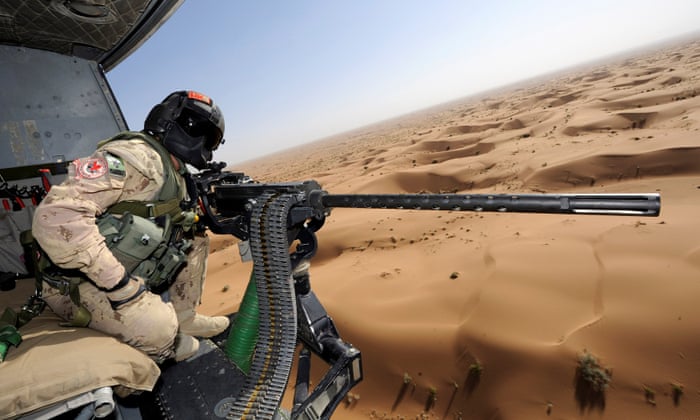 |
| Canadian Forces door gunner Sgt Chad Zopf leans out of a CH-146 Griffon helicopter during a training exercise in Afghanistan. Four Griffon helicopters will form part of the Canadian force in Mali. Photograph: Handout/Reuters |
In an interview Monday Dallaire said he is more comfortable with the idea of the Canadian Forces playing a support role than putting peacekeepers on the ground. “To me, this is the first step into a new generation of peacekeeping in Africa — a support role that is absolutely essential, helicopters that will be force-multipliers. So it is a useful engagement,” he said.
But his initial reticence is understandable. Mali is the most dangerous UN mission in the world. One hundred and sixty two blue helmets have died and, according to a former UN assistant secretary general, 80 per cent of the force’s resources are spent on self-protection from northern separatists and Islamic extremists.
“The United Nations in Mali is day-to-day marching into its first quagmire,” Anthony Banbury wrote two years ago in the New York Times.
The most recent report by Jean-Pierre Lacroix, the UN’s under-secretary general for peacekeeping, was scarcely more optimistic. “We are facing increased insecurity,” Lacroix told the UN, characterized by worsening human rights, food insecurity and daring attacks on mission forces, mainly from Burkina Faso, Bangladesh, Chad and Senegal.
Dallaire’s preference was a mission to the Central African Republic, where there are at least the foundations of peace on which to build. It’s not clear why CAR was rejected in favour of Mali — beyond the appeal by allies like Germany and the Netherlands, which have provided helicopters in the past.
But this is a decision that has ominous implications, not only for the men and women being deployed but also for the political fortunes of the Liberal government that is sending them.
The plan fails to articulate how the deployment to West Africa is in the national interest, Conservative defence critic James Bezan said Monday. There is a case to be made that the Mali commitment is being made to combat international jihadism, but Sajjan and Freeland didn’t make it during their press conference. “It’s actually about Justin Trudeau’s selfish political ambition to win a seat at the UN security council,” said Bezan. “He’s using our troops as pawns in his own political game.”
Of course, Bezan would say that. Many will dismiss his comments as a typical partisan smear. Except, there is more than a crumb of truth to them.
Winning the security council seat, after the Conservatives failed to do so, has been a foreign policy priority for the Trudeau government — a sign that “Canada is back.” A one-year commitment by Canada is not likely to make an appreciable difference to the broader mission but it does fulfil a Liberal electoral promise and improves the prospects of winning the seat.
Global Affairs minister Chrystia Freeland, downplayed the grubby brokerage aspect of the announcement, pointing out that Canada believes strongly in an international rules-based order that requires confronting instability and conflict around the world. “We are very aware of the complexity and the difficulty of the situation (in Mali),” she said.
But for a government that proclaims itself prepared, the plan has the back-of-an-envelope feel to it.
“In the coming days, the government will register its pledge with the UN and the Canadian Armed Forces will begin their planning process,” the official release said.
In addition, there remain many unanswered questions that should be tackled by ministers in a debate in the House of Commons, followed by a vote. What are the rules of engagement for Canadians flying into a war-zone? Could the mission be extended beyond 12 months? What is the chain of command? Is this just the first phase of a number of deployments?
The number of personnel being sent to Mali was not released Monday but Canada has committed to 600 peacekeepers and 150 police to UN missions. It is Dallaire’s distinct impression that further forces will be deployed elsewhere in Africa over time.
The cause is noble, no doubt. But it is risky for peacekeepers and politicians alike. The Dutch defence minister was forced to resign last October, after two troops died in a training exercise.
Freeland said that, as a candidate in 2015, she heard at the doors of her constituency that Canadians were enthusiastic about a mission.
But such testimony should be taken lightly. For one, her Toronto riding encompasses the bleeding hearts of Rosedale and the Annex (in favour, as long as someone else is doing the bleeding); for another, that was two-and-a-half years ago, when the Liberals were considerably more popular than they are now.
In sum, Trudeau’s government has dithered for two years before agreeing to send Canadian Forces into the most dangerous UN combat mission in the world.
If it goes badly, blandishments about “the international rules-based order” will get less purchase than allegations about “Trudeau’s selfish political ambition.”
• Email: jivison@nationalpost.com
