Translate

Showing posts with label CAF to Mali. Show all posts

Tuesday, November 20, 2018

Sajjan Confirms - Mali Mission Will Not Be Extended

By: Kathrine Starr, CBC News 

Canada's peacekeeping mission in Mali will end in July as planned, Defence Minister Harjit Sajjan has confirmed.

"The United Nations is working with other nations to look at replacing us," Sajjan told Chris Hall in an interview airing today on CBC Radio's The House. Sajjan spoke to Hall before his speech Friday to the tenth annual Halifax International Security Forum, a gathering of global leaders discussing major security and defence issues.

Sajjan said Canada will have fulfilled its year-long promise to head the Mali mission by July. The Canadian Press reported this week that the UN has quietly asked Canada about extending its role.

"The discussions I've had with other UN security generals has not led to that," Sajjan said.

Canadian troops arrive at a UN base in Gao, Mali, on Monday, June 25, 2018. (Sean Kilpatrick/Canadian Press)
"We've said this for a year. We wanted to offer up support for what the UN wanted to do. One big ask they had was the concept of smart pledges. Nations come, take a yearly responsibility. We have done that."

The minister added that there will be a transition period before Canada leaves Mali, much like the one that occurred when the German-Belgian helicopter mission in Mali was winding down and Canadian personnel were arriving last year.

Although an official announcement has not been made, The Canadian Press is reporting that Romania is expected to take over from Canada, but not until October or November — months after the Canadians have left.

"The UN is on track to be able to find a replacement," Sajjan said. "We will work with whoever steps up."
Most dangerous UN mission

Canada currently has eight helicopters and 250 military members in the sprawling West African nation to rescue injured peacekeepers and UN workers and to transport troops and equipment.

The Mali mission is considered the most dangerous UN mission in the world; 22 peacekeepers were killed this year alone and 177 have been killed since the mission began in 2013. About 15,500 people are part of the Mali mission now, which began after a rebellion in the north and a coup in the capital in 2012 resulted in a surge of violence.

Canadian peacekeepers have so far conducted four emergency evacuations in Mali. The most recent was on Nov. 1, after two civilians were injured when they were attacked with an improvised explosive device while driving.
More permanent presence needed in North

Sajjan also discussed Canada's defence goals in the Arctic, saying that more permanent troops are needed in the North to respond to threats such as increasing Russian aggression and Chinese interest in the region.

"We did identify that we do need to do more," he said, adding that a broader approach to the Arctic is necessary.

"Sovereignty [in the Arctic] isn't strictly about defence. It's about supporting our communities up there. We're looking at this from a whole-of-government approach."

Sajjan pointed to investments in Arctic offshore patrol vessels and satellites with greater coverage as two examples of government efforts to "sustain our ability to respond in the North."
Defence Minister Harjit Sajjan says that with the North growing in strategic importance every day, Canada needs to further develop its Arctic military presence. (Jeff McIntosh/The Canadian Press)
In August and September, Canada's largest annual Arctic sovereignty exercise, Nanook 2018, took place in Northern Labrador, Nunavut and the Northwest Territories. Sajjan himself visited various Canadian Armed Forces installations in the North in August.

With approximately four million square kilometres of Arctic land to keep an eye on — that's about 40 per cent of Canada's total land mass — Canada won't be able to ramp up its polar presence overnight, Sajjan acknowledged.

"We have increased our spending year by year, but it's going to take us a little more time to get to the efficiency we want," he said.

In its updated defence policy released last year, the federal government committed to pushing Canada's defence budget to $32.7 billion annually in the tenth year, with expenditures set to rise the most after the 2019 election.

Specific Arctic investments will include updating Canada's ability to monitor air traffic over all of the 36,000 islands in Canada's Arctic archipelago, and buying ATVs, snowmobiles and other vehicles as part of an $8.8 billion, 20-year commitment to new equipment.

The navy also will receive five to six armed and "ice-capable" ships, meant to keep the government informed of activity in Arctic waters.

Wednesday, July 18, 2018

Photos: Air Task Force Mali Arrive in Gao, Mali

Thanks to the Canadian Forces Combat Camera, the first images are surfacing from OP Presence, Canada's contribution to the UN mission in Mali. 

IS03-2018-0041-006
Canada's contingent to the UN Mission in Mali includes a large Female presence. 

IS03-2018-0040-025
Canadian Forces members meet their German counterparts at Camp Castor, Gao, Mali. 
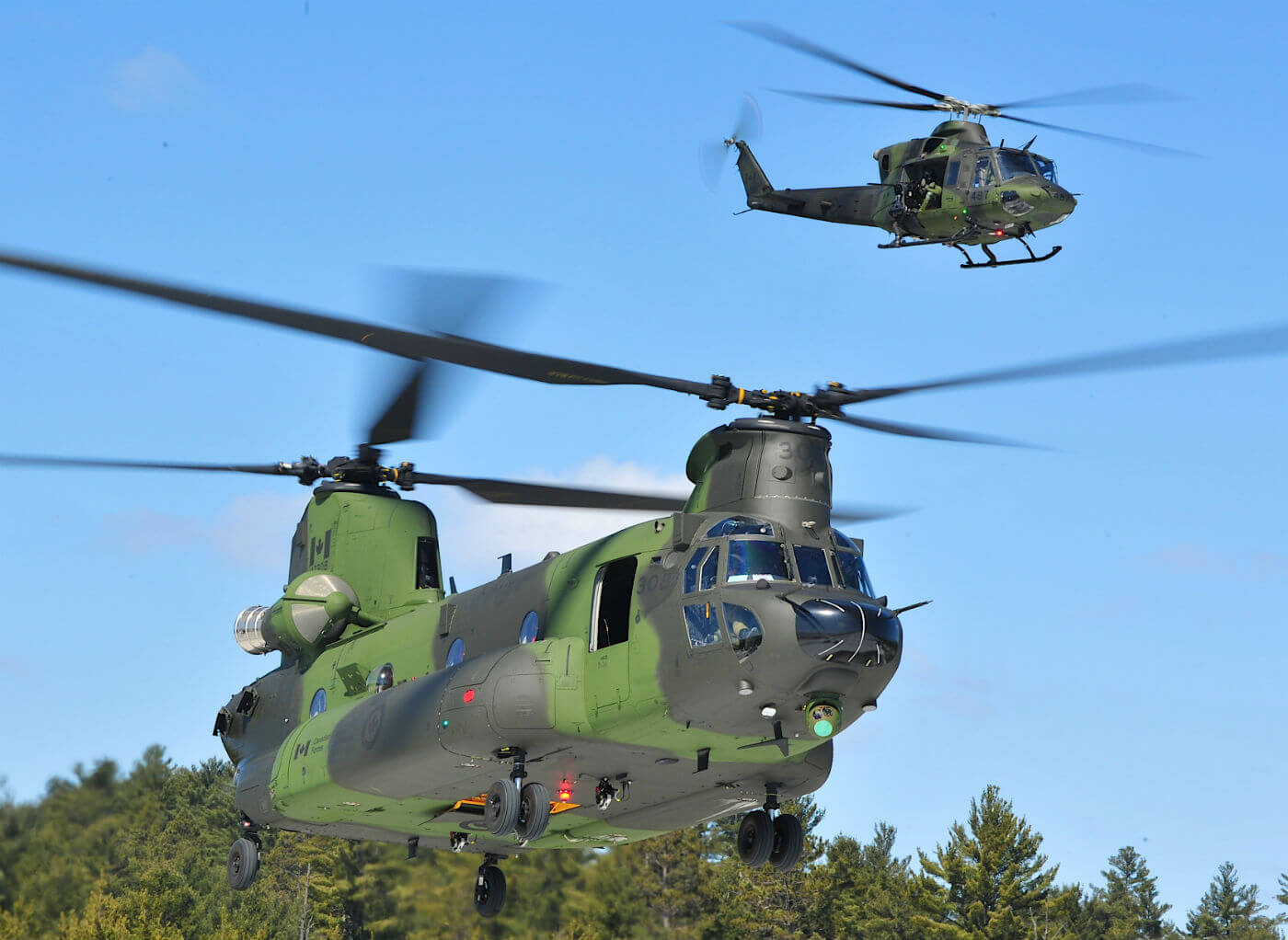
An RCAF CH-147 Chinook arrives at Camp Castor in Gao, Mali on July 15, 2018. Photo: MCpl Jennifer Kusche. Note the door gun MG in the Chinook for suppression during medevac or transport missions.
IS03-2018-0040-019
A CH-146 Griffon with door gunner arrives at Camp Castor in Gao, Mali on July 15, 2018. Photo: MCpl Jennifer Kusche


Friday, July 6, 2018

Opinion: Canada is Sending the Wrong Helicopters to Mali

By: Robert Smol, iPolitics 

In Mali, Canada’s flying pick-ups are no replacement for European helicopters

Canadian Forces door gunner keeps watch as his Griffon helicopter goes on a mission, February 20, 2017 in northern Iraq. THE CANADIAN PRESS/Ryan Remiorz
"Will our next round of UN peacekeepers have to engage, yet again, in that perennial Canadian military tradition of sending our military into harm’s way with far less than what our allies might provide to their forces?"A

For the last four years the German peacekeeping contingents, as well as the preceding Dutch, have struggled though the military and political quagmire of Mali with heavily armed, combat-proven attack helicopters operated by specially trained crews.

Quite appropriate for what is already considered the most dangerous peacekeeping operation attempted by the UN in its 73-year history.

But Canada does not own any attack helicopters. Instead our aging Griffon utility helicopters will be taking on armed escort responsibilities alongside our larger Chinook transport helicopters. Griffons were never designed to be an attack helicopter except in a pinch.

So the question needs to be asked: if Canada is expected to carry on and match the efforts of the Germans and Dutch will we have comparable capability in our improvised “armed” helicopters or will our next round of UN peacekeepers have to engage, yet again, in that perennial Canadian military tradition of sending our military into harm’s way with far less than what our allies might provide to their forces?

National Defence Headquarters, perhaps predictably, would not respond to my requests for information on any possible armament, sensor, and protective devices being installed on our 22-year old utility helicopters. However during the Afghan and Iraqi deployments , when Canadian troops were under the protective shield of US and allied attack helicopters and fighter aircraft, our Griffons were occasionally photographed carrying a door gunner positioned in the aircraft’s opening with a C-134 machine gun.

This haphazard, Vietnam-era “gun in the door” protection is quite consistent with the Griffon’s purpose. The Griffon is classified as a Utility Tactical Transport Helicopter. Its primary role, according to the RCAF website is “transportation of troops and material” making it more of a flying pick-up truck as opposed to highly agile flying tank that is a modern attack helicopter.

We should be concerned because, in Mali we will be away from the protective, largely U.S military shield that our military, not to mention the Canadian public, have come to expect in recent years.

So what did the preceding Dutch and German contingents in Mali have by way of armed helicopter escort? What level of armed, combat capability would our improvised, souped up utility helicopters have to match?

From 2014 to 2017 the Royal Netherlands Air Force deployed A-64D Apache attack helicopters to protect its assets. The Dutch Apache is armed with a 30mm automatic Boeing M230 chain gun that has a rate of fire of 625 rounds a minute. It also has a Lockheed Martin/Boeing AGM-114D hellfire air-to-surface missile with a range of 8-12 km. Also, depending on the nature of the threat, the Dutch Apache can also be mounted with Hydra 70 general purpose rockets and the AIM-92 Stinger anti-aircraft missiles.

Equally lethal, the standard armament for the German Tiger attack helicopter, currently exiting Mali, include a 30 mm cannon with a rate of fire of 750 rounds per minute. The Tiger can also be equipped 8 HOT Trigat anti-tank missiles, and 4 Stinger or Mistral short range air-to-air missiles. Also standard for the Tiger are two pods carrying 22 SNEB 68mm rockets.

Also impressive are the defensive countermeasure systems that are fitted to these flying tanks maximizing their survivability and effectiveness. These include, on both the German Tiger and the Dutch Apache a radar warning receiver, laser warning, and a chaff/flare dispenser. Crew survivability is also enhanced through the armoured protection given them a chance to make it back safely even after taking on enemy fire.

Could it be that Canada’s modified utility-transport helicopters, being deployed to Mali, are fitted with comparable armament and protection? Since we all know what the answer likely is the question then has to be asked: what level of additional support and compensation for our military weakness and vulnerabilities could we demand from the primary peacekeeping contingents in Mali which today are Burkina Faso, Chad, Bangladesh, Senegal, and Togo?

With Germany and the Netherlands out of the conflict, and the United States disengaged, it is from these country’s militaries that we will have to rely on once Mali’s Islamic militants realize that America’s most humble and obedient military servant (Canada) is facing them with utility transports posing as attack helicopters.


Welcome back to peacekeeping Canada!


The views, opinions and positions expressed by all iPolitics columnists and contributors are the author’s alone. They do not inherently or expressly reflect the views, opinions and/or positions of iPolitics.

Friday, June 22, 2018

Canada in Mali: What Exactly is the Mission?

By Charlie Pinkerton, iPolitics 

The Canadian Armed Forces are just weeks away from deployment to Mali, where they will replace a German helicopter contingent as part of the United Nations’ peacekeeping mission in the country.

Questions have been raised about whether there is any peace to keep in the central African nation. So what is the mission?

Some background: During the 2015 federal election Justin Trudeau promised that a Liberal government would involve Canada in peacekeeping again. In 2016 the government said up to 600 Forces troops would be made available to peacekeeping efforts.
A French soldier stands inside a military helicopter during a visit by French President Emmanuel Macron to the troops of Operation Barkhane, France's largest overseas military operation, in Gao, northern Mali, Friday, May 19, 2017. The six military helicopters that Canada plans to send to Mali could be used to move more than peacekeepers: they could be called upon to support a multinational counter-terrorism force also operating in the country.THE CANADIAN PRESS/AP-Christophe Petit Tesson, POOL
French soldier inside a military helicopter in Gao, northern Mali, Friday, May 19, 2017. is keeping the door open to sending more helicopters to Mali to support Canada's peacekeeping mission there. Christophe Petit Tesson / THE CANADIAN PRESS
The government announced in March that Canada would join the Multidimensional Integrated Stabilization Mission in Mali (also known as MINUSMA). It has since said that between 200-250 troops will deploy initially. The “flexibility” exists to deploy more, said Defence Minister Harjit Sajjan. “We can go up to 600 and we will make adjustments,” he said in May.

In Mali: Canadian troops will fly two Chinook transport helicopters and four Griffon armed escort helicopters. Forces will be armed on base and, in some circumstances, on board the helicopters. Weapon systems on the Griffons will be similar to those used in Afghanistan, according to Lt.-Gen Al Meinzinger, the commander of the Royal Canadian Air Force. Canada’s Griffons were outfitted with side-door machine guns and Gatling guns in Afghanistan.

The defence minister has not closed the door on the possibility that the number of helicopters that Canada sends to Mali could change.

While serving as the commander of the Canadian Joint Operations Command, Lt.-Gen Stephen Bowes clarified to the House defence committee what Canada’s role in Mali would be, saying that “it’s air medical evacuation, logistics support and transportation.” Bowes has since moved to a position with Veterans Affairs Canada.

Meinzinger said that Canadian troops will be supported by about 500 Germans in the base camp in the Gao region of Mali, where they’ll operate from.

Canadian soldiers are committed to MINUSMA for a year.

Since the mission began in April 2013 it has been the deadliest UN peacekeeping mission. In total, 169 MINUSMA peacekeepers have been killed.

Two German pilots were killed last year in a helicopter crash near Gao. A report conducted by Germany’s Defence Ministry showed the crash occurred because the helicopter’s autopilot had been set incorrectly.

A contentious aspect of the mission has been Forces rules of engagement when encountering child soldiers. The Forces published a joint doctrine last year on how to face young combatants. It was the first time the Canadian military has published a directive that specifically addressed encountering child soldiers.

Bowes told the Commons defence committee in April that Canadian Forces members would follow “Canadian rules of engagement” in MINUSMA.

“They will have the authority to defend themselves,” the defence minister has also said.

Discussion dividing Canada’s government and its opposition has largely been over whether Mali is considered a war zone.
At the G7 summit just weeks ago, UN Secretary General Antonio Guterres told CBC News that Mali is a war zone and that casualties are “possible.”

Bowes called it a “complex conflict zone.”

Sajjan has called the conflict “complex and dangerous” and repeatedly said it’s important to consider the “realities” of modern peacekeeping.

Bowes said in April that Canada would begin its involvement in Mali in June with most of its main troops entering before the third week of July and Germany’s helicopters exiting in August.

Sajjan said last month that Forces would enter Mali in July but that they would put safety over meeting deployment deadlines.

CAF Mali Mission May be Tainted by Atrocities

By: Geoffrey York, The Globe and Mail
African Correspondent, Johannesburg

As Canada prepares to send hundreds of troops to Mali on a peacekeeping mission, a fresh discovery of mass graves and alleged military atrocities has highlighted the human-rights challenges that the Canadians could face.

The defence minister of the West African country admitted this week that Malian soldiers were implicated in “gross violations” after the bodies of 25 civilians were found in mass graves in central Mali.

Canada plans to deploy up to 250 troops and six helicopters to northern Mali in August for a one-year mission as part of the United Nations peacekeeping force, known as MINUSMA, which co-operates with the Malian military on the ground. The Malian forces have been battling Islamists and other rebel groups.

Why is Mali in crisis?

Some experts say Canadian troops should look for opportunities to train and advise Mali’s soldiers on human rights – a subject where previous training by the European Union seems to have been ineffective.

Kisal, an organization that helps pastoral communities in Mali, said the 25 dead civilians in the mass graves were mostly herders from the Fulani ethnic group who had been detained by the Malian military last week.
Members of the Malian Armed Forces secure a road in 2017.
Mali’s defence minister, Tiena Coulibaly, confirmed the existence of the mass graves and ordered an investigation. He said “some armed-forces personnel” were implicated in “gross violations” that caused the deaths.

Mali’s authorities are “firmly resolved to fight impunity and get soldiers to strictly observe international rights and humanitarian conventions,” Mr. Coulibaly said.

The evidence of mass graves was just the latest in a long series of documented cases of extrajudicial killings and arbitrary arrests by Mali’s military.

Corinne Dufka, a West Africa researcher at Human Rights Watch who travels frequently to Mali, said she has documented more than 60 alleged summary executions by Mali’s security forces since 2017, with the remains of the victims found in at least seven mass graves. This does not include the latest case of the 25 bodies reported this week.

“Since early 2017, scores of witnesses have described severe mistreatment, arbitrary arrest, disappearances and summary executions,” she said. “I am aware of no single soldier held to account for any of these. … As long as soldiers continue to enjoy impunity, the abuses will continue.”

Human Rights Watch had earlier warned in April that it had received many reports of torture and mass arrest by the Malian army. The army seemed to be “running amok” in central Mali, it said.

In a report in late March, covering a three-month period, the UN said Mali’s defence and security forces were involved in a quarter of the 133 cases of human-rights abuses that UN peacekeepers had documented.

It said, for example, that Malian armed forces had arbitrarily arrested 10 civilians in a counterterrorism operation on Feb. 21 and had summarily executed seven of them, while the others are still missing.

In another report in June, the UN cited allegations of 56 summary executions by Mali’s armed forces.

Because of the continuing problem of human-rights abuses, the Canadian troops in Mali should prioritize the protection of civilians and should try to advise and mentor Malian soldiers to ensure better respect for human rights, Ms. Dufka said.

“We have found that the presence of MINUSMA and French forces in conflict zones in Mali serve as a strong deterrent to abuses by armed groups,” she told The Globe and Mail.

The UN peacekeeping mission co-operates with Mali’s military in a number of areas, including intelligence-sharing and some ground patrols, although the Canadian troops would primarily be supporting the UN in helicopter operations.

The UN mission has “conducted regular patrols” with Mali’s defence and security personnel and provided medical evacuations for the military, according to the UN report in late March.

The Canadian government has disclosed few details of how Canada’s peacekeepers will operate in Mali. Opposition MPs in Ottawa have complained about a lack of information on the planned mission.

It seems likely, however, that the Canadian troops will be based at an airfield in the town of Gao in northern Mali, and they will primarily be there to support the Canadian helicopters.

Bruno Charbonneau, a peacekeeping expert and associate professor of political science at Laurentian University, said he is doubtful that the Canadian peacekeepers will have much contact with Malian forces.

He noted, however, that the Canadian forces could potentially be asked to support the activities of the French military or a new West African military force known as G5 Sahel, both of which are fighting Islamist jihadists in Mali. The G5 group includes Malian troops.

The UN peacekeeping force is not officially authorized to conduct counterterrorism operations, he said. “But in practice it is difficult if not impossible to differentiate between peacekeeping and counterterrorist operations,” he said.

Walter Dorn, a peacekeeping expert at the Canadian Forces College in Toronto, said the Canadian military should support the UN peacekeeping force in providing human-rights training and mentoring for Malian soldiers.

Tuesday, June 12, 2018

Boeing Sending Technical Staff with RCAF to Mali

By: David Pugliese, Defence Watch 

Boeing says it will be sending a technical representative to Mali to support the RCAF when it deploys its Chinook helicopters. So far one specialist is scheduled to go but others could follow.

The Boeing staff will be at the RCAF base in Mali to consult on issues that arise during the Chinook operations in what is expected to be a deployment that is hard on the helicopters because of the environment.

Members of the Canadian Medical Emergency Response Force Protection Team fall back to the CH -147 Chinook helicopter, during Exercise Maple Resolve in Wainwright, Alberta on the 16th of May 2018. Photo: Corporal Andrew Kelly, Canadian Forces Combat Camera IS08-2018-0010-009

On March 19 the Canadian government announced its commitment to deploy a task force made up of medium utility and heavy lift transport helicopters for up to 12 months to the United Nations Multidimensional Integrated Stabilization Mission in Mali.

The task force will provide two CH-147F Chinook helicopters from 450 Tactical Helicopter Squadron, based in Petawawa, Ont. and four CH-146 Griffon helicopters from 408 Tactical Helicopter Squadron, based in Edmonton, Alta. Aircraft spares could also be made available to the Aviation Detachment.

The aircraft and personnel are expected in Africa by August.

In Mali, the CH-146 Griffon helicopters will serve as an armed escort for the Chinooks as they carry out UN missions. The Canadian Armed Forces will provide MINUSMA with a number of medically-trained personnel who will help in medical evacuations for partners and allied forces on the ground and provide logistical support for the mission.

Monday, June 11, 2018

In Mali, how do we avoid helping the bad guys again?

By: Doug Saunder, The Globe and Mail

In a few weeks, six military helicopters and 250 soldiers will begin their journey from Canada to the Sahara Desert, where they will join more than 11,000 international forces in a five-year-old operation known as the United Nations Multidimensional Integrated Stabilization Mission in Mali.

MINUSMA Guinean contingents set up positions on higher ground around Kidal, Mali, in December 2016.
UN PHOTO/HARANDANE DICKO/UN PHOTO
And once again, there is controversy: Are we pouring money and lives into another mission that risks becoming a decade-long quagmire, with unclear goals? Has the Trudeau government pushed our soldiers into this commitment because there’s pressure from our allies and a voter appetite to see maple leaves on the peacekeepers’ blue helmets?

While there’s some truth in both accusations, the Mali mission is not, by itself, an unworthy or imprudent use of our military resources. Mali, a hopeful and comparatively stable country until Islamist forces invaded its north in 2012, needs help rescuing itself from an outside invader hated by most of the population. The UN mission is not a Western imposition or a regime-change operation: Mali’s legitimate government has requested military assistance with what should be a limited operation against a jihadi insurgency – thus the operation’s name.

That said, there is reason to be gravely concerned about the prospects of this sort of military mission. While this is still officially a peacekeeping operation, in practice it bears no resemblance to the classic conflict-prevention campaigns of decades ago. Its mission is “to help stabilize key population centres and support the re-establishment of state authority throughout Mali, and to develop and implement programs for the disarmament, demobilization, and reintegration of former combatants.” It is, in everything but name, a counter-insurgency operation.

And counterinsurgency operations – designed to neutralize an extremist guerrilla enemy by strengthening a country’s civic institutions and supporting the population – have a terrible track record.

The Mali goals are strikingly similar to those of Canada’s mission in Afghanistan, under NATO’s International Security Assistance Force. The stabilization and institution-building operations in Afghanistan were expensively implemented by hundreds of thousands of people, lavishly and carefully designed by scholars and social scientists – and they failed badly.

Last week, the U.S. government’s Special Inspector General for Afghanistan Reconstruction released its report concluding that 17 years of “efforts to stabilize insecure and contested areas in Afghanistan mostly failed,” and that elsewhere the Afghan mission “overestimated its ability to build and reform government institutions as part of the stabilization strategy,” and “spent far too much money, far too quickly, in a country woefully unprepared to absorb it.”

As a consequence, “opportunities for corruption and elite capture [theft] abounded, making many of those projects more harmful than helpful,” and “power brokers and predatory government officials with access to coalition projects became kings with patronage to sell, fueling conflicts,” and the many Afghans left outside these power networks “found natural allies in the Taliban, who used that support to divide and conquer communities the coalition was keen to win over.”

This pattern keeps repeating itself: Even the most well-intentioned and well-designed “stabilization and assistance” operations end up benefiting the enemy.

Aisha Ahmad, a political scientist at the University of Toronto who specializes in the financing and economic activities of jihadi extremist groups (patterns she investigates in her new book Jihad & Co.: Black Markets and Islamist Power) has found that most efforts to stabilize and normalize countries are designed in ways that benefit the jihadis more than those they’re meant to support.


The reason why jihadist groups keep returning to power in African and Central Asian countries, she writes in a new essay, “has remarkably little to do with jihadist ideology or identity politics. Rather, there is a clear economic logic behind these patterns of jihadist resurgence.”

Big international interventions (whether UN or NATO), she writes, “flood conflict zones with foreign resources, which create a series of perverse incentives. These incentives change the cost calculations and the behaviour of local armed groups, especially the international community’s local allies. Too often, foreign dollars socialize and incentivize these local allies to behave poorly — and indeed, even sabotage mission success.”

From the perspective of a poor country’s economy, an international military mission is something like a discovery of oil – a flood of untethered money that risks a “resource curse” effect, making the worst people more powerful. This has a tendency to turn insurgent groups into winners and governments into losers. It is still possible to play an important role in making Mali a better place – but, as Dr. Ahmad concludes, we’d better pay a lot more attention to what our money is doing.

Friday, June 1, 2018

Canada’s Mission to Mali could become a new Afghanistan

By: Ken Hansen, Special to Macleans Magazine 

Opinion: There is no peace to keep in Mali, and the UN mission there has become a deadly quagmire—one that Canada might be wise to just avoid

Ken Hansen is an independent defence and security analyst and owner of Hansen Maritime Horizons. Retired from the navy in 2009 in the rank of Commander, he is a member of the Science Advisory Committee for Atlantic Oceans Research Enterprise and a contributor to the Security Affairs Committee for the Royal United Services Institute.
“Canada is back,” Justin Trudeau said when his Liberals won the 2015 election. After years in the wilderness on peacekeeping, he said, Canada would be returning to its heritage as a leader in peacekeeping missions, promising to commit up to $400 million and 600 Canadian Armed Forces personnel to UN peace operations.

In this Feb. 25, 2015 photo provided by the United Nations, UN peacekeepers from Bangladesh arrive at the Niger Battalion Base in Ansongo, in eastern Mali. (Marco Dormino/United Nations via AP)
But his Liberal government has hit a significant road bump along the way: The most recent figures from the United Nations have found that Canada’s peacekeeping commitment has reached an all-time low. The government said it was looking for a mission that would be the right fit.

In March, after the United Nations sent a formal request for a military contribution to its ongoing mission in Mali (MINUSMA)—established in April of 2013 with a mandate to “support the transitional authorities of Mali in the stabilization of the country and implementation of the transitional roadmap”—the government announced that it had found the right mission. Canada offered up six helicopters—four light utility “Griffons” and two twin-rotor “Chinook” transports—and approximately 250 military personnel (and up to 600) to MINUSMA.

But the UN was quick with its assessment. In mid-April, the UN said that the Canadian force was not robust enough to meet the increasing demands of what is being described as the UN’s most dangerous mission, saying that Canada needed more helicopters to assure a minimum of two transport aircraft and two escort helicopters at short notice. The current German contingent employs four armed utility helicopters and four transports with over 900 support personnel, while the Dutch, who the Germans replaced, used four Apache attack helicopters and three Chinook transports; both contingents lost a helicopter due to accidents Nevertheless, the helicopters and personnel were reportedly set to be deployed later this summer, though Canada now appears to be hemming and hawing as the UN calls for Canada to meet its deadlines.

But even beyond Canada’s seeming unpreparedness, and the pressure to bolster its peacekeeping efforts, there are red flags all over the mission. The situation in Mali strongly resembles the conflict in Afghanistan, a mission marked by mission creep and escalating risk. Ethnically divided, with a weak central government and borders that are not respected or controllable, Mali is confronted by a radical opponent that will use any level of violence against all manner of victims. Canada’s desire to participate in future UN peace support missions must be tempered by careful situation analysis and adequate risk mitigation, or they risk blundering into a dangerous mission like MINUSMA—a toxic situation that Canada would be wise to avoid.

The history of the violent conflict between the impoverished northern and affluent southern parts of Mali is long, with a traceable history going back to the 13th century. This most recent issue, according to the Clingendael Institute—which has charted the break-up between north and south—stems from the French period of colonization when the northern Tuareg and nomadic Arab communities were virtually excluded from plans for post-colonial rule on June 20, 1960. From that point onward, the Tuareg have had only a few seats in the Malian assembly. The first-ever Arab, Zahabi Ould Sidi Mohamed, was elected in 2013.


From 1960 to 2012, there were four Tuareg rebellions and five different peace agreements. The use of the French military to force the sides apart has been a recurring theme, and the deployment of France’s notorious Foreign Legion—whose heavy-handed use of force in this part of the world is legendary—only sharpens the resentment of the northerners.

The most recent peace accord, sponsored by Algeria, was signed in 2015, but the violence since then has been almost constant. Neither side respects the agreement. The arrival of al-Qaeda in the Sahel to bolster the northerners has provoked a significant escalation in the type of attacks being staged, while also broadening the issues at stake; indeed, the Malian situation is only part of the bigger social and economic problems that stretch across the entire region. The International Crisis Group (ICG) report for 2017 postulated the Sahel as the zone of conflict between forces from Saharan Africa and the non-Arab agrarian south.

The trend lines in Mali do not auger well for Canada’s peacekeeping aspirations. The ICG’s 2018 Watch List Report describes strengthening insurgencies in parts of Mali, Burkina Faso and Niger. Jihadi groups are exploiting the situation to establish secure operating areas and find new recruits. The ICG maintains that the Bamako Peace agreement of June 2015 has stalled, and crop failure and food shortages are only exacerbating the ethnic tensions.

These are huge, historical issues, and if disentangling them seems like an outsize task for Canadians who still value the peacekeeping tradition, the UN’s recent history of expanding the mission mandate should be particularly worrisome. a long list of further duties, including: “ensuring security, stabilization and protection of civilians; supporting national political dialogue and reconciliation; and assisting the reestablishment of State authority, the rebuilding of the security sector, and the promotion and protection of human rights in that country.” These complicated responsibilities tasks carry a far heavier burden of responsibility for the use of force. The mission has grown, as a result, and its current strength is set at 15,425 personnel, comprising mostly 13,289 military and 1,920 police. The annual budget is USD$1.048 billion.

The biggest problem is that MINUSMA does not have the capabilities for the type of threat they face. “We are gathering the intelligence, but we lack the forces­ who can act on that information,” the mission’s chief of intelligence, Swedish Lt.-Colonel Per Wilson, told Sieff. And after a visit to Mali, Prof. Walter Dorn of the Royal Military College in Kingston told the CBC“the UN mission is struggling, but is making a difference on the ground… The Mali government is struggling to exert control over the wild territories in the north.” The successes, so far, have been limited—and the risks are great.

The need for more robust military capabilities led the UN to approve cooperation between the French military and the UN mission. Resolution 2364 (2017) expanded MINUSMA to its current limits and added the additional tasks of “providing operational and logistical support to the Malian Security and Defence Forces. The resolution also reinforced cooperation between the mission, the local multi-national “Group of 5” Sahel forces and French forces while respecting their respective mandates.” The escalatory nature of the UN’s move is obvious.

The tactical connection between French Foreign Legionnaires and the UN forces have only led to an inevitable comparison that has made the task even tougher for the peacekeepers on the front lines: according to Sieff’s article, Islamist extremists across the Sahel region have dubbed the whole undertaking as “Crusader occupation forces.” As a result, the militants have started targeting peacekeepers. Sieff described attacks on UN convoys with improvised explosive devices and cars driven into UN compounds carrying 1,000-pound bombs detonated in suicide attacks. The UN death toll is currently 169, and there will be more.

If Canadians think that our mission in Mali will be a return to some form of peacekeeping, they are in for a stunning shock: There is no peace to keep. The UN has already begun moving into a dangerous and violent form of operations that the UN does not formally recognize, known in military circles as “peace imposition.” The obvious demand for rapid reaction and effective logistics will put a heavy burden on the Canadian contingent. They will be in the very epicentre of the most aggressive and dangerous actions, and losses are practically a certainty. “It is a crisis that looks more like the U.S. ground wars in Iraq and Afghanistan than the cease-fires traditionally monitored by U.N. missions,” Sieff writes—and in this, he is absolutely correct.

Former ambassador Robert Fowler, in an open letter published in the Globe and Mail, wrote of what he saw as “the importance of Canada’s mission to Mali.” “The Islamists hate everything we represent,” he argued. “They also hate the United Nations with a vicious passion.” His assessment aligns quite well with the trends identified here. However, his recommendation for a major whole-of-government commitment to the region is definitely not what the Trudeau government wants—that is, another searing Afghanistan experience.

Fowler, who spent months as a captive of the rebels, feels that the Canadian mission will not be about regime change and social re-engineering. But frankly, how he views the mission will not affect how it is actually conducted. That has already been established by the rebels who have likened all outside forces to “crusaders.” The prospects are high that this will go much as the Afghanistan debacle went; the same type of escalation and mission creep seen during our 12-year engagement there is already happening in Mali. The UN is expanding its operational aims and tactical objectives in the region, finding new allies, and some old ones, for a protracted struggle.

This type of mission against radical extremists and corrupted political systems has consistently produced very dubious results in Afghanistan, Iraq, Libya and Syria. Given the long and complicated history of the Sahel region, it feels foolish to expect anything else in Mali.

Wednesday, May 30, 2018

CAF Will Not Rush to Meet Mali Mission Deadlines

By Charlie Pinkerton, iPolitics 

The Canadian Armed Forces won’t be rushing to meet any deployment deadlines in Mali or on any other future peacekeeping missions under this government, the minister of defence said Tuesday.

“I will not speed up the process just for the sake of meeting a certain timeline for any time of competitive nature. We will always make sure that when we make a decision that we will achieve the mission and that our troops will have the right training and equipment,” Harjit Sajjan told members of the House Standing Committee on National Defence.

The Canadian Forces are preparing to send two Chinook transport helicopters and four Griffon escort helicopters as part of a United Nations’ peacekeeping mission in Mali. Canada is replacing German and Belgian allies in an area near Gao, where its helicopters will serve in a support role.

The Canadian Press reported last week that the helicopters and 250 military personnel are scheduled to leave in July and begin work at the start of August.

Sajjan insisted the number of troops deployed is not as important as their capabilities in modern peacekeeping missions such as Mali.

“This is not about the numbers anymore. This is about understanding what contributions that we can make that can have a substantial impact.”

He added that the number of Canadian troops deployed should be expected to fluctuate.

“We now have the flexibility, based on the plan that we have, to go up to 600 and we will make adjustments.”

Conservative defence critic James Bezan slammed the government for the amount of time it has taken to deploy troops.

“The armed forces know how to deploy, that’s what they do. Why is it taking so long to move a small helicopter task force to Mali?” Bezan questioned.

Sajjan blamed planning and safety concerns for delays in deployment.

When pressed by Conservative members on the dangers that Canadian Armed Forces members deployed in Mali will face, Sajjan admitted that the mission poses threats.

“We need to look at what the realities are on the ground and that’s what we need to discuss. Yes, those conflicts are complex, and are dangerous,” he said.

Both German and Dutch forces have lost helicopters in accidents in Mali over the last couple of years in the area where Canadian helicopters will deploy. Four peacekeepers died in those accidents, which were caused by difficulties posed by the environment.

Canadian troops are pledged to a one-year commitment to the UN’s peacekeeping mission in Mali.

RCAF Griffons To Replace German Tiger Attack Helicopters in Mali

By: Daniel Maillet,
CAF Dispatch  

By August 2018 Canada will have "returned" to the United Nations Peacekeeping circle with some 250 members of Air Task Force Mali; which is expected to have two CH-147 Chinook helicopters and four CH-146 Griffons with door-gunner escort helicopters.

The mission is the deadliest of any United Nations peace operation, with 162 fatalities since it began in 2014.

Canada's deployment of an RCAF contingent is replacing the German Air Force's four UH-Tiger Attack helicopters and the Belgian Air Forces two NH90 medium-utility transport helicopters.

Image result for UH-Tiger Mali
Two German UH-Tiger Attack helicopters in Mali. 
The CH-147 Chinook is an upgrade for the Mali mission over the NH90. While the Chinook is slower and has a slightly shorter ranger - it can carry a much larger payload - more than double the payload of the NH90.

Canada's CH-146 Griffon Helicopters, on the other hand, are leading to questions about whether or not they can maintain the same level of security as the UH-Tigers. Prior to the Tiger's arrival in Mali; the Dutch Air Force had deployed Apache Attack helicopters as escorts. So the Griffon is a clear step-down.

Ted Campbell, a retired Senior Officer of the Canadian Armed Forces clearly expresses this concern. "[The] Griffon is a good helicopter and its crews, including the door gunners, are...much better than any aircrews anywhere on earth, but they do not have the “punch” of any attack helicopter." He goes on to say, "it is, of course, far to late to equip the Canadian Forces with attack helicopters for this mission."

Mr. Campbell is correct - here is a side-by-side comparison I compiled, as one does exist (because the Griffon is not considered by anyone except the RCAF as an "attack" helicopter)

Eurocopter UH-TigerBell CH-146 Griffon
Range: 800 kmRange: 656 km
Max Speed: 290 km/hMax Speed: 260 km/h
Ceilling: 14,000 ftCeilling: 20,000 ft
Max Takeoff: 13,000 lbsMax Takeoff: 11,900 lbs
Main Armament: 2x 30 mm (1.18 in) GIAT 30
Secondary Armament:  Multiple Options for
two outer hardpoint connections. This includes options for rockets and additional guns.
Main Armament: 2 x  7.62 mm M134D "Minigun";
or  2 x 7.62 mm C6 general purpose machine gun;
or  2 x .50 Cal (12.7 mm) GAU-21
Secondary Armament: None
Power Plant: 2 × MTU Turbomeca Rolls-Royce MTR390 turboshaft engines, 1.303 shp (958 kW) - EachPower Plant: 1 × Pratt & Whitney Canada PT6T-3D turboshaft engine, 1,250 shp (932 kW)

With the side-by-side comparison - it is clear that the Griffon, while it can operate a higher altitude, has little else in comparion to the UH-Tiger. The Eurocopter Tiger Attack helicopter is a far more versatile helicopter than the Griffon, and the twin engines make it far more powerful.

Image result for Griffon Door Gunner
Canadian Door Gunner sits back in his CH-146 Griffon helicopter over Afghanistan. Photo by: Sergeant Matthew McGregor, Canadian Forces Combat Camera© 2011 DND-MDN Canada
The Risks to RCAF Helicopters and Crew 

Additionally, something the Government of Canada is not highlighting is the very real risks involved in the Mali deployment. Last summer Germany lost a Tiger Helicopter, killing its crew of two.  This was not due to an attack by extremists, but an error in the auto-pilot settings.  This source of this error has not yet been located, but the Subsaharan climate could be to blame. RCAF Griffon pilots have experience in both Afghanistan and in Iraq, but the deserts of Mali are different than both those of Mesopotamia. Although General Vance considers the dry, dusty conditions of the terrain in Mali are similar to what the military has faced elsewhere.  Only four of the 160 fatalities have been associated with helicopter incidents. All of those had to do with mechanical failure of the aircraft and not with enemy or belligerent fire” according to Chief of Defence Staff Gen. Jonathan Vance in an interview with Global News.

Thursday, May 24, 2018

With Mali Mission, Canadian Troops are entering a Madhouse

By: ROSIE DIMANNO, The Toronto Star 

Canadian troops deployed in UN peacekeeping missions, as of Feb. 28, 2018: 0.

Canadian police deployed in UN peacekeeping missions as of Feb. 28, 2018: 19.
Helicopters piloted by German soldiers take off from Gao airport in Mali last year. When the Canadians are deployed later this year, they will be replacing the Belgians, who are currently in the process of replacing the Germans. (SOULEMAIN AG ANARA / AFP/GETTY IMAGES FILE PHOTO)
Canadian staff officers deployed in UN peacekeeping missions as of Feb. 28, 2018: 12.

In all, 22 actual soldiers — excluding some staff positions — are participating in four of the 16 international peacekeeping operations around the world sanctioned by the UN Security Council, according to National Defence figures. Lowest number ever.

Out of 90,000 — 77,456 troops — deployed under the UN flag by 123 nations.

Which is surely an indictment for a country that likes to think it invented the whole blue helmet thing and still rhapsodizes/romanticizes over the concept.

Operationally, we are frauds.

Just as a by-comparison, for instance: Bangladesh has 6,342 troops in UN peacekeeping missions. Ethiopia has 8,121. Nepal has 4,672. (As per most recent UN statistics).

Of course Canada played a key role — sacrificing blood and treasure — in NATO-led operations in Afghanistan. Canadian CF-18s conducted airstrikes in the military intervention that brought down the Gaddafi regime in Libya in 2011, with a Canadian general in top command of that NATO undertaking. It was a spectacular success — until NATO wiped its hands of Libya, leaving a frail democratic movement to be overwhelmed by all the warring militias and terrorist groups on the ground. In a sideways development, tons of weapons from what is now a failed state were dispersed across Africa, fuelling conflicts in Syria, Somalia and Mali.

Some of those arms, now in the hands of Malian insurrectionists, could very well eventually be trained on the Canadian helicopter contingent — two Chinook choppers to provide medical evacuations and logistical support (unclarified in the details) and four smaller, lightly armoured Griffons to act as armed escorts for larger transports — that Ottawa this week announced will be sent to Mali by the end of the summer. For one year.

Fulfilling Prime Minister Justin Trudeau’s long, lazy, laggard commitment to step up Canada’s peacekeeping pledges to the UN.

While Mali is the worst of hellholes for UN peacekeeping missions — 162 peacekeeping fatalities since the mission began in 2013 — only four resulted from helicopter incidents and all of those were the result of mechanical failures, as Chief of Defence Staff Gen. Jonathan Vance told Global News in an interview a few days ago. Though I still don’t much like the idea of lightly armoured aircraft for the purpose in a war zone.

If nothing else — and a deployment of some 250 Canadians for the Mali endeavour, which is pitifully meagre — the commitment makes good on a Trudeau electoral vow after three years of dithering and dawdling and, even before that, as Opposition leader, disrespecting Canadian pilots (advocating humanitarian aid to Iraq rather than joining the military coalition against Daesh, “trying to whip out our CF-18s to show how big they are.”)

Ugh.

And nowhere near the later promise to deliver 600 troops and 150 police officers to UN operations.

Still and all, Mali wins the lottery. Canadian troops will, in about six months, replace the Belgians, who are currently in the process of replacing the Germans.

Also, this being Trudeau, the deployment comes wrapped in gender parity tinsel, because that is Trudeau’s obsession.

So off to war-ravaged Mali we shall go, where a peace agreement signed in 2015 hasn’t been worth the paper it was written on.

Listen, I’m all for peacekeeping, when there’s any peace to keep. I’m much more for peacemaking and boots on the ground when absolutely necessary. I know Canadian Forces personnel are well-trained and eager to deploy somewhere — and that they don’t require being swathed in no-risk gauze. That’s what Ottawa would deeply prefer, of course — noncombat no risk and no blowback should a Canadian be killed.

(A bit rich, however, for the Conservatives to be leading that war-leery charge now, a change-lobsters-and-dance position from the Afghanistan years.)

Not to Syria, then. Because, oh no, Ottawa doesn’t want any part of that endless atrocity. Not for a combat capacity contribution to Northern Iraq, where a U.S.-led coalition of the more-willing has seized back most of the territory which had fallen under the control of Islamic State (also known as ISIS and Daesh). And not to Burma, where a genocide against the Muslim-minority Rohingya continues to unfold before our uncaring eyes.

There are compelling reasons to intervene — to contribute to a military intervention — in combustible flashpoints across our war-exhausted planet:

Urgency. Except civilians dying by the tens of thousands in Syria is apparently not catastrophic enough for Canada, and in any event Russia’s veto at the Security Council would block a sturdy response under the UN aegis. President Barack Obama’s “line in the sand” — gas attacks — was just a rhetorical figment.

Reasonable expectation of making a difference. As Canadian troops clearly did in Afghanistan, until they were withdrawn and the Taliban tide erased just about every security and governance footprint.

Keeping the fighting sides apart by putting some armed muscle into ceasefire agreements. Not happening in Mali.

Places where Canada could make a difference, could be on the side of the angels. Because the Canadian public apparently insists on this — on clear-cut virtue.

Maybe that will be Mali as Canada returns to Africa, a continent where this country’s peacekeeping bona fides went to just about die: the 1993 shooting of an unarmed Somali drawn into an ambush to prevent looting and, two weeks later, beating to death a Somali teenager who snuck into their compound. Followed by denials and coverup conspiracies and, finally — there really was no choice, it was rotten to the core — disbandment of the Canadian Airborne Regiment.

There is always the potential for unforeseen consequences, in a strange land, and Mali is among the strangest of lands of all, torn apart by civil war between north and south, overrun with child soldiers and Islamic terrorism, reeling from severe food shortages.

Great big HOWEVER: Mali is a madhouse. And the United Nations MINUSMA (Multidimensional Integrated Stabilization Mission in Mali) has mismanaged the operation from the get-go, originally sending 10,000 soldiers in response to a terrorist takeover by independence fighters from the north, turned back from reaching the captial only by the earlier intervention of rapid response French troops in their former colony.

The UN troops were unprepared to engage in counterterrorism, which fundamentally the mission has become. In fact, they were explicitly ordered not to engage, until the rules of engagement were changed.

Writing in the New York Times two years ago, outgoing UN assistant secretary general Anthony Banbury called the Mali mission a blunder, with 80 per cent of the deployment’s resources going to logistics and self-protection. “The UN in Mali is day by day marching into its first quagmire.”

We’ll lock-step with them.

Rosie DiManno is a columnist based in Toronto covering sports and current affairs. Follow her on Twitter: @rdimanno

GoC Still Considering Spare Helicopters for Mali Mission

By: Lee Berthiuame, The Canadian Press

OTTAWA — The Trudeau government is keeping the door open to sending more helicopters to Mali to ensure the Canadian Forces can provide round-the-clock medical evacuations in what is expected to be a harsh operating environment.

Canada is preparing to send two Chinook transport helicopters and four armed Griffon escorts to the African nation this summer as part of a commitment to support the UN mission there.

Those helicopters and about 250 military personnel are scheduled to leave in July and begin work on Aug. 1, Col. Chris McKenna, the commander of the helicopter detachment, told The Canadian Press on Wednesday.

While the detachment will likely be called upon at times to move troops and equipment across the arid landscape as required by UN officials, their primary mission will be evacuating injured peacekeepers and others.

That will entail having one Chinook and two Griffons on "perpetual standby, 24/7," McKenna said, "so our crews are essentially sleeping almost beside the aircraft ready to launch.

"We are focused on getting to an incident site as quick as we can to be able to provide lifesaving interventions for both soldiers and anyone else that the UN would choose to medevac."

Such medical services are especially important given the nature of the UN mission in Mali, which has seen dozens of peacekeepers killed or injured in ambushes and roadside bomb attacks by local militants.

While that high tempo alone could be expected to put a heavy burden on the detachment, the extreme heat and dust at the UN mission in Gao, where the Canadians will be based, isn't expected to make life any easier.

Both the Germans and the Dutch have lost helicopters in the area over the last couple of years in crashes blamed on technical problems caused by the environment. The accidents killed four peacekeepers.

McKenna, whose detachment recently wrapped up several days of training at Canadian Forces Base Wainwright in Alberta, described the environment as "the biggest enemy."

"We're talking about operating state-of-the-art helicopters in the sub-Saharan Sahel region where the temperatures can reach 50-plus degrees and you see an enormous amount of dust," he said.

"And as you know from our experience in Afghanistan, that can be quite tricky from a helicopter point of view."

There are ways to manage those challenges, McKenna said, including making sure crews are familiar with the environment and setting up a stringent and efficient maintenance regime.

But the question of whether to send spare helicopters to Mali, either now or at some other point during the 12-month mission, is also on the horizon.

"I've been given leeway (to ask) for spares if we so think that that is required," he said. "And it is still being determined by government whether or not we'll be able to bring spares."

The Canadian helicopters and military personnel will replace counterparts from Belgium and Germany, the latter of which has been operating both transport and attack helicopters in Mali for several years.

Canada's arrival in Mali comes only months after the UN Security Council authorized the peacekeeping mission there to provide medical evacuations and transport services to a multinational counterterror mission in the country.

When asked whether that means his force could be called upon to support the so-called Group of Five Sahel force, McKenna would only say that his role will be to support the peacekeeping mission's mandate.

"We are having essentially no caveats going in," he added, "so we work for that force commander and we execute what he asks us to do as long as it's within our capabilities and our risk."

— Follow @leeberthiaume on Twitter.

Tuesday, May 8, 2018

More RCAF Helicopters a Possibility for Mali Mission

By: David Pugliese, Defence Watch 

The number of helicopters the RCAF will eventually send to Mali continues to be uncertain.

Image result for griffon attack helicopter
Canada has announced it will send two Chinook and four armed Griffon escort helicopters to Mali. 
In mid-March Defence Minister Harjit Sajjan announced that Canada would send to the United Nations mission in Mali two Chinook helicopters and four armed Griffon helicopters to escort them. A few minutes later at the same news conference Chief of the Defence Staff Gen. Jon Vance said the number of helicopters being assigned to the Mali mission have still not been determined as a reconnaissance had to be carried out.

A short time after that, Sajjan’s office sent out a message to journalists, contradicting Vance by stating that ‘up to’ two Chinooks and four Griffons would be sent.

Now in a response from the Canadian Forces to a series of questions about the Mali mission submitted by Defence Watch, it appears changes are again in the works…maybe…. “Details regarding tactics, risk mitigation, and force protection measures are yet to be finalized and many considerations need to be made,” the Canadian Forces noted in an email. “For instance, regarding operational sustainment, considerations include the possibility of deploying spare helicopters. As planning continues, we will be able to confirm such details in the near future.”

The response didn’t indicate whether that refers to spare Chinooks, Griffons, or both.

In addition, there are no details yet on costs….not even a ballpark figure on what Canadian taxpayers will have to spend for this one-year mission.

Monday, April 30, 2018

Is sending helicopters to Mali good enough?

By Chris Kilford

Given the recent concern over Canada’s upcoming contribution to the Multidimensional Integrated Stabilization Mission in Mali (MINUSMA), one might easily assume that up until now few Canadians had ever set foot in Mali. However, this is far from the case – Canada is Mali’s second-most important bilateral development partner, after France.

Image result for rcaf chinook helicopter afghanistan
Sgt Chad Zopf, a door gunner, onboard a Griffon helicopter while on exercise in Afghanistan.

At the Embassy of Canada in Mali, which opened in the city of Bamako in 1970, the Université Laval and various Canadian non-governmental organizations have been working for years to improve the daily lives of Malians.

In the past 12 months alone, and with the support of the Canadian government, efforts were underway to: improve agricultural output and food security; to assist community health physicians graduate from the University of Bamako; and to provide new software to Mali’s government for improving domestic revenue collection.

Meanwhile, several Canadian mining companies have significant investments in Mali. B2Gold Corporation, for example, operates the Fekola Mine with a 950-strong, mostly Malian workforce. According to Canada’s Ambassador, Louis Verret, the gold sector “accounts for about 66% of Mali's exports and is therefore critical for government revenue.”

However, since 2012, Mali has been gripped by civil war in part fuelled by the Canadian-backed ouster of Libya’s Muammar Gaddafi in 2011. Following his death, many Malian Tuareg fighters who had fought for his regime, returned home to fight for their own space in northern Mali. And, while a peace agreement between the government and its main opponents (including the Tuareg) was signed in 2015, little has changed on the security front. Instead, the French, the G5 Sahel regional force, and MINUSMA are doing what they can to contain various rebel factions.

As for MINUSMA, it is only as good as the troops it gets from contributing countries – and many western armies, which could make a big difference – are noticeably absent from the front lines. For a mission deployed in an asymmetrical conflict environment, this is a big problem, and has resulted in significant casualties for UN troops that have largely been drawn from developing countries.

Still, not all is lost. In June 2017, the UN instructed MINUSMA to fully concentrate its efforts on supporting the Agreement on Peace and Reconciliation and step-up efforts to redeploy Malian security forces to the centre and north of the country. To help, an EU Training Mission with 580 personnel is re-building the military, while 128 personnel with the EU Capacity Building Mission are focused on training the police, gendarmerie and national guard.

As for Canada, it will soon send six helicopters and approximately 250 personnel for 12 months in support of MINUSMA. For those wanting Canada to take on a more active international role, it’s good news. But when it comes to truly helping the UN, apparently our deeds are falling short of our words. Sending helicopters is important, but it’s not quite what many had expected from a government that has been consistently eager to portray itself internationally as a serious player on the world stage.

–––
Chris Kilford is a former Army Officer and defence attaché who served in Afghanistan and Turkey. Currently he is a fellow with the Queen's Centre for International and Defence Policy.

Thursday, April 26, 2018

Pardy: 'Peacekeeping' in Mali is but a Mirage for Canada

By: Gar Pardy, Special to The Ottawa Citizen 

There is a sharp bit of historical cynicism that generals always prepare to fight the last war. In today’s world, it’s politicians who want to ignore the lessons of the past and fight the war again.

Case in point: the decision to deploy the Canadian military as part of the United Nations “peacekeeping” force in Mali. Mali, which, just last week, suffered another attack on peacekeepers on its soil – one Blue Helmet was killed, and 14 French troops and UN peacekeepers were injured, along with two Malian civilians. The UN said it was the third attack this month.

A Bangladeshi United Nations soldier walks by a car during the weekly cattle market in Gao, Mali, in this file shot from 2017.ALEXANDER KOERNER / GETTY IMAGES
Canada’s decision to deploy military personnel there suggests none of the lessons learned from our 13-year war in Afghanistan are remembered. Nor is there memory of Canadian military involvement in the messy, inconclusive wars in Libya and Iraq, or our involvement in the disastrous wars in Somalia, Rwanda and the Congo. Adding the “United Nations” label to a force has become a cruel deception in collective decisions to fight first and make peace later.

There are daily reminders of the lasting effects of the Afghan war on Canadians. One would hope there would be some pause before an even more dangerous military adventure was undertaken. And at first, it did look as if the Liberal government remembered. But the Liberals’ ill-defined promise before the 2015 election that, if elected, they would return Canadian soldiers to peacekeeping missions around the world, needed fulfilment. Like electoral reform, the promise should have been left on the side of the road as an indication of mature decision-making. But it wasn’t.

The result is Canada joining the United Nations Multidimensional Integrated Stabilization Mission in Mali (MINUSMA) – ­a mission named for hope, not reality. As we have seen, the less hope there is, the greater the grandiosity of the name.

Trudeau defended the mission this week in Paris, where he said Canada is taking a more modern approach, trying to deal with child soldiers and focusing on training, for instance.

Even so, the world has changed dramatically in terms of the ability of outside countries to significantly alter the dynamics of internal civil conflicts. “Peacekeeping” has become an over- and ill-used metaphor when the international community faces with tragedies that are largely the products of colonial gerrymandering, poor governance and an unwillingness to seeks policies of national reconciliation. The injection of foreign troops into the struggles of weakening states will do nothing except sharpen divides, increase deaths and prolong the tragedy.
The hope that foreign interventions can stop wars lives on, despite overwhelming evidence to the contrary.

Indeed the UN itself is now reviewing its Mali mission, to see if it is actually helping support stability or peace. This is happening even as Canada has committed to sending in military helicopters.

For hundreds of years, the policy of European and other countries called for the intervention of a few soldiers and ships to shape the international and regional futures of troubling countries. That time has passed. Unfortunately, the historical impulse to intervene has not. And so the hope that foreign interventions (irrespective of the sponsoring body) can stop wars lives on, despite overwhelming evidence to the contrary.

Mali is but the latest example. France, the colonial era intruder in this tragedy, decided it could no longer cope with the mess it had created when it sent in a few hundred French troops. It decided to spread the blame and asked for help, first from other African states, then the UN.

Even a cursory acknowledgement of the history of the country and the region, where “empires” were almost as numerous as the sands of the Sahara, suggests the injection of thousands of foreign troops will do little to settle historical geographic, ethnic and linguistic divides, which have been sharpened by the involvement, or more accurately, accentuation of extreme Islamic theology.

During the colonial period, formalized in 1892, the region was called French Sudan and, at various iterations, was inclusive of Senegal, Ivory Coast, Benin, Burkina Faso and Mali. In the north, it overlapped with the southern regions of Algeria with easy, uncontrolled connections into Morocco, Tunisia and Libya.

Some will suggest our Afghanistan experience was unique but in doing so we easily forget the beginnings of African peacekeeping in 1960 in the Congo. More are dying today than when the area was the personal fiefdom of the King of the Belgians.

Granted, today’s urge to help may be larger than lingering colonial mentality. But even the faint hopes associated with the “responsibility to protect” concept move many to promote and accept bad policies. The ubiquity of these disasters always includes adding more guns.

There is sufficient evidence to disabuse us of the hope that we are doing anything more than assuaging historical guilt and the public urge for government to do something. What is missing from these considerations is any serious effort by the international community to foster, create and maintain a non-military process in the affected countries.

The disasters associated with “peacekeeping” are now more than manifest and successes are faint memories. It is time for new thinking. If half of the cost of the UN mission to Mali were dedicated to a political solution, then there might be some hope that a more peaceful future could be achieved.

Otherwise, after a while on the “peacekeeping” road, we will soon wonder how we can get off.
---
Gar Pardy is retired from the Canadian foreign service and comments on issues of foreign policy from Ottawa.

Mackenzie: Make Mali about peacekeeping, not politics

By: Lewis Mackenzie - Special to the Globe and Mail 

Image result for Lewis Mackenzie

Lewis MacKenzie, a retired major-general, was the first commander of UN peacekeeping forces in Sarajevo, Bosnia and Herzegovina. 


So, the United Nations has officially requested Canada provide helicopter support to its floundering “peacekeeping” mission in Mali. Okay, but that is not the full story – far from it. You see, the UN never makes a formal public request for support from a country that is turned down. This would be too embarrassing for both parties.

In this case, Canada spent an enormous amount of time and effort to study, research, liaise, travel and debate internally before it publicly promised to contribute a modest force of some 600 souls to help out somewhere in the multitude of possibilities in Africa. The UN was pleased with the expectation that a small battalion of our highly capable soldiers would be sent to one of the three major UN missions to augment the Third World contingents currently doing the dirty work on the ground. After months of inexplicable foot dragging, the private negotiations with the UN resulted in Canada agreeing to a formal request for some helicopters. The UN was disappointed, but at least it was an actual commitment somewhere on the horizon.

Once the modest pledge had finally been announced, the subsequent public political pronouncements contributed even more to embarrassing our country at home and abroad. Having taken more than a year to come up with the commitment, we were told ad nauseam that while Mali was the most dangerous of the UN missions in Africa, our folks would be safe by avoiding the IED threat and ambushes by the insurgents.

Now I come to the crux of the matter: risk. In any sane planning process involving deployments into hostile territory, the first question that needs to be answered is, “What is the aim of the mission we are about to join?” The second question must be, “What is the chance of success?” When those two questions are answered in a positive, satisfactory manner, then planning for the Mali mission should continue. However, the misleading answer to the first question has been, “to contribute to the peace process,” which is ridiculous in the extreme, as there is no functioning peace process. With regard to the second question, the answer is “absolutely none.”

When the aim becomes clear and is determined to be in Canada’s best interests – including the ethical issue of protecting innocent victims who need our help – then proceed. Gaza, Sinai, Cyprus, Cambodia, Sierra Leone, Central America and Sarajevo are but a few examples of missions where risk was accepted as a given.

In the case of Mali, our government’s obsession with avoiding risk and actually advertising such is a clear indication that the decision makers do not believe the objective is achievable. Regarding the chance of success, the predicted end to the Canadian mission is our own self-declared end date of one year – no matter how serious the situation is on the ground or in the air at the time. Success has nothing to do with our departure.

Mali is a classic dog’s breakfast. In fact, it’s a dog’s breakfast discovered after he’s been sick. First, there is the on-again, off-again civil war that’s been raging since the coup born of NATO’s ill-founded attack on Moammar Gadhafi’s forces in 2011. Second, there are competing insurgencies and terrorist groups sometimes fighting each other and other times linking up to advance their own short-term self-interests. There are multiple international missions operating in the country with different aims, some of which are actually achievable: the mission of the effective French operation is to kill as many of the insurgents as possible. For others, it’s to protect some isolated communities vulnerable to attack. Some are not sure what the aim is, and hunker down in their base locations. The compelling and illustrative fact is that none of them want or will agree to operate under UN command and control, realizing that the UN is experiencing serious challenges in leading its own force of 16,000.

Before Canada deploys to Mali, let’s be told what the actual objective is. If it’s to support the so-called stalled peace process, that’s not good enough. If it was to be the protection of a small geographical populated area under threat, then fine, deploy Canadian boots on the ground to do so. If it’s to win some UN brownie points with a modest, low-risk contribution for future consideration when it comes time to seek a rotating seat on the Security Council, then stay home. Soldiers aren’t political pawns – at least they shouldn’t be.