Translate

Showing posts with label RCAF. Show all posts

Thursday, November 29, 2018

Saskatchewan Airshow Returning After 14 Year Hiatus

By: David Baxter, Global News 

Military pilots from across Canada, and NATO allies have been earning their wings just south of Moose Jaw for over 75 years. To celebrate the aviation and military tradition, 15 Wing Moose Jaw will bring back the Saskatchewan Airshow.

Image result for Saskatchewan Airshow
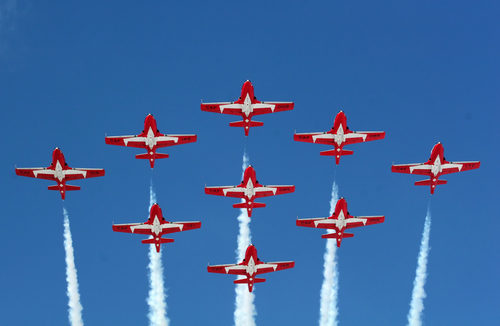
The Canadian Forces Snowbirds will be a main attraction at the returning Saskatchewan Airshow in 2019. The Airshow will take place at their home base of 15 Wing Moose Jaw. 
Originally discontinued in 2005, the airshow will once again take place on July 6 and 7, 2019.

Wing commander for the base Col. Denis O’Reilly was central in bringing back the airshow. The Moose Jaw native said he wanted to inspire a new generation of pilots.

“My parents had a farm just off the end of the runway and I used to bike out the airport in the summertime, grab a coke and help the pilots wash their aircraft and maybe hope to get a flight,” O’Reilly said.

Growing up in Moose Jaw’s South Hill neighbourhood, O’Reilly routinely heard Snowbirds and other aircraft flying overhead.

“I just grew up hearing that noise all the time and just looking up in the sky and thinking that’s something really cool men and women get to do and that’s something I’ll probably never get to do, not really realizing it’s something available to all Canadians,” O’Reilly said.

Today, one of those “really cool men” is Lt-Col. Mike French, commanding officer for the Snowbirds. Like O’Reilly, his aviation dreams began when he was a three-year-old at an airshow in Abbostford, B.C.

“I saw the Snowbirds flyover. I came out from under my blanket because the RAF Vulcan Bomber flew over and scarred me,” French said. “I came out from under my blanket and looked and saw the Snowbirds flying and decided right then and there that’s what I wanted to do.”

Image result for Avro Vulcan
The Avro Vulcan bomber which flew at the 1977 Canadian International Saskatchewan Airshow. Today, the only remaining flight worthy Vulcan only tours the UK. 
French used to fly in the Saskatchewan Airshow prior to its cancellation. Now, he said the Snowbirds will be midway through their season when the July return comes around, making for a well-rehearsed show.

Formation flying can look seamless from the ground. Up in the air, French compared it to driving in bumper to bumper traffic at 300 miles per hour with vehicles beside, above and below you. That means pilots only have a about a two foot box to maneuver their planes in, leaving no room for error.

“What that means is a lot more room for trust, and we absolutely have to trust each other. We hold ourselves accountable to each other and we can’t break that trust; plain and simple,” French said.

There is still a lot of prep work that will have to go into the airshow’s big return. Organizers anticipate more than 30,000 people will attend the weekend shows.

Military and civilian performers will be announced next year.

In addition to flight demonstrations there will be opportunities to get up close and personal with planes, a cabaret and a Saskatchewan micro-brewery will be chosen to brew a signature beer for the event.

Friday, October 19, 2018

Mali Mission has 'no prospect of immediate success: Former Op. Medusa Commander

Rachel Gilmore,  CTV Power Play producer

The man who led Canada’s troops in Afghanistan said the Canadian peacekeeping mission in Mali has “no prospect of immediate success.”

Image result for Canadian Forces in Mali
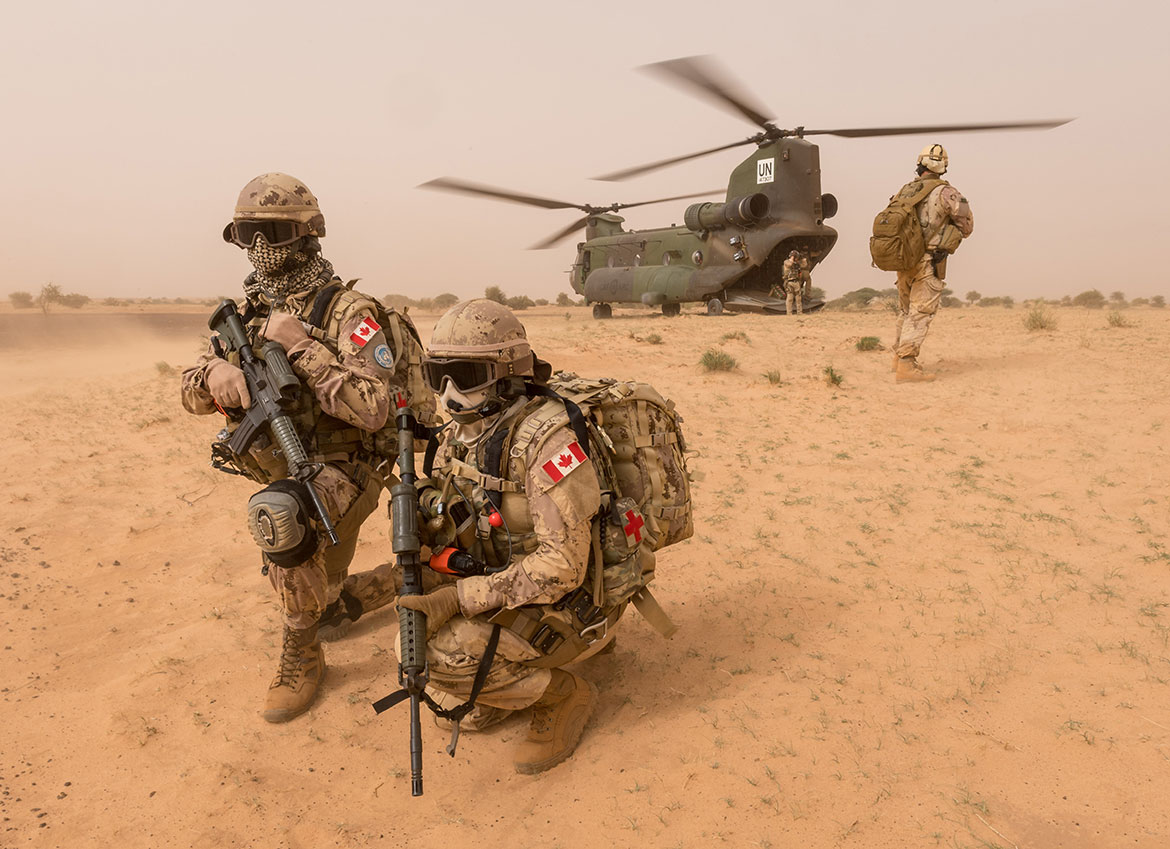
Gao, Mali. July 18, 2018 – Photo has been digitally altered for operational security. Members of the CH-147 Chinook medical team practice exiting the helicopter under the watchful eye of the force protection team in support of Operation PRESENCE - Mali around Gao, Mali. (Photo: MCpl Jennifer Kusche)
“The political overtones and what’s going on in this country and this mission are ugly,” retired major-general David Fraser told CTV’s Power Play host Don Martin on Monday.

“This is not going to be short mission.”

Canadian boots hit Malian soil in June for what has widely been regarded as a dangerous year-long peacekeeping mission. While Canada’s role is primarily to fly medical evacuation missions and provide support from the skies, the security situation in the region is said to have sharply deteriorated in recent months.

That’s something that hasn’t escaped Fraser’s notice.

“It’s as bad -- if not worse -- than what we experienced in Afghanistan, Iraq or Syria,” Fraser said of the conditions in Mali.

“It doesn’t take a rocket scientist to figure out that this mission isn’t going in the right direction from a trajectory point of view.”

His comments echo the revelations of a United Nations report released Wednesday. The assessment, conducted by UN Secretary General Antonio Guterres, described a plummeting humanitarian situation in Mali. Food aid and other humanitarian relief is in overwhelming demand and the country, according to the report, is faring worse in many ways than when Canadian peacekeepers first arrived in June.

Fraser explained that the key issue marking this decline is a lack of leadership. Despite successful elections in July and August, he said the insurgents are “winning the fight on the ground.”

“Peacekeeping can’t be effective. It can’t be effective without a strong civilian government leadership that’s running the government, that’s actually providing oversight for the military and the police forces and that’s not happening fast enough,” Fraser said.

“The race is being won not by the government and not by the military -- it’s being won by the people we don’t want to win.”

That on-the ground reality means humanitarian efforts aren’t getting to where they need to be.

“Aid, from a strategic and from a tactical point of view, is not getting to the ground fast enough,” Fraser said.

And at the end of the day, Fraser warned this hurts some people more than others.

“The local people are the ones who are going to be adversely affected,” he said.

To change this, the UN needs a change in their approach, according to Fraser.

“The UN’s not getting the locals to get the leadership or the women engaged fast enough, and they’re going to lose this race.”

If nothing changes, Fraser warned, we can expect the situation to continue to deteriorate -- and the UN reports to harshen.

“The people that are adversely affected are women and children and the innocent people, which is just going to make the next report card even worse than this one,” he said.

Friday, October 12, 2018

New RCAF Spy Planes to cost upwards of $300 Million

By: David Pugliese, Post Media 

The cost of three small surveillance aircraft Canada is buying from the U.S. could be $140 million more than the Canadian military had originally estimated.

The three Beechcraft King Air planes, to be based at CFB Trenton in Ontario, will be outfitted with sensors and equipment to intercept cell phone and other electronic transmissions. Canadian special forces and, potentially, other government departments will use them for missions overseas and in Canada.

On Oct. 1 the Canadian Forces told Postmedia the three outfitted planes and initial in-service support would cost between $100 million and $249 million, as outlined in the Liberal government’s defence policy documents.

However, on Oct. 4 the U.S. Defense Security Cooperation Agency revealed the final tally, informing Congress that the deal was underway with an estimated cost of US $300 million — around $389 million.

Canadian companies had wanted to provide the aircraft and on-board equipment, and several have formed alliances with U.S. firms who supply the Pentagon with the same or similar aircraft.


We will work to more clearly define our interests and requirements for the purchase, and negotiate an acceptable price with the U.S.


But the Canadian military decided it needed the planes more quickly than they believed Canadian companies could deliver, and that U.S. security regulations governing the on-board sensor equipment might cause delays. As a result, it determined the U.S. government was the only supplier capable of providing the planes.

The Canadian Forces says it hopes to get a better deal. The cost the U.S. government agency presented to Congress is not the final tally and the “final cost is anticipated to be much lower,” the Canadian Forces claimed in an email. “Over the coming months, we will work to more clearly define our interests and requirements for the purchase, and negotiate an acceptable price with the U.S.,” the email said.
A Beechcraft Super King Air 200 sits in the Air Transportation Services hangar at the City Centre Airport in Edmonton on Tuesday, Aug. 7, 2012. EDMONTON SUN/QMI AGENCY

Department of National Defence spokeswoman Ashley Lemire said in an email to Postmedia that the delivery of the first plane would take place sometime between 2020 and 2021. The final delivery of the three aircraft would be wrapped up by 2022.

The main contractor is Beechcraft in Wichita, Kan.

The Canadian government will run a separate program to allow companies to compete to provide in-service support for the planes. The government expects to ask for bids for that 20-year contract sometime in the spring of 2019, said Lemire. DND declined to provide an estimate of what that long-term support would cost taxpayers.

Industry representatives have complained over the years that the Canadian Forces cut domestic firms out of the project and reduced the role they could play. Lemire rejected that claim, saying Canadian firms would have a role in servicing the planes.

It is unclear at this point whether the aircraft will be under the command of the Royal Canadian Air Force or special forces. “The Manned Airborne Intelligence, Surveillance and Reconnaissance project will deliver a rapidly deployable, airborne intelligence, surveillance and reconnaissance capability to Canadian Special Operations Forces Command to support domestic and overseas operations,” Lemire said in her email. “The command and control arrangement of this capability has yet to be finalized.”

RCAF pilots will fly the aircraft but special forces personnel will operate the specialized equipment in the planes.

The planes will be outfitted with electro-optical sensors that would allow the aircraft to track the movement of individuals and vehicles on the ground. Canadian special forces had access to similar aircraft in Afghanistan to track and target insurgents.

Thursday, July 12, 2018

RCAF Back in NATO AWACS program

By: David Pugliese, The Ottawa Citizen 

Canada will provide up to 25 personnel over the next five years to NATO’s Airborne Warning and Control System program, Prime Minister Justin Trudeau announced at the NATO summit.

In February, the Liberal government announced it was reversing a 2011 decision by the previous Conservative government that saw Canada withdraw from NATO’s AWACS program.

The Conservative government decided at that time to end participation in the airborne early warning plane program to save money. Canada’s NATO allies were surprised and angered about the pullout. The Royal Canadian Air Force warned at the time that the decision could put overseas operations at risk.

Over the last several years, however, NATO has significantly increased the use of its AWACS, including in areas like Central and Eastern Europe where Canada is leading a multinational NATO battlegroup based in Latvia.

The original shutdown of Canada’s contribution to NATO’s AWACS saved about $50 million a year, according to the records obtained under the Access to Information law by Defence Watch.


Canada will also contribute to the new NATO Command Structure and support the new United States Readiness Initiative. Canada is now a member of the European Centre of Excellence for Countering Hybrid Threats and will join the Cooperative Cyber Defence Centre of Excellence.

In addition, Canada will extend its contribution to NATO’s enhanced Forward Presence through Operation REASSURANCE for another four years and increase the number of personnel taking part in this mission in Latvia from 455 to 540, Trudeau said.

Monday, April 30, 2018

Is sending helicopters to Mali good enough?

By Chris Kilford

Given the recent concern over Canada’s upcoming contribution to the Multidimensional Integrated Stabilization Mission in Mali (MINUSMA), one might easily assume that up until now few Canadians had ever set foot in Mali. However, this is far from the case – Canada is Mali’s second-most important bilateral development partner, after France.

Image result for rcaf chinook helicopter afghanistan
Sgt Chad Zopf, a door gunner, onboard a Griffon helicopter while on exercise in Afghanistan.

At the Embassy of Canada in Mali, which opened in the city of Bamako in 1970, the Université Laval and various Canadian non-governmental organizations have been working for years to improve the daily lives of Malians.

In the past 12 months alone, and with the support of the Canadian government, efforts were underway to: improve agricultural output and food security; to assist community health physicians graduate from the University of Bamako; and to provide new software to Mali’s government for improving domestic revenue collection.

Meanwhile, several Canadian mining companies have significant investments in Mali. B2Gold Corporation, for example, operates the Fekola Mine with a 950-strong, mostly Malian workforce. According to Canada’s Ambassador, Louis Verret, the gold sector “accounts for about 66% of Mali's exports and is therefore critical for government revenue.”

However, since 2012, Mali has been gripped by civil war in part fuelled by the Canadian-backed ouster of Libya’s Muammar Gaddafi in 2011. Following his death, many Malian Tuareg fighters who had fought for his regime, returned home to fight for their own space in northern Mali. And, while a peace agreement between the government and its main opponents (including the Tuareg) was signed in 2015, little has changed on the security front. Instead, the French, the G5 Sahel regional force, and MINUSMA are doing what they can to contain various rebel factions.

As for MINUSMA, it is only as good as the troops it gets from contributing countries – and many western armies, which could make a big difference – are noticeably absent from the front lines. For a mission deployed in an asymmetrical conflict environment, this is a big problem, and has resulted in significant casualties for UN troops that have largely been drawn from developing countries.

Still, not all is lost. In June 2017, the UN instructed MINUSMA to fully concentrate its efforts on supporting the Agreement on Peace and Reconciliation and step-up efforts to redeploy Malian security forces to the centre and north of the country. To help, an EU Training Mission with 580 personnel is re-building the military, while 128 personnel with the EU Capacity Building Mission are focused on training the police, gendarmerie and national guard.

As for Canada, it will soon send six helicopters and approximately 250 personnel for 12 months in support of MINUSMA. For those wanting Canada to take on a more active international role, it’s good news. But when it comes to truly helping the UN, apparently our deeds are falling short of our words. Sending helicopters is important, but it’s not quite what many had expected from a government that has been consistently eager to portray itself internationally as a serious player on the world stage.

–––
Chris Kilford is a former Army Officer and defence attaché who served in Afghanistan and Turkey. Currently he is a fellow with the Queen's Centre for International and Defence Policy.

Friday, April 13, 2018

Addressing the "Fighter Gap"

By: JAMES FRYER
© 2018 FrontLine Defence (Vol 15, No 2)

When asked if a second supply ship for the Royal Canadian Navy could be ordered from Davie Shipbuilding – a move that would restore re-fueling capability to both coasts and head off job losses at the Quebec shipyard – Transport Minister Marc Garneau declared: “We cannot artificially create a need for something that doesn’t exist.”

How ironic that a member of the federal cabinet should make this bold remark when there is a broad consensus that this is exactly what the Trudeau government is doing in the case of the alleged fighter capability gap. No fewer than 13 former chiefs of the air staff (with about 400 years’ worth of experience between them), as well as the Senate of Canada and most informed defence analysts, all agree that the Royal Canadian Air Force (RCAF) is not deficient in fighter capability (though they are certainly due to be replaced). 

F-35A
Insofar as the ‘gap’ is concerned, former fighter pilot Alan Stephenson has argued convincingly that it has been manufactured for political reasons – namely to impose unnecessary delays on the replacement of the CF-18 fleet, and put distance between a notional Trudeau government circa 2021 and its ill-considered 2015 election promise to buy anything but the much-maligned F-35.

Gap? What gap?
Certainly last year’s defence policy roll-out did nothing to add to the public’s understanding of why an interim buy of fighters is suddenly necessary to ensure Canada’s security. On page 38 of the policy – named Strong, Secure, Engaged (SSE) – the government did not specify how the security landscape had changed to such a degree that extra planes are required now. Nor has the government justified why an initial plan to fill the ‘gap’ with 18 modern F/A-18 E/F Super Hornets could be so easily aborted in favour of buying highly-used legacy Hornets from Australia. If national security is so well served by the latter, why wasn't it chosen as the first (and demonstrably cheaper) option.

Nor is there evidence that either NATO or NORAD have pressured Ottawa to up its game and put more fighters into service. Such a demand would likely have made it into the public domain, if for no other reason that NATO’s budgetary and force development targets are publicly known. Yet not a word from either about a fighter gap. The government continues to insist that such a thing exists, but is it pedalling ‘fake news’? Again, where is the evidence of a gap that would silence the legions of doubters?

And with the formal announcement (12 December 2017) of a process to replace Canada’s legacy fleet, many are left wondering why a seemingly straightforward competition to replace the full fleet should take until 2025 to deliver the first machine.
Boeing Super Hornet
It is instructive, if not a little ominous, that the government claims so much time is required to consult with industry on what it has to offer.

The RCAF requirements may have been tweaked for political reasons on 12 December (perhaps discounting low-observability as a key requirement), but can the requirements be so profoundly different from what they were toward the end of the last government’s tenure?

Indeed, with virtually every major country transitioning to low-observable fighters (Russia to the SU-57; China to the J-20 and J-31; much of NATO to the F-35; Israel, Japan, and South Korea announcing their intent to build stealthy designs) there seems to be little doubt as to where the future lies. Does the current government have some special insight into the future of air warfare that has eluded ally and non-ally alike?

Obfuscation, naïveté, or both?
What are we to make of the need for another round of industry consultations that will culminate in a list of suppliers? Consultations began with the previous government – the results of which were written up by the National Fighter Procurement Secretariat (NFPS) and presented to the Harper government in June of 2014. Surely this information could be leveraged to reduce the duration of the recently-announced competition. Yet to listen to Defence Minister Harjit Sajjan’s convoluted response to a question from the assembled media on 12 December, it is as if the NFPS and its peer-reviewed study never existed.

Not to be outdone, Public Services and Procurement Minister Carla Qualtrough stated in the same press conference that bidders should bear in mind that their current or prior dealings with Canada could be weighted against them during the bid evaluations. If a bidder was perceived to have inflicted harm on Canada’s economy, that would play against them in a competition – a none-too-subtle swipe at Boeing for launching a failed bid to impose punitive tariffs on Bombardier’s C-Series airliner. When asked if this would only add more time and complexity to the procurement (given that the definition of ‘harm’ could be quite subjective and therefore open to legal challenge), the Minister said she hoped it would not. As a novice cabinet minister, she might be forgiven for her naïveté.
Eurofighter Typhoon
Yet the broader government cannot be so easily excused. It should be obvious to anyone that when it comes to defence procurement in Canada, hope is not a method. One suspects that Minister Qualtrough will soon learn that painful lesson. For one thing, the government’s timetable for the fighter project puts delivery of the first jet in 2025 – precisely when the lead ship in the Canadian Surface Combatant (CSC) project is supposed to be floated out. Superimposing the fighter and warship replacements upon each other is a sure-fire way to over-tax the insufficient project management capacity residing in the relevant federal departments. It has long been argued (and accepted) that a lack of trained and experienced civilian and military procurement staff are to blame for delays in delivering on core projects. Should not the two most complex and costly projects of our times be staggered so as not to interfere with each other? (There was a four-year gap between the acquisition of the final CF-18 in 1988 and the arrival of the first Halifax-class frigate). Herein lies the danger of not proceeding immediately to a competition.

Yet perhaps the grand prize for obfuscation should go to Liberal MP Steven MacKinnon, the parliamentary secretary to Minister Qualtrough. On a CTV News panel discussion in December he boldly proclaimed that it was an “exciting time” for the RCAF, lucky as it was to be acquiring used Australian Hornets as an interim measure. It may not have occurred to him that acquiring 30-year-old planes may actually be a disincentive to recruiting and retention. A would-be aviator is unlikely to be attracted by the prospect of climbing into obsolescent aircraft. And with the airlines trolling for experienced pilots and technical tradespeople, what message is sent to the current crop of air and ground crew by investing in the past rather than the future? Side-note: the latest batch of television recruiting ads no longer feature the fighter capability – perhaps a veiled admission that featuring obsolete kit does nothing to incentivize recruiting.

When asked about the fighter gap, MacKinnon claimed that the government’s defence policy had dealt “at length” with the issue. As noted above, no explanation – lengthy or otherwise – has been forthcoming in the policy about how the aerospace environment has changed to such as degree as to mandate a gap-filler. Either Mr. MacKinnon did not even read his own party’s policy document, or he banked that his co-panelists (not to mention the viewers) could be easily duped.

Timing is everything… isn’t it?
Aside from the danger of having to manage two mega-projects simultaneously, the timing of the fighter replacement raises another serious issue: technological obsolescence. Put simply, the longer Canada takes to decide, the narrower our options become.

Reviewing public statements by European governments, militaries, and aerospace officials regarding the future of their fighter aircraft fleets, it is clear that the Europeans are looking ahead to the next-generation of aircraft to replace Tornado and Typhoon (UK, Germany, Italy), as well as Rafale (France)and Gripen E (Sweden).

In the US, manufacturers such as Northrop are already musing about 6th-generation technologies. Worried by what it sees as Russian and Chinese advancements, the US Air Force is looking at advanced aircraft, weapons and sensors for introduction circa 2030.

The current leading-edge (4.5-/4.75-generation) aircraft in service in Europe are being upgraded, but officials from Airbus (Typhoon’s manufacturer) state that even with upgrades their design is not viable against capable adversaries beyond 2040 and that planning for their replacement should begin now if Europe is to retain the requisite design/manufacturing capability. The French and German governments have begun discussing collaboration on the next-generation fighter. The Rafale is likely in the same boat as Typhoon (obsolescent by 2040), since it and all the other canard-winged designs date back to the 1990s. Meanwhile, the US Navy has signalled that the penultimate version of the F/A-18 E/F Super Hornet (Block 3) will go out of service in 2040.

The relevance of this for Canada is clear. If there is any inclination by the current or future government to buy an advanced 4th-generation aircraft – either from Europe or from Boeing – we will not be able to treat is as we have the CF-18. The new platform will not remain combat-viable for 35-40 years after its purchase because all ‘established’ candidates are fast reaching the end of their upgrade potential.

In effect, the RCAF’s ‘new’ 4.5/4.75-generation aircraft would function only as an interim, or inter-generational, aircraft for a period of about 15 years – or until new-generation machines emerge from European or American production lines in early 2040s.
Dassault Rafale
Even if European plans slip by 5 years (to the mid-2040s), the writing is clearly on the wall for fighter aircraft of the 4th generation. Pushing Canada’s fighter replacement into the mid-2020s puts Canada out of step with the pace of fighter replacement. Minister Sajjan was correct that we should have moved ahead on this file a decade ago, with a replacement in service today. Yet we now find ourselves in the position that if we choose one of the many ‘established’ candidates, we will likely have to go through the procurement process again after only 10 years to avoid the fleet obsolescence that our allies have now admitted to.

The promising but still-immature F-35 might be the only candidate with a technological growth path beyond 2040. But if it is not chosen, Canada should not delude itself that the other candidates will enjoy significant design longevity. Choosing one of them means lots of money for a very questionable return. As US Air Force Secretary Heather Wilson observed, “Buying a new version of something that was revolutionary 30 years ago doesn’t take us to a more competitive future.”

Creative thinking needed...
Clearly Canada cannot wait until late 2030s to replace the full fleet. Are there other options? One is to take a chance on the F-35, as many allied and partner nations have done.

All partner nations remain committed to it, and the aircraft has won orders in Israel and Japan and South Korea where these allies face capable rivals and would not think of entrusting their security to yesterday’s technology. A Canadian order would seem logical given that potential bidders were told during an ‘industry day’ on 28 January 2018 that Canada needs an aircraft that could last until 2060. By simple process of elimination, the F-35 is the only possible choice. Why then does the government fetishize competition when there are arguably no viable competitors?

A second option is to go with a mixed fleet of 4.75-generation aircraft available now, backed up by a mature 5th-generation candidate when available. Aside from the training and logistical challenges this will cause, there is the distinct possibility that once the former is acquired, this or a future government could balk at Phase 2, leaving Canada behind the technological curve after only a decade. It would also befuddle DND and the RCAF how to decide what portion of 88 planes – the numerical requirement articulated in SSE – can be drawn from each generation.

Another possible way forward is to make a choice between a European design or Super Hornet (Block 3), then re-scope the temporal dimension of the fighter project to last only 20 years (i.e., delivery of the first airframe until final disposal) rather than the 50 years currently envisioned for the CF-18. Again, such an aircraft will by design be an interim or ‘inter-generational’ aircraft.
Saab Gripen
There may be a political advantage in going this latter route. Since the government is required to specify the cost of acquisition and ownership over the lifespan of the airplane, the overall cost of a 20-year program should be considerably lower than a 40-year program since operations and maintenance costs will be halved. Sceptics will note (rightly) that DND will have to come back to Treasury at the 10-year point in order to buy a replacement aircraft. But 10 years is a long time in politics. Plenty of room to blame the situation on long-gone predecessors.

To be sure, a truncated fighter program may force the government to amortize the costs into a shorter timeframe. But if Canada is comfortable with an interim capability, choosing Saab’s Gripen E – undoubtedly the least expensive option – may have merit. Its single engine need not be a factor given the RCAF’s readiness to procure the F-35; and its advanced technology (electronically-scanned radar, internal infra-red sensor, advanced cockpit) represent an improvement over the CF-18.

…and less politicking
One more factor might need consideration: the new and somewhat bizarre requirement that a successful bidder demonstrate that its business dealings do not harm the Canadian economy.

If it is hard to see how Saab, Airbus, or Dassault could have done harm to the Canadian economy, it is equally hard to see how they could provide the lasting benefits that Boeing or Lockheed have bestowed on Canada over the decades. While some have argued that the so-called ‘Boeing clause’ is meant to put the screws to the US giant in its dispute with Bombardier, the corollary is that Boeing already has rendered significant industrial and technological benefits to Canada – something not lost on the 1,700 workers at the company’s Winnipeg facility. This cannot be overlooked by the government’s bid evaluators. Thus even after calculating the net ‘benefit-to-harm’ ratio, Boeing (or Lockheed) may still offer more politically-attractive partnerships than the three European firms. (Dassault or Saab could, however, attempt to court political favour by offering to assemble their jets in Canada.) Yet with the Super Hornet coming to the end of its development pathway with the Block 3 version, this again would seem to leave Lockheed Martin and the F-35 as the only viable choice – assuming that the government is indeed considering a long-term solution to the RCAF’s needs.

Conclusion
With the government stubbornly clinging to the false premise of a fighter gap, with the addition of highly subjective conditions for bidders, and with the apparent deletion of stealth capability as a requirement for the new aircraft, it is clear that the fighter replacement issue has become monstrously politicized. After promising sensible defence procurement reform during the last election, the Trudeau government seems to have acquired a distaste for simplicity and efficiency, not to mention evidence-based analysis. The politically-motivated cancellation of the EH-101 helicopter, followed by an 11-year ordeal to choose a (still non-operational) replacement, should have served as a cautionary tale against allowing what should be a straight-forward matter morph into a political football to be kicked around endlessly. Yet no such lesson seems to have been learned. What’s worse is that the government cannot deliver a cogent response to the question of why it’s doing what it’s doing. Perhaps it feels that it doesn’t need to?

Any fighter replacement program needs to be viewed through the lens of operational capability, logistical supportability, and cost. But timing must also play a part, and the government has set itself and DND up for a significant managerial, technical, and financial challenge by not exploiting the work done by the NFPS and de-conflicting the fighter purchase with other major procurements. Minister Sajjan seemed to at least partially recognize the former when he said on 6 December 2017: “These [air force] requirements are not only about having an aircraft for now, but we need to make sure this aircraft is there to serve us in the future.” The Americans and Europeans have given ample indication that their legacy fighter designs have a limited shelf-life. Canada should listen to them and act accordingly.

===
James Fryer is an independent defence analyst based in Toronto.
Tuesday, March 6, 2018

RCAF Outlines Cyclone Fix for Landing on RCN Fleet

RCAF Press Release 

Back in December the Canadian Press news agency had a story revealing a new series of problems affecting the RCAF’s new maritime helicopter, the CH-148 Cyclone, and its sonar system. The article outlined how the sonar system used by some CH-148 Cyclones must be removed before the helicopters are allowed to land on ships.

Crewmembers onboard Her Majesty’s Canadian Ship (HMCS) MONTREAL conduct vertical replenishment training with the CH-148 Cyclone helicopter during Exercise SPARTAN WARRIOR 16 in the Atlantic Ocean on October 31, 2016.

Photo: MCpl Jennifer Kusche, Canadian Forces Combat Camera 
IS15-2016-0003-042
The RCAF has provided additional information to Defence Watch about what caused the problems and what is being done about those issues:

What is the issue with the sonar equipment on the CH-148 Cyclones?

The HELRAS is a deployable sonar system onboard the CH148 Cyclone. The HELRAS internal reeling machine (used to recover the unit after it has been deployed) on the Block 1 CH-148 was modified (tilted slightly) to improve the hover characteristics of the aircraft while deploying the sonar into the water. The slight “tilt” of the reeling machine results in the sonar protruding slightly from the base of the helicopter once it has been recovered into the helicopter.

The protrusion from the base of the helicopter introduces a risk of the sonar striking the Cyclone – Recovery Assist Secure and Traverse (C-RAST) during a ship landing. Analyses have shown that, in theory, it is possible for the sonar submersible unit to contact the ship mounted assisted recovery system when operating in a high sea state condition. If contact occurred, it would not prevent the safe recovery of the helicopter but it could cause damage the submersible unit.


To prevent damage, the sonar submersible unit is not installed whenever the Block 1 configured Cyclones conduct shipborne operations. The Block 1 aircraft can fly from shore-based locations with the sonar installed.
This has had no impact on flying or training, as maintenance personnel can remove the sonar prior to conducting embarked operations.

How effective is the Cyclone as a maritime helicopter without its sonar system? Without its ship landing system?
Using its Sonobuoy Processing Sub-System (SPSS) to prosecute sub-surface targets by deploying sonobuoys into the water and processing their signals, the CH148 Cyclone is an effective ASW asset. The HELRAS is an additional system that can be used to prosecute sub-surface targets, but it is not the only means of conducting ASW operations. All of the other sensor systems on the CH148 can be used unrestricted (Radar, IR camera, etc.), making it an effective weapons system across the spectrum of operations.
Without the use of C-RAST, the CH148 is limited to a conservative ship motion envelope for takeoff and landing, and cannot be traversed into or out of the hangar. Again, CH148 maintenance personnel can remove the HELRAS system to conduct shipborne landings as required. Helicopter Air Detachments that embark with a Block 1 CH148 include the HELRAS as part of the equipment pack-up onboard ship. In the case of a requirement to use the HELRAS, the CH148 can be disembarked to a shore location where the sonar can be installed and operations conducted from the land based airfield.

What’s being done to fix the issue?

In the Block 2 configuration, the sonar system has been re-positioned so that the submersible unit will be housed completely inside the fuselage when stowed. This redesign eliminates the possibility of contact between any part of the helicopter and the ship mounted assisted recovery system.

The first 6 Block 2 Cyclones are scheduled to be delivered to Canada by June 2018.

Block 1 Cyclones have already begun a phased return for induction into Sikorsky’s Block 2 production line. For example, of the fifteen Block 1 helicopters delivered, seven have been rotated back to the contractor for retrofit and delivery in the Block 2 configuration. All 28 aircraft will be retrofitted, and final delivery is expected to be completed by 2021.

In its final configuration, the CH-148 Cyclone will be capable of a full range of anti-submarine and anti-surface warfare, search and rescue and utility missions in various environments, making it one of the most capable maritime helicopters in the world.

How much is it costing to fix the issue?

There is no additional cost to the Crown to rectify this issue.

What are the Block 1 Cyclones doing now?

The Cyclones currently in Shearwater are suitable for training and operations for a number of missions including Search and Rescue, utility transport, and surface and sub-surface surveillance, from both ashore, and while embarked on Royal Canadian Navy ships.