Translate

Showing posts with label CH-148 Cyclone. Show all posts

Thursday, November 29, 2018

The Sea King - A Fond Farewell

By Peter Mallett, Lookout Newspaper at CFB Esquimalt

When the Royal Canadian Air Force’s remaining Sea King helicopters are phased out, retired Major Paul O’Reilly admits it will be akin to losing a close friend.

That’s because he spent much of his 34-year career flying the Cold War-era, Sikorsky-built twin-engine amphibious helicopter—first acquired by Canada on May 24, 1963—on and off the decks of Royal Canadian Navy warships.

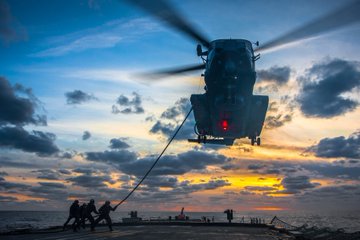
On board a ship, a helicopter is silhouetted by an orange sunset.
Onboard a ship at sea, a Royal Canadian Air Force CH-124 Sea King helicopter is silhouetted by the sun setting at deck level. PHOTO: Sergeant René Dubreuil
Major O’Reilly, 71, believes saying goodbye to them will be a teary affair. “You can’t help but get a little bit misty-eyed. For any pilot who flies an aircraft,” he says, “you grow attached to it as the years roll by, and you would forever recognize it instantly.”

Today, he spends two days a week volunteering at the Canadian Forces Base Esquimalt Naval and Military Museum. He is a military history buff and a founding member of the Vimy Flight group, which, in 2017, took First World War replica planes to the 100th anniversary ceremony in Vimy, France.

His love of history, and living some of it, gives him an interesting perspective on the Sea King.

In 1987, Major O’Reilly was a pilot on board Her Majesty’s Canadian Ship Huron as she sailed through the Panama Canal from 12 Wing Shearwater, Nova Scotia, heading to Esquimalt, British Columbia’s harbour with two Sea Kings onboard. They were the first two helicopters to arrive for naval operations on Canada’s West Coast.

“I’m surprised they are still here,” he says. “When I came out to the West Coast with the first Sea Kings, the whole idea was these aircraft would last three or four years and a new, more modern helicopter would show up and we would move to that.”

A hasty replacement for them in Canada did not happen, and so the decades went by.

“One of the reasons why they lasted so long was because with constant technological upgrades over the years they could still do the job. Why would you change and get a new aircraft when the one you are using does everything the Navy wanted it to do?” he asks.

The Sea King’s compact design, combined with fold-up rotor and tail, enabled it to fit neatly in the hangar of a warship after landing on the deck, and its amphibious hull enabled it to conduct water landings in an emergency.

“They got the job done because they handled well,” says Major O’Reilly. “The flight deck on most ships was about 48 by 78 feet [14.6 x 23.8 metres], so the biggest challenge with the Sea King, as with other helicopters of their size, was landing it as the ship bobbed up and down in the water, especially in stormy seas. Your timing had to be perfect so the ship’s company could hook the helicopter in with its Beartrap system.”

The Beartrap haul-down mechanism was developed in Canada. It uses a line and probe lowered from the helicopter to the deck and then attached to the ship; the Beartrap then winches the helicopter down to a solid and safe set-down.

“The Royal Canadian Navy was at the forefront of learning how to put a big helicopter on a small ship,” he continues, “and these helicopters were much more capable than smaller ones because they could travel longer, carry more supplies, and had a more sophisticated suite of detection equipment.”

CH-124 Sea King technicians work on HMCS Iroquois’ embarked Sea Kings in the deck hangar on February 1, 1981. PHOTO: DND Archives, HSC81-74-29
But their usefulness has gradually been eclipsed by new helicopters with modern technology. Today, very few countries still use Sea Kings. That includes the British military, which said farewell to its remaining Sea Kings in 2016, and the U.S. military, which replaced them 12 years ago.

“The main reason the helicopter is being phased out,” says Mr. O’Reilly, “is because nobody makes the engines or replacement parts anymore, making it next to impossible to make repairs.”

2018 marks the replacement of the Sea Kings with CH-148 Cyclones, which are being phased into service. As the future generation of aviators prepares to take to the cockpits of the new Cyclone, Major O’Reilly’s advice to them is “expect the unexpected”, as with any new technology. “But I have a feeling this one may also stand the test of time.”

The final Sea King flight in the RCAF will take place by December 31, 2018. The official retirement ceremony is Saturday, December 1, 2018 at 443 Maritime Helicopter Squadron in British Columbia; where a fly past will take place. The Sea King has operated for 55 years in Canadian military service. As part of the celebrations, there will be a fly-past, according to the Canadian Forces.

Friday, July 20, 2018

CH-148 Cyclone Deploys on First International Deployment with HMCS Ville de Quebec

By BRETT BUNDALE, The Canadian Press

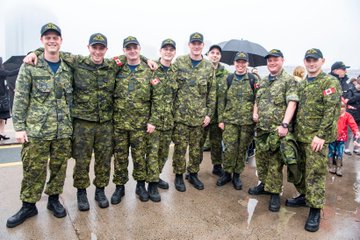
HALIFAX— Hundreds of people gathered on a jetty at Halifax’s naval base Wednesday to bid farewell to 240 military members aboard HMCS Ville de Quebec as it headed to the Mediterranean as part of Canada’s ongoing contribution to a NATO mission in central and eastern Europe.

Under pouring rain, family, friends and dignitaries waved goodbye as the warship sounded a fog horn and departed through a heavy mist in Halifax harbour.
HMCS Ville de Quebec in Halifax last December. Hundreds of people gathered on a jetty at Halifax's naval base today to bid farewell to 240 military members aboard the vessel. (ANDREW VAUGHAN / THE CANADIAN PRESS FILE PHOTO)

An RCAF CH-148 Cyclone maritime helicopter flies past a luxury yacht in Halifax on Friday, July 13, 2018. It departed for its first international deployment with the frigate HMCS Ville de Quebec today. (ANDREW VAUGHAN / THE CANADIAN PRESS)
Children in brightly-coloured rain boots waved Canadian flags and homemade signs, one saying, “Bye Mommy, see you later” while another said, “Bon Voyage Daddy.”

Couples shielded from the rain under large umbrellas hugged and kissed goodbye before the six-month mission.

“It’s overwhelming,” said Vanessa Picard, standing on the jetty with her two young children after her husband departed. She called the experience of watching him sail off “surreal.”

It’s a familiar scene here at HMC Dockyard Halifax, as the commanding officer of the warship noted.

“It’s really hard on families,” said Cmdr. Scott Robinson, adding he was leaving behind his wife and two young children. “I’m not the only one. It weighs on you.”

Several ships deploy from the east coast base every year, but the HMCS Ville de Quebec send off was a significant milestone for the Canadian military.

On board the frigate was a CH-148 Cyclone helicopter — the first international mission for the new twin-engine machine.

Defence Minister Harjit Sajjan said the state-of-the-art technology adds to the “tremendous capability” of the country’s armed forces and its contribution to Operation Reassurance.

The retired lieutenant-colonel also said it “sends a very strong message of deterrence” to countries like Russia, which he said is starting to go against “a rule-based order.”

Sajjan pointed to Russian actions under Vladimir Putin, such as the annexation of Crimea, its support for rebel forces in eastern Ukraine and Bashar al-Assad’s government in Syria.

“It’s something that we will not stand for,” he told reporters following the warship’s departure. “This is one of the reasons why Canada will continue to step up not only as part of NATO, but as part of a coalition.”

He added that Canada “will not take threats lightly” and that the multinational, “fully combat ready” battle groups send a strong message.

Indeed, the commander of the HMCS Ville de Quebec said he expects to run training exercises with his crew to “keep our combat capability at a high level in case the government calls upon us to react to some sort of world event,” Robinson said.

“We want to maintain our proficiency as much as we can at the highest level in case the government of Canada calls on us to do something.”

Meanwhile, the Royal Canadian Navy commander called it an “exciting moment” for the first-ever Cyclone helicopter to be sent on a mission.

Vice-Admiral Ron Lloyd said Canada’s contribution to the NATO mission will help “enhance regional maritime security and stability.”

The Halifax-class warship HMCS Ville de Quebec is slated to relieve HMCS St. John’s, which returns to Halifax later this month after a six-month mission.


Today the first CH-148 Cyclone helicopter and aircrew embark aboard HMCS Ville de Québec for Op REASSURANCE, @CanadianForces support to #NATO defence and deterrence measures in Central and Eastern Europe.#RCAF #RCAFProud

The deployment of the Cyclone marks a major milestone for the 17-metre, 13,000-kilogram aircraft.

In January, the East Coast fleet of Sea Kings was retired after 54 years of service.

The Cyclone fleet will be tasked with surface and sub-surface surveillance, and search and rescue missions, while providing “tactical transport for national and international security efforts,” according to the military. Its aluminum and composite airframe is built with lightning-strike and high-intensity radio frequency pulse protection.

Wednesday, May 30, 2018

Cormorant SAR Helicopters to be Modernized

By: David Pugliese, Defence Watch 

The Canadian military is moving ahead with plans to upgrade its Cormorant search-and-rescue helicopter fleet and will also examine whether to buy or lease more of the same aircraft.

The federal government notified industry Thursday morning of the sole source deal to modernize the 14 helicopters. There was no cost attached to the plan but a previous estimate on the upgrade put the price-tag anywhere between $500 million to $1.5 billion.

A Search and Rescue Technician is hoisted down from a CH-149 Cormorant helicopter over a confined area in Cloud Lake, NS during a training flight on January 8, 2016. Photo: Master Corporal Johanie Maheu, 14 Wing Imaging GD2016-0039-33 ~ Un technicien en recherche et sauvetage est descendu par treuil depuis un hélicoptère CH-149 Cormorant au dessus d’une zone restreinte, à Cloud Lake, en N. É., lors d’un vol d’entraînement, le 8 janvier 2016. Photo : Caporal chef Johanie Maheu, Services d’imagerie de la 14e Escadre GD2016-0039-33 
The deal is with Leonardo, the Italian aerospace firm whose subsidiaries originally built the CH-149 Cormorants.

Last year Defence Minister Harjit Sajjan suggested that the upgrade program for the Cormorants would be a key program for the Royal Canadian Air Force in the future.

The government will also examine a number of options to expand the search-and-rescue helicopter fleet. Those will include leasing AW-101 helicopters, a variant of the Cormorant, buying AW-101s or upgrading former U.S. presidential helicopters so they can join the search-and-rescue flight line.

Canada purchased the nine VH-71 presidential helicopters, which are similar to the Cormorant, as well as 800,000 spare parts in 2012 after then U.S. President Barack Obama shut down the multi-billion dollar program and decided that existing aircraft were good enough for his needs.

The Department of National Defence stated at the time of the purchase that the VH-71 helicopters would not be put into service but instead stripped down for parts to supply the Cormorant fleet.

Although Canada is entering into a sole-source deal with Leonardo, the government is considering holding a competition among other companies to provide in-service support for the helicopters, according to Department of National Defence officials.

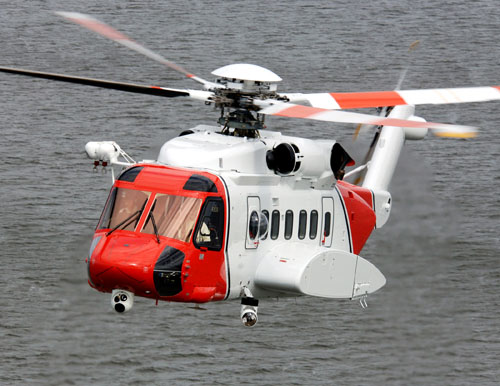
The modernization project comes as the U.S. helicopter firm Sikorsky was trying to interest Canada in buying its S-92 choppers for search and rescue. The S-92 is a civilian version of the Cyclone maritime helicopter the RCAF is putting into service. Sikorsky officials have argued that buying new S-92s would cost less than upgrading the older Cormorants.

Related image
A Sikorsky S-92 in Coast Guard Colours. The Irish Coast Guard currently operates the S-92. The RCN operates the CH-148 Cyclone - the military version of the S-92. 
Department of National Defence sources, however, say it was determined that it was more cost effective to stay with the Cormorant fleet as it is a proven aircraft the RCAF knows well. In addition, existing infrastructure can continue to be used.

The RCAF also hopes to purchase a simulator for the Cormorant fleet to help train crews.

The upgrade program is expected to include the latest avionic and mission systems, advanced radars and sensors, vision enhancement and tracking systems. The CH-149 Cormorant fleet entered service in the year 2000 and the modernization would allow the helicopters to operate for another 25 years at least.

Canada originally bought 15 Cormorants, but one crashed in 2006.

Powered by three engines, the Cormorants are known for their long-range capability, large cargo space and rear-ramp. The helicopter can carry up to 12 stretchers, according to the RCAF.

The decision to sole-source the deal appears to have caught some in the air force off guard. On April 20, the RCAF spokesman Maj. Scott Spurr claimed the air force was still examining options on how to proceed and that the next phase of the project wouldn’t come until 2019.

Defence sources say some inside the RCAF have argued that since seven of the nine U.S. presidential helicopters are already airworthy, it makes sense to use them. Preparing those helicopters for search-and-rescue duty would include installing a side door as well as upgrading the cockpits.

Parts obtained in the U.S. presidential helicopter deal have also played a critical role in keeping the RCAF Cormorants flying, according to documents obtained by Postmedia through the Access to Information law. The U.S. helicopters and spare parts were originally purchased for $168 million.

Tuesday, March 6, 2018

RCAF Outlines Cyclone Fix for Landing on RCN Fleet

RCAF Press Release 

Back in December the Canadian Press news agency had a story revealing a new series of problems affecting the RCAF’s new maritime helicopter, the CH-148 Cyclone, and its sonar system. The article outlined how the sonar system used by some CH-148 Cyclones must be removed before the helicopters are allowed to land on ships.

Crewmembers onboard Her Majesty’s Canadian Ship (HMCS) MONTREAL conduct vertical replenishment training with the CH-148 Cyclone helicopter during Exercise SPARTAN WARRIOR 16 in the Atlantic Ocean on October 31, 2016.

Photo: MCpl Jennifer Kusche, Canadian Forces Combat Camera 
IS15-2016-0003-042
The RCAF has provided additional information to Defence Watch about what caused the problems and what is being done about those issues:

What is the issue with the sonar equipment on the CH-148 Cyclones?

The HELRAS is a deployable sonar system onboard the CH148 Cyclone. The HELRAS internal reeling machine (used to recover the unit after it has been deployed) on the Block 1 CH-148 was modified (tilted slightly) to improve the hover characteristics of the aircraft while deploying the sonar into the water. The slight “tilt” of the reeling machine results in the sonar protruding slightly from the base of the helicopter once it has been recovered into the helicopter.

The protrusion from the base of the helicopter introduces a risk of the sonar striking the Cyclone – Recovery Assist Secure and Traverse (C-RAST) during a ship landing. Analyses have shown that, in theory, it is possible for the sonar submersible unit to contact the ship mounted assisted recovery system when operating in a high sea state condition. If contact occurred, it would not prevent the safe recovery of the helicopter but it could cause damage the submersible unit.


To prevent damage, the sonar submersible unit is not installed whenever the Block 1 configured Cyclones conduct shipborne operations. The Block 1 aircraft can fly from shore-based locations with the sonar installed.
This has had no impact on flying or training, as maintenance personnel can remove the sonar prior to conducting embarked operations.

How effective is the Cyclone as a maritime helicopter without its sonar system? Without its ship landing system?
Using its Sonobuoy Processing Sub-System (SPSS) to prosecute sub-surface targets by deploying sonobuoys into the water and processing their signals, the CH148 Cyclone is an effective ASW asset. The HELRAS is an additional system that can be used to prosecute sub-surface targets, but it is not the only means of conducting ASW operations. All of the other sensor systems on the CH148 can be used unrestricted (Radar, IR camera, etc.), making it an effective weapons system across the spectrum of operations.
Without the use of C-RAST, the CH148 is limited to a conservative ship motion envelope for takeoff and landing, and cannot be traversed into or out of the hangar. Again, CH148 maintenance personnel can remove the HELRAS system to conduct shipborne landings as required. Helicopter Air Detachments that embark with a Block 1 CH148 include the HELRAS as part of the equipment pack-up onboard ship. In the case of a requirement to use the HELRAS, the CH148 can be disembarked to a shore location where the sonar can be installed and operations conducted from the land based airfield.

What’s being done to fix the issue?

In the Block 2 configuration, the sonar system has been re-positioned so that the submersible unit will be housed completely inside the fuselage when stowed. This redesign eliminates the possibility of contact between any part of the helicopter and the ship mounted assisted recovery system.

The first 6 Block 2 Cyclones are scheduled to be delivered to Canada by June 2018.

Block 1 Cyclones have already begun a phased return for induction into Sikorsky’s Block 2 production line. For example, of the fifteen Block 1 helicopters delivered, seven have been rotated back to the contractor for retrofit and delivery in the Block 2 configuration. All 28 aircraft will be retrofitted, and final delivery is expected to be completed by 2021.

In its final configuration, the CH-148 Cyclone will be capable of a full range of anti-submarine and anti-surface warfare, search and rescue and utility missions in various environments, making it one of the most capable maritime helicopters in the world.

How much is it costing to fix the issue?

There is no additional cost to the Crown to rectify this issue.

What are the Block 1 Cyclones doing now?

The Cyclones currently in Shearwater are suitable for training and operations for a number of missions including Search and Rescue, utility transport, and surface and sub-surface surveillance, from both ashore, and while embarked on Royal Canadian Navy ships.