Translate

Showing posts with label Future of the RCN. Show all posts

Thursday, November 29, 2018

The Sea King - A Fond Farewell

By Peter Mallett, Lookout Newspaper at CFB Esquimalt

When the Royal Canadian Air Force’s remaining Sea King helicopters are phased out, retired Major Paul O’Reilly admits it will be akin to losing a close friend.

That’s because he spent much of his 34-year career flying the Cold War-era, Sikorsky-built twin-engine amphibious helicopter—first acquired by Canada on May 24, 1963—on and off the decks of Royal Canadian Navy warships.

On board a ship, a helicopter is silhouetted by an orange sunset.
Onboard a ship at sea, a Royal Canadian Air Force CH-124 Sea King helicopter is silhouetted by the sun setting at deck level. PHOTO: Sergeant René Dubreuil
Major O’Reilly, 71, believes saying goodbye to them will be a teary affair. “You can’t help but get a little bit misty-eyed. For any pilot who flies an aircraft,” he says, “you grow attached to it as the years roll by, and you would forever recognize it instantly.”

Today, he spends two days a week volunteering at the Canadian Forces Base Esquimalt Naval and Military Museum. He is a military history buff and a founding member of the Vimy Flight group, which, in 2017, took First World War replica planes to the 100th anniversary ceremony in Vimy, France.

His love of history, and living some of it, gives him an interesting perspective on the Sea King.

In 1987, Major O’Reilly was a pilot on board Her Majesty’s Canadian Ship Huron as she sailed through the Panama Canal from 12 Wing Shearwater, Nova Scotia, heading to Esquimalt, British Columbia’s harbour with two Sea Kings onboard. They were the first two helicopters to arrive for naval operations on Canada’s West Coast.

“I’m surprised they are still here,” he says. “When I came out to the West Coast with the first Sea Kings, the whole idea was these aircraft would last three or four years and a new, more modern helicopter would show up and we would move to that.”

A hasty replacement for them in Canada did not happen, and so the decades went by.

“One of the reasons why they lasted so long was because with constant technological upgrades over the years they could still do the job. Why would you change and get a new aircraft when the one you are using does everything the Navy wanted it to do?” he asks.

The Sea King’s compact design, combined with fold-up rotor and tail, enabled it to fit neatly in the hangar of a warship after landing on the deck, and its amphibious hull enabled it to conduct water landings in an emergency.

“They got the job done because they handled well,” says Major O’Reilly. “The flight deck on most ships was about 48 by 78 feet [14.6 x 23.8 metres], so the biggest challenge with the Sea King, as with other helicopters of their size, was landing it as the ship bobbed up and down in the water, especially in stormy seas. Your timing had to be perfect so the ship’s company could hook the helicopter in with its Beartrap system.”

The Beartrap haul-down mechanism was developed in Canada. It uses a line and probe lowered from the helicopter to the deck and then attached to the ship; the Beartrap then winches the helicopter down to a solid and safe set-down.

“The Royal Canadian Navy was at the forefront of learning how to put a big helicopter on a small ship,” he continues, “and these helicopters were much more capable than smaller ones because they could travel longer, carry more supplies, and had a more sophisticated suite of detection equipment.”

CH-124 Sea King technicians work on HMCS Iroquois’ embarked Sea Kings in the deck hangar on February 1, 1981. PHOTO: DND Archives, HSC81-74-29
But their usefulness has gradually been eclipsed by new helicopters with modern technology. Today, very few countries still use Sea Kings. That includes the British military, which said farewell to its remaining Sea Kings in 2016, and the U.S. military, which replaced them 12 years ago.

“The main reason the helicopter is being phased out,” says Mr. O’Reilly, “is because nobody makes the engines or replacement parts anymore, making it next to impossible to make repairs.”

2018 marks the replacement of the Sea Kings with CH-148 Cyclones, which are being phased into service. As the future generation of aviators prepares to take to the cockpits of the new Cyclone, Major O’Reilly’s advice to them is “expect the unexpected”, as with any new technology. “But I have a feeling this one may also stand the test of time.”

The final Sea King flight in the RCAF will take place by December 31, 2018. The official retirement ceremony is Saturday, December 1, 2018 at 443 Maritime Helicopter Squadron in British Columbia; where a fly past will take place. The Sea King has operated for 55 years in Canadian military service. As part of the celebrations, there will be a fly-past, according to the Canadian Forces.

Wednesday, November 28, 2018

CSC Fleet In Limbo as Trade Tribunal Investigates Alion Claims

By: Murray Brewster, CBC News 

The federal government's plan to award a group of companies led by Lockheed Martin Canada the contract to design and support the construction of the Navy's new frigates was dealt another setback late Tuesday by the Canadian International Trade Tribunal, CBC News has learned.

The agency said it intends to investigate a complaint by one of the other bidders, Alion Science and Technology Corp., and its subsidiary Alion Canada.

The tribunal ordered the Liberal government to suspend negotiations with Lockheed Martin, which was selected last month by Public Services and Procurement Canada as the preferred bidder on the $60 billion program.

An artist's rendering of the British Type 26 frigate, which Lockheed Martin submitted for consideration as the replacement for Canada's patrol frigates. (BAE Systems Inc./Lockheed Martin Canada)
"You are hereby ordered to postpone the award of any contract in connection with the above-mentioned procurement until the Canadian International Trade Tribunal determines the validity of the complaint," said a copy of the letter that was obtained late Tuesday by CBC News.

Alion asked the CITT last week to investigate the procurement deal, saying the preferred warship design will need substantial changes and that it doesn't meet the Navy's requirements as spelt out in the government tender.

Last week, the company asked the Federal Court in a separate filing for a judicial review of the long-awaited decision.

Three companies were in the running to design the next generation of warships to replace the navy's aging Halifax-class frigates. Navantia, a Spanish-based company, was the other bidder in the competition.

Alion proposed its De Zeven Provinciën Air Defence and Command (LCF) frigate, a Dutch-designed warship, for the Canadian competition. The ship is already in service in other countries.

No one from the trade tribunal, nor the federal government was immediately available for comment late Tuesday.

A program already behind schedule:

Experts had warned the trade challenge and the court case might delay the program, which is already behind schedule.

The design competition stretched for almost two years as public services officials and executives at the federal government's go-to shipyard for combat vessel construction, Irving Shipbuilding of Halifax, worked with bidders to ensure a fair competition and to avoid post-decision court fights.

Public Services and Procurement Canada declined to comment when the court challenge was launched last week. But a senior federal official, speaking on the background at the time, said the federal government has up to 20 days to respond in Federal Court.

The official — who was not authorized to speak on the record because of the sensitivity of the file — said there is flexibility built into the timeline and the government is optimistic it can meet its goal of an early 2019 contract signing.

The substance of the Alion complaint is that the Lockheed Martin Canada-led bid should have been disqualified from the outset because it allegedly doesn't meet the Navy's criteria in terms of speed and crew space.

The Liberal government said it wanted to go with a proven warship design, rather than starting from scratch because it would be faster and cheaper.

Tuesday, November 20, 2018

Government Rejects Advice to Replace Victoria-Class Submarines

By: David Pugliese, The Ottawa Citizen 

New submarines won’t be part of the future mix for the Royal Canadian Navy, at least in the foreseeable future.

Several years ago there were some suggestions that a possible replacement for the Victoria-class submarines might be in the works. In 2017 a Senate defence committee recommended the subs be replaced.

The Commons defence committee also recently recommended that the Victoria-class subs, bought used in 1998 from the United Kingdom, be replaced with submarines capable of under-ice capabilities.

But the Liberal government has rejected that recommendation. The recommendation was the only one of the 27 made by the Commons defence committee that was rejected outright in a response delivered to the committee last month.

The committee had recommended that the federal government respond to NATO calls to improve the quality of their naval fleets and underwater surveillance capabilities by starting the process of replacing Victoria-class submarines with new boats that have under-ice capabilities. It also recommended increasing the size of that fleet to enhance Canada’s Arctic and North Atlantic defence preparedness.
Image result for victoria-class submarines
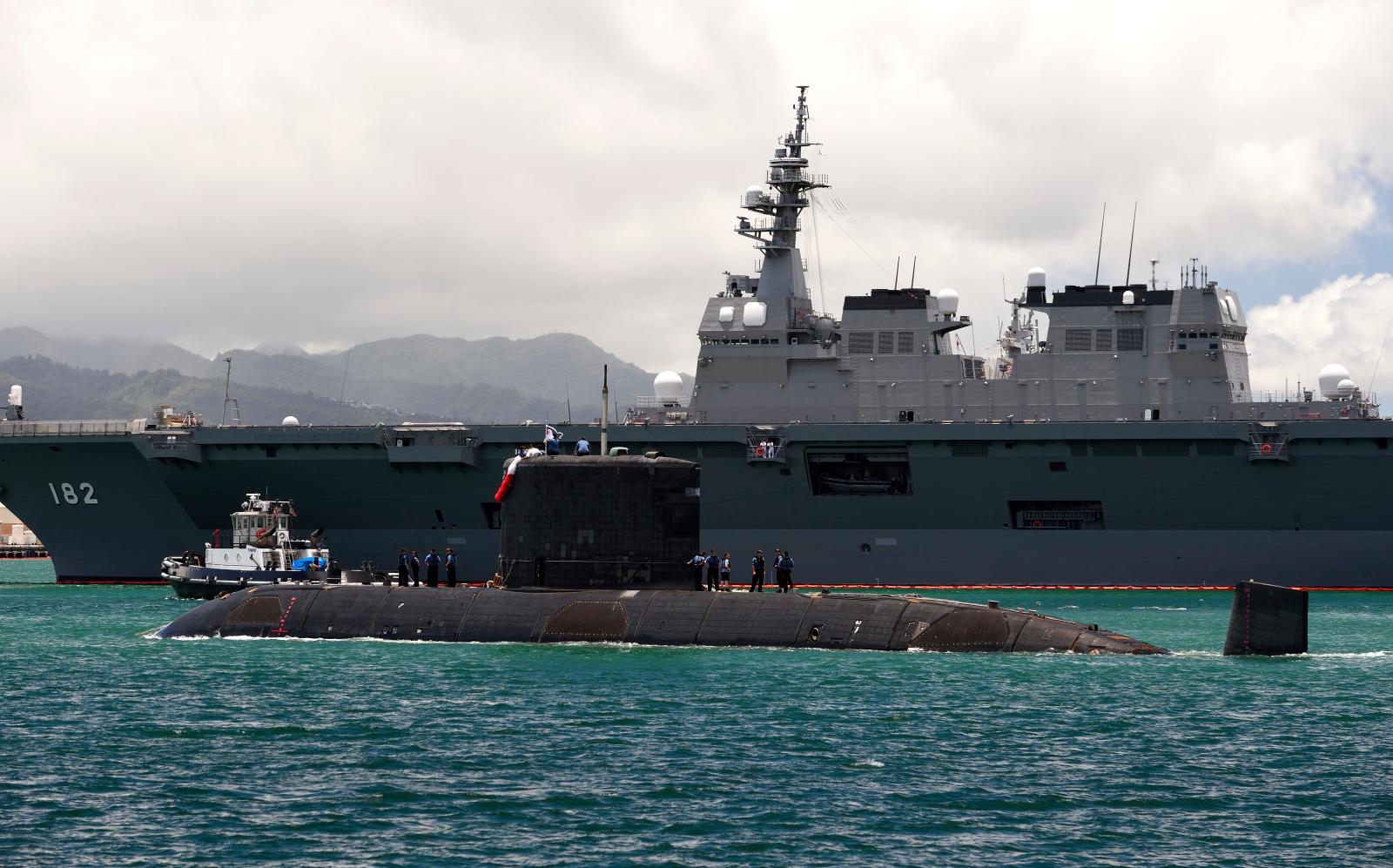
HMCS VICTORIA sails past the Japanese Ship ISE as she arrives in Pearl Harbor on July 1, 2014 to take part in Exercise Rim of the Pacific (RIMPAC).
But the Liberal government pointed out in its response that it is in the midst of the most intensive and comprehensive fleet modernization and renewal in the peacetime history of the Royal Canadian Navy. Canada is recapitalizing and increasing the size of its surface fleet through investments in 15 Canadian Surface Combatants, two Joint Support Ships, and five to six Arctic and Offshore Patrol Ships, it added. “The government has also committed to modernizing the four Victoria-class submarines to include weapons and sensor upgrades that will enhance the ability of the submarines to conduct Intelligence, Surveillance and Reconnaissance (ISR) and deliver necessary improvements of platform and combat systems to extend operational capability to the mid-2030’s,” the government response noted.

Canada is also engaged in the re-building of the anti-submarine warfare capabilities of the fleet through the introduction of technologies, sensors and weapons while preparing to transition to the fleet of the future, it added. “As part of the NATO S&T Organization, Canada is participating in the Maritime Unmanned Systems S&T Pre-Feasibility Studies that focus on ASW and naval mine warfare capabilities with Allied nations that have the same capability targets,” the government stated. “In addition to increasing existing platform capabilities, the RCN is also in the process of re-vitalising individual and collective ASW training and advancing distributed mission training and synthetic training environments.”

Last year Defence Minister Harjit Sajjan praised the capability submarines provide Canada. “No other platform in the Canadian Armed Forces can do what a submarine can do,” Sajjan said. “No other platform has the stealth, the intelligence-gathering, surveillance and reconnaissance capability and the deterrence to potential adversaries that a sub does.”

Upgrading the Victoria-class subs is more “prudent” than buying new subs, Sajjan said at the time.

Without upgrades, the first of the submarines will reach the end of its life in 2022, according to documents obtained last year through Access to Information by the Canadian Press. The last of the boats would be retired in 2027.

Friday, July 20, 2018

Final Canadian Surface Combatant Bids Due Today

By: David Pugliese, Defence Watch 

The final bids are being submitted Friday by various consortiums for the Canadian Surface Combatant program.

The bids going in Friday involve the finalized portions of the bids on designs (the technical design bids were originally submitted in November but today marks the deadline for responses that deal with any questions the federal government may have had/changes needed to be made) as well as proposals for the financial elements for the project.

The new ships will be the backbone of the future Royal Canadian Navy.

The groups bidding include:

-Lockheed Martin Canada, who will be the prime on the team that includes BAE Systems, CAE, L3 Technologies, MDA, and Ultra Electronics. The team is offering the BAE Type 26 warship for the Canadian program. The proposal will include Lockheed Martin Canada’s combat management system, CMS 330, which is currently on board the modernized Halifax-class frigates. A scaled down version of the system will be used on the Royal Canadian Navy’s new Arctic Offshore Patrol Ship fleet. The United Kingdom is acquiring 8 of the Type 26 ships. Australia has also identified the Type 26 as the design for its future warship.

Gary Fudge, Vice President and General Manager, Lockheed Martin Canada Rotary and Mission Systems told Defence Watch that the group’s bid was submitted earlier this week. He noted that the Type 26 would be excellent in an anti-submarine warfare role as it is designed to be extremely quiet. The vessel also has room to future modernization, unlike older designs, he added. The Lockheed Martin team, which is making $17 billion in value proposition commitments to Canada, will commit to spending billions in innovation across Canada’s priority areas, including $2 billion in supplier development and $2 billion in research and development, and $200 million in advanced manufacturing, the company noted.

-Alion Science and Technology, along with its subsidiary Alion Canada, submitted their proposal based on the Dutch De Zeven Provinciën Air Defence and Command (LCF) frigate. “Our solution delivers an effective, affordable, production-ready 21st century naval capability to meet Canada’s defence needs,” Bruce Samuelsen, Chief Operating Officer for Alion, said last year while promoting the firm’s bid. The De Zeven Provinciën-class frigate is a proven NATO vessel, built by Damen Schelde Naval Shipbuilding, with more than 10 years of operational excellence, the company added.

Alion’s combat system solution is based on the world-class capabilities of ATLAS-Elektronik and Hensoldt Sensors. ATLAS brings an open architecture Combat Management System that readily accepts new and evolving technologies, the firm noted. Hensoldt’s capability and experience in developing and fielding state-of-the art radars was central to meeting the unique Canadian requirements with a fielded, non-developmental radar, the Alion team added in an earlier news release. Other key suppliers include L3 Technologies Canada, Raytheon Canada Limited, DRS Technologies Canada Limited (DRS TCL) and Rheinmetall Canada Inc.

-Navantia of Spain is leading a team that includes Saab Australia and CEA Technologies. Its proposal is based on the F-105 frigate design, a ship in service with the Spanish navy. The design has also already been exported to Norway and Australia. Saab, which would provide the combat management system, has support on the CSC program from Lockheed Martin (Moorestown, New Jersey), General Dynamic Mission Systems – Canada, DRS Technologies Limited Canada, OSI Maritime Service and Rheinmetall Canada, according to Navantia.

The F-105 Anti-Submarine Warfare ship will incorporate Saab’s 9LV Combat Management Systems, elements of which are in service on over 240 platforms in 16 navies across the globe, including Canada’s own Halifax-class frigates, the company has said.

The budget for the Canadian Surface Combatant project is estimated by the federal government to be between $55 billion and $60 billion. That is a range but specific costs won’t be known until contacts are signed and more details worked out. Fifteen warships will be built.

Pat Finn, assistant deputy minister for materiel at the Department of National Defence, told Defence Watch he expects a winning bid to be selected by the end of this year.

After that negotiations would start and a contract is expected to be signed sometime early 2019. If an agreement can’t be reached then negotiations would begin with the group that came second in the competition.

About half of the cost of the surface combatant price-tag is for systems and equipment that will go on the 15 ships, according to federal documents obtained by Postmedia through the Access the Information law. “Approximately one-half of the CSC build cost is comprised of labour in the (Irving’s) Halifax yard and materials,” the documents added.

Jean-Denis Fréchette, the Parliamentary Budget Officer, estimated the CSC program would cost $61.82 billion. He also warned that every year the awarding of the contract is delayed beyond 2018, taxpayers will spend an extra $3 billion because of inflation.

Tuesday, June 26, 2018

Why Canada Needs More Supply Ships for Humanitarian Relief Missions

By: Jeffrey F. Collins, Andrea Lane, Policy Opinions Forum 

Having at least two supply ships would allow Canada to engage in more humanitarian and disaster relief, thus furthering our foreign policy interests.

Naval procurement has been in the news lately for all the wrong reasons. First up is the ongoing legal squabbling over the former number two in the Canadian military, Vice Admiral Mark Norman, who is charged with breach of trust for allegedly leaking cabinet secrets to Quebec’s Davie shipyard. Then, the government is refusing to release a report that would shed light on exactly how far behind schedule the joint support ship and Coast Guard heavy icebreaker procurements are, nor will it provide an updated delivery estimate. Finally, the plan to replace frigates and retired destroyers with a new surface combatant vessel continues to be beset by delays and industry infighting as the bid process drags on and on — with further delays announced by the government recently.

Yet despite such persistent bad news, in March 2018 the Royal Canadian Navy (the navy) achieved a rare procurement success when its new supply ship, MV Asterix, officially entered service under a lease arrangement with the firm Federal Fleet Inc. A commercial ship purchased in 2015 and converted over the following two years, Asterix fulfills a key naval capability lost in 2014 when a fire and, separately, hull fatigue removed from service the decades-old auxiliary oiler replenishment (AOR) ships HMCS Protecteur and HMCS Provider. These ships, known as oilers, provided the lifeblood of the fleet, carrying the extra fuel, food, spare parts, helicopters and ammunition necessary to extend naval operations away from shore for longer periods at sea. The Protecteur-class AORs also gave limited onshore support to other Canadian Armed Forces units participating in peace support and in humanitarian assistance and disaster relief operations. With the loss of both AORs, the navy needs another ship like Asterix — and fast.


The M/V Asterix. Photo - RCN. 
The Protecteur-class oilers had to be retired when their replacements, to be called joint support ships, were scarcely beyond the design stage, much less completed. With delays stretching into the 2020s on the joint-support-ship project, the navy faced the very real possibility of losing its vital replenishment-at-sea skills and naval support capabilities. Oilers borrowed from the Spanish and Chilean navies were only a temporary stopgap. In fact, the need to get an AOR capability was so pressing that Asterix embarked into navy service even before all its interior fittings were completed. The ship has already taken part in military exercises in the North Atlantic, completed a double replenishment-at-sea operation with the US Navy and has now deployed for the West Coast to join in one of the world’s largest multinational naval exercises, RIMPAC.

The rapid pace of Asterix’s deployments has highlighted the navy’s stark need for the ship. But as the sole AOR in the Canadian fleet, the ship faces a clear limitation: it has to service a navy split between two oceans, Atlantic and Pacific, with a long transit voyage in between. While Asterix is taking part in RIMPAC, the East Coast fleet will be beholden to friends and allies for refuelling, or tied to shore on restricted sailings. This presents a problem, as the navy — indeed, the armed forces as a whole — is expected under the Trudeau government’s defence policy, Strong, Secure, Engaged, to be able to “act in multiple theatres simultaneously.” This includes sustaining not just domestic and North American defence but also overseas engagements, for example in support of NATO commitments in eastern Europe, drug interdiction in the Caribbean and antipiracy patrols. Put simply, with only one oiler, the navy cannot independently fulfill all of its assigned duties under the policy. Having only one functioning AOR also raises questions as to the Canadian military’s ability to respond to a humanitarian disaster whether at home or abroad, another tasking emphasized in the policy. While Strong, Secure, Engaged stipulates that “Strong at home” comes first, it is debatable whether the navy could currently meet large-scale humanitarian assistance and disaster relief challenges, in addition to its “normal” operations.

Naval humanitarian assistance and disaster relief capabilities serve both domestic and international functions. Natural disasters in recent years, like the New Brunswick floods this May, highlight the possible roles such a ship can provide. The 2010 landing of Hurricane Igor in Newfoundland saw hundreds of coastal communities lose power and endure days of isolation after road washouts. Under Operation Lama, three ships and a Sea King helicopter were dispatched to assist the hardest-hit communities. The timing and landfall of the hurricane coincided with the seasonal operation of a car ferry that carried troops and vehicles over from CFB Gagetown, New Brunswick, via Nova Scotia. Had the disaster struck in late fall or early winter or with more devastation, the military response would have been even more logistically challenging. With the possibility of earthquakes in British Columbia and more powerful hurricanes on the east coast, the strategic value of having domestic humanitarian assistance and disaster relief capabilities is greater than ever. The 2016 earthquake in New Zealand and the 2017 cyclone in Australia illustrate the value of having humanitarian and-disaster relief capable ships like HMNZS Canterbury and HMAS Choules available for duty on the home front.

On the international level, humanitarian assistance and disaster relief capabilities are more than just disaster response; they also are a proactive means of dealing with disasters before they happen. The United States has used a number of its vessels in this role, including expeditionary fast transport ships like USNS Brunswick and dedicated hospital ships like USNS Mercy. The navies of the United States, Australia, New Zealand and other Pacific countries support a forward engagement humanitarian assistance mission called Pacific Partnership every year; it provides health care and trains regional partners for coordinated disaster response. Canadian sailors and personnel sometimes take part, but Canadian ships do not. This mission is exactly the sort of thing that Asterix and other potential humanitarian assistance and disaster relief assets could participate in, if Canada chooses to become more active in this role.

Proactive humanitarian assistance and disaster relief represents a potentially rich opportunity for furthering Canada’s foreign policy interests, especially in light of the global political uncertainty generated by the Trump presidency. Countries in South America, the Caribbean and Asia are looking for reliable, stalwart allies, and Canada could well step into the breach left by the US, which is increasingly distracted and focused on national security. Such a role for Canada is not fantastical; indeed, the navy’s own policy framework, Leadmark 2050, has called for “the acquisition of a dedicated peace-support ship to meet the unique demands of HA/DR.” Such a vessel would become one of the “most heavily used assets” and “the principal Canadian Armed Forces defence diplomacy asset.” Currently, the navy practises defence diplomacy in port visits interspersed throughout more mission-focused deployments; having a dedicated humanitarian assistance and disaster relief ship or, at the very least, a sister ship to Asterix available for use in proactive humanitarian engagement when it is not busy as an oiler would allow the navy to be used directly as a whole-of-government asset, representing Canada’s diplomatic, trade and regional development agencies to the wider world.

Asterix, even more than its Protecteur-class predecessors, is the ideal humanitarian assistance and disaster relief platform from which to launch and sustain humanitarian aid operations in coastal regions, where 40 percent of the world’s population lives. Once fully finished, the ship will have a fully fitted hospital, a dental clinic and an emergency dormitory capable of holding up to 350 evacuees. The galleys can even cook 500 meals an hour if necessary. Navy ships like Asterix are self-contained in the event of a disaster, because their sailors live and eat on board, removing the necessity to first construct housing and kitchens for service members sent to help. While heavy airlift is faster to the scene of a disaster, nothing beats a large ship for medium-term disaster assistance, especially when, like Asterix, its company can include a helicopter and air detachment.

This brings us to an important conclusion: Canada needs more capability than Asterix can provide by itself. Currently, the interim AOR is being kept busy fulfilling its vital fuelling and replenishment role for the navy. At a minimum, a three-coast navy would have at least two AOR ships. Three would allow the navy — and Canada — to commit to a long-sought humanitarian role, one called for in the Strong, Secure, Engaged policy, and it ought not to come at the expense of standard naval readiness. The joint support ship project is an untold number of years behind schedule, and even on completion, it will supply the navy with only two ships. Canada needs the capability now, not in 10 years’ time.

Given the success of the Asterix procurement, the Trudeau government should take steps to acquire another interim AOR, ideally using the same modified off-the-shelf method as for Asterix, to ensure prompt delivery. Both AORs should eventually be transitioned from interim to permanent, augmenting the navy’s support ship fleet from two to four. Building on the success of Asterix would also keep jobs and knowledge in Canada, and they would likely be at Quebec’s Davie shipyard, which has not yet received any contracts under the National Shipbuilding Strategy. If Canada is intent on building ships at home for the foreseeable future, ensuring the sustainability of the industry across the country should be a priority, to encourage competition and reduce the hold that individual companies have on the government purse.
----
Jeffrey F. Collins holds a PhD in Political Science from Carleton University and is a Research Fellow with the Centre for the Study of Security and Development at Dalhousie University. He is the co-editor of the book, Reassessing the Revolution in Military Affairs (London: Palgrave, 2015) and the yet to be released, Canada's Defence Procurement Woes (London: Palgrave, 2019).


Andrea Lane is deputy director of the Centre for the Study of Security and Development and a PhD student at Dalhousie University. Her most recent publication is “Manning Up: Justin Trudeau and the Politics of the Canadian Defence Community” (2018).

Thursday, June 7, 2018

RCN Supply Ship Cost Increases by $1.1 Billion; Now over $3 Billion

By: David Pugliese, National Post 

At one point, the first ship was supposed to arrive in 2012. That date has changed a number of times. DND is now hoping for delivery in 2022 or 2023

Taxpayers will have to spend an additional $1.1 billion to build two new supply ships for the Royal Canadian Navy, the federal government has revealed.

The cost of building the Joint Support Ships, or JSS, had been pegged at $2.3 billion. However, the government ordered a review of that figure and in an email to Postmedia procurement minister Carla Qualtrough’s office confirmed the cost is now expected to be $3.4 billion.

Of the $3.4 billion price tag, the actual cost of building the two ships accounts for a little more than 60 per cent, Finn said. Pat Finn, the head of procurement at the Department of National Defence, said the new price tag includes items the government had not previously included. In some cases equipment for the ship has been purchased, so the government has a more accurate understanding of what it actually cost, Finn said in an interview Monday. The inflated figure also takes into account new infrastructure and delays with the program which have driven up its price as the cost of materials has increased over the years.

“The build period has changed quite dramatically,” Finn acknowledged.
Workers watch as the main girder of a new 300-tonne gantry crane is lifted into place at Seaspan Vancouver Shipyards in North Vancouver, B.C., on Wednesday April 2, 2014. Darryl Dyck/Canadian Press
At one point, the first ship was supposed to arrive in 2012. That date has changed a number of times with the government later hoping for a 2018 delivery and then a 2019 arrival for the first vessel.

DND is now hoping for the delivery of the first ship in 2022 or 2023. Construction of some initial portions of the vessels will begin at Seaspan Shipyards in Vancouver this summer, Finn said, which it hopes will head off any potential layoffs of skilled employees at the shipyard.

Finn said the new costing model for the JSS is more akin to the one used by the parliamentary budget office. That office had an even higher estimate for JSS when it concluded in 2013 that the final tally for taxpayers would be $4.13 billion.

The Joint Support Ships are seen as being critical for the navy, as they will provide fuel and supplies for warships at sea.

The navy retired its last two aging supply ships years ago, one after being damaged beyond repair in a fire, the other because of excessive corrosion. After their retirement the Canadian military had been relying on the Spanish and Chilean navies to provide it with supply vessels for short periods of time.

Because of the delays to the JSS program, the previous Conservative government entered into agreement with Davie Shipyards in Quebec to lease a commercial vessel converted into a supply ship. That ship, the MV Asterix, is at the heart of the federal government’s case against Vice-Admiral Mark Norman.

In March, the Norman was charged with a single count of breach of trust. The RCMP accused Norman of warning Davie in the fall of 2015 that Liberal cabinet ministers wanted to derail the Asterix project. When word of the Liberal plan leaked to the media, the resulting embarrassment forced the Trudeau government to back down on its plans and the conversion of Asterix proceeded.

Norman was put under investigation and Prime Minister Justin Trudeau predicted on two occasions the officer would ultimately end up in court.

Norman denies the charge and has said he looks forward to clearing his name. A date for the trial has not yet been set.

Asterix is considered a rare achievement in Canadian military procurement in that it was delivered on time and on budget. The supply ship is now at sea with Royal Canadian Navy and is headed to a major military exercise to begin later this month.

Wednesday, May 16, 2018

BAE Type-26 GCS to be operational in 2027; Still considered a top contender for CSC Fleet

By: David Pugliese, National Post 

One of the top contenders in Canada’s new frigate program – a ship now being built for the United Kingdom – won’t be operational for the Royal Navy until 2027.

BAE’s Type 26 frigate has been ordered by the United Kingdom and the cutting of steel started last year.

But the United Kingdom’s defence procurement minister Guto Bebb has told parliamentarians that the first of those frigates won’t be delivered until 2025. Because of testing it won’t become operational until 2027, the minister added.

Artists Rendition of the BAE Type-26 Global Combat Frigate. 
The Type 26 design has been submitted to Canada for its Canadian Surface Combatant program and is one of three contenders. Construction on the Canadian frigate program to start in the early 2020s.

That raises the possibility, say industry insiders, that Canada could be the first nation to acquire the Type 26 and put it to sea.

Being the first to deploy a new class of warships, however, comes with associated issues of working through the initial problems of new vessels.

That, however, is what the Canadian government had hoped to avoid with its CSC program. It originally stated that only mature ships or proven designs would be considered.

But the Liberal government inexplicably retreated on that stipulation and allowed the Type 26 design to be entered even though the vessel had not been built yet.

That, in turn, sparked a belief in some quarters of industry that the fix is in for BAE’s Type 26. The federal government has denied that.

Lockheed Martin Canada is leading the consortium that has proposed the Type 26. A company spokesperson said the progress of the British program will not have an impact on CSC.

“Our CSC bid meets or exceeds all requirements and this does not impact our bid in any manner,” the spokesperson noted in an email to Defence Watch. “Our CSC bid does not rely upon the T26 becoming operational before 2027.”

Some industry officials have also suggested that the 2027 date won’t be an issue because they expect the CSC to fall significantly schedule. By the time CSC gets really underway, the Type 26 will be ready.

The Canadian Surface Combatant program will cost between $55 billion and $60 billion. Fifteen ships will be eventually built. Three consortiums have bid on the program.

A contract for the CSC is expected to be awarded by the end of this year, said Pat Finn, assistant deputy minister for materiel at the Department of National Defence.

About half of the cost of the surface combatant price-tag is for systems and equipment that will go on the 15 ships, according to federal documents obtained by Postmedia through the Access the Information law. “Approximately one-half of the CSC build cost is comprised of labour in the (Irving’s) Halifax yard and materials,” the documents added.

Last year, Jean-Denis Fréchette, the Parliamentary Budget Officer, estimated the CSC program

would cost $61.82 billion. He also warned that every year the awarding of the contract is delayed beyond 2018, taxpayers will spend an extra $3 billion because of inflation.

Friday, May 11, 2018

RCN Facing Mold Problems

By: Murray Brewster, CBC News 

A newly released report blames a build-up of potentially hazardous mold aboard Canada's frontline warships squarely on a lack of upkeep by the navy.

The engineering analysis — obtained by CBC News under access to information after an almost two-year battle — said shipboard heating and air conditioning structures (HVAC) and their associated controls were allowed to deteriorate over the years to the point where they became almost useless.

The systems have "significantly degraded," said a March 2015 engineering report prepared for the navy by an outside contractor. "Little maintenance has been performed and the state of equipment is old and unsupportable."

Thermostats and pneumatic devices, meant to control airflow and humidity, were "failing, outdated and unsupportable," said the engineering analysis by the firm Bronswerk.

The report is the first clear effort to assign blame for a hazard the navy has tried to control. It could even have legal ramifications.

A former sailor, retired lieutenant Alan Doucette, is suing the federal government over the "staggering mold growth" aboard navy destroyers in the early 2000s. He alleges exposure to the mold ruined his health and that the navy "failed to take appropriate action in order to ensure the health and wellness" of serving men and women.

Retired chief petty officer Patrick MacLaughlin said the failure to keep the ships' HVAC systems up-to-date should not be laid at the feet of individual sailors or those responsible for day-to-day maintenance.

The equipment, he said, should have been swapped out at least 15 years ago — particularly the thermostat controls, which regulate humidity and condensation buildup.

"We tried to get things done," said MacLaughlin, who has been a vocal critic of the navy's approach to the problem. The leadership "needed to go to NDHQ (National Defence Headquarters) and ask for the funding. They didn't."

Blame the navy

Commodore Simon Page, the navy's director general of maritime equipment, denied the navy is solely responsible for the problem.

"My personal assessment is that is this not a problem of our own making," said Page, adding warship interiors tend to be humid spaces.

He pushed back against the claim that "little maintenance" was performed, saying the navy does its "due diligence" and carries out the necessary work.

"It is possible sometimes that maintenance is deferred, but if it is deferred we have a measure to catch up," said Page.

The Bronswerk report was prepared after the contractor surveyed several Halifax-class frigates — which were, at the time, being modernized under a $4.3 billion, multi-year program.

CBC News was the first to reveal the navy's struggle with mold in pictures and video broadcast in the summer of 2016 — a situation a former fleet commander tried to downplay at the time by saying there was "absolutely no concern."

Rear-Admiral Craig Baines, who in 2016 was the commodore in charge of the East Coast fleet, acknowledged mold was a problem but insisted the navy was conducting regular air quality monitoring and there had been no reports of illness.

CBC News requested copies of engineering and health assessment reports under access to information legislation in August 2016.

Just last week, National Defence released technical assessments and minutes of fleet operations and maintenance meetings dating back several years, but did not produce any monitoring reports.

The department also has yet to produce evidence that health monitoring took place after the issue of mold growth in various compartments was flagged as a concern aboard HMCS St. John's in the fall of 2011.

Officials in the access to information branch insisted Wednesday those reports are forthcoming.

Page said he could not speak to the withholding of documents, but said he stands by Baines' assessment of two years ago and insisted "the small amount of mold" they see in the warships is not a significant source of concern.
The 'AC flu'

Sailors have complained informally for years about a myriad of health issues while serving on deployed ships, describing recurring colds and breathing trouble as "AC flu" or the "CPF hack" — CPF being an abbreviation for Canadian Patrol Frigate.

The records show there was considerable internal debate among top naval engineers, particularly over 2014-15, about how to deal with the mold problem.

Some ships bought dehumidifiers. MacLaughlin said they were often purchased at Canadian Tire. That approach, however, was criticized internally as an attempt to "treat the symptom rather than the cause."

Navy officials were also seriously divided about whether to issue a fleet-wide technical bulletin giving warship crews instructions on mold cleaning.

"The info is very simple/easy and there is concern that releasing a [technical bulletin] on mold cleaning procedures may cause undo (sic) panic for such [a] minor instruction," said a Dec. 8, 2015.

That directive was finally issued last year.

The navy has started a series of engineering fixes on each of the frigates to address the ventilation issues. Part of the plan is a program to swap out the thermostats.

Page said two of the frigates have had the work done already and four more are slated for it in the near future.

The navy also has conducted hazardous air quality assessments.

A report on HMCS Winnipeg obtained by CBC News said mold was found in four compartments, including the ship's galley.

"It was a surface sample," said Page. "Surface mold can be addressed in a very aggressive and immediate manner, which was done."

Thursday, March 8, 2018

DND Needs $54M in Additional Funds to Evaluate CSC Fleet Proposals

By: David Pugliese, The National Post

The Department of National Defence needs an extra $54 million just so it can examine the bids from companies hoping to build it a new fleet of warships — an indication of the growing expense of a program that has more than tripled in cost over the years.

HMCS Ottawa, one of the Royal Canadian Navy's Halifax-class frigates that will be replaced by the eventual arrival of the Canadian Surfance Combatant Fleet. Roslan Rahman/AFP/Getty Images
The funds are not earmarked for anything to do with the actual construction of the ships, but instead to fund DND’s evaluation of the the bids this year — and they would be in addition to the $39 million the department has already received to review the bids, according to defence sources.

The cost of the new Canadian Surface Combatants, which will replace the existing Halifax-class frigates, has steadily been climbing. The 15 ships were originally estimated to cost $15 billion. That increased to $24 billion before DND came out with a new estimate of around $40 billion. That too has since changed, and the project is now estimated to cost between $55 billion and $60 billion — and even then, the federal government acknowledges it doesn’t know what the program’s final cost will be to taxpayers. Parliamentary budget officer Jean-Denis Fréchette estimated last year the CSC program would cost $61.82 billion, and warned that every year the awarding of the contract is delayed beyond 2018, taxpayers will spend an extra $3 billion because of inflation.

Despite the Liberal government’s repeated statements about openness and transparency, it took Postmedia more than three months to get basic information from DND about its request for new funding, and even then, the details provided are limited.

“These funds will permit the project to maintain the Project Management Office and to continue work under the Definition Support Contract with Irving Shipbuilding Inc. for the remainder of this fiscal year,” the DND said in an email. “This funding will primarily support the Request for Proposal, bid evaluation and preparations for the design services contract.”

The money will cover salaries and benefits for the 135 military and civilian staff at the DND who are assigned to the project office, the department said, and will also be used to train staff and upgrade their offices.

Prospective builders of the new warships submitted their bids on Nov. 30, and a winning bid is expected to be selected sometime this year. Halifax-based Irving Shipbuilding will begin construction of the first ship in the early 2020s and delivery of the first vessel is expected in the mid-2020s, according to the federal government.

Image result for canadian surface combatant
Artists rendering of a BAE Type-26 Global Combat Ship with the Royal Canadian Navy Ensign - a proposed design for the Canadian Surface Combatant Fleet. 
Defence analyst Martin Shadwick said that without more detail of how the funds will be spent it’s hard to determine whether taxpayers are getting value for money. “But it seems a very high cost to run a project office for a one-year period and to evaluate bids,” added Shadwick, a strategic studies professor at York University in Toronto.

The surface combatant project, intended to provide the backbone of the future Royal Canadian Navy, has long been controversial.

In a surprise twist in November, a French-Italian consortium declined to formally submit a bid, instead offering Canada a fleet of vessels at half the price. Fincantieri of Italy and Naval Group of France don’t believe the established procurement process for the surface combatant program, already beset with delays and increasing costs, will be successful.

They instead proposed that Irving Shipbuilding construct 15 ships based on the consortium’s proven FREMM frigate design, currently in operation in both the French and Italian navies, among others, and guaranteed a fixed price of $30 billion. Thier proposal also focused on using Canadian technology on board the ships, and would have transferred technology to Canadian firms so they could be involved in future sales of the FREMM vessels on the international market. Under the plan, Irving would have been able to start building the warships almost immediately.

The Canadian government, however, rejected the offer.

Image result for Alpino fremm frigate
Italian Navy Alpino FREMM Frigate. Italy ordered 10 FREMM Frigates. The FREMM is currently operated by the Italian Navy, the French Navy, the Egyptian Navy, and the Royal Moroccan Navy. 

Tuesday, March 6, 2018

Asterix more Survivable than her Immediate RCN Predecessors

By: David Pugliese, Defence Watch 

There has recently been a flurry of discussion about the Asterix, the new supply ship being leased by the federal government to support the Royal Canadian Navy. The ship is expected to see much use as the RCN no longer has any supply ships of its own.

Asterix on Maiden Voyage from Quebec City to Halifax 25/12/2017 (CNW Group/Davie Shipbuilding) 
But there was some discussion about whether Asterix, a commercial vessel converted to a supply ship configuration, could be used in a combat zone. The RCN says no. That is because the ship does not carry defensive weapons.

The company behind Asterix, Davie Shipbuilding, says the ship can be used in a war zone.

So how would a supply ship be used in a conflict? Would it normally go into combat or stay on the outer perimeters of a conflict zone? Is Asterix much different from the RCN’s previous class of supply ships?

I turned to the Navy League of Canada for those answers. They weren’t of any help though and instead responded with a talking point that looked like it had been approved by the government (the league was confident the RCN would not send forces into harm’s way without proper preparation.)

Thankfully the Royal United Services Institute of Nova Scotia was able to provide information that the Navy League couldn’t.

Colin Darlington, a retired commander in the Royal Canadian Navy, who is now vice president of the Royal United Services Institute of Nova Scotia sent this information in a background paper on the subject:
The Canadian Armed Forces (CAF) has previously deployed contracted employees in dangerous areas (recall the very-Canadian Tim Horton’s in Afghanistan).
WhilstAsterix’sfirst line of defence is not to be put in harm’s way, that can be done at a tactical (local) level, not precluding her deployment into a danger zone (which tend to be wide area).
Asterix’sbest defence is an escort (e.g., frigate), as it is for any logistics ship.

Asterixlacks weapons and combat sensors plus dedicated operations spaces. She can, however, be fitted with sensors and weapons (e.g., containerized point missile defence system) and with additional working spaces. It is understood she has points for heavy machine guns and strengthened decks for heavier systems. Fitment could take time which may affect the speed with which the ship could be deployed. However, it can be foreseen at this time that by far the majority of likely missions for her would not involve high-intensity combat so she is unlikely to need much outfitting.

Asterixis more survivable than her three immediate predecessors. She has a double bottom. Of course, any ship carrying significant amounts of ship fuel, aviation gas and munitions is very vulnerable.

WhilstAsterixhas modern merchant ship damage control systems (firefighting and the like), she is not compartmented like a naval ship nor has she a chemical-biological-radiological-nuclear defence ‘citadel.’ She also lacks a large crew, capable of undertaking significant damage control as is the company in a naval ship. These are major factors that differentiate her from a naval design replenishment oiler.

Asterixis an excellent interim replenishment oiler and, once the Protecteur-class replenishment oilers are built by the Joint Support Ship (JSS_ project, would make a great second line oiler, especially for operations off North America.

The Royal Canadian Navy (RCN) needs the Protecteur-class replenishment oilers as they will be even more capable of operating in danger zones thanAsterix, and ultimately the CAF needs to procure equipment and train people to fight in high intensity conflicts. For that, it is Canada’s responsibility to have the best and be as ready as possible.

Major decisions of defence procurement are the purview of the Government of Canada. It is evident that the government sees the necessity of two replenishment oilers as a steady state for the RCN, but also assesses that until then one interim oiler will suffice. Ultimately the numbers and capabilities of the ships is the result of decision based on geo-strategic-economic cost-benefit risk analyses.