Translate

Showing posts with label CSC Fleet. Show all posts

Thursday, November 22, 2018

Alion Canada Sues Over Failed Canadian Surface Combatant Bid

By: Andrea Gunn, The Chronicle Herald
Alion Canada, one of the firms involved in the $60-billion dollar procurement of Canada’s new fleet of warships, has launched a Federal Court appeal to overturn a recent decision to select Lockheed Martin as the preferred bidder.

According to an application for judicial review filed in Ottawa on Friday, Alion Canada, a Nova Scotia-based wholly owned subsidiary of the U.S. parent company, is asking the court to prohibit the federal government and Irving Shipbuilding from entering into a contract with Lockheed Martin Canada on the grounds that Lockheed’s bid was non-compliant.

Last month, Public Services and Procurement Canada announced that after a lengthy, and sensitive competition, Lockheed Martin Canada was selected as the preferred bidder to design replacements for the navy’s frigate and destroyer fleets, beating out two other bids: Alion Canada, which offered up Dutch De Zeven Provinciën Class air defence and command frigate, and Navantia/SAAB’s design based on the F-105 anti-submarine frigate design for the Spanish navy.

But now Alion is alleging that the BAE Systems Type 26 Global Combat Ship design offered by Lockheed, which is currently also being constructed for the U.K. and Australian navies, is incapable of meeting three critical and mandatory requirements of the request for proposals that the firms crafted their bids around: two requirements concern the vessels’ speed, and one deals with the number of crew berths.
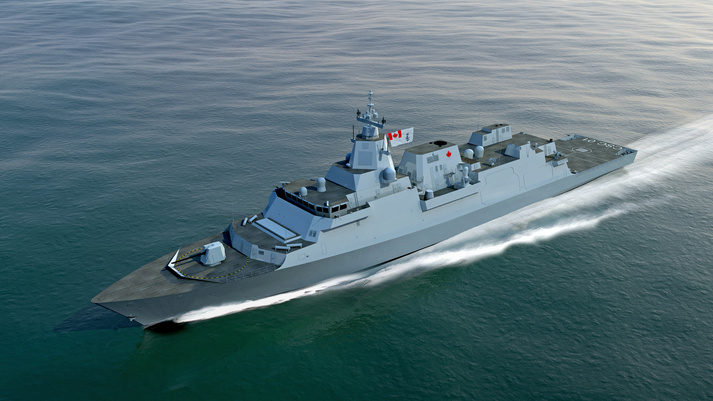
An artist's rendering of the Type 26 Global Combat Ship, Lockheed Martin's proposed design for Canada's $60-billion fleet of new warships. - BAE Systems Inc. / Lockheed Martin Canada

But now Alion is alleging that the BAE Systems Type 26 Global Combat Ship design offered by Lockheed, which is currently also being constructed for the U.K. and Australian navies, is incapable of meeting three critical and mandatory requirements of the request for proposals that the firms crafted their bids around: two requirements concern the vessels’ speed, and one deals with the number of crew berths.

“The RFP required (Public Services and Procurement Canada) and Irving to reject Lockheed’s bid because of its non-compliance,” the application reads.

Instead, the document says, the federal government and Halifax-based Irving Shipbuilding announced Lockheed as the preferred bidder and has entered into the conditions precedent period. This is the step immediately prior to awarding the definition subcontract between Irving, the prime contractor and shipbuilder, and Lockheed, the warship designer.

“(Alion) submitted a fully-compliant and conforming bid, at enormous expense, (and) expected that their bid, and the entire procurement process, would be administered in accordance with the terms and conditions in the RFP,” Alion says in the document.

“This was not the case and the applicants have been denied the fair treatment they were owed.”

As such, Alion is asking a federal court to set aside the decision to select Lockheed as the preferred bidder, and to prohibit the government from issuing the necessary approvals to award the Canadian Surface Combatant definition subcontract to Lockheed.

The respondents named in Alion’s application include Irving Shipbuilding, Lockheed Martin Canada, Navantia, SAAB Australia, and the Attorney General of Canada.

Alion’s legal actions come after months of rumblings and speculation from industry about bid-rigging: that the Type 26 was always the preferred ship of the Royal Canadian Navy, and that a number of amendments were made to the RFP to tailor it to Lockheed’s bid. These concerns centred around changes to the RFP that allowed Lockheed to offer a “paper” design that had not yet been in the water, even though Ottawa announced it was streamlining the National Shipbuilding Strategy back in 2016, axing plans for a fully Canadian designed ship and opting instead for a proven, off-the-shelf design to cut costs and mitigate risks.

The amendments, 88 in total, are referenced in Alion’s federal court application.

“While the RFP originally set out a requirement for a relatively mature and proven vessel platform, the amendments to the RFP effectively diluted the requirements and resulted in (PSPC) and Irving being able to accept an increasingly unproven vessel platform, like the one offered by Lockheed,” it reads.

David Perry, senior analyst with the Canadian Global Affairs Institute, told The Chronicle Herald he’s not surprised in the slightest that one of the other bidders is challenging the process in court.

“I mean there’s just far too much money and potential opportunity at stake for it not to be worth anyone’s while to at least try,” he said.

But, Perry said, he does find the premise of Alion’s appeal somewhat strange.

“(Alion) is basically saying that they know what (Lockheed) was able to substantiate better than either than the government/Irving did,” Perry said.

Large military procurements are a very technical and comprehensive process, and Perry said all requirements would have been laid out very clearly in the RFP. Bidders would have had to prove quite clearly to the teams evaluating the bids that they’re able to adequately meet all the requirements.

“Just to get to the point where Lockheed is right now they had to prove that they could do what Alion is saying they couldn’t,” he said.

Furthermore, Perry said it’s highly unlikely that anyone from Alion has managed to get their hands on a full copy of Lockheed’s bid. Because of the money on the line and the amount of incredibly sensitive corporate intelligence contained within a bid like this, Lockheed — one of the world’s biggest defence companies — would have guarded that information pretty closely.

“People in industry talk to each other a lot (and) have a good general idea of what others are doing, but as for if they have seen the bid, I would be astounded if that was the case.”

The Chronicle Herald reached out to Alion, Irving Shipbuilding Lockheed Martin Canada and and Public Services and Procurement Canada and all declined comment while the matter is before the courts.

Lockheed has responded to rumblings that it doesn’t meet all the RFP requirements in the past. In September, before they were announced as the preferred bidder, the Twitter account for the Lockheed/BAE team posted: “BAE System’s Type 26 meets all requirements in the CSC proposal, including speed.”

Both Irving and Public Services and Procurement Canada have expressed numerous times in response to concerns about the Canadian Surface Combatant competition that they are committed to a fair, open and transparent procurement process.

Monday, October 22, 2018

British firm BAE Selected for Canada’s $60B Warship Replacement Program

By: David Pugliese, The National Post 

The Canadian Surface Combatant project will see the Halifax-based Irving build 15 warships, which will form the backbone of the future Royal Canadian Navy.


Artists Rendition of an RCN BAE Type 26 Global Combat Ship. BAE Handout
The Canadian government has selected a consortium closely linked to Irving Shipbuilding to provide it with a new warship design for the most expensive defence project the country has ever seen.

Canada announced Friday it had chosen the Type 26 warship design by British defence firm BAE for the $60-billion program to replace the Royal Canadian Navy’s Halifax-class frigates. Lockheed Martin Canada is leading the BAE consortium and will be the prime contractor. The group’s win had been anticipated since 2016, however, after rival defence firms raised concerns that the competition had been rigged in favour of the British design.

The Canadian Surface Combatant project will see the Halifax-based Irving Shipbuilding build 15 warships, which will form the backbone of the future Royal Canadian Navy. It will be the largest and most complex procurement in Canadian history. However, it is seen as a major departure from previous procurement processes, as Irving is playing a significant role in selecting the winning design.

The previous federal procurement minister, Judy Foote, had said only mature existing designs or designs of ships already in service would be accepted for the bidding process, on the grounds they could be built faster and would be less risky — unproven designs can face challenges as problems are found once the vessel is in the water and operating. But the Liberal government and Irving accepted the BAE design into the process, though at the time it existed only on the drawing board. Construction began on the first Type 26 frigate in the summer of 2017 for Britain’s Royal Navy, but it has not yet been completed.
Federal shipbuilding program poorly managed and lacks oversight, government adviser warns
Federal warship replacement cost swells to $62 billion, now more than twice the original budget: PBO
Liberals reject warship proposal that companies said would save taxpayers as much as $32B

Both Irving and the federal government have insisted the procurement was being conducted in a way that ensures all bidders are treated equally, overseen by a fairness monitor with no unfair advantage given to any individual bidder. Nonetheless, while three consortiums submitted bids for the surface combatant program, several European shipbuilders decided against participating because of concerns about the fairness of the process. Others raised concerns about BAE’s closeness with the Halifax firm.


Last year a French-Italian consortium also declined to formally submit a bid and instead offered Canada a fleet of vessels at a fixed price. Officials with Fincantieri of Italy and Naval Group of France said they don’t believe the procurement process as it is currently designed will be successful. The federal government, however, rejected the deal.

The federal government had to remind Irving about the potential for conflict of interest when the firm joined forces with BAE in late 2016 to bid on a multi-billion dollar contract to provide maintenance and support for the navy’s new Arctic patrol and supply ships.

The Irving-BAE alliance was not successful in that bid, but it led the government to remind Irving it had an obligation to “ensure that the Canadian Surface Combatant competition is conducted in a manner that is free from real or perceived conflicts of interest,” according to February 2017 documents prepared for defence minister Harjit Sajjan and released to the Conservatives under the Access to Information law.

Andre Fillion, assistant deputy minister for defence and marine procurement at Public Services and Procurement Canada, said Friday’s decision is not a contract award. “It’s an important step to getting to contract award in the coming months,” he said.

Negotiations will now begin with Lockheed Martin. if negotiations proceed accordingly a contract is expected to be signed sometime between January and March 2019.

But Fillion said if there are issues with those negotiations and an agreement is not reached, the government will then turn to the next highest-ranked bidder. The government has declined to identify that firm, but the other bidders were from the U.S. and Spain.

The Canadian Surface Combatant program has already faced delays and rising costs. In 2008 the then-Conservative government estimated the project would cost roughly $26 billion. But in 2015, Vice-Admiral Mark Norman, then commander of the navy, voiced concern that taxpayers may not have been given all the information about the program, publicly predicting the cost for the warships alone would approach $30 billion.

Thursday, May 3, 2018

RCN and Irving Look to Sell AOPS Internationally to Fill Construction Gap

By: David Pugliese, National Post

The gap between the building of new ships for the navy could be as much as 18 months, opening the possibility of east coast shipyard employees to be laid off.

But the Defence department’s top equipment official says changes to the shipbuilding procurement process will reduce some, but not all, of that gap. Workers that could be affected would be blue-collar shipyard employees at Irving Shipbuilding.

The 18-month gap between finishing construction of the fleet of Arctic Offshore Patrol Ships or AOPS and starting the new Canadian Surface Combatant vessels at Irving shipyards in Halifax is outlined in documents obtained by Postmedia through the Access to Information law.

Image result for AOPS

“We are still concerned about a gap,” Pat Finn, assistant deputy minister for materiel at the Department of National Defence, acknowledged in a recent interview.

The engineering workforce in the Irving yard is about to ramp up dramatically, he added, so there are no concerns there. “The issue is on what we call the blue‑collar workforce, and particularly (in) the early stages of construction,” Finn explained. “Those are the people that, once you’ve finished cutting steel in the last AOPS, ideally the next day you start cutting steel on the first surface combatant. Well, right now we’re not lined up to do that.”

Construction of the first surface combatants isn’t scheduled to begin until the early 2020s.

The first AOPS will be in the water in the summer and the other vessels are expected to follow fairly quickly.

“The gap is still a few years away, but clearly if we’re going to make sure there’s continuous flow of work, we’ve got to be dealing with that now,” Finn said.

He said the Royal Canadian Navy is lending its support to help promote the AOPS to international customers in the hopes of drumming up more work to shrink the size of the construction gap.

Procurement Minister Carla Qualtrough has also said she is open to the idea of additional AOPS being purchased for Canada.

Irving spokesman Sean Lewis said Wednesday that the company, the federal government and a third-party expert continue to look at the issue. “The construction of additional AOPS for Canada or international export opportunities is being considered and various options pursued,” he explained. “At this time it is premature to comment further.”

It’s way too early to talk about layoffs

In November federal government and Irving officials acknowledged their worry that highly skilled employees and their expertise could be lost in any potential gap between construction of AOPS and the surface combatants. “It’s way too early to talk about layoffs,” Irving Shipbuilding president Kevin McCoy said at the time.

The same problem has emerged in the federal shipbuilding program on the west coast and unions there warn that layoffs are coming. Seaspan Shipyards in Vancouver acknowledges there will be a gap between the construction of coast guard vessels, a situation it is trying to deal with by drumming up more work from the federal government or from the commercial marketplace.

Such gaps were supposed to be prevented by the federal government’s national shipbuilding strategy, which called for the continuous build of vessels, ensuring steady employment for a skilled labour force.

The Canadian Surface Combatant program will cost between $55 billion and $60 billion. Fifteen ships will be eventually built. Three consortiums have bid on the program.

Image result for Type 26 Canadian Surface Combatant proposal
Artits Rendering of the BAE Type-26 Global Combat Ship; which many believe is the frontrunner in the CSC Fleet Proposal.
Finn said a contract is expected to be awarded by the end of the year.

About half of the cost of the surface combatants is for systems and equipment that will go on the 15 ships, according to federal documents obtained by Postmedia through the Access the Information law. “Approximately one-half of the CSC build cost is comprised of labour in the (Irving’s) Halifax yard and materials,” the documents added.

Last year, Jean-Denis Fréchette, the Parliamentary Budget Officer, estimated the CSC program would cost $61.82 billion. He also warned that every year the awarding of the contract is delayed beyond 2018, taxpayers will spend an extra $3 billion because of inflation.

Friday, April 20, 2018

Firms Skipped CSC Bib for Fear of Loss of Proprietary Information

By: David Pugliese, Ottawa Citizen 

In December Fincantieri of Italy and Naval Group of France decided not to bid on the Canadian Surface Combatant project. Instead, they offered the Canadian government a direct proposal that would see the the companies build 15 of the consortium’s FREMM frigates at a fixed price of roughly $30 billion.

The Liberal government rejected the offer.

A FREMM frigate sails off the coast of France in 2016. BORIS HORVAT/AFP/GETTY IMAGES
Fincantieri and Naval Group knew they were taking a chance when they passed on the formal bidding process for the CSC. Sources close to the European companies said at the time they felt they didn’t have anything to lose. They alleged the Canadian competition was skewed to favour a bid by Lockheed Martin Canada and the British firm BAE which would see Canada buying the Type 26 frigate BAE is building for Britain’s navy.

The Canadian government had originally asked for only bids featuring proven ship designs. But it later changed those parameters to allow a bid from BAE, though the Type 26 was at the time still on the drawing board.

Giuseppe Bono, the CEO of Fincantieri, recently told my colleagues at the U.S. publication Defense News of another concern that led to the decision not to bid on the CSC. Bono said that the firms were willing to turn over their sensitive technical data to the Canadian government but that they drew the line at providing the proprietary information to Irving and its team.

“We said we were prepared to give the information to the Canadian government but not to a rival company if we didn’t know if we were going to win the bid or not,” Bono said.

Fincantieri and Naval Group, along with other companies, have voiced concerns about Irving’s alliance with the U.S. firm, Gibbs and Cox, a top U.S. naval architecture firm that designs surface warships. Gibbs and Cox is also the main competitor for many companies – including Fincantieri and Naval Group – pursuing ship contracts around the world.

Irving, however, has rejected such concerns and has stated it is committed to protecting any sensitive data provided by companies bidding on CSC.

But Fincantieri and Naval Group weren’t buying that reassurance.

The firms still have their proposal ready in case the Canadian procurement falls apart and the federal government decides on a different course of action.

In February, the U.S. Navy named the FREMM design as one of five it could consider for its future frigate program and has provided Fincantieri $15 million to look at a design concept.

Monday, April 16, 2018

Bids for Future RCN Warships Don't Meet Many of the Requirements

By: David Pugliese, The National Post 

Canada’s quest for a new fleet of warships is off to a rocky start with all bidders failing to meet some of the federal government’s requirements.

Procurement officials are now trying to regroup on the $60-billion project and figure out ways that bidders might be able to change their proposals to make them acceptable, a number of defence industry executives pointed out.

The problems centre around technical issues. Some are minor but in other cases there is a view among defence industry officials that Canada is asking for too much in some areas such as radar, which may be causing problems with meeting requirements.

Public Services and Procurement Canada spokeswoman Michèle LaRose said the bids received for the Canadian Surface Combatant project have not been disqualified. Three bids have been received. The federal government and Irving Shipbuilding are still evaluating the proposals, she added. LaRose pointed out that the evaluation is at the second stage in the process.

Government officials say that involves what is known as “the cure process” in which bidders will be given details of how their proposals have failed to meet the stated criteria. They will then be given only one opportunity to fix issues with their bids.

HMCS St. John’s, one of Canada’s Halifax-class frigates, undergoes a mid-life refit at the Irving Shipbuilding facility in Halifax on Thursday, July 3, 2014. Andrew Vaughan/Canadian Press

If they are still considered “non-compliant” after the cure period they “will be eliminated from the competition,” according to the federal government.

Technical specifications are now being evaluated by the government. Later this year, the companies will provide the financial information related to their bids.

Warship builders submitted their bids on Nov. 30. A winning bid is expected to be selected sometime this year.

Irving Shipbuilding will begin construction of the first ship in the early 2020s and delivery of the first vessel is expected in the mid-2020s, according to the federal government.

But the project has been plagued with delays and controversy.

Approximately one-half of the CSC build cost is comprised of labour in the (Irving’s) Halifax yard and materials

The final cost of the ships is still unknown. In 2008 the government estimated the total cost of the project to be about $26 billion.

But in 2015 navy commander Vice Admiral Mark Norman voiced concern that taxpayers may not have been given all relevant information, and publicly predicted the cost for the ships alone would be around $30 billion.

Cost estimates for the project are now between $55 billion and $60 billion.

About half of the cost is for systems and equipment that will go on the 15 ships, according to federal documents obtained by Postmedia through the Access to Information law. “Approximately one-half of the CSC build cost is comprised of labour in the (Irving’s) Halifax yard and materials,” the documents added.
HMCS Iroquois arrives in Halifax on Oct. 23, 2008 after a six-month deployment to the Persian Gulf and Arabian Sea. Andrew Vaughan/Canadian Press
Last year, Jean-Denis Fréchette, the parliamentary budget officer, estimated the CSC program would cost $61.82 billion. He also warned that every year the awarding of the contract is delayed beyond 2018, taxpayers will spend an extra $3 billion because of inflation.

The surface combatant will be the backbone of the future Royal Canadian Navy.

In November in a surprise twist a French-Italian consortium declined to formally submit a bid and instead offered Canada a fleet of vessels at half the price.

Officials with Fincantieri of Italy and Naval Group of France said they don’t believe the procurement process as it is currently designed will be successful.

Instead they provided the Canadian government with a direct proposal that Irving Shipbuilding on the east coast construct 15 ships based on the consortium’s FREMM frigate design, which is proven and is currently in operation with the French and Italian navies. They are guaranteeing the cost of the ships at a fixed price of $30 billion.

The deal would have also focused on using Canadian technology on board the ships and included technology transfer to Canadian firms, so they could be involved in future sales of the FREMM vessels on the international market.

FREMM ships are operated by the Italian, French, Moroccan and Egyptian navies.

Under that plan, Irving could start building the warships almost immediately.

The Liberal government, however, rejected the deal.

Thursday, March 8, 2018

DND Needs $54M in Additional Funds to Evaluate CSC Fleet Proposals

By: David Pugliese, The National Post

The Department of National Defence needs an extra $54 million just so it can examine the bids from companies hoping to build it a new fleet of warships — an indication of the growing expense of a program that has more than tripled in cost over the years.

HMCS Ottawa, one of the Royal Canadian Navy's Halifax-class frigates that will be replaced by the eventual arrival of the Canadian Surfance Combatant Fleet. Roslan Rahman/AFP/Getty Images
The funds are not earmarked for anything to do with the actual construction of the ships, but instead to fund DND’s evaluation of the the bids this year — and they would be in addition to the $39 million the department has already received to review the bids, according to defence sources.

The cost of the new Canadian Surface Combatants, which will replace the existing Halifax-class frigates, has steadily been climbing. The 15 ships were originally estimated to cost $15 billion. That increased to $24 billion before DND came out with a new estimate of around $40 billion. That too has since changed, and the project is now estimated to cost between $55 billion and $60 billion — and even then, the federal government acknowledges it doesn’t know what the program’s final cost will be to taxpayers. Parliamentary budget officer Jean-Denis Fréchette estimated last year the CSC program would cost $61.82 billion, and warned that every year the awarding of the contract is delayed beyond 2018, taxpayers will spend an extra $3 billion because of inflation.

Despite the Liberal government’s repeated statements about openness and transparency, it took Postmedia more than three months to get basic information from DND about its request for new funding, and even then, the details provided are limited.

“These funds will permit the project to maintain the Project Management Office and to continue work under the Definition Support Contract with Irving Shipbuilding Inc. for the remainder of this fiscal year,” the DND said in an email. “This funding will primarily support the Request for Proposal, bid evaluation and preparations for the design services contract.”

The money will cover salaries and benefits for the 135 military and civilian staff at the DND who are assigned to the project office, the department said, and will also be used to train staff and upgrade their offices.

Prospective builders of the new warships submitted their bids on Nov. 30, and a winning bid is expected to be selected sometime this year. Halifax-based Irving Shipbuilding will begin construction of the first ship in the early 2020s and delivery of the first vessel is expected in the mid-2020s, according to the federal government.

Image result for canadian surface combatant
Artists rendering of a BAE Type-26 Global Combat Ship with the Royal Canadian Navy Ensign - a proposed design for the Canadian Surface Combatant Fleet. 
Defence analyst Martin Shadwick said that without more detail of how the funds will be spent it’s hard to determine whether taxpayers are getting value for money. “But it seems a very high cost to run a project office for a one-year period and to evaluate bids,” added Shadwick, a strategic studies professor at York University in Toronto.

The surface combatant project, intended to provide the backbone of the future Royal Canadian Navy, has long been controversial.

In a surprise twist in November, a French-Italian consortium declined to formally submit a bid, instead offering Canada a fleet of vessels at half the price. Fincantieri of Italy and Naval Group of France don’t believe the established procurement process for the surface combatant program, already beset with delays and increasing costs, will be successful.

They instead proposed that Irving Shipbuilding construct 15 ships based on the consortium’s proven FREMM frigate design, currently in operation in both the French and Italian navies, among others, and guaranteed a fixed price of $30 billion. Thier proposal also focused on using Canadian technology on board the ships, and would have transferred technology to Canadian firms so they could be involved in future sales of the FREMM vessels on the international market. Under the plan, Irving would have been able to start building the warships almost immediately.

The Canadian government, however, rejected the offer.

Image result for Alpino fremm frigate
Italian Navy Alpino FREMM Frigate. Italy ordered 10 FREMM Frigates. The FREMM is currently operated by the Italian Navy, the French Navy, the Egyptian Navy, and the Royal Moroccan Navy. 

Wednesday, December 13, 2017

Davie Warns about Government’s Lack of action on Shipbuilding

By: David Pugliese, Defence Watch 
The naval support ship Asterix is unveiled at a ceremony at the Davie shipyard in Levis, Que., on July 20, 2017. The Asterix was delivered on time and budget. Something the CSC Fleet Proposal for Bits cannot say. 
Davie Shipbuilding and a number of its Montreal-area suppliers will hold a news conference Thursday to warn about the federal government’s “inaction” on tending shipbuilding contracts and how that will affect jobs.

Spencer Fraser of Davie Shipbuilding will outline the various proposals that the yard has made to the Liberal government (for icebreakers, supply ships, etc) and “present the results these efforts have yielded to date.” (all rejected?).

Politicians and unions in Quebec have been turning up the heat on the Liberal government, questioning why Davie shipyards in the province isn’t getting any more work from the federal government. Davie converted a commercial container ship into a supply vessel for the Royal Canadian Navy. The ship, the Asterix, goes into service early next year and under the agreement will be leased to the RCN. Davie says it is ready to quickly convert another vessel into a supply ship.

But Prime Minister Justin Trudeau’s government has said thanks but no thanks.

Transport Minister, and former navy officer, Marc Garneau said the federal government doesn’t need another supply ship. ”We cannot artificially create a need for something that doesn’t exist,” he told reporters.