Translate

Showing posts with label Canadian Surface Combatant Fleet. Show all posts

Wednesday, December 12, 2018

Government Gets OK to award $60B Shipbuilding Contract to Lockheed Martin Canada

By: David Pugliese, The National Post

A federal trade tribunal has rescinded its order preventing the federal government from awarding a contract to Lockheed Martin Canada for a new fleet of warships for the Canadian navy.

The Canadian International Trade Tribunal ordered the government on Nov. 27 to postpone the awarding of the contract for the $60 billion Canadian Surface Combatant project while it investigated claims that Lockheed Martin’s proposed vessel doesn’t meet the military’s needs.

The firm is offering Canada the Type 26 warship designed by BAE in the United Kingdom.

Alion, one of the companies that submitted a bid on the project, filed a complaint with the trade tribunal alleging the process was flawed and that BAE’s Type 26 can’t meet Canadian requirements. Alion has also filed a legal challenge in federal court, asking for a judicial review of the decision by Irving and the government to select the BAE design. Alion argues the Type 26 cannot meet the stated mandatory requirements, including speed, that Canada set out for the new warship, so it should be disqualified.

But on Monday the CITT lifted its order, even though it has determined it will examine the Alion complaint. Mélanie Lalonde, CITT’s deputy director of communications, said Tuesday that the tribunal cannot comment on ongoing proceedings.

A delay in awarding contracts would be contrary to the public interest

But the decision came after Andre Fillion, an assistant deputy minister at Public Services and Procurement Canada, wrote to request the order be removed. He noted that “the procurement of goods and services to which the Alion Complaint pertains is urgent, and that a delay in awarding contracts would be contrary to the public interest.”

Alion’s legal team objected, noting that “no reasons, nor any justifications, are provided to support this claim.”

The CSC program, the largest single government purchase in Canadian history, will see the eventual construction of 15 warships at Irving Shipbuilding in Halifax. Lockheed Martin Canada says the Type 26 will meet all of Canada’s requirements. The government hopes to be in a position to have a contract ready for signature by early next year.
The Irving Shipbuilding facility is seen in Halifax on June 14, 2018. Andrew Vaughan/The Canadian Press

The CITT hearings into the Alion complaint could take as long as 90 days.

Alion had offered Canada the Dutch De Zeven Provinciën Air Defence and Command frigate, which the firm says meets all of Canada’s requirements. It also noted in its court application that the requirements and other parameters of the surface combatant project were altered 88 times during the process and that the changes diluted the requirements for a new warship, allowing the government and Irving to pick “an unproven design platform.”

The entry of the BAE Type 26 warship in the competition was controversial from the start. Previously, the government had said only mature existing designs or designs of ships already in service with other navies would be accepted for the bidding process, on the grounds they could be built faster and would be less risky — unproven designs can face challenges as problems are found once the vessel is in the water and operating.

But that criteria was changed and the Liberal government and Irving accepted the BAE design in the process, though at the time it existed only on the drawing board. Construction began on the first Type 26 frigate in the summer of 2017 for Britain’s Royal Navy, but it has not been completed.

Company claims about what the Type 26 ship can do, including how fast it can go, are based on simulations or projections.

The two other bidders in the surface combatant program have ships actually in service with other navies so their capabilities are known.

Wednesday, November 28, 2018

CSC Fleet In Limbo as Trade Tribunal Investigates Alion Claims

By: Murray Brewster, CBC News 

The federal government's plan to award a group of companies led by Lockheed Martin Canada the contract to design and support the construction of the Navy's new frigates was dealt another setback late Tuesday by the Canadian International Trade Tribunal, CBC News has learned.

The agency said it intends to investigate a complaint by one of the other bidders, Alion Science and Technology Corp., and its subsidiary Alion Canada.

The tribunal ordered the Liberal government to suspend negotiations with Lockheed Martin, which was selected last month by Public Services and Procurement Canada as the preferred bidder on the $60 billion program.

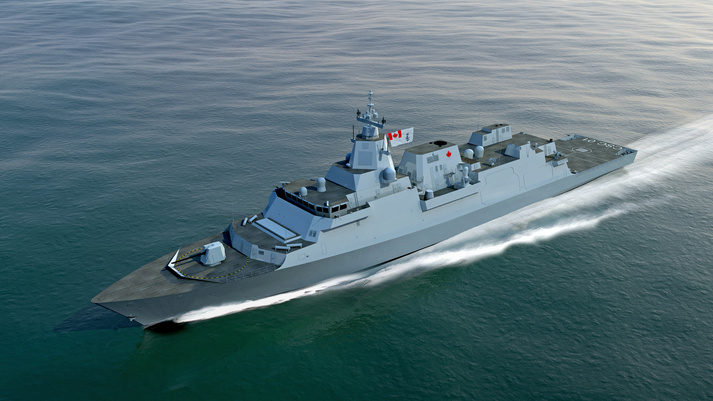
An artist's rendering of the British Type 26 frigate, which Lockheed Martin submitted for consideration as the replacement for Canada's patrol frigates. (BAE Systems Inc./Lockheed Martin Canada)
"You are hereby ordered to postpone the award of any contract in connection with the above-mentioned procurement until the Canadian International Trade Tribunal determines the validity of the complaint," said a copy of the letter that was obtained late Tuesday by CBC News.

Alion asked the CITT last week to investigate the procurement deal, saying the preferred warship design will need substantial changes and that it doesn't meet the Navy's requirements as spelt out in the government tender.

Last week, the company asked the Federal Court in a separate filing for a judicial review of the long-awaited decision.

Three companies were in the running to design the next generation of warships to replace the navy's aging Halifax-class frigates. Navantia, a Spanish-based company, was the other bidder in the competition.

Alion proposed its De Zeven Provinciën Air Defence and Command (LCF) frigate, a Dutch-designed warship, for the Canadian competition. The ship is already in service in other countries.

No one from the trade tribunal, nor the federal government was immediately available for comment late Tuesday.

A program already behind schedule:

Experts had warned the trade challenge and the court case might delay the program, which is already behind schedule.

The design competition stretched for almost two years as public services officials and executives at the federal government's go-to shipyard for combat vessel construction, Irving Shipbuilding of Halifax, worked with bidders to ensure a fair competition and to avoid post-decision court fights.

Public Services and Procurement Canada declined to comment when the court challenge was launched last week. But a senior federal official, speaking on the background at the time, said the federal government has up to 20 days to respond in Federal Court.

The official — who was not authorized to speak on the record because of the sensitivity of the file — said there is flexibility built into the timeline and the government is optimistic it can meet its goal of an early 2019 contract signing.

The substance of the Alion complaint is that the Lockheed Martin Canada-led bid should have been disqualified from the outset because it allegedly doesn't meet the Navy's criteria in terms of speed and crew space.

The Liberal government said it wanted to go with a proven warship design, rather than starting from scratch because it would be faster and cheaper.

Monday, October 22, 2018

British firm BAE Selected for Canada’s $60B Warship Replacement Program

By: David Pugliese, The National Post 

The Canadian Surface Combatant project will see the Halifax-based Irving build 15 warships, which will form the backbone of the future Royal Canadian Navy.


Artists Rendition of an RCN BAE Type 26 Global Combat Ship. BAE Handout
The Canadian government has selected a consortium closely linked to Irving Shipbuilding to provide it with a new warship design for the most expensive defence project the country has ever seen.

Canada announced Friday it had chosen the Type 26 warship design by British defence firm BAE for the $60-billion program to replace the Royal Canadian Navy’s Halifax-class frigates. Lockheed Martin Canada is leading the BAE consortium and will be the prime contractor. The group’s win had been anticipated since 2016, however, after rival defence firms raised concerns that the competition had been rigged in favour of the British design.

The Canadian Surface Combatant project will see the Halifax-based Irving Shipbuilding build 15 warships, which will form the backbone of the future Royal Canadian Navy. It will be the largest and most complex procurement in Canadian history. However, it is seen as a major departure from previous procurement processes, as Irving is playing a significant role in selecting the winning design.

The previous federal procurement minister, Judy Foote, had said only mature existing designs or designs of ships already in service would be accepted for the bidding process, on the grounds they could be built faster and would be less risky — unproven designs can face challenges as problems are found once the vessel is in the water and operating. But the Liberal government and Irving accepted the BAE design into the process, though at the time it existed only on the drawing board. Construction began on the first Type 26 frigate in the summer of 2017 for Britain’s Royal Navy, but it has not yet been completed.
Federal shipbuilding program poorly managed and lacks oversight, government adviser warns
Federal warship replacement cost swells to $62 billion, now more than twice the original budget: PBO
Liberals reject warship proposal that companies said would save taxpayers as much as $32B

Both Irving and the federal government have insisted the procurement was being conducted in a way that ensures all bidders are treated equally, overseen by a fairness monitor with no unfair advantage given to any individual bidder. Nonetheless, while three consortiums submitted bids for the surface combatant program, several European shipbuilders decided against participating because of concerns about the fairness of the process. Others raised concerns about BAE’s closeness with the Halifax firm.


Last year a French-Italian consortium also declined to formally submit a bid and instead offered Canada a fleet of vessels at a fixed price. Officials with Fincantieri of Italy and Naval Group of France said they don’t believe the procurement process as it is currently designed will be successful. The federal government, however, rejected the deal.

The federal government had to remind Irving about the potential for conflict of interest when the firm joined forces with BAE in late 2016 to bid on a multi-billion dollar contract to provide maintenance and support for the navy’s new Arctic patrol and supply ships.

The Irving-BAE alliance was not successful in that bid, but it led the government to remind Irving it had an obligation to “ensure that the Canadian Surface Combatant competition is conducted in a manner that is free from real or perceived conflicts of interest,” according to February 2017 documents prepared for defence minister Harjit Sajjan and released to the Conservatives under the Access to Information law.

Andre Fillion, assistant deputy minister for defence and marine procurement at Public Services and Procurement Canada, said Friday’s decision is not a contract award. “It’s an important step to getting to contract award in the coming months,” he said.

Negotiations will now begin with Lockheed Martin. if negotiations proceed accordingly a contract is expected to be signed sometime between January and March 2019.

But Fillion said if there are issues with those negotiations and an agreement is not reached, the government will then turn to the next highest-ranked bidder. The government has declined to identify that firm, but the other bidders were from the U.S. and Spain.

The Canadian Surface Combatant program has already faced delays and rising costs. In 2008 the then-Conservative government estimated the project would cost roughly $26 billion. But in 2015, Vice-Admiral Mark Norman, then commander of the navy, voiced concern that taxpayers may not have been given all the information about the program, publicly predicting the cost for the warships alone would approach $30 billion.

Friday, July 20, 2018

Final Canadian Surface Combatant Bids Due Today

By: David Pugliese, Defence Watch 

The final bids are being submitted Friday by various consortiums for the Canadian Surface Combatant program.

The bids going in Friday involve the finalized portions of the bids on designs (the technical design bids were originally submitted in November but today marks the deadline for responses that deal with any questions the federal government may have had/changes needed to be made) as well as proposals for the financial elements for the project.

The new ships will be the backbone of the future Royal Canadian Navy.

The groups bidding include:

-Lockheed Martin Canada, who will be the prime on the team that includes BAE Systems, CAE, L3 Technologies, MDA, and Ultra Electronics. The team is offering the BAE Type 26 warship for the Canadian program. The proposal will include Lockheed Martin Canada’s combat management system, CMS 330, which is currently on board the modernized Halifax-class frigates. A scaled down version of the system will be used on the Royal Canadian Navy’s new Arctic Offshore Patrol Ship fleet. The United Kingdom is acquiring 8 of the Type 26 ships. Australia has also identified the Type 26 as the design for its future warship.

Gary Fudge, Vice President and General Manager, Lockheed Martin Canada Rotary and Mission Systems told Defence Watch that the group’s bid was submitted earlier this week. He noted that the Type 26 would be excellent in an anti-submarine warfare role as it is designed to be extremely quiet. The vessel also has room to future modernization, unlike older designs, he added. The Lockheed Martin team, which is making $17 billion in value proposition commitments to Canada, will commit to spending billions in innovation across Canada’s priority areas, including $2 billion in supplier development and $2 billion in research and development, and $200 million in advanced manufacturing, the company noted.

-Alion Science and Technology, along with its subsidiary Alion Canada, submitted their proposal based on the Dutch De Zeven Provinciën Air Defence and Command (LCF) frigate. “Our solution delivers an effective, affordable, production-ready 21st century naval capability to meet Canada’s defence needs,” Bruce Samuelsen, Chief Operating Officer for Alion, said last year while promoting the firm’s bid. The De Zeven Provinciën-class frigate is a proven NATO vessel, built by Damen Schelde Naval Shipbuilding, with more than 10 years of operational excellence, the company added.

Alion’s combat system solution is based on the world-class capabilities of ATLAS-Elektronik and Hensoldt Sensors. ATLAS brings an open architecture Combat Management System that readily accepts new and evolving technologies, the firm noted. Hensoldt’s capability and experience in developing and fielding state-of-the art radars was central to meeting the unique Canadian requirements with a fielded, non-developmental radar, the Alion team added in an earlier news release. Other key suppliers include L3 Technologies Canada, Raytheon Canada Limited, DRS Technologies Canada Limited (DRS TCL) and Rheinmetall Canada Inc.

-Navantia of Spain is leading a team that includes Saab Australia and CEA Technologies. Its proposal is based on the F-105 frigate design, a ship in service with the Spanish navy. The design has also already been exported to Norway and Australia. Saab, which would provide the combat management system, has support on the CSC program from Lockheed Martin (Moorestown, New Jersey), General Dynamic Mission Systems – Canada, DRS Technologies Limited Canada, OSI Maritime Service and Rheinmetall Canada, according to Navantia.

The F-105 Anti-Submarine Warfare ship will incorporate Saab’s 9LV Combat Management Systems, elements of which are in service on over 240 platforms in 16 navies across the globe, including Canada’s own Halifax-class frigates, the company has said.

The budget for the Canadian Surface Combatant project is estimated by the federal government to be between $55 billion and $60 billion. That is a range but specific costs won’t be known until contacts are signed and more details worked out. Fifteen warships will be built.

Pat Finn, assistant deputy minister for materiel at the Department of National Defence, told Defence Watch he expects a winning bid to be selected by the end of this year.

After that negotiations would start and a contract is expected to be signed sometime early 2019. If an agreement can’t be reached then negotiations would begin with the group that came second in the competition.

About half of the cost of the surface combatant price-tag is for systems and equipment that will go on the 15 ships, according to federal documents obtained by Postmedia through the Access the Information law. “Approximately one-half of the CSC build cost is comprised of labour in the (Irving’s) Halifax yard and materials,” the documents added.

Jean-Denis Fréchette, the Parliamentary Budget Officer, estimated the CSC program would cost $61.82 billion. He also warned that every year the awarding of the contract is delayed beyond 2018, taxpayers will spend an extra $3 billion because of inflation.

Wednesday, May 16, 2018

BAE Type-26 GCS to be operational in 2027; Still considered a top contender for CSC Fleet

By: David Pugliese, National Post 

One of the top contenders in Canada’s new frigate program – a ship now being built for the United Kingdom – won’t be operational for the Royal Navy until 2027.

BAE’s Type 26 frigate has been ordered by the United Kingdom and the cutting of steel started last year.

But the United Kingdom’s defence procurement minister Guto Bebb has told parliamentarians that the first of those frigates won’t be delivered until 2025. Because of testing it won’t become operational until 2027, the minister added.

Artists Rendition of the BAE Type-26 Global Combat Frigate. 
The Type 26 design has been submitted to Canada for its Canadian Surface Combatant program and is one of three contenders. Construction on the Canadian frigate program to start in the early 2020s.

That raises the possibility, say industry insiders, that Canada could be the first nation to acquire the Type 26 and put it to sea.

Being the first to deploy a new class of warships, however, comes with associated issues of working through the initial problems of new vessels.

That, however, is what the Canadian government had hoped to avoid with its CSC program. It originally stated that only mature ships or proven designs would be considered.

But the Liberal government inexplicably retreated on that stipulation and allowed the Type 26 design to be entered even though the vessel had not been built yet.

That, in turn, sparked a belief in some quarters of industry that the fix is in for BAE’s Type 26. The federal government has denied that.

Lockheed Martin Canada is leading the consortium that has proposed the Type 26. A company spokesperson said the progress of the British program will not have an impact on CSC.

“Our CSC bid meets or exceeds all requirements and this does not impact our bid in any manner,” the spokesperson noted in an email to Defence Watch. “Our CSC bid does not rely upon the T26 becoming operational before 2027.”

Some industry officials have also suggested that the 2027 date won’t be an issue because they expect the CSC to fall significantly schedule. By the time CSC gets really underway, the Type 26 will be ready.

The Canadian Surface Combatant program will cost between $55 billion and $60 billion. Fifteen ships will be eventually built. Three consortiums have bid on the program.

A contract for the CSC is expected to be awarded by the end of this year, said Pat Finn, assistant deputy minister for materiel at the Department of National Defence.

About half of the cost of the surface combatant price-tag is for systems and equipment that will go on the 15 ships, according to federal documents obtained by Postmedia through the Access the Information law. “Approximately one-half of the CSC build cost is comprised of labour in the (Irving’s) Halifax yard and materials,” the documents added.

Last year, Jean-Denis Fréchette, the Parliamentary Budget Officer, estimated the CSC program

would cost $61.82 billion. He also warned that every year the awarding of the contract is delayed beyond 2018, taxpayers will spend an extra $3 billion because of inflation.

Thursday, May 3, 2018

RCN and Irving Look to Sell AOPS Internationally to Fill Construction Gap

By: David Pugliese, National Post

The gap between the building of new ships for the navy could be as much as 18 months, opening the possibility of east coast shipyard employees to be laid off.

But the Defence department’s top equipment official says changes to the shipbuilding procurement process will reduce some, but not all, of that gap. Workers that could be affected would be blue-collar shipyard employees at Irving Shipbuilding.

The 18-month gap between finishing construction of the fleet of Arctic Offshore Patrol Ships or AOPS and starting the new Canadian Surface Combatant vessels at Irving shipyards in Halifax is outlined in documents obtained by Postmedia through the Access to Information law.

Image result for AOPS

“We are still concerned about a gap,” Pat Finn, assistant deputy minister for materiel at the Department of National Defence, acknowledged in a recent interview.

The engineering workforce in the Irving yard is about to ramp up dramatically, he added, so there are no concerns there. “The issue is on what we call the blue‑collar workforce, and particularly (in) the early stages of construction,” Finn explained. “Those are the people that, once you’ve finished cutting steel in the last AOPS, ideally the next day you start cutting steel on the first surface combatant. Well, right now we’re not lined up to do that.”

Construction of the first surface combatants isn’t scheduled to begin until the early 2020s.

The first AOPS will be in the water in the summer and the other vessels are expected to follow fairly quickly.

“The gap is still a few years away, but clearly if we’re going to make sure there’s continuous flow of work, we’ve got to be dealing with that now,” Finn said.

He said the Royal Canadian Navy is lending its support to help promote the AOPS to international customers in the hopes of drumming up more work to shrink the size of the construction gap.

Procurement Minister Carla Qualtrough has also said she is open to the idea of additional AOPS being purchased for Canada.

Irving spokesman Sean Lewis said Wednesday that the company, the federal government and a third-party expert continue to look at the issue. “The construction of additional AOPS for Canada or international export opportunities is being considered and various options pursued,” he explained. “At this time it is premature to comment further.”

It’s way too early to talk about layoffs

In November federal government and Irving officials acknowledged their worry that highly skilled employees and their expertise could be lost in any potential gap between construction of AOPS and the surface combatants. “It’s way too early to talk about layoffs,” Irving Shipbuilding president Kevin McCoy said at the time.

The same problem has emerged in the federal shipbuilding program on the west coast and unions there warn that layoffs are coming. Seaspan Shipyards in Vancouver acknowledges there will be a gap between the construction of coast guard vessels, a situation it is trying to deal with by drumming up more work from the federal government or from the commercial marketplace.

Such gaps were supposed to be prevented by the federal government’s national shipbuilding strategy, which called for the continuous build of vessels, ensuring steady employment for a skilled labour force.

The Canadian Surface Combatant program will cost between $55 billion and $60 billion. Fifteen ships will be eventually built. Three consortiums have bid on the program.

Image result for Type 26 Canadian Surface Combatant proposal
Artits Rendering of the BAE Type-26 Global Combat Ship; which many believe is the frontrunner in the CSC Fleet Proposal.
Finn said a contract is expected to be awarded by the end of the year.

About half of the cost of the surface combatants is for systems and equipment that will go on the 15 ships, according to federal documents obtained by Postmedia through the Access the Information law. “Approximately one-half of the CSC build cost is comprised of labour in the (Irving’s) Halifax yard and materials,” the documents added.

Last year, Jean-Denis Fréchette, the Parliamentary Budget Officer, estimated the CSC program would cost $61.82 billion. He also warned that every year the awarding of the contract is delayed beyond 2018, taxpayers will spend an extra $3 billion because of inflation.

Friday, April 20, 2018

Firms Skipped CSC Bib for Fear of Loss of Proprietary Information

By: David Pugliese, Ottawa Citizen 

In December Fincantieri of Italy and Naval Group of France decided not to bid on the Canadian Surface Combatant project. Instead, they offered the Canadian government a direct proposal that would see the the companies build 15 of the consortium’s FREMM frigates at a fixed price of roughly $30 billion.

The Liberal government rejected the offer.

A FREMM frigate sails off the coast of France in 2016. BORIS HORVAT/AFP/GETTY IMAGES
Fincantieri and Naval Group knew they were taking a chance when they passed on the formal bidding process for the CSC. Sources close to the European companies said at the time they felt they didn’t have anything to lose. They alleged the Canadian competition was skewed to favour a bid by Lockheed Martin Canada and the British firm BAE which would see Canada buying the Type 26 frigate BAE is building for Britain’s navy.

The Canadian government had originally asked for only bids featuring proven ship designs. But it later changed those parameters to allow a bid from BAE, though the Type 26 was at the time still on the drawing board.

Giuseppe Bono, the CEO of Fincantieri, recently told my colleagues at the U.S. publication Defense News of another concern that led to the decision not to bid on the CSC. Bono said that the firms were willing to turn over their sensitive technical data to the Canadian government but that they drew the line at providing the proprietary information to Irving and its team.

“We said we were prepared to give the information to the Canadian government but not to a rival company if we didn’t know if we were going to win the bid or not,” Bono said.

Fincantieri and Naval Group, along with other companies, have voiced concerns about Irving’s alliance with the U.S. firm, Gibbs and Cox, a top U.S. naval architecture firm that designs surface warships. Gibbs and Cox is also the main competitor for many companies – including Fincantieri and Naval Group – pursuing ship contracts around the world.

Irving, however, has rejected such concerns and has stated it is committed to protecting any sensitive data provided by companies bidding on CSC.

But Fincantieri and Naval Group weren’t buying that reassurance.

The firms still have their proposal ready in case the Canadian procurement falls apart and the federal government decides on a different course of action.

In February, the U.S. Navy named the FREMM design as one of five it could consider for its future frigate program and has provided Fincantieri $15 million to look at a design concept.

Monday, April 16, 2018

Bids for Future RCN Warships Don't Meet Many of the Requirements

By: David Pugliese, The National Post 

Canada’s quest for a new fleet of warships is off to a rocky start with all bidders failing to meet some of the federal government’s requirements.

Procurement officials are now trying to regroup on the $60-billion project and figure out ways that bidders might be able to change their proposals to make them acceptable, a number of defence industry executives pointed out.

The problems centre around technical issues. Some are minor but in other cases there is a view among defence industry officials that Canada is asking for too much in some areas such as radar, which may be causing problems with meeting requirements.

Public Services and Procurement Canada spokeswoman Michèle LaRose said the bids received for the Canadian Surface Combatant project have not been disqualified. Three bids have been received. The federal government and Irving Shipbuilding are still evaluating the proposals, she added. LaRose pointed out that the evaluation is at the second stage in the process.

Government officials say that involves what is known as “the cure process” in which bidders will be given details of how their proposals have failed to meet the stated criteria. They will then be given only one opportunity to fix issues with their bids.

HMCS St. John’s, one of Canada’s Halifax-class frigates, undergoes a mid-life refit at the Irving Shipbuilding facility in Halifax on Thursday, July 3, 2014. Andrew Vaughan/Canadian Press

If they are still considered “non-compliant” after the cure period they “will be eliminated from the competition,” according to the federal government.

Technical specifications are now being evaluated by the government. Later this year, the companies will provide the financial information related to their bids.

Warship builders submitted their bids on Nov. 30. A winning bid is expected to be selected sometime this year.

Irving Shipbuilding will begin construction of the first ship in the early 2020s and delivery of the first vessel is expected in the mid-2020s, according to the federal government.

But the project has been plagued with delays and controversy.

Approximately one-half of the CSC build cost is comprised of labour in the (Irving’s) Halifax yard and materials

The final cost of the ships is still unknown. In 2008 the government estimated the total cost of the project to be about $26 billion.

But in 2015 navy commander Vice Admiral Mark Norman voiced concern that taxpayers may not have been given all relevant information, and publicly predicted the cost for the ships alone would be around $30 billion.

Cost estimates for the project are now between $55 billion and $60 billion.

About half of the cost is for systems and equipment that will go on the 15 ships, according to federal documents obtained by Postmedia through the Access to Information law. “Approximately one-half of the CSC build cost is comprised of labour in the (Irving’s) Halifax yard and materials,” the documents added.
HMCS Iroquois arrives in Halifax on Oct. 23, 2008 after a six-month deployment to the Persian Gulf and Arabian Sea. Andrew Vaughan/Canadian Press
Last year, Jean-Denis Fréchette, the parliamentary budget officer, estimated the CSC program would cost $61.82 billion. He also warned that every year the awarding of the contract is delayed beyond 2018, taxpayers will spend an extra $3 billion because of inflation.

The surface combatant will be the backbone of the future Royal Canadian Navy.

In November in a surprise twist a French-Italian consortium declined to formally submit a bid and instead offered Canada a fleet of vessels at half the price.

Officials with Fincantieri of Italy and Naval Group of France said they don’t believe the procurement process as it is currently designed will be successful.

Instead they provided the Canadian government with a direct proposal that Irving Shipbuilding on the east coast construct 15 ships based on the consortium’s FREMM frigate design, which is proven and is currently in operation with the French and Italian navies. They are guaranteeing the cost of the ships at a fixed price of $30 billion.

The deal would have also focused on using Canadian technology on board the ships and included technology transfer to Canadian firms, so they could be involved in future sales of the FREMM vessels on the international market.

FREMM ships are operated by the Italian, French, Moroccan and Egyptian navies.

Under that plan, Irving could start building the warships almost immediately.

The Liberal government, however, rejected the deal.

Thursday, March 8, 2018

DND Needs $54M in Additional Funds to Evaluate CSC Fleet Proposals

By: David Pugliese, The National Post

The Department of National Defence needs an extra $54 million just so it can examine the bids from companies hoping to build it a new fleet of warships — an indication of the growing expense of a program that has more than tripled in cost over the years.

HMCS Ottawa, one of the Royal Canadian Navy's Halifax-class frigates that will be replaced by the eventual arrival of the Canadian Surfance Combatant Fleet. Roslan Rahman/AFP/Getty Images
The funds are not earmarked for anything to do with the actual construction of the ships, but instead to fund DND’s evaluation of the the bids this year — and they would be in addition to the $39 million the department has already received to review the bids, according to defence sources.

The cost of the new Canadian Surface Combatants, which will replace the existing Halifax-class frigates, has steadily been climbing. The 15 ships were originally estimated to cost $15 billion. That increased to $24 billion before DND came out with a new estimate of around $40 billion. That too has since changed, and the project is now estimated to cost between $55 billion and $60 billion — and even then, the federal government acknowledges it doesn’t know what the program’s final cost will be to taxpayers. Parliamentary budget officer Jean-Denis Fréchette estimated last year the CSC program would cost $61.82 billion, and warned that every year the awarding of the contract is delayed beyond 2018, taxpayers will spend an extra $3 billion because of inflation.

Despite the Liberal government’s repeated statements about openness and transparency, it took Postmedia more than three months to get basic information from DND about its request for new funding, and even then, the details provided are limited.

“These funds will permit the project to maintain the Project Management Office and to continue work under the Definition Support Contract with Irving Shipbuilding Inc. for the remainder of this fiscal year,” the DND said in an email. “This funding will primarily support the Request for Proposal, bid evaluation and preparations for the design services contract.”

The money will cover salaries and benefits for the 135 military and civilian staff at the DND who are assigned to the project office, the department said, and will also be used to train staff and upgrade their offices.

Prospective builders of the new warships submitted their bids on Nov. 30, and a winning bid is expected to be selected sometime this year. Halifax-based Irving Shipbuilding will begin construction of the first ship in the early 2020s and delivery of the first vessel is expected in the mid-2020s, according to the federal government.

Image result for canadian surface combatant
Artists rendering of a BAE Type-26 Global Combat Ship with the Royal Canadian Navy Ensign - a proposed design for the Canadian Surface Combatant Fleet. 
Defence analyst Martin Shadwick said that without more detail of how the funds will be spent it’s hard to determine whether taxpayers are getting value for money. “But it seems a very high cost to run a project office for a one-year period and to evaluate bids,” added Shadwick, a strategic studies professor at York University in Toronto.

The surface combatant project, intended to provide the backbone of the future Royal Canadian Navy, has long been controversial.

In a surprise twist in November, a French-Italian consortium declined to formally submit a bid, instead offering Canada a fleet of vessels at half the price. Fincantieri of Italy and Naval Group of France don’t believe the established procurement process for the surface combatant program, already beset with delays and increasing costs, will be successful.

They instead proposed that Irving Shipbuilding construct 15 ships based on the consortium’s proven FREMM frigate design, currently in operation in both the French and Italian navies, among others, and guaranteed a fixed price of $30 billion. Thier proposal also focused on using Canadian technology on board the ships, and would have transferred technology to Canadian firms so they could be involved in future sales of the FREMM vessels on the international market. Under the plan, Irving would have been able to start building the warships almost immediately.

The Canadian government, however, rejected the offer.

Image result for Alpino fremm frigate
Italian Navy Alpino FREMM Frigate. Italy ordered 10 FREMM Frigates. The FREMM is currently operated by the Italian Navy, the French Navy, the Egyptian Navy, and the Royal Moroccan Navy. 

Wednesday, February 28, 2018

Budget 2018 Shores up Cyber Defence but is Silent on New Jets and Warships

By: Murray Brewster, CBC News
The new federal budget focuses on ones and zeros over tanks and troops by pouring hundreds of millions of dollars into new and improved cyber and national security defences.

Several federal departments will not only see upfront cash but promises of long-term spending to counter both the threat of hackers — state-sponsored and otherwise — and cyber-criminals.

National Defence, by comparison, is seeing virtually nothing in terms of new spending on the nuts and bolts of the military, other than initiatives outlined in the recently tabled national defence policy.

The 2018 budget is, on the surface, a tacit acknowledgement that the nature of threats to national security — the nature of modern warfare itself — is changing.

The budget recycles the government's $3.6 billion pledge last December to provide veterans with the option of a pension for life and better services.
But cyber-security was, by far, the headline national security measure in the budget.

Finance Minister Bill Morneau's fiscal plan sets aside $750 million in different envelopes — much of it to be spent over five years — to improve cyber security and better prepare the federal government to fend off online attacks and track down cyber-criminals.
More for CSE

It also promises an additional $225 million, beginning in 2020-21, to improve the capacity of the country's lead electronic intelligence agency, the Communications Security Establishment, to gather foreign signals intelligence.

The Liberals will soon pass new national security legislation — C-59 — and CSE will receive important new powers and responsibilities to disrupt global cyber threats.

"These are brand new tools. They're going to need lots of resources — technological resources, personnel resources — to engage in those kinds of operations," said Wesley Wark, a University of Ottawa professor and one of the country's leading experts on cybersecurity and intelligence, in an interview prior to the budget.

The sense of urgency about getting the country's cyber-security house in order is being driven in part by the fallout from Russian hacking and meddling in the 2016 U.S. presidential election, said a former assistant parliamentary budget officer.

"With what we've seen south of the border, I think cyber-security and cyber-threat has been elevated in this budget to a high-priority item," said Sahir Khan, now the executive vice president of the Institute of Fiscal Studies and Democracy.

The budget creates two new entities to deal with online threats.

The first, the Canadian Centre for Cyber Security, will assemble all of the federal government's cyber expertise under one roof — a plan that will require new legislation.

The second organization will be run by the RCMP and be known as the National Cybercrime Coordination Unit.

It will coordinate all cybercrime investigations and act as a central agency to which the public can report incidents.

The budget also includes cash for Public Safety's National Cyber Strategy, which not only aims to protect federal government networks but is meant to collaborate with the corporate financial and energy sectors to boost their defences.
Military procurement a work in progress

The budget's dearth of new spending on the real-world military — at a time of significant global insecurity — is due to reasons that are partly political and partly organizational, said Khan.

The former Conservative government's inability to deliver on promises of new equipment during its nine-year tenure was a political "albatross around its neck," he said.

The Liberals may have produced a clear defence policy but they have yet to straighten out the procurement system, he added.
The Trudeau government has promised a lot of military capital spending down the road. Khan said it seems determined to keep the issue out of the spotlight in the meantime.

What's missing from the new budget is a clear commitment that National Defence will get the cash it needs as those needs arise.

"I think there was a lot of clarity in the policy direction coming out of the government [defence] white paper," said Khan. "What a lot of us are trying to understand is whether the money … is accompanying that change in direction … so that DND has a stable footing to meet its needs."

He said he still has questions about whether promised future spending on fighter jets and warships has been baked into the federal government's long-term fiscal plans.

A senior federal official, speaking on background prior to the release of the budget, insisted that military capital spending is welded into fiscal plans going forward into the 2030s.

Defence Minister Harjit Sajjan has said repeatedly, since the strategy was released last June, that the defence plan was "fully costed" into the future.

Up until 2016, National Defence produced an annual list of planned defence purchases.

The Liberals promised to produce their own list of planned acquisitions and table it this year. Khan said it "needs to be presented to Parliament and the public."
Training and retaining?

The cyber initiatives in Monday's budget drew a mixed response from the high-tech sector.

On the one hand, the Council of Canadian Innovators praised budget signals that suggest the Liberals are open to dealing with home-grown companies rather than buying off-the-shelf from major U.S. firms.

"The imperative to build domestic cyber capacity is not just economic. It's existential," said Benjamin Bergen, the council's executive director.

"Without a domestic capacity in cyber we risk becoming a client state. Innovators welcome the announcement of a new Canadian Centre for Cyber Security, which will allow for information sharing between the public and private sector."

What the budget didn't offer was a clear commitment to training and retaining highly-skilled software engineers and IT professionals.

"We would have liked to have seen a retention strategy. There wasn't one," said Bergen. "We know Canada produces amazing graduates but we're struggling to keep that talent here."

The council estimates there will be up to 200,000 job openings in high-tech by 2020, which will put pressure on the industry and on the federal government as it bulks up its cyber capability.

Adam Froman, CEO of the Toronto-based data collection firm Delvinia, was blunt when asked if the federal government will be able to fill all of the cyber-security job openings created by this budget.

"They're not going to be able to. Plain and simple," he said. "Or they're going to have to outsource those jobs to foreign companies."

Wednesday, January 24, 2018

Forbes: Why We Are Buying Canadian Warships

By: Gordon Forbes, The Ottawa Citizen - Opinions 

It is so simple, according to some: Just go out to your foreign new warship dealer and buy the warship of your dreams for billions less than you can build it is Canada. Take the savings and pay ex-shipyard workers Employment Insurance for 10 years.

This would, of course, close every shipyard capable of building large ships in Canada – all three of them. Why did nobody think of it before?

Well, they have, and for decades the idea has been rejected by every type of government. Because it is not just the shipyards that would lose business, but hundreds of small, medium and large businesses across the country. Businesses that not only provide such things as steel and copper but that produce products ranging from anchors to the integration of combat systems. Does anyone remember the hundreds of businesses that suffered when the Avro Arrow was canceled in 1959?
Canada can take a lesson from the fate of the Avro Arrow fighter program. COPY PHOTO BY IAN ROBERTSON, SUN
But the most important loss would be the loss of intellectual property (IP) that would go along with such an idea.

Intellectual property belongs to those who design the millions of things that go into a modern warship. This IP would belong to those offshore companies who designed the ship and it systems. We have already seen an inkling of this problem with the current attempt to buy offshore designs for the Navy’s Canadian Surface Combatant (CSC). Several countries and their shipyards have balked at the requirement for Canada to have access to the IP of their proposed designs.

But why is this IP important? It is primarily because it limits the amount of maintenance and modification that Canada can carry out. Without the IP, you cannot fix anything, you cannot modify anything and you cannot sell your technology to other countries. It would mean that we would have to send the ships back to their parent shipyards for dockings and other essential work. It would mean that maintenance of any ship systems, from main engines to combat systems, could only be done by the holders of the IP. It would mean little or no work for Canadian workers on any of these systems.

Image result for Canadian Surface Combatant Fleet
Artists Renditions of the Future Vessels of the RCN
But surely we could buy the IP from the selling shipyard? Well, that would also mean buying it from every IP holder who has equipment on the ship. And it would cost us billions, many of those billions we might also have to put toward payment of ex-employees. This is a sellers’ market and Canada would have very little leverage to acquire IP for minimal cost.

To those who argue the point: It is just not that simple to buy all our warships offshore.
---
Gordon Forbes, LCDR (ret’d), has been involved in the naval procurement business for the most part of 38 years, both in the Navy and in the defence industry. He lives in Orléans.