Translate

Showing posts with label CF-18 Replacement. Show all posts

Thursday, March 28, 2019

Questions Loom for Used F-18 Fleet with Budget Officer Report

By: David Pugliese, The Ottawa Citizen 

The Defence department’s procurement chief says the Royal Canadian Air Force might not need the seven used Australian F-18 aircraft being purchased for parts afterall.

The first used Australian F-18 arrives at CFB Cold Lake earlier this month. It appears that not all 25 procured used jets will even be used. Australia has even asked for some of the engines be returned as a result of a shortage. 

Canada is buying 25 used F-18s from Australia, with 18 of those to be flown and seven to be either stripped down for parts or used for testing. The aircraft to be flown will augment the existing RCAF CF-18 fleet until a new generation fighter jet can be purchased.

But Pat Finn, the Department of National Defence’s Assistant Deputy Minister for Materiel, said there may be no need for the seven F-18s. “The seven, whether or not we actually take them at this point, we’re still looking at that,” Finn recently told the Commons defence committee. “What we’re actually finding is the number of spares that they’ve been able to provide to us is more than adequate. Rather than take aircraft apart and go through that cost, we’re taking the spares. We may not, in fact, at this point look at any of the seven.”

It is unclear whether there will be a reduction in the cost of the purchase or the overall project cost if the seven airframes are not acquired.

The DND also clarified what is happening with the engines on the Australian F-18s. Rumours have been circulating in the retired military community that the engines are being stripped out of the planes and given back to Australia.

“Only the engines from the first two Australian F-18s (four engines total) are being returned to Australia, at their request,” explained DND spokesman Dan Le Bouthillier. “Australia needs those engines to meet their own operational requirements.”

In order to take advantage of an advanced delivery date for the first two Australian aircraft, Canada agreed to return those aircraft’s engines to Australia, but the plan is to get an equivalent number of engines back at a later date, he added.

“Canada has sufficient engines in reserve to support this plan and this will have no impact on operations,” Le Bouthillier stated. “We therefore found this to be a reasonable request, and agreed to it.”According to the Parliamentary Budget Officer’s recent report provides more details about the used Australian F-18s that Canada is purchasing. Eighteen of the 25 will eventually be flying, while the other seven will be used for spare parts and testing.

Here are details taken from the PBO report:

According to PBO calculations, the Canadian fleet is both slightly older and has experienced more usage than the Australian fleet. The average Canadian F-18 had accrued over 6,000 flying hours by the end of the 2017-2018 fiscal year. These calculations are supported by media reports indicating that by 2014, the CF-18s had accumulated over 5,700 flying hours on average, with over a third of the fleet already having flown over 6,000.

Canada’s Department of National Defence has stated that the aircraft being purchased from Australia’s F-18 fleet are very similar to those currently in operation within the RCAF.
The fleet arrival profile consists of 2 aircraft in 2018-2019, 2 aircraft in 2019-2020, 8 aircraft in 2020-2021, and 6 aircraft in 2021-2022;
The aircraft will enter service approximately 6 months after being received;
The aircraft will each accumulate about 160 flying hours per year, in accordance with the recent experience of the Canadian CF-18 fleet;
Each Australian F/A-18 has accumulated an average of 6000 flying hours over the course of its operational history with the Royal Australian Air Force;.

Friday, January 4, 2019

Canada Finalizes Deal for 25 Australian F-18s; RCAF will fly used jets Summer 2019

By: David Pugliese, The National Post 

Canada has finalized a deal to buy 25 used fighter jets from Australia, the first of which are expected to be operating by this summer, says the top procurement official at the Department of National Defence.

Royal Australian Air Force F-18 Hornet pilots wave to the crowd as they taxi down the runway after performing during the Australian International Airshow at the Avalon Airfield near Lara southwest of Melbourne on February 24, 2015.PAUL CROCK/AFP/Getty Images
“The first two aircraft will be here this spring,” Pat Finn, assistant deputy minister for materiel at DND, told Postmedia in an interview. “I would say it could be by the summer the first couple are on the flight line and painted with the maple leaf.”

A second group of planes would arrive later this year. Eighteen of the Australian F-18 aircraft will eventually be flying for the Canadian Forces, while another seven will be used for testing and spare parts.

Canada is paying Australia $90 million for the aircraft. The federal government originally estimated the purchase of the Australian jets would cost around $500 million, but Finn said that price reflected every aspect of the associated deal, not just the cost of purchasing the jets. Canada is also acquiring extra spare parts, the Australian jets will have to be outfitted with specific Canadian equipment and software and testing will be needed.

The $500-million project estimate also included $50 million in contingency funds to cover any problems and another $35 million for the salaries of all civilian and military personnel involved over the life of the project. An additional $30 million will be spent on new infrastructure needed to accommodate the aircraft.

Royal Canadian Air Force CF-188 Hornet jets from 4 Wing Cold Lake, Alberta are refuelled by a KC-135 Stratotanker assigned to the 340th Expeditionary Air Refueling Squadron on October 30, 2014, over Iraq during the first combat mission in the area of operations, supporting Operation Inherent Resolve. U.S. Air Force Photo by Staff Sgt. Perry Aston

Those costs add up to $360 million, Finn said. But DND also plans to upgrade its existing fleet of CF-18s with new communications gear and equipment required to meet regulations to operate in civilian airspace, improvements which the Australian jets will also eventually receive at a cost of around $110 million, an amount that brought the original estimate to nearly $500 million.

The Liberal government had planned to buy 18 new Super Hornet fighter jets from U.S. aerospace giant Boeing to augment the Royal Canadian Air Force’s CF-18s until new aircraft can be purchased in the coming years.

But in 2017 Boeing complained to the U.S. Commerce Department that Canadian subsidies for Quebec-based Bombardier allowed it to sell its C-series civilian passenger aircraft in the U.S. at cut-rate prices. As a result, the administration of U.S. President Donald Trump enacted a tariff of almost 300 per cent against the Bombardier aircraft sold in the U.S. In retaliation, Canada cancelled the deal to buy the 18 Super Hornets, which would have cost more than US$5 billion.

Instead of buying the new Super Hornets, the Liberals decided to acquire the used Australian jets.

Defence Minister Harjit Sajjan has said the extra jets are needed to deal with a “capability gap,” as Canada does not have enough fighters to handle its commitments to NATO as well as protecting North America.

But Conservative MPs say the capability gap doesn’t exist and was concocted by the government to delay a larger project to buy new jets, a competition that might end up selecting the F-35 stealth fighter that during the 2015 election campaign the Liberals vowed never to purchase.

In the fall of 2016, then-Royal Canadian Air Force commander Lt.-Gen. Mike Hood told senators that the Liberal government brought in a policy change which required the RCAF to be able to meet both its NATO and North American air defence commitments at the same time. That, in turn, created the capability gap, he said. Hood said he was not told about the reasons for the policy change.

In November 2018 Auditor General Michael Ferguson issued a report noting that the purchase of the extra aircraft would not fix the fundamental weaknesses with the CF-18 fleet which is the aircraft’s declining combat capability and a shortage of pilots and maintenance personnel.

“The Australian F/A-18s will need modifications and upgrades to allow them to fly until 2032,” the report said. “These modifications will bring the F/A-18s to the same level as the CF-18s but will not improve the CF-18’s combat capability.”

“In our opinion, purchasing interim aircraft does not bring National Defence closer to consistently meeting the new operational requirement introduced in 2016,” Ferguson’s report added.

The Canadian Forces says it is bringing in new initiatives to boost the numbers of pilots and maintenance staff.

Wednesday, December 12, 2018

New RCAF Aircraft to be Operational in 2026; but No Decision on Replacement Yet

By: David Puligese,

The Royal Canadian Air Force will be operating the first nine aircraft from its new fleet of fighter jets starting in 2026, Department of National Defence officials say.

But at least one member of parliament questions whether the federal government will be able to meet its timetable to replace the CF-18 fighter fleet with advanced aircraft.

MPs on the Standing Committee on Public Accounts received more details on Monday about the Liberal government’s plan to buy 88 new fighter jets. Aircraft expected in the competition include Lockheed Martin’s F-35, the Eurofighter Typhoon, Saab’s Gripen and the Boeing Super Hornet.

Pat Finn, assistant deputy minister for material at the DND, told MPS that the formal request for proposals will go out in the spring of 2019. Negotiations would be held in 2021 and a contract awarded in 2022.

“We have tried to be very judicious and not have too risky a schedule to try to achieve some of that,” Finn explained to MPs. “But from the bids until the signing of the contract is where we’ve given ourselves two years for the competitive dialogue, the final negotiations and the various approvals we need to get, signing the contract in 2022.”

The first aircraft would be delivered in 2025. Finn said this schedule has been shared with all the potential bidders and “they’re comfortable with that approach.”

Jody Thomas, the DND deputy minister, told MPs that the plan is to “achieve initial operating capability by 2026 with nine advanced fighters ready to fulfill the NORAD mission.”

But one committee member, Conservative MP Pat Kelly, was wary of whether the aircraft acquisition would proceed as scheduled.

The plan, he told Finn, doesn’t leave a lot of margin for error. Everything would have to run like clockwork to meet the timetable and Kelly questioned if that would even be possible given the track record of defence procurement over the years. “We just don’t have time in this for the kinds of delays and the kinds of failures of procurement that we have seen in other programs,” Kelly said. “I shudder to think of what many Canadians listening to this hearing might think about. What has the potential to go wrong to get to 2025? I’m going to leave it at that.”

Wednesday, November 28, 2018

Liberals Press Ahead with Second-Hand F-18s Amid Questions Over Who Will Fly Them

The Canadian Press - The Kingston Whig-Standard 

The Trudeau government pressed ahead with its plan to buy second-hand fighter jets from Australia on Tuesday despite withering fire from the federal auditor general, who warned that the military might not have anybody to fly them.

A pilot prepares for take off in a CF-188 Hornet aircraft at Mihail Kogalniceanu Air Base in Romania during Operation REASSURANCE on Sept. 27. Last week, the auditor general released a report highlighting the pilot shortage faced by the Canadian Air Force and continued problems with procuring new fighter jets. CPL. DOMINIC DUCHESNE-BEAULIEU/POSTMEDIA
Six years after blowing up the Harper government’s plan to buy new F-35s without a competition, auditor general Michael Ferguson targeted the Liberals’ own attempts to buy jets. He first picked apart the government’s aborted plan to purchase “interim” Super Hornets to bolster Canada’s aging CF-18 fleet, and then its current plan to buy used Australian fighters.

The government says those extra fighters are needed to address a shortage of CF-18s until a state-of-the-art replacement can be purchased and delivered — a lengthy process that will run through 2032, at which point the CF-18s will be 50 years old.

But the auditor general’s office arrived at a very different conclusion: The military doesn’t need more planes because it doesn’t even have the pilots and mechanics to operate what it already has. What it really needs, the office found, is more people.

“The shortage of personnel in relation to technicians means that they don’t have enough technicians to prepare and maintain the planes,” Casey Thomas, the principal auditor on the fighter jets study, told reporters on Tuesday.

“And they have 64 per cent of the pilots that they need, so they don’t have enough pilots to fly the planes . . . What National Defence actually needed was to increase its personnel.”

The auditor general’s report also flagged concerns that the government’s plan to sink $3 billion into the current CF-18s and additional Australian fighters to keep them flying to 2032 won’t be enough, as the money won’t actually improve the aircrafts’ combat systems.

Without more money, which some analysts have suggested could mean hundreds of millions if not billions of dollars more, Canada’s fighter-jet fleet will become even more obsolete, to the point where the plans might not be any use at home or overseas.

Yet only a few hours after the auditor general’s report was released, Defence Minister Harjit Sajjan announced that the Liberals had signed a contract to buy the 18 second-hand jets from Australia. Officials have pegged the cost at around $500 million.

Sajjan also said he had directed officials to look at options for upgrading the combat systems on the CF-18s and Australian fighters, which he acknowledged would mean investing more money into aging fighter jets.

Missing from the announcement: Any new funding or other initiative to increase recruiting and retention of pilots and technicians.

Instead, Sajjan said the government and military have already introduced several initiatives through the Liberals’ defence policy last year, such as giving tax breaks to military personnel deployed on overseas missions, to give them reasons to stay.

At the same time, the minister sidestepped questions about recruitment, saying the military can’t reduce its standards for new pilots. He noted that commercial airlines are also facing a significant pilot crunch.

Air-force commanders have previously said the current training system, which can only produce 115 new pilots each year, a fraction of whom are fighter pilots, is not fast enough to replace all those who move on to commercial opportunities.

The subtext to much of the auditor general’s report on Tuesday was the question of how Canada ended up in a position where the military will be flying fighter jets until they are 50 years old.

The Liberals were urged early in their tenure to launch an immediate competition to replace the CF-18s. Instead they spent two years working to buy those stopgap Super Hornets before a trade dispute with the company that makes them, Boeing, saw the government move on to the used Australian jets.

The Trudeau government insists that it was doing its due diligence, but critics — including numerous retired air force and defence officials — have accused it of trying to bend procurement rules to avoid buying the F-35.

Yet even before the Liberals took the reins, the Harper government was having a hard time making any progress on buying new fighter jets. The Tories championed the F-35 before resetting the entire process in 2012.

That move was prompted by Ferguson’s first report, which accused defence officials of misleading parliamentarians about the stealth fighter’s costs and various technical issues. National Defence later pegged the full lifetime cost of the fighters at $46 billion.

“Lot of people had a hand in this,” said defence analyst David Perry of the Canadian Global Affairs Institute, adding that the worst part is there is no easy or obvious solution to what has become a very troubling situation for Canada and its military.

“I think our fighter force is in trouble.”

Tuesday, November 27, 2018

CF-18 Replacement Delay Fueling Exodus of Pilots from RCAF

By: Bruce Campion-Smith, The Toronto Star

OTTAWA—The oft-delayed purchase of new fighter jets is contributing to a flight of pilots out of the Air Force to the civilian sector, causing a critical shortage of skilled aviators to fly Canada’s ageing fleet of CF-18s, insiders say.

Flying a 30-year-old jet holds less appeal for pilots who are no longer prepared to sacrifice quality of life and are instead quitting for airline careers, where demand for experienced personnel is sky-high.

Frustration over the oft-delayed purchase of new fighter jets is contributing to a flight of pilots out of the Air Force to the civilian sector, causing a critical shortage of skilled aviators to fly Canada’s aging fleet of CF-18s, insiders say. (Andrew Vaughan / THE CANADIAN PRESS FILE PHOTO)

The rush out the door has left the Royal Canadian Air Force coping with less experienced pilots flying increasingly outdated jets, former fighter pilots tell the Star.

“It’s not a winning proposition,” one veteran former pilot told the Star.

In a recent report, the auditor general turned a spotlight on the crisis, noting that the Air Force only had 64 per cent of the CF-18 pilots it needs. Between April 2016 and March 2018, 40 fighter pilots left and the Air Force was only able to train 30 new ones. Since then, 17 more pilots have indicated they are out the door.

If that pace continues, there won’t be enough experienced pilots to train new ones and the Air Force won’t be able to meet its obligations to NATO and NORAD, the report said.

The Star spoke to several former fighter pilots about the situation. They spoke on background because of sensitivities around their current jobs.

They say several factors are at play in the exodus of pilots. These include exasperation over the delayed purchase of replacement jets that are now not expected for a decade or more, as well as a desire for better quality of life away from the two main fighter bases in Cold Lake, Alta., and Bagotville, Que.

But the biggest factor is the huge demand for pilots across Canada and the world, offering military pilots an easy path to the cockpits of commercial airliners.

“There’s not enough pilots globally ... so companies are very aggressive in recruiting wherever they can find them. Military pilots are prime candidates, so they get offered good deals and off they go,” one former pilot said.


The broader pilot shortage problem could soon be the topic of parliamentary study. Liberal MP Steve Fuhr, a former Air Force pilot who flew the CF-18, has proposed a motion to have the Commons transport committee examine the challenges facing flight schools in training new pilots.

Speaking to the motion earlier this month, Fuhr (Kelowna-Lake Country) said the industry-wide shortage is already having an effect on the civilian sector and the military, and noted that Canada could be short 3,000 pilots by 2025.

“As the pilot shortage percolates up, both scheduled and nonscheduled commercial air service will be negatively affected,” Fuhr told a meeting of the committee on Nov. 21.

The CF-18s were last deployed in a combat role in Iraq against Daesh, and remain potent fighters. Able to fly at almost twice the speed of sound, they continue to hold appeal for young military pilots.

But delays in purchasing new fighters, first by the Conservative government and now the Liberals, means replacement aircraft are 10 years or more away. With no prospect of flying the next generation of fighter, some pilots see little incentive to stick around and are opting to quit the Armed Forces when their flying tours are complete.

“They make the calculation that I’m never going to fly anything other than an old 40-year-old F-18 in my entire career,” the former pilot said.

However, another veteran pilot downplayed the delayed procurement as a reason for the departures. “Realistically, I don’t think that’s driving people out the door,” he said.

After two tours of flying — typically about six years — pilots usually move to a desk job. That’s the point where military pilots who are keen to keep flying decide to jump to the private sector, which offers the promise of a good career and the chance to live closer to big cities.

“That’s why guys get out. What’s ultimately driving them out is opportunity,” he said.

Whatever the reason, the departures are hitting the RCAF hard. The Air Force has 76 CF-18s and just over 100 pilots qualified to fly them, insiders say. As a result, having almost 60 quit the forces in just over two years marks a huge loss in experience, they say.

The former Air Force veterans stressed that training is good and that the young pilots arriving at the front-line squadrons are well-qualified. Yet they are considered “minimum combat-ready,” able to initially fly only as wingmen and require another one or two years of experience to be considered qualified to fly all missions and serve as flight leaders.

“That’s the danger of this cycle. They’re not regenerating the same numbers as they’re losing,” the pilot said. “The experience level is dropping ... With that goes an increase in risk.”

By the time they are replaced, the CF-18s will have been in the Air Force fleet for almost half a century, 30 years longer than planned. The auditor general noted that it’s been 10 years since there was any significant upgrade to their combat capabilities. The Air Force had been relying on the experience of its pilots to overcome shortfalls caused by the age of the aircraft.

“You can still fight OK with an old jet if you have very, very skilled individuals flying it. We invest a lot in our training and therefore our people are very capable, adaptive, innovative,” the pilot said.

“The problem is that those guys are leaving,” he said.

In response to the auditor general findings, Lt.-Gen. Al Meinzinger, commander of the RCAF, said the Air Force is taking steps to help retain aircrews, including measures to improve the quality of life along with changes to how the Air Force trains its pilots to give it “greater flexibility to better meet future personnel demands.”

Thursday, November 22, 2018

Norway's Experience with F-35 Procurement is a Lesson for Canada

By: Levon Sevunts, Radio Canada International

s the federal government embarks on a much delayed and criticized quest to find a replacement for its ageing fleet of CF-18 Hornet fighter jets, Norway’s saga with the acquisition of F-35 stealth fighters offers Canada a valuable lesson.

The search for a replacement for CF-18 got a new urgency Tuesday after a blistering report by Canada’s auditor general, who lambasted the Liberal government’s handling of the file that could have serious implications for Ottawa’s ability to fulfill its NATO and NORAD obligations.

Just like Ottawa, Oslo was one of the first NATO countries to show interest in the new stealth multirole fighters developed by U.S. defence giant Lockheed Martin.

In June 2009, the Norwegian Parliament decided that the F-35A Lightning II would replace its current fleet of F-16 fighter jets. Unlike Ottawa, despite strong internal opposition, Oslo saw things through.

By 2025, Norway hopes to have a fleet of 52 F-35s. 

No-show at Trident Juncture demonstration
Norwegian F-16s escort a Jet Falcon DA-20 electronic warfare aircraft during an Air Power Capability Demonstration of the NATO exercise Trident Juncture 2018 in Byneset near Trondheim, Norway, October 30, 2018. (Jonathan Nackstrand/AFP/Getty Images)
Norwegian authorities were hoping to showcase their newest and most expensive defence acquisition in the country’s history at a massive display of NATO’s military might during the official launch of Trident Juncture 2018 exercise on Oct. 30.

But much to the chagrin of dozens of journalists, NATO officials and dignitaries that had assembled on the shores of the Trondheim Fjord in central Norway to watch the display of land, sea and air power, the Norwegian F-35s never showed up.

Lt.-Col. Stale Nymoen, commander of the 332 Squadron of the Royal Norwegian Air Force and one of the first Norwegian pilots to learn to fly the F-35s, said strong crosswinds at the Ørland Air Base forced officials to cancel the planned overflight.

The cancellation of the overflight on an otherwise perfect autumn day had nothing to do with the jet’s capabilities, Nymoen said.

“Seen from my perspective, it’s one of the best fighter aircraft out there,” Nymoen told a roomful of journalists during a briefing at the Ørland Air Base in central Norway earlier this month.

But it has taken even experienced pilots like him years to learn to fly the new fighter jets and, just as importantly, unlearn old habits, Nymoen said.
The first three F-35 fighter jets ordered by Norway’s Air Force arrive in Orland Air Base in central Norway Friday Nov. 3, 2017. (Ned Alley/NTB scanpix via AP)
Norway received its first four F-35s in January of 2017. But all of them were stationed at the Luke Air Force Base in Phoenix, Arizona, where Norwegian, U.S. and Italian pilots trained on the new aircraft.

It wasn’t until November of 2017 that the stealth fighter jets actually arrived for service in Norway, at the Ørland Air Base, which is going through a massive infrastructure upgrade to house the new planes.

Operating and flying them in Norway with its harsh North Atlantic and Arctic climate is a whole new experience, Nymoen said.

“What is different from Luke when we train to operate the aircraft here is temperatures, winter, icy and slippery runways, winds,” Nymoen said. “Those are conditions that we don’t necessarily get to train for when we’re training in the United States.”

And the Norwegian air force is taking a very cautious approach to avoid any accidents, he said.

“We have to learn to crawl before we can walk, and we have to learn to walk before we can run,” Nymoen said.

The first squadron of F-35s is expected to reach initial operational capability in 2019 and full operational capability only in 2025, eight years after the aircraft were delivered to Norway.

This timeline would also apply to Canada, if Lockheed Martin were to emerge as the winner of the competition to buy 98 advanced aircraft for the Royal Canadian Air Force announced by the Liberal government last December.

The list of eligible suppliers identified by the federal government also includes France’s Dassault Aviation, Sweden’s SAAB, the U.K.’s Airbus Defense and Space, and the U.S. defence and aerospace giant Boeing.

If the federal government manages to stick to its timetable, a contract award is anticipated in 2022 and the first replacement aircraft delivered in 2025.

This means that the current fleet of Canadian CF-18s and the 18 additional second-hand Australian F-18s the federal government is buying as a stopgap measure will have to operate until at least 2030, experts say.

Wednesday, November 21, 2018

Auditor General Slams Government Plan to Maintain CF-18 Fleet Until 2032

By: Murray Brewster, CBC News 

Canada's auditor general has shot down the Liberal government's handling of the air force's aging CF-18s in a blistering report that raises questions about national security, and even long-term safety, regarding the viability of the country's frontline fighter jets.

Auditor General Michael Ferguson's fall report, tabled Tuesday, methodically picks apart the recent policy change at the Department of National Defence, which requires the military to have enough warplanes to meet Canada's commitments to both NORAD and NATO at the same time.

Watch Power & Politics take a look at the ups and downs of Canada's fighter jet program
The RCAF is currently facing a shortage of both qualified pilots and technicians. Those pilots the RCAF does have on active roster are struggling to maintain the minimum 140 flight hours per year. 

From the get-go the policy was a non-starter, and the federal government knew it, said Ferguson.

"The fighter force could not meet the requirement because National Defence was already experiencing a shortage in personnel, and the CF-18 was old and increasingly hard to maintain," said the audit.

As of April 2018, the air force's CF-18 squadrons faced a 22 per cent shortage in technical positions — and a startling number of technicians were not fully qualified to do maintenance.

Fighter pilots are also in short supply. The air force is losing more of them than it is training each year; among those who do remain, almost one third do not get the required 140 hours of flying time per year.

At a news conference following the release of the report, Defence Minister Harjit Sajjan conceded that personnel shortages were identified "early on" after the Liberals took over in 2015.

"This is a problem we knew we had," he said, pointing the finger at budget cuts made by the previous Conservative government. "This is what happens when you don't put enough resources into the military."

Watch Defence Minister Harjit Sajjan react to the AG report on fighter jets on Power & Politics


The extent of Liberals' own efforts to boost recruiting and retention of pilots and technicians in the three years since the election was the subject of some confusion Tuesday.

A written statement from Sajjan said the government "will launch new efforts to recruit and retain pilots and technicians."

During the news conference, the minister said the military's top commander had been directed to deal with the problem and that recruiting pilots is "a priority."

Pressed for specifics on recruitment, Sajjan said he's "going to leave it to the experts to figure out."

Proposed solution 'will not help solve' issues

The auditor's report took issue with the Liberal government's strategy to fill the so-called capability gap by buying additional interim aircraft.

The current proposal is to buy used Australian F-18s — of approximately the same vintage as Canada's CF-18s — and convert them for further use until the federal government completes the purchase of brand-new aircraft.

This plan, the auditor's report said, "will not help solve either the personnel shortage or the aging fleet."

Ferguson said an earlier, $6.3 billion plan to buy 18 brand new Super Hornet fighter jets on an interim basis would have been even worse — and the government was told so in no uncertain terms by the air force.

"National Defence's analysis showed that buying the Super Hornet alone would not allow the department to meet the new operational requirement," said the audit.

"The department stated that the Super Hornet would initially decrease, not increase, the daily number of aircraft available because technicians and pilots would have to be pulled away from the CF-18s to train on the new aircraft."

The proposal to buy Super Hornets was scrapped last spring after the manufacturer, Chicago-based Boeing, angered the Trudeau government in a separate trade dispute involving the sale of Bombardier passenger jets.

The Opposition Conservatives have long claimed the 'capability gap' was concocted by the Liberals as a way to push off a decision on a permanent replacement for the CF-18s. In the last election, Prime Minister Justin Trudeau pledged not to buy the F-35 stealth fighter, the preferred option of the Harper government.
Sparring in the House

The report led to sparring in the House of Commons, with the Conservatives seeing the auditor general's assessment as vindication.

"Today's report confirms what we have been saying all along," said James Bezan, the defence critic.

"Justin Trudeau deliberately misled Canadians by manufacturing a 'capability gap' to fulfil a misguided campaign promise, and in the process has put the safety and security of Canadians at risk."

Sajjan, however, believed the report supported the government's position.

"The report confirms what we have always known: The Harper Conservatives mismanaged the fighter jet files and misled Canadians for over a decade," he said.

"The report confirms a capability gap exists, and started under the Conservatives."

In fact, what the report said was that "Canada's fighter force could not meet the government's new operational requirement." It contained objective analysis of how many aircraft would be required to meet various contingencies.
Fleet 'will become more vulnerable'

Meanwhile, the auditor is warning that the Liberal government has no plan to upgrade the combat capabilities of the CF-18s to keep them current over the next decade while the air force waits for replacements.

The last major refurbishment of the war-fighting equipment on the jets happened in 2008, and Department of National Defence planners have done little since because they had been expecting new planes by 2020.

"National Defence did not have a plan to upgrade the combat capability of the CF-18 even though it will now have to fly until 2032," said the audit.

"Without these upgrades, according to the department, the CF-18 will become more vulnerable as advanced combat aircraft and air defence systems continue to be developed and used by other nations."

The fact that the CF-18s are not up to date means they will not be able to operate in certain environments where the risk of surface-to-air missiles or advanced enemy planes is great.

That, in turn, "would limit Canada's contribution to NORAD and NATO operations," Ferguson said.

Sajjan said the department is looking at an upgrade to the combat systems.

"We would love to be able to solve this problem immediately," he said.

Tuesday, November 20, 2018

Dassault & Rafale Withdraw from CF-18 Replacement

By: Lee Berthiaume, The Canadian Press 

OTTAWA — The long effort to replace Canada’s ageing fighter jets took another surprise twist on Tuesday, as multiple sources revealed that French fighter-jet maker Dassault is pulling out of the multibillion-dollar competition.

Image result for dassault rafale
Three newly delivered Rafale aircraft to the Egyptian Air Force (2017) 
The decision comes just over a week after the federal government published the military’s requirements for a replacement for Canada’s CF-18s as well as a draft process by which a winning supplier will be chosen.

Dassault had repeatedly pitched its Rafale aircraft to Canada over the years as successive governments in Ottawa have wrestled with selecting a new fighter jet. Dassault’s pitch included significant promises, including that it would assemble the planes in Canada.

But sources tell The Canadian Press that Dassault’s decision to withdraw was related to the fact France is not a member of the Five Eyes intelligence-sharing network, which counts the U.S., Britain, Australia, New Zealand and Canada as members. The five members have very specific requirements for how their equipment works together.

The French government, which had been closely working with Dassault as the most recent iteration of Canada’s fighter-replacement program has inched along over the past year, was preparing to notify Ottawa of the company’s withdrawal.

The move leaves four companies — U.S. aerospace giants Lockheed Martin and Boeing, European competitor Airbus and Swedish firm Saab — competing for the $19-billion contract to replace Canada’s 76 CF-18s with 88 new fighters.

A contract isn’t expected to be awarded until 2021 or 2022, with delivery of the first new aircraft slated for 2025. In the meantime, the government is planning to upgrade its CF-18s and buy 25 used fighters from Australia as a stopgap.

Dassault faced several significant challenges in meeting Canada’s requirements for a new fighter, said defence analyst David Perry of the Canadian Global Affairs Institute, and while they weren’t insurmountable, they would have cost time and money.

Those challenges included meeting those Five-Eyes intelligence-sharing requirements, which Perry said put Dassault at a distinct disadvantage in the competition when compared to Lockheed Martin, Boeing and, to a certain degree, Airbus.

“For any of the non-American companies, solving the Five-Eyes interoperability issues is going to be challenging,” he said, noting that the U.S. in particular is very sensitive about data-sharing.

“And it costs companies a lot of money to mount and pursue bids. So if they think at this point in time that it’s not a realistic prospect, then pulling out is pretty understandable.”

That could explain why Dassault never established a strong presence in Canada during the many years when it was trying to sell the Rafale as a replacement for the CF-18, he added.

The CF-18s are about 35 years old. Canada’s attempts to buy a new fighter jet have dragged on for nearly a decade after the previous Conservative government announced in 2010 that Canada would buy 65 F-35s without a competition, with the first to be delivered in 2015.

But the Tories pushed the reset button in 2012 after the auditor general raised questions about the program and National Defence revealed the jets would cost $46 billion over their lifetimes.

After campaigning on a promise not to buy the F-35s, the Trudeau Liberals announced in November 2016 they would take their time with a competition to replace the CF-18s, and buy 18 “interim” Boeing Super Hornets without a competition because Canada needed more fighter jets badly.

But then Boeing’s trade dispute with Canadian rival Bombardier saw the Liberals scrap their plan to buy Super Hornets and instead begin talks to buy 18 used fighter jets from Australia. A contract for those used planes is expected in the coming weeks.

The formal competition to replace the CF-18s is scheduled to begin next spring.

RCAF - No Documented Fighter "Gap" Evidence

By: David Pugliese, The Ottawa Citizen 

Neither Canada’s top soldier nor the commander of the air force had or produced any records about a fighter jet “capability gap” in the year leading up to the Liberal government’s announcement that such a critical issue had to be dealt with by spending billions to buy aircraft.

Defence Minister Harjit Sajjan used the capability gap argument in November 2016 to justify a $5-billion program to buy new Super Hornet jets, a deal since scuttled, and later a $500-million program to purchase used F-18 planes from Australia.

But in the year leading up to Sajjan’s announcement about the urgent need to acquire such planes, neither Chief of Defence Staff Gen. Jon Vance nor Lt.-Gen. Mike Hood, then head of the Royal Canadian Air Force, produced any documentation indicating there was ever a capability gap, according to Department of National Defence’s Access to Information branch. In addition, no such documents exist among the records of various members of Sajjan’s staff, according to the department.
A Royal Australian Air Force F-18 Hornet performs during the Australian International Airshow in 2015.PAUL CROCK/AFP/GETTY IMAGES

It would be normal practice to have hundreds, if not thousands of pages of records, discussing such a key defence issue or gap if it existed, military insiders tell Postmedia.

But records obtained by Postmedia through the Access law do show that just before Sajjan’s announcement that the 18 jets were needed in the “interim” to deal with the capability gap, the minister was told the existing fleet of CF-18s was in better shape than expected and could keep flying until 2032.


Conservative MPs allege the capability gap didn’t exist and was concocted by the government to delay a larger project to buy new jets, a competition that might end up selecting the F-35 stealth fighter the Liberals vowed never to purchase.

When asked about the lack of documentation about the capability gap, a DND official said the department could not comment.

Taxpayers may get more information Tuesday when the Auditor General’s office releases its examination of the fighter jet plan.

The deal to buy the 18 Super Hornets as “interim” jets eventually collapsed after the aircraft’s U.S. supplier, Boeing, angered the Liberals by complaining to the Trump administration that a Canadian firm was receiving unfair subsidies to build civilian aircraft. Because of that complaint, the government deemed Boeing an unreliable partner and instead struck a deal to buy used F-18 jets from Australia. That project is estimated to cost $500 million.

Those jets are needed on an interim basis not only to help fill the capability gap but because the current fleet of CF-18 fighters is too old, the government has stated.

But nine days before Sajjan held his November 2016 news conference to announce the original Super Hornet interim jet deal, the minister was told the CF-18 fleet was in better shape than expected.

“Analysis over the summer indicates that the structural damage is less than anticipated and that all aircraft can be flown and retired at a predicted rate beyond 2025 without additional investment in structural work,” Sajjan was told by deputy defence minister John Forster. “Doing so would require an investment to 2032 (when the last legacy aircraft would retire).”

Shortly after Sajjan’s news conference, Hood explained to a Senate committee it was the government that brought in a policy change that required the RCAF to meet both its NATO and North American air defence commitments at the same time. That, in turn, created the capability gap.

“That demands a certain number of aircraft that our present CF-18 fleet is unable to meet on its day-to-day serviceability rate,” said Hood, who has since retired. “They’ve (the Liberals) changed the policy of the number of aircraft I have to have.”

Hood said he didn’t know the reason for the change. “I’m not privy to the decisions behind the policy change,” added the general.

In addition, a 2014 report produced by Defence Research and Development Canada recommended against the purchase of such “bridging” aircraft to deal with gaps in capability. “The costs involved with bridging options make them unsuitable for filling capability gaps in the short term,” the report states. “Any short-term investment results in disproportionately high costs during the bridging period.”

That report, which had been in the public domain for years, was removed from the DND website. The DND claimed it was pulled down from its website because the report was found to contain classified information.

Auditor general takes aim at Liberals' fighter-jet plan with new probe

By: Lee Berthiaume, The Canadian Press - Published to BNN Bloomberg 

OTTAWA -- Six years after helping blow up the Harper government's plans to buy F-35 stealth fighters without a competition, auditor general Michael Ferguson is about to release a new report on Canada's tumultuous attempts to buy new fighter jets.

This time, the focus will be on the Trudeau government's handling of the file, which includes adopting several stopgaps while taking its time on a competition to buy new planes for the Canadian Forces.

Ferguson is expected to report specifically on the financial and technological costs of flying Canada's venerable CF-18s -- plus a handful of second-hand Australian jets -- into the early 2030s, when the aircraft will be nearly 50 years old.

The auditor general is also expected to train a spotlight on the air force's problems recruiting and retaining fighter pilots, the question of whether Canada has enough jets to defend itself -- and whether the Liberals followed procurement laws.

Ferguson's report follows several years of criticism over the Trudeau government's decision not to launch an immediate competition to replace the CF-18s, which started flying in the 1980s and were supposed to be retired by 2020.

It has been highly anticipated in political and defence circles given the damage that Ferguson's previous report on fighter jets dealt to the Conservatives and because of the shroud of secrecy that has surrounded the Liberals' decision-making on the file.

The Trudeau government has forced hundreds of federal civil servants and contractors working on the fighter-jet project to sign lifelong non-disclosure agreements, while many documents associated with the issue have been declared cabinet secrets.

Canada's attempts to buy fighter jets have dragged on for nearly a decade since the previous Conservative government announced in 2010 that Canada would buy 65 F-35s without a competition, with the first to be delivered in 2015.

The Tories pushed the reset button in 2012 after Ferguson released a scathing report that found defence officials twisted procurement rules and misled Parliament. National Defence later revealed the jets would cost $46 billion over their lifetimes, much more than the sticker price.

The Trudeau Liberals waded into the issue in the 2015 election when they campaigned on a promise to hold an open and fair competition while at the same time vowing not to buy the F-35s.

But rather than launch a competition right away, as many suggested, the Liberals said in November 2016 that they would wait until 2019. In the meantime, they planned to use a hole in the federal procurement laws to buy 18 "interim" Super Hornets without a competition.

The Liberals said at the time that the Super Hornets were urgently needed because Canada did not have enough CF-18s, but opposition parties and several retired military officers accused the government of bending the rules and wasting taxpayer dollars just to avoid buying the F-35.

They demanded the government launch an immediate competition to replace the CF-18s rather than wait; the government insisted more time was necessary to ensure due diligence and a successful procurement after years of trouble.

The government ultimately scrapped the plan to buy Super Hornets from Boeing for more than $6 billion due to a trade dispute between the U.S. aerospace giant and Montreal rival Bombardier.

But rather than launch a competition, it announced plans to buy 25 second-hand fighter jets from Australia for around $500 million.

The $19-billion competition to replace the CF-18s is slated to begin officially in the spring, though a winner won't be selected until 2021 or 2022. Delivery of the first of 88 planes is scheduled for 2025, with the last due in 2032.

The F-35 has been allowed to compete, despite the Liberals' election promise not to buy it. It is up against the Super Hornet as well as two European designs: the Eurofighter Typhoon and Saab Gripen. A French company with a fifth option dropped out last week.

In the meantime, the government is looking to spend upwards of $1.5 billion to keep the CF-18s and Australian fighters in the air long enough for the new planes to be delivered.

Defence analyst David Perry of the Canadian Global Affairs Institute said they key question leading up to the report's release is what impact it will have on the Liberal government and Canada's attempts to buy a new fighter jet.

"I hope it doesn't set back our fighter program by another 10 years," he said. "Because what the auditor general found -- and the way it was interpreted last time -- set the fighter-jet program back by a decade."

Tuesday, June 26, 2018

Smol: Trump Paying Attention to Canadian Defence Spending

By: Robert Smol, CBC News 

Defence procurement is the government promise that keeps on rebooting. At the moment, Canada is preparing to purchase 25 second-hand F-18 fighter jets from Australia — pending U.S. approval —as a stop-gap measure until it can replace its fleet with new jets. The earlier plan was to buy 18 used jets, making this the roughly zillionth update to Canada's defence procurement plan.

This de facto refusal to truly modernize our fighter jet fleet will make Canada look like the runt compared to our allies. And by "allies," I am referring mainly to nations beyond our increasingly rogue and unpredictable friend to the south; nations such as Australia, Denmark, Norway and the Czech Republic which, unlike Canada, are not allowing their government's fighter jet procurement plans to indefinitely sputter and stall.

In spite of promises made in the last budget, the Liberal government's modest defence procurement goals remain unfulfilled. In its 2017 spending roadmap, the Trudeau government promised $6.2 billion in capital spending in the first year. In actual fact, only $3.9 billion went to our emaciated forces.

The Harper government was actually not much better when it came to defence spending, despite its bellicose rhetoric in support of the military. On top of canceled programs and perennial delays, the Conservative government was also in the habit of making self-promoting announcements of new defence procurement initiatives, without actually earmarking the financing needed.

In fact, while in power, the Harper Conservatives allowed about $9.6 billion in military funding to lapse. Speaking to CBC in 2015, Parliamentary Budget Officer Kevin Page noted that the government was not spending the defence dollars authorized by Parliament, suggesting that "National Defence is becoming a source of funds to reduce the deficit."

Relying on the U.S.

Could this perennial dithering be the result of institutional incompetence? Lack of political will? Or is it simply grounded in the assumption that the United States will always be willing to use its military, at no cost to us, to protect Canada for Canadians? My concern is that it's primarily the latter — a premise especially worrying under the current U.S. president, who has made it clear he cares little about the welfare of his allies.

In any case, it is telling that our commitment to defend our airspace, the second-largest in the world, will be a tiny fleet of second-hand fighters.

To reiterate: Canada is the anomaly among our allies. Regardless of their own political and economic challenges, smaller nations such as Australia, Denmark, Norway and the Netherlands have ensured that their air forces have the modern aircraft needed to do the job. Success in modern warfare requires high tech, highly mobile delivery of lethal force on key enemy targets in both offensive and defensive operations, as well as over long distances and over very short periods of time. Fighter jets are a leading edge in the delivery of that capability. We need them.

Procurement among allies

Norway has purchased and is in the process of acquiring 52 F-35 jets, with several already becoming operational. Denmark is buying 27 of the same. Next door, non-aligned Sweden continues its tradition of defence self-reliance with a deal to acquire 60 of the latest JAS-39Gripen, with plans to lease 14 jets each to the Czech Republic and Hungary.

Australia, from which Canada is getting our second-hand F-18s, has already purchased and is taking on a fleet of 72 new F-35 Lightning — ironically, the same aircraft that we might finally decide we need.

We might think we don't need to match these efforts. We might well choose to hold on to the delusion that our "polite" reputation and proximity to the U.S war machine will keep us safe.

But how reliable will the United States be as a guarantor of our own defence when, under its current administration, it unapologetically shuns, slanders and shames traditional allies, all while seeming to embrace countries like North Korea and Russia?

And even if the willingness was there, the U.S military is beginning to question its own ability to sustain consistent military superiority beyond its borders. The U.S Department of Defence's own risk assessment titled "At Our Own Peril," published in 2017, states that the U.S military "no longer enjoys an unassailable position versus state competitors" and that it no longer can "automatically generate consistent and sustained local military superiority at range."

So maybe a well-equipped Canadian air force — and entire military, for that matter — is both a practical necessity, as well as a symbolic imperative. We must be ready to act, as well as be seen to be ready to act, along with our allies.

Perhaps we could afford to live with the delusion that the United States would always be ready to come to our aid in the past. Not anymore.
----
Robert Smol served over 20 years in the Canadian Armed Forces. He is currently a teacher and freelance writer in Toronto.

Monday, June 18, 2018

RCAF Ups Used-Aussie F-18 Purchase to 25

By: David Pugliese, Defence Watch 

Canada has boosted the number of used Australian fighter jets it is purchasing to 25 but the deal to acquire those aircraft still hinges on approval from the U.S. government.

A Royal Canadian Air Force CF-188 Hornet departs Marine Corps Air Station Miramar, California to conduct a mission as part of Exercise PUMA STRIKE 16-B on November 16, 2016. Photo: Cpl Manuela Berger, 4 Wing Imaging CK01-2016-1124-014
The Liberal government originally announced it would buy 18 used Australian F-18 jets to augment the Royal Canadian Air Force’s CF-18s until new aircraft can be purchased in the coming years.

But it has added seven more used Australian F-18 aircraft to the deal, the Department of National Defence has confirmed.

Those extra aircraft will be stripped down for parts, Dan Blouin, a spokesman for the DND, said Friday.

It is not known yet if the seven aircraft will be flown to Canada or shipped, he added.

The exact cost of purchasing the 25 aircraft, along with weapons and other equipment is not yet known as negotiations are still underway on the deal, Procurement Minister Carla Qualtrough recently told journalists. The Liberal government has set aside up to $500 million for the project.

An Australian Senate hearing was recently told that Canada was presented with a cost proposal from the Australian government last year. “They accepted our offer in December, but they have also put in a further request for some seven aircraft for system testing, training and spares,” Australian Air Vice Marshal Cath Roberts told the hearing.

The U.S. government is examining the deal and will have to give its approval to Australia before that country can sell the F-18s to Canada.

Approval is needed because the F-18s were built in the U.S. with American technology.

Canada is hoping for the U.S. approval sometime in the summer.

Although U.S.-Canada relations have hit a slump, with American President Donald Trump vowing to punish Canadians because of ongoing economic disputes, the DND does not expect that situation to affect approval for the fighter jet deal to proceed.

Pat Finn, the Department of National Defence’s assistant deputy minister of materiel, has said he expects that a deal will be in place by the end of the year with deliveries of the Australian planes to begin in the summer of 2019. The Liberal government originally planned for the arrival of the first used aircraft in January 2019.

The Liberal government had originally planned to buy 18 new Super Hornet fighter jets from U.S. aerospace giant Boeing.

But last year Boeing complained to the U.S. Commerce Department that Canadian subsidies for Quebec-based Bombardier allowed it to sell its C-series civilian passenger aircraft in the U.S. at cut-rate prices. As a result, the Trump administration brought in a tariff of almost 300 per cent against the Bombardier aircraft sold in the U.S.

In retaliation, Canada cancelled the deal to buy the 18 Super Hornets. That project would have cost more than US$5 billion.

Thursday, June 14, 2018

Canada-US Trade Dispute Could Impact US Firms Out in Military Equipment Sales

By: David Pugliese, The National Post 

U.S. President Donald Trump’s tirade against Canada and threats to punish the country could undermine efforts by American firms trying to sell fighter jets and other military equipment to the Canadian Forces, warn defence and industry analysts.

One European firm, Airbus, has already been talking with Canadian officials to pitch its plan to build fighter jets in Quebec as it positions itself to win the $16-billion deal to replace CF-18 aircraft. A similar offer has been made in the past by Dassault Aviation. 

A Canadian Forces CF-18 Hornet comes in for a landing at CFB Bagotville, Quebec, on June 7, 2018. GEOFF ROBINS/AFP/GETTY. 
An Italian aerospace firm, Leonardo, is looking at building helicopters in Nova Scotia as it moves towards negotiations for a search-and-rescue aircraft modernization project the Department of National Defence says will be worth between $1 billion and $5 billion.

Trump has hit Canadian aluminum and steel with tariffs, claiming their import is a threat to national security. After the weekend G7 meeting and Prime Minister Justin Trudeau’s reaffirming that Canada would reciprocate with tariffs on specific U.S. products, Trump vowed more economic grief that will “cost a lot of money for the people of Canada.”

Trump’s move comes at a time when European firms are courting the Canadian government, particularly on big-ticket defence items such as aircraft and warships. Billions of dollars in new purchases are potentially at stake and European firms had a strong presence at the recent CANSEC military equipment trade show in Ottawa.

“Trump certainly isn’t helping U.S. defence companies who want to sell to Canada,” said Martin Shadwick, a defence analyst in Toronto. “It would be very difficult at this point from a political optics point of view for the government to announce awarding contracts to any American firm.”

Shadwick said whether that situation will continue for the next several years, when for instance the decision on new fighter jets is supposed to be made, would depend on any further actions by the president. Two U.S. aircraft, the Boeing Super Hornet and the Lockheed Martin F-35, are among the top contenders in that jet competition. The other three aircraft are from European companies.

An earlier trade dispute with Canada has already backfired on Boeing and the Trump administration, costing the U.S. billions in fighter jet sales. Last year Boeing complained to the U.S. Commerce Department that Canadian subsidies for Quebec-based Bombardier allowed it to sell its civilian passenger aircraft in the U.S. at cut-rate prices. As a result, the Trump administration brought in a tariff of almost 300 per cent against Bombardier aircraft sold in the U.S.

In retaliation, Canada decided against buying 18 new Super Hornet fighter jets from Boeing. That deal would have been worth more than US$5 billion.

Trump certainly isn't helping U.S. defence companies who want to sell to Canada

Christyn Cianfarani, president of the Canadian Association of Defence and Security Industries, said it is too early to determine the impact of the U.S. tariffs on the domestic defence industry. “Tariffs are never good for trade or business,” she added.

“CADSI is monitoring the issue and consulting our members to better understand the potential impact to Canadian firms, both in terms of the direct impact of any tariffs and the more indirect, long term impact on supply chains and market access,” she said.

There is growing concern that Canadian aviation firms could be hurt by Trump’s aluminum tariffs. The Aerospace Industries Association of Canada did not respond to a request for comment. But its counterpart in the U.S. has voiced concern that American aerospace companies could feel pain.

In March, the U.S. Aerospace Industries Association noted it was deeply concerned about Trump’s tariffs on steel and aluminum as it “will raise costs and disrupt the supply chain, putting U.S. global competitiveness at risk.”

“There is also a significant threat for retaliation from other countries towards American ­made products,” the association noted in a statement.

Canada is the largest exporter of aluminum and steel to the U.S.

Thursday, June 7, 2018

RCAF CF-18's Ground-Based Radars are Failing due to Age

By: David Pugliese, Postmedia 

The ground-based radars key to supporting CF-18 fighter jets on domestic and international operations are falling apart and still years away from being replaced, according to documents obtained by Postmedia.

Image result for Canadian tactical control radars,
Canadian Forces members set up a portable TCR in Resolute Bay, Nuvavut. File Photo. CBC. 
Defence industry representatives were briefed in April by Royal Canadian Air Force officers that the tactical control radars, or TCRs, are is a state of disrepair but there is no government approval yet to replace the equipment purchased in 1991. “The new roles and tasks assigned to the radars have resulted in considerable deployment and usage increases, and have caused the TCRs to enter into a never-ending deterioration cycle,” the officials were told, according to the documents.

The radars were supposed to be replaced years ago but the purchase of new equipment, announced with great fanfare by the previous Conservative government, was a dud.

Thales Canada, a subsidiary of the French defence giant, was awarded a contract in 2011 and was supposed to deliver the radars two years later. At the time of the original contract announcement, Thales noted that its award was building on its “40-year track record of providing world-class sensor systems to the Canadian Forces.”

But in 2015, the federal government announced the $55-million contract was being terminated by “mutual consent” between the firm and Canada. Neither Thales nor Public Services and Procurement Canada have said why.


A plan had also been put in place to upgrade the radars, which are used to provide long-range air surveillance and the capability for the military to control air missions. But that upgrade never happened because the equipment was being used so much, the RCAF confirmed.

RCAF spokesman Capt. Steven Dieter said the roles and the missions for the two AN/TPS-70 tactical control radars have increased significantly since their original purchase. The aging radars and the lack of a modern capability has had an impact, the air force admitted. “Over the years, technological advancements and operational developments have limited the tactical control radars’ effectiveness and the RCAF’s interoperability with allies on the modern battlefield,” Dieter said in an email.

The radars are used to support flight training, contributions to NATO and commitments to the North American Aerospace Defence Command, according to the RCAF.

It could still take several years before the federal government purchases new radars.

In the April presentation to industry officials, the RCAF noted it hopes to get the endorsement of the government to put out a request for bids for three new radars, but that is still yet to come. Public Services and Procurement Canada said that request for proposals could be issued later this year.

“We expect about a year to reach contract award, and delivery of the radar equipment approximately two years after contract award,” spokesperson Michèle LaRose stated in an email.

The Liberal government has promised to replace the CF-18 fighter jet fleet with 88 new planes. It is also buying 18 Australian F-18 jets to augment the CF-18s until the new aircraft are acquired.

Procurement Minister Carla Qualtrough said last week at the CANSEC military equipment trade show in Ottawa that she expects the first two used Australian F-18s to be delivered in 2019. But Qualtrough said she still doesn’t have a final cost for taxpayers for the 18 used aircraft, spares, weapons and other related equipment. The Liberal government has set aside up to $500 million for the purchase.

Qualtrough said negotiations are ongoing.

Pat Finn, the Department of National Defence’s assistant deputy minister of materiel, recently said he expects a deal by the end of the year with deliveries of the Australian planes to begin next summer. The Liberal government originally planned for the arrival of the first used aircraft in January 2019.

Further Reading: 

By: Daniel Maillet, CAF Distpach 

This is not the first time the RCAF and it's CF-18 Radar system has made the news. Back in November 2017, it was reported by Warzone that Canada's request to purchase the latest Air-To-Air Missile (AMRAAM), the AIM-120D, had been granted by the US State Department. The problem with this purchase was reported that the current fleet of aging CF-18 Hornets would realize little from the missile's most preeminent feature, its greatly enhanced range; because the onboard radar systems have a more limited range than the range of the AIM-120D. You can read the full story, by Tyler Rogoway, here

DND currently pegs the replacement of the Tactical Control Radar systems at a cost between $50 million and $100 Million. The Canadian forces are looking to purchase at least three portable radar systems, with a delivery timetable between 2021-2023. You can follow the procurement project here

Thursday, May 31, 2018

Canada Quietly Pays $54 Million to remain in F-35 Consortium

The Canadian Press

Canada has quietly paid another $54 million toward the development of the F-35 stealth fighter jets, bringing its total investment in the controversial project to roughly half a billion dollars over the last 20 years.

Image result for f-35
The government is consulting with fighter-jet builders, including U.S. aerospace giant Boeing, before launching a formal competition early next year to decide on a replacement for the air force’s aging CF-18s.

Boeing remains on the fence about whether its Super Hornet will participate in the competition because of enduring questions about how the government will run it.

One concern is a new provision the government announced last year that aims to make it more difficult for companies that are deemed to be hurting the Canadian economy to win defence contracts.

The measure was announced at the height of Boeing’s bitter dispute with Canadian rival Bombardier, which has since been tossed out by a U.S. trade tribunal.

Boeing says it made its point with the challenge, and continues to work with the government with regards to other military contracts, but wants to see how the fighter-jet competition will be run before deciding whether to join.

Wednesday, May 30, 2018

Still No Cost Associated with Used Australian F-18 Purchase

By: Charlie Pinkerton, iPolitics

Costs for the used F-18 fighter jets the government plans to purchase from Australia are still up in the air, the minister of defence revealed Tuesday when pried by opposition MPs on the topic.

“We don’t have the exact costs just yet,” Harjit Sajjan told members of the House Standing Committee on National Defence.

“We will know, but we want to make sure we have the right details. Giving you an estimated cost right now would be irresponsible. It’s better to make sure that we get you the correct information once we have the further details,” he said.


Military personnel guide a CF-18 Hornet into position at the CFB Cold Lake, in Cold Lake, Alberta on Tuesday October 21, 2014. THE CANADIAN PRESS/Jason Franson
The government first announced that it would be buying 18 used Boeing F-18s from the Australian government for roughly $500 million. In the Royal Canadian Air Force the model is known as the CF-18. Canadian fighters have flown the jets since 1982. Canada opted out of a plan to purchase a fleet of modern Boeing F/A-18 Super Hornets from the United States and into an agreement with Australia for the more than 30-year-old planes in December.

The defence minister said the first of the planes purchased from Australia should touch down on Canadian soil in Spring 2019.

Which specific Australian F-18s to be sold to Canada has yet to be settled.

“We don’t want to take aircrafts that are at the very end of their service life,” Patrick Finn, assistant deputy minister of materiel of the Department of National Defence, told the committee. “These will be flyable assets that are in service with the Royal Australian Air Force as we see today.”

Finn said the planes that Canada is purchasing have been used more on average than the same jets currently in Canada’s air force. He asked for the committee to look beyond the hours-used of the aircraft.

“They, like us, have put a lot of investment into those air craft. I’ve sailed on 40-year-old ships that had brand new modern missiles. I think we’ve got to be careful about the age of an aircraft and saying that reflects its capability,” Finn said.

Finn said the bill of sale has not yet been signed for the jets and the acquisition is currently being reviewed by a third party. He added Canada has been given data about each of the airplanes in question and has been able to conduct their own examinations of each.

“We know exactly what shape they’re in,” Finn said. “We actually expanded that further and we have inspection points — very discreet ones — where we actually put the aircraft through a very detailed maintenance process.”

If Canada is offered an aircraft in better shape a few months later than one that can be acquired immediately, then it will choose to wait for the better model, Finn said.

Canada plans to fly the fleet of F-18 fighter jets until 2032, after which it plans to adopt the plane’s successor.

Tuesday, May 1, 2018

CF-18 Replacement Program Does Not Account for Losses from Attrition

By: David Pugliese, Defence Watch

A Canadian government project to buy new fighter jets does not include replacement aircraft to deal with those lost to attrition.

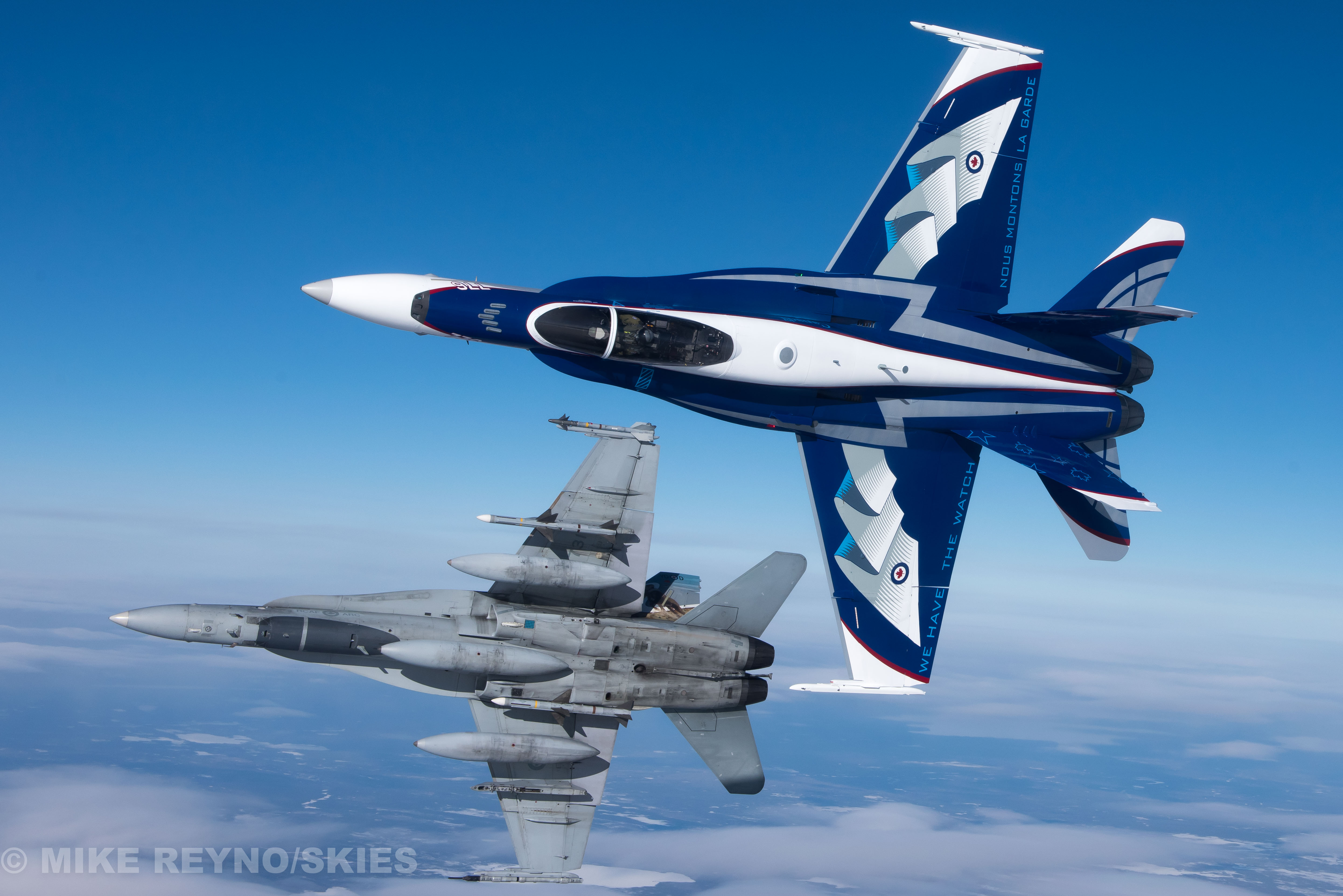
The 2017 Demonstration Hornet (foreground) flies with a CF-188 Hornet from 401 Squadron. The Demo Hornet pays tribute to the 60th anniversary of NORAD.
The 2018 Demonstration Hornet (foreground) flies with a CF-188 Hornet from 401 Squadron. The Demo Hornet pays tribute to the 60th anniversary of NORAD. Mike Reyno Photo
The Liberal government says it will acquire 88 advanced fighter jets to replace the current fleet of CF-18s.

The fleet size is based on the Canadian Armed Forces requirement to have sufficient fighter aircraft to fulfill Canada’s NORAD and NATO commitments simultaneously, based on planned aircraft serviceability rates and aircraft required for training, said RCAF spokesman Maj. Scott Spurr.

“If the RCAF loses any future fighters due to attrition, it would be a policy decision on whether attrition aircraft would be replaced, and if so how,” Spurr told Defence Watch.

The RCAF did not answer whether it had projected any estimates on how many aircraft are expected to be lost to attrition over the course of the program.

Wednesday, April 25, 2018

Dassault & Airbus Team-Up - What Does it Mean for the CF-18 Replacement

By: Daniel Maillet, CAF Dispatch Author

Breaking news was announced today from the Berlin Airshow that Dassault Aviation and Airbus are teaming up to build what can only be considered a "Fifth" or "Fifth & Half" Generation Fighter Jet - what does this news mean for the future of both companies attempt to export the Rafael and the Typhoon?

French air force flies Rafale B fighter jets like this one photographed in operations over Mali last year. Dassault Aviation wants Canada to choose the Rafale as a replacement for the CF-18, and is willing to have the planes assembled in Canada. (Anthony Jeuland/French Air Force)
In the brief announcement, Dassault and Airbus indicated that they would be starting work immediately on a new fighter jet that will at first supplement both the Dassault Rafael and the Eurofighter Typhoon; but the long-term goal is for this new fighter to replace both jets between 2030-2040.

That leaves one question for those us of on the other side of the Atlantic. What does this mean for the RCAF CF-18 Replacement?

The official list of approved bidders in the process are: (In Alphabetical Order)
  • France—Dassault Aviation (Thales DMS France SAS and Safran Aircraft Engines)
  • Sweden—SAAB AB (publ)—Aeronautics 
  • United Kingdom and Northern Ireland—Airbus Defense and Space GmbH 
  • United States—Lockheed Martin Corporation (Lockheed Martin Aeronautics Company)
  • United States—The Boeing Company
In Canada's search for a new fighter jet - the Dassault Rafael and the Eurofighter Typhoon are among the options. While many consider the Typhoon too expensive, and the Rafael too limited in its use - they are not top contenders. This is despite Dassault having repeatedly offering to transfer technologies to Canada and build the Rafael aircraft in Canada. Others argue that both aircraft are also incapable of interoperability with the US and Canada's NORAD commitments. This argument seems weak - especially when you consider Rafael aircraft were used alongside USAF fighters in the recent bombing of Syria. I digress... 

Canada has recently announced that it will extend the life-expectancy of its current fleet of CF-18s from 2025-2030. Will this announcement mean Canada might look to supplement its current CF-18 fleet until this new aircraft arrives? Will Dassault and Airbus be able to pitch or even offer it to the Canadian Government as a viable option? 

Friday, April 13, 2018

Addressing the "Fighter Gap"

By: JAMES FRYER
© 2018 FrontLine Defence (Vol 15, No 2)

When asked if a second supply ship for the Royal Canadian Navy could be ordered from Davie Shipbuilding – a move that would restore re-fueling capability to both coasts and head off job losses at the Quebec shipyard – Transport Minister Marc Garneau declared: “We cannot artificially create a need for something that doesn’t exist.”

How ironic that a member of the federal cabinet should make this bold remark when there is a broad consensus that this is exactly what the Trudeau government is doing in the case of the alleged fighter capability gap. No fewer than 13 former chiefs of the air staff (with about 400 years’ worth of experience between them), as well as the Senate of Canada and most informed defence analysts, all agree that the Royal Canadian Air Force (RCAF) is not deficient in fighter capability (though they are certainly due to be replaced). 

F-35A
Insofar as the ‘gap’ is concerned, former fighter pilot Alan Stephenson has argued convincingly that it has been manufactured for political reasons – namely to impose unnecessary delays on the replacement of the CF-18 fleet, and put distance between a notional Trudeau government circa 2021 and its ill-considered 2015 election promise to buy anything but the much-maligned F-35.

Gap? What gap?
Certainly last year’s defence policy roll-out did nothing to add to the public’s understanding of why an interim buy of fighters is suddenly necessary to ensure Canada’s security. On page 38 of the policy – named Strong, Secure, Engaged (SSE) – the government did not specify how the security landscape had changed to such a degree that extra planes are required now. Nor has the government justified why an initial plan to fill the ‘gap’ with 18 modern F/A-18 E/F Super Hornets could be so easily aborted in favour of buying highly-used legacy Hornets from Australia. If national security is so well served by the latter, why wasn't it chosen as the first (and demonstrably cheaper) option.

Nor is there evidence that either NATO or NORAD have pressured Ottawa to up its game and put more fighters into service. Such a demand would likely have made it into the public domain, if for no other reason that NATO’s budgetary and force development targets are publicly known. Yet not a word from either about a fighter gap. The government continues to insist that such a thing exists, but is it pedalling ‘fake news’? Again, where is the evidence of a gap that would silence the legions of doubters?

And with the formal announcement (12 December 2017) of a process to replace Canada’s legacy fleet, many are left wondering why a seemingly straightforward competition to replace the full fleet should take until 2025 to deliver the first machine.
Boeing Super Hornet
It is instructive, if not a little ominous, that the government claims so much time is required to consult with industry on what it has to offer.

The RCAF requirements may have been tweaked for political reasons on 12 December (perhaps discounting low-observability as a key requirement), but can the requirements be so profoundly different from what they were toward the end of the last government’s tenure?

Indeed, with virtually every major country transitioning to low-observable fighters (Russia to the SU-57; China to the J-20 and J-31; much of NATO to the F-35; Israel, Japan, and South Korea announcing their intent to build stealthy designs) there seems to be little doubt as to where the future lies. Does the current government have some special insight into the future of air warfare that has eluded ally and non-ally alike?

Obfuscation, naïveté, or both?
What are we to make of the need for another round of industry consultations that will culminate in a list of suppliers? Consultations began with the previous government – the results of which were written up by the National Fighter Procurement Secretariat (NFPS) and presented to the Harper government in June of 2014. Surely this information could be leveraged to reduce the duration of the recently-announced competition. Yet to listen to Defence Minister Harjit Sajjan’s convoluted response to a question from the assembled media on 12 December, it is as if the NFPS and its peer-reviewed study never existed.

Not to be outdone, Public Services and Procurement Minister Carla Qualtrough stated in the same press conference that bidders should bear in mind that their current or prior dealings with Canada could be weighted against them during the bid evaluations. If a bidder was perceived to have inflicted harm on Canada’s economy, that would play against them in a competition – a none-too-subtle swipe at Boeing for launching a failed bid to impose punitive tariffs on Bombardier’s C-Series airliner. When asked if this would only add more time and complexity to the procurement (given that the definition of ‘harm’ could be quite subjective and therefore open to legal challenge), the Minister said she hoped it would not. As a novice cabinet minister, she might be forgiven for her naïveté.
Eurofighter Typhoon
Yet the broader government cannot be so easily excused. It should be obvious to anyone that when it comes to defence procurement in Canada, hope is not a method. One suspects that Minister Qualtrough will soon learn that painful lesson. For one thing, the government’s timetable for the fighter project puts delivery of the first jet in 2025 – precisely when the lead ship in the Canadian Surface Combatant (CSC) project is supposed to be floated out. Superimposing the fighter and warship replacements upon each other is a sure-fire way to over-tax the insufficient project management capacity residing in the relevant federal departments. It has long been argued (and accepted) that a lack of trained and experienced civilian and military procurement staff are to blame for delays in delivering on core projects. Should not the two most complex and costly projects of our times be staggered so as not to interfere with each other? (There was a four-year gap between the acquisition of the final CF-18 in 1988 and the arrival of the first Halifax-class frigate). Herein lies the danger of not proceeding immediately to a competition.

Yet perhaps the grand prize for obfuscation should go to Liberal MP Steven MacKinnon, the parliamentary secretary to Minister Qualtrough. On a CTV News panel discussion in December he boldly proclaimed that it was an “exciting time” for the RCAF, lucky as it was to be acquiring used Australian Hornets as an interim measure. It may not have occurred to him that acquiring 30-year-old planes may actually be a disincentive to recruiting and retention. A would-be aviator is unlikely to be attracted by the prospect of climbing into obsolescent aircraft. And with the airlines trolling for experienced pilots and technical tradespeople, what message is sent to the current crop of air and ground crew by investing in the past rather than the future? Side-note: the latest batch of television recruiting ads no longer feature the fighter capability – perhaps a veiled admission that featuring obsolete kit does nothing to incentivize recruiting.

When asked about the fighter gap, MacKinnon claimed that the government’s defence policy had dealt “at length” with the issue. As noted above, no explanation – lengthy or otherwise – has been forthcoming in the policy about how the aerospace environment has changed to such as degree as to mandate a gap-filler. Either Mr. MacKinnon did not even read his own party’s policy document, or he banked that his co-panelists (not to mention the viewers) could be easily duped.

Timing is everything… isn’t it?
Aside from the danger of having to manage two mega-projects simultaneously, the timing of the fighter replacement raises another serious issue: technological obsolescence. Put simply, the longer Canada takes to decide, the narrower our options become.

Reviewing public statements by European governments, militaries, and aerospace officials regarding the future of their fighter aircraft fleets, it is clear that the Europeans are looking ahead to the next-generation of aircraft to replace Tornado and Typhoon (UK, Germany, Italy), as well as Rafale (France)and Gripen E (Sweden).

In the US, manufacturers such as Northrop are already musing about 6th-generation technologies. Worried by what it sees as Russian and Chinese advancements, the US Air Force is looking at advanced aircraft, weapons and sensors for introduction circa 2030.

The current leading-edge (4.5-/4.75-generation) aircraft in service in Europe are being upgraded, but officials from Airbus (Typhoon’s manufacturer) state that even with upgrades their design is not viable against capable adversaries beyond 2040 and that planning for their replacement should begin now if Europe is to retain the requisite design/manufacturing capability. The French and German governments have begun discussing collaboration on the next-generation fighter. The Rafale is likely in the same boat as Typhoon (obsolescent by 2040), since it and all the other canard-winged designs date back to the 1990s. Meanwhile, the US Navy has signalled that the penultimate version of the F/A-18 E/F Super Hornet (Block 3) will go out of service in 2040.

The relevance of this for Canada is clear. If there is any inclination by the current or future government to buy an advanced 4th-generation aircraft – either from Europe or from Boeing – we will not be able to treat is as we have the CF-18. The new platform will not remain combat-viable for 35-40 years after its purchase because all ‘established’ candidates are fast reaching the end of their upgrade potential.

In effect, the RCAF’s ‘new’ 4.5/4.75-generation aircraft would function only as an interim, or inter-generational, aircraft for a period of about 15 years – or until new-generation machines emerge from European or American production lines in early 2040s.
Dassault Rafale
Even if European plans slip by 5 years (to the mid-2040s), the writing is clearly on the wall for fighter aircraft of the 4th generation. Pushing Canada’s fighter replacement into the mid-2020s puts Canada out of step with the pace of fighter replacement. Minister Sajjan was correct that we should have moved ahead on this file a decade ago, with a replacement in service today. Yet we now find ourselves in the position that if we choose one of the many ‘established’ candidates, we will likely have to go through the procurement process again after only 10 years to avoid the fleet obsolescence that our allies have now admitted to.

The promising but still-immature F-35 might be the only candidate with a technological growth path beyond 2040. But if it is not chosen, Canada should not delude itself that the other candidates will enjoy significant design longevity. Choosing one of them means lots of money for a very questionable return. As US Air Force Secretary Heather Wilson observed, “Buying a new version of something that was revolutionary 30 years ago doesn’t take us to a more competitive future.”

Creative thinking needed...
Clearly Canada cannot wait until late 2030s to replace the full fleet. Are there other options? One is to take a chance on the F-35, as many allied and partner nations have done.

All partner nations remain committed to it, and the aircraft has won orders in Israel and Japan and South Korea where these allies face capable rivals and would not think of entrusting their security to yesterday’s technology. A Canadian order would seem logical given that potential bidders were told during an ‘industry day’ on 28 January 2018 that Canada needs an aircraft that could last until 2060. By simple process of elimination, the F-35 is the only possible choice. Why then does the government fetishize competition when there are arguably no viable competitors?

A second option is to go with a mixed fleet of 4.75-generation aircraft available now, backed up by a mature 5th-generation candidate when available. Aside from the training and logistical challenges this will cause, there is the distinct possibility that once the former is acquired, this or a future government could balk at Phase 2, leaving Canada behind the technological curve after only a decade. It would also befuddle DND and the RCAF how to decide what portion of 88 planes – the numerical requirement articulated in SSE – can be drawn from each generation.

Another possible way forward is to make a choice between a European design or Super Hornet (Block 3), then re-scope the temporal dimension of the fighter project to last only 20 years (i.e., delivery of the first airframe until final disposal) rather than the 50 years currently envisioned for the CF-18. Again, such an aircraft will by design be an interim or ‘inter-generational’ aircraft.
Saab Gripen
There may be a political advantage in going this latter route. Since the government is required to specify the cost of acquisition and ownership over the lifespan of the airplane, the overall cost of a 20-year program should be considerably lower than a 40-year program since operations and maintenance costs will be halved. Sceptics will note (rightly) that DND will have to come back to Treasury at the 10-year point in order to buy a replacement aircraft. But 10 years is a long time in politics. Plenty of room to blame the situation on long-gone predecessors.

To be sure, a truncated fighter program may force the government to amortize the costs into a shorter timeframe. But if Canada is comfortable with an interim capability, choosing Saab’s Gripen E – undoubtedly the least expensive option – may have merit. Its single engine need not be a factor given the RCAF’s readiness to procure the F-35; and its advanced technology (electronically-scanned radar, internal infra-red sensor, advanced cockpit) represent an improvement over the CF-18.

…and less politicking
One more factor might need consideration: the new and somewhat bizarre requirement that a successful bidder demonstrate that its business dealings do not harm the Canadian economy.

If it is hard to see how Saab, Airbus, or Dassault could have done harm to the Canadian economy, it is equally hard to see how they could provide the lasting benefits that Boeing or Lockheed have bestowed on Canada over the decades. While some have argued that the so-called ‘Boeing clause’ is meant to put the screws to the US giant in its dispute with Bombardier, the corollary is that Boeing already has rendered significant industrial and technological benefits to Canada – something not lost on the 1,700 workers at the company’s Winnipeg facility. This cannot be overlooked by the government’s bid evaluators. Thus even after calculating the net ‘benefit-to-harm’ ratio, Boeing (or Lockheed) may still offer more politically-attractive partnerships than the three European firms. (Dassault or Saab could, however, attempt to court political favour by offering to assemble their jets in Canada.) Yet with the Super Hornet coming to the end of its development pathway with the Block 3 version, this again would seem to leave Lockheed Martin and the F-35 as the only viable choice – assuming that the government is indeed considering a long-term solution to the RCAF’s needs.

Conclusion
With the government stubbornly clinging to the false premise of a fighter gap, with the addition of highly subjective conditions for bidders, and with the apparent deletion of stealth capability as a requirement for the new aircraft, it is clear that the fighter replacement issue has become monstrously politicized. After promising sensible defence procurement reform during the last election, the Trudeau government seems to have acquired a distaste for simplicity and efficiency, not to mention evidence-based analysis. The politically-motivated cancellation of the EH-101 helicopter, followed by an 11-year ordeal to choose a (still non-operational) replacement, should have served as a cautionary tale against allowing what should be a straight-forward matter morph into a political football to be kicked around endlessly. Yet no such lesson seems to have been learned. What’s worse is that the government cannot deliver a cogent response to the question of why it’s doing what it’s doing. Perhaps it feels that it doesn’t need to?

Any fighter replacement program needs to be viewed through the lens of operational capability, logistical supportability, and cost. But timing must also play a part, and the government has set itself and DND up for a significant managerial, technical, and financial challenge by not exploiting the work done by the NFPS and de-conflicting the fighter purchase with other major procurements. Minister Sajjan seemed to at least partially recognize the former when he said on 6 December 2017: “These [air force] requirements are not only about having an aircraft for now, but we need to make sure this aircraft is there to serve us in the future.” The Americans and Europeans have given ample indication that their legacy fighter designs have a limited shelf-life. Canada should listen to them and act accordingly.

===
James Fryer is an independent defence analyst based in Toronto.