Translate

Showing posts with label Boeing. Show all posts

Wednesday, May 30, 2018

Still No Cost Associated with Used Australian F-18 Purchase

By: Charlie Pinkerton, iPolitics

Costs for the used F-18 fighter jets the government plans to purchase from Australia are still up in the air, the minister of defence revealed Tuesday when pried by opposition MPs on the topic.

“We don’t have the exact costs just yet,” Harjit Sajjan told members of the House Standing Committee on National Defence.

“We will know, but we want to make sure we have the right details. Giving you an estimated cost right now would be irresponsible. It’s better to make sure that we get you the correct information once we have the further details,” he said.


Military personnel guide a CF-18 Hornet into position at the CFB Cold Lake, in Cold Lake, Alberta on Tuesday October 21, 2014. THE CANADIAN PRESS/Jason Franson
The government first announced that it would be buying 18 used Boeing F-18s from the Australian government for roughly $500 million. In the Royal Canadian Air Force the model is known as the CF-18. Canadian fighters have flown the jets since 1982. Canada opted out of a plan to purchase a fleet of modern Boeing F/A-18 Super Hornets from the United States and into an agreement with Australia for the more than 30-year-old planes in December.

The defence minister said the first of the planes purchased from Australia should touch down on Canadian soil in Spring 2019.

Which specific Australian F-18s to be sold to Canada has yet to be settled.

“We don’t want to take aircrafts that are at the very end of their service life,” Patrick Finn, assistant deputy minister of materiel of the Department of National Defence, told the committee. “These will be flyable assets that are in service with the Royal Australian Air Force as we see today.”

Finn said the planes that Canada is purchasing have been used more on average than the same jets currently in Canada’s air force. He asked for the committee to look beyond the hours-used of the aircraft.

“They, like us, have put a lot of investment into those air craft. I’ve sailed on 40-year-old ships that had brand new modern missiles. I think we’ve got to be careful about the age of an aircraft and saying that reflects its capability,” Finn said.

Finn said the bill of sale has not yet been signed for the jets and the acquisition is currently being reviewed by a third party. He added Canada has been given data about each of the airplanes in question and has been able to conduct their own examinations of each.

“We know exactly what shape they’re in,” Finn said. “We actually expanded that further and we have inspection points — very discreet ones — where we actually put the aircraft through a very detailed maintenance process.”

If Canada is offered an aircraft in better shape a few months later than one that can be acquired immediately, then it will choose to wait for the better model, Finn said.

Canada plans to fly the fleet of F-18 fighter jets until 2032, after which it plans to adopt the plane’s successor.

Tuesday, February 27, 2018

Boeing Applies to be Part of CF-18 Replacement

The Canadian Press 

The federal government says Boeing has been approved to participate in an upcoming competition to replace Canada's CF-18s, though the U.S. aerospace giant says it still hasn't decided whether it will actually bid.

A F18 Boeing-made Super Hornet creates a vapour cone as it flies at a transonic speed while doing a flyby of the USS Eisenhower in this 2015 photo. Boeing has applied to be chosen to supply Canada with its new fleet of 88 fighter jets.
A F18 Boeing-made Super Hornet creates a vapour cone as it flies at a transonic speed while doing a flyby of the USS Eisenhower in this 2015 photo. Boeing has applied to be chosen to supply Canada with its new fleet of 88 fighter jets. (Mark Wilson/Pool Photo via The Associated Press)

Public Services and Procurement Canada says Boeing, which makes the Super Hornet jet, is one of five companies approved as potential bidders in the multibillion-dollar competition to deliver 88 new aircraft.

Boeing had remained on the fence when asked whether it would throw its hat in the ring, saying it was waiting to see how the government would run the competition, which will formally kick off next year.

The comments appeared to be in response to the government's plan to change future competitions for military equipment, including fighter jets, to penalize companies deemed to be hurting Canada's economic interests.

The proposed change is believed to be a direct response to Boeing's complaints against Bombardier over the latter's C Series passenger jet, which were largely thrown out last month by the U.S. International Trade Commission.

Still, even though Boeing has been allowed to participate, company spokesman Scott Day says the company is continuing to monitor the process and still hasn't decided whether to submit a formal bid.
"Boeing values Canada as a customer and supplier-partner for both our commercial and defence businesses," said Day. "We continue to believe that the Super Hornet is the low-risk, low-cost approach and has all the advanced capabilities the Royal Canadian Air Force needs now and well into the future."

The firms eligible to take part are:
  • Lockheed-Martin, which makes the F-35 stealth fighter
  • Boeing, which makes the F-18 Super Hornet
  • Airbus, which makes the Eurofighter
  • Saab AB, which makes the Gripen
  • Dassault Aviation, which makes the Rafale

Wednesday, February 7, 2018

Deadline Looms for Boeing to Decide on CF-18 Replacement Bid

By: David Ljunggren & Leah Schnurr, Reuters News 

OTTAWA (Reuters) - Boeing Co must decide by the end of this week whether to take part in a multi-billion-dollar race to supply Canada with fighter jets, even as the U.S. company’s relationship with Ottawa has soured due to a trade dispute.

Image result for Boeing

Although a U.S. trade commission on Jan. 26 dismissed Boeing’s complaint that Canadian plane maker Bombardier was dumping airliners on the American market, it is far from certain the ruling will be enough to placate Canada.

That could well influence the company’s decision on bidding on a contract for 88 jets worth between C$15 billion ($12.1 billion) and C$19 billion, people familiar with the matter said.

Boeing Chief Executive Dennis Muilenburg said in a post earnings call last week the company will wait to see the commission’s reasoning, coming later this month, “to make decisions on our path forward.”

The company declined to comment further.

Boeing has until Feb. 9 to express an interest in taking part in the Canadian jet competition, failing which it will be excluded from the bidding process.

At stake could be billions of dollars of defense procurement orders at a time when Canada is ramping up military spending over the next decade. Boeing says it supports some 17,000 jobs in Canada.


The dispute also has weighed on the crucial NAFTA modernization talks, which have dragged on for months.

Although government officials say the competition will be open, they have privately made it clear that Boeing needs to drop the Bombardier challenge and talk of an appeal to stand a better chance of winning the jet contract, say sources familiar with the matter.

“A lot of things would be better if they did that,” said one source who declined to be identified given the sensitivity of the situation.
FROSTY RELATIONSHIP

There are signs the relationship between Boeing and Ottawa remain frosty. Boeing did not send its own staff to a meeting between the Canadian government and industry held in January to discuss the jets contract, the sources said.

Boeing said its F-18 Super Hornet was represented by the U.S. Defense Security Cooperation Agency, the Pentagon unit that implements foreign arms sales. U.S. foreign military sales are often negotiated between the U.S. government and each customer nation.

Lockheed Martin Corp, Dassault Aviation SA and Airbus SE also are expected to compete.

Canada is part of the consortium that helped develop Lockheed’s F-35 stealth fighter, although Prime Minister Justin Trudeau said during his successful 2015 election campaign that he would not buy the plane because it was too expensive.

Canadian Defence Minister Harjit Sajjan, who has said Boeing has not behaved like a trusted partner, did not answer directly last Tuesday when repeatedly pressed as to how the aerospace giant could get back into Ottawa’s good books.

Ottawa says the bids will be evaluated in part on the basis of “past and recent economic behavior of potential bidders leading up to the procurement.”


That test is months away from being finalised, meaning Boeing has no idea whether Ottawa would be satisfied if it did drop the challenge, sources said.

A company’s submission will be evaluated not just on the economic test but on a number of factors including, price and military capability, one of the sources said.

While Boeing has repeatedly said it will not take reprisals against its Canadian supply chain and workforce, the dispute between Boeing and Canada worries aerospace suppliers who fear they could lose future contracts, an industry source familiar with the matter said. Canada’s aerospace industry is a major employer in Quebec, a politically valuable province for Trudeau, who is facing elections in 2019.

Wednesday, January 24, 2018

Boeing Skips Industry Day in CF-18 Replacement


SOURCE: FLIGHTGLOBAL.COM
BY: STEPHEN TRIMBLE
WASHINGTON DC

Boeing has yet to decide whether to compete for a contract worth $12-14.5 billion to replace Canada’s tactical fighter fleet. The airframer once had the deal in its pocket before Ottawa terminated plans to buy the F/A-18E/F Super Hornet after Boeing filed a trade complaint against Bombardier last May.

In a possible sign that the company could forego submitting a bid, Boeing chose to skip a one-day information session for potential bidders on 22 January that was hosted by Canadian agency managing the Future Fighter Capability acquisition programme.

Boeing confirmed the absence and says it remains convinced that the Super Hornet is the best option for the Royal Canadian Air Force, although the airframer has not decided whether to offer the aircraft yet.

“We continue to believe that the Super Hornet is the low-risk, low-cost approach that has all the advanced capabilities the Royal Canadian Air Force needs now and well into the future,” Boeing says.

“We will evaluate our participation in Canada’s Future Fighter Capability Project (FFCP) after the Government of Canada outlines the FFCP procurement approach, requirements and evaluation criteria,” Boeing adds.

US government officials attended the information session hosted by Public Services and Procurement Canada (PSPC), the Canadian government’s acquisition arm, Boeing says.

Boeing may face a deadline in two weeks to make a decision. Attendance at the information session was not mandatory, but PSPC has requested that all potential bidders respond by 9 February to an invitation to join a Suppliers List. Only companies that respond to the invitation will be informed and allowed to participate in all future steps of the FFCP acquisition process, the PSPC says.

The indecision by Boeing reflects a staggering turn-around in the company’s fortunes in Ottawa since last year. In his victorious 2015 election campaign, now-prime minister Justin Trudeau promised to cancel the previous government’s plans to buy the Lockheed Martin F-35A without first staging a competition. A year later, the Trudeau government announced plans to acquire 24 new F/A-18E/Fs as an interim replacement for the CF-18, until a competition selected a permanent solution after 2020.

But those plans changed last May after Boeing filed an anti-dumping and countervailing duty complaint against Canadian aircraft manufacturer Bombardier over an April 16 sale to Delta Air Lines of 75 CS100s. The US Commerce Department agreed with Boeing’s position and set a nearly 300% tariff on CSeries imports to the USA. The final outcome of the case now depends on a vote by the US International Trade Commission on 25 January, which will decide whether the Delta order caused financial harm to Boeing and, if so, ratify the tariff.

Meanwhile, the Trudeau government scrapped the plan to buy Super Hornets last summer. The RCAF instead plans to buy retired F/A-18s from the Royal Australian Air Force as an interim CF-18 replacement.

Friday, December 15, 2017

Buying Vintage: Examining the Cost of Purchasing Used Australian F-18s


By Christopher Cowan & Dr. Andrew Davies, CDA Institute

Image result for Australian F-18s
Royal Australian Air Force F-18 Hornet pilots wave to the crowd as they taxi down the runway after performing during the Australian International Airshow at the Avalon Airfield near Lara southwest of Melbourne on February 24, 2015.PAUL CROCK/AFP/Getty Images
The CF-18 A/B Hornet (a Canadian-variant of the same design in service with Australia and many other nations) has been the core component of Canada’s air combat capability since it was first introduced in the 1980s. The type has served the country well in overseas missions (including over Iraq, Kosovo and Libya) and at home defending North American airspace.

The road to finding its replacement, however, has been a bumpy one for the Royal Canadian Air Force (RCAF) and the Government of Canada (GoC). After a few false starts, the GoC recently announced that it will move forward with its plan to finally find a replacement for the CF-18 and secure an ‘interim’ air combat capability of 18 second-hand Hornets from the Royal Australian Air Force (RAAF) until the new jets arrive in the mid-2020s.

The GoC has been criticized heavily for its handling of the CF-18 replacement program, with many commentators highlighting the political machinations behind the supposed ‘capability gap’ that the ‘interim’ fighters were to fill. Nonetheless, the GoC has persisted with its plan, so it’s worth taking a look at what it means to buy ‘used’ aircraft.

Australia has a fleet of 71 Hornets. The first was delivered to the RAAF in 1984, roughly the same time that Canada received its first CF-18. The airframe of a F/A-18 A/B has a nominal age of 6,000 hours, which can be extended through service life management processes and structural upgrades. The United States Marine Corps (USMC) also flies F/A-18 A/B models (as well as C and D models), and has put a significant number of flight hours on their airframes. 91% of USMC Hornets have over 6,000 flight hours and 19% have over 8,000 hours, with a few aircraft approaching 10,000 flight hours.

The average RAAF legacy Hornet has flown around 4,200 hours (see page 114 in the linked document), allowing for approximately another 1,800 hours of flight time before it reaches the planned end of its service life in the early 2020s. That’s a fair amount of life left on the airframe—almost one-third of its nominal lifespan—but the RCAF may well end up with some of the RAAF’s older Hornets, which are being replaced by F-35s. Australia has done an excellent job managing its Hornet fleet; each aircraft has a through-life plan designed to minimize wear-and-tear on the airframe. It has been such a success that Australia’s legacy Hornets have seen a recent uptick in flight hours—including taking them into action over Iraq and Syria—at an age when most aircraft are being flown less often, not more. So while the Hornets the RCAF will receive will be ‘used’, they’ll likely still be in relatively good nick.

Despite being roughly the same age as the Australian Hornets, Canada’s fleet of CF-18s looks positively ancient in comparison. As of April 2016, the average CF-18 airframe had approximately 6,100 hours on it, with some airframes having over 7,000 hours on them. Structural upgrades have extended the lives of their airframes to 8,000 hours per aircraft—something that most RAAF Hornets lack. Keeping the CF-18 fleet going and relevant until replacement jets arrive in the mid-2020s will require a series of relatively minor, low-risk upgrades, but extending their lives past 2025 would likely require significant structural and avionics upgrades, so any further delay in the replacement program would be costly. And by the mid-2020s, the CF-18s will be significantly less capable than the aircraft operated by Canada’s main allies.

Getting the newly acquired RAAF Hornets up to speed once they arrive in RCAF hands will likely not be very difficult, given the cooperation between the two air forces on a number of sustainment and upgrade programs for their Hornet fleets over past few decades. There are minor differences between the two fleets—the Australian Hornets have a different avionics package for example—but the Australian Hornets should be a relatively easy fit into Canada’s air force.

Now for the kicker. According to the Australian Financial Review, the reported cost of the deal is CAD $497m (USD $388m), which works out to a unit cost of CAD $27.6m (USD $21.5m). If true, that’s an awful lot of money for used aircraft that will only be in RCAF service for around six to seven years. It’s also around one-tenth of the cost of the GoC’s now-abandoned USD$5.23 billion plan to acquire 18 new-build Super Hornets from Boeing. But the difference is that the ‘interim’ Super Hornets could’ve flown with the RCAF for 30 years, rather than six.

Nonetheless, the data suggests that the RAAF’s 18 legacy Hornets, while around the same vintage as the CF-18s, may have a fair amount of life left in them and likely won’t require significant modifications when they arrive to supplement the RCAF’s fleet. That’s good news for the RCAF, which will finally get some ‘new’ jets to take the load off of its aging fleet. In the end, this acquisition appears to be an expensive solution to an ‘interim’ problem that should’ve been avoided. While it’s strange that it will take the GoC another three to four years to decide on a replacement for the venerable CF-18, any progress is good progress in the world of Canadian defence procurement.
---
~Christopher Cowan is a Research Analyst and Editor at the CDA Institute, while Dr. Andrew Davies is the Director – Defence & Strategy Program at the Australian Strategic Policy Institute.

Wednesday, December 13, 2017

Canada Announces 88 Fighter Replacement Competition; Includes "Boeing Clause"

By Amanda Connolly, National Online Journalist Global News

The Canadian government is launching a competition to buy a new fleet of 88 fighter jets and officials confirmed Tuesday they will also be buying an interim fleet of 18 jets from Australia rather than Boeing.

Image result for RCAF Fighter Jet Competition
The Canadian Press - RCAF CF-18

READ MORE: Boeing not backing down on Bombardier trade challenge as Canada pivots on jets

A clause in the announcement effectively suggests that if Boeing wants to bid on the competition itself, it better back down in its trade challenge of Bombardier.

The announcement, which follows up on a campaign pledge by Prime Minister Justin Trudeau to hold a competition to replace Canada’s aging CF-18 Hornets, does not exclude Lockheed Martin from submitting a bid for the government to consider its F-35 fighter jet as had also been promised in the Liberals’ 2015 campaign platform.

Government officials speaking on background prior to the announcement on Tuesday said no potential bidders are being excluded but that any firm engaging in activities that hurt Canadian economic interests will be at a steep disadvantage.

“When bids are assessed, any bidder that is responsible for harm to Canada’s economic interests will be at a distinct disadvantage,” the press release states.

That aspect of the announcement seems specifically aimed at Boeing, the American aerospace firm that is challenging government subsidies of Bombardier at the U.S. Commerce Department.

Boeing complained about the subsidies after it says Bombardier sold C-Series jets to Delta Airlines at a steep discount, and the U.S. Commerce Department sided with Boeing this fall when it recommended implementing a 300 per cent tariff on the sale.

That tariff will not go into place until the U.S. International Trade Tribunal rules on the decision next year.

Early in 2016, the government had announced that it would buy sole-sourced interim fighter jets from Boeing to fill what it claimed was a “capability gap” in allowing the military to meet both its NATO and NORAD commitments at the same time.

Air force officials disputed those claims, saying the military realistically did not need to be able to meet both commitments at the same time.

Officials said Tuesday buying the interim jets from Australia will fill that “capability gap” until a full fleet can be acquired, and Chief of Defence Staff Gen. Jonathan Vance said in a statement that there will no issues with buying second-hand jets from the Australians.

“This is a natural fit; the Australian jets are functionally equivalent to our own CF-18s and, once converted to Canadian specifications, will provide an easy transition for our pilots, technicians, and ground crew,” he said.

“I am fully confident that this supplemental capability will help the [Royal Canadian Air Force] meet our domestic and international obligations until a replacement fighter is chosen and acquired.”

READ MORE: Canada scraps Boeing fighter jet deal, will buy used Australian F-18s instead

Officials said Tuesday the cost is being estimated at roughly half a billion dollars for the interim replacement, while roughly $15 billion to $19 billion will be set aside for the full competition.

A letter outlining the terms is expected to be in the government’s hands by the end of December.
What comes next?

First up in the process is inviting interested bidders to sign up for what is essentially a list of interested suppliers by February 9, 2018.

Firms that do not register by then will not be considered as the competition heads forward.

Next, bids will be evaluated on a basis of cost, whether they meet Canada’s technical requirements, and what the economic benefits are of the proposal.

As part of the latter, an assessment of whether the bidder is causing economic harm to Canada will be considered.

Consultations will run through 2018 and 2019, with formal solicitation documents expected to be made available in spring 2019.

A contract award is expected in 2022 and the government says it expects to have the first aircraft resulting from the award of the contract in its possession by 2025.

Canada launches contest for 88 new fighter aircraft

How to measure ‘economic harm?’

Government officials refused to say exactly how they plan to calculate the concept of “economic harm” when pressed by reporters on Tuesday.

A statement from Boeing last week suggested the company had made peace with the loss of the interim fighter deal but was trying to smooth out relations in the hope of keeping the option open for potential future work.

“Although we will not have the opportunity to grow our supply base, industrial partnerships and jobs in Canada the way we would if Canada purchased new Super Hornets, we will continue to look to find productive ways to work together in the future,” the company wrote.

“Boeing is fortunate to have an outstanding 100 years of partnership with Canada, which had culminated in our [$4-billion] annual economic impact in Canada, and we look forward to partnering for the next 100 years.”

Canadian officials would not say explicitly whether the clause was aimed at getting Boeing to drop its complaint against Bombardier.

Canada Announces Purchase of 18 Australian F/A-18s

The Associated Press 
In trade blowback, Canada will buy used Australian jets rather than new Boeing aircraft
A Royal Australian Air Force F-18 fighter on a training mission. (Royal Australian Air Force)
Canada has ditched a plan to buy 18 Super Hornet jet fighters from U.S.-based Boeing Co. and will instead buy 18 used F-18 fighters from Australia.

Prime Minister Justin Trudeau had previously warned that Canada would stop doing business with Boeing if the company doesn't drop a trade complaint against Canadian plane maker Bombardier, and the government warned again on Tuesday that Boeing would have little chance of winning a new contract for 88 additional fighter jets under the status quo.

Trudeau's government also said Tuesday that it would assess companies' overall impact on Canada's economy before buying the 88 additional fighter jets to replace its aging F-18s.

"Bidders responsible for harming Canada's economic interest will be at a distinct disadvantage compared to bidders who aren't engaged in detrimental behavior," Procurement Minister Carla Qualtrough said.

Boeing spokesman Scott Day acknowledged that the statement was directed toward the company and said that Boeing respects the Canadian government's decision to buy the Australian planes. Day also said the company would review the requirements for the new fleet and emphasized what he said was Boeing's long-term presence in Canada.

"I think you have to let our record speak for itself," Day said in an email.

Boeing claims Bombardier's new C Series passenger aircraft receives subsidies that give it an advantage internationally.

Canada had been in talks to purchase the F/A-18 E/F Super Hornet fighter jets from Boeing in an effort to bridge the gap between its aging F-18s and the new fighter fleet that it plans to purchase.

But officials said the Australian jets will cost significantly less than Super Hornets and can be put into action two years earlier. "We have received an offer for sale of F-18 aircraft from the government of Australia, which we intend to pursue, and we have received an offer of Super Hornets from the U.S. government, which we intend to let expire," Qualtrough said.

Jonathan Vance, chief of the defense staff of the Canadian Armed Forces, said Canada can't meet its domestic and international obligations without some form of supplemental capability until the future fighter fleet is in place and the Australian jets will work fine.

Canada will begin receiving deliveries of the used Australian jets next year. The value of the deal is about $388 million.

Vance expects the fleet of 88 next-generation fighters to arrive in 2025, and the government said the competition would be open to all companies as bidding gets underway.

Analysts see the F-35 made by Boeing rival Lockheed Martin as a likely contender, even though Trudeau has said it is too expensive. Trudeau has since softened that stance.

Defense Minister Harjit Sajjan said the new fleet of planes is required to meet Canada commitments to NATO and the North American Aerospace Defense Command.

Monday, November 6, 2017

RCAF CF-18s to Fly past 2030?

By: David Pugliese, The Ottawa Citizen 

Image result for RCAF CF-18

Some sources in industry as well as at the Department of National Defence are now suggesting that the country’s CF-18 fleet could be flying until 2030.

Why?

The purchase of interim Super Hornets from Boeing is stalled, if not dead in the water. That is the result of Boeing’s decision to go after Bombardier on its C-Series commercial aircraft and the resulting duties from the U.S. of almost 300 per cent.

The potential acquisition of fighter aircraft from Australia is a possibility. But that won’t happen overnight. Australia will respond by the end of December but that is just the beginning of the process, if it does proceed.

The CF-18s will be upgraded to allow them to keep flying to at least 2025.

But even Defence Minister Harjit Sajjan has acknowledged in the past that the planes could remain in the air much longer. In November 2016 on CBC Radio’s As It Happens, Sajjan said the jets might be required to keep flying until 2032. (And that was before the issues emerged with the purchase of interim Super Hornets from Boeing).

This is all despite the fact that DND stated, "An ELE extension to 2030 is assessed as a high risk option in terms of cost, schedule and technical factors" in its now Archived CF-18 Hornet Estimated Life Expectancy document.

Thursday, October 26, 2017

Will Airbus-Bombardier Alliance Pave the way for Canada to purchase Eurofighter?

By: David Pugliese, Defence Watch 


Airbus officials made a pitch yesterday at a Quebec aerospace forum for a Canadian purchase of the Eurofighter Typhoon.

Airbus Canada President Simon Jacques, like his counterparts at Lockheed Martin Canada, called for an open and fair competition for the fighter replacement.

“We have a very good plane,” he said, referring to the Typhoon. “If the tender comes out with criteria that are fair to everyone – that is to say that no matter the company – it’s open and fair, if it’s a real competition, absolutely we have a chance to win.”

Airbus currently has the contract to provide the RCAF with a fleet of new search and rescue aircraft. Jacques has noted that Airbus is associated with a number of Canadian firms, such as CAE. A Canadian team would be designed to offer the Typhoon to the RCAF, he added.

With the takeover of the Bombardier CSeries by Airbus, the European consortium is now in a favorable position for any fighter jet competition, the Quebec newspaper Le Devoir has suggested.


But Jacques declined to comment on what may come because of the deal with Bombardier.

European aerospace firms, BAE, Leonardo and Airbus are partners in the Typhoon program.

Eurofighter Typhoon has become the backbone of the air forces in the UK, Germany, Italy, Spain, Austria and Saudi Arabia, the companies point out.

Wednesday, October 18, 2017

Canada Signs EOI to Purchase Australian F-18s

DefenseWorld.Net News 

The Canadian government has submitted an expression of interest to buy used Boeing F/A-18 Hornet fighter jets from Australia amidst a trade dispute with the United States.

"Canada expects to receive a response by the end of this year that will provide details regarding the availability and cost of the aircraft and associated parts that Canada is considering," the Canadian government said in a statement yesterday.

Australia is replacing its fleet of 71 F/A-18A/B Hornet jets with 72 fifth-generation F-35A Lightning II aircraft from 2018 onwards.

The Australian government and Canada began discussions to assess the potential sale of F/A-18 fighter aircraft and associated parts earlier this year.

The Canadian government has now confirmed that on 29 September it submitted an expression of interest, formally marking Canada’s interest in the Australian equipment, various reports said.

Last year, Canada announced plans to buy 18 Super Hornets as an interim solution for replacing a subset of the CF-18 Hornet fleet due for retirement within five years, but talks with Boeing over the planned acquisition were suspended by Canada after Boeing accused Bombardier in April of dumping its jet into the US market after receiving unfair subsidies from the Canadian government.

Matters worsened in recent months with the US Commerce Department recently levying a 219 per cent tariff on Bombardier’s CS100 sale to Delta Air Lines.

Earlier, Canada pulled out from a planned F-35 fighter jet purchase citing budgetary issues. A section of Canadian politicians have voiced against overspending on military acquisitions since the country does not face any direct threats.

Monday, September 11, 2017

Canadian Firms prod Trudeau to approve Super Hornet deal

By: Daniel Leblanc, The Globe and Mail 

Ten Canadian-based aerospace companies are calling on Prime Minister Justin Trudeau to stop blocking the purchase of 18 Super Hornet fighter jets, arguing they stand to suffer from the government's unwavering support of Bombardier Inc. in a trade dispute with Boeing Co.

"Prime Minister, we ask for your co-operation as we work with Boeing to keep our collective growth and innovation story unfolding here in Canada. Our partnership is deep and enduring, but it needs your engagement," said the letter sent on Tuesday by senior executives from firms such as Héroux-Devtek, L-3 MAS, CAE and GE Canada.

The letter, which calls on the government to advance "aerospace for all of Canada," is the most recent development in an increasingly bitter dispute between the Canadian government and Boeing. Ottawa is holding the Super Hornet contract as its main bargaining chip in its fight on behalf of Quebec-based Bombardier, while members of the "Boeing team in Canada" want to convince the government that its strategy will actually hurt Canada's aerospace industry as a whole.


Read more: Ottawa seeks second-hand jets from Australia amid Boeing, Bombardier dispute

"There is a bright opportunity in front of us that can be harvested, in a successful and mutually beneficial win for Canada, our Canadian companies, and Boeing," said the letter sent to Mr. Trudeau, his two key aides, Katie Telford and Gerald Butts, and five federal ministers.


At the heart of the dispute is Boeing's complaint against Bombardier over allegations of illegal subsidies and dumping that was filed in April with the U.S. Department of Commerce. The matter is currently in front of the U.S. International Trade Commission, with Boeing asking for tariffs to be imposed on Bombardier C Series planes sold in the United States.

Ottawa responded by lambasting Boeing for its actions against Bombardier, which is seen in the Liberal government as the crown jewel of Canada's aerospace industry, quickly putting the Super Hornet deal on hold.

A Canadian delegation recently travelled to Australia to see whether second-hand fighter jets, which are being placed on the market by the country's military, could instead fit Canada's needs for an "interim" fleet.

"Australia has flown a very similar F-18 to ours, it is one of the reasons why we have sent a team down to take a look at various options," Defence Minister Harjit Sajjan told reporters at a caucus meeting in Kelowna. "Our engineers will take a look at all the specs to make sure the airframe is worthy enough, making sure we look at the systems that are also employed. ... They will provide an assessment in short order."

Mr. Trudeau has himself sought to put pressure on Boeing to drop its complaint against Bombardier. On Tuesday, Mr. Trudeau called Eric Greitens, the Governor of Missouri, where Super Hornets are assembled, to highlight the billions of dollars and thousands of jobs that are now in play.


STORY CONTINUES BELOW ADVERTISEMENT


"Canada is reviewing current military procurement that relates to Boeing, as Boeing is pursuing unfair and aggressive trade action against the Canadian aerospace sector. Meanwhile, Boeing receives billions in support from U.S. federal, state and municipal governments," the Prime Minister's Office said on Tuesday.

Still, the president of Boeing International has told Canadian media that Boeing will not back down in its fight against unfair subsidies.

"We recognize the Canadian government might be upset with us. We don't intend to upset anybody, but we plainly have to do what we believe is right," Boeing International president Marc Allen told The Globe and Mail.

Mr. Allen urged the federal government to stop making a link between Boeing's case against Bombardier and the Super Hornet contract. "If you ask me my opinion, I wouldn't want the U.S. government trading national security for trade," he said.

Mr. Allen added the federal government should not forget that Boeing does $4-billion a year of business in Canada, with 560 suppliers and an overall impact of 17,000 jobs.

Bombardier has denied any wrongdoing and is currently defending itself in front of the U.S. International Trade Commission.


"The bottom line is that Boeing's petition is meritless and based on false assumptions, citing a campaign in which they didn't even compete," Bombardier Commercial Aircraft spokesman Bryan Tucker said. "Boeing's petition is a direct attack on innovation, competition, development and jobs on both sides of the border."

Friday, July 7, 2017

Boeing to Get $200 Million Maintenance Contract Despite Bombardier Fight

By: David Pugliese, The National Post 

A $200 million deal would see Boeing maintain the military’s C-17 aircraft despite claims by the Liberal government it is getting tough on the U.S. firm for its complaint against Bombardier
Boeing C-17 Globemaster III is being assembled at the Boeing assembly facility in Long Beach, Calif. in a July 31, 2012. The Canadian government may grant Boeing a massive contract to maintain the air force's fleet of C-17s despite a trade dispute with Bombardier. Damian Dovarganes/ The Canadian Press
Canada is set to approve a $200 million deal that would see Boeing maintain the military’s C-17 aircraft despite claims by the Liberal government it is getting tough on the U.S. firm for its complaint against Bombardier.

Liberal ministers have said all military procurement with Boeing is being reviewed as a result of that company’s decision to file a complaint with the U.S. government against Bombardier. Boeing is alleging Canada is unfairly subsidizing Bombardier’s CSeries civilian transport aircraft.

The Liberal government has also threatened to back away from the proposed purchase of 18 Boeing Super Hornet fighter jets.

The Boeing F-18 Super Hornet performs during its demonstration flight. Remy De La Mauviniere/ Associated Press / The Associated Press
But the upcoming C-17 deal shows how difficult it is to use military procurements as a bargaining chip.

Boeing, which built the C-17 transports, currently helps maintain those planes for the Royal Canadian Air Force. That agreement expires on Sept. 20, according to Public Services and Procurement Canada. To walk away from a new deal would jeopardize the operation of the RCAF’s fleet of five C-17s, military officers say.

Canada purchases C-17 maintenance and support from the U.S. government through what is called a foreign military sale. Boeing, however, does most of the work. The new deal on C-17 maintenance will cost Canadian taxpayers $195 million U.S.

The U.S. Congress was informed of the Canadian deal in late April.

“The Liberals don’t have much choice on the C-17 maintenance,” said Martin Shadwick, a defence analyst who teaches strategic studies at York University in Toronto. “Boeing is the prime contractor on that aircraft and a lot of the work will be done at Boeing.”

According to the U.S. government, the work on the Canadian C-17s will be done at Boeing’s facilities at Long Beach, Calif., and in St. Louis, Missouri. Lockheed Martin will also be involved.

In addition, the U.S. government noted that there are currently 13 employees from Boeing now in Canada who provide C-17 technical support on a regular basis.

The Liberal government declined to provide a list of the Boeing contracts or procurements it is reviewing. Instead Anthony Laporte, press secretary for procurement minister Judy Foote, repeated in an email that, “Canada is reviewing current military procurement that relates to Boeing. ”

Foreign Affairs Minister Chrystia Freeland announced that review in May.

Shortly before Freeland made her statement, a Boeing-built military communications satellite, paid for by Canada and other countries, was launched in the U.S. Canada contributed $340 million to the Wideband Global satellite built by Boeing. Defence Minister Harjit Sajjan praised the project, noting that the satellite will provide key communications for the Canadian military.

Sajjan said Boeing’s complaint against Bombardier is “not the behaviour of a trusted partner.” He called on the U.S. firm to withdraw its complaint but Boeing has declined. “This is a commercial matter that Boeing is seeking to address through the normal course for resolving such issues,” the firm noted in a statement.

Sajjan said Canada has had a good relationship with Boeing over the decades but the firm’s actions have now damaged that.

The Liberals are continuing to review the Super Hornet jet proposal and whether they should continue with the purchase. But Liberal ministers acknowledge Canada continues to have discussions with the Pentagon over the acquisition of the Super Hornets. If it proceeds, the Super Hornet purchase is expected to cost between $5 billion and $7 billion.

Shadwick said the Liberals might also find it difficult to back away from the Super Hornet deal. Sajjan has stated the Canadian military faces a critical gap in that it lacks enough fighter aircraft. New jets are needed quickly, the minister added.

Other aerospace firms are in the wings ready to offer Canada new aircraft, including Lockheed Martin with its F-35 fighter jet. “The political optics on a F-35 purchase wouldn’t be too good since Justin Trudeau campaigned directly against that aircraft,” Shadwick explained. “To turn around and then purchase the planes as an interim solution may be challenging from a political point of view.”

But Shadwick pointed out that the Boeing complaint against Bombardier could hurt the U.S. firm’s chances in the future in winning new defence contracts from Canada. Canada is interested in buying new patrol aircraft and aerial refuelling planes. Boeing has indicated it is interested in both of those multi-billion dollar programs.

Thursday, June 22, 2017

Liberals Limiting Options for Interim Fighter Solution

By: Murray Brewster, CBC News 

Talks with the Pentagon about filling the Canadian air force's short-term need for jet fighters remain on track, said Defence Minister Harjit Sajjan.

Those negotiations for a so-called "interim capability" continue despite the Liberal government making a very public display at the Paris Air Show this week of snubbing Boeing executives.

The U.S. aerospace giant's commercial trade complaint against Montreal-based Bombardier has thrown the military contract into limbo.

Boeing wants trade regulators in Washington to investigate subsidies for Bombardier's CSeries aircraft, claiming they allow the Canadian company to export planes at well below cost.

The Liberals had intended to purchase 18 Super Hornet fighters — at a potential total program cost of between $5 billion and $7 billion — from Boeing. The deal was supposed to be a stopgap until the government can finalize the purchase of 88 permanent replacements for the aging CF-18 fleet.

After Boeing filed the trade complaint earlier this year, the government broke off contact with the U.S. company and said it was reviewing the "interim" fighter deal. It heightened the rhetoric last month, saying the aircraft maker was no longer the "trusted partner" it had been.

Sajjan said that, regardless of the trade dispute, the urgent requirement for fighters has not gone away and must be filled somehow.

"We're still continuing our discussions with the U.S. government, making sure that we fill this capability gap," Sajjan said.
Other options?

If Boeing has been frozen out, what is the Liberal government talking about with the Pentagon?

Sajjan said there are "other options," but refused to explain what they might be.

There are limited choices for a government-to-government purchase with the U.S. if the Super Hornet has been excluded.

During a recent trip to Singapore, Sajjan met with the CEO of Lockheed Martin, which is eager to sell Canada its advanced, but often maligned, F-35 — a plane the Liberals promised not to buy during the last election.

A defence industry source with knowledge of the file said Lockheed Martin has sent a letter to the Liberal government, expressing interest in providing its jets as the "interim solution."

Defence Minister Harjit Sajjan unveiled the government's long-awaited vision for the Canadian Armed Forces last week. The new policy calls for the purchase of 88 new jet fighters but also says the government will continue to explore a stopgap purchase until the full fleet arrives. (Adrian Wyld/Canadian Press)

Sajjan dismissed the notion of making the stealth fighter the "interim" solution and seemed to place his faith in the trade dispute being settled.

"No, right now for us we need to fill this interim capability gap and keep on with these discussions with the U.S. government on this," he told CBC News. "We are going to be looking at other options as well. We are looking for this to be resolved by the U.S. Department of Commerce quickly, so we can get back to business."

During an appearance before the Commons defence committee late Tuesday, the country's top military commander also dangled that possibility.

"What I would tell you is that, as the minister has said, the option for the Super Hornet is still open," said Gen. Jonathan Vance.

Referring to Boeing, he said: "They're a bad partner now. Maybe they [could] become a good partner again."
New versus used

But if the dispute drags on, it is unclear what the Liberal government can do if both the Super Hornet and the F-35 are ruled out as the gap-filler.
Image result for F-18
There is a possibility that the Liberals could purchase refurbished F/A-18; which would be similar to the current CF-18's flown by the RCAF. 
Defence experts have suggested there is a remote possibility the U.S. could sell Canada refurbished F-18s, similar to the current CF-18s.

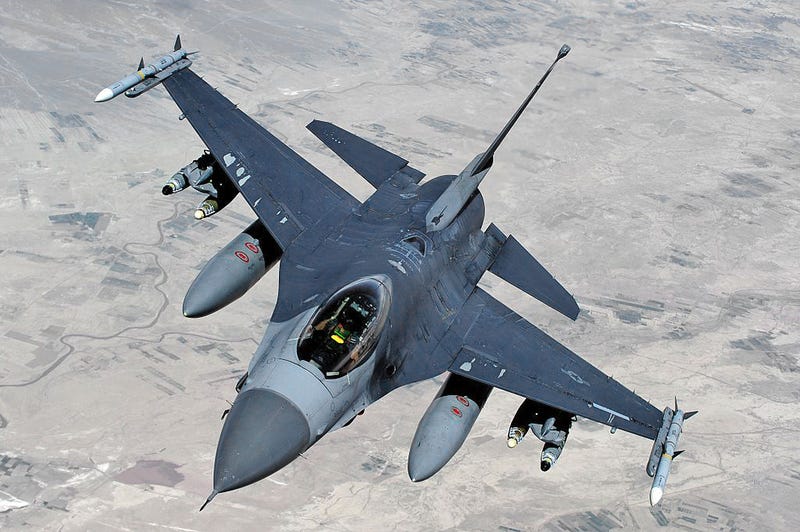
The Pentagon recently had modernized F-16s on the market, which the Polish air force considered but eventually declined. That would be an even more unlikely fit, since Canada has never flown the single-seat fighters, which were the backbone of the U.S. air force for decades.

Image result for F-16
The US Government also has surplus F-16s available, but it is highly unlikely Canada would purchase these jets. 
The "interim" fleet is meant to fill the gap until the Liberal government decides on a permanent replacement for the CF-18s.

Conservative MP James Bezan, his party's defence critic, wants the government to proceed to an open competition to buy fighter jets. (Adrian Wyld/Canadian Press)

Conservative defence critic James Bezan said he doesn't understand why the Liberals are twisting themselves into knots for a temporary solution when they can simply proceed to the open competition they promised for the full fleet.

Sajjan said that is still in the cards, but federal procurement officials have said a competition could take up to five years to run.

"If you look at what other states, other countries are doing in their recent procurement to replace their tactical fighters, none of them are taking five years to do this competition," Bezan said.

"If you look right now, Denmark is doing theirs in two years; Belgium means to complete theirs right now in 18 months; and just earlier this week, Finland started their F-18 replacement program, and they plan to have their first deliveries in 2021 and the entire fleet replaced by 2025, which coincidentally is the same time that our life extension on our CF-18s run out."