Translate

Showing posts with label Liberal Government. Show all posts

Wednesday, November 28, 2018

Liberals Press Ahead with Second-Hand F-18s Amid Questions Over Who Will Fly Them

The Canadian Press - The Kingston Whig-Standard 

The Trudeau government pressed ahead with its plan to buy second-hand fighter jets from Australia on Tuesday despite withering fire from the federal auditor general, who warned that the military might not have anybody to fly them.

A pilot prepares for take off in a CF-188 Hornet aircraft at Mihail Kogalniceanu Air Base in Romania during Operation REASSURANCE on Sept. 27. Last week, the auditor general released a report highlighting the pilot shortage faced by the Canadian Air Force and continued problems with procuring new fighter jets. CPL. DOMINIC DUCHESNE-BEAULIEU/POSTMEDIA
Six years after blowing up the Harper government’s plan to buy new F-35s without a competition, auditor general Michael Ferguson targeted the Liberals’ own attempts to buy jets. He first picked apart the government’s aborted plan to purchase “interim” Super Hornets to bolster Canada’s aging CF-18 fleet, and then its current plan to buy used Australian fighters.

The government says those extra fighters are needed to address a shortage of CF-18s until a state-of-the-art replacement can be purchased and delivered — a lengthy process that will run through 2032, at which point the CF-18s will be 50 years old.

But the auditor general’s office arrived at a very different conclusion: The military doesn’t need more planes because it doesn’t even have the pilots and mechanics to operate what it already has. What it really needs, the office found, is more people.

“The shortage of personnel in relation to technicians means that they don’t have enough technicians to prepare and maintain the planes,” Casey Thomas, the principal auditor on the fighter jets study, told reporters on Tuesday.

“And they have 64 per cent of the pilots that they need, so they don’t have enough pilots to fly the planes . . . What National Defence actually needed was to increase its personnel.”

The auditor general’s report also flagged concerns that the government’s plan to sink $3 billion into the current CF-18s and additional Australian fighters to keep them flying to 2032 won’t be enough, as the money won’t actually improve the aircrafts’ combat systems.

Without more money, which some analysts have suggested could mean hundreds of millions if not billions of dollars more, Canada’s fighter-jet fleet will become even more obsolete, to the point where the plans might not be any use at home or overseas.

Yet only a few hours after the auditor general’s report was released, Defence Minister Harjit Sajjan announced that the Liberals had signed a contract to buy the 18 second-hand jets from Australia. Officials have pegged the cost at around $500 million.

Sajjan also said he had directed officials to look at options for upgrading the combat systems on the CF-18s and Australian fighters, which he acknowledged would mean investing more money into aging fighter jets.

Missing from the announcement: Any new funding or other initiative to increase recruiting and retention of pilots and technicians.

Instead, Sajjan said the government and military have already introduced several initiatives through the Liberals’ defence policy last year, such as giving tax breaks to military personnel deployed on overseas missions, to give them reasons to stay.

At the same time, the minister sidestepped questions about recruitment, saying the military can’t reduce its standards for new pilots. He noted that commercial airlines are also facing a significant pilot crunch.

Air-force commanders have previously said the current training system, which can only produce 115 new pilots each year, a fraction of whom are fighter pilots, is not fast enough to replace all those who move on to commercial opportunities.

The subtext to much of the auditor general’s report on Tuesday was the question of how Canada ended up in a position where the military will be flying fighter jets until they are 50 years old.

The Liberals were urged early in their tenure to launch an immediate competition to replace the CF-18s. Instead they spent two years working to buy those stopgap Super Hornets before a trade dispute with the company that makes them, Boeing, saw the government move on to the used Australian jets.

The Trudeau government insists that it was doing its due diligence, but critics — including numerous retired air force and defence officials — have accused it of trying to bend procurement rules to avoid buying the F-35.

Yet even before the Liberals took the reins, the Harper government was having a hard time making any progress on buying new fighter jets. The Tories championed the F-35 before resetting the entire process in 2012.

That move was prompted by Ferguson’s first report, which accused defence officials of misleading parliamentarians about the stealth fighter’s costs and various technical issues. National Defence later pegged the full lifetime cost of the fighters at $46 billion.

“Lot of people had a hand in this,” said defence analyst David Perry of the Canadian Global Affairs Institute, adding that the worst part is there is no easy or obvious solution to what has become a very troubling situation for Canada and its military.

“I think our fighter force is in trouble.”

Tuesday, November 27, 2018

CAF Says Submarines can operate until mid-2020s

By: David Pugliese, Defence Watch 

The Victoria-class submarines were expected to reach the end of their operational lives starting in 2022, according to documents obtained under the Access to Information law.

That could have been a major problem for the federal government as it is looking at planning a modernization program for the on-board systems on the class, starting in 2023 or 2024.

If the subs were to reach the end of their operational lives starting a year earlier, how would that have worked?
HMCS Victoria operating on the west coast. Photo by David Pugliese.
Defence Watch asked that question and has been informed that things have now changed. Department of National Defence spokesman Daniel Le Bouthillier said that the Victoria-class start to reach the end of their operational life in the mid-2020s. That later date was determined after DND officials did a more extensive examination of the submarine fleet life.

But there are still no details on what needs to be done to extend the life of the subs, how much that will cost, or when that will be done. “The Victoria-class Modernization (VCM) Program is currently in the Options Analysis stage, where the preferred modernization option is being selected,” Le Bouthillier noted. “Details of specific capabilities and milestones will be determined as the program evolves.”

Last year Defence Minister Harjit Sajjan praised the capability submarines provide Canada. “No other platform in the Canadian Armed Forces can do what a submarine can do,” Sajjan said. “No other platform has the stealth, the intelligence-gathering, surveillance and reconnaissance capability and the deterrence to potential adversaries that a sub does.”

But the Liberals have rejected a Commons defence committee recommendation that the Victoria-class subs, bought used in 1998 from the United Kingdom, be replaced with submarines capable of under-ice capabilities.

“The government has also committed to modernizing the four Victoria-class submarines to include weapons and sensor upgrades that will enhance the ability of the submarines to conduct Intelligence, Surveillance and Reconnaissance (ISR) and deliver necessary improvements of platform and combat systems to extend operational capability to the mid-2030’s,” the government response to the committee noted.

Wednesday, November 21, 2018

Auditor General Slams Government Plan to Maintain CF-18 Fleet Until 2032

By: Murray Brewster, CBC News 

Canada's auditor general has shot down the Liberal government's handling of the air force's aging CF-18s in a blistering report that raises questions about national security, and even long-term safety, regarding the viability of the country's frontline fighter jets.

Auditor General Michael Ferguson's fall report, tabled Tuesday, methodically picks apart the recent policy change at the Department of National Defence, which requires the military to have enough warplanes to meet Canada's commitments to both NORAD and NATO at the same time.

Watch Power & Politics take a look at the ups and downs of Canada's fighter jet program
The RCAF is currently facing a shortage of both qualified pilots and technicians. Those pilots the RCAF does have on active roster are struggling to maintain the minimum 140 flight hours per year. 

From the get-go the policy was a non-starter, and the federal government knew it, said Ferguson.

"The fighter force could not meet the requirement because National Defence was already experiencing a shortage in personnel, and the CF-18 was old and increasingly hard to maintain," said the audit.

As of April 2018, the air force's CF-18 squadrons faced a 22 per cent shortage in technical positions — and a startling number of technicians were not fully qualified to do maintenance.

Fighter pilots are also in short supply. The air force is losing more of them than it is training each year; among those who do remain, almost one third do not get the required 140 hours of flying time per year.

At a news conference following the release of the report, Defence Minister Harjit Sajjan conceded that personnel shortages were identified "early on" after the Liberals took over in 2015.

"This is a problem we knew we had," he said, pointing the finger at budget cuts made by the previous Conservative government. "This is what happens when you don't put enough resources into the military."

Watch Defence Minister Harjit Sajjan react to the AG report on fighter jets on Power & Politics


The extent of Liberals' own efforts to boost recruiting and retention of pilots and technicians in the three years since the election was the subject of some confusion Tuesday.

A written statement from Sajjan said the government "will launch new efforts to recruit and retain pilots and technicians."

During the news conference, the minister said the military's top commander had been directed to deal with the problem and that recruiting pilots is "a priority."

Pressed for specifics on recruitment, Sajjan said he's "going to leave it to the experts to figure out."

Proposed solution 'will not help solve' issues

The auditor's report took issue with the Liberal government's strategy to fill the so-called capability gap by buying additional interim aircraft.

The current proposal is to buy used Australian F-18s — of approximately the same vintage as Canada's CF-18s — and convert them for further use until the federal government completes the purchase of brand-new aircraft.

This plan, the auditor's report said, "will not help solve either the personnel shortage or the aging fleet."

Ferguson said an earlier, $6.3 billion plan to buy 18 brand new Super Hornet fighter jets on an interim basis would have been even worse — and the government was told so in no uncertain terms by the air force.

"National Defence's analysis showed that buying the Super Hornet alone would not allow the department to meet the new operational requirement," said the audit.

"The department stated that the Super Hornet would initially decrease, not increase, the daily number of aircraft available because technicians and pilots would have to be pulled away from the CF-18s to train on the new aircraft."

The proposal to buy Super Hornets was scrapped last spring after the manufacturer, Chicago-based Boeing, angered the Trudeau government in a separate trade dispute involving the sale of Bombardier passenger jets.

The Opposition Conservatives have long claimed the 'capability gap' was concocted by the Liberals as a way to push off a decision on a permanent replacement for the CF-18s. In the last election, Prime Minister Justin Trudeau pledged not to buy the F-35 stealth fighter, the preferred option of the Harper government.
Sparring in the House

The report led to sparring in the House of Commons, with the Conservatives seeing the auditor general's assessment as vindication.

"Today's report confirms what we have been saying all along," said James Bezan, the defence critic.

"Justin Trudeau deliberately misled Canadians by manufacturing a 'capability gap' to fulfil a misguided campaign promise, and in the process has put the safety and security of Canadians at risk."

Sajjan, however, believed the report supported the government's position.

"The report confirms what we have always known: The Harper Conservatives mismanaged the fighter jet files and misled Canadians for over a decade," he said.

"The report confirms a capability gap exists, and started under the Conservatives."

In fact, what the report said was that "Canada's fighter force could not meet the government's new operational requirement." It contained objective analysis of how many aircraft would be required to meet various contingencies.
Fleet 'will become more vulnerable'

Meanwhile, the auditor is warning that the Liberal government has no plan to upgrade the combat capabilities of the CF-18s to keep them current over the next decade while the air force waits for replacements.

The last major refurbishment of the war-fighting equipment on the jets happened in 2008, and Department of National Defence planners have done little since because they had been expecting new planes by 2020.

"National Defence did not have a plan to upgrade the combat capability of the CF-18 even though it will now have to fly until 2032," said the audit.

"Without these upgrades, according to the department, the CF-18 will become more vulnerable as advanced combat aircraft and air defence systems continue to be developed and used by other nations."

The fact that the CF-18s are not up to date means they will not be able to operate in certain environments where the risk of surface-to-air missiles or advanced enemy planes is great.

That, in turn, "would limit Canada's contribution to NORAD and NATO operations," Ferguson said.

Sajjan said the department is looking at an upgrade to the combat systems.

"We would love to be able to solve this problem immediately," he said.

Tuesday, November 20, 2018

Government Rejects Advice to Replace Victoria-Class Submarines

By: David Pugliese, The Ottawa Citizen 

New submarines won’t be part of the future mix for the Royal Canadian Navy, at least in the foreseeable future.

Several years ago there were some suggestions that a possible replacement for the Victoria-class submarines might be in the works. In 2017 a Senate defence committee recommended the subs be replaced.

The Commons defence committee also recently recommended that the Victoria-class subs, bought used in 1998 from the United Kingdom, be replaced with submarines capable of under-ice capabilities.

But the Liberal government has rejected that recommendation. The recommendation was the only one of the 27 made by the Commons defence committee that was rejected outright in a response delivered to the committee last month.

The committee had recommended that the federal government respond to NATO calls to improve the quality of their naval fleets and underwater surveillance capabilities by starting the process of replacing Victoria-class submarines with new boats that have under-ice capabilities. It also recommended increasing the size of that fleet to enhance Canada’s Arctic and North Atlantic defence preparedness.
Image result for victoria-class submarines
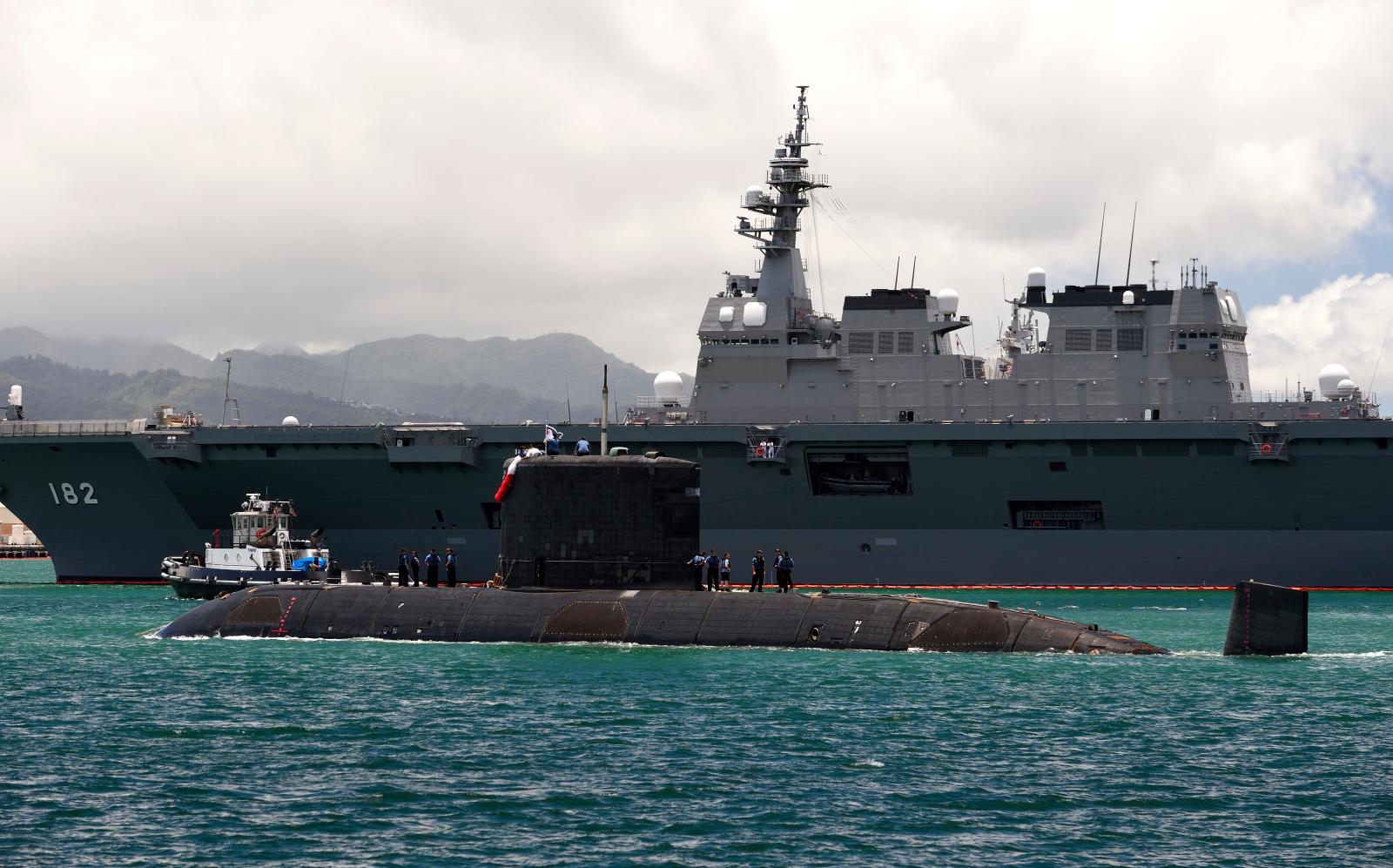
HMCS VICTORIA sails past the Japanese Ship ISE as she arrives in Pearl Harbor on July 1, 2014 to take part in Exercise Rim of the Pacific (RIMPAC).
But the Liberal government pointed out in its response that it is in the midst of the most intensive and comprehensive fleet modernization and renewal in the peacetime history of the Royal Canadian Navy. Canada is recapitalizing and increasing the size of its surface fleet through investments in 15 Canadian Surface Combatants, two Joint Support Ships, and five to six Arctic and Offshore Patrol Ships, it added. “The government has also committed to modernizing the four Victoria-class submarines to include weapons and sensor upgrades that will enhance the ability of the submarines to conduct Intelligence, Surveillance and Reconnaissance (ISR) and deliver necessary improvements of platform and combat systems to extend operational capability to the mid-2030’s,” the government response noted.

Canada is also engaged in the re-building of the anti-submarine warfare capabilities of the fleet through the introduction of technologies, sensors and weapons while preparing to transition to the fleet of the future, it added. “As part of the NATO S&T Organization, Canada is participating in the Maritime Unmanned Systems S&T Pre-Feasibility Studies that focus on ASW and naval mine warfare capabilities with Allied nations that have the same capability targets,” the government stated. “In addition to increasing existing platform capabilities, the RCN is also in the process of re-vitalising individual and collective ASW training and advancing distributed mission training and synthetic training environments.”

Last year Defence Minister Harjit Sajjan praised the capability submarines provide Canada. “No other platform in the Canadian Armed Forces can do what a submarine can do,” Sajjan said. “No other platform has the stealth, the intelligence-gathering, surveillance and reconnaissance capability and the deterrence to potential adversaries that a sub does.”

Upgrading the Victoria-class subs is more “prudent” than buying new subs, Sajjan said at the time.

Without upgrades, the first of the submarines will reach the end of its life in 2022, according to documents obtained last year through Access to Information by the Canadian Press. The last of the boats would be retired in 2027.

Auditor general takes aim at Liberals' fighter-jet plan with new probe

By: Lee Berthiaume, The Canadian Press - Published to BNN Bloomberg 

OTTAWA -- Six years after helping blow up the Harper government's plans to buy F-35 stealth fighters without a competition, auditor general Michael Ferguson is about to release a new report on Canada's tumultuous attempts to buy new fighter jets.

This time, the focus will be on the Trudeau government's handling of the file, which includes adopting several stopgaps while taking its time on a competition to buy new planes for the Canadian Forces.

Ferguson is expected to report specifically on the financial and technological costs of flying Canada's venerable CF-18s -- plus a handful of second-hand Australian jets -- into the early 2030s, when the aircraft will be nearly 50 years old.

The auditor general is also expected to train a spotlight on the air force's problems recruiting and retaining fighter pilots, the question of whether Canada has enough jets to defend itself -- and whether the Liberals followed procurement laws.

Ferguson's report follows several years of criticism over the Trudeau government's decision not to launch an immediate competition to replace the CF-18s, which started flying in the 1980s and were supposed to be retired by 2020.

It has been highly anticipated in political and defence circles given the damage that Ferguson's previous report on fighter jets dealt to the Conservatives and because of the shroud of secrecy that has surrounded the Liberals' decision-making on the file.

The Trudeau government has forced hundreds of federal civil servants and contractors working on the fighter-jet project to sign lifelong non-disclosure agreements, while many documents associated with the issue have been declared cabinet secrets.

Canada's attempts to buy fighter jets have dragged on for nearly a decade since the previous Conservative government announced in 2010 that Canada would buy 65 F-35s without a competition, with the first to be delivered in 2015.

The Tories pushed the reset button in 2012 after Ferguson released a scathing report that found defence officials twisted procurement rules and misled Parliament. National Defence later revealed the jets would cost $46 billion over their lifetimes, much more than the sticker price.

The Trudeau Liberals waded into the issue in the 2015 election when they campaigned on a promise to hold an open and fair competition while at the same time vowing not to buy the F-35s.

But rather than launch a competition right away, as many suggested, the Liberals said in November 2016 that they would wait until 2019. In the meantime, they planned to use a hole in the federal procurement laws to buy 18 "interim" Super Hornets without a competition.

The Liberals said at the time that the Super Hornets were urgently needed because Canada did not have enough CF-18s, but opposition parties and several retired military officers accused the government of bending the rules and wasting taxpayer dollars just to avoid buying the F-35.

They demanded the government launch an immediate competition to replace the CF-18s rather than wait; the government insisted more time was necessary to ensure due diligence and a successful procurement after years of trouble.

The government ultimately scrapped the plan to buy Super Hornets from Boeing for more than $6 billion due to a trade dispute between the U.S. aerospace giant and Montreal rival Bombardier.

But rather than launch a competition, it announced plans to buy 25 second-hand fighter jets from Australia for around $500 million.

The $19-billion competition to replace the CF-18s is slated to begin officially in the spring, though a winner won't be selected until 2021 or 2022. Delivery of the first of 88 planes is scheduled for 2025, with the last due in 2032.

The F-35 has been allowed to compete, despite the Liberals' election promise not to buy it. It is up against the Super Hornet as well as two European designs: the Eurofighter Typhoon and Saab Gripen. A French company with a fifth option dropped out last week.

In the meantime, the government is looking to spend upwards of $1.5 billion to keep the CF-18s and Australian fighters in the air long enough for the new planes to be delivered.

Defence analyst David Perry of the Canadian Global Affairs Institute said they key question leading up to the report's release is what impact it will have on the Liberal government and Canada's attempts to buy a new fighter jet.

"I hope it doesn't set back our fighter program by another 10 years," he said. "Because what the auditor general found -- and the way it was interpreted last time -- set the fighter-jet program back by a decade."

Wednesday, March 7, 2018

Budget Flatlines Canadian Defence Spending

By: Ken Hanse, Macleans Magazine 

You really have to dig into Equality+Growth, the Liberal government’s 2018 budget document, to find any mention of defence spending at all. Only after more than 300 pages, in the Supplementary Information section, can you find a table that shows National Defence is the largest spender amongst government departments. At $25.5 billion, forecasted direct-program expenditures by National Defence will clock in at more than the next two departments—Indigenous Services Canada and the Canada Revenue Agency, which were both forecasted to spend $11.0 billion—combined.

The same table shows that the total for all direct programs spending from the government in 2018 will be $338.5 billion, so the defence part only comprises 7.53 per cent of that total. That seems minuscule until it’s compared with the $26.3 billion the government will pay covering the interest on the federal debt. Or—seen another way—given that the budget shortfall for 2018-19 is projected to be $18.1 billion, knowing what a significant portion of spending defence represents helps explain why it’s always a target for reduction.

Practically all Liberal governments of the past—and many Conservative ones too—have carved large amounts out of the defence budget to cut down on deficits. Recently, though, things have seemed different. Last year, the budget announced an eye-popping 70-per-cent increase to defence spending over the next decade, reaching $32.7 billion by the 2026/27 fiscal year, as part of the Liberals’ new defence policy, Strong, Secure, Engaged, released last year. This year, in addition to that significant top-line figure, there were some minor funding increases for the Defence Department; military family crisis centres will get $4 million over five years, plus $800,000 ongoing afterward. Operation IMPACT against ISIS will get $48 million over two years, but it will be refocused on security and stabilization efforts in Jordan and Lebanon. Work is ongoing to improve the military pension system and provide better care for disabled veterans.

So the likely course of action for the military leadership will be to hold their tongues and keep their heads down. But of course, there are problems—lots of them.

What was supposed to be a low-risk, two-year deployment to Afghanistan turned into the longest conflict in Canadian history. The army is broken and worn out. Beyond that, almost all major equipment systems are decades-old and the supporting infrastructure is in a deplorable state of disrepair. There are very great needs for increased defence spending just to rectify the material side of the house.

The human costs of Afghanistan have also been high. Suicide, depression and domestic violence are commonplace in the forces. Shortages of trained and effective members, most recently identified in the 2016 report of the Auditor General, have worsened. Recruitment targets are not being met and voluntary releases have continued to climb. Some military trades are now 20 per cent short of target manning levels. When five per cent short is considered a critical manpower shortage, 20 per cent is a catastrophe.

And most of the spending in this year’s budget is devoted to cybersecurity and cyberdefence; virtually no new spending has been set out for the fundamentals of Canada’s armed forces, including capital procurement.

When it comes to defence, absent a major threat, new capital program spending is always viewed as discretionary, meaning that Cabinet retains approval of all major programs and could reduce or eliminate them, even if recommended by Treasury Board. That was supposed to change with the Liberal defence policy, Strong, Secure, Engaged, released last year. The claim, made repeatedly by Defence Minister Harjit Sajjan, is that full lifecycle costs for all material needs were built into the new policy. However, the lack of capacity from within the department to administer major programs due to the lack of experienced military and public works program managers has already translated into reduced spending, despite the money carved out for them. “DND is on track to deliver barely better than half of the intended spending on new equipment and infrastructure,” wrote Dave Perry, vice president and senior analyst with Canadian Global Affairs, in a report in January. While some believe deferred spending will eventually be used as planned, I remain skeptical.

In the short term, the lack of new spending in the new budget means DND will have to make economical choices for interim replacements for worn-out ships, aircraft and vehicles. The air force’s interest in acquiring used fighters from Australia may fit this purpose. But the navy’s leasing of a converted container ship from Federal Fleet Systems for $700 million over five years for operational sustainment is a less convincing effort at economy; it cannot be used for combat missions, so it will also have limited effectiveness.

The lack of new spending is only exacerbated by the fact that the future of many of the military’s legacy systems is murky. The design for the navy’s future warship has not yet been chosen and the future of the submarine fleet is being put off for further review. The need for more modern fighters, helicopters and other aircraft is also being weighed against the use of unmanned drones. This project will have significant cost regardless of which is chosen; moving to new platforms and methods will require extensive testing and development, plus a host of retraining and reorganization measures, while failing to recognize a new transformational age of drone technology and remaining with expensive legacy systems will mean huge expenditures for capabilities that risk becoming immediately obsolete.

Procurement decisions will also inevitably be complex and come slowly. This means, in the mid-term, the air force will likely have to look for an economical solution to replace their aged fighters. The navy will need to be content so long as the money in the Shipbuilding Strategy is left untouched. The army will also have to buy time until benefits of a decade-long funding increase produce useful tools. All of the services will have a long list of immediate and critical needs if a major new operation is announced.

That’s not to say that the investment into cybersecurity isn’t welcome. For some, cyber threats and unconventional warfare methodologies and the state of our intelligence capabilities are more worrying than the state of our military, and with major conflict with Russia or China possible, investment into the Communications Security Establishment (CSE) is an overdue priority that’s finally being addressed. As Benjamin Bergen, the executive director of the Council of Canadian Innovators, said in a CBC report: “Without a domestic capacity in cyber, we risk becoming a client state.”

But if this strategic principle is valid, and it is taken to its logical conclusion, the need for nationally planned and generated capabilities to address security risks should apply equally to the defence, security and safety sectors, or we risk becoming a client state in other avenues, too. Buying off-the-shelf foreign products that do not reflect our own estimates of need will not prove economical, as DND’s instinct to “Canadianize” a foreign-designed system to suit our situation will make that choice expensive all the same.

To assure that Canada has an independent and self-sustaining military, a common-sense appreciation of what the future holds is urgently needed—and that starts with the planning exercise of the defence budget. While money has been set aside in the previous budget, the proven difficulties with doling that out and the lack of explicitly budgeted new spending risks hamstringing the military at a critical juncture.
----
Ken Hansen is an independent defence and security analyst and owner of Hansen Maritime Horizons. Retired from the navy in 2009 in the rank of commander, he is a member of the Science Advisory Committee for Atlantic Oceans Research Enterprise and a contributor to the Security Affairs Committee for the Royal United Services Institute.

Monday, March 5, 2018

GoC Restricts Fighter Jet Purchase Information

By: David Pugliese, National Post

Capt. Denis Beaulieu flies the CF-18 upside down at the Wings Over Springbank air show at Springbank Airport west of Calgary, Ab., on Saturday July 18, 2015.Mike Drew/Calgary Sun/Postmedia Network
The federal government says it needs to tightly control the type of information being circulated about its $19-billion fighter jet replacement program because it knows best what the public should be told.

In early February, Postmedia revealed that companies interested in the government’s planned purchase of new fighter jets were warned not to talk to journalists. That came in advance of a Jan. 22 industry day to discuss the basic details of the jet purchase.

Public Services and Procurement Canada, which is co-ordinating the project, confirmed that the media blackout for companies was in place but defends that as necessary.

“As fighter aircraft and their component systems are sensitive, heavily controlled goods, it is also critical that (government) procurement officials remain the definitive source of publicly shared information, to ensure the integrity of the overall process,” the department noted in an email to Postmedia.

Procurement Canada also noted that the same rules will apply throughout this year and next as meetings are held with various companies on the jet deal. Such meetings “will require sharing extensive amounts of information, including sensitive technical data” that needs to be protected, the department added.

A CF18 Hornet prepares to resume its activities after being refuelled by a CC150 Polaris during Operation Impact, on February 4, 2015. Photo: Canadian Forces Combat Camera, DND
But sources who leaked details of the industry day meeting and the department’s plan to limit information to the news media, scoffed at government claims about the need to protect sensitive information. Industry executives often talk to journalists about government bungling of military procurements, not about the secret details of their respective products, sources pointed out.

They predicted that the media blackout won’t stop details about problems associated with the jet program from leaking out.

Public Services and Procurement Canada noted it is “committed to provide regular updates” to the public and media as the jet project proceeds.

The Liberal government’s quest to buy new fighter jets has been controversial from the beginning, with mixed signals and bungled deals.

Prime Minister Justin Trudeau originally said his government wouldn’t buy the F-35 stealth fighter, later claiming it didn’t work. The government then reversed course, pointing out that F-35 manufacturer Lockheed Martin was welcome to offer their plane to Canada in any competition.

In 2016, the Liberals launched a plan to buy new Super Hornet jets from Boeing as an interim measure, only to scuttle that deal a year later because of a trade war involving the U.S. firm.

Instead, the government says it will now buy used F-18 jets from Australia. But that purchase is already running into delays.

Pat Finn, the Department of National Defence’s assistant deputy minister of materiel, told the Commons defence committee in February that Canada is looking for delivery of the used aircraft in the summer of 2019. The Liberal government originally planned for the arrival of the first used aircraft in January 2019.

The purchase of new jets, which will eventually replace all of Canada’s CF-18s as well as the used aircraft acquired from Australia, will unfold over the next 14 years. Some of those who attended the industry day in January noted that the purchase, which would see a contract awarded in 2021 or 2022, seems drawn out, considering federal procurement officials have been involved in trying to buy a new jet since 2010.

The restrictions on what industry can say about the jet project is not the first attempt by the Liberals to crack down on what information might make its way to the public or news media about the multi-billion-dollar program.


As fighter aircraft and their component systems are sensitive, heavily controlled goods, it is also critical that (government) procurement officials remain the definitive source of publicly shared information

In November 2016, it was revealed the government brought in an unprecedented gag order that prevents 235 military personnel and federal workers from ever talking about the program. The non-disclosure agreement for the equipment project puts the fighter jet replacement on the same level as top secret counter-terrorism missions undertaken by the Joint Task Force 2 commando unit, as well as clandestine operations by the country’s spies, military sources say.

The permanent non-disclosure agreements were at the time uncovered by Conservative defence critic James Bezan after he requested information through the House of Commons “inquiry of ministry” process.

The DND claimed that such agreements have been used with procurement staff before on occasion.

But Alan Williams, the former assistant deputy minister for materiel at the DND, has said that he had never heard of such agreements.

dpugliese@postmedia.com

Twitter.com/davidpugliese

Friday, July 7, 2017

The Battle to get More Women into the Military


This article was originally published on The Conversation, an independent and nonprofit source of news, analysis and commentary from academic experts. Disclosure information is available on the original site.
——

The Trudeau government released a new defence policy in early June, after months of speculation about the size of the defence budget, purchase of major equipment and Canada’s future role in military operations.

The election of Donald Trump in the U.S. no doubt threw the process off course and forced certain revisions to the policy, which was initially due in January. The policy offers guidelines on the types of operations the Canadian Armed Forces (CAF) might undertake and promises a steady increase in funding over the next decade. But its main focus is on people — the women and men who dedicate their life to military service.


Highlighting the importance of diversity, the policy pays special attention to female service members and aims “to further increase the representation of women in the military by one per cent annually towards a goal of 25 per cent in 10 years.” Driving this shift is the assumption the CAF is in need of culture change — and that more women and the use of gender perspectives will improve the effectiveness of the armed forces.

Reflecting the community it serves

Why are women now seen as critical to the military enterprise?

First, greater diversity in the CAF is key to maintaining a healthy connection between the military and the rest of society. The CAF Diversity Strategy recognizes this and envisions an armed force representative of the community it serves to ensure public legitimacy and keep support for the military strong.

How can the CAF attract more women? There are formal commitments to recognize the importance of retaining diverse personnel, but informal barriers remain. The CAF already has some of the longest parental-leave policies in the world. But single parents and women still face professional setbacks.

The CAF must quickly recognize and address the pressures of military careers on families, which includes frequent moves and prolonged absences from loved ones during deployments. Counting parental leave toward promotion will also be necessary for the professional advancement of women, who disproportionately take on the role of primary caregiver.

Women are also less likely than men to consider a military career in the first place.

To address these well-known challenges, the CAF’s new recruitment strategy will aim to showcase the wide variety of occupations it offers, in an attempt to make the military more attractive to women. The Women in Force Program will also allow for a “try it before you buy it” program for women interested in joining but not ready to commit.

Seeking buy-in among the ranks

Second, a more diverse CAF is good for the entire organization, men included. Although adding more women will not result in immediate and transformative changes in the way the CAF does business, research has shown that diverse teams work better.

Military leaders will have to constantly promote these initiatives, but will also have to assuage fears about the maintenance of physical and performance standards. All members of the armed forces must trust that standards will be enforced fairly if the diversity strategy is to have buy-in at all levels.

This kind of broad-based buy-in has proven elusive in the past. Even if no formal professional barriers remain, there is still organizational resistance to women’s presence in non-traditional roles, such as combat. And women are still disproportionately affected by sexual misconduct, as a recent survey showed. Discriminatory and sexist attitudes, thus, persist.

‘Hop on Her’ controversy

These common narratives can be tempered with dedicated leadership. In the military context, these challenges need a commitment to addressing hard-to-answer questions.

For example, the Chief of the Defence Staff issued Operation Honour, an order meant to eradicate harmful and inappropriate sexual behaviour in the CAF’s ranks. This was a leadership decision that addressed a difficult and pervasive challenge for the military. But some members of the armed forces started undermining the initiative by calling it “Hop on Her.”.

This is where leaders in the military — who are mostly men — must be included in the discussion of promoting gender perspectives and women’s participation in the armed forces. For these reasons, the burden of change cannot rest on women’s shoulders, but must be spread evenly across the entire organization.

Education and training are key. Including feminist texts in the military curriculum or challenging the warrior ethos might lead to greater gender awareness amongst the upper cadre of military leaders, but most operators will only pay attention if they see how gender matters on the battlefield.

To this end, highlighting the link between gender (as opposed to women) and operational effectiveness is necessary. When soldiers are on the ground, accounting for the roles played by women and men — and their unique needs and power differences — is critical to operational planning and securing lasting outcomes. Understanding how gender intersects with social and cultural factors leads to greater situational awareness. Gender roles in Afghanistan and in Iraq, for example, had clear operational implications.

Promoting the operational and social benefits of women in the CAF is just the first step toward increasing their numbers in the military. To move beyond commitments and toward organizational change and buy-in, the CAF must go beyond women’s representation in the ranks and become aware of how gender relations are constructed, at home and on the battlefield.

----
Authors: Stefanie von Hlatky, Assistant Professor of Political Studies and Director of the Centre for International and Defence Policy, Queen’s University, Ontario and Meaghan Shoemaker, PhD Student, International Relations and Gender and Politics, Queen’s University, Ontario

Boeing to Get $200 Million Maintenance Contract Despite Bombardier Fight

By: David Pugliese, The National Post 

A $200 million deal would see Boeing maintain the military’s C-17 aircraft despite claims by the Liberal government it is getting tough on the U.S. firm for its complaint against Bombardier
Boeing C-17 Globemaster III is being assembled at the Boeing assembly facility in Long Beach, Calif. in a July 31, 2012. The Canadian government may grant Boeing a massive contract to maintain the air force's fleet of C-17s despite a trade dispute with Bombardier. Damian Dovarganes/ The Canadian Press
Canada is set to approve a $200 million deal that would see Boeing maintain the military’s C-17 aircraft despite claims by the Liberal government it is getting tough on the U.S. firm for its complaint against Bombardier.

Liberal ministers have said all military procurement with Boeing is being reviewed as a result of that company’s decision to file a complaint with the U.S. government against Bombardier. Boeing is alleging Canada is unfairly subsidizing Bombardier’s CSeries civilian transport aircraft.

The Liberal government has also threatened to back away from the proposed purchase of 18 Boeing Super Hornet fighter jets.

The Boeing F-18 Super Hornet performs during its demonstration flight. Remy De La Mauviniere/ Associated Press / The Associated Press
But the upcoming C-17 deal shows how difficult it is to use military procurements as a bargaining chip.

Boeing, which built the C-17 transports, currently helps maintain those planes for the Royal Canadian Air Force. That agreement expires on Sept. 20, according to Public Services and Procurement Canada. To walk away from a new deal would jeopardize the operation of the RCAF’s fleet of five C-17s, military officers say.

Canada purchases C-17 maintenance and support from the U.S. government through what is called a foreign military sale. Boeing, however, does most of the work. The new deal on C-17 maintenance will cost Canadian taxpayers $195 million U.S.

The U.S. Congress was informed of the Canadian deal in late April.

“The Liberals don’t have much choice on the C-17 maintenance,” said Martin Shadwick, a defence analyst who teaches strategic studies at York University in Toronto. “Boeing is the prime contractor on that aircraft and a lot of the work will be done at Boeing.”

According to the U.S. government, the work on the Canadian C-17s will be done at Boeing’s facilities at Long Beach, Calif., and in St. Louis, Missouri. Lockheed Martin will also be involved.

In addition, the U.S. government noted that there are currently 13 employees from Boeing now in Canada who provide C-17 technical support on a regular basis.

The Liberal government declined to provide a list of the Boeing contracts or procurements it is reviewing. Instead Anthony Laporte, press secretary for procurement minister Judy Foote, repeated in an email that, “Canada is reviewing current military procurement that relates to Boeing. ”

Foreign Affairs Minister Chrystia Freeland announced that review in May.

Shortly before Freeland made her statement, a Boeing-built military communications satellite, paid for by Canada and other countries, was launched in the U.S. Canada contributed $340 million to the Wideband Global satellite built by Boeing. Defence Minister Harjit Sajjan praised the project, noting that the satellite will provide key communications for the Canadian military.

Sajjan said Boeing’s complaint against Bombardier is “not the behaviour of a trusted partner.” He called on the U.S. firm to withdraw its complaint but Boeing has declined. “This is a commercial matter that Boeing is seeking to address through the normal course for resolving such issues,” the firm noted in a statement.

Sajjan said Canada has had a good relationship with Boeing over the decades but the firm’s actions have now damaged that.

The Liberals are continuing to review the Super Hornet jet proposal and whether they should continue with the purchase. But Liberal ministers acknowledge Canada continues to have discussions with the Pentagon over the acquisition of the Super Hornets. If it proceeds, the Super Hornet purchase is expected to cost between $5 billion and $7 billion.

Shadwick said the Liberals might also find it difficult to back away from the Super Hornet deal. Sajjan has stated the Canadian military faces a critical gap in that it lacks enough fighter aircraft. New jets are needed quickly, the minister added.

Other aerospace firms are in the wings ready to offer Canada new aircraft, including Lockheed Martin with its F-35 fighter jet. “The political optics on a F-35 purchase wouldn’t be too good since Justin Trudeau campaigned directly against that aircraft,” Shadwick explained. “To turn around and then purchase the planes as an interim solution may be challenging from a political point of view.”

But Shadwick pointed out that the Boeing complaint against Bombardier could hurt the U.S. firm’s chances in the future in winning new defence contracts from Canada. Canada is interested in buying new patrol aircraft and aerial refuelling planes. Boeing has indicated it is interested in both of those multi-billion dollar programs.

Monday, May 29, 2017

Government Makes 2017 Payment to remain in F-35 Consortium

Lee Berthiaume, The Canadian Press

OTTAWA -- Canada has quietly paid another $30 million toward development of the F-35 -- money that could become insurance in the trade dispute between U.S. aerospace firm Boeing and Canadian rival Bombardier.

The annual payment was made to the U.S. military at the end of April, the Department of National Defence says, and will keep Canada at the table as one of nine partners in the fighter jet project for the next year.

Canada has paid US$373 million into the program since 1997, National Defence spokeswoman Jessica Lamirande said in an email.

Staying in the program has advantages, as partners can compete for billions of dollars worth of contracts associated with the building and maintaining F-35. They also get a discount when purchasing the plane.

That latter point wasn't considered much of a benefit when Canada paid its annual instalment last year, as the Liberals had promised during the 2015 election not to buy the stealth fighter.

The government instead went out of its way last July to highlight the potential benefits to Canada's aerospace industry when explaining why it had decided to stick with the program.

Those industrial benefits continue to accrue, Lamirande said, with Canadian companies having secured US$926 million in F-35-related contracts over the last 20 years -- including US$114 million in the last year alone.

But the trade dispute between Boeing, which builds Super Hornet fighter jets, the F-35's main competitor, and Montreal-based Bombardier casts the decision to stick with the stealth-fighter program in a new light.

Citing an urgent need for more fighter jets, the Liberal government announced last November plans to buy 18 "interim" Super Hornets until a competition could be held to replace Canada's entire CF-18 fleet.

But then last week, the government threatened to scrap the Super Hornet purchase after Boeing persuaded the U.S. Department of Commerce to launch an investigation against Bombardier.

Boeing alleges Bombardier sold its CSeries jets in the U.S. at an unfair discount thanks to subsidies from the Canadian government, while Bombardier says its planes never competed with Boeing.

Many defence analysts and former air force officers have questioned whether "interim" fighter jets are needed and instead want an immediate competition to replace all of the CF-18s.

But if more jets are truly needed on a short-term basis, the decision to stay at the F-35 table could be used to get a better deal on interim stealth fighters -- or even as a bargaining chip against Boeing.

"If the government is in fact serious about re-evaluating its dealings with Boeing, then this could be part of showing that," said defence analyst David Perry of the Canadian Global Affairs Institute.

"Because the F-35, at least in my mind, would be a possible alternative if the government remains committed to buying separate interim aircraft."

Three other alternatives exist -- the Saab Gripen, Eurofighter Typhoon and Dassault Rafale -- but all are made by European companies and the government has emphasized the need for a U.S. design.

Lockheed Martin, the company behind the F-35, has remained relatively quiet about the government's plan to buy interim Super Hornets, but is now chomping at the bit for a chance to fill any potential gap.

The U.S. company "would openly welcome discussions about interim fighter solutions," spokeswoman Cindy Tessier said, adding that Lockheed has partnered with Bombardier on another military project.

The government is providing little information as to what next steps it might take as the dispute between Boeing and Bombardier continues to play out.

Boeing, for its part, has emphasized its longstanding relationship with Canada, even as representatives from its defence division have scrambled to meet and smooth the edges with Canadian officials.

The U.S. International Trade Commission, which heard arguments from both aerospace companies in a hearing last week, isn't expected to issue a ruling until June 12.

The U.S. Department of Commerce would then decide whether to penalize Bombardier.

Thursday, February 23, 2017

Alenia C-27J Legally Challenges FWSAR Airbus C-295W Buy

By: Murray Brewster, CBC News 

The losing bidder in the race to replace Canada's fixed-wing search and rescue fleet is asking a Federal Court judge to toss out the multibillion-dollar contract, CBC News has learned.

Leonardo S.p.A., also know as Alenia, which offered its C-27J transport for the competition, filed notice of legal action in January, but only delivered supporting arguments and affidavits to the court on Tuesday.

The company is challenging the Liberal government's decision last fall to buy 16 new C-295W transports manufactured by rival Airbus Defence and Space.

The Italian aircraft-maker says the bid by Airbus should be disqualified and the court should cancel the contract.

The company cites a number of grounds, including a claim the C-295W does not meet the specifications originally set out by the Royal Canadian Air Force, notably the ability to "perform mandatory long-range missions stipulated" in the request for proposals.

Leonardo's court filing also raises alleged safety concerns related to the absence of a redundant power system in the aircraft.

"The necessary consequences of this inadequacy should have been the disqualification (if no modification was proposed) or rating penalization (if a modification was proposed) of the Airbus proposal," said the filing.
'A decision has been made and it's a really good thing for Canadians.'- Minister of Defence Harjit Sajjan

Separately, Leonardo argues that the Airbus bid should have been disqualified at the outset because of cost.

In late November, the Liberal government announced it was buying the C-295 in a two-step procurement for a total price of $4.7 billion over the next two decades.

The first step — at a cost of $2.4 billion — involves the purchase of aircraft, simulators and 11 years of support.

The second step involves a future in-service support program that will have to be negotiated with Airbus, at an estimated cost of $2.3 billion.

However, in the request for proposals, which was filed in court as part of the supporting documents, all bidders were told their package could not exceed $3.4 billion, including in-service maintenance support.
Silence from Public Works

Officials with Leonardo have sought an explanation from Public Works, but have been met with silence, said a source familiar with the file, but who was not authorized to speak with the media.

"The applicant's proposal to supply Canada with FWSAR aircraft and related services … was evaluated as being fully compliant with the requirements of the (request for proposals) and substantially less costly than the aircraft and services proposed by Airbus," the court filing said.

Federal lawyers have indicated the government intends to fight the claim, but has not filed a statement of defence.

The announcement last December by Defence Minister Harjit Sajjan, Public Works Minister Judy Foote and the commander of the Royal Canadian Air Force, Lt.-Gen. Michael Hood, was supposed to end a frustrating 12-year procurement odyssey that spanned three governments.

Defence Minister Harjit Singh Sajjan says he is confident the appropriate steps were followed in the procurement process and doesn't see any need for further delay. (Sean Kilpatrick/Canadian Press)

It was former prime minister Paul Martin's Liberal government in 2004 that first proposed replacing the fleet.

The former Conservative government, which put the program on hold over allegations the air force had calibrated the specifications in favour of Leonardo's C-27J, eventually asked the National Research Council to evaluate the requirements.

The Air Bus C-295, which is in service in 15 countries, is supposed to speed along the retirement of the air force's nearly 50-year-old C-115 Buffalos and older model C-130 Hercules transports, which were assigned to search and rescue duties a number of years ago.

The government said last fall that the first C-295 is expected on the tarmac in 2019, with the final delivery slated for 2022.

It is unclear how the court challenge will affect that timetable.

Sajjan defended the government's choice late Wednesday, saying he's confident the appropriate steps were followed and doesn't see any need for a delay.

"A decision has been made and it's a really good thing for Canadians," Sajjan told CBC News. "If somebody has any concerns about that decision they have the right to be able to have a look at that decision and use the various processes within our court system."

He described the C-295 as a "game-changer" for the air force.

Monday, October 31, 2016

The politically-charged issue of Peacekeeping

BY HUDSON ON THE HILL
© 2016 FrontLine Defence (Vol 13, No 5)

During the campaign for last October’s ­general election – which gave the Liberals a majority in the House of Commons after a decade in the political wilderness – they promised to renew Canada’s commitment to international peacekeeping operations.

Decrying the Conservatives’ scaling back of participation in UN-centric observer and peacekeeping missions, the Liberals said the demand had never been greater. Moreover, they added, “a more peaceful world is a safer and more prosperous world for Canada.”

Prosperity, a.k.a. economic gain, is simply a fact of life for countries that engage in peacekeeping. So, too, is the political desire to score points in global standings and possibly gain a UN Security Councilseat for 2021-2022 (we held one every decade since the UN’s inception, but were rebuffed in the last round of votes). “We will recommit to supporting international peace operations with the United Nations, and will make our specialized capabilities […] available on a case-by-case basis,” the Liberal platform continued.

There’s a cliché about “punching above our weight”, which the Canadian Armed Forces (CAF) have clearly accomplished on dozens of deployments over the decades. Now, the Liberals were promising rapidly-deployable personnel to “lead an international effort to improve and expand the training of military and civilian personnel deployed on peace operations” while contributing more to UN conflict-prevention, mediation, and reconstruction efforts.

After winning the election, Prime Minister Justin Trudeau is evidently determined to play with stronger cards at the UN table, and has doubled down on the campaign rhetoric, promising to revitalize Canada’s peacekeeping machinery while supporting civil institutions. “This is how we will build the world of tomorrow,” he told Canadian staff at UN headquarters in New York in March.

In discussions with the UN and allies Foreign Affairs Minister Stéphane Dion ­pursued “the optimal way for Canada to re-engage itself,” suggesting that Canada’s military contribution would focus at the training end of the spectrum.

Whether packaged as revitalization or reengagement, or both, it is evolving into the first major test for the reborn Liberals in the global arena – and at home too. This became increasingly apparent during Parliament’s summer hiatus, which included a Liberal caucus retreat in Quebec’s Saguenay region in late August. Trudeau rolled out Dion, Defence Minister Harjit Sajjan, International Development Minister Marie-Claude Bibeau, and Public Safety Minister Ralph Goodale to announce a plan to spend $450 million over three years on a Peace and Stabilization Fund. Not all new money, it would build on a resource already managed by Dion’s department, and include a renewed $47-million fund for RCMP involvement.

The PM later added “it is important that when we go into engagements internationally that we be clear-eyed around what we hope to deliver, about what kind of support and outcomes we can offer, at how we are going to achieve those and about how we will continually evaluate whether we’re making the best contributions.”

Left unanswered were such questions as where the up to 600 military personnel and up to 150 police officers might be tasked, and what operational constraints might apply.

Top contenders for such a mission are the Central African Republic, Congo, Mali, Rwanda and South Sudan. In August, Minister Sajjan and a team of advisors visited Congo, Ethiopia, Kenya, Tanzania, Uganda and Tanzania in the company of retired General Roméo Dallaire and former UN High Commissioner for Human Rights and Supreme Court Justice Louise Arbour – to prepare for a “whole of government effort.”
Not the cultural monolith many still see it as, Africa is a continental mixed bag of regional, religious and tribal challenges with long-standing simmering animosities that routinely boil over.

Canada’s last involvement was a UN-led mission in Rwanda in 1993-1994, but peacekeepers’ hands were effectively tied by UN rules of engagement as the tribal conflict deteriorate into genocide. Dallaire’s 2003 book, Shake Hands with the Devil: The Failure of Humanity in Rwanda, should be read by anyone hoping to discuss peacekeeping intelligently, particularly MPs.

In early September, after a two-day peacekeeping summit in London, and antici­pating heated debate when the House would resume sitting a week later, Sajjan understandably declined to discuss specifics about the next CAF commitment (despite many signs pointing to Mali, where Canada recently completed a “reconnaissance mission” that included talks with Malian officials and members of the UN peacekeeping mission already on the ground. Mali is generally considered the most dangerous current UN peacekeeping mission, with 105 peacekeepers killed and hundreds wounded since UN troops took over the mission from their African Union counterparts in 2013.

“We are looking at peace support operations,” Sajjan confirmed, adding that he and other ministers with skin in the game would eventually pitch a mission to cabinet. But it was too early to discuss “further steps” or how to ensure that CAF personnel would have everything they need to make “a meaningful impact.”

When Frontline Defence asked Sajjan whether there had been any “broad brush consensus” on what summit participants might contribute to the next mission, he replied without elaborating that there were “significant gaps” to fill.

“We’ve been in conversation with the United Nations leadership and especially the various missions themselves,” he continued. “We know what we are good at and […] we will look at those gaps and [determine] how we can best contribute.”

He seemed particularly keen on capacity-building, pointing out that Canada has “significant experience” in that field, including the prospect of bringing other countries’ peacekeeping leaders to Canada for particular training.

When FrontLine asked if he would be averse to putting CAF personnel in roles for which they are trained (notably combat) during a peacekeeping mission, Sajjan demurred, saying he did not want to get into that debate. However, there was no gainsaying the fact that Canadian troops are put in situations which might require the use of deadly force. “We need to make sure that we have a robust enough mandate so that we can create the right rules of engagement that the military will sign off on,” Minister Sajjan explained. “But protection of civilians is a top priority. The potential use of deadly force would be addressed through what he said should be an appropriate mandate, rules of engagement, and training.

Meanwhile, ideological battle lines have hardened as the Conservatives suggest that the UN is incapable of managing peacekeeping missions. “In the last 15 years, our success … has been in peacemaking, not in peacekeeping,” said Manitoba MP James Bezan, the Conservative defence critic and former chair of the House of Commons Standing Committee on National Defence.

Then there were the Liberals’ motives for pushing ahead with the peacekeeping concept. “The ultimate goal here is to achieve a seat at the UN Security Council when it becomes available,” Bezan told reporters. “That, to me, is politics, and we shouldn’t be using our troops as pawns.”

Bezan seems to have lost sight of the fact, like it or not, that the CAF are an arm of the government and, hence, subject to its policies and directives. To have it otherwise would be problematic, to put it mildly.

As expected, when the Commons did resume, the opposition parties continued to press the government to clearly set out the details before any deployment. But the government would not commit to a vote – even though, with their parliamentary majority, the outcome would be predictable.

“Canadians must be able to trust that these decisions are made in our national interest, not the political interest of the ­Liberal Party,” Opposition Leader Rona Ambrose led off with. Sajjan’s response going forward was that the electorate in 2015 had “voted for a party that promised to re-engage Canada in the world and […] would be commited to actively contributing to greater security and peace.” He later added that the government welcomed “healthy debate” in the House and elsewhere, not only on peacekeeping but defence policy overall.

In London, Sajjan acknowledged that “this is not the peacekeeping of the past.” Truer words were never spoken; conflicts today are not conducive to the requirement of consent from the main parties, nor to political process. It clearly remains to be seen what the future holds for the Liberals, the CAF, and this country. That’s about the only thing that’s clear so far.

===
Hudson on the Hill
The role of Hudson is being filled by contributing editor Ken Pole.

Friday, October 28, 2016

Government Backtracks on Demand that Firms Stay Silent on Canadian Surface Combatant Bid

By: David Pugliese, The Ottawa Citizen 

Industry representatives were stunned by a new decree from Public Services and Procurement Canada that would have prevented any communication to the public about the Canadian Surface Combatant program. No advertising. No press releases issued announcing that a firm was even interested in bidding on the program. No discussions about what a company could offer and the jobs it could provide to Canadians.

“Neither the bidders, nor any of their respective subcontractors, employees or representatives shall make any public comment, respond to questions in a public forum or carry out any activities to either criticize another bidder or any bid — or publicly advertise their qualifications,” noted the order to industry.

Why put a clause like that in the bidding package? Sources say the Canadian Surface Combatant process has major problems. There are concerns in some quarters the outcome of the program has already been determined. And the Canadian government doesn’t want industry talking about such concerns – or anything related to the procurement, sources say. It just wants to spend tens of billions of dollars without any pesky questions from opposition MPs, the media and taxpayers, some industry representatives worry.

After details about the order were made public, Procurement Canada issued this statement: “A clause in the Request for Proposal (RFP) for the Canadian Surface Combatant has raised questions about restrictions on communications activities, such as advertising, of participating bidders. Public Services and Procurement Canada would like to clarify that industry is free to communicate as it sees fit. The intent of the clause is simply to encourage bidders to respect and preserve the integrity of the solicitation process and focus on the content of their proposals. Companies are free to promote their products and services, but the RFP asks that they not do so in a way that would discredit the procurement process or other bidders.”

U.S. Again Pitches F-35 jet to Ottawa as Liberals aim to Replace CF-18

By: Daniel Leblanc, The Globe and Mail 

The U.S. Air Force made a last-minute pitch to the federal government in favour of the Lockheed-Martin F-35, hoping to reassure officials about the long-term viability of the stealth fighter jet that the Liberals promised not to buy in the past election, sources said.

A top American officer who leads the F-35 Lightning II Joint Program Office, based in Virginia, travelled to Ottawa on Oct. 14 to meet with Canadian officials who are working on the purchase of Canada’s next fleet of fighter jets. Lieutenant-General Christopher Bogdan discussed the ongoing development of the state-of-the-art fighter jet, which has clients around the world but is still facing a series of technological problems, officials said.

The visit from Lt.-Gen. Bogdan came at a crucial time, as a small team of Liberal ministers are set to choose one of three options to replace Canada’s fleet of CF-18s: launch a full and open competition; buy a small number of fighter jets for an interim fleet; or purchase an entire fleet of jets through a sole-sourced acquisition.

Defence-industry officials expect the cabinet committee on defence procurement to meet on this matter next week. Federal officials declined to comment on the timing of the coming meeting, but said the government does not plan to let the complex file drag on.

There are widespread concerns in the Liberal government about the short-term risks associated with the acquisition of the F-35, which is still in development.

Explainer: Breaking down the dogfight over Canada's next fighter jet

In September, 15 F-35s were grounded over the discovery of faulty insulation in avionics cooling lines in the aircraft’s wings, an issue that should be be fixed by the end of the year.

On a broader level, some Canadian officials were preoccupied by a recent report that raised a number of questions about the ability of the F-35 to achieve its promised capabilities.

Leaked to Bloomberg News over the summer, the report from the U.S. government’s Director of Operational Test and Evaluation warned that the F-35 program was “not on a path toward success but instead on a path toward failing to deliver” full capabilities by the scheduled end of its development in 2018.

Lt.-Gen. Bogdan was in Ottawa earlier this month specifically to discuss the Canadian government’s plans to buy new fighter jets.

“The general provided an update on the status of the program and answered questions to help ensure officials had as complete information as possible on the F-35 program, as the Government of Canada considers all of its options to replace their legacy CF-18 fighter fleet,” said Joe DellaVedova, a spokesman for Lt.-Gen. Bogdan.

Mr. DellaVedova would not give details of what was discussed at the meeting, but provided a statement by Lt.-Gen. Bogdan to dissipate concerns over the report from the Director of Operational Test and Evaluation.

“All of the issues mentioned are well-known to the F-35 Joint Program Office, the U.S. services, international partners and our industry team. … While nearing completion, the F-35 is still in development and technical challenges are to be expected. The program has a proven track record of solving technical issues and we’re confident we’ll continue to do so,” Lt.-Gen. Bogdan said.

There was no similar visit to Ottawa by American officials in charge of the Boeing Super Hornet, which is seen as the main rival to the F-35 in the race to replace Canada’s CF-18s.

Defence-industry sources said the U.S. Air Force is more supportive of the F-35 than the Super Hornet, which is operated by the U.S. Navy. Still, the Super Hornet program has had the opportunity to provide detailed information on its aircraft to Canadian officials, sources said.

During the past federal election, the Liberal Party said: “We will not buy the F-35 stealth fighter-bomber.” The Liberals promised an “open and transparent competition to replace the CF-18 fighter aircraft,” leading to the “purchase [of] one of the many, lower-priced options that better match Canada’s defence needs.”

Wednesday, October 5, 2016

RCAF to ask for $500 million in spending for CF-18 upgrades

By: David Pugliese, The National Post

The Canadian military is hoping to ask the government early next year for approval to spend up to $500 million to modernize its CF-18 fighter jets.

The upgrade would keep the planes flying until 2025, giving the government some breathing room to organize the purchase of replacements and make sure they are delivered before the older jets are taken out of service.

Work has already started to ensure the CF-18s are structurally sound.

Now, the military is analyzing improvement options for communications equipment to deal with changes in civil aviation regulations. There could be other upgrades to weapons and how the CF-18s communicate and operate with Allied fighter jets.
DND/FileThe CF-18 upgrade would keep the planes flying until 2025, giving the government some breathing room to organize the purchase of replacements
“This project is expected to go for potential government submission early in 2017,” said Ashley Lemire, Department of National Defence spokeswoman.

The options focus “on what is required from a regulatory and interoperability perspective.”

The DND estimates the cost of the modernization at between $250 million and $499 million, depending on the options chosen and what the government accepts, say defence sources.

Military officers say the upgrades will have to be done by 2021 to make financial sense — new fighter jets are expected by 2025. That means decisions on the upgrades must be made and contracts placed by 2018.

Since 2002, Canada has spent $2.6 billion modernizing the CF-18s. The planes were bought in 1982.

The Conservative government planned to buy 65 F-35 stealth fighters to replace the CF-18s. The purchase was put on hold as the cost ballooned and technical problems emerged.

Related
Colin Kenny: It’s time for us to get on with replacing the CF-18 fighter fleet
‘It’s here. It’s real:’ Stealth fighters vie for attention from air show attendees — and the Canadian Forces
Eight CF-18s deployed for month to U.S.-led exercise despite Liberals’ warning of jet shortage

During last year’s federal election, the Liberals said they would buy a less expensive fighter jet if they came to power.

In June, Prime Minister Justin Trudeau said the F-35 “does not work, and is far from working.”

But the Liberal promise not to buy the F-35 has been thrown into question by Defence Minister Harjit Sajjan, who has said any competition would be open to all jets. He has insisted the government must move “quickly” selecting a new fighter jet, but has not outlined any timetable.

Last month, the House of Commons defence committee called on the government to pick a replacement within a year. It pointed out the costs of the new jets should be well documented so other military equipment programs would not be affected.
THE CANADIAN PRESS/Jason Franson A CF-18 Hornet on the runway at CFB Cold Lake Alberta, Oct. 21, 2014.
Both the NDP and Conservatives argued the report was written to support the Liberal government’s defence strategy.

“The committee report marshals evidence to bolster the Liberal decision to sole-source the purchase of Super Hornets,” the NDP said in its submission.

That refers to the Liberals’ attempt in the summer to buy Super Hornet fighter jets, built by Boeing, instead of holding a competition. The plan was put on hold after it prematurely became public when Postmedia revealed the scheme.

Industry sources say they believe some senior Liberals still hope to revive the Super Hornet sole-source purchase in the near future.

Sajjan has said the Canadian military is facing a “capability gap” since the CF-18 fleet can’t handle the country’s commitments to NATO and the North American Aerospace Defence Command’s needs to protect the continent.

“Between our NORAD and NATO commitments and how many jets are serviceable at one time, we cannot meet both those requirements simultaneously,” he said in July.

“The Canadian Armed Forces have been risk-managing this problem for some time now and the previous government found it acceptable. I do not, and I want to make sure that we give all the tools necessary not to put the Canadian Armed Forces in a scenario to risk-manage.”

Tuesday, September 27, 2016

Harper government ‘messed up’ jet-replacement process: Sajjan

By CHRISTOPHER GULY, and RACHEL AIELLO, The Hill Times

Defence Minister Harjit Sajjan says he’s moving as fast as a he can on finalizing a plan to replace Canada’s fighter jets but that the previous Conservative government “messed up” the process and that’s why things are taking so long,

“We’ve been moving on that as quickly as possible, but this file is extremely complex and it had been thoroughly, if I can say, messed up from the previous government and it has slowed things down,” Mr. Sajjan (Vancouver South. B.C.) said in an interview with The Hill Times last week. “We should have replaced our fighters a long time ago, and now we’re dealing with another potential capability gap for our Air Force.”

He said something would happen on this file “sooner rather than later” in terms of deciding on a process for picking a replacement to Canada's aging fleet of CF-18s.

Last week, the House of Commons National Defence Committee recommended that the government decide on a CF-18 replacement within the next 12 months.

Mr. Sajjan the government has to “make sure we have the right aircraft for our men and women. And it was only last November since we formed government, but replacement of the fighters was something we knew is a necessity.”

Meanwhile, man who once saw oversaw the lifecycle management of Canada’s CF-18 fighter jets says the Liberals should stick to their 2015 campaign commitment and not purchase the F-35 stealth fighters the former Conservative government wanted.

“We do not need the F-35,” said Paul Maillet, a retired Royal Canadian Air Force (RCAF) colonel who as an aerospace engineering officer was responsible for the military’s fleet of CF-18 Hornets.

He said that Canada would “pay far too much and get far too little” for Lockheed Martin’s F-35A Lightning II at a time when Justin Trudeau’s government is shifting the country’s military focus to peace operations.

The results of an independent audit by accounting firm KPMG, released in late 2012, pegged the cost of buying and maintaining 65 F-35s at $45.8-billion over a 42-year period. Mr. Maillet said the price tag is a lot higher in the U.S., which now considers the F-35 the standard for fighter jets.

“It will cost the Americans more than a trillion dollars, and it’s the most expensive military project ever,” he explained. “Yet we’re nearing the end of an era of manned fighter aircraft, and there’s a lot of overlap going on with unmanned drones right now.”

Mr. Maillet, who before his 2001 retirement from the military served as director of defence ethics at DND, said Canada doesn’t need stealth fighter jets to protect national sovereignty or contribute to United Nations or NATO peace missions.

“If we are no longer doing bombing campaigns in the Middle East, our money should be better spent elsewhere.”

Tuesday, September 20, 2016

Liberals accused of hijacking report recommending CF-18 Replacement and BMD Debate

Lee Berthiaume, The Canadian Press

OTTAWA — Opposition parties have accused the Liberals of hijacking a committee report that recommended buying new fighter jets within a year and re-opening the debate over ballistic missile defence.

The House of Commons defence committee on Monday released the results of a two-month study into the defence of Canada and North America that had been requested by Defence Minister Harjit Sajjan as part of the Liberal government's plan to publish a new defence policy.

Three of the 13 recommendations contained in the final report deal specifically with replacing the Royal Canadian Air Force's aging fleet of CF-18 fighter jets, including one calling on the government to decide on a replacement "within the next 12 months."

Another recommendation lays down a number of criteria for the new warplane, including compatibility with the air force's existing infrastructure and "well-defined" costs that won't shortchange other military projects.

The Liberals promised during last year's election not to buy the F-35 stealth fighter, and redirect any savings back into new warships for the navy.

The report also calls on the government to "reconsider Canada's position with regard to ballistic missile defence (BMD) in the context of Canada's defence priorities and limited financial resources."

But in dissenting opinions attached at the end, both Conservative and NDP committee members accused the Liberals of having written the report and recommendations without opposition input.

"No opposition members were present for the final stages of drafting," the Conservatives wrote.

"Some members of the committee, with the tyranny of the majority, rushed through the final stages of the draft report, which included making recommendations and established the short deadline for the dissenting opinions for opposition members."

Conservative committee members alleged the final report simply reflects the Liberal government's political agenda with regards to defence, a charge echoed by the NDP.

"The committee report marshals evidence to bolster the Liberal decision to sole-source the purchase of Super Hornets, their desire to reposition Canada's current fighter jets, and their attempt to justify participation in the U.S. missile defence program," the NDP wrote.

The Liberals have said they need to replace the CF-18s quickly to avoid a shortage of aircraft. Opposition parties, however, have accused the government of manufacturing a crisis to justify buying a fighter jet other than the F-35 without a competition.

The report released Monday is the second in as many years from the Commons' defence committee dealing with defending North America. The first, published in June 2015, received unanimous approval from all committee members.

- Follow @leeberthiaume on Twitter.

Thursday, July 28, 2016

Liberals pay $33 million to stay in F-35 program

By: Lee Berthiaume, The Canadian Press

OTTAWA — Canada has so far forked over more than $311 million to develop the F-35 — without any guarantee it will actually buy the multibillion-dollar stealth fighter.

The most recent instalment was made June 24, when the Liberal government quietly paid $32.9 million to the U.S. program office overseeing development of the warplane, despite having promised during last year's election campaign not to buy the F-35.

The contribution keeps Canada at the table as one of the nine partners in the project for the next year. Partners get a discount when purchasing the stealth fighter, and have access to billions of dollars in contracts associated with producing the plane.

Those potential industrial benefits are a big part of the reason why Canada continues to pay into the program, said Jordan Owens, a spokeswoman for Defence Minister Harjit Sajjan. The government says Canadian companies have secured US$812 million in contracts since Canada's first F-35 payment in 1997.

"New skills and technologies gained through access to the program have helped position Canadian industry to take advantage of other advanced aerospace and defence projects," Owens added in an email.

Being a partner, however, does not guarantee future work.

U.S. defence giant Lockheed Martin, which makes the F-35, warned last month that future work would be directed to other countries if Canada chooses not to buy the stealth fighter.

Remaining at the table makes sense if there is a chance Canada will buy the plane, said former Defence Department procurement chief Alan Williams.

"But if they've already made up their mind that they're going to buy something else, then it's a waste of money."

During the campaign, the Liberals promised not to buy the F-35 and to hold a competition to replace the existing fleet of aging CF-18 fighters. Experts say that has put the government in a bind, since there's a real chance the fighter would come out on top in an open and fair competition.

The government recently launched consultations with jet fighter manufacturers to address what Sajjan has described as a shortage of available CF-18s. But some worry the consultations are more about giving the Liberals political cover to buy a plane other than the F-35 without holding a competition.

Owens said no decisions have been made in replacing the CF-18s. The five companies involved in the consultations are to submit details about their aircraft by Friday.

Monday, July 25, 2016

Canada Requests for information from Boeing, Lockheed-Martin, Saab, Dassault and Eurofighter in CF-18 Replacement

By: DefenseWorld.Net

Canada has issued a request for information to Boeing, Lockheed-Martin, Saab, Dassault and Eurofighter earlier this month seeking information by the end of July in order to design an acquisition process to replace Ottawa’s CF-18 fighters.

Amidst reports that Lockheed Martin’s F-18 stands at an advantage in Canada’s fighter aircraft competition, the Canadian MoD has issued a document stating “all procurement options are being considered,” Defence Minister Harjit Sajjan was quoted as saying by the globe and mail earlier this month.

The Department of National Defence predicts that its fleet of CF-18s will be able to fly into the next decade, even as Defence Minister Harjit Sajjan ramps up his calls for an urgent purchase of new fighter jets to ward off an eventual “capability loss.”

“Some aircraft could begin to be retired beginning in 2023. Over all, the Canadian Armed Forces are working to “extend the fleet to 2025” as part of a series of upgrades,” said a document provided at the start of this month to the five aircraft manufacturers in the race to offer new fighter jets.

He added that the Canadian Forces have adopted a risk-management strategy to deal with the scarcity of available aircraft, and he wants to put an end to the practice. Because of maintenance issues, he said, only about half the fleet of 77 fighter jets is available at any given time.

Conservative MP James Bezan said the government seems to be looking for a way to fulfill its promise to buy an aircraft other than the F-35.

“This is about setting the narrative to go to a sole-source [acquisition of Super Hornets],” he said.

Bezan said the government could simply launch an open competition and quickly obtain the best product for the Canadian Forces at the best price for taxpayers.

“There’s no question that planes are available,” he said, explaining that both Super Hornets and F-35s are currently in production. “They can go through this very methodically and still come to the right decision, rather than try to rig the process.”

Asked to expand on the capability gap, Sajjan’s office said the 2023 timeline for the retirement of the first aircraft “doesn’t take into consideration any of the issues that could come up with our fleet,” such as crashes, being used for parts, or other commitments for deployment to NATO or peacekeeping missions that would add flying hours.

The government sent a 38-page questionnaire last week to five aircraft manufacturers that are in the running to replace the CF-18s.

The acquisition process will be unveiled as early as September. The questions include acquisition and life-cycle costs, current and planned production numbers, and potential industrial and technological benefits for Canada.

Canada has issued a request for information to Boeing, Lockheed-Martin, Saab, Dassault and Eurofighter earlier this month seeking information by the end of July in order to design an acquisition process to replace Ottawa’s CF-18 fighters.

Amidst reports that Lockheed Martin’s F-18 stands at an advantage in Canada’s fighter aircraft competition, the Canadian MoD has issued a document stating “all procurement options are being considered,” Defence Minister Harjit Sajjan was quoted as saying by the globe and mail earlier this month.

The Department of National Defence predicts that its fleet of CF-18s will be able to fly into the next decade, even as Defence Minister Harjit Sajjan ramps up his calls for an urgent purchase of new fighter jets to ward off an eventual “capability loss.”

“Some aircraft could begin to be retired beginning in 2023. Over all, the Canadian Armed Forces are working to “extend the fleet to 2025” as part of a series of upgrades,” said a document provided at the start of this month to the five aircraft manufacturers in the race to offer new fighter jets.

He added that the Canadian Forces have adopted a risk-management strategy to deal with the scarcity of available aircraft, and he wants to put an end to the practice. Because of maintenance issues, he said, only about half the fleet of 77 fighter jets is available at any given time.

Conservative MP James Bezan said the government seems to be looking for a way to fulfill its promise to buy an aircraft other than the F-35. “This is about setting the narrative to go to a sole-source [acquisition of Super Hornets],” he said.

Bezan said the government could simply launch an open competition and quickly obtain the best product for the Canadian Forces at the best price for taxpayers.

“There’s no question that planes are available,” he said, explaining that both Super Hornets and F-35s are currently in production. “They can go through this very methodically and still come to the right decision, rather than try to rig the process.”

Asked to expand on the capability gap, Mr. Sajjan’s office said the 2023 timeline for the retirement of the first aircraft “doesn’t take into consideration any of the issues that could come up with our fleet,” such as crashes, being used for parts, or other commitments for deployment to NATO or peacekeeping missions that would add flying hours.

The government sent a 38-page questionnaire last week to five aircraft manufacturers that are in the running to replace the CF-18s.

The acquisition process will be unveiled as early as September. The questions include acquisition and life-cycle costs, current and planned production numbers, and potential industrial and technological benefits for Canada.