Translate

Showing posts with label Lockheed Martin. Show all posts

Tuesday, February 27, 2018

Boeing Applies to be Part of CF-18 Replacement

The Canadian Press 

The federal government says Boeing has been approved to participate in an upcoming competition to replace Canada's CF-18s, though the U.S. aerospace giant says it still hasn't decided whether it will actually bid.

A F18 Boeing-made Super Hornet creates a vapour cone as it flies at a transonic speed while doing a flyby of the USS Eisenhower in this 2015 photo. Boeing has applied to be chosen to supply Canada with its new fleet of 88 fighter jets.
A F18 Boeing-made Super Hornet creates a vapour cone as it flies at a transonic speed while doing a flyby of the USS Eisenhower in this 2015 photo. Boeing has applied to be chosen to supply Canada with its new fleet of 88 fighter jets. (Mark Wilson/Pool Photo via The Associated Press)

Public Services and Procurement Canada says Boeing, which makes the Super Hornet jet, is one of five companies approved as potential bidders in the multibillion-dollar competition to deliver 88 new aircraft.

Boeing had remained on the fence when asked whether it would throw its hat in the ring, saying it was waiting to see how the government would run the competition, which will formally kick off next year.

The comments appeared to be in response to the government's plan to change future competitions for military equipment, including fighter jets, to penalize companies deemed to be hurting Canada's economic interests.

The proposed change is believed to be a direct response to Boeing's complaints against Bombardier over the latter's C Series passenger jet, which were largely thrown out last month by the U.S. International Trade Commission.

Still, even though Boeing has been allowed to participate, company spokesman Scott Day says the company is continuing to monitor the process and still hasn't decided whether to submit a formal bid.
"Boeing values Canada as a customer and supplier-partner for both our commercial and defence businesses," said Day. "We continue to believe that the Super Hornet is the low-risk, low-cost approach and has all the advanced capabilities the Royal Canadian Air Force needs now and well into the future."

The firms eligible to take part are:
  • Lockheed-Martin, which makes the F-35 stealth fighter
  • Boeing, which makes the F-18 Super Hornet
  • Airbus, which makes the Eurofighter
  • Saab AB, which makes the Gripen
  • Dassault Aviation, which makes the Rafale

Thursday, June 22, 2017

Liberals Limiting Options for Interim Fighter Solution

By: Murray Brewster, CBC News 

Talks with the Pentagon about filling the Canadian air force's short-term need for jet fighters remain on track, said Defence Minister Harjit Sajjan.

Those negotiations for a so-called "interim capability" continue despite the Liberal government making a very public display at the Paris Air Show this week of snubbing Boeing executives.

The U.S. aerospace giant's commercial trade complaint against Montreal-based Bombardier has thrown the military contract into limbo.

Boeing wants trade regulators in Washington to investigate subsidies for Bombardier's CSeries aircraft, claiming they allow the Canadian company to export planes at well below cost.

The Liberals had intended to purchase 18 Super Hornet fighters — at a potential total program cost of between $5 billion and $7 billion — from Boeing. The deal was supposed to be a stopgap until the government can finalize the purchase of 88 permanent replacements for the aging CF-18 fleet.

After Boeing filed the trade complaint earlier this year, the government broke off contact with the U.S. company and said it was reviewing the "interim" fighter deal. It heightened the rhetoric last month, saying the aircraft maker was no longer the "trusted partner" it had been.

Sajjan said that, regardless of the trade dispute, the urgent requirement for fighters has not gone away and must be filled somehow.

"We're still continuing our discussions with the U.S. government, making sure that we fill this capability gap," Sajjan said.
Other options?

If Boeing has been frozen out, what is the Liberal government talking about with the Pentagon?

Sajjan said there are "other options," but refused to explain what they might be.

There are limited choices for a government-to-government purchase with the U.S. if the Super Hornet has been excluded.

During a recent trip to Singapore, Sajjan met with the CEO of Lockheed Martin, which is eager to sell Canada its advanced, but often maligned, F-35 — a plane the Liberals promised not to buy during the last election.

A defence industry source with knowledge of the file said Lockheed Martin has sent a letter to the Liberal government, expressing interest in providing its jets as the "interim solution."

Defence Minister Harjit Sajjan unveiled the government's long-awaited vision for the Canadian Armed Forces last week. The new policy calls for the purchase of 88 new jet fighters but also says the government will continue to explore a stopgap purchase until the full fleet arrives. (Adrian Wyld/Canadian Press)

Sajjan dismissed the notion of making the stealth fighter the "interim" solution and seemed to place his faith in the trade dispute being settled.

"No, right now for us we need to fill this interim capability gap and keep on with these discussions with the U.S. government on this," he told CBC News. "We are going to be looking at other options as well. We are looking for this to be resolved by the U.S. Department of Commerce quickly, so we can get back to business."

During an appearance before the Commons defence committee late Tuesday, the country's top military commander also dangled that possibility.

"What I would tell you is that, as the minister has said, the option for the Super Hornet is still open," said Gen. Jonathan Vance.

Referring to Boeing, he said: "They're a bad partner now. Maybe they [could] become a good partner again."
New versus used

But if the dispute drags on, it is unclear what the Liberal government can do if both the Super Hornet and the F-35 are ruled out as the gap-filler.
Image result for F-18
There is a possibility that the Liberals could purchase refurbished F/A-18; which would be similar to the current CF-18's flown by the RCAF. 
Defence experts have suggested there is a remote possibility the U.S. could sell Canada refurbished F-18s, similar to the current CF-18s.

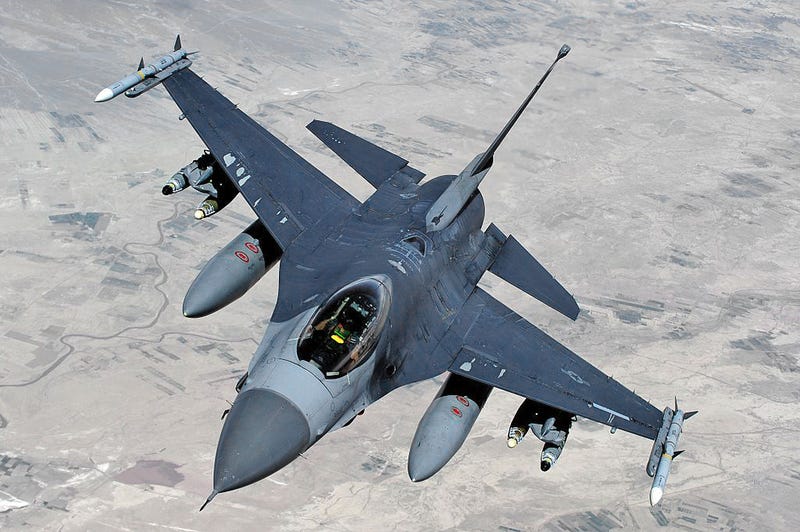
The Pentagon recently had modernized F-16s on the market, which the Polish air force considered but eventually declined. That would be an even more unlikely fit, since Canada has never flown the single-seat fighters, which were the backbone of the U.S. air force for decades.

Image result for F-16
The US Government also has surplus F-16s available, but it is highly unlikely Canada would purchase these jets. 
The "interim" fleet is meant to fill the gap until the Liberal government decides on a permanent replacement for the CF-18s.

Conservative MP James Bezan, his party's defence critic, wants the government to proceed to an open competition to buy fighter jets. (Adrian Wyld/Canadian Press)

Conservative defence critic James Bezan said he doesn't understand why the Liberals are twisting themselves into knots for a temporary solution when they can simply proceed to the open competition they promised for the full fleet.

Sajjan said that is still in the cards, but federal procurement officials have said a competition could take up to five years to run.

"If you look at what other states, other countries are doing in their recent procurement to replace their tactical fighters, none of them are taking five years to do this competition," Bezan said.

"If you look right now, Denmark is doing theirs in two years; Belgium means to complete theirs right now in 18 months; and just earlier this week, Finland started their F-18 replacement program, and they plan to have their first deliveries in 2021 and the entire fleet replaced by 2025, which coincidentally is the same time that our life extension on our CF-18s run out."

Wednesday, June 14, 2017

Government to Approach Fighter Manufactures at Paris Airshow

By: Lee Berthiaume, The Canadian Press

OTTAWA — Federal officials are expected to sit down with representatives from different fighter jet makers in Paris next week, as uncertainty swirls over the Trudeau government's plan to buy "interim" Super Hornets.

The meetings on the sidelines of the prestigious Paris Air Show are being billed as the first step towards the eventual launch of a competition to replace Canada's aging CF-18 fleet with 88 new fighters.

That is how many warplanes the Liberals' new defence policy calls for Canada to buy, an increase from the 65 previously promised by the Conservatives under Stephen Harper.

The policy estimates the cost at between $15 billion and $19 billion, up from the $9 billion previously budgeted by the Tories.

But while much of the attention will be on the competition, which the government says it will launch in 2019, the companies are also expected to pitch their own ability to sell Canada "interim" jets if needed.

Defence Minister Harjit Sajjan on Monday said the government was still reviewing its decision to buy 18 "interim" Super Hornets from U.S. aerospace firm Boeing.

The Liberals previously said they needed the Super Hornets to address a critical shortage of fighter jets, referred to as a "capability gap," until the full competition to replace the CF-18s could be run.

The government said at the time that the Super Hornet was the only aircraft that met its immediate requirements, including being compatible with U.S. fighters and not in development.

But that was before Boeing complained to the U.S. Commerce Department about Canadian aerospace firm Bombardier, sparking a trade dispute and threats from the Liberals to kill the Super Hornet deal.

The plan to purchase an interim fighter jet has been unpopular with retired military officers and defence officials as well as analysts, who have instead called for the competition to start now rather than in 2019.

A survey of 75 such experts conducted by the Macdonald-Laurier Institute and released on Tuesday found that the vast majority didn't believe there was a capability gap, and opposed the plan to buy interim jets.

But a senior government official told The Canadian Press that the Liberals have no intention of backing away from their plan to buy an interim fighter — even if it means going with a different jet.

Sources say the government has not actually approached any of Boeing's competitors about stepping into the breach if the Liberals decide to scrap the Super Hornet deal.

But the Paris meetings offer an opportunity for U.S. defence giant Lockheed Martin, French firm Dassault, Swedish company Saab, and European consortium Eurofighter to make their best pitches on the issue.

Each has indicated that it is prepared to provide interim fighter jets upon request.

The government's delegation will be led by Maj.-Gen. Alain Pelletier, head of National Defence's fighter program, and Lisa Campbell, who oversees military procurement at the federal procurement department.

While sources say meetings with Boeing's competitors have been set up, it wasn't immediately clear whether the delegation would sit down with the Super Hornet manufacturer as well.

That is despite Boeing's plan to enter the Super Hornet in the full competition to replace the CF-18s.

Public Services and Procurement Canada spokesman Pierre-Alain Bujold said in an email that details of the delegation, including its schedule for the Paris Air Show, were still being finalized.

"Canada is committed to fair and transparent procurement processes," Bujold added. "Supplier engagement and industry feedback are important elements of PSPC's work."

The Liberals have cut off most contact with Boeing since the government threatened to cancel the planned Super Hornet purchase over of the company's spat with Bombardier last month.

Boeing spokesman Scott Day said in a statement that the company continues to work closely with the U.S. Navy, through which any sale of interim Super Hornets to Canada would actually be arranged.

The government also recently paid another $30 million to remain at the table as a partner in the development of the F-35, and largely backed off its promise never to buy that stealth fighter.

Tuesday, November 22, 2016

Cabinet could decide fighter jet plan as early as Today

By: Lee Berthiaume, The Canadian Press

Image result for F/A-18 V F-35
An RAAF F/A-18 Super Hornet. Australia recently purchased the Super Hornet as a stop-gap measure until their new F-35s are delivered. 
OTTAWA — Industry sources expect the Liberal government to decide as early as Tuesday whether to purchase a new fighter jet without a competition.

Federal cabinet ministers are reportedly considering three options for replacing Canada's CF-18s, one of which they are expected to pick during their weekly closed-door meeting on Parliament Hill.

The options include holding a competition, buying a new warplane without a competition, or purchasing an "interim" aircraft as a stop-gap measure until a future competition.

The government was eyeing the third option in the spring, with the intention of buying Boeing Super Hornets, until an outcry from industry and the opposition forced them back to the drawing board.

But while Defence Minister Harjit Sajjan held consultations with different industry players in the summer, industry sources say the interim option is back as the preferred choice.

Sajjan's office refused to comment on Monday, with a spokeswoman saying only that a decision still has not been made.

In the House of Commons, Conservative defence critic James Bezan called for an open competition to replace Canada's CF-18s.

Purchasing Super Hornets without a competition would "be foolishly putting billions of taxpayer money at risk," he said.

Sajjan would only say that the government had done "a considerable amount of work" on the file.

"We will make a decision on replacing the fighters and will pick a process that will meet the needs of Canada."

Anything short of an open competition, which the Liberals promised during last year's election, is sure to stoke anger from industry players as well as the opposition.

Part of the problem for the Liberals is that while they promised an open competition, they also promised not to buy the F-35 stealth fighter.

But the government has been struggling with how to fulfil that promise for fear any attempt to exclude the stealth fighter from a competition would result in a multibillion-dollar lawsuit.

Prime Minister Justin Trudeau nonetheless made his views of the F-35 known in June, when he panned the stealth fighter as a plane that "does not work and is far from working."

Recent memos and reports within the U.S. military appear to back up that assessment, with the Pentagon's top weapons tester warned last month that the aircraft was being rushed too fast through testing.

There is precedent for buying Super Hornets on an interim basis. Australia paid $2.5 billion for 24 of the aircraft to replace antiquated F-111 jets until newer F-35s were ready.

However, the idea of Canada needing to follow suit was largely dismissed by a government-appointed expert panel and the military's research branch as too expensive, since the air force would be operating two types of aircraft, demanding different training, infrastructure and supporting equipment.

Rival companies have argued that purchasing Super Hornets on an "interim" basis would stack the deck in its favour in any future competition.

There are also concerns that Canada would fall behind the rest of its allies — as well as potential foes Russia and China — by purchasing the older Super Hornet rather than the state-of-the-art F-35.

The Liberals have emphasized the need for speed since Sajjan warned in the spring that Canada did not have enough CF-18s to meet its commitments to NATO and North American defence.

Critics, however, accused the Liberals of manufacturing a crisis to justify buying a new fighter jet other than the F-35 stealth fighter without a competition.

— Follow @leeberthiaume on Twitter

Lee Berthiaume, The Canadian Press

Tuesday, November 15, 2016

Canada Expected to Launch new Fighter Competition

By: David Pugliese, National Post 

Canadian firms have now won $1 billion worth of work on the F-35 fighter jet, a selling point that aircraft manufacturer Lockheed Martin hopes to use as it prepares for an expected competition to replace the CF-18 fleet.

Cabinet officials met recently to discuss the way forward on a CF-18 fighter replacement and industry sources say they now expect the Liberal government to eventually proceed to a competition to buy new aircraft.

Aerospace firms are shifting into high gear for that event, although the timing of an announcement is unknown.

Marillyn Hewson, Lockheed Martin’s CEO, will be in Ottawa Tuesday for a major aerospace conference and various meetings, while Pratt and Whitney officials will be highlighting details about the F-35 engine the firm builds.

Shelley Lavender, the president of Boeing Military Aircraft, will be in Ottawa on Thursday for the same conference. Lavender was program manager for Boeing’s Super Hornet aircraft, one of the F-35’s rivals in any Canadian competition.


Jordan Owens, spokeswoman for Defence Minister Harjit Sajjan, said Monday that work is still underway on determining how to replace the CF-18. Sajjan has said the procurement strategy would be decided in months, not years, as the CF-18s need to be replaced quickly.

The minister has noted he prefers an open competition.
Jack Boland/Postmedia NetworkA U.S. Navy F/A 18 Super Hornet performs at the Canadian International Air Show at the CNE in Toronto, Sept. 4, 2016.
Prime Minister Justin Trudeau came to power pledging the Liberals would hold a competition for a new fighter jet but, at the same time, said it would not buy the F-35. Trudeau has yet to explain that contradiction.

Lockheed Martin said Monday that while in Canada, Hewson will meet with company employees and “numerous Canadian stakeholders to Lockheed Martin.”

Jack Crisler, one of Lockheed Martin’s senior F-35 officials, told Postmedia in August that it looked like the F-35 would be included in any competition.

The stealth fighter became a political nightmare for the Conservative government after it pledged to buy 65 of the planes. The F-35 was plagued with technology problems. U.S. lawmakers were complaining about its cost.

Last year Donald Trump, then one of a number of Republican presidential candidates, complained about the cost of the F-35 and the technology issues affecting the aircraft. “I do hear that it’s not very good,” he said during an October 2015 radio interview. “I’m hearing that our existing planes are better.”

But Trump, now president-elect, has not indicated what, if anything, he will do about the F-35 program.

Related

Canadian military to ask Ottawa to approve up to $500 million in spending for CF-18 upgrades
A cautionary tale for Canada? Boeing preps legal challenge after Denmark rejects Super Hornet for F-35
F-35 exit strategy: Canada could pay about $313M to pull out of jet program, defence documents show

However, stock market analysts are seeing positive news for defence company stocks, including Lockheed Martin, because of Trump’s election, as he has promised to revamp the U.S. military.

Lockheed Martin officials are keen for a competition since they believe their aircraft can readily beat other planes. The F-35 won in competitions in Denmark, Japan and South Korea, they add.

In June, Lockheed Martin almost saw its hopes of selling planes to Canada disappear completely. The government was close to moving on an interim purchase of Super Hornet jets from Boeing and Trudeau claimed the F-35 “does not work and is far from working.”

That prompted Lockheed Martin to warn that Canadian companies who had contracts on the F-35 would suffer. After that, plans for a Super Hornet interim deal seemed to disappear.

The F-35 has been declared ready for combat by the U.S. Air Force although critics have pointed out that much work still needs to be done on the aircraft. Two F-35s visited Canada for the first time at the August airshow in Abbotsford, B.C.

Wednesday, October 19, 2016

RCAF Marks Completion of Upgrades to CC-130J Hercules

DND Press Release

Yesterday, the Royal Canadian Air Force (RCAF) marked the completion of a major upgrade of all 17 CC-130J Hercules aircraft, keeping Canada’s CC-130J Hercules at the forefront of airlift operations. The 17th and last upgraded Hercules was received on October 13, 2016.

The modifications include significant improvements to navigation, communication, and maintenance capabilities. The Hercules model J can now fly more efficiently amongst large commercial aircraft in heavily congested and controlled airspace and perform much more fuel-efficient long-range flights. It can now also conduct approaches in poor visibility and receive critical mission information from allied ground, air, and naval partners via a high-speed, encrypted link.

“The improved capabilities of the CC-130J Hercules will allow Canada to sustain our forces on future operations, including peace support operations and domestic interventions, while continuing our meaningful contributions in supporting allies,” said Defence Minister Harjit Sajjan.

The successful completion of the upgrades was possible thanks to the close collaboration between the Department of National Defence, Lockheed Martin, and the Canadian company Cascade Aerospace. With these modifications, the RCAF can continue to count on the CC-130J Hercules to provide exemplary support to operations, such as defending Canada’s sovereignty in the Far North or helping communities facing natural disasters.
About 100 Canadian employees were involved in delivering the most recent upgrade modifications on the CC-130J Hercules: from shippers, receivers, and warehousers, to technicians, engineers, project managers, suppliers, and their staffs.

“The procurement of the CC-130J is an ongoing success story," said Col Bruce Cooke, Project Manager of the CC-130J procurement, Department of National Defence. "Not only were the first two aircraft delivered significantly ahead of schedule and the remaining 15 on time, but thanks to the professionalism of Lockheed Martin and the Canadian company Cascade Aerospace, the latest upgrade has been implemented in an equally timely fashion.”

The successful procurement of the CC-130Js demonstrates the Government's commitment to providing the RCAF with a cost-effective tactical airlift capability to support operations at home and abroad.

The CC-130J Hercules is the workhorse of the RCAF’s transport fleet and has been in service since 2010. Based in 8 Wing Trenton, the CC-130J is used to transport troops and equipment, for airlifts in operations, to train aircrew, and more.

This upgrade program started in November 2013, when Lockheed Martin was awarded a contract amendment to modify the fleet to meet new Global Airspace requirements.

This upgrade was completed as per the program schedule established between the Government of Canada and Lockheed Martin.

Thursday, September 29, 2016

U.S. approves Boeing, Lockheed fighter jet sales to Middle East Allies

Announced late yesterday, the US has approved sales of both the F-15, F-16, and F/A-18 Super Hornet to three Middle Eastern allies. This news might help Canada in its search for a replacement for the CF-18 Hornet's as it could possibly extend the Boeing Super Hornet production line to allow Canada time to buy the aircraft before it is official retired by the manufacturer. 

Here is the article announcing the sale: 

By: Andrea Shalal, Reuters -  Berlin Office 

The United States on Wednesday began notifying lawmakers that it has approved $7 billion in long-stalled sales of Boeing Co (BA.N) fighter jets to Kuwait and Qatar, and more than $1 billion in Lockheed Martin Corp (LMT.N) jets to Bahrain, sources familiar with the decision said.

The sales had been pending for more than two years amid concerns raised by Israel, Washington's closest Middle East ally, that arms sold to Gulf Arab states could be used against it, and criticism of Qatar for alleged ties to armed Islamist groups.

U.S. officials began notifying lawmakers informally about the sale of 36 Boeing F-15 fighter jets to Qatar valued at around $4 billion, and 28 F/A- 18E/F Super Hornets, plus options for 12 more, to Kuwait for around $3 billion, the sources said.

They also told lawmakers about plans to sell 17 Lockheed F-16 fighter jets to Bahrain, plus upgrades of up to 20 additional aircraft.

The deals will be formally announced once the 40-day informal notification process has ended. Then lawmakers will have 30 days to block the sales, although such action is rare.

Reuters reported earlier this month that the U.S. government was poised to approve the long-delayed sales to Kuwait and Qatar.

The State Department said it could not comment on any ongoing government-to-government arms sales.

Delays in the process had caused frustration among U.S. defense officials and industry executives, who warned that Washington’s foot-dragging could cost them billions of dollars of business if buyers grew impatient and sought other suppliers.

The approval of the fighter jet sales comes as the White House tries to bolster relations with Gulf Arab allies who want to upgrade their military capabilities. They fear the United States is drawing closer to Iran, their arch-rival, after Tehran's nuclear deal with world powers last year.

Sources said officials at both the State Department and Pentagon had largely agreed to the deals some time ago, but had been awaiting final approval from the White House.

Qatar, home to the largest U.S. air base in the Middle East, and Kuwait have ramped up military spending after uprisings across the Arab world and amid rising tensions between Sunni Muslim Gulf Arab states and Iran, the region's Shi'ite power.

Both Qatar and Kuwait are part of a 34-nation alliance announced by Saudi Arabia in December aimed at countering Islamic State and al Qaeda militants in Iraq, Syria, Libya, Egypt and Afghanistan.

The sales will boost fighter production for both companies.

Boeing's F-15 line is set to close in 2019 after Boeing completes work on a large order for Saudi Arabia, unless a follow-on order is approved.

As orders slow, Boeing is increasingly relying on technology upgrades and services sales to maintain its revenue stream from fighter jets, Shelley Lavender, president of Boeing's military aircraft division, said in an interview.

The company is adding new technology to the F-15 and F/A-18 and other aircraft, and is refurbishing them on the same assembly lines use to build new aircraft, she said.

When the current fighter jet lines end, that loss of revenue will be offset by upgrade efforts. "We're blurring the traditional lines of new aircraft builds and sustainment," Lavender said.

Boeing's broad portfolio from commercial derivatives rotocraft, autonomous vehicles, fighters and weapons "will allow us to remain healthy for the decades to come," she said.

Byron Callan with Capital Alpha Partner said he expected all three sales to be approved.

Thursday, August 25, 2016

F-35 exit strategy: Canada could pay about $313M to pull out of jet program


By: David Pugliese, The Ottawa Citizen

Canada could withdraw from the F-35 stealth fighter jet program on short notice by paying a little more than $300 million U.S., according to an analysis prepared by the defence department soon after the Liberals won the federal election.


The government could leave after only 90 days’ notice, although it would still need to pay the remaining fees the previous Conservative government committed to the F-35 program, according to the Department of National Defence documents obtained by Postmedia.

The analysis was produced four days after the election.

Prime Minister Justin Trudeau came to power, pledging the Liberals would not buy the F-35, an aircraft he said was unnecessary for Canada’s needs and too expensive.

Although a Liberal government originally signed on to a research and development program for the plane, the Conservatives significantly expanded that commitment.

In 2006, Canada agreed to participate as a partner at a cost of US$551 million, according to the DND analysis. That did not commit the government to buying the aircraft, although it provided inside data about the project and a chance for domestic aerospace firms to bid on F-35 work.

“Canada has not signed a contract and can pull out by providing a 90-day written notification to other participating nations,” the analysis prepared for Deputy Minister John Forster pointed out.

“Canada’s liability would be no greater than US$346.7 million” – the difference between what it had already contributed and what was remaining of the original US$551 million commitment.

Since the analysis was produced, the Liberal government has paid another US$33 million.


The analysis noted Ottawa had also signed a separate memorandum of understanding with F-35 builder Lockheed Martin.

Under that commitment, Lockheed Martin provided F-35 work to Canadian firms on the understanding the Canadian government would eventually buy 65 of the jets.

If Canada decided not to proceed with the purchase, Lockheed Martin would not be obliged to employ domestic firms, the DND analysis noted.

“There is a risk that some contacts would not be renewed,” it added.

The Liberal government is expected to decide within months how to replace Canada’s aging fleet of CF-18 aircraft.

Defence Minister Harjit Sajjan has talked about a fair and open competition for a new fighter jet. Despite Trudeau’s pledge that Canada will not buy the F-35, Lockheed Martin, with other aircraft firms, recently submitted information about their planes to the government.

“It looks like we’re being included so we look forward to competing on that basis,” Jack Crisler, one of Lockheed Martin’s senior F35 officials, recently told Postmedia.

The stealth fighter became a political nightmare for the Conservative government after it agreed to buy the planes. The F-35 has been plagued with technology problems and U.S. lawmakers have complained about its cost.

In 2012, Auditor General Michael Ferguson issued a report that concluded Canadian defence officials withheld key information from Parliament about the proposed purchase, underestimated costs and did not follow proper procurement rules.

In June, Lockheed Martin almost saw its hopes of selling planes to Canada evaporate. Ottawa was close to moving on an interim purchase of Super Hornet jets from Boeing and Trudeau claimed the F-35 “does not work and is far from working.”

In response, Lockheed Martin warned Canadian companies who had F-35 contracts would suffer. After that, plans for a Super Hornet interim deal seemed to disappear.

The U.S. Air Force says the F-35 is combat ready although critics say much work still needs to be done on the aircraft. Two F-35s recently visited Canada for the first time at the airshow in Abbotsford, B.C.

© Copyright (c) National Post

Friday, August 5, 2016

Former Bureaucrat: Canada’s new fighter jet should be chosen by open competition

By: Bruce  Champion-Smith, The Toronto Star 

OTTAWA—If the federal government is serious about finding a new fighter jet for Canada’s air force, it should launch an open competition immediately rather than continue the “nonsensical” process now underway, a former senior bureaucrat says.

Ottawa had set a Friday deadline for aerospace manufacturers to respond to a questionnaire seeking details about the costs and capabilities of their fighters that might serve as a potential replacement for the aging CF-18s.

But Alan Williams, who once oversaw defence procurement, dismissed that as a waste of time that belies the Liberals’ own claim that the air force needs new fighters fast.

“If you really think that there is some kind of urgency and there is a capability gap, the fastest way to solve it is to run a competition,” said Williams, who previously served as assistant deputy minister in charge of materiel for the defence department.

“If a competition was started tomorrow, within a year you’d have a winner picked,” he said Tuesday in an interview.

One of the possible contenders — the Lockheed Martin F-35A — got a boost Tuesday when the U.S. air force declared the new jet was combat ready. Gen. Hawk Carlisle, commander of air combat command, said the jet had met criteria for initial operational capability. That includes the capability to conduct basic close air support, interdiction and limited suppression and destruction of enemy air defences with a squadron of between 12 and 24 aircraft, the air force said in a news release.

It’s an important milestone for an aircraft that has been dogged by technical challenges during its development.

Lockheed Martin was one of five aerospace manufacturers that responded to Ottawa’s call for more information about their fighter jets. The others were the Boeing Company, Dassault Aviation, Eurofighter and Saab Group.

The federal government says it will use the responses “to make an informed decision on the path forward to a future fighter fleet.”

But Williams is sharply critical of that exercise, saying the government is doing little more than treading water by seeking information that he said is largely already in the public domain.

“It really is totally, totally a waste of time,” he said. “Why they’re going through all this crap is really mind-boggling.”

He said the true capabilities of each aircraft would only be disclosed to government during a formal bidding process, when the manufacturers can be assured such details won’t be made public.

“All the secretive stuff on performance they will only convey in a competition where it’s all protected,” Williams said.

He said the Liberals should fulfil their election pledge for an “open and transparent” competition to replace CF-18s, especially since the government claims that the aging state of the existing fighters will leave the air force with an “unacceptable” gap in meeting operational demands.

“If we really do something, stop screwing around, go out and tell the world what you need, put out your statement of requirements in the public domain . . . and let people bid,” Williams said.

He said both Conservative and Liberals have bobbled the file. He said the Conservatives erred by committing to the F-35 at a time when the jet’s cost and capabilities were unknown. Indeed, that decision was later reversed after the federal auditor raised concerns about the swelling price tag for the sophisticated fighter.

Yet Williams said the Liberals have made missteps as well, notably when Trudeau pledged during the election that his government would never buy the F-35, a commitment that has them “all tied up in knots now,” Williams said.

“This jet may turn out to be the right jet for us. But the process is what’s critical here,” Williams said.

A defence department spokesperson said Tuesday that the responses to the questionnaire would not be released.

“Responses received through the consultation process are subject to commercial confidentiality and form advice to Ministers, and as such will not be publicly disclosed,” Daniel Le Bouthillier told the Star in an email.

5 Aerospace companies battle to replace Canada's CF-18s

By: Bruce Champion-Smith, The Toronto Star

OTTAWA—Five aerospace companies are offering their fighter jets as potential replacement for Canada’s fleet of aging CF-18s, including Lockheed Martin’s F-35, the very jet Prime Minister Justin Trudeau has pledged not to buy.

The federal government had set Friday as the deadline for potential suppliers to respond to a detailed questionnaire outlining the costs and capabilities of their jets, as well as benefits that would flow to Canadian companies.

The defence department said Saturday that five companies responded: Boeing Company, Dassault Aviation, Eurofighter, Lockheed Martin and Saab Group.

“Government officials are now reviewing and analyzing information received to date to inform the way forward over the coming months,” a department spokesperson told the Star in an email.

A Boeing executive said his company is offering its F/A-18 Super Hornet as a “great fit” for Canada, saying the purchase and operating costs for its jet rank as among the lowest of its competitors


“With respect to capability, cost . . . we’ve really put a good offer on the table,” Jim Barnes, a Canadian development executive for Boeing Defense, Space and Security, said Friday.

Despite Lockheed Martin’s sales pitch that its F-35 is a more advanced and newer design, Barnes said the Boeing jet easily meets the needs of the Royal Canadian Air Force.

“I would argue that all capability you need is in the Super Hornet,” he said in an interview.


Lockheed Martin confirmed that its F-35 is also in the mix.


The F-35 has been dogged by controversy but company officials said the program has turned a corner, noting that the U.S. Air Force expects this year to declare the jet as “operational,” an important milestone that means the F-35 is ready to undertake missions.


The questionnaire demanded extensive details from the manufacturers. For example, it asked them to detail the cost of new weapons if the current stockpile of ammunition, missiles and bombs for the CF-18s is incompatible with their aircraft.

It also asked the jet makers to outline potential missions, notably in Canada’s north, flying from places such as Inuvik and Iqaluit.

The companies were also required to outline how they should share economic benefits with Canadian businesses.

Defence analyst Dave Perry of the Canadian Global Affairs Institute said the aerospace firms were given a very narrow window to respond to a complex request, suggesting the government is in a hurry to find a fix for the aging fighters.

“It was a crazy request in a crazy time frame . . . It’s a lot of stuff to ask for pretty quickly,” he said in an interview.

Defence Minister Harjit Sajjan has said that the air force is in a race against the clock. In June, he said that Canada faces a “capability gap”: as the aging jets reach the end of their lifespan, the air force may not have enough fighters to meet demands.

That was underscored in the note to the aerospace firms accompanying the questionnaire that said new jets are needed “as soon as possible so Canada can remain a credible and dependable ally.”

The previous Conservative government had originally announced its intention to buy F-35s in 2010, but then put that decision on hold in late 2012 after the auditor general flagged concerns about the potential price tag.

On the election trail last year, Trudeau vowed that a Liberal government would not buy the F-35 and would instead choose a less costly option to free up “tens of billions of dollars” that would be invested in the navy.

Since taking office, the Liberals have softened that hardline stance and suggested that the F-35 would be considered, even though Trudeau recently denounced the high-tech aircraft as unworkable.

The letter to the manufacturers said that no decision has been made and that “all procurement options are being considered.” It also stresses that the questionnaire is not a formal tender or request for proposals.

The CF-18s have been in service since the early 1980s, when the government had plans to only fly them for 20 years.

Modernization work has extended the life of 77 CF-18s and further work could keep them in the air until 2025 though the document warns that the fighters are “old and are running out of life.


“The reality is our fighters should have been replaced years ago,” the note reads. “As the existing fleet gets older, and aircraft are retired, the capability gap only gets worse.”


But picking a replacement jet proved contentious for the former Conservative government and it’s been troublesome for the Liberals, too.

There’s been speculation that the Liberals, keen to live up to their campaign pledge, may buy a batch of Super Hornets as a stopgap measure to ease pressure on the fleet but also buy the government some time.

Perry is hopeful that the selection process isn’t unfairly skewed toward Boeing.

“I hope they haven’t ruled out anyone — and before doing this, aren’t heavily favouring anyone — and just pick whatever provides the best return for the dollar,” he said.

Monday, July 25, 2016

Canada Requests for information from Boeing, Lockheed-Martin, Saab, Dassault and Eurofighter in CF-18 Replacement

By: DefenseWorld.Net

Canada has issued a request for information to Boeing, Lockheed-Martin, Saab, Dassault and Eurofighter earlier this month seeking information by the end of July in order to design an acquisition process to replace Ottawa’s CF-18 fighters.

Amidst reports that Lockheed Martin’s F-18 stands at an advantage in Canada’s fighter aircraft competition, the Canadian MoD has issued a document stating “all procurement options are being considered,” Defence Minister Harjit Sajjan was quoted as saying by the globe and mail earlier this month.

The Department of National Defence predicts that its fleet of CF-18s will be able to fly into the next decade, even as Defence Minister Harjit Sajjan ramps up his calls for an urgent purchase of new fighter jets to ward off an eventual “capability loss.”

“Some aircraft could begin to be retired beginning in 2023. Over all, the Canadian Armed Forces are working to “extend the fleet to 2025” as part of a series of upgrades,” said a document provided at the start of this month to the five aircraft manufacturers in the race to offer new fighter jets.

He added that the Canadian Forces have adopted a risk-management strategy to deal with the scarcity of available aircraft, and he wants to put an end to the practice. Because of maintenance issues, he said, only about half the fleet of 77 fighter jets is available at any given time.

Conservative MP James Bezan said the government seems to be looking for a way to fulfill its promise to buy an aircraft other than the F-35.

“This is about setting the narrative to go to a sole-source [acquisition of Super Hornets],” he said.

Bezan said the government could simply launch an open competition and quickly obtain the best product for the Canadian Forces at the best price for taxpayers.

“There’s no question that planes are available,” he said, explaining that both Super Hornets and F-35s are currently in production. “They can go through this very methodically and still come to the right decision, rather than try to rig the process.”

Asked to expand on the capability gap, Sajjan’s office said the 2023 timeline for the retirement of the first aircraft “doesn’t take into consideration any of the issues that could come up with our fleet,” such as crashes, being used for parts, or other commitments for deployment to NATO or peacekeeping missions that would add flying hours.

The government sent a 38-page questionnaire last week to five aircraft manufacturers that are in the running to replace the CF-18s.

The acquisition process will be unveiled as early as September. The questions include acquisition and life-cycle costs, current and planned production numbers, and potential industrial and technological benefits for Canada.

Canada has issued a request for information to Boeing, Lockheed-Martin, Saab, Dassault and Eurofighter earlier this month seeking information by the end of July in order to design an acquisition process to replace Ottawa’s CF-18 fighters.

Amidst reports that Lockheed Martin’s F-18 stands at an advantage in Canada’s fighter aircraft competition, the Canadian MoD has issued a document stating “all procurement options are being considered,” Defence Minister Harjit Sajjan was quoted as saying by the globe and mail earlier this month.

The Department of National Defence predicts that its fleet of CF-18s will be able to fly into the next decade, even as Defence Minister Harjit Sajjan ramps up his calls for an urgent purchase of new fighter jets to ward off an eventual “capability loss.”

“Some aircraft could begin to be retired beginning in 2023. Over all, the Canadian Armed Forces are working to “extend the fleet to 2025” as part of a series of upgrades,” said a document provided at the start of this month to the five aircraft manufacturers in the race to offer new fighter jets.

He added that the Canadian Forces have adopted a risk-management strategy to deal with the scarcity of available aircraft, and he wants to put an end to the practice. Because of maintenance issues, he said, only about half the fleet of 77 fighter jets is available at any given time.

Conservative MP James Bezan said the government seems to be looking for a way to fulfill its promise to buy an aircraft other than the F-35. “This is about setting the narrative to go to a sole-source [acquisition of Super Hornets],” he said.

Bezan said the government could simply launch an open competition and quickly obtain the best product for the Canadian Forces at the best price for taxpayers.

“There’s no question that planes are available,” he said, explaining that both Super Hornets and F-35s are currently in production. “They can go through this very methodically and still come to the right decision, rather than try to rig the process.”

Asked to expand on the capability gap, Mr. Sajjan’s office said the 2023 timeline for the retirement of the first aircraft “doesn’t take into consideration any of the issues that could come up with our fleet,” such as crashes, being used for parts, or other commitments for deployment to NATO or peacekeeping missions that would add flying hours.

The government sent a 38-page questionnaire last week to five aircraft manufacturers that are in the running to replace the CF-18s.

The acquisition process will be unveiled as early as September. The questions include acquisition and life-cycle costs, current and planned production numbers, and potential industrial and technological benefits for Canada.

Tuesday, June 28, 2016

The F-35 may be about to face even more delays

By: JEREMY BENDER, Business Insider

The oft-troubled F-35 may be on the verge of facing an even greater series of delays that could affect the supply chain of the aircraft and work agreements with jet-partner Great Britain.

At the root of the problem is the still-unresolved issue of the F-35’s ejection seat, which runs the risk of causing fatal whiplash in pilots under 200 pounds.

The issue is most pronounced with lighter-weight pilots, with those weighing under 136 pounds now barred from flying the aircraft for safety concerns related to the F-35’s Martin-Baker ejection seat, Defence News reports.

The problem with the ejection seats has been known since at least October 2015. But so far, fixes from Martin-Baker have focused on small issues without resolving the overall design flaw that could cause the fatal whiplash, according to two anonymous officials who spoke to Defence News.

In light of this, the F-35 program has begun to look at other manufacturers for its ejection seats. Chiefly, the program is looking at the United Technologies ACES 5 model.

“We believe it is prudent to look at what it would take to qualify the ACES 5 seat as a potential risk mitigation step if additional things happen as we go through the testing of the Martin-Baker seat,” Air Force Lt. Gen. Arnold Bunch told Defence News. “We believe it’s prudent to determine what it would cost, how much [effect it has on] the schedule, what the timeline would be, if something else happened and we wanted to go a different way.”

Should the F-35 project decide to replace the F-35’s ejection seats, costs of the program could increase and the aircraft could take longer to deliver. Martin-Baker is a British company, and its role in the construction of F-35 jets allows Britain to reap economic benefits from being a part of the F-35 program. Should the project decide to scrap Martin-Baker and use United Technologies, a US company, then the UK could demand a greater work share in other portions of the F-35.
(Martin-BakerA test of the F-35 ejection seat.
This would likely drive up costs for the program, as the supply chain and logistics of the project would need to be significantly altered.

The risk of fatal whiplash was previously thought to be caused by a combination of the way in which the ejection seats rolled forwards combined with the weight of the F-35’s helmet.

During simulated low-speed ejections, the heavy forces at play during the acceleration or deceleration of the advanced fighter jet would snap the neck of lightweight dummies. The problem was initially thought to have been caused by the ejection seats rotating too far forward. This movement, combined with the force of ejecting from the aircraft, would snap the dummies’ necks.

However, Reuters reported in October 2015 that the risk from the ejection seats to even lighter pilots was still exceptionally small. Pilots weighing under 136 pounds had a one-in-50,000 chance of hurting their neck, while pilots weighing 146 to 165 pounds had a one-in-200,000 chance.

Thursday, June 16, 2016

CF-18 airframes approaching their age limits: Report

By: Murray Brewster, CBC News 

Canada's current fleet of CF-18s is rapidly wearing out, according to new figures tabled in Parliament, and there are fresh questions emerging about how well the fighter jets, and other so-called legacy aircraft, will be able to communicate with the new F-35s.

The new data emerged on the same day as the corporate air war over the Trudeau government's fighter replacement program heated up, with one of the principal contenders going on a PR offensive to counter the notion that choosing anything other than the Lockheed Martin F-35 stealth fighter would cost Canadian jobs.

Last week Lockheed Martin warned it would pull hundreds of millions of dollars in F-35 related work out of the country unless its jet was selected to replace Canada's CF-18s.

On Wednesday, rival aerospace company Boeing tried to paint that notion as an empty threat and promised to match or even exceed the value of lost contracts should Canada go with it instead.

Related:
Peter MacKay says he regrets Conservatives' failure to buy new fighter planes
Lockheed Martin warns it will pull $825M in F-35 contracts if Canada buys different jet
Canada's F-35 decision anxiously awaited, says U.S. deputy secretary of defence

But it was the release of a defence department chart, which tracks maintenance on the 77 remaining CF-18s, which may be the most startling development. It shows many of the fighters have used up to 85 per cent of their anticipated airframe life.

On average, each aircraft is expected to end its service life with just over 7,000 hours in the air.

As many as 49 of them have already logged in excess of 6,000 hours, according to air force data tabled at the request of Conservative defence critic James Bezan. Three of the aircraft had even exceeded the limit.

The figures are current up to April 22, 2016, and therefore would have included the wear and tear accumulated during the recent bombing campaign in Iraq and Syria against ISIS.

The Harper government set aside nearly $500 million to extend the life of the CF-18s, a program the Defence Department recently said was still in the "options analysis" phase and wouldn't be completed until October of next year.
Defining the 'capability gap'

Despite that, Defence Minister Harjit Sajjan told the House of Commons on Wednesday that 26 of Canada's CF-18s have undergone some sort of refurbishment, but he gave no further details.

"A lot more work needs to be done, but we would not be here if we had replaced the fighters 10 years ago," Sajjan told the Commons.

The Liberals have said Canada faces a "capability gap," meaning either the air force doesn't have enough fast jets to meet its obligations — or the current aircraft do not have the right capabilities.

They've forwarded that argument as justification for taking swift action, which might include the sole-source purchase of a handful of Boeing Super Hornets.

But there are new questions within the defence community about what that would mean for the air force, especially when many allies operating in the Far North, including the U.S., Norway and Denmark, have all opted for the F-35.
Communication issues

The U.S. is currently wrestling with important technical aspects, including how the stealth fighters can communicate and exchange data with older model jets, such as the CF-18s, the Super Hornets and European designed fighters.

It has been known for years that F-35s and F-22 Raptors will have trouble signalling and handing off "weapons quality data" to older planes while maintaining their radar-evading capabilities.

The U.S. air force and Lockheed Martin have been working on a solution to the communications problem through something called Project Missouri.

But proponents of the stealth fighter say Denmark's recent selection of the F-35 means Canada will be relegated to the back seat in terms of operations, including in the Arctic.
Traven says concerns over the ability to communicate between various makes of aircraft are misplaced. (Terry Milewski/CBC News)
But Ricardo Traven, the chief test pilot for the Boeing Super Hornet, denied there's a problem and called it a "ridiculous" notion.

Communications among everyone on the battlefield are paramount and the obstacles will be overcome, he said.

"We're all going to be able to communicate and share information, whether you're a tank, a [joint strike fighter] or a Super Hornet," Traven said.

Boeing vice-president Roger Schallom also attempted Wednesday to put to rest the notion that Canadian aerospace jobs would be lost if the F-35 isn't selected.

Many of the 110 Canadian companies doing business with Lockheed Martin are also working for Boeing on separate contracts.

If Boeing's plane is chosen, Schallom said, the company could replace or even exceed the current $825 million in contracts and the up to $10 billion lifetime value of industrial benefits.

"We will put in much more work than those numbers. I can't quantify it until we see what the [air force] requirement is, but we will definitely trump those numbers," he said.

Wednesday, June 15, 2016

Lockheed Gets Sole-sourced Maintenance deal on CC-130 Hercules

By: Lee Berthiaume, Ottawa Citizen 

OTTAWA — Months before a mini-war of words over the F-35 stealth fighter, the federal government and Lockheed Martin quietly inked a deal for the U.S. aerospace giant to provide maintenance support and training for one of the military’s transport plane fleets.

The $500-million agreement, which extended an earlier contract to 2021, was never publicly announced or put to a competition. This was despite Defence Department auditors flagging a lack of transparency and raising questions about value for money in the original contract.

The government has cited national security to justify why other companies were not allowed to compete. It also says the new contract addresses the auditors’ concerns.

One former Defence Department official says it’s no surprise Lockheed and the government have continued to do business while wrangling over the F-35. “There are only so many big players out there,” said Alan Williams, former head of procurement at National Defence.

However, Williams said the way the deal was concluded doesn’t pass the smell test, and that it raises fresh concerns about waste.

“National security exemptions should be used in really exceptional cases where there really is a national security risk to Canada,” he said. “You shouldn’t use it to get around poor planning.”

In December 2007, the Conservative government inked a $1.45-billion deal for Lockheed to sell 17 Hercules military transport aircraft to Canada.

Two years later, the contract was amended to include seven years of maintenance support and training at a cost of $800 million. The support work was not put to a competition because National Defence had implemented a policy that year to award support contracts to the company that provided the equipment.

Then last June, Lockheed proposed extending the contract another five years. Public Procurement spokesman Pierre-Alain Bujold confirmed an extension was signed on Dec. 15 for $504.3 million. He said the contract was not put to a competition because it was “subject to a national security exemption.”

The new deal was signed the same month Defence Department auditors raised concerns with the original contract. In particular, Lockheed received full payment but only did half the work originally expected because a shortage of pilots and mechanics meant the Hercules were only flown half as much as planned.

Complicating matters, the auditors wrote, was the fact Lockheed closely guarded how much the work cost it to perform. That threatened to make negotiations difficult for government officials wanting to tailor any new contract to the air force’s needs.

Defence Department spokeswoman Ashley Lemire said Tuesday that the new contract includes enough flexibility to meet the military’s current and future needs. Williams, however, said the only way to truly ensure the government and Canadians are getting value for their money would be to run a competition.

“I don’t know if the deal with Lockheed was the best one,” he said. “I worry when you sole-source any type of contract, you’re wasting taxpayers’ money. And there may have been other players out there, equally capable, that would be in our best interest.”

In addition to the Hercules maintenance contract and the F-35, Lockheed is also hoping to secure billions of dollars of work as part of the federal national shipbuilding plan.

• Email: lberthiaume@postmedia.com

Sajjan: F-35 consortium agreement never seen as commitment to buy


By TIM NAUMETZ, The Hill Times 

A 2002 agreement Canada signed with the U.S. and seven other countries for development of the F-35 stealth warplane was never viewed by the partners as “a commitment to buy the F-35,” Defence Minister Harjit Sajjan’s office told The Hill Times.

Meanwhile, a leading expert on military affairs said the Liberal government could make good on its 2015 election promise to exclude the F-35 stealth attack plane as it wrestles with the need to replace Canada’s aging CF-18 fighter jets, but the decision would inevitably anger “a lot of powerful people in the Pentagon.”

In the wake of reports the government may be considering a sole-source acquisition of new fighter planes to replace at last part of Canada’s fleet of roughly 80 1980s-vintage CF-18 Hornets, University of British Columbia professor Michael Byers told The Hill Times Prime Minister Justin Trudeau (Papineau, Que.) and his cabinet could either hold a competition, as Mr. Trudeau promised in the election campaign, or acquire more modern versions of the Boeing CF-18 without inviting other bids.

“Doing a fleet extension of Canada’s existing planes, Canada would buy a number of the latest model of the same plane,” Mr. Byers said, in reference to the fact Canada initially acquired the U.S. Boeing Corp. aircraft, under a previous Liberal government, coincidentally led by Justin Trudeau’s father, then prime minister Pierre Trudeau, in 1982.

“It would be like, let’s say you had a taxi fleet of Toyota Priuses that were all from 2010 and you decided to buy a sizeable number of 2016s, you’re buying the latest model of the same equipment, which means that your mechanics and your pilots don’t need to undergo the same degree of re-training,” Mr. Byers said in an interview this week.

Under his scenario, either through a sole-sourced contract with Boeing or a competition to replace part of the aging fleet whose life span was extended by the previous government to 2025 the year before the federal election, the Liberal government could still have an option in later years to acquire a smaller number of the new generation F-35 aircraft, sophisticated to the point some avionic experts refer to it as a “flying computer.”

Development delays, however, have been extensive.

U.S. Air Force news releases this month reported one of its major bases has yet to declare F-35As, the same model plane Canada was set to buy, fully combat operational.

Hill Air Force Base, Utah, also reported its wheel-shop technicians found a hydraulic tire-changing machine Lockheed Martin had supplied in 2015, along with the base’s first batch of F-35 planes, was designed to require four technicians to lift one wheel onto the changer.

The shop adapted its legacy changer to fit the heavy F-35 wheel.

Furthermore, the Eglin Air Force Base in Florida reported on May 24 that its technicians saved $84,000 by using locally manufactured parts and tools rather than those available from Lockheed Martin.

Mr. Byers noted Australia has already beefed up its similarly aging F-18 Hornet fighter jet fleet by acquiring Boeing F-18 “Super Hornets,” a more modern version of the original F-18, while waiting for the delayed Lockheed Martin F-35 to reach full operationally ready levels, as well as production levels that provide economy of scale prices Lockheed Martin promised as the plane was in early development and testing stages.

Canada in 2002 signed on with a consortium of eight other countries after the U.S. launched the Pentagon-led Joint Strike Fighter Program.

The previous year, the Pentagon conducted a prototype competition that defence giant Lockheed Martin Corp. won over Boeing Corp., for development and production of the so-called next generation of fighter jet warplanes.

In 2010, the former Conservative government announced Canada would exercise its option of acquiring a fleet of the costly planes—a total of 65 F-35 fighters with no timeline yet set for the actual purchase—but the Conservatives put the acquisition on hold in 2012 after a raging controversy over costs that had been withheld from Parliament prior to the 2011 federal election.

Former prime minister Stephen Harper (Calgary Heritage, Alta.) and his Conservatives concluded an analysis of options from among a range of fighter jet makers in 2014, including Lockheed Martin, but Parliament has received no update on the estimated cost of acquiring and operating a fleet of 65 F-35s since the last government report that year.

The 2014 update estimated a cost of $45.8 billion for acquisition, maintenance and sustainment over the fleet’s 35-year lifecycle, and the estimated price tag has since risen by at least $3 billion for acquisition and operating costs alone, due to the Canadian dollar’s lower value in exchange with the U.S. dollar.

Liberal Defence Minister Harjit Sajjan last week did not rule out the possibility that the government is set to begin replacing the declining CF-18 fleet without competitive bidding.

“The CF-18 will be extended to 2025,” Mr. Sajjan (Vancouver South, B.C.) told the House of Commons on June 7.

“We do need replacements, they should have been replaced a long time ago, we have to start the process soon because our fighters have been flying for some time, they should have been replaced,” Mr. Sajjan said.
Canada intends to pay instalment to F-35 consortium

In response to the speculation about sole-sourcing, a Lockheed Martin official raised a requirement that the Canadian aerospace industry would be able to bid on future aircraft sustainment and contracts only if Canada acquires some of the planes.

Mr. Sajjan responded Tuesday by pointing out that none of the original members of the Joint Strike Fighter Consortium are required to buy any F-35s, and Canada’s participation in the development of the plane through the consortium has led to $743 million in contacts for the Canadian aerospace industry.

“Canada remains a member of the Joint Strike Fighter program and has not notified the JSF Office about any changes to our participation,” Mr. Sajjan’s press secretary, Jordan Owens, said on behalf of Mr. Sajjan in response to questions from The Hill Times.

Ms. Owens said the government still owes an instalment to the consortium, but intends to pay it.

“To date, our participation in the JSF MOU (Joint Strike Fighter Memorandum of Understanding) has allowed companies in Canada to secure US $743 million in contracts,” the email from Ms. Owens said.

“New skills and technologies gained through access to the JSF Program have helped position Canadian industry to take advantage of other advanced aerospace and defence projects; it has always been clear that participation in the JSF MOU is not a commitment to buy the F-35.”

Canada currently has four Canadian Forces personnel assigned to the Joint Strike Fighter Office near Washington, D.C.

The Liberal campaign promise to hold a competition while excluding consideration of Lockheed Martin has come under severe criticism, including from Alan Williams, the former Department of National Defence procurement chief who was with DND when Canada joined the F-35 Joint Strike Fighter Program in 2002.

Mr. Byers said the Liberals, now having delayed a decision for seven months, could have delivered on their campaign promise by either sole-sourcing a CF-18 fleet extension with Boeing or releasing a competitive request for proposals whose maximum cost and desired type of fighter jet, along with required regional industrial benefits, would have ruled out the F-35.

The DND statement of operating requirements for the new plane could have established a maximum unit price, lower than the costly single-engine F-35, or a need for two engines, which the legacy Hornets as well as the modern version of the Boeing fighters have.

“There was nothing inherently difficult with the Liberal position in the campaign, but obviously it would require certainly annoying Lockheed Martin and by extension a lot of powerful people in the Pentagon,” Mr. Byers said.

He said the Liberals still have the option of sole-sourcing the Boeing plane, with no competition from any other bidders.

“That is my understanding, you are able to do a sole-source procurement, we do sole-source procurement for lots of things,” Mr. Byers said, referring to Conservative government procurement of long-range jet transport planes from Boeing, as well as short-haul cargo aircraft from Lockheed Martin.

“You can do this, and obviously it’s easier politically to do that when you’re simply acquiring the same model of equipment, that same type of equipment, in effect the same but a newer model,” Mr. Byers said. “It (the Super Hornet) is not a totally new plane, it’s based on the same air frame and a lot of the avionics are based on 30 years of experience and technological development at Boeing.”

The NDP has been insisting on an open competition to replace the CF-18 Hornets, with cost and capability among the required parameters.
“Either of those aircrafts might have pros and cons, but the only way to make that evaluation is to have an open and transparent competition,” said NDP MP Erin Weir.

“One of the things I find striking is that the federal government has not even put forward what those parameters would be for a competition,” said Mr. Weir (Regina-Lewvan, Sask.)

“We challenge the government, they say there haven’t been any decisions, there’s still a possibility of an open competition, but in seven months they haven’t taken any steps towards initiating such a competition,” Mr. Weir said in an interview.

“Certainly I would agree that one of those first steps is to lay out parameters of what the government is looking for, in terms of our defence requirements.”

tnaumetz@hilltimes.com
The Hill Times

Monday, June 13, 2016

Lockheed Martin Reiterates it will pull $825M in F-35 contracts if Canada buys another jet

By: Murray Brewster, CBC News 

U.S. defence giant Lockheed Martin reiterated its warning to Canada that $825 million in aerospace industrial contracts signed with Canadian companies to build and equip F-35 jets would be moved to other partner nations if the Trudeau government decides to buy a different fighter jet.

Steve Over, the company's director of F-35 international business development, says other countries that have already committed to buying the stealth jet are clamouring for the work.

"It's not really a threat," Over said in an interview with CBC News. "I don't want it perceived as a threat, but we will have no choice, if Canada walks away from F-35, except to relocate work in Canada to other purchasing nations."​

By the end of the year, Over said he expects the value of Canadian parts and sustainment contracts to reach $1 billion, with an anticipated lifetime value of $10 billion or more.

Related:
Baloney Meter: Is there a capability gap when it comes to fighter jets?
Liberals cite CF-18 'capability gap' as upgrades in limbo
Liberals miss membership payment to stay in F-35 consortium

The comments mark a sharp escalation in the war of words over the Liberal government's efforts to speed up the replacement of the Royal Canadian Air Force's current fleet of CF-18s fighters.

During the 2015 election, Prime Minister Justin Trudeau promised not to buy the F-35 and instead go with a cheaper alternative. Lockheed Martin remained silent at the time, regarding the comments as campaign rhetoric.

Under questioning this week, Defence Minister Harjit Sajjan refused to exclude the notion of a sole-source purchase of brand new Boeing Super Hornet fighters, despite a campaign promise for an open bidding process.

The deputy minister of material at DND, Pat Finn, told a House of Commons committee Thursday that all options, from sole-source to full-blown competition, were being studied by the government, but no decision had been made.

A Change in tone

Earlier in the week, Lockheed Martin officials seemed content to pull their punches when it came to the industrial benefits question, saying only that they would "evaluate their options."

Even going back to 2013, months after the Harper government put the acquisition of the F-35 on hold, company officials were soft-pedalling the consequences, suggesting that if Canada went in a different direction, existing contracts would remain safe but no new work would be offered.

But all of that was tossed aside Friday as Over and other company executives made it clear that existing contracts would be honoured until renewal, and once they expire, they would go to nations participating in the program.

"If, in that most negative scenario where Canada chose to purchase a different airplane, we would have to take those future opportunities that are today envisioned for Canadian industry and we'd have to offer it to countries that are purchasing the airplane," he said.
Losing future contracts

The example he offered was Mississauga, Ont.-based Magellan Aerospace's 20-year, $1.2-billion subcontract from BAE Systems Inc. to build the jet's tail fins.

"So Magellan would just no longer be offered the opportunity to produce horizontal stabilizers," Over said.

A 2006 memorandum setting up Canada's participation in the development of the stealth fighter was signed by the Conservative government with the implicit suggestion the country was in for the long haul.

"The government of Canada and Lockheed committed together that we would put this industrial work in Canada, assuming that Canada bought airplanes, and we can't meet our commitments around the rest of the partnership if Canada doesn't buy the airplane," said Over.

"We want to approach this in a good-faith effort, but Canada is going to have to help us with that."

There are approximately 110 Canadian companies working on the F-35.
Industry warns of lost money, jobs

Unlike other defence procurement contracts, the stealth fighter is unique in that Canadian companies don't get guaranteed work. They are required to compete and work collaboratively to keep costs down.

The Lockheed Martin warning comes one day after an open letter published by Canadian companies involved in the program expressed fears about what would happen to them if the Trudeau government went with another plane.

"Not selecting the F-35 will set off a chain of events that will see hundreds of millions of investment dollars lost and high-tech jobs leaving Canada, going to countries who are buying the F-35," said the letter.

"Sole-sourcing a legacy aircraft will leave Canadian industry in the unfavourable position of working on 30-year-old technology over a finite period of time, with little opportunity to progress Canada's aerospace capabilities globally. The future landscape of the aerospace and defence industry in Canada will be permanently affected in an adverse manner."

The Liberals have attempted to justify their desire to move quickly — and possibly avoid an open competition — by saying the air force is facing a "capability gap," which means it may not have enough fighters to live up to its domestic and international obligations.

In the Commons Friday, Liberal MP John McKay, the parliamentary secretary for defence, put the blame on the previous Conservative government.

He said only 20 of the air force's 77 CF-18s will be available for service by 2025 if circumstances remain the same.

Lockheed-Martin says not buying F-35 jet would be wrong choice for Canada

By: Daniel Leblanc, Globe and Mail 

Lockheed-Martin is bluntly warning the Liberal government that it will make a mistake if it does not follow the lead of its allies and fails to buy the F-35 to deter Russia and China from threatening Canadian sovereignty.

Pointing out that the F-35 has already been sold to 12 allied countries, one of the firm’s executives said the Trudeau government has every right to choose a rival aircraft – if it wants to make the wrong choice for Canada.

“The world’s best air forces have all decided the F-35 is absolutely superior and offers the best value,” said Steve Over, Lockheed-Martin’s director of international business development for the F-35.

“It’s not my prerogative to question your political leaders, but what do they know that these 12 air forces besides them don’t know?” said the Lockheed-Martin executive based in Fort Worth, Tex.

Mr. Over travelled to Ottawa last week to make his sales pitch, which came amid concerns the Liberal government is trying to avoid purchasing the F-35 aircraft that was so popular with the previous Conservative government.

Mr. Over took particular umbrage with Prime Minister Justin Trudeau’s recent comment that the F-35 “doesn’t work” and is far away from reaching its potential. There are already 185 F-35s flying in the United States and Italy, with plans to have more than 600 of them flying all over the world by 2020.

“I’m mystified,” Mr. Over said.

He went on to quote a lieutenant-general in the U.S. Marine Corps who has referred to his current fleet of F-35s as “Jurassic Park.” “His logic is, ‘Anything that comes into my jungle, this airplane kills,’” Mr. Over said.

The Liberal government has promised to hold an “open and transparent competition” to replace Canada’s fleet of CF-18s. Still, there is a sense in Ottawa that the Liberal government could sole-source the contract to Boeing for the purchase of Super Hornets, which is a less modern aircraft, to fulfill the Liberal Party’s election promise not to buy F-35s.

Mr. Over said Lockheed-Martin welcomes a full competitive process by which Canada would select its next fighter jets, saying a full fleet could easily be delivered by 2025, when the CF-18s will be retired. The first aircraft could be delivered some time between 2018 and 2020, depending on the process adopted by the federal government, he said.

Lockheed-Martin officials have sent out warnings that if Canada eventually decides to buy another firm’s fighter jet, the country will lose the industrial benefits that have come from participation in the F-35 program.

The Canadian Forces undertook to buy 65 of the aircraft as part of the program that they officially joined in 2006, but there is no final deal in place.

“This is not a punitive measure, it’s not a threat,” Mr. Over said. “Still, it’s impossible for us to meet our industrial commitments to the seven other partner nations if every nation does not buy the quantity of airplanes that they said they would buy.”

Friday, June 10, 2016

Lockheed may shift F-35 fighter work away from Canada

By: ANDREA SHALAL,  Berlin, Reuters

Top U.S. weapons maker Lockheed Martin Corp is studying whether to shift work on its multibillion-dollar F-35 fighter jet away from Canadian firms amid uncertainty over Ottawa’s plans to buy the jet.

Jack Crisler, Lockheed’s vice president of business development for the F-35 program, told Reuters Lockheed was under pressure from other partner countries that had placed firm orders or accelerated orders to shift more work to them.

In this July 7, 2006, file photo, the Lockheed Martin F-35 Joint Strike Fighter is shown after it was unveiled in a ceremony in Fort Worth, Texas. (Matthew Otero/THE ASSOCIATED PRESS)
In this July 7, 2006, file photo, the Lockheed Martin F-35 Joint Strike Fighter is shown after it was unveiled in a ceremony in Fort Worth, Texas.
(Matthew Otero/THE ASSOCIATED PRESS)
“This is not anything punitive. It is just business,” he said in a telephone interview from the Netherlands, where the F-35 will fly in its first international air show on Saturday.

Canadian firms will account for development and production work on the F-35 program worth about $1 billion by the end of 2016, Crisler said.

But future work could be in jeopardy if Canada decides to skip a competition and order F/A-18E/F fighter jets built by rival Boeing Co, as indicated by recent Canadian media reports, he said.

A spokeswoman for Canada’s defense ministry said the reports were not accurate, but gave no further information.

Crisler said Lockheed had been unable to secure a meeting with the Canadian government to discuss the issue.

He said F-35 supply chain contracts were competitively awarded in rough proportion to the purchase plans of the nine original partner countries that helped fund development of the radar-evading jet: the United States, Britain, Canada, Turkey, Italy, Norway, the Netherlands, Australia and Denmark.

Canada’s ruling Liberals won an election last October on a promise not to buy F-35s because the planes were too expensive. Prime Minister Justin Trudeau told the House of Commons the opposition Conservatives had “clung to a plane that does not work and is far from being able to work.”

Joe DellaVedova, a spokesman for the Pentagon’s F-35 office, said Canada remained a partner in the $379 billion program, and U.S. officials continued to provide the Canadian government information about the jets as they decided how to proceed.

More than 180 of the new jets are now flying, including an initial squadron of U.S. Marine Corps F-35 jets that were declared ready for combat a year ago, he said.

Crisler said if Canada held an open competition, Lockheed would retain contracts with Canadian firms, but it would need to rethink if Ottawa opted for a sole-source deal with Boeing.

“We are evaluating all that now,” he said. “The most important thing is that we’ve got to protect the enterprise as we get ready to ramp up production.”

However, in a note to clients on Friday, Macquarie analyst Konark Gupta questioned Lockheed’s rhetoric, noting that the company recently awarded long-term F-35 contracts to another Canadian supplier.

“(This) suggests to us that Lockheed could simply be threatening Canada to win an F-35 order,” Gupta wrote.

Sixty Canadian firms had worked on the F-35 development program, and 70 others are now involved in production of the jets, including Magellan Aerospace, Crisler said.

Canadian firms involved urged Ottawa on Thursday to hold a fair and open competition to replace its aging fleet of CF-18 fighter jets. Their supply contracts, they wrote in the joint statement, were contingent on Canada buying the F-35.

“Not selecting the F-35 will set off a chain of events that will see hundreds of millions of investment dollars lost, and high-tech jobs leaving Canada, going to countries who are buying the F-35,” they said.

Thursday, June 9, 2016

Lockheed Martin still has hopes to sell Canada the F-35

By: Jordan Press, The Canadian Press 

A top executive says the firm wants back into the competition to replace CF-18s, and will “evaluate all of our alternatives” if it is shut out.

OTTAWA—The company building the F-35 fighter jet says all it wants is a chance to compete in an open and fair competition to provide the next generation of airplanes to Canada’s military.
New F-35s in Leeuwarden, The Netherlands, last month.
New F-35s in the Netherlands, June 2016 (Getty Images) 
The possibility of being part of that process is murky, with the Liberal government having promised during last year’s election campaign that it would not buy the F-35, but vowing to hold an open competition to replace Canada’s fleet of aging CF-18s.

Further complicating matters is a published report that the Liberals have decided to purchase Boeing’s F/A-18 Super Hornet — a direct competitor to the F-35 being built by Lockheed Martin — as an interim measure to buy time for a long-term fix.

Jack Crisler, Lockheed Martin’s vice-president of F-35 business development and strategic integration, said the company plans to support the Canadian procurement process, but believes its plane can compete with and beat the Super Hornet for any contract.
Examples of Boeing's F/A-18 on a U.S. aircraft carrier. One report says Ottawa has already decided to buy this aircraft type as an interim replacement for its aging CF-18s.
When asked if the company would sue the federal government if blocked from competing for the fighter jet contract, Crisler said the company would look at all of its options.

“Right now, all we want to do is to be able to compete,” Crisler said in a telephone interview.

“So if we get told that we’re not allowed to compete, then we’ll go and evaluate all of our alternatives at that point. But right now all we’re asking to do is be able to compete in a fair, open, transparent and requirements-based competition for the replacement of the CF-18s.”

The comments came amid a tumultuous two days in the House of Commons where the opposition parties attacked the Liberals over the path the government appears to be taking on a replacement for the CF-18s.

The Ottawa Citizen reported this week that cabinet had discussed buying the Super Hornets while officials seek a long-term replacement.

On Tuesday, Prime Minister Justin Trudeau blamed the Conservatives for backing “a plane that does not work” and was a “long way from ever working” when peppered with questions about the F-35.

Crisler said Trudeau’s comments “couldn’t be further from the truth.” He said the U.S. Marines declared earlier this year that their fleet of F-35s is ready for combat, while the American air force is expected to make the same declaration by the end of 2016.

On Wednesday, the Conservatives questioned the Liberals about why they were reportedly sole-sourcing the purchase of the Super Hornets, rather than holding an open competition.

“I find it ironic and rich for the opposition to talk about an open-sourced, full competition considering they were going to be sole-sourcing the F-35,” Defence Minister Harjit Sajjan told the Commons. “No decision has been made, but we will be replacing the CF-18s.”

He said the government wanted to ensure that the procurement process ends with the military receiving the equipment it needs and that Canadian companies benefit as well.

“We will go through an appropriate evaluation and when I’m good and ready, our government will be announcing (the results) to this House,” Sajjan said.

The CF-18s, purchased in the 1980s, were designed to last for 20 years. Having been pressed years beyond that timeline, the previous Conservative government decided to spend $400 million to keep the jets flying until at least 2025.

Federal lobbying records show Boeing has had a dozen meetings with government officials between February and April, including with senior staff in the Prime Minister’s Office.

Those records show Lockheed Martin hasn’t been able to meet any federal officials on the CF-18 file.

However, Annie Trepanier, a spokeswoman for Public Services Minister Judy Foote, whose department oversees major military procurements, said company officials had a meeting with Foote’s office on April 21 and again on May 25, both about the CF-18 replacement.

Friday, May 27, 2016

Liberal Officials Explore CF-18 Replacement Options

By: Daniel Leblanc - The Globe and Mail 

The chief of staff to Procurement Minister Judy Foote sat in an F-35 simulator and fought against fake enemy jets at a military trade show in Ottawa, offering a clear sense that the once-maligned Lockheed-Martin aircraft remains in the race to replace Canada’s fleet of CF-18s.
A model of a Lockheed-Martin F-35 is on display at the CANSEC trade show in Ottawa on Wednesday. (For the globe and mail/Dave Chan)
A model of the Lockheed Martin F-35 at CANSEC 2016  (Globe and Mail/Dave Chan)
Gianluca Cairo also tried his hand at Boeing’s Super Hornet simulator, later explaining that the government is simply involved in “information sharing” with all of the firms interested in the massive military contract.

Still, there has been a heavy federal presence at this year’s CANSEC security and defence trade show, as both bureaucratic and political staff showed a willingness to find out more about all of the fighter jets on the market despite the Liberal Party’s pledge not to buy F-35s.

Officials from many of the world’s largest military manufacturers were out in full force to lobby the government on the multibillion-dollar fighter-jet procurement that has been in limbo for years, all trying to prod the Liberals into launching a competition as soon as possible.

“It’s an evolving process,” said John Belanger of Sweden’s Saab, which is hoping to sell its Gripen fighter jet to the Canadian Forces.

“At this point, the government really needs to come out and tell us what they are looking for.”

Prime Minister Justin Trudeau’s Liberal Party said during last year’s election campaign that it “no longer makes sense” to buy a fighter with the F-35’s stealth, first-strike capability, citing skyrocketing costs for a plane that has been plagued with development problems. The Liberals vowed instead to buy a “lower-priced” aircraft and funnel the savings into the Royal Canadian Navy.

However, Mr. Cairo and other officials from Ms. Foote’s office, as well as senior bureaucrats in charge of procurement, made a point of touring all of the stalls at the fair on Wednesday.

At the Lockheed-Martin booth, former Canadian fighter pilot Billie Flynn and retired lieutenant-general Charles Bouchard greeted visitors by arguing that Canada needs the most modern fighter-jet capability to ward off security threats. Canada has been a paying partner in the F-35 program since 2001, although it remains to be seen whether the Canadian Forces will ever buy the aircraft for their own use.

“What I know is that the F-35 program continues to advance and that more countries continue to commit to the airplane with vigour,” Mr. Flynn said in an interview. “There is no wavering of commitment of the partners in the F-35 program and the momentum continues to be strong.”

Boeing is countering that its twin-engine Super Hornet is the best-equipped aircraft to patrol the Arctic, stating it offers more options to pilots in the event of an engine loss than the single-engine F-35.

“It is fundamentally important for the kinds of missions that Canada performs on a day-to-day basis,” said Roberto Valla, Boeing’s vice-president for Canada.

Mr. Valla added that Boeing is promising to invest 100 per cent of the value of the fighter-jet contract in industrial and technological benefits in Canada, whereas the F-35 program only offers Canadian firms a chance to bid on contracts for the international project.

A number of protesters arrived early at CANSEC on Wednesday to denounce Canada’s sale of light armoured vehicles to Saudi Arabia, arguing the $15-billion contract should have been cancelled over human-rights concerns in the country.

“International human-rights organizations and the United Nations have provided ample evidence that Saudi Arabia uses weaponry, specifically armoured vehicles mounted with machine guns, to kill and injure unarmed civilians in both Saudi Arabia and Yemen,” said Kevin Shimmin of a group called Homes Not Bombs.

Protesters are expected to show up again on Thursday when Defence Minister Harjit Sajjan and Ms. Foote both speak on the final day of CANSEC.