By: Lee Berthiaume, The Canadian Press
OTTAWA — Federal officials are expected to sit down with representatives from different fighter jet makers in Paris next week, as uncertainty swirls over the Trudeau government's plan to buy "interim" Super Hornets.
The meetings on the sidelines of the prestigious Paris Air Show are being billed as the first step towards the eventual launch of a competition to replace Canada's aging CF-18 fleet with 88 new fighters.
That is how many warplanes the Liberals' new defence policy calls for Canada to buy, an increase from the 65 previously promised by the Conservatives under Stephen Harper.
The policy estimates the cost at between $15 billion and $19 billion, up from the $9 billion previously budgeted by the Tories.
But while much of the attention will be on the competition, which the government says it will launch in 2019, the companies are also expected to pitch their own ability to sell Canada "interim" jets if needed.
Defence Minister Harjit Sajjan on Monday said the government was still reviewing its decision to buy 18 "interim" Super Hornets from U.S. aerospace firm Boeing.
The Liberals previously said they needed the Super Hornets to address a critical shortage of fighter jets, referred to as a "capability gap," until the full competition to replace the CF-18s could be run.
The government said at the time that the Super Hornet was the only aircraft that met its immediate requirements, including being compatible with U.S. fighters and not in development.
But that was before Boeing complained to the U.S. Commerce Department about Canadian aerospace firm Bombardier, sparking a trade dispute and threats from the Liberals to kill the Super Hornet deal.
The plan to purchase an interim fighter jet has been unpopular with retired military officers and defence officials as well as analysts, who have instead called for the competition to start now rather than in 2019.
A survey of 75 such experts conducted by the Macdonald-Laurier Institute and released on Tuesday found that the vast majority didn't believe there was a capability gap, and opposed the plan to buy interim jets.
But a senior government official told The Canadian Press that the Liberals have no intention of backing away from their plan to buy an interim fighter — even if it means going with a different jet.
Sources say the government has not actually approached any of Boeing's competitors about stepping into the breach if the Liberals decide to scrap the Super Hornet deal.
But the Paris meetings offer an opportunity for U.S. defence giant Lockheed Martin, French firm Dassault, Swedish company Saab, and European consortium Eurofighter to make their best pitches on the issue.
Each has indicated that it is prepared to provide interim fighter jets upon request.
The government's delegation will be led by Maj.-Gen. Alain Pelletier, head of National Defence's fighter program, and Lisa Campbell, who oversees military procurement at the federal procurement department.
While sources say meetings with Boeing's competitors have been set up, it wasn't immediately clear whether the delegation would sit down with the Super Hornet manufacturer as well.
That is despite Boeing's plan to enter the Super Hornet in the full competition to replace the CF-18s.
Public Services and Procurement Canada spokesman Pierre-Alain Bujold said in an email that details of the delegation, including its schedule for the Paris Air Show, were still being finalized.
"Canada is committed to fair and transparent procurement processes," Bujold added. "Supplier engagement and industry feedback are important elements of PSPC's work."
The Liberals have cut off most contact with Boeing since the government threatened to cancel the planned Super Hornet purchase over of the company's spat with Bombardier last month.
Boeing spokesman Scott Day said in a statement that the company continues to work closely with the U.S. Navy, through which any sale of interim Super Hornets to Canada would actually be arranged.
The government also recently paid another $30 million to remain at the table as a partner in the development of the F-35, and largely backed off its promise never to buy that stealth fighter.
Showing posts with label Super Hornet Interim Replacement. Show all posts
Showing posts with label Super Hornet Interim Replacement. Show all posts
Wednesday, June 14, 2017

Friday, March 17, 2017
Will Super Hornet Acquisition Affect Arctic Sovereignty?
By: Matthew Fisher, The National Post
If the Liberal government goes ahead with its decision to purchase Super Hornet fighter jets instead of stealthy F-35s, Canada may be giving up its sovereignty over the High Arctic as it comes to depend on U.S. jets flying from airfields in Yellowknife, Inuvik, Rankin Inlet, Iqaluit and Alaska.
That was the unanimous opinion of half a dozen retired fighter pilots I spoke with recently, pilots with decades of experience flying over the continent’s northern margins and in senior positions at NORAD headquarters in Colorado: that Canada would be relegated to “second-tier status” in defending its own territory.
U.S. war planes such as the F-35 and F-22 would defend the bulk of Canada’s vast northern air space because they would be invisible to Russian radars and would be able to seamlessly share data and sensor information with each other and with airborne and ground command posts, the retired Canadian pilots said. Canada’s CF-18 Hornets and Super Hornets, operating much older technologies and much less able to deliver such complicated data fusion, would likely be tasked with defending North American cities far to the south or with shooting down any missiles that managed to penetrate the first line of defence, they said.
The 18 Super Hornets the Trudeau government has said it intends to buy are expected to cost between $5 and $7 billion. On Tuesday, the Canadian government sent a letter to its U.S. counterpart outlining what it’s looking for in a potential Super Hornet purchase, which the jets’ manufacturer, Boeing, will use to draft a formal proposal by this fall. If the price and timeline are right — and if the purchase would provide enough economic spinoff benefits for Canada — the Liberals hope to sign a contract by late this year or early next. The plan has drawn plenty of criticism.
“Will Canada be surrendering sovereignty? The simple answer is yes,” said Lt.-Gen. George MacDonald, who flew CF-18 Hornets from Bagotville, Que., for NORAD for five years and was the binational military alliance’s deputy commander before 9/11 and then served as vice chief of the defence staff in Ottawa before retiring in 2004. (He now works for CFN Consultants, which has as a client Lockheed Martin, the manufacturer of the F-35.)
“The Russians would be delighted to see Canada flying Super Hornets in the north,” said Gen. Tom Lawson, the retired former chief of the defence staff and ex-deputy commander of NORAD, who sometimes works as a consultant for Lockheed. “The Super Hornets will be a big, bright object on the radars of Russian early-warning aircraft. With the F-35, the Russians will not see them until they are too close.”
Gen. Jean Boyle, a former chief of defence and fighter pilot who was Boeing’s vice-president of international business when the Super Hornet was coming online nearly 20 years ago, says he can see the argument against using Super Hornets in the Far North. “In times of increased tension there is no doubt that NORAD would put its best assets, the (U.S. Air Force’s) F-35 and F-22, forward instead of a Super Hornet, to ensure the defence is thorough.
“My position, even when I was chief and ever since I was a colonel and started to understand national security, is that Canada should have a defence capability where we can defend all the northern and maritime approaches to our country, 100 per cent, that it is fully paid for by us and that there are no arguments on that point.”
“I am loathe to say we should buy the F-35 but skeptical about the capabilities of the Super Hornet,” Boyle said. “Having been with Boeing when it was developed, I am relatively aware of what the Super Hornet can do. It is fourth-generation compared to fifth-generation.”
Related
Liberals take next step toward buying 18 Super Hornets, hope for deal by year’s end
Buying ‘political insulation’: Liberals to call for bids in 2019 for permanent fleet to replace CF-18s
Retired air chiefs urge Liberals to ditch ‘costly and unnecessary’ plan to buy Super Hornet jets
A fourth retired Canadian air force general, who had not worked for either Lockheed or Boeing but whose company does not allow employees to be quoted by name, concurred. He highlighted “survivability issues” for Super Hornet crews because they could be seen by enemy radars, and warned that new Russian cruise missiles would be “a game-changer” if not confronted by a fighter with cutting-edge technology.
None of the former pilots interviewed for this article were among the 13 retired air force three-star generals who recently sent a letter to the prime minister decrying the Super Hornet purchase.
“I don’t know what the government’s calculus is but if they look to the threats in the future we should go to a competition quickly,” Lawson said. “Enough information is already available to develop an operational requirement to have a competition within one year to 18 months and to have the first aircraft delivered within three years.”
That is approximately the same timeline the government has been using to justify the need for an emergency purchase of Super Hornets rather than F-35s. The RCAF told parliamentarians last year that it can safely fly its existing CF-18s until 2025.
The F-35 and Super Hornet were both “tremendous airplanes,” Boyle said. “My position is to not buy from an interim proposal. We should move forward with an open competition. Put them up against each other and make a decision.”
If the Liberal government goes ahead with its decision to purchase Super Hornet fighter jets instead of stealthy F-35s, Canada may be giving up its sovereignty over the High Arctic as it comes to depend on U.S. jets flying from airfields in Yellowknife, Inuvik, Rankin Inlet, Iqaluit and Alaska.
That was the unanimous opinion of half a dozen retired fighter pilots I spoke with recently, pilots with decades of experience flying over the continent’s northern margins and in senior positions at NORAD headquarters in Colorado: that Canada would be relegated to “second-tier status” in defending its own territory.
U.S. war planes such as the F-35 and F-22 would defend the bulk of Canada’s vast northern air space because they would be invisible to Russian radars and would be able to seamlessly share data and sensor information with each other and with airborne and ground command posts, the retired Canadian pilots said. Canada’s CF-18 Hornets and Super Hornets, operating much older technologies and much less able to deliver such complicated data fusion, would likely be tasked with defending North American cities far to the south or with shooting down any missiles that managed to penetrate the first line of defence, they said.
The 18 Super Hornets the Trudeau government has said it intends to buy are expected to cost between $5 and $7 billion. On Tuesday, the Canadian government sent a letter to its U.S. counterpart outlining what it’s looking for in a potential Super Hornet purchase, which the jets’ manufacturer, Boeing, will use to draft a formal proposal by this fall. If the price and timeline are right — and if the purchase would provide enough economic spinoff benefits for Canada — the Liberals hope to sign a contract by late this year or early next. The plan has drawn plenty of criticism.
“Will Canada be surrendering sovereignty? The simple answer is yes,” said Lt.-Gen. George MacDonald, who flew CF-18 Hornets from Bagotville, Que., for NORAD for five years and was the binational military alliance’s deputy commander before 9/11 and then served as vice chief of the defence staff in Ottawa before retiring in 2004. (He now works for CFN Consultants, which has as a client Lockheed Martin, the manufacturer of the F-35.)
“The Russians would be delighted to see Canada flying Super Hornets in the north,” said Gen. Tom Lawson, the retired former chief of the defence staff and ex-deputy commander of NORAD, who sometimes works as a consultant for Lockheed. “The Super Hornets will be a big, bright object on the radars of Russian early-warning aircraft. With the F-35, the Russians will not see them until they are too close.”
Gen. Jean Boyle, a former chief of defence and fighter pilot who was Boeing’s vice-president of international business when the Super Hornet was coming online nearly 20 years ago, says he can see the argument against using Super Hornets in the Far North. “In times of increased tension there is no doubt that NORAD would put its best assets, the (U.S. Air Force’s) F-35 and F-22, forward instead of a Super Hornet, to ensure the defence is thorough.
“My position, even when I was chief and ever since I was a colonel and started to understand national security, is that Canada should have a defence capability where we can defend all the northern and maritime approaches to our country, 100 per cent, that it is fully paid for by us and that there are no arguments on that point.”
“I am loathe to say we should buy the F-35 but skeptical about the capabilities of the Super Hornet,” Boyle said. “Having been with Boeing when it was developed, I am relatively aware of what the Super Hornet can do. It is fourth-generation compared to fifth-generation.”
Related
Liberals take next step toward buying 18 Super Hornets, hope for deal by year’s end
Buying ‘political insulation’: Liberals to call for bids in 2019 for permanent fleet to replace CF-18s
Retired air chiefs urge Liberals to ditch ‘costly and unnecessary’ plan to buy Super Hornet jets
A fourth retired Canadian air force general, who had not worked for either Lockheed or Boeing but whose company does not allow employees to be quoted by name, concurred. He highlighted “survivability issues” for Super Hornet crews because they could be seen by enemy radars, and warned that new Russian cruise missiles would be “a game-changer” if not confronted by a fighter with cutting-edge technology.
None of the former pilots interviewed for this article were among the 13 retired air force three-star generals who recently sent a letter to the prime minister decrying the Super Hornet purchase.
“I don’t know what the government’s calculus is but if they look to the threats in the future we should go to a competition quickly,” Lawson said. “Enough information is already available to develop an operational requirement to have a competition within one year to 18 months and to have the first aircraft delivered within three years.”
That is approximately the same timeline the government has been using to justify the need for an emergency purchase of Super Hornets rather than F-35s. The RCAF told parliamentarians last year that it can safely fly its existing CF-18s until 2025.
The F-35 and Super Hornet were both “tremendous airplanes,” Boyle said. “My position is to not buy from an interim proposal. We should move forward with an open competition. Put them up against each other and make a decision.”
Liberals Hope for Super Hornet Deal by Years End

OTTAWA — The Liberal government has taken the next step towards buying 18 Super Hornet fighter jets on an interim basis, a purchase it hopes to make official by year's end.
The government sent a letter to the U.S. government on Tuesday outlining exactly what it needs in the warplanes, when it needs them, and what type of economic benefits Canada expects in return.
Aerospace giant Boeing will use those requirements to draw up a formal proposal by the fall, with the government hoping for a contract by the end of this year or early in 2018.
The Liberals have said any deal will be contingent on getting the Super Hornets at the right price, at the right time and with the right industrial spinoffs for Canada, all of which is to be laid out in Boeing's offer.
"We will assess whether an interim Super Hornet fleet purchase will help ensure Canada remains a credible and dependable ally for many years to come," Defence Minister Harjit Sajjan said in a statement Tuesday.
The agreement must also be approved by the U.S. Congress.
Boeing spokesman Becky Yeamans said the aircraft giant, whose defence and aerospace division is based in St. Louis, Mo., is ready to start working to respond to the government's request for a formal proposal.
"We believe the Super Hornet is the best fit for Canada, with low acquisition and sustainment costs, advanced capabilities, and economic benefits for Canadian industry," Yeamans said in an email.
The government announced in November its plans to augment Canada's aging CF-18 fleet with the new Hornets until a full competition to replace the CF-18s can start in 2019.
The Liberals say the Super Hornets are necessary because the air force doesn't have enough jets to meet the requirement, implemented in September, that it be ready to defend North America and take part in NATO operations at the same time.
But the Conservatives and a number of retired military officers, including former air force commanders, have warned that an interim fighter fleet will be more expensive in the long run.
They have called on the government to immediately launch a competition to replace the CF-18s, saying there is no reason to wait until 2019.
"It has taken the Liberals five months to make this request — five months that could have been used to launch an open and fair competition to actually replace our CF-18s," Conservative defence critic James Bezan said in a statement.
"Instead, the prime minister has delayed that process for another five years and is planning to spend billions of dollars on a Band-Aid solution that is not in the best interests of Canada or our allies."
Sources have said the Liberals plan to purchase the Super Hornets using money the previous Conservative government originally set aside for F-35 stealth fighters.
But experts say they will need to find additional money to replace the CF-18s, either through the Liberals' new defence policy or by cutting some other projects.
A 2014 report by National Defence's research arm, meanwhile, dismissed the idea of operating an interim fleet of fighter jets because of the "significant additional costs" it would incur.
That report has since been removed from the department's website.
— Follow @leeberthiaume on Twitter
Wednesday, March 1, 2017
Hawn: Choosing Super Hornet will Ground Canada's Air Force
By: Lt.-Col. (Retired) Hon. Laurie Hawn, The Ottawa Citizen
“Per Ardua Ad Dis-Astra.” This altered RCAF motto sums up what the federal the government’s convoluted process to buy 18 “interim” Super Hornets to fill a “capability gap” really means. It will kill Canada’s fighter force.
Everything can be traced to the prime minister’s election campaign promise to never buy the F-35 fighter jet, allegedly because it is too expensive and doesn’t work.
His conclusions are being proven wrong, but he seems determined to proceed without a timely competition, thanks to a politically created “capability gap.” That gap was based on aircraft numbers that have never been demanded simultaneously; by fudging actual CF-18 operational serviceability history; and by the false narrative that the CF-18 cannot keep operating until we start getting new aircraft.
Any imagined gap, however, could be filled by 27 available Kuwaiti F-18C/D aircraft for $330 million US. Or, we could upgrade our entire fleet of 76 CF-18s to close to Super Hornet systems status for about 20 per cent of what we’ll pay for 18 Super Hornets. Neither option was explored.
We don’t have technicians and support capacity for today. Eighteen Super Hornets will cost about $7 billion Cdn and add 350 non-existent personnel and Super Hornet-specific infrastructure. We are already losing pilots to voluntary release at rates we can’t re-generate, and we certainly don’t have extras for the Super Hornet.
Many real experts were never consulted, and 240 were forced to sign lifetime non-disclosure agreements, which hides the truth. The Auditor General, the Ethics Commissioner and the Parliamentary Budget Officer should take an interest.
Competitions don’t take five years, and to satisfy everyone, we need to start one immediately. Denmark did one quickly, and Canada already has a (now suppressed) options analysis that points to the F-35. As in the past, the F-35 will win any competition not rigged against it.
The Super Hornet is a fine aircraft for its roles and time, but we need a fighter for projected threats into the 2050s. The Super Hornet also has a thorny safety issue in its oxygen system, which has resulted in 297 incidents and permanent grounding for some aircrews.
One argument that doesn’t stand up is that the F-35 doesn’t work. Its operational development continues and in every exercise where F-35 participates, its effectiveness is very evident. In our own primary aim of air sovereignty, the F-35’s clean configuration will allow it to conduct higher-altitude intercepts that the Super Hornet cannot.
Another argument that doesn’t stand up is cost. The latest cost for the F-35A is $8.5 billion US for 90 aircraft, or $94.6 million per aircraft. But as predicted, that cost will continue to decrease and in 2020, when we should start receiving our aircraft, it will be about $85 Million. The F-35 is cheaper than the Super Hornet.
The Super Hornet will not be interim. Even if the F-35 were to win a competition, we would suddenly realize that we can’t afford two small fleets, due to duplication of everything. That will apply to the Super Hornet and CF-18, and assuredly to the Super Hornet and F-35. The Aussies are doing it, but we are not them, and we would be stuck buying more Super Hornets.
Canadian aerospace industries, jobs and the economy will also be losers on our current path. We will lose out on billions in contracts and be out of step with future technology. This will be an industry-killing Avro Arrow redux and/or a costly Sea King redux.
We cannot afford to continue on the current path for many reasons: Canadian sovereignty and security, taxpayers, technical, personnel, moral, commonality with allies and Canadian industry. I have received virtually unanimous support for my position, most importantly from members of the RCAF at all rank levels.
----
Lt.-Col. (Retired) Hon. Laurie Hawn, PC, CD is a former RCAF CF-18 Squadron Commander and member of Parliament.
“Per Ardua Ad Dis-Astra.” This altered RCAF motto sums up what the federal the government’s convoluted process to buy 18 “interim” Super Hornets to fill a “capability gap” really means. It will kill Canada’s fighter force.
Everything can be traced to the prime minister’s election campaign promise to never buy the F-35 fighter jet, allegedly because it is too expensive and doesn’t work.
His conclusions are being proven wrong, but he seems determined to proceed without a timely competition, thanks to a politically created “capability gap.” That gap was based on aircraft numbers that have never been demanded simultaneously; by fudging actual CF-18 operational serviceability history; and by the false narrative that the CF-18 cannot keep operating until we start getting new aircraft.
Any imagined gap, however, could be filled by 27 available Kuwaiti F-18C/D aircraft for $330 million US. Or, we could upgrade our entire fleet of 76 CF-18s to close to Super Hornet systems status for about 20 per cent of what we’ll pay for 18 Super Hornets. Neither option was explored.
We don’t have technicians and support capacity for today. Eighteen Super Hornets will cost about $7 billion Cdn and add 350 non-existent personnel and Super Hornet-specific infrastructure. We are already losing pilots to voluntary release at rates we can’t re-generate, and we certainly don’t have extras for the Super Hornet.
Many real experts were never consulted, and 240 were forced to sign lifetime non-disclosure agreements, which hides the truth. The Auditor General, the Ethics Commissioner and the Parliamentary Budget Officer should take an interest.
Competitions don’t take five years, and to satisfy everyone, we need to start one immediately. Denmark did one quickly, and Canada already has a (now suppressed) options analysis that points to the F-35. As in the past, the F-35 will win any competition not rigged against it.
The Super Hornet is a fine aircraft for its roles and time, but we need a fighter for projected threats into the 2050s. The Super Hornet also has a thorny safety issue in its oxygen system, which has resulted in 297 incidents and permanent grounding for some aircrews.
One argument that doesn’t stand up is that the F-35 doesn’t work. Its operational development continues and in every exercise where F-35 participates, its effectiveness is very evident. In our own primary aim of air sovereignty, the F-35’s clean configuration will allow it to conduct higher-altitude intercepts that the Super Hornet cannot.
Another argument that doesn’t stand up is cost. The latest cost for the F-35A is $8.5 billion US for 90 aircraft, or $94.6 million per aircraft. But as predicted, that cost will continue to decrease and in 2020, when we should start receiving our aircraft, it will be about $85 Million. The F-35 is cheaper than the Super Hornet.
The Super Hornet will not be interim. Even if the F-35 were to win a competition, we would suddenly realize that we can’t afford two small fleets, due to duplication of everything. That will apply to the Super Hornet and CF-18, and assuredly to the Super Hornet and F-35. The Aussies are doing it, but we are not them, and we would be stuck buying more Super Hornets.
Canadian aerospace industries, jobs and the economy will also be losers on our current path. We will lose out on billions in contracts and be out of step with future technology. This will be an industry-killing Avro Arrow redux and/or a costly Sea King redux.
We cannot afford to continue on the current path for many reasons: Canadian sovereignty and security, taxpayers, technical, personnel, moral, commonality with allies and Canadian industry. I have received virtually unanimous support for my position, most importantly from members of the RCAF at all rank levels.
----
Lt.-Col. (Retired) Hon. Laurie Hawn, PC, CD is a former RCAF CF-18 Squadron Commander and member of Parliament.
Monday, February 27, 2017
Open Letter to the PM from Former RCAF Commanders Re: Super Hornet Purchase
Open Letter to the Prime Minister
From Former Air Force Commanders
Dear Prime Minister,
As former commanders of Canada’s air force, we respectfully but urgently ask that your government not proceed with the plan to purchase a fleet of Super Hornet aircraft as an interim measure pending the eventual replacement of our venerable CF- 18 fighters. It is our firm belief that the interim strategy is ill- advised, costly and unnecessary. Most important, it would significantly impair the Royal Canadian Air Force for years to come and ultimately damage the nation’s defence posture. The situation is complex, but our call for dropping the Super Hornet buy is based on some compelling facts, which we offer for your consideration.
First, we have serious misgivings about the use of a “capability gap” as the basis for your interim plan. Your government’s newly created policy calling for the Royal Canadian Air Force to meet its NATO and NORAD treaty obligations concurrently does not reflect a real and sudden change in the strategic situation. In our experience, it has been decades since Canada had sufficient fighter aircraft to meet all our commitments simultaneously. Over the years the air force, by judiciously balancing strategic risks and available resources, has managed its operational contributions reasonably well. We certainly welcome any initiative that promises to close the longstanding capability gap, but purchasing eighteen Super Hornet aircraft would in fact exacerbate the gap in the near to mid- term by imposing a heavy burden on the RCAF’s existing resources without producing a meaningful increase in fighter availability.
Although the Super Hornet does have some commonality with our current CF- 18s, it is a different airplane, requiring its own training system for pilots and technicians, as well as new flight simulators, logistic support and maintenance organizations specific to the Super Hornet. The air force would have to draw personnel from the existing CF- 18 fighter fleet (usually its most experienced people) to help bring into service a new and more complex fleet of fighter aircraft. But that would not be enough. It would be necessary to recruit, train and qualify several hundred new technicians and dozens of pilots. Recent experience indicates that the RCAF would face difficulty in achieving this; it can take four to five years from recruitment to produce fully trained, operationally ready pilots and specialists for advanced fighter aircraft. We foresee that bringing in an interim fleet would create serious practical problems of this kind.
Quite apart from such technical issues, we are aware that buying, operating and supporting an interim fleet of Super Hornets would be an expensive proposition, with cost estimates ranging from $5-$7 billion. We therefore ask that your government seek a better way of keeping the RCAF operationally effective until its fleet of CF- 18s is replaced with a modern fighter.
To this end, we respectfully recommend that three important initiatives be undertaken.
First, the RCAF should be given the necessary resources to conduct an aggressive recruiting and training process to eliminate existing personnel shortfalls and to provide for the interim period leading to CF- 18 replacement.
Second, if your government feels compelled to acquire additional fighters for the interim, it should seriously examine the prospect of purchasing so- called legacy Hornets (i.e. basically the same as our current CF- 18s) that are increasingly becoming available as Canada’s partner nations replace their older Hornet fleets with the F- 35. For example, both the United States Navy and the Royal Australian Air Force will have surplus F- 18s that are very close in configuration to our own. These would require very little modification to make them essentially identical to the CF- 18, having the same operational effectiveness and excellent safety record as today’s fleet. The capability exists in the Canadian aerospace industry to do the necessary modifications. The acquisition cost would be a fraction of a Super Hornet buy. Of critical importance, all the training, logistics and infrastructure needed to support the additional CF18s are already in place, and the larger CF- 18 fleet would fill the operational capability gap in the interim. All of this would be achieved without the cost, delay and disruption of burdening the RCAF with a second fleet of fighters.
Finally, and emphatically, we urge the government to proceed without further delay to implement the open and fair competition that you promised for replacement of our CF- 18s. Completing this within the next few years is entirely feasible, and it would allow for a faster, more effective and much less costly transition to full operational service by the CF-18’s eventual replacement.
We offer these recommendations based on our collective experience of many years of serving Canada’s air force, with the sole purpose of bringing to your attention some important realities regarding the future of the RCAF and the nation’s defence. We look to you for wisdom in resolving the matters that we have placed before you.
Sincerely,
Lieutenant- General (Ret’d) Larry Ashley
Lieutenant- General (Ret’d) Yvan Blondin
Lieutenant- General (Ret’d) Lloyd Campbell
Lieutenant- General (Ret’d) Bill Carr
Lieutenant- General (Ret’d) André Deschamps
Lieutenant- General (Ret’d) Dave Huddleston
Lieutenant- General (Ret’d) Dave Kinsman
Lieutenant- General (Ret’d) Steve Lucas
General (Ret’d) Paul Manson
Lieutenant- General (Ret’d) Don McNaughton
Lieutenant- General (Ret’d) Ken Pennie
Lieutenant- General (Ret’d) Fred Sutherland
Lieutenant- General (Ret’d) Angus Watt
Thursday, February 23, 2017
Retired Air Chiefs Urge Liberals to Ditch Super Hornet Buy
By: John Ivison
OTTAWA — Former chief of the defence staff Paul Manson and 12 other retired senior air force commanders have written to the prime minister asking the government to abandon the $5-7 billion interim purchase of Super Hornet fighter jets.
OTTAWA — Former chief of the defence staff Paul Manson and 12 other retired senior air force commanders have written to the prime minister asking the government to abandon the $5-7 billion interim purchase of Super Hornet fighter jets.
 |
| An F/A-18E Super Hornet on the flight deck of the aircraft carrier USS Dwight D. Eisenhower on Oct. 23, 2016 in the Gulf. AFP/US NAVY/PETTY OFFICER 3RD CLASS NATHAN T. BEARD |
Gen. Manson, who held Canada’s top military role between 1986 and 1989, said the government’s plan to buy an interim fleet to replace the current CF-18 fighters is “ill-advised, costly and unnecessary.”
“I’m 82 years old and I may not see the outcome of all this but I want the facts put before the public,” he said in an interview.
“The main point right now is that the government seems determined to go ahead with a plan that those of us with countless decades of experience running the air force think would take decades to correct. It makes no sense.”
Manson and the 12 former air force lieutenant-generals say they have serious misgivings about the government’s claim that a “capability gap” exists, justifying the need for an interim fleet of 18 Super Hornets.
“Your government’s newly created policy calling for the Royal Canadian Air Force to meet its NATO and NORAD treaty commitments concurrently does not reflect a real and sudden change in the strategic situation. In our experience, it has been decades since Canada had sufficient aircraft to meet all our commitments simultaneously. Over the years, the air force, by judiciously balancing strategic risks and available resources, has managed its operational contributions reasonably well,” the letter states.
Rather than increasing fighter availability, the air force commanders claim the interim fleet would tax resources, because it would require training for pilots and technicians, plus new flight simulators, logistics support and maintenance operations.
Even that would not be enough, the authors say. “It would be necessary to recruit, train and qualify several hundred new technicians and dozens of pilots. Recent experience suggests the RCAF would face difficulty in achieving this … We forsee that bringing in an interim flight would create serious practical problems of this kind.”
If the government is intent on an interim purchase, the letter says, it should examine the prospect of buying so-called legacy Hornets, which are similar to the existing CF-18 and are increasingly becoming available as such partner nations as Australia and the United States replace their Hornet fleets with the F-35 fighter.
“The acquisition cost would be a fraction of a Super Hornet buy,” the air commanders say, pointing out that all the training, logistics and infrastructure needs are already in place.
Related
Liberals admit ‘interim’ Super Hornet jets may only fly for 12 years, despite costing billions
Government decides report that questions purchase of interim fighter jets will remain secret
Retired RCAF commanders say not enough pilots to fly ‘interim’ fighter jets Liberals plan to buy
John Ivison: Liberals’ jet purchase a political solution to political problem of their own making
The letter also urges the government to proceed to the open and fair competition for a permanent replacement for the CF-18s promised by the Liberals during the past election.
During the campaign, Justin Trudeau said the Liberals would not buy the F-35, a statement Manson called “outrageous.”
He said he remains a strong proponent of the F-35, even if that is not the focus of the letter sent to the Trudeau government. He is a former chairman of Lockheed Martin Canada, manufacturer of the F-35, but said he left the company 20 years ago and today has no commercial interest in Lockheed.
Manson admitted that with the Liberals having just backed down on their electoral reform proposal, the prospect of a reversal on the interim purchase is slim.
“There is not an awful lot of hope they’ll do the right thing,” he said.
But, he added that if the interim purchase is being made by the Liberals to ingratiate the government with the incoming Trump administration, it is a superficial solution.
“The point needs to be made that it may add to the one per cent of GDP (spent on defence) but if it doesn’t improve operational effectiveness, it won’t fool our NATO allies,” he said.
According to Jordan Owens, spokesman for Defence Minister Harjit Sajjan, the government has no intention of reversing its decision on the interim purchase.
“The Royal Canadian Air Force faces a significant challenge because it does not have the number of fighter aircraft available to meet Canada’s NORAD and NATO obligations if called to do so simultaneously,” Owens said.
“Our government believes that we owe it to our women and men in uniform to provide them with the equipment needed to do their jobs. By acquiring an interim fighter fleet and proceeding to an open and transparent competition to procure the full replacement fleet, we will be providing the Royal Canadian Air Force with the resources necessary to meet this challenge.
“We have full confidence in their ability to do so.”
“I’m 82 years old and I may not see the outcome of all this but I want the facts put before the public,” he said in an interview.
“The main point right now is that the government seems determined to go ahead with a plan that those of us with countless decades of experience running the air force think would take decades to correct. It makes no sense.”
Manson and the 12 former air force lieutenant-generals say they have serious misgivings about the government’s claim that a “capability gap” exists, justifying the need for an interim fleet of 18 Super Hornets.
“Your government’s newly created policy calling for the Royal Canadian Air Force to meet its NATO and NORAD treaty commitments concurrently does not reflect a real and sudden change in the strategic situation. In our experience, it has been decades since Canada had sufficient aircraft to meet all our commitments simultaneously. Over the years, the air force, by judiciously balancing strategic risks and available resources, has managed its operational contributions reasonably well,” the letter states.
Rather than increasing fighter availability, the air force commanders claim the interim fleet would tax resources, because it would require training for pilots and technicians, plus new flight simulators, logistics support and maintenance operations.
Even that would not be enough, the authors say. “It would be necessary to recruit, train and qualify several hundred new technicians and dozens of pilots. Recent experience suggests the RCAF would face difficulty in achieving this … We forsee that bringing in an interim flight would create serious practical problems of this kind.”
If the government is intent on an interim purchase, the letter says, it should examine the prospect of buying so-called legacy Hornets, which are similar to the existing CF-18 and are increasingly becoming available as such partner nations as Australia and the United States replace their Hornet fleets with the F-35 fighter.
“The acquisition cost would be a fraction of a Super Hornet buy,” the air commanders say, pointing out that all the training, logistics and infrastructure needs are already in place.
Related
Liberals admit ‘interim’ Super Hornet jets may only fly for 12 years, despite costing billions
Government decides report that questions purchase of interim fighter jets will remain secret
Retired RCAF commanders say not enough pilots to fly ‘interim’ fighter jets Liberals plan to buy
John Ivison: Liberals’ jet purchase a political solution to political problem of their own making
The letter also urges the government to proceed to the open and fair competition for a permanent replacement for the CF-18s promised by the Liberals during the past election.
During the campaign, Justin Trudeau said the Liberals would not buy the F-35, a statement Manson called “outrageous.”
He said he remains a strong proponent of the F-35, even if that is not the focus of the letter sent to the Trudeau government. He is a former chairman of Lockheed Martin Canada, manufacturer of the F-35, but said he left the company 20 years ago and today has no commercial interest in Lockheed.
Manson admitted that with the Liberals having just backed down on their electoral reform proposal, the prospect of a reversal on the interim purchase is slim.
“There is not an awful lot of hope they’ll do the right thing,” he said.
But, he added that if the interim purchase is being made by the Liberals to ingratiate the government with the incoming Trump administration, it is a superficial solution.
“The point needs to be made that it may add to the one per cent of GDP (spent on defence) but if it doesn’t improve operational effectiveness, it won’t fool our NATO allies,” he said.
According to Jordan Owens, spokesman for Defence Minister Harjit Sajjan, the government has no intention of reversing its decision on the interim purchase.
“The Royal Canadian Air Force faces a significant challenge because it does not have the number of fighter aircraft available to meet Canada’s NORAD and NATO obligations if called to do so simultaneously,” Owens said.
“Our government believes that we owe it to our women and men in uniform to provide them with the equipment needed to do their jobs. By acquiring an interim fighter fleet and proceeding to an open and transparent competition to procure the full replacement fleet, we will be providing the Royal Canadian Air Force with the resources necessary to meet this challenge.
“We have full confidence in their ability to do so.”
Wednesday, February 15, 2017
Ex-MP Laurie Hawn resigns honorary military role after criticizing Super Hornets buy
Kristen Everson · CBC News
Laurie Hawn, Canada's first CF-18 fighter pilot and a former Conservative MP, says he was asked to resign his position as honorary colonel after he criticized the government's decision to buy up to 18 Super Hornet fighter jets.
Hawn revealed the move in a message posted to Facebook Monday night.
"Speaking truth to power can be risky. I re-confirmed that this week by speaking out rather more forcefully than was appreciated to the commander of the RCAF and the chief of defence staff," he wrote.
Super Hornet purchase could have $5B to $7B price tag
RCAF facing challenge of operating old and new fighter fleets
Conservatives made 'political' decision to cut flying time: Hawn
Hawn has been critical of the government's decision to buy the Super Hornets as an interim measure to fill what it calls a capability gap in Canada's air force. In his Facebook post, Hawn called the gap "fabricated," arguing the decision to buy the interim jets was "100 per cent politically motivated."
Hawn favours Lockheed Martin's F-35 Stealth Fighter as a long-term replacement for the CF-18s.
Hawn said he sent the commander of the Royal Canadian Air Force, Lt.-Gen. Michael Hood, and Chief of Defence Staff Jonathan Vance an email on Friday outlining his concerns, including his view that the interim purchase of the Super Hornets is "a waste of money and time and is something, in my view, that will ultimately kill the fighter (jet) force."
CBC News has not seen the email, but Hawn said his post on Facebook included the essence of his message in a condensed version.
CBC has reported the cost of the interim Super Hornet program could run between $5 to $7 billion, based on data being studied within National Defence. Those numbers are preliminary but are backed up by U.S. congressional budget information. The government maintains there is no price tag for the new fleet yet and is currently in negotiations with the U.S. government.
Super Hornets decision 'wrong'
In an interview, Hawn said the air force commander was already aware of his concerns, but said his email might have been "too specific and direct" for the military's liking. Hawn said that after some back and forth, Hood asked for his resignation on Saturday.
Hawn said he was disappointed but wasn't surprised he was asked to resign. As for Hood and Vance, Hawn said "their hands are kind of tied by what the government's doing. And in my view what the government is doing is entirely wrong."
In an email to CBC News, a spokesperson for the air force said Hood asked for Hawn's resignation "as political advocating is not compatible with continued service as an honorary colonel."
The spokesperson also pointed to a section in the honorary colonel's handbook, which advises that those holding the position should "remain outside any public controversy concerning the Canadian Armed Forces... and never use the appointment to promote political opinion."
Hawn was appointed honorary colonel of 401 Tactical Fighter Squadron, based out of Cold Lake, Alta., in October 2015. He was recommended for the position by former chief of defence staff Tom Lawson and his appointment was approved then defence minister Jason Kenney and the Prime Minister's Office.
'More to follow'
Honorary colonels do not hold any command or authority. They are generally former officers or distinguished Canadians and their function is to promote the unit or squadron they are attached to and assist with ceremonial events and "fostering esprit de corps" or morale.
Hawn is a retired air force lieutenant-colonel, serving for 30 years before sitting as an Edmonton MP from 2006-2015. He was parliamentary secretary to the minister of defence for three-and-a-half years and served on the defence committee. He didn't run for re-election in 2015.
Hawn said he will continue to be outspoken about the Liberal government's decision to purchase an interim fleet.
"Most Canadians may not really care about Super Hornet versus F-35, but I think they do care about the waste of billions of dollars for very little return, especially if it's purely in the name of politics.
"More to follow," he wrote on Facebook.
Laurie Hawn, Canada's first CF-18 fighter pilot and a former Conservative MP, says he was asked to resign his position as honorary colonel after he criticized the government's decision to buy up to 18 Super Hornet fighter jets.
Hawn revealed the move in a message posted to Facebook Monday night.
"Speaking truth to power can be risky. I re-confirmed that this week by speaking out rather more forcefully than was appreciated to the commander of the RCAF and the chief of defence staff," he wrote.
Super Hornet purchase could have $5B to $7B price tag
RCAF facing challenge of operating old and new fighter fleets
Conservatives made 'political' decision to cut flying time: Hawn
Hawn has been critical of the government's decision to buy the Super Hornets as an interim measure to fill what it calls a capability gap in Canada's air force. In his Facebook post, Hawn called the gap "fabricated," arguing the decision to buy the interim jets was "100 per cent politically motivated."
Hawn favours Lockheed Martin's F-35 Stealth Fighter as a long-term replacement for the CF-18s.
 |
| A U.S. Navy Super Hornet circles Naval Air Station Oceana, in Oceans, Va. in late January. Canada has opened negotiations for the sole-source purchase of 18 of the advanced jet fighters. (Murray Brewster/CBC) |
CBC News has not seen the email, but Hawn said his post on Facebook included the essence of his message in a condensed version.
CBC has reported the cost of the interim Super Hornet program could run between $5 to $7 billion, based on data being studied within National Defence. Those numbers are preliminary but are backed up by U.S. congressional budget information. The government maintains there is no price tag for the new fleet yet and is currently in negotiations with the U.S. government.
Super Hornets decision 'wrong'
In an interview, Hawn said the air force commander was already aware of his concerns, but said his email might have been "too specific and direct" for the military's liking. Hawn said that after some back and forth, Hood asked for his resignation on Saturday.
Hawn said he was disappointed but wasn't surprised he was asked to resign. As for Hood and Vance, Hawn said "their hands are kind of tied by what the government's doing. And in my view what the government is doing is entirely wrong."
In an email to CBC News, a spokesperson for the air force said Hood asked for Hawn's resignation "as political advocating is not compatible with continued service as an honorary colonel."
The spokesperson also pointed to a section in the honorary colonel's handbook, which advises that those holding the position should "remain outside any public controversy concerning the Canadian Armed Forces... and never use the appointment to promote political opinion."
Hawn was appointed honorary colonel of 401 Tactical Fighter Squadron, based out of Cold Lake, Alta., in October 2015. He was recommended for the position by former chief of defence staff Tom Lawson and his appointment was approved then defence minister Jason Kenney and the Prime Minister's Office.
'More to follow'
Honorary colonels do not hold any command or authority. They are generally former officers or distinguished Canadians and their function is to promote the unit or squadron they are attached to and assist with ceremonial events and "fostering esprit de corps" or morale.
Hawn is a retired air force lieutenant-colonel, serving for 30 years before sitting as an Edmonton MP from 2006-2015. He was parliamentary secretary to the minister of defence for three-and-a-half years and served on the defence committee. He didn't run for re-election in 2015.
Hawn said he will continue to be outspoken about the Liberal government's decision to purchase an interim fleet.
"Most Canadians may not really care about Super Hornet versus F-35, but I think they do care about the waste of billions of dollars for very little return, especially if it's purely in the name of politics.
"More to follow," he wrote on Facebook.
Tuesday, February 14, 2017
Former MP and RCAF Pilot Hawn Expresses his concerns over Super Hornet Stop-Gap
By: Laurie Hawn. PC, CD (Lt. Col Ret)
Speaking truth to power can be risky...
I re-confirmed that this week by speaking out rather more forcefully than was appreciated to the Commander of the RCAF and the Chief of the Defence Staff, on the issue of the CF-18 replacement. This is a condensation of some of my main points, and I know that senior military leaders have their hands tied. As followers will know, I have been very critical of the 100% politically motivated plan to buy 18 “interim” Super Hornets for some time and the story only gets worse.
We could fill the fabricated “capability gap” with 27 F-18C/D aircraft from Kuwait at the bargain basement price of $330 million, but we’re not pursuing it. We could also upgrade our 76 CF-18s to Super Hornet system status for about 20% of what it will cost us to buy 18 Super Hornets. Rather than pursue either of those options, we’d rather waste about USD 5.4 Billion on 18 aircraft with no real increase in capability. The cost of 90 F-35As will be USD 8.5 Billion (USD 94.6 million per) in the latest contract; and that unit cost will come down to USD 85 million by the time we should be receiving our first aircraft about 2020. What is wrong with this picture?
The F-18C is virtually identical to our CF-18s, while the Super Hornet is very different in size, radar, engines, mission computers and other systems. We don’t have the qualified technicians, pilots and support capacity to manage our current fleet; and adding a dissimilar fleet will make a very difficult job impossible. We are losing pilots to release at a rate that is unsustainable, and there is no ether that we can dip into to hive off more to get trained on the Super Hornet.
Neither the CF-18 nor Super Hornet actually has the kinematics to properly execute our primary mission of peacetime air sovereignty, with commercial aircraft operating above 40,000 feet. F-35 can properly execute that mission, and many more. The real experts were not consulted and, in fact, 240 of them have been muzzled with lifetime non-disclosure agreements. Why would a government with nothing to hide do that? The answer is that they wouldn’t, and this government has a lot to hide. It would be nice if the Auditor General and the Ethics Commissioner would take an interest. The options analysis that was conducted and clearly showed F-35 to be the answer has been suppressed, because it didn’t conform to the Prime Minister’s foolish and inaccurate statements during and since the 2015 campaign. And you thought that Donald Trump was the only purveyor of “alternate facts”.
Super Hornet also has serious safety concerns with the oxygen system that has resulted in 297 (reported) incidents that have resulted in the permanent grounding of some aircrew. Can we afford that and has anyone done a risk analysis of operating Super Hornet?
An open and fair competition could be started tomorrow and take no more than a year; but the government wants to kick the can down the road until after the next election. If the Statement of Requirements (SOR) is not “modified” to eliminate F-35, that aircraft would win any fair competition, just as it has in so many other cases. There’s good reason to believe that the SOR is being “massaged”. There will be nothing interim about a Super Hornet buy. Even if F-35 were to win a rigged competition, the sudden realization will be that, “Gosh, we just cannot afford a mixed fleet and we’ll just have to buy more Super Hornets.” The first part of that statement would be correct – we cannot afford a mixed fleet of Super Hornet and F-35 down the road, just as we cannot afford a mixed fleet of CF-18 and Super Hornet today.
The latest bit of insanity is that we are looking at buying two-seat Super Hornets and putting navigators in the back seat as Weapons System Operators (WSO). Our primary mission is air defence and there are no two-seat air defence fighters in the world today. There is a reason for that - navigators in fighters and many other applications have been overtaken by technology years ago. To be sure, fighter pilots will also eventually be overtaken by technology; but for the next few decades they have a job to do. We have no capacity to train WSOs, even if someone did invent a reason to want to do so.
The bottom line is that we can’t afford to do what we’re doing for a wide variety of reasons – Canadian sovereignty and security, financial, technical, personnel, moral, alliance support, Canadian industry, etc. If we carry on, I firmly believe and many others share my belief that we will kill the fighter force. I simply can’t support that and my conscience will not let me stay silent and be deemed complicit by that silence. I have been in and around the RCAF for 53 years and it is soul destroying to see what is happening in the name of politics. As anticipated, my vocal opposition to the plan was not well received by the most senior leadership of the RCAF and Canadian Armed Forces. I was asked to resign my position of Honourary Colonel of 401 Tactical Fighter Squadron (the oldest Squadron in the RCAF, 20 Nov 1918). That, I dutifully did, but since I’m not important enough to have a sword, I just fell on my pen-knife.
I will continue to advocate for what I think is in the best interests of the RCAF, Canada, our aerospace industry AND taxpayers. Most Canadians may not really care about Super Hornet versus F-35, but I think they do care about the waste of billions of dollars for very little return, especially if it’s purely in the name of politics.
I re-confirmed that this week by speaking out rather more forcefully than was appreciated to the Commander of the RCAF and the Chief of the Defence Staff, on the issue of the CF-18 replacement. This is a condensation of some of my main points, and I know that senior military leaders have their hands tied. As followers will know, I have been very critical of the 100% politically motivated plan to buy 18 “interim” Super Hornets for some time and the story only gets worse.
We could fill the fabricated “capability gap” with 27 F-18C/D aircraft from Kuwait at the bargain basement price of $330 million, but we’re not pursuing it. We could also upgrade our 76 CF-18s to Super Hornet system status for about 20% of what it will cost us to buy 18 Super Hornets. Rather than pursue either of those options, we’d rather waste about USD 5.4 Billion on 18 aircraft with no real increase in capability. The cost of 90 F-35As will be USD 8.5 Billion (USD 94.6 million per) in the latest contract; and that unit cost will come down to USD 85 million by the time we should be receiving our first aircraft about 2020. What is wrong with this picture?
The F-18C is virtually identical to our CF-18s, while the Super Hornet is very different in size, radar, engines, mission computers and other systems. We don’t have the qualified technicians, pilots and support capacity to manage our current fleet; and adding a dissimilar fleet will make a very difficult job impossible. We are losing pilots to release at a rate that is unsustainable, and there is no ether that we can dip into to hive off more to get trained on the Super Hornet.
Neither the CF-18 nor Super Hornet actually has the kinematics to properly execute our primary mission of peacetime air sovereignty, with commercial aircraft operating above 40,000 feet. F-35 can properly execute that mission, and many more. The real experts were not consulted and, in fact, 240 of them have been muzzled with lifetime non-disclosure agreements. Why would a government with nothing to hide do that? The answer is that they wouldn’t, and this government has a lot to hide. It would be nice if the Auditor General and the Ethics Commissioner would take an interest. The options analysis that was conducted and clearly showed F-35 to be the answer has been suppressed, because it didn’t conform to the Prime Minister’s foolish and inaccurate statements during and since the 2015 campaign. And you thought that Donald Trump was the only purveyor of “alternate facts”.
Super Hornet also has serious safety concerns with the oxygen system that has resulted in 297 (reported) incidents that have resulted in the permanent grounding of some aircrew. Can we afford that and has anyone done a risk analysis of operating Super Hornet?
An open and fair competition could be started tomorrow and take no more than a year; but the government wants to kick the can down the road until after the next election. If the Statement of Requirements (SOR) is not “modified” to eliminate F-35, that aircraft would win any fair competition, just as it has in so many other cases. There’s good reason to believe that the SOR is being “massaged”. There will be nothing interim about a Super Hornet buy. Even if F-35 were to win a rigged competition, the sudden realization will be that, “Gosh, we just cannot afford a mixed fleet and we’ll just have to buy more Super Hornets.” The first part of that statement would be correct – we cannot afford a mixed fleet of Super Hornet and F-35 down the road, just as we cannot afford a mixed fleet of CF-18 and Super Hornet today.
The latest bit of insanity is that we are looking at buying two-seat Super Hornets and putting navigators in the back seat as Weapons System Operators (WSO). Our primary mission is air defence and there are no two-seat air defence fighters in the world today. There is a reason for that - navigators in fighters and many other applications have been overtaken by technology years ago. To be sure, fighter pilots will also eventually be overtaken by technology; but for the next few decades they have a job to do. We have no capacity to train WSOs, even if someone did invent a reason to want to do so.
The bottom line is that we can’t afford to do what we’re doing for a wide variety of reasons – Canadian sovereignty and security, financial, technical, personnel, moral, alliance support, Canadian industry, etc. If we carry on, I firmly believe and many others share my belief that we will kill the fighter force. I simply can’t support that and my conscience will not let me stay silent and be deemed complicit by that silence. I have been in and around the RCAF for 53 years and it is soul destroying to see what is happening in the name of politics. As anticipated, my vocal opposition to the plan was not well received by the most senior leadership of the RCAF and Canadian Armed Forces. I was asked to resign my position of Honourary Colonel of 401 Tactical Fighter Squadron (the oldest Squadron in the RCAF, 20 Nov 1918). That, I dutifully did, but since I’m not important enough to have a sword, I just fell on my pen-knife.
I will continue to advocate for what I think is in the best interests of the RCAF, Canada, our aerospace industry AND taxpayers. Most Canadians may not really care about Super Hornet versus F-35, but I think they do care about the waste of billions of dollars for very little return, especially if it’s purely in the name of politics.
Friday, February 3, 2017
Liberals admit ‘interim’ Super Hornet jets may only fly for 12 years, despite costing billions
By: David Pugliese, The National Post
The Super Hornet jets the Liberal government is spending billions of dollars to purchase could be flying for as little as 12 to 15 years before they are taken out of service.
There had been some suggestions by analysts and, privately by military officers, that the Super Hornets could be kept flying, along with the new aircraft the government intends to purchase as a replacement for the CF-18s in the late 2020s.
But the operational life of the Super Hornets, expected to arrive sometime after 2019, will be limited, unlike the current CF-18s that have been flying for more than three decades, the Liberals confirm.
“The operational life span of the Super Hornet fleet will start at the delivery and not end before the completion of the transition to the CF-18 permanent replacement aircraft,” Harjit Sajjan noted in a written response to a question asked by Conservative MP Diane Finley.
Sajjan has said the government wants to get a permanent fleet delivered as quickly as possible, with some estimates putting that by 2029 or as late as 2032.
But Conservative defence critic James Bezan said Sajjan’s answer to Finley shows the Super Hornet purchase is a waste of money. “If they are going to use them for only 12 years, then this is a very expensive option that makes absolutely no sense,” Bezan said Thursday.
He said a better move would be to dump the Super Hornet deal, estimated to cost between $5 billion and $7 billion, and immediately run a competition for a permanent fighter jet fleet.
“You could have your new fleet delivered and operating quickly without having to go this route of an interim fighter,” he said.
Sajjan announced in November the government’s decision to buy 18 Boeing Super Hornets as “interim” fighter jets until a permanent replacement for the existing CF-18 aircraft could be bought.
The Liberals said Canada is facing a capability gap because it doesn’t have enough fighter jets to fulfill its military missions, a situation Sajjan has blamed on the previous Conservative government for bungling the project to replace the aging CF-18s.
But Bezan has questioned the Liberal claim that the CF-18s are on their last legs. He has pointed out that military officers have stated those jets can operate effectively until 2025, more than enough time for a permanent replacement to be bought.
In addition, Defence department officials had earlier warned against buying an interim fighter jet. But the report containing those warnings, which had been on the department’s website for more than a year, was quietly removed after the Liberal government announced its Super Hornet purchase.
The Defence Research and Development Canada report recommended against the purchase of such “bridging” aircraft to deal with gaps in capability. “The costs involved with bridging options make them unsuitable for filling capability gaps in the short term,” according to the report. “Any short-term investment results in disproportionately high costs during the bridging period.”
The Liberal government has acknowledged the decision to buy the 18 Super Hornets will cost more in the long run but they haven’t provided details on what that amount might be.
There is currently no price tag, Sajjan said Tuesday. “Once we have gone through the right process, have all the necessary information, then we’ll have an actual price tag.”
The Super Hornet jets the Liberal government is spending billions of dollars to purchase could be flying for as little as 12 to 15 years before they are taken out of service.
There had been some suggestions by analysts and, privately by military officers, that the Super Hornets could be kept flying, along with the new aircraft the government intends to purchase as a replacement for the CF-18s in the late 2020s.
But the operational life of the Super Hornets, expected to arrive sometime after 2019, will be limited, unlike the current CF-18s that have been flying for more than three decades, the Liberals confirm.
“The operational life span of the Super Hornet fleet will start at the delivery and not end before the completion of the transition to the CF-18 permanent replacement aircraft,” Harjit Sajjan noted in a written response to a question asked by Conservative MP Diane Finley.
Sajjan has said the government wants to get a permanent fleet delivered as quickly as possible, with some estimates putting that by 2029 or as late as 2032.
But Conservative defence critic James Bezan said Sajjan’s answer to Finley shows the Super Hornet purchase is a waste of money. “If they are going to use them for only 12 years, then this is a very expensive option that makes absolutely no sense,” Bezan said Thursday.
He said a better move would be to dump the Super Hornet deal, estimated to cost between $5 billion and $7 billion, and immediately run a competition for a permanent fighter jet fleet.
“You could have your new fleet delivered and operating quickly without having to go this route of an interim fighter,” he said.
Sajjan announced in November the government’s decision to buy 18 Boeing Super Hornets as “interim” fighter jets until a permanent replacement for the existing CF-18 aircraft could be bought.
The Liberals said Canada is facing a capability gap because it doesn’t have enough fighter jets to fulfill its military missions, a situation Sajjan has blamed on the previous Conservative government for bungling the project to replace the aging CF-18s.
But Bezan has questioned the Liberal claim that the CF-18s are on their last legs. He has pointed out that military officers have stated those jets can operate effectively until 2025, more than enough time for a permanent replacement to be bought.
In addition, Defence department officials had earlier warned against buying an interim fighter jet. But the report containing those warnings, which had been on the department’s website for more than a year, was quietly removed after the Liberal government announced its Super Hornet purchase.
The Defence Research and Development Canada report recommended against the purchase of such “bridging” aircraft to deal with gaps in capability. “The costs involved with bridging options make them unsuitable for filling capability gaps in the short term,” according to the report. “Any short-term investment results in disproportionately high costs during the bridging period.”
The Liberal government has acknowledged the decision to buy the 18 Super Hornets will cost more in the long run but they haven’t provided details on what that amount might be.
There is currently no price tag, Sajjan said Tuesday. “Once we have gone through the right process, have all the necessary information, then we’ll have an actual price tag.”
Tuesday, January 10, 2017
Conservatives hoping Auditor General will investigate Super Hornet deal
By: David Pugliese, Defence Watch
Conservative defence critic James Bezan said his party has asked Auditor General Michael Ferguson to conduct an investigation into the Liberal government’s proposed sole-source purchase of 18 Super Hornets.
Conservative defence critic James Bezan said his party has asked Auditor General Michael Ferguson to conduct an investigation into the Liberal government’s proposed sole-source purchase of 18 Super Hornets.
 |
| A US Navy F/A-18 Super Hornet fighter lands onto the deck of the USS Ronald Reagan, a Nimitz-class nuclear-powered aircraft carrier, during a joint naval drill between South Korea and the US in the West Sea off South Korea on October 28, 2015. KIM HONG / AFP/GETTY IMAGES |
“Given the magnitude of this decision, we have requested that the Auditor General of Canada conduct an investigation to determine that all rules were followed properly,” Conservative MPs wrote in a letter to the Auditor General sent just before Christmas.
No word yet from the Auditor General’s office on whether this investigation will happen.
But Bezan says the party believes the AG can unravel the purchase to see whether it makes financial sense or whether it will end up costing taxpayers hundreds of millions of dollars extra.
“I know with lifetime gag orders put in place at Defence, Public Works, Justice and other departments on this purchase, it will make it incredibility difficult to ever see what the details really are,” Bezan explained. “But the Auditor General is one person who can really get in there and ensure that rules are followed or were followed.”
In the letter to the AG, the Conservatives noted: “This deal could stick taxpayers with a multi-billion dollar bill and will have a significant impact on the aerospace industry across Canada; thousands of jobs could be at risk. Most importantly, this decision will directly affect the Royal Canadian Air Force, their ability to keep our borders safe and to work internationally with our allies.”
No word yet from the Auditor General’s office on whether this investigation will happen.
But Bezan says the party believes the AG can unravel the purchase to see whether it makes financial sense or whether it will end up costing taxpayers hundreds of millions of dollars extra.
“I know with lifetime gag orders put in place at Defence, Public Works, Justice and other departments on this purchase, it will make it incredibility difficult to ever see what the details really are,” Bezan explained. “But the Auditor General is one person who can really get in there and ensure that rules are followed or were followed.”
In the letter to the AG, the Conservatives noted: “This deal could stick taxpayers with a multi-billion dollar bill and will have a significant impact on the aerospace industry across Canada; thousands of jobs could be at risk. Most importantly, this decision will directly affect the Royal Canadian Air Force, their ability to keep our borders safe and to work internationally with our allies.”
Monday, November 28, 2016
DND Confirms: RCAF Not Looking to Acquire EA-18G Growlers
By: David Pugliese, Defence Watch
As the dust settles after last week’s announcement that Canada would buy 18 Super Hornet fighter jets, Defence Watch readers have raised an interesting question.
Will any of those 18 aircraft be EA-18G Growlers?
A variant of the Super Hornet, the EA-18G Growler provides tactical jamming and electronic protection. If Canada were to acquire those type of aircraft – or at least some to be part of that 18-plane order – then that would be a truly game-changing development.
The Royal Australia Air Force has gone that route. Boeing was awarded the contract for 12 Growlers to be acquired by the RAAF under a foreign military sales agreement with the U.S. Navy. In July of 2015, Boeing and the U.S. Navy turned over the first EA-18G Growler to Australia. (Australia is the first country other than the U.S. to obtain this aircraft, Boeing noted.)
The Growlers are to enhance the RAAF’s current fleet, which includes 24 Super Hornets, Boeing pointed out.
As the dust settles after last week’s announcement that Canada would buy 18 Super Hornet fighter jets, Defence Watch readers have raised an interesting question.
Will any of those 18 aircraft be EA-18G Growlers?
A variant of the Super Hornet, the EA-18G Growler provides tactical jamming and electronic protection. If Canada were to acquire those type of aircraft – or at least some to be part of that 18-plane order – then that would be a truly game-changing development.
The Royal Australia Air Force has gone that route. Boeing was awarded the contract for 12 Growlers to be acquired by the RAAF under a foreign military sales agreement with the U.S. Navy. In July of 2015, Boeing and the U.S. Navy turned over the first EA-18G Growler to Australia. (Australia is the first country other than the U.S. to obtain this aircraft, Boeing noted.)
The Growlers are to enhance the RAAF’s current fleet, which includes 24 Super Hornets, Boeing pointed out.
 |
| EA-18G at Whidbey April 2007 |
So will Canada take the plunge?
The official word from the Department of National Defence is no. None of the 18 Super Hornets will be a Growler variant; just the “vanilla” type of Super Hornet aircraft.
The official word from the Department of National Defence is no. None of the 18 Super Hornets will be a Growler variant; just the “vanilla” type of Super Hornet aircraft.
An opportunity wasted perhaps?
Wednesday, November 23, 2016
Perry: 5-year search for Canada's new fighter jets 'ridiculous'
By: Graham Slaughter, CTVNews.ca Writer
An expert on defence budgeting says the federal government’s plan to hold a five-year competition to scout out a replacement for the military’s aging aircraft fleet is “ridiculous” and could be done much quicker.
“The question of why we need five years I think is one that hasn’t really been fully answered,” David Perry, a senior analyst and fellow with Canadian Global Affairs Institute, told CTV’s Power Play.
The Liberal government announced Tuesday that it plans to “explore the acquisition” of 18 Boeing Super Hornet jets until it has settled on a new, permanent aircraft purchase to replace the current fighter jets, which are more than 30 years old.
RELATED STORIES
A timeline of Canada's march to getting new fighter jets
An expert on defence budgeting says the federal government’s plan to hold a five-year competition to scout out a replacement for the military’s aging aircraft fleet is “ridiculous” and could be done much quicker.
“The question of why we need five years I think is one that hasn’t really been fully answered,” David Perry, a senior analyst and fellow with Canadian Global Affairs Institute, told CTV’s Power Play.
The Liberal government announced Tuesday that it plans to “explore the acquisition” of 18 Boeing Super Hornet jets until it has settled on a new, permanent aircraft purchase to replace the current fighter jets, which are more than 30 years old.
RELATED STORIES
A timeline of Canada's march to getting new fighter jets
_115_makes_an_arrested_landing_on_the_flight_deck_of_the_aircraft_carrier_USS_George_Washington_(CVN_73)_Aug._20,_2013,_while_130820-N-GC965-276.jpg) |
| A US Navy Super Hornet aircraft assigned to Strike Fighter Squadron (VFA) 115 makes an arrested landing on the flight deck of the aircraft carrier USS George Washington (CVN 73) Aug 20 2013 |
A competition will be held to allow the federal government to consider a variety of jet models. Defence Minister Harjit Sajjan said the process is expected to last five years.
It’s hardly the first time the issue has been studied, Perry said.
“The air force leading up to 2010 had made a recommendation, after which point the last government was unhappy with how that proceeded, and basically went through a full analysis starting from scratch. This government came in and has done the same thing,” he said.
“So since 2012, there’s basically been four years of looking at this issue. So I just find it incredulous that it would then take five years in addition to this to actually run a competition.”
Perry also cast doubt on the government’s proposed timeline to purchase the Super Hornets, which are considered a temporary placeholder until a permanent solution is made.
“If you look at the past two big aircraft we’ve purchased through non-competitive processes -- our Hercules and our Chinook aircraft -- those took three and five years, respectively,” he said.
Asked whether Canada could receive the Super Hornet jets by the time the five-year competition is over, Perry said: “I don’t think that’s out of the question.”
Perry insisted that the government could slash the competition’s timeline to as short as one to three years.
“I think five years to actually compete this thing sometime starting next spring is ridiculous. It could start today,” he said.
Sajjan: Jets should arrive by late 2020s
Sajjan defended the government’s time-frame, saying the process must be done “in a thorough manner.”
“By having an open competition that we don’t cut corners on allows us to make sure that we can look at every aspect,” Sajjan told CTV’s Power Play. “This is a significant investment, so we’re going to make sure that we get this right.”
Sajjan said the timeline was developed based on the advice of government officials with knowledge of the fighter jets.
“We’d love to be able to move it faster, but we want to make sure that the process itself is going to be thorough.”
But the five-year competition doesn’t mean Canada’s new jets will be in the sky by 2021. Sajjan said the new aircraft will require new training for pilots and mechanics, and the fleet will be gradually phased in.
“It’ll start as early as in five years, but it will take until the late 2020s to get the full fleet in,” the minister said.
The minister also slammed the previous Conservative government for failing to solve the problem while it was in power.
“We should have replaced our jets a long time ago. The previous government should have done this. Our fighters are over 30 years old,” he said. “We cannot take a chance with flying older aircraft.”
It’s hardly the first time the issue has been studied, Perry said.
“The air force leading up to 2010 had made a recommendation, after which point the last government was unhappy with how that proceeded, and basically went through a full analysis starting from scratch. This government came in and has done the same thing,” he said.
“So since 2012, there’s basically been four years of looking at this issue. So I just find it incredulous that it would then take five years in addition to this to actually run a competition.”
Perry also cast doubt on the government’s proposed timeline to purchase the Super Hornets, which are considered a temporary placeholder until a permanent solution is made.
“If you look at the past two big aircraft we’ve purchased through non-competitive processes -- our Hercules and our Chinook aircraft -- those took three and five years, respectively,” he said.
Asked whether Canada could receive the Super Hornet jets by the time the five-year competition is over, Perry said: “I don’t think that’s out of the question.”
Perry insisted that the government could slash the competition’s timeline to as short as one to three years.
“I think five years to actually compete this thing sometime starting next spring is ridiculous. It could start today,” he said.
Sajjan: Jets should arrive by late 2020s
Sajjan defended the government’s time-frame, saying the process must be done “in a thorough manner.”
“By having an open competition that we don’t cut corners on allows us to make sure that we can look at every aspect,” Sajjan told CTV’s Power Play. “This is a significant investment, so we’re going to make sure that we get this right.”
Sajjan said the timeline was developed based on the advice of government officials with knowledge of the fighter jets.
“We’d love to be able to move it faster, but we want to make sure that the process itself is going to be thorough.”
But the five-year competition doesn’t mean Canada’s new jets will be in the sky by 2021. Sajjan said the new aircraft will require new training for pilots and mechanics, and the fleet will be gradually phased in.
“It’ll start as early as in five years, but it will take until the late 2020s to get the full fleet in,” the minister said.
The minister also slammed the previous Conservative government for failing to solve the problem while it was in power.
“We should have replaced our jets a long time ago. The previous government should have done this. Our fighters are over 30 years old,” he said. “We cannot take a chance with flying older aircraft.”
Plan for stop-gap Super Hornets leaves question of Cost Unanswered
By: Lee Berthiaume and Steve Lambert, Canadian Press
OTTAWA — The federal government unveiled its interim steps Tuesday in the long-fraught effort to replace Canada's aging fleet of fighter jets, but key questions — how much it would cost taxpayers and the impact on the military — remained up in the air.
Following a closed-door cabinet meeting on Parliament Hill, three Liberal cabinet ministers held a news conference to announce plans to enter into discussions with U.S. aerospace giant Boeing to purchase 18 Super Hornet jets.
At the same time, however, the government intends to launch an open competition starting next year to replace all 77 of the air force's CF-18s — a process that's expected to last up to five years.
The ministers described buying the 18 Super Hornets as a necessary stop-gap to ensure Canada has enough planes to fill a so-called "capability gap" — enabling it to both fulfil its NATO obligations and to defend North American interests.
"We need additional planes as soon as possible for an interim period," said Defence Minister Harjit Sajjan, flanked by Public Procurement Minister Judy Foote and Innovation Minister Navdeep Bains.
"Having a new squadron of interim aircraft will mitigate those risks significantly as we address the capability gap."
The Hornet, the ministers said, is both compatible with the U.S. and currently operational — the unspoken implication being that the F-35 remains in development, even though the U.S. Air Force declared it operational in the summer.
And even as they repeatedly highlighted the urgent need for new planes, the ministers refused to say much the government expects the Super Hornets to cost to buy and operate.
During last year's election campaign, the Liberals pegged the cost of a single F-35 — the vaunted and controversial stealth fighter favoured by the previous Conservative government — at $175 million, compared with $65 million for one Super Hornet.
But Kuwait recently announced plans to buy 40 Super Hornets for $13 billion. Even with eight of them specially equipped for electronic warfare, that still works out to $335 million per plane.
At the same time, Denmark is moving ahead with plans to buy 27 F-35s at a cost of $4 billion, which amounts to about $148 million per plane.
Then there's the compatibility issue: a government-appointed expert panel and the military's research branch determined in separate reports that it would be extremely expensive for Canada to operate two types of fighter jets, given the different training, infrastructure and supporting equipment required.
Sajjan sidestepped questions about the supposed savings promised by the Liberals during last year's election campaign.
"We want to go through an appropriate process to determine all the costings," he said, "but at the same time, making sure that we fill the capability gap while we look to the long term of replacing our fighter fleet as well."
Foote, meanwhile, wouldn't say what would happen if Boeing tried playing hardball with the government, stating only that it was in the company's interest to come up with a good deal for Canada.
The ministers also deflected questions over whether buying Super Hornets now would give the plane a leg-up on its competitors in the upcoming competition.
"We're having an open, transparent, competitive process," Foote said. "The more we have engaging in that process, the more competitors we have, the better it will be for Canada."
Air force officials were reportedly dead-set against the plan to purchase Super Hornets, which they consider outdated technology compared with the state-of-the-art — albeit largely unproven — F-35.
The government has also been accused of manufacturing a "capability gap" to allow for the purchase of the aircraft without a competition.
But the Liberal plan was praised by defence chief Gen. Jonathan Vance, who stated categorically that the military desperately needed new planes immediately.
"With this investment in the Royal Canadian Air Force over the short and long term, Canadian air space will be better defended," he said.
Opposition parties seized on the announcement as a waste of taxpayer dollars at best, and a case of political interference at worst.
"The prime minister is making a political decision about what fighter jets to buy our pilots," interim Conservative leader Rona Ambrose said during question period.
"Instead of telling our fighter pilots what jets they are allowed to have, why does he not let them make the decision?"
Prime Minister Justin Trudeau blamed the Conservatives for "completely botching" the procurement effort.
NDP defence critic Randall Garrison openly mocked the notion of an open competition with 18 new Super Hornets stationed at Canadian bases.
"I don't think anyone can take seriously that after we replace a third of our fleet with the Super Hornets there can possibly be a level playing field for some kind of open competition after that."
Rival Lockheed Martin, which makes the F-35, said it was "disappointed" by the news, but struck a conciliatory tone by saying it was looking forward to an open competition.
The government made a point of saying it would remain a member of the program that produced the F-35, and that the aircraft would be allowed to compete.
Manitoba Premier Brian Pallister expressed concern about the fate of Manitoba companies that have been supplying parts for the F-35.
"I take this as a very obvious departure from the stated commitments the federal government has made in respect to our aerospace industry here in Manitoba," Pallister said.
"We are not impressed or happy with the announcement this morning," he added.
— With files from Steve Lambert in Winnipeg
Lee Berthiaume , The Canadian Press
OTTAWA — The federal government unveiled its interim steps Tuesday in the long-fraught effort to replace Canada's aging fleet of fighter jets, but key questions — how much it would cost taxpayers and the impact on the military — remained up in the air.
Following a closed-door cabinet meeting on Parliament Hill, three Liberal cabinet ministers held a news conference to announce plans to enter into discussions with U.S. aerospace giant Boeing to purchase 18 Super Hornet jets.
At the same time, however, the government intends to launch an open competition starting next year to replace all 77 of the air force's CF-18s — a process that's expected to last up to five years.
The ministers described buying the 18 Super Hornets as a necessary stop-gap to ensure Canada has enough planes to fill a so-called "capability gap" — enabling it to both fulfil its NATO obligations and to defend North American interests.
"We need additional planes as soon as possible for an interim period," said Defence Minister Harjit Sajjan, flanked by Public Procurement Minister Judy Foote and Innovation Minister Navdeep Bains.
"Having a new squadron of interim aircraft will mitigate those risks significantly as we address the capability gap."
The Hornet, the ministers said, is both compatible with the U.S. and currently operational — the unspoken implication being that the F-35 remains in development, even though the U.S. Air Force declared it operational in the summer.
And even as they repeatedly highlighted the urgent need for new planes, the ministers refused to say much the government expects the Super Hornets to cost to buy and operate.
During last year's election campaign, the Liberals pegged the cost of a single F-35 — the vaunted and controversial stealth fighter favoured by the previous Conservative government — at $175 million, compared with $65 million for one Super Hornet.
But Kuwait recently announced plans to buy 40 Super Hornets for $13 billion. Even with eight of them specially equipped for electronic warfare, that still works out to $335 million per plane.
At the same time, Denmark is moving ahead with plans to buy 27 F-35s at a cost of $4 billion, which amounts to about $148 million per plane.
Then there's the compatibility issue: a government-appointed expert panel and the military's research branch determined in separate reports that it would be extremely expensive for Canada to operate two types of fighter jets, given the different training, infrastructure and supporting equipment required.
Sajjan sidestepped questions about the supposed savings promised by the Liberals during last year's election campaign.
"We want to go through an appropriate process to determine all the costings," he said, "but at the same time, making sure that we fill the capability gap while we look to the long term of replacing our fighter fleet as well."
Foote, meanwhile, wouldn't say what would happen if Boeing tried playing hardball with the government, stating only that it was in the company's interest to come up with a good deal for Canada.
The ministers also deflected questions over whether buying Super Hornets now would give the plane a leg-up on its competitors in the upcoming competition.
"We're having an open, transparent, competitive process," Foote said. "The more we have engaging in that process, the more competitors we have, the better it will be for Canada."
Air force officials were reportedly dead-set against the plan to purchase Super Hornets, which they consider outdated technology compared with the state-of-the-art — albeit largely unproven — F-35.
The government has also been accused of manufacturing a "capability gap" to allow for the purchase of the aircraft without a competition.
But the Liberal plan was praised by defence chief Gen. Jonathan Vance, who stated categorically that the military desperately needed new planes immediately.
"With this investment in the Royal Canadian Air Force over the short and long term, Canadian air space will be better defended," he said.
Opposition parties seized on the announcement as a waste of taxpayer dollars at best, and a case of political interference at worst.
"The prime minister is making a political decision about what fighter jets to buy our pilots," interim Conservative leader Rona Ambrose said during question period.
"Instead of telling our fighter pilots what jets they are allowed to have, why does he not let them make the decision?"
Prime Minister Justin Trudeau blamed the Conservatives for "completely botching" the procurement effort.
NDP defence critic Randall Garrison openly mocked the notion of an open competition with 18 new Super Hornets stationed at Canadian bases.
"I don't think anyone can take seriously that after we replace a third of our fleet with the Super Hornets there can possibly be a level playing field for some kind of open competition after that."
Rival Lockheed Martin, which makes the F-35, said it was "disappointed" by the news, but struck a conciliatory tone by saying it was looking forward to an open competition.
The government made a point of saying it would remain a member of the program that produced the F-35, and that the aircraft would be allowed to compete.
Manitoba Premier Brian Pallister expressed concern about the fate of Manitoba companies that have been supplying parts for the F-35.
"I take this as a very obvious departure from the stated commitments the federal government has made in respect to our aerospace industry here in Manitoba," Pallister said.
"We are not impressed or happy with the announcement this morning," he added.
— With files from Steve Lambert in Winnipeg
Lee Berthiaume , The Canadian Press
Monday, July 4, 2016
Poll: Canadians want open competition to pick new jet,
By: Daniel Leblanc, Globe and Mail
The Trudeau government will suffer a blow in public opinion if it skips an open competition and hand-picks the new fighter jets that will replace Canada’s fleet of CF-18s, a new poll paid for by a manufacturer has found.
The survey, conducted by Nanos Research, found large support for the position that the Liberal Party held in opposition, namely that the Canadian Forces should go to tenders to buy their next fighter jet. However, officials have refused in recent public comments to commit to a competition, insisting instead on the urgent need to fill a “capability gap” between the low number of available CF-18s and the demands of Canada’s NATO and NORAD commitments.
The poll of 1,000 Canadians was paid for by Lockheed Martin, the manufacturer of the stealth F-35, and provided in full to The Globe and Mail.

It found that 82 per cent of respondents would have a “negative or somewhat negative impression” of the government if it sole-sourced the purchase of new jet fighters to a company without competition. On the other hand, 97 per cent of respondents said it would be important or somewhat important for the government to launch an “open and transparent selection process” for the new fighter jets.
Pollster Nik Nanos said the Liberals are reaping what they sowed in opposition, when they lambasted the Conservative government for trying to buy F-35s without going to tenders. In the poll, 59 per cent of respondents said Canada would get poor or very poor “value for tax dollars” if it opted out of a competition.
“The risk for the government is that they engage in a potential sole-source [contract], which isn’t what Canadians would expect from a Trudeau government,” Mr. Nanos said in an interview. “Polling suggests that if they do sole-source it, there will probably be negative fallout for the Liberals.”
Mr. Nanos said he composed all of the questions that were asked between June 24 and 26. The random survey, conducted by telephone and online, offers a margin of error of plus or minus 3.1 percentage points, 19 times out of 20.
Both Lockheed Martin and Boeing, which manufacturers the Super Hornet, have been calling on the government to launch a competition for new military aircraft.
The opposition has accused the Liberal government of trying to rig the process to avoid purchasing F-35s, with Prime Minister Justin Trudeau and some of his key ministers dismissing the aircraft as overly pricey and risky.
When asked for the criteria that should guide the government’s choice, respondents to the poll favoured “asserting sovereignty over Canada’s North” (67 per cent), opting for the aircraft with the “most advanced technology” (65 per cent) and the one with the “greatest positive impact” on job creation (58 per cent). In contrast, selecting the “lowest cost” aircraft was deemed extremely important by only 20 per cent of respondents.
“What Canadians would like to see is a certain level of self-interest for Canada, which involves asserting sovereignty over Canada’s North and creating jobs that are connected to the most advanced technology out there,” Mr. Nanos said.
Both Boeing and Lockheed Martin have promoted their respective aircraft as being the best suited to patrol in the Arctic, and both argue they would offer the best package of technological benefits for Canadian industry.
Canadians do not seem to share the federal government’s sense of urgency on the file, as only 29 per cent of respondents said it was extremely important for the government to choose a new aircraft “as quickly as possible” to replace the CF-18s that were bought in the 1980s.
“People tend to equate making fast decisions with potentially not spending tax dollars wisely,” Mr. Nanos said. “The key message is let’s have a transparent and open process, make it competitive and take the time for the best solution to come over.”
In the last election, the Liberals made a clear promise that they would not buy the F-35. Instead, Mr. Trudeau proclaimed that a Liberal government would launch an “open and transparent competition to replace the CF-18 fighter aircraft.” However, he did not say what would happen if the F-35 were to win that competition.
In early June, Defence Minister Harjit Sajjan was twice asked whether he would pursue an “open” competition to buy new jets, and twice responded about the urgent need to replace the CF-18s to meet Canada’s international commitments.
“We are looking at a gap that we have to deal with. These jets should have been replaced a long time ago,” Mr. Sajjan said.
The Trudeau government will suffer a blow in public opinion if it skips an open competition and hand-picks the new fighter jets that will replace Canada’s fleet of CF-18s, a new poll paid for by a manufacturer has found.
The survey, conducted by Nanos Research, found large support for the position that the Liberal Party held in opposition, namely that the Canadian Forces should go to tenders to buy their next fighter jet. However, officials have refused in recent public comments to commit to a competition, insisting instead on the urgent need to fill a “capability gap” between the low number of available CF-18s and the demands of Canada’s NATO and NORAD commitments.
The poll of 1,000 Canadians was paid for by Lockheed Martin, the manufacturer of the stealth F-35, and provided in full to The Globe and Mail.
It found that 82 per cent of respondents would have a “negative or somewhat negative impression” of the government if it sole-sourced the purchase of new jet fighters to a company without competition. On the other hand, 97 per cent of respondents said it would be important or somewhat important for the government to launch an “open and transparent selection process” for the new fighter jets.
Pollster Nik Nanos said the Liberals are reaping what they sowed in opposition, when they lambasted the Conservative government for trying to buy F-35s without going to tenders. In the poll, 59 per cent of respondents said Canada would get poor or very poor “value for tax dollars” if it opted out of a competition.
“The risk for the government is that they engage in a potential sole-source [contract], which isn’t what Canadians would expect from a Trudeau government,” Mr. Nanos said in an interview. “Polling suggests that if they do sole-source it, there will probably be negative fallout for the Liberals.”
Mr. Nanos said he composed all of the questions that were asked between June 24 and 26. The random survey, conducted by telephone and online, offers a margin of error of plus or minus 3.1 percentage points, 19 times out of 20.
Both Lockheed Martin and Boeing, which manufacturers the Super Hornet, have been calling on the government to launch a competition for new military aircraft.
The opposition has accused the Liberal government of trying to rig the process to avoid purchasing F-35s, with Prime Minister Justin Trudeau and some of his key ministers dismissing the aircraft as overly pricey and risky.
When asked for the criteria that should guide the government’s choice, respondents to the poll favoured “asserting sovereignty over Canada’s North” (67 per cent), opting for the aircraft with the “most advanced technology” (65 per cent) and the one with the “greatest positive impact” on job creation (58 per cent). In contrast, selecting the “lowest cost” aircraft was deemed extremely important by only 20 per cent of respondents.
“What Canadians would like to see is a certain level of self-interest for Canada, which involves asserting sovereignty over Canada’s North and creating jobs that are connected to the most advanced technology out there,” Mr. Nanos said.
Both Boeing and Lockheed Martin have promoted their respective aircraft as being the best suited to patrol in the Arctic, and both argue they would offer the best package of technological benefits for Canadian industry.
Canadians do not seem to share the federal government’s sense of urgency on the file, as only 29 per cent of respondents said it was extremely important for the government to choose a new aircraft “as quickly as possible” to replace the CF-18s that were bought in the 1980s.
“People tend to equate making fast decisions with potentially not spending tax dollars wisely,” Mr. Nanos said. “The key message is let’s have a transparent and open process, make it competitive and take the time for the best solution to come over.”
In the last election, the Liberals made a clear promise that they would not buy the F-35. Instead, Mr. Trudeau proclaimed that a Liberal government would launch an “open and transparent competition to replace the CF-18 fighter aircraft.” However, he did not say what would happen if the F-35 were to win that competition.
In early June, Defence Minister Harjit Sajjan was twice asked whether he would pursue an “open” competition to buy new jets, and twice responded about the urgent need to replace the CF-18s to meet Canada’s international commitments.
“We are looking at a gap that we have to deal with. These jets should have been replaced a long time ago,” Mr. Sajjan said.
Friday, June 10, 2016
Open competition for fighter jet contract an option, Parliament told
By: Daniel Leblanc, Globe and Mail
There is nothing stopping the Liberal government from fulfilling its promise to hold a full and open competition for new fighter jets, a top procurement bureaucrat told MPs.
“That is definitely an option that can be pursued, and again, it’s information that we are providing [to Defence Minister Harjit Sajjan],” Patrick Finn, the assistant deputy minister in charge of procurement at National Defence, said to a committee of the House on Thursday.
Mr. Finn was responding to questions from NDP MP Erin Weir, who brought up the possibility that the Liberal government could use a sole-source contract to replace the current fleet of CF-18s.
The Conservatives are raising concerns that Ottawa is seeking a way around a competition to avoid buying Lockheed-Martin F-35s, opting instead for a sole-sourced purchase of Boeing Super Hornets.
The F-35 is a leading-edge stealth aircraft that has faced a series of technological challenges and delays in its development, while the Super Hornet is an older aircraft that offers fewer short-term risks to its buyer.
During the past election, Liberal Leader Justin Trudeau said he would not buy the F-35 aircraft, which was championed by the previous Conservative government.
Once in office, however, the Liberals promised to launch an “open and transparent” competition for new aircraft.
Mr. Finn confirmed that the government is currently exploring a series of options to purchase new fighter jets, suggesting the Liberals could eventually opt out of an open tendering process.
“Right now, no decisions have been made,” Mr. Finn said. “The full spectrum is being looked at. Our minister has asked us many questions about approaches, products, how it could be done, what could be done, to make sure he has all of the information that he needs to bring to his colleagues.”
Sources said the file is currently in front of the cabinet “ad hoc” committee on defence procurement, which is chaired by Natural Resources Minister Jim Carr.
Government officials said the cabinet committee is working to refine the choices that will eventually be put in front of the full cabinet, where there will be a debate before the government makes a final call.
The acquisition of the new fighter jets is estimated to cost at least $9-billion, plus decades of maintenance and operation costs.
Mr. Finn said the government considers many issues when it looks at aircraft, including cost and whether they can be bought “off the shelf,” but also the long-term ability to upgrade their capabilities to prolong their efficiency.
“Maturity at the outset can be an important factor, but it’s one of many. Interoperability, price, being able to upgrade – all of those are important factors,” he said.
Retired lieutenant-general Ken Pennie, who is a former head of the Air Force, has said he hopes the government will make its choice based on Canada’s defence needs rather than political considerations.
There is nothing stopping the Liberal government from fulfilling its promise to hold a full and open competition for new fighter jets, a top procurement bureaucrat told MPs.
“That is definitely an option that can be pursued, and again, it’s information that we are providing [to Defence Minister Harjit Sajjan],” Patrick Finn, the assistant deputy minister in charge of procurement at National Defence, said to a committee of the House on Thursday.
Mr. Finn was responding to questions from NDP MP Erin Weir, who brought up the possibility that the Liberal government could use a sole-source contract to replace the current fleet of CF-18s.
The Conservatives are raising concerns that Ottawa is seeking a way around a competition to avoid buying Lockheed-Martin F-35s, opting instead for a sole-sourced purchase of Boeing Super Hornets.
The F-35 is a leading-edge stealth aircraft that has faced a series of technological challenges and delays in its development, while the Super Hornet is an older aircraft that offers fewer short-term risks to its buyer.
During the past election, Liberal Leader Justin Trudeau said he would not buy the F-35 aircraft, which was championed by the previous Conservative government.
Once in office, however, the Liberals promised to launch an “open and transparent” competition for new aircraft.
Mr. Finn confirmed that the government is currently exploring a series of options to purchase new fighter jets, suggesting the Liberals could eventually opt out of an open tendering process.
“Right now, no decisions have been made,” Mr. Finn said. “The full spectrum is being looked at. Our minister has asked us many questions about approaches, products, how it could be done, what could be done, to make sure he has all of the information that he needs to bring to his colleagues.”
Sources said the file is currently in front of the cabinet “ad hoc” committee on defence procurement, which is chaired by Natural Resources Minister Jim Carr.
Government officials said the cabinet committee is working to refine the choices that will eventually be put in front of the full cabinet, where there will be a debate before the government makes a final call.
The acquisition of the new fighter jets is estimated to cost at least $9-billion, plus decades of maintenance and operation costs.
Mr. Finn said the government considers many issues when it looks at aircraft, including cost and whether they can be bought “off the shelf,” but also the long-term ability to upgrade their capabilities to prolong their efficiency.
“Maturity at the outset can be an important factor, but it’s one of many. Interoperability, price, being able to upgrade – all of those are important factors,” he said.
Retired lieutenant-general Ken Pennie, who is a former head of the Air Force, has said he hopes the government will make its choice based on Canada’s defence needs rather than political considerations.
Thursday, June 9, 2016
Liberals cite CF-18 'capability gap' due to upgrades being in limbo
By: Murray Brewster, CBC News
A nearly $500-million upgrade to the country's CF-18 jet fighters, ordered by the Harper government almost two years ago, is still under study by the military, an evaluation that won't be completed for another 16 months.

Capt. Alexandre Munoz, a spokesman for the air force, says the refurbishment, which is meant to keep the 1980s-vintage jets flying until 2025, is still in the "options analysis" phase.
The Conservatives directed the work be done in September 2014 as it released a series of independent reports on the failed bid to buy F-35 stealth fighters.
They deemed the program important and necessary to keep the jets out of retirement and to avoid a "capability gap" in the fighter fleet, which is considered a strategic military capability.
Despite that, Munoz conceded the process of analyzing how the extension would take place and what was required didn't get underway until September 2015.
International obligations lagging?
A spokesman for Procurement Services says no contract has been arranged for the work.
"As the Department of National Defence (DND) is working on requirements for the life extension of the CF-18s, no request for proposal has been issued and no contract has been awarded," said Jean-François Letourneau.
The new Liberal government recently resurrected the notion of a "capability gap" between fighter fleets and used it to justify their desire to take immediate action.
Defence Minister Harjit Sajjan stuck to that line on Wednesday, telling the House of Commons that the air force was "risk-managing a gap between our Norad and NATO commitments at this time."
'The state of the fleet is far worse than has been described because the upgrades haven't happened.'- George Petrolekas, Conference of Defence Associations Institute
That suggests Canada is struggling to meet its international obligations to both continental defence and overseas operations.
Up until just recently, both Liberal and Conservative governments, in tandem with the head of the air force, have insisted that the situation was under control, and a defence analyst said some tough questions need to be asked.
"It means the state of the fleet is far worse than has been described because the upgrades haven't happened," said retired colonel George Petrolekas, of the Conference of Defence Associations Institute.
The Trudeau government has been under fire all week after a published report suggested that cabinet was prepared to sole-source the purchase of an unknown number of Boeing Super Hornets as an interim measure in order to address the gap.
'It can't be that hard'
"I don't see the value of an interim purchase," said Petrolekas, who noted that acquiring interim jets would likely take between two and three years.
If the condition of the CF-18 fleet is that dire, he said: "Why not just go straight to the competition right now. It can't be that hard."
It has been suggested publicly that Canada would follow Australia's example and acquire Super Hornets until its order of F-35s is ready.
Petrolekas says it's an irrelevant example, because the circumstances of both countries are not the same.
The CF-18s, originally purchased in the mid-1980s, were given a $2.6-billion facelift about a decade ago, receiving new electronics and up-to-date targeting technology.
Depending upon the age of the aircraft, the "capability gap" that Sajjan refers to could mean several things. It might be needed to update the avionics, strengthen the airframe, and reinforce different stress points on the fighter so it can make high-speed turns.
It could also mean the air force is having trouble mustering the required number of jets because so many are in the shop for maintenance.
Petrolekas says he's been told the air force has been "husbanding" and conscious of gently flying the jets over the last several months.
Follow @Murray_Brewster on Twitter
A nearly $500-million upgrade to the country's CF-18 jet fighters, ordered by the Harper government almost two years ago, is still under study by the military, an evaluation that won't be completed for another 16 months.
The Conservatives directed the work be done in September 2014 as it released a series of independent reports on the failed bid to buy F-35 stealth fighters.
They deemed the program important and necessary to keep the jets out of retirement and to avoid a "capability gap" in the fighter fleet, which is considered a strategic military capability.
Despite that, Munoz conceded the process of analyzing how the extension would take place and what was required didn't get underway until September 2015.
International obligations lagging?
A spokesman for Procurement Services says no contract has been arranged for the work.
"As the Department of National Defence (DND) is working on requirements for the life extension of the CF-18s, no request for proposal has been issued and no contract has been awarded," said Jean-François Letourneau.
The new Liberal government recently resurrected the notion of a "capability gap" between fighter fleets and used it to justify their desire to take immediate action.
Defence Minister Harjit Sajjan stuck to that line on Wednesday, telling the House of Commons that the air force was "risk-managing a gap between our Norad and NATO commitments at this time."
'The state of the fleet is far worse than has been described because the upgrades haven't happened.'- George Petrolekas, Conference of Defence Associations Institute
That suggests Canada is struggling to meet its international obligations to both continental defence and overseas operations.
Up until just recently, both Liberal and Conservative governments, in tandem with the head of the air force, have insisted that the situation was under control, and a defence analyst said some tough questions need to be asked.
"It means the state of the fleet is far worse than has been described because the upgrades haven't happened," said retired colonel George Petrolekas, of the Conference of Defence Associations Institute.
The Trudeau government has been under fire all week after a published report suggested that cabinet was prepared to sole-source the purchase of an unknown number of Boeing Super Hornets as an interim measure in order to address the gap.
'It can't be that hard'
"I don't see the value of an interim purchase," said Petrolekas, who noted that acquiring interim jets would likely take between two and three years.
If the condition of the CF-18 fleet is that dire, he said: "Why not just go straight to the competition right now. It can't be that hard."
It has been suggested publicly that Canada would follow Australia's example and acquire Super Hornets until its order of F-35s is ready.
Petrolekas says it's an irrelevant example, because the circumstances of both countries are not the same.
The CF-18s, originally purchased in the mid-1980s, were given a $2.6-billion facelift about a decade ago, receiving new electronics and up-to-date targeting technology.
Depending upon the age of the aircraft, the "capability gap" that Sajjan refers to could mean several things. It might be needed to update the avionics, strengthen the airframe, and reinforce different stress points on the fighter so it can make high-speed turns.
It could also mean the air force is having trouble mustering the required number of jets because so many are in the shop for maintenance.
Petrolekas says he's been told the air force has been "husbanding" and conscious of gently flying the jets over the last several months.
Follow @Murray_Brewster on Twitter
Wednesday, June 8, 2016
Former CF-18 Pilot: Super Hornet wrong decision for RCAF
By: Matthew Fisher
A recently retired senior air force officer says he knows of no emergency that would require Ottawa to buy Super Hornets as a stopgap.
“This gives Canada the wrong aircraft forever, or certainly for the next generation,” says the veteran who spent decades flying fighter jets.
“The fact is that there is no urgent need to bolster the fighter force right now.”
By deciding to buy the Super Hornets without a competition, Ottawa is not waiting for the findings of a defence policy review that was supposed to seek input from Canadians about the country’s strategic needs and procurement priorities.
Even if new fighter jets were urgently needed, there is still time to hold an open and fair competition, says the former officer, who flew CF-18s and CF-104 Starfighters in the High Arctic and Europe before holding key staff positions.
If the F-35 won such a competition — and it has won every competition where other air forces have pitted it against the Super Hornet and older European fighters — the U.S. Air Force would be willing to slow its acquisition of F-35s to enable the Royal Canadian Air Force to jump the queue and get enough of them within three years to fill any alleged gap in Canada’s ability to defend the Arctic and assist NATO in a time of war.
The RCAF had told the government and a parliamentary committee it could safely operate the current CF-18s until 2025 and meet all Canada’s obligations to NORAD and NATO with a $400-million life extension program the Conservative government approved.
It has been reported that the Liberal government of Justin Trudeau is intent on buying Super Hornet fighter jets from Boeing rather than F-35s from Lockheed Martin.
“I assess the situation as entirely political,” the retired officer said. “Nobody will even have this discussion a year from now.”
This is because with nearly 200 F-35s already flying and solutions being found for initial technical problems with the software and high-tech pilot’s helmet, “it is becoming more and more obvious every day that it is the best aircraft.”
More and more obvious every day that (F-35) is the best aircraft
Defence Minister Harjit Sajjan suggested several months ago there would be an open competition to choose the next fighter. A few weeks ago, he indicated another shift in policy: the government would fill “a capability gap” by seeking an interim solution and would make a final choice later on.
But the retired pilot said it was “disingenuous” of the government to hint that after buying Super Hornets it would buy another type of fighter jet at some point.
One of the reasons long cited by the Liberals for excluding the F-35 — also known as the Joint Strike Fighter (JSF) — was that it cost a lot more than the Super Hornet. That is no longer true because the JSF has dropped dramatically in price. Finland recently costed the Super Hornet at about $92 million each, compared to $85 million for the JSF, he said.
Related
Trudeau says F-35s are ‘far from working,’ as Liberals, Tories spar over fighter jet strategies
Michael Den Tandt: Liberals must get on with job of modernizing Canada’s rapidly aging air fleet
Liberals planning to buy Super Hornet fighter jets before making final decision on F-35s, sources say
Repugnant, deceitful and dishonest are some of the milder words used by others in the defence community when asked to describe how the Liberals have handled the fighter jet file.
While much more polite, the former fighter pilot was highly critical of the government for leaving the defence of Canada for the next 40 years to an aircraft developed more than 40 years ago and rebuilt 20 years ago, instead of acquiring the cutting edge F-35, which has been designed to be invisible to enemy radar. That, he said, was a critical issue in the Far North, where other air forces, including Russia, will soon be flying only stealthy aircraft.
Defence Minister Harjit Sajjan has warned of a pending "gap" in Canada's military capabilities.
Debunking the myth that the twin-engine Super Hornet was a wiser choice for Canada’s vast north than the single-engine F-35, he noted engine technologies had greatly improved since Canada bought its CF-18s in the 1980s and jets seldom fly at low altitude any more, rendering them less vulnerable to bird strikes.
The U.S. has such confidence in the F-35s, they were the only jets being based in northern Alaska.
Ottawa has argued that by buying Super Hornets as a stopgap measure it would only be following Australia lead, but the retired pilot said, “there is no comparison to be made. That was a very different situation.”
Australia bought Super Hornets to fill a gap created by the retirement of its F-111 jets. But it had already decided to buy F-35s as its front-line fighter and had remained committed to that purchase.
“If you do get the Super Hornet in 2016 that would be an upgrade on our CF-18s. Nobody would argue with that,” the officer said. “But it is not going to be updated. The manufacturing process is shutting down and pretty soon the Super Hornet will be frozen in time.
“The F-35s will have parts and be maintained for five decades. The beauty of the F-35 is that 15 to 20 countries are getting it. Many of them will be working on better radars and more stealth.”
A recently retired senior air force officer says he knows of no emergency that would require Ottawa to buy Super Hornets as a stopgap.
“This gives Canada the wrong aircraft forever, or certainly for the next generation,” says the veteran who spent decades flying fighter jets.
“The fact is that there is no urgent need to bolster the fighter force right now.”
 |
| A photo released by aeronautical manufacturer Boeing shows Super Hornet fighter jets during tests at an unidentified location. |
Even if new fighter jets were urgently needed, there is still time to hold an open and fair competition, says the former officer, who flew CF-18s and CF-104 Starfighters in the High Arctic and Europe before holding key staff positions.
If the F-35 won such a competition — and it has won every competition where other air forces have pitted it against the Super Hornet and older European fighters — the U.S. Air Force would be willing to slow its acquisition of F-35s to enable the Royal Canadian Air Force to jump the queue and get enough of them within three years to fill any alleged gap in Canada’s ability to defend the Arctic and assist NATO in a time of war.
The RCAF had told the government and a parliamentary committee it could safely operate the current CF-18s until 2025 and meet all Canada’s obligations to NORAD and NATO with a $400-million life extension program the Conservative government approved.
It has been reported that the Liberal government of Justin Trudeau is intent on buying Super Hornet fighter jets from Boeing rather than F-35s from Lockheed Martin.
“I assess the situation as entirely political,” the retired officer said. “Nobody will even have this discussion a year from now.”
This is because with nearly 200 F-35s already flying and solutions being found for initial technical problems with the software and high-tech pilot’s helmet, “it is becoming more and more obvious every day that it is the best aircraft.”
More and more obvious every day that (F-35) is the best aircraft
Defence Minister Harjit Sajjan suggested several months ago there would be an open competition to choose the next fighter. A few weeks ago, he indicated another shift in policy: the government would fill “a capability gap” by seeking an interim solution and would make a final choice later on.
But the retired pilot said it was “disingenuous” of the government to hint that after buying Super Hornets it would buy another type of fighter jet at some point.
One of the reasons long cited by the Liberals for excluding the F-35 — also known as the Joint Strike Fighter (JSF) — was that it cost a lot more than the Super Hornet. That is no longer true because the JSF has dropped dramatically in price. Finland recently costed the Super Hornet at about $92 million each, compared to $85 million for the JSF, he said.
Related
Trudeau says F-35s are ‘far from working,’ as Liberals, Tories spar over fighter jet strategies
Michael Den Tandt: Liberals must get on with job of modernizing Canada’s rapidly aging air fleet
Liberals planning to buy Super Hornet fighter jets before making final decision on F-35s, sources say
Repugnant, deceitful and dishonest are some of the milder words used by others in the defence community when asked to describe how the Liberals have handled the fighter jet file.
While much more polite, the former fighter pilot was highly critical of the government for leaving the defence of Canada for the next 40 years to an aircraft developed more than 40 years ago and rebuilt 20 years ago, instead of acquiring the cutting edge F-35, which has been designed to be invisible to enemy radar. That, he said, was a critical issue in the Far North, where other air forces, including Russia, will soon be flying only stealthy aircraft.
Defence Minister Harjit Sajjan has warned of a pending "gap" in Canada's military capabilities.
Debunking the myth that the twin-engine Super Hornet was a wiser choice for Canada’s vast north than the single-engine F-35, he noted engine technologies had greatly improved since Canada bought its CF-18s in the 1980s and jets seldom fly at low altitude any more, rendering them less vulnerable to bird strikes.
The U.S. has such confidence in the F-35s, they were the only jets being based in northern Alaska.
Ottawa has argued that by buying Super Hornets as a stopgap measure it would only be following Australia lead, but the retired pilot said, “there is no comparison to be made. That was a very different situation.”
Australia bought Super Hornets to fill a gap created by the retirement of its F-111 jets. But it had already decided to buy F-35s as its front-line fighter and had remained committed to that purchase.
“If you do get the Super Hornet in 2016 that would be an upgrade on our CF-18s. Nobody would argue with that,” the officer said. “But it is not going to be updated. The manufacturing process is shutting down and pretty soon the Super Hornet will be frozen in time.
“The F-35s will have parts and be maintained for five decades. The beauty of the F-35 is that 15 to 20 countries are getting it. Many of them will be working on better radars and more stealth.”
Tuesday, June 7, 2016
Interim Super Hornets Plan risks becoming the EH-101s, all over again
By: Matt Gurney, National Post
The Liberal government is planning to procure a few American-made Boeing F-18 Super Hornet fighter jets on an “interim” basis, to shore up Canada’s current fleet of aging jets. The Super Hornets are an advanced jet, operated in large numbers by the U.S. Navy. The very capable aircraft are larger, more modern version of the CF-18 jets already operated by Canada’s air force. They would make a fine plane for Canadian pilots.
But the process the Liberals seem set to embark on raises many questions. In trying to sidestep one problem, they may entrap themselves in others.
During last year’s federal election campaign, the Liberals pledged to scrap Conservative plans to buy the F-35 fighter jet, even though Canada has long participated in developing the jet in expectation of future industrial spinoffs. They also promised to hold an “open” competition before choosing an alternative. But open competitions take time and the results can’t be predicted. Time isn’t something the government enjoys: The CF-18 jets in use are dwindling in number and may have 10 years or less of reliable service.
It’s easy to see the appeal for the Liberals in procuring Super Hornets. They can honour their promise in spirit, if not in letter — they would procure jets that aren’t F-35s, while keeping the door open, at least in theory, for F-35s later. That would allow Canada to remain a part of the program while purchasing “interim” Super Hornets. This would help meeting growing operational gaps caused by the fact Canada’s fighter fleet is far too small to reliably meet our domestic patrol obligations and international commitments. It might also make it easier for the government to officially decide, at some later date, against the F-35. Since we already have all these Super Hornets, after all …
Related
Liberals planning to buy Super Hornet fighter jets before making final decision on F-35s, sources say
But this poses obvious problems. If Canada is to buy new jets, we need to buy enough of them, and quickly enough, to make a real difference. We will have to invest heavily in infrastructure and training and simulators. Super Hornets evolved from the same F-18 jet that Canada first bought in the 1980s, but they are, in many ways, very different aircraft and would involve significant expense. Even as an interim solution, the air force would need enough of them to be able to actually deploy in strength.
How many would that mean? Australia, for instance, spent $2.5 billion on two dozen Super Hornets, as an interim measure until its F-35s could arrive. Canada is a larger country, with more sky to patrol, plus, thanks to membership in NORAD and NATO, greater international obligations. It would be difficult to buy enough jets to fill even an “interim” role without having to buy so many it would be transparently obvious that the “interim” claim was a fiction. The CF-18 fleet is down to only 80 jets. If Ottawa bought 40 Super Hornets as an “interim” measure, would anyone believe the next 40 (or so) would be anything else?
There’s another risk, one that anyone who has observed Canada’s troubled history of procurements is keenly aware of. When the Liberals took office in 1993 and cancelled a Conservative order for replacement helicopters, under circumstances similar to the F-35 debate, they paid $478 million in penalties and set off a 20-year delay in finding a replacement helicopter. Canadian pilots are still waiting. There is also the possibility a cash-strapped government will later cancel additional purchases, leaving the “interim” jets as the permanent replacement for an air force that will shrink, again, leaving Canada less able to patrol its own skies and help allies overseas.
Giving the military the tools its needs to do its job properly shouldn’t be secondary to honouring ill-thought campaign promises. If the air force needs interim jets, fine. Procure them. But this must not be a way for Liberals to dodge making a final decision. Canada needs a new fleet of jets, and in large numbers. Delay, by any other name, won’t help.
National Post
mgurney@nationalpost.com
Twitter.com/MattGurney
The Liberal government is planning to procure a few American-made Boeing F-18 Super Hornet fighter jets on an “interim” basis, to shore up Canada’s current fleet of aging jets. The Super Hornets are an advanced jet, operated in large numbers by the U.S. Navy. The very capable aircraft are larger, more modern version of the CF-18 jets already operated by Canada’s air force. They would make a fine plane for Canadian pilots.
But the process the Liberals seem set to embark on raises many questions. In trying to sidestep one problem, they may entrap themselves in others.
During last year’s federal election campaign, the Liberals pledged to scrap Conservative plans to buy the F-35 fighter jet, even though Canada has long participated in developing the jet in expectation of future industrial spinoffs. They also promised to hold an “open” competition before choosing an alternative. But open competitions take time and the results can’t be predicted. Time isn’t something the government enjoys: The CF-18 jets in use are dwindling in number and may have 10 years or less of reliable service.
It’s easy to see the appeal for the Liberals in procuring Super Hornets. They can honour their promise in spirit, if not in letter — they would procure jets that aren’t F-35s, while keeping the door open, at least in theory, for F-35s later. That would allow Canada to remain a part of the program while purchasing “interim” Super Hornets. This would help meeting growing operational gaps caused by the fact Canada’s fighter fleet is far too small to reliably meet our domestic patrol obligations and international commitments. It might also make it easier for the government to officially decide, at some later date, against the F-35. Since we already have all these Super Hornets, after all …
Related
Liberals planning to buy Super Hornet fighter jets before making final decision on F-35s, sources say
But this poses obvious problems. If Canada is to buy new jets, we need to buy enough of them, and quickly enough, to make a real difference. We will have to invest heavily in infrastructure and training and simulators. Super Hornets evolved from the same F-18 jet that Canada first bought in the 1980s, but they are, in many ways, very different aircraft and would involve significant expense. Even as an interim solution, the air force would need enough of them to be able to actually deploy in strength.
How many would that mean? Australia, for instance, spent $2.5 billion on two dozen Super Hornets, as an interim measure until its F-35s could arrive. Canada is a larger country, with more sky to patrol, plus, thanks to membership in NORAD and NATO, greater international obligations. It would be difficult to buy enough jets to fill even an “interim” role without having to buy so many it would be transparently obvious that the “interim” claim was a fiction. The CF-18 fleet is down to only 80 jets. If Ottawa bought 40 Super Hornets as an “interim” measure, would anyone believe the next 40 (or so) would be anything else?
There’s another risk, one that anyone who has observed Canada’s troubled history of procurements is keenly aware of. When the Liberals took office in 1993 and cancelled a Conservative order for replacement helicopters, under circumstances similar to the F-35 debate, they paid $478 million in penalties and set off a 20-year delay in finding a replacement helicopter. Canadian pilots are still waiting. There is also the possibility a cash-strapped government will later cancel additional purchases, leaving the “interim” jets as the permanent replacement for an air force that will shrink, again, leaving Canada less able to patrol its own skies and help allies overseas.
Giving the military the tools its needs to do its job properly shouldn’t be secondary to honouring ill-thought campaign promises. If the air force needs interim jets, fine. Procure them. But this must not be a way for Liberals to dodge making a final decision. Canada needs a new fleet of jets, and in large numbers. Delay, by any other name, won’t help.
National Post
mgurney@nationalpost.com
Twitter.com/MattGurney
An Argument for E/A-18 Growler's instead of Super Hornets
Last Updated: June 7, 2016 2:30 pm
Early this week numerous reports announced the government's intention to purchase Boeing F/A-18E/F Super Hornets as an interim replacement to the RCAF's aging fleet of McDonnell-Douglas CF-18 Hornets.
Canada's current CF-18 fleet is quickly approaching the point of no return when it comes to hours flown. The majority of the 77 remaining active CF-18s have flown close to an average of 6,000 hours each. In fighter-jet mileage - that is like running your car past 200,000 kms and expecting it to continue working like new. Except the CF-18s are not new - they were all built in the 1980s so Minister of Defence Sajjan was right when he said a replacement is needed sooner rather than later.
I personally do not think an interim solution is needed. If a decision on a complete fleet replacement is made within the next 2-3 years; and deliveries start by 2021 - the entire fleet will be replaced before 2025; and the current retirement date of Canada's CF-18s. So a gap in capabilities? Perhaps this is being fabricated.
However, if you want to fill a gap that currently exists; purchase a small number of EA-18 Growlers instead of Super Hornets. While the RCAF has argued against the creation of a mixed fleet for years; whether it is the Super Hornets or Growlers, they need to get over it. The Super Hornet and CF-18's are not the same aircraft and will need to be in mixed fleets. If done correctly costs are not as big of an issue as the RCAF makes it seem to be. Besides, before the CF-18s were introduced the RCAF operated 3 different fighters; the CF-104 Starfighter, the CF-101 Voodoo and the CF-115 (or CF-5) Freedom Fighter. Understandably the RCAF does not want to maintain 3 different aircraft. The Growler, like the Super Hornet is a 80%+ clone of the original Hornet.
So why should Canada look to purchase E/A-18 Growlers instead of Super Hornets? Simply because it fills a gap in the RCAF's current capabilities - electronic warfare.
In the RCAF's history of operating the CF-18s they almost always been deployed internationally against ground based insurgencies.
According to Boeing, The Growler's flight performance is similar to that of the F/A-18E/F. This attribute enables the Growler to perform escort jamming as well as the traditional standoff jamming mission. Growlers are able to accompany F/A-18s during all phases of an attack mission. Therefore, when deploying our CF-18s against grown based targets (which is the main purpose of all international CF-18 deployments - other than OP REASSURANCE and the NATO Baltic Policing) a force of E/A-18 Growlers would be beneficial - especially as Russia continues to deploy anti-aircraft weaponry in Syria and near its boarders. The Growlers can protect our current CF-18s while also providing additional firepower.
According to the Canadian American Strategic Review, The Growler is the 'Electronic Attack ' variant of the Super Hornet family. Growler operates in a way that is diametrically opposed to stealth aircraft like the F-35. Rather than hide from a threat radar, the Growler hunts them. Equipped with sophisticated jamming equipment and armed with 'anti-radiation' missiles for attacking ground-based radar, theGrowlers carry out their Suppression of Enemy Air Defence (SEAD) missions. Growler flies its SEAD missions either in the traditional stand-off jamming role or as a close escort – protecting other strike aircraft. This Electronic Attack capability is in short supply within NATO and added SEAD capability from Canada would be more welcomed by the Alliance than extra strike aircraft.
Critics of the governments announcement to buy Super Hornets point to Australia and their decision to by 24 Super Hornets as an interim solution while waiting for their 70 F-35s. The same people should mention that Australia also purchased 12 E/A-18 Growlers to help those Super Hornets. Australia expects its Growlers to begin operations in 2017 and be fully operational by 2022.
So even if the government officially announces an interim purchase of F/A-18 Super Hornets; don't expect deliveries tomorrow - they would most likely start taking place in 2018 - behind the Australians, and the US Marine Corps which also purchased more while waiting for the F-35.
To sum up simply - Canada should consider E/A-18 Growlers as a true interim solution to the aging CF-18 Fleet.
Early this week numerous reports announced the government's intention to purchase Boeing F/A-18E/F Super Hornets as an interim replacement to the RCAF's aging fleet of McDonnell-Douglas CF-18 Hornets.
Canada's current CF-18 fleet is quickly approaching the point of no return when it comes to hours flown. The majority of the 77 remaining active CF-18s have flown close to an average of 6,000 hours each. In fighter-jet mileage - that is like running your car past 200,000 kms and expecting it to continue working like new. Except the CF-18s are not new - they were all built in the 1980s so Minister of Defence Sajjan was right when he said a replacement is needed sooner rather than later.
I personally do not think an interim solution is needed. If a decision on a complete fleet replacement is made within the next 2-3 years; and deliveries start by 2021 - the entire fleet will be replaced before 2025; and the current retirement date of Canada's CF-18s. So a gap in capabilities? Perhaps this is being fabricated.
However, if you want to fill a gap that currently exists; purchase a small number of EA-18 Growlers instead of Super Hornets. While the RCAF has argued against the creation of a mixed fleet for years; whether it is the Super Hornets or Growlers, they need to get over it. The Super Hornet and CF-18's are not the same aircraft and will need to be in mixed fleets. If done correctly costs are not as big of an issue as the RCAF makes it seem to be. Besides, before the CF-18s were introduced the RCAF operated 3 different fighters; the CF-104 Starfighter, the CF-101 Voodoo and the CF-115 (or CF-5) Freedom Fighter. Understandably the RCAF does not want to maintain 3 different aircraft. The Growler, like the Super Hornet is a 80%+ clone of the original Hornet.
So why should Canada look to purchase E/A-18 Growlers instead of Super Hornets? Simply because it fills a gap in the RCAF's current capabilities - electronic warfare.
 |
| Features of the new RAAF Growlers from the RAAF. |
- OPERATIONS DESSERT SHIELD & STORM (Iraq -1999)
- Deployment of 24 CF-18s; which completed 2,700 sorties, 56 bombing missions and flew more than 5,700 hours.
- OPERATIONS MIRADOR, ECHO, & KINETIC (Former Yugoslavia -1997-1999)
- Deployment of 18 CF-18s; which completed 327 sorties, dropped 532 bombs, and flew more than 2,600 hours.
- OPERATIONS MOBILE & UNIFIED PROTECTOR ( Libya - 2011)
- Deployment of 7 CF-18s; which completed 946 sorties, dropped 696 bombs, and flew more than 3,880 hours.
- OPERATION IMPACT (Iraq - 2014-2016)
- Deployment of 6 CF-18s; which completed 1,378 sorties, dropped 606 bombs, and flew more than 4,000 hours.
While the CF-18 is an agile multi-role combat aircraft; more than capable of attacking ground targets we know it is not stealth; and has no electronic warfare capabilities. The E/A-18 Growler on the other hand could easily be attached to a Squadron of CF-18s and provide that capability on sorties while also being able to attack ground targets easily.
The E/A-18 Growler is a clone of the F/A-18E/F Super Hornet; but with electronic warfare equipment installed, and the leading edge of the wings adapted. Boeing began testing the idea of the Growler early in 2001 after the initial flights of the Super Hornet. The fully developed Growler entered service in 2009. So it is a much newer aircraft that the Super Hornet.
According to the Canadian American Strategic Review, The Growler is the 'Electronic Attack ' variant of the Super Hornet family. Growler operates in a way that is diametrically opposed to stealth aircraft like the F-35. Rather than hide from a threat radar, the Growler hunts them. Equipped with sophisticated jamming equipment and armed with 'anti-radiation' missiles for attacking ground-based radar, theGrowlers carry out their Suppression of Enemy Air Defence (SEAD) missions. Growler flies its SEAD missions either in the traditional stand-off jamming role or as a close escort – protecting other strike aircraft. This Electronic Attack capability is in short supply within NATO and added SEAD capability from Canada would be more welcomed by the Alliance than extra strike aircraft.
Critics of the governments announcement to buy Super Hornets point to Australia and their decision to by 24 Super Hornets as an interim solution while waiting for their 70 F-35s. The same people should mention that Australia also purchased 12 E/A-18 Growlers to help those Super Hornets. Australia expects its Growlers to begin operations in 2017 and be fully operational by 2022.
So even if the government officially announces an interim purchase of F/A-18 Super Hornets; don't expect deliveries tomorrow - they would most likely start taking place in 2018 - behind the Australians, and the US Marine Corps which also purchased more while waiting for the F-35.
To sum up simply - Canada should consider E/A-18 Growlers as a true interim solution to the aging CF-18 Fleet.
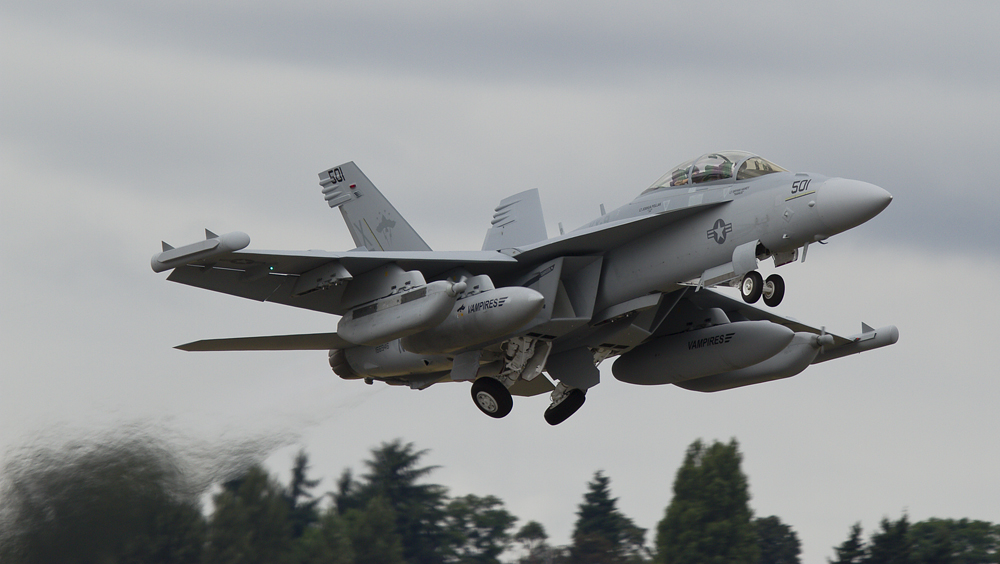 |
| USAF E/A-18 Growler - Russel Hill |
Liberals playing defence with reports of Super Hornet Purchase
By: Lee Berthiaume & David Pugliese, Ottawa Citizen (Post Media)
The Liberal government has brushed aside opposition concerns following a report it intends to purchase Super Hornet fighter jets, saying it must act “sooner rather than later” to meet the country’s defence needs.
 But the opposition says the government has manufactured a crisis so it can fulfil its promise not to buy the F-35 stealth fighter.
The Ottawa Citizen, citing multiple sources, reported over the weekend the Liberal government is intent on buying Super Hornet fighter jets.
Rather than a full replacement of the air force’s aging CF-18 fighter fleet, it’s believed the purchase will be labelled an interim measure to fill what Defence Minister Harjit Sajjan has warned is a pending “gap” in Canada’s military capabilities.
The Liberals promised during the election campaign not to buy the F-35 to replace the CF-18s. But the government has been struggling with how to fulfill that promise for fear any attempt to exclude the stealth fighter from a competition will result in a multi-billion-dollar lawsuit, says a senior Defence Department official.
In the House of Commons Monday, Conservative defence critic James Bezan accused the Liberals of having already decided to buy the Boeing Super Hornet.
John McKay, Sajjan’s parliamentary secretary, didn’t deny the charge, but blamed the Conservatives for failing to deal with the fighter jet replacement during their tenure.
“Unfortunately, the last five years has been a bit of a loss, and as a consequence, there is a developing capability gap which needs to be managed,” McKay said. “We have obligations to NATO. We have obligations to NORAD. We have obligations to our own defence and to expeditionary matters.”
Sajjan has “taken the responsible action and he is moving forward with making a decision sooner rather than later, which should have happened maybe five years ago now.”
Bezan questioned the Liberal government’s claim the CF-18s are close to the end, pointing out they can operate effectively until 2025.
“Liberal suggestions that our fighters are literally on their last legs is patently false,” he said.
In 2014, the Conservative government said it was upgrading the CF-18s so they could continue to operate through 2025. That $400-million initiative was intended to buy the government time to make the right decision on a replacement.
The Royal Canadian Air Force is continuing to work on the project and contracts are expected to be awarded in the next two years.
In April, Lt.-Gen. Michael Hood, the air force chief, told the Commons’ defence committee the military had enough CF-18s to do its job for the foreseeable future.
The end of the CF-18s “useful life” has been established as 2025, and while some aircraft will be retired before that, there is no rush on a replacement, he added.
“I’m confident, heading into what the government has suggested for an open and transparent competition, about the timelines associated with that project,” Hood said. “I’m confident that if a decision were taken, certainly in the next five years, we’ll be in a comfortable position changing that aircraft.”
In the last month, Sajjan has introduced the idea that a fighter capability gap has emerged and the government needs to move quickly on a replacement jet.
McKay said the government finds itself in the situation “where we are going to have to make serious decisions about the replacement for the CF-18. We cannot any longer carry on in the fashion that we’ve been carrying on.”
There is precedent for buying Super Hornets on an interim basis. Australia paid $2.5 billion for 24 of the aircraft to replace antiquated F-111 jets until newer F-35s were ready.
However, the idea of Canada needing to follow suit was largely dismissed by a government-appointed expert panel and the military’s research branch.
The expert panel, whose mandate was to evaluate options for replacing the CF-18s, wrote in its final report in December 2014 “there was no need to pursue a bridging option,” as “it is possible, with certain investments, to fly the CF-18 to 2025 and even beyond.”
In 2014, Defence Research and Development Canada wrote ,“The costs involved with bridging options make them unsuitable for filling capability gaps in the short term … any short-term investment results in disproportionately high costs during the bridging period.”
The reason such a stop-gap would be more expensive is because the air force would be operating two types of aircraft, requiringdifferent training, infrastructure and supporting equipment. Opinion is divided over whether buying the Super Hornet could mitigate some of those costs given its similarities to the CF-18.
The Liberal government has brushed aside opposition concerns following a report it intends to purchase Super Hornet fighter jets, saying it must act “sooner rather than later” to meet the country’s defence needs.
The Ottawa Citizen, citing multiple sources, reported over the weekend the Liberal government is intent on buying Super Hornet fighter jets.
Rather than a full replacement of the air force’s aging CF-18 fighter fleet, it’s believed the purchase will be labelled an interim measure to fill what Defence Minister Harjit Sajjan has warned is a pending “gap” in Canada’s military capabilities.
The Liberals promised during the election campaign not to buy the F-35 to replace the CF-18s. But the government has been struggling with how to fulfill that promise for fear any attempt to exclude the stealth fighter from a competition will result in a multi-billion-dollar lawsuit, says a senior Defence Department official.
In the House of Commons Monday, Conservative defence critic James Bezan accused the Liberals of having already decided to buy the Boeing Super Hornet.
John McKay, Sajjan’s parliamentary secretary, didn’t deny the charge, but blamed the Conservatives for failing to deal with the fighter jet replacement during their tenure.
“Unfortunately, the last five years has been a bit of a loss, and as a consequence, there is a developing capability gap which needs to be managed,” McKay said. “We have obligations to NATO. We have obligations to NORAD. We have obligations to our own defence and to expeditionary matters.”
Sajjan has “taken the responsible action and he is moving forward with making a decision sooner rather than later, which should have happened maybe five years ago now.”
Bezan questioned the Liberal government’s claim the CF-18s are close to the end, pointing out they can operate effectively until 2025.
“Liberal suggestions that our fighters are literally on their last legs is patently false,” he said.
In 2014, the Conservative government said it was upgrading the CF-18s so they could continue to operate through 2025. That $400-million initiative was intended to buy the government time to make the right decision on a replacement.
The Royal Canadian Air Force is continuing to work on the project and contracts are expected to be awarded in the next two years.
In April, Lt.-Gen. Michael Hood, the air force chief, told the Commons’ defence committee the military had enough CF-18s to do its job for the foreseeable future.
The end of the CF-18s “useful life” has been established as 2025, and while some aircraft will be retired before that, there is no rush on a replacement, he added.
“I’m confident, heading into what the government has suggested for an open and transparent competition, about the timelines associated with that project,” Hood said. “I’m confident that if a decision were taken, certainly in the next five years, we’ll be in a comfortable position changing that aircraft.”
In the last month, Sajjan has introduced the idea that a fighter capability gap has emerged and the government needs to move quickly on a replacement jet.
McKay said the government finds itself in the situation “where we are going to have to make serious decisions about the replacement for the CF-18. We cannot any longer carry on in the fashion that we’ve been carrying on.”
There is precedent for buying Super Hornets on an interim basis. Australia paid $2.5 billion for 24 of the aircraft to replace antiquated F-111 jets until newer F-35s were ready.
However, the idea of Canada needing to follow suit was largely dismissed by a government-appointed expert panel and the military’s research branch.
The expert panel, whose mandate was to evaluate options for replacing the CF-18s, wrote in its final report in December 2014 “there was no need to pursue a bridging option,” as “it is possible, with certain investments, to fly the CF-18 to 2025 and even beyond.”
In 2014, Defence Research and Development Canada wrote ,“The costs involved with bridging options make them unsuitable for filling capability gaps in the short term … any short-term investment results in disproportionately high costs during the bridging period.”
The reason such a stop-gap would be more expensive is because the air force would be operating two types of aircraft, requiringdifferent training, infrastructure and supporting equipment. Opinion is divided over whether buying the Super Hornet could mitigate some of those costs given its similarities to the CF-18.
Subscribe to:
Posts (Atom)