Translate

Showing posts with label Canada and NORAD. Show all posts

Wednesday, November 28, 2018

Liberals Press Ahead with Second-Hand F-18s Amid Questions Over Who Will Fly Them

The Canadian Press - The Kingston Whig-Standard 

The Trudeau government pressed ahead with its plan to buy second-hand fighter jets from Australia on Tuesday despite withering fire from the federal auditor general, who warned that the military might not have anybody to fly them.

A pilot prepares for take off in a CF-188 Hornet aircraft at Mihail Kogalniceanu Air Base in Romania during Operation REASSURANCE on Sept. 27. Last week, the auditor general released a report highlighting the pilot shortage faced by the Canadian Air Force and continued problems with procuring new fighter jets. CPL. DOMINIC DUCHESNE-BEAULIEU/POSTMEDIA
Six years after blowing up the Harper government’s plan to buy new F-35s without a competition, auditor general Michael Ferguson targeted the Liberals’ own attempts to buy jets. He first picked apart the government’s aborted plan to purchase “interim” Super Hornets to bolster Canada’s aging CF-18 fleet, and then its current plan to buy used Australian fighters.

The government says those extra fighters are needed to address a shortage of CF-18s until a state-of-the-art replacement can be purchased and delivered — a lengthy process that will run through 2032, at which point the CF-18s will be 50 years old.

But the auditor general’s office arrived at a very different conclusion: The military doesn’t need more planes because it doesn’t even have the pilots and mechanics to operate what it already has. What it really needs, the office found, is more people.

“The shortage of personnel in relation to technicians means that they don’t have enough technicians to prepare and maintain the planes,” Casey Thomas, the principal auditor on the fighter jets study, told reporters on Tuesday.

“And they have 64 per cent of the pilots that they need, so they don’t have enough pilots to fly the planes . . . What National Defence actually needed was to increase its personnel.”

The auditor general’s report also flagged concerns that the government’s plan to sink $3 billion into the current CF-18s and additional Australian fighters to keep them flying to 2032 won’t be enough, as the money won’t actually improve the aircrafts’ combat systems.

Without more money, which some analysts have suggested could mean hundreds of millions if not billions of dollars more, Canada’s fighter-jet fleet will become even more obsolete, to the point where the plans might not be any use at home or overseas.

Yet only a few hours after the auditor general’s report was released, Defence Minister Harjit Sajjan announced that the Liberals had signed a contract to buy the 18 second-hand jets from Australia. Officials have pegged the cost at around $500 million.

Sajjan also said he had directed officials to look at options for upgrading the combat systems on the CF-18s and Australian fighters, which he acknowledged would mean investing more money into aging fighter jets.

Missing from the announcement: Any new funding or other initiative to increase recruiting and retention of pilots and technicians.

Instead, Sajjan said the government and military have already introduced several initiatives through the Liberals’ defence policy last year, such as giving tax breaks to military personnel deployed on overseas missions, to give them reasons to stay.

At the same time, the minister sidestepped questions about recruitment, saying the military can’t reduce its standards for new pilots. He noted that commercial airlines are also facing a significant pilot crunch.

Air-force commanders have previously said the current training system, which can only produce 115 new pilots each year, a fraction of whom are fighter pilots, is not fast enough to replace all those who move on to commercial opportunities.

The subtext to much of the auditor general’s report on Tuesday was the question of how Canada ended up in a position where the military will be flying fighter jets until they are 50 years old.

The Liberals were urged early in their tenure to launch an immediate competition to replace the CF-18s. Instead they spent two years working to buy those stopgap Super Hornets before a trade dispute with the company that makes them, Boeing, saw the government move on to the used Australian jets.

The Trudeau government insists that it was doing its due diligence, but critics — including numerous retired air force and defence officials — have accused it of trying to bend procurement rules to avoid buying the F-35.

Yet even before the Liberals took the reins, the Harper government was having a hard time making any progress on buying new fighter jets. The Tories championed the F-35 before resetting the entire process in 2012.

That move was prompted by Ferguson’s first report, which accused defence officials of misleading parliamentarians about the stealth fighter’s costs and various technical issues. National Defence later pegged the full lifetime cost of the fighters at $46 billion.

“Lot of people had a hand in this,” said defence analyst David Perry of the Canadian Global Affairs Institute, adding that the worst part is there is no easy or obvious solution to what has become a very troubling situation for Canada and its military.

“I think our fighter force is in trouble.”

Tuesday, November 27, 2018

CF-18 Replacement Delay Fueling Exodus of Pilots from RCAF

By: Bruce Campion-Smith, The Toronto Star

OTTAWA—The oft-delayed purchase of new fighter jets is contributing to a flight of pilots out of the Air Force to the civilian sector, causing a critical shortage of skilled aviators to fly Canada’s ageing fleet of CF-18s, insiders say.

Flying a 30-year-old jet holds less appeal for pilots who are no longer prepared to sacrifice quality of life and are instead quitting for airline careers, where demand for experienced personnel is sky-high.

Frustration over the oft-delayed purchase of new fighter jets is contributing to a flight of pilots out of the Air Force to the civilian sector, causing a critical shortage of skilled aviators to fly Canada’s aging fleet of CF-18s, insiders say. (Andrew Vaughan / THE CANADIAN PRESS FILE PHOTO)

The rush out the door has left the Royal Canadian Air Force coping with less experienced pilots flying increasingly outdated jets, former fighter pilots tell the Star.

“It’s not a winning proposition,” one veteran former pilot told the Star.

In a recent report, the auditor general turned a spotlight on the crisis, noting that the Air Force only had 64 per cent of the CF-18 pilots it needs. Between April 2016 and March 2018, 40 fighter pilots left and the Air Force was only able to train 30 new ones. Since then, 17 more pilots have indicated they are out the door.

If that pace continues, there won’t be enough experienced pilots to train new ones and the Air Force won’t be able to meet its obligations to NATO and NORAD, the report said.

The Star spoke to several former fighter pilots about the situation. They spoke on background because of sensitivities around their current jobs.

They say several factors are at play in the exodus of pilots. These include exasperation over the delayed purchase of replacement jets that are now not expected for a decade or more, as well as a desire for better quality of life away from the two main fighter bases in Cold Lake, Alta., and Bagotville, Que.

But the biggest factor is the huge demand for pilots across Canada and the world, offering military pilots an easy path to the cockpits of commercial airliners.

“There’s not enough pilots globally ... so companies are very aggressive in recruiting wherever they can find them. Military pilots are prime candidates, so they get offered good deals and off they go,” one former pilot said.


The broader pilot shortage problem could soon be the topic of parliamentary study. Liberal MP Steve Fuhr, a former Air Force pilot who flew the CF-18, has proposed a motion to have the Commons transport committee examine the challenges facing flight schools in training new pilots.

Speaking to the motion earlier this month, Fuhr (Kelowna-Lake Country) said the industry-wide shortage is already having an effect on the civilian sector and the military, and noted that Canada could be short 3,000 pilots by 2025.

“As the pilot shortage percolates up, both scheduled and nonscheduled commercial air service will be negatively affected,” Fuhr told a meeting of the committee on Nov. 21.

The CF-18s were last deployed in a combat role in Iraq against Daesh, and remain potent fighters. Able to fly at almost twice the speed of sound, they continue to hold appeal for young military pilots.

But delays in purchasing new fighters, first by the Conservative government and now the Liberals, means replacement aircraft are 10 years or more away. With no prospect of flying the next generation of fighter, some pilots see little incentive to stick around and are opting to quit the Armed Forces when their flying tours are complete.

“They make the calculation that I’m never going to fly anything other than an old 40-year-old F-18 in my entire career,” the former pilot said.

However, another veteran pilot downplayed the delayed procurement as a reason for the departures. “Realistically, I don’t think that’s driving people out the door,” he said.

After two tours of flying — typically about six years — pilots usually move to a desk job. That’s the point where military pilots who are keen to keep flying decide to jump to the private sector, which offers the promise of a good career and the chance to live closer to big cities.

“That’s why guys get out. What’s ultimately driving them out is opportunity,” he said.

Whatever the reason, the departures are hitting the RCAF hard. The Air Force has 76 CF-18s and just over 100 pilots qualified to fly them, insiders say. As a result, having almost 60 quit the forces in just over two years marks a huge loss in experience, they say.

The former Air Force veterans stressed that training is good and that the young pilots arriving at the front-line squadrons are well-qualified. Yet they are considered “minimum combat-ready,” able to initially fly only as wingmen and require another one or two years of experience to be considered qualified to fly all missions and serve as flight leaders.

“That’s the danger of this cycle. They’re not regenerating the same numbers as they’re losing,” the pilot said. “The experience level is dropping ... With that goes an increase in risk.”

By the time they are replaced, the CF-18s will have been in the Air Force fleet for almost half a century, 30 years longer than planned. The auditor general noted that it’s been 10 years since there was any significant upgrade to their combat capabilities. The Air Force had been relying on the experience of its pilots to overcome shortfalls caused by the age of the aircraft.

“You can still fight OK with an old jet if you have very, very skilled individuals flying it. We invest a lot in our training and therefore our people are very capable, adaptive, innovative,” the pilot said.

“The problem is that those guys are leaving,” he said.

In response to the auditor general findings, Lt.-Gen. Al Meinzinger, commander of the RCAF, said the Air Force is taking steps to help retain aircrews, including measures to improve the quality of life along with changes to how the Air Force trains its pilots to give it “greater flexibility to better meet future personnel demands.”

Thursday, November 22, 2018

Norway's Experience with F-35 Procurement is a Lesson for Canada

By: Levon Sevunts, Radio Canada International

s the federal government embarks on a much delayed and criticized quest to find a replacement for its ageing fleet of CF-18 Hornet fighter jets, Norway’s saga with the acquisition of F-35 stealth fighters offers Canada a valuable lesson.

The search for a replacement for CF-18 got a new urgency Tuesday after a blistering report by Canada’s auditor general, who lambasted the Liberal government’s handling of the file that could have serious implications for Ottawa’s ability to fulfill its NATO and NORAD obligations.

Just like Ottawa, Oslo was one of the first NATO countries to show interest in the new stealth multirole fighters developed by U.S. defence giant Lockheed Martin.

In June 2009, the Norwegian Parliament decided that the F-35A Lightning II would replace its current fleet of F-16 fighter jets. Unlike Ottawa, despite strong internal opposition, Oslo saw things through.

By 2025, Norway hopes to have a fleet of 52 F-35s. 

No-show at Trident Juncture demonstration
Norwegian F-16s escort a Jet Falcon DA-20 electronic warfare aircraft during an Air Power Capability Demonstration of the NATO exercise Trident Juncture 2018 in Byneset near Trondheim, Norway, October 30, 2018. (Jonathan Nackstrand/AFP/Getty Images)
Norwegian authorities were hoping to showcase their newest and most expensive defence acquisition in the country’s history at a massive display of NATO’s military might during the official launch of Trident Juncture 2018 exercise on Oct. 30.

But much to the chagrin of dozens of journalists, NATO officials and dignitaries that had assembled on the shores of the Trondheim Fjord in central Norway to watch the display of land, sea and air power, the Norwegian F-35s never showed up.

Lt.-Col. Stale Nymoen, commander of the 332 Squadron of the Royal Norwegian Air Force and one of the first Norwegian pilots to learn to fly the F-35s, said strong crosswinds at the Ørland Air Base forced officials to cancel the planned overflight.

The cancellation of the overflight on an otherwise perfect autumn day had nothing to do with the jet’s capabilities, Nymoen said.

“Seen from my perspective, it’s one of the best fighter aircraft out there,” Nymoen told a roomful of journalists during a briefing at the Ørland Air Base in central Norway earlier this month.

But it has taken even experienced pilots like him years to learn to fly the new fighter jets and, just as importantly, unlearn old habits, Nymoen said.
The first three F-35 fighter jets ordered by Norway’s Air Force arrive in Orland Air Base in central Norway Friday Nov. 3, 2017. (Ned Alley/NTB scanpix via AP)
Norway received its first four F-35s in January of 2017. But all of them were stationed at the Luke Air Force Base in Phoenix, Arizona, where Norwegian, U.S. and Italian pilots trained on the new aircraft.

It wasn’t until November of 2017 that the stealth fighter jets actually arrived for service in Norway, at the Ørland Air Base, which is going through a massive infrastructure upgrade to house the new planes.

Operating and flying them in Norway with its harsh North Atlantic and Arctic climate is a whole new experience, Nymoen said.

“What is different from Luke when we train to operate the aircraft here is temperatures, winter, icy and slippery runways, winds,” Nymoen said. “Those are conditions that we don’t necessarily get to train for when we’re training in the United States.”

And the Norwegian air force is taking a very cautious approach to avoid any accidents, he said.

“We have to learn to crawl before we can walk, and we have to learn to walk before we can run,” Nymoen said.

The first squadron of F-35s is expected to reach initial operational capability in 2019 and full operational capability only in 2025, eight years after the aircraft were delivered to Norway.

This timeline would also apply to Canada, if Lockheed Martin were to emerge as the winner of the competition to buy 98 advanced aircraft for the Royal Canadian Air Force announced by the Liberal government last December.

The list of eligible suppliers identified by the federal government also includes France’s Dassault Aviation, Sweden’s SAAB, the U.K.’s Airbus Defense and Space, and the U.S. defence and aerospace giant Boeing.

If the federal government manages to stick to its timetable, a contract award is anticipated in 2022 and the first replacement aircraft delivered in 2025.

This means that the current fleet of Canadian CF-18s and the 18 additional second-hand Australian F-18s the federal government is buying as a stopgap measure will have to operate until at least 2030, experts say.

Wednesday, November 21, 2018

Auditor General Slams Government Plan to Maintain CF-18 Fleet Until 2032

By: Murray Brewster, CBC News 

Canada's auditor general has shot down the Liberal government's handling of the air force's aging CF-18s in a blistering report that raises questions about national security, and even long-term safety, regarding the viability of the country's frontline fighter jets.

Auditor General Michael Ferguson's fall report, tabled Tuesday, methodically picks apart the recent policy change at the Department of National Defence, which requires the military to have enough warplanes to meet Canada's commitments to both NORAD and NATO at the same time.

Watch Power & Politics take a look at the ups and downs of Canada's fighter jet program
The RCAF is currently facing a shortage of both qualified pilots and technicians. Those pilots the RCAF does have on active roster are struggling to maintain the minimum 140 flight hours per year. 

From the get-go the policy was a non-starter, and the federal government knew it, said Ferguson.

"The fighter force could not meet the requirement because National Defence was already experiencing a shortage in personnel, and the CF-18 was old and increasingly hard to maintain," said the audit.

As of April 2018, the air force's CF-18 squadrons faced a 22 per cent shortage in technical positions — and a startling number of technicians were not fully qualified to do maintenance.

Fighter pilots are also in short supply. The air force is losing more of them than it is training each year; among those who do remain, almost one third do not get the required 140 hours of flying time per year.

At a news conference following the release of the report, Defence Minister Harjit Sajjan conceded that personnel shortages were identified "early on" after the Liberals took over in 2015.

"This is a problem we knew we had," he said, pointing the finger at budget cuts made by the previous Conservative government. "This is what happens when you don't put enough resources into the military."

Watch Defence Minister Harjit Sajjan react to the AG report on fighter jets on Power & Politics


The extent of Liberals' own efforts to boost recruiting and retention of pilots and technicians in the three years since the election was the subject of some confusion Tuesday.

A written statement from Sajjan said the government "will launch new efforts to recruit and retain pilots and technicians."

During the news conference, the minister said the military's top commander had been directed to deal with the problem and that recruiting pilots is "a priority."

Pressed for specifics on recruitment, Sajjan said he's "going to leave it to the experts to figure out."

Proposed solution 'will not help solve' issues

The auditor's report took issue with the Liberal government's strategy to fill the so-called capability gap by buying additional interim aircraft.

The current proposal is to buy used Australian F-18s — of approximately the same vintage as Canada's CF-18s — and convert them for further use until the federal government completes the purchase of brand-new aircraft.

This plan, the auditor's report said, "will not help solve either the personnel shortage or the aging fleet."

Ferguson said an earlier, $6.3 billion plan to buy 18 brand new Super Hornet fighter jets on an interim basis would have been even worse — and the government was told so in no uncertain terms by the air force.

"National Defence's analysis showed that buying the Super Hornet alone would not allow the department to meet the new operational requirement," said the audit.

"The department stated that the Super Hornet would initially decrease, not increase, the daily number of aircraft available because technicians and pilots would have to be pulled away from the CF-18s to train on the new aircraft."

The proposal to buy Super Hornets was scrapped last spring after the manufacturer, Chicago-based Boeing, angered the Trudeau government in a separate trade dispute involving the sale of Bombardier passenger jets.

The Opposition Conservatives have long claimed the 'capability gap' was concocted by the Liberals as a way to push off a decision on a permanent replacement for the CF-18s. In the last election, Prime Minister Justin Trudeau pledged not to buy the F-35 stealth fighter, the preferred option of the Harper government.
Sparring in the House

The report led to sparring in the House of Commons, with the Conservatives seeing the auditor general's assessment as vindication.

"Today's report confirms what we have been saying all along," said James Bezan, the defence critic.

"Justin Trudeau deliberately misled Canadians by manufacturing a 'capability gap' to fulfil a misguided campaign promise, and in the process has put the safety and security of Canadians at risk."

Sajjan, however, believed the report supported the government's position.

"The report confirms what we have always known: The Harper Conservatives mismanaged the fighter jet files and misled Canadians for over a decade," he said.

"The report confirms a capability gap exists, and started under the Conservatives."

In fact, what the report said was that "Canada's fighter force could not meet the government's new operational requirement." It contained objective analysis of how many aircraft would be required to meet various contingencies.
Fleet 'will become more vulnerable'

Meanwhile, the auditor is warning that the Liberal government has no plan to upgrade the combat capabilities of the CF-18s to keep them current over the next decade while the air force waits for replacements.

The last major refurbishment of the war-fighting equipment on the jets happened in 2008, and Department of National Defence planners have done little since because they had been expecting new planes by 2020.

"National Defence did not have a plan to upgrade the combat capability of the CF-18 even though it will now have to fly until 2032," said the audit.

"Without these upgrades, according to the department, the CF-18 will become more vulnerable as advanced combat aircraft and air defence systems continue to be developed and used by other nations."

The fact that the CF-18s are not up to date means they will not be able to operate in certain environments where the risk of surface-to-air missiles or advanced enemy planes is great.

That, in turn, "would limit Canada's contribution to NORAD and NATO operations," Ferguson said.

Sajjan said the department is looking at an upgrade to the combat systems.

"We would love to be able to solve this problem immediately," he said.

Tuesday, May 1, 2018

CF-18 Replacement Program Does Not Account for Losses from Attrition

By: David Pugliese, Defence Watch

A Canadian government project to buy new fighter jets does not include replacement aircraft to deal with those lost to attrition.

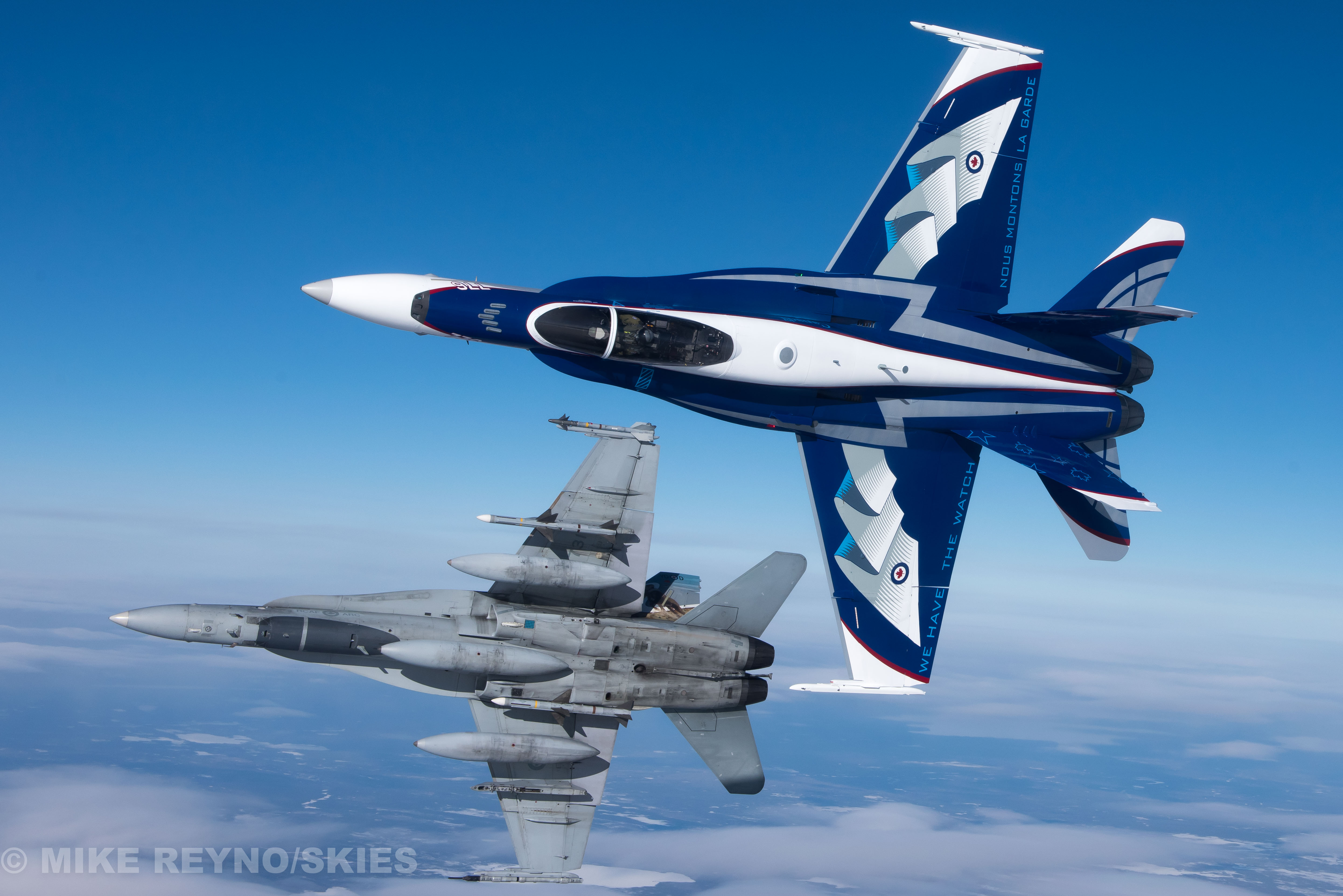
The 2017 Demonstration Hornet (foreground) flies with a CF-188 Hornet from 401 Squadron. The Demo Hornet pays tribute to the 60th anniversary of NORAD.
The 2018 Demonstration Hornet (foreground) flies with a CF-188 Hornet from 401 Squadron. The Demo Hornet pays tribute to the 60th anniversary of NORAD. Mike Reyno Photo
The Liberal government says it will acquire 88 advanced fighter jets to replace the current fleet of CF-18s.

The fleet size is based on the Canadian Armed Forces requirement to have sufficient fighter aircraft to fulfill Canada’s NORAD and NATO commitments simultaneously, based on planned aircraft serviceability rates and aircraft required for training, said RCAF spokesman Maj. Scott Spurr.

“If the RCAF loses any future fighters due to attrition, it would be a policy decision on whether attrition aircraft would be replaced, and if so how,” Spurr told Defence Watch.

The RCAF did not answer whether it had projected any estimates on how many aircraft are expected to be lost to attrition over the course of the program.

Tuesday, September 19, 2017

RCAF Fighter Replacement Reaching New Depths

By: David Bercuson

The government’s initiative to replace Canada’s long-serving CF-18s with a new jet fighter (88 of them according to the June defence policy paper) is reaching new depths of hilarity.

Canadian governments have known for almost two decades that the day of the CF-18 is almost over. Stalwart aircraft, the fighter jets have been updated at least twice – but there is only so much that can be done with an obsolete airframe, and it is time for Canada to join virtually all its allies in updating to a new and much more modern jet.

But Prime Minister Trudeau declared during his election campaign that Canada would never, ever buy the Lockheed-Martin F-35 Joint Strike Fighter – a solemn election declaration based on zero facts – and he is now in a very delicate situation.

Sometime last year, the government suddenly decided that the current CF-18 fleet (which was supposed to last at least another five years after its last update) was no longer viable, and that the air force needed a quick “gap filler” to fulfill Canada’s NORAD commitments between now and whenever the government actually decides which aircraft it will pick for a wholesale replacement of the CF-18. And when would that be? Why, after the next election, of course, when the Trudeau pledge would be forgotten and Canada could follow virtually every one of its major allies – especially the United States – and purchase the F-35.

Why wait until after the next election? In truth, there is no reason under the sun to take up to four years (the Liberal proposal) to hold a fighter competition. First of all, the F-35 is the only fighter aircraft (aside from the very advanced F-22, which is unavailable for export) the U.S. will be flying for at least the next three decades. Second, there have been at least a dozen countries that have picked the F-35 in their own competitions, and third, because almost all of Canada’s allies have selected the F-35 already.

In any case, what to do about filling the "gap" that the government suddenly decided exists between our CF-18s and the next fighter? Initially the government decided early this year to buy 18 Boeing F-18 Super Hornets. These fighters are somewhat larger and more capable than their CF-18 predecessors, and are flown almost exclusively by the U.S. Navy and by Australia. The Aussies bought them to fill a gap between their old F-18s and their new F-35s which will soon be delivered. Israel and Japan are, right now, taking delivery of their F-35s and other countries will soon begin to receive theirs.

Not long after the Liberal government announced it was going to acquire the Super Hornets, Boeing brought a case to the United States trade commissioner complaining that the new Bombardier single-aisle jetliner was being “dumped” in the United States at artificially low prices. Ottawa took umbrage and has, at least for now, quashed its deal with Boeing.

How then to “fill the gap”? Last week Canada sent representatives to Australia to check out the Royal Australian Air Force’s fire sale of its old F-18s because the Aussies are about to take delivery of their new F-35s. So, Canada is ready to lay cash on the line in “Hairy Harry’s Hornet sale” to buy airplanes to “fill the gap” that are as old as the fighters we are flying now. They can probably buy a few hundred bins of spare parts while they are at it. Maybe we will rummage around some Australian airfields to pick the best old set of wings here and the best old engine there so that we can make one flyable plane out three or four old ones that are not so flyable.

The whole situation has become a vast tragicomedy of errors, and it's beginning to look as silly as the decades-long effort (now finally coming to a conclusion) to replace the 1960s era Sea Kings. All because of a partisan political announcement by a man aspiring to become prime minister who knew nothing about the issues.

Monday, July 10, 2017

First Female to Command at 22 Wing/Canadian Forces Base North Bay

By: BayToday Staff

The 51 Aerospace Control and Warning (Operational Training) Squadron Change of Command took place today and CFB North Bay has its first woman commander.

Major Shawn Guilbault officially relinquished command of 51 Aerospace Control and Warning (Operational Training) Squadron to Major Brenda Tinsley.

“I am grateful for the opportunity to take command of 51 Aerospace Control & Warning (Operational Training) Squadron," said Tinsley, incoming Commanding Officer, 21 AC&W Squadron ‘A’ Flight Commander Squadron. "This squadron holds a fundamental role in NORAD, using the highly trained officers and NCMs to train the future control and surveillance experts of the RCAF. I wish Shawn good luck in the Joint Services Command and Staff College at Shrivenham, United Kingdom.’’

Colonel Henrik Smith, 22 Wing Commander and Canadian Air Defence Sector Commander, presided over the ceremony which was witnessed by members of 51 AC&W (OT) Sqn, 22 Wing and local dignitaries.

“Major Shawn Guilbault's exceptional drive and determination has ensured that the important mission of training members of the Canadian Air Defence Sector, 22 Wing/CFB North Bay, has been flawlessly executed throughout his tenure as commanding officer. NORAD has received a great service in his quest to institutionalize the aerospace training within 51 Squadron; a no fail mission to continually develop and train new controllers keeping CADS operationally effective."

Guilbault says it has been a privilege to command.

"The Jaegers are some of the most dedicated and hard-working operators, instructors, and aviators I have had the honour of working with – the future of the RCAF is in good hands! Maj. Tinsley brings a wealth of battle management and training systems experience to the fight; she will be an excellent fit and I wish her all the best.”

The squadron’s primary mandate is occupational and trade training for Aerospace Control Officers and Aerospace Control Operators in 12 different positional qualifications or certifications, training nearly 200 operators annually. Additionally, 51 Squadron is tasked to provide readiness training (first aid, small arms, and chemical, biological, radiological and nuclear defence) for all wing members.

Thursday, November 10, 2016

Trump’s win will increase pressure on Canada to ramp up defence spending, military analysts predict

By: David Pugliese, National Post 

Donald Trump’s election victory will put pressure on the Liberal government to boost defence spending and rethink participation in the U.S. missile defence shield, and could affect some of its high-profile missions such as in eastern Europe.

Department of National Defence officials in Ottawa are working on an analysis of what a Trump presidency will mean. But Trump has already provided a preview of the direction he plans to take.

He has promised to boost the size of the U.S. military and significantly increase the number of warships in America’s arsenal. He has talked about improving missile defence, focusing on outfitting naval ships with such a capability.

In addition, Trump has warned that NATO nations he sees as “free riders” will have to share more of the financial burden on the security front. Although he didn’t specifically name Canada, defence analysts expect Washington will send a message in the future that more money and equipment are needed.
CF-18 fighter jets sit on the tarmac at the NATO airbase at the NATO Baltic Air Policing mission in  Lithuania in 2014.
CF-18 fighter jets sit on the tarmac at the NATO airbase at the NATO Baltic Air Policing mission in Lithuania in 2014.
Related
Defence cuts have left Canadian military in ‘fragile’ shape: Rick Hillier
Harjit Sajjan defends Canada’s military budget after Donald Trump slams NATO ‘free riders’

“Canada is going to come under some pressure to bump up its defence spending,” said analyst Martin Shadwick, who teaches strategic studies at York University in Toronto. “Trump is also talking about a type of Fortress America so that could affect our own border security policies.”


NATO members had signed a declaration in Wales two years ago agreeing to increase defence spending to two per cent of gross domestic product within a decade.

NATO says Canada spent just one per cent of GDP on defence last year, the smallest amount since before the Second World War. While most other NATO members have also failed to fulfil their commitment, Canada is currently in the bottom third in terms of defence spending as a percentage of GDP.

Steve Staples, vice president of the Rideau Institute in Ottawa, said Trump’s victory could have a significant impact on Canada’s defence policy. Trump is promoting protectionist trade policies and tighter border security. Similar to the presidency of George W. Bush, Canada may have to make security concessions if it wants to keep the border open for trade, Staples said.

“There will be intense pressure to boost spending on the military, to buy new equipment, preferably from the Americans,” said Staples. “Canadian defence policy makers are going to have little room to manoeuvre with this president.”

In an interview shortly after Trump complained in April about NATO free riders, Defence Minister Harjit Sajjan defended Canada’s level of defence spending. He questioned NATO’s figures and told the Ottawa Citizen that depending on what formula is used, Canada’s contribution could be seen to be as high as 1.5 per cent of GDP.

At the same time, Sajjan said what’s important is that Canada is contributing to a large number of military operations that directly and indirectly benefit NATO. That includes sending troops to Ukraine and Poland and deploying a frigate to the Black Sea.

But will Canada’s presence in eastern Europe — aimed at supporting NATO’s efforts against what it terms Russian aggression — leave much of an impression on Trump?

Trump has said he wants to form a new relationship with Russia and promised he would meet the country’s president, Vladimir Putin, before his inauguration. Trump has also suggested there needs to be increased co-operation with Russia in the battle against Islamic extremists in Iraq and elsewhere.

“We may see a big shift in tone on Russia,” said Staples. “In some ways Trump’s future policy is a blank page. As he has said, he doesn’t owe anything to anybody.”

In addition, both Staples and Shadwick see a Trump administration wanting Canadian participation in missile defence.

Some Liberals have already signaled their desire to take part in America’s missile shield and any pressure from a Trump administration may be enough to seal Canada’s participation.

Shadwick, however, pointed out that Trump is interested in focusing on a missile defence system outfitted on naval vessels, something Canada’s navy is also examining.

dpugliese@postmedia.com

Twitter.com/davidpugliese

Tuesday, October 18, 2016

Exercise VIGILANT SHEILD Starts - RCAF CF-18s and CH-149s involved

DND Press Release

Exercise Vigilant Shield has started.

“The Canadian North American Aerospace Defense (sic) Command (NORAD) Region has begun its participation in NORAD’s annual VIGILANT SHIELD field training exercise,” the news release from the Canadian Forces noted. “The live-fly field training exercise, which will run October 17 to 21, is part of a larger series of annual NORAD VIGILANT SHIELD exercises that take place throughout the United States and Canada.”

VIGILANT SHIELD 17 will see NORAD building on previous training in North America’s northern aerospace and in the high Arctic, according to the release.

Exercise VIGILANT SHIELD 17 will see the deployment of:

– Royal Canadian Air Force (RCAF) CF-18 Hornets to Inuvik, N.W.T.;

– U.S. Air Force (USAF) F-15 Eagle fighter jets to Yellowknife, N.W.T.;

– USAF E-3 Sentry airborne early warning and control aircraft and KC-135 Stratotankers to 5 Wing Goose Bay, N.L.;

– an RCAF CH-149 Cormorant search and rescue (SAR) helicopter and 42 Radar Squadron to Canadian Forces Station Alert;

– an RCAF CH-149 Cormorant SAR helicopter and CC-130H Hercules SAR aircraft to the USAF’s Point Barrow Long Range Radar Site in Alaska; and

– Canadian Army personnel to provide on-site security support.

Monday, October 3, 2016

Canada’s jilted partners languish as peacekeeping fetish feeds love affair with the UN

By: Matthew Fisher, National Post 

The Trudeau government has a bit of a pacifist streak, a peacekeeping fetish, a romantic nostalgia for Pearsonian internationalism and a distrust of the security arrangements that have kept Canada safe since the Second World War.

Canadian troops donning blue berets and marching off to Africa for the first time in two decades are part of a seismic shift by Prime Minister Justin Trudeau to prioritize working with the UN to solve international disputes rather than collaborating with traditional allies.

The Liberals’ lack of ardour for working with such treaty partners as NATO or NORAD precedes the current prime minister’s term by many years. But with peacekeeping now dominating the conversation in government circles in Ottawa, there is less enthusiasm for those alliances than ever.

While there is no talk of Canada quitting NATO or NORAD — the rote platitudes about a profound and abiding commitment are still uttered — the prime minister and his closest advisers are clearly more comfortable working with the UN than the country’s old partners. This conviction arises partly from the insecurities some Canadians have about their southern neighbours and partly from a desire to stake out international diplomatic turf that Canada can claim as its own.

Geoff Robins/AFP/Getty ImagesPrime Minister Justin Trudeau greets UN Secretary-General Ban Ki-moon as he arrives for a conference on AIDS, tuberculosis and malaria in Montreal Sept. 17, 2016.

The change in focus can not only be seen in Ottawa’s rapture with the UN and French Africa — which Liberal Quebecers such as Trudeau the Elder and Jean Chrétien always had a soft spot for — but in the government’s giddy promotion of trade and friendship with China, whose “basic dictatorship” Trudeau the Younger has said he admires, and which is likely construed from the U.S. point of view as a move away from Washington.

It has been repeated like a mantra recently that China is now Canada’s second-most important trading partner, after the United States. Usually left unsaid is that Canada is only China’s 13th-most important trading partner. Similarly forgotten in the rush to become close to China’s Communist regime — and put aside its appalling human rights record and current mania for building fighter and naval bases on sandbars in the South China Sea — is that Canada’s trade with the U.S. is still about 10 times greater and represents the largest trading relationship in the world.

As for Trudeau’s “bromance” with Barack Obama, it is fun while it lasts. The friendship ends with the U.S. presidential election next month. It will almost certainly be followed by more complicated relationships with either Hillary Clinton or Donald Trump.

Related
Matthew Fisher: ‘The Kumbaya thing will not work, especially in Africa,’ ex-soldier warns Canadians
Emma Watson praises Justin Trudeau for half-female cabinet in meeting at Ottawa summit
John Ivison: Trudeau wins over UN with strange speech full of liberal platitudes

It was obvious that Trudeau’s bond with Obama was wearing a little thin after the president told Parliament a couple of months ago that he expected Canada to continue pulling its weight in NATO. That polite public reading of the riot act was followed almost immediately by Trudeau’s announcement that a Canadian-led combat force would soon be sent overseas to act as tripwire along the Russian border in the Baltics.

The announcement came as a shock at NATO headquarters in Brussels. As one delighted senior official told me, Ottawa had done everything it could for months to avoid making such a commitment.

The lack of interest in NATO comes as the alliance faces many stresses and tests because of Russia and fractures in the European Union. If NATO comes apart, don’t expect Canada to try to help much to keep it together.

On NORAD, it looks as if Trudeau is determined to buy a new fighter jet that will not have the latest capabilities that the American and other NATO aircraft have. While privately unhappy about this, the Americans are unlikely to publicly criticize Canada. That is because continental air defence is so crucial to Americans that they will simply take over Canada’s northern air space and put our new, small fleet of second-tier fighter jets in the rear with the gear.

The Liberals’ preference for the UN, which has been underlined by Trudeau’s pursuit of a temporary seat on the United Nations Security Council, began long before he decided to follow his father into federal politics. The Chrétien government wisely declined to be part of George W. Bush’s ill-starred coalition in Iraq and the reason at the time was because the operation did not have the UN’s blessing. The Chrétien and Martin Liberals later agreed to send troops to Afghanistan, but that was a UN-sanctioned mission.

Stephen Harper had a famously different view of the UN than Trudeau. Although Canada continued to be one of the UN’s biggest financial supporters during Harper’s years in power, he criticized it frequently as ineffectual and corrupt and for being dominated by unsavoury officials from countries that are dictatorships.

Harper sometimes denounced the UN but mostly ignored it. He preferred to co-operate with the Five Eyes (the intelligence-sharing alliance with Britain, New Zealand, Australia and the U.S.). He signed on to American- and NATO-led bombing campaigns against Iraq, Syria and Libya; sent F-18s on a NATO mission to defend Lithuania; and put Canadian military trainers on the ground in Ukraine, Poland and Iraq.

Until now, the Trudeau government’s warm embrace of the UN has not produced benefits or damaging consequences. But the change of direction must be causing bewilderment and anxiety in Washington and other Western capitals and perverse delight in Beijing and Moscow.

Wednesday, September 14, 2016

RCAF aircraft faced temporary flight restrictions due to of engine oil mix-up

By: David Pugliese, Defence Watch

All of the Canadian military’s aircraft, including CF-18 fighter jets, were temporarily restricted in their flight operations after concerns were raised about the type of engine oil that might have been used in the planes.

The oil had been mislabelled by a supplier, leading to worries that the wrong material had been used in aircraft engines, sources told the Ottawa Citizen.

The Royal Canadian Air Force confirmed Tuesday that temporary flight restrictions had been put on the aircraft fleets.

But David Lavallee, a spokesman for the RCAF, said no fleets were grounded.

He said the issue arose on Aug. 30 when a technician at 8 Wing in Trenton, Ont. discovered that an incorrect type of oil may have been used in an aircraft.

“Not knowing how widespread the problem was there was a temporary restriction placed on non-essential flying,” Lavallee explained. “That would include things like training flights, exercises and local area flying.”

Key air force roles such as operations for NORAD, international missions or search and rescue were not affected.

“Within 24 hours most of the fleets were cleared to resume full flying operations,” Lavallee said. “There are still some fleets with restrictions on non-essential flying.”

Those include four Aurora surveillance aircraft. Another C-17 transport is also affected but it was already in maintenance and was not flying.

“We’re in the process of clearing them and changing the oil and getting them ready to go,” Lavallee said. “We expect they’ll assume normal operations soon.”

Lavallee said the CF-18 fighter jets were among the first to be cleared for full flight.

The RCAF is in the process of investigating.

“We’re looking into it,” Lavallee said. “We’re trying into the dig into what exactly the cause of the problem was so we’re not able to speculate.”

Tuesday, July 19, 2016

Despite "Capability Gap" 8 RCAF CF-18s Deploy to RIMPAC

By: Lee Berthiaume, The Canadian Press

OTTAWA — Eight Canadian fighter jets have been deployed on a massive training exercise in the Pacific, despite Liberal government warnings the country does not have enough such aircraft to defend North America and fulfil its obligations to NATO.

The government says the month-long exercise is critical for training Canadian fighter pilots to work alongside allies — and the planes will return to Canada immediately if they are needed.

But the Conservatives say their involvement proves Liberal claims of a fighter-jet shortage aren't true.

The eight CF-18s arrived in Hawaii at the beginning of July as part of Canada's contribution to the Rim of the Pacific Exercise, or RIMPAC, which has been billed as one of the largest military exercises in the world. Canada is among 27 countries participating in the U.S.-led exercise, which takes place every two years.

The fighter jets are expected to remain in the region until July 29. Canada also has four naval ships, six helicopters, two refuelling aircraft, a surveillance plane and more than 1,500 military personnel participating in RIMPAC.

Defence Minister Harjit Sajjan's spokeswoman, Jordan Owens, said the air contingent is the largest ever for Canada in the Pacific. The exercise gives Canadian pilots the opportunity to operate together and also to work alongside counterparts from traditional and non-traditional allies throughout the Pacific region, she said.

"We need to train pilots, and they have this opportunity to train with more than 20 other countries," Owens said. "This is essential for having a combat-capable air force."

Yet Sajjan warned earlier this month that only about half of the Royal Canadian Air Force's 77 CF-18s are available for operations at any given time, which was not enough to meet Canada's commitments to NATO and North American defence.

"Today, the number of mission-ready aircraft we can deploy on an average day is actually less than the number of planes we are committed to have ready," Sajjan said on July 9, as he reiterated the need to purchase a replacement fighter jet quickly.

Conservative defence critic James Bezan said the CF-18s' involvement at RIMPAC is evidence the Liberals have made up talk the military is dealing with a shortage of fighter jets to purchase a new plane without a competition.

"It proves the fact Canada can do not just our NORAD and NATO missions, but we can do these exercises as well," he said. "Anything Minister Sajjan is saying now about a capability gap is a complete fabrication."

But Owens said the CF-18s' involvement in RIMPAC highlights the difficult work the air force has been doing to manage that shortage of fighter jets. If the aircraft are needed somewhere else before RIMPAC ends, she added, "they would leave."

The question of whether the military is really dealing with a shortage of fighter jets has become central to the debate that has raged for years over which aircraft Canada should buy to replace its aging CF-18s.

The Liberals say the problem is real and requires a quick solution to ensure Canada is able to meet all its international obligations. Critics, however, have accused the Liberals of manufacturing a crisis to justify buying a new fighter jet other than the F-35 stealth fighter without a competition.

The Liberals promised during last year's election that they would hold an open competition to replace the CF-18s. But they also promised not to buy the F-35. This created a potential legal situation if the government was seen to discriminate against the stealth fighter.

Postmedia reported in June that the government was considering whether to use an exemption in federal procurement laws to buy Super Hornets as an "interim" measure to address the capability gap. That would let it sole-source the planes without fear of a lawsuit.

- Follow @leeberthiaume on Twitter.

Wednesday, July 6, 2016

USAF General: Super Hornets Can't Do Job in Arctic

By: Matthew Fisher, Post Media, Ottawa Citizen 

A recently retired senior U.S. Air Force general with decades of experience defending the margins of North American air space agrees with Prime Minister Justin Trudeau that there will be a “capability gap” in defending the northern approaches to the continent.

But retired Lt.-Gen. Michael Dubie, a deputy commander of the U.S. Northern Command until last year, offered a different explanation for the gap and recommended that Canada find out the best way to defend the continent by holding a competition.

After Postmedia reported last month that the government was close to buying Boeing’s fourth-generation Super Hornets to replace some of its current fleet of CF-18s, the prime minister told the Commons that Lockheed Martin’s stealthy fifth-generation F-35 would not be able to fill the developing capability gap because it “is far from working.”


Defence Minister Harjit Sajjan said Canada had to act now to close the gap in order to be able to fulfil its responsibilities in NORAD and NATO.

Dubie dismissed the idea that the F-35 was still somehow an experimental aircraft.

After noting that “every new airplane ever designed takes a whole lot of time to operationalize,” the former test and evaluation pilot said the U.S. Marine Corps had already declared IOC (initial operational capability) on its variant of the F-35 and that the USAF planned to do the same by the end of the year with the model that the Harper government had been considering buying.

“The milestones are being met. They are on track,” the former three-star general said of the F-35. “Sure, there are problems, but this airplane is going forward and it is going to be in the fleets of many countries for many decades to come. They already have 50,000 or 60,000 hours and it is just getting better as the bugs are ironed out.”

The capability gap was not because the F-35 was not ready, he said, but would occur if Canada and other countries did not purchase the right aircraft to confront a rapidly evolving threat.

“The threat — and let’s be candid here — is that the Russian threat is evolving and it will become harder to combat in the future without fifth-generation aircraft,” Dubie said.

“NORAD has to continually evolve with technology and with capability because the threat against North America is going to evolve, too. The F-35 is designed for the threats of the 21st century and those threats will require a much more sophisticated platform than we have in fourth-generation aircraft.”

This was because the F-35 had “a suite of advanced avionics that provide a superior 360 degrees of situational awareness that can target, track and, if needed, engage a variety of threats to North America whether it be small bots (swarms of tiny weapons), UAVs, advanced long-range cruise missiles, all the way to commercial airliners.

“The threat is going to become more complex. Information dominance across all spectrums will be essential. That is the F-35’s strength.”

Dubie, whose father was from Trois Rivieres, Que., emphasized that he did not wish his remarks to be construed as a criticism of the Canadian government.

“I am not trying to be disrespectful to your prime minister or your minister of defence. I am not being cavalier,” he said. “I am not saying he is wrong. I am saying the threat is going to demand fifth-generation aircraft.”

A command pilot with 1,500 hours on the F-16s and hundreds of hours on other jets, Dubie said he had reached this conclusion based on what he had learned from flying missions charged with intercepting Russian aircraft.

“Around Alaska, they have become incredulous about the aggressiveness of the Russians,” he said. “They are launching complex package of airplanes — bombers, Mi-G-31s (fighters) and tankers — with navy ships below. When we send out AWACS (reconnaissance planes), F-22s and tankers, they are sucking up all our data. It is an orchestrated, sophisticated air campaign the likes of which we have never seen before. They are getting better and more aggressive.”

Dubie’s opinion is significant because of the key jobs he has held helping to oversee the defence of North America and because he does not work for either Lockheed or Boeing.

Since last November he has been the president of Revision Military Technologies, a Vermont-based subsidiary of Montreal’s Revision Military Inc., which makes military eyewear and tactical gear.

While not closely informed on the manufacturing schedules of the F-35 or the Super Hornet, which first flew 21 years ago, he said that “what I do know about the Super Hornet is that it is near the end of the line. As I understand the timeline, the F-35 would be available to cover any capability gap on the NORAD mission.”

Dubie rejected the reasoning of F-35 critics who have said that because it has a single engine and the Super Hornet has twin engines, the latter aircraft was a superior choice for operations across the vastness of the north. He noted that the USAF had operated single-engine F-16s for years from a base in northern Alaska, and intended to soon replace those jets with F-35s that had “even more reliable” engines.

The Danes and Norwegians intended to defend the High Arctic with F-35s, too, he said.

“I am not against the Super Hornet,” Dubie said. “What I am saying is that the F-35 will have greater inter-operability with the U.S. fleet and other NATO partners.”

Asked what was the most prudent way for Canada to make the crucial, multi-billion dollar decision about which aircraft was best to defend the country for the next 40 years, Dubie replied “the ultimate question is why would you not have an open competition in Canada? If you have a competition, the strengths and weaknesses of the air frames will come out.

“I cannot envisage any scenario in which the F-35 does not come out better than the Super Hornet or any other aircraft. Fourth-generation jets, they just aren’t as capable.”

Tuesday, June 21, 2016

Defence Review Could Lead to Reduced Canadian Army

By: Richard Cohen, iPolitics 

The federal government, as part of its ongoing Defence Policy Review (DPR), recently announced public consultation on the future of Canada’s armed forces. So what does Defence Minister Harjit Sajjan have in mind — a political exercise, or something more in-depth?

For all its faults, the Conservatives’ 2008 Canada First Defence Strategy (CFDS) was developed inside a clear fiscal framework … which was later discarded. In contrast, the DPR is wide open and (allegedly) not constrained by financial considerations. But as everyone knows, the size and shape of the Armed Forces will be determined by what the government decides to spend on defence. Money drives defence policy.

Given the big budget deficit, it’s hard to imagine the Liberals significantly boosting defence spending. Their aim is a ‘leaner and more agile’ military — almost certainly a code word for ‘smaller.’ And as any seasoned politician or bureaucrat knows, the $4 billion in equipment spending that was deferred for five years in the March budget is unlikely to return to Defence. Even if it does, by that time ‘defence inflation’ will have gobbled up a good part of its value.

Ideally, the government would announce that, unlike its predecessors, it will begin to work toward the agreed NATO goal of spending 2 per cent of GDP on defence. Canada, as one of the lowest-ranking military spenders in NATO, hovers around 1 per cent. But barring a major international crisis, or an unexpected change of heart, such an increase in defence spending isn’t likely to happen.

So the DPR will have to be developed within realistic financial limits. This means focusing only on military capabilities that are absolutely essential to our national interests — while relegating the rest to the ‘nice to have but can’t afford’ category.

So where to start? Nearly everyone agrees on the three basic roles of Canada’s Armed Forces: defence of Canada, defence of North America with the U.S. and contributing to international operations.

Reducing the Army’s strength — which is more than double that of the other two services — would free up funds for higher-priority capabilities.

The first two roles are not optional; the third may have to be. The only way Canada can continue to contribute to international operations is if the capabilities it funds for its primary and secondary military roles — defence of Canada and of the continent — can be adapted to overseas conflicts.

Let’s break down those three roles according to what they require. Defending Canadian territory starts with a robust surveillance capability for all three coasts and for our vast land area, including the Arctic. For this we need satellites, land-based sensors and radars, underwater devices and unmanned air and underwater vehicles — backed up by the Canadian Rangers, who spread very thinly across the North. We need ice-capable ships, transport aircraft, heavy-lift helicopters and quick-response army units to react to incursions or incidents. An effective anti-submarine capability and submarines capable of travelling under ice complete the picture. Tasks like air search-and-rescue and routine domestic disaster response could be transferred to non-military organizations.

Continental defence overlaps with national defence. The focal point for continental defence is NORAD, and it requires advanced interceptor aircraft, an integrated Canada-U.S. ballistic missile defence system, joint maritime surveillance and a new and more effective North Warning System across the Arctic.

State-of-the-art jets, ships, submarines and UAVs are essential for both these roles and also could make a useful contribution to international combat operations. But they are expensive to buy, operate and maintain.

So what do we have to give up?

The Army relies on people. People are expensive and account for half of our defence budget. Reducing the Army’s strength — which is more than double that of the other two services — would free up funds for higher-priority capabilities. The government and Canadians would have to accept that our ground forces cannot play a significant role in allied combat operations.

Our mechanized forces, based around a small number of (expensive to maintain) Leopard 2 tanks, cannot contribute much to major combat operations. Canada’s Light Armoured Vehicles (LAVs) and the new military trucks would be useful in small-scale overseas operations, including support for the UN — but in smaller numbers. So tanks and other combat vehicles, and the ground units that operate them, probably will have to be reduced or eliminated.

The DRP must ensure that, at minimum, we have world-class defence capabilities on the home front. Some ships and aircraft can be ‘double-hatted’ for international operations. But limiting our ambitions to contribute to major land battles overseas makes sense — and would release money needed to effectively defend Canada closer to home.

Monday, June 13, 2016

Fisher: Super Hornets will force Canada out of its own Arctic


F-35-1
Critics of the F-35 will laugh and say this is hyperbole and melodrama. It is not. Keeping the U.S. safe is the top priority of every U.S. president. If Canada cannot or will not protect its Atlantic, Pacific and northern approaches, its NORAD treaty with the U.S. permits Washington to do so.

Russia announced last week that its air force will begin deploying its first stealthy T-50 fifth-generation jet fighters next year. Such a timeline is highly doubtful. But Vladimir Putin has no higher priority than acquiring stealth technologies and, within a decade, T-50s will be deployed at air bases across the top of Russia.

Once this happens, and with threats from T-50-launched cruise missiles and Russian and North Korean intercontinental ballistic missiles (ICBMs), which fifth-generation aircraft such as the F-35 will be far more able to shoot down than Super Hornets, the reality is that the U.S. will do whatever it has to to defend itself.

That will mean patrolling Canada’s margins with USAF F-35s, which will use fighter jet-capable airfields in Iqaluit, Rankin Inlet, Inuvik and Yellowknife built mostly with U.S. money in the 1980s.

Worse than that, Washington will insist that Canada’s Super Hornets stay in the rear.

The reason is clear. Four allied air forces operate in the Arctic. The U.S., Norway and Denmark, which defends Greenland and sometimes deploys fighter jets to a base they jointly operate with the USAF at Thule, will soon only be flying state-of-the art F-35s in the Far North. The other country, Canada, will not.

The F-35 is revolutionary in that it will basically be a flying computer with sensor fusion. F-35s flying hundreds of kilometres apart will be able to create a common battle picture. Being stealthy, they will secretly patrol far more safely while collectively surveying vast amounts of territory for information that they can instantly share with each other, spy and command aircraft and ground stations.

Once the Super Hornet is found, as it will be by a stealthy enemy, F-35s in the vicinity will become targets, too. That is why the U.S. will not want Canadian fighters operating anywhere near its warplanes in the north.

A new argument advanced by the government last week is that there is a “credibility gap” for NATO and Norad with the existing F-18 Hornets that must be immediately filled by an interim purchase of Super Hornets. NATO and Norad people have privately but emphatically insisted that no such crisis exists and will not exist for about a decade, so there is no reason for Canada to rush to make a decision.

As for this being sold as an interim buy, with a decision on the F-35 later, this is a red herring. Canada has neither the money nor the military infrastructure to support two fleets of fighter aircraft.

An older but still persistent argument to support the Super Hornets is that it will be safer to operate in the Far North than the one engine F-35s. Advances in civilian and military jet engine technology long ago made such thinking obsolete. Otherwise, the Pentagon would not have decided that only F-35s will fly from its most northern air base near Fairbanks, Alaska.

The Super Hornets’ advantages in range, payload and an extra engine are irrelevant if the aircraft is not survivable. The Super Hornet will not be invisible to radar so, at a certain point in the not too distant future, it will be shot down long before it can engage the enemy.

With the U.S. defending Canadian air space because of Ottawa’s refusal to buy F-35s, what the RCAF will eventually end up with in the north is a niche capability in air/sea rescue.

That Canada is prepared to cede its defence and sovereignty over all three maritime approaches to the USAF is one of the many reasons that there is extreme disappointment and disbelief across the upper reaches of Canada’s military community about what has been decided. What makes them furious is the government’s refusal to discuss the matter.

Finland has looked at the numbers that Denmark came up with after a competition in which it chose the F-35 over the Super Hornet. As a result, the Finns are believed to be close to deciding that they, too, will reject the Super Hornet in favour of the F-35. If Finland follows Denmark’s lead, it will become the 12th western-oriented air force in a row to choose the F-35 over the Super Hornet, with Canada the only exception.

Canadians should ask themselves: Is everyone who made those decisions — including those confronting similar security challenges in the Arctic — stupid? What is it that makes Canada so unique that it feels it can ignore the collective wisdom of all its allies and friends?

There are no two more important issues for a government than national defence and sovereignty. Such matters must be settled fairly and as transparently as possible. Have the promised open competition to decide what aircraft is best to defend Canada for the next half-century

By: Matthew Fisher, The Ottawa Citizen 

LONDON — The most questionable aspect of Prime Minister Justin Trudeau’s quixotic decision to renege on the promise of an open competition for Canada’s next fighter jet and suddenly ram through the sole-source purchase of Super Hornets — a decision Postmedia News has revealed it is close to making — is that, by doing so, Canada will end up surrendering sovereignty of its Arctic air space to the United States Air Force in about 10 years.

Wednesday, June 8, 2016

CF-18's Scrambled for Drone near Ottawa Airport

By: BRUCE CAMPION-SMITH, Ottawa Bureau, Toronto Star 

OTTAWA—Two CF-18 fighter jets were scrambled into the skies over Ottawa after reports of a large drone flying near commercial jets, the Star has learned.

The fighters were dispatched from their base in Bagotville, Que., and were quickly over the nation’s capital after the pilots of two arriving airliners spotted the unmanned aerial vehicle during their approach into Ottawa’s airport on May 25.

While the presence of drones has become increasingly common over Canadian cities, scrambling fighter jets to intercept them is a rare occurrence, suggesting this incident jangled nerves among security officials.

“What we’re concerned with from a NORAD perspective, obviously, is any unidentified aircraft,” said Maj. Steve Neta, senior public affairs officer for the North American Aerospace Defence Command Canadian region headquarters.

“It’s a relatively new phenomenon . . . something that everyone is trying to deal with and to address. It’s certainly not common for us, from a NORAD perspective either.

“The risk that these things could pose to aircraft, considering a large airliner approaching an airport . . . is significant.”

Neta could not say why fighter jets were deployed in this incident. But the fact it was a large drone, flying over the nation’s capital probably all factored into the decision to scramble the jets.

“It’s something that we’re definitely taking very seriously,” he said.

Federal Transport Minister Marc Garneau said the incident underscores growing worries about the proliferation of drones in Canadian skies.

“We are hearing more and more from pilots . . . that they are spotting drones at different altitudes near airports,” Garneau told the Star Tuesday.

The airspace around Ottawa airport — like most major airports in the country — is controlled by air traffic controllers to ensure the safe separation of aircraft.

As well, some airspace in the Ottawa area is barred to low-flying aircraft because of security concerns, such as over the Parliament buildings, Rideau Hall, the prime minister’s cottage retreat in Quebec’s Gatineau Hills, and the secret training facility for JTF2, Canada’s special forces soldiers.

While it’s not clear whether the drone violated any of that restricted airspace, it had no authorization to fly into the airspace overseen by air traffic controllers.

The pilots of an arriving WestJet Boeing 737 were the first to report the aerial intruder at 2,042 metres during their descent into Ottawa airport.

“Just to let you know that we just flew pretty close to a drone,” the pilots told the controller, according to a recording available on LiveATC.net.

About 11 minutes later, the controller alerts the pilots of an Air Canada jet arriving from Toronto about the drone, telling them of a target he’s got on radar.

“Type and altitude unknown. It might be that drone,” the controller said.

“Thanks for the heads up,” the Air Canada pilot replied

The controller called with another warning a few minutes later — the target is now 1.2 km off the left wing of the Air Canada Airbus A320 jet.

“I see him there now. Yeah, a couple of thousand feet below me and yeah, I can see the drone,” the Air Canada pilot replied.

It was soon after that last report that the CF-18s — on standby as part of their duties for North American air defence — were scrambled from Bagotville.

“They did go over Ottawa to investigate the reported area where the drone was reportedly spotted. They did a pretty thorough search of the area and weren’t able to find anything,” Neta said.

“Our fighters were not able to make any positive identification.”

With an hourly operating cost of about $8,700, the price tag to scramble the two fighters for the 90-minute mission would have clocked in at about $26,000.

The incident was turned over to the RCMP for follow-up.

Garneau said the department is moving on two fronts to counter the possible risks of drone flights.

“We’re working very hard to put in place not only the education but also the regulation. This is something that has exploded all over the world,” the minister said.

Transport Canada laid out a proposal to regulate drones last year. The rules would apply to drones weighing 25kg or less and would set out requirements to have the drones marked with a four-letter registration for identification. It would also require training for those operating them.

The federal regulator says growing sales of drones have given rise to “novice pilots” who are in the dark about aviation rules and lack the knowledge to operate the devices safely.

Those operating drones heavier than 25kg are currently required to get special authorization from Transport Canada.

In the meantime, Transport Canada is educating drone operators about existing rules. Those include not operating them within nine kilometres of an airport, not flying them higher than 90 metres, not allow them to travel beyond line-of-sight.

Former CF-18 Pilot: Super Hornet wrong decision for RCAF

By: Matthew Fisher

A recently retired senior air force officer says he knows of no emergency that would require Ottawa to buy Super Hornets as a stopgap.

“This gives Canada the wrong aircraft forever, or certainly for the next generation,” says the veteran who spent decades flying fighter jets.

“The fact is that there is no urgent need to bolster the fighter force right now.”

A photo released by aeronautical manufacturer Boeing shows Super Hornet fighter jets during tests at an unidentified location.
By deciding to buy the Super Hornets without a competition, Ottawa is not waiting for the findings of a defence policy review that was supposed to seek input from Canadians about the country’s strategic needs and procurement priorities.

Even if new fighter jets were urgently needed, there is still time to hold an open and fair competition, says the former officer, who flew CF-18s and CF-104 Starfighters in the High Arctic and Europe before holding key staff positions.

If the F-35 won such a competition — and it has won every competition where other air forces have pitted it against the Super Hornet and older European fighters — the U.S. Air Force would be willing to slow its acquisition of F-35s to enable the Royal Canadian Air Force to jump the queue and get enough of them within three years to fill any alleged gap in Canada’s ability to defend the Arctic and assist NATO in a time of war.

The RCAF had told the government and a parliamentary committee it could safely operate the current CF-18s until 2025 and meet all Canada’s obligations to NORAD and NATO with a $400-million life extension program the Conservative government approved.

It has been reported that the Liberal government of Justin Trudeau is intent on buying Super Hornet fighter jets from Boeing rather than F-35s from Lockheed Martin.

“I assess the situation as entirely political,” the retired officer said. “Nobody will even have this discussion a year from now.”

This is because with nearly 200 F-35s already flying and solutions being found for initial technical problems with the software and high-tech pilot’s helmet, “it is becoming more and more obvious every day that it is the best aircraft.”

More and more obvious every day that (F-35) is the best aircraft

Defence Minister Harjit Sajjan suggested several months ago there would be an open competition to choose the next fighter. A few weeks ago, he indicated another shift in policy: the government would fill “a capability gap” by seeking an interim solution and would make a final choice later on.

But the retired pilot said it was “disingenuous” of the government to hint that after buying Super Hornets it would buy another type of fighter jet at some point.

One of the reasons long cited by the Liberals for excluding the F-35 — also known as the Joint Strike Fighter (JSF) — was that it cost a lot more than the Super Hornet. That is no longer true because the JSF has dropped dramatically in price. Finland recently costed the Super Hornet at about $92 million each, compared to $85 million for the JSF, he said.

Related
Trudeau says F-35s are ‘far from working,’ as Liberals, Tories spar over fighter jet strategies
Michael Den Tandt: Liberals must get on with job of modernizing Canada’s rapidly aging air fleet
Liberals planning to buy Super Hornet fighter jets before making final decision on F-35s, sources say

Repugnant, deceitful and dishonest are some of the milder words used by others in the defence community when asked to describe how the Liberals have handled the fighter jet file.

While much more polite, the former fighter pilot was highly critical of the government for leaving the defence of Canada for the next 40 years to an aircraft developed more than 40 years ago and rebuilt 20 years ago, instead of acquiring the cutting edge F-35, which has been designed to be invisible to enemy radar. That, he said, was a critical issue in the Far North, where other air forces, including Russia, will soon be flying only stealthy aircraft.

Defence Minister Harjit Sajjan has warned of a pending "gap" in Canada's military capabilities.

Debunking the myth that the twin-engine Super Hornet was a wiser choice for Canada’s vast north than the single-engine F-35, he noted engine technologies had greatly improved since Canada bought its CF-18s in the 1980s and jets seldom fly at low altitude any more, rendering them less vulnerable to bird strikes.

The U.S. has such confidence in the F-35s, they were the only jets being based in northern Alaska.

Ottawa has argued that by buying Super Hornets as a stopgap measure it would only be following Australia lead, but the retired pilot said, “there is no comparison to be made. That was a very different situation.”

Australia bought Super Hornets to fill a gap created by the retirement of its F-111 jets. But it had already decided to buy F-35s as its front-line fighter and had remained committed to that purchase.

“If you do get the Super Hornet in 2016 that would be an upgrade on our CF-18s. Nobody would argue with that,” the officer said. “But it is not going to be updated. The manufacturing process is shutting down and pretty soon the Super Hornet will be frozen in time.

“The F-35s will have parts and be maintained for five decades. The beauty of the F-35 is that 15 to 20 countries are getting it. Many of them will be working on better radars and more stealth.”

Monday, June 6, 2016

Liberals to Purchase F/A-18 Super Hornet as Interim Replacement to CF-18

By: Lee Berthiaume, Ottawa Citizen 

The Liberal government is intent on buying Super Hornet fighter jets, according to multiple sources

Suggesting an urgent need to replace the CF-18 fleet due to difficulties in meeting NORAD and NATO requirements, and describing the purchase of Super Hornets as an interim measure, could allow the Liberals to make good on their promise not to buy the F-35 without sparking a legal battle.
Prime Minister Justin Trudeau’s cabinet reportedly discussed the issue last week, and while no formal decision was taken, one top-level official said: “They have made up their minds and are working on the right narrative to support it."

Rather than a full replacement of the air force’s aging CF-18 fighter fleet, it’s believed the purchase will be labelled an interim measure to fill what Defence Minister Harjit Sajjan has warned is a pending “gap” in Canada’s military capabilities.

The Liberals promised during the election campaign not to buy the F-35 to replace the CF-18s. But the government has been struggling with how to fulfil that promise for fear any attempt to exclude the stealth fighter from a competition will result in a multi-billion-dollar lawsuit, according to one senior Defence Department official.

The current fleet size makes it difficult to do everything NORAD and NATO require. There is precedent for purchasing Super Hornets on an interim basis; Australia bought 24 of the aircraft about five years ago for $2.5 billion, to replace antiquated F-111 jets until newer F-35s were ready.

Sajjan, who recently visited Australia, warned last month that Canada’s CF-18s “need to be replaced now. And the fact they have not been replaced means we are facing a capability gap in the years ahead.” He indicated the government planned to move quickly.

An official in Sajjan’s office reiterated that sense of urgency on Saturday, saying the Royal Canadian Air Force has been “risk-managing” its fighter jet fleet.

“The government is working very hard on this file as it must because today the Canadian Armed Forces are risk-managing a gap between our NATO and NORAD obligations, and the number of planes we can put in the air on any given day,” the official said. “That capability gap is expected to grow in the years ahead, and that’s an unacceptable situation.”

The official added that the issue is a “very high priority for the government to chart a way forward in the very near future.”

Liberal suggestions that Canada’s CF18s are on their last legs appear to have come out of nowhere, after the previous Conservative government announced in 2014 that it was upgrading the CF-18s so they could continue to operate through 2025. That $400-million initiative was intended to buy the government time to make the right decision on a replacement. Defence analyst David Perry of the Canadian Global Affairs Institute noted Canada originally bought 138 CF-18s, and is now down to fewer than 80 — all of which are aging.

“The current fleet size makes it difficult to do everything NORAD and NATO require,” he said.

But Perry noted that has been the case for years, including under the Conservatives. “This government seems to find the situation a lot more problematic than the last one did,” he said.

Suggesting there is an urgent need to replace the CF-18s, and then describing any purchase of Super Hornets as an interim measure could be one way for the Liberals to make good on their promise not to buy the F-35, without sparking a costly legal battle. The government could maintain that it still plans to hold a full competition to replace the CF-18s at a later, undetermined date.

There have long been suspicions that the Liberals have wanted to buy the Super Hornet. Aside from ruling out the F-35 during the election, officials have indicated that Canada all but has to buy an American-built plane, given the importance of joint continental defence with the U.S. That leaves the Super Hornet as the only alternative, given that the F-35’s other competitors — the Dassault Rafale, the Eurofighter Typhoon and the Saab Gripen — are all European.

The official in Sajjan’s office described reports of the government’s intention to buy the Super Hornet as “speculative,” insisting no decision has been made.

Meanwhile, the Liberals have also refused to publicly rule out buying the F-35 since winning the election. It’s believed that’s because they have realized that the U.S. aerospace giant responsible for building the stealth fighter, Lockheed Martin, could hit the government with a massive lawsuit.

There is reason for such a worry. Last month, a federal trade tribunal sided with an American company that felt it was treated unfairly during a competition to provide new trucks for the army. The tribunal called for the company’s design to be retested, and if it would have won, for the government to pay compensation.

In that competition, the winning company was paid $834 million, and the loser stands to gain tens of millions of dollars, if not hundreds of millions, in compensation following the tribunal’s ruling. In the case of the F-35, that figure could easily reach the billions — all of which would be covered by taxpayers.

Industry representatives warned there could be a fight if the government does move to purchase the Super Hornet, even if it’s labelled an interim measure. But one Defence Department official said the government might be able to sidestep legal questions by citing urgent national security needs.

Tuesday, May 3, 2016

RCAF Preparing for RIMPAC 2016

RCAF News Release

By Major Mark Patterson

Exercise Rim of the Pacific (RIMPAC) is the world’s largest international maritime exercise, involving nations with an interest in the Pacific Rim region. The exercise, led by the United States Navy, is conducted every two years from the Hawaiian Islands and Pearl Harbour.

Canada has participated in every RIMPAC since its inception in 1971, when it was an annual exercise; in 1974, it became a biennial exercise due to its size. The 2014 exercise involved 47 ships, six submarines, more than 200 aircraft and about 25,000 personnel from 22 nations.

The enormous exercise provides an opportunity for all Canada’s services – Royal Canadian Navy, Canadian Army and Royal Canadian Air Force – to train with international allies and partners. As of late April, the exact date of RIMPAC had not been announced by the U.S. Navy, but it generally takes place in the July timeframe.

Although RIMPAC is a navy-led exercise, it involves a strong air power component. To prepare RCAF personnel who will deploy on the 2016 exercise, the Canadian Forces Aerospace Warfare Centre (CFAWC), located in Trenton, Ontario, devel­oped and delivered an air operations centre (AOC) familiarization training session from March 21 to 24, 2016. Three more training sessions will take place in the weeks to come.

The RCAF will have a lead role in the RIMPAC combined air operations centre. Approximately 80 air force personnel will deploy, including Brigadier-General Blaise Frawley, the deputy commander of 1 Canadian Air Division, located in Winnipeg, Manitoba, who will hold the position of joint force air component com­mander during the exercise.

The air operations centre provides operational-level command and control of air and space forces to accomplish joint force commander and air component commander objectives. The air operations centre plans, directs and assesses air operations to enable centralized control and decentralized execution of theater-wide operations at the com­ponent or joint task force level. Its structure is “task tailorable” to the mission or theatre, as well as the type of operations to be conducted.

CFAWC’s familiarization package provided a detailed explanation of command and control relationships, particularly as they apply at the joint-force level. As well, the training illustrated how an air operations centre performs operational-level planning and coordination: upward with the joint force commander; horizontally with land, sea and special operations components; and downward with wings or air expeditionary wings.
RCAF CF-188 Hornets arrive at Joint Base Hickam-Pearl Harbor in Hawaii to participate in the 2014 Rim of the Pacific (RIMPAC) Exercise. The RCAF is preparing for participation in the 2016 edition of the exercise. PHOTO: Sergeant Matthew McGregor, IS2014-1022-03
RCAF CF-18 Hornets arrive at Joint Base Hickam-Pearl Harbor in Hawaii to participate in the 2014 Rim of the Pacific (RIMPAC) Exercise. The RCAF is preparing for participation in the 2016 edition of the exercise. PHOTO: Sergeant Matthew McGregor, IS2014-1022-03
Throughout the training session, the instructors passed along the knowledge and experience they have gained from employment in domes­tic and coalition air operations centre, using lectures and guided discussions to assist the students in understanding their roles and responsibilities within the centre.

The training session also provided an understanding of the continuous air planning cycle and allowed RIMPAC staff to meet as a group – as well as receive their initial guidance directly from Brigadier-General Frawley, RIMPAC 2016’s joint force air component commander.

With files from the Department of National Defence and United States Navy.

Monday, May 2, 2016

CDA Instutute Releases Vimy Paper on BMD

Originally published by Frontline Defence 

The Conference of Defence Associations Institute (CDA Institute) has released Vimy Paper 31: "Canada, NORAD, and Missile Defence: Prospects for Canadian Participation in BMD" by David McDonough.

The Canadian government recently launched its Defence Policy Review, expected to be completed by early 2017. The Department of National Defence also released a consultation paper that offered an overview of the issues facing the Canadian Armed Forces and key questions meant to guide public consultations as part of this review process. Of note, the document raised the previous government's 2005 decision to refuse participation in the US ballistic missile defence (BMD) system, and asked whether it was time to revisit this decision "given changing technologies and threats?"

This Vimy Paper explores the debate about Canada's possible participation in US missile defence plans, and assesses the advantages and possible disadvantages of such a commitment. The paper begins by examining the Canadian role in the North American Aerospace Defence Command (NORAD), particularly the implications if NORAD fails to be directly involved in BMD. It then looks at the possibility of Canada receiving some protection in a BMD system, possible scenarios in which such protection would be required, and the likely contributions necessary if Canada wants to participate in missile defence and receive a modicum of protection. Lastly, the paper disentangles and assesses some of the key arguments used by critics against BMD.

By directly participating in BMD, Canada would reinforce the status of NORAD, strengthen the Canada-US defence relationship, and potentially ensure an important element of protection against ballistic missile threats. Canada will likely have to offer an "asymmetrical" or "in-kind contribution" if it hopes to receive protection afforded by the BMD system, so the question of cost needs to be further assessed. Lastly, criticism of BMD have often been either overstated or hampered by a degree of logical inconsistency or dissonance. As the Vimy Paper concludes, for these reasons, Canada should begin discussions with the United States on this issue - to better ascertain the costs Canada may be expected to shoulder for participation and ultimately to become an official participant in BMD.

The paper is available at the following link:
http://www.cdainstitute.ca/images/Vimy_Papers/Vimy_Paper_31.pdf