Translate

Showing posts with label NORAD. Show all posts

Thursday, May 10, 2018

NORAD Struggles for Relevance after 60 Years

By: Andrea Charron The Conversation 
Associate Professor and Director of the Centre for Defence and Security Studies, University of Manitoba

The North American Aerospace Defense Command (NORAD) will celebrate its 60th anniversary this week.

Image result for norad

On May 12, 1958, the United States and Canada, recognizing that it made more sense to defend the airspace of North America together rather than separately, signed the first NORAD agreement.

This mutual defence logic, which drove the joint defence of North America following more than a decade of bilateral air defence, made infinite sense during the Cold War, when both states were threatened by the Soviet Union and its bear bombers and intercontinental ballistic missiles.

As the world has changed, however, so have the threats facing North America, including threats emanating from within the continent that resulted in the Sept. 11, 2001 terrorist attacks, requiring NORAD to adapt.

Canada and the United States have been “partners in defence” in NORAD since the beginning. Indeed, the agreement requires that the NORAD commander be chosen from one country and the deputy commander from the other.

The NORAD commander, currently Lori J. Robinson, has always been American; the deputy commander, currently Pierre St-Amand, has always been Canadian by convention, but Canada must agree to the U.S. choice of commander before the nomination is sent to the U.S. Senate for approval.
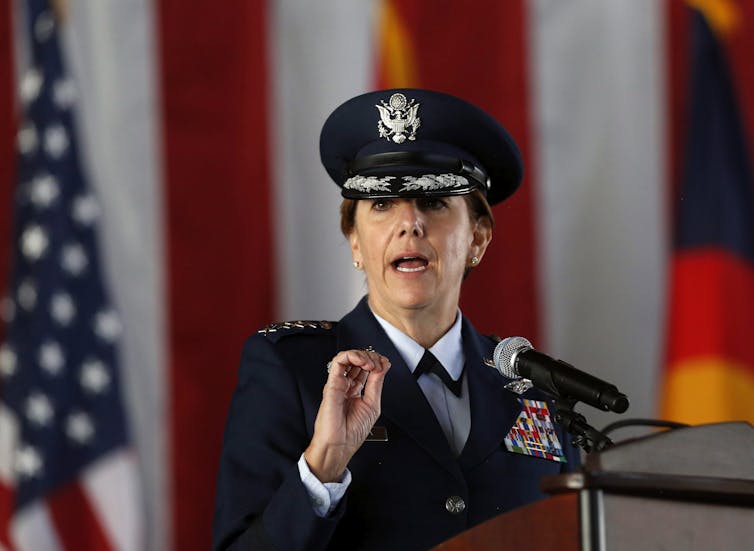
Lori J. Robinson, the first woman to lead a top-tier U.S. military command, is seen in this May 2016 photo in Colorado. (AP Photo/Brennan Linsley)
This speaks to the truly remarkable nature of the binational agreement. NORAD is charged with the combined defence of both the U.S. and Canada, and the commander of NORAD is responsible to the highest levels of both governments via the Secretary of Defense and the President on the American side, and to the Minister of Defence and the Prime Minister in Canada.
Canadian in charge on 9/11

A Canadian, however, may find himself or herself responsible for the air defence of both states during a crisis, as was the case when then Maj.-Gen. Eric “Rick” Findley of the Royal Canadian Air Force was on watch as director of operations on 9/11, overseeing both Canadian and U.S. personnel at NORAD’s Cheyenne Mountain Operations Center.

The Canadian contribution also includes its NORAD regional headquarters based in Winnipeg, the maintenance of the North Warning System in the Arctic that provides vital aerospace surveillance information, data on maritime activity approaching North America and fighter jets to intercept potential threats.

Canada’s smaller military force, including approximately 150 personnel at NORAD headquarters in Colorado Springs, contributes a lot to NORAD. But that contribution isn’t well known, nor is the importance of NORAD to both countries fully appreciated.

NORAD today is largely out of sight and out of mind, best known as the organization that “tracks Santa.”

Image result for norad

The organization, however, has evolved, adapted and modernized, providing aid to drug interdiction missions in the 1980s and adding a maritime warning mission in 2006 to its aerospace warning and control missions.

Both the U.S. and Canada reflexively point to NORAD as proof of excellent relations between the two countries. And yet, few outside NORAD grasp the significant changes that have taken place and will need to be made in the very near future if NORAD is to continue to “deter, detect and defeat” threats to North America.
Questions and the need to adapt

First, threats can originate from multiple domains: Air, sea, cyberspace, aerospace, land and space to threaten North America. Does a command with responsibility in only three of the domains —air, aerospace and maritime — still make sense?

Second, is NORAD currently organized optimally to react to threats? Does it make sense for the commander of NORAD to be involved in operational-level decisions (for example, allocation of NORAD aircraft to specific regions) or should the Commander and her team focus their attention on broader strategic implications and how NORAD coordinates with allies and other combatant commands?

Third, does NORAD have the right information at the right time to make decisions? Given that a vital source of such information comes from an aged North Warning System about to reach its end of life, what could replace it, with what capabilities and at what cost?

And finally, what might be the future of NORAD in another 60 years’ time? Will Mexico be invited to join? Will Greenland play a greater role? Might NORAD become a multi-domain, multi-partner, multi-mission North American defense command, dropping reference to “aerospace” altogether?

No organization is more focused on all of these questions than NORAD itself, but what about the Canadian and U.S. governments and Canadian and American citizens and stakeholders?

On NORAD’s 60th birthday, a good start to looking ahead would be to pause and consider the contributions, challenges and failures of the command and reflect on its six decades of adaptation.

Anniversary celebrations will be held in Colorado Springs on May 12 and in Winnipeg on May 24.

And if you look to the sky in those cities, you may see a reminder of NORAD and its constant watch over North America with a fighter jet flyby. Such an important binational agreement, coupled with potentially significant changes in the future, merits all of our attention.

Image result for norad

Monday, April 24, 2017

RCAF CF-18s intercept Russian bombers for first time in 2 years

The Canadian Press 

OTTAWA—Canadian fighter jets have intercepted Russian bombers off Canada’s northern coast for the first time in more than two years, as relations between Moscow and the West continue to worsen.

A Canadian Forces CF-18 makes a highspeed afterburner turn at the Great Lakes International Air Show.
A Canadian Forces CF-18 makes a highspeed afterburner turn at the Great Lakes International Air Show
Two CF-18s were scrambled on Thursday after North American early-warning air defences spotted two TU-95 Bear bombers approaching Alaskan and Canadian airspace from the west around 7 p.m.

The long-range bombers, which can carry nuclear weapons, were also tracked by U.S. F-22 jets based out of Alaska, said North American Aerospace Defence Command spokeswoman Maj. Jennifer Stadnyk.

Stadnyk said the Russians never entered Canadian or American airspace, and acted “professionally and safely” before returning to their home base.

The incident marked the first time since December 2014 that Canadian fighter jets have been scrambled to intercept Russian military aircraft flying in the Far North.


It was also the fourth time in as many days that Russian aircraft have been spotted approaching North American airspace. Norad also dispatched F-22s on Monday to track Bear bombers that were flying near Alaska.

Two TU-95s were also spotted near Alaskan airspace on Tuesday while two IL-38 maritime patrol aircraft were tracked on Wednesday, though Norad opted not to scramble fighters in either case.

“We haven’t seen this level of activity since July 2015,” Stadnyk said, though she added: “It’s not unprecedented. What they’re doing this week is very similar to what they used to do.”


Such Russian bomber flights over the Far North were a regular occurrence between 2012-14, Stadnyk said, before the TU-95s were grounded over safety concerns.

One of the bombers skidded off a runway on June 8, 2015, and caught fire, killing a crew member and injuring several more.

The resumption of Russian flights over the Arctic this week comes at a key moment for Russia and the West, whose relationship has reached what U.S. Secretary of State Rex Tillerson recently called “a low point.”

Ties between Moscow and Washington have been particularly strained ever since the U.S. launched a cruise-missile strike against Syria, which it blamed for a chemical attack that killed more than 80 people earlier this month.

Relations between Ottawa and Moscow have not been spared, despite the Liberal government’s initial plan to re-engage Russia.

Prime Minister Justin Trudeau called out the Kremlin earlier this month for supporting the Syrian government of president Bashar Assad, who is widely seen by the West as being responsible for the attack.

More than 450 Canadian troops are also preparing to head to Latvia in the next few weeks, where they will lead a NATO force intended to check Russian aggression in eastern Europe.

And Foreign Affairs Minister Chrystia Freeland remains on a list of individuals banned from visiting Russia, after Canada slapped the country with sanctions for annexing Crimea in 2014.

Steve Saideman, a political science professor at Carleton University’s Norman Paterson School of International Affairs, said the Russians could be trying to send a signal to the Trump administration.

But he noted the Russians have been conducting such military flights throughout Europe and Asia for years, “so if it’s a message to Trump, what’s the message?”

Tuesday, February 7, 2017

Sajjan's Statement Following Meeting with SoD Mattis


Defence Minister Harjit S. Sajjan today issued the following readout after his first meeting with new U.S. Secretary of Defense, James Mattis:

"Today I had the pleasure of meeting with U.S. Secretary of Defence James Mattis. The warm, cordial tone of the discussion reflects the long-standing, close partnership between Canada and the United States, particularly when it comes to defence and security. "The close defence relationship between our two nations provides both countries with greater security in North America and contributes to peace and stability in the world in increasingly complex and uncertain times.

"With 2018 marking the 60th anniversary of NORAD, I was pleased to highlight the importance of this unique partnership and its success in protecting North America, and we looked forward to working together on its modernization. Secretary Mattis and I also discussed multilateral issues, including our pledges to lead battle groups in support of NATO's enhanced forward presence in Eastern Europe, our commitments to the United Nations and the Summit of Defence Ministers that Canada will host later this year. We discussed our training missions in both Ukraine and Iraq and the work being done by the Global Coalition to degrade and defeat Daesh. I also took the opportunity to discuss Canada's Defence Policy Review.

"We discussed Canada’s decision to launch an open and transparent competition to replace our legacy fleet of CF-18 fighter aircraft, and to explore the immediate acquisition of 18 new Super Hornet fighter aircraft as an interim capability. I expressed my appreciation to the secretary for the support and cooperation of the US Government in these processes.

"Secretary Mattis and I pledged to work closely together and look forward to our next meeting at the upcoming NATO defence ministerial later this month. "I want to thank Secretary Mattis and Pentagon officials for the warm welcome in Washington and look forward to hosting Secretary Mattis in Canada."

Tuesday, November 29, 2016

Canada's New Super Hornet Plans Possibly Illegal say Critics

By: David Pugliese, Defense News 

RCAF CF-18's (Globe and Mail File Photo)
VICTORIA, British Columbia – The Canadian government’s proposal to buy 18 Super Hornet aircraft as a stopgap measure before proceeding to a full competition for a new fighter jet is not only a waste of time and money but illegal, say political and industry critics of the plan.

Defence Minister Harjit Sajjan announced Nov. 22 that Canada would enter into negotiations with Boeing for the purchase of the 18 aircraft. Sajjan noted the government had been forced to proceed with the urgent acquisition because a capability gap had emerged with the current fleet of CF-18 fighters. Canada cannot meet its NORAD, NATO and other defense commitments with those aging aircraft, he added.


But Canada’s former procurement chief says the Super Hornet deal is illegal and can be challenged if Lockheed Martin or other aircraft firms wanted to do so. Existing trade agreements allow for Canada to proceed with a purchase without competition if there is an urgent and unforeseeable need for goods and services required by the military, said Alan Williams, the former assistant deputy minister for materiel at Canada’s Department of National Defence.

“A capability gap that was allowed to grow over many years is hardly unforeseeable," said Williams. “Bad planning is not an excuse for sole-sourcing.”

Williams noted the Liberal Party government has been in power for a year and already had enough information to launch a full competition for a permanent fighter replacement.

Lockheed Martin officials have expressed their disappointment in the government’s decision to buy Super Hornets but the firm has not indicated its next course of action.

Liberal Party Prime Minister Justin Trudeau vowed his government would hold a competition for a new jet. But he also made an election promise last year that Canada would not buy the F-35 as it was too expensive and didn’t meet the country’s needs.

James Bezan, the defense critic for the Conservative Party, said the CF-18 capability gap issue was concocted to support the sole-source purchase of the Super Hornet. The country’s 77 CF-18 fighter jets are capable of doing the job until a full competition can be held to buy a new plane, he added.

Bezan said the decision to buy Super Hornets as a stopgap solution will end up wasting billions of dollars and valuable time needed to replace the CF-18 fleet.

Sajjan has said it will take at least another five years to run a competition to buy a fleet of jets to replace the CF-18s on a permanent basis. The government has said Lockheed Martin is welcome to enter the F-35 in that competition when it is held.

Questions have also been raised about the validity of the Sajjan’s claim that the CF-18s can’t defend the country.

When Lt. Gen. Michael Hood, the commander of the Royal Canadian Air Force, testified in April before the Commons defence committee, he didn’t mention a capability gap. Instead he told lawmakers the CF-18s could continue operating until 2025 or beyond.

Concern has also been voiced about how the Super Hornet purchase will affect Canadian industry participation in the F-35 program.
Canada has said it intends to continue as a partner in the program but Lockheed Martin suggested several months ago it could reconsider participation by Canadian companies if the F-35 is not purchased.

Brian Pallister, the Conservative Party premier of the province of Manitoba, said the Super Hornet acquisition is not only a waste of tax dollars but could jeopardize aerospace firms involved in the F-35 program.

Pallister said he was particularly concerned about Magellan Aerospace in Winnipeg, a company that makes the tail assemblies for the F-35 as well as other components.

But Navdeep Bains, the government minister in charge of industry and innovation, said any deal for the Super Hornets would bring with it the equivalent amount of work for Canadian firms.

Tuesday, October 18, 2016

Exercise VIGILANT SHEILD Starts - RCAF CF-18s and CH-149s involved

DND Press Release

Exercise Vigilant Shield has started.

“The Canadian North American Aerospace Defense (sic) Command (NORAD) Region has begun its participation in NORAD’s annual VIGILANT SHIELD field training exercise,” the news release from the Canadian Forces noted. “The live-fly field training exercise, which will run October 17 to 21, is part of a larger series of annual NORAD VIGILANT SHIELD exercises that take place throughout the United States and Canada.”

VIGILANT SHIELD 17 will see NORAD building on previous training in North America’s northern aerospace and in the high Arctic, according to the release.

Exercise VIGILANT SHIELD 17 will see the deployment of:

– Royal Canadian Air Force (RCAF) CF-18 Hornets to Inuvik, N.W.T.;

– U.S. Air Force (USAF) F-15 Eagle fighter jets to Yellowknife, N.W.T.;

– USAF E-3 Sentry airborne early warning and control aircraft and KC-135 Stratotankers to 5 Wing Goose Bay, N.L.;

– an RCAF CH-149 Cormorant search and rescue (SAR) helicopter and 42 Radar Squadron to Canadian Forces Station Alert;

– an RCAF CH-149 Cormorant SAR helicopter and CC-130H Hercules SAR aircraft to the USAF’s Point Barrow Long Range Radar Site in Alaska; and

– Canadian Army personnel to provide on-site security support.

Monday, June 13, 2016

Fisher: Super Hornets will force Canada out of its own Arctic


F-35-1
Critics of the F-35 will laugh and say this is hyperbole and melodrama. It is not. Keeping the U.S. safe is the top priority of every U.S. president. If Canada cannot or will not protect its Atlantic, Pacific and northern approaches, its NORAD treaty with the U.S. permits Washington to do so.

Russia announced last week that its air force will begin deploying its first stealthy T-50 fifth-generation jet fighters next year. Such a timeline is highly doubtful. But Vladimir Putin has no higher priority than acquiring stealth technologies and, within a decade, T-50s will be deployed at air bases across the top of Russia.

Once this happens, and with threats from T-50-launched cruise missiles and Russian and North Korean intercontinental ballistic missiles (ICBMs), which fifth-generation aircraft such as the F-35 will be far more able to shoot down than Super Hornets, the reality is that the U.S. will do whatever it has to to defend itself.

That will mean patrolling Canada’s margins with USAF F-35s, which will use fighter jet-capable airfields in Iqaluit, Rankin Inlet, Inuvik and Yellowknife built mostly with U.S. money in the 1980s.

Worse than that, Washington will insist that Canada’s Super Hornets stay in the rear.

The reason is clear. Four allied air forces operate in the Arctic. The U.S., Norway and Denmark, which defends Greenland and sometimes deploys fighter jets to a base they jointly operate with the USAF at Thule, will soon only be flying state-of-the art F-35s in the Far North. The other country, Canada, will not.

The F-35 is revolutionary in that it will basically be a flying computer with sensor fusion. F-35s flying hundreds of kilometres apart will be able to create a common battle picture. Being stealthy, they will secretly patrol far more safely while collectively surveying vast amounts of territory for information that they can instantly share with each other, spy and command aircraft and ground stations.

Once the Super Hornet is found, as it will be by a stealthy enemy, F-35s in the vicinity will become targets, too. That is why the U.S. will not want Canadian fighters operating anywhere near its warplanes in the north.

A new argument advanced by the government last week is that there is a “credibility gap” for NATO and Norad with the existing F-18 Hornets that must be immediately filled by an interim purchase of Super Hornets. NATO and Norad people have privately but emphatically insisted that no such crisis exists and will not exist for about a decade, so there is no reason for Canada to rush to make a decision.

As for this being sold as an interim buy, with a decision on the F-35 later, this is a red herring. Canada has neither the money nor the military infrastructure to support two fleets of fighter aircraft.

An older but still persistent argument to support the Super Hornets is that it will be safer to operate in the Far North than the one engine F-35s. Advances in civilian and military jet engine technology long ago made such thinking obsolete. Otherwise, the Pentagon would not have decided that only F-35s will fly from its most northern air base near Fairbanks, Alaska.

The Super Hornets’ advantages in range, payload and an extra engine are irrelevant if the aircraft is not survivable. The Super Hornet will not be invisible to radar so, at a certain point in the not too distant future, it will be shot down long before it can engage the enemy.

With the U.S. defending Canadian air space because of Ottawa’s refusal to buy F-35s, what the RCAF will eventually end up with in the north is a niche capability in air/sea rescue.

That Canada is prepared to cede its defence and sovereignty over all three maritime approaches to the USAF is one of the many reasons that there is extreme disappointment and disbelief across the upper reaches of Canada’s military community about what has been decided. What makes them furious is the government’s refusal to discuss the matter.

Finland has looked at the numbers that Denmark came up with after a competition in which it chose the F-35 over the Super Hornet. As a result, the Finns are believed to be close to deciding that they, too, will reject the Super Hornet in favour of the F-35. If Finland follows Denmark’s lead, it will become the 12th western-oriented air force in a row to choose the F-35 over the Super Hornet, with Canada the only exception.

Canadians should ask themselves: Is everyone who made those decisions — including those confronting similar security challenges in the Arctic — stupid? What is it that makes Canada so unique that it feels it can ignore the collective wisdom of all its allies and friends?

There are no two more important issues for a government than national defence and sovereignty. Such matters must be settled fairly and as transparently as possible. Have the promised open competition to decide what aircraft is best to defend Canada for the next half-century

By: Matthew Fisher, The Ottawa Citizen 

LONDON — The most questionable aspect of Prime Minister Justin Trudeau’s quixotic decision to renege on the promise of an open competition for Canada’s next fighter jet and suddenly ram through the sole-source purchase of Super Hornets — a decision Postmedia News has revealed it is close to making — is that, by doing so, Canada will end up surrendering sovereignty of its Arctic air space to the United States Air Force in about 10 years.

Wednesday, June 8, 2016

CF-18's Scrambled for Drone near Ottawa Airport

By: BRUCE CAMPION-SMITH, Ottawa Bureau, Toronto Star 

OTTAWA—Two CF-18 fighter jets were scrambled into the skies over Ottawa after reports of a large drone flying near commercial jets, the Star has learned.

The fighters were dispatched from their base in Bagotville, Que., and were quickly over the nation’s capital after the pilots of two arriving airliners spotted the unmanned aerial vehicle during their approach into Ottawa’s airport on May 25.

While the presence of drones has become increasingly common over Canadian cities, scrambling fighter jets to intercept them is a rare occurrence, suggesting this incident jangled nerves among security officials.

“What we’re concerned with from a NORAD perspective, obviously, is any unidentified aircraft,” said Maj. Steve Neta, senior public affairs officer for the North American Aerospace Defence Command Canadian region headquarters.

“It’s a relatively new phenomenon . . . something that everyone is trying to deal with and to address. It’s certainly not common for us, from a NORAD perspective either.

“The risk that these things could pose to aircraft, considering a large airliner approaching an airport . . . is significant.”

Neta could not say why fighter jets were deployed in this incident. But the fact it was a large drone, flying over the nation’s capital probably all factored into the decision to scramble the jets.

“It’s something that we’re definitely taking very seriously,” he said.

Federal Transport Minister Marc Garneau said the incident underscores growing worries about the proliferation of drones in Canadian skies.

“We are hearing more and more from pilots . . . that they are spotting drones at different altitudes near airports,” Garneau told the Star Tuesday.

The airspace around Ottawa airport — like most major airports in the country — is controlled by air traffic controllers to ensure the safe separation of aircraft.

As well, some airspace in the Ottawa area is barred to low-flying aircraft because of security concerns, such as over the Parliament buildings, Rideau Hall, the prime minister’s cottage retreat in Quebec’s Gatineau Hills, and the secret training facility for JTF2, Canada’s special forces soldiers.

While it’s not clear whether the drone violated any of that restricted airspace, it had no authorization to fly into the airspace overseen by air traffic controllers.

The pilots of an arriving WestJet Boeing 737 were the first to report the aerial intruder at 2,042 metres during their descent into Ottawa airport.

“Just to let you know that we just flew pretty close to a drone,” the pilots told the controller, according to a recording available on LiveATC.net.

About 11 minutes later, the controller alerts the pilots of an Air Canada jet arriving from Toronto about the drone, telling them of a target he’s got on radar.

“Type and altitude unknown. It might be that drone,” the controller said.

“Thanks for the heads up,” the Air Canada pilot replied

The controller called with another warning a few minutes later — the target is now 1.2 km off the left wing of the Air Canada Airbus A320 jet.

“I see him there now. Yeah, a couple of thousand feet below me and yeah, I can see the drone,” the Air Canada pilot replied.

It was soon after that last report that the CF-18s — on standby as part of their duties for North American air defence — were scrambled from Bagotville.

“They did go over Ottawa to investigate the reported area where the drone was reportedly spotted. They did a pretty thorough search of the area and weren’t able to find anything,” Neta said.

“Our fighters were not able to make any positive identification.”

With an hourly operating cost of about $8,700, the price tag to scramble the two fighters for the 90-minute mission would have clocked in at about $26,000.

The incident was turned over to the RCMP for follow-up.

Garneau said the department is moving on two fronts to counter the possible risks of drone flights.

“We’re working very hard to put in place not only the education but also the regulation. This is something that has exploded all over the world,” the minister said.

Transport Canada laid out a proposal to regulate drones last year. The rules would apply to drones weighing 25kg or less and would set out requirements to have the drones marked with a four-letter registration for identification. It would also require training for those operating them.

The federal regulator says growing sales of drones have given rise to “novice pilots” who are in the dark about aviation rules and lack the knowledge to operate the devices safely.

Those operating drones heavier than 25kg are currently required to get special authorization from Transport Canada.

In the meantime, Transport Canada is educating drone operators about existing rules. Those include not operating them within nine kilometres of an airport, not flying them higher than 90 metres, not allow them to travel beyond line-of-sight.

Thursday, May 12, 2016

Sajjan in Washington for meetings; including with Sen. McCain

DND Press Release:

Defence Minister Harjit S. Sajjan will participate in a roundtable meeting hosted by the Atlantic Council in Washington, D.C., on Thursday, May 12, 2016. Minister Sajjan will then travel to Capitol Hill for meetings with senior officials, including U.S. Senator John McCain.

During his meetings, Minister Sajjan will be discussing a number of issues currently being examined as part of Canada’s ongoing defence policy review, including continental defence.

Following Washington, Minister Sajjan will proceed to Peterson Air Force Base in Colorado Springs for the North American Aerospace Defense Command (NORAD) and U.S. Northern Command (USNORTHCOM) Change of Command ceremony on Friday, May 13, 2016

Tuesday, May 3, 2016

RCAF Preparing for RIMPAC 2016

RCAF News Release

By Major Mark Patterson

Exercise Rim of the Pacific (RIMPAC) is the world’s largest international maritime exercise, involving nations with an interest in the Pacific Rim region. The exercise, led by the United States Navy, is conducted every two years from the Hawaiian Islands and Pearl Harbour.

Canada has participated in every RIMPAC since its inception in 1971, when it was an annual exercise; in 1974, it became a biennial exercise due to its size. The 2014 exercise involved 47 ships, six submarines, more than 200 aircraft and about 25,000 personnel from 22 nations.

The enormous exercise provides an opportunity for all Canada’s services – Royal Canadian Navy, Canadian Army and Royal Canadian Air Force – to train with international allies and partners. As of late April, the exact date of RIMPAC had not been announced by the U.S. Navy, but it generally takes place in the July timeframe.

Although RIMPAC is a navy-led exercise, it involves a strong air power component. To prepare RCAF personnel who will deploy on the 2016 exercise, the Canadian Forces Aerospace Warfare Centre (CFAWC), located in Trenton, Ontario, devel­oped and delivered an air operations centre (AOC) familiarization training session from March 21 to 24, 2016. Three more training sessions will take place in the weeks to come.

The RCAF will have a lead role in the RIMPAC combined air operations centre. Approximately 80 air force personnel will deploy, including Brigadier-General Blaise Frawley, the deputy commander of 1 Canadian Air Division, located in Winnipeg, Manitoba, who will hold the position of joint force air component com­mander during the exercise.

The air operations centre provides operational-level command and control of air and space forces to accomplish joint force commander and air component commander objectives. The air operations centre plans, directs and assesses air operations to enable centralized control and decentralized execution of theater-wide operations at the com­ponent or joint task force level. Its structure is “task tailorable” to the mission or theatre, as well as the type of operations to be conducted.

CFAWC’s familiarization package provided a detailed explanation of command and control relationships, particularly as they apply at the joint-force level. As well, the training illustrated how an air operations centre performs operational-level planning and coordination: upward with the joint force commander; horizontally with land, sea and special operations components; and downward with wings or air expeditionary wings.
RCAF CF-188 Hornets arrive at Joint Base Hickam-Pearl Harbor in Hawaii to participate in the 2014 Rim of the Pacific (RIMPAC) Exercise. The RCAF is preparing for participation in the 2016 edition of the exercise. PHOTO: Sergeant Matthew McGregor, IS2014-1022-03
RCAF CF-18 Hornets arrive at Joint Base Hickam-Pearl Harbor in Hawaii to participate in the 2014 Rim of the Pacific (RIMPAC) Exercise. The RCAF is preparing for participation in the 2016 edition of the exercise. PHOTO: Sergeant Matthew McGregor, IS2014-1022-03
Throughout the training session, the instructors passed along the knowledge and experience they have gained from employment in domes­tic and coalition air operations centre, using lectures and guided discussions to assist the students in understanding their roles and responsibilities within the centre.

The training session also provided an understanding of the continuous air planning cycle and allowed RIMPAC staff to meet as a group – as well as receive their initial guidance directly from Brigadier-General Frawley, RIMPAC 2016’s joint force air component commander.

With files from the Department of National Defence and United States Navy.

Replacement for CC-150T Polaris will wait until CF-18 Replacement

By: David Pugliese, Defence Watch 

The RCAF has plans to replace its CC-150 Polaris refuelling tankers but is holding off until the Liberal government makes its decision on what type of aircraft will be selected to replace the CF-18s.

“That will determine the requirements of the next tanker aircraft,” RCAF commander Lt.-Gen. Michael Hood recently explained to MPs. “So whether it is a probe-and-drogue, as we use right now, or a boom that flies into a refuelling receptacle, we will replace the tanker aircraft with whatever our front-line fighter is at the time.”

“We know that the lifespan of the Airbus is 2026 right now, so that decision has to be taken regardless,” he added.

Hood also pointed out that of Canada’s two Polaris aircraft, one is assigned to the Iraq mission and the other is in heavy maintenance and not available. (There is a C-130 refueling aircraft available out of Winnipeg for NORAD duties, he added.)

Privately military officers suggest the Liberal government’s decision on a CF-18 replacement is a long way off.

Hood suggested there are ways to deal with potential delays in any Polaris replacement program.

“In fact, recently we leased a tanker to bring some aircraft back overseas,” he revealed. “There are options that will allow us to mitigate whatever program challenges we have.”

Monday, May 2, 2016

CDA Instutute Releases Vimy Paper on BMD

Originally published by Frontline Defence 

The Conference of Defence Associations Institute (CDA Institute) has released Vimy Paper 31: "Canada, NORAD, and Missile Defence: Prospects for Canadian Participation in BMD" by David McDonough.

The Canadian government recently launched its Defence Policy Review, expected to be completed by early 2017. The Department of National Defence also released a consultation paper that offered an overview of the issues facing the Canadian Armed Forces and key questions meant to guide public consultations as part of this review process. Of note, the document raised the previous government's 2005 decision to refuse participation in the US ballistic missile defence (BMD) system, and asked whether it was time to revisit this decision "given changing technologies and threats?"

This Vimy Paper explores the debate about Canada's possible participation in US missile defence plans, and assesses the advantages and possible disadvantages of such a commitment. The paper begins by examining the Canadian role in the North American Aerospace Defence Command (NORAD), particularly the implications if NORAD fails to be directly involved in BMD. It then looks at the possibility of Canada receiving some protection in a BMD system, possible scenarios in which such protection would be required, and the likely contributions necessary if Canada wants to participate in missile defence and receive a modicum of protection. Lastly, the paper disentangles and assesses some of the key arguments used by critics against BMD.

By directly participating in BMD, Canada would reinforce the status of NORAD, strengthen the Canada-US defence relationship, and potentially ensure an important element of protection against ballistic missile threats. Canada will likely have to offer an "asymmetrical" or "in-kind contribution" if it hopes to receive protection afforded by the BMD system, so the question of cost needs to be further assessed. Lastly, criticism of BMD have often been either overstated or hampered by a degree of logical inconsistency or dissonance. As the Vimy Paper concludes, for these reasons, Canada should begin discussions with the United States on this issue - to better ascertain the costs Canada may be expected to shoulder for participation and ultimately to become an official participant in BMD.

The paper is available at the following link:
http://www.cdainstitute.ca/images/Vimy_Papers/Vimy_Paper_31.pdf

Monday, April 25, 2016

CF-18 Life-Extension Risks; Canada looks to fly fighters past the age of 40.

By: Daniel Maillet, CAF Dispatch author
April 25, 2016

As Canada's Defence Review gets started the debate as to which fighter should replace the Royal Canadian Air Force's aging CF-18 Hornet's continues - despite the fact that much of the budget for their replacement has been postponed until after 2021. Something that could cause major problems for the RCAF.

The CF-18s are going through another life extension to keep the fleet air-worthy until 2025; but that is based on a 5 year acquisition rate of a new fighter; which would mean a contract awarded sometime soon - and not in 2021-2022 as the current budget figures would seem to show. According to senior members of the RCAF; if the current life extension is not complete by 2021, it is not economically viable - as more upgrades will be needed. Just because this extension date is 2025 - does not mean the fleet will be retired in 2025; but the risks get much higher when flying a combat aircraft over 40 years old. If the entire fleet is retired in 2025, the oldest aircraft will be 43 years old.

But according to the RCAF plans are in place for a 2025-2030 life expectancy plan for the ageing CF-18s.


The CF-18 Hornet entered service in 1982 as a multirole fighter/interceptor replacement for the CF-5 Freedom Fighter, the CF-101 Voodoo and the CF-104 Starfighter. The Hornet fleet’s Estimated Life Expectancy (ELE) was initially set to 2003, which represented a service life of 20 years after the declaration of Initial Operational Capability. This value was based upon projected initial usage when calculated against the original equipment manufacturer’s certified design life.

In the case of the CF-18 fleet, early structural lifing concerns led to the implementation of a structural fatigue life management program (FLMP) in 1988, and a collaborative full-scale structural fatigue test program with the Royal Australian Air Force (RAAF) to re-certify the CF-18’s design life based on Canadian and Australian usage. This collaborative effort was known as the International Follow-on Structural Test Program (IFOSTP) and was completed in 2006. Results from this test program formed the basis from which the CF-18 Hornet’s structural Life Extension Program (LEP) was developed. As the aircraft’s structural life is an airworthiness limitation, it is an important factor in calculating a realistic ELE.

The implementation of the FLMP, a LEP tailored to Royal Canadian Air Force (RCAF) usage requirements, changes to how the CF-18 was flown, and reductions in the planned yearly flying rate (YFR) over the years have all combined to extend the CF-18’s projected physical life.  The CF-18 ELE was extended to 2020 with an assumed three-year overlapping transition window to a new fighter (i.e. 2017-2020) following an extensive study first started in 2004. 

The problem however, is the RCAF has now entered this period; and no replacement has been chosen. Therefore, the CF-18 ELE has once again been examined to determine if it can be viably extended beyond 2020. The analysis for this report assessed the option of extending the CF-18 ELE to 2025 and 2030, using a new five year overlapping transition window to a new fighter.

An ELE of 2020-2025 represents a target beyond which significant structural investments will be required to maintain the fleet’s airworthiness. As such, it represents an ELE extension for modest cost while still resulting in reasonably low to moderate technical and operational risk respectively.

An ELE of 2025-2030 represents a technically feasible albeit risky stretch target. It would require the entire fleet to undergo the Control Point 3 (CP3) Life Extension Program (LEP) along with other significant structural refurbishment investments. This option is a high risk solution, from both a technical and operational perspective.

The operational relevance of the CF-18 Hornet is assured until 2020. Based on the analysis conducted during the Operational Analysis phase of the Next Generation Fighter Capability (NGFC) project, the modernized CF-18 avionics suite remains compliant with the current interoperability requirements of other Canadian services and allies until 2020. However, beyond 2020, some core CF-18 avionics systems will need to be upgraded.

The CF-18 was a leading edge state-of-the-art fighter when it was introduced in the 1980s and it gradually fell behind over time until during the Kosovo conflict it had reached the ‘back edge’ of coalition capability. The capability upgrades over the last 10 years have resulted in the CF-18 again being near the ‘front edge’ during the 2011 Libya operations. This capability has once again  began to erode over the remainder of the Hornet’s service life as technology continues to evolve.

CF-18 fleet size has decreased 44% since the aircraft were purchased due to attrition (operational losses due to accidents) and the management decision to retire older configuration aircraft which would have required significant NRE costs to modernize to the current configuration. Current fleet size is sufficient to meet CFDS commitments; however the flexibility to withdraw significant numbers of aircraft for required upgrades has decreased significantly. Any decision to pursue lengthy and complex upgrades would result in a commitment-capability gap.

With the above information; it would seem that the Canadian Government needs to move forward on a replacement for the CF-18s, or else Canada risks entering a period with a higher attrition rate of older aircraft and a significant capabilities gap in our areal defences.

Sources: 

Wednesday, April 20, 2016

BMD Debate: NO ‘SPECIFIC’ MISSILE THREAT TO CANADA - Says General

By: Lee Berthiaume, National Post (National Edition)

WE ARE IN A SPHERE WHERE WE COULD BE TARGETED.
ADRIAN WYLD / THE CANADIAN PRESS There has been a “proliferation” of ballistic missiles since former prime minister Paul Martin opted not to join the U.S. missile defence program in 2005, says Lt.-Gen. Pierre St. Amand, left, a deputy commander with NORAD.
A Canadian senior military commander responsible for protecting against airborne threats to North America says Canada would not be shielded from a ballistic missile attack.

But he also admitted he did not know of any direct ballistic missile threat to Canada.

Lt.-Gen. Pierre St. Amand, deputy commander of the joint U.S.-Canadian aerospace defence system, NORAD, made the comments Tuesday when he appeared before the House of Commons defence committee where ballistic missile defence was front and centre.

The Ottawa Citizen revealed this week the Liberal government’s defence review includes questions about whether Canada should join the U.S. in building a shield against foreign-launched missiles.

While the New Democratic Party opposes Canada’s participation, several Conservative MPs, including former defence minister Jason Kenney, favour reopening the debate.


St. Amand listed ballistic missiles as one threat among the many NORAD watches for every day. The difference between it and other threats is it is the only one in which Canada would not have a say in how to respond, he said.

“Canada will be advised (of an attack),” he said. “With respect to the defence itself, we’ll know that there is going to be an action taken because we’re sitting in the room … We’re kind of a silent observer, if you want.”

There has been a “proliferation” of such weapons since then-prime minister Paul Martin opted not to join the U.S. missile defence program in 2005, St. Amand said, before referring to recent developments by North Korea and Iran.

The U.S. spent about $100 billion over the last decade to develop land- and sea-based systems that would stop a limited ballistic missile attack from rogue states, like North Korea or Iran. (They would not protect against an all-out attack by Russia or China.)

St. Amand agreed with an opposition assessment that if there were an attack, the Americans’ ballistic missile defence system would only be used to protect the U.S.

But he added he did not know of any direct ballistic missile threat to Canada from North Korea or elsewhere. Rather, it could be targeted during a war because of its alliances with the U.S. and NATO.

“There’s nothing specific that I can talk about,” he said when asked about direct threats. “The fact that we have signed up to certain alliances, NATO, for example, and we are closely aligned with the United States, means we are in a sphere where we could be targeted.”

NDP defence critic Randall Garrison said the comment was proof Canada does not need to join ballistic missile defence.

“If there’s no credible or realistic threat from a state actor to Canada, then why would we enter into (missile defence)?” he asked.

But Conservative defence critic James Bezan said with North Korea and Iran continuing to develop ballistic missile technology, Canada needs to be prepared.

“They may be aiming for the United States, but (Iranian or North Korean missiles) could fall into Canadian territory,” he said. On a visit to Washington, Kenney also spoke in favour of Canada reexamining the issue.

Tuesday, April 19, 2016

Boosting CAF UN Peace Operations: Proceed with caution


BY DAVID MCDONOUGH, CDA Institute,


David McDonough, CDA Institute Research Manager and Senior Editor, recently published an article in The Embassycommenting on the government’s promise to renew Canada’s role in UN peace operations. 

The new Trudeau government has shown an interest in renewing Canada’s commitment to United Nations peace operations. The ministerial mandate letter given to Defence Minister Harjit Sajjan and Foreign Minister Stéphane Dion spelled out this promise quite clearly, even if neither went into much detail on how this commitment will be realized.

A key problem is the commitment’s lack of context. By itself, it is hard to argue that renewing Canada’s role in UN peace operations is a bad thing. But such policy options cannot be judged in a vacuum. They must be placed within a context that recognizes the national interest, competing policy priorities and limited resources available to achieve such priorities, as well as the inevitable trade-​offs that come with such a means-​ends chain. Such a commitment should more properly be assessed as part of the government’s recently announced defence policy review.

The three pillars of priorities

It’s useful to return to the key priorities outlined in the last defence white paper: defence of Canada, continental defence, and international security. In some respects, these three reflect a rising degree of discretion for Canadian decision-​makers: no discretion when it comes to Canada, very little for North America, and greater discretion in how we approach expeditionary operations abroad.

Clearly, UN commitments relate to international peace and security. Canadian decision-​makers need to ensure that their non-​discretionary priorities are achieved first—such as monitoring our coastal waters, aerospace surveillance and defence of North America, search and rescue, and protection of our Arctic sovereignty and resources—before opting for more discretionary missions abroad like UN peace operations.

Yet not all missions in the third pillar are created equal or are equally discretionary. Canada also has the option of working primarily with key allies in pursuit of international security, including the United States, key European countries in NATO, as well as Australia, New Zealand, and Japan, among others. In so doing, Canada can better align its military role abroad with its interest in maintaining and strengthening relations with such countries.

The same cannot readily be said about UN operations, which might help burnish Canada’s reputation with the world body but where the national interest is hard to identify—a fact that will undoubtedly cause problems if and when a UN mission results in casualties.

A different, more dangerous, era

Such a possibility should not be discounted. Today’s UN missions are distinct from the past. Current missions retain the size and complexity of post-​Cold War operations, but now Blue Helmets can quickly become a participant in the conflict, such as when an “intervention brigade” was mandated to neutralize armed groups in the Democratic Republic of Congo.

We need to understand and appreciate that the game has changed. Future so-​called peace operations, including those established by the UN, will likely require robust military capabilities and entail possibly more dangerous operations, especially if more UN peacekeepers begin to fully apply their more proactive mandates.

Importantly, if Canada does undertake peace operations, it might be better served working with key allies and organizations like NATO. Canada would gain the additional benefit of working with like-​minded states with advanced, interoperable militaries that can bring considerably more firepower and sophistication to any mission. In NATO’s case, Canada would benefit from an organization with a strong command structure and extensive experience with robust peace or stabilization missions in places such as Bosnia, Kosovo, and Afghanistan.

One should also remember the continuing gap between UN mandates and deployed forces. A good example is the hybrid UN-​African Union force in the Darfur region of Sudan, which despite a robust mandate adopted a non-​confrontational approach that has failed to halt attacks against both civilians and its own peacekeepers.

It might even be worse if peacekeepers began fulfilling their Chapter VII mandates to use force. Blue Helmets, not all of whom will be well-​trained or armed, will then likely be seen as more legitimate targets by non-​state armed groups with an increasingly sophisticated capacity for violence.

These missions can also not be easily separated from the wider post-​9/​11 environment, given the presence of jihadist groups from Boko Haram to Al Qaeda to ISIL (also called ISIS and the Islamic State) in numerous failed or failing states like Mali and Libya. This might increase the Canadian interest in undertaking such missions, but it also raises important dangers—from the possibility of our soldiers being specifically targeted to potential terrorist blowback both in Canada and to its interests overseas.

Context is key

This does not mean that Canada should eschew UN peace missions. But the Canadian government needs to take into account competing priorities and the possible dangers that could arise from such missions. Above all, strategic-​level thinking on the benefits, value, and possible costs and trade-​offs of undertaking these missions need to be carefully and diligently assessed.

In other words, if Canada chooses to undertake a significant UN mission, it needs to first ensure that this does not come at the expense of its non-​discretionary missions. Then it needs to assess its capacity to undertake such a mission in addition to its current operational tempo and, if that proves impossible, weigh the relative merits of a UN mission compared to other missions abroad, such as its role in NATO reassurance measures or as part of the Global Coalition to Counter ISIL.

Of course, Canada could try to avoid such trade-​offs by simply adding a significant UN role to its other commitments. But, absent a significant and sustained infusion of resources, this will prove exceedingly difficult.

What needs to be avoided at all costs is a fixation on UN peace operations that overshadows and supplants other priorities.This could endanger the non-​discretionary missions crucial for Canadian security and defence, as well as damage our relations with allies and long-​standing alliances like NORAD and NATO.

It could also have serious consequences to the future force structure of the Canadian Armed Forces. In light of budgetary shortfalls and recapitalization challenges, the government may be tempted to achieve cost savings by opting for an unbalanced force structure—one that is lightly armed, constabulary focused, and specializing in peace operations rather than combat-​capable, multi-​purpose, and joint.

Yet such a force would be ill-​suited for the range of missions (from constabulary to combat, and including robust peace operations) facing today’s CAF. It would also necessarily be manpower rather than capital intensive, meaning that the high personnel costs eating up much of the defence budget are unlikely to dissipate. As such, any cost savings will likely prove more illusory than real.

The strategic consequences of such a shorted-​sighted move will be severe and long-​lasting. Rather than simply affecting the government’s current choices, it would constrain the policy options available to Canadian decisions-​makers for decades to come. In that case, the Trudeau government’s adage that “Canada is back” may be remembered as more of a lament rather than the dawn of sunnier ways.

Originally published in The Embassy.

Dr. David S. McDonough is research manager and senior editor at the CDA Institute, and a research fellow at Dalhousie University’s Centre for Foreign Policy Studies.

Wednesday, April 6, 2016

Defence Minister to announce Public Consultations on new Defence Policy

Written by David Pugliese, The National Post 

Defence Minister Harjit Sajjan will announce Wednesday the beginning of public consultations on the country’s new defence policy.

Sajjan says he wants to have the policy completed by the end of the year.

The review would include details on the future size of the Canadian Forces, its roles and alliances and the type of missions it can expect to take on in the future.

Government sources told Postmedia Tuesday that they expect the public consultations to be finished by the end of July.

Department of National Defence sources say they expect to be flooded with presentations from defence analysts, groups and lobbyists pushing for more funding for the Canadian Forces as well as a plea to resist cutting back on the current size of the military.

But it is expected the Liberal government will follow the path it has already outlined during the federal election and move ahead in developing an “agile and lean” Canadian Forces.

Related Stories:
Retired Canadian general aims blunt message at Liberal government ahead of defence review
Conrad Black: Canada’s planned defence review is an opportunity for our nation to take a giant stride
DND’s science cuts threaten ability to do job, documents warn

Retired general Rick Hillier, the former chief of the defence staff, has advocated cutting the size of the military. He has argued that would ensure the organization remains stable and effective; Hillier pointed out that the size of the Canadian Forces could be reduced from the current size of around 66,000 to 50,000.

The Liberals are also committed to a continuation of the current military roles in defence of Canada and North America, working with the U.S. military on alliances such as NORAD and maintaining key alliances such as NATO.

In addition, the Liberals want to return to contributing militarily to United Nations missions, both in peacekeeping and disaster relief, defence sources tell Postmedia.

Canada’s role on UN operations was significantly scaled back under the Conservative government’s tenure.

Military equipment programs will not be looked at specifically but instead defence procurement would be address more broadly, Sajjan has noted

Sajjan has also said the review will examine how the military looks after its personnel as well as Canada’s capabilities to fend off cyber attacks.

Military equipment programs will not be looked at specifically but instead defence procurement would be address more broadly, Sajjan has noted.

The Liberal government has also stated it would renew focus on surveillance and control of Canadian territory and approaches, particularly in the Arctic regions. It would also follow the Conservative government’s earlier approach and increase the size of the Canadian Rangers, which provide the eyes and ears for the military in the far North.

During the election the Liberals also promised they would “launch enhanced icebreakers.”

But Postmedia has confirmed with government sources that the term “enhanced icebreakers” is a reference to what was already promised under the Conservative government’s national shipbuilding strategy. The Liberals do not intend to purchase additional icebreakers.

The review is also expected to look at funding and whether Canada can afford the equipment the military wants. The Senate defence committee was recently told that the gap between what the Canadian Forces says it needs for the future, and the amount of funding that had been proposed for the future, is in the tens of billions of dollars.

This story has been updated with a response from Defence officials.

Thursday, January 21, 2016

Defence Minister Sajjan visits NORAD headquarters

Frontline Defece News announced today, that Defence Minister Harjit S. Sajjan paid his first visit to the North American Aerospace Defense Command Headquarters (NORAD) at Peterson Air Force Base in Colorado yesterday. During his visit, he met with Admiral Bill Gortney, Commander of NORAD and U.S. Northern Command, and Canadian Lieutenant-General Pierre St Amand, Deputy Commander of NORAD.

Discussions focused on a number of issues important to the Canad-U.S. defence relationship, including continental defence, new challenges to North American aerospace defence and NORAD's continuing evolution to meet those challenges. The Minister toured the NORAD facilities and had an opportunity to speak with a number of Canadian and American military personnel who serve at its headquarters.

Minister Sajjan released the following statement at the conclusion of his visit:

“My visit to NORAD was a great opportunity to discuss the important work being carried out by this unique binational defence partnership to protect North America from potential airborne and seaborne threats. I want to thank Admiral Gortney and Lieutenant-General St-Amand, and their dedicated team, for their ongoing leadership and cooperation, which is essential for the defence and security of North America now and for the future.”

Friday, January 15, 2016

Defence Review to be completed in 2016

Written by: Marie-Danielle Smith

Published: Wednesday, 01/13/2016 12:00 am EST

Defence Minister Harjit Sajjan says he plans to complete a thorough defence policy review by the end of 2016—and the public will be asked to participate.

In an interview with Embassy Jan. 12, Mr. Sajjan confirmed that Department of National Defence officials are already identifying how the review, or Defence White Paper, will be conducted.

Public consultation will be involved and foreign allies will be consulted, he said. The review is expected to set a road map for the next 10 to 20 years.

“I want to make sure that we get the 'How' part. It’s so important,” he said. “If we don’t get that right then the quality’s not going to be there at the end.”

Arctic sovereignty, NORAD prioritized

As the raison d’être for the Canadian Armed Forces is debated once again, Mr. Sajjan said there are elements of Canadian defence policy that he assumes will be prioritized. The safety of Canadians will always be the “number one priority,” he said, while continental defence, Arctic sovereignty and Canada’s responsibilities within the North American Aerospace Defense Command and the North Atlantic Treaty Organization will stay constant.

Even so, he said defence policy needs to be placed “in a wider context that suits the needs of the vision that our government is setting." The Liberal government, in its early days, has talked up a return to multilateralism and a greater focus on diplomacy.

Working with foreign allies is “critical,” Mr. Sajjan said. The minister has connected with his counterparts from the United States, the United Kingdom, Australia, New Zealand and France, as well as other NATO allies.

British, Australian lessons

“The British just did a defence review," he said, referring to the Strategic Defence and Security Review 2015 released by the Cameron government on Nov. 23. "Australia is about to release theirs, and especially it’s important for us to be able to learn from those lessons."

He said he recently spoke with UK Defence Secretary Michael Fallon in London. “It is helping me to shape how Canada can look at doing [the defence review],” he said, noting the UK had used an interactive website to get public input.

“I’ve got some really key ideas that Fallon provided, and I’m looking forward to reading the Australian review when it comes out as well,” Mr. Sajjan said.

The minister said the credibility and relevancy of the review was important. “We can do a white paper of everything on the wishlist, but if you don’t have the budget to support it it really doesn’t matter.”

Defence officials declared the previous Harper government's military wishlist, the Canada First Defence Strategy, unaffordable in 2011, but no updated document was ever released.

'Very focused' on procurement

Sitting in his office at National Defence headquarters—where staffers said reporters hadn't been seen in the past few years under the previous government—Mr. Sajjan told Embassy that procurement is being looked at in “extreme detail."

“Does it have the right number of people, the right type of expertise to be able to make it more efficient,” he posited.

A recent report from the Canadian Global Affairs Institute’s David Perry had warned that cutbacks to DND’s materiel department were causing major slowdowns to the process.

“To have an agile force we need to support it as well. Certain areas we do need to increase,” Mr. Sajjan said. Procurement is "definitely one of them."

Though hesitant to look back at the previous government’s record, he acknowledged a belaboured procurement process.

He is “dismayed” at the capability gap in the Canadian Navy, he said, “because we didn’t get the procurement process right.” So he is “very focused” on making sure that procurement becomes more efficient.

“We’re going through a process that’s going to be more transparent, so that it’s done in a manner that gives confidence to the Canadian public,” Mr. Sajjan said.

He would not confirm, however, whether the Statement of Requirements for new defence procurements would be released publicly. In 2013, DND quietly decided to no longer post these key technical documents on its website, which allowed the public to see the military’s requirements for crucial new planes, ships, and vehicles.

With the ubiquitous F-35 fighter jet program, shafted by the Liberals to replace the CF-18s in favour of an open competition, Mr. Sajjan said “the last thing I want to see with our fighters is what we have with our Navy right now: the gap in our capabilities.”

When it comes to figuring out how Canada's National Shipbuilding Procurement Strategy should move forward—including narrowing down exactly which ships are needed and how many—the defence policy review will help to provide “a lot more clarity.”

'Consistent and predictable' funding

Asked about the transformation recommendations of fellow MP and retired general Andrew Leslie, whose controversial report recommended ways to improve the department’s efficiency, Mr. Sajjan noted there could be redundancies in some areas within the department. The defence review will identify these, he said.

Another thing the review will determine, he said, is the future for Canada’s reserve force. The previous government had committed to an accelerated expansion from 24,000 to 30,000 members.

“With the defence review it will allow us to look at what the capability and the role of the reserves will be for the future,” Mr. Sajjan said. “In some areas, as much as we want to grow, the population can’t support that growth.”

Ultimately, funding will play a big role in how the department will evolve. The Liberals committed to maintaining the current defence budget escalator—a three per cent increase to the budget annually, as of the 2015 federal budget.

The minister wouldn’t specify whether the government is thinking of increasing funding any more than that, but he said it’s his goal to make sure funding is “consistent and predictable” to better plan for the future.

“And as the economy improves, we can look at adjusting things as well,” he added.

Friday, December 4, 2015

Canadian NORAD Region Names Santa's Fighter Escort Team

Captain Andrew Jakubaitis and Corporal Steeven Cantin. 
PHOTO: Leading Seaman Alex Roy
This year NORAD celebrates 60 years of tracking Old Saint Nicholas

From Royal Canadian Air Force Public Affairs

The Canadian NORAD Region kicks off the 60th anniversary of tracking Santa’s yuletide journey from the North Pole with the naming of his escort pilots and tracking crews for the important job.

Santa’s escort pilots from 3 Wing Bagotville, Quebec, are Captain Andrew Jakubaitis, and Captain Pierre-David Boivin. The CF-188 Hornet crew chiefs supporting them are Master Corporal Marc-André David and Corporal Steeven Cantin.

Santa’s escort pilots from 4 Wing Cold Lake, Alberta, are Lieutenant-Colonel William Radiff, and United States Air Force Lieutenant-Colonel Mark Bortnem. Their CF-188 Hornet crew chiefs are Corporal Sean Adel and Aviator Laurie Dunbar.

Santa Trackers from 21 Aerospace Control and Warning Squadron at 22 Wing North Bay, Ontario, include RCAF Major Darren Reck and Captain Pierre Grignon, and United States Air Force Technical Sergeant Amanda Pascoe. The team’s duty it is to maintain radio contact with Santa and his escort pilots.

“The men and women of the Canadian NORAD Region keep watchful eyes over North American airspace 24 hours a day, 7 days a week,” says Major-General David Wheeler, Commander Canadian NORAD Region. “It’s a great responsibility to ensure Santa’s safe passage around North America so that he can continue his journey of goodwill and cheer. We’re honoured to celebrate 60 successful years of this gratifying mission.”

The NORAD Tracks Santa website: www.noradsanta.org, now live and available in eight languages, features Santa’s North Pole Village, including a holiday countdown, games, activities, and more.

Starting at 12:01 a.m. MST on Dec. 24, website visitors can watch Santa make preparations for his flight. NORAD’s “Santa Cams” will stream videos on the website as Santa makes his way over various locations. Then, at 4 a.m. MST (6 a.m. EST), trackers worldwide can speak with a live phone operator to inquire as to Santa’s whereabouts by dialing the toll-free number 1-877-Hi-NORAD (1-877-446-6723) or by sending an email to noradtrackssanta@outlook.com

Any time on Dec. 24, Windows Phone users can ask Cortana for Santa’s location, and OnStar subscribers can press the OnStar button in their vehicles to find Santa.

Tuesday, October 20, 2015

Liberal Majority: What to Expect for the CAF


Justin Trudeau

It is the morning after - and we now have another Majority government - no election until October 2020 (unless the fixed date election law changes)

So with a Liberal Majority will we see a return to the "Decade of Darkness" for the Canadian Armed Forces as was seen under the leadership of Jean Chretien? It is highly unlikely, as the world has changed a lot since the 2000, and the CAF is just as involved internationally now as we were then, albeit less involved in UN led missions. So what should we expect for the CAF under a Liberal government for the next 5 years?

The Liberals and Justin Trudeau pledge to boost Canada's support for International Peace and Security. The policy calls for a renewed commitment by Canada to Peacekeeping Operations. (I personally do not believe Peacekeeping exists, but Peace Enforcing, or Peace Making, but that is another rant all together)

The Liberals have said they will support Civilian Police Training Operations, particularly in French-Speaking nations where our highly Professional Military Police, RCMP and Civilian Police agencies can help developing nations maintain law and order.

They will lead an international effort to improve and expand the training of military and civilian personnel deployed on peace operations, and will insist that any peacekeepers involved in misconduct be held accountable by their own country and the United Nations.

They will recommit to supporting international peace operations with the United Nations, and will make the specialized capabilities – from mobile medical teams to engineering support to aircraft that can carry supplies and personnel  of the CAF available on a case-by-case basis.

For military spending, the Liberals will not let Canada’s Armed Forces be shortchanged, and we will not lapse military spending from year to year. They will also reinvest in building a leaner, more agile, better-equipped military, including adequate support systems for military personnel and their families. So perhaps no new money, but no new cuts, and current planned increases will take place. 

The Liberal Party will not by the F-35 Stealth Joint Strike Fighter. They will immediately launch an open and transparent competition to replace the CF-18 fighter aircraft. The primary mission of our fighter aircraft should remain the defence of North America, not stealth first-strike capability. (My vote would be for the Dassault Rafael, which Dassault has offered to build in Canada = JOBS; it is also faster, cheaper, and dual engines) The Liberals will reduce the procurement budget for replacing the CF-18s, and will instead purchase one of the many, lower-priced options that better match Canada’s defence needs.

The money saved from the F-35 purchase will be invested in the Royal Canadian Navy - which despite the ship building contracts awarded by the Conservatives has seen a "Decade of Darkness" under Harper. Many will claim that is because the Navy was not highly active in the War in Afghanistan (2001-2014); but I contest that they were deployed in the Arabian Peninsula almost entirely throughout the War.  The Liberals say they will have the funds that we need to build promised icebreakers, supply ships, arctic and offshore patrol ships, surface combatants, and other resources required by the Navy. These investments will ensure that the Royal Canadian Navy is able to operate as a true blue-water maritime force, while also growing the economy and creating jobs.

They will immediately begin an open and transparent review process of existing defence capabilities, with the goal of delivering a more effective, better-equipped military. The Canada First Defence Strategy, launched by Stephen Harper in 2008, is underfunded and out of date. The Liberals will review current programs and capabilities, and lay out a realistic plan to strengthen the CAF.

The Liberals plan to develop the CAF into an agile, responsive, and well-equipped military force that can effectively defend Canada and North America; provide support during natural disasters, humanitarian support missions, and peace operations; and offer international deterrence and combat capability. (The CAF already does much of this, but we can look forward to more domestic operations)

The Liberals plan to  continue to work with the United States to defend North America under NORAD, and contribute to regional security within the North Atlantic Treaty Organization.

They will do this by ensuring that equipment  is acquired faster, and with vigorous Parliamentary oversight; and  put a renewed focus on surveillance and control of Canadian territory and approaches, particularly our Arctic regions, and will increase the size of the Canadian Rangers.

The Liberals remain fully supportive of OPERATION REASSURANCE and OPERATION UNIFIER. However, they will make changes to OPERATION IMPACT. The RCAF involvement in the air campaign against ISIS will come to an end, but the Liberals plan to increase the number of trainers in Iraq (no specifics given yet) and will increase Canada's commitment to helping 25,000 Syrian refugees. Although no specif role for the CAF in the Syrian refugee crisis has been announced yet - the CAF can and will most likely play a role. 

The Liberals will restore funding for Canada’s four heavy urban search and rescue teams. Being able to respond swiftly and effectively to emergencies like ice storms, floods, wildfires, and building collapses is in our national interest. In the past, Canada’s four heavy urban search and rescue teams have proven invaluable in keeping Canadians and communities safe.To protect Canadians, our oceans, and our coastal economies, they will also re-open the Maritime Rescue Sub-centre in St. John’s, and the Kitsilano Coast Guard Base in Vancouver. No specifics yet on a new FWSAR for the RCAF.

The Liberals also plan to be much better to Veterans, who also seem to have been in a "Decade of Darkness" under the Conservatives, and invest in new career opportunities in a new Veterans Education Benefit program, at a  cost of $80 million per year. 

There is a lot here - so now we can sit back and watch for the next 5 years and see how things go. The CAF should be in good hands.

Feel Free to let me know what you think? Comment here or on Twitter, @Avro_ArrowRL201


Friday, May 29, 2015

NORAD Jets Practising Interceptions in Arctic

Canadian Air Force jet escorting a Russian bomber
U.S Army File Photo: An RCAF CF-18 escorts a Russian Tu-95 Bear Bomber out of Canadian airspace (Undated Photo)

As part of Exercise  AMALGAM DART taking place in the Arctic region between Canada and the United States, NORAD Jets will be practising intercepting foreign aircraft in the Northern regions of North America.

This training is a response to the increased Russian presence in the Arctic region - at its highest levels since the Cold War.

According to U.S. reports, Russian aircraft approached North American airspace 17 times in 2014. That includes Russian bombers, tankers, and fighter jets. Its not just the number of flights, but where they are flying.

The increase in numbers in 2014 is attributed to the West's strong stance on the Russian aggression in Crimea and Eastern Ukraine. Similar increases are being seen in Northern Europe, including Russian bombers flying through the English Channel late last year.

More than 300 personnel, and 15 NORAD aircraft are participating in Exercise AMALGAM DART, in Alaska, the Northwest Territories, and Nunavut.