Translate

Showing posts with label Cold War. Show all posts

Wednesday, February 28, 2018

Is NATO’s Relationship with Democracy at Risk?

By: David Bercuson, PhD 
© 2018 FrontLine Defence (Vol 15, No 1)

Image result for NATO

Disquieting events are beginning to shake the North Atlantic Treaty Organization from within, and no sign yet that NATO is preparing itself to deal with the rise of political autarchy in states such as Romania, Poland and Turkey and perhaps a few more, mostly from what used to be Warsaw Pact countries.

In the early days of NATO, there was little concern among the alliance leaders over which members were authoritarian, police states, or anti-democratic. With the Cold War at its full height in the 1950s and 1960s, all it took for membership was a commitment to Article 5 of the NATO treaty, a half decent military, and an anti-communist government. So, Franco’s Spain, Salazar’s Portugal, Greece under the colonels, and Turkey (enduring a military coup almost every year), were just fine as alliance members.

With the end of the Cold War and the collapse of military government in Greece and Turkey, the rules changed. Member countries now had to be democracies (or aspiring democracies in some form), and for former Warsaw Pact countries, NATO membership practically became a precursor for joining the European Union. Thus, until a few years ago, a NATO country was considered to be a democracy in some form – and could be trusted on our side to receive military aid or assistance and even, in some cases, to share military secrets with.

In the last several years, driven partly by the refugee crisis in Europe – and the rise of far-right leaders in several NATO countries – the old NATO is starting to resemble something of a squabbling yard full of chickens arguing over their bird seed.

The most serious example is Turkey, which clamped down very hard on virtually every civil institution after the failed coup attempt in the summer of 2016. President Recep Tayyip Erdogan had been increasingly authoritarian as to how he handles his political opposition, but in the two years after the coup collapsed, he has become the virtual dictator of Turkey. More recently, he has invaded Syria in a military campaign against Kurdish nationalists who were so instrumental in driving ISIS out of the region. These Kurds are, or were, aligned with the United States, which, needless to say, is not happy with Turkey’s military adventure.

In Poland, a government recently took power under symbols and using tropes of pre-Second World War Polish nationalism. They are unhappy at what they see as the United States’ reneging on an agreement to provide them with anti-missile protection, but they are also backing away from serious efforts initiated under the immediate post-Cold War regime to take responsibility for the roles many Poles took in the Holocaust of European Jewry in the Second World War. The bill recently passed by the Polish legislature, and signed by the president, makes it illegal to discuss “Polish death camps” – of which there were none (they were all German) – but also appears to make it a crime to discuss acts of Polish anti-Semitism during the war, of which there were more than enough.

The Government of Hungary has also showed several authoritarian signs recently as it took a sharp turn to the right after recent elections. In April 2017 the government passed a law to close the liberal-oriented Central European University, which was funded by Hungarian-born American philanthropist George Soros. At the time of the vote, Human Resources Minister Zoltan Balog allowed that the government was committed to stopping education carried out by “pseudo-civil society spy groups such as the ones funded by George Soros.”

The move to the right has even found fertile ground in eastern Germany, where the last election saw right-wing “Alternative for Germany” members elected to the Bundestag for the first time.

There are two paths open to NATO right now. First, it can ignore these disturbing tendencies and return to the days when the only qualification needed to join NATO was a willingness to fight Russia and its allies if a new major war broke out. Under these circumstances, it would be hard for a country like Canada to pretend there is anything noble about NATO.

The other is to begin to either suspend the NATO status of states that drift from democratic norms, such as Turkey or Poland and give them time to renew themselves and re-join the fold or throw them out. The problem with this solution is that it probably won’t work and, in the case of Turkey, keeping Russia as constricted as possible in its effort to find warm water ports would be permanently impaired.

The reality is that the world is not perfect and that NATO today is more constrained in what it can do in Europe than it was a decade ago. In the next year or so, these internal pressures on NATO will increase. At that time Canada, and the other NATO stalwarts who put the alliance together in the first place will have to take a hard look at a possible alternative.

===
Dr. Bercuson is a Research Fellow at the Canadian Global Affairs Institute (CGAI) and Director of the Centre for Military and Strategic Studies at the University of Calgary.

Tuesday, April 19, 2016

Boosting CAF UN Peace Operations: Proceed with caution


BY DAVID MCDONOUGH, CDA Institute,


David McDonough, CDA Institute Research Manager and Senior Editor, recently published an article in The Embassycommenting on the government’s promise to renew Canada’s role in UN peace operations. 

The new Trudeau government has shown an interest in renewing Canada’s commitment to United Nations peace operations. The ministerial mandate letter given to Defence Minister Harjit Sajjan and Foreign Minister Stéphane Dion spelled out this promise quite clearly, even if neither went into much detail on how this commitment will be realized.

A key problem is the commitment’s lack of context. By itself, it is hard to argue that renewing Canada’s role in UN peace operations is a bad thing. But such policy options cannot be judged in a vacuum. They must be placed within a context that recognizes the national interest, competing policy priorities and limited resources available to achieve such priorities, as well as the inevitable trade-​offs that come with such a means-​ends chain. Such a commitment should more properly be assessed as part of the government’s recently announced defence policy review.

The three pillars of priorities

It’s useful to return to the key priorities outlined in the last defence white paper: defence of Canada, continental defence, and international security. In some respects, these three reflect a rising degree of discretion for Canadian decision-​makers: no discretion when it comes to Canada, very little for North America, and greater discretion in how we approach expeditionary operations abroad.

Clearly, UN commitments relate to international peace and security. Canadian decision-​makers need to ensure that their non-​discretionary priorities are achieved first—such as monitoring our coastal waters, aerospace surveillance and defence of North America, search and rescue, and protection of our Arctic sovereignty and resources—before opting for more discretionary missions abroad like UN peace operations.

Yet not all missions in the third pillar are created equal or are equally discretionary. Canada also has the option of working primarily with key allies in pursuit of international security, including the United States, key European countries in NATO, as well as Australia, New Zealand, and Japan, among others. In so doing, Canada can better align its military role abroad with its interest in maintaining and strengthening relations with such countries.

The same cannot readily be said about UN operations, which might help burnish Canada’s reputation with the world body but where the national interest is hard to identify—a fact that will undoubtedly cause problems if and when a UN mission results in casualties.

A different, more dangerous, era

Such a possibility should not be discounted. Today’s UN missions are distinct from the past. Current missions retain the size and complexity of post-​Cold War operations, but now Blue Helmets can quickly become a participant in the conflict, such as when an “intervention brigade” was mandated to neutralize armed groups in the Democratic Republic of Congo.

We need to understand and appreciate that the game has changed. Future so-​called peace operations, including those established by the UN, will likely require robust military capabilities and entail possibly more dangerous operations, especially if more UN peacekeepers begin to fully apply their more proactive mandates.

Importantly, if Canada does undertake peace operations, it might be better served working with key allies and organizations like NATO. Canada would gain the additional benefit of working with like-​minded states with advanced, interoperable militaries that can bring considerably more firepower and sophistication to any mission. In NATO’s case, Canada would benefit from an organization with a strong command structure and extensive experience with robust peace or stabilization missions in places such as Bosnia, Kosovo, and Afghanistan.

One should also remember the continuing gap between UN mandates and deployed forces. A good example is the hybrid UN-​African Union force in the Darfur region of Sudan, which despite a robust mandate adopted a non-​confrontational approach that has failed to halt attacks against both civilians and its own peacekeepers.

It might even be worse if peacekeepers began fulfilling their Chapter VII mandates to use force. Blue Helmets, not all of whom will be well-​trained or armed, will then likely be seen as more legitimate targets by non-​state armed groups with an increasingly sophisticated capacity for violence.

These missions can also not be easily separated from the wider post-​9/​11 environment, given the presence of jihadist groups from Boko Haram to Al Qaeda to ISIL (also called ISIS and the Islamic State) in numerous failed or failing states like Mali and Libya. This might increase the Canadian interest in undertaking such missions, but it also raises important dangers—from the possibility of our soldiers being specifically targeted to potential terrorist blowback both in Canada and to its interests overseas.

Context is key

This does not mean that Canada should eschew UN peace missions. But the Canadian government needs to take into account competing priorities and the possible dangers that could arise from such missions. Above all, strategic-​level thinking on the benefits, value, and possible costs and trade-​offs of undertaking these missions need to be carefully and diligently assessed.

In other words, if Canada chooses to undertake a significant UN mission, it needs to first ensure that this does not come at the expense of its non-​discretionary missions. Then it needs to assess its capacity to undertake such a mission in addition to its current operational tempo and, if that proves impossible, weigh the relative merits of a UN mission compared to other missions abroad, such as its role in NATO reassurance measures or as part of the Global Coalition to Counter ISIL.

Of course, Canada could try to avoid such trade-​offs by simply adding a significant UN role to its other commitments. But, absent a significant and sustained infusion of resources, this will prove exceedingly difficult.

What needs to be avoided at all costs is a fixation on UN peace operations that overshadows and supplants other priorities.This could endanger the non-​discretionary missions crucial for Canadian security and defence, as well as damage our relations with allies and long-​standing alliances like NORAD and NATO.

It could also have serious consequences to the future force structure of the Canadian Armed Forces. In light of budgetary shortfalls and recapitalization challenges, the government may be tempted to achieve cost savings by opting for an unbalanced force structure—one that is lightly armed, constabulary focused, and specializing in peace operations rather than combat-​capable, multi-​purpose, and joint.

Yet such a force would be ill-​suited for the range of missions (from constabulary to combat, and including robust peace operations) facing today’s CAF. It would also necessarily be manpower rather than capital intensive, meaning that the high personnel costs eating up much of the defence budget are unlikely to dissipate. As such, any cost savings will likely prove more illusory than real.

The strategic consequences of such a shorted-​sighted move will be severe and long-​lasting. Rather than simply affecting the government’s current choices, it would constrain the policy options available to Canadian decisions-​makers for decades to come. In that case, the Trudeau government’s adage that “Canada is back” may be remembered as more of a lament rather than the dawn of sunnier ways.

Originally published in The Embassy.

Dr. David S. McDonough is research manager and senior editor at the CDA Institute, and a research fellow at Dalhousie University’s Centre for Foreign Policy Studies.

Wednesday, September 23, 2015

France announces sale of Mistral-Class ships to Egypt

Earlier this week news came out that Canada had been actively persuing the purchase of the two Mistral-Class Heli-Carriers from France for the Royal Canadian Navy. These vessels, once converted to Canadian Navy standards could have been thhe backbone to humanitarian missions around the word for the next thirty to forty years. That will not happen now.
635739371000269124-mistral-getty
 GEORGES GOBET/AFP/Getty Images
France announced today that they have come to terms with Egypt to sell the two warships. This deal comes a little more than 6 weeks after France finalized the repayment of $1.2 Billion Euro deal with Russia, after the West entered a Cold War like standoff with Russia over the Ukraine last year.

As the warships are being sold to Egypt, a close ally of both Russia and the West, the Russian technology that was installed on the two Mistral's will most likely be left aboard the ships. This technology would have been removed if they were sold to a NATO member, like Canada.

So the Royal Canadian Navy will continue to suffer waiting for its Canadian Surface Combatant Fleet, which are not yet fully designed, and not set to be in the water before the mid to late 2020s.
This would have been a huge bargain for the RCN, and it missed out because of the early call for the 2015 Election.

Friday, September 4, 2015

Refugee Crisis: CAF Can Help - Deploy Them

In the wake of the recent tragic death of 3 year old Alan Kurdi, his brother and mother - there have been calls for Canada and the World do to more to help Syrian and Iraqi refugees fleeing the Middle East. Minister of Defence Jason Kenney comes out and said that Canada has no responsibility to help the migrant issue. We had no 'onus' to help.

What about the human responsibility? While I have always been a proponent of the Peacekeeping Myth - that Canada became a Peacekeeping country as a war by other means during the Cold War. Canada has always cared about those in need.

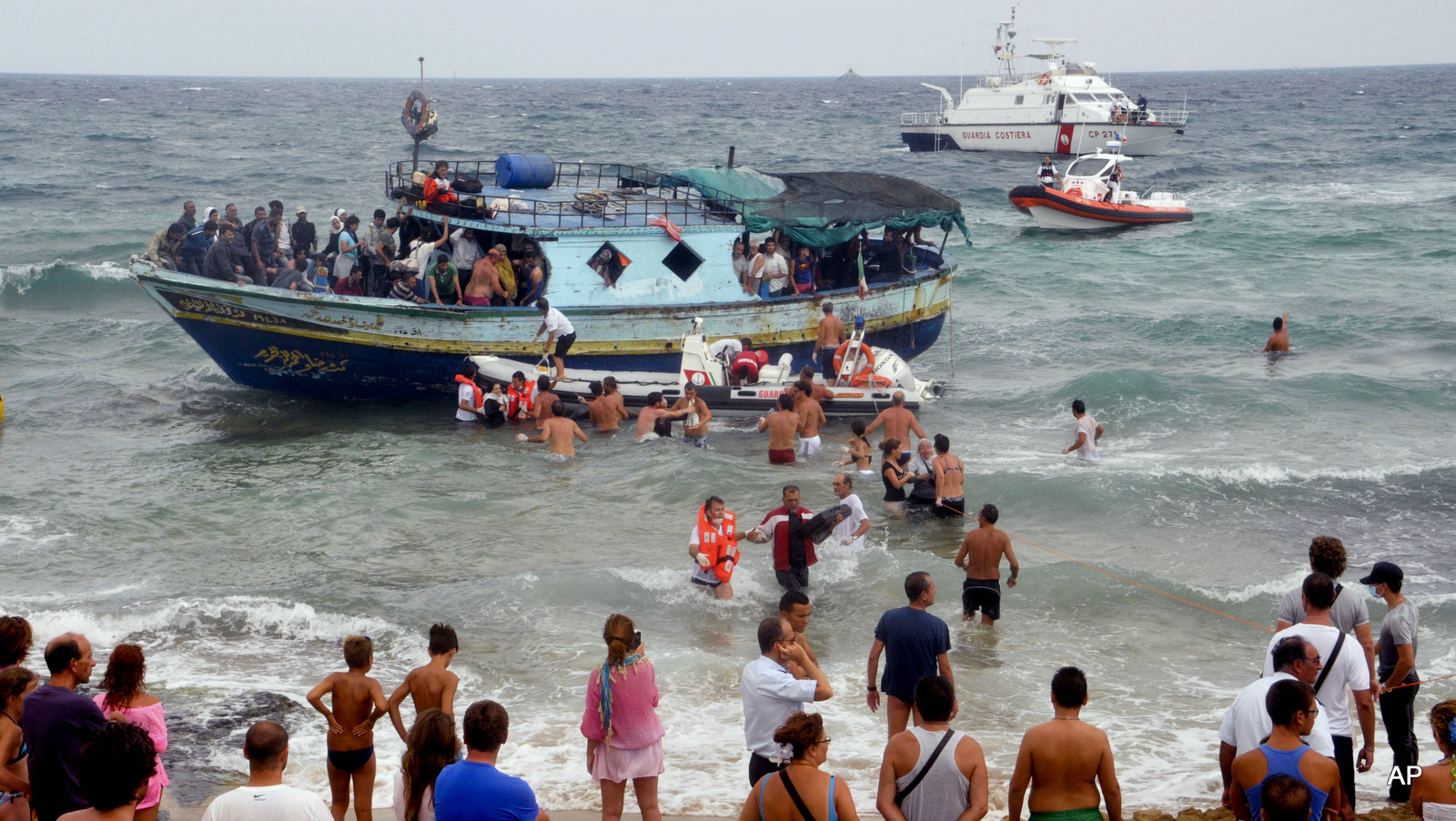
According to the UN an estimated 350,000 refugees crossed the Mediterranean fleeing the Middle East in the last year - and approximately 2,500 have died trying. Earlier this year Italy made a global outcry for help on the migrant problem, as their Navy is baring the brunt of the rescue.


Other European nations have send support. In May Great Britain deployed HMS Bulwark to help. It rescued 500 migrants off of Libya earlier this year. The Irish Naval service also deployed a ship, and it has rescued some 2,000 migrants. As of August 22, 2015, the Italian Navy has rescued more than 3,000 migrants.

Canada has had a Naval vessel deployed to the Mediterranean since 2014, and could have went to the aid of migrants. But, according to the Royal Canadian Navy, they were never given the order to intervene by the Conservative Government.

My question is why not? Why does Canada not have any military responsibility to help European nations struggling with the thousands of migrants?

It would not cost any extra money to have the RCN vessel that is already deployed to help support Eastern Europe. Not sending help when it is the vicinity, is like not stopping at the scene of a horrific car accident on a back road, when you know paramedics will not make it in time.

Why not help at the refugee centers? Hungary has thousands of migrants blockaded in their train station. While this situation needs political help to help move the trains to locations willing to accept the migrants - the camps in Turkey and Jordan are huge, and quickly outgrow their boundaries. Canada could easily deploy the DART (Disaster Assistance Response Team) to one of the regions to help. This team specializes in setting up and helping in humanitarian crisises. They are usually deployed for a month long period, but with added support - the team could be deployed for a longer period of time.

In the current election campaign, the Liberals and NDP have both said they will do more to help the humanitarian issue caused by ISIS and the Syrian Civil War - neither are willing to continue to stand up and confront ISIS. Yet, now it seems the Conservatives are unwilling to help through  humanitarianism. What we need is a government that will step up on both fronts - the CAF can help in the refugee crisis all we need is a leader who will deploy them to do so.


Monday, July 20, 2015

HMCS Athabaskan in rough shape: Rear Admiral Admits

Earlier this year the Royal Canada Navy retired two of its three destroyers, HMCS Algonquin  and HMCS Iroquois due to their age, and the extensive damage. Now, Canada's last destroyer, HMCS Athabaskan is in for repairs, after its engines suffered a breakdown while on exercise. The Ottawa Citizen reports that this is not the first time Athabaskan has had engine issues, and now cracks in her hull have been found.

HMCS Athabaskan is the flagship of the Atlantic fleet for the RCN, and now she is sidelined until the fall (or so the RCN hopes). According to the Ottawa Citizen, the engines on Athabaskan broke down earlier this year while the vessel was on exercise in Florida and then again in the Caribbean.

According to several crew members, the engines are not the only problem, The vessel struggles to hold onto is fresh water supply - making life aboard her difficult. The Ottawa Citizen was given leaked documents from June 2015, that show that Athabaskan also has cracks in her hull; the same reason Iroquois was retired.

The problems came to the attention of Read Admiral John Newton, when on a recent sail day in Halifax. Newton was on-board the vessel when the engines again had issues; but Newton also noticed several other problems.   After talks with the crew, Newton came to realize that several repairs had been deferred to keep the vessel afloat, which were causing unnecessary hardships for the crew.

The Navy is extremely hopeful the repairs can take place quickly, as Athabaskan was one of five RCN vessels that is scheduled to take part in Operation TRIDENT JUNCTURE-15 - NATO's largest exercise in Europe since the end of the Cold War - which is scheduled to take place in September/October of this year.

Newton found that several of the ships essential equipment is so worn that controls and directions are hard to, if not impossible to make out. Newton brought the attention to the Navy command to get the repairs complete, as much of the repairs had been delegated to the crew, who have little to no experience depending on the repairs required. Newton hopes they can restore Athabaskan and keep her operational until her scheduled retirement in 2017. The Navy does not expect the new Canadian Surface Combatant vessels to be ready until 2025.

The RCN has blamed much of the neglect of its equipment on the War in Afghanistan - as for nearly two decades, the Army and Air Force we given billions of dollars to upgrade their equipment to get the job done - the Navy wasn't in Afghanistan, and therefore was left out of the procurement loop.

Thursday, June 25, 2015

1,650 CAF members heading to Europe


Defence Minister Jason Kenney announced yesterday that Canada will partake in the largest NATO exercise in Europe since the end of the Cold War in 1991.

Operation TRIDENT JUNCTURE-15 will be held in late September to early November in Spain, Portugal, and Italy; and will include more than 25,000 troops from NATO members. Canada will be sending a contingent of 1,650 troops, including elements of the RCAF, RCN, and Land elements, including Special Forces.


The Conservative government, despite not spending the NATO requested 2% of GDP on defence has been a large supporter of NATO's response to Russian aggression in Eastern Europe. Canada is still deciding on how many members (if any) of the CAF it will contribute to the NATO Rapid Reaction Force. However, Ottawa officially offered the RCAF spy planes, tanker aircraft and strategic lift capabilities to the Rapid Reaction Force, which is set to triple in size from the current 13,000 members.

Two weeks ago, the CAF announced that it would provide staff officers to work at the Rapid Reaction Force command centres in Latvia, Lithuania, Estonia, Poland, Bulgaria, and Romania.

Despite Canada's slow decision making process in sending troops to be part of the reaction force, Canada has had 200 infantry rotating through Eastern Europe since the summer of 2014, and according to DND, plans for the continued rotation is set for as far as March 2016.

Opponents are saying that Canada is planning on establishing a permanent presence in Europe, much like it did between 1946 and 1991 in Germany. However, DND says no permanent planning is in the process, as it is not cost-effective and in most cases too expensive.