Translate

Showing posts with label DART. Show all posts

Saturday, October 8, 2016

CAF Disaster Assessment Team sent to Haiti: DART on Standby

By: David Pugliese, The Ottawa Citizen 

The Canadian government has sent a Canadian Disaster Assessment Team (CDAT) to Haiti and put aside up to $3 million as an initial humanitarian response for those in Haiti and other countries in the region affected by Hurricane Matthew.

“The CDAT will rapidly assess the situation, which is a critical step in ensuring that a Canadian response to the hurricane is coordinated, evidence-based and tailored to the needs on the ground,” the government stated in a news release. Canada is also supporting the United Nations disaster assessment teams in Jamaica and Haiti, who are still examining the situation and assisting local authorities.

Canadian military sources say the Disaster Assistance Response Team is getting ready to move out when they get the word.

Here are more details from the government news statement:

On October 4, 2016, Hurricane Matthew tore through Haiti, Jamaica, Cuba and the Dominican Republic.

Over 1.24 million people are estimated to have been affected by Hurricane Matthew in Haiti.
Haiti was the hardest-hit country and requires attention in at least 11 communities around the Grand’Anse, Nippes and Sud areas, where there has been coastal flooding.

The role of the CDAT is to meet with local and international representatives to assess the needs on the ground and to identify potential follow-up response options for the Government of Canada.
The CDAT comprises three experts from Global Affairs Canada and three officers from the Canadian Armed Forces, including the Disaster Assistance Response Team Commander.

Monday, June 20, 2016

US Official: CAF Needs to Examine Roles for Future Disaster Aid

By Elliot Ferguson
The Whig

Canada and the United States may need to be willing to re-examine the role of the military in their societies as part of the preparations to deal with major natural disasters, says an American military expert.

Prof. Bert Tussing, director of the Homeland Defense and Security Issues Group at the U.S. Army War College, said preparations need to be made to respond to a "catastrophic incident" that would cause large numbers of deaths and injuries and destroy infrastructure over a large geographic area.

"You want to plan and prepare for the worst and pray that the worst never happens," Tussing said while addressing the 11th annual Kingston Conference on International Security at the Residence Inn Kingston Water's Edge.

Tussing said the role of the armed forces in times of natural disaster is to support civilian agencies in their response, not assume control.

In recent cases in the United States where the military was called in -- after the 1992 Los Angeles earthquake and in 2005 after hurricane Katrina -- the operations were short and the military withdrew quickly when its help was no longer needed, Tussing said.

Tussing used the New Madrid earthquakes of 1811 and 1812 as an example of a natural disaster that could threaten the stability of the country.

Three earthquakes in late 1811 and early 1812 -- all registering more than 7.3 on the Richter scale -- caused damage across 600,000 square kilometres and temporarily reversed the flow of the Mississippi River.

Rebuilding after that disaster took several months, at a time when there was little infrastructure.

Tussing said a similar earthquake now would cause widespread devastation. He added that it would take about 18 months to restore critical services, such as electricity and water.

In that time, local law enforcement agencies would be hard-pressed to maintain social order and it may fall to the armed forces to keep society together.

Tussing said governments need to put in place plans that give the military and civilian agencies clear roles during times of widespread and enduring disaster.

"It's time for us to plan now," he said.

This year's conference examines how militaries change and adapt to new situations during war and peace.

Conference participants looked at the "grey zone" between war and peace populated by non-governmental organizations, private corporations armed groups and states.

"It is hard to grasp, define, put borders and boundaries around it," said Maj.-Gen. Jean-Marc Lanthier, Canadian Army Doctrine and Training Centre.

"If we define the problem too narrowly, we will miss the solutions because the complexity of the problem makes it necessary to analyze it in the broadest sense."

This year's conference was meant to bring together military, academic, private sector and non-governmental organizations to discuss different issues.

Joining Tussing on the first discussion panel on Tuesday morning were Andrew Carswell from the International Committee of the Red Cross, Almero Retief from the mining company Rio Tinto, and Diego Ruiz-Palmer, an economics and security adviser to the NATO aecretary general.

"As an academic doing security and defence research, I really cherish those opportunities to have members of the armed forces, people from government and even the private sector react to the kind of research I am doing," said Prof. Stefanie von Hlatky of the Centre for International and Defence Policy at Queen's University.

"It usually takes the discussion in unexpected places."

Tuesday, April 19, 2016

Sajjan: DART Ready if Requested by Ecuador

The Associated Press

Canada has pledged $1 million in immediate aid. Defence Minister Harjit Sajjan said Monday that DART, Canada's Disaster Assistance Response Team, would be ready to deploy if Ecuador wants it. The DART can only deploy if Ecuador asks for it.

Members of the DART combat engineering team leading a versatile vehicle engineering (VPG), opens the passage to the village of Dolkha, Sindhupalchok district in Nepal, as part of Operation RENAISSANCE 15-1, May 7, 2015.
Photo: Sgt Yannick Bedard, Canadian Forces Joint Imagery Centre
Members of the DART combat engineering team leading a versatile vehicle engineering (VPG), opens the passage to the village of Dolkha, Sindhupalchok district in Nepal, as part of Operation RENAISSANCE 15-1, May 7, 2015. Photo: Sgt Yannick Bedard, Canadian Forces Joint Imagery Centre
Rescuers pulled three people out alive Monday after they had been trapped for more than 32 hours in the rubble of a shopping centre that was flattened by this weekend's powerful earthquake on Ecuador's coast.

Televised images of the dramatic pre-dawn rescue in the port city of Manta gave Ecuadoreans hope that some of the dozens of people still unaccounted for might yet be found even as the death toll from Saturday's 7.8-magnitude quake rose to 413. An American and two Canadians were among those confirmed dead from the worst quake to hit Ecuador in decades.

To reach the survivors trapped between the floor and roof of the collapsed shopping center in Manta, firefighters cut a nearly 70-centimetre hole through concrete then pulled a woman out head first. A group of firefighters applauded as she emerged from the debris, disoriented, caked in dust and complaining of pain but otherwise in good health.
Japan and Ecuador earthquakes not linked, seismologists say

Later, at the same site, about 50 rescuers working with sniffer dogs, hydraulic jacks and a drill managed to free another woman and a young man. All three were rushed in ambulances to a nearby hospital. In total, eight people were rescued from the site in the past 24 hours, said Angel Moreiera, the firefighter coordinating the effort.

Authorities had hoped to save another woman whose legs were pinned by a heavy concrete slab. They were working to free her when they were forced to abandon the effort during an aftershock. When they returned the debris pile had moved and the woman was dead, Moreira said.

Christian Rivera, the head of emergency services for the capital, Quito, said that depending on the circumstances a person without serious injuries can survive up to a week under the rubble.


A woman cries in one of Ecuador's worst-hit towns, Pedernales, two days after a 7.8-magnitude quake hit the country. Rescuers and desperate families clawed through the rubble Monday to pull out survivors. (Rodrigo Buendia/AFP/Getty Images)

"After that, there's a quick decline ... and the rescuers' work becomes very difficult," he said.

Still, there are good reasons to believe more people will be found alive in the coming hours as some 450 rescue workers from Spain, Peru, Cuba, Bolivia, Venezuela, and elsewhere reached the most-affected areas along the Pacific coast. The U.S. has also offered assistance but so far President Rafael Correa, a strong critic of U.S. foreign policy in Latin America, has yet to respond publicly.

Correa, upon arriving in Manta late Sunday, said that the priority remains finding survivors.

"Our grief is very large, the tragedy is very large, but we'll find the way to move forward," the Ecuadorean leader said, adding that the quake was the worst to hit the country since a 1949 earthquake in the Andean city of Ambato that took more than 5,000 lives. "If our pain is immense, still larger is the spirit of our people."
Power outages, aftershocks

Manta, a thriving port city, was among the hardest-hit areas. Power cables were strewn across city streets as electricity in many neighbourhoods remained down. Among the many buildings that were flattened was a control tower at the airport that was home to U.S. anti-narcotics missions in South America until Correa kicked the Americans out.
Torontonians anxious for messages from family after Ecuador earthquake

As rescuers scrambled through the ruins near the epicentre, in some cases digging with their hands to look for survivors, humanitarian aid began trickling in. More than 3,000 packages of food and nearly 8,000 sleeping kits were delivered Sunday.

The quake knocked out power in many areas along the coast and some who fled to higher ground fearing a tsunami had no home to return to or feared structures still standing might collapse. The country's Geophysics Institute said it recorded 230 aftershocks as of Sunday night.

Spain's Red Cross said as many as 5,000 people may need temporary housing after the quake destroyed homes, and 100,000 may need some sort of aid.

U.S. State Department spokesman John Kirby didn't identify the American who was killed but said the U.S. government will work with Ecuadorean authorities to locate and ensure the well-being of all Americans. The area of pristine beaches where the quake struck is popular with American tourists and expat retirees.

Aggravating matters were reports of looting, including in Manta, where 180 prisoners from a nearby prison escaped amid the tumult. Authorities said some 20 inmates were recaptured and others returned voluntarily.

Friday, September 4, 2015

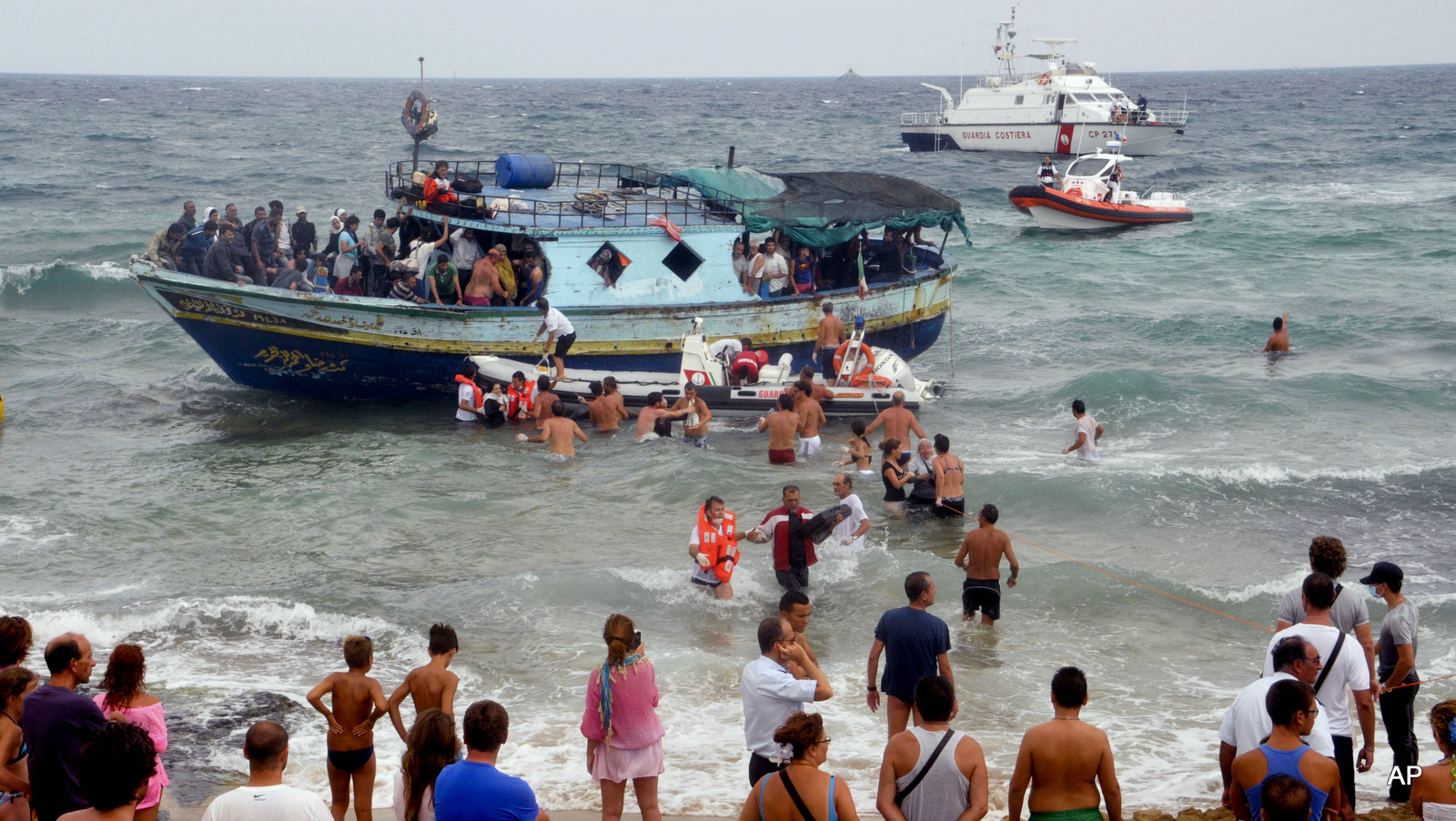
Refugee Crisis: CAF Can Help - Deploy Them

In the wake of the recent tragic death of 3 year old Alan Kurdi, his brother and mother - there have been calls for Canada and the World do to more to help Syrian and Iraqi refugees fleeing the Middle East. Minister of Defence Jason Kenney comes out and said that Canada has no responsibility to help the migrant issue. We had no 'onus' to help.

What about the human responsibility? While I have always been a proponent of the Peacekeeping Myth - that Canada became a Peacekeeping country as a war by other means during the Cold War. Canada has always cared about those in need.

According to the UN an estimated 350,000 refugees crossed the Mediterranean fleeing the Middle East in the last year - and approximately 2,500 have died trying. Earlier this year Italy made a global outcry for help on the migrant problem, as their Navy is baring the brunt of the rescue.


Other European nations have send support. In May Great Britain deployed HMS Bulwark to help. It rescued 500 migrants off of Libya earlier this year. The Irish Naval service also deployed a ship, and it has rescued some 2,000 migrants. As of August 22, 2015, the Italian Navy has rescued more than 3,000 migrants.

Canada has had a Naval vessel deployed to the Mediterranean since 2014, and could have went to the aid of migrants. But, according to the Royal Canadian Navy, they were never given the order to intervene by the Conservative Government.

My question is why not? Why does Canada not have any military responsibility to help European nations struggling with the thousands of migrants?

It would not cost any extra money to have the RCN vessel that is already deployed to help support Eastern Europe. Not sending help when it is the vicinity, is like not stopping at the scene of a horrific car accident on a back road, when you know paramedics will not make it in time.

Why not help at the refugee centers? Hungary has thousands of migrants blockaded in their train station. While this situation needs political help to help move the trains to locations willing to accept the migrants - the camps in Turkey and Jordan are huge, and quickly outgrow their boundaries. Canada could easily deploy the DART (Disaster Assistance Response Team) to one of the regions to help. This team specializes in setting up and helping in humanitarian crisises. They are usually deployed for a month long period, but with added support - the team could be deployed for a longer period of time.

In the current election campaign, the Liberals and NDP have both said they will do more to help the humanitarian issue caused by ISIS and the Syrian Civil War - neither are willing to continue to stand up and confront ISIS. Yet, now it seems the Conservatives are unwilling to help through  humanitarianism. What we need is a government that will step up on both fronts - the CAF can help in the refugee crisis all we need is a leader who will deploy them to do so.


Wednesday, April 29, 2015

1st of 2 RCAF C-17s Arrives in Kathmandu

The CAF announced today that an RCAF C-17 Globemaster transport aircraft has arrived in Kathmandu, Nepal to help with Earthquake relief. It was carrying 31 CAF members and supplies for the region. The plane will be reconfigured to take 100 passengers to New Delhi before it leaves the region.

A second RCAF C-17 will be in the region by Thursday, loaded with more supplies and personnel.

TN09-2015-0302-0009
RCAF C-17 Globemaster takes off from 8 Wing Trenton, heading to Kathmandu, Nepal with supplies and the DART Unit.
Photo: CF Combat Camera: Cpl Dan Strohan, 8 Wing Imaging. 

Monday, April 27, 2015

UPDATED: DART en-route to Nepal With 200 CAF members

Late last night, an assessment team and elements of the CAF's Disaster Assistance Response Team (DART) departed  8 Wing Trenton for Kathmandu, Nepal. The deployment is part of the Canadian Governments international support for Nepal following the devastating earth quake last week and sizeable after shocks that have continued to affect the region.

The C-17 trasnport left 8 Wing Trenton last night, and according to Maj.Gen. Dean Milner, the troops deployed as part of the DART unit are trained in urban search and rescue and medical personnel.

Travelling with the DART unit is a smaller group of soldiers and civilians, who will assess how Canada can effectively aid Nepal in the short, medium, and long term. The DART unit was last deployed in 2013 after Typhoon Haiyan in the Philippines. The Unit is designed to be deployed for up to 40 days until local and international humanitarian aid resources can be put in place.

Ottawa announced late Sunday that it has committed $5 million in initial relief aid.

UPDATE: April 28 2015

Ottawa announced today that 200 additional members of the CAF have been placed on standby, and will deploy to Nepal to help with the disaster relief. They will join the 40 members ( including the 18 members of the DART) who are already on the group in the coming days.