Translate

Showing posts with label Poland. Show all posts

Tuesday, March 21, 2017

CAF Working to Iron Out Challenges Ahead of Latvia Deployment

By: Murray Brewster, CBC News 

Some NATO allies are calling it "Noah's Ark."

The description of the Canadian-led battle group being assembled in Latvia this summer is more than just a cheeky reference to the disparate collection of nations that make up the force of 1,500 heavily-armoured troops.

It underlines some of the very real challenges military planners face, including how much intelligence data Canadians can share with their partners on the ground and what restrictions — known as caveats — the other nations will impose on the use of their troops.

The constraints some European NATO members placed on their soldiers during the Afghan war, notably forbidding them from operating in southern provinces where the Taliban were present, were a major source of tension among the allies.

Nations operating alongside Canada in Latvia will also be coming with caveats, some of which have raised eyebrows at alliance headquarters in Brussels, said defence officials, who were only authorized to only speak with the media on background.

They would not be specific about the restrictions, other than to say officials are working through the matter.

The Trudeau government agreed to the open-ended deployment at last summer's NATO summit in Warsaw, where the western military alliance announced it would place four battalion-sized formations in the three Baltic States and eastern Europe to act as deterrent against a resurgent Russia.
Diverse team
Canada will deploy 450 soldiers, including a headquarters team and a company of infantry soldiers driving the army's new (light armoured vehicle) LAV 6 fighting vehicle, a larger more powerful version of the troop carrier used in Afghanistan. They will be joined by: A troop of tanks from Poland; Two companies of mechanized soldiers travelling in armoured vehicles — one each from Spain and Italy; and infantry soldiers from Slovenia, Albania and Latvia.

"We are certainly recognized as taking on a diverse team," said Brig.-Simon Hetherington, commander of the 3rd Canadian Division, which is training the first rotation of Canadians for deployment in a few weeks.

One of the important preoccupations for commanders will be deciding what intelligence can and cannot be shared.

"Nobody is in the Five-Eyes there so we've got to be careful about what we do there in that regard," said Hetherington, referring to the long-standing intelligence-sharing network among Canada, the U.S., Britain, Australia and New Zealand.

It's not your grandfather's Cold War, Canadian and NATO officials insist

What also makes this deployment different is the cyber threat posed by Russia and the expectation that so-called fake news will be used to drive a wedge between the NATO troops and the Latvian population.

To that end, Hetherington says soldiers are being schooled and reminded to be careful what they post online and where they post it.

"We need to educate our soldiers. What do they say on social media? How do they say it? That's a direct link to the cyber threat," he said.
Cyber vs. 'fake news'

Karlis Eihenbaums, Latvia's ambassador to Canada, says public opinion in his country overwhelmingly supports the NATO deployment.

His country has not faced the same kind of cyberattacks as neighbouring Estonia, but has struggled against disinformation campaigns.

A military unit from Canada marches during a 2014 military parade marking Polish Armed Forces Day, in Warsaw, Poland, where Canadian soldiers were taking part in military exercises. Canada is preparing to lead a multinational battle group in Latvia that will include Polish tanks, as part of NATO's deterrence measures against Russia. (Czarek Sokolowski/AP Photo)

"What is good is our Western allies understand the urgency to do something about this," he said.

There are other more pedantic details for the Canadian-led force to consider.

"The language issue: That's always a challenge, particularly at the junior level," Hetherington told CBC News in an interview. "Our Polish isn't that good and I doubt the young (non-commissioned officer) from Poland's English is going to be that great."

Mechanics is another issue: "How do we communicate? We've all got different radio sets, different comms systems, digital and analogue. We have to work through that."
Tripwire battalions

A study by the Rand Corporation, a U.S.-based think-tank, estimated it would take less than 60 hours for Russian troops to overrun Latvia, Estonia and Lithuania in the event of a full-blown crisis.

The NATO battalions have been loosely described as a "tripwire" to guard against any interference similar to what to has unfolded in Ukraine over the last three years.
Troops from the U.S. Army's 173rd Infantry Brigade Combat Team parachute from a Boeing C-17 Globemaster III during a NATO-led exercise in May 2014 that including parachuting, airborne operations and infantry skills. (Kacper Pempel/Reuters)
The sobering scenarios are on the minds of soldiers, particularly as tensions with Moscow remain high in the aftermath of allegations of tampering in the U.S. election.

"We need to be prepared for the worst case," said Hetherington.

"This is about showing the solidarity of our alliance. The willingness of Canada to be prepared to defend one of NATO's allies."

In theory, the battle groups would be expected to hold out until NATO could muster its high-readiness rapid reaction force — something that could take days.

Privately, Latvian officials don't believe help would arrive in time, an assessment Hetherington, as a professional military officer, shares.

"It would be over very quickly," he said.

"Are we a tripwire? I've never liked that term. We are a show of assurance. We are a show of deterrence. We hope that everything, like every other war that's happened out there; that diplomacy and other means of national power are going to be the way we avoid the worst case scenario."

Friday, October 28, 2016

Four countries promise to join Canadian-led battle group in Latvia

By: Lee Berthiaume, The Globe and Mail 

Canadian troops will not face Russia alone when they begin to arrive in Latvia early next year.

Four countries — Albania, Italy, Poland and Slovenia — have promised to contribute troops and equipment to a Canadian-led NATO force that is being organized in Latvia in response to recent Russian actions in Eastern Europe.

“As Canada takes a leadership role as a NATO framework nation, I look forward to working with our partners from Latvia, Albania, Italy, Poland and Slovenia as we stand together to enhance our collective security,” Defence Minister Harjit Sajjan said in a statement.
Image result for OP REASSURANCE in Latvia
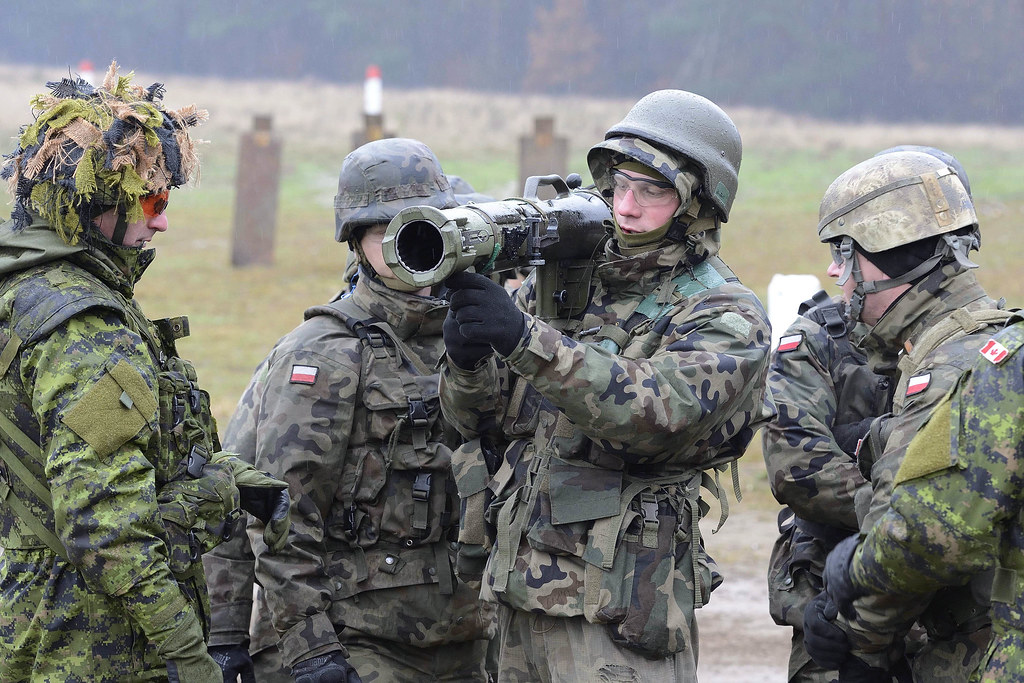
CAF Members train with Polish Military members in a recent exercise during OP REASSURANCE in Poland. (CAF/Flickr) 
The Liberal government announced in July that Canada would lead one of four multinational NATO forces in Eastern Europe, where the military alliance has been beefing up its presence in response to recent Russian actions.

Germany, the United States and Britain are leading similar forces in Lithuania, Poland and Estonia, respectively.

Eastern Europe allies had asked NATO to bolster its footprint in the region as a deterrent against Russia trying to destabilize them in the same way it did in Ukraine — with cyberattacks and by crossing into their territory and inciting Russian speakers within their borders.

Russia has denied any such intentions, and instead accused NATO of instigating the current standoff by expanding into former Soviet territory and trying to undermine its sphere of influence. It has also warned against any military build-up on its borders.

Canada will provide 450 troops as well as light armoured vehicles and other military equipment to the force; Italy has said it will send 140 soldiers.

It wasn’t immediately clear what the other countries will contribute, though media reports have indicated the Polish contribution will include tanks.

The Canadians will form the “nucleus” of the battle group, which will be based at the Adazi military base, about half an hour northeast of the capital Riga.

The first troops will arrive in the spring, but the bulk won’t touch down until fall. They will stay six months before being replaced by another group of Canadians.

Officials have said the four battle groups are intended to make Russia think twice before taking any aggressive action. But they are also being kept small to prevent any provocation or escalation in tensions between Russia and NATO.

Friday, February 19, 2016

New CAF Commander for OP REASSURANCE

DND Press Release - February 19, 2016

Department of National Defence / Canadian Joint Operations Command

OTTAWA – The new commander of the Operation REASSURANCE Land Task Force, Major Éric Beauchamp, assumed command from Major Simon Côté today in Warsaw, Poland. Hosted by Canada’s Ambassador to Poland, Stephen de Boer, the ceremony at the Canadian embassy was presided over by Colonel Pascal Demers, Canadian Defence Attaché.

The Canadian Armed Forces (CAF) presence in the region demonstrates Canada’s commitment to work with NATO allies and react rapidly to international crises as part of Allied assurance measures to promote security in Central and Eastern Europe.

RP001-2016-0001-150
Canadian Armed Forces simulated casualties are loaded onto a UH-60 Blackhawk medical evacuation helicopter during Exercise ALLIED SPIRIT IV at the Joint Multinational Readiness Center Training area in Hohenfels, Germany on January 30, 2016 during Operation REASSURANCE. Photo: CAF Combat Camera
 

Wednesday, December 23, 2015

CAF Participating in Maple Detachment: OP REASSURANCE

Canadian Armed Forces News Release:

Some 50 Canadian soldiers are taking part in Maple Detachment with the 25th Air Calvary Brigade in Nowa Deba, Poland, as part of Operation REASSURANCE.

Maple Detachment consists of ongoing coordinated bilateral training exercises involving Canadian members of the Land Task Force and members of the 25th Air Calvary Brigade, located in Tomaszów Mazowiecki, Poland.

Canadian and Polish Armed Forces members take a knee.
CAF and Polish 25th Air Calvary Members at the Nowa Deba Training center in Poland. December 4, 2015. Photo: DND 
The training includes a series of firing range exercises (levels one, two and three), section and platoon attacks, parachuting, tactical exercises and reconnaissance patrols.

“The goal of the training is to conduct operations that will allow us to assess and improve our interoperability with the Polish Armed Forces,” stated Captain Yannik Trudeau, an officer in the Operation REASSURANCE Land Task Force. “During the training, we alternate between Canadian and Polish command. It’s an extraordinary experience.”

To date, three training exercises have been conducted with the 25th Air Calvary Brigade: three weeks of parachute training in Nowy Glinnik and Leznica Wielka, then helicopter support as part of combat-related first-aid training, and, finally, the training in Nowa Deba.

“Maple Detachment helps foster relations between the Canadian and the Polish armed forces by combining the operations of the Land Force and the 25th Air Calvary Brigade,” noted Captain Nicolas George, Deputy Commander of the Operation REASSURANCE Land Task Force. “In addition to the tactical aspect, Maple Detachment allows Canadian and Polish soldiers to share common values and develop a work ethic.”

The impact of the training provided through Maple Detachment can be measured in multinational exercises such as Ex DRAGON 15, during which Canadian soldiers were paired up with the 25th Air Calvary Brigade.

Thursday, June 25, 2015

1,650 CAF members heading to Europe


Defence Minister Jason Kenney announced yesterday that Canada will partake in the largest NATO exercise in Europe since the end of the Cold War in 1991.

Operation TRIDENT JUNCTURE-15 will be held in late September to early November in Spain, Portugal, and Italy; and will include more than 25,000 troops from NATO members. Canada will be sending a contingent of 1,650 troops, including elements of the RCAF, RCN, and Land elements, including Special Forces.


The Conservative government, despite not spending the NATO requested 2% of GDP on defence has been a large supporter of NATO's response to Russian aggression in Eastern Europe. Canada is still deciding on how many members (if any) of the CAF it will contribute to the NATO Rapid Reaction Force. However, Ottawa officially offered the RCAF spy planes, tanker aircraft and strategic lift capabilities to the Rapid Reaction Force, which is set to triple in size from the current 13,000 members.

Two weeks ago, the CAF announced that it would provide staff officers to work at the Rapid Reaction Force command centres in Latvia, Lithuania, Estonia, Poland, Bulgaria, and Romania.

Despite Canada's slow decision making process in sending troops to be part of the reaction force, Canada has had 200 infantry rotating through Eastern Europe since the summer of 2014, and according to DND, plans for the continued rotation is set for as far as March 2016.

Opponents are saying that Canada is planning on establishing a permanent presence in Europe, much like it did between 1946 and 1991 in Germany. However, DND says no permanent planning is in the process, as it is not cost-effective and in most cases too expensive.


Thursday, April 2, 2015

3rd RCR & Ex MOUNTAIN WARRIOR in Poland

DND revealed yesterday that approximately thirty-five (35) members of the 3rd Battalion of the Royal Canadian Regiment (RCR) based out of Petawawa will be participating in Exercise MOUNTAIN WARRIOR in Trzclaniec, Poland throughout the month of April.

The 3rd RCR is joining in on this exercise with our Polish NATO ally to better develop our mountaineering expertise, says the news release from DND. The exercise will further promote interoperability, collective training and overall operation proficiency.

Exercise MOUNTAIN WARRIOR is a training exercise held every year, hosted by Poland's 25th Air Cavalry Brigade Reconnaissance Company. They regularly operate in the mountain regions, high altitudes and cold weather environments. This training will help prepare Canadian troops for operations in mountainous regions, high altitudes and extreme weather conditions that are usually only found in mountain regions. Each soldier will traverse steep mountain passes while carrying 25kg of cold weather gear and other survival kit.


Wednesday, April 1, 2015

Canada's Mission Costs Partly Revealed

Following yesterday's announcement that the Conservative Government would classify OP IMPACT and OP REASSURANCE's budget as classified, for the purpose of National Security. This caused both opposition parties to cry foul.

Today, Defence Minister Jason Kenney, announced that Canada's one year extension in Iraq and expansion into Syria will cost tax payers $406 million, and has instructed DND to include the figure in federal budget reports.

But the remaining details for the price of the missions may still be classified - which would be the first time since 1996/97 that such figures have been classified.

OP IMPACT has 600 troops in Kuwait, 6 CF-18s, 1 CC-150 Polaris, and 2 CP-140 Aurora Aircraft.

OP REASSURANCE has seen CF-18s patrol the Baltic's, RCN frigates deployed to the Black Sea and the Mediterranean, as well as several rotations of troops preforming training with Baltic States as well as the Polish Army.

Wednesday, March 4, 2015

3rd RCR Off To Poland

MI-8 HIP transport helicopter flies over a line of soldiers from 3rd Battalion, Royal Canadian Regiment, Mike company while taking part in a multi-national fire power demonstration with the Polish 6th Airborne Brigade and American 173rd Airborne Brigade during Operation REASSURANCE on July 17, 2014 in Eastern Europe. Photo: Cpl Mark Schombs, 4 Cdn Division, Petawawa PA2014-0144-15
A MI-8 helicopter flies over CAF members and the 6th Polish Airborne and
the 173rd American Airborne in joint training in July 2014.
Photo: CF Combat Camera, Cpl Mark Schombs. 

Some 125 members of the 3rd Battalion, Royal Canadian Regiment left Petawawa on Monday for Poland.

The soldiers are headed to Poland as part of Operation REASSURANCE, where they will spend the next three months on a training mission with other NATO nations, including the Polish military. The training will focus on inter-operations between forces.

This is the second deployment to Eastern Europe under Op. REASSURANCE. Members from Petawawa deployed last year as well, under the NATO training plan.