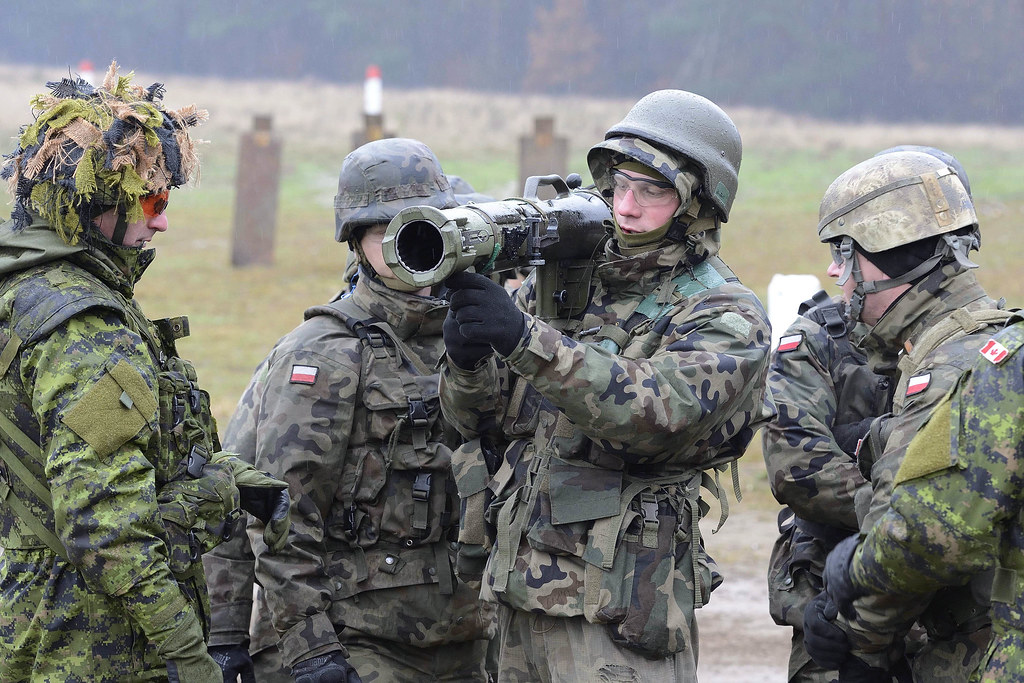
Some NATO allies are calling it "Noah's Ark."
The description of the Canadian-led battle group being assembled in Latvia this summer is more than just a cheeky reference to the disparate collection of nations that make up the force of 1,500 heavily-armoured troops.
It underlines some of the very real challenges military planners face, including how much intelligence data Canadians can share with their partners on the ground and what restrictions — known as caveats — the other nations will impose on the use of their troops.
The constraints some European NATO members placed on their soldiers during the Afghan war, notably forbidding them from operating in southern provinces where the Taliban were present, were a major source of tension among the allies.
Nations operating alongside Canada in Latvia will also be coming with caveats, some of which have raised eyebrows at alliance headquarters in Brussels, said defence officials, who were only authorized to only speak with the media on background.
They would not be specific about the restrictions, other than to say officials are working through the matter.
The Trudeau government agreed to the open-ended deployment at last summer's NATO summit in Warsaw, where the western military alliance announced it would place four battalion-sized formations in the three Baltic States and eastern Europe to act as deterrent against a resurgent Russia.
Diverse team
Canada will deploy 450 soldiers, including a headquarters team and a company of infantry soldiers driving the army's new (light armoured vehicle) LAV 6 fighting vehicle, a larger more powerful version of the troop carrier used in Afghanistan. They will be joined by: A troop of tanks from Poland; Two companies of mechanized soldiers travelling in armoured vehicles — one each from Spain and Italy; and infantry soldiers from Slovenia, Albania and Latvia.
"We are certainly recognized as taking on a diverse team," said Brig.-Simon Hetherington, commander of the 3rd Canadian Division, which is training the first rotation of Canadians for deployment in a few weeks.
One of the important preoccupations for commanders will be deciding what intelligence can and cannot be shared.
"Nobody is in the Five-Eyes there so we've got to be careful about what we do there in that regard," said Hetherington, referring to the long-standing intelligence-sharing network among Canada, the U.S., Britain, Australia and New Zealand.
It's not your grandfather's Cold War, Canadian and NATO officials insist
What also makes this deployment different is the cyber threat posed by Russia and the expectation that so-called fake news will be used to drive a wedge between the NATO troops and the Latvian population.
To that end, Hetherington says soldiers are being schooled and reminded to be careful what they post online and where they post it.
"We need to educate our soldiers. What do they say on social media? How do they say it? That's a direct link to the cyber threat," he said.
Cyber vs. 'fake news'
Karlis Eihenbaums, Latvia's ambassador to Canada, says public opinion in his country overwhelmingly supports the NATO deployment.
His country has not faced the same kind of cyberattacks as neighbouring Estonia, but has struggled against disinformation campaigns.
A military unit from Canada marches during a 2014 military parade marking Polish Armed Forces Day, in Warsaw, Poland, where Canadian soldiers were taking part in military exercises. Canada is preparing to lead a multinational battle group in Latvia that will include Polish tanks, as part of NATO's deterrence measures against Russia. (Czarek Sokolowski/AP Photo)
"What is good is our Western allies understand the urgency to do something about this," he said.
There are other more pedantic details for the Canadian-led force to consider.
"The language issue: That's always a challenge, particularly at the junior level," Hetherington told CBC News in an interview. "Our Polish isn't that good and I doubt the young (non-commissioned officer) from Poland's English is going to be that great."
Mechanics is another issue: "How do we communicate? We've all got different radio sets, different comms systems, digital and analogue. We have to work through that."
Tripwire battalions
A study by the Rand Corporation, a U.S.-based think-tank, estimated it would take less than 60 hours for Russian troops to overrun Latvia, Estonia and Lithuania in the event of a full-blown crisis.
The NATO battalions have been loosely described as a "tripwire" to guard against any interference similar to what to has unfolded in Ukraine over the last three years.
 |
| Troops from the U.S. Army's 173rd Infantry Brigade Combat Team parachute from a Boeing C-17 Globemaster III during a NATO-led exercise in May 2014 that including parachuting, airborne operations and infantry skills. (Kacper Pempel/Reuters) |
"We need to be prepared for the worst case," said Hetherington.
"This is about showing the solidarity of our alliance. The willingness of Canada to be prepared to defend one of NATO's allies."
In theory, the battle groups would be expected to hold out until NATO could muster its high-readiness rapid reaction force — something that could take days.
Privately, Latvian officials don't believe help would arrive in time, an assessment Hetherington, as a professional military officer, shares.
"It would be over very quickly," he said.
"Are we a tripwire? I've never liked that term. We are a show of assurance. We are a show of deterrence. We hope that everything, like every other war that's happened out there; that diplomacy and other means of national power are going to be the way we avoid the worst case scenario."