Translate

Showing posts with label Russian Relations. Show all posts

Thursday, April 12, 2018

Trudeau Rules out Canadian Participation in Military strikes against Syria

By BRUCE CAMPION-SMITH, The Toronto Star 

OTTAWA—Prime Minister Justin Trudeau says that Canada's military will not participate in expected strikes against the Syrian regime that are meant as retaliation for a suspected chemical attack against civilians.

Canadian CF-18 Hornets depart after refueling over Iraq on Oct. 30, 2014. The fighters jets were in the region flying bombing mission against Daesh extremists in Iraq but that mission was ended by Trudeau’s government after it took office in 2015.
Canadian CF-18 Hornets depart after refueling over Iraq on Oct. 30, 2014. The fighters jets were in the region flying bombing mission against Daesh extremists in Iraq but that mission was ended by Trudeau’s government after it took office in 2015.  (STAFF SGT. PERRY ASTON / THE CANADIAN PRESS)
Speaking to Radio-Canada, the prime minister said Canadian military personnel are already involved in missions in northern Iraq and Latvia and will be deploying to Mali. “We are not looking to be present in Syria,” Trudeau said in an interview.

But he said Canada has been involved in delivering humanitarian assistance and working through diplomatic and political channels to resolve the conflict in Syria that has laid waste to cities, left thousands dead and forced citizens to flee to safety in neighbouring countries.

U.S. President Donald Trump warned Wednesday of an imminent strike on Syria, declaring on social media that missiles “will be coming” and taunted Russia for its pledge to shoot them down.

“Get ready Russia, because they will be coming, nice and new and “smart!” Trump said on Twitter.

The threatened action comes after an attack last weekend in the Syrian town of Douma that possibly involved chemical weapons, which is believed to have killed 40 people. The attack is blamed on the government of President Bashar al-Assad though it has denied responsibility.

Foreign Affairs Minister Chrystia Freeland condemned the attack at the time, saying the “repeated and morally reprehensible use of chemical weapons” by the Assad regime has been confirmed by independent observers.

“Canada condemns the Assad regime — and its backers, Russia and Iran — for its repeated, gross violations of human rights and continued, deliberate targeting of civilians,” Freeland said in a statement.

Trump has spoken to world leaders and U.S. officials said the U.S., France and Britain discussed the possibility of a military strike, according to a report by The Associated Press.

Canada did have CF-18 fighters jets in the region flying bombing mission against Daesh extremists in Iraq. That mission — launched by the previous Conservative government — was halted by Trudeau’s Liberal government after it took office in 2015.

Currently, Canada has a small number of special operations forces troops still deployed in northern Iraq to assist local forces in their fight against Daesh, along with Griffon helicopters. A CC-150 Polaris air-to-air refueller is also still flying missions, refuelling other fighters in their patrol missions.

Monday, April 24, 2017

RCAF CF-18s intercept Russian bombers for first time in 2 years

The Canadian Press 

OTTAWA—Canadian fighter jets have intercepted Russian bombers off Canada’s northern coast for the first time in more than two years, as relations between Moscow and the West continue to worsen.

A Canadian Forces CF-18 makes a highspeed afterburner turn at the Great Lakes International Air Show.
A Canadian Forces CF-18 makes a highspeed afterburner turn at the Great Lakes International Air Show
Two CF-18s were scrambled on Thursday after North American early-warning air defences spotted two TU-95 Bear bombers approaching Alaskan and Canadian airspace from the west around 7 p.m.

The long-range bombers, which can carry nuclear weapons, were also tracked by U.S. F-22 jets based out of Alaska, said North American Aerospace Defence Command spokeswoman Maj. Jennifer Stadnyk.

Stadnyk said the Russians never entered Canadian or American airspace, and acted “professionally and safely” before returning to their home base.

The incident marked the first time since December 2014 that Canadian fighter jets have been scrambled to intercept Russian military aircraft flying in the Far North.


It was also the fourth time in as many days that Russian aircraft have been spotted approaching North American airspace. Norad also dispatched F-22s on Monday to track Bear bombers that were flying near Alaska.

Two TU-95s were also spotted near Alaskan airspace on Tuesday while two IL-38 maritime patrol aircraft were tracked on Wednesday, though Norad opted not to scramble fighters in either case.

“We haven’t seen this level of activity since July 2015,” Stadnyk said, though she added: “It’s not unprecedented. What they’re doing this week is very similar to what they used to do.”


Such Russian bomber flights over the Far North were a regular occurrence between 2012-14, Stadnyk said, before the TU-95s were grounded over safety concerns.

One of the bombers skidded off a runway on June 8, 2015, and caught fire, killing a crew member and injuring several more.

The resumption of Russian flights over the Arctic this week comes at a key moment for Russia and the West, whose relationship has reached what U.S. Secretary of State Rex Tillerson recently called “a low point.”

Ties between Moscow and Washington have been particularly strained ever since the U.S. launched a cruise-missile strike against Syria, which it blamed for a chemical attack that killed more than 80 people earlier this month.

Relations between Ottawa and Moscow have not been spared, despite the Liberal government’s initial plan to re-engage Russia.

Prime Minister Justin Trudeau called out the Kremlin earlier this month for supporting the Syrian government of president Bashar Assad, who is widely seen by the West as being responsible for the attack.

More than 450 Canadian troops are also preparing to head to Latvia in the next few weeks, where they will lead a NATO force intended to check Russian aggression in eastern Europe.

And Foreign Affairs Minister Chrystia Freeland remains on a list of individuals banned from visiting Russia, after Canada slapped the country with sanctions for annexing Crimea in 2014.

Steve Saideman, a political science professor at Carleton University’s Norman Paterson School of International Affairs, said the Russians could be trying to send a signal to the Trump administration.

But he noted the Russians have been conducting such military flights throughout Europe and Asia for years, “so if it’s a message to Trump, what’s the message?”

Friday, March 10, 2017

CAF Deployed in Latvia to include ‘Cyber Warriors’

By: Matthew Fisher, The National Post 

Canada is to deploy “cyber warriors” to Latvia this June to defend its military computer networks and the information on them from sustained attacks by Russia, as a Canadian-led NATO battle group begins an open-ended deployment to the small, strategically important Baltic nation.

Canadian and Latvian soldiers in Kadaga, Latvia, during Operation Reassurance in September 2015.
Canadian and Latvian soldiers in Kadaga, Latvia, during Operation Reassurance in September 2015. (Cpl. Nathan Moulton -DND)
Separately, the Canadian Forces have been preparing the 450 troops bound for Latvia to act as a tripwire to deter Russian aggression to be ready to for a smear campaign orchestrated by the Kremlin to create tensions between them and their Latvian hosts, through the placement of “fake news” about their behaviour and about NATO’s motives in Central Europe.

The moves are part of a little-known plan to rapidly build Canada’s cyber and information warfare capabilities to counter threats, not only from Russia but adversaries such as Islamic State and al-Qaida.

“We definitely have to get it right. We have to go to Latvia with a strong defensive posture,” said Brig.-Gen. Paul Rutherford, commander of the newly created Joint Forces Cyber Component. “First and foremost, we recognize cyber as a domain of warfare.… We are constantly under attack.

“We will educate our troops about vulnerabilities, because Russia is quite adept in the cyber and information warfare domains.”

As well as defending against attempts to hack into military computer networks, troops had to be ready to defend against blatant disinformation in Latvia. This was underscored last month when bogus stories about German troops raping Lithuanian women began circulating on social and mainstream media within two weeks of the arrival of the German-led battle group.

“When you see how quickly it happened with the Germans, that shows us what to expect,” said Lt. Col. Richard Perreault, who recently returned from Latvia. “

Are they going to try? Yes they will. We fully expect such actions by the Russians.”

The Canadian approach in Latvia would be much different than Kandahar, “where we went in with a war mindset,” Perreault said. To counter Russian attempts to shape the narrative with false and deceptive information, “we will communicate facts and the truth,” the colonel said. “We will provide clear and transparent information. If we see inaccurate facts, we will take action.”

The danger posed by cyber attacks was of such crucial significance that the military was creating a new cyber trade specialty, Rutherford said.

“We want to bring people into the trade to become what I call cyber warriors,” the general said. “To retain these experts, we need a career path for the duration of their careers.

“That is what they eat and dream about and we need to do this for them. We want a breadth of cyber operators. We need analysts who can understand. We also need guys who understand the strengths and weaknesses of our systems and cyber intel. We have to invest heavily to ensure from a cyber perspective we can anticipate and bolster our defenses.”

Training, promoting and paying these soldiers enough that they will want to remain in the Forces was a top priority, as was the need to invest in cutting-edge technology for them, Rutherford said.

Like Ukraine, the Baltic states have been particularly susceptible to Russian propaganda and trolls because large Russian minorities there can easily tune in television stations from Moscow. The Lithuanian ambassador to the U.S. has said that “cooked” broadcasts from Russia were designed to turn his countrymen against NATO.

Russia’s cyber assaults first attracted intense attention when the Estonian parliament, banks and media were swamped and disabled in 2007 by massive amounts of electronic spam and malware. More recently, Russia was the sole suspect behind a cyber blitz that tried to shut down Ukraine’s power grid and banking system.

Moscow has also been accused of using cyber attacks to try to interfere in the U.S. presidential election and in impending European elections from Norway to Italy.

The Russian efforts were made plain this week with the revelation — never denied but hitherto unknown — that the grandfather of Foreign Affairs Minister Chrystia Freeland ran a pro-Nazi publication in Ukraine during the Second World War.

This is part of what Russia’s top general, Valeri Gerasimov, has called “hybrid warfare.” Cyberspace “opens wide asymmetrical possibilities for reducing the fighting potential of the enemy,” Gerasimov said in an article published four years ago.

Defence Minister Sergei Shoigu, who is close to President Vladimir Putin, recently announced that a new military unit designed to conduct “information operations” was being created.

As U.S. forces in Afghanistan discovered, computer networks can be seriously compromised by something as simple as a soldier buying a USB stick outside the base gates for personal use that was infected with a virus.

“That is exactly what I am talking about,” Rutherford said. “From the electronic signature perspective, they must be highly educated.” he said. “They have to know how to use devices such as smart phones or to not bring them with them.”

Monday, January 16, 2017

Ukraine Awaiting Word From Canada on Troop Commitment

By: David Pugliese, Defence Watch 

Ukraine’s envoy has told the Canadian Press news agency that his country is growing concerned about whether Canada will continue its future military support to his country to help it deal with Russian aggression.

The Canadian Forces has 200 military personnel providing training to their Ukrainian security counterparts. The mission will expire at the end of March.

“It has taken us much longer than we expected to discuss the future format of our co-operation,” Andriy Shevchenko, the Ukrainian ambassador to Canada, said in an interview with the Canadian Press. “We still don’t have a formal response from Canada.”

A spokesperson for Defence Minister Harjit Sajjan didn’t provide any other details, except to say, “The announcement will come after cabinet has made a decision.”

But readers might recall that it was just two months ago, Sajjan was stating that Canada and Ukraine share the same values and that it could count on continued support. “We are committed to supporting Ukraine,” Sajjan said. “We have our troops there.”


Around the same time, Prime Minister Justin Trudeau also reaffirmed Canada’s commitment to NATO in eastern Europe, pointing out that his government is a stronger supporter of the alliance in Ukraine.

To retreat on a Ukraine commitment would be a significant development for the Liberal government.

The delay on a new commitment could be that the Department of National Defence/Canadian Forces is trying to juggle the Latvian deployment and Ukraine mission and is still trying to work those details out for both missions.

Friday, November 25, 2016

Russia suggests it wants thawed relations with Canada in Arctic

By: MIKE BLANCHFIELD, The Globe and Mail

A Russian politician who laments the decline of his country’s relations with Canada suggested Thursday that his homeland might be willing to play nice in its long-standing dispute over who controls the North Pole.

Igor Chernyshenko, a senator from the northern city of Murmansk, said Russia would respect any United Nations decision on who should control a swath of the Arctic seabed known as the Lomonosov Ridge, which extends across the North Pole.

Chernyshenko, who was at Carleton University in Ottawa for a conference on Canada-Russia relations, delivered the overture as an example of positive co-operation between two countries that have been at odds for nearly a decade.

The Russian embassy and Canada’s foreign ministry, Global Affairs Canada, organized the conference as an example of the Liberal government’s new foreign policy decision to re-engage with Russia because of its shared interest in the Arctic.

The previous Conservative government downgraded ties with Russia because of its unilateral annexation of Ukraine’s Crimea region in 2014. In opposition, the Conservatives have vocally opposed the rapprochement, saying it represents “cosying up” to the “regime” of Russian President Vladimir Putin.

The Conservatives saw Russia’s Arctic ambitions as provocative, especially after the Russians planted a flag on the North Pole seabed in 2007.

The Liberals say it is time to move beyond that, citing the need to work with countries that have a shared interest in a frozen wasteland that’s rapidly thawing, leading to increased ship traffic, potential oil and gas exploration, as well as potential threats on the environment and security fronts.

Russia, Canada and Denmark have all filed competing territorial claims and it could take as long as 15 years for the United Nations Convention on Law of the Sea to decide.

But the UN won’t have the final say because it will be up to the countries themselves to negotiate a settlement based on the assessment.

The visiting senator told that his country would negotiate the division of the territory, which researchers believe contains significant oil and gas deposits.

“We recognize international law and after the UN Commission makes its decision, Canada and Russia will positively decide on how to divide that up,” Chernyshenko said through an interpreter.

He lamented the decline in trade between the two countries, which has shrunk since ties were downgraded and Canada joined its allies in imposing sanctions.

“This is very sad.”

Russia’s envoy to Canada says the renewed Arctic co-operation could be the spark that reignites relations on a broader level, including possible co-operation on fighting terrorism, and deeper business ties.

“It’s very good our bilateral dialogue has been re-launched. Canada’s self-imposed isolation from Russia is over,” Alexander Darchiev, the Russian ambassador, said in an interview.

Not so fast, said Joseph Pickerill, a spokesman for Foreign Affairs Minister Stephane Dion.

“Russian and Canadian companies are free to pursue commercial opportunities in one another’s markets so long as their undertakings are in compliance with Canada’s sanctions regime,” Pickerill said in an email.

“However, our diplomatic re-engagement does not mean it is ’business as usual’ with Russia.”

Indeed, Canadian co-operation with Russia will have to be confined to the Arctic because of major differences on Ukraine and Russia’s backing of the Assad regime in Syria, said Whitney Lackenbauer, a St. Jerome’s University historian.

Military co-operation between the two countries is also a long way off, which means no Russian observation of Canadian military operations in the North or renewed meetings between their defence chiefs.

Any characterization of the two countries “as great partners, great friends, is not going to be appropriate,” he said.

University of British Columbia international law professor Michael Byers said Russia and Canada are capable of settling territorial disputes and working together on shared interests in the North, including dealing with challenges that will come with more shipping traffic.

The Russians are anxious to find partners in the Arctic because their economy has been “pummelled” by sanctions and the decline in world oil prices, Byers said.

“The Russians are desperate to see sanctions lifted. In that context, they’re very eager to improve relations in any domain.”

Monday, November 21, 2016

NATO a 'cold-war relic,' according to Russian ambassador

By: Laura Payton, CTV News 

OTTAWA -- Russia's ambassador to Canada says NATO is deploying in eastern Europe to justify its existence in a post-Soviet world.

Alexander Darchiev says Canada is a sovereign country that can make its own choices, but he doesn't believe NATO should be moving additional troops into countries that border Russia.

"NATO is irrelevant. It's cold-war relic, which desperately needs rationale for its continued existence," Darchiev said in an interview with Evan Solomon, host of CTV's Question Period.

"If you want [to] divert your resources for [a] NATO build-up, that's the sovereign choice of Canada," he said.

NATO started reinforcing itself in countries like Lithuania and Poland in 2014, after Russia captured Crimea, a pro-Russia part of Ukraine. NATO called the takeover illegal, although Russia termed it a reunification.

Canada is set to command a 1,000-person battle group in Latvia early in the new year, including 450 Canadian Forces members, following nearly two years of military exercises and training in central and eastern Europe.

The Russian ambassador says the only way to achieve peace in Ukraine is for both sides to negotiate.

"The major self-deception for the west is to believe there is a Russian aggression. There is no Russian aggression," Darchiev said, calling the conflict in Ukraine a civil war.

"[The] NATO buildup is a national security concern. We are open for dialogue, but we sincerely believe it's not good for European security," he added.

Russian email hack? 'Definite' no

Darchiev praised U.S. president-elect Donald Trump's win nearly two weeks ago as "a victory of common sense and pragmatism," but said Russia had nothing to do with the email hacks that revealed messages of Democratic nominee Hillary Clinton's top campaign officials. American intelligence officials, including the FBI, said it was Russian government hackers who stole thousands of emails from the Democratic National Committee and other officials.

"No. We have a definite answer on that," Darchiev said when asked if Russia was behind the hacks, which saw the documents made public by Wikileaks.

"Due to Edward Snowden, we now know that NSA capabilities are unmatched in imposing global surveillance, in bugging smart phones and in eavesdropping [on] even closest allies," he said, referring to the former National Security Agency contractor who revealed the NSA's mass surveillance program.

The Russian official said his country didn't interfere in the American election.

"All elections are domestic. It's about jobs, it's about discontent of the middle class so no foreign power could ever influence election in a super power," he said.

Tuesday, November 15, 2016

Trudeau affirms commitment to NATO, Latvia mission following Trump victory

By: Lee Berthiaume, Canadian Press 

OTTAWA — Canada is pressing ahead with plans to deploy hundreds of troops as part of a NATO effort to deter Russian aggression in eastern Europe amid concerns about the military alliance's future under Donald Trump.

Prime Minister Justin Trudeau on Monday affirmed Canada's commitment to lead one of four NATO forces in eastern Europe, which will see 450 Canadian troops deploy to Latvia starting next year.

Trudeau said he is "very proud" that Canada is taking a leadership role "as we support the Baltic states and defend the eastern European border against Russia."

His comments came as NATO members scrambled to understand how the Trump administration plans to deal with and support the 67-year-old military alliance.

During the presidential election campaign, Trump repeatedly called NATO obsolete and warned the U.S. would not automatically come to the defence of a member that was attacked.

The real-estate mogul and reality-television star also praised Russian President Vladimir Putin, despite a clampdown on human rights and democracy in Russia and its actions in Ukraine and Syria.

Now that Trump has been elected president, many NATO members have been wringing their hands over what might happen if Russia decided to flex its muscles in eastern Europe in the same way it did in Ukraine.

U.S. President Barack Obama sought to allay those concerns in Washington, D.C., on Monday, as he prepared to visit NATO members Germany and Greece.

"In my conversation with the president-elect, he expressed a great interest in maintaining our core strategic relationships," Obama said.

"There is no weakening of resolve when it comes to America's commitment to maintaining a strong and robust NATO relationship."

Many NATO members are nonetheless waiting for Trump himself to set the record straight on his views over the military alliance.

Trump has said he would first consider whether an ally that is under attack has been pulling its weight in terms of defence spending before deciding whether the U.S. would help.

All NATO members agreed in 2014 to spend two per cent of their gross domestic product (GDP) on defence, but only five meet that target.

Canada is in the bottom third of allies at less than one per cent, the lowest level in decades.

Latvia was at 1.04 per cent last year, but has committed to doubling that figure by 2018.

Asked about the risk to troops in Latvia if U.S. support for NATO softens, Defence Minister Harjit Sajjan said the military is considering all the risks and will make sure the soldiers and their partners are prepared.

The Canadians are to form the core of a 1,000-strong battle group that will include troops from Albania, Italy, Poland and Slovenia.

"This will be a very robust battlegroup that Canada will be leading," Sajjan said.

Latvia's ambassador to Canada downplayed the impact of Trump's election on NATO, saying his country, a former Soviet republic, has lived through "different times and settings" in its history.

"We believe that U.S. institutions and democracy are strong, international commitments clear and there are no obstacles that we could not overcome if necessary," Karlis Eihenbaums said in an email.

Steve Saideman, a NATO expert at Carleton University, said he would like to see Canada come together with Germany and Britain to publicly affirm their support for the alliance and eastern European members.

Such an action, he said, would help counter some of the uncertainty that Trump has injected into the alliance and give Russia pause about taking any action.

But defence analyst David Perry of the Canadian Global Affairs Institute said the reality is that Canada and most of the other NATO members have not been pulling their weight, and that it may be time to start doing so.

"We've all agreed to these commitments of two per cent," he said. "We won't move to two per cent tomorrow, but increasing to 1.2 or 1.3 per cent would be a significant increase."

— with reporting from Alexander Panetta in Washington, D.C.

— Follow @leeberthiaume on Twitter

Lee Berthiaume, The Canadian Press

Tuesday, November 1, 2016

Canadian Army training Ukrainian Military Police as part of OP UNIFIER

Canadian Army News
By Steven Fouchard, Army Public Affairs

An Army Public Affairs team is deploying to Ukraine and will be providing further coverage of Operation UNIFIER in the coming weeks.

Kingston, Ontario — A Canadian Army officer says efforts to bring the Armed Forces of Ukraine up to speed on NATO military policing practices as part of Operation UNIFIER (Op UNIFIER) have been a great success.

Op UNIFIER is the name of Canada’s contribution to an ongoing multinational training mission that is building capacity in the Armed Forces of Ukraine. Canadian troops have been on the ground there since the summer of 2015 as Joint Task Force-Ukraine, sharing their expertise in a wide range of soldiering skills.Major Greg Losier recently returned to his position at the Canadian Army Doctrine and Training Centre in Kingston, Ontario after spending several weeks leading a team charged with training Ukrainian troops in various aspects of military policing.

Ukrainian trainees conduct a practice vehicle checkpoint under the guidance of Canadian Military Police instructors while on Operation UNIFIER at the International Peacekeeping and Security Centre in Starychi, Ukraine on September 23, 2016. Photo by: Joint Task Force – Ukraine. ©2016 DND/MDN.

In the following interview, Maj Losier discusses the challenges of the task, the enthusiasm of both his team and the trainees, and the role of the international military policing family.
What is the context of the military policing aspect of Op UNIFIER?

The Ukrainians have something called the Military Law and Order Service. It’s a nascent military police capability that stood up just a few years ago. It’s a bit different culturally compared to what we’re used to in a Western military. The old Soviet structures didn’t really have fulsome military police and investigative capabilities per se, and the Ukrainians were sort of a product of that culture.
Our main effort is training in proper use of force and personal protection so that they can become more interoperable with NATO in the future. And we’ve also provided a military police investigation course. Ukraine is actually collaborating with Poland and Lithuania to put together a brigade structure with a platoon of field-capable military police from each of the three countries.
What did the training consist of?

I was appointed as the team lead back in April, and I had the luxury of being able to assemble and hand-pick a very competent team. There were eight members of our team, five military police and three non-military police to provide us support.

Training consisted of a variety of lectures, practical scenarios to support the lectures, and some additional exercises. So we would do theory, demonstration, and then we’d go out and practice in the actual deployed environment.

Ukrainian Military Law and Order Service trainees prepare a vehicle checkpoint following a lesson by Canadian instructors during Operation UNIFIER in Ukraine. Photo by: Joint Task Force – Ukraine on September 12, 2016. ©2016 DND/MDN.
How would you describe the experience?

The Ukrainians took some of their best and brightest and put them together in this particular platoon so they could train and work together to eventually deploy in the NATO environment. What we had as a training audience was a group of very fit, very experienced, very capable and very motivated military police soldiers that were hungry to learn as much as they could about NATO.

It was an absolute pleasure to work with such a group of professionals. They are phenomenal soldiers in their own right, very well experienced. I was incredibly impressed with the group, all ranks within the group, with how keen and motivated they are to work towards this goal.

We delivered the training in three weeks. It was very gratifying to see the progress of a group from start to finish in such a short period of time.

What were the greatest challenges?

One of the biggest challenges we have is language. It’s the Cyrillic alphabet, Ukrainian language, and of course Ukrainian and Russian are spoken interchangeably. I was able to get the services of a Ukrainian speaker and writer as well as a Russian speaker and writer to assist with translation of our curriculum.

People can translate information but when it comes to technical language, military language, there’s always a challenge to ensure that the translation is being done as well as possible. We mitigated that in large part by bringing our own linguistic support, actual military police and military police officers that understood the curriculum and that broke down most of the communication barriers right there.
The NATO military police community is, as hokey as it sounds, very much a family environment. And that was one of the things we really stressed upon with this group – to say, ‘Folks you’re now part of the military police family.’ And once they saw they were part of this wider community, it really assisted in focusing the efforts on both sides to ensure that we would be able to work well together in the future, which is the ultimate goal.

Monday, October 31, 2016

Canada Expanding OP REASSURANCE to Black Sea Region

By: Zane Schwartz, National Post

Canada will send troops to the Black Sea region to combat Russian influence there, NATO Secretary General Jens Stoltenberg announced Wednesday.

“I’m pleased to confirm that several nations indicated their willingness to contribute to our presence in the Black Sea region, on land, at sea and in the air,” said Stoltenberg, adding that the countries involved include: “Canada, Germany, the Netherlands, Poland, Turkey and the United States.”

The deployment is in addition to the troops Canada has already committed to Operation Reassurance in Eastern Europe.

Department of National Defence spokesperson Evan Koronewski confirmed the Black Sea deployment. It will include CF-18s stationed in Romania and a RCN frigate in the Black Sea.

Stoltenberg said he intends to confirm the plans by the next meeting of NATO defence ministers in February.

Stoltenberg also announced a land brigade in Romania, but Canada will not be part of that, Jordan Owens, press secretary of Defence Minister Harjit Sajjan, said Thursday.

Romania, Russia, Ukraine and Turkey are among the countries that border the
Black Sea. Turkish President Recep Tayyip Erdogan has described it as “almost a Russian lake” as a result of the Russian military presence there.

Related
U.S., Russia and other global rivals unite against a UN call to shed their nuclear weapons
Russia drops request to refuel Syrian-bound battle group at Spanish port after NATO uproar
Russia taunts U.S. on eve of election with biggest military deployment since the Cold War

Canada has 220 armed forces members deployed in Poland as well as about 250 aboard HMCS Charlottetown as part a maritime task force formed by NATO. HMCS Charlottetown could deploy to the Black Sea or, if its rotation is up by the time the order to move comes, the frigate replacing it will go.

Rona Ambrose, the interim Conservative leader, criticized Justin Trudeau’s government this week for its failure to disclose basic facts about Canadian troops fighting ISIL.

Stoltenberg’s announcement comes on the heels of rising tensions between Russia and NATO following the breakdown of a ceasefire on Oct. 3 brokered by the two countries in Syria.

For Operation Reassurance, about 4,000 soldiers divided into four battalions will deploy in Poland, Lithuania, Estonia and Latvia. Canada is leading the battalion based in Latvia.

Stoltenberg announced that Albania, Italy, Poland, and Slovenia would contribute to the Latvia battalion.

Friday, October 28, 2016

Four countries promise to join Canadian-led battle group in Latvia

By: Lee Berthiaume, The Globe and Mail 

Canadian troops will not face Russia alone when they begin to arrive in Latvia early next year.

Four countries — Albania, Italy, Poland and Slovenia — have promised to contribute troops and equipment to a Canadian-led NATO force that is being organized in Latvia in response to recent Russian actions in Eastern Europe.

“As Canada takes a leadership role as a NATO framework nation, I look forward to working with our partners from Latvia, Albania, Italy, Poland and Slovenia as we stand together to enhance our collective security,” Defence Minister Harjit Sajjan said in a statement.
Image result for OP REASSURANCE in Latvia
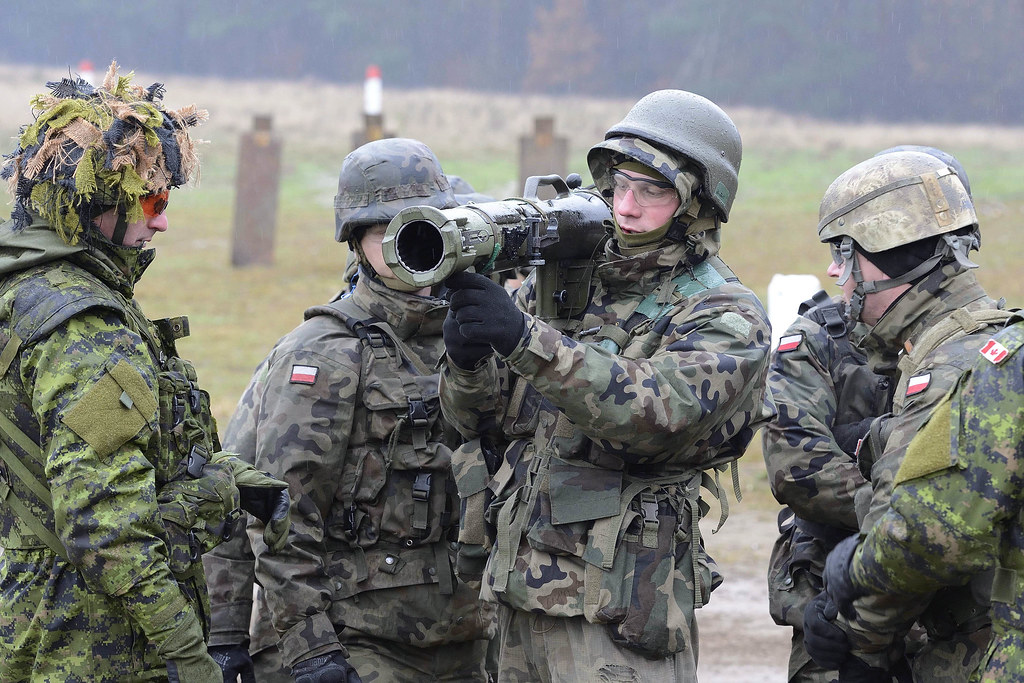
CAF Members train with Polish Military members in a recent exercise during OP REASSURANCE in Poland. (CAF/Flickr) 
The Liberal government announced in July that Canada would lead one of four multinational NATO forces in Eastern Europe, where the military alliance has been beefing up its presence in response to recent Russian actions.

Germany, the United States and Britain are leading similar forces in Lithuania, Poland and Estonia, respectively.

Eastern Europe allies had asked NATO to bolster its footprint in the region as a deterrent against Russia trying to destabilize them in the same way it did in Ukraine — with cyberattacks and by crossing into their territory and inciting Russian speakers within their borders.

Russia has denied any such intentions, and instead accused NATO of instigating the current standoff by expanding into former Soviet territory and trying to undermine its sphere of influence. It has also warned against any military build-up on its borders.

Canada will provide 450 troops as well as light armoured vehicles and other military equipment to the force; Italy has said it will send 140 soldiers.

It wasn’t immediately clear what the other countries will contribute, though media reports have indicated the Polish contribution will include tanks.

The Canadians will form the “nucleus” of the battle group, which will be based at the Adazi military base, about half an hour northeast of the capital Riga.

The first troops will arrive in the spring, but the bulk won’t touch down until fall. They will stay six months before being replaced by another group of Canadians.

Officials have said the four battle groups are intended to make Russia think twice before taking any aggressive action. But they are also being kept small to prevent any provocation or escalation in tensions between Russia and NATO.

Thursday, October 20, 2016

Military Confrontation Over Arctic...Unlikely says SIPRI Report


By: Daniel Maillet, CAF Dispatch Author
October 20, 2016

In it's most recent publication the Stockholm International Peace Research Institute (SIPRI), an independent resource on global security, has examined the military capabilities of five of the most prominent arctic nations and posed the question, A New Cold War in the High North?

In its executive summary, the publication says, "Climate change is making the Arctic region—and its expected natural resources—more accessible. Overlapping claims by the fi ve Arctic littoral states—Canada, Denmark, Norway, the United States (all of which are members of NATO) and Russia—have raised concerns about future conflict in the region and have stimulated new thinking about the security situation in the Arctic. All fi ve states started to strengthen their military presence and capabilities in the Arctic even before the rise in tensions between Russia and NATO members observed since 2014. This increase in tensions has fuelled fears of the onset of a new ‘cold war’ and possible conflict in Europe. It has also resulted in a further build-up of military capabilities in the Arctic region."

"However, the actions taken by the five Arctic littoral states in the region and the offi cial documents released by those states in the past few years seem to suggest that the focus remains solely on the defence of current national territories. While this relatively restrained approach to overlapping maritime claims is to be welcomed, the increases in military forces provide cause for concern, and military confi dence measures and expanded cooperation should be high on the agenda for all five states."

The SIPRI report clearly states that while there are numerous who believe that the Arctic is headed towards conflict, most notably over natural resources; the actuality of military confrontation between any of the five states is unlikely.

The report clearly indicates that Canada is not alone in it's exhaustively slow military rebuild of its Arctic capabilities. The United States, Denmark, Norway, Canada, and Russia while all are heavily investing in a resurgence of military capabilities in the Arctic, all are doing so very slowly (much slower than planned) and are mainly doing so to protect their own borders, sovereignty, and secure a region that is becoming more and more accessible to non-Arctic nations. Therefore, an actual military confrontation over the Arctic in the near future is unlikely. Especially as the five Arctic nations (despite the state of Russian-West Relations) are still working diplomatically together on Arctic issues.

You can read the full report below:
https://drive.google.com/file/d/0BxqdoHflB6JNUzRjUnAwdmkyeWM/view?usp=sharing

Tuesday, October 4, 2016

Ukraine warns Canada not to trust Russian co-operation over Arctic

By: Steven Chase, Globe and Mail 

A senior Ukrainian envoy is warning a thaw in diplomatic relations between Canada and Russia will primarily benefit Vladimir Putin – a caution that came as relations abruptly deteriorated between Moscow and Washington on Monday over Syria and nuclear arsenals.

Vadym Prystaiko, deputy foreign minister of Ukraine, is visiting Ottawa this week to discuss the future of his country, where Russia has controlled the Crimean peninsula since 2014, and bankrolls pro-Moscow militants that have destabilized eastern Ukraine.

Mr. Prystaiko, a former Ukrainian ambassador to Canada, said Kiev is grateful for all Canadians have done for his country, but is not happy to see the Trudeau government resume co-operation with Russia over the Arctic.

Canada and Russia are members of the Arctic Council, but the former Conservative government suspended all but low-level discussions with Moscow after the country annexed Crimea.

The Liberals announced last week that Canada and Russia will host an Arctic conference in Ottawa in November, saying shunning Moscow was an “irrationality” and illogical given that “between us we control 75 per cent of the North.” Foreign Minister StĂ©phane Dion says Canada will continue to voice “profound disagreement” over Russia’s conduct in Ukraine, noting Ottawa has increased sanctions on Moscow since the Liberals took power.

Mr. Prystaiko said engaging with Russia chips away at the international isolation that has bedevilled Mr. Putin since he took over Crimea. Russia was ejected from the Group of Eight forum of major industrialized countries and faces damaging sanctions.

“The Arctic Council is another way where [the Russian President] can break through the worldwide political blockade,” the Ukraine envoy said. “The guy is going for something else than just … the fate of seals or spills of oil.”

The Ukrainian official warned Canada cannot trust any of Russia’s commitments at the Arctic Council.

“Any rapprochement with Russians, before they behave in a civilized way, is too premature,” Mr. Prystaiko said. “Whatever the forum ... we are talking to the aggressor.”

Mr. Prystaiko pointed to Mr. Putin’s announcement on Monday that Moscow will suspend a treaty with Washington on cleaning up weapons-grade plutonium.

“How can you believe in the Arctic Council or document signed with Russia if they would break any agreement?

Russia’s move came just before the United States announced it was suspending one-on-one talks with Moscow toward ending the violence in Syria. Washington accused Moscow of not living up to its commitments under a ceasefire agreement.

Mr. Putin issued a decree suspending an accord concluded in 2000 that had committed the United States and Russia to shrink their nuclear arsenals and dispose of surplus plutonium originally intended for use in nuclear weapons.

The Kremlin said it was taking that action in response to unfriendly acts by Washington.

Under the Conservatives, Ottawa sent military trainers to western Ukraine to help that country’s soldiers upgrade their skills for the conflict in eastern Ukraine. The deployment is slated to end in 2017, but Ukraine hopes the Liberals will extend the mission. Several years ago, Ottawa gave Ukraine $400-million in low-interest loans and has donated tonnes of non-lethal military equipment. Canada also recently concluded a free-trade agreement with Ukraine.

Pro-Russian militants retain control of a portion of eastern Ukraine where Mr. Prystaiko said Moscow posted 6,000 soldiers to lead and support the rebels. The ruble is a circulating currency in this region, he said, and Kiev charges that Russia has been stealing valuable factory equipment and metallurgical coal from the area.

Furthermore, the conflict has blocked the most direct route for Ukraine’s exports to Asia.

“Imagine the United States is [going after you] you with military force, cutting out all trade you have with the United States and then they will decide to block, for example, exports to China,” Mr. Prystaiko said. “We used to send all our exports to China through the railroads over the Russian territory. Now they are blocking exports.”

Monday, October 3, 2016

Can Canada be an Honest Broker on Ukraine?

Originally Published by the CGA Institute 

By Andrew Rasiulis

It was noted in some circles last week, that Canadian Prime Minister Justin Trudeau was not invited to participate in talks held on the margins of the G-20 meeting focused on resolving the political and military impasse in eastern Ukraine. This meeting included the leaders of US, France, Germany, Ukraine and Russia under the informal diplomatic umbrella of the Normandy Group (first formed in June 2014 at D-Day anniversary gathering). Murray Brewster wrote an excellent article for the CBC on September 11, examining the background for Canada's absence, with thoughtful analysis by Professors Piotr Dutkiewicz and Dominique Arel. The upshot being Canada has been too closely identified with the political position of the government in Ukraine and too tight with US positions on Ukraine to distinguish itself as a potential honest broker in finding a political/diplomatic solution to the conflict.

Canadian objectivity on the Ukraine file needs to be restored if Canada has the aspiration to return to its traditional role of honest broker and to thereby make a diplomatic contribution to finding a peaceful settlement. Being objective does not mean that Canada must relinquish its values or interests. On the contrary, Canada has traditionally fostered its values and interests through a measured objectivity which has enabled our diplomats and soldiers to act in an impartial manner to negotiate and resolve conflict.

This was the pattern set after World War II in which Canadian foreign and defence policy was firmly rooted within the Western camp during the Cold War. Canada made its valued military contribution to the NATO and NORAD alliances, as it continues to do so today. However, being a strong backer of its values and interests as represented by these alliances, as well as its close bilateral relationship to the US, did not prevent Canada from playing a valued honest broker role in the context of the UN or other international fora such as the Conference on Security and Cooperation in Europe (CSCE), now renamed the Organization on Security and Cooperation in Europe (OSCE). Canadian diplomats and soldiers were often sought after to play the helpful fixer role in finding solutions to security issues of the day.

Canada still has that opportunity today, whether on the larger international scene or specifically the Ukraine-Russian conflict. The current peace settlement process under the Minsk 2 arrangement agreed in February 2015 is stalled over the reluctance of the Ukrainian government to hold discussions on constitutional reform that would allow greater autonomy for the predominately Russian-speaking rebel-held areas. Both Ukrainians and Russians have agreed under Minsk on reforms and to confirm the package through local elections in the rebel-held areas under Ukrainian law.

Subject to this constitutional reform agreement, all sides agree that the Ukrainian authorities would retake control of the Ukrainian border. Canada has the opportunity to engage itself as an honest broker and to bring to the negotiating table our extensive experience in the evolution of federalism and the peaceful accommodation of ethnic and linguistic diversity. Canada is diplomatically well placed to engage itself in the process under the auspices of the OSCE which continues to play a supporting role to the Normandy Group and the Minsk process.

====

M. Andrew Rasiulis is retired from the Public Service and is now a freelance consultant with Andrew Rasiulis Associates Inc. He is also a Fellow at the Canadian Global Affairs Institute.

Monday, September 19, 2016

Op UNIFIER medical staff hit the ground running

DND Press Release
By: a Joint Task Force-Ukraine Medical Technician and Trainer

Barely unpacked, Joint Task Force-Ukraine medical staff began mentoring Ukrainian instructors in mid-August as they conducted their first Combat First Aid (CFA) course. The course was entirely taught by the Ukrainian Armed Forces instructors, who were well-trained by the outgoing Operation UNIFIER medical personnel.

Starychi, Ukraine. September 2, 2016 – Sergeant Marnie Musson, a Medical Technician with Joint Task Force - Ukraine, mentors Combat First Aid training at the International Peacekeeping and Security Centre during Operation UNIFIER. (Photo: Joint Task Force Ukraine)
After a busy handover with the out-going medical team, the newly arrived medical staff from 1 Field Ambulance at Canadian Forces Base Edmonton moved forward with an open mind.

“I was very impressed with the level of performance and instruction,” said a Master Corporal Medical Technician and trainer at the conclusion of Ukrainian-led Combat First Aid training. “Our Ukrainian instructor colleagues, as well as the course candidates, far exceeded expectations.”

The course was divided into segments that included theoretical (classroom-based) instruction, demonstrations of technique from the Ukrainian instructors, practical sessions where candidates demonstrated their understanding of material, and skill stations designed to perfect key techniques.

The Ukrainian instructors arrived the day before classes started. This gave the Canadian medical mentors time to review expectations and provide the Ukrainians an opportunity to refine their skills and ask any last minute questions prior to beginning instruction the next morning. This was the first opportunity for Ukrainian instructors to deliver a complete CFA course to their Ukrainian Armed Forces colleagues, and they stepped up to the plate in a big way.

The course consisted of thirty-six candidates with diverse backgrounds and military experience levels, ranging from seasoned veterans with front-line experience, to new recruits with as little as nine months of total military experience. All of the candidates were enthusiastic and eager to learn the course material; their pride showed when they were congratulated by the Operation UNIFIER Task Force Commander, Task Force Sergeant-Major, and Task Force Surgeon upon graduation.

“I think the success of a Ukrainian-led CFA course marks an important milestone in the progression of Operation UNIFIER,” said Major Carlo Rossi, Operation UNIFIER, Task Force Surgeon. “These courses are a strong indicator of the mission’s success-to-date, and are the way forward for our medical training here.”

The inaugural course complete, Operation UNIFIER medical staff are now on to the next challenge: they will be mentoring the next CFA serial being delivered to Ukrainian Combat Engineers by Ukrainian instructors.

Thursday, September 1, 2016

CAF Reconnaissance Team in Latvia


According to the Canadian Forces, a reconnaissance team is currently in Latvia to conduct initial assessments of the requirements necessary to establish and sustain a multinational NATO battle group there, according to Canadian military. The visit includes a series of briefings and activities with Latvian and other Allied officials.

The Canadian military is preparing to deploy troops and equipment to Latvia in 2017 “in order to lead a robust multinational NATO battlegroup,” the military stated.

The reconnaissance team, led by Commodore Brian Santarpia, is composed of members of the “Defence Team” specializing in the fields of operational planning, policy, military training, logistics, medical, signals and communications, transport, and finance, the Canadian Forces noted.

Tuesday, July 19, 2016

HMCS Charlottetown in Black Sea

DND Press Release

Her Majesty’s Canadian Ship (HMCS) Charlottetown, while deployed on Operation REASSURANCE, will work and train in the Black Sea with vessels from several allied and partner nations from July 18 to August 2, 2016.

While operating in the Black Sea, HMCS Charlottetown will participate in two training exercises and conduct maritime situational awareness operations to enhance maritime security in the region. As part of its operations in the Black Sea, HMCS Charlottetown will also conduct port visits to enhance diplomatic and defence relations with strategic Allies.

“The deployment of HMCS Charlottetown to the Black Sea demonstrates the Canadian Armed Forces commitment to enhance NATO’s maritime capability to conduct operations and respond quickly to crises and conflict in the maritime domain.” said, Lieutenant-General Stephen Bowes, Commander CJOC

“HMCS Charlottetown’s participation in joint activities and training exercises improves our interoperability with NATO allies and other partners, and better prepares us to meet our collective defence and deterrence obligations.”according to Commander Andrew Hingston, Commanding Officer HMCS Charlottetown
From July 19 to 22, HMCS Charlottetown will participate in Exercise SEA SHIELD, which is aimed at developing international cooperation in the Black Sea operating area with NATO Allies and partner states to strengthen and develop common procedures for combat readiness, including anti-submarine warfare.

From July 27 to 30, HMCS Charlottetown will participate in Exercise SEA BREEZE, which is an air, land, and maritime exercise designed to enhance maritime safety, security, and stability in the Black Sea. This year, the 2016 exercise involves naval vessels from four nations.

Operation REASSURANCE refers to the military activities undertaken by the Canadian Armed Forces to support NATO assurance and deterrence measures in Eastern and Central Europe. It includes operational and tactical level demonstrations, manoeuvres, and enhanced interoperability activities with Allies and partners.

Thursday, July 14, 2016

Canadian army pulls anti-tank missiles out of storage as tensions increase with Russia

By: David Pugliese, The Ottawa Citizen

As tensions increase with Russia, the Canadian military is pulling anti-tank missiles out of storage and will start distributing them to troops next year.

The Canadian Army had sold off most of its tube launched optically sighted wire guided (TOW) missiles and mothballed a few of the anti-tank weapons, assuming they would not be needed in the future.

But with Canada now stationing troops on Russia’s borders, soldiers will require the weapons to counter the Kremlin’s robust armoured forces, military sources say.

Brig.-Gen. Derek Macaulay, chief of staff for army strategy, confirmed the service is re-introducing the tripod-mounted missile system to all regular force infantry battalions.


“Each battalion will receive its complement of systems with all systems being fielded and deployable by summer 2017,” Macaulay said in a statement to the Ottawa Citizen. “We are not purchasing new systems at this time, but rather re-introducing what we had placed into preservation.”

The TOW missiles are designed to destroy armoured vehicles. Although the army has other weapons to deal with such targets, the TOW system is considered among the most effective. Its missile has a range of about 3,700 metres.

NATO has begun preparations for escalating from the Cold War into a hot one.

Courses for training troops on using the TOW system are now underway at Canadian Forces Base Gagetown, N.B., the army noted.

Macaulay denied the move was related to the increase in tensions with Russia. The re-introduction of the weapons is “not in response to any external influence” but instead a decision to deal with a gap in a capability that is fundamental to how the army operates, he said.

It is not clear why such missiles were removed from service in the first place if they are so critical to how the army operates.

But the initiative comes as Canada and NATO turn up the heat militarily on Russia, prompting some observers to point out the West has started a new Cold War with the Kremlin.

NATO is establishing a more permanent and extensive troop presence on Russia’s borders and is sending thousands of soldiers to the region.

Canada recently announced it would deploy about 450 soldiers to Latvia as part of those efforts. It will also keep a warship in the region and contribute fighter jets at different times to the NATO mission.

Peggy Mason, a former security adviser to the Mulroney government, says the moves by the Liberals are further provoking an already tense situation.

“What we’re seeing is Justin Trudeau and his government continuing with the most disagreeable aspects of Stephen Harper’s foreign policy,” said Mason, president of the Rideau Institute in Ottawa.

“People didn’t vote for that. They voted for change.”

At the same time the Liberal government has appeared to have turned its back on talks with Russia, she added.

Chris Westdal, a former Canadian diplomat who was ambassador in both Russia and Ukraine, has said six months into his mandate, Global Affairs Minister Stephane Dion has not yet met his Russian counterpart.

The West has taken a hardl ine against Russia, prompted by Russian leader Vladimir Putin’s decision in 2014 to annex Crimea, once part of Ukraine. The Russians claim they acted to protect the predominately Russian-speaking population there. Western nations have also denounced Russia’s military support for separatists in eastern Ukraine.

As a result, Western nations, including Canada, brought in economic sanctions against Russia as well as increasing their military presence in the region.

But those actions have only backfired, instead shoring up support for Putin among the Russian people who see NATO as closing in on their country’s borders, Mason argues.

Mikhail Gorbachev, the former Soviet leader who helped end the Cold War and who has been of critical of Putin, recently accused NATO of preparing for offensive operations against his country.

“NATO has begun preparations for escalating from the Cold War into a hot one,” he said. “All the rhetoric just yells of a desire almost to declare war on Russia.”

But NATO’s Secretary-General Jens Stoltenberg denies the alliance is a threat to Russia.

“We do not want a new Cold War,” he said. “We do not want a new arms race. And we do not seek confrontation.”

Tuesday, June 21, 2016

Mulroney: Canada must do more to help NATO combat Russian threat

By: Robert Fife, Globe and Mail 
Forrmer Prime Minister Brian Mulroney says the Trudeau government should choose the very best fighter jet to confront the growing threat from Russia as he urged Canada to play a more forceful role within NATO and the United Nations.

In a prepared text for a major foreign policy speech to the NATO Association of Canada on Monday night, Mr. Mulroney warned that Russian President Vladimir Putin is attempting to create a new Eurasian union dependent on Moscow.

“The primary challenge now is to thwart further expansion by Russia and to ensure that those NATO members that border Russia, especially Estonia, Latvia and Lithuania, remain secure and firmly under NATO’s wing,” he said.

NATO is scrambling to contain the threat by stationing four battalions of troops in the Baltic countries, but more needs to be done, Mr. Mulroney said.

“Canada is being invited to contribute troops in some way and, in my view, we should respond positively,” he said. “We need to be equipped and ready, as necessary, to preserve our values.”

Mr. Mulroney said Canada should double defence spending to 2 per cent of GDP.

“The simple reality is that if Canada expects NATO to do more on global security, we must decide to do more for NATO. That should be a top defence priority. What we cannot do is talk about Canada ‘being back’ in the world without making tangible commitments that will anchor our aspirations,” he said.

Mr. Mulroney was sharply critical of the Liberal government’s‎ waffling on an open competition for a new fighter jet. During the election campaign, Justin Trudeau promised to reject the former Conservative government’s favoured aircraft, the F-35 stealth jet, which 11 western allies have now bought.

The government is considering Super Hornets as an interim replacement for the aging CF-18s‎.

“We need new fighter aircraft, but most of all, we need a decision on what we will buy to serve our strategic needs, not an interim purchase driven by political considerations that risk repeating the helicopter fiasco,” Mr. Mulroney said.

The former prime minister noted the problems that happened in the 1990s, when the ChrĂ©tien Liberals succeeded the Mulroney Conservatives and cancelled their $4.4-billion purchase of EH-101 helicopters. Mr. ChrĂ©tien’s decision cost taxpayers half a billion dollars in penalties. The government ended up buying the same helicopters, but the costs had then risen to $7.6-billion.

U.S. defence giant Lockheed Martin has already said Canada could lose $825-million in aerospace contracts that were signed with Canadian companies to build equipment for the F-35 jets if the Liberal government buys the Super Hornets.

Mr. Mulroney said Canada should follow the Australian model and set up an independent, arms-length agency to handle major defence procurement through an open bidding process.

He also urged Mr. Trudeau to join the U.S. anti-ballisic missile defence system to protect Canada from countries such as North Korea that are heavily investing in long-range nuclear missile capability.

“We cannot subcontract our responsibility to national security to our southern neighbour, no matter how secure we may believe ourselves to be relying exclusively on American continental security,” he said.

Mr. Mulroney supported Mr. Trudeau’s plans to be more engaged in UN peacekeeping and to play a more prominent role in the world body.

The UN is in urgent need of an overhaul in its personnel policies, and requires much tighter accountability, Mr. Mulroney said.

“Since Cana‎da remains the 7th-largest contributor of funds to the UN and its agencies, we should move beyond fuzzy sentiments and position ourselves in the vanguard of those seeking genuine reform at the UN,” he said.

Tuesday, May 31, 2016

Incident in North Atlantic last fall shows why Canada needs Submarines

By: Brett Ruskin, CBC News 

Top East Coast naval brass are pointing to a recent foray by a foreign power as an act of aggression that shows why Canada needs a strong sub-sea presence.

Rear-Admiral John Newton, commander of the East Coast navy, shared details of the 2015 incident during a media tour aboard HMCS Windsor, one of Canada's four submarines.

Last fall, NATO forces noticed five submarines belonging to a major foreign power moving into the North Atlantic. Newton did not name the country.

The subs — four nuclear-powered and one diesel-electric — were tracked to the area near Iceland and Greenland.

The Canadian military deployed Halifax-based HMCS Windsor, and Aurora patrol aircraft from 14 Wing Greenwood.

The response was in coordination with American and European allies to "demonstrate resolve" against this show of aggression, Newton said.

HMCS Windsor is one of four submarines purchased by the Canadian government nearly two decades ago from Britain. They were slow to be put into service, and have had numerous issues over the years including on-board fires and collisions with the sea floor.

But the subs are getting significant technological refits.

HMCS Windsor is now using the same sonar system found on the United States' Virginia-class submarines, considered among the most capable nuclear subs on the planet. The sonar system can identify and track targets from many kilometres away.
Crew stand atop HMCS Windsor, one of Canada's four submarines.
Crew stand atop HMCS Windsor, one of Canada's four submarines. (Brett Ruskin/CBC)
Military officials showed the system to members of the media, but did not permit them to take pictures or disclose specific details about its performance capabilities.
'These submarines or no submarines'

Canada's submarines have often been criticized for being second-hand and expensive to maintain.

While both those assertions are true, the subs are still good value for money, said Ken Hansen, a retired military officer and independent maritime security analyst.

"It was these submarines or no submarines," he said. "We couldn't have bought new submarines for the money that was available [in 1998]. Therefore, we had to buy used. It was simple."
Next mission involves trip to Norway

He said the submarines are powered by diesel-electric engines, which are quieter than many nuclear-powered submarines.

Beneath the surface, HMCS Windsor runs on battery power. A nuclear submarine needs complex systems for power and heat management that produce slightly more noise.

The next mission for Canada's East Coast submarine involves a trip to Norway, followed by a series of international exercises planned to take place in the waters between Halifax and St. John's.

Friday, March 18, 2016

CAF Sends More Troops to Ukraine

Written by: Murray Brewster, The Canadian Press

OTTAWA — A fresh contingent of Canadian troops has arrived in eastern Europe to take part in NATO exercises meant to reassure jittery allies and the deployment follows a spike in violence between Ukrainian forces and Russian-backed separatists.

More than 100 soldiers from the 1st Battalion, the Royal 22e Regiment of Valcartier, Que., will conduct training in Poland and Romania — far from the eastern front lines — and are separate from a U.S-led training mission in western Ukraine.

Senior American officials have expressed "deep concern" about the number of ceasefire violations reported by the Organization for Security and Co-operation in Europe in breakaway regions of Ukraine.

The Canadian commander, Maj. Eric Beauchamp, says his troops don't necessarily feel the tension, but they get a clear sense eastern European soldiers are happy to see them.

"Even if we are a small detachment that is going to train with them, they appreciate this and they want the world to know we are there," he said in a recent interview with The Canadian Press. "Because of the tension, the effect we have here is really tangible and we see it."

Defence Minister Harjit Sajjan and his parliamentary secretary, Liberal MP John McKay, are in the region this week, meeting officials in Ukraine, Germany and Poland.

The trip is seen as a political reassurance mission on top of the military contribution.

In a conference call from Germany late Wednesday, Sajjan said that Russia's partial withdrawl from Syria will not mean a softening of Canadian policy — or sanctions imposed in the wake of the annexation of Crimea, which began two years ago Wednesday.

"Our support for Ukraine remains solid," he said. "I'm hopeful — as I mentioned to my counterparts in Ukraine — that Mr. Putin would make a similar statement about withdrawing troops from Ukraine."

The war in that part of the world has largely slipped from the headlines in many western countries, replaced by daily accounts of the conflict with the Islamic State in Iraq and the Levant.

Russia's annexation of Crimea was followed a few months later by an uprising in two eastern Ukrainian districts, known as oblasts.

That set off a wave of sanctions from western governments and fears among eastern European countries that Russian President Vladimir Putin's ambitions would not stop at the Ukraine border. Many of those countries are new members of NATO, who would demand help should their territory be violated.

Last year, the U.S.-based Pew Research Centre conducted an exhaustive public opinion study among the military alliance's member nations.

While many see Russia as a military threat, there is a general reluctance to send military aid to Ukraine. Even more significant, the study found at least half of Germans, French and Italians say their country should not use military force to defend a NATO ally attacked by Russia.

"Americans and Canadians are the only publics where more than half think their country should use military action if Russia attacks a fellow NATO member (56 per cent and 53 per cent respectively)," said the study published on June 10, 2015.

The report also said that NATO members were more receptive to sending economic, rather military aid to Ukraine.

Sajjan said the issue of sending lethal aid to Ukraine did not come up in his meetings with officials.

Murray Brewster, The Canadian Press