Translate

Showing posts with label Eastern Europe. Show all posts

Friday, October 28, 2016

Four countries promise to join Canadian-led battle group in Latvia

By: Lee Berthiaume, The Globe and Mail 

Canadian troops will not face Russia alone when they begin to arrive in Latvia early next year.

Four countries — Albania, Italy, Poland and Slovenia — have promised to contribute troops and equipment to a Canadian-led NATO force that is being organized in Latvia in response to recent Russian actions in Eastern Europe.

“As Canada takes a leadership role as a NATO framework nation, I look forward to working with our partners from Latvia, Albania, Italy, Poland and Slovenia as we stand together to enhance our collective security,” Defence Minister Harjit Sajjan said in a statement.
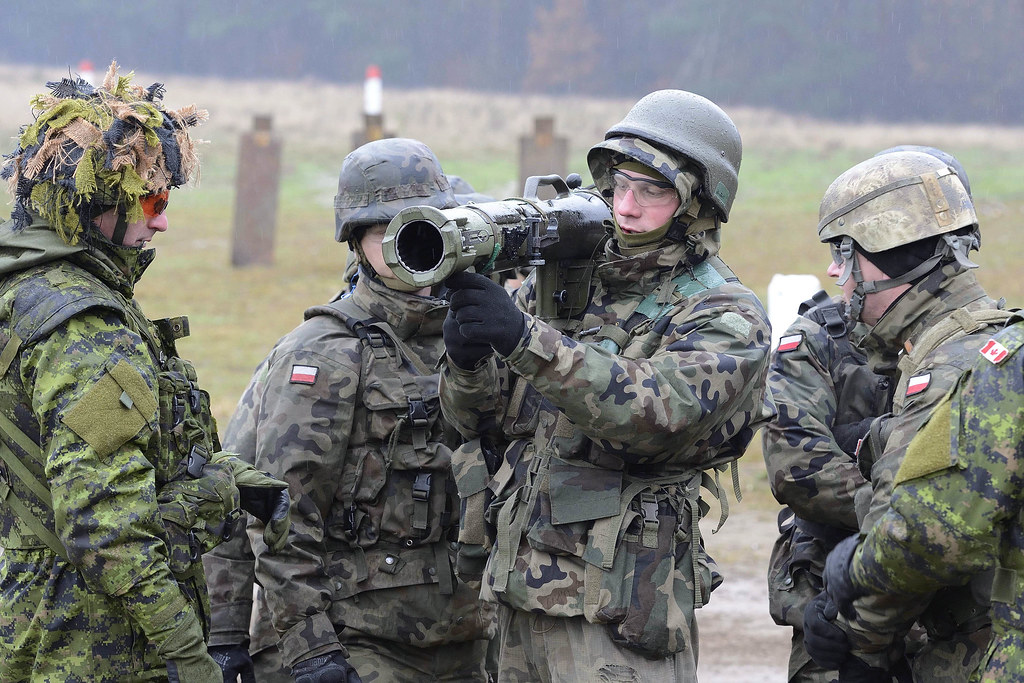
Image result for OP REASSURANCE in Latvia
CAF Members train with Polish Military members in a recent exercise during OP REASSURANCE in Poland. (CAF/Flickr) 
The Liberal government announced in July that Canada would lead one of four multinational NATO forces in Eastern Europe, where the military alliance has been beefing up its presence in response to recent Russian actions.

Germany, the United States and Britain are leading similar forces in Lithuania, Poland and Estonia, respectively.

Eastern Europe allies had asked NATO to bolster its footprint in the region as a deterrent against Russia trying to destabilize them in the same way it did in Ukraine — with cyberattacks and by crossing into their territory and inciting Russian speakers within their borders.

Russia has denied any such intentions, and instead accused NATO of instigating the current standoff by expanding into former Soviet territory and trying to undermine its sphere of influence. It has also warned against any military build-up on its borders.

Canada will provide 450 troops as well as light armoured vehicles and other military equipment to the force; Italy has said it will send 140 soldiers.

It wasn’t immediately clear what the other countries will contribute, though media reports have indicated the Polish contribution will include tanks.

The Canadians will form the “nucleus” of the battle group, which will be based at the Adazi military base, about half an hour northeast of the capital Riga.

The first troops will arrive in the spring, but the bulk won’t touch down until fall. They will stay six months before being replaced by another group of Canadians.

Officials have said the four battle groups are intended to make Russia think twice before taking any aggressive action. But they are also being kept small to prevent any provocation or escalation in tensions between Russia and NATO.

Monday, October 3, 2016

Can Canada be an Honest Broker on Ukraine?

Originally Published by the CGA Institute 

By Andrew Rasiulis

It was noted in some circles last week, that Canadian Prime Minister Justin Trudeau was not invited to participate in talks held on the margins of the G-20 meeting focused on resolving the political and military impasse in eastern Ukraine. This meeting included the leaders of US, France, Germany, Ukraine and Russia under the informal diplomatic umbrella of the Normandy Group (first formed in June 2014 at D-Day anniversary gathering). Murray Brewster wrote an excellent article for the CBC on September 11, examining the background for Canada's absence, with thoughtful analysis by Professors Piotr Dutkiewicz and Dominique Arel. The upshot being Canada has been too closely identified with the political position of the government in Ukraine and too tight with US positions on Ukraine to distinguish itself as a potential honest broker in finding a political/diplomatic solution to the conflict.

Canadian objectivity on the Ukraine file needs to be restored if Canada has the aspiration to return to its traditional role of honest broker and to thereby make a diplomatic contribution to finding a peaceful settlement. Being objective does not mean that Canada must relinquish its values or interests. On the contrary, Canada has traditionally fostered its values and interests through a measured objectivity which has enabled our diplomats and soldiers to act in an impartial manner to negotiate and resolve conflict.

This was the pattern set after World War II in which Canadian foreign and defence policy was firmly rooted within the Western camp during the Cold War. Canada made its valued military contribution to the NATO and NORAD alliances, as it continues to do so today. However, being a strong backer of its values and interests as represented by these alliances, as well as its close bilateral relationship to the US, did not prevent Canada from playing a valued honest broker role in the context of the UN or other international fora such as the Conference on Security and Cooperation in Europe (CSCE), now renamed the Organization on Security and Cooperation in Europe (OSCE). Canadian diplomats and soldiers were often sought after to play the helpful fixer role in finding solutions to security issues of the day.

Canada still has that opportunity today, whether on the larger international scene or specifically the Ukraine-Russian conflict. The current peace settlement process under the Minsk 2 arrangement agreed in February 2015 is stalled over the reluctance of the Ukrainian government to hold discussions on constitutional reform that would allow greater autonomy for the predominately Russian-speaking rebel-held areas. Both Ukrainians and Russians have agreed under Minsk on reforms and to confirm the package through local elections in the rebel-held areas under Ukrainian law.

Subject to this constitutional reform agreement, all sides agree that the Ukrainian authorities would retake control of the Ukrainian border. Canada has the opportunity to engage itself as an honest broker and to bring to the negotiating table our extensive experience in the evolution of federalism and the peaceful accommodation of ethnic and linguistic diversity. Canada is diplomatically well placed to engage itself in the process under the auspices of the OSCE which continues to play a supporting role to the Normandy Group and the Minsk process.

====

M. Andrew Rasiulis is retired from the Public Service and is now a freelance consultant with Andrew Rasiulis Associates Inc. He is also a Fellow at the Canadian Global Affairs Institute.

Tuesday, June 21, 2016

Mulroney: Canada must do more to help NATO combat Russian threat

By: Robert Fife, Globe and Mail 
Forrmer Prime Minister Brian Mulroney says the Trudeau government should choose the very best fighter jet to confront the growing threat from Russia as he urged Canada to play a more forceful role within NATO and the United Nations.

In a prepared text for a major foreign policy speech to the NATO Association of Canada on Monday night, Mr. Mulroney warned that Russian President Vladimir Putin is attempting to create a new Eurasian union dependent on Moscow.

“The primary challenge now is to thwart further expansion by Russia and to ensure that those NATO members that border Russia, especially Estonia, Latvia and Lithuania, remain secure and firmly under NATO’s wing,” he said.

NATO is scrambling to contain the threat by stationing four battalions of troops in the Baltic countries, but more needs to be done, Mr. Mulroney said.

“Canada is being invited to contribute troops in some way and, in my view, we should respond positively,” he said. “We need to be equipped and ready, as necessary, to preserve our values.”

Mr. Mulroney said Canada should double defence spending to 2 per cent of GDP.

“The simple reality is that if Canada expects NATO to do more on global security, we must decide to do more for NATO. That should be a top defence priority. What we cannot do is talk about Canada ‘being back’ in the world without making tangible commitments that will anchor our aspirations,” he said.

Mr. Mulroney was sharply critical of the Liberal government’s‎ waffling on an open competition for a new fighter jet. During the election campaign, Justin Trudeau promised to reject the former Conservative government’s favoured aircraft, the F-35 stealth jet, which 11 western allies have now bought.

The government is considering Super Hornets as an interim replacement for the aging CF-18s‎.

“We need new fighter aircraft, but most of all, we need a decision on what we will buy to serve our strategic needs, not an interim purchase driven by political considerations that risk repeating the helicopter fiasco,” Mr. Mulroney said.

The former prime minister noted the problems that happened in the 1990s, when the Chrétien Liberals succeeded the Mulroney Conservatives and cancelled their $4.4-billion purchase of EH-101 helicopters. Mr. Chrétien’s decision cost taxpayers half a billion dollars in penalties. The government ended up buying the same helicopters, but the costs had then risen to $7.6-billion.

U.S. defence giant Lockheed Martin has already said Canada could lose $825-million in aerospace contracts that were signed with Canadian companies to build equipment for the F-35 jets if the Liberal government buys the Super Hornets.

Mr. Mulroney said Canada should follow the Australian model and set up an independent, arms-length agency to handle major defence procurement through an open bidding process.

He also urged Mr. Trudeau to join the U.S. anti-ballisic missile defence system to protect Canada from countries such as North Korea that are heavily investing in long-range nuclear missile capability.

“We cannot subcontract our responsibility to national security to our southern neighbour, no matter how secure we may believe ourselves to be relying exclusively on American continental security,” he said.

Mr. Mulroney supported Mr. Trudeau’s plans to be more engaged in UN peacekeeping and to play a more prominent role in the world body.

The UN is in urgent need of an overhaul in its personnel policies, and requires much tighter accountability, Mr. Mulroney said.

“Since Cana‎da remains the 7th-largest contributor of funds to the UN and its agencies, we should move beyond fuzzy sentiments and position ourselves in the vanguard of those seeking genuine reform at the UN,” he said.

Friday, June 10, 2016

NATO request that 1,000 Canadian troops be deployed in Eastern Europe

BY LEE BERTHIAUME, OTTAWA CITIZEN

OTTAWA — Eastern European NATO allies have been pressing Canada to deploy up to 1,000 soldiers into the region to bolster the alliance’s presence amid continued concerns about Russian aggression.

The Liberal government says it is looking “actively considering options.” However, Eastern European diplomats say Ottawa has so far been giving “contradictory” signals.

“One day we hear we might be pleased with what is coming,” one envoy told the Citizen Thursday, “and the next things do not look good at all.”

Liberals ‘considering’ NATO request that 1,000 Canadian troops be deployed in Eastern Europe
Members of 3rd Battalion, The Royal Canadian Regiment during NATO exercises on May 16, 2015 in Cincu, Romania
The allies’ request has been conveyed through diplomatic channels as well as political meetings between Canadian ministers and their NATO counterparts in recent months. Polish President Andrzej Duda raised the issue personally with Prime Minister Justin Trudeau during a visit to Ottawa in May.

Canada has had 220 soldiers in Poland since June 2014, three months after Russia annexed Crimea and began supporting separatist forces in eastern Ukraine. They are currently involved in a 10-day military exercise with 30,000 other NATO troops, the largest such exercise since the end of the Cold War.

NATO, however, wants to establish a new force in eastern Europe that would provide a bulwark against any further Russian expansion or aggression. The U.S., Britain and Germany have each promised 1,000 troops that will be stationed in different countries, but they need a fourth ally to step up.

If the request is approved by cabinet, one of Canada’s nine infantry battalions would rotate through Europe, serving between six and nine months before being replaced by another battalion.

Another possibility under discussion is for Canada to send an armoured reconnaissance unit to eastern Europe, a source in NATO said.

NATO has also requested that Canada keep a warship continuously on patrol in European waters and to continue from time to time to contribute CF-18 fighter jets to the Baltic Air Policing mission, which was set up after repeated violations of NATO air space by Russian aircraft.

A senior NATO diplomat told Reuters that other European allies are stretched thin because of operations in Africa, Afghanistan or at home, which is why Canada is being singled out.

Defence Minister Harjit Sajjan’s spokeswoman, Jordan Owens, was non-committal when asked if Canada would contribute the requested troops. “As a committed NATO ally, Canada is‎ actively considering options to effectively contribute to NATO’s strengthened posture,” she said Thursday.

Discussions between Canada and the alliance are ongoing, diplomats told the Citizen on condition of anonymity, and a decision should be made before NATO leaders gather in Warsaw next month. Before that, however, the issue is expected to come up when Sajjan meets with other NATO defence ministers in Brussels next week.

Deploying so many soldiers overseas could be taxing for the Canadian Armed Forces given recent operational and budgetary pressures. Canada is ramping up its mission in Iraq to more than 800 personnel, including helicopters and other equipment. This is in addition to existing commitments in Europe.

At the same time, Canadian defence spending as a percentage of the economy has reached levels not seen in decades. This is despite NATO members having agreed in Wales two years ago to reverse the decline, and aim to spend two per cent of GDP on defence. Canada spends one per cent.

Eastern European NATO members, however, see the alliance force that Canada is being asked to support as essential for ensuring their security in the face of Russian aggression. Most are former Soviet states, and they worry that what is happening in Ukraine could also play out within their borders.

Canada previously had troops in Western Europe on a permanent basis during the Cold War, though most were returned home when the Soviet Union collapsed. The new force would be comprised of troops who would rotate through the region on a regular basis.

Despite not having a clear indication where the Liberal government was leaning, Eastern European diplomats said they were hopeful Canada would contribute the requested troops.

“I very much hope that by the time of NATO summit, it’s more clear and decisions will be taken at the summit that match our expectations,” said one. “I think Canada won’t let us down.”

With files from Postmedia News

Monday, June 15, 2015

HMCS Winnipeg Deploying on OP REASSURANCE

HMCS Winnipeg deployed today for a 9 month mission throughout the Mediterranean and Black Sea as part of OP REASSURANCE, as a member of NATOs Standing Maritime Forces.

HMCS Winnipeg will replace HMCS Fredericton, which has been deployed in the region since January 2015.

255 Sailors and Air Crew aboard the Winnipeg will spend the next nine months promoting security and stability in Central and Eastern Europe.