Translate

Showing posts with label Royal Canadian Navy. Show all posts

Wednesday, December 12, 2018

HMCS Calgary Witnesses Possible Violations of North Korean Sanctions on Patrol in Pacific

By: Lee Berthiaume, The Canadian Press

OTTAWA -- The crew of a Canadian warship in the Pacific had front-row seats to potential violations of UN sanctions against North Korea during a recent patrol in the East China Sea -- but was under orders not to intercept any suspicious vessels, the ship's commander says.

Image result for hmcs calgary
HMCS Calgary - Halifax Class Frigate 
Crew members on HMCS Calgary instead took photos and collected other information, Cmdr. Blair Saltel said Tuesday.

"We saw several ship-to-ship transfers at sea and by the markings -- based on the intelligence that we had -- some of those were associated with ... potential violators of those sanctions," Saltel said.

"We maintained a (distance), and that's in (accordance) with the entire approach to the operation. We took pictures, we passed that information to the higher authorities and the expectation is that could be used for legal sanctions."

HMCS Calgary is the first Canadian military vessel to deploy to the area after the federal government agreed earlier this year to help the U.S. and other allies crack down on smuggling designed to subvert sanctions against North Korea.

Western security officials have previously accused Russia and China of exporting oil to North Korea -- or at least turning a blind eye as their companies do -- which would be a violation of sanctions. Both countries have denied the charge.

While the Canadian frigate did not intercept any vessels, Saltel said the mere presence of a Western warship was enough in some cases to cause the other vessels to turn tail and run.

"We noted in a few instances that the transfers would wrap up quite quickly and they would have to escape. So our presence disrupted several of the transfers. But we had no intention of actually doing something as forceful as boarding or blocking a ship."

The Calgary and the navy's interim support ship, MV Asterix, are wrapping up a six-month deployment in the Pacific off Asia, during which they also participated in several multinational military exercises and visited several countries.

One of the main objectives was to demonstrate Canada's naval presence in a part of the world that is growing increasingly important to Canadian prosperity and international security.

Saltel said the deployment has included being shadowed by Chinese naval vessels in the South and East China Seas, which has become routine for Western military ships operating in the area amid growing tensions over competing territorial claims.

The U.S., the United Kingdom and other allies have made a point of sailing close to disputed islands and through disputed waters claimed by China, prompting several close calls and tense moments as the latter flexes its muscles.

The situation in the South China Sea, in particular, has been compared to a powder keg, as Chinese and U.S. naval vessels have almost collided as the U.S. navy has conducted "freedom of navigation" operations.

Saltel said he was not directed to do anything like that, and while HMCS Calgary did sail near the disputed Spratly Islands, its course was intended to save fuel and not to send a message to China.

The Canadian officer said his Chinese "shadows" acted professionally and "never really came within a distance that I would have considered unsafe."

HMCS Calgary's recent deployment was also unique for being the first to involve the Asterix, a converted civilian vessel that the federal government is leasing from Quebec-based Davie Shipbuilding until permanent support ships can be built.

The Asterix is captained and crewed by civilians except for a small contingent of military personnel who are responsible for providing fuel and other supplies at sea. Saltel said it has conducted about 50 such replenishments with the Calgary and allies.

Tuesday, November 20, 2018

Government Announces Purchase of 6th AOPS

By: Mairin Prentiss · CBC News

The federal government is purchasing another ship to be built in Halifax, the defence minister says a day after Ottawa awarded $7 billion in contracts to three shipyards for work on Royal Canadian Navy frigates — leaving concerns over an 18-month gap in work for Irving Shipyard employees.

Image result for aops
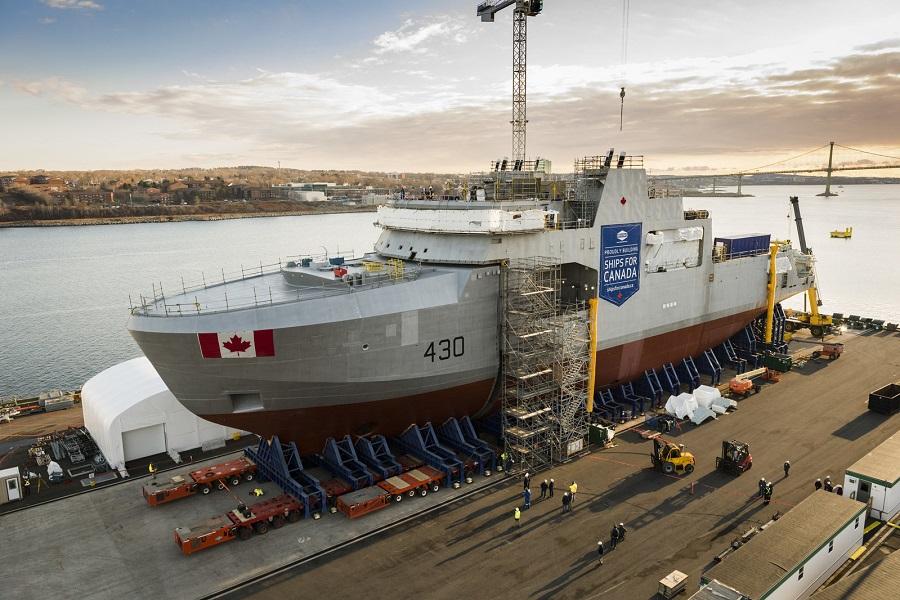
The First Arctic and Offshore Patrol Ship assembled at Halifax Shipyard - Irving Shipbuilding
The government will buy a sixth Arctic and offshore patrol ship for the navy, Harjit Sajjan said to a crowd at the Irving Shipyard in Halifax on Friday.

"The women and men of the Irving Shipyard build incredible ships and are essential for enabling the success of the Royal Canadian Navy," said Sajjan.

The government planned to purchase five Arctic and offshore patrol ships — with a possibility of a sixth — after scaling back its original plan of buying between six and eight vessels in 2014.

Public Services and Procurement Canada announced Thursday in a news release that it intends to sign contracts worth $7 billion with Davie in Lévis, Que., Irving Shipbuilding Inc. in Halifax and Seaspan Victoria Shipyards in Victoria for maintenance on 12 Canadian navy ships.

With the maintenance program split between three yards, workers in Halifax feared they would be laid off in between the end of the patrol ships program and the start of the Canadian Surface Combatant program.

Last month, Irving employees held a march in Halifax to protest the Liberal government's intention to split the contracts with other yards, saying it would result in job losses.

Irving Shipyard workers say sharing the work will mean layoffs. (Robert Short/CBC)

Friday's announcement appears to be aimed at allaying those fears.

In a news release, the Department of National Defence said the sixth ship will help sustain hundreds of jobs at Irving shipyards.

"Today's announcement is good news for the Royal Canadian Navy, but it is also good news for Canadians, our economy and the city of Halifax. This is a region with deep ties to our navy," said Sajjan.

"By adding a sixth Arctic and offshore patrol ship, we are ensuring that our Royal Canadian Navy remains an agile and responsive force for years to come, so that Canada can continue to assert and enforce our Arctic sovereignty," he said.

Irving officials had meetings in Ottawa on Thursday where they said they received the news.

But building another ship doesn't mean there won't be layoffs, said Kevin McCoy, the president of Irving Shipbuilding.

"Nothing is guaranteed until we have contracts in hand and I know hearing that might make some folks a little uneasy, but I am encouraged by our discussions yesterday particularly around Halifax class maintenance work. This is a big piece of solving about a three-year problem, but we now have about half the problem solved."

Irving will begin construction on the fourth Arctic and offshore patrol vessel later this year.

Friday, June 15, 2018

Canadian Submarines not part of international Arctic under-ice exercise

Kaila Jefferd-Moore, CBC News 


Royal Navy submarine HMS Trenchant after it had broken through the metre-thick ice of the Arctic Ocean to join two U.S. boats on a major exercise. Ice Exercise 18 (ICEX) is a series of demanding trials in the frigid climate of the Arctic Circle, designed to test submariners' skills in operating under the Arctic ice cap. No Canadian submarines took part. (MoD/Crown copyright 2018)
Over five weeks, the British submarine HMS Trenchant travelled beneath — and broke through — Beaufort Sea ice alongside two U.S. submarines.

It was there as part of the Arctic and Ice Exercise (ICEX) 2018, a U.S. Navy submarine arctic warfare exercise involving U.S., Canadian and British armed forces.

Taking place about 200 kilometres off the Alaskan coast in the Beaufort Sea, the exercise was designed, in part, for the U.S. Navy to practise and test the operational and tactical capabilities of its submarines under ice.

The Trenchant is one of the United Kingdom's Royal Navy submarines that has extensive under-ice capabilities.

"This exercise shows that our Royal Navy is primed and ready to operate in the harshest conditions imaginable, to protect our nation from any potential threats," Armed Forces Minister Mark Lancaster said in a Royal Navy news release.

The Royal Canadian Navy, however, cannot make the same claim about its submarines.

Canada's fleet of submarines, bought 20 years ago from the British Royal Navy, didn't join the latest ICEX operation. The Royal Canadian Navy's HMCS Windsor, Victoria, Chicoutimi and Corner Brook aren't designed for those kinds of under-ice uses.
Canada buys British submarines

Unlike their nuclear counterparts, Canadian submarines are limited to open water and near-ice-edge operations, an acknowledged concession due to budgetary realities. This is in part because they're diesel powered boats, and must come up for air periodically.

Both the U.S.and British navies have nuclear-powered submarines with the capacity to stay underwater for as long as a crew's food supply lasts. They can confidently travel under arctic ice.

Still, the Royal Canadian Navy has been involved in ICEX since 2011, according to naval communications adviser, Jennifer St. Germain. This year, Canada offered a "modest contribution" to ICEX 2018, sending "a naval communicator to support the exercises." That's one Canadian among a sea of many U.S. Navy and Royal Navy personnel.

The Royal Canadian Air Force also participated in the exercises, but did not respond to a CBC request for information on their involvement.
Sailors line up on Canadian submarine HMCS Corner Brook to salute Queen Elizabeth II during an international fleet review Tuesday, June 29, 2010 in Halifax. (Paul Chiasson/CP)
Canada relies on U.S. for security

Robert Huebert, a political science professor at the University of Calgary with a specific interest in arctic sovereignty and security, said the relationship between the U.S. and Canadian naval forces is one of the strongest in the world.

Without the ability to patrol and protect its arctic sovereignty, Canada relies on its allies — in particular the U.S. Navy — to help enforce it, Huebert explained.

Arctic sovereignty, according to Huebert, means "determining the boundaries within the region of the Arctic that Canada asserts having complete and absolute control [over]."

But the the ability of Canada's submarine fleet to work under ice isn't about sovereignty — it's about security, said Huebert.

"Sovereignty is about the international legal control, but security is about the enforcement ability."

Over the long term, Huebert said, it's important to keep an eye on China's naval forces, which now have icebreakers and an Arctic policy. He said it isn't hard to imagine that the Chinese will someday have under-ice submarine capabilities.

"It does bring up the question of sovereign control," Huebert said.
What does China's new Arctic policy mean for Canada?
A co-operative affair

Under the North American Aerospace Defence Command (Norad) agreement, the Canadian Armed Forces play a supportive role in the joint effort to patrol and protect North American arctic waters.

In 2017, the Canadian Armed Forces contracted Ocean Networks Canada to begin testing the feasibility of sensor-technology that would allow the navy to detect and track vessel traffic entering the Northwest Passage. This would replace the North Warning System that's been in use since the 1980s.

St. Germain said agreements with the Canadian Coast Guard on joint Arctic operations, and the addition of new Arctic patrol ships, mean the Royal Canadian Navy's "presence in the Arctic will increase in the near future."

Thursday, June 14, 2018

Lockheed Martin Canada Awarded 3 Year Extension on Halifax Frigate Support Contract

Frontline Defence Press Release

Lockheed Martin Canada has been awarded a three-year extension to its In-Service Support contract for the Royal Canadian Navy’s 12 Halifax Class Frigates.

“We are pleased by the vote of confidence from our Royal Canadian Navy customer to continue this existing relationship,” said Gary Fudge, vice president and general manager of Lockheed Martin Canada Rotary Mission Systems. As part of our Combat System Integrator portfolio, Lockheed Martin Canada has established a world class in-service support team which is also being recognized by our international customers.”


The Lockheed Martin Canada In-Service Support team has provided uninterrupted support to the Halifax Class Combat System, Command and Control System and Trainers for 25 years.

The existing In-Service Support contract commenced in November 2008 with the award of the Halifax Class Modernization project. The In-Service support contract also included support of the legacy Halifax Class system prior to ships entering the shipyard for modernization.

The Combat Management Systems (CMS) support entails hardware and software support for the CMS 330, and the CMS to combat subsystem interfaces, ancillary systems and tools, as well as the integration of new weapons, sensors and information sources.

Thursday, June 7, 2018

RCN Supply Ship Cost Increases by $1.1 Billion; Now over $3 Billion

By: David Pugliese, National Post 

At one point, the first ship was supposed to arrive in 2012. That date has changed a number of times. DND is now hoping for delivery in 2022 or 2023

Taxpayers will have to spend an additional $1.1 billion to build two new supply ships for the Royal Canadian Navy, the federal government has revealed.

The cost of building the Joint Support Ships, or JSS, had been pegged at $2.3 billion. However, the government ordered a review of that figure and in an email to Postmedia procurement minister Carla Qualtrough’s office confirmed the cost is now expected to be $3.4 billion.

Of the $3.4 billion price tag, the actual cost of building the two ships accounts for a little more than 60 per cent, Finn said. Pat Finn, the head of procurement at the Department of National Defence, said the new price tag includes items the government had not previously included. In some cases equipment for the ship has been purchased, so the government has a more accurate understanding of what it actually cost, Finn said in an interview Monday. The inflated figure also takes into account new infrastructure and delays with the program which have driven up its price as the cost of materials has increased over the years.

“The build period has changed quite dramatically,” Finn acknowledged.
Workers watch as the main girder of a new 300-tonne gantry crane is lifted into place at Seaspan Vancouver Shipyards in North Vancouver, B.C., on Wednesday April 2, 2014. Darryl Dyck/Canadian Press
At one point, the first ship was supposed to arrive in 2012. That date has changed a number of times with the government later hoping for a 2018 delivery and then a 2019 arrival for the first vessel.

DND is now hoping for the delivery of the first ship in 2022 or 2023. Construction of some initial portions of the vessels will begin at Seaspan Shipyards in Vancouver this summer, Finn said, which it hopes will head off any potential layoffs of skilled employees at the shipyard.

Finn said the new costing model for the JSS is more akin to the one used by the parliamentary budget office. That office had an even higher estimate for JSS when it concluded in 2013 that the final tally for taxpayers would be $4.13 billion.

The Joint Support Ships are seen as being critical for the navy, as they will provide fuel and supplies for warships at sea.

The navy retired its last two aging supply ships years ago, one after being damaged beyond repair in a fire, the other because of excessive corrosion. After their retirement the Canadian military had been relying on the Spanish and Chilean navies to provide it with supply vessels for short periods of time.

Because of the delays to the JSS program, the previous Conservative government entered into agreement with Davie Shipyards in Quebec to lease a commercial vessel converted into a supply ship. That ship, the MV Asterix, is at the heart of the federal government’s case against Vice-Admiral Mark Norman.

In March, the Norman was charged with a single count of breach of trust. The RCMP accused Norman of warning Davie in the fall of 2015 that Liberal cabinet ministers wanted to derail the Asterix project. When word of the Liberal plan leaked to the media, the resulting embarrassment forced the Trudeau government to back down on its plans and the conversion of Asterix proceeded.

Norman was put under investigation and Prime Minister Justin Trudeau predicted on two occasions the officer would ultimately end up in court.

Norman denies the charge and has said he looks forward to clearing his name. A date for the trial has not yet been set.

Asterix is considered a rare achievement in Canadian military procurement in that it was delivered on time and on budget. The supply ship is now at sea with Royal Canadian Navy and is headed to a major military exercise to begin later this month.

Friday, May 11, 2018

RCN Facing Mold Problems

By: Murray Brewster, CBC News 

A newly released report blames a build-up of potentially hazardous mold aboard Canada's frontline warships squarely on a lack of upkeep by the navy.

The engineering analysis — obtained by CBC News under access to information after an almost two-year battle — said shipboard heating and air conditioning structures (HVAC) and their associated controls were allowed to deteriorate over the years to the point where they became almost useless.

The systems have "significantly degraded," said a March 2015 engineering report prepared for the navy by an outside contractor. "Little maintenance has been performed and the state of equipment is old and unsupportable."

Thermostats and pneumatic devices, meant to control airflow and humidity, were "failing, outdated and unsupportable," said the engineering analysis by the firm Bronswerk.

The report is the first clear effort to assign blame for a hazard the navy has tried to control. It could even have legal ramifications.

A former sailor, retired lieutenant Alan Doucette, is suing the federal government over the "staggering mold growth" aboard navy destroyers in the early 2000s. He alleges exposure to the mold ruined his health and that the navy "failed to take appropriate action in order to ensure the health and wellness" of serving men and women.

Retired chief petty officer Patrick MacLaughlin said the failure to keep the ships' HVAC systems up-to-date should not be laid at the feet of individual sailors or those responsible for day-to-day maintenance.

The equipment, he said, should have been swapped out at least 15 years ago — particularly the thermostat controls, which regulate humidity and condensation buildup.

"We tried to get things done," said MacLaughlin, who has been a vocal critic of the navy's approach to the problem. The leadership "needed to go to NDHQ (National Defence Headquarters) and ask for the funding. They didn't."

Blame the navy

Commodore Simon Page, the navy's director general of maritime equipment, denied the navy is solely responsible for the problem.

"My personal assessment is that is this not a problem of our own making," said Page, adding warship interiors tend to be humid spaces.

He pushed back against the claim that "little maintenance" was performed, saying the navy does its "due diligence" and carries out the necessary work.

"It is possible sometimes that maintenance is deferred, but if it is deferred we have a measure to catch up," said Page.

The Bronswerk report was prepared after the contractor surveyed several Halifax-class frigates — which were, at the time, being modernized under a $4.3 billion, multi-year program.

CBC News was the first to reveal the navy's struggle with mold in pictures and video broadcast in the summer of 2016 — a situation a former fleet commander tried to downplay at the time by saying there was "absolutely no concern."

Rear-Admiral Craig Baines, who in 2016 was the commodore in charge of the East Coast fleet, acknowledged mold was a problem but insisted the navy was conducting regular air quality monitoring and there had been no reports of illness.

CBC News requested copies of engineering and health assessment reports under access to information legislation in August 2016.

Just last week, National Defence released technical assessments and minutes of fleet operations and maintenance meetings dating back several years, but did not produce any monitoring reports.

The department also has yet to produce evidence that health monitoring took place after the issue of mold growth in various compartments was flagged as a concern aboard HMCS St. John's in the fall of 2011.

Officials in the access to information branch insisted Wednesday those reports are forthcoming.

Page said he could not speak to the withholding of documents, but said he stands by Baines' assessment of two years ago and insisted "the small amount of mold" they see in the warships is not a significant source of concern.
The 'AC flu'

Sailors have complained informally for years about a myriad of health issues while serving on deployed ships, describing recurring colds and breathing trouble as "AC flu" or the "CPF hack" — CPF being an abbreviation for Canadian Patrol Frigate.

The records show there was considerable internal debate among top naval engineers, particularly over 2014-15, about how to deal with the mold problem.

Some ships bought dehumidifiers. MacLaughlin said they were often purchased at Canadian Tire. That approach, however, was criticized internally as an attempt to "treat the symptom rather than the cause."

Navy officials were also seriously divided about whether to issue a fleet-wide technical bulletin giving warship crews instructions on mold cleaning.

"The info is very simple/easy and there is concern that releasing a [technical bulletin] on mold cleaning procedures may cause undo (sic) panic for such [a] minor instruction," said a Dec. 8, 2015.

That directive was finally issued last year.

The navy has started a series of engineering fixes on each of the frigates to address the ventilation issues. Part of the plan is a program to swap out the thermostats.

Page said two of the frigates have had the work done already and four more are slated for it in the near future.

The navy also has conducted hazardous air quality assessments.

A report on HMCS Winnipeg obtained by CBC News said mold was found in four compartments, including the ship's galley.

"It was a surface sample," said Page. "Surface mold can be addressed in a very aggressive and immediate manner, which was done."

Tuesday, April 17, 2018

Clement: It's Time to Change Course on Shipbuilding


By Tony Clement, Special to Postmedia Network

Canada’s National Shipbuilding Strategy was announced with the goal of delivering vessels for the Canadian Coast Guard and the Royal Canadian Navy that were affordable, modern and effective. It was expected that the strategy would create world class, competitive yards that could produce vessels which could be exported.
Image result for aops
The Royal Canadian Navy's first Arctic and Offshore Patrol Ship (AOPS), the future HMCS Harry DeWolf, assembled at Irving Shipbuilding's Halifax Shipyard.
Two shipyards were selected under the plan in 2010 – Irving Shipbuilding of Halifax and Seaspan of Vancouver – and they were to be capable to start building ships immediately, and close gaps over time at “no cost to Canada” under a non-binding umbrella agreement.

Irving Shipbuilding in Nova Scotia was chosen to build the five Arctic Off-Shore Patrol Vessels (AOPS) and the future fleet of up to 15 Canadian Surface Combatants (CSC). Seaspan in Vancouver was selected to build five coast guard vessels and two Joint Support Ships (JSS) for the Navy.

Under the strategy, the two yards were guaranteed this work provided they could close their capability gaps within a specific period of time and at no cost to taxpayers. So where do we stand after almost eight years?

To date, millions in government subsidies have poured into the two selected shipyards; costs to taxpayers are‎ soaring and vessel delivery dates are pushed further back. Seven years later, not one ship has been delivered. When it comes to costs:

— The budget for the three Off-Shore Fisheries Science Vessels has grown from $244 million to $687 million.

— The Off-Shore Oceanographic Science Vessel, which is still in the design phase, has seen its budget grow from $108 million to $144 million, and speculation abounds that the budget will grow to over $275 million in the coming year.

— The two JSS originally budgeted at $2.6 billion are now expected to cost $4.13 billion according to the Parliamentary Budget Office (PBO).

Add to the list of shipbuilding woes, the John G. Diefenbaker, Canada’s planned polar class icebreaker for $1.3 billion. The vessel was designed in 2012; however it may not be contracted until 2030, meaning its design will already be obsolete before the keel is laid.

The Liberal government has no plans for the second polar class icebreaker, and no actions are being taken to build the three high endurance multi-tasked icebreakers or the five ocean patrol vessels for which funding has been allocated.

When it comes to the five AOPS, progress is being made, yet taxpayers will not know the cost of the vessels until at least six months after the first ship is delivered.

The budget for the future fleet of 15 surface combatants has grown from $26 billion to $60 billion and the procurement is in question, as many bidders have backed away from a process is that has been amended over 50 times.

Under the Liberals, the National Shipbuilding Program is failing. It is time for a course correction. Here are a few suggestions:

— All vessels under the NSS must come under a fixed-price contract.

— The government must return to selecting a proven design for the future fleet of surface combatants, rather than spending billions more and taking significant risks, and delays with an unproven ship design.

— Expand the shipbuilding strategy to add capacity and commercial pressure by including Davie Shipbuilding of Quebec in ongoing planning, including building additional coast guard vessels which are urgently needed, and for which funding was allocated years ago.

— The government should also follow up on the success of the AstĂ©rix, and accept Davie’s offer to build the second interim supply ship at $650M, (significantly cheaper than JSS) so the Navy can get on with having the capability to refuel the Atlantic and Pacific fleet simultaneously at sea.

Without some drastic changes in this program, all signs point to taxpayers getting soaked; our navy and coast guard being hobbled, and our security and sovereignty being put at risk.
---
— Tony Clement is a Conservative MP and Official Opposition Public Services and Procurement Critic

Monday, April 16, 2018

Bids for Future RCN Warships Don't Meet Many of the Requirements

By: David Pugliese, The National Post 

Canada’s quest for a new fleet of warships is off to a rocky start with all bidders failing to meet some of the federal government’s requirements.

Procurement officials are now trying to regroup on the $60-billion project and figure out ways that bidders might be able to change their proposals to make them acceptable, a number of defence industry executives pointed out.

The problems centre around technical issues. Some are minor but in other cases there is a view among defence industry officials that Canada is asking for too much in some areas such as radar, which may be causing problems with meeting requirements.

Public Services and Procurement Canada spokeswoman Michèle LaRose said the bids received for the Canadian Surface Combatant project have not been disqualified. Three bids have been received. The federal government and Irving Shipbuilding are still evaluating the proposals, she added. LaRose pointed out that the evaluation is at the second stage in the process.

Government officials say that involves what is known as “the cure process” in which bidders will be given details of how their proposals have failed to meet the stated criteria. They will then be given only one opportunity to fix issues with their bids.

HMCS St. John’s, one of Canada’s Halifax-class frigates, undergoes a mid-life refit at the Irving Shipbuilding facility in Halifax on Thursday, July 3, 2014. Andrew Vaughan/Canadian Press

If they are still considered “non-compliant” after the cure period they “will be eliminated from the competition,” according to the federal government.

Technical specifications are now being evaluated by the government. Later this year, the companies will provide the financial information related to their bids.

Warship builders submitted their bids on Nov. 30. A winning bid is expected to be selected sometime this year.

Irving Shipbuilding will begin construction of the first ship in the early 2020s and delivery of the first vessel is expected in the mid-2020s, according to the federal government.

But the project has been plagued with delays and controversy.

Approximately one-half of the CSC build cost is comprised of labour in the (Irving’s) Halifax yard and materials

The final cost of the ships is still unknown. In 2008 the government estimated the total cost of the project to be about $26 billion.

But in 2015 navy commander Vice Admiral Mark Norman voiced concern that taxpayers may not have been given all relevant information, and publicly predicted the cost for the ships alone would be around $30 billion.

Cost estimates for the project are now between $55 billion and $60 billion.

About half of the cost is for systems and equipment that will go on the 15 ships, according to federal documents obtained by Postmedia through the Access to Information law. “Approximately one-half of the CSC build cost is comprised of labour in the (Irving’s) Halifax yard and materials,” the documents added.
HMCS Iroquois arrives in Halifax on Oct. 23, 2008 after a six-month deployment to the Persian Gulf and Arabian Sea. Andrew Vaughan/Canadian Press
Last year, Jean-Denis Fréchette, the parliamentary budget officer, estimated the CSC program would cost $61.82 billion. He also warned that every year the awarding of the contract is delayed beyond 2018, taxpayers will spend an extra $3 billion because of inflation.

The surface combatant will be the backbone of the future Royal Canadian Navy.

In November in a surprise twist a French-Italian consortium declined to formally submit a bid and instead offered Canada a fleet of vessels at half the price.

Officials with Fincantieri of Italy and Naval Group of France said they don’t believe the procurement process as it is currently designed will be successful.

Instead they provided the Canadian government with a direct proposal that Irving Shipbuilding on the east coast construct 15 ships based on the consortium’s FREMM frigate design, which is proven and is currently in operation with the French and Italian navies. They are guaranteeing the cost of the ships at a fixed price of $30 billion.

The deal would have also focused on using Canadian technology on board the ships and included technology transfer to Canadian firms, so they could be involved in future sales of the FREMM vessels on the international market.

FREMM ships are operated by the Italian, French, Moroccan and Egyptian navies.

Under that plan, Irving could start building the warships almost immediately.

The Liberal government, however, rejected the deal.

Thursday, March 22, 2018

HMCS Chinoutimi Returns from Longest-Ever Victoria-Class Submarine Deployment

Royal Canadian Navy Press Release

HMCS Chicoutimi has returned to CFB Esquimalt, B.C. after a 197-day deployment in the Asia-Pacific region, marking a historic milestone for the Royal Canadian Navy (RCN) submarine fleet after a nearly 50-year absence from the region. The deployment included numerous opportunities for HMCS Chicoutimi to operate with regional partner navies such as the United States Navy, the Japan Maritime Self Defence Force, The Royal Australian Navy and the French Navy. As part of her deployment, HMCS Chicoutimi visited Yokosuka, Japan, further strengthening the relationship between our two countries. 

Image result for hmcs chicoutimi
HMCS Chicoutimi file Photo. (The Canadian Encyclopedia) 
“HMCS Chicoutimi’s successful six-month deployment to the Asia-Pacific region is a historic 50-year milestone for the Royal Canadian Navy and our Victoria-Class submarine,” said Harjit S. Sajjan, Defence Minister.

“I am incredibly proud of the work done by the submariners on board HMCS Chicoutimi. Their consistent dedication and professionalism is an inspiration. The advantage that submarines can bring to a battle space cannot be underestimated. They are stealthy, lethal, and persistent. They are an important strategic asset that the Canadian Armed Forces brings to the table when working with our partners and allies around the world,” said Vice-Admiral Ron Lloyd, Commander Royal Canadian Navy.

“HMCS Chicoutimi conducted a well-executed patrol to the Asia-Pacific region to operate with our partners, and allies – a clear signal of the strategic importance of the region to Canada, that reinforces Canada’s commitment to the maintenance of regional peace, and security,” said Captain (N) Chris Robinson, Commander Canadian Submarine Force.

HMCS Chicoutimi deployed on patrol in the Asia-Pacific region as part of a strategic engagement mission, for 197 days. This is the longest Victoria-class deployment to date. Prior to this the longest Victoria-class single deployment was a 101-day North Atlantic patrol by HMCS Windsor in 2015. HMCS Windsor is once again deployed, currently supporting NATO operations in the Mediterranean Sea.

HMCS Chicoutimi operated with the Japan Maritime Self Defence Force (JMSDF) and the United States Navy (USN) for several months, a period which included participation in the annual USN-JMSDF ANNUALEX – a three week bi-lateral exercise which was made tri-lateral for the first time with the inclusion of Canada in 2017.

HMCS Chicoutimi visited Hawaii, Guam, and Japan during the six-month deployment. The visit to Yokosuka, Japan was the first by a Canadian submarine since the visit by HMCS Grilse in May 1968.

HMCS Chicoutimi conducted two Rest and Maintenance Periods, in Japan and the US territory of Guam, supported by deployed maintenance teams from the RCN Fleet Maintenance Facility based in Esquimalt. These periods further refined processes for deployed maintenance and support activities.

HMCS Chicoutimi is one of four Victoria-class submarines in the RCN. Chicoutimi along with HMCS Victoria and HMCS Corner Brook are based out of CFB Esquimalt, while HMCS Windsor is based at CFB Halifax in Nova Scotia.

Victoria-class submarines are extremely versatile, allowing them to operate in any weather condition for periods of up to 45 days, and perform in a variety of roles to fulfill Canada’s requirements for a balanced, multi-purpose and combat-effective naval fleet.

Thursday, January 18, 2018

Navy Supply Ships Delayed...Again

By: David Pugliese, The National Post 

Construction of the navy’s supply ships won’t start until 2019, the federal government says, yet another delay in outfitting the maritime service with a critical capability.

Work on the first Joint Support Ship at Seaspan shipyards in Vancouver was supposed to begin this year, but federal officials recently refused to outline to parliamentarians the building and delivery schedule for those vessels.

However, in the newly released update on the progress on the government’s shipbuilding strategy, the Liberals report that construction will begin in 2019.

The update, which covers progress made throughout 2016, is a mix of old and new information and includes an introduction by Procurement Minister Carla Qualtrough. Design work is continuing on a number of vessels, including the supply ships, writes Qualtrough, who took over the portfolio from Judy Foote in August.

Yet another delay for the Joint Support Ships cements the need for the leased supply ship, MV Asterix, which was acquired as a stop-gap measure so Canadian warships could be refuelled and resupplied at sea, navy officers privately say.

The Asterix, a commercial ship converted by Davie shipyards to perform a military supply role, is at the heart of the federal government’s case against Vice Admiral Mark Norman.

Norman has been accused by the RCMP of warning Davie that Liberal cabinet ministers wanted to derail the Asterix project.
Man overboard: Inside the fall of Vice-Admiral Mark Norman
Supply ship project delay means DND postpones $20-million payment
Two years after Liberals were accused of trying to scuttle it, new supply ship arrives in Halifax for navy training

That development leaked out to the news media and the resulting embarrassment forced the Liberal government to back down on its plans and Asterix proceeded. Royal Canadian Navy sailors are currently training on the ship on the East Coast and Asterix will be available in the coming months to resupply the navy’s vessels.

Norman, who was suspended from his job by Chief of the Defence Staff Gen. Jon Vance more than a year ago, has denied any wrongdoing. No charges have been laid against Norman and the claims made against him by the RCMP are so far unproven.

Norman had at times warned parliamentarians about the need to deal with the gap in supply ships because of his concerns that construction of the Joint Support Ships had fallen behind schedule.

The navy had hoped to get the first ship in 2021 and the second in 2022. The update issued by Qualtrough and posted to her department’s website on Dec. 17 still uses those dates. Industry officials, however, have said that those delivery dates are highly unlikely.

Last week Postmedia reported the Department of National Defence was holding off on spending $20 million on the Joint Support Ships because of ongoing delays but the department did not issue details about the timeframe. In an email, the DND noted the money would not be spent this year “due to delays in project approvals and contract awards, delay in construction of ships.”

Taxpayers will eventually spend $2.3 billion on the ships once the project is fully underway.

In late November, the federal government told MPs it can’t provide them with a schedule for the delivery of the new ships or the coast guard’s Polar-class icebreaker because it deems such information secret.

The refusal to provide such basic details to MPs on shipbuilding programs that are costing billions of dollars was a warning construction of the vessels had fallen further behind schedule, said industry representatives and Conservative MP Todd Doherty.

Qualtrough’s press secretary, Ashley Michnowski, noted the Liberal government has made a commitment to be transparent in communicating the progress on the national shipbuilding program. “Pulling together data and information for this first annual report was complex as it involved input from multiple departments and companies,” she noted. “We are now in a better position to provide more timely reporting moving forward.”

The update contains details of maintenance contracts for the Victoria-class submarines.

It also highlighted the work to convert Asterix, noting that 700 people are employed at Davie by the program.

But neither the submarines nor Asterix is part of the national shipbuilding program. In addition, Davie has laid off many of those workers since the Liberal government has refused to proceed with the conversion of a second supply ship and has rejected other ship proposals from the company.

Friday, January 12, 2018

iAOR Asterix Loses Power before Massive Storm

By: Tom Ayers, The Chronicle Herald 

A new naval supply ship lost power in Halifax Harbour last week just ahead of a winter storm that packed nearly 80 kilometre-per-hour winds at the dockyard and gusts that exceeded 100 km/h elsewhere in the province.

The MV Asterix, a large former commercial container ship that has been converted into an interim auxiliary naval replenishment vessel, arrived in Halifax late last month and will be leased to the Royal Canadian Navy once it passes sea trials.

With the storm coming and the Asterix tied up at the pier next to the Halifax Seaport Farmers’ Market, the harbour authority asked the ship’s owners to move its berth up the harbour, said Spencer Fraser, CEO of Federal Fleet Services, the company that refurbished the vessel.

The ship was accompanied by tugboats, as usual, he said, and after the power went out, an extra tug was called in just as a precaution.

“The reason we moved berths was I guess it was too exposed and they don’t want to suffer damage to the jetty with the ship knocking in, so the ship was in fact moved before the storm approached,” Fraser told The Herald.

“There was a power blackout ... a sensor on the lube-oil system failed on the power generation, but the emergency power generation kicked in as required, and the extra tug was kept there just because of the pending storm and sorting out the sensor problem, which has been solved.

“We did that and we’ve subsequently done more harbour moves in the harbour. We’re now tied up at the navy dockyard at jetty November Bravo.

“So all systems worked. There was a failure of a sensor and then the backup systems worked as engineered. There was no damage to the ship, no storm damage, no cost to us other than standard repair.”

Fraser declined to discuss financial issues, but said there was no extra cost because the large ship always requires tugboats to manoeuvre around the harbour.

“It’s a new ship and it’s new to the Halifax Port Authority so everyone’s being extra cautious and professionalism came through,” he said.

Ken Hansen, a retired navy commander and defence consultant, said finding a faulty sensor is a common aspect of sea trials before a ship goes into service.

And lubricating oil is a critical component of a ship’s mechanical operations, so running drills related to the lube-oil would be expected, he said.

“Lube-oil failures are a very common thing to practise and the engineering staff have to take action so that they can determine whether or not it’s a faulty sensor or quickly shut down,” Hansen said.

“Lubricating oil is vital. It’s one of those real, honest-to-God emergencies that happen in a ship, because if the engine or the transmission runs dry, you can very quickly end up with a catastrophic failure.”

However, he said, the incident with the Asterix sounds like it was fixed right away and was not serious.

“It’s like cars,” Hansen said. “Cars are the same. In fact, I’ve got a faulty engine light in my car right now, and I know it’s a sensor, because all the other indications — running temperature, fuel efficiency, power response, all that stuff — is normal, so we don’t pay any attention.”

As an auxiliary naval replenishment vessel, the Asterix will provide the navy with fuel, cargo, ammunition, a floating hospital, a platform for two helicopters and quarters for humanitarian and rescue operations.

It will be leased to the federal government for five years at a cost of about $700 million, with an option to renew for an additional five years, while another firm builds new replacement ships for the navy.

The Asterix is currently crewed with a mix of 36 civilian and 114 Canadian Forces personnel and is set to run through sea trials this month.

Fraser said he expects the navy will put the ship into service in February.

RCN Revising Policy on Wi-Fi

By: Murray Brewster, CBC News 

For the navy's most senior enlisted man it was a seminal moment.

It was — in today's terms — the most ordinary of scenes, but the fact it was taking place in a mess aboard the frigate HMCS Charlottetown was extraordinary.

Chief Petty Officer 1st Class Michel Vigneault was amazed to see a sailor having a Facetime conversation with family back home on a smartphone.

The moment neatly captured the conundrum he and the top brass have faced in making the navy, which has for a decade been perpetually short of sailors, an appealing place to work.

The moment encapsulated two issues: the longstanding prohibition on Wi-Fi coverage aboard warships and the amount of time sailors are away from home.

Both have become central to the retention and recruiting makeover that is underway as part of the Liberal government's recently introduced defence strategy.

The ban on Wi-Fi was an obvious irritant.

"I realized then how important it is. Maybe not for my generation, because we didn't grow up with that, but for younger sailors, being connected is very, very important," Vigneault told CBC News is a recent interview. "Everything we can do to enable that for the benefit of the sailor and his or her family is very, very important."
Infrequent chats

The navy has dropped what its top sailor called the "draconian" policy on the technology and has embarked on a program to install Wi-Fi on each of its warships.

"There are other navies that operate with NATO that have Wi-Fi in far more spaces than we do." said Vice-Admiral Ron Lloyd, commander of the Royal Canadian Navy. "And we're saying 'No you can't have it aboard' — period? That's crazy."

The U.S. navy began installing 4G LTE networks aboard its ships in 2012, while Canadians sailors have over the same period of time been forced to stow their cellphones while at sea — particularly when in secured areas — and rely on the occasional satellite phone conversation with family at home.

Those infrequent chats conducted through "morale phones" were largely dependant on the warship's jammed-up operational network.

Lloyd said last summer the crew of HMCS Toronto bought a Wi-Fi kit and installed it for use in non-secure locations aboard the ship, demonstrating it could be done expeditiously.

The coastal patrol ship HMCS Summerside had done the same, according to a navy publication.

The Wi-Fi works while a warship is in port — home or otherwise — and Lloyd said they are working on creating access while the ship is at sea, in much the same manner airlines now offer connectivity for passengers in the air.

Aside from obvious security issues, which the navy insists it has a handle on, the introduction of Wi-Fi brings with it questions about privacy, social media addiction and, potentially, policing of content. Many of those issues are covered by the military's overall social media policy, but until recently they were not matters individual ship commanders had to routinely consider.

The navy is examining how much time sailors spend at sea as part of a strategy to be more family friendly. (Private Dan Bard/Canadian Forces Combat Camera)

Getting the quality of work-life balance right has also forced the navy to revisit and revise long-standing deployment policies.

The shortage of sailors has meant an increase in what is known as "attached postings," which has seen crew members do back-to-back deployments at sea for months on end.

Lloyd says they are now measuring, down to the sailor, how many attached postings there are.

"There is nothing worse than going from ship to ship," he said.

A flag officer — namely a fleet admiral or task force commander — will now have to sign off on deploying a sailor for more than 180 days per year.

And ideally, Lloyd said, the navy is trying to avoid sending someone to sea for that length of time years in a row.

It is a sea change for an institution that, for decades, gauged its effectiveness not by how long individual sailors were away but by the numbers of days its individual ships spent on the ocean.

Just how far out of step the navy has been with the rest of society was underlined when senior brass met recently with pollsters to discuss, among other things, getting millennials interested in a career at sea.

Lloyd said the research found the navy was — in some instances — going in precisely the opposite direction to the expectations of the next generation.

Friday, December 22, 2017

RCAF Sea King 50 Year Life Span Coming to A Close


By: Brett Ruskin · Reporter/Videojournalist · CBC News
The outgoing Sea King helicopter, right, and its replacement, the Cyclone, at their East Coast headquarters at 12 Wing Shearwater near Halifax. (Brett Ruskin/CBC)
Canada's half-century-old Sea King helicopters will take a step closer to retirement next month, with the last official East Coast flight planned for Jan. 26, CBC News has learned.

West Coast operations will continue until December 2018, military officials said, at which point the new Cyclone aircraft will officially take over as Canada's Maritime helicopter.

There still may be some Sea King flights on the East Coast past January, but only for logistical reasons, such as repositioning the aircraft locally or sending them to other parts of the country.

Sea Kings have been operating in Canada since 1963.

The multipurpose workhorse aircraft is paired with every Royal Canadian Navy frigate. Its tail and rotors fold so it fits inside the ship. Its hull is designed to perform emergency water landings, and it can be outfitted as a submarine hunter, with sonar systems and torpedoes.
Cyclone helicopters still being tweaked

The Sea King's replacement is the Cyclone, a military variant of the Sikorsky S-92.

The federal government has accepted delivery of more than a dozen Cyclone aircraft, but not all of them are currently in Canada.
A Canadian military Sikorsky CH-148 Cyclone conducts test flights with HMCS Montreal in Halifax Harbour on April 1, 2010. (Andrew Vaughan/Canadian Press)
Each new batch of helicopters is flown and tested by Canadian aircraft experts. If changes are needed, the helicopters are sent back to Sikorsky to re-enter the production cycle and the improvements are made for future versions.

There have been at least three different batches or "blocks" delivered to Canada.
New issue discovered

The navy recently discovered a new problem with the latest block of Cyclones.

Just like the Sea Kings, these helicopters are designed to land on ships at sea. To test the Cyclone's limits, the crew of HMCS Montreal spent months seeking the worst weather and highest seas.

In extreme conditions, the Cyclone can use a cable to safely land on a ship. While the helicopter hovers above the surging and tilting vessel, the cable slowly winches the aircraft down.

The method is highly effective, but officials found it can cause problems for another important system.

The Cyclone is also equipped with a sonar system that it lowers into the water on a tether. It dips beneath the surface and sends out pings to search for submarines.

Sonar could hit ship during landings

"Analyses have shown that, in theory, it is possible for the sonar submersible unit to contact the ship-mounted assisted-recovery system when operating in high sea state condition," said an emailed statement from Department of National Defence officials.

Put simply, both the sonar and landing systems work fine. But due to the sonar's position, it could hit the ship when the helicopter uses the cable landing system.

The long-term fix will be to reposition the sonar system. Until Sikorsky makes that change, the current group of helicopters can either be used as shore-based aircraft, or have the sonar system removed for ship-based operations.

Even without the tethered sonar system, the Cyclone can still search beneath the surface. An additional sonar system sends remote buoys into the ocean that transmit acoustic information wirelessly back to the helicopter.

The next block of Cyclones will fix the sonar issue by repositioning the mechanism. That block should be delivered by June 2018.

Wednesday, December 13, 2017

Alion submits proposal for Canadian Surface Combatant

Alion Press Release

Alion Science and Technology, along with its subsidiary Alion Canada, is pleased to confirm that it submitted a proposal for the Canadian Surface Combatant program on November 30. “Our solution delivers an effective, affordable, production-ready 21st century naval capability to meet Canada’s defence needs,” said Bruce Samuelsen, Chief Operating Officer for Alion. “Underlying the Alion offering is an unrelenting focus on affordability, risk reduction and Canadian content, grounded in nearly 50 years of experience designing and producing combatants. We feel confident this ship provides a secure and supportive foundation for the objectives of the National Shipbuilding Strategy.”

Canada selected a Military-Off-the-Shelf (MOTS) procurement model to reduce cost, improve delivery schedules and meet performance requirements. In addition, the Royal Canadian Navy (RCN) developed an objective, comprehensive evaluation model to assess the ship and combat system. “In our proposal, we wanted to ensure the offering covered the RCN’s requirements while also delivering the flexibility to adapt to emerging missions in the coming decades,” said Samuelsen,

The Alion solution is based on the De Zeven ProvinciĂ«n-class frigate— a proven NATO vessel, built by Damen Schelde Naval Shipbuilding, with more than 10 years of operational excellence. Damen’s knowledge and design-for-production experience is made available to Canada through their key role as part of Alion’s team.

Alion’s combat system solution is based on the world-class capabilities of ATLAS-Elektronik and Hensoldt Sensors. ATLAS brings an outstanding, globally renowned open architecture Combat Management System that readily accepts new and evolving technologies. Hensoldt’s capability and experience in developing and fielding state-of-the art radars was central to meeting the unique Canadian requirements with a fielded, non-developmental radar. Other key suppliers include L3 Technologies Canada, Raytheon Canada Limited, DRS Technologies Canada Limited (DRS TCL) and Rheinmetall Canada Inc.

“Each decision we made for equipment selection and systems integration focused on delivering cost-effective solutions that meet the requirements while delivering robust Canadian content,” said Samuelsen. “Many original system suppliers are building systems in Canada, but our combat system partners are actually creating manufacturing jobs for Canadians.” In fact, Alion Canada provides the only domestic surface combatant ship design capability that will create additional high technology jobs through the CSC program, by including dozens of Canadian companies.

By selecting a ship with proven operational and combat experience, Alion’s solution also eliminates the risk associated with the typical lead-ship transition from design to production. “Our bid focused on reducing development and design activities, which delivers a lower overall cost,” said Samuelsen. “This is also significant from the standpoint of accelerating production.”

Using a locally developed, globally delivered business model, Alion is proud to leverage its permanent presence in Canada and a long history in advanced technologies and ship design to maximize Canadian content and further grow new, permanent, high-value skills and jobs in Canada.

About Alion Science and Technology and Alion Canada
At Alion, we combine large company resources with small business responsiveness to design and deliver engineering solutions across six core capability areas. With an 80-year technical heritage and more than 40 years as a trusted partner for the United States Navy, we bridge invention and action to support military readiness from the lab to the battle space. Our engineers, technologists, and program managers bring together an agile engineering methodology and the best tools on the market to deliver mission success faster and at lower costs. Committed to maintaining the highest standards, Alion is ISO 9001:2008 certified and maintains CMMI Level 3-appraised development facilities. Based just outside of Washington, D.C., we help our clients turn big ideas into real solutions. To see the De Zeven Provinciën-class frigate in action, visit www.alion.ca.

Monday, September 18, 2017

iAOR Will Alternate between CFB Halifax and CFB Esquimalt

By: David Pugliese, The Ottawa Citizen 

There was a report out of Halifax last week claiming that the new Resolve-class supply ship, being leased to the Royal Canadian Navy would be based out of that city for the next decade.


Not so, says the RCN.

The headquarters for the civilian crew will be in Halifax, the RCN says.

But the ship itself will alternate between the east and west coasts.

After its acceptance procedures at the end of this year – done in Halifax – the ship will sail for CFB Esquimalt, BC. It is expected to be based at that port in early 2018 as the RCN concentrates on expanding its presence in the Pacific, according to a RCN spokesman.

At some point in 2018 the ship (Asterix, shown above in a Davie provided photo) will sail back to Halifax but it is unclear at this point when that would happen. And then back and forth between the two coasts as needed for operations.