Translate

Showing posts with label Ice Breakers. Show all posts

Friday, June 15, 2018

Canadian Submarines not part of international Arctic under-ice exercise

Kaila Jefferd-Moore, CBC News 


Royal Navy submarine HMS Trenchant after it had broken through the metre-thick ice of the Arctic Ocean to join two U.S. boats on a major exercise. Ice Exercise 18 (ICEX) is a series of demanding trials in the frigid climate of the Arctic Circle, designed to test submariners' skills in operating under the Arctic ice cap. No Canadian submarines took part. (MoD/Crown copyright 2018)
Over five weeks, the British submarine HMS Trenchant travelled beneath — and broke through — Beaufort Sea ice alongside two U.S. submarines.

It was there as part of the Arctic and Ice Exercise (ICEX) 2018, a U.S. Navy submarine arctic warfare exercise involving U.S., Canadian and British armed forces.

Taking place about 200 kilometres off the Alaskan coast in the Beaufort Sea, the exercise was designed, in part, for the U.S. Navy to practise and test the operational and tactical capabilities of its submarines under ice.

The Trenchant is one of the United Kingdom's Royal Navy submarines that has extensive under-ice capabilities.

"This exercise shows that our Royal Navy is primed and ready to operate in the harshest conditions imaginable, to protect our nation from any potential threats," Armed Forces Minister Mark Lancaster said in a Royal Navy news release.

The Royal Canadian Navy, however, cannot make the same claim about its submarines.

Canada's fleet of submarines, bought 20 years ago from the British Royal Navy, didn't join the latest ICEX operation. The Royal Canadian Navy's HMCS Windsor, Victoria, Chicoutimi and Corner Brook aren't designed for those kinds of under-ice uses.
Canada buys British submarines

Unlike their nuclear counterparts, Canadian submarines are limited to open water and near-ice-edge operations, an acknowledged concession due to budgetary realities. This is in part because they're diesel powered boats, and must come up for air periodically.

Both the U.S.and British navies have nuclear-powered submarines with the capacity to stay underwater for as long as a crew's food supply lasts. They can confidently travel under arctic ice.

Still, the Royal Canadian Navy has been involved in ICEX since 2011, according to naval communications adviser, Jennifer St. Germain. This year, Canada offered a "modest contribution" to ICEX 2018, sending "a naval communicator to support the exercises." That's one Canadian among a sea of many U.S. Navy and Royal Navy personnel.

The Royal Canadian Air Force also participated in the exercises, but did not respond to a CBC request for information on their involvement.
Sailors line up on Canadian submarine HMCS Corner Brook to salute Queen Elizabeth II during an international fleet review Tuesday, June 29, 2010 in Halifax. (Paul Chiasson/CP)
Canada relies on U.S. for security

Robert Huebert, a political science professor at the University of Calgary with a specific interest in arctic sovereignty and security, said the relationship between the U.S. and Canadian naval forces is one of the strongest in the world.

Without the ability to patrol and protect its arctic sovereignty, Canada relies on its allies — in particular the U.S. Navy — to help enforce it, Huebert explained.

Arctic sovereignty, according to Huebert, means "determining the boundaries within the region of the Arctic that Canada asserts having complete and absolute control [over]."

But the the ability of Canada's submarine fleet to work under ice isn't about sovereignty — it's about security, said Huebert.

"Sovereignty is about the international legal control, but security is about the enforcement ability."

Over the long term, Huebert said, it's important to keep an eye on China's naval forces, which now have icebreakers and an Arctic policy. He said it isn't hard to imagine that the Chinese will someday have under-ice submarine capabilities.

"It does bring up the question of sovereign control," Huebert said.
What does China's new Arctic policy mean for Canada?
A co-operative affair

Under the North American Aerospace Defence Command (Norad) agreement, the Canadian Armed Forces play a supportive role in the joint effort to patrol and protect North American arctic waters.

In 2017, the Canadian Armed Forces contracted Ocean Networks Canada to begin testing the feasibility of sensor-technology that would allow the navy to detect and track vessel traffic entering the Northwest Passage. This would replace the North Warning System that's been in use since the 1980s.

St. Germain said agreements with the Canadian Coast Guard on joint Arctic operations, and the addition of new Arctic patrol ships, mean the Royal Canadian Navy's "presence in the Arctic will increase in the near future."

Tuesday, April 17, 2018

Clement: It's Time to Change Course on Shipbuilding


By Tony Clement, Special to Postmedia Network

Canada’s National Shipbuilding Strategy was announced with the goal of delivering vessels for the Canadian Coast Guard and the Royal Canadian Navy that were affordable, modern and effective. It was expected that the strategy would create world class, competitive yards that could produce vessels which could be exported.
Image result for aops
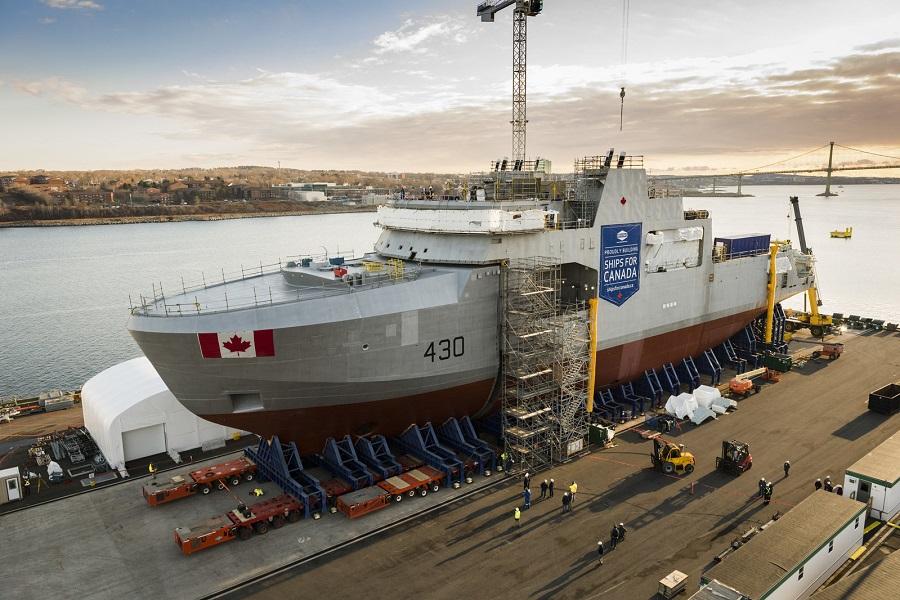
The Royal Canadian Navy's first Arctic and Offshore Patrol Ship (AOPS), the future HMCS Harry DeWolf, assembled at Irving Shipbuilding's Halifax Shipyard.
Two shipyards were selected under the plan in 2010 – Irving Shipbuilding of Halifax and Seaspan of Vancouver – and they were to be capable to start building ships immediately, and close gaps over time at “no cost to Canada” under a non-binding umbrella agreement.

Irving Shipbuilding in Nova Scotia was chosen to build the five Arctic Off-Shore Patrol Vessels (AOPS) and the future fleet of up to 15 Canadian Surface Combatants (CSC). Seaspan in Vancouver was selected to build five coast guard vessels and two Joint Support Ships (JSS) for the Navy.

Under the strategy, the two yards were guaranteed this work provided they could close their capability gaps within a specific period of time and at no cost to taxpayers. So where do we stand after almost eight years?

To date, millions in government subsidies have poured into the two selected shipyards; costs to taxpayers are‎ soaring and vessel delivery dates are pushed further back. Seven years later, not one ship has been delivered. When it comes to costs:

— The budget for the three Off-Shore Fisheries Science Vessels has grown from $244 million to $687 million.

— The Off-Shore Oceanographic Science Vessel, which is still in the design phase, has seen its budget grow from $108 million to $144 million, and speculation abounds that the budget will grow to over $275 million in the coming year.

— The two JSS originally budgeted at $2.6 billion are now expected to cost $4.13 billion according to the Parliamentary Budget Office (PBO).

Add to the list of shipbuilding woes, the John G. Diefenbaker, Canada’s planned polar class icebreaker for $1.3 billion. The vessel was designed in 2012; however it may not be contracted until 2030, meaning its design will already be obsolete before the keel is laid.

The Liberal government has no plans for the second polar class icebreaker, and no actions are being taken to build the three high endurance multi-tasked icebreakers or the five ocean patrol vessels for which funding has been allocated.

When it comes to the five AOPS, progress is being made, yet taxpayers will not know the cost of the vessels until at least six months after the first ship is delivered.

The budget for the future fleet of 15 surface combatants has grown from $26 billion to $60 billion and the procurement is in question, as many bidders have backed away from a process is that has been amended over 50 times.

Under the Liberals, the National Shipbuilding Program is failing. It is time for a course correction. Here are a few suggestions:

— All vessels under the NSS must come under a fixed-price contract.

— The government must return to selecting a proven design for the future fleet of surface combatants, rather than spending billions more and taking significant risks, and delays with an unproven ship design.

— Expand the shipbuilding strategy to add capacity and commercial pressure by including Davie Shipbuilding of Quebec in ongoing planning, including building additional coast guard vessels which are urgently needed, and for which funding was allocated years ago.

— The government should also follow up on the success of the Astérix, and accept Davie’s offer to build the second interim supply ship at $650M, (significantly cheaper than JSS) so the Navy can get on with having the capability to refuel the Atlantic and Pacific fleet simultaneously at sea.

Without some drastic changes in this program, all signs point to taxpayers getting soaked; our navy and coast guard being hobbled, and our security and sovereignty being put at risk.
---
— Tony Clement is a Conservative MP and Official Opposition Public Services and Procurement Critic

Tuesday, March 27, 2018

What does China's new Arctic policy mean for Canada?

By: Jimmy Thompson, CBC News 

In January China released a white paper describing its Arctic policy in a rare public move.

The policy outlines plans to develop shipping routes, expand its research programs, pursue environmental protection and develop resources across the Arctic.

hi-china-icebreaker-8col
The Chinese icebreaker Xuelong, or Snow Dragon, docked Thursday in Shanghai, after an 85-day scientific quest across the Arctic Ocean. (Pei Xin, Xinhua/Associated Press)
"I'm a little shocked," said University of Calgary associate professor Robert Huebert.

"The Chinese do not issue white papers. This clearly illustrated how important the Arctic is to the Chinese."

Experts say the policy is attempting to tread a line — between respecting the sovereignty of Arctic nations, like Canada and the United States, and leaving room to gain from disputes in international law.

Like the Arctic Council, the document specifically refers to the rights of the Indigenous peoples of the Arctic. It also references environmental protection, scientific research and international cooperation.

But it also repeatedly comes back to respect for international law, a choice that Huebert and Université Laval professor Frédéric Lasserre view as an attempt to articulate limits on Arctic states' sovereignty.
'It's this ambiguity over what China wants to do in the Arctic that's a bit troubling.'-Frédéric Laserre, professor at Université Laval

For example, the United States views the Northwest Passage as an "international strait" while Canada sees it as "internal waters" — a semantic difference that could mean major changes in how the waterway is managed and who has the right to use it.

Lasserre is co-author of China's Arctic Ambitions and What They Mean for Canada, a book coincidentally also released on Friday.

"We don't know how China places the hierarchy between Arctic states and international law," Lasserre said.

"It's this ambiguity over what China wants to do in the Arctic that's a bit troubling."

Huebert said China is especially interested in issues of sovereignty and access to shipping lanes, as growing and maintaining Arctic shipping is a "core Arctic interest."
A 'Near-Arctic state'?

China refers to itself as a "near-Arctic state" throughout the policy document.

The term that has no formal legal meaning.

However, it's been used in the past by non-Arctic countries that were eager to gain Arctic Council observer status.

China gained that status in 2013.

India has taken that a step further when applying for observer status, saying that its prehistoric geological connection to Antarctica qualifies it as a polar nation.

Lasserre said China's Arctic ambitions have largely been carried out thus far in Russia — with investments in a liquefied natural gas project in the Yamal oilfield and more interest in the Northern Sea Route by Russia than Canada's Northwest Passage.
New investments, new risks

But just last year, the Chinese icebreaker Xue Long completed a transit of the Northwest Passage.
'Be careful what you wish for.'- Robert Huebert, University of Calgary professor

In addition, Chinese state-owned firms have made tentative forays into Canadian mining.

The policy paper specifically refers to an increase in Chinese Arctic tourism, something Yellowknife has been an example of in recent years.

In 2016, Chinese tourists outnumbered Japanese for the first time ever in Yellowknife.

"They are clearly, clearly aware that there are new opportunities for investment in this region," Huebert said, adding that inviting Chinese investment in the Canadian Arctic could be a double-edged sword.

"Be careful what you wish for," he said.

"If the Chinese do start investing more [in Canada], if the Chinese do start sending more shipping — outside of the obvious economic benefits that would provide — what are some of the longer-term impacts in regards to the environment? In regards to the communities?"
'What do you intend to do?'

Both Huebert and Lasserre say the document is notable, in part, for what it leaves out.

"We're starting to see a little bit of Chinese naval activity, especially around the fringes of the Arctic, and that's always something that we have to keep an eye on," Huebert said.

Canada has begun making investments in its Arctic surveillance and security systems, including a new network of listening posts and the first of the Harry DeWolf Class Arctic and Offshore Patrol Ships currently nearing completion in Halifax.

For Lasserre, the solution is to keep a running dialogue as questions arise across the Arctic.

"I think that's what Arctic states should do in the future: ask clearly, 'What do you intend to do?'"

Smol: Canada is Weak in the Arctic


By: Robert Smol, CBC Opinions 

Russian President Vladimir Putin's recent boast of possessing an arsenal of undetectable nuclear weapons has not really had material effect on geo-political relations — yet. North American and European preoccupation of late has been less on Russia's military procurement than on the acute issue of the nerve agent attack on an ex-spy in the U.K.

On Monday, Canada and the U.S. both announced it would be expelling diplomats from its borders in response to the attack.

But despite this recent action, this country continues to bask in that ever-so-Canadian sense of delusion when it comes to understanding our place in a potential future Russian-American standoff. And while I do not want to sound like those old-fashioned "Russians are Coming" harbingers of hype, it is important that we take careful stock of our strategic military options in the case of a superpower spat — or worse.

For starters, the notion of a neutral, peaceful demilitarized Canada is a delusion. Whether we like it or not, Canada is perfectly placed to be the battleground of choice in a future conflict: we share a long and long-disputed Arctic border with an increasingly militaristic and hostile superpower.

Largely unpopulated, open and scantily defended, Canada's Arctic is the safest and shortest line of attack and counterattack in a potential conflict. To think that Russians, North Koreans or Americans will decide, out of courtesy, to hang a detour around the second-largest country in the world is dangerously naïve and irresponsible. And the United States will not necessarily protect Canada in the case of a ballistic missile attack, as Canada's senior officer in Norad reminded us last year.

We know that Russia is rather unabashedly building up its military presence in the Arctic. There are at least 18 recently constructed or upgraded Russian military bases along the Russian-Canadian Arctic border, along with its sizeable air force, nuclear submarines and 40 operational icebreakers with more under construction.

In terms of Canadian military assets in the region, we maintain a small signals intelligence facility on Ellesmere Island (CFS Alert), which is manned by approximately 60 personnel — not all of whom are serving military. In Yellowknife, Joint Task Force North maintains a small headquarters staff of approximately 70 personnel, with an area support unit of 50.
Boots in the snow

The Royal Canadian Air Force is represented in the region by a non-combat utility transport squadron flying four small CC-138 Twin Otter aircraft that came into operation around the time our prime minister was born. And apart from the southern Canada-based soldiers who occasionally stick their heads into the Arctic for short exercises, there is no permanent "boots in the snow" combat establishment ready to deal with a violation of our territory.

Meanwhile, the closest thing to a ground force on the Canadian side consists of a series of patrols of minimally trained reserve auxiliaries, The Canadian Rangers, who each receive all of 10 days training and are still carrying vintage World War II rifles.

Our government might try to assure us that the Arctic Offshore Patrol Ship project, which is currently under construction, will provide a deterrent to possible Russian aggression. But the minimal armament for these boats will place these ships in a "constabulary role," according to the Royal Canadian Navy. Translation: they are not going into battle.

The hull assembly of Canada's first AOPS. This ship is not going into battle, writes Robert Smol. (Andrew Vaughan/Canadian Press)
We might tell ourselves that the specially trained Russian soldiers, warships and fighter bomber aircraft that are now rigorously training on bases such as Sredny Ostrov, Alexandra Land and Nagurskoye near ourdisputed northern border have no nefarious intentions, at least when it comes to Canada. But they are there, armed and ready, on our disputed border. So the question is: what are their intentions?
Just how much longer can we pretend that our strategically important and resource-rich Arctic will remain secure? Can we really afford to delude ourselves into thinking that our projection of ourselves as a "peacekeeping nation" will be enough for the superpowers to both respect Canada's claims to the Arctic and sidestep our territory in the event of war?

As time goes on, and other nations continue to stake their claim on the Arctic, the answer may soon not be ours to make.

Robert Smol served over 20 years in the Canadian Armed Forces. He is currently a teacher and freelance writer in Toronto.

This column is part of CBC's Opinion section. For more information about this section, please read this editor's blog and our FAQ.

Wednesday, January 24, 2018

2nd Hand Ice-Breakers Available...if GoC Wants Them


By Colonel (Retired) Pierre Leblanc 
The Maritime Executive 

I recently attended the Maritime and Arctic Security & Safety Conference in St. John’s, Newfoundland, Canada, where I learned of an interesting unforeseen opportunity for the Canadian Government to acquire a number of modern icebreakers at deeply discounted prices.

On January 30, 2017 I raised my concerns with the aging of the Canadian Coast Guard fleet of icebreakers. The ships in that fleet are coming to the end of their technical designs. The average age of the fleet is 36 years. The CCGS Louis St-Laurent is 48 years old.

Although there can be life extending programs in place there is still a need to replace those ships with modern ones. There is only one vessel that I can clearly identify in the Ship Building Strategy. At the moment, the replacement for the Louis-St-Laurent is planned to enter service in 2028 at which point the Louis St-Laurent will be 59 years old.

Building a new fleet will provide an opportunity to introduce more environmentally friendly propulsion systems to reduce the pollution of black carbon and nitrous oxide in the Arctic since the momentum to ban heavy fuel oil from the Arctic is increasing.

Two related elements are creating stress on the Canadian icebreaker fleet: global warming and demand for services. I believe that most Canadians are by now aware that global warming is taking place and that the arctic ice is disappearing. What might not be realized is that the breaking up of the ice means that the winds and currents will move the ice, especially thick and hard multi-year ice, in unexpected places and at unexpected times. One day the ice may be gone from the shore of a community but the next day it may block the departure of the supply ship requiring the support of an icebreaker. The opposite may happen with a supply ship not being able to reach the community because the wind will have pushed a barrier of ice against the coast line. All of the communities of Nunavut are resupplied by ship; it is therefore essential that icebreaker services be readily available.

The other element of stress is that the level of human activity in the Arctic is on the increase, allowed by the easier access caused by the disappearance of the ice. There is more activity requiring icebreaker support. A cruise ship in distress may divert the support of an icebreaker from community resupply. This will more than likely continue to increase which will in turn likely call for more icebreaker support.

When I commanded Joint Task Force North, my Coast Guard colleagues used to tell me that “if there is more ice you need more icebreakers, and if there is less ice you still need more icebreakers.” Although counter-intuitive, the need for more icebreaker when there is less ice is because the Arctic ice starts moving around early and throughout the shipping season causing largely unpredictable ice dams. This is already reported by the Coast Guard and the marine companies resupplying the Canadian Arctic communities.

The oil and gas company Shell is reported to have spent in excess of $9 billion dollars exploring and developing a capability to drill for oil in the Arctic. For several reasons forming a “perfect storm,” in September of 2015 they canceled their Arctic project. To support their Arctic operations they had secured a number of icebreakers that are now surplus.

The m/v Aiviq is a Polar Class 3 icebreaker built by North American Shipbuilders in 2012. It is reported to be the world’s most powerful icebreaker privately owned. In addition, m/v Tor Viking IIm/v Vidar Viking  and m/v Balder Viking are three Norwegian built Polar Class 4 icebreakers that were destined to support Shell’s arctic operations. All these vessels are now available to be secured by Canada and more specifically the Canadian Coast Guard.

Image result for m/v Vidar Viking
The M/V Vidar Viking 
Given the state of the Canadian icebreaker fleet and the increasing demand for icebreaker support in both the Arctic and in support of the Saint-Lawrence Seaway, Canada might be wise to consider the offer of those icebreakers.

The ships will likely need some modifications to meet the Coast Guard requirements, but those should be relatively easy to complete in a short period of time compared to building a ship from the ground up. The U.S. has also identified a need for icebreakers to replace and augment the two that are in operation today. They may also be interested in acquiring the ones that were once destined to support the Shell Arctic operations that have been canceled.
---
Colonel (Retired) Pierre Leblanc is a former Commander of the Canadian Forces in the Canadian Arctic. www.arcticsecurity.ca

Tuesday, November 1, 2016

Canadian Arctic Capabilities

By: KEN POLE
© 2016 FrontLine Defence (Vol 13, No 5)

As global warming improves access to the region and its potential natural resources, improvements to Canada’s air, land, and sea military capabilities in the Arctic are covered in a five-nation review of the prospects of increased tensions. Published by the respected Stockholm International Peace Research Institute (SIPRI), the review also looks at the capabilities of three other Arctic littoral states that are NATO members – the United States, Denmark and Norway – as well as Russia. The bottom line is that Russia is the only state that has “significantly” upgraded its Arctic military capabilities.

In the report entitled “Military Capabilities in the Arctic: A New Cold War in the High North”, Siemon Wezeman, a Dutch senior researcher in SIPRI’s arms and military expenditure program, points out that the Arctic littoral states have tended to have a “relatively restrained approach” to overlapping claims in the Arctic. He notes, however, that increases in the various military forces “provide cause for concern” and should be clarified.

“Forecasts of far-reaching climate change in the Arctic have stimulated new thinking about the security situation,” Wezeman says. “Some have identified the region as heading towards conflict, notably over natural resources, and official documents […] refer to the potential for military confrontation and indicate a perceived need to increase military capabilities accordingly.”

While affirming that all of these states have bolstered their military presence in the Arctic or increased capabilities for Arctic use, and are planning further strengthening of their military capabilities beyond their national territories, he suggests that while there is official recognition of the need to improve security and policing, the official positions stop short of a militarization of Arctic security issues.
Canadian Coast Guard Ship (CCGS) Pierre Radisson sails past an iceberg in the Hudson Strait off the coast of Baffin Island during Operation Nanook. (Photo: Sergeant Kevin MacAulay)
This, despite the “dramatic” extent to which Russia-NATO relations had deteriorated in recent years, a situation which Russian Prime Minister Dmitry Medvedev described as “a new cold war.” Russia’s intervention in Ukraine since early 2014, and its more assertive and even aggressive foreign policy had increased the other Arctic states’ concerns about Russia’s long-term goals.

In Canada’s case, the former Conservative administration in Ottawa had adopted a “use it or lose it” stance in pressing for economic exploitation of the Arctic. The 2008 Canada First Defence Strategy put renewed emphasis on defending territorial sovereignty in the increasingly accessible Arctic. The Conservatives’ Northern Strategy the following year was matched by a limited expansion of special Arctic forces, increased training, and a limited amount of new equipment.

In the U.S., the Republican administration, as one of its last acts, in January 2009, updated a 1994 Arctic policy, which the Democrats essentially echoed in a National Strategy for the Arctic Region policy document in May 2013. “However, Arctic security concerns play only a minor role in overall U.S. defence policy,” Wezeman says, citing a 2010 National Security Strategy and a 2011 National Military Strategy which he says “mention the Arctic only in passing” and 2012 and 2015 strategy documents that effectively ignore the region militarily.

As for Denmark-Greenland, he notes that defence documents have included special mention of the Arctic, but that funding had not kept up with the vision.

In October 2012, the Greenland and Faroe Islands commands were merged into a new joint military Arctic Command headquartered in Nuuk, Greenland. “The Danish state auditing agency, Rigsrevisionen, concluded in October 2013 that the government had over the previous nine years provided insufficient funds and equipment for the Danish forces to fulfil their Arctic tasks, in particular SAR and environmental protection.” That situation is expected to be addressed in a “comprehensive analysis” sometime in 2017, including options for cooperation with the other Arctic countries.
March 2012 – Canadian soldiers regroup after conducting an attack on an enemy position in the mountains near Gratangsbotn, Norway during Exercise Cold Response, a Norwegian-led, invitational ­military exercise with participants from 14 nations. (DND Photo: Cpl Stuart MacNeil)
Turning to Norway, Wezeman affirms that its relations with Russia had been considered “very good”, with increased Arctic cooperation, including joint military exercises, but added that Russia’s military modernization and more assertive policies in Europe had “created uncertainty.”

A 2015 strategic military review, the “Norwegian Armed Forces in transition” outlines a stronger military presence in Finnmark, the northern part of Norway. The Norwegian defence budget has increased in real terms since 2009, and is projected to increase further until 2017 to cover the costs of ordered equipment (mainly F-35 combat aircraft). A new Defence White Paper is planned for 2016, which is expected to indicate a real-term decrease for 2018-2020.

Norwegian defence policy remains guided by the 2007 Soria Moria Declaration on International Policy, which gave priority to the north of Norway and Svalbard (often referred to in Norway as the ‘High North’) within national defence. Although strongly focused on Russia, it has shifted from emphasizing a potential threat to the whole of Norway to the potential for conflicting interests in the Arctic area. However, the increased military capabilities outlined in the 2015 review are mainly directed at a threat against Norwegian territory in the High North, and not in the extra-territorial Arctic. In August 2009 its armed forces headquarters moved from Jåtta in the south to Reitan, just north of the Arctic Circle; the headquarters of the Norwegian Army is even further north, in Bardufoss. While the Norwegian Navy remains based mainly in Bergen, in the south, the coast guard headquarters was moved north to Sortland in 2010.


Since 2006, Norwegian, NATO, and other allied troops have held biannual large-scale ‘Cold Challenge’ exercises in northern Norway. These have been directed at unspecified threats in cold environments but have also been good training opportunities for potential Arctic operations. In 2013 and 2015 Norway was the lead country for a new set of large military training exercises in the north of Scandinavia called the ‘Arctic Challenge’ (ACE). Involving Norwegian, Swedish, Finnish, and other NATO air forces, ACE is to be held every two years.

Russia’s position on the Arctic has been set out in a couple of policy documents which look out to 2020 and beyond and highlight the region’s importance as a key source of natural resources and security issues resulting from increasingly long open-water periods that are generally attributed to global warming.

While those documents focus mainly on non-military challenges and ostensibly underline the importance of cooperation among all Arctic countries, others specifically highlight protecting military interests. “For the first time, the December 2014 Russian Military Doctrine includes the task of ‘protecting Russian interests in the Arctic’,” Wezeman points out. “The July 2015 Maritime Doctrine outlines specific security concerns, with a strong focus on security of the bases and units of the Northern Fleet in the Arctic.” Moreover, these documents make clear that Arctic forces would have protection of the northern regions of Russia as their main task.

To underline the growing importance of Arctic military security, on 1 December 2014 the Russian forces in the Arctic were included in a new Joint Strategic Command North. In addition to expanding the size of the Russian forces in the Arctic and modernizing their equipment, Russia has also increased Arctic training.

A substantial increase in its Northern Fleet capabilities is also ongoing. Many of the new ships can operate effectively in the harsh Arctic environment and are probably meant as escorts for the more active ballistic-missile-capable, nuclear-powered (SSBN) fleet of submarines. Indeed, the reduction in Arctic ice under which the SSBNs can hide is likely to further increase the need for escorts and patrol aircraft. Plans for new amphibious ships to increase power-projection capabilities have been seriously disrupted with the cancellation by France in 2015 of two Mistral amphibious assault / helicopter carrier ships ordered in 2010 and 2011, one of which was due to be included in the Northern Fleet.
Yamal, one of six Russian Arktika-class civilian, nuclear-powered icebreakers built between 1975 and 2007, break through ice for cargo ships and other vessels along the Northern Sea Route.

Capability Perspective

Even before the Russian invasion and annexation of Crimea in early 2014, some media, politicians and researchers had begun to portray the changes in the capabilities of the Arctic littoral states as a significant military build-up and potential threat to security. Such messages seemed to be validated by the events in 2014 and the subsequent Russian intervention in support of rebels in eastern Ukraine.

While these and other actions have strained East-West relations to a level of distrust and tension not seen since the end of the cold war, the overall picture in the Arctic remains an almost shining example of proper state behaviour over contested claims.

The 2012 SIPRI review of the then ­current and projected military forces in the Arctic region pointed to a process of modernization and creation of new capacity to address challenges associated with environmental, economic and political changes anticipated for the region, rather than as a response to major threat perceptions in the Arctic. Conventional military forces, specially adapted to the harsh Arctic environment, were projected to remain small-scale, especially given the size of the Arctic region, and would remain in most cases considerably smaller than cold war levels.

This latest review of the existing and planned Arctic military capabilities of the five Arctic littoral states was undertaken in the context of increased East-West tension – the ‘new cold war’ as Medvedev described it. Like the previous review, it concludes that the changes in military forces, structure, and policies in the Arctic do not undermine the commitment of all five states to settling Arctic issues in multilateral discussions, negotiations and cooperation. Certainly, all five have continued the modernization, and in some cases expansion, of their military capabilities in or for the Arctic. However, these remain limited and have proceeded slowly.

Some of the changes – for example, the acquisition of new combat aircraft by Norway and Denmark, the strengthening of the Canadian Rangers, the main Norwegian land units moving to the north of Norway, or the new Russian Arctic units – have little or nothing to do with power projection into the areas of the Arctic with unclear ownership. Rather, they are for the purposes of patrolling and protecting recognized national territories that are becoming more accessible, including protection against illegal activities. Other changes – such as new but unarmed icebreakers – have more to do with protection of the environment, civilian shipping, and civilian research in support of national claims to an ‘extended continental shelf’ under the 1982 United Nations Convention on the Law of the Sea (UNCLOS).

While aircraft and ships play a much more important role for Arctic security than land forces, most of the extensive changes – such as the acquisitions of new combat aircraft or large surface combat vessels by Canada, Denmark and Norway – have a much more general rationale than increasing worries about potential military threats in the Arctic region.
HMS Illustrious (foreground) and HMS Bulwark near Harstad, Norway, participating in Exercise Cold Response. (MOD Photo: Martin Carney)
Russia’s expansion of its Northern Fleet and other land and air forces in the Arctic, the largest military force stationed in the region, also appear to be more a matter of providing protection for its SSBNs – as the Soviet Union did during the 1970s and 1980s – than a programme building up for a military struggle over Arctic resources.

This main conclusion notwithstanding, an increase of military forces in a region where several states claim maritime zones expected to contain extensive natural resources does give reason for concern, including the potential for unnecessary incidents and misunderstandings between claimants. In the general security environment since early 2014, of increasing tensions and mistrust between Russia and most of the rest of Europe and North America, responses to real or imagined threats and insults could certainly escalate. Moreover, there is the risk that the security tensions between NATO and Russia elsewhere may spill over into the Arctic region. Russia’s unscheduled large-scale exercises held in response to ACE 2015 are one example of how the security situation has changed since early 2014.

Thus, in order to help mitigate negative perceptions about security policies in the region, as well as the possibility of misunderstandings, the Arctic littoral states need to be even clearer about their military policies, doctrines and operational rules, and should include more military confidence-building measures in their bilateral or multilateral relations associated with the Arctic.

Could such positive steps in the Arctic also provide an impetus to duplicate this ‘Arctic spirit of problem-solving through cooperation and international law’ in other regions or issues of the current East-West confrontation? Time will tell.

===
Ken Pole is a contributing editor at FrontLine magazines.