Translate

Showing posts with label Canadian Coast Guard. Show all posts

Tuesday, June 26, 2018

Davie to Convert Three Icebreakers for Coast Guard

By: David Pugliese, Ottawa Citizen

The Canadian government intends to enter into a deal with Davie Shipyards of Quebec to provide three medium icebreakers, Public Services and Procurement Canada announced Friday.

The vessels will be acquired for the Canadian Coast Guard. The ships would provide the interim capability for the coast guard, while replacement vessels are built later under the government’s National Shipbuilding Strategy. The icebreakers are seen as essential to ensuring that Canadian ports remain open during winter months, according to the federal government.

The deal will see the purchasing a class of three existing Anchor Handling Tug Supply icebreakers. Those vessels will be used by the coast guard while its other ships undergo maintenance, refit and vessel life extension.
Artist Rendition courtesy of Davie Inc. 
The ships will be used for icebreaking duties during the winter and sent to the Arctic as needed during the summer. The first ship will be put to immediate use for icebreaking during the upcoming 2018-2019 season, Public Services and Procurement Canada stated in their news release.

The department has issued an Advanced Contract Award Notice to Chantier Davie of Lévis, Quebec, for the acquisition and conversion of three medium commercial icebreakers.

Other companies will have 15 business days to signal their interest in bidding for the contract, by submitting a “statement of capabilities” that meets the requirements laid out in the ACAN, the government noted.

Industry representatives, however, pointed out that an ACAN is usually designed so the company named in the notice is the only one capable of fulfilling the stated requirements.

No other details of the deal were released. It is unclear what the arrangement will cost taxpayers.

Quick facts

• This acquisition will consist of purchasing a class of three existing anchor-handling tug supply (AHTS) icebreakers.
• These ships will be used to backfill for Canadian Coast Guard vessels while they are undergoing maintenance, refit and vessel life extension.
• These ships will conduct critical icebreaking duties for the southern wintertime program and are to be deployed as needed in support of Arctic summertime programs.
• The first ship will be put to immediate use for icebreaking during the upcoming 2018-2019 season.

Tuesday, April 17, 2018

Clement: It's Time to Change Course on Shipbuilding


By Tony Clement, Special to Postmedia Network

Canada’s National Shipbuilding Strategy was announced with the goal of delivering vessels for the Canadian Coast Guard and the Royal Canadian Navy that were affordable, modern and effective. It was expected that the strategy would create world class, competitive yards that could produce vessels which could be exported.
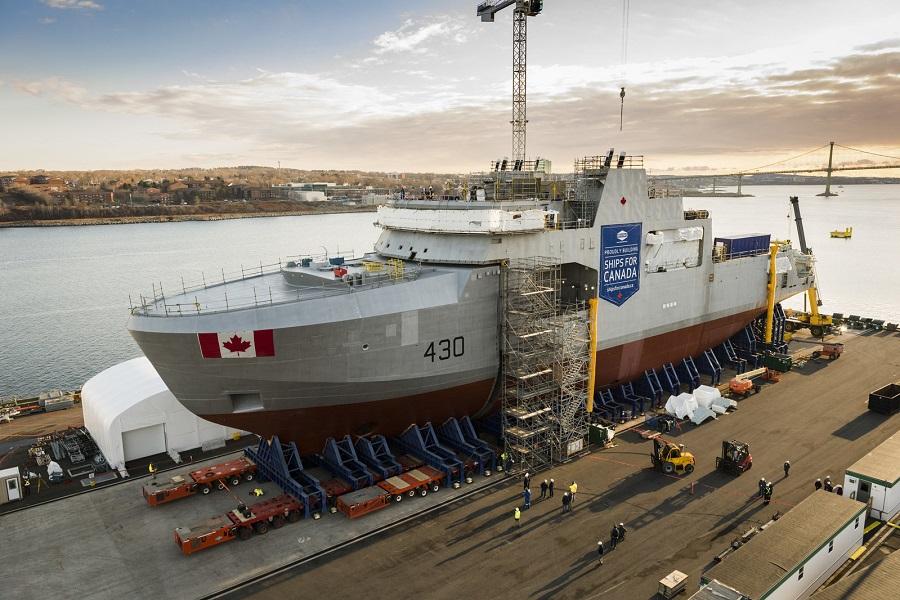
Image result for aops
The Royal Canadian Navy's first Arctic and Offshore Patrol Ship (AOPS), the future HMCS Harry DeWolf, assembled at Irving Shipbuilding's Halifax Shipyard.
Two shipyards were selected under the plan in 2010 – Irving Shipbuilding of Halifax and Seaspan of Vancouver – and they were to be capable to start building ships immediately, and close gaps over time at “no cost to Canada” under a non-binding umbrella agreement.

Irving Shipbuilding in Nova Scotia was chosen to build the five Arctic Off-Shore Patrol Vessels (AOPS) and the future fleet of up to 15 Canadian Surface Combatants (CSC). Seaspan in Vancouver was selected to build five coast guard vessels and two Joint Support Ships (JSS) for the Navy.

Under the strategy, the two yards were guaranteed this work provided they could close their capability gaps within a specific period of time and at no cost to taxpayers. So where do we stand after almost eight years?

To date, millions in government subsidies have poured into the two selected shipyards; costs to taxpayers are‎ soaring and vessel delivery dates are pushed further back. Seven years later, not one ship has been delivered. When it comes to costs:

— The budget for the three Off-Shore Fisheries Science Vessels has grown from $244 million to $687 million.

— The Off-Shore Oceanographic Science Vessel, which is still in the design phase, has seen its budget grow from $108 million to $144 million, and speculation abounds that the budget will grow to over $275 million in the coming year.

— The two JSS originally budgeted at $2.6 billion are now expected to cost $4.13 billion according to the Parliamentary Budget Office (PBO).

Add to the list of shipbuilding woes, the John G. Diefenbaker, Canada’s planned polar class icebreaker for $1.3 billion. The vessel was designed in 2012; however it may not be contracted until 2030, meaning its design will already be obsolete before the keel is laid.

The Liberal government has no plans for the second polar class icebreaker, and no actions are being taken to build the three high endurance multi-tasked icebreakers or the five ocean patrol vessels for which funding has been allocated.

When it comes to the five AOPS, progress is being made, yet taxpayers will not know the cost of the vessels until at least six months after the first ship is delivered.

The budget for the future fleet of 15 surface combatants has grown from $26 billion to $60 billion and the procurement is in question, as many bidders have backed away from a process is that has been amended over 50 times.

Under the Liberals, the National Shipbuilding Program is failing. It is time for a course correction. Here are a few suggestions:

— All vessels under the NSS must come under a fixed-price contract.

— The government must return to selecting a proven design for the future fleet of surface combatants, rather than spending billions more and taking significant risks, and delays with an unproven ship design.

— Expand the shipbuilding strategy to add capacity and commercial pressure by including Davie Shipbuilding of Quebec in ongoing planning, including building additional coast guard vessels which are urgently needed, and for which funding was allocated years ago.

— The government should also follow up on the success of the Astérix, and accept Davie’s offer to build the second interim supply ship at $650M, (significantly cheaper than JSS) so the Navy can get on with having the capability to refuel the Atlantic and Pacific fleet simultaneously at sea.

Without some drastic changes in this program, all signs point to taxpayers getting soaked; our navy and coast guard being hobbled, and our security and sovereignty being put at risk.
---
— Tony Clement is a Conservative MP and Official Opposition Public Services and Procurement Critic

Wednesday, July 12, 2017

Nanisivik Naval Refueling Station On Track For Fall 2018 Opening

By: Sara Frizzell, CBC News 

Roofs are being welded onto two giant fuel tanks at the Nanisivik naval facility under construction near Arctic Bay, Nunavut.

The refuelling station will enter the home stretch of construction this summer, with final checks occurring next summer before it becomes operational in the fall of 2018.

"Much of the infrastructure will be near complete within the next month and a half and we expect that commissioning activities, that means our tests and trials, will begin," said Rod Watson, project manager for the facility.

The project budget is $130 million and Watson expects the port to come in on budget and on time for the revised 2018 deadline.
Fuel tanks under construction. (Department of National Defence)
Each of the two fuel tanks is designed to hold 3.75 million litres and a pipeline has been built to run from the tanks directly down to the jetty.

There will be an unheated storage facility and a small office, but the port will only be staffed during the navigable season, which Watson estimates is from the beginning of August until October.

Initially slated for completion in 2015, Watson said they realized the short summer window for construction would delay the project.
Arctic naval facility at Nanisivik completion delayed to 2018

Environmental and geotechnical studies needed to be done before construction could begin and he said the team had difficulty getting the necessary equipment to the northern location.

The project was also scaled back from the plans announced in 2007 by Stephen Harper in his "use it or lose it' speech about Arctic sovereignty due to high construction costs.

Now, the facility will be mainly a refueling point for vessels from the Canadian navy and Canadian Coast Guard.

Watson says the coast guard has used this facility for years as it marshalls cargo vessels through Strathcona Sound and he expects they will continue to do so.

The original Nanisivik port was part of a lead and zinc mine that closed in 2002. While the buildings and fuel farm that were there have been removed, the jetty will look much the same.

The construction crew is currently pouring concrete to resurface the area.

Around 60 crew are on-site this summer, 11 of whom are local hires. 
The general use storage building shown under construction. (Department of National Defence)
"We've worked very hard to make sure people from the community are involved and are hired to work at the site and we expect to continue that as we move from construction into operation," Watson said.

Operational staff will help with the refueling of some of the Arctic patrol vessels that the new liberal defence policy promised to deliver.

Related:
In new defence policy, Liberals turn focus to Arctic sovereignty

The first of which will be delivered in 2018, though that doesn't necessarily mean it will make it north to Nanisivik next year.

Tuesday, November 1, 2016

Canadian Arctic Capabilities

By: KEN POLE
© 2016 FrontLine Defence (Vol 13, No 5)

As global warming improves access to the region and its potential natural resources, improvements to Canada’s air, land, and sea military capabilities in the Arctic are covered in a five-nation review of the prospects of increased tensions. Published by the respected Stockholm International Peace Research Institute (SIPRI), the review also looks at the capabilities of three other Arctic littoral states that are NATO members – the United States, Denmark and Norway – as well as Russia. The bottom line is that Russia is the only state that has “significantly” upgraded its Arctic military capabilities.

In the report entitled “Military Capabilities in the Arctic: A New Cold War in the High North”, Siemon Wezeman, a Dutch senior researcher in SIPRI’s arms and military expenditure program, points out that the Arctic littoral states have tended to have a “relatively restrained approach” to overlapping claims in the Arctic. He notes, however, that increases in the various military forces “provide cause for concern” and should be clarified.

“Forecasts of far-reaching climate change in the Arctic have stimulated new thinking about the security situation,” Wezeman says. “Some have identified the region as heading towards conflict, notably over natural resources, and official documents […] refer to the potential for military confrontation and indicate a perceived need to increase military capabilities accordingly.”

While affirming that all of these states have bolstered their military presence in the Arctic or increased capabilities for Arctic use, and are planning further strengthening of their military capabilities beyond their national territories, he suggests that while there is official recognition of the need to improve security and policing, the official positions stop short of a militarization of Arctic security issues.
Canadian Coast Guard Ship (CCGS) Pierre Radisson sails past an iceberg in the Hudson Strait off the coast of Baffin Island during Operation Nanook. (Photo: Sergeant Kevin MacAulay)
This, despite the “dramatic” extent to which Russia-NATO relations had deteriorated in recent years, a situation which Russian Prime Minister Dmitry Medvedev described as “a new cold war.” Russia’s intervention in Ukraine since early 2014, and its more assertive and even aggressive foreign policy had increased the other Arctic states’ concerns about Russia’s long-term goals.

In Canada’s case, the former Conservative administration in Ottawa had adopted a “use it or lose it” stance in pressing for economic exploitation of the Arctic. The 2008 Canada First Defence Strategy put renewed emphasis on defending territorial sovereignty in the increasingly accessible Arctic. The Conservatives’ Northern Strategy the following year was matched by a limited expansion of special Arctic forces, increased training, and a limited amount of new equipment.

In the U.S., the Republican administration, as one of its last acts, in January 2009, updated a 1994 Arctic policy, which the Democrats essentially echoed in a National Strategy for the Arctic Region policy document in May 2013. “However, Arctic security concerns play only a minor role in overall U.S. defence policy,” Wezeman says, citing a 2010 National Security Strategy and a 2011 National Military Strategy which he says “mention the Arctic only in passing” and 2012 and 2015 strategy documents that effectively ignore the region militarily.

As for Denmark-Greenland, he notes that defence documents have included special mention of the Arctic, but that funding had not kept up with the vision.

In October 2012, the Greenland and Faroe Islands commands were merged into a new joint military Arctic Command headquartered in Nuuk, Greenland. “The Danish state auditing agency, Rigsrevisionen, concluded in October 2013 that the government had over the previous nine years provided insufficient funds and equipment for the Danish forces to fulfil their Arctic tasks, in particular SAR and environmental protection.” That situation is expected to be addressed in a “comprehensive analysis” sometime in 2017, including options for cooperation with the other Arctic countries.
March 2012 – Canadian soldiers regroup after conducting an attack on an enemy position in the mountains near Gratangsbotn, Norway during Exercise Cold Response, a Norwegian-led, invitational ­military exercise with participants from 14 nations. (DND Photo: Cpl Stuart MacNeil)
Turning to Norway, Wezeman affirms that its relations with Russia had been considered “very good”, with increased Arctic cooperation, including joint military exercises, but added that Russia’s military modernization and more assertive policies in Europe had “created uncertainty.”

A 2015 strategic military review, the “Norwegian Armed Forces in transition” outlines a stronger military presence in Finnmark, the northern part of Norway. The Norwegian defence budget has increased in real terms since 2009, and is projected to increase further until 2017 to cover the costs of ordered equipment (mainly F-35 combat aircraft). A new Defence White Paper is planned for 2016, which is expected to indicate a real-term decrease for 2018-2020.

Norwegian defence policy remains guided by the 2007 Soria Moria Declaration on International Policy, which gave priority to the north of Norway and Svalbard (often referred to in Norway as the ‘High North’) within national defence. Although strongly focused on Russia, it has shifted from emphasizing a potential threat to the whole of Norway to the potential for conflicting interests in the Arctic area. However, the increased military capabilities outlined in the 2015 review are mainly directed at a threat against Norwegian territory in the High North, and not in the extra-territorial Arctic. In August 2009 its armed forces headquarters moved from Jåtta in the south to Reitan, just north of the Arctic Circle; the headquarters of the Norwegian Army is even further north, in Bardufoss. While the Norwegian Navy remains based mainly in Bergen, in the south, the coast guard headquarters was moved north to Sortland in 2010.


Since 2006, Norwegian, NATO, and other allied troops have held biannual large-scale ‘Cold Challenge’ exercises in northern Norway. These have been directed at unspecified threats in cold environments but have also been good training opportunities for potential Arctic operations. In 2013 and 2015 Norway was the lead country for a new set of large military training exercises in the north of Scandinavia called the ‘Arctic Challenge’ (ACE). Involving Norwegian, Swedish, Finnish, and other NATO air forces, ACE is to be held every two years.

Russia’s position on the Arctic has been set out in a couple of policy documents which look out to 2020 and beyond and highlight the region’s importance as a key source of natural resources and security issues resulting from increasingly long open-water periods that are generally attributed to global warming.

While those documents focus mainly on non-military challenges and ostensibly underline the importance of cooperation among all Arctic countries, others specifically highlight protecting military interests. “For the first time, the December 2014 Russian Military Doctrine includes the task of ‘protecting Russian interests in the Arctic’,” Wezeman points out. “The July 2015 Maritime Doctrine outlines specific security concerns, with a strong focus on security of the bases and units of the Northern Fleet in the Arctic.” Moreover, these documents make clear that Arctic forces would have protection of the northern regions of Russia as their main task.

To underline the growing importance of Arctic military security, on 1 December 2014 the Russian forces in the Arctic were included in a new Joint Strategic Command North. In addition to expanding the size of the Russian forces in the Arctic and modernizing their equipment, Russia has also increased Arctic training.

A substantial increase in its Northern Fleet capabilities is also ongoing. Many of the new ships can operate effectively in the harsh Arctic environment and are probably meant as escorts for the more active ballistic-missile-capable, nuclear-powered (SSBN) fleet of submarines. Indeed, the reduction in Arctic ice under which the SSBNs can hide is likely to further increase the need for escorts and patrol aircraft. Plans for new amphibious ships to increase power-projection capabilities have been seriously disrupted with the cancellation by France in 2015 of two Mistral amphibious assault / helicopter carrier ships ordered in 2010 and 2011, one of which was due to be included in the Northern Fleet.
Yamal, one of six Russian Arktika-class civilian, nuclear-powered icebreakers built between 1975 and 2007, break through ice for cargo ships and other vessels along the Northern Sea Route.

Capability Perspective

Even before the Russian invasion and annexation of Crimea in early 2014, some media, politicians and researchers had begun to portray the changes in the capabilities of the Arctic littoral states as a significant military build-up and potential threat to security. Such messages seemed to be validated by the events in 2014 and the subsequent Russian intervention in support of rebels in eastern Ukraine.

While these and other actions have strained East-West relations to a level of distrust and tension not seen since the end of the cold war, the overall picture in the Arctic remains an almost shining example of proper state behaviour over contested claims.

The 2012 SIPRI review of the then ­current and projected military forces in the Arctic region pointed to a process of modernization and creation of new capacity to address challenges associated with environmental, economic and political changes anticipated for the region, rather than as a response to major threat perceptions in the Arctic. Conventional military forces, specially adapted to the harsh Arctic environment, were projected to remain small-scale, especially given the size of the Arctic region, and would remain in most cases considerably smaller than cold war levels.

This latest review of the existing and planned Arctic military capabilities of the five Arctic littoral states was undertaken in the context of increased East-West tension – the ‘new cold war’ as Medvedev described it. Like the previous review, it concludes that the changes in military forces, structure, and policies in the Arctic do not undermine the commitment of all five states to settling Arctic issues in multilateral discussions, negotiations and cooperation. Certainly, all five have continued the modernization, and in some cases expansion, of their military capabilities in or for the Arctic. However, these remain limited and have proceeded slowly.

Some of the changes – for example, the acquisition of new combat aircraft by Norway and Denmark, the strengthening of the Canadian Rangers, the main Norwegian land units moving to the north of Norway, or the new Russian Arctic units – have little or nothing to do with power projection into the areas of the Arctic with unclear ownership. Rather, they are for the purposes of patrolling and protecting recognized national territories that are becoming more accessible, including protection against illegal activities. Other changes – such as new but unarmed icebreakers – have more to do with protection of the environment, civilian shipping, and civilian research in support of national claims to an ‘extended continental shelf’ under the 1982 United Nations Convention on the Law of the Sea (UNCLOS).

While aircraft and ships play a much more important role for Arctic security than land forces, most of the extensive changes – such as the acquisitions of new combat aircraft or large surface combat vessels by Canada, Denmark and Norway – have a much more general rationale than increasing worries about potential military threats in the Arctic region.
HMS Illustrious (foreground) and HMS Bulwark near Harstad, Norway, participating in Exercise Cold Response. (MOD Photo: Martin Carney)
Russia’s expansion of its Northern Fleet and other land and air forces in the Arctic, the largest military force stationed in the region, also appear to be more a matter of providing protection for its SSBNs – as the Soviet Union did during the 1970s and 1980s – than a programme building up for a military struggle over Arctic resources.

This main conclusion notwithstanding, an increase of military forces in a region where several states claim maritime zones expected to contain extensive natural resources does give reason for concern, including the potential for unnecessary incidents and misunderstandings between claimants. In the general security environment since early 2014, of increasing tensions and mistrust between Russia and most of the rest of Europe and North America, responses to real or imagined threats and insults could certainly escalate. Moreover, there is the risk that the security tensions between NATO and Russia elsewhere may spill over into the Arctic region. Russia’s unscheduled large-scale exercises held in response to ACE 2015 are one example of how the security situation has changed since early 2014.

Thus, in order to help mitigate negative perceptions about security policies in the region, as well as the possibility of misunderstandings, the Arctic littoral states need to be even clearer about their military policies, doctrines and operational rules, and should include more military confidence-building measures in their bilateral or multilateral relations associated with the Arctic.

Could such positive steps in the Arctic also provide an impetus to duplicate this ‘Arctic spirit of problem-solving through cooperation and international law’ in other regions or issues of the current East-West confrontation? Time will tell.

===
Ken Pole is a contributing editor at FrontLine magazines.

Thursday, May 5, 2016

Harper government funded Seaspan Shipyard to help with Contract

BY MARIE-DANIELLE SMITH

OTTAWA — The former Conservative government quietly helped fund improvements for a Vancouver shipyard that was scrambling to get ready for shipbuilding, despite saying it would not do so.

Seaspan’s Vancouver Shipyards received about $40 million in 2014-15 to get its engineering systems up to speed as it prepared to build non-combat vessels for the Canadian Coast Guard, documents suggest.

But one of the premises underlying the Conservative government’s enormous National Shipbuilding Procurement Strategy (NSPS) — lauded by prime minister Stephen Harper’s government as the biggest defence program in Canadian history — is that shipyards would have to fund improvements to their shipbuilding infrastructure at no cost to Ottawa.

The existence of a government-funded program to help Seaspan, an association of western Canadian marine transportation companies, was revealed at a House of Commons committee meeting in December 2014.

Marty Muldoon, assistant deputy minister and chief financial officer at Fisheries and Oceans, told committee members $9.5 million of his department’s money was going to the “horizontal engineering program plan,” an initiative shared with the Department of National Defence.

That money was to help Seaspan “hit full stride in manufacturing capability or construction capability for our vessels,” he said.

“Basically, what we’re doing is investing in the shipyard’s capability to get itself up to capacity, to start churning out vessels.”

(Seaspan) went from a very small shipyard to a very large shipyard in a very short amount of time.

Though Public Services and Procurement Canada admits the contract is being used to help Seaspan create “material, engineering and production standards” for its yard, making systems consistent across “multiple projects,” it says this doesn’t count as the type of shipyard improvement forbidden under the agreement governing NSPS.

Jessica Kingsbury, a spokeswoman for PSPC, said this contract is “clearly distinguished” from capital investments Seaspan made to ready its yard for shipbuilding.

The horizontal engineering program plan is “in no way related to the criteria which the shipyards were required to meet, at their own cost, to achieve target-state,” she added.

Rather, it aims to co-ordinate and manage Seaspan’s non-combat package “more strategically,” through building a “program management capability.”

All three bids for NSPS contracts — from Halifax-based Irving, Seaspan and Quebec-based Davie — orginally included the guarantee that Ottawa wouldn’t pay to help the shipyards get ready for shipbuilding. Federal money would only go towards the shipbuilding projects.

But successful bidders Irving and Seaspan lacked capacity to start building ships when umbrella agreements were announced in 2011. Both negotiated to include clauses in the agreements, saying Ottawa would reimburse them for shipyard infrastructure if it decided to spend less than promised on new ships.

Irving and Seaspan also went to the provinces for money. Irving got a $304-million loan from Nova Scotia, $260 million of it forgivable, while Seaspan got only $40 million, for training from British Columbia.

No federal money was officially announced for either shipyard.

The agreement between Ottawa and Seaspan, dated Feb. 14, 2012, obtained by the National Post, says Seaspan agreed any improvements to shipyard capacity would be “paid for by the company entirely at its own expense” — unless Canada reneged on its commitments.

In November 2014, Seaspan announced a two-year, $170-million project to modernize its shipyard had finished “ahead of schedule and under-budget,” according to its website.

Still, recent job postings show it has continued hiring people to work on the “horizontal engineering program plan.”

The plan does not include improvements to physical infrastructure, but focuses on improving engineering systems, technical programs and management, says a consultant who worked for Seaspan from April to October 2014.

“It covered the whole spectrum of trying to stand up an engineering organization that was robust enough to support the overall shipbuilding objectives,” said Matt von Ruden, now director of vessels at Washington State Ferries.

Employees believed Ottawa was helping fund this work, he confirmed. “The government understood the need for this program, as far as I understand,” he said.

“(Seaspan) went from a very small shipyard to a very large shipyard in a very short amount of time.”

The fact government money was used for “systems” and “programs,” not physical infrastructure, may have made this a grey area under NSPS guidelines.

Several unusual contracts posted on the government’s Buy and Sell website from June 2014 to October 2015 appear to show money flowing into such programs.

For example, Public Services and Procurement Canada sourced just under $40 million in “engineering services” from the Vancouver shipyard.

Contracts are labelled as noncompetitive, representing the “best interests” and “value” to government. They differ from other contracts held by Seaspan, which are usually identified as being tied to a shipbuilding project.

The NSPS has an official budget of $39 billion, with $8 billion set aside for non-combat vessels.

Construction is expected to take at least 20 to 30 years, says the procurement department.

Seaspan began building the first of three offshore fisheries science vessels in June 2015 and the second in March. The three vessels, the first NSPS ships to come out of the improved Vancouver shipyard, are scheduled to be delivered by the end of 2017.

• Email: mdsmith@postmedia.com |
© Copyright (c) National Post

Wednesday, April 13, 2016

Liberals will spend $133 million in five years for Arctic Surveillance

By: David Pugliese, The National Post 

OTTAWA — The Canadian government will spend $133 million over the next five years for new technologies to improve surveillance of the Arctic.

Gascoyne Inlet Camp, Nunavut. 7 April 2014 – Twin Otter aircraft crew, Captain (Capt) Chuck Rockwell, Capt Andrew Oakes and Corporal Mike Nesbitt takes off from Gascoyne Inlet Camp, Nunavut after a personnel and equipment drop off on April 7, 2014 during Operation NUNALIVUT. (Photo: Master Seaman Peter Reed, CFB Shearwater, Nova Scotia)
The research project dovetails with the election promise of the Liberals who said they would increase surveillance in the Far North.

The work could also provide new technology for Canada as it enters into the renewal of the North American Aerospace Defence Command agreement with the United States. Senior NORAD officers have suggested that to be relevant past 2025 the alliance should improve its surveillance capabilities in the north.

Defence Research and Development Canada, the military’s science organization, is co-ordinating the surveillance research. The project will “enhance all domain situational awareness” of the air, sea and underwater approaches to Canada, particularly in the Arctic, according to a DRDC notice recently issued to companies and universities.

“Right now we’re generating interest,” said DRDC spokeswoman Kathleen Guillot. “The call for proposals is anticipated in the fall.” The DRDC notice sent to industry noted that climate change is making the north more accessible, increasing economic activity and international interest in the Arctic.

“Such increased Arctic activity brings additional responsibilities for the Department of National Defence and other government departments in search and rescue, emergency response and environmental monitoring,” the notice noted. “A greater awareness of the potential challenges posed by foreign military and commercial activities in the Arctic region is also essential for Canada.”

It also stated that the current North Warning System radar technology, used for providing surveillance of northern air approaches to North America, will need to be replaced as early as 2025.

We view the Arctic as an emerging operating area with much yet to be defined.

“Starting work now to define cost effective solutions that would provide the situational awareness capabilities required into the future is critical for the defence of Canada, and the United States, against continuously evolving potential adversary systems and threats,” according to the DRDC notice.

Whatever technology to be considered for the Arctic must be suitable for a remote setting, where there is limited power, harsh weather and “vulnerability to capture,” it said.

U.S. officers are already viewing improvements in surveillance in the Arctic as an important part of protecting the continent. At a January 2015 news conference, Admiral William Gortney, head of NORAD and the U.S. Northern Command, said the Arctic remains “key terrain as the northern approach to North America.”

“We view the Arctic as an emerging operating area with much yet to be defined,” he said.

Canadian defence officials see the provision of a new radar system in the Arctic as potentially fulfilling part of its contribution to the future of NORAD, according to a September 2013 Department of National Defence briefing note. NORAD conducted a strategic review in 2014 noting the need for improved sensors, communications and infrastructure in the high North in order to remain effective into the future.

Canada’s Arctic coastline is 162,000 kilometers long and only one-tenth of its northern waters are charted.

© Copyright (c) National Post

Tuesday, April 12, 2016

Liberals Are Consider Privatizing SAR in Canada

By: LEE BERTHIAUME, Ottawa Citizen 

An RCAF CH-149 Cormorant helicopter on exercising with a Canadian Coast Guard vessel.
The Liberal government is considering whether the military should continue to be involved in search-and-rescue missions, or rely instead on private companies and other alternatives to save Canadians in distress.

The idea has been raised as part of the government’s defence review, and is sure to stoke strong reactions both inside the military and across the country.

The previous Conservative government aired a similar proposal five years ago, before letting it quietly die.

Defence Minister Harjit Sajjan said last week that everything was on the table as he launched consultations with the public, parliamentarians and defence experts on how the military should be structured for the future. Consultations will continue until the end of July, with a new defence policy to be released in early 2017.

As part of those consultations, the government released a 36-page document asking for feedback on what the military should — and should not — be doing. One section focuses specifically on the military’s role in search and rescue, and asks if there are “models for alternative service delivery that could be explored.”

The Canadian Armed Forces responds to more than 9,000 distress calls each year, the document says. But only about 1,000 actually require military search-and-rescue helicopters or airplanes. The rest involve co-ordinating other government departments, volunteers and private companies hired to help. The Conservatives raised the possibility of privatizing search-and-rescue operations in a meeting with representatives from various aerospace firms in 2011. The idea didn’t get far, however, after a public outcry.
HMCS Saskatoon near Esquimalt, British Columbia and An RCAF CH-149 Cormorant helicopter that is practicing personnel transfers.
Among those who spoke out against the proposal was Liberal MP Judy Foote, who wrote in a blog post at the time that she was “appalled by the government’s notice to companies that the government would be exploring the privatization of searchand-rescue operations.”

Foote, who hails from Newfoundland and Labrador, is now the minister of public services and procurement, which oversees military equipment purchases. Her department is currently managing a $3.1-billion project to replace the air force’s ancient search-and-rescue planes.

Paul Ives, mayor of Comox, B.C., which is home to the air force’s search-and-rescue school as well as one of its search-and-rescue squadrons, said he was surprised to learn that privatizing the service was being considered.

A Canadian Coast Guard communications centre is slated to close in the Vancouver Island community next month, and Ives said there would be an economic impact if search and rescue were privatized as well. But he was more skeptical that private companies could provide the same level of service as the military.

“Those guys who are rappelling down to rescue you are professionals to the nth degree and they’re a very proud part of the military,” he said.
An RCAF CC-146 Griffon helicopter waits to take off as CAF personnel from 424 (Transport and Rescue) Squadron conducted a search and rescue (SAR) during exercise TIGEREX
“I wouldn’t want to be out in the wilderness somewhere expecting somebody to come in on a rescue mission who’s working on a contract basis and worrying about, ‘Can we really do this? Will it cost us more than it’s worth?’ ”

York University professor Martin Shadwick, who has written extensively on military search and rescue, said the actual monetary savings of privatization or moving the service somewhere else such as the Coast Guard would likely be very small.

At the same time there would be a number of intangible costs, he said, such as damage to military morale and the Force’s links with average Canadians given that search and rescue is one of the military’s most highprofile activities.

“So there’s a whole lot of things that often don’t fit nicely on a balance sheet,” he said. “Getting rid of it completely, I don’t think it’s in the broader national interest.”

Thursday, April 7, 2016

Setting a New Course for the National Ship Strategy

BY MARK ROMANOW
© 2016 FrontLine Defence (Vol 13, No 2)

At the turn of the 21st century, the Royal Canadian Navy (RCN) was well on its way to becoming a potent, well-balanced navy...

The combat fleet included 12 recently commissioned multipurpose Halifax-class patrol frigates with Anti-Submarine Warfare (ASW), Anti-Surface Warfare (ASuW), and point Area Air Defence (AAD) capabilities, and carrying a Maritime Helicopter (MH). Also just commissioned were 12 moderately-capable Kingston-class Maritime Coastal Defence Vessels (MCDV) with limited Mine Counter-Measures capabilities. They joined the four recently (1987-94) modernized and upgraded Iroquois- or Tribal-class ASW destroyers, which now fielded Long-Range (LR)-AAD capability.

With the older Provider-class Auxiliary Oiler Replenishment (AOR) ship having been paid off in 1998, the surface fleet was still ably supported by two ageing single-hulled Protecteur-class AORs that had been commissioned in 1969 and 1970.

And most promisingly, the RCN was set to be joined by four Victoria-class (ex-Royal Navy Upholder-class) diesel submarines (SSKs) considered to be the quietest in service anywhere, which just been acquired (after unexpectedly harsh defence cuts in Britain) from the UK Ministry of Defence in 1998 for a quarter of their build cost.

... and then the current changed.
Feb 2016 – HMCS Fredericton transits into Souda Bay, Greece for a fuel stop during Operation Reassurance. (DND Photo: Cpl Anthony Chand)
Overworked and Neglected

Throughout the 90s and the first decade of the new century, the RCN’s surface fleet was constantly over-tasked and in-demand, and the subject of many a Department of National Defence (DND) news release praising their ‘front line’ role in various conflicts or missions, from the 1991 Gulf War through to their ‘role’ fighting the Taliban (wait... they have a navy?). Unfortunately, while quick to praise their efforts and garner the political laurels, the various political parties forming the Government of Canada over the past 25 years basically let the RCN surface fleet rust out through lack of any timely replacements. Various programs to replace capability have suffered from both a lack of funding and a serious lack of procurement acumen.

Only too late, after many good shipyards that had previously built RCN ships closed through lack of orders, and the industrial knowledge base drifted away, has there been any political realization that the shipbuilding industry needs steady orders to produce navy vessels in a timely and affordable fashion. This has, belatedly, been slowly addressed through the tortuous National Shipbuilding Procurement Strategy, however, the NSPS (now apparently being shortened by PSPC to drop the “procurement” out of the shipbuilding strategy) seems more geared towards ‘built in Canada at an outdated fixed cost’, and ensuring various regional entities get their piece of the procurement pie – first Industrial Regional Benefits then Industrial and Technological Benefits – than in meeting RCN/national requirements for the right equipment to adequately protect our maritime sovereignty. Will this latest name contraction to the National Shipbuilding Strategy signal a shift from the “longer timeframe for less capability and more cost” scenario te NSPS was being criticized for?

Surface warships

The centrepiece of the RCN, HMCS Athabaskan is the lone surviving Iroquois-class destroyer (slated to be paid off in 2017 after 45 years of service) and was already experiencing engine and maintenance issues in 2015 from being pushed well-past the regular 35-year warship service life.HMCS Huron was paid off in 2005 due to personnel shortages, and sunk as a target in 2007 (just 13 years after the expensive upgrades). Both Iroquois and Algonquin were paid off in 2015 after experiencing age and non-economically repairable damage-related issues.

Even though RCN Commander Vice-Admiral Mark Norman noted to FrontLine (issue #1, 2015) that “Athabaskan has been kept in service, so we’ve kept that legacy [Long Range, Area Air Defence] capability alive”, from 2017 through to 2025-26 when the first LR-AAD configured Canadian Surface Combatant (CSC) is hopefully commissioned, the RCN will face a ‘significant’ gap for nearly a decade – and additionally loose its current skill-set for intercept as point-AAD drills just can’t replicate LR-AAD challenges and live training exercises.

As for the Kingston-class vessels, their low speed (15kts max) suggests they may not be the most effective patrol vessels. Originally 100% reserve-crewed and -operated, they had not been fully utilized until, as cuts took their toll, these vessels began to receive extensive taskings.

The limited number of remotely operated modular payloads, which were always meant to be supplemented during the mid-life refit, have obviously limited their performance. A C$100 million mid-life refit of the nearly 20-year-old vessels was deemed unwarranted, and some or all will likely be retired once the Arctic Offshore Patrol Ships (AOPS) start entering service.
Jan 2016 – Fredericton’s Naval Boarding Party participates in a boarding exercise during Op Reassurance. (DND Photo: Cpl Anthony Chand)
The premature retirement of HMCS Iroquois and Algonquin enabled a revised 60/40 regular/reserve force crewing model for the MCDVs to continue sea opportunities for the displaced crews, and the RCN Commander acknowledged “we are running them flat out now and that’s paying enormous dividends and really working well.” The MCDVs are also being tasked for limited Northern Arctic operations during the short ice-free summer . The max 17kt speed of the Arctic Offshore Patrol Ships (AOPS) will present many of the same limitations as the slow MCDV.

The core of the RCN surface fleet, the Halifax-class are currently in the middle of a C$4.3 billion modernization and Frigate Life Extension (HCM-FELEX) program that is designed to replace and upgrade systems by 2018 “to ensure the frigates remain effective throughout their service life” and reflect an increasing emphasis on combined littoral operations. Additionally, to ameliorate the lost flagship capabilities of divesting the Iroquois-class, the RCN Commander noted “we made a decision to enhance the first four of the modernized Halifax-class with some extra space [minor structural reconfiguration] and some monitors and extra accommodation space – so we could bridge the gap in the command and control function.”

As the upgrades are relatively on time and within approved budget, one would think that FELEX is a good RCN success story. But, one look at the Defence Acquisition Guide (DAG) 2015 raises serious questions over the possibility of additional C$410-890 million in post-FELEX Halifax-specific upgrades. In fact, the 2015 Guide lists nine Halifax-specific projects for implementation out to 2035, which is well past the expected 2027-2031 service life of the Halifax-class ships.

Two of these projects are scheduled for completion within a few years. The Multi Role Boat project is looking for new faster, larger Rigid Hull Inflatable Boats (RHIBs) to provide multi-functional and improved systems. The Maritime Satellite Communications Upgrade will improve allied interoperability. The reasonable preliminary estimates of C$50-100 million each, plus the fact that such capabilities can be ported to the new CSC when the time comes, makes these projects easily justifiable.

The other seven Halifax-specific projects (StrongBow; Maritime Next Generation Communications Suite; Maritime Tactical Command and Control; Naval Electronic Attack Recapitalization; Naval Electronic Warfare System Surface; Virtual Integrated Shipboard Information Networks and Underwater Warfare (Sensor) Suite Upgrade), are a different story. Valued at an estimated C$310-690 million over the 2024 to 2035 time frame, they only make sense if the RCN and DND expect the NSS to fail and not deliver new CSC ships until 2035 onwards!

DAG 2015 seemingly indicates a lack of communication and understanding between the RCN, DND and the government when looking at the interrelationship between FELEX and the CSC project. Most Halifax-specific projects in DAG 2015 are not scheduled for completion until 2024/2025, and two not until 2035, which seems to indicate the RCN and DND are moving the CSC goal posts 10 years to the right. Or, in other words, the left hand is not talking to the right hand, and vice versa, and the centre just does not have a clue. As a CGAI report by Stewart Webb and Chris Murray (January 2016) notes, “Disturbingly, none of these preparations seem to address the elephant in the room, neglected hull maintenance to extend the frigates beyond” the 2027-2031 time frame. Does this portend a Halifax-class hull-driven retirement debacle (à la Iroquois-class and Protecteur-class) in the making?
March 2016 – HMCS Edmonton, an MCDV, approaches the harbour of Ensanada, Mexico, during ­Operation Caribbe. While on patrol in the Caribbean Sea and the eastern Pacific Ocean during March 2016 for Operation Caribbe, Canadian MCDVs Summerside and Saskatoon assisted the USCG in two interceptions that resulted in the seizure 26 bales of cocaine. (Photo: DND)
NSS Procurement Update

The much touted, agonizingly slow, NSPS was recently pegged at over C$42 billion. Noting his acquisition experience in the UK, the hiring of retired Rear-Admiral Steve Brunton of the Royal Navy as an expert shipbuilding advisor for the Surface Combatant project, may be a step in the right direction.

Clearly, the (new) NSS should not be artificially constrained by outdated budget figures, rather by the ‘best value’ solution best suited for the requirement. Let the competitive selection for an in-service or final development stage design that best meets each requirement be the cost driver, while keeping the penchant for innumerable Canadian-specific modifications to a minimum. If the budget needs a slight top-up to obtain the proper equipment – so be it!

As we put our RCN and Coast Guard personnel in harms way, surely it is incumbent on the GoC to provide them with the right tools for the task. The Auditor General of Canada confirmed this important point: “Cost/capability trade-offs need to be monitored and revisions made to project budgets, if necessary, to make sure that Canada gets the military ships it needs to protect Canadian interests and sovereignty.”

At the heart of the early NSPS delay was the state of Canada’s shipyards. Without a continuous source of contracts for sophisticated navy vessels, all three of Canada’s formerly impressive shipyards had lost most if not all of their navy-specific expertise and had been scrambling for small upgrade and repair contracts to keep at least a few people employed.

NSS Combatants

The first ‘combatants’ preceding the CSC build, the minimally-armed (short-range 25mm gun) constabulary AOPS are a politically-driven procurement foisted on the RCN by the previous government. There seems to be little drive to protect Canada’s vast and perennially neglected (except by every other country), Arctic Ocean maritime space, with its increasingly accessible natural resources. Even the UK is building a £200 million Polar Research Ship capable of 60-day operation in sea ice. Polling has indicated that Canadians want the government to assert our northern sovereignty.

The current AOPS is watered-down from the 2005 election promise of three armed naval icebreakers with full Polar-1 classification capable of year-round operation in all ice states.

Ideally, three armed Coast Guard (CG) Polar-1 rated icebreakers, instead of the currently planned six AOPS with barely adequate Polar-4/5 classification and one lone, unarmed, Polar-2 rated icebreaker, would have been more efficient for asserting sovereignty in our increasingly accessible Northwest passage shipping route through the Canadian Arctic. While the Americans have two heavy icebreakers to our lone remaining ship commissioned in 1969, the Russians have 12 heavy Polar-1 icebreakers (half of which are nuclear-powered for extended operation), plus dozens of smaller vessels whose operations have often extended into Canada’s Arctic region. If politicians seriously care about our Arctic, this Polar-1 icebreaker capability gap should be cause for serious concern.
Canadian Coast Guard medium icebreaker Henry Larsen participated in Operation Nanook, in 2010. At the time, ­Liberal Senator Colin Kenny said the Conservative’s Arctic ship plan should be sunk and replaced real icebreakers. (Photo: Sean Kilpatrick, THE CANADIAN PRESS)
As the Liberals review the old NSPS, there may still be time to increase CG funding and modify the icebreaker design, which is still in its initial design phase, and add a Polar-1 derivative. Better use of all three shipyards (Irving on the East coast; Davie in Quebec; and Seaspan on the West coast) could allow a speedier replacement of the ancient Louis S. St Laurent and the three 35-year old R-class icebreakers. Armed Polar-1 and Polar-2 rated Coast Guard icebreakers – utilizing RCN-crewed refurbished 76mm guns, fire control radar and basic Combat Management Systems from the paid off Iroquois-class or post-FELEX Halifax-class ships to keep costs to a minimum – would provide a very useful capability. These would allow a reduced number of constabulary reservist-crewed AOPS for asserting a northern Arctic sovereignty presence during the summer. The government would then have scalable options, available all seasons, to respond to the increasing likelihood of incursions of our Northern waters by unwanted commercial shipping or by cruise ships needing assistance.

CSC Update

The Canadian Surface Combatant project had become a weak link in the old NSPS, with many complaints. The early strategy of choosing between Most Capable Design (MCD) and Most Qualified Team (MQT) was quietly abandoned after MQT was identified by multiple press sources as clearly being written to favour only one team: Irving / Lockheed. A change to “Most Competitive Procurement Strategy” was announced in May 2015.

Another problem with the CSC procurement model was the separate Warship Designer (WD) and Combat Systems Integrator (CSI) streams, which greatly increased potential for unforeseen system integration issues while at the same time obscuring authority and therefore accountability. A recentFrontLine article and graphic by former ADM(Mat) Alan Williams illustrated the lack of transparency in that model. Two weeks after the article was published online, the current Liberal government announced it was combining WD/CSI streams. Assistant deputy minister at Public Services and Procurement Canada Lisa Campbell asserted this “was a big step for us [as it will help rein in costs, and] we’re not talking about a custom build anymore. We’re talking about existing designs [which were determined to meet Canadian needs] ... and in our view that is likely to have an impact on diminishing all sorts of risks,” and helps speed up the process. The change is still subject to industry feedback and final Cabinet approval and, of course, there will still be some modifications to suit Canadian requirements, as in every large so-called “off-the-shelf” procurement to date.

Based on the short-list of pre-qualified WD/CSI firms on the NSPS website, we can further narrow this down to companies with a Design Reference Point LR-AAD design that is robust enough to defeat both missile saturation attacks as well as simpler ASW requirements.

Defence Review Implications

With the ongoing Liberal review of military capabilities, its re-evaluation of major procurement projects, plus the recent budgetary shift of C$3.72 billion in capital procurement funds five years into the future, it would seem that sorely needed ship replacements are slipping further into the future. By better utilizing Canada’s third major shipyard (which admittedly had been facing financial hardship in previous years), some of the scheduling problems could be ameliorated.

With the new NSS, will the roadblocks be lifted to end further delay? It is hoped that the marine industry will not be abandoned by the Canadian defence procurement process once again, and that accountability will be restored to procurement processes.

===
Mark Romanow is an independent defence analyst/writer based in Edmonton, Alberta.

Monday, March 21, 2016

Tories urge Liberals to reconsider unsolicited icebreaker bid

Written by Murray Brewster, CTV-News

OTTAWA -- Conservative MP and former cabinet minister Steven Blaney says the Trudeau government was too hasty in dismissing a pair of unsolicited bids from the Davie Shipyard, which offered to pad out existing plans to rebuild the coast guard's icebreaker fleet.

The company, in Levis, Que., is located in Blaney's riding.

"It is irresponsible not to consider a competitive offer that would provide additional, much needed ships," he said.

He said he supports the national shipbuilding program conceived under the Conservative government, but there is nothing stopping the federal Liberals from adding ships to the plan outside of the existing framework.

Blaney says the rapidly aging fleet of federal civilian ships, particularly the heavy icebreaker Louis St. Laurent, needs replacements right away -- or at least faster than the existing plan can produce them.

"Let's be clear. We are expecting the shipyards to deliver the ships awarded under (the national shipbuilding plan) on time and on cost," Blaney told The Canadian Press. "But what are the needs of the navy and the coast guard? They have huge needs and if there is room for additional ships, well, this should be seriously looked into."

The shipbuilding program, announced five years ago, has yet to see any vessels constructed because the winning yards -- in Halifax and Vancouver -- have gone through hundreds of millions of dollars in modernization and planning.

Davie offered to rebuild -- or construct from scratch -- seven icebreakers and support ships at a cost between $1.5 billion to $1.7 billion, in a bid that officials said would not be answered.

"(Procurement Canada) does not comment on or respond to unsolicited proposals," said department spokeswoman Michele LaRose.

The Canadian Press outlined details of the bids last week, but the department did not issue a firm denial until late Friday, a hesitation that stoked uncertainty in both Nova Scotia and B.C., which are heavily invested in the success of the existing program. Premiers Stephen McNeil and Christie Clark condemned the Davie offers.

The Davie proposals were seen as a deliberate attempt to undermine Seaspan shipyards in Vancouver, which is gearing up to build many of the vessels offered in the unsolicited bids. The shipbuilding program establishes both Seaspan and Irving Shipbuilding Inc., in Halifax, as the go-to yards for federal work.

Blaney says both of those facilities, which he has visited, are at capacity and still years away from producing the planned ships.

He noted that the civilian shipbuilding program -- depending on class and size -- has ordered fewer vessels than needed for replacements.

Asked why the Conservatives didn't order more ships up front -- or move the process along faster -- Blaney said that the government was working within a tight fiscal envelope and did what it thought best.

Friday, March 11, 2016

Davie shipyard submits unsolicited $1B bid on Liberals to build icebreakers

The battle over building Canada's future Navy, Coast Guard, and Icebreakers just got even uglier. Davie, who is currently converting the Asterix into a Resolve-Class AOR for the Navy, says it can do the same for the Coast Guard, and Icebreakers that Canada needs, for $1 billion - nearly $1 billion cheaper than currently awarded to Seaspan. 

Here is the rest of the article. 

By: Murray Brewster, The National Post

OTTAWA — An unsolicited bid — potentially worth up to $1 billion — to provide icebreakers and multi-purpose ships for the coast guard was submitted to the Trudeau government late last month, The Canadian Press has learned.

The proposal by Quebec-based Chantier Davie Canada Inc. has the potential to undercut one pillar of the national shipbuilding strategy, which delegates the construction of civilian ships to Vancouver’s Seaspan shipyard.

In a presentation to Public Services and Procurement Canada, Davie is partially reviving a pitch made to the former Conservative government in 2013, where it offered to a construct a Polar Class 3 icebreaker and deliver it in 18 months.

The latest bid offers not only that, but three smaller so-called River-class icebreakers and two multi-purpose ships, which could be used for scientific research, border patrol of search and rescue.


Related
Michael Den Tandt: Liberals’ untangling of shipbuilding strategy could ignite regional tug-of-war
Smaller Canadian Forces ships won’t have to be built in Canada, undercutting Tory shipbuilding strategy

The pitch involves converting three different types of vessels which Davie already has under construction — or can be obtained on the international market “at highly affordable prices.”

Some of the ships were being built for the offshore oil and gas sector, but the collapse in energy prices has led to their cancellation.

“This is a fast-track solution providing enhanced capabilities at a fraction of the newbuilding (sic) price,” said the proposal.

Davie says its ships can be delivered at 60 per cent of the cost of the current program with Seaspan and gives the federal government the option of either buying or leasing the vessels.

The prices are blacked out from a copy of the Feb. 24 cover letter to Public Services and Procurement Minister Judy Foote, which was obtained by The Canadian Press. But officials, speaking on background because they’re not authorized to talk to the media, say the pitch adds up to at least $1 billion, depending on the options chosen.

Alex Vicefield, CEO of Davie’s parent company, said the pitch “has been very well received,” but would not go into detail.

Public services and procurement spokesman Pierre-Alain Bujold would not confirm receipt of the proposal but did say the government has not issued a request for proposals for icebreakers and reaffirmed the department’s commitment to the overall shipbuilding program.

Vicefield said there is a business opportunity but also an important public policy issue at stake.

“We come from the international marine industry where we have to be innovative and lean to compete,” he said Wednesday.

“When we see a situation which is clearly facing all kinds of problems and we have solutions which can save our client many hundreds of millions of dollars and receive an even better product faster, it would not be in anyone’s interest to hold back.”

Davie used a similar approach to the federal government when it pitched — and won — a multimillion-dollar contract to provide the navy with a temporary supply ship. The former Harper government had to amend cabinet rules in order to allow the sole-sourced contract to go through.

Both Seaspan and Halifax-based Irving Shipyards, the other company in the national shipbuilding program, protested and the Liberals, shortly after being elected last fall, temporarily put the plan on hold. They relented and Davie has already begun the modifications for the leased ship.


The worst thing we could do is to stop, alter or otherwise change the (National Shipbuilding Procurement Strategy) before it’s actually really gotten underway

Jonathan Whitworth, the CEO of Seaspan, said the new bid is an attempt to undermine the shipbuilding program, where the fundamental premise was to establish only two go-to shipyards in the country — one for combat, the other for civilian vessels.

“The worst thing we could do is to stop, alter or otherwise change the (National Shipbuilding Procurement Strategy) before it’s actually really gotten underway,” he said in an interview Wednesday.

One of the biggest criticisms of the program, which was launched in 2011, is that it has yet to produce a single ship, something the Davie proposal plays on in its presentation by referencing the age of the current decades-old fleet.

“What has become increasingly evident is that it would be considerably more cost-effective and considerably better for the men and women of the Canadian Coast Guard to fully replace these over-aged vessels,” said the presentation.

Whitworth would not discuss the potential legal ramifications of the Liberals running with the Davie proposal. But he said if the federal government was looking for stop-gap ships until Seaspan delivered, then it should allow an open competition among all the shipyards in Canada rather than a “sole-source gift” as the previous government did with the navy supply ship.

Wednesday, February 10, 2016

CAF and CCG Members Charged as a Result of Drug Investigation

Written by the Canadian Press 
February 10, 2016 

HALIFAX — Two former employees of the Canadian Coast Guard and the Department of National Defence are facing charges in Halifax following a drug investigation with ties to Colombian and Mexican drug cartels.

The RCMP allege the pair used their positions to gain access to information for criminal intent.

The police investigation, which started in the spring of 2013, uncovered evidence of conspiracies to import cocaine from Antigua, Brazil, Colombia, Guyana and the United States.

When the RCMP first announced the results of their investigation last year, they said multiple charges had been laid against people in Ontario, Quebec and Nova Scotia.

The Mounties also confirmed that among those charged was Ryan James Wedding, a former Olympic snowboarder who lives in Montreal.

The RCMP said they seized vehicles, firearms, drug paraphernalia, cash and more than 200 kilograms of cocaine.

In April 2015, 15 people were charged with 45 offences, including conspiracy to import cocaine and trafficking cocaine.

Additional charges were laid Tuesday against two of those accused, both of them from Nova Scotia.

Delbert William Meister of Halifax, a former employee of the Canadian Coast Guard, and Darlene Margaret Richards of Greenwood, N.S., who once worked with the Defence Department, have each been charged with breach of trust and possession of proceeds of crime.

The Canadian Press

Friday, November 13, 2015

Minister of Procurement: Work on CF-18 Replacement and Shipbuilding for RCN and CCG

Minister of Public Services and Procurement, Judy Foote also received here marching orders from Prime Minister Justin Trudeau today. Her three main focuses on the CAF and Canadian Coast Guard (CCG) 
  • Work with the Minister of National Defence and the Minister of Innovation, Science and Economic Development to launch an open and transparent competition to replace the CF-18 fighter aircraft, focusing on options that match Canada’s defence needs.
  • Prioritize the National Shipbuilding Procurement Strategy to support renewal of the Canadian Coast Guard fleet and to ensure the Royal Canadian Navy is able to operate as a true blue-water maritime force.
  • Modernize procurement practices so that they are simpler, less administratively burdensome, deploy modern comptrollership, and include practices that support our economic policy goals, including green and social procurement.