Translate

Showing posts with label Search and Rescue Canada. Show all posts

Friday, October 19, 2018

CAF Ditches Plan for New Paint Scheme on SAR Aircraft

By: David Pugliese, The National Post 

Canada’s military has reversed its plan to abandon the familiar yellow paint scheme for the country’s new search-and-rescue planes after debate within the ranks over the aircraft’s need to be visible on such missions.

The new fleet of 16 Airbus C-295W planes will replace the main Royal Canadian Air Force search-and-rescue fleet of Buffalo aircraft as well as the Hercules transport planes which are also used at times in a search-and-rescue role. Postmedia reported last year that RCAF leadership had requested the new planes be painted tactical grey, asking for a change to the original contract which had stipulated the familiar yellow colour scheme, because they wanted the aircraft to be available for other missions, including combat.

But the move to the grey paint scheme has now been reversed. “While there was, last year, a stated interest in painting the C-295W grey, a decision was made following further consultation to maintain the iconic yellow colour scheme of the RCAF’s current SAR fleet, such as the Buffalo, Twin Otter, Cormorant and Griffon,” the Department of National Defence said in a statement Wednesday. “This colour, which provides a higher level of visibility and recognition in the ground and the air, is also widely known by Canadians — especially those who might find themselves in a situation requiring our aid.”

Asked last year about the plan to ditch the yellow paint scheme, the Forces said in a statement to Postmedia that “the RCAF has made the decision to use a grey colour scheme for the C-295W fleet to enable surging flexibility for the very wide range of missions the RCAF is required to conduct, from humanitarian and disaster relief missions, to security missions with partners, and all the way to full spectrum operations.”

Military sources said RCAF leadership wanted to redirect some of the planes for use on international missions instead of search-and-rescue. But that unilateral decision sparked heated debate inside the military and DND and, sources said, the air force was forced to abandon its plans.


When the federal government awarded the contract to Airbus in December 2016, cabinet ministers highlighted the importance of having the right aircraft for the search-and-rescue job. “With this technology, we are giving our women and men in uniform the tools they need to continue to deliver effective and essential search and rescue operations,” defence minister Harjit Sajjan said at the time.

Construction of the first aircraft began in 2017 and the first new planes are expected to be delivered in 2019. They are outfitted with sensors that allow RCAF personnel to share real-time information with searchers on the ground. Equipment also includes sensors for searching in low-light conditions. A centre, equipped with simulators, is being built at Comox, B.C. to support training for the air crews.

The RCAF’s Buffalo and Hercules aircraft assigned to search and rescue perform more than 350 missions annually, according to the Canadian Forces. The Canadian military is responsible for providing aeronautical search and rescue operations.
The RCAF’s search-and-rescue Buffalo aircraft, above, will be replaced, but the yellow colour scheme will remain with the new Airbus planes. DND
But the project to purchase the new planes has faced a rough road over the years. The competition was announced in 2004 by the then-Liberal government and re-announced by the Conservative government in 2006. But it took another decade before it could be completed and Airbus declared the winning company.

Even then, Leonardo, an Italian aerospace firm, launched a lawsuit against Canada over what it claimed was a rigged purchase that favoured Airbus.

That lawsuit was dropped earlier this year, shortly before the federal government awarded Leonardo a new sole-source deal potentially worth billions of dollars to upgrade Cormorant search-and-rescue helicopters.

Officials with the Canadian Forces and Leonardo say the ending of the legal action in May had nothing to do with the company being picked for the new project the same month.

Thursday, May 11, 2017

RCAF Helicopter Rescues 3 Men from Boat off N.B. Coast

FILE: Search and rescue technicians are hoisted by a Cormorant helicopter during a Canada-United States coast guard ceremony in Halifax
By:Alexander Quon, Global News 

Three men were rescued by a Royal Canadian Air Force helicopter early Monday morning after their fishing boat ran aground and began to take on water in Miramichi Bay

The call went out to members of the Joint Task Force Atlantic (JTFA) at 11:30 p.m. on Sunday.

A Cormorant helicopter was then dispatched from the Royal Canadian Air Force’s base in Greenwood, N.S.

According to Alex Roy, a JTFA spokesperson, three people were on board the fishing vessel.

“The three were hoisted on board [the helicopter] and transported to Neguac, N.B. where RCMP and Emergency Health Services were waiting,” said Roy.

Roy did not have information on the status of the three rescued individuals.

FWSAR Budget Jumped by $1B - but Bidders were Unaware

By: David Pugliese, The National Post 

The Canadian government made a last-minute, billion-dollar change to how much it was willing to spend on its new search-and-rescue aircraft fleet, but didn’t bother informing the bidders trying to win the contract to build the planes of the change in budget.

In December, the federal government announced it would spend $4.7 billion to buy a fleet of C-295 planes from Airbus, including long-term support for the planes. The losing bidder, Italian aerospace firm and Airbus rival Leonardo, had been under the impression Canada could only afford to spend $3.4 billion, so had tailored its bid to that amount.

Leonardo has gone to the Federal Court in Ottawa to ask a judge to overturn the contract, arguing that the C-295 aircraft cannot fulfill the search-and-rescue missions as outlined in the requirements provided to industry. But it is also angered by the last-minute budget switch.

“If we had been told that was the budget then our bid would have been much, much different,” said retired Lt.-Gen. Steve Lucas, who is a consultant for Leonardo. “We still haven’t been given a straight answer on how the budget jumped to $4.7 billion.”

The new details about the fixed-wing search-and-rescue aircraft program are emerging as the Liberal government prepares to announce its defence policy review, likely to include a plan to spend tens of billions of dollars on new equipment.

The Department of National Defence acknowledged in an email to the Ottawa Citizen that companies were provided with the $3.4 billion figure in the information they used to develop their bids. But DND now says that information was “incomplete.”

“The $3.4 billion was a notional figure based on original estimates from 2011,” the DND told the Citizen, and did not take into account the full costs.

Documents obtained by the Citizen also show that at various briefings for industry in the run-up to the bidding deadline, federal officials consistently used the $3.4-billion figure.

DND told the Citizen that the acquisition process looked at overall cost, the capability of the aircraft being offered and the economic benefits the bids offered to Canada. “The winning bidder built its strategy around this scoring system with emphasis on the capability which included the requirement for modern and effective technologically advanced systems, and a robust comprehensive in-service support program to ensure availability of aircraft when needed,” DND said.

But Leonardo representatives are questioning why they weren’t told about the change in budget and why Airbus had information that led them to submit a bid with a significantly higher pricetag.

“It’s strange that (Airbus) would bid more than $1 billion over the stated budget and not be worried about doing that,” said Lucas.

If Leonardo had been aware the Canadian government was willing to spend more than the $3.4 billion indicated, it too could have improved its bid with more capability on the aircraft and more benefits for Canadian companies, he said.

Lucas, the former head of the Royal Canadian Air Force, said it is unclear what extra capabilities and services Canada will get for the added $1.3 billion. Leonardo has asked the federal government for further details but, Lucas claims, it has not received adequate answers.

Airbus declined the Citizen’s request for comment, saying that the federal government should answer questions about the contract.

When the Liberal government awarded the contract to Airbus in December, cabinet ministers highlighted the importance of having the right aircraft for the job. “With this technology, we are giving our women and men in uniform the tools they need to continue to deliver effective and essential search-and-rescue operations,” Defence Minister Harjit Sajjan said.

The new planes will replace the RCAF’s 40-year-old Buffalo aircraft and older model C-130s currently assigned to search-and-rescue duties.

The RCAF will receive 16 C-295s. Their delivery is expected in 2019 but it is unclear what would happen were the Federal Court to find in Leonardo’s favour and overturn the government’s deal with Airbus.

Tuesday, January 24, 2017

C295 performs refuelling support with Helicopter

Airbus Press Release 

In December 2016, Airbus Defence and Space successfully demonstrated refuelling contacts between a C295 transport aircraft and a H225M Caracal helicopter. In the trial, performed jointly with Airbus Helicopters from Marignane, France in December, contacts were executed at speeds of 105-115kt and both crews reported smooth and simple operation.


This followed a recent successful demonstration of air-to-air refuelling between two C295W medium transports, proving capability for support to both fixed wing and rotary wing aircraft.

The refuelling system is now being offered to existing and prospective C295 operators. Possible applications include special operations and extending the range of search and rescue aircraft.


Video of the trials can be downloaded at:
http://bcr.airbusdefenceandspace.com/bcr/BroadcastPlayer.php?id=1_hp1ksd0l

The Government of Canada has announced it is purchasing 16 C295W aircraft equipped with advanced technology systems to support Canada’s search and rescue operations. The aircraft will be based where search and rescue squadrons are currently located, in Comox, British Columbia; Winnipeg, Manitoba; Trenton, Ontario; and Greenwood, Nova Scotia.

These aircraft will replace Canada’s current fleet of CC-115 Buffalo and CC-130H Hercules, which have served Canada well over the last 20 to 40 years. They perform over 350 missions annually and are responsible for saving the lives of thousands of Canadians every year.

Wednesday, November 2, 2016

RCAF SAR Rescues Fisherman off Cape Scott

DND Press Release

Late Monday afternoon 442 Transport and Rescue Squadron was involved in a mission to medevac a crew member of a commercial fishing vessel to hospital for immediate care, the Canadian Forces said in a news release Tuesday.

More details from the news release:

* The vessel was 60 nautical miles (110 km) northwest of Cape Scott at the time of the call for assistance.

* A CH-149 Cormorant helicopter and a CC-115 Buffalo were tasked to respond.

* The Buffalo arrived on scene first and after making contact with the crew by radio provided them instructions to prepare for the arrival of the Cormorant with SAR Techs on board.


* The Cormorant arrived on scene shortly after the Buffalo and two SAR Techs were lowered onto the deck of the vessel to prepare the patient to be hoisted onto the Cormorant.

* The patient was transported by Cormorant to Port Hardy then transferred to the Buffalo and subsequently flown to Victoria where the BC Ambulance Service transferred the patient to hospital

Monday, September 19, 2016

RCAF Squadrons fly to Yellowknife for SAR Exercise

RCAF Press Release

Royal Canadian Air Force (RCAF) squadrons from across Canada are participating in their annual National Search and Rescue Exercise, SAREX 2016, from September 18 to 24, 2016, in Yellowknife, Northwest Territories.

Involving nearly 200 participants, the training brings together the Canadian Armed Forces with civilian search and rescue communities, including the Civil Air Search and Rescue Association (CASARA), and other first responders to standardize and evaluate skills. This event follows on the heels of previous successful SAREX events in Gimli, Manitoba (2013), Goose Bay, Newfoundland (2014) and Comox, British Columbia (2015). “For the first time, the National SAREX will experience and overcome the challenges of Search and Rescue in the Northwest Territories, which will provide an exciting Search and Rescue environment. Together, we hope to exercise and showcase all of the important and unique skills of our professional and volunteer organizations,” said Colonel Patrick Thauberger, Commander, 14 Wing Greenwood.

Exercise aims include aerial and ground searches, medical responses, parachute accuracy, as well as land and marine rescues.

Search and rescue response in Canada involves several provincial and government departments, including Public Safety Canada, the Department of National Defence, Fisheries and Oceans Canada, and Transport Canada. A number of volunteer organizations such as CASARA and non-governmental organizations such as STARS (the Shock Trauma Air Rescue Society) regularly assist in search and rescue operations.
14 Sep – Sergeant Chad Hildebrant surveys the land before Search and Rescue Technicians, Warrant Officer Norm Penny and Master Corporal Ashley Barker parachute out of a Twin Otter aircraft during the National Search and Rescue Exercise 2015 (SAREX15) held at Comox, British Columbia. (Photo: Sgt Halina Folfas, 19 Wing Imaging)
The primary SAR responsibility of the Canadian Armed Forces (CAF) is the provision of aeronautical SAR and the coordination of the aeronautical and maritime SAR system.

CAF resources may also assist in ground search and rescue (GSAR) efforts, medical evacuations, and other humanitarian incidents if requested by the responsible provincial/territorial or municipal authority. The Canadian Rangers, Reserve Force members of the CAF, regularly aid in GSAR upon request in sparsely settled regions of the country.

Approximately one third of the RCAF’s 150 Search and Rescue Technicians are participating in the exercise. Others are on duty and maintaining a 24-hour standby at their respective squadrons around the country.

RCAF squadrons and organizations participating include:
103 Search and Rescue Squadron, 9 Wing Gander, Newfoundland;
413 Transport and Rescue Squadron,14 Wing Greenwood, Nova Scotia;
417 Combat Support Squadron, 4 Wing Cold Lake, Alberta;
424 Transport and Rescue Squadron, 8 Wing Trenton, Ontario;
435 Transport and Rescue Squadron,17 Wing Winnipeg, Manitoba;
439 Combat Support Squadron, 3 Wing Bagotville, Quebec;
440 Transport Squadron, Yellowknife, Northwest Territories;
442 Transport and Rescue Squadron,19 Wing Comox, British Columbia;
The Canadian Forces School of Search and Rescue, Comox; and
Representatives from the Joint Rescue Coordination Centers from Victoria,Trenton and Halifax.

A variety of RCAF aircraft will be utilized during the exercise, including:
The CH-149 Cormorant helicopter;
The CC-115 Buffalo;
The CH-146 Griffon helicopter;
The CC-130 Hercules; and
The CC-138 Twin Otter.

Other organizations participating formally in the exercise include the following:
Public Safety Canada;
Fisheries and Oceans Canada;
Transport Canada;
Environment and Climate Change Canada;
The Canadian Rangers;
The Royal Canadian Mounted Police;
Nav Canada;
The Civil Air Search and Rescue Association (CASARA);
The Shock Trauma Air Rescue Society (STARS); and
The Yellowknife Airport.

Monday, September 12, 2016

Two Fleets for FWSAR: Specialization can be more Cost-Effective

Written by Canadian American Strategic Review — Editorial

The Royal Canadian Air Force ( RCAF ) has held primary responsibility for aerial search and rescue (SAR) over Canada and its territorial waters since 1947. [1] Initially, the dedicated SAR aircraft fleet consisted of patrol aircraft for search (large, four- engined Avro Lancaster Mk.10 SRs ) and flying boats for rescue (the Canadian-made Canso and, later, Grumman Albatrossamphibians). [2]

Helicopters joined these fixed-wing SAR aircraft as rotary-wing technology matured. By the 1970s, Canada's fixed-wing search and rescue fleet had devolved into an ad hoc collection of old tactical transport aircraft – CC-130 Herculesand CC-115 Buffalo STOL transports (which lacked a role). [3]

Fast-forward to 2004 and DND's Fixed-Wing Search and Rescue (FWSAR) Project presented no real advance over the 1970s approach. Those ad hoc tactical transport aircraft were to be replaced by purpose-bought tactical transports, without questioning which type of aircraft actually suited the FWSAR role. This approach appealed to Air Force planners focused on bolstering the transport fleet. But, other than providing newer airframes, this procurement approach offered no real enhancement of the actual fixed-wing search and rescue capability.

After a 2010 external review by the National Research Council of the FWSAR Project, DND belatedly acknowledged that fixed-wing search and rescue aircraft might benefit from a more capable sensor than simply relying upon the human eye. [4] As a result, an infrared electro- optical turret was added to a revised FWSAR Statement of Operational Requirements (SOR).

The FWSAR Project has dragged on for a decade because, despite all of the proclamations, neither the Air Force nor the Government of Canada has ever made the FWSAR Project a genuine top priority. [5] This indifference may be, in part, because both bureaucracies know that completing the FWSAR Project will gain them very little in the end. Most of the current complaints about existing FWSAR aircraft relate to lengthy reaction times. But new FWSAR aircraft – still based on transport airframes – will make almost no difference to reaction times.

Idée fixe: Getting away from Fixed Ideas about the Fixed-Wing Search and Rescue Project

In accordance with the Canadian SAR Manual, an RCAF SAR Major Operating Base (MOB) must have one FWSAR aircraft ready to respond to any emergency call at 30 minutes notice. New FWSAR aircraft would continue to fly out of these MOBs, which are situated far to the south. As a result, response times will be no quicker than before the arrival of new FWSAR aircraft – and transit times to Northern Canada almost as long and just as exhausting for the FWSAR aircraft flight crews. Potential solutions to this FWSAR conundrum emerge from re- examinating the way that the RCAF implemented the aerial SAR when first assigned the role.

As noted, in 1947, the RCAF separated 'Search' from the more complex 'Rescue' functions. Compared to today, SAR bases were more widely distributed. There were very few 'Regular' SAR squadrons. Most of the early RCAF FWSAR aircraft weren't assigned to squadrons at all. They belonged to small, regional 'Rescue Flights' and were flown by RCAF Reservists.

A survivor of that model is Yellowknife-based 440 Transport Squadron. Originally designated a Transport and Rescue Squadron, [6] 440 (T) began as 111 Search and Rescue Flight. Based further north than other RCAF squadrons, 440 members are a mix of Reservists and Regulars. 440's four CC-138Twin Otter aircraft are a tiny number to be designated a squadron, but quite typical for earlier RCAF Air Reserve 'Rescue Flights' – which often held only 3-to-5 aircraft.

'Fixed-Wing Surveillance and Response'? – Re-examining the RCAF's FWSAR Roles

In a modern context, having RCAF Reservists form the crew of 'Search' aircraft has multiple advantages. Currently, the RCAF has been forced to employ foreign pilots due to domestic recruiting constraints (civilians lacking prior military experience) and training budget limits.

With a different approach to FWSAR, this 'experienced pilot' recruiting problem can be side- stepped. Consider a dedicated 'Search' role within FWSAR. By adopting an airframe already in widespread Canadian commerical service, RCAF Reserve crews could be readily recruited. And the ideal airframe for search, surveillance, and monitoring is the Canadian-made Dash 8.

Earlier model Dash 8s (with their greater cruising economy) are operated by airlines throughout Canada – including in the Arctic ( with Air Inuit, Canadian North and Summit Air). [7] In contrast to finding pilots with military aircraft experience, recruiting suitable pilots to become Reservists to crew the 'Search' Dash 8would be comparatively easy. Recruits would have ties to home locations across Canada, with no incentive to stick to the established RCAF SAR MOBs in the south.

The advantages of recruiting Reservist flightdeck crews would also be true for 'spotters'. At present, volunteers from the Civil Air Search and Rescue Association (CASARA) often man the 'bubble' windows on the RCAF's FWSAR aircraft. That volunteer resource should not be abused, but it does show that civilians are quite capable of doing the 'spotter' job. And some of the CASARA volunteers might be highly motivated to serve in the RCAF Air Reserve. [8]

Also see: 'Search': The First Element in the FWSAR Project's Interim Solution

FWSAR Primary and Secondary Roles – Tactical Transport is as Tactical Transport does

The primary role for any FWSAR aircraft is SAR. But that has never been all that FWSAR aircraft do. The 'Search' Dash 8 described above is a surveillance platform specialized in the SAR role. However, sensors would allow it to perform a host of surveillance and monitoring roles when not required for SAR duty. What it wouldn't do is carry parachuting SAR Techs.

The 2010 NRC review reaffirmed the Air Force's choice of rear ramps for any FWSAR aircraft dropping SAR Techs. And 'rear ramp' means 'tactical transport aircraft'. The current FWSAR conundrum results, in part, from trying to squeeze some operating economies out of tactical transports. But it doesn't work. Tactical transport is a demanding role and few economies are to be found. The Air Force's attempted solution was to make their tactical transports smaller.

The outcome of the FWSAR project as planned would be unfamiliar new airframes with only marginally better operating economies than the Hercules. But separate 'Search' from 'Rescue' and a superior option appears. Relieved of the need to fly long search patterns, that 'Rescue' aircraft is already more economical. That allows other capabilities – like tactical transport and fleet commonality – to be made higher priorities for the FWSAR Project. Viewed in that light, the ideal 'Rescue' component of this two-role FWSAR approach would be another Hercules.

Also see: 'Rescue': The Second Element in the FWSAR Project's Interim Solution

[1] See online pdf, 'Canada Command SAR CONOPs' (or Concept of Operations) for details.

[2] Secondary responsibility for aerial SAR tended to fall on RCAF 'KU' or Composite Units. Many of the KUs flying utility transport aircraft would evolve into regional 'Rescue Flights'.

[3] The Buffalo had been designed as a short take-off and landing tactical transport. But the Canadian Air Force found little use for these rough-field specialists (outside Arctic supply).

[4] FWSAR now relies exclusively on human spotters augmented with night vision goggles and flares. The revised FWSAR SOR also included, under instruction from government, the consideration of 'Alternative Service Delivery' and to allow for more than one aircraft type.

[5] FWSAR as top priority was 2005 Conservative election promise. However, once elected, the Harper Tories shelved the FWSAR Project in favour of buying C-17 strategic transports.

[6] 440 TRS was redesignated a pure Transport squadron when moved from Edmonton up to Yellowknife in 1995. Despite their yellow paint, 440's Rescue markings were removed in 1999.

[7] Summit's Dash-8/Q100s first flew with Arctic Sunwest (which Summit took over in 2012).

[8] Remaining in one's home community is a recruiting advantage for the RCAF Air Reserve.

Monday, June 27, 2016

An RCAF Icy Rescue

RCAF Rescue Story:

Transcript Warrant Officer Aaron Bygrove: We parachuted and were able to rescue two hunters and a helicopter pilot who had crashed through the ice out on Hudson Bay. My name is Warrant Officer Aaron Bygrove, this is Master-Corporal Bruno Robitaille. Master-Corporal Bruno Robitaille: For myself, at nine years old I saw a program about search and rescue, and since that day I did everything I could to be a Search and Rescue Technician. We parachuted with medical and survival needs for him and myself. When we landed on the ground there were three patients. There were Inuit and the pilot, who was submerged in water. It was –36, plus the wind. I personally took care of the medical aspect for the patients and everything having to do with logistics and extraction. I warmed up the pilot, who was still submerged during that time. Aaron started to put up the tent. We brought the three patients inside. We were able to bring the three patients to a suitable temperature. And then later, about two hours from when we’d jumped, the 417 Squadron from Cold Lake came to extract us. We were busy the whole time. Trying all the time to do something to improve our quality of life because, yes, you know the helicopter will come, but you never know if it will really happen. But we have all that we need to spend the night, no matter what. It's a team effort. Warrant Officer Aaron Bygrove: We took some calculated risks, risks that needed to be taken to save lives. We worked our crew, as well as Search and Rescue as a whole. At Rideau Hall we were both honored with a Meritorious Service Medal. I feel, and we feel, honoured today to receive this. Not only for ourselves, but also for the Canadian Forces Air Force who is tasked with almost a thousand missions every year to help bring back people and save lives. Master-Corporal Bruno Robitaille: Anytime, anywhere, we’ll be
there. That’s what we do.

Thursday, June 23, 2016

Spartan FWSAR Consortium Proposes $3B SAR Training Center in Comox

By: David Pugliese, Defence Watch 

A consortium trying to win a $3 billion contract to provide Canada with new search and rescue aircraft says it will build a new training facility in British Columbia if it is selected as the winning bidder.

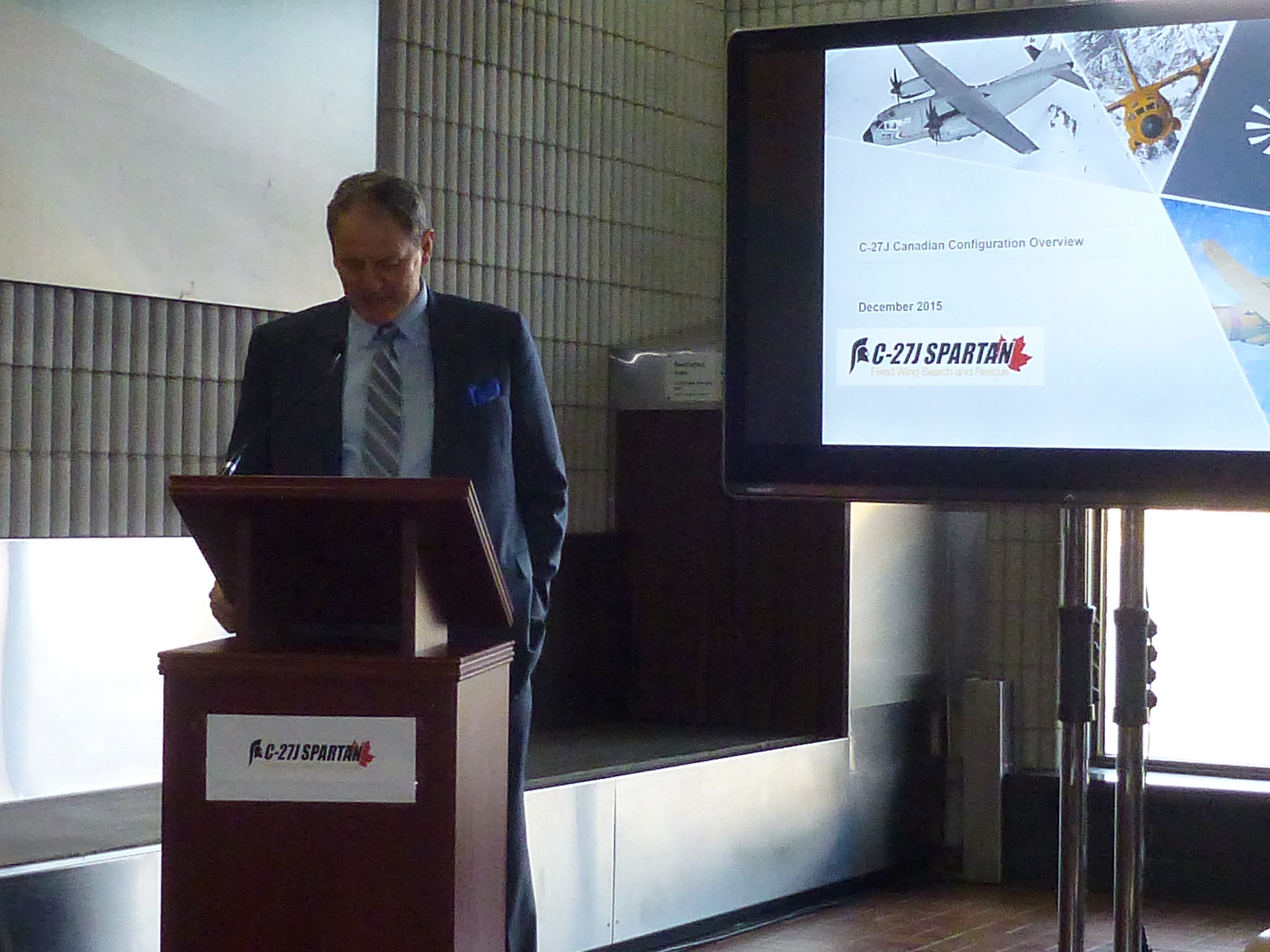
The proposed three-storey, 73,000 square foot building would be located in Comox, British Columbia, Steve Lucas, a retired lieutenant general and former head of the Royal Canadian Air Force, told a news conference on Wednesday. Lucas is with Team Spartan, a consortium of companies which bid the C-27J aircraft for the Canadian contract.

Team Spartan consists of Leonardo-Finmeccanica, General Dynamics Mission Systems-Canada, DRS Technologies Canada and other firms. The company faces competition from Airbus and its team, which are offering Canada its C-295 plane as well as Embraer of Brazil, which has proposed its KC-390.

A new aircraft fleet will replace the Canadian military’s existing fleet of Buffalo and Hercules aircraft used for search and rescue. The Buffalos, first purchased in 1967, are key to search and rescue on the west coast and in parts of the Rockies.

The training center and training support system will be designed, built and managed by a team of Canadian-based companies led by DRS Technologies Canada Ltd. The new facility will be designed to house a cadre of instruction classrooms, the air maintenance training hangar, and state-of-the-art full-flight and sensor-operator simulators for the C-27J Spartan aircraft, Lucas said.

19 Wing Comox is home to the Buffalo search and rescue aircraft as well as CH-149 Cormorant helicopters, also used for SAR missions.

Lucas said Comox is an ideal training location because of its proximity to mountain areas, the ocean and other bodies of water.

The Canadian government expects to select the winning bidder by the end of the year.

During the election campaign, the Liberals promised that their government would “prioritize the acquisition of cost-effective search and rescue aircraft.”

The project originally envisioned buying 17 aircraft. But that has been changed and it will be up to aerospace firms to submit in their bids the numbers of aircraft they believe are needed for Canada to handle the needed search and rescue capability.

Friday, May 6, 2016

CAF Releases Official Statement on OP LENTUS-16

DND Statement:

Following a request for assistance from the Province of Alberta, on May 4, 2016, the CAF deployed four CH-146 Griffon helicopters in response to the outbreak of wildfires in and around Fort McMurray, Alberta. Additional air assets remain on stand-by, ready to assist as required.

The CAF is ready to provide support, as required, to the Province of Alberta in areas including:
The provision of air assets to assist with the evacuation of persons in distress and individuals in affected and isolated areas,

The provision of air assets to assist with the delivery of essential aid to affected areas, and
The provision of air assets to assist with transport of essential firefighting equipment and personnel to, from, and within the affected area.

Operation LENTUS can draw personnel and assets from across Canada, and may be drawn from any or all of the primary force-generators of the Canadian Armed Forces:
the Royal Canadian Navy (RCN);
the Canadian Army; and
the Royal Canadian Air Force (RCAF).

In addition, specialized abilities such as engineering, health services, force protection, transport, aviation or logistics may also be employed.

Once tasked, Canadian Joint Operations Command coordinates the personnel, vehicles, equipment, crews and aircraft to be employed in the region affected by the disaster, in coordination with the respective regional joint task force.

Wednesday, April 13, 2016

Sajjan: Military SAR won’t be Privatized

In what appears to be one of the fastes turn-around's in defence policy - less than 24 hours after the Liberal Defence Review announced that it would consider privatizing Search and Rescue (SAR) in Canada - Defence Minister Sajjan told the House of Commons yesterday; that no - SAR will not be privatized; as the CAF plays too critical a role in SAR in Canada. 

Here is Lee Berthiaume, Ottawa Citizen |article: 

THE CANADIAN PRESS/Andrew Vaughan “The Canadian Armed Forces play a critical role in search and rescue,” Defence Minister Harjit Sajjan told the House of Commons on Tuesday.
OTTAWA — Defence Minister Harjit Sajjan has headed off a potentially divisive debate by declaring the Liberal government will not privatize military search and rescue.

Sajjan made the comments Tuesday in response to an NDP question, after the Citizen revealed that the government’s defence review included questions about whether there were “alternatives” to having the military conduct search and rescue missions.

“The previous government might have been looking at privatizing search and rescue,” Sajjan told the House of Commons. “But I can assure the member that this government is not, because the Canadian Armed Forces play a critical role in search and rescue.”

Sajjan said last week everything was on the table as he launched consultations with the public, parliamentarians and defence experts on how the military should be structured for the future.

Related
Liberals considering privatizing search and rescue operations as part of Canadian Forces review
Harjit Sajjan defends Canada’s military budget after Donald Trump slams NATO ‘free riders’
Liberals ‘absolutely’ committed to military but it needs a tighter focus, defence minister says

The government released a 36-page document asking for feedback on what the military should — and should not — be doing. One section focuses on the military’s role in search and rescue, and asks if there are “models for alternative service delivery that could be explored.”

“Given the range of other actors engaged in this activity and the small proportion of rescues that require CAF assets,” the document reads, “a valid question is: what role should the CAF have in search and rescue?”

The Liberals have said their goal for the defence review is a “leaner, more agile” military that is better able to respond to the challenges facing Canada, but others fear the review is intended to identify ways the government can cut costs. The review is expected to culminate in a new defence policy in early 2017.

The previous Conservative government raised the idea of privatizing military search and rescue five years ago, before letting it die amid a public outcry. Liberal MP Judy Foote was among those who said she was “appalled” by the idea.

Foote, who hails from Newfoundland and Labrador, is now the minister of public services and procurement, which oversees military equipment purchases. Her department is managing a $3.1-billion project to replace the air force’s ancient search-and-rescue planes.

Tuesday, April 12, 2016

Liberals Are Consider Privatizing SAR in Canada

By: LEE BERTHIAUME, Ottawa Citizen 

An RCAF CH-149 Cormorant helicopter on exercising with a Canadian Coast Guard vessel.
The Liberal government is considering whether the military should continue to be involved in search-and-rescue missions, or rely instead on private companies and other alternatives to save Canadians in distress.

The idea has been raised as part of the government’s defence review, and is sure to stoke strong reactions both inside the military and across the country.

The previous Conservative government aired a similar proposal five years ago, before letting it quietly die.

Defence Minister Harjit Sajjan said last week that everything was on the table as he launched consultations with the public, parliamentarians and defence experts on how the military should be structured for the future. Consultations will continue until the end of July, with a new defence policy to be released in early 2017.

As part of those consultations, the government released a 36-page document asking for feedback on what the military should — and should not — be doing. One section focuses specifically on the military’s role in search and rescue, and asks if there are “models for alternative service delivery that could be explored.”

The Canadian Armed Forces responds to more than 9,000 distress calls each year, the document says. But only about 1,000 actually require military search-and-rescue helicopters or airplanes. The rest involve co-ordinating other government departments, volunteers and private companies hired to help. The Conservatives raised the possibility of privatizing search-and-rescue operations in a meeting with representatives from various aerospace firms in 2011. The idea didn’t get far, however, after a public outcry.
HMCS Saskatoon near Esquimalt, British Columbia and An RCAF CH-149 Cormorant helicopter that is practicing personnel transfers.
Among those who spoke out against the proposal was Liberal MP Judy Foote, who wrote in a blog post at the time that she was “appalled by the government’s notice to companies that the government would be exploring the privatization of searchand-rescue operations.”

Foote, who hails from Newfoundland and Labrador, is now the minister of public services and procurement, which oversees military equipment purchases. Her department is currently managing a $3.1-billion project to replace the air force’s ancient search-and-rescue planes.

Paul Ives, mayor of Comox, B.C., which is home to the air force’s search-and-rescue school as well as one of its search-and-rescue squadrons, said he was surprised to learn that privatizing the service was being considered.

A Canadian Coast Guard communications centre is slated to close in the Vancouver Island community next month, and Ives said there would be an economic impact if search and rescue were privatized as well. But he was more skeptical that private companies could provide the same level of service as the military.

“Those guys who are rappelling down to rescue you are professionals to the nth degree and they’re a very proud part of the military,” he said.
An RCAF CC-146 Griffon helicopter waits to take off as CAF personnel from 424 (Transport and Rescue) Squadron conducted a search and rescue (SAR) during exercise TIGEREX
“I wouldn’t want to be out in the wilderness somewhere expecting somebody to come in on a rescue mission who’s working on a contract basis and worrying about, ‘Can we really do this? Will it cost us more than it’s worth?’ ”

York University professor Martin Shadwick, who has written extensively on military search and rescue, said the actual monetary savings of privatization or moving the service somewhere else such as the Coast Guard would likely be very small.

At the same time there would be a number of intangible costs, he said, such as damage to military morale and the Force’s links with average Canadians given that search and rescue is one of the military’s most highprofile activities.

“So there’s a whole lot of things that often don’t fit nicely on a balance sheet,” he said. “Getting rid of it completely, I don’t think it’s in the broader national interest.”

Tuesday, April 5, 2016

Last RCAF CC-130E Lands at Aviation Museum in Ottawa

Check out the Tweet Above to watch the Last CC-130E land at the Aviation and Space Museum, in Ottawa.

Written by David Pugliese, The Ottawa Citizen 

The Department of National Defence has donated the last CC-130 Hercules E aircraft still in service to the Canada Aviation and Space Museum. The aircraft made its last flight this morning, flying from 424 Transport and Rescue Squadron, Trenton Ontario to land at the museum in Ottawa this morning, according to the RCAF.

The Hercules will become part of the museum’s permanent exhibition.

In the case of transfer of the last CC-130 E Hercules Legacy in service to the museum, standard preservation procedures were applied: the fuel tanks were drained and engines disabled, the RCAF noted.
RCAF Crew with the CC-130E Hercules, ahead of its last flight (photo courtesy of RCAF)
Background from the RCAF on the C-130 E model:

Although designed in the early 1950s, the Lockheed C-130 Hercules remains one of the most successful military transport airplanes ever designed. Operated in every region of the globe, this flying truck has consistently shown itself to be extremely durable, reliable, and tough. The Royal Canadian Air Force received its first Hercules in the fall of 1960. Improved versions were ordered as time went by. A new batch was in fact delivered in 2010-12 and will remain in service for years to come. The Hercules offered to the Canada Aviation and Space Museum is the oldest Canadian example of the type. It entered service in 1965 and was used as a transport airplane, a navigation training airplane, and a search and rescue airplane.

The Hercules offered to the Museum (manufacturer number 382-4041) is the third CC-130E – and the seventh CC-130 – acquired by the Canadian military. Taken on strength on February 9, 1965, the airplane received the RCAF serial number 10307 (130307 from May 1970 onward). It flew with 435 Squadron, a unit based at RCAF Station Namao (Alberta).

After approximately ten years spent at Namao, the Hercules was converted into a navigation training airplane, with the designation CC-130N / NT or Nav-Herc, and used at Canadian Forces Base (CFB) Winnipeg by the Canadian Forces Air Navigation School. It was one of four Hercules so modified to train navigators who would fly aboard transport airplanes (Lockheed CC-130 Hercules) or maritime patrol airplanes (Canadair CP-107 Argus or, later, Lockheed CP-140 Aurora). The airplanes could be configured for either type of training by using removable pallet-mounted consoles made by Northwest Industries of Edmonton. Each of these consoles carried two student positions as well as an instructor position, further back. A Hercules could either carry two identical consoles, or one of each type.

With the introduction of a dedicated navigation training airplane in 1991, the Hercules offered to the Museum was transferred to 429 Squadron, a transport unit based at CFB Winnipeg. In 1993, it was converted into a search and rescue airplane, a version known informally as the CC-130E(SAR). The airplane went to 424 Squadron, a unit based at CFB Trenton (Ontario).

This Hercules is the last of the CC-130Es and the oldest Hercules still flying in Canada. There is a CC-130E Hercules (serial number 130314), very similar to the one offered to the Museum, at the National Air Force Museum of Canada, in Trenton

Thursday, February 18, 2016

Comparing the FWSAR Bids for RCAF

BY KEN POLE
© 2016 FrontLine Defence (Vol 13, No 1)

Sometime in the late 1990s, air force planners in the Department of National Defence began considering the next stage in fixed-wing search and rescue (FWSAR) capabilities. Whatever aircraft was selected would continue a proud heritage dating to just after World War: servicing what has evolved into one of the largest SAR jurisdiction in the world, extending to the High Arctic and well out into the Atlantic and Pacific oceans.


2012 – MCpl Sean Daniell, a SAR Tech from 442 Transport and Rescue Sqn, Comox, British Columbia checks the tail of the CC-115 Buffalo aircraft for ice buildup during a SAR training scenario during Operation NUNALIVUT 2012. (Photo: Sgt Matthew McGregor, CF Combat Camera)

It would be 2002 before the new requirement would be officially identified, in 2003 the Defence Minister would announce it as “a priority” for his department. After a few drafts, the first Statement of Requirements (SOR), which DND planners did not make public, followed in 2004 and the government’s budget that March provided for $1.3 billion in initial funding. The stated goal was to have the first new aircraft entering service in 2006, however, the project became mired in controversy – originally due to complaints that the SOR had been written with a particular aircraft in mind, effectively eliminating any opportunity for competitive bids. Since then, a Request for Proposals (RFP) from industry was drafted and revised a half dozen times and the project bogged down in rewrites, bureaucratic delays and worry over political fallout. Every Defence Minister from Art Eggleton (1999-2002) to Jason Kenney (2015) has tried to push this project forward to no avail. The new minister, Harjit Singh Sajjan, will finally see it move forward.

Two decades after the need was first considered by those DND planners (most or all of whom have retired), the SOR was reportedly heavily modified, and the new RFP (deemed satisfactorily fair by industry stakeholders) was issued in March 2015 – finally setting the stage for first delivery of new aircraft.

As of the 11 January 2016 deadline for responding to the new Request for Proposals (RFP), three twin-engine aircraft (two European-built turboprops and one Brazilian jet) are in the final competition to supply the Royal Canadian Air Force with new fixed-wing search and rescue capability. Entry into service of new aircraft will end one of the longest and most controversial procurements in the history of the Canadian Armed Forces.

Although Team Spartan’s C-27J and the Airbus C-295W (the two turboprops from Italy and Spain) had long been considered the only serious contenders for Canada’s Fixed Wing SAR contract, a number of others have considered entering the competition, such as Bombardier and Lockheed Martin. Embraer’s KC-390 (the jet from Brazil) is now the newest and only other contender to seek to fill the role. Over the years, a few companies had also offered alternative solutions, such as Boeing and Viking Air. Now, however, with three contenders submitting bids, and a decision anticipated later this year, the painful procurement saga is about to end and a tantalizing new chapter of operational missions is on the horizon.

The C-295W, built in Spain by Airbus Defence & Space, and the C-27J Spartan, built in Italy by the Aircraft Division of Finmecchanica (formerly Alenia-Aermacchi), are both similar in basic configuration to the six remaining deHavilland C-115 Buffalos, which entered service with the RCAF in the 1960s as tactical transports and were retasked for SAR work in 1975. Those six remaining “Buffs” currently operate on the West Coast at RCAF Base Comox. While still capable aircraft, having been extensively upgraded a decade ago, they now cost millions annually to keep in service, and spare parts are increasingly difficult to find. The third and newest contender, the KC-390 built in São Paulo by Embraer, is a latecomer to the FWSAR competition.


CC-115 Buffalo goes through the bird-bath to remove any residue that may have accumulated on the airframe as a result of the hours flown over salt water. Buffalos, Hercules and Twin Otters have been handling all FWSAR flights over the years.(Photo: Sgt Eileen Redding)

When the extended bidding process finally closed for the $3.1-billion contract to supply around 17 missionized aircraft (which will also replace 11 older Lockheed Martin C-130 Hercules aircraft used for SAR work), Public Services and Procurement Canada (PSPC) would say only that three companies had responded to its 2,000-page Request for Proposal (RFP), which also provides for an initial 20 years of in-service support (ISS).

While PSPC declines to identify the bidders as a matter of policy, FrontLine Defence had already confirmed their identities. Lockheed Martin had been rumoured to be considering bidding new J models of its C-130, which would have had fleet commonality with the RCAF’s current core transport, but the company was neither confirming nor denying that it had bid even two days after the deadline had expired.

A week after the bids closed, Lockheed Martin confirmed to FrontLine that although it had been a “potential” bidder, the company had opted to drop out after “an extensive and thorough analysis of the RFP’s requirements.” Spokesperson Cindy Tessier said the company preferred to focus on supporting the RCAF’s fleet of newer J-model Hercules.

Each of the RFP bidders were requested to provide a digitally-signed master and six printed copies, the latter weighing at least a couple of hundred kilograms each. “The master copy . . . takes precedence,” PSPC explained. “Additional paper copies are required to support bid evaluation teams that will be working in parallel across three departments.” PSPC retained two copies, the Department of National Defence received three for distribution to its evaluation teams, and the other copy went to the Department of Innovation, Science & Economic Development, which assesses industrial offsets proposed for Canadian companies in the various bids.

“Verification of the proposals will be conducted by the bid evaluation teams . . . and there is a process in place where bidders may be requested to clarify information or correct any inadvertent errors or omissions,” PSPC said. “Bid evaluation, which includes aircraft (ground and flight) testing, is expected to take about six months and a contract award is anticipated sometime in the late 2016, early 2017 timeframe.”


September 2015 – Search and Rescue Technicians aboard a CC-130 Hercules aircraft from 435 Squadron, watch out the spotter window for their ground target during in SAREX 15, in Comox, British Columbia. (Photo: Cpl Ian Thompson, 4 Wing Cold Lake Alberta)

The original target date to meet a need anticipated by the RCAF in the 1990s and officially identified in 2002 is long past. History shows that after a few drafts, the first official version of the Statement of Operational Requirements (SOR), which was signed off in March 2004, was greeted with accusations that DND had written it with a specific aircraft in mind (the C-27J) rather than the mission. Controversy delayed the issue of an RFP and subsequent revisions (versions 2 and 3) of the SOR, issued in April and August 2005, did not resolve the complaints. The increasingly rancorous political debate went on for years and confounded numerous Defence Ministers.

Despite attempts to “fast-track” the program, it continually found itself at the bottom of the “to do” list due to the political quagmire. In late 2009, in an attempt to get out from under the multi-layered accusations, the department of Public Works & Government Services, as it was known then, asked the National Research Council Flight Research Laboratory in Ottawa to review the SOR.

The NRC’s test pilots and engineers concluded in their March 2010 report that the SOR had effectively limited the RCAF’s options by, among other things, specifying an “off the shelf” aircraft which lacked integrated SAR sensors such as electro-optical and infrared (EO/IR), search radar and night vision imaging. This represented a need for extensive modifications involving significant risk, expense, and delay (otherwise known as “Canadianization”). The NRC team recommended avoiding the use of this terminology “unless it is anticipated that aircraft may be procured in the form they are currently produced with no design changes.


Sept 2015 – WO Norm Penny parachutes out of a Twin Otter aircraft as Sgt Chad Hildebrant and MCpl Ashley Barker look on during SAREX15 in British Columbia. (Photo: Sgt Halina Folfas, 19 Wing Imaging)

The review team also balked at the SOR’s specification of an unrefueled range of 1,699 nautical miles (nearly 3,150 kilometres) with a 3,130 kg payload, which they said was “inconsistent with the stated core objective of […] maintaining or improving the SAR level of service.” The current Buffalos have a range of 2,240km with a maximum load of 2,727 kilograms. It should be noted that the standard SAR payload for the Buffalo is just under 1,000 kg, and the minimum payload, as stated in the RFP, is reportedly 3057 lbs (1,387 kg).

Another comparison to utilize is “Ferry range” which implies a lightly-loaded aircraft with full tanks (the minimum payload cited in the SOR likely would be close). FrontLine gathered the following ferry range data on the contenders: C295W: 5750km; C-27J: 5926km; KC-390: 6019km.

More critical to the issue of transparency, and what may have kick-started the accusations of impropriety, was the SOR’s mandatory requirement of a minimum cabin height of 83 inches. This eliminated the competition as, at the time, only the C-27J conformed to that specification. In its review of the SOR, the NRC team noted that both the Cormorant and Buffalo cabin heights are significantly less than 83 inches, and that none of the SAR techs they interviewed were uncomfortable with the cabin heights of those aircraft. NRC concluded that the stated requirement of 83 inches cabin height was “not supported”.

Lauded as a fair and unbiased assessment by the NRC, this report created the much-needed whiff of transparency that finally unlocked the shackles, allowed the SOR to be revised, and the program finally saw the light of day after more than a decade of controversy.


Captain Matt Adam steers his CC-130 Hercules aircraft from 435 Sqn in a tight orbit around the ground target during SAREX 15.(Photo: Cpl Ian Thompson, Imagery Technician, 4 Wing Cold Lake)

Airbus C-295W
The revised SOR enabled Airbus to keep the C-295 in contention. A tactical transport developed from the proven CN-235, it features a stretched fuselage, Pratt & Whitney Canada PW127G engines (which afford longer range, a higher operational ceiling, and heavier payloads), and the now-ubiquitous winglets (which improved its aerodynamics – performance and fuel efficiency – significant enough to add the W to the designator).

In bidding for the contract, Airbus has set up AirPro SAR Services, a joint venture with Provincial Aerospace Ltd. (PAL), which is headquartered in St. John’s, Newfoundland and has a track record of providing ISS and other services to customers in Caribbean and Middle East markets as well as at home, racking up more than 250,000 hours of flying time. PAL Chief Development Officer Keith Stoodley told FrontLine at a bid-day briefing that all C-295W in-service support will be done in Canada.

Other partners added to the C-295 team include CAE (training provider), Pratt & Whitney Canada(engine provider), and L-3 WESCAM (for their world-renowned electro-optical/infrared turrets). The company has indicated it will release a list of second tier suppliers at a later date.

Pablo Molina, Head of Airbus’ Military Aircraft Division in Canada, told the briefing that the C-295W is the “market leading aircraft” in its category, capable of handling any conditions the Canadian SAR mission can throw at it – and at the lowest cost. Airbus advises that since the RFP was launched in March, there have been sales of an additional 13 aircraft, bringing the total C-295 sales to more than 165. Antonio Rodriguez-Barberan, Senior Vice-President Commercial, Special Projects for Airbus, noting that 15 years had passed since he first visited Canada to discuss the FWSAR project, added that their proposal was “fully compliant” with the “very, very demanding requirement” set out in the RFP.

Airbus is proud to point out that, despite the development of the KC-390s, the Brazilian Air Force purchased three new Airbus C-295 aircraft (configured for SAR with mission system and sensors), to augment the 12 basic-configuration C-295s the country has been operating since 2006. Although they have opted out of the winglet configuration for reasons of fleet commonality, the mission ­systems and sensors of the new aircraft are similar to what is required for Canada, the company says. The first aircraft for the 2014 contract will be delivered to the Brazilian government later this year.


Airbus C-295W

Airbus points out that all “Canadianization” will be incorporated into the C-295 at the manufacturing stage, not added after delivery. The mission system, sensors, engines, EO/IR turrets and other components are all installed on the assembly line in Seville as part of the manufacturing process and facilitating quality control. This “eliminates the need to modify the aircraft after final assembly,” says a company representative. It also creates more accountability based on control of the process and allows Airbus to reduce risk and cost, while ensuring the aircraft is delivered on schedule, as contracted.

Like its two competitors, the C-295W requires a minimum crew of two, pilot and co-pilot, but SAR missions also can involve sensor operators, spotters, SAR Technicians and a load master as needed. Measuring 24.4 metres in length with a 27.59 m wingspan, its maximum speed is 480 kilometres per hour, with a range of over 5400 km (over 2,900 nm) with the required minimum SAR payload of 3,057 lbs (1,387 kg).

Finmeccanica C-27J
The other top contender, Finmeccanica, brought its C-27J Spartan to Gatineau-Ottawa Executive Airport for a two-hour briefing in December 2015. A multi-mission variant for la Fuerza Aérea del Perú, one of more than a dozen military and paramilitary services around the world which fly the Spartan, it was being flown by company pilots to Lima from Italy via Canada and the Bahamas.

The C-27J was developed from a 1962 design for the Fiat G.222 and is, hence, effectively a contemporary airframe to the Buffalo. Its engine, propeller and flight deck equipment were originally Hercules-based, however, Lockheed has publicly stated that there are no remaining flight deck commonalities between the C-130J and the C-27J. Team Spartan’s FWSAR configuration would be an upgraded version of the one acquired by the U.S. Coast Guard. The cockpit would feature the latest avionics, and extra power from the Rolls Royce AE-2100-S2A turbines would increase its maximum takeoff weight.


Paratroopers prepare to jump from the rear ramp of a Polish C-295.

Team Spartan consists of numerous aerospace defence companies ready to supply their specialized expertise. For example, Finmeccanica Aeronautics would supply green aircraft for outfitting at IMP Aerospace in Nova Scotia. Others include Airdyne (spotter windows, seats and flare launcher); DRS Technologies Canada (courseware and training aids); Esterline CMC (flight management system and electronic flight bag); Flyht Aerospace Solutions (Iridium satellite communications); General Dynamics Mission Systems – Canada (ISS integrator); KF Aerospace (maintenance, supply chain and repair engineering ISS, pilot and maintenance training, management support); L-3 WESCAM (EO/IR turrets); Rockwell Collins (radios); and Selex-ES (search radar).

On the key element of industrial offsets, Team Spartan said in a statement that it has committed to delivering “100 per cent of contract value […] benefits in the form of hundreds of long-term jobs and far-reaching investments in Canadian firms and technology.”

DND’s former Chief of the Air Staff (2005-2007), Steve Lucas, is now Canadian spokesman for Team Spartan. He told a media briefing at the Gatineau airport that “thanks to its exceptional speed, size, endurance and manÅ“uverability,” the C-27J “can reach austere and remote locations […] from Canada’s existing main operating bases.”

Although similar in length and manÅ“uvrability to the Buffalo, the C-27J’s speed, pressurized cargo compartment and circumference are more similar to the Hercules than the Buffalo. Shorter than the Airbus platform at 22.7 m, it has a significantly higher and wider cabin. The C-27-J also features a greater wingspan and 25% more wing area, which facilitates searching at slower speeds. Its maximum speed is 602kph, its range is nearly 1,852km with a full payload of 11,500kg. Based on the minimum SAR load specified in the RFP, Team Spartan puts the C-27J’s range between 2,300 and 2,600 nautical miles (4,260 to 4,815 km), depending on the conditions.

Both aircraft offer, like the venerable Buffalo, exceptional short-field take-off and landing capability.


C-27J

IMP’s “Canadianization” would involve a range of government-mandated hardware, including the chin-mounted L-3 WESCAM turret, belly-mounted radar and extraordinarily large bubble spotter windows which would take up almost the entire rear doors on each side of the aft fuselage. Coupled with a modular “palletized” interior, all mean increased weight and drag and, when asked whether that was why winglets have been added to the design, Lucas replied that it was “certainly one of the reasons.” Noting that many newer commercial aircraft feature them, he added that in the case of the C-27J, “in a number of flight environments, the winglets will either completely or partially offset those particular drag components.”

Embraer KC-390
As for the third contender, the KC-390, Embraer is touting its speed, range, payload and lifecycle costs as key attributes for the RCAF. Conceived as a clean-sheet design in 2006, it was still in early development when FrontLine Defence visited São Paulo in late 2012, but the company rolled out the first of two prototypes in just two years.

Geraldo Gomes, vice-president of international business development for Embraer Defense and Security, said the company managed to fast-track the program by drawing on nearly a half-century of civil and military design, development and production expertise. “Development of the KC-390 made extensive use of advanced digital modeling technologies, test rigs and advanced manufacturing processes in order to anticipate any issue,” he explained to FrontLine while attending the AIAC conference in November 2015.

The first flight of the KC-390 was in February 2015 and that aircraft, about to be joined by the second prototype, now is approximately halfway through 2,000 hours of flight test evaluation. Certification is expected in the second half of 2017, entry into service in 2018. Embraer’s heaviest model to date, the KC-390 is by far the largest candidate for the Buffalo replacement at 33.43m in length with a 33.94m wingspan. It can carry up to 23.6 tonnes some 1,400km at a top speed of 850kph. Its range, based on the minimum SAR payload of 3,057 pounds, is 6,278 km (3,390 nm); this range includes reserves for 100 nautical miles alternate and 45 minutes hold.

According to Embraer, the certification strategy for the KC-390 is based on a dual approach: civil certification, under Part 25 (transport category), by ANAC, the Brazilian Civil Certification Authority, for the “green aircraft” (basic aircraft), complemented by IFI, the Brazilian Military Certification Authority, military certification, for the full certification of all systems and capabilities of the aircraft.


KC-390

“In the case we are selected for the FWSAR Program, the Canadian Military Certification Authority is expected to issue the FWSAR configuration type certificate, based on the Brazilian full military certification,” explained corporate spokesperson Valtécio Alencar. “For the moment,” he continued, “there is no identified need for a civil certification with the FAA (USA) or Transport Canada. The KC-390 development planning and schedule allow us to assure full compliance with all certification requirements on the FWSAR request for proposals and we are very confident about our ability to deliver the best solution for the Canadian SAR needs.”

As for specialized technologies, Gomes said the KC-390 features the latest avionics, electro-optic/infrared and radar sensors, full night-vision-goggle capability, and fly-by-wire technology, which enables the crew to focus on the mission. It would, he said, be “the ideal aircraft” for the Canadian SAR mission because it can be flown not only ‘high and fast’ but also ‘low and slow’ (which is a Brazilian Air Force requirement for paratrooper drops and inflight refueling of helicopters). He said it is “SAR-ready from the initial concept” and “fast reconfiguration allows the plane to act as a fast transport for injured victims with litters and life-support equipment.”

He pointed out that the BAF’s SAR environments are similar to Canada’s, including dense forest, mountains and large maritime areas. “The sooner you get to the search area, the higher the chances of success,” reminds Gomes.

Power is from International Aero Engines V2500-E5 turbofans, and this is the first military application of the units used in the larger Airbus A320s. While test evaluation is “progressing well”, none of it has involved austere airstrips. Even so, Gomes said “the ability to operate from unpaved or contaminated runways has been an integral part of the design requirements.”

Other key suppliers to Embraer include two U.S. majors – Rockwell Collins (avionics and cargo-handling and aerial delivery system) and Goodrich Corp. (primary fly-by-wire) – as well as the venerable Czech firm Aero Vodochody (aft fuselage). Although Embraer has talked with potential Canadian partners about spinoffs from the RCAF procurement, Gomes would say only that Embraer would deliver “a competitive, custom-made solution for Canada and this will certainly include local participation.”

As for lifecycle costs, Gomes insisted that the KC-390’s are the lowest in its class. “The latest maintainability processes and tools allow the aircraft to operate with longer time between inspections and reduced maintenance downtime. The KC-390 uses mature solutions like proven engines, commercial off-the-shelf basic avionics, and integrated fault monitoring. It also introduces new technologies to the medium airlift category such as Prognostic Health Monitoring and Advanced Structural Health Monitoring.”
There currently are 28 firm orders from the BAF, which also will acquire the two prototypes, having put up the equivalent of $1.5 billion in initial funding. Argentina, the Czech Republic and Portugal (which also contributed to the $2-billion development cost) have signed letters of intent, as have Chile and Colombia. If all translate into firm orders, the total would be 60 aircraft, excluding the prototypes.

A Canadian selection would give Embraer a foothold in North America, which is a key element of its goal of securing “a good share” of what Gomes called the “addressable replacement market” of some 700 medium-airlift transports worldwide by 2030.

Wrap-up
Selection of any one of the three contenders would be a significant step toward a long-overdue reinvigoration of Canada’s overall SAR capabilities in what is acknowledged at home and abroad as one of the most demanding environments in the world.

===
Ken Pole is a contributing editor
at FrontLine magazines.

Monday, January 18, 2016

Lockheed Martin Admits it didn't enter CC-130J for FWSAR

Four days ago David Pugliese published an article in The Ottawa Citizen that said Lockheed Martin didn't bid on the RCAF's FWSAR program; despite having indicated in June 2015 that it would. 

Today, Pugliese's Defence Watch published the following article about Lockheed admitting it did not bid. 

Lockheed Martin has decided to reverse its questionable public relations strategy and finally confirm what was reported last week – that it did not submit a bid for the Canadian government’s fixed wing search and rescue (FWSAR) program.

Defence Watch, as well as Skies magazine, published the news last week that Lockheed Martin didn’t submit a bid.

But at the time Lockheed Martin was still sticking to its media line: “Out of respect for the procurement process, Lockheed Martin does not comment on competitive tenders that are underway.”

As noted earlier, this statement, which LM had been repeating for months, is laughable. Companies love to talk about their products to the news media and LM’s competitors have been holding press conferences and briefings on their FWSAR submissions.

In fact, for the last couple of years, Lockheed Martin officials had been highlighting how great their C-130J would be for the FWSAR program.

All that changed and the “out of respect for the procurement process” media line materialized when Lockheed’s proposal ran into trouble.

So with the bids in, and news reports from Defence Watch and Skies magazine that Lockheed Martin was a no-show for FWSAR (and queries also coming in from the U.S. media), the firm has decided to change its message.

“Lockheed Martin participated in the FWSAR procurement process as a potential bidder,” the company noted in a new statement Monday to Defence Watch. “After following an extensive and thorough analysis of the RFP’s requirements, we decided to not submit a formal response to Canada’s FWSAR RFP. We remain fully committed to supporting the RCAF and its CC-130J fleet as it continues to perform the tactical transport role in Canada for decades to come.”

Lockheed Martin, however, has not explained why it didn’t bid. But its competitors have toldDefence Watch the firm decided against bidding because the in-service support costs for the C-130J are extremely high, making a proposal a non-starter.

Embraer, Alenia and Airbus all bid on the $3.1 billion FWSAR program.

Monday, January 11, 2016

FWSAR Eval to Take up to 6 Months

By: David Pugliese

Aerospace firms will submit their bids on Monday to provide Canada’s air force with a new fleet of search-and-rescue planes.

Aerospace companies will submit bids proposing a combination of aircraft and in-service support to replace the RCAF’s existing fleet of Buffalo and older Hercules aircraft used for search and rescue.

The Buffalos, first purchased in 1967, are key to search and rescue on the west coast and in parts of the Rockies. Those aircraft are already facing mechanical and technical problems and several years ago the air force had difficulty obtaining spare propellers.

The Fixed Wing Search and Rescue (FWSAR) aircraft project originally envisioned buying 17 planes. But that has been changed and it will be up to aerospace firms to submit in their bids the numbers of aircraft they believe are needed for Canada to handle the needed search and rescue capability.

Public Services and Procurement Canada hasn’t provided a timeline for when the new aircraft might arrive. But it looks like it is hoping the evaluation of the bids will be done fairly soon.

“It is estimated that the evaluation period for the selection of the successful bidder, which includes aircraft testing, may take up to six months, after closing of the RFP (request for proposal),” according to Pierre-Alain Bujold, spokesman for Public Services and Procurement Canada.

No details were provided on when the winning company would be announced but some aerospace firms are expecting that to happen by early 2017.

Thursday, January 7, 2016

FWSAR Bids Due Monday


After more than a decade of delays, aerospace firms will submit their bids next week to provide Canada’s air force with a new fleet of search-and-rescue planes.

So far, three companies have said they plan to bid on the $3.1 billion project.

The bids are due Monday, Pierre-Alain Bujold, spokesman for Public Services and Procurement Canada, said in an email.

Aerospace companies will submit bids proposing a combination of aircraft and in-service support to replace the Canadian military’s existing fleet of Buffalo and Hercules aircraft used for search and rescue, he said.

The Buffalos, first purchased in 1967, are key to search and rescue on the west coast and in parts of the Rockies. Those aircraft are already facing mechanical and technical problems and several years ago, the air force had difficulty obtaining spare propellers.

Airbus Defence and Space plans to offer Canada its C-295 aircraft while Alenia is bidding its C-27J plane.

The Brazilian aerospace firm Embraer has said it will propose its KC-390 aircraft.

Canada released its request for proposals from industry on March 31.

But the Department of National Defence and Canadian Forces first announced the project to buy a new fleet of search-and-rescue aircraft in 2004.

The Conservatives reannounced that project as part of their Canada First Defence Strategy. In 2008, then-defence minister Peter MacKay called the project a top priority and vowed to buy a new fleet of planes by early 2009. That never happened.

In 2011, DND and the Canadian Forces again noted the project was to be one of their top procurement goals over the next three years but the acquisition has continued to limp along.

On Tuesday, a report from the Canadian Global Affairs Institute and the University of Calgary blamed delays in equipment purchases on the turnover of ministers and senior military staff as well as on delays caused by federal elections.

But aerospace industry representatives say that wasn’t the case with the proposed purchase of the fixed-wing search-and-rescue planes. Shortly after the project was launched, various aerospace firms accused the Canadian air force of rigging the contract to favour Alenia’s C-27J. Those accusations, in turn, caused years of delays as government officials painstakingly tried to ensure the process was seen to be fair.

Senior air force officers denied there was any favouritism at play.

But Alan Williams, the Department of National Defence’s former assistant deputy minister for materiel, later testified before a parliamentary committee that the Canadian air force had designed the requirements for the original search-and-rescue aircraft project to favor the C-27J, prompting the complaints to government from companies.

In 2014, the Citizen obtained DND documents that also blamed some of the delay on the Conservative government’s freeze on hiring staff. That resulted in a shortage of personnel in the search-and-rescue aircraft project management office, according to the records.

DND officials acknowledged the freeze had created some problems but noted that it was only temporary and the situation has improved.

During the election campaign, the Liberals promised that their government would “prioritize the acquisition of cost-effective search and rescue aircraft.”

The project originally envisioned buying 17 aircraft. But that has been changed and it will be up to aerospace firms to submit in their bids the numbers of aircraft they believe are needed for Canada to handle the needed search-and-rescue capability.

Tuesday, December 15, 2015

Alenia Brings C-27J Spartan Ottawa-Gatineau for FWSAR

Article by: Philippe Cauhi

GATINEAU – On Friday, December, the 11th, Team Spartan Canada brought for a three hours stop and a press conference, a Peruvian Air Force C-27J Spartan to the Gatineau-Ottawa Executive Airport on its way to Peru.

This event took place exactly one month before the deadline to submit bids to Publics Works and Governement Services Canada to supply the Royal Canadian Air Force (RCAF) with new fixed-wing search and rescue (FWSAR) aircraft. The cost of the program is set at CAN$3,1 billions including a 20-year maintenance contract.


Turin Italy based Alenia Aermacchi, a division of Finmeccanica is leading Tean Spartan which includes :

General Dynamics Mission Systems Canada : supplier, integrator and in-service support (ISS) of the state of the art mission system based on the one found on the RCAF CP-140 Block III aircraft ;

IMP Aerospace : aircraft Canadianization by modifying the C-27J baseline aircraft into the Canadian

FWSAR, support to Alenia during initial delivery, installation of the mission systems, flare launchers,

EO/IR turret, search radar and interior design modifications ;

L3 Wescam : MX-15HDI electro-optical/infrared turret ;

DRS Technologies Canada, a Finmeccanica company : courseware and training aid ;

Esterline CMC : CMA-9000 Flight Management System and Flight Bag

FLYHT Aerospace Solutions : AFIRS 228S SATCOM Iridium satellite communications ;

KF Aerospace : maintenance, supply chain and repair engineering ISS, and pilot and maintenance training management support ;

Rockwell Collins : ATC radios ;

Finmeccanica Selex-EX : Seaspray 7500E search radar ;

Aerodyne : wide observer windows and pressurized flare launchers

Steve Lucas.
Photo: Philippe Cauchi.

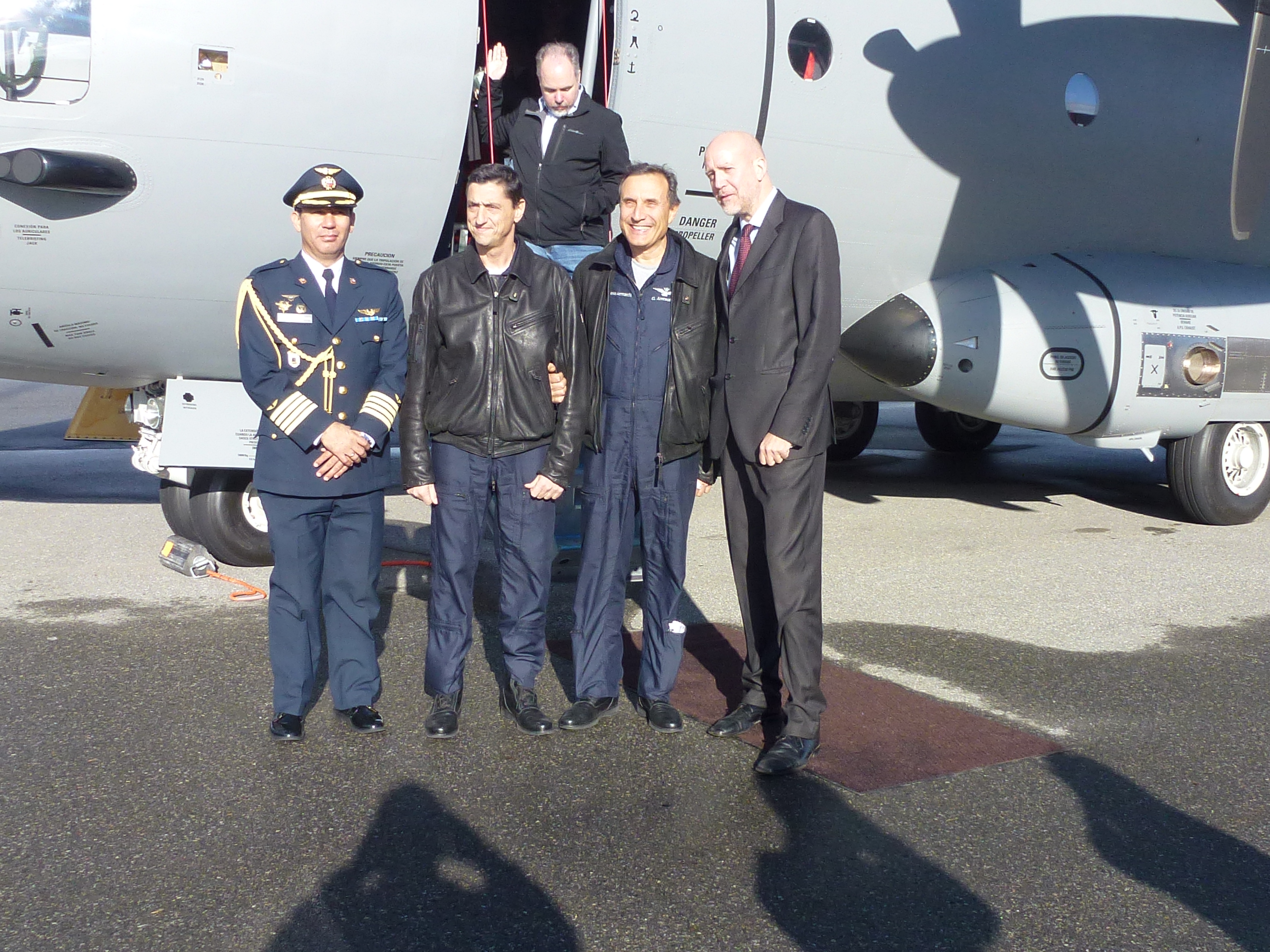
Steve Lucas senior representative for team Spartan and former chief of the Air Staff of the now Royal Canadian Air Force from 2005 to 2007 was flanked by the two C-27J test pilots, Marco Venanzetti and Gianni Ammoniaci who left Turin on thursday afternoon on their way to Peru and the Peru Defence Attaché in Ottawa, Colonel Alejandro Humberto Marusic Caceda, attended.

Mr. Lucas started the press conference by stating that the C-27J, the aircraft of Team Spartan in the Canada’s Fixed Wing Search and Rescue (FWSAR) RFP whose bids are due for January, the 11th, 2016 , is ‘An exceptional aircraft beyond expectations but still within reach of Canada’.


Alenia C-27J Spartan.
Photo: Philippe Cauchi.

In spite of the fact that the C-27J offered to Canada is based on the same configuration that has been supplied to the US Coast Guard, the US Army Special Operations Forces and the Royal Australian Air Force, it will be modified by the Canadian industry in order to ‘make this aircraft right to fulfill the Canadian FWSAR mission’.

The FWSAR will be replacing the six aging De HavilLand CC-115 Buffalo based in Comox, British Columbia and fourteen Lockheed CC-130H Hercules based in Winnipeg, Manitoba (4), Trenton, Ontario (4) and Greenwood, Nova Scotia (3). This process which began more than ten years ago aims to replace theses two fleets of aircraft in service for more than 50 years.

According to Steve Lucas, the C-27J has a rapid response time thanks to its exceptional speed, size, endurance and manoeuvrability enabling it to reach austere and remote locations including theses in the mountains as well as in the far North and the far sea. This way, the C-27J is only aircraft in its class far enough capable to respond by its speed to SAR incidents to the limits of Canada vast SAR area of resposability.

The Canadian RFP underlined Steve Lucas is not a simple replacement on a one-to-one replacement basis of existing aircraft but a very complex set of requirements of thousands of pages requesting that the contender’s aircraft be able :

To respond to three simultaneous SAR incidents in Canada’s three different SAR regions : Victoria SSR, Trenton SSR and Halifax SSR ;

To reach the most remote Canadian location in the shortest time ;

To achieve a 95% availability rate for at least one aircraft in each SSR and a 70% rate for a second one ;

To reach 2674 points in Canada where incidents occured in the last five years.

The size of the cabin of the Spartan is a big plus acording to Mr. Lucas. With a heigth of 2,60 meters, a width of 3,33 meters, and its high floor strength, (4,900kg/mload capability), the cabin allows a lot of activity of moving around in the back, the SAR technicians bringing a lot of equipment.

It is divided in three sections : the mission system section, the storage section and on the ramp, the personnel section.

Photo: Philippe Cauchi.

The C-27J Spartan is not only an aircraft capable to bring the first respondents to site but also to land on short strips and bring back everyone.

Compared to the Buffalo, the C-27J flies faster, further and is pressurized. For this reason, the Buffalo can be used only in the Victoria Region. On top of that, the Spartan have the landing and take off performances of the Buffalo in spite of the weigth of its complete mission system and longer endurance.

Team Spartan C-27J is based on the same configuration of the aircraft supplied to the US Coast Guard which is looking for systems similar to the one installed on the one offered to Canadian Forces. This means opportunities for Canadian suppliers if Canada picks the Spartan.

Steve Lucas recalled that the C-27J is a modern military transport aircraft with an established production line, mature production processes and excellent operational performances.

He concluded by stating that the Spartan is an affordable solution to Canada SAR needs ‘very within reach of Canada with no need to compromise on response time, geographical coverage, crew comfort and cockpit visibility’ and ‘Maximizing Canadian participation and minimizing program risks’.

An advanced derivative of the Aeritalia G222 first flown in 1970, the C-27J is a tactical military cargo aircraft able to perform a variety of missions including transport of troops, logistical resuply, MEDEVAC, air drop operations, paratroopers launches, humanitarian assistance, oil spill relief, fire fighting and SAR.

The C-27J featured the same engines and propellers than the Lockheed Martin C-130J Hercules as well as a common avionics architecture.

Having obtained its Military Qualification Certificate, the C-27J is also airworthy to civil standards with certification from EASA and FAA.

Certification of the C-27J Spartan included cold weather flight testing in Finland.

More than 82 C-27J had beeen ordered by the air forces of Italy, Greece, Bulgaria, Lithuania, Romania, Morocco, Mexico, Australia, Chad, Peru, Slovak Republic, an undisclosed African customer as well as the US Army Special Operations Command and the US Coast Guard.

Monday, December 14, 2015

Embraer to Enter KC-390 in Bid for RCAF FWSAR


By: David Pugliese, Defensenews.com 

OTTAWA, Canada — Embraer is set to shake up the competition to provide Canada with search-and-rescue aircraft as the Brazilian firm seeks export orders for its new KC-390.

The CAN $3.1 billion (US $2.3 billion) search-and-rescue aircraft procurement has long been seen as a competition between Airbus’ C-295 and Alenia’s C-27J. But Embraer officials told Defense News the company will submit its bid in January when Canada requests formal proposals from aerospace firms.

Bids for the Fixed Wing Search and Rescue (FWSAR) program are to be submitted Jan. 11.

The KC-390 conducted its first flight in February 2015 but the aircraft is not expected to enter into service until early 2018.
635853520416533029-DFN-Canada-Embraer.jpg
An artists rendering of the Embraer KC-390 in the SAR Paint Scheme of the RCAF. 
Geraldo Gomes, vice president of business development for Embraer Defense and Security, said the aircraft is well suited for Canada’s search-and-rescue needs. Powered by two jet engines, it has the speed and range to quickly respond to rescue operations, including in the Arctic, he said. In addition, the aircraft has the capability to stay on station for long periods, Gomes said.

Sixty aircraft are on order for Brazil, Chile, Portugal, Argentina, the Czech Republic and Colombia. Gomes said the KC-390 was designed to be a search-and-rescue aircraft and that one of its strong selling points is its low life-cycle costs.

Aerospace industry sources said that selection of the KC-390 would give the company a foothold in the North American market for the aircraft and a high profile customer in the search-and-rescue arena. Canada has the longest coastline in the world, and its search–and-rescue aircraft are also expected to cover the massive Arctic region of the country.

But the industry sources also questioned whether the Brazilian-built plane would be ready in time for the Canadian program.

Gomes said the company does not see any issues with the delivery schedule for the KC-390. The Royal Canadian Air Force has not outlined exactly when the first aircraft would be delivered. A winning bidder is expected to be selected by Canada in late 2016, according to industry representatives. Delivery of the first aircraft is required three years after the contract is signed.

The Canadian government noted in its Defence Acquisition Guide 2015 published May 28 that it expects all aircraft for the FWSAR program to be delivered by 2023.

Both Airbus and Alenia have been courting the Canadian government for more than a decade on FWSAR. Their aircraft are proven and currently flying in search-and-rescue missions.

Asked whether the Embraer bid will change the tone of the competition, Pablo Molina, head of military aircraft for Airbus Defence and Space in Canada, responded, “We remain convinced that we will be able to offer the best solution to Canada with the C295.”

Alenia officials said it is company policy not to comment on a competitor’s bid.

Steve Lucas, a former head of the Royal Canadian Air Force and now an adviser to Alenia, said the firm is in the final stages of preparing its bid.

“We are confident about the aircraft and have put together an excellent team,” he added.

Alenia Aermacchi North America has brought together a team that includes IMP Aerospace, Halifax, NS; General Dynamics Canada, Ottawa; DRS Technologies, Ottawa; and Kelowna Flightcraft, Kelowna, BC.

Airbus Defence and Space has teamed with Provincial Aerospace, St. John’s, Newfoundland; Pratt & Whitney Canada, Longueuil, Quebec; CAE, Montreal; Vector Aerospace, Richmond, BC; and L-3 WESCAM, Burlington, Ontario.

Gomes said Embraer has had initial discussions with Canadian firms but has not settled on any partners for the Canadian bid.

Lockheed Martin was looking at bidding the C-130J for the FWSAR program, but industry sources said Lockheed is now reconsidering.

Asked whether Lockheed Martin Canada would submit a bid, company spokeswoman Cindy Tessier stated in an email that, "out of respect for the procurement process, Lockheed Martin does not comment on competitive tenders that are underway."

The new planes will replace the Royal Canadian Air Force’s 40-year-old Buffalo aircraft and older model C-130s currently assigned to search-and-rescue duties.

The FWSAR project is divided into a contract for the acquisition of the aircraft and another contract for 20 years of in-service support.

FWSAR originally envisioned acquiring 17 aircraft. But that has now changed and will be capability-based, said government officials. The aerospace firms are to submit in their bids the number of aircraft they believe necessary for Canada to handle the needed search-and-rescue capability, they added.

Wednesday, October 7, 2015

Eelction 2015: NDP Promise to Maintain Spending; Increase Peacekeeping

As the NDP continues to slide in the polls - they are releasing their partial Defence policy plan.

If elected on October 19th (which seems less and less likely, daily) the NDP promise to maintain stable defence spending (but provided no details on what that number is) and plan on returning Canada to the Peacekeeping table. The NDP eye to make Canada the top troop contributor among Western nations in a few years - all according to Murray Brewster of the Canadian Press.

I won't even go into the Peacekeeping aspect of the promise - as my regular readers know - Canada's Peacekeeping image is a Myth that has stood for too long. I am not against it, or the UN, but only in the right circumstances.

Also included in the NDPs Defence policy is a very pricey ($$$$) around the clock response time for Canada's Search and Rescue Squadrons. The problem with such a proposal - the RCAF has long said that such a plan is too costly and labour intensive - let alone the fact that the RCAF does not operate enough aircraft for such an endeavor in our vast landscape - especially in the North. The NDP claim that this would move Canada into the international standards with regards to SAR.

While Mulcair said earlier in September that the party would not kill the F-35; the party admits that the F-35 does not fit into the Defence strategy it sees for Canada; and such a review would discover the same thing.

The biggest issue is the "maintain" stable defence spending. The Parliamentary Budget Office says that the $20 Billion budget for the Department of National Defence needs to be increased to maintain current troop and equipment levels. The NDP have only said they would maintain a budget for our existing commitments - not new ones or possibly future ones.

To increase transparency throughout DND, the NDP have said they would also create an Inspector Generals Office.