© 2017 FrontLine Defence (Vol 14, No 1)
The expressions “game changer” and “paradigm shift” tend to be thrown around like gravel on any remote airstrip. Clichéd or not, they truly do apply to the Royal Canadian Air Force’s new fixed-wing search and rescue (FWSAR) platform and how it will be used to good effect in one of the largest and arguably most challenging SAR environments in the world.
The government of Canada has ordered 16 Airbus C295Ws, with first delivery by Airbus Defence and Space (D&S) expected in 2019. Like its forerunner, the venerable and still capable deHavilland DHC-5A – which first entered service with the RCAF as the C-115 Buffalo in 1965 – the C295W is a short take off and landing (STOL) high-tailed utility transport with twin turboprops on a high wing.
There’s no denying the aircraft’s solid performance worldwide but, over a decade ago, when the program was in the requirements identification phase, the Alenia C27J Spartan had been considered the RCAF’s preferred platform. However, Leonardo (formerly Alenia-Aermacchi) evidently could not beat the Airbus bid.
Canada’s decision boosted total C295 orders, including earlier variants, to 185 aircraft for 25 countries, a development which Airbus Military Aircraft Head Fernando Alonso says is not only “a clear sign that the C295’s robustness, reliability and cost-effectiveness will ensure that it remains the market leader”, but also demonstrates that Airbus is “on the right path with our strategy of rapidly developing and adapting versions of our aircraft to address emerging market requirements.”

In addition to replacing the remaining Buffalos, all stationed at Canadian Forces Base Comox on Vancouver Island, the Airbus platform will replace four-engined H-model Lockheed Martin CC-130s, some of which also have been in RCAF service since 1974 at SAR squadrons in Winnipeg, Trenton, and Greenwood.
Manufactured at the sprawling Airbus facility in Seville, Spain, abutting San Pablo International Airport, the C295W, which first flew in 1998, is fundamentally a stretched version of a Spanish-Indonesian light transport, the CASA/IPTN CN-235, first flown in 1983.
While the basic configuration is much the same, that’s where the similarity to the Buffalo ends. The ‘W’ refers to now-standard winglets. These aerodynamic enhancements were part of a 2013 design evolution that also saw, among other things, beefier landing gear, external hardpoints, an integrated tactical system, and the introduction of uprated 2,645-horsepower Pratt & Whitney Canada PW127G turbines driving six-bladed Hamilton Standard 586-F propellors. Another key element is the electro-optical/infrared turret system designed by L-3 WESCAM, headquartered in Burlington, Ontario.
So far, other Airbus partners in the FWSAR program include landing gear overhaul by Heroux Devtekof Longeuil, Quebec, and propellers from Hope Aero of Missisauga, Ontario. Sonovision, which has facilities in seven countries including Canada, is on board to provide the technical publications.
The C295W can cruise faster and further than the legacy aircraft and, while it has a narrower wingspan, a more modern wing profile gives it enhanced manoeuverability in confined mountainous terrain – where “low-and-slow” can be key to a successful search.

It also weighs less and can carry more, which presumably results in fuel savings. Also, thanks to automated load-handling, it requires an aircrew of two rather than the Buffalo’s three (its third crew member is a Flight Engineer who also performs the loadmaster role). The number of others on a SAR mission varies.
Simon Jacques, Airbus Head in Canada, points out that some 20% of the aircraft content is Canadian, a result of global product mandates. “It already serves as a global ambassador for the skills, innovation and expertise of Canadians,” he says. “Now it will get to serve them directly.”
Evidently the Embraer C-390 jet didn’t meet the certification deadline and was deemed non-compliant, so personnel from the RCAF’s Aerospace Engineering Test Establishment (AETE) in Cold Lake and the FWSAR Project Management Office flew the other two competitor aircraft, the Airbus C295W and the Leonardo C-27J Spartan turboprop. According to a Department of National Defence spokesperson, they are prevented from discussing their hands-on experience by confidentiality agreements as well as the “integrity” of the FWSAR evaluation process.
“What we can tell you is that we’re purchasing a state-of-the-art, sensor-equipped aircraft,” he told FrontLine. “It will have a new communication systems to improve interoperability with key partners, and it is a modern, agile aircraft that will be effective day and night, in all-weather conditions.”
The contract with Airbus also includes “robust, comprehensive, well-integrated, low-risk in-service support which will significantly improve aircraft availability” as well as general infrastructure and set-up such as training and engineering and a new simulator-equipped training centre in Comox from the specialists at CAE.
In-service support (ISS) will be provided by AirPro, a joint venture between Airbus D&S and PAL Aerospace of St. John’s, Newfoundland, which has decades of experience with customers worldwide.
 Mexican Air Force C295W toured across Canada this past summer. This photo was taken near Kassabonika, Ontario.
After the first few C295s are delivered, they will be operated in parallel with the Buffalos and Hercs as the RCAF transitions to a single FWSAR platform and the older aircraft are retired. The ISS element will kick in once the final aircraft is delivered in 2022.
Public Works and Procurement Canada (PSPC) says the contract for the initial 11 years, including taxes, is worth more than $2.5 billion. It also includes the prospect of extensions, in increments of one to three years, for up to a possible additional 15 years – potentially pushing the value to nearly $5 billion by 2043.
“With the opportunity to earn contract extensions based on its performance, the company is motivated to provide highly reliable aircraft, services and spare parts,” PSPC says. “This will also provide more efficient government contract management, since it means not renegotiating contracts every year.”
The contract also includes the prospect of a 2% performance bonus, but the other side of that coin is that Airbus could face a penalty of up to 10% if its performance is not in accordance with the contract requirements. Moreover, “payment will only be made after milestones have been met and accepted by Canada.”
The route toward the contract award (December 2016) had been tortuous and dogged by controversy. When the initial Statement of Operational Requirements (SOR) went out, DND was accused of tailoring it specifically to the Spartan instead of the mission. After many years, the increasingly heated debate eventually forced the government to ask the National Research Council Flight Research Laboratory in Ottawa to review the document.
NRC’s test pilots and engineers concluded, in their exhaustive 2010 report, that the SOR had effectively limited the RCAF’s options by, among other things, specifying an “off the shelf” aircraft which might require extensive modifications. Nor did they like the SOR’s specification of an unrefueled range of 1,699 nautical miles, which they said was “inconsistent with the stated core objective of […] maintaining or improving the SAR level of service.” So program managers went back to the drawing board, eventually producing a Letter of Interest in July 2013, coupled with a plan to begin “sharing elements” of a draft Request for Proposals (RFP) that summer in preparation for a fall workshop for potential bidders.
 Air-to-air refueling.
The procurement process shakedown continued until January 2016, when PSPC confirmed that there had been three bidders but, as a matter of policy, did not name them, leaving confirmation to the original equipment manufacturers.
Bids were evaluated on three fundamentals totalling 100 points: overall capability of the aircraft, its systems and the ISS (65 points); long-term operational capability and the maintenance and support services benefits for Canada (25 points); and the Industrial and Technological Benefits and value proposition (10 points).
As expected, the two turboprops were judged to be compliant. Judy Foote, the Minister of PSPC, said “it came down to the cost.”
The evaluation – which was subjected to an independent third-party review and included the aforementioned flight tests as well as a computer-aided assessment of how each aircraft would have responded to more than 7,000 SAR incidents in the past five years – set the stage for the contract announcement in a 424 Transport and Rescue Sqn hangar at 8 Wing in Trenton in early December, attended by, among others, Fernando Alonso, Defence Minister Harjit Sajjan, PSPC Minister Judy Foote, and RCAF Commander LGen Mike Hood.
Alonso, who had been involved in early cold-weather testing in Canada, professed that he had only 48 hours’ notice that Airbus had won the contract. “Until this morning, I was saying ‘it’s not really true,’” the burly aerospace engineer said. “Now I am starting to believe it.”

Hood admitted that he had even less notice, a reflection of how closely the program management team had guarded their conclusions. “I only found out yesterday,” he said, saying that the C295W’s ability to track up to 200 objects simultaneously in poor light and weather conditions and to share real-time data with other SAR participants “will fundamentally change the SAR paradigm for us.”
Airbus D&S demonstrated some of its capability recently by air-to-air hose-and-drogue refueling between two C295Ws and then using one to top up an Airbus Helicopter H225M Caracal. There’s also an airborne early warning and control variant and, while that isn’t on the RCAF’s shopping list, the tanker option would arguably be desirable.
In Trenton, Sajjan called the C295W a “game changer” which represented “a great technological improvement of our capabilities for the future.”
However, less than a month after the contract was announced, Leonardo introduced another potential ‘game changer’ by asking the Federal Court on January 6th for a judicial revocation of the contract in favour of its C-27J. “Team Spartan’s main allegation is that the selected airplane is unfit to safely perform certain key Search and Rescue tasks and missions required by Canada and should have been, therefore, disqualified,” it says in its statement.
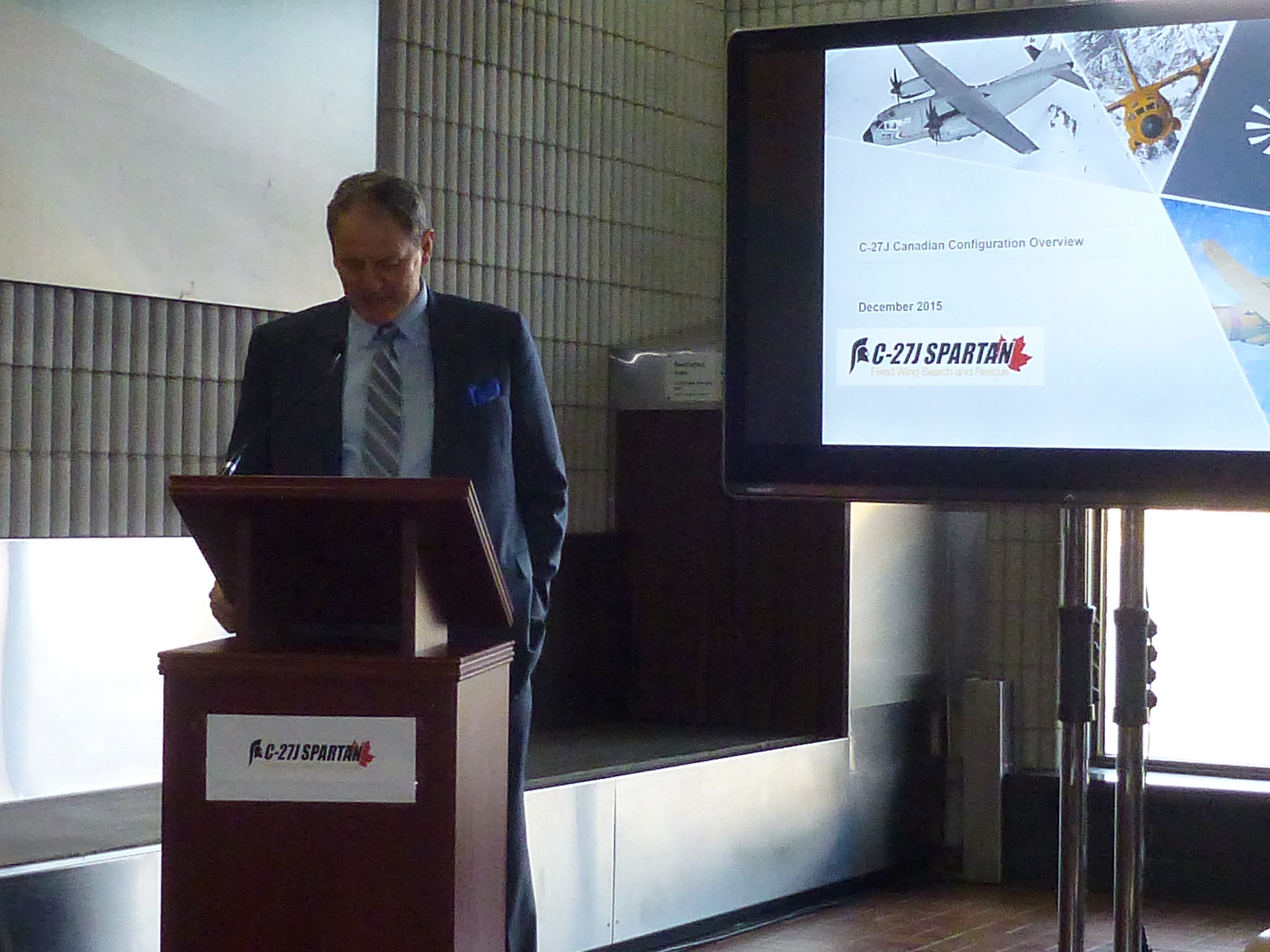
It insists that the C-27J is “the only aircraft in its class with the speed and range to respond to SAR incidents across Canada’s entire area of responsibility while operating from Canada’s existing base structure.” Leonardo used the opportunity to reiterate its maneuverability, short take-off and landing capabilities (characteristics it shares with the C295W), as well as its higher cabin height and faster cruising speed.
When the Federal Court will issue a ruling is unknown. However, among the things it will have to consider is the AETE/PMO conclusions, potentially setting up this 14-year old contest for a countersuit by Airbus as well as, more critically, an even longer delay in replacing aircraft that should have been pensioned off long ago and are incurring considerable maintenance costs.
The expressions “game changer” and “paradigm shift” tend to be thrown around like gravel on any remote airstrip. Clichéd or not, they truly do apply to the Royal Canadian Air Force’s new fixed-wing search and rescue (FWSAR) platform and how it will be used to good effect in one of the largest and arguably most challenging SAR environments in the world.
The government of Canada has ordered 16 Airbus C295Ws, with first delivery by Airbus Defence and Space (D&S) expected in 2019. Like its forerunner, the venerable and still capable deHavilland DHC-5A – which first entered service with the RCAF as the C-115 Buffalo in 1965 – the C295W is a short take off and landing (STOL) high-tailed utility transport with twin turboprops on a high wing.
There’s no denying the aircraft’s solid performance worldwide but, over a decade ago, when the program was in the requirements identification phase, the Alenia C27J Spartan had been considered the RCAF’s preferred platform. However, Leonardo (formerly Alenia-Aermacchi) evidently could not beat the Airbus bid.
Canada’s decision boosted total C295 orders, including earlier variants, to 185 aircraft for 25 countries, a development which Airbus Military Aircraft Head Fernando Alonso says is not only “a clear sign that the C295’s robustness, reliability and cost-effectiveness will ensure that it remains the market leader”, but also demonstrates that Airbus is “on the right path with our strategy of rapidly developing and adapting versions of our aircraft to address emerging market requirements.”
In addition to replacing the remaining Buffalos, all stationed at Canadian Forces Base Comox on Vancouver Island, the Airbus platform will replace four-engined H-model Lockheed Martin CC-130s, some of which also have been in RCAF service since 1974 at SAR squadrons in Winnipeg, Trenton, and Greenwood.
Manufactured at the sprawling Airbus facility in Seville, Spain, abutting San Pablo International Airport, the C295W, which first flew in 1998, is fundamentally a stretched version of a Spanish-Indonesian light transport, the CASA/IPTN CN-235, first flown in 1983.
While the basic configuration is much the same, that’s where the similarity to the Buffalo ends. The ‘W’ refers to now-standard winglets. These aerodynamic enhancements were part of a 2013 design evolution that also saw, among other things, beefier landing gear, external hardpoints, an integrated tactical system, and the introduction of uprated 2,645-horsepower Pratt & Whitney Canada PW127G turbines driving six-bladed Hamilton Standard 586-F propellors. Another key element is the electro-optical/infrared turret system designed by L-3 WESCAM, headquartered in Burlington, Ontario.
So far, other Airbus partners in the FWSAR program include landing gear overhaul by Heroux Devtekof Longeuil, Quebec, and propellers from Hope Aero of Missisauga, Ontario. Sonovision, which has facilities in seven countries including Canada, is on board to provide the technical publications.
The C295W can cruise faster and further than the legacy aircraft and, while it has a narrower wingspan, a more modern wing profile gives it enhanced manoeuverability in confined mountainous terrain – where “low-and-slow” can be key to a successful search.
It also weighs less and can carry more, which presumably results in fuel savings. Also, thanks to automated load-handling, it requires an aircrew of two rather than the Buffalo’s three (its third crew member is a Flight Engineer who also performs the loadmaster role). The number of others on a SAR mission varies.
Simon Jacques, Airbus Head in Canada, points out that some 20% of the aircraft content is Canadian, a result of global product mandates. “It already serves as a global ambassador for the skills, innovation and expertise of Canadians,” he says. “Now it will get to serve them directly.”
Evidently the Embraer C-390 jet didn’t meet the certification deadline and was deemed non-compliant, so personnel from the RCAF’s Aerospace Engineering Test Establishment (AETE) in Cold Lake and the FWSAR Project Management Office flew the other two competitor aircraft, the Airbus C295W and the Leonardo C-27J Spartan turboprop. According to a Department of National Defence spokesperson, they are prevented from discussing their hands-on experience by confidentiality agreements as well as the “integrity” of the FWSAR evaluation process.
“What we can tell you is that we’re purchasing a state-of-the-art, sensor-equipped aircraft,” he told FrontLine. “It will have a new communication systems to improve interoperability with key partners, and it is a modern, agile aircraft that will be effective day and night, in all-weather conditions.”
The contract with Airbus also includes “robust, comprehensive, well-integrated, low-risk in-service support which will significantly improve aircraft availability” as well as general infrastructure and set-up such as training and engineering and a new simulator-equipped training centre in Comox from the specialists at CAE.
In-service support (ISS) will be provided by AirPro, a joint venture between Airbus D&S and PAL Aerospace of St. John’s, Newfoundland, which has decades of experience with customers worldwide.
After the first few C295s are delivered, they will be operated in parallel with the Buffalos and Hercs as the RCAF transitions to a single FWSAR platform and the older aircraft are retired. The ISS element will kick in once the final aircraft is delivered in 2022.
Public Works and Procurement Canada (PSPC) says the contract for the initial 11 years, including taxes, is worth more than $2.5 billion. It also includes the prospect of extensions, in increments of one to three years, for up to a possible additional 15 years – potentially pushing the value to nearly $5 billion by 2043.
“With the opportunity to earn contract extensions based on its performance, the company is motivated to provide highly reliable aircraft, services and spare parts,” PSPC says. “This will also provide more efficient government contract management, since it means not renegotiating contracts every year.”
The contract also includes the prospect of a 2% performance bonus, but the other side of that coin is that Airbus could face a penalty of up to 10% if its performance is not in accordance with the contract requirements. Moreover, “payment will only be made after milestones have been met and accepted by Canada.”
The route toward the contract award (December 2016) had been tortuous and dogged by controversy. When the initial Statement of Operational Requirements (SOR) went out, DND was accused of tailoring it specifically to the Spartan instead of the mission. After many years, the increasingly heated debate eventually forced the government to ask the National Research Council Flight Research Laboratory in Ottawa to review the document.
NRC’s test pilots and engineers concluded, in their exhaustive 2010 report, that the SOR had effectively limited the RCAF’s options by, among other things, specifying an “off the shelf” aircraft which might require extensive modifications. Nor did they like the SOR’s specification of an unrefueled range of 1,699 nautical miles, which they said was “inconsistent with the stated core objective of […] maintaining or improving the SAR level of service.” So program managers went back to the drawing board, eventually producing a Letter of Interest in July 2013, coupled with a plan to begin “sharing elements” of a draft Request for Proposals (RFP) that summer in preparation for a fall workshop for potential bidders.
The procurement process shakedown continued until January 2016, when PSPC confirmed that there had been three bidders but, as a matter of policy, did not name them, leaving confirmation to the original equipment manufacturers.
Bids were evaluated on three fundamentals totalling 100 points: overall capability of the aircraft, its systems and the ISS (65 points); long-term operational capability and the maintenance and support services benefits for Canada (25 points); and the Industrial and Technological Benefits and value proposition (10 points).
As expected, the two turboprops were judged to be compliant. Judy Foote, the Minister of PSPC, said “it came down to the cost.”
The evaluation – which was subjected to an independent third-party review and included the aforementioned flight tests as well as a computer-aided assessment of how each aircraft would have responded to more than 7,000 SAR incidents in the past five years – set the stage for the contract announcement in a 424 Transport and Rescue Sqn hangar at 8 Wing in Trenton in early December, attended by, among others, Fernando Alonso, Defence Minister Harjit Sajjan, PSPC Minister Judy Foote, and RCAF Commander LGen Mike Hood.
Alonso, who had been involved in early cold-weather testing in Canada, professed that he had only 48 hours’ notice that Airbus had won the contract. “Until this morning, I was saying ‘it’s not really true,’” the burly aerospace engineer said. “Now I am starting to believe it.”
Hood admitted that he had even less notice, a reflection of how closely the program management team had guarded their conclusions. “I only found out yesterday,” he said, saying that the C295W’s ability to track up to 200 objects simultaneously in poor light and weather conditions and to share real-time data with other SAR participants “will fundamentally change the SAR paradigm for us.”
Airbus D&S demonstrated some of its capability recently by air-to-air hose-and-drogue refueling between two C295Ws and then using one to top up an Airbus Helicopter H225M Caracal. There’s also an airborne early warning and control variant and, while that isn’t on the RCAF’s shopping list, the tanker option would arguably be desirable.
In Trenton, Sajjan called the C295W a “game changer” which represented “a great technological improvement of our capabilities for the future.”
However, less than a month after the contract was announced, Leonardo introduced another potential ‘game changer’ by asking the Federal Court on January 6th for a judicial revocation of the contract in favour of its C-27J. “Team Spartan’s main allegation is that the selected airplane is unfit to safely perform certain key Search and Rescue tasks and missions required by Canada and should have been, therefore, disqualified,” it says in its statement.
It insists that the C-27J is “the only aircraft in its class with the speed and range to respond to SAR incidents across Canada’s entire area of responsibility while operating from Canada’s existing base structure.” Leonardo used the opportunity to reiterate its maneuverability, short take-off and landing capabilities (characteristics it shares with the C295W), as well as its higher cabin height and faster cruising speed.
When the Federal Court will issue a ruling is unknown. However, among the things it will have to consider is the AETE/PMO conclusions, potentially setting up this 14-year old contest for a countersuit by Airbus as well as, more critically, an even longer delay in replacing aircraft that should have been pensioned off long ago and are incurring considerable maintenance costs.