Translate

Showing posts with label Ottawa. Show all posts

Wednesday, April 27, 2016

Liberals Consider Moving AETE to Ottawa as part of Defence Review

By: David Pugliese, Ottawa Citizen

As part of efforts to cut costs, the Canadian Forces is looking at options to revamp its Alberta-based aerospace test facilities, including transferring some of the work to private industry or moving the organization to a more accessible location, such as the Ottawa area.

The process, dubbed the Engineering Flight Test Rationalization Initiative, is part of continuing efforts at the Department of National Defence to create a lean, more efficient organization while freeing up money or staff to support other military capabilities. It was started last year under the Conservative government but has continued under the Liberals.

The focus is on the services offered by the Aerospace Engineering Test Establishment, or AETE, in Cold Lake, Alta.
A jet flies past AETE in 2004. The services currently offered by AETE may be moved near Ottawa.
An CF-18 attached to the AETE  for testing, flies over the AETE in 2004. 
Defence industry representatives have been told the military believes substantial savings can be made at AETE while keeping essential flight test capabilities intact.

Several options are being considered, including increased co-operation with industry, allies or other government departments or changing how the staff is structured — 175 of its 200 employees belong to the military.

Other possibilities are moving the facility to the Ottawa region or contracting out some of the work. Areas where industry might play a role include aircraft maintenance, providing planes for flight testing and operating ranges.

“We’re still gathering information to build up our options,” said Col. Mike Barker, AETE’s commanding officer. “Once we figure out the ‘what,’ then the ‘how’ or the ‘when’ all falls from that.”

AETE tests everything from new seatbelts for military planes to radars to aircraft. Some of its recent work included testing gun systems on helicopters and the new guided bombs for the CF-18 fighter jets.

“Nobody is talking about shutting down what we do,” Barker said. “It’s a core capability. (But) are there opportunities to do it smarter or better?”

The military has already gathered information from industry on what services it could offer and there have been back-and-forth discussions.

Whether AETE moves from Cold Lake depends on the options being examined.

But the military has told industry representatives the remote Cold Lake location makes it challenging to attract or retain people. AETE employs test pilots, engineers, and other specialists and support staff.

Whatever option is selected, there will still be the need for the bombing ranges at Cold Lake. But other parts of AETE could be located near regional airports aerospace industry hubs, or in the national capital region.

“You don’t have to go very far north of Ottawa before there is a lot of nothing,” Barker said when asked about what airspace could be used for testing near the capital city.

You don’t have to go very far north of Ottawa before there is a lot of nothing

AETE staff have been kept in the loop about the process and why it is being done, he said.

John MacLennan, national president of the Union of National Defence Employees, said one potential location in the national capital region is in Gatineau, Que., where there is another military testing organization.

AETE began operating at Canadian Forces Base Cold Lake in 1971.

Barker said he does not have a specific timetable for the options to be completed or acted upon if necessary.

But the Liberal government recently launched a defence review that is expected to be made public in early 2017. The Liberals said during the election campaign they would move ahead with developing an “agile and lean” Canadian Forces and the review of defence capabilities is part of that process.


Tuesday, December 15, 2015

Alenia Brings C-27J Spartan Ottawa-Gatineau for FWSAR

Article by: Philippe Cauhi

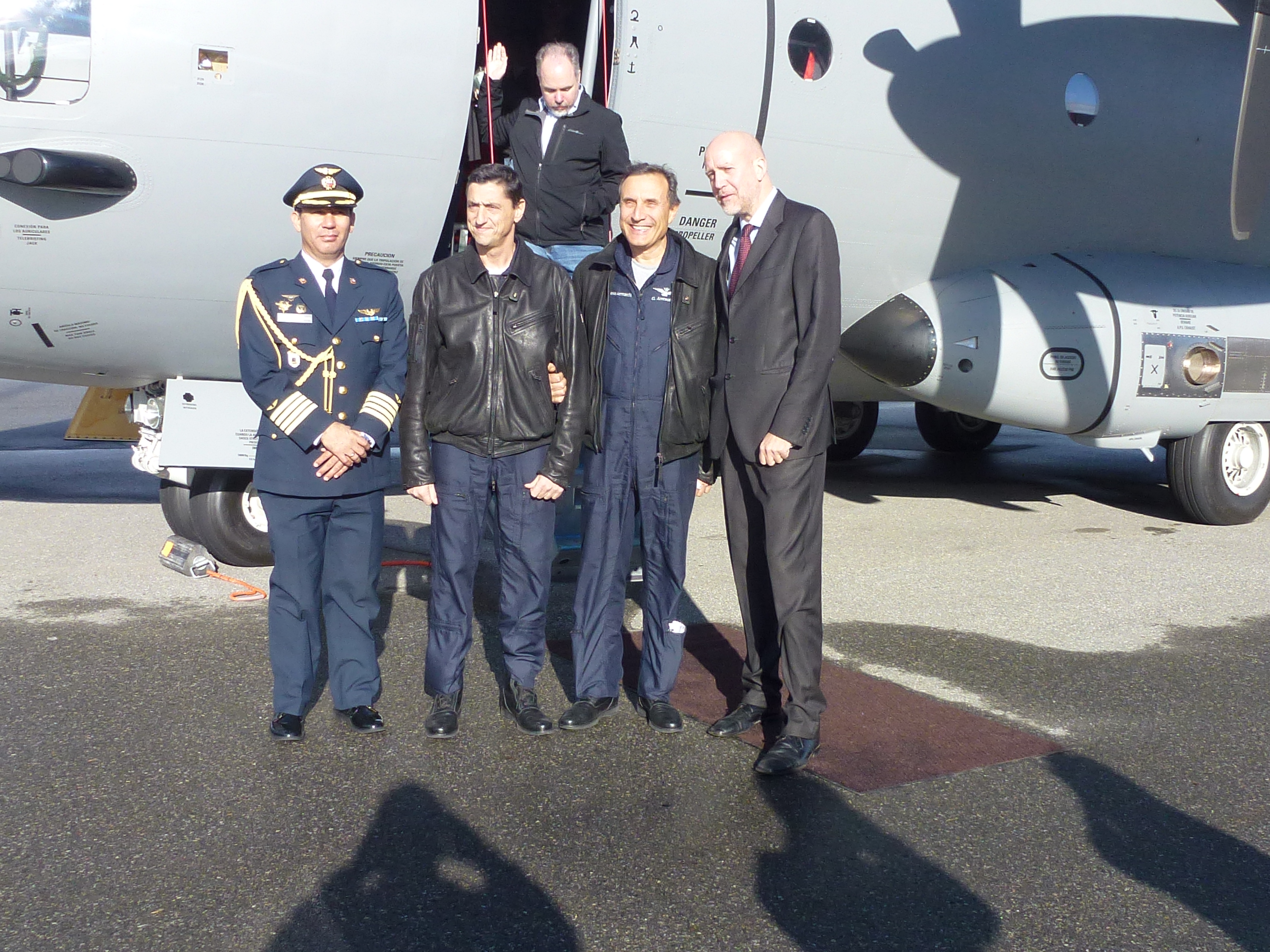
GATINEAU – On Friday, December, the 11th, Team Spartan Canada brought for a three hours stop and a press conference, a Peruvian Air Force C-27J Spartan to the Gatineau-Ottawa Executive Airport on its way to Peru.

This event took place exactly one month before the deadline to submit bids to Publics Works and Governement Services Canada to supply the Royal Canadian Air Force (RCAF) with new fixed-wing search and rescue (FWSAR) aircraft. The cost of the program is set at CAN$3,1 billions including a 20-year maintenance contract.


Turin Italy based Alenia Aermacchi, a division of Finmeccanica is leading Tean Spartan which includes :

General Dynamics Mission Systems Canada : supplier, integrator and in-service support (ISS) of the state of the art mission system based on the one found on the RCAF CP-140 Block III aircraft ;

IMP Aerospace : aircraft Canadianization by modifying the C-27J baseline aircraft into the Canadian

FWSAR, support to Alenia during initial delivery, installation of the mission systems, flare launchers,

EO/IR turret, search radar and interior design modifications ;

L3 Wescam : MX-15HDI electro-optical/infrared turret ;

DRS Technologies Canada, a Finmeccanica company : courseware and training aid ;

Esterline CMC : CMA-9000 Flight Management System and Flight Bag

FLYHT Aerospace Solutions : AFIRS 228S SATCOM Iridium satellite communications ;

KF Aerospace : maintenance, supply chain and repair engineering ISS, and pilot and maintenance training management support ;

Rockwell Collins : ATC radios ;

Finmeccanica Selex-EX : Seaspray 7500E search radar ;

Aerodyne : wide observer windows and pressurized flare launchers

Steve Lucas.
Photo: Philippe Cauchi.

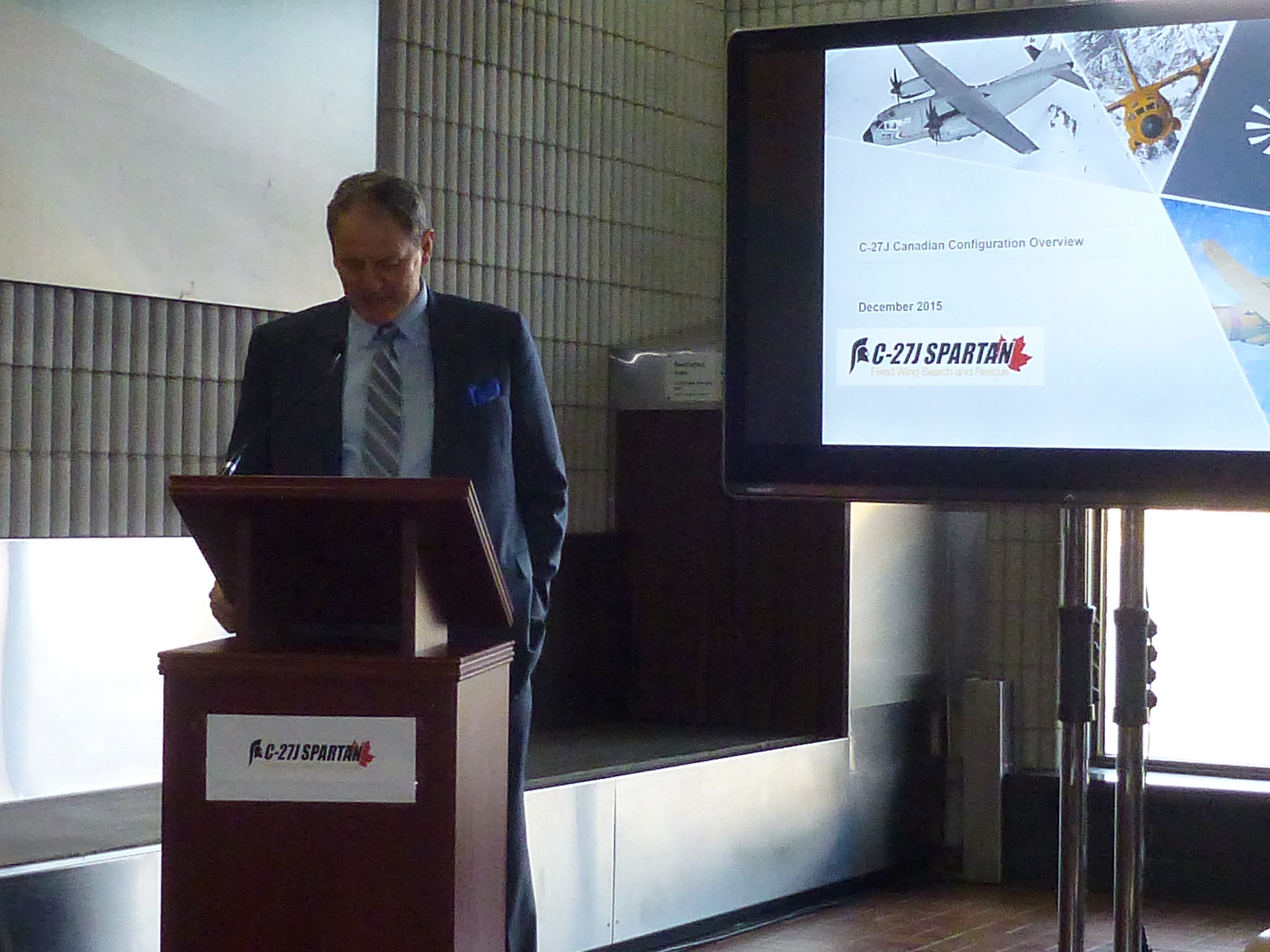
Steve Lucas senior representative for team Spartan and former chief of the Air Staff of the now Royal Canadian Air Force from 2005 to 2007 was flanked by the two C-27J test pilots, Marco Venanzetti and Gianni Ammoniaci who left Turin on thursday afternoon on their way to Peru and the Peru Defence Attaché in Ottawa, Colonel Alejandro Humberto Marusic Caceda, attended.

Mr. Lucas started the press conference by stating that the C-27J, the aircraft of Team Spartan in the Canada’s Fixed Wing Search and Rescue (FWSAR) RFP whose bids are due for January, the 11th, 2016 , is ‘An exceptional aircraft beyond expectations but still within reach of Canada’.


Alenia C-27J Spartan.
Photo: Philippe Cauchi.

In spite of the fact that the C-27J offered to Canada is based on the same configuration that has been supplied to the US Coast Guard, the US Army Special Operations Forces and the Royal Australian Air Force, it will be modified by the Canadian industry in order to ‘make this aircraft right to fulfill the Canadian FWSAR mission’.

The FWSAR will be replacing the six aging De HavilLand CC-115 Buffalo based in Comox, British Columbia and fourteen Lockheed CC-130H Hercules based in Winnipeg, Manitoba (4), Trenton, Ontario (4) and Greenwood, Nova Scotia (3). This process which began more than ten years ago aims to replace theses two fleets of aircraft in service for more than 50 years.

According to Steve Lucas, the C-27J has a rapid response time thanks to its exceptional speed, size, endurance and manoeuvrability enabling it to reach austere and remote locations including theses in the mountains as well as in the far North and the far sea. This way, the C-27J is only aircraft in its class far enough capable to respond by its speed to SAR incidents to the limits of Canada vast SAR area of resposability.

The Canadian RFP underlined Steve Lucas is not a simple replacement on a one-to-one replacement basis of existing aircraft but a very complex set of requirements of thousands of pages requesting that the contender’s aircraft be able :

To respond to three simultaneous SAR incidents in Canada’s three different SAR regions : Victoria SSR, Trenton SSR and Halifax SSR ;

To reach the most remote Canadian location in the shortest time ;

To achieve a 95% availability rate for at least one aircraft in each SSR and a 70% rate for a second one ;

To reach 2674 points in Canada where incidents occured in the last five years.

The size of the cabin of the Spartan is a big plus acording to Mr. Lucas. With a heigth of 2,60 meters, a width of 3,33 meters, and its high floor strength, (4,900kg/mload capability), the cabin allows a lot of activity of moving around in the back, the SAR technicians bringing a lot of equipment.

It is divided in three sections : the mission system section, the storage section and on the ramp, the personnel section.

Photo: Philippe Cauchi.

The C-27J Spartan is not only an aircraft capable to bring the first respondents to site but also to land on short strips and bring back everyone.

Compared to the Buffalo, the C-27J flies faster, further and is pressurized. For this reason, the Buffalo can be used only in the Victoria Region. On top of that, the Spartan have the landing and take off performances of the Buffalo in spite of the weigth of its complete mission system and longer endurance.

Team Spartan C-27J is based on the same configuration of the aircraft supplied to the US Coast Guard which is looking for systems similar to the one installed on the one offered to Canadian Forces. This means opportunities for Canadian suppliers if Canada picks the Spartan.

Steve Lucas recalled that the C-27J is a modern military transport aircraft with an established production line, mature production processes and excellent operational performances.

He concluded by stating that the Spartan is an affordable solution to Canada SAR needs ‘very within reach of Canada with no need to compromise on response time, geographical coverage, crew comfort and cockpit visibility’ and ‘Maximizing Canadian participation and minimizing program risks’.

An advanced derivative of the Aeritalia G222 first flown in 1970, the C-27J is a tactical military cargo aircraft able to perform a variety of missions including transport of troops, logistical resuply, MEDEVAC, air drop operations, paratroopers launches, humanitarian assistance, oil spill relief, fire fighting and SAR.

The C-27J featured the same engines and propellers than the Lockheed Martin C-130J Hercules as well as a common avionics architecture.

Having obtained its Military Qualification Certificate, the C-27J is also airworthy to civil standards with certification from EASA and FAA.

Certification of the C-27J Spartan included cold weather flight testing in Finland.

More than 82 C-27J had beeen ordered by the air forces of Italy, Greece, Bulgaria, Lithuania, Romania, Morocco, Mexico, Australia, Chad, Peru, Slovak Republic, an undisclosed African customer as well as the US Army Special Operations Command and the US Coast Guard.

Wednesday, December 2, 2015

Ottawa to Track Veteran Suicides

Ever since the Globe and Mail investigation; The Unremembered which conclusively showed that 54 CAF members committed suicide following deployments to Afghanistan, nearly 1/3 of all combat related deaths within Afghanistan - there has been a greater call for Veterans Affairs to take a closer look at Veterans and current serving CAF members following deployments.

The Globe and Mail released today that Ottawa will now regularly track veteran suicides.

Here is the article written by RENATA D’ALIESIO

Veterans Affairs is taking steps to solve a crucial statistical gap by planning to report on suicides of former military members annually starting in late 2017 – a move that will disclose, for the first time, how many vets are taking their lives each year in Canada.

While the coming change is taking too long for some veterans advocates, it will mark a milestone when implemented: Suicides of released military members have never been regularly tracked in Canada, even after intense combat missions, such as the Second World War and Korea.


INVESTIGATION
The Unremembered

158 Canadian soldiers died in the Afghanistan mission. But the losses did not end there. A Globe and Mail investigation reveals a disturbing number the military has kept secret: that at least 54 soldiers and vets killed themselves after they returned from war


In a statement Tuesday, Veterans Affairs Minister Kent Hehr said that “better tracking and reporting on suicides will help inform our suicide prevention actions.” He added that the Canadian Forces and Veterans Affairs must continue to address the stigma of mental health and encourage those in need to seek treatment.

“Even one soldier, sailor, airmen or women suffering from the invisible wounds of a mental health injury or committing suicide, is one too many,” Mr. Hehr said.

The lack of monitoring was one of several failings highlighted in a Globe and Mail investigation of suicides of soldiers who died after serving in the 13-year Afghanistan war. Through an Access to Information request to National Defence and poring over more than a decade’s worth of death notices, The Globe found that at least 48 active-duty soldiers and six veterans had taken their lives after returning from the Afghanistan operation.

The Canadian Forces released an updated number soon after The Globe’s investigation was published in late October, raising the suicide count to at least 59 military members and veterans – more than one-third of the number of soldiers who died in the war. There were 158 Canadian military deaths in theatre during the NATO-led combat operation that began in 2001 and ended last year.

Since The Globe’s series of stories, Prime Minister Justin Trudeau has instructed the ministers of Veterans Affairs and National Defence to make a new suicide-prevention strategy a priority. Defence Minister Harjit Sajjan, a veteran of the Afghanistan war, has directed the Chief of the Defence Staff, General Jonathan Vance, to examine the military’s mental-health services and efforts to reduce suicides.

The Globe’s series also drew attention to the fact that soldiers who died by suicide after returning from Afghanistan are not recognized in the same way as those who perished in the mission, even when their suicides were deemed attributable to military service. On Remembrance Day, Mr. Hehr, who is also associate minister of national defence, told The Globe he wants to ensure these soldiers and vets are commemorated.


The minister is meeting with representatives of about 30 stakeholder groups in Ottawa on Wednesday. The groups have been asked to provide him with feedback on priorities outlined in Mr. Trudeau’s mandate letter.

Gen. Vance applauded the department’s plans to improve the monitoring of former military members. In a statement, he said: “I remain committed to ensuring the well-being of all members of the Canadian Armed Forces, whether they are currently serving or veterans.”

Veterans advocates have long vented frustration at Canada’s lack of suicide tracking of former soldiers. The Canadian Forces keeps tabs on the number of active-duty military members who kill themselves, although its data on reservists are incomplete. A recent report released by the military’s surgeon-general revealed that suicides have increased in the army in recent years and the impact of overseas deployment may be emerging as a risk factor.

Canada’s only comprehensive look at veterans’ suicides showed that former members make up the lion’s share of military suicides in Canada. The Canadian Forces Cancer and Mortality Study, released in 2011, was done in partnership with Statistics Canada, National Defence and Veterans Affairs. It revealed that 78 per cent of 934 military suicides documented from 1972 to the end of 2006 involved vets. Male veterans were 1.5 times more likely to die by suicide than Canadian men of the same age – an increased risk that translated into 231 more vet deaths than expected.

David Pedlar, director of research for Veterans Affairs, said the department will be watching to see if vet suicides remain elevated. Officially known as the Veteran Suicide Mortality Study, the examination will involve linking National Defence data – which includes whether a member was released from the military – with Statistics Canada’s database of deaths from all provinces and territories. (Names of military members will be removed after the data are linked.)

Dr. Pedlar, who is leading the project that began late last year, said the methodology is still being ironed out. At the moment, it’s unclear how far back the first annual suicide report will go. Initial analysis will not include deployment history, Dr. Pedlar said, but both vets who were clients of Veterans Affairs and those who were not will be captured in the study.

“Right now the focus is on being able to get a high-quality suicide number and rate for release to Canadians on an annual basis,” Dr. Pedlar said. The study, he added, will give “us trends over time, which is something we don’t have right now. … That will be important information for us.”

The study has taken a lot of time to put together because it involves two departments and a federal agency, Dr. Pedlar said. Data quality has been an issue, too. The 2011 study that showed an increased suicide risk among veterans relied on National Defence human-resources information that did not accurately capture deployment history, said Elizabeth Rolland-Harris, a senior epidemiologist with the military’s directorate of force health protection.

“It was clear that we needed to find better data,” she said in an interview at a military health-research conference in Quebec City last week.

Dr. Rolland-Harris is leading the second run of the Canadian Forces Cancer and Mortality Study, which will produce a separate report from the veteran suicide study. She said the new examination will use member pay data, which is more reliable, and include those who enrolled in the military between January, 1976, and mid-2015.

The pay data will allow researchers to look at deployment and occupational history and to include Class C reservists who served full-time at some point during the nearly 40-year period. Class C designations are applied when reservists deploy to missions such as Afghanistan. Reservists were excluded in the 2011 study.

Initial results from the new cancer and mortality study are expected in 2017. Dr. Rolland-Harris said the examination will be one of the most comprehensive military suicide studies ever done in the world.

Still, former veterans ombudsman Pat Stogran is frustrated that the public will have to wait another two years to get a clearer picture on how many vets are taking their lives annually. He believes regular tracking of vet suicides could already be happening, if there had been a will to do so.

“This is a demographic that the federal government has complete control over,” said Mr. Stogran, a retired colonel. “We got to start demanding transparency and accountability and value for money.”

Follow Renata D’Aliesio on Twitter: @renatadaliesio 

(The Above was Written by RENATA D’ALIESIO, of The Globe and Mail) 

Friday, October 30, 2015

Liberal Defence Plan: Lose/Move 1,000 NDQH "Managers"

Liberal MP Andrew Leslie (right) produced a study suggesting National Defence headquarters was top-heavy. He advised Liberal Leader Justin Trudeau (left) on defence matters.
Liberal MP Andrew Leslie (right) produced a study suggesting National Defence headquarters was top-heavy. He advised Liberal Leader Justin Trudeau (left) on defence matters. Photo: Canadian Press
Article by David Pugliese, Ottawa Citizen 
The Department of National Defence wants to eliminate the positions of around 1,100 managers in the Ottawa area as it tries to create what it calls a “lean headquarters.”

The initiative, based on recommendations from former Lt.-Gen. Andrew Leslie, now the Liberal MP for Orléans, is expected to take several years.

The managers in question, both public servants and those in uniform, aren’t expected to lose their jobs. Instead, they would be moved to front-line positions or employment in priority areas.

DND estimates it has 5,200 “managers” as part of its headquarters in the National Capital Region. Under the plan, that number would drop to 4,087.

DND spokesman Dan Le Bouthillier said that for the purposes of the initiative, the term “manager” was used in its most generic sense. It refers to any manager, military or civilian, at any level who supervises the work of subordinate staff, even a single person.

The “lean headquarters” initiative originally talked about reducing the managers starting in 2014, with the process ending in Spring of 2016. But no reductions have been made yet.

“No changes to personnel have been implemented from the Lean HQ initiative to date, as we are still completing the analysis phase of this initiative,” said Le Bouthillier.

A consulting firm is currently analyzing three headquarters-based groups as part of a pilot study for the initiative. It is unclear when decisions on the employee moves would be made.

But Le Bouthillier said the initiative is complex and is expected to take several years.

A 2011 report by Leslie found that the size of the military and DND had gone from 112,377 in 2004 to 132,870 in 2010. Most of the growth was in headquarters jobs.

Leslie also outlined how DND’s presence in the National Capital Region jumped from 13,199 in 2004 to 18,168 in 2010. That was a 38-per-cent increase, with most of that going to headquarters positions. Leslie went on to become an adviser to Liberal Leader Justin Trudeau.

Trudeau has said that his government will move ahead with the recommendations from Leslie’s report so the military will have “more teeth and less tail.”

“We will reduce the size of administration within the Department of National Defence and the Canadian Armed Forces,” notes the Liberals’ defence platform, released during the election.

DND launched its defence renewal process in the fall of 2013 as it followed up on some of Leslie’s recommendations.

“By rationalizing the number of managers at headquarters and modernizing management practices National Defence will become leaner, with fewer layers and bureaucratic blockages, the decision making process will be expedited and staff will be more empowered to accomplish their assigned tasks,” the department’s defence renewal plan says.

The employees affected by the renewal efforts would be moved to priority initiatives and new military capabilities. For instance, the department and military is interested in expanding its capabilities in cyber security and space operations.

In an October 2011 appearance before the Senate defence committee, Leslie, by then retired, explained the importance of reducing headquarters overhead.

“Just under 20,000 people are paid by DND in the National Capital Region,” he said. “The size of the Royal Canadian Navy is under 20,000. We have more people in Ottawa doing headquarters and headquarters-like activity than we have in the entire Royal Canadian Navy.”

He noted that the navy was short about 1,000 sailors. “We know where they are; they are here in Ottawa,” Leslie said. “They are working in staff jobs.”

The renewal initiative has caused unease among the department’s main union.

John MacLennan, national president of the Union of National Defence Employees, has pointed out that more than 1,000 civilian jobs have been eliminated so far because of cuts ordered by the Conservative government.

In 2012, Prime Minister Stephen Harper told then-defence minister Peter MacKay to further reduce overhead in the department and the Canadian Forces, while not affecting military readiness.

But union officials pointed out that many of the jobs that were cut were jobs needed to support military operations. They included firing range safety officers, defence scientists, weapons specialists, radiation safety advisers. In addition, jobs held by lower-paid workers such as clerks, cleaners and kitchen staff were also eliminated.

Friday, August 28, 2015

Report: JTF2 Relocation Delayed


According to an article in the Ottawa Citizen published today, by Defence insider David Pugliese the Department of National Defence's planned relocation of the special forces JTF2 Unit from its Ottawa location at Dwyer Hill to CFB Trenton is facing at least a year delay and a significant increase in the cost required to move.

JTF2 is Canada's anti-terrorism special forces, and they have been looking for a new home since 2005. Their current facility, Dwyer Hill, just outside Ottawa is an 80-hectare site that was formerly a horse farm which was purchased by DND in 1993 with the creation of JTF2. The site is designed for counter-terrorism training and includes; a pool, multiple firing ranges, and a rappel tower.

In 2008 the Conservative government announced that it would relocate JTF2 from its Ottawa facility to CFB Trenton, which would grant it more access to military transport aircraft which are flown out of Trenton. It also places the team on the 401 Highway, allowing for rapid deployment to Toronto or Montreal if they are needed. Stationing JTF2 in Trenton also places them next to the Canadian Forces Joint Incident Response Unit - which are responsible for  nuclear, biological, and chemical incidents. The Canadian Special Forces Regiment, are currently stationed at CFB Petawawa, and will stay there.

The initial estimate to more JTF2 was $346 million, which included moving, decommissioning, and building a new facility. The amount of the increase has not been disclosed, but an increase has been discussed, as well as delays. JTF2 is supposed to be in Trenton by 2019, but current contractor documents suggest they will still be occupying Dwyer Hill until at least 2020. That extension from 2019 to 2020 is costing $17 million.

DND has announced they still plan to move JTF2 - and will offer the site to other DND units following its Special Forces decommissioning. If no one at DND wants the site, it will be offered to Federal or Provincial departments. Following that, if no one steps forward to wanting the site, it will sell it on the open market in a fair and open process.


Wednesday, May 13, 2015

Richmond Landing to house two new Military Memorial Monuments

With Canada's 150th Anniversary just around the corner, the military and public works announced late yesterday that they plan to add two new memorials to the "Memorial Walk" in Ottawa that begins in Major Hill's Park, and heads down Wellington Ave. to the War Museum at Lebreton Flats.

The site of the new memorials will be Richmond Landing, located right behind the Library and Archives Canada building. The site already houses the Royal Canadian Navy Monument.

A design competition for the two new memorials will be announced shortly, as the government wants both to be in place for the celebration of Canada's 150th Anniversary in 2017.

One memorial will be Canada's Victoria Cross memorial, and will honour the 99 Canadians who have been awarded the highest military honour throughout Canada's history.

The other memorial will be to Canada's Mission in Afghanistan and will honour both the Civilian and Military personnel who conducted the fourteen year long mission in Afghanistan between 2001-2014. Other details have not been released yet.

Wednesday, April 29, 2015

Canadian Forces Trainers to head to Jordan

Prime Minister Stephen Harper will announce today that Canada will send Canadian Forces trainers to Jordan, in an effort to help one of the biggest Arab allies in the fight against ISIS. The announcement will come with the visit of King Abdullah II to Ottawa on Wednesday.

Canada will help train the Jordanian Special Forces in an effort to prevent ISIS from spilling over the Jordanian boarder. The training mission will be for the next two years, into 2017 - depending on the start date - which is expected to be announced today.

The two year commitment in military training, and equipment from 2015 to 2017 will give Jordan the ability to prevent terrorist activities, as well as increase the overall response to such activities.  Training will also include chemical, biological, radiological and nuclear threat assessments and prevention of such attacks.

The exact location of the training is being kept a secrete for security reasons, but Canadian Special Forces were in Jordan last year as part of Exercise Eager Lion.

More News after the announcement.

More from the Globe and Mail news release: