Translate

Showing posts with label JSS. Show all posts

Thursday, June 7, 2018

RCN Supply Ship Cost Increases by $1.1 Billion; Now over $3 Billion

By: David Pugliese, National Post 

At one point, the first ship was supposed to arrive in 2012. That date has changed a number of times. DND is now hoping for delivery in 2022 or 2023

Taxpayers will have to spend an additional $1.1 billion to build two new supply ships for the Royal Canadian Navy, the federal government has revealed.

The cost of building the Joint Support Ships, or JSS, had been pegged at $2.3 billion. However, the government ordered a review of that figure and in an email to Postmedia procurement minister Carla Qualtrough’s office confirmed the cost is now expected to be $3.4 billion.

Of the $3.4 billion price tag, the actual cost of building the two ships accounts for a little more than 60 per cent, Finn said. Pat Finn, the head of procurement at the Department of National Defence, said the new price tag includes items the government had not previously included. In some cases equipment for the ship has been purchased, so the government has a more accurate understanding of what it actually cost, Finn said in an interview Monday. The inflated figure also takes into account new infrastructure and delays with the program which have driven up its price as the cost of materials has increased over the years.

“The build period has changed quite dramatically,” Finn acknowledged.
Workers watch as the main girder of a new 300-tonne gantry crane is lifted into place at Seaspan Vancouver Shipyards in North Vancouver, B.C., on Wednesday April 2, 2014. Darryl Dyck/Canadian Press
At one point, the first ship was supposed to arrive in 2012. That date has changed a number of times with the government later hoping for a 2018 delivery and then a 2019 arrival for the first vessel.

DND is now hoping for the delivery of the first ship in 2022 or 2023. Construction of some initial portions of the vessels will begin at Seaspan Shipyards in Vancouver this summer, Finn said, which it hopes will head off any potential layoffs of skilled employees at the shipyard.

Finn said the new costing model for the JSS is more akin to the one used by the parliamentary budget office. That office had an even higher estimate for JSS when it concluded in 2013 that the final tally for taxpayers would be $4.13 billion.

The Joint Support Ships are seen as being critical for the navy, as they will provide fuel and supplies for warships at sea.

The navy retired its last two aging supply ships years ago, one after being damaged beyond repair in a fire, the other because of excessive corrosion. After their retirement the Canadian military had been relying on the Spanish and Chilean navies to provide it with supply vessels for short periods of time.

Because of the delays to the JSS program, the previous Conservative government entered into agreement with Davie Shipyards in Quebec to lease a commercial vessel converted into a supply ship. That ship, the MV Asterix, is at the heart of the federal government’s case against Vice-Admiral Mark Norman.

In March, the Norman was charged with a single count of breach of trust. The RCMP accused Norman of warning Davie in the fall of 2015 that Liberal cabinet ministers wanted to derail the Asterix project. When word of the Liberal plan leaked to the media, the resulting embarrassment forced the Trudeau government to back down on its plans and the conversion of Asterix proceeded.

Norman was put under investigation and Prime Minister Justin Trudeau predicted on two occasions the officer would ultimately end up in court.

Norman denies the charge and has said he looks forward to clearing his name. A date for the trial has not yet been set.

Asterix is considered a rare achievement in Canadian military procurement in that it was delivered on time and on budget. The supply ship is now at sea with Royal Canadian Navy and is headed to a major military exercise to begin later this month.

Monday, June 4, 2018

Final Cost for RCN Joint-Support-Ships Still Unknown as Work Begins

By: Lee Berthiaume, The Canadian Press 

OTTAWA -- The cutting of steel for the navy's long overdue support ships will begin next month in Vancouver, even though the federal government doesn't know how much the two vessels will ultimately cost.

Federal procurement minister Carla Qualtrough confirmed plans for an early start to work on the supply ships during a breakfast address Thursday at the Cansec defence show in Ottawa.

Seaspan Shipyards will receive $66 million to work on several dozen components of the so-called joint support ships during a lull in the building of two other Canadian Coast Guard vessels.

The government is hoping that advance work will shave about a year off the expected delivery time for the first support vessel, which is currently slated to hit the water in 2023.

It will also ensure Seaspan continues to have work for its employees during what would otherwise be a dead zone between construction of the last of three coast guard fisheries vessels and a new coast guard ocean science ship.

"These support ships will deliver fuel and other vital supplies to vessels at sea," Qualtrough said, "ensuring our women and men of the Canadian Armed Forces are able to carry out their missions for decades to come."

The navy has been without a permanent support ship since retiring its last two in 2015 because of an unexpected fire and excessive corrosion, and is currently relying on a converted civilian vessel to fill the gap.

The first new vessel, originally proposed by the Conservative as the Queenston-Class, now rebranded by the Trudeau Government as the Protecteur-Class was originally supposed to be delivered in 2019, but the project has been plagued with delays. The ships will be modeled after the German Navy's Berlin-Class Supply ships. 

EGV Berlin.JPG
The EVG Berlin, the flagship of The Berlin-Class. 
Even as work is set to begin, however, Qualtrough conceded later that the government still doesn't have a concrete estimate of how much the two joint support ships are going to cost.

"It's too early to speculate on what the (support ships) will ultimately cost," she said.

The previous Conservative government set a budget of $2.3 billion for the vessels back in 2011, but that number has been under review for nearly two years.

The parliamentary budget office pegged the full cost of two support ships back in 2013 at $4.13 billion, while the government's new defence investment plan, released this week, said it could cost up to $4.99 billion.

"There are a lot of things happening on (the support ships)," said Andre Fillion, head of military procurement at Public Services and Procurement Canada.

"The acquisition of long lead items, the start of the (early work) and also a lot of engineering work."

Seaspan vice-president Tim Page told The Canadian Press that the shipbuilder is in negotiations with the government, but remains committed to delivering the support ships to the navy.

Starting work early is a reasonable solution to what would otherwise be a troublesome lull in work at Seaspan, said defence analyst David Perry of the Canadian Global Affairs Institute.

But the government still doesn't have an approved design for the support ships, he said, and the whole point of the federal government's multibillion-dollar shipbuilding strategy was to prevent such production gaps.

"It's a solution to an immediate problem," Perry said, "but it's not by any means an ideal scenario."

Tuesday, April 17, 2018

Clement: It's Time to Change Course on Shipbuilding


By Tony Clement, Special to Postmedia Network

Canada’s National Shipbuilding Strategy was announced with the goal of delivering vessels for the Canadian Coast Guard and the Royal Canadian Navy that were affordable, modern and effective. It was expected that the strategy would create world class, competitive yards that could produce vessels which could be exported.
Image result for aops
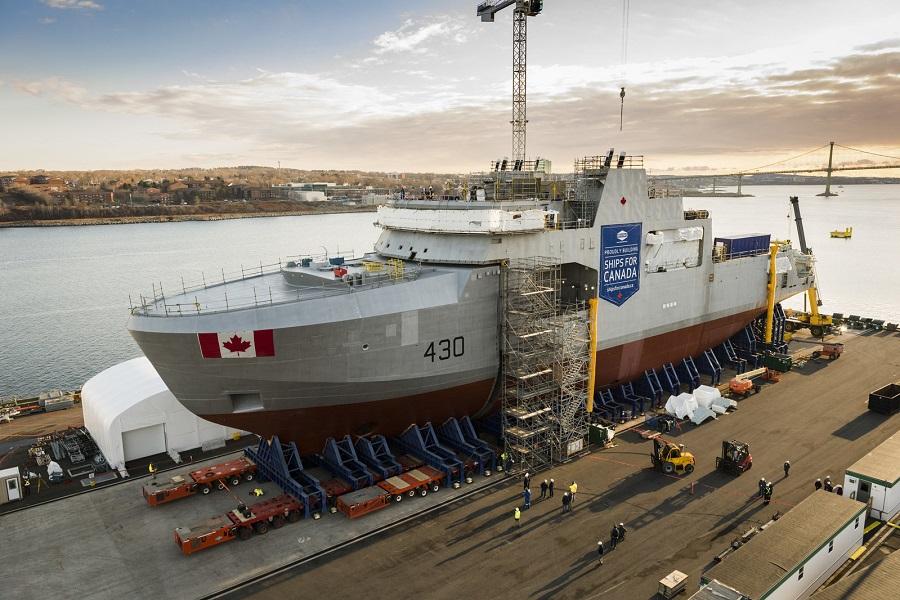
The Royal Canadian Navy's first Arctic and Offshore Patrol Ship (AOPS), the future HMCS Harry DeWolf, assembled at Irving Shipbuilding's Halifax Shipyard.
Two shipyards were selected under the plan in 2010 – Irving Shipbuilding of Halifax and Seaspan of Vancouver – and they were to be capable to start building ships immediately, and close gaps over time at “no cost to Canada” under a non-binding umbrella agreement.

Irving Shipbuilding in Nova Scotia was chosen to build the five Arctic Off-Shore Patrol Vessels (AOPS) and the future fleet of up to 15 Canadian Surface Combatants (CSC). Seaspan in Vancouver was selected to build five coast guard vessels and two Joint Support Ships (JSS) for the Navy.

Under the strategy, the two yards were guaranteed this work provided they could close their capability gaps within a specific period of time and at no cost to taxpayers. So where do we stand after almost eight years?

To date, millions in government subsidies have poured into the two selected shipyards; costs to taxpayers are‎ soaring and vessel delivery dates are pushed further back. Seven years later, not one ship has been delivered. When it comes to costs:

— The budget for the three Off-Shore Fisheries Science Vessels has grown from $244 million to $687 million.

— The Off-Shore Oceanographic Science Vessel, which is still in the design phase, has seen its budget grow from $108 million to $144 million, and speculation abounds that the budget will grow to over $275 million in the coming year.

— The two JSS originally budgeted at $2.6 billion are now expected to cost $4.13 billion according to the Parliamentary Budget Office (PBO).

Add to the list of shipbuilding woes, the John G. Diefenbaker, Canada’s planned polar class icebreaker for $1.3 billion. The vessel was designed in 2012; however it may not be contracted until 2030, meaning its design will already be obsolete before the keel is laid.

The Liberal government has no plans for the second polar class icebreaker, and no actions are being taken to build the three high endurance multi-tasked icebreakers or the five ocean patrol vessels for which funding has been allocated.

When it comes to the five AOPS, progress is being made, yet taxpayers will not know the cost of the vessels until at least six months after the first ship is delivered.

The budget for the future fleet of 15 surface combatants has grown from $26 billion to $60 billion and the procurement is in question, as many bidders have backed away from a process is that has been amended over 50 times.

Under the Liberals, the National Shipbuilding Program is failing. It is time for a course correction. Here are a few suggestions:

— All vessels under the NSS must come under a fixed-price contract.

— The government must return to selecting a proven design for the future fleet of surface combatants, rather than spending billions more and taking significant risks, and delays with an unproven ship design.

— Expand the shipbuilding strategy to add capacity and commercial pressure by including Davie Shipbuilding of Quebec in ongoing planning, including building additional coast guard vessels which are urgently needed, and for which funding was allocated years ago.

— The government should also follow up on the success of the Astérix, and accept Davie’s offer to build the second interim supply ship at $650M, (significantly cheaper than JSS) so the Navy can get on with having the capability to refuel the Atlantic and Pacific fleet simultaneously at sea.

Without some drastic changes in this program, all signs point to taxpayers getting soaked; our navy and coast guard being hobbled, and our security and sovereignty being put at risk.
---
— Tony Clement is a Conservative MP and Official Opposition Public Services and Procurement Critic

Monday, August 21, 2017

Thales awarded 35-year RCN ISS contract

DND Press Release

Canada has chosen Thales as the prime contractor for In-Service Support (ISS), refit, repair, maintenance and training to both Arctic and Offshore Patrol Ships (AOPS) and Joint Support Ships (JSS).

Known as AJISS, the contract includes an initial service period of eight years for up to C$800 million with options to extend services up to 35 years – for a total value of C$5.2 Billion, making it the largest ISS contract in Canadian history.

(As part of its 2017 order intake, Thales will book the management portion for the 1st phase of this contract at less than C$60 million.)

This contract builds on Thales’ experience in providing in-service support to every major Royal Canadian Navy (RCN) platform for the past 50 years, including ISS for systems onboard Victoria-class submarines, Kingston-class maritime coastal defence vessels, Iroquois-class destroyers, and Halifax-class frigates.
Artists Rendering of a RCN Arctic and Offshore Patrol Vessel of the Harry DeWolf Class © Irving Shipbuilding Inc. 2015 
Thales will leverage its Canadian expertise in project management, systems engineering and integrated logistics support to lead the development of a new Canadian supply chain that will offer comprehensive in-service support for all systems and equipment of these fleets over their operational lifetime, ensuring they are mission-ready, on time, every time, from coast to coast to coast.

This in-service support contract will create an important collaboration with RCN staff. With such a contract, Thales will work closely with the Navy's support facilities and personnel.

Over its 35-year duration, this contract will generate economic benefit of more than $250 Million CAD in Research & Development for Canada, leveraging the creativity of both industry and academia and sparking innovation in areas such as predictive maintenance, life-cycle management and logistics support analysis.

With over 16 years of performance-based ISS experience with the Royal Australian Navy in a relational contracting model, Thales will also transfer knowledge of existing and innovative ISS-ready solutions from Australia to Canada. Since 1989, the Australian Government, with the Royal Australian Navy and industry, have trusted Thales to manage, maintain and upgrade its naval assets at the most important ship repair facility in the Southern Hemisphere, the Garden Island Naval Base in Sydney.

Thales’ proven and award-winning ship service and maintenance model has consistently exceeded material readiness requirements and exceeded operational availability targets by as much as 30 per cent. Thales has provided ISS to navies in Singapore, New Zealand, USA, Saudi Arabia, the UAE, Bahrain, Papua and New Guinea, and Tonga.

Mark Halinaty, Thales' Country Director in Canada, remarked that the company is committed to "empowering Canadian industry to support this program for decades to come." He noted that through this contract, Thales "will create jobs across Canada and will ensure that the ships are mission-ready.”

Monday, January 9, 2017

Liberals select Thales for $5.2-billion AOPS Maintenance Program

By: David Pugliese, The Ottawa Citizen 

A subsidiary of French defence giant Thales has been selected for a $5-billion contract to maintain Canada’s new Arctic patrol vessels and supply ships, but according to documents obtained by the Ottawa Citizen, the Canadian government had earlier been warned by some officials at the Department of National Defence that its strategy of having one firm do maintenance for both fleets could cost taxpayers more money in the long run.

Pierre-Alain Bujold, a spokesman for Public Services and Procurement Canada, said Friday that all the bids received for the maintenance contract have been evaluated and the government will now enter into negotiations with the highest-ranked bidder. Despite the Liberal government’s vow of openness and transparency, the department declined to name the winning bid, citing reasons of commercial confidentiality.

But multiple industry sources say Thales Canada and was told in late December it had won the $5.2-billion project.

The deal would see the firm provide in-service support for an initial period of eight years, with options to extend services up to 35 years. Bujold said the actual contract is expected to be awarded in the fall of 2017. “If the parties cannot reach an agreement on the financial aspects of the contract within an allocated 45 calendar days, the GoC will invite the next highest ranked bidder to enter into negotiation,” he added.

The first Arctic Offshore Patrol Ship is being built by Irving on the east coast and is expected in 2018. Construction has yet to start on the two new Joint Support Ships. The first of those supply ships, to be built by Seaspan in Vancouver, is expected in 2021.

Thales Canada did not respond to requests for comment.

The Canadian government announced in July it was seeking bids from companies to repair and maintain the two new fleets over a 35-year period.

But some Department of National Defence officials warned the government years ago that selecting one company for a single in-service support (ISS) contract covering two types of ships could give one firm too much control and end up being more costly. “A single ISS provider may assume a ‘take it or leave it’ attitude at the time of contract option renewal, forcing prices up,” warned an April 2012 DND briefing note for then-deputy minister Robert Fonberg.

A dispute with the contractor could also force the Royal Canadian Navy to resort to conducting maintenance and support for the ships on a piecemeal basis, a development that would affect its operations, added the briefing obtained by the Citizen.

DND also warned that not all companies would be happy with such a strategy as it would take a significant amount of business out of competition for a long time. Other DND officials, however, argued that the single contract strategy would work and any risks could be handled by increasing the level of oversight on the deal.

Last year, the government said the competition to pick one firm to provide in-service support, including refit, repair and maintenance and training for the two fleets, would benefit Canadian industry and the public. “By combining the Arctic Offshore Patrol Ships and Joint Support Ships In-Service Support into one contract, we ensure the effective maintenance and support of these fleets over their operational lives,” Judy Foote, the Minister of Public Services and Procurement, said at the time.

The federal government also noted, “that combining the contracts for the AOPS and JSS In-Service Support under a single contractor will benefit industry by increasing workforce stability and benefit Canadians by reducing costs through economies of scale.”

Industry sources say there is no need for the intense secrecy about Thales being the top bidder since the news has circulated over the last couple of weeks among various companies. They warn that there is a growing pattern of secrecy over defence purchases at Public Services and Procurement Canada.

Tuesday, April 19, 2016

Re-Fresh Idea for the National Shipbuilding Procurement Strategy


By Mikaël Perron, CD
Defence Watch Guest Writer

As a three-ocean nation and a member of the G7, Canada shall be at the forefront of the world’s ocean safety. The flagships of a nation like ours should be using our own specific home design and should be of the highest standard.

So, the main classes of ships to be built under the National Shipbuilding Procurement Strategy (NSPS aka NSS) should be of a Canadian design. Over the years, Canada achieved independence from mother England by designing ships like the Cadillac destroyers, the Louis St-Laurent and river class icebreakers, the Provider and Protecteur class AOR, the Tribal class destroyer and the Halifax class frigate.

In the process, we developed ground breaking technologies like the bear trap that allows for the usage of a heavy helicopter from a destroyer’s deck, the probe at sea refuelling system, the extensive use of gas turbines on combat ships, the integrated platform management system and many other innovations. I strongly believe that we should be keeping that attitude, especially in the case of the Canadian Surface Combatant program.

A MP once questioned why the Canadian Navy should get the best destroyers in the world since we are a middle power! Well, for starters, Canada is a member of the G7 and is looking for a seat at the UN Security Council. We do not possess aircraft carriers, amphibious assault ships or nuclear attack submarines but we definitely are a destroyers/frigate Navy.

More than 80% of world trade goes through the seas and nations that maintain the security of the major sea lane of communication (SLOC) are getting noticed. The western world’s population lost sight of it but there is a major fleet building in Asia and a great submarine proliferation around the world; our new ship should be able to match threats from, and capabilities of, other nations so our sailors return safely home.

In many parts of the world, gun boat diplomacy is a very actual tactic that is well understood. At a time of financial constrain, ships are much less expensive to deploy and maintain for an sustained international presence than moving a ground force or a large air force deployment.

Ships can remain in international waters for long periods; a minimum footprint ashore is required. Warships can also rapidly shift from a humanitarian or diplomacy mission to full combat capability.

Only a few nations can keep ships deploy away from home for long periods of time or seamlessly integrate into an American battle group; we should not lose those abilities.

On the Arctic front, the race for northern resources has begun. Russia is building up to 14 new conventionally and nuclear propelled heavy Icebreakers on top of their large actual fleet. The USA are now accelerating the regeneration process of their icebreaker fleet while players like China are sending Icebreakers to test the resolve of Arctic nations. We should maintain an active and persistent presence that requires more than one heavy icebreaker, considering the vastness of our Arctic claim and the maintenance cycle of these ships.

The National Shipbuilding Procurement Strategy was a very well thought process that was done with the best information available at that time. I fully support it but it needs to evolve to include a higher level of flexibility. As the situation evolves, it should be able to get the most out of the passing opportunities. It must, at all time, take in consideration the interests of our military personnel, the strategic interests of the nation, the taxpayers and of course the industry.

For example, Davie shipyard was basically bankrupt at the selection moment and it made sense from an accountant’s point of view to discard them although they possess the highest capacity shipyard in Canada.

Since then, they’ve built the most advanced civilian ship in North America and we could take advantage of that. The government must seize the opportunity to improve the NSPS to ad flexibility to it that will better serve our sailors, national interest, our budget but also the industry.

The downturn in the oil industry offers us the possibility to negotiate the acquisition of ships that would be otherwise unaffordable and unavailable. There are now two VS4220 sitting at Davie shipyard; one 70% and the other one 40% complete. These ships possess extreme capabilities that are perfect for our ocean’s conditions.

I propose that Canada acquires them as true multi-task high endurance vessel that will also double as Offshore Oceanographic Science Vessels (OOSV). The science equipment that was to go on the OOSV to be built will be installed on one of them (we could easily buy extra gear to equip both the same way).

They will also possess helicopter support capability to carry up to a Cyclone size helicopter and to land up to Cormorant or even Chinook helicopters. Their large fuel carrying capacity would also allow them to support other government vessel such as the AOPS and other offshore vessel.

With a good negotiation process, the Canadian government could obtain these two ships at a low price. They would replace the OOSV and one of the Medium Endurance Multi-Tasked Vessel that were to be built.

That would speed up the delivery process of some much needed ships. In addition, the non-combatant winner of the NSPS – Seaspan – would not lose out in such a scenario. I can see three main scenarios that could deliver more to every stakeholder:

First scenario: 

Once the OOSV is cancelled, the building of the JSS can start ahead of time (Scientific gear that was to go on the OOSV will be installed on the VS4220). Seaspan will be given the construction of the more profitable third optional JSS instead of the OOSV. Because of reasons I will explain further, the Navy actually needs four supply ships — the three JSS and the interim AOR (iAOR) in this scenario.

Two Diefenbaker-class Icebreakers would be built. In order to have these two icebreakers in due time, the building of the Diefenbaker’s sister ship could be awarded to the Davie Shipyard. The performance of both Seaspan and Davie could be effectively measured and help to set a competitive bidding process in order to build three Canadian-designed River-class Icebreakers that would be optimal to the taxpayers later on.

Davie is also proposing the conversion of a three-year old PC3 Icebreaker sitting idle in Seattle. That has the potential to be a great bargain to the taxpayers as well as prevent a capability gap. The replacement of our icebreaker fleet would be achieved with much added capability while the NSPS process would keep the course with no losers.

Second scenario:

Once the OOSV is cancelled, the building of the JSS still can start ahead of time. Davie would be given the building of a second interim AOR so the building of the first Diefenbaker-class Icebreaker could also start ahead of time. In this case, Seaspan would be given the contract to build two Diefenbaker class Icebreakers. Davie would also do the conversion of the PC3 Icebreaker sitting idle in Seattle to prevent a capability gap and to strengthen our nation’s Icebreaking capability. A contract involving a competition would also be awarded later to replace the three remaining River-class Icebreakers. (The River-class Icebreakers were commissioned between 1979 and 1987).

Third scenario: 

Still having replaced the OOSV and the first Medium Endurance Multi-Tasked Vessel with two VS4220 vessels from Davie, Seaspan would be more than compensated with the building of three JSS and two Diefenbaker-class Icebreakers. The GoC would negotiate Davie’s offer for the PC3 Icebreaker conversion and also the three River-class conversions that they earlier proposed. That would offer a significant deal to the Canadian public and compensate for the delays caused by the building of additional JSS and heavy Icebreaker. Let’s remember that the CCGS Terry Fox was a commercial Icebreaker before joining the CCG fleet. The nation will then possess a strong shipbuilding industry ready to compete on the international market for specialized ship conversion.

The main point of this text is about the Canadian Surface Combatant (CSC) portion of the National Shipbuilding Procurement Strategy. The program is to renew our surface combatant fleet with up to 15 vessels to replace the Iroquois class destroyers and the Halifax class frigates. It is understood that the program is more expensive than it was initially planned for and that the actual budget could only afford around eleven ships.

It is now under consideration to adopt a foreign design and to do a cost trade-off on the required capabilities.

I do believe that such a course of action is the wrong way to go. We are a major industrial nation with the largest coast line in the world. The CSC will be our flagship.

There is a solution that would allow us to reach a maximum effect with eleven ships with no or minimum compromise to the statement of requirement (SOR).

Last year, before I retired from the Canadian Armed Forces, I submitted a few initiatives under the defence renewal program. One of those was a fleet manning concept for the CSC.

The core idea of that solution is to separate the needs of the crew from the needs of the ships themselves. The end result looks like this: five Area Air Defence (CSC AAD) ships, five General Purpose (CSC GP) ships with all the necessary spares. One extra hull will allow for each ship to go on a two year extended maintenance period every ten years.

There will be twelve sea going crews and a shore maintenance team. It is organized so we can have four ships permanently deployed, four ships available for training, local exercises / patrol, short work periods and finally three ships on extended work period. This way of operating a class of ships will work with classes of ships of five or more ships. These ships also need to be designed so they could operate away from home port for a complete year.

That is also where the need for, at least, four JSS/iAOR comes from. Support ships multiply the effect of the surface fleet. We need to have at least one supply ship available on each coast at any given time. They will support the deployed CSC, do humanitarian relief mission, support the AOPS on northern patrol occasionally, etc.

To have fewer CSCs will free up the necessary personnel to man these two extra supply ships and also a class of around four corvette/light frigates, similar to the Dutch Holland class patrol ships with the addition of anti-submarine warfare capability. Those would be very affordable (around four of them for the price of a single CSC and would reposition gear from the Halifax class frigates such as the 57 mm gun, the close in weapon system (CIWS), the naval remote weapon system (NRWS) and other systems. These are excellent and up to date pieces of equipment; for example, the most advanced Dutch frigate are using the exact same guns that used to be installed on our Iroquois class destroyers in the 70s-80s after being refurbished. The proposed corvettes would also operate with a small crew. Such ship would patrol our coast, participate to Op Caribbe-type missions, conduct piracy patrols and support the CSC on some occasion.

As for the CSC, the use of AAD and CSC GP concepts would be ideal with the required number of hulls. I would see a ship of around 148-155 metres in length and around 20m breadth. Its displacement would probably be around 6000-7000 tons.

It would possess an integrated electric power plant consisting of two main diesel generators, a gas turbine generator and two small diesel generators for anchor or shore without power. That power plant allows for better fuel efficiency (only one generator supplying propulsion and hotel load at sea).

It allows for a great redundancy, for the disposal of the maintenance heavy controllable reversible pitch propeller (CRPP) and the disposal of the main gear box and gives extra power for eventual addition of energy-consuming technologies like a rail gun or laser CIWS. A possible option toward that power plant would be to use already designed parts of the QE class carrier an incorporate them to our hulls. I am thinking here of two of their 9MW diesel generators, one MT-30 gas turbine generator and two 20 MW electric motors.

For cruising, one diesel economically supplies hotel load and a speed above 15 kts along with a minimum range of 7000 nm. Two diesels will be used for fast cruising and close proximity maneuvering. The gas turbine will be used for sub hunting and fast man oeuvre while a diesel can be added to reach a maximum speed above 30 kts with a diesel to spare and the potential to later add some new energy consuming technologies. This would give a high level of redundancy.

They would carry a minimum of two multi-role boats (MRBs) and the flight deck will be able to land up to Chinook helicopter in order to support Special Forces operations.

We could afford the best weapons and sensors; 5 inch gun, two millennium guns, harpoon, evolved sea sparrow missile (ESSM), standard missile for the AAD and Tomahawk for GP version without forgetting torpedoes and the naval remote weapon system (NRWS).

I believe a 48 cell MK-41vls launcher could allow us to carry 32 ESSM and 40 SM missiles for the AAD version and 32 ESSM and a combination of Tomahawk and ASROC for the GP version. If savings are needed, the mix of weapon could be changed.

All CSC shall have full ASW capability with Cyclone helicopter, torpedo launchers, towed and hull sonars and possess the latest in torpedo counter-measures. I would suggest the I-mast 500 to be used on them ship since we participate in the development of the active phased array radar (APAR). The I-mast of the AAD version would be without the sea master 400 radar since it would utilize the SMART-L ER radar while the GP version would use the sea master 400 not using the SMART-L radar. The new upcoming SF500 radar could offer further possibilities.

The ships would possess an optimized crew around 200 strong.

OPV, Corvette or Light frigate

To balance the fleet and keep the NSPS going, a class of four smaller ships would be designed and built. They would be around 110m long 15m wide and displace about 3500 tons. They might share the same power plant as the AOPS or even a more economical plant aiming for a max speed between 21 and 24 kts. The use helicopter and two MRBs will compensate for the lower maximum speed. The I-mast 400 could be a good choice of sensors in this case. The crew would consist of a (65-75 strong) team with extra room for up to 20 and an extra 20 in austere conditions, in the same way as the CSC.

To conclude, the NSPS is essential in order to keep a modern government fleet at all time. It must enable us to replace every existing and to be built ships before it gets to its best before date. Every possibility to make it more affordable such as a new manning strategy for the CSC shall be taken. It must also quickly adapt to the changing economic situation and take advantage of passing occasions. A strong naval presence home and abroad is probably the best way for Canada to affirm itself on the world stage.

Wednesday, December 9, 2015

RCN to Lease Two Spanish AORs during 2016

By: Esteban Villarejo, Defense News 

MADRID — The Spanish Navy will deploy two auxiliary oiler and replenishment (AOR) vessels in 2016 to "cover the Canadian Navy's temporary need for logistic support vessels in the North Atlantic," military sources told Defense News.

Both replenishment ships — Patiño and Cantabria — will support training for the Royal Canadian Navy's Atlantic fleet in two different time periods: Patiño will operate between February and March, and Cantabria between mid-September and November.

"This support is based on NATO’s principle of solidarity among its allies, by which a country provides a capability that the other does not have," a Spanish military source said. "The deployment will not have additional costs and will not have an impact in our capabilities."

The main mission of a combat-replenishment ship and hospital is to supply fuel, fresh water, ammunition, provisions, spare parts, military equipment, uniforms, medicines and medical assistance to other combat units at sea.

The Cantabria deployed with the Royal Australian Navy in 2013. The government of Australia paid the expenses of that deployment during the year.

This year Canada chose the German Navy’s Berlin-class design to replace its two Protecteur-class supply ships, which have been removed from service.

On Wednesday,, December 8, 2915 the RCN confirmed the Defense News report.

LCdr Alain Blondin, the RCN’s Deputy-Head of Public Affairs, told  the Ottawa Citizen's Defence Watch:

“We can confirm that the RCN is continuing the process of developing a Mutual Logistic Support Arrangement (MLSA) with the Spanish Navy where we will receive services from two separate Spanish vessels in 2016 to fulfill replenishment responsibilities and facilitate training in support of Maritime Forces Atlantic training and exercise activities. The current plan is for the first vessel, the Spanish Navy Ship Patino, to arrive in late January to March, and the second is planned for the fall of 2016. The exact dates are yet to be negotiated. Full details are still to come as negotiations are still ongoing and the MLSA is not yet finalized.”

Villarejo wrote that the Cantabria will be on Canada’s east coast between mid-September and November.

Some RCN sailors are already familiar with the Patiño. In 2014 HMCS Toronto conducted five replenishment-at-sea “evolutions” with both French supply ship Marne and the Patiño, the RCN website noted.

As readers know, Canada is facing a supply ship gap as the new Joint Support Ships are not expected in the water until 2020/2021. Davie is working on converting a container ship into an interim refueller (iAOR) for the RCN. That is expected to be ready in late 2017.

Last summer Canada made arrangements with Chile’s navy to have a supply ship available on the west coast.

Monday, December 7, 2015

Canadian Defence Review - What Needs to be Reviewed

During the Speech from the Throne last Friday, Justin Trudeau's Liberal Majority Government had little to say on Defence - the few short sentences mentioned little to no specifics.

Here is the text relating to the CAF from the Throne Speech:

"...To contribute to greater peace throughout the world, the Government will renew Canada's commitment to United Nations peacekeeping operations, and will continue to work with its allies in the fight against terrorism.

To keep Canadians safe and be ready to respond when needed, the Government will launch an open and transparent process to review existing defence capabilities, and will invest in building a leaner, more agile, better-equipped military."

What does that all mean? 

We know that during the 2015 Federal Election the Liberals promised to withdraw from the Aireal Bombing Campaign against ISIS; scrap the F-35 Purchase; ensure the Navy got the Vessels it needs; and return to more Peacekeeping missions. Only one of these things was mentioned in the Throne Speech. As Rona Ambrose, the Leader of the Official Opposition pointed out following the reading, the Speech doesn't even mention ISIS. 

Let's take a look a a few things within the CAF that need a review; 

1. The Budget

Under the previous Liberal Government of Jean Chretien - the CAF called the 1990s the "Decade of Darkness." This is not all that far off from what is was. The Chretien Government cut defence spending 25% from $12 billion in 1993 to $9.4B in 1998; cut troop levels from 74,000 to below 60,000; while at the same time deploying CAF members on almost every UN Peacekeeping mission that came up. 

Some of these Missions were highly required; and were laden with heavy burdens for the CAF. One of these missions was the 2000-03 deployment to Ethiopia and Eritrea. Under OP ECLIPSE and OP ADDITION, CAF equipment was hit by a great tole of wear and tare. 

During the same time, Canada deployed to Afghanistan in 2002 - which led to a stretching of CAF personnel, when retention within the CAF became a huge problem.  All while the CAF was facing a nearly $15 billion equipment shortfall. 

This all helped the 2006 Conservative victory with their "Stand Up for Canada" campaign, followed by their Canada First Defence Strategy  (CFDS) in 2008. The Conservatives made jokes about the Liberal Parties management of the CAF; heavily called them out on deploying the CAF to arid (desert-like) climates in temperate (forest) camouflage.  The Conservatives also vowed to move beyond the operational "Tokenism" of peacekeeping, and allow Canada to make a substantial contribution to international security. 

Was the Conservative's decade all that much better? If we take a closer look; the period from 2006-2009 can almost be called "Golden Years" for the CAF. In 2006 the Conservatives quickly announced $17 Billion worth of procurement projects. The CAF would be shopping for: 
  • 3 Joint Support Ships; 
  • 6-8 Arctic Offshore Patrol Ships;
  • 4 C-17 Strategic Lift Aircraft; and 
  • 17 C-130 Tactical Transport Aircarft 
These were just to start the revitalization of the CAF. The Government at the time also announced  an increase to $14.5 Billion. 

Then came the CFDS - which outlined a 20-year funding formula that would increase defence spending 2% from 2008 until 2028. In real terms, the Budget would increase from $18 Billion (2008) to $30 Billion (*2028 Projection) - an increase of $490 Billion over two decades; of which nearly $50 billion would be for equipment acquisitions. The Government would increase the regular force back to over 70,000 and increase the reserves to 30,000. 

Added to the list of procurements for the CAF were: 
  • 65 "Next-Generation" Fighter Jets to replace the CF-18s; 
  • 100 Leopard-II Tanks;
  • 17 Fixed-Wing Search and Rescue Aircraft to replace the Buffalo aircraft; 
  • 15 Canadian Surface Combatant (CSC) Warships to revitalize the Royal Canadian Navy;
  • 10 to 12 Maritime Patrol Aircaft; and
  • A fleet (100+) close combat armored vehicles.   
Up until 2010-2011 the Conservative Government largely followed the CFDS - the budget had increased nearly 24%. The CAF had received: 
  • 3 C-17 Aircraft; 
  • Dozens of new C-130's;
  • Numerous new or leased tanks;
  • Numerous M-777 howitzers; and
  • purchased Chinook Strategic Lift Helicopters 
While these successes seem all well and good - the other procurement plans; particularly the replacement of the entire Naval fleet was on hold. This was partly because of cost overruns in the planning, and development stage of the National Ship Building Plan (NSBP) - it was largely the fault of Afghanistan that everything else was put on hold.

With the Afghan War (2001-2014) the army rightly became the priority; meaning a vast majority of procurement funds were being diverted into its needs. $1.3 Billion was used for the Leopard II tanks; the Parliamentary Budget put the total coast of Afghanistan at $18 Billion through 2011.

At the closing of the stimulous spending in the 2012 Budget, 1/5 of all savings were to come from Defence; and by 2014, 1/4 of all savings came out of Defence. This effectively made CFDS unusable.

From its height in 2011, Defence spending was at $22 Billion, but by 2013, that had dropped to $19 Billion; and when adjusted for inflation it was approimatly the same as it was in 2005 before the Conservatives took power. As a percentage of GDP, it stood at 1.1% (the same level as it was during the "Decade of Darkness")

With these cuts, most projects are underfunded - and on the rails of collapse. The CSC Ships are at least $15 Billion short - and the Navy is estimating it will only get 8 Vessels instead of the needed 15. As a stopgap measure, the CAF is spending $4.2 Billion on upgrades to the Halifax-class frigates to keep them operational until the CSC Fleet is ready (between 2025-2035); another $1.2 Billion to upgrade its current light armored vehicles; and $100 million on a second round of upgrades to the 77 CF-18's still flying; and will spend $500 million to lease a retrofitted boxship that will be made into an interim auxiliary oil replenishment ship (iAOR).

So a major review of the overall Defence budget is required. The Liberal Government has said it will withdraw from the JSF F-35 program which was going to cost nearly $16 Billion for 65 Fighters (including life cycle management costs) and find a cheaper alternative, while moving the saved funds into the CSC Fleet program. The FWSAR aircraft contract has not yet been awarded, and neither has the Maritime Patrol Aircraft contracts. The Liberals will need to be willing to put enough money into Defence to restore the CAF to pre-Afghan War equipment readiness levels. The CAF gained a great deal of experience in Afghanistan, but its equipment got worn out and needs to be replaced.

A Defence review must show that Defence needs more Money; as the Parliamentary Budget Officer believes that just on Procurement, the CAF is short between $33-$42 Billion (November 2015 figures).

"This gap must be addressed if the government hopes to recapitalize the CAF, maintain the current force structure, and ensure defence sustainability. This paper will explore some of the short- and long-term challenges currently facing the CAF, from capability gaps to recapitalization, and assess some of the Liberal promises to fix these problems. It concludes with some thoughts on the need to recalibrate defence resource allocations." (McDonough)
defence_chart1
From Maclean's Magazine Defence Issue during the 2015 Election. 

2. Procurement 

Procurement has largely been a joke in the CAF for many years, plagued by an over complex bureaucracy - projects have been started, and cancelled multiple time costing taxpayers millions of dollars. The Procurement process needs to be simplified while ensuring the correct and needed equipment is purchased in a timely manner at an appropriate cost.

Here is a list of current projects and their overruns:

  • Arctic Off Shore Patrol Ships - Cost: $3.1 Billion for 6 to 8 Ships, the first delivery was expected in 2013 - it is now not expected until 2021; with the final ship in 2025. In all likely hood, only 6 will be built. 
  • Maritime Patrol Aircraft - Cost: $7 Bullion for 10 to 12 Aircraft. Delivery was supposed to take place in 2020 - but current fiscal restraints has the contract date not until 2025, with delivery taking place between 2026 and 2035. Instead the RCAF is spending $2 Billion to upgrade its 14 CP-140 Aurora's. 
  • Canadian Surface Combatant Fleet - Cost: $29 Billion (Estimated to be at least $14 Billion short). Original first delivery date was between 2016 and 2017; especially for the Joint Support Ships (AORs) but all dates now between 2021 and 2035. (This includes the JSS Contracts)
  • CF-18 Replacement Program - Cost $17 Billion (Estimate based on F-35 Purchase). Fleet was supposed to be replaced by 2017. CF-18s currently undergoing 2nd Life extension plan to keep the fleet flying until at least 2020, with delivery of new aircraft not expected until between 2025 and 2035. 
  • Close Combat Vehicles - Cost: $2.1 Billion - Project Cancelled in 2013 due to Financial Restraints. 
  • FWSAR Aircraft - Cost: $1.4 Billion - Original Delivery Date was 2014-2015. There has been no contract awarded, it is expected in early 2016, with delivery between 2021 and 2025. 
  •  UAV Program - Cost: $1.5 Billion - Original Delivery Date was 2011 - now not expected until between 2021 and 2025. 
  • LAV III Life Extension Program - Cost: $1.2 Billion - Expected completion 2018. 
  • Maritime Helicopter Program - Cost: $5.7 Billion - Replacement of the Sea King Helicopters. Program was started in 2004, with delivery in 2008. Was later cancelled and restarted. Now deliveries started in 2015 but full operational status not expected until 2018, and final delivery in 2020. 
  • Medium Support Vehicles (1,500 Military Pattern Trucks) - Cost: $1.2 Billion. The Program has been cancelled twice since 2006. Original delivery was set between 2008 and 2010. Contract was due in 2015 and delivery between 2017 and 2018. 
  • Medium Heavy Lift Helicopters - Cost: $4.9 Billion. 15 of 16 Planned were purchased; but 5 years later than originally scheduled. Last was delivered in 2014. 
  • Tactical Armoured Patrol Vehicle - Cost: $708 Million for 500 vehicles. Contract was awarded in 2012 with deliveries expected in 2014. Problems with the design of the vehicle has post postponed deliveries until at least 2016. 
A Defence review must show that Defence to simplify the procurement process, and increase the amount of currency available for these projects. As delays run longer, it is inevitable these programs will cost even more. 


3. Peacekeeping and Staffing Levels

If the Liberal Government plans to return Canada to it's global Peacekeeping Role, both Procurement and the Budget need to be fixed first. The more missions you deploy on, the greater amount of the Defence budget is spent on Deployment costs (higher wages, shipping, and equipment). Equipment breaks in theater, and it is often cheaper to scrap the equipment in theater than ship it home to repair it. The more missions, the more equipment you need to have to deploy in the first place.

So before you can deploy on a greater number of UN mandated missions, you need to resupply and re-arm the CAF; which means more Money. You also need to work on increasing staffing levels, which inevitably, you guessed it - costs more money. The more deployment CAF personnel go on, the higher number of retirements from the CAF - so retention then becomes an issue.

These are the three things that I believe need a review in the Canadian Defence World. What do you think?

Sources: 

Collins, Jeffrey F. "Reviving and Revising the Canada First Defence Strategy." (November 2014) http://www.c2cjournal.ca/2014/11/reviving-and-revising-the-canada-first-defence-strategy/#

Maclean's Magazine: "Election Issues 2015:  A Maclean's Primer on Defence Spending" (August, 2 2015) http://www.macleans.ca/politics/ottawa/defence-primer/ 

McDonough, David. "Procurement Challenges for the New Liberal Government." CDA Institute Vimy Paper November 2015.  http://www.cdainstitute.ca/images/Analysis/McDonough_Analysis_November_2015.pdf 

Perry, David. "The Growing Gap Between Defence End and Means." CDA Institute Vimy Paper June 2014. https://www.cdainstitute.ca/images/PerryBudgetJune2014.pdf  


Wednesday, November 25, 2015

Project Resolve: CEO says Seaspan could Supply iAOR Cheaper/Faster


By Jonathan Whitworth,

Chief Executive Officer, Seaspan ULC

Let’s give the new Liberal government in Ottawa credit for taking a deeper dive into the reported costs associated with Canada’s search for an interim capability to support the Royal Canadian Navy’s supply ship needs in the aftermath of the unanticipated retirement of HMCS Protecteur and HMCS Preserver. This interim capability would provide a needed bridge to the greater capability of the future Joint Support Ship (JSS) to be built at Seaspan’s Vancouver Shipyard.

Notwithstanding the indignation of certain commentators from Quebec, the Davie Shipyard-controlled Shipbuilding Association of Canada (neither Seaspan nor Irving are members of this organization) and some in the media, at the heart of the issue is whether Canada will get value for the reported $750 million it would be spending on a sole-source contract with Chantier Davie. Taxpayers should expect our federal government to have confidence in the answer they give to that question and one clear way of determining best value is through a fair, open and transparent competition.

Since Seaspan’s name has found its way into media articles related to this issue over the past week, I offer facts for the public record.

– Seaspan believes in competition and are proud to have won the federal government’s competition to build the next generation of vessels for the Canadian Coast Guard and Joint Support (supply ships) for the Royal Canadian Navy (RCN) under the National Shipbuilding Procurement Strategy (NSPS).

– With no financial support from either the Province of British Columbia or the federal government we have invested $170 million of our own money to build North America’s most modern shipyard through which we have begun to produce the vessels that make up our initial inventory of work;

– The first of those vessels – the Offshore Fisheries Science Vessel for the Canadian Coast Guard – began construction in June and has 15 of 37 blocks presently under construction and is on plan;

– The engineering and planning phases are well underway on the next two classes of ships to be built in Vancouver. The Offshore Ocean Science Vessel for the Canadian Coast Guard and JSS for the Royal Canadian Navy are both benefiting from the world-class expertise that has been built at the Vancouver Shipyard under NSPS;

– This level of effort is currently providing employment to over 650 people at the Vancouver Shipyard and has resulted in contracts valued at over $321 million being awarded to some 140 Canadian suppliers. These numbers will continue to climb as our NSPS build program increases;

– Project delays that are often attributed to JSS are related to a failed procurement back in 2008 which predates NSPS and is unrelated to our current program. We are currently working to schedule and to budget with our JSS deliverables;

– We have formally expressed interest to Canada, at its request, to support the RCN’s interim capability need with a converted containership, similar to that offered by Davie but at a significantly lower price and faster, through our Victoria Shipyards. The work would be performed without compromise to our capacity at Vancouver Shipyards which will deliver JSS to Canada, in 2020;

– Seaspan’s Victoria Shipyards, and its trades-men and women, have enjoyed a very successful long-term relationship with the RCN including our delivery next summer of the fifth of five extensively refit Halifax Class frigates, each delivered to Canada on-time and on-budget. If Canada opens the interim supply ship project to best value competition, it is the Victoria Shipyard that stands ready to offer a winning, low-cost interim solution as a bridge to the much more capable Joint Support Ship.

We invite journalists and those who comment through the media to come and visit us at Seaspan, in both Vancouver and Victoria, to see with their own eyes why we are bullish on the future.

Wednesday, June 24, 2015

Navy: Further Delays expected for Joint Support Ships

On a day when Defence Minister Jason Kenney announced that the government has entered into talks with the Quebec Shipyard about converting a civilian supply-ship for the navy as a stop gap - the Navy has come out and announced that they believe more delays are coming for the Joint Supply Ship (JSS) fleet.

Originally supposed to be built and be in the water by 2012, the JSS's current timeline is to being construction by 2017, and be fully operational by 2021. The Navy currently believes the Vancouver Shipyard will not be ready to begin construction by 2017, due to the fact that they are currently building the government's Fisheries Science and Oceanographic Vessels.

On top of the possibility that construction will not begin on time - a review of the budget has found that the JSS project might not even be affordable. There is a concern that with the lack of ship building in Canada over the past two decades, thaat the Vancouver Shipyard will not be able to hire the qualified staff it will require for the JSS. Also there are questions about the $2.6 billion put aside for the project (another $1.9 billion has been set aside for in-service support). Some critics question whether enough money has been put aside.

The Royal Canadian Navy is planing a third party review of the costs - and will make minor changes to its plans if the costs continue to rise - but says it requires the capabilities of the JSS. The Royal Canadian Navy selected the Germany Navy's Berlin-Class design for the ships - so changes will all depend on what those designs allow.

A Germany Navy Berlin-Class Replenishment Ship